
Numbers 3:13

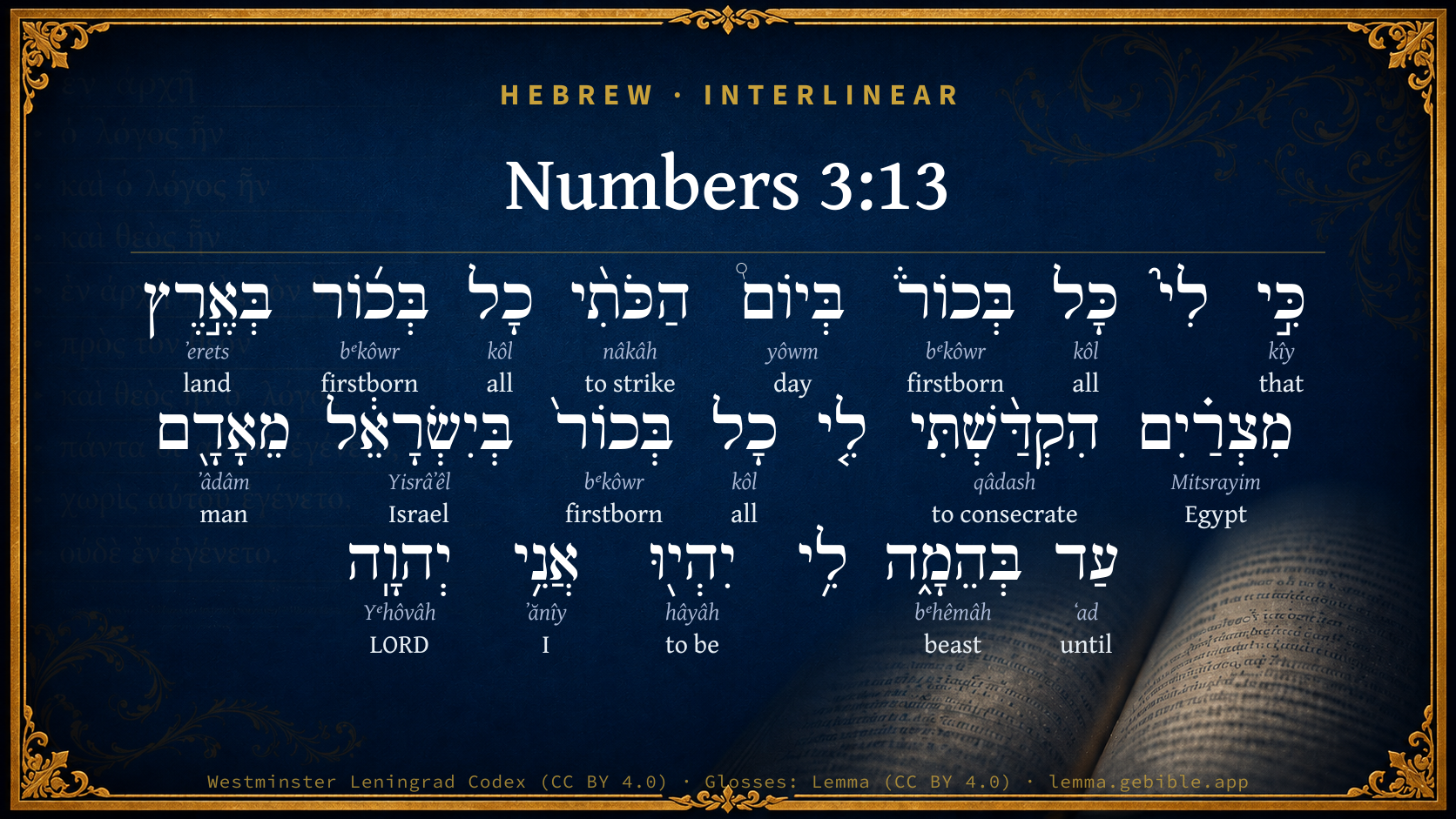
Hebrew (Westminster Leningrad Codex) Numbers 3:13 appears in the Hebrew Old Testament. The text above is from the Westminster Leningrad Codex. Each word links to its Strong’s number, a concise gloss, and parsing drawn from the Open Scriptures Hebrew Bible morphology. Click any word for its full Brown-Driver-Briggs (BDB) entry.
Download image
Cite this verse

Numbers 3:13 (World English Bible). Public Domain. Lemma interlinear Bible study tool, https://lemma.gebible.app/v/numbers/3/13.

Show BibTeX & RIS
BibTeX
RIS
English Translation
for all the firstborn are mine. On the day that I struck down all the firstborn in the land of Egypt I made holy to me all the firstborn in Israel, both man and animal. They shall be mine. I am Yahweh."
World English Bible · Public Domain
Download a study sheet

One document with this verse’s original text, its word-by-word gloss line, the meaning frame, cross-references with their text, attributed commentary, and full source and license credits — printable, and it pastes into notes with its structure intact.

This verse Autodidact and up

Study sheet (.html) Plain text (.txt)

A passage Seminary Student

Up to 50 verses in one chapter. A passage sheet keeps up to 6 commentary sources and 12 cross-references per verse, in the order this page ranks them, and says so on the sheet whenever that leaves anything out. Ask for a single verse and you get the Autodidact verse sheet above.

Everything on this page stays free to read, with no account — the sheet is a download of what is already on screen, not access to it.

Want to remove ads? Support Godless Engineer
Compare translations 3

The same verse in 3 English versions, stacked beneath the original-language interlinear above. Click any original word for its lexicon entry.

Each is an independent rendering of the whole verse — the interlinear is not word-aligned to these translations.

Highlighted words mark where these versions differ — a whole-verse word diff, not a word-by-word alignment.

  • World English Bible Public Domain
    for all the firstborn are mine. On the day that I struck down all the firstborn in the land of Egypt I made holy to me all the firstborn in Israel, both man and animal. They shall be mine. I am Yahweh."
  • King James Version Public Domain
    Because all the firstborn are mine; for on the day that I smote all the firstborn in the land of Egypt I hallowed unto me all the firstborn in Israel, both man and beast: mine shall they be: I am the LORD.
  • unfoldingWord Literal Text CC BY-SA 4.0
    for every firstborn for me. On the day of my striking down every firstborn in the land of Egypt, I consecrated for me every firstborn in Israel, from man up to animal. They are for me. I am Yahweh.”

unfoldingWord Literal Text — © unfoldingWord, licensed CC BY-SA 4.0. Word-aligned USFM3 via Door43 (git.door43.org/unfoldingWord/en_ult).

Versions to compare (up to 4)

3 of 4 selected

Show all 18 translations

Every available English version of this verse, each an independent rendering of the whole verse.

  • World English Bible Public Domain
    for all the firstborn are mine. On the day that I struck down all the firstborn in the land of Egypt I made holy to me all the firstborn in Israel, both man and animal. They shall be mine. I am Yahweh."
  • Berean Standard Bible Public Domain
    for all the firstborn are Mine. On the day I struck down every firstborn in the land of Egypt, I consecrated to Myself all the firstborn in Israel, both man and beast. They are Mine; I am the LORD.”
  • Majority Standard Bible Public Domain
    for all the firstborn are Mine. On the day I struck down every firstborn in the land of Egypt, I consecrated to Myself all the firstborn in Israel, both man and beast. They are Mine; I am the LORD.”
  • King James Version Public Domain
    Because all the firstborn are mine; for on the day that I smote all the firstborn in the land of Egypt I hallowed unto me all the firstborn in Israel, both man and beast: mine shall they be: I am the LORD.
  • American Standard Version (1901) Public Domain
    for all the first-born are mine; on the day that I smote all the first-born in the land of Egypt I hallowed unto me all the first-born in Israel, both man and beast; mine they shall be: I am Jehovah.
  • Revised Version (1885) Public Domain
    for all the firstborn are mine; on the day that I smote all the firstborn in the land of Egypt I hallowed unto me all the firstborn in Israel, both man and beast: mine they shall be; I am the LORD.
  • Geneva Bible (1599) Public Domain
    Because all the first borne are mine: for the same day, that I smote all the first borne in the land of Egypt, I sanctified vnto me all the first borne in Israel, both man and beast: mine they shalbe: I am the Lord.
  • Douay-Rheims (1899) Public Domain
    For every firstborn is mine: since I struck the firstborn in the land of Egypt: I have sanctified to myself whatsoever is firstborn in Israel both of man and beast, they are mine: I am the Lord.
  • Young's Literal Translation Public Domain
    for Mine `is' every first-born, in the day of My smiting every first-born in the land of Egypt I have sanctified to Myself every first-born in Israel, from man unto beast; Mine they are; I `am' Jehovah.'
  • Literal Standard Version CC BY-SA 4.0
    for every firstborn [is] Mine, in the day of My striking every firstborn in the land of Egypt I have sanctified to Myself every firstborn in Israel, from man to beast; they are Mine; I [am] YHWH.”
  • Unlocked Literal Bible CC BY-SA 4.0
    All the firstborn belong to me. On the day that I attacked all the firstborn in the land of Egypt, I set apart for myself all the firstborn in Israel, both people and animals. They belong to me. I am Yahweh.”
  • unfoldingWord Literal Text CC BY-SA 4.0
    for every firstborn for me. On the day of my striking down every firstborn in the land of Egypt, I consecrated for me every firstborn in Israel, from man up to animal. They are for me. I am Yahweh.”
  • Darby Bible Public Domain
    for every firstborn is mine. On the day that I smote all the firstborn in the land of Egypt, I hallowed unto me all the firstborn in Israel, both of man and beast; mine shall they be: I am Jehovah.
  • World Messianic Bible Public Domain
    for all the firstborn are mine. On the day that I struck down all the firstborn in the land of Egypt I made holy to me all the firstborn in Israel, both man and animal. They shall be mine. I am the LORD.”
  • Webster's Bible Public Domain
    Because all the first-born are mine; for on the day that I smote all the first-born in the land of Egypt, I hallowed to me all the first-born in Israel, both man and beast: mine they shall be: I am the LORD.
  • Free Bible Version CC BY-SA 4.0
    because all the firstborn are mine. When I killed every firstborn in Egypt I set apart as holy to me all the firstborn of Israel, human and animal. They are mine. I am the Lord.”
  • Bible in Basic English Public Domain
    For all the first sons are mine; on the day when I put to death all the first sons in the land of Egypt, I took for myself every first male birth of man and beast. They are mine; I am the Lord.
  • JPS Tanakh (1917) Public Domain
    for all the first-born are Mine: on the day that I smote all the first-born in the land of Egypt I hallowed unto Me all the first-born in Israel, both man and beast, Mine they shall be: I am the LORD.'

Literal Standard Version (2020), Covenant Press — licensed CC BY-SA 4.0. Text via the HelloAO Bible API (eBible.org). Unlocked Literal Bible (unfoldingWord) — licensed CC BY-SA 4.0. Text via the HelloAO Bible API (eBible.org). unfoldingWord Literal Text — © unfoldingWord, licensed CC BY-SA 4.0. Word-aligned USFM3 via Door43 (git.door43.org/unfoldingWord/en_ult). Free Bible Version, Dr. Jonathan Gallagher — licensed CC BY-SA 4.0. Text via the HelloAO Bible API (eBible.org).

Word by word

More ways to search: Search by grammar → Find every occurrence → Compare this word →

Practice this passage: Drill this verse → Learn its vocabulary →

בְּכוֹר֒
bᵉkôwr
H1060
“firstborn”
Noun, Common, Masculine, Singular, Absolute
Part of Speech
Noun
Type
Common
Gender
Masculine
Number
Singular
State
Absolute
Full BDB Definition

Origin: from H1069

TWOT: 244a

firstborn, firstling - of men and women - of animals - noun of relation (figuratively)
  1. כִּ֣י kîy H3588 “that” Conjunction
  2. כָּל kôl H3605 “all of” Noun, Common, Masculine, Singular, Construct
  3. בְּיוֹם֩ yôwm H3117 “in/at · day of” Preposition + Noun, Common, Masculine, Singular, Construct
  4. הַכֹּתִ֨י nâkâh H5221 “to strike · me” Verb, Hiphil, Infinitive Construct + Suffix, Personal, 1st Person, Common, Singular
  5. כָל kôl H3605 “all of” Noun, Common, Masculine, Singular, Construct
  6. בְּכ֜וֹר bᵉkôwr H1060 “firstborn” Noun, Common, Masculine, Singular, Absolute
  7. בְּאֶ֣רֶץ ʼerets H776 “in/at · land of” Preposition + Noun, Common, Both, Singular, Construct
  8. מִצְרַ֗יִם Mitsrayim H4714 “Egypt” Noun, Proper
  9. הִקְדַּ֨שְׁתִּי qâdash H6942 “to consecrate” Verb, Hiphil, Perfect, 1st Person, Common, Singular
  10. כָל kôl H3605 “all of” Noun, Common, Masculine, Singular, Construct
  11. בְּכוֹר֙ bᵉkôwr H1060 “firstborn” Noun, Common, Masculine, Singular, Absolute
  12. בְּיִשְׂרָאֵ֔ל Yisrâʼêl H3478 “in/at · Israel” Preposition + Noun, Proper
  13. מֵאָדָ֖ם ʼâdâm H120 “from · man” Preposition + Noun, Common, Masculine, Singular, Absolute
  14. עַד ʻad H5704 “until” Preposition
  15. בְּהֵמָ֑ה bᵉhêmâh H929 “beast” Noun, Common, Feminine, Singular, Absolute
  16. יִהְי֖וּ hâyâh H1961 “to be” Verb, Qal, Imperfect, 3rd Person, Masculine, Plural
  17. אֲנִ֥י ʼănîy H589 “I” Pronoun, Personal, 1st Person, Common, Singular
  18. יְהוָֽה Yᵉhôvâh H3068 “LORD” Noun, Proper

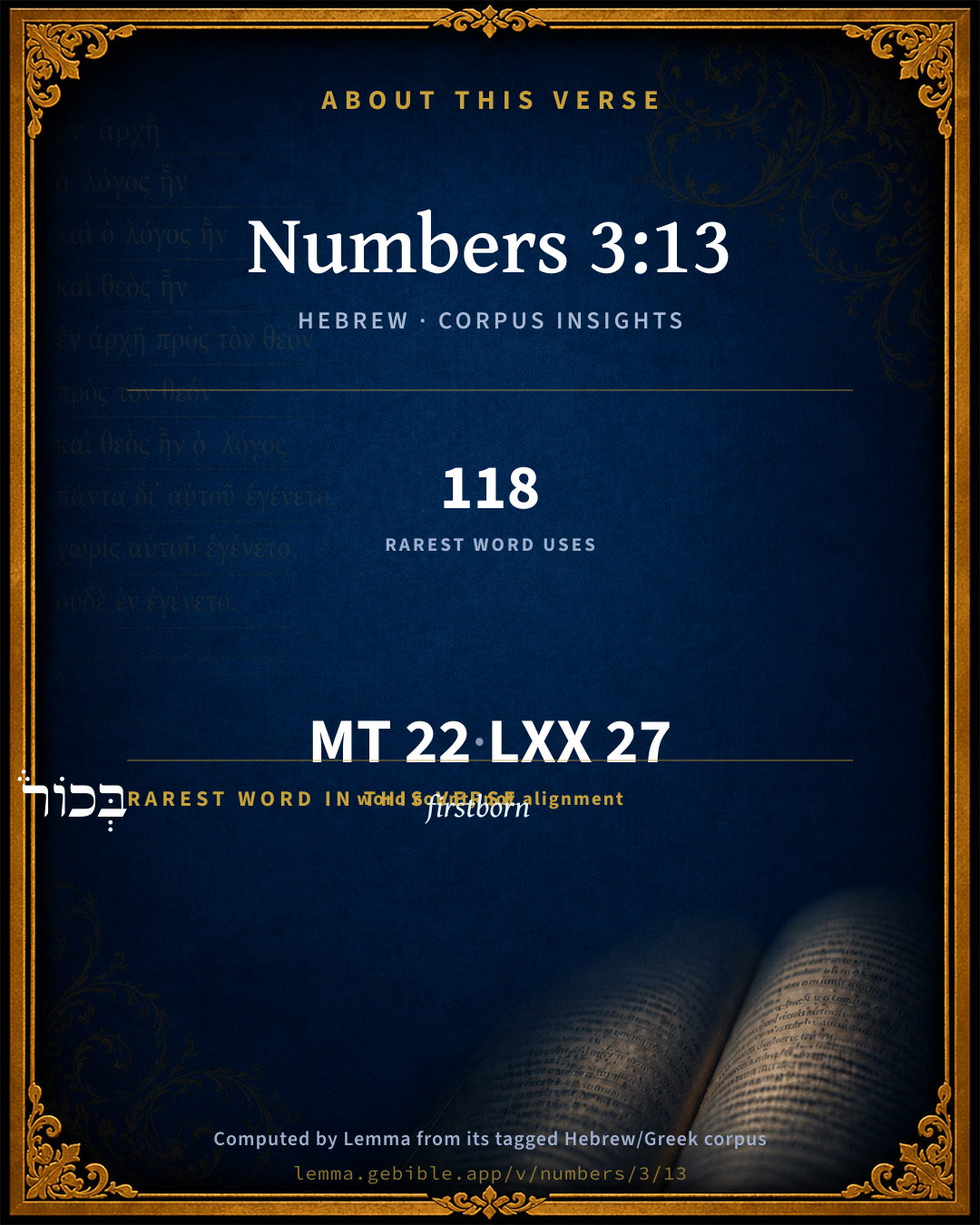
About this verse

These counts appear in no published source. They are computed here, from the morphology-tagged text and Lemma’s own curated glosses. What Lemma adds →

22
words
15
distinct lemmas
Pentateuch
section

Grammatical profile

  • 3 verbs
  • 13 nouns
  • 1 pronoun
  • 4 prepositions
  • 1 conjunction

Verb forms

  • הַכֹּתִ֨י Hiphil · Infinitive Construct
  • הִקְדַּ֨שְׁתִּי Hiphil · Perfect
  • יִהְי֖וּ Qal · Imperfect

Repetition

Words recur within this verse — often emphatic in Hebrew:

  • כָּל all H3605 ×3
  • בְּכוֹר֒ firstborn H1060 ×3

Hebrew & Septuagint length

In English translation the verse runs 42 words from the Hebrew and 40 from the Septuagint (LXX English) — closely comparable.

A rough comparison of the two English renderings, which tokenize alike — not a word-level alignment.

Word counts can differ between the Hebrew and the Greek without any difference in meaning — e.g. the Hebrew direct-object marker אֵת has no separate Greek word, and Greek often adds the article ὁ.

In the original languages it is 22 Hebrew tokens and 27 Greek tokens — but the two are counted differently (Hebrew bundles its prefixes and suffixes into one token; the Greek is in lemma form), so that isn’t a like-for-like length.

Cross-references

12

Topical passages linked to Numbers 3:13 in the Treasury of Scripture Knowledge — connected by theme and wording, ordered by reader-vote popularity; previews shown in the World English Bible.

  • Exodus 13:12 that you shall set apart to Yahweh all that opens the womb, and every firstborn which you have that comes from an animal. The males shall be Yahweh's.
  • Luke 2:23 (as it is written in the law of the Lord, "Every male who opens the womb shall be called holy to the Lord"),
  • Exodus 13:2 "Sanctify to me all of the firstborn, whatever opens the womb among the children of Israel, both of man and of animal. It is mine."
  • Exodus 13:15 and it happened, when Pharaoh would hardly let us go, that Yahweh killed all the firstborn in the land of Egypt, both the firstborn of man, and the firstborn of animal. Therefore I sacrifice to Yahweh all that opens the womb, being males; but all the firstborn of my sons I redeem.'
  • Leviticus 27:26 "'Only the firstborn among animals, which is made a firstborn to Yahweh, no man may dedicate it; whether an ox or sheep, it is Yahweh's.
  • Exodus 12:29–30 It happened at midnight, that Yahweh struck all the firstborn in the land of Egypt, from the firstborn of Pharaoh who sat on his throne to the firstborn of the captive who was in the dungeon; and all the firstborn of cattle.
  • Exodus 22:29 "You shall not delay to offer from your harvest and from the outflow of your presses. "You shall give the firstborn of your sons to me.
  • Exodus 34:19 All that opens the womb is mine; and all your cattle that is male, the firstborn of cow and sheep.
  • Numbers 8:16–17 For they are wholly given to me from among the children of Israel; instead of all who open the womb, even the firstborn of all the children of Israel, I have taken them to me.
  • Numbers 18:15 Everything that opens the womb, of all flesh which they offer to Yahweh, both of man and animal shall be yours: nevertheless the firstborn of man shall you surely redeem, and the firstborn of unclean animals shall you redeem.
  • Ezekiel 44:30 The first of all the first fruits of every thing, and every offering of everything, of all your offerings, shall be for the priest: you shall also give to the priests the first of your dough, to cause a blessing to rest on your house.
  • Hebrews 12:23 to the general assembly and assembly of the firstborn who are enrolled in heaven, to God the Judge of all, to the spirits of just men made perfect,

Cross-references courtesy of OpenBible.info (CC BY 4.0).

Hebrew and Greek witnesses Masoretic Hebrew ↔ Greek Septuagint

The same verse in the two great witnesses to the Old Testament, shown verse-for-verse.

These are two independent witnesses, not word-aligned to each other, and the Septuagint is shown in lemma (dictionary) form.

Hebrew Numbers 3:13 Masoretic · Westminster Leningrad Codex

כִּ֣י לִי֮ כָּל בְּכוֹר֒ בְּיוֹם֩ הַכֹּתִ֨י כָל בְּכ֜וֹר בְּאֶ֣רֶץ מִצְרַ֗יִם הִקְדַּ֨שְׁתִּי לִ֤י כָל בְּכוֹר֙ בְּיִשְׂרָאֵ֔ל מֵאָדָ֖ם עַד בְּהֵמָ֑ה לִ֥י יִהְי֖וּ אֲנִ֥י יְהוָֽה

for all the firstborn are mine. On the day that I struck down all the firstborn in the land of Egypt I made holy to me all the firstborn in Israel, both man and animal. They shall be mine. I am Yahweh."

World English Bible · Public Domain

Greek LXX Numbers 3:13 Septuagint · lemma form

ἐγώ γάρ πᾶς πρωτότοκος ἐν ὅς ἡμέρα πατάσσω πᾶς πρωτότοκος ἐν γῆ αἴγυπτος ἁγιάζω ἐγώ πᾶς πρωτότοκος ἐν ἰσραήλ ἀπό ἄνθρωπος ἕως κτῆνος ἐγώ εἰμί ἐγώ κύριος

For every firstborn is mine; in the day in which I struck every firstborn in the land of Egypt, I sanctified to myself every firstborn in Israel: both of man and beast, they shall be mine: I am the Lord.

LXX2012 (modern English Septuagint) · Public Domain

Hebrew: Westminster Leningrad Codex (CC BY 4.0). Greek: Septuagint (public domain); English from LXX2012 (modern English Septuagint) (Public Domain). How the Septuagint differs from the Hebrew →

Targum (Aramaic paraphrase)

2

The Targum is the ancient Jewish Aramaic paraphrase of the Hebrew Scriptures — an interpretive translation, not the Hebrew text itself. Onkelos (literal) and Pseudo-Jonathan (expansive) render the Torah, and Jonathan the Prophets. Coverage is partial: where no permissively-licensed English translation exists for a verse, only the Aramaic is shown. This is verse-level text, not a word-by-word alignment to the Hebrew.

  1. Targum Onkelos Torah (Genesis–Deuteronomy)
    אֲרֵי דִילִי כָּל בּוּכְרָא בְּיוֹמָא דִקְטָלִית כָּל בּוּכְרָא בְּאַרְעָא דְמִצְרַיִם אַקְדֵשִׁית קֳדָמַי כָּל בּוּכְרָא בְּיִשְׂרָאֵל מֵאֱנָשָׁא עַד בְּעִירָא דִילִי יְהוֹן אֲנָא יְיָ

    (no public-domain English translation for this verse)

    Targum Onkelos — Aramaic: “Onkelos Genesis” (public domain); “Onkelos Exodus” (public domain); “Onkelos Leviticus” (public domain); “Onkelos Numbers” (public domain); “Onkelos Deuteronomy” (public domain). English: “Sefaria Community Translation” (CC0 1.0 (public-domain dedication)); “J.W. Etheridge. The Targums of Onkelos and Jonathan Ben Uzziel on the Pentateuch. London: Longmans, Green, 1862” (public domain). Text via Sefaria.

  2. Targum Pseudo-Jonathan Torah (Genesis–Deuteronomy)
    אֲרוּם דִילִי כָּל בּוּכְרָא בִּבְנֵי יִשְרָאֵל בְּיוֹמָא דִקְטָלִית כָּל בּוּכְרָא בְּאַרְעָא דְמִצְרַיִם אַקְדֵישִׁית קֳדָמַי כָּל בּוּכְרָא בְּיִשְרָאֵל מֵאֵינָשָׁא עַד בְּעִירָא דִילִי יְהוֹן אֲנָא יְיָ

    For every first-born among the sons of Israel is Mine, from the day when. I slew every first-born in the land of Mizraim; I have sanctified before Me every first-born in Israel; from man to animal, they are Mine: I am the Lord.

    Targum Pseudo-Jonathan — Aramaic: “Targum Jonathan on Genesis” (public domain); “Targum Jonathan on Exodus” (public domain); “Targum Jonathan on Leviticus” (public domain); “Targum Jonathan on Numbers” (public domain); “Targum Jonathan on Deuteronomy” (public domain). English: “The Targum of Jonathan ben Uzziel, trans. J. W. Etheridge, London, 1862” (public domain). Text via Sefaria.

Commentary

Notes on Numbers 3:13 from classic Christian and Jewish commentators (each source and its license shown beneath its notes). The classic Christian expositions comment on the surrounding passage and are grouped to its opening verse, so a note may address several verses; the Jewish commentaries on the Tanakh (Rashi and others) are per-verse, so they appear only where the commentator wrote on this verse.

Lemma curates 59 commentaries, every one of them public domain or Creative Commons licensed, each selected and text-cleaned for this edition rather than reprinted as found. About our sources →

Trapp's Complete Commentary

John Trapp

Num 3:13 Because all the firstborn [are] mine; [for] on the day that I smote all the firstborn in the land of Egypt I hallowed unto me all the firstborn in Israel, both man and beast: mine shall they be: I [am] the LORD.

Ver. 13. Because all the firstborn.] So they were from the beginning: but here is noted a continuance of this ordinance, when it is said that he sanctified the first born to himself, what time he smote every firstborn in Egypt. Now the firstborn are said to be God’s by a singular right, {Exo 13:2} and so they were types, (1.) Of Christ, {Rom 8:29} to whom therefore we must give the honour of his first birthright; all our sheaves must vail and bow to his sheaf: (2.) Of Christians; those "firstborn whose names are written in heaven," {Heb 12:23} who are dear to God, as his firstborn, {Exo 4:22} and so "higher than the kings of the earth," {Psa 89:27} for they are "kings and priests unto God," {Rev 1:6} to "serve him day and night in his temple." {Rev 7:15}

John Trapp, A Commentary or Exposition upon All the Books of the Old and New Testament (1647–1656) — public domain. Text from a community e-Sword module.

Ellicott's Commentary for English Readers

(13) On the day that I smote all the firstborn.—The command given to Moses respecting the sanctification or separation of the firstborn, both of man and of beast, is recorded immediately after the account of the exodus and of the institution of the Passover (Exo_13:1-2). It does not clearly appear, however, from the terms employed whether the sanctification or separation applied to the firstborn then in existence—which appears to be by far the more probable supposition—or whether, as some suppose, the command was simply prospective. The whole nation of Israel is described in Exo_4:22 as the Lord’s firstborn son, and the firstborn sons appear to have been regarded in the light of representatives of the entire nation.

Mine shall they be: I am the Lord.—Or, They shall be (i.e., belong) to me, (even) to me, Jehovah. (Comp. Gen_4:26 : “And to Seth, to him also.” Literally, And to Seth, even him.)

A Bible Commentary for English Readers, edited by Charles John Ellicott (1878–1897) — public domain. Text from a community e-Sword module.

The Cambridge Bible for Schools and Colleges

gen. ed. J. J. S. Perowne

13. on the day, &c.] A reference to Exo_13:1 f. (P ).

I am Jehovah] A solemn formula emphasizing the importance of a command or statement. It occurs occasionally in P (i.e. Num_3:41, Exo_6:8; Exo_12:12), but is specially characteristic of the ‘Holiness’ laws in Leviticus 17-26. See Chapman, Introd. p. 112.

The Cambridge Bible for Schools and Colleges (gen. ed. J. J. S. Perowne; Cambridge University Press, 1878–1918) — public domain. Text from a community e-Sword module.

John Gill's Exposition

Because all the firstborn are mine,.... Not merely in a general way, as all creatures are his, but in a special manner as his own, and that for the following reason:

for on the day that I smote all the firstborn in the land of Egypt,

I hallowed unto me all the firstborn in Israel, both man and beast; that is, sanctified or set them apart as his own special property, or ordered the people of Israel so to do, Exo 13:2; for as when he destroyed the firstborn of the Egyptians, he saved the firstborn of Israel, he had a special claim upon them as his; and though it was in the night when he destroyed the firstborn of Egypt, yet it was the night which preceded that day, and was a part of that day, even the fifteenth of Nisan, when the instructions were given to sanctify all the firstborn; though, as Aben Ezra observes, "day" signifies "time", so that it was at or about the same time that the one and the other were done:

mine they shall be; this was declared when they were ordered to be sanctified to him, but now they were to be exchanged for the Levites:

I am the Lord; who have sovereign power to do as he would in claiming the firstborn, and then in exchanging them for the Levites, and appointing the Levites to minister to the priests, and serve in the tabernacle.

John Gill's Exposition of the Whole Bible (1746–1763) — public domain (CC PDM 1.0). Text via the HelloAO Bible API.

Albert Barnes' Notes on the Bible

The concluding words are better expressed thus: “Mine shall they be, Mine, the Lord’s.” On the subject of the firstborn see the notes at Num 3:43-51.

Albert Barnes' Notes on the Bible (1834–1885) — public domain. Text from a community e-Sword/MySword module.

Matthew Poole's English Annotations

Who may appoint whom I please for my service.

Matthew Poole's English Annotations on the Holy Bible (1683–1685) — public domain. Text from a community e-Sword/MySword module.

Whedon's Commentary on the Bible

Daniel D. Whedon

13. All the firstborn are mine — This is a claim founded on the sovereignty of Jehovah, as is seen by the declaration, I am the Lord. As he had chosen Israel to be his firstborn (Exo_4:22, note) by a sovereign national election to certain earthly privileges — not to life everlasting — so he exercised the prerogative of selecting a certain class in Israel to be devoted to his especial service. The intimation in this verse is, that the firstborn were saved from the destroyer because they were set apart or hallowed into Jehovah, and not that they were hallowed because they were spared. Hallowed — Hebrew, kadash; Greek, αγιαζω; Vulgate, sanctifico. The two senses of these words are: — 1.) To set apart from secular to holy uses. 2.) To cleanse, to purify: of things, a physical cleansing; of persons, a spiritual as well as a physical purification is signified. When the Levites took the place of the firstborn they were not only set apart, but they were washed also. See Num_8:6-7. Hence the figures of the physical and spiritual cleansing from all filthiness of the flesh and spirit enjoined by St. Paul in 2Co_7:1, and by James in Num_4:8. “Hallowed,” in this verse, signifies set apart. The firstborn were never ceremonially washed and initiated into the service of the tabernacle, because of the almost immediate substitution of the Levites.

Daniel D. Whedon (gen. ed.), Commentary on the Old and New Testaments (1874–1909) — public domain. Text from a community e-Sword module.

The Pulpit Commentary

Because all the first-born are mine. (see Exo_13:2, and below on verse 43) That the powers of heaven had a special claim upon the firstling of man or beast was probably one of the oldest religious ideas in the world, which it would be difficult to trace to any origin but in some primeval revelation. It branched out into many superstitions, of which the cruel cultus of Moloch was the worst. Among the tribes which preserved the patriarchal faith, it retained more or less of its primitive meaning in the assignment of sacrificial duties to the eldest son. According to the Targums, the "young men of the children of Israel" sent by Moses to offer sacrifices before the consecration of Aaron (Exo_24:5) were firstborn. Whatever ancient and latent claims, however, God may have had upon the firstborn of Israel, they are here superseded by a special and recent claim founded upon their miraculous preservation when the firstborn of the Egyptians were slain. All the firstborn in that day became "anathema," devoted to God, for evil or for good, for death or for life. He, to whom belongs the whole harvest of human souls, came and claimed his first-fruits from the fields of Egypt. He took unto himself by death the firstborn of the Egyptians; he left for himself in life the first-born of the Israelites. For the convenience, however, of the people, and for the better and more regular discharge of the ministry, he was content to take the single small tribe of Levi in lieu of the first-born of all.

Mine shall they be: I am the Lord. Rather, "mine shall they be, mine, the Lord"s."

The Pulpit Commentary (1880–1919), ed. H.D.M. Spence-Jones & Joseph S. Exell — public domain. Text from a community e-Sword module.

Lesson kit

Teaching starters — assembled from the data on this page, not authored interpretation. Every prompt links to the verse data it draws on. Edit before teaching.

Numbers, in the Pentateuch, opens this verse with 22 words (15 distinct Hebrew lemmas). Its most distinctive word is bᵉkôwr (“firstborn”). A historical commentator’s framing appears above. Read the whole chapter for the surrounding context.

Discussion questions

  1. What does “firstborn” (bᵉkôwr) contribute to the verse as a whole?
  2. How does Exodus 13:12, which shares this passage’s theme, read alongside this verse?
  3. What does the repetition of “all” (3× in this one verse) do in this verse?
  4. The translations on this page render this verse differently — a whole-verse word diff, not a word-by-word alignment. What might account for the different wordings?
  5. «הַכֹּתִ֨י» is a Hiphil Infinitive Construct verb. How does that grammatical form shape the action described?
  6. Compare how Trapp's Complete Commentary and Ellicott's Commentary for English Readers read this verse. Where do they agree or differ?

Things to notice

Reading settings

Reading text

Shown beneath each verse's original-language words.

Old Testament
Old Testament edition

Read the OT as the Masoretic Hebrew (MT) or the Greek Septuagint (LXX).

English shown for the Greek Septuagint (in the Hebrew ↔ Greek comparison).

Comparing translations? Open the Compare panel on any verse page to stack up to four side by side.