
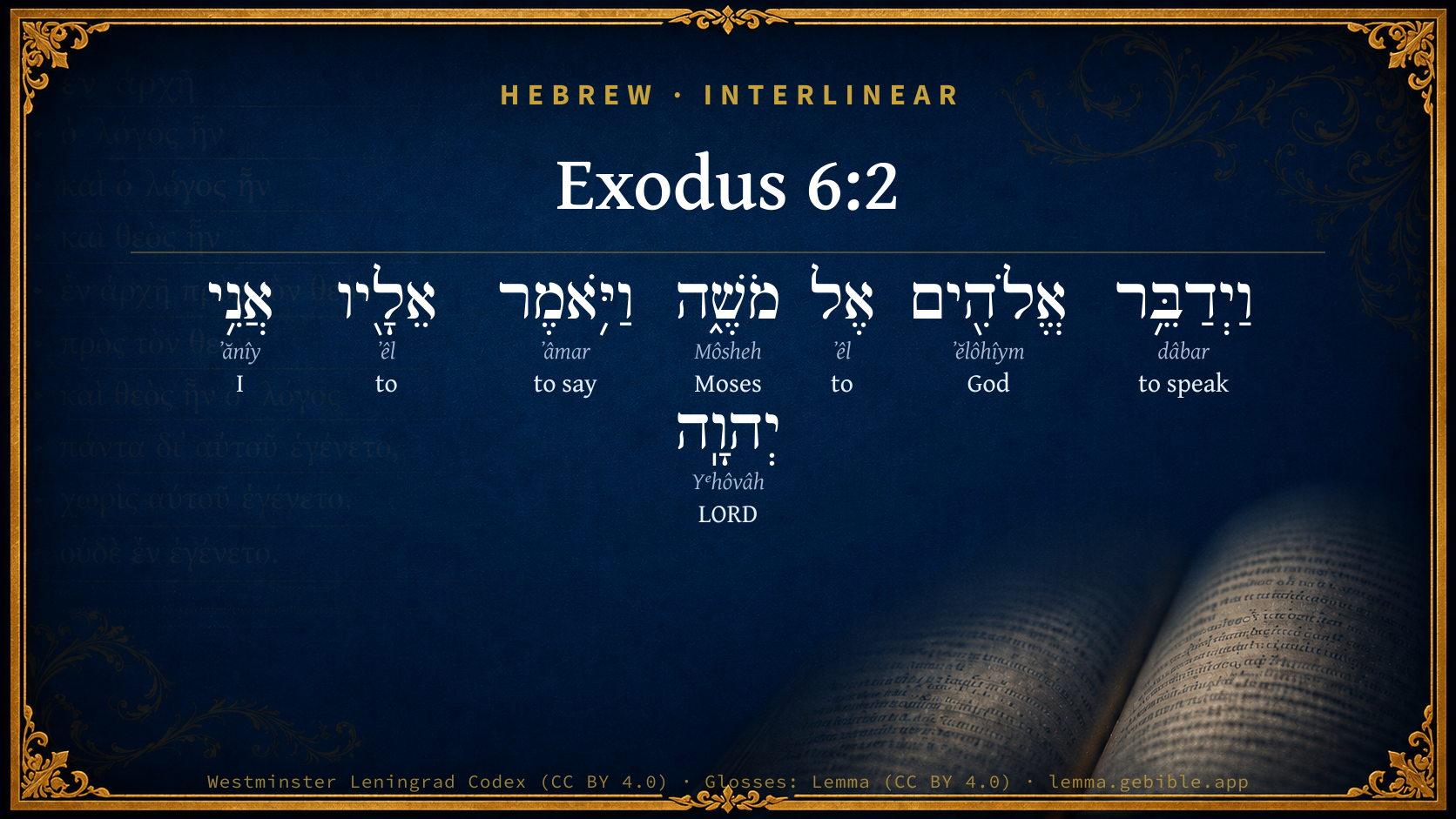
Exodus 6:2

Hebrew (Westminster Leningrad Codex) Exodus 6:2 appears in the Hebrew Old Testament. The text above is from the Westminster Leningrad Codex. Each word links to its Strong’s number, a concise gloss, and parsing drawn from the Open Scriptures Hebrew Bible morphology. Click any word for its full Brown-Driver-Briggs (BDB) entry.
Download image
Cite this verse

Exodus 6:2 (World English Bible). Public Domain. Lemma interlinear Bible study tool, https://lemma.gebible.app/v/exodus/6/2.

Show BibTeX & RIS
BibTeX
RIS
English Translation
God spoke to Moses, and said to him, "I am Yahweh;
World English Bible · Public Domain
Download a study sheet

One document with this verse’s original text, its word-by-word gloss line, the meaning frame, cross-references with their text, attributed commentary, and full source and license credits — printable, and it pastes into notes with its structure intact.

This verse Autodidact and up

Study sheet (.html) Plain text (.txt)

A passage Seminary Student

Up to 50 verses in one chapter. A passage sheet keeps up to 6 commentary sources and 12 cross-references per verse, in the order this page ranks them, and says so on the sheet whenever that leaves anything out. Ask for a single verse and you get the Autodidact verse sheet above.

Everything on this page stays free to read, with no account — the sheet is a download of what is already on screen, not access to it.

Want to remove ads? Support Godless Engineer
Compare translations 3

The same verse in 3 English versions, stacked beneath the original-language interlinear above. Click any original word for its lexicon entry.

Each is an independent rendering of the whole verse — the interlinear is not word-aligned to these translations.

Highlighted words mark where these versions differ — a whole-verse word diff, not a word-by-word alignment.

  • World English Bible Public Domain
    God spoke to Moses, and said to him, "I am Yahweh;
  • King James Version Public Domain
    And God spake unto Moses, and said unto him, I am the LORD:
  • unfoldingWord Literal Text CC BY-SA 4.0
    And God spoke to Moses, and said to him, “I am Yahweh

unfoldingWord Literal Text — © unfoldingWord, licensed CC BY-SA 4.0. Word-aligned USFM3 via Door43 (git.door43.org/unfoldingWord/en_ult).

Versions to compare (up to 4)

3 of 4 selected

Show all 18 translations

Every available English version of this verse, each an independent rendering of the whole verse.

  • World English Bible Public Domain
    God spoke to Moses, and said to him, "I am Yahweh;
  • Berean Standard Bible Public Domain
    God also told Moses, “I am the LORD.
  • Majority Standard Bible Public Domain
    God also told Moses, “I am the LORD.
  • King James Version Public Domain
    And God spake unto Moses, and said unto him, I am the LORD:
  • American Standard Version (1901) Public Domain
    And God spake unto Moses, and said unto him, I am Jehovah:
  • Revised Version (1885) Public Domain
    And God spake unto Moses, and said unto him, I am JEHOVAH:
  • Geneva Bible (1599) Public Domain
    Moreouer God spake vnto Moses, and sayd vnto him, I am the Lord,
  • Douay-Rheims (1899) Public Domain
    And the Lord spoke to Moses, saying: I am the Lord,
  • Young's Literal Translation Public Domain
    And God speaketh unto Moses, and saith unto him, `I `am' Jehovah,
  • Literal Standard Version CC BY-SA 4.0
    And God speaks to Moses and says to him, “I [am] YHWH,
  • Unlocked Literal Bible CC BY-SA 4.0
    God spoke to Moses and said to him, “I am Yahweh.
  • unfoldingWord Literal Text CC BY-SA 4.0
    And God spoke to Moses, and said to him, “I am Yahweh
  • Darby Bible Public Domain
    And God spoke to Moses, and said to him, I am Jehovah.
  • World Messianic Bible Public Domain
    God spoke to Moses, and said to him, “I am the LORD.
  • Webster's Bible Public Domain
    And God spoke to Moses, and said to him, I am the LORD:
  • Free Bible Version CC BY-SA 4.0
    God spoke to Moses and told him, “I am Yahweh!
  • Bible in Basic English Public Domain
    And God said to Moses, I am Yahweh:
  • JPS Tanakh (1917) Public Domain
    And God spoke unto Moses, and said unto him: 'I am the LORD;

Literal Standard Version (2020), Covenant Press — licensed CC BY-SA 4.0. Text via the HelloAO Bible API (eBible.org). Unlocked Literal Bible (unfoldingWord) — licensed CC BY-SA 4.0. Text via the HelloAO Bible API (eBible.org). unfoldingWord Literal Text — © unfoldingWord, licensed CC BY-SA 4.0. Word-aligned USFM3 via Door43 (git.door43.org/unfoldingWord/en_ult). Free Bible Version, Dr. Jonathan Gallagher — licensed CC BY-SA 4.0. Text via the HelloAO Bible API (eBible.org).

Word by word

More ways to search: Search by grammar → Find every occurrence → Compare this word →

Practice this passage: Drill this verse → Learn its vocabulary →

About this verse

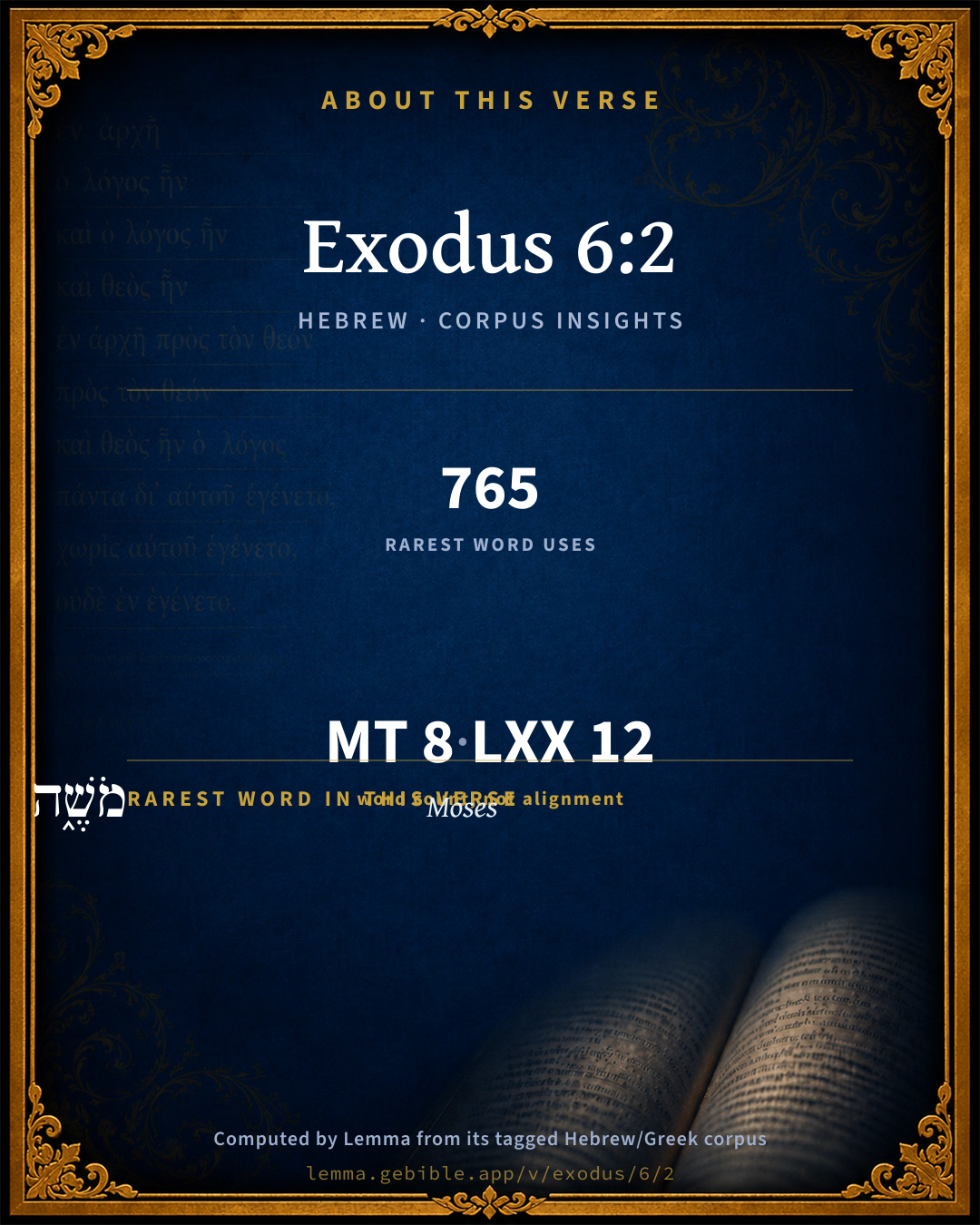
These counts appear in no published source. They are computed here, from the morphology-tagged text and Lemma’s own curated glosses. What Lemma adds →

8
words
7
distinct lemmas
Pentateuch
section

Grammatical profile

  • 2 verbs
  • 3 nouns
  • 1 pronoun
  • 2 prepositions

Verb forms

  • וַיְדַבֵּ֥ר Piel · Sequential Imperfect
  • וַיֹּ֥אמֶר Qal · Sequential Imperfect

Repetition

A word recurs within this verse — often emphatic in Hebrew:

  • אֶל to H413 ×2

Hebrew & Septuagint length

In English translation the verse runs 11 words from the Hebrew and 13 from the Septuagint (LXX English) — closely comparable.

A rough comparison of the two English renderings, which tokenize alike — not a word-level alignment.

Word counts can differ between the Hebrew and the Greek without any difference in meaning — e.g. the Hebrew direct-object marker אֵת has no separate Greek word, and Greek often adds the article ὁ.

In the original languages it is 8 Hebrew tokens and 12 Greek tokens — but the two are counted differently (Hebrew bundles its prefixes and suffixes into one token; the Greek is in lemma form), so that isn’t a like-for-like length.

Cross-references

13

Topical passages linked to Exodus 6:2 in the Treasury of Scripture Knowledge — connected by theme and wording, ordered by reader-vote popularity; previews shown in the World English Bible.

  • Isaiah 42:8 I am Yahweh, that is my name; and my glory will I not give to another, neither my praise to engraved images.
  • Jeremiah 9:24 but let him who glories glory in this, that he has understanding, and knows me, that I am Yahweh who exercises loving kindness, justice, and righteousness, in the earth: for in these things I delight, says Yahweh.
  • Malachi 3:6 "For I, Yahweh, don't change; therefore you, sons of Jacob, are not consumed.
  • Acts 17:24–25 The God who made the world and all things in it, he, being Lord of heaven and earth, doesn't dwell in temples made with hands,
  • Genesis 15:7 He said to him, "I am Yahweh who brought you out of Ur of the Chaldees, to give you this land to inherit it."
  • Exodus 6:6 Therefore tell the children of Israel, 'I am Yahweh, and I will bring you out from under the burdens of the Egyptians, and I will rid you out of their bondage, and I will redeem you with an outstretched arm, and with great judgments:
  • Exodus 6:8 I will bring you into the land which I swore to give to Abraham, to Isaac, and to Jacob; and I will give it to you for a heritage: I am Yahweh.'"
  • Exodus 14:18 The Egyptians shall know that I am Yahweh, when I have gotten myself honor over Pharaoh, over his chariots, and over his horsemen."
  • Exodus 17:1 All the congregation of the children of Israel traveled from the wilderness of Sin, by their journeys, according to Yahweh's commandment, and encamped in Rephidim; but there was no water for the people to drink.
  • Exodus 20:2 "I am Yahweh your God, who brought you out of the land of Egypt, out of the house of bondage.
  • Isaiah 43:11 I, even I, am Yahweh; and besides me there is no savior.
  • Isaiah 43:15 I am Yahweh, your Holy One, the Creator of Israel, your King.
  • Isaiah 44:6 Thus says Yahweh, the King of Israel, and his Redeemer, Yahweh of Hosts: I am the first, and I am the last; and besides me there is no God.

Cross-references courtesy of OpenBible.info (CC BY 4.0).

Hebrew and Greek witnesses Masoretic Hebrew ↔ Greek Septuagint

The same verse in the two great witnesses to the Old Testament, shown verse-for-verse.

These are two independent witnesses, not word-aligned to each other, and the Septuagint is shown in lemma (dictionary) form.

Hebrew Exodus 6:2 Masoretic · Westminster Leningrad Codex

וַיְדַבֵּ֥ר אֱלֹהִ֖ים אֶל מֹשֶׁ֑ה וַיֹּ֥אמֶר אֵלָ֖יו אֲנִ֥י יְהוָֽה

God spoke to Moses, and said to him, "I am Yahweh;

World English Bible · Public Domain

Greek LXX Exodus 6:2 Septuagint · lemma form

λαλέω δέ ὁ θεός πρός μωυσῆς καί εἶπον πρός αὐτός ἐγώ κύριος

And God spoke to Moses and said to him, I am the Lord.

LXX2012 (modern English Septuagint) · Public Domain

On this verse, The Cambridge Bible for Schools and Colleges discusses the Septuagint’s reading. Read the note in Commentary ↓

Hebrew: Westminster Leningrad Codex (CC BY 4.0). Greek: Septuagint (public domain); English from LXX2012 (modern English Septuagint) (Public Domain). How the Septuagint differs from the Hebrew →

Targum (Aramaic paraphrase)

2

The Targum is the ancient Jewish Aramaic paraphrase of the Hebrew Scriptures — an interpretive translation, not the Hebrew text itself. Onkelos (literal) and Pseudo-Jonathan (expansive) render the Torah, and Jonathan the Prophets. Coverage is partial: where no permissively-licensed English translation exists for a verse, only the Aramaic is shown. This is verse-level text, not a word-by-word alignment to the Hebrew.

  1. Targum Onkelos Torah (Genesis–Deuteronomy)
    וּמַלִיל יְיָ עִם משֶׁה וַאֲמַר לֵהּ אֲנָא יְיָ:

    (no public-domain English translation for this verse)

    Targum Onkelos — Aramaic: “Onkelos Genesis” (public domain); “Onkelos Exodus” (public domain); “Onkelos Leviticus” (public domain); “Onkelos Numbers” (public domain); “Onkelos Deuteronomy” (public domain). English: “Sefaria Community Translation” (CC0 1.0 (public-domain dedication)); “J.W. Etheridge. The Targums of Onkelos and Jonathan Ben Uzziel on the Pentateuch. London: Longmans, Green, 1862” (public domain). Text via Sefaria.

  2. Targum Pseudo-Jonathan Torah (Genesis–Deuteronomy)
    וידבר וּמַלֵיל יְיָ עִם משֶׁה וַאֲמַר לֵיהּ אֲנָא יְיָ הוּא דְאִתְגְלֵיתִי עֲלָךְ בְּגוֹ סַנְיָא וַאֲמָרִית לָךְ אֲנָא יְיָ

    AND the Lord spake with Mosheh, and said to him, I am the Lord who revealed Myself to thee in the midst of the bush, and said to thee, I am the Lord.

    Targum Pseudo-Jonathan — Aramaic: “Targum Jonathan on Genesis” (public domain); “Targum Jonathan on Exodus” (public domain); “Targum Jonathan on Leviticus” (public domain); “Targum Jonathan on Numbers” (public domain); “Targum Jonathan on Deuteronomy” (public domain). English: “The Targum of Jonathan ben Uzziel, trans. J. W. Etheridge, London, 1862” (public domain). Text via Sefaria.

Commentary

Notes on Exodus 6:2 from classic Christian and Jewish commentators (each source and its license shown beneath its notes). The classic Christian expositions comment on the surrounding passage and are grouped to its opening verse, so a note may address several verses; the Jewish commentaries on the Tanakh (Rashi and others) are per-verse, so they appear only where the commentator wrote on this verse.

Lemma curates 59 commentaries, every one of them public domain or Creative Commons licensed, each selected and text-cleaned for this edition rather than reprinted as found. About our sources →

Trapp's Complete Commentary

John Trapp

Exo 6:2 And God spake unto Moses, and said unto him, I [am] the LORD:

Ver. 2. I am Jehovah.] Aυταυτος (Scaliger’s {a} word); that do Press {b} (Gregory’s word); that have being of myself, give being to all things else, and in special to my promises, to "perform with my hand" what I have "spoken with my mouth"; {1Ki 8:15} only God expects that men put his promises in suit by their prayers, as here, and burden him with them, as that martyr said.

{a} Scalig., De Subtilit.

{b} [Sic. - ? Peresse; qui est per se.]

John Trapp, A Commentary or Exposition upon All the Books of the Old and New Testament (1647–1656) — public domain. Text from a community e-Sword module.

Albert Barnes' Notes on the Bible

There appears to have been an interval of some months between the preceding events and this renewal of the promise to Moses. The oppression in the meantime was not merely driving the people to desperation, but preparing them by severe labor, varied by hasty wanderings in search of stubble, for the exertions and privations of the wilderness. Hence, the formal and solemn character of the announcements in the whole chapter.

Exo 6:2

I am the Lord ... - The meaning seems to be this: “I am Jehovah (Yahweh), and I appeared to Abraham, Isaac, and Jacob as El Shaddai, but as to my name Jehovah, I was not made known to them.” In other words, the full import of that name was not disclosed to them. See Exo 3:14.

Exo 6:3

God Almighty - Rather, “El Shaddai,” (שׁדי אל 'êl shadday), it is better to keep this as a proper name.

Albert Barnes' Notes on the Bible (1834–1885) — public domain. Text from a community e-Sword/MySword module.

The Biblical Illustrator

Joseph S. Exell

Exo_6:2-3

I am the Lord.

Duty to Jehovah

Consider the meaning of our duty to God; the great truth that we have such a duty; and how it comes about that we have it.

I. Duty is something which is due from one to another: something which ought to be given, or ought to be done; not a thing which is given or done under compulsion, under the influence of fear, extorted by force, not even a free gift or offering; quite different from this; if a thing is a duty, it must be done because it is right to do it and wrong to omit it.

II. The words of the text are as it were, the sign manual whereby Almighty God, in His dealings with His ancient people the Children of Israel, claimed from them the performance of that duty which they owed to Him. The words which gave validity to an Israelitish law merely rehearsed the fact that He who gave the law was Jehovah; and nothing more was added, because nothing more remained to be said.

III. Notice the principles upon which our duty to God depends.

1. There is a relationship, a close vital connection between God and man, which does not exist between God and any other of His creatures; man is in a very high sense the Son of God, so that it is inconceivable that the true aims and purposes of God and man can be distinct. Man being made in Gods image, ought to do Gods will.

2. Our duty to God depends also on the ground of election. God deals with us now as with His Church in former days; it is still a Church of election. We, to whom God sends His commands, are still rightly described as redeemed out of the house of our bondage; and if the redemption of Israel out of Egypt be nothing better than the faintest type and shadow of the redemption of mankind out of the power of the devil, how much greater is the appeal which is made to us on the ground of ,that deliverance which Jesus Christ has wrought out. (Bp. Harvey Goodwin.)

The Biblical Illustrator, edited by Joseph S. Exell (c. 1880s–1900s) — public domain. Text from a community e-Sword module.

Joseph Benson's Commentary

Exo 6:2. I am the Lord — That is, Jehovah, on which word the emphasis is laid, and it is to be wished that it had been always preserved in this translation, and especially in such passages as this, the sense of which entirely depends on the word. It signifies the same with, I AM THAT I AM, the fountain of being and blessedness, and of infinite perfection. By my name Jehovah was I not known unto them — As it is certain that God declared himself to these patriarchs by the name Jehovah, as may be seen Gen 15:6-7; Gen 22:14; Gen 22:16, some of the best and most accurate writers conclude that the latter part of this verse ought to be read interrogatively, thus, And by my name Jehovah was I not known unto them? The original words will well bear this translation, and it would entirely remove that apparent contradiction which is implied in our version. At the same time it would greatly improve the sense and force of the passage. But if we do not read it in this manner, we must not understand it of the name itself, but of the power and virtue which the name expresses. And then the meaning of the passage will be, that though God had revealed himself to the patriarchs as the El-shaddai, the Almighty, or All-sufficient, yet they did not live to see the accomplishment of his promises; and therefore, though they believed, yet they did not experimentally know that he was a God of unchangeable truth; nor had they experienced that all the powers of nature were in his hand, and that he could change them as he pleased, and even communicate the power of doing so to man. But it was to Moses that God first showed his power of making alterations in nature, or working miracles and prodigies. What makes this sense of the passage probable is, that the knowing of Jehovah is spoken of in this way, Exo 7:5, And the Egyptians shall know that I am Jehovah, when I stretch forth my hand on Egypt. Thus, Henry observes, “The patriarchs knew this name, but they did know him in this matter by that which this name signifies.” God would now be known by his name Jehovah, that Isaiah , 1 st, A God performing what he had promised, and so giving being to his promises. 2d, A God perfecting what he had begun, and finishing his own work. In the history of the creation God is never called Jehovah till the heavens and the earth were finished, Gen 2:4. When the salvation of the saints is completed in eternal life, then he will be known by his name Jehovah, Rev 22:13; in the mean time they shall find him for their strength and support, El-shaddai, a God all-sufficient, a God that is enough.

Joseph Benson's Commentary on the Old and New Testaments (1811–1818) — public domain. Text from a community e-Sword module.

Tyndale Open Study Notes

Tyndale Open Resources

6:2-8 Once again, God forcefully linked his promises to the patriarchs (Abraham’s family) with what he was about to do. God’s work in history shows his faithfulness. He has made promises, and he will keep them. God also wished to reveal more of himself than he had been able to do with the patriarchs. This generation would know more of God and his intentions than Abraham had, particularly regarding the implications of the covenant (6:4-5). Why does God redeem (6:6)? Why did he reveal himself to Abraham in the first place? God wanted the Israelites to be his own people, and he wanted to be their God (6:7). God’s goal is for humanity to be in a lovingly submissive covenant relationship with him, where we can be what he made us to be.

6:2-3 I am Yahweh . . . El-Shaddai: Here the NLT transliterates the divine names Yahweh and El-Shaddai because God was emphasizing that he was now using a different name than the name by which he was known to Abraham, Isaac, and Jacob. To assist the English reader, the translators have also supplied the English terms usually used for these Hebrew terms: “the Lord” and “God Almighty.” • I did not reveal my name, Yahweh, to them: The name Yahweh in fact appears frequently in Genesis (translated “the Lord”). Two solutions are possible: (1) The name Yahweh was not known to the patriarchs, but Moses, the author of Genesis, was inspired to insert that name in those places in Genesis where God’s grace and his nature as covenant-keeper were apparent. While the patriarchs might have known the name Yahweh, it is possible that they had never seen God’s nature displayed as it was in the Exodus and the Sinai covenant. In Hebrew, a person’s name has a broader significance than it does in English. People’s names were intended to reflect their character and nature, not just serve as a label (see, e.g., Pss 8:1, 9; 148:13). Here reveal is a Hebrew word often translated “to know,” which implies intimate knowledge and experience. In this case, the patriarchs knew God’s name, but they did not know and experience his nature fully as he revealed himself in the Exodus.

Tyndale Open Study Notes — © Tyndale Open Resources, licensed CC BY-SA 4.0. Text via the HelloAO Bible API.

Jamieson, Fausset & Brown

Robert Jamieson, A. R. Fausset & David Brown

And God spake unto Moses--For his further encouragement, there was made to him an emphatic repetition of the promise (Exo 3:20).

Jamieson, Fausset & Brown — Commentary Critical and Explanatory on the Whole Bible (1871) — public domain (CC PDM 1.0). Text via the HelloAO Bible API.

Adam Clarke's Commentary

Verse 2. I am the Lord] It should be, I am JEHOVAH, and without this the reason of what is said in the 3d verse is not sufficiently obvious.

Adam Clarke's Commentary on the Bible (1810–1826) — public domain. Text from a community e-Sword/MySword module.

The Cambridge Bible for Schools and Colleges

gen. ed. J. J. S. Perowne

2. I am Yahweh] The speaker declares His name to be ‘Yahweh,’ though to the patriarchs He had been known, not by this name, but as El Shaddai. It is the theory of P that the name ‘Yahweh’ was not known until now; and accordingly in the sections of Genesis belonging to P, Elohim, ‘God,’ is the Divine name regularly employed (except twice, Gen_17:1; Gen_21:1 b, where ‘Yahweh’ has been introduced by a scribe or redactor), ‘El Shaddai’ (see the next note) being the distinctive name said to have been revealed to, and used by, the patriarchs. The Being denoted by ‘Yahweh,’ the special, personal name of the God of Israel, is thus identified with the ‘Elohim’ and ‘El Shaddai’ of (according to P) the pre-Mosaic period. On the name Yahweh, see on Exo_3:14, and p. 40.

as God Almighty] as El Shaddai. See Gen_17:1 (‘I am El Shaddai,’ addressed to Abraham), Gen_35:11 (‘I am El Shaddai,’ ad dressed to Jacob); Gen_28:3 and Gen_48:3 (‘El Shaddai’ used by Isaac (and Jacob). All these passages belong to P.

‘El Shaddai’ occurs besides in Gen_43:14 (E), Gen_49:25 [read with LXX. אל for את], Eze_10:5; ‘Shaddai’ alone, as a poet, name of God, in Num_24:4; Num_24:16, Rth_1:20-21, Eze_1:24, Isa_13:6 = Joe_1:15, Psa_68:14; Psa_91:1, and 31 times in Job. Shaddai is rendered convention ally ‘Almighty’ (LXX. 14 times in Job παντοκράτωρ; elsewhere θεός, κύριος, &c., in Gen. Ex. strangely my (thy, their) God; Vulg. mostly omnipotens); and it is true that the idea of might does suit the context in many passages in which the name occurs; but whether ‘Almighty is its real meaning is more than we can say, neither tradition nor philology throwing any certain light upon it, and all suggested explanations of it,—the ‘Waster,’ the ‘Over-powerer,’ ‘My mountain, (from the Assyrian; cf. ‘My rock,’ Psa_18:2 al.),—being open to objection of one kind or another (see the writer’s Genesis, p. 404 ff.).

I was not, &c.] Or (cf. Eze_20:5), made I not myself known. For but, &c., a Yemen MS. of 11 cent. (Kittel), LXX., Syr., Vulg., Onk. have ‘but my name J. I made not known to them’ (ה for נ), easing the construction (Ewald, § 281c), but not materially affecting the sense.

2–8. God, who had appeared to the patriarchs as El Shaddai, reveals Himself to Moses by His name Yahweh; and bids him tell the Israelites that, having heard their groanings in bondage, He has resolved to fulfil the covenant made with the patriarchs, to deliver them from their sufferings, to make them His people, and to bring them into the land promised to their forefathers.

The Cambridge Bible for Schools and Colleges (gen. ed. J. J. S. Perowne; Cambridge University Press, 1878–1918) — public domain. Text from a community e-Sword module.

John Gill's Exposition

And God spake unto Moses, and said unto him, I am the Lord. Or Jehovah, the self-existent Being, the Being of beings, the everlasting I am, the unchangeable Jehovah, true, firm, and constant to his promises, ever to be believed, and always to be depended on.

And God spake unto Moses, and said unto him, I am the Lord. Or Jehovah, the self-existent Being, the Being of beings, the everlasting I am, the unchangeable Jehovah, true, firm, and constant to his promises, ever to be believed, and always to be depended on.

Exodus 6:3

exo 6:3

exo 6:3

exo 6:3And I appeared unto Abraham, unto Isaac, and unto Jacob, by the name of God Almighty,.... Able to fulfil all his purposes, promises, and covenant, with whom nothing is impossible; or Elshaddai, God all-sufficient, who has a sufficiency of happiness in himself, and everything to supply the wants of his creatures in things temporal and spiritual, see Gen 17:1,

but by my name Jehovah was I not known to them; which he had in the preceding verse called himself by. This is not to be understood absolutely; for it is certain that he had made himself known by this name, and this name was known unto Abraham, Isaac, and Jacob, Gen 15:6, and but comparatively, as some think; that is, he was not so much made known to them by the one name as the other; though it may be questioned whether the one was more used in speaking to them than the other; wherefore others think, as Saadiah Gaon, that the word only is to be supplied, as in Gen 32:28 and the sense to be, that by his name Jehovah he was not only made known to them, but by his name Elshaddai, and others also; and others reconcile the difficulty thus, that though the name Jehovah itself was known to the patriarchs, by which they were assured that God is eternal, immutable, and faithful to his promises; yet he was not known as to the efficacy of this name, or with respect to the actual performance of his promise, as he now would be by delivering the children of Israel out of Egypt, and bringing them into the land of Canaan; though perhaps, by reading the words with an interrogation, the clause will appear more plain, "and by my name Jehovah was I not known to them?" (t) verily I was. Josephus (u) says, this name was not before made known to men, and that it was not lawful for a man to speak it; and this is the common notion of the Jews, that it is ineffable, and not lawful to be pronounced, and therefore they put Adonai and Elohim in the room of it, and the vowel points of these words to it, which is a false and superstitious notion: this name was known among the Heathens; it is the same with in the oracle of Apollo (w); and Diodorus Siculus (x) says, that with the Jews Moses is said to give laws from a God called "IAO", and is the same which in Philo Byblius (y) is called Jevo; and both are no other than a corruption of Jah or Jehovah; and perhaps the of the Pythagoreans (z), by which they swore, is the same with the tetragrammaton, or this word of four letters, with the Jews.

(t) Vid. Noldium, No. 788. (u) Antiqu. l. 2. c. 12. sect. 4. (w) Cornelius Labeo de oraculo Apoll. Clarii apud Macrob. Saturnal. l. 1. c. 18. (x) Bibliothoc. l. 1. p. 84. (y) Apud Euseb. Praepar. Evangel. l. 1. c. 9. p. 31. (z) Carmin. Aurea Pythagor. l. 47. & Hierocles in ib. p. 225, 277. Porphyr. de Vita Pythagor. p. 189.

John Gill's Exposition of the Whole Bible (1746–1763) — public domain (CC PDM 1.0). Text via the HelloAO Bible API.

Whedon's Commentary on the Bible

Daniel D. Whedon

2-8. I am the Lord: (JEHOVAH:) and I appeared unto Abraham, unto Isaac, and unto Jacob, in (the character of) El Shaddai, (God Almighty,) but by my name (that is, in my character) JEHOVAH was I not known (made known) to them. (Nordh., Hebrews Gram., § 1040, 2, c.; Ewald, Gram., § 299, 6.) Concerning the import, of the word “Jehovah,” and the meaning of this declaration, see notes on Exo_3:13-15. From the call of Abraham God had been unfolding his character, as the patriarchs could by experience become acquainted with him. Man is not instructed by teaching him names, but by unfolding to him the import of names, and this had been the divine education of the fathers of Israel through such appellations as El, Elyon, and El Shaddai; but a deeper and grander lesson was now to be taught their children by experience such as the fathers knew not, so that the depth and richness of the great Covenant Name would become a national possession. It was not the sound, (as some critics imagine,) but the import of the Name that was unknown to their fathers, that is, unknown comparatively, considering the meaning which was now to be known. In interpreting such passages we are to remember that the Hebrew style does not admit of the periodic sentence, with the balanced qualifications and limitations of the Western tongues, and it is thus forced to make statements in an absolute form, which have obviously a comparative sense. Thus Joseph says to his brethren, “It was not you that sent me hither, but God,” (Gen_45:8;) that is, “Your share in the matter is nothing when compared with his; the evil from your act is trifling compared with the good which God will bring out of it.” So Joseph called his son Manasseh, for, said he, “God hath made me to forget my father’s house” — not absolutely to forget, but that his new home made the old to be comparatively unthought of.

[The name Jehovah was the proper name of the God of Israel, as George or Paul is the proper name of a man, or Molech that of the god of the Ammonites. So profound was the reverence of the Hebrews for this name that they refused to pronounce it, and the vowelled pronunciation was lost, and is restored at this day only by conjecture. In reading the Scriptures vocally the Jews substituted the Hebrew word for Lord — Adonai. The Septuagint translators translated the name by the Greek word for Lord. Our English translators unfortunately followed suit, and translated the word by LORD in capitals. In the word Jehovah the vowels are borrowed, absurdly, from the word Adonai. The more probable, but not certain, form of the word is Jahveh. But the English reader should always mentally read LORD as the true proper name of Israel’s God.] 9. They hearkened not — For their cruel oppression now crushed them in an anguish that made them dead to hope. It was the very extremity which is the opportunity of Providence.

Daniel D. Whedon (gen. ed.), Commentary on the Old and New Testaments (1874–1909) — public domain. Text from a community e-Sword module.

The Pulpit Commentary

And God spake. The promise of the first verse was, apparently, given first, and was quite distinct from all the others perhaps separated from them by an interval of hours, or days. It was especially addressed to Moses. The rest was in the main (ver. 6-8) a message to the people. I am the Lord. Or, "I am JEHOVAH." Compare 3:15, and note ad loc.

Vers. 2, 3. God"s names and their importance.

With men a name is simply a "mark of difference a mode of distinguishing one individual from another; and the particular name that a man bears is, generally speaking, a matter of the very slightest importance. But with God the case is otherwise. The names of God have always been among all men significant names. If their signification is clear, or generally known, then men"s views of the Supreme Being are vitally affected by the names under which they know him. Persons whose only name for God is Dyaus or Tien "the heaven are not likely to be strongly apprehensive of the personality and spirituality of the Creator. If God is known as Ammon, the main idea of him will be, that he is a riddle and a mystery; if as Shaddai, that he is powerful; if as Mazda, that he is wise or bounteous. When monotheism is firmly established, it is well that God should be known by many names, as El, Elohim, Adonai, Eliun, Shaddai, Jehovah, because then his many and various attributes are better apprehended. If, however, God is to be known by one name only, or by one special name, while there is none more pure or lofty than Jehovah Self-Existent there is none more tender and loving than our own English name, Godi.e. "the Good.

HOMILIES BY J. URQUHART Vers. 2-8. The message to afflicted Israel.

I THE WORD TO THE LEADER: vers. 2-5. The message must be from faith to faith. The heart of God"s servant must first be revived ere he can impart strength to the people.

1. He is reminded of God"s faithfulness: "I am Jehovah." We cannot graspthis truth without deliverance from fear.

2. The darkness will only make God"s glory shine out the moreresplendently. Their present sufferings will mark a new era in God"s revelation of himself. Known before as the Almighty, he will now reveal himself as Jehovah, "the faithful One," who remembers and fulfils his promises.

3. Having grasped the truth regarding God"s faithfulness he is led back tothe promises by which the Lord has bound himself.

4. The assurance of present sympathy and speedy deliverance. He hasheard their groaning and called to remembrance his pledged word. To dwell in these truths is to possess light and power. God"s word will then be a joy to our hearts, and will be in our lips consolation and strength for the fainting ones around us.

II THE WORD TO THE PEOPLE: vers. 6-8.

1. It is shut in between the reiterated assurance, I am Jehovah," vers. 6-9. For them, too, the truth to rest in is God"s faithfulness.

2. The deliverance will be accompanied by the revelation of God"sterribleness (ver. 6). Israel never forgot those days, and never will.

3. God will wed them to himself. He does not deliver us and then leave Us:"i will take you to me for a people and I will be to you a God.

4. He will fulfil all the promises and give them the land for a heritage. Thisis the Gospel message: Our bonds will be broken God will bind us to himself and give us his people"s heritage. Have we received it? Is it a living hope, an abiding joy to us? U.

HOMILIES BY G. A. GOODHART Vers. 2-3. The Lord thy God is one God.

God appeared to the fathers of the race under one name; to their successors under another. Name is more than title; it is the character, or aspect of character, denoted by the title. Jehovah would seem to have been a title of God before the time of Moses; but to him, and to the Israelites through him, was first revealed that aspect of the Divine character which explained and justified the title. Notice

I ONE MAY KNOW GOD WITHOUT KNOWING ALL ABOUT HIM. Abraham, Isaac, and Jacob certainly knew God. They believed in him as an Almighty Ruler one who was ruling them, and who would fulfil his promise to them. His power and his trustworthiness were the characteristics they most relied on. Their faith centred in his name El-Shaddai, and as a living practical faith it tended to secure the righteousness for which as seed for fruit it was reckoned. Illustration : Certain medicines, in earlier years, were trusted and used successfully to produce certain effects; yet other uses remained unknown until long afterwards. God was trusted by the patriarchs to the extent of their then knowledge, though they knew nothing of other characteristics which were to be afterwards revealed.

II WE MAY KNOW GOD UNDER DIFFERENT ASPECTS, AND YET KNOW THE SAME GOD. No doubt the revelation of a new name, the fixing of the attention upon a new aspect of the Divine character, must have been, at first, somewhat startling to those who held by the old traditions. Those taught to believe in El-Shaddai may have held the new believers in Jehovah unorthodox. Yet both, in so far as their belief was genuine, knew and trusted the same God. Jehovah was El-Shaddai only viewed from a new standpoint. There was no contradiction between the two names one God owned both.

III WE MAY EXPECT AS THE OLD ORDER CHANGES TO VIEW GOD UNDER OTHER THAN THE OLD CONDITIONS. The new revelation resulted from new conditions. The old order having changed, a new standpoint was necessitated, whence God must be viewed under a new aspect. Illustration: The properties of a medicine are discovered little by little, as new diseases cause it to be applied in different ways. New conditions must result in new discoveries as to the "properties" of God.

Application: God is one; Truth is one; yet God and Truth are manysided we see them differently according to the position which we occupy. Some people are in a great hurry to denounce all novelty as heresy; but novelty may mean nothing more than a new point of view, whereas heresy results from distorted vision; it sees wrongly, through personal idiosyncrasy, that which, from the same standpoint, is seen clearly by the clear-eyed. We do well to suspect ourselves when our conclusions differ from those of others. We may test such conclusions in two ways:

1. What are the conditions under which they have been arrived at? If theconditions have changed, we may expect the conclusions to be different.

2. Do they contradict old beliefs? If so, they should be suspected or, Do they merely embrace them within a wider faith? If so, they may sufficiently justify themselves. We may expect new revelations, but we must not hurriedly accept novelties. New names will be made known, but they are never really inconsistent with the old. G.

The Pulpit Commentary (1880–1919), ed. H.D.M. Spence-Jones & Joseph S. Exell — public domain. Text from a community e-Sword module.

John Wesley's Explanatory Notes

I am Jehovah - The same with I am that I am, the fountain of being and blessedness, and infinite perfection. The patriarchs knew this name, but they did not know him in this matter by that which this name signifies. God would now be known by his name Jehovah, that is,

1. A God performing what he had promised, and so giving being to his promises.

2. A God perfecting what he had begun, and finishing his own work. In the history of the creation God is never called Jehovah, till the heavens and the earth were finished, Gen. ii, 4. When the salvation of the saints is compleated in eternal life, then he will be known by his name Jehovah, Rev. xxii, 13, in the mean time they shall find him for their strength and support, El-shaddai, a God All-sufficient, a God that is enough.

John Wesley, Explanatory Notes Upon the Whole Bible (1754–1765) — public domain. Text via the GEBible commentary corpus.

unfoldingWord translationNotes

Door43 World Missions Community

I appeared to Abraham, to Isaac, and to Jacob

"I showed myself to Abraham, to Isaac, and to Jacob"

I was not known to them

This can be stated in active form. AT: "They did not know me" (See: Active or Passive)

groaning

This means making sad sounds because of pain and suffering.

translationWords

God

Yahweh

Abraham

Isaac

Jacob

Almighty

know

covenant

Canaan

Israel

Egypt

enslave

unfoldingWord translationNotes — © Distant Shores Media and the Door43 World Missions Community, licensed CC BY-SA 4.0. Source: git.door43.org/Door43/en_tn.

Rashi

Rabbi Shlomo Yitzchaki (Rashi)

וידבר אלהים אל משה AND GOD SPOKE UNTO MOSES — He took him to task because he had spoken so censoriously when he said, (Exodus 5:22) “Wherefore hast thou done so evil to this people”.

ויאמר אליו אני ה׳ AND HE SAID UNTO HIM, I AM THE LORD, Who am faithful to recompense with a full reward those who walk before Me. Nor have I sent you with no purpose in view (cf. 5:22), but to fulfil the promise which I made to the early patriarchs. In this sense we find that the phrase is to be explained in many passages: אני ה׳ signifies, I am the Lord, Who am faithful to exact punishment — when it is spoken in reference to a matter that demands punishment, as, for instance, (Leviticus 19:12) “And thou profanest the name of thy God; I am the Lord”; and when it is spoken in reference to observing the Divine commands — as in, (Leviticus 22:31) “Ye shall keep my commandments and do them; I am the Lord” — it signifies, “I am the Lord Who am faithful to give reward.”

Rashi on the Tanakh — English translations: “The Judaica Press complete Tanach with Rashi, translated by A. J. Rosenberg” (CC BY 4.0); “Pentateuch with Rashi's commentary by M. Rosenbaum and A.M. Silbermann, 1929-1934” (public domain); “The Metsudah Tanach series, Lakewood, N.J” (CC BY 4.0); and “The Book of Joshua, Metsudah Publications, 1997” (CC BY 4.0). Text via Sefaria.

Ramban (Nachmanides)

Rabbi Moshe ben Nachman (Ramban / Nachmanides)

AND G-D SPOKE UNTO MOSES. Rashi explains that He spoke to him harshly (G-d) mentioned here, which signifies the Divine attribute of justice (Mizrachi), or on the two words Va’yedabeir Elokim (And G-d spoke), whereas the usual expression in the Torah is Va’yedabeir Hashem (And the Eternal spoke) (Gur Aryeh). because he had been critical when he said, Wherefore hast Thou dealt ill with this people? AND HE SAID UNTO HIM: “I AM THE ETERNAL, Who am faithful to recompense reward to those who walk before Me wholeheartedly.”, 26:2, where a similar expression is mentioned in connection with Isaac. All three patriarchs were thus whole-hearted in their worship of G-d. In this sense we find the phrase explained in many places, etc.

Ramban (Nachmanides) on the Tanakh — English translation: “Commentary on the Torah by Ramban (Nachmanides). Translated and annotated by Charles B. Chavel. New York, Shilo Pub. House, 1971-1976” (CC BY 4.0). Text via Sefaria.

Lesson kit

Teaching starters — assembled from the data on this page, not authored interpretation. Every prompt links to the verse data it draws on. Edit before teaching.

Exodus, in the Pentateuch, opens this verse with 8 words (7 distinct Hebrew lemmas). Its most distinctive word is Môsheh (“Moses”). A historical commentator’s framing appears above. Read the whole chapter for the surrounding context.

Discussion questions

  1. The word Môsheh carries the sense “Moses.” How does it shape the verse?
  2. Isaiah 42:8 shares this passage’s theme. How do the two illuminate each other?
  3. “to” occurs 2× in this one verse. What is the effect of the repetition?
  4. These translations render this verse differently; the difference is in the English rendering, not the original. What questions does that raise?
  5. The verb «וַיְדַבֵּ֥ר» is Piel Sequential Imperfect. How does its form color the action?
  6. Reading how Trapp's Complete Commentary and Albert Barnes' Notes on the Bible read this verse, where do the two commentators agree and where do they part?

Things to notice

Reading settings

Reading text

Shown beneath each verse's original-language words.

Old Testament
Old Testament edition

Read the OT as the Masoretic Hebrew (MT) or the Greek Septuagint (LXX).

English shown for the Greek Septuagint (in the Hebrew ↔ Greek comparison).

Comparing translations? Open the Compare panel on any verse page to stack up to four side by side.