Leviticus 18:21

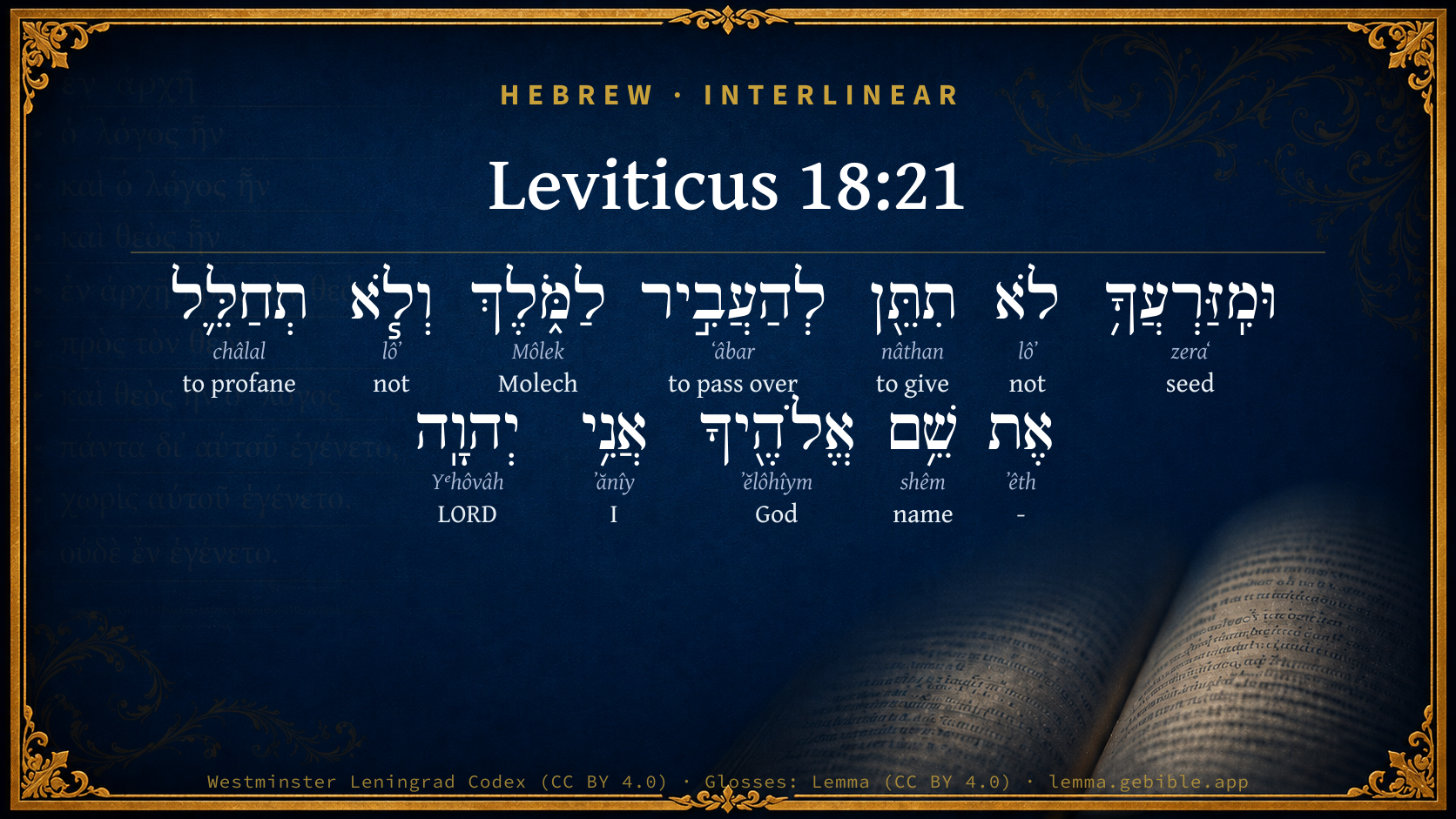
Hebrew (Westminster Leningrad Codex) Leviticus 18:21 appears in the Hebrew Old Testament. The text above is from the Westminster Leningrad Codex. Each word links to its Strong’s number, a concise gloss, and parsing drawn from the Open Scriptures Hebrew Bible morphology. Click any word for its full Brown-Driver-Briggs (BDB) entry.
Download image
Cite this verse

Leviticus 18:21 (World English Bible). Public Domain. Lemma interlinear Bible study tool, https://lemma.gebible.app/v/leviticus/18/21.

Show BibTeX & RIS
BibTeX
RIS
English Translation
"'You shall not give any of your children to sacrifice to Molech; neither shall you profane the name of your God: I am Yahweh.
World English Bible · Public Domain
Highlights
  • 1 first appearance in the Hebrew Bible
Full analysis ↓
Download a study sheet

One document with this verse’s original text, its word-by-word gloss line, the meaning frame, cross-references with their text, attributed commentary, and full source and license credits — printable, and it pastes into notes with its structure intact.

This verse Autodidact and up

Study sheet (.html) Plain text (.txt)

A passage Seminary Student

Up to 50 verses in one chapter. A passage sheet keeps up to 6 commentary sources and 12 cross-references per verse, in the order this page ranks them, and says so on the sheet whenever that leaves anything out. Ask for a single verse and you get the Autodidact verse sheet above.

Everything on this page stays free to read, with no account — the sheet is a download of what is already on screen, not access to it.

Want to remove ads? Support Godless Engineer
Compare translations 3

The same verse in 3 English versions, stacked beneath the original-language interlinear above. Click any original word for its lexicon entry.

Each is an independent rendering of the whole verse — the interlinear is not word-aligned to these translations.

Highlighted words mark where these versions differ — a whole-verse word diff, not a word-by-word alignment.

  • World English Bible Public Domain
    "'You shall not give any of your children to sacrifice to Molech; neither shall you profane the name of your God: I am Yahweh.
  • King James Version Public Domain
    And thou shalt not let any of thy seed pass through the fire to Molech, neither shalt thou profane the name of thy God: I am the LORD.
  • unfoldingWord Literal Text CC BY-SA 4.0
    And from your seed, you shall not give to cause to pass over to Molech. And you shall not profane the name of your God. I am Yahweh.

unfoldingWord Literal Text — © unfoldingWord, licensed CC BY-SA 4.0. Word-aligned USFM3 via Door43 (git.door43.org/unfoldingWord/en_ult).

Versions to compare (up to 4)

3 of 4 selected

Show all 18 translations

Every available English version of this verse, each an independent rendering of the whole verse.

  • World English Bible Public Domain
    "'You shall not give any of your children to sacrifice to Molech; neither shall you profane the name of your God: I am Yahweh.
  • Berean Standard Bible Public Domain
    You must not give any of your children to be sacrificed to Molech, for you must not profane the name of your God. I am the LORD.
  • Majority Standard Bible Public Domain
    You must not give any of your children to be sacrificed to Molech, for you must not profane the name of your God. I am the LORD.
  • King James Version Public Domain
    And thou shalt not let any of thy seed pass through the fire to Molech, neither shalt thou profane the name of thy God: I am the LORD.
  • American Standard Version (1901) Public Domain
    And thou shalt not give any of thy seed to make them pass through `the fire' to Molech; neither shalt thou profane the name of thy God: I am Jehovah.
  • Revised Version (1885) Public Domain
    And thou shalt not give any of thy seed to make them pass through the fire to Molech, neither shalt thou profane the name of thy God: I am the LORD.
  • Geneva Bible (1599) Public Domain
    Also thou shalt not giue thy children to offer them vnto Molech, neither shalt thou defile the name of thy God: for I am the Lord.
  • Douay-Rheims (1899) Public Domain
    Thou shalt not give any of thy seed to be consecrated to the idol Moloch, nor defile the name of thy God: I am the Lord.
  • Young's Literal Translation Public Domain
    `And of thy seed thou dost not give to pass over to the Molech; nor dost thou pollute the name of thy God; I `am' Jehovah.
  • Literal Standard Version CC BY-SA 4.0
    And you do not give from your seed to pass over to the Molech, nor do you defile the Name of your God; I [am] YHWH.
  • Unlocked Literal Bible CC BY-SA 4.0
    You must not give any of your children to put them into the fire, so that you sacrifice them to Molech, because you must not profane the name of your God. I am Yahweh.
  • unfoldingWord Literal Text CC BY-SA 4.0
    And from your seed, you shall not give to cause to pass over to Molech. And you shall not profane the name of your God. I am Yahweh.
  • Darby Bible Public Domain
    And thou shalt not give of thy seed to let them pass through [the fire] to Molech, neither shalt thou profane the name of thy God: I am Jehovah.
  • World Messianic Bible Public Domain
    “‘You shall not give any of your children as a sacrifice to Molech. You shall not profane the name of your God. I am the LORD.
  • Webster's Bible Public Domain
    And thou shalt not let any of thy seed pass through the fire to Molech, neither shalt thou profane the name of thy God: I am the LORD.
  • Free Bible Version CC BY-SA 4.0
    Don't give any of your children as a human sacrifice to Molech, for you must not disgrace the character of your God. I am the Lord.
  • Bible in Basic English Public Domain
    And you may not make any of your children go through the fire as an offering to Molech, and you may not put shame on the name of your God: I am the Lord.
  • JPS Tanakh (1917) Public Domain
    And thou shalt not give any of thy seed to set them apart to Molech, neither shalt thou profane the name of thy God: I am the LORD.

Literal Standard Version (2020), Covenant Press — licensed CC BY-SA 4.0. Text via the HelloAO Bible API (eBible.org). Unlocked Literal Bible (unfoldingWord) — licensed CC BY-SA 4.0. Text via the HelloAO Bible API (eBible.org). unfoldingWord Literal Text — © unfoldingWord, licensed CC BY-SA 4.0. Word-aligned USFM3 via Door43 (git.door43.org/unfoldingWord/en_ult). Free Bible Version, Dr. Jonathan Gallagher — licensed CC BY-SA 4.0. Text via the HelloAO Bible API (eBible.org).

Word by word

More ways to search: Search by grammar → Find every occurrence → Compare this word →

Practice this passage: Drill this verse → Learn its vocabulary →

לַמֹּ֑לֶךְ
Môlek
H4432
“to/for the · Molech”
Preposition, Determined + Noun, Proper
Part of Speech
Preposition + Noun
Type
Proper
Full BDB Definition

Origin: from H4427

TWOT: 1199h

Molech = "king" - the god of the Ammonites and Phoenicians to whom some Israelites sacrificed their infants in the valley of Hinnom
  1. וּמִֽזַּרְעֲךָ֥ zeraʻ H2233 “and · from · seed · your” Conjunction + Preposition + Noun, Common, Masculine, Singular, Construct + Suffix, Personal, 2nd Person, Masculine, Singular
  2. לֹא lôʼ H3808 “not” Particle, Negative
  3. תִתֵּ֖ן nâthan H5414 “to give” Verb, Qal, Imperfect, 2nd Person, Masculine, Singular
  4. לְהַעֲבִ֣יר ʻâbar H5674 “to pass over” Preposition + Verb, Hiphil, Infinitive Construct
  5. וְלֹ֧א lôʼ H3808 “and · not” Conjunction + Particle, Negative
  6. תְחַלֵּ֛ל châlal H2490 “to profane” Verb, Piel, Imperfect, 2nd Person, Masculine, Singular
  7. אֶת ʼêth H853 “-” Particle, Direct Object
  8. שֵׁ֥ם shêm H8034 “name of” Noun, Common, Masculine, Singular, Construct
  9. אֱלֹהֶ֖יךָ ʼĕlôhîym H430 “God(s) · your” Noun, Common, Masculine, Plural, Construct + Suffix, Personal, 2nd Person, Masculine, Singular
  10. אֲנִ֥י ʼănîy H589 “I” Pronoun, Personal, 1st Person, Common, Singular
  11. יְהוָֽה Yᵉhôvâh H3068 “LORD” Noun, Proper

About this verse

These counts appear in no published source. They are computed here, from the morphology-tagged text and Lemma’s own curated glosses. What Lemma adds →

12
words
11
distinct lemmas
Pentateuch
section

Notable vocabulary

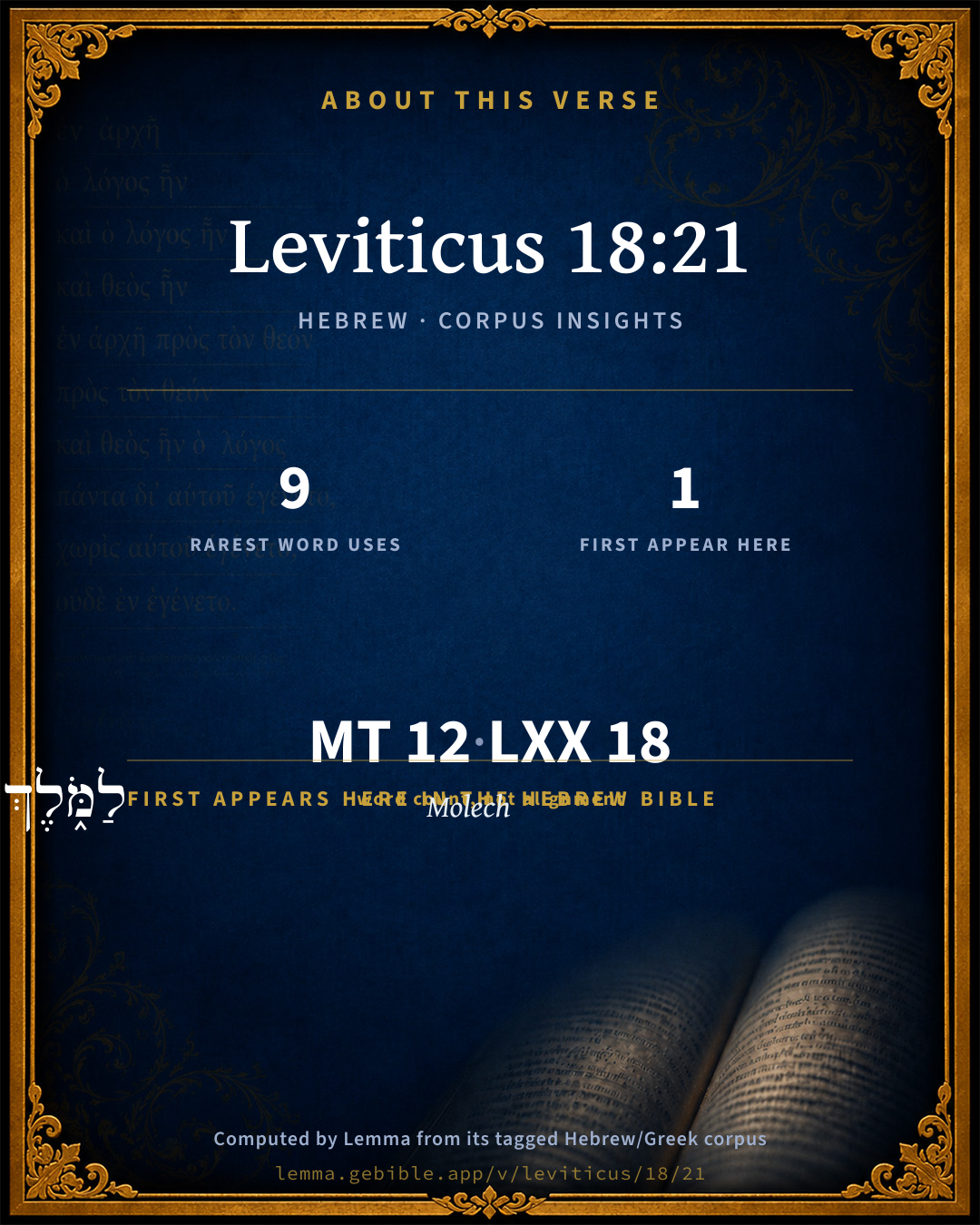
The rarest word here is לַמֹּ֑לֶךְ Molech H4432 — appearing just 9 times in the whole Hebrew Bible.

First appearance in Scripture

This word makes its first canonical appearance in the Hebrew Bible here:

  • לַמֹּ֑לֶךְ Molech H4432

Shared distinctive vocabulary

לַמֹּ֑לֶךְ Molech H4432 occurs in 9 verses of the Hebrew Bible. Also found in:

Grammatical profile

  • 3 verbs
  • 5 nouns
  • 1 pronoun
  • 3 particles

Verb forms

  • תִתֵּ֖ן Qal · Imperfect
  • לְהַעֲבִ֣יר Hiphil · Infinitive Construct
  • תְחַלֵּ֛ל Piel · Imperfect

Repetition

A word recurs within this verse — often emphatic in Hebrew:

Hebrew & Septuagint length

In English translation the verse runs 24 words from the Hebrew and 24 from the Septuagint (LXX English) — the same length.

A rough comparison of the two English renderings, which tokenize alike — not a word-level alignment.

Word counts can differ between the Hebrew and the Greek without any difference in meaning — e.g. the Hebrew direct-object marker אֵת has no separate Greek word, and Greek often adds the article ὁ.

In the original languages it is 12 Hebrew tokens and 18 Greek tokens — but the two are counted differently (Hebrew bundles its prefixes and suffixes into one token; the Greek is in lemma form), so that isn’t a like-for-like length.

Cross-references

23

Topical passages linked to Leviticus 18:21 in the Treasury of Scripture Knowledge — connected by theme and wording, ordered by reader-vote popularity; previews shown in the World English Bible.

  • Deuteronomy 12:31 You shall not do so to Yahweh your God: for every abomination to Yahweh, which he hates, have they done to their gods; for even their sons and their daughters do they burn in the fire to their gods.
  • Leviticus 20:2–5 "Moreover, you shall tell the children of Israel, 'Anyone of the children of Israel, or of the strangers who live as foreigners in Israel, who gives any of his seed to Molech; he shall surely be put to death. The people of the land shall stone him with stones.
  • Deuteronomy 18:10 There shall not be found with you anyone who makes his son or his daughter to pass through the fire, one who uses divination, one who practices sorcery, or an enchanter, or a sorcerer,
  • Leviticus 19:12 "'You shall not swear by my name falsely, and profane the name of your God. I am Yahweh.
  • Leviticus 22:32 You shall not profane my holy name, but I will be made holy among the children of Israel. I am Yahweh who makes you holy,
  • Leviticus 22:2 "Tell Aaron and his sons to separate themselves from the holy things of the children of Israel, which they make holy to me, and that they not profane my holy name. I am Yahweh.
  • 1 Kings 11:7 Then did Solomon build a high place for Chemosh the abomination of Moab, on the mountain that is before Jerusalem, and for Molech the abomination of the children of Ammon.
  • 1 Kings 11:33 because that they have forsaken me, and have worshiped Ashtoreth the goddess of the Sidonians, Chemosh the god of Moab, and Milcom the god of the children of Ammon; and they have not walked in my ways, to do that which is right in my eyes, and [to keep] my statutes and my ordinances, as did David his father.
  • Jeremiah 19:5 and have built the high places of Baal, to burn their sons in the fire for burnt offerings to Baal; which I didn't command, nor spoke it, neither came it into my mind:
  • Malachi 1:12 "But you profane it, in that you say, 'Yahweh's table is polluted, and its fruit, even its food, is contemptible.'
  • Acts 7:43 You took up the tent of Moloch, The star of your god Rephan, The figures which you made to worship. I will carry you away beyond Babylon.'
  • Leviticus 21:6 They shall be holy to their God, and not profane the name of their God; for they offer the offerings of Yahweh made by fire, the bread of their God; therefore they shall be holy.
  • 2 Kings 16:3 But he walked in the way of the kings of Israel, yes, and made his son to pass through the fire, according to the abominations of the nations, whom Yahweh cast out from before the children of Israel.
  • 2 Kings 21:6 He made his son to pass through the fire, and practiced sorcery, and used enchantments, and dealt with those who had familiar spirits, and with wizards: he worked much evil in the sight of Yahweh, to provoke him to anger.
  • 2 Kings 23:10 He defiled Topheth, which is in the valley of the children of Hinnom, that no man might make his son or his daughter to pass through the fire to Molech.
  • Psalms 106:37–38 Yes, they sacrificed their sons and their daughters to demons.
  • Jeremiah 7:31 They have built the high places of Topheth, which is in the valley of the son of Hinnom, to burn their sons and their daughters in the fire; which I didn't command, neither came it into my mind.
  • Ezekiel 20:31 and when you offer your gifts, when you make your sons to pass through the fire, do you pollute yourselves with all your idols to this day? and shall I be inquired of by you, house of Israel? As I live, says the Lord Yahweh, I will not be inquired of by you;
  • Ezekiel 23:37 For they have committed adultery, and blood is in their hands; and with their idols have they committed adultery; and they have also caused their sons, whom they bore to me, to pass through [the fire] to them to be devoured.
  • Ezekiel 36:20–23 When they came to the nations, where they went, they profaned my holy name; in that men said of them, These are the people of Yahweh, and are gone forth out of his land.
  • Amos 5:26 Yes, you have borne the tent of your king and the shrine of your images, the star of your god, which you made for yourselves.
  • Romans 1:23 and traded the glory of the incorruptible God for the likeness of an image of corruptible man, and of birds, and four-footed animals, and creeping things.
  • Romans 2:24 For "the name of God is blasphemed among the Gentiles because of you," just as it is written.

Cross-references courtesy of OpenBible.info (CC BY 4.0).

Hebrew and Greek witnesses Masoretic Hebrew ↔ Greek Septuagint

The same verse in the two great witnesses to the Old Testament, shown verse-for-verse.

These are two independent witnesses, not word-aligned to each other, and the Septuagint is shown in lemma (dictionary) form.

Hebrew Leviticus 18:21 Masoretic · Westminster Leningrad Codex

וּמִֽזַּרְעֲךָ֥ לֹא תִתֵּ֖ן לְהַעֲבִ֣יר לַמֹּ֑לֶךְ וְלֹ֧א תְחַלֵּ֛ל אֶת שֵׁ֥ם אֱלֹהֶ֖יךָ אֲנִ֥י יְהוָֽה

"'You shall not give any of your children to sacrifice to Molech; neither shall you profane the name of your God: I am Yahweh.

World English Bible · Public Domain

Greek LXX Leviticus 18:21 Septuagint · lemma form

καί ἀπό ὁ σπέρμα σύ οὐ δίδωμι λατρεύω ἄρχων καί οὐ βεβηλόω ὁ ὄνομα ὁ ἅγιος ἐγώ κύριος

And you shall not give of your seed to serve a ruler; and you shall not profane my holy name; I am the Lord.

LXX2012 (modern English Septuagint) · Public Domain

On this verse, Haydock's Catholic Bible Commentary discusses the Septuagint’s reading. Read the note in Commentary ↓

Hebrew: Westminster Leningrad Codex (CC BY 4.0). Greek: Septuagint (public domain); English from LXX2012 (modern English Septuagint) (Public Domain). How the Septuagint differs from the Hebrew →

Targum (Aramaic paraphrase)

2

The Targum is the ancient Jewish Aramaic paraphrase of the Hebrew Scriptures — an interpretive translation, not the Hebrew text itself. Onkelos (literal) and Pseudo-Jonathan (expansive) render the Torah, and Jonathan the Prophets. Coverage is partial: where no permissively-licensed English translation exists for a verse, only the Aramaic is shown. This is verse-level text, not a word-by-word alignment to the Hebrew.

  1. Targum Onkelos Torah (Genesis–Deuteronomy)
    וּמִבְּנָיִךְ לָא תִתֵּן לְאַעְבָּרָא לְמוֹלֶךְ וְלָא תַחֵל יָת שְׁמָא דֶאֱלָהָךְ אֲנָא יְיָ

    (no public-domain English translation for this verse)

    Targum Onkelos — Aramaic: “Onkelos Genesis” (public domain); “Onkelos Exodus” (public domain); “Onkelos Leviticus” (public domain); “Onkelos Numbers” (public domain); “Onkelos Deuteronomy” (public domain). English: “Sefaria Community Translation” (CC0 1.0 (public-domain dedication)); “J.W. Etheridge. The Targums of Onkelos and Jonathan Ben Uzziel on the Pentateuch. London: Longmans, Green, 1862” (public domain). Text via Sefaria.

  2. Targum Pseudo-Jonathan Torah (Genesis–Deuteronomy)
    וּמִן זַרְעָךְ לָא תִתֵּן בְּתַשְׁמִישְׁתָּה לְצֵיד בַּת עַמְמִין לְמָעְבְרָא לְפוּלְחָנָא אוֹחְרָא וְלָא תָפִיס יַת שְׁמָא דֶאֱלָהָךְ אֲנָא יְיָ

    And of thy offspring thou shalt not give up any to lie carnally with the daughters of the Gentiles, to perform strange worship; nor shalt thou profane the Name of thy God: I am the Lord.

    Targum Pseudo-Jonathan — Aramaic: “Targum Jonathan on Genesis” (public domain); “Targum Jonathan on Exodus” (public domain); “Targum Jonathan on Leviticus” (public domain); “Targum Jonathan on Numbers” (public domain); “Targum Jonathan on Deuteronomy” (public domain). English: “The Targum of Jonathan ben Uzziel, trans. J. W. Etheridge, London, 1862” (public domain). Text via Sefaria.

Commentary

Notes on Leviticus 18:21 from classic Christian and Jewish commentators (each source and its license shown beneath its notes). The classic Christian expositions comment on the surrounding passage and are grouped to its opening verse, so a note may address several verses; the Jewish commentaries on the Tanakh (Rashi and others) are per-verse, so they appear only where the commentator wrote on this verse.

Lemma curates 59 commentaries, every one of them public domain or Creative Commons licensed, each selected and text-cleaned for this edition rather than reprinted as found. About our sources →

Trapp's Complete Commentary

John Trapp

Lev 18:21 And thou shalt not let any of thy seed pass through [the fire] to Molech, neither shalt thou profane the name of thy God: I [am] the LORD.

Ver. 21. Pass through the fire.] Either to be burnt to death in honour of that abominable idol; or to be consecrated thereto, by passing between two fires, which scorched them. {See Trapp on "Mat 5:22"}

Neither shalt thou profane the name,] i.e., Cause it to be profaned and blasphemed by others, as in Pro 30:9 1Ti 1:20. {See Trapp on "1Ti 1:20"}

John Trapp, A Commentary or Exposition upon All the Books of the Old and New Testament (1647–1656) — public domain. Text from a community e-Sword module.

Joseph Benson's Commentary

Lev 18:21. Pass through the fire to Molech — In the Hebrew it is only pass through to Molech. But though the word fire be not in the original, it is reasonably supplied from other places, where it is expressed, as Deu 18:10; 2Ki 23:10. Molech, called also Milcom, was the idol of the Ammonites. The name signifies king, or regal dominion, and is thought to denote the sun, the supreme, and probably the first object of idolatrous worship. Or, as others, the planet Saturn; for it appears from Amo 5:26, that Molech represented one of the celestial luminaries. Now, as fire is a fit emblem of the sun, the causing their seed to pass through the fire is thought to have been a rite of purification whereby parents consecrated their children to that deity, either by waving them over the fire, or by making them walk between two fires, or jump over a fire. This is the opinion of many able interpreters. But Selden, who has given a large account of this idol, and of the rites with which it was worshipped, shows, from several testimonies, that the Phœnicians, and other nations in the neighbourhood of Judea, actually sacrificed their children, in times of great calamity, to this blood-thirsty demon. Accordingly this phrase of causing them to pass through the fire, signifies sacrificing them in the following horrid manner, Eze 16:20-21. Fagius informs us, that the image of Molech was of brass, contrived with seven cells or receptacles, probably representing the seven planets, the first for receiving an offering of flour; the second of turtle-doves; the third for a ewe; the fourth for a ram; the fifth for a calf; the sixth for an ox; the seventh for a child. who, being shut up in this cell, as in a furnace, was therein burned to death, while the people danced about the idol, and beat timbrels, that the cries of the tormented infant might not be heard. We have authority from the sacred writings to believe that these nations actually sacrificed their children to that grim idol, in some such horrid manner. Compare 2Ch 28:3, and Jer 7:31, with Jer 32:35; Jer 19:5; Psa 106:37-38, and Eze 16:20-21. In all which places, to pass through the fire, signifies the consuming of the victim by fire. And Le Clerc ingeniously conjectures, that this phrase, passing through to Molech, was invented by the impious priests, in order to convey a softer idea of that horrid rite. We may further observe, that there was a place near Jerusalem, where this horrid custom was observed. It was called the valley of the sons of Hinnom, (2Ch 28:3,) from the yelling of the sacrificed infants. And for the same reason it had the name of Tophet, (2Ki 23:10,) from Toph, a tabret or drum, with which they used to drown the dreadful outcries of the unhappy victims. Neither shalt thou profane the name of thy God — This idolatry in the Israelites would be the foulest and most profane renunciation of the true GOD, to whom they and their posterity were solemnly devoted, and at the same time it would give occasion to strangers to blaspheme the name of Jehovah, as if he authorized such barbarities in his worshippers.

Joseph Benson's Commentary on the Old and New Testaments (1811–1818) — public domain. Text from a community e-Sword module.

Tyndale Open Study Notes

Tyndale Open Resources

18:21 Molech was the national god of the Ammonites (1 Kgs 11:7). This god was later worshiped by Israel during times of apostasy (2 Kgs 23:10; Jer 32:35). Molech probably appears in this list because Molech worship was associated with sexual sins; it seems to have included child sacrifice as well. • To bring shame on (literally blaspheme, profane) the name of your God meant using the name of the Lord as though it were not holy, such as in a false oath (Lev 19:12) or in the worship of a false god (Ezek 20:39).

Tyndale Open Study Notes — © Tyndale Open Resources, licensed CC BY-SA 4.0. Text via the HelloAO Bible API.

Geneva Bible (1599)

Geneva Bible translators

Which was an idol of the Ammonites, unto whom they burned and sacrificed their children, 2 Kings 23:10. This seemed to be the chief and principal of all idols: and as the Jews write, was of a great stature, and hollow within, having seven places or chambers within him: one was to receive meal that was offered: another turtle doves: the third, a sheep: the fourth, a ram: the fifth a calf: the sixth an ox: the seventh a child. This idol’s face was like a calf: his hands were ever stretched out to receive gifts: his priests were called Chemarim, 2 Kings 23:5; Hos. 10:5; Zeph. 1:4.

Or, to make them pass.

Hebrew, of thy seed.

Geneva Bible (1599) marginal notes — public domain. Text via Bolls.life.

Jamieson, Fausset & Brown

Robert Jamieson, A. R. Fausset & David Brown

thou shalt not let any of thy seed pass through the fire to Molech, &c.--Molech, or Moloch, which signifies "king," was the idol of the Ammonites. His statue was of brass, and rested on a pedestal or throne of the same metal. His head, resembling that of a calf, was adorned with a crown, and his arms were extended in the attitude of embracing those who approached him. His devotees dedicated their children to him; and when this was to be done, they heated the statue to a high pitch of intensity by a fire within, and then the infants were either shaken over the flames, or passed through the ignited arms, by way of lustration to ensure the favor of the pretended deity. The fire-worshippers asserted that all children who did not undergo this purifying process would die in infancy; and the influence of this Zabian superstition was still so extensively prevalent in the days of Moses, that the divine lawgiver judged it necessary to prohibit it by an express statute.

neither shalt thou profane the name of thy God--by giving it to false or pretended divinities; or, perhaps, from this precept standing in close connection with the worship of Molech, the meaning rather is, Do not, by devoting your children to him, give foreigners occasion to blaspheme the name of your God as a cruel and sanguinary deity, who demands the sacrifice of human victims, and who encourages cruelty in his votaries.

Jamieson, Fausset & Brown — Commentary Critical and Explanatory on the Whole Bible (1871) — public domain (CC PDM 1.0). Text via the HelloAO Bible API.

Adam Clarke's Commentary

Verse 21. Pass through the fire to Molech] The name of this idol is mentioned for the first time in this place. As the word מלח molech or melech signifies king or governor, it is very likely that this idol represented the sun; and more particularly as the fire appears to have been so much employed in his worship. There are several opinions concerning the meaning of passing through the fire to Molech.

1. Some think that the semen humanum was offered on the fire to this idol.

2. Others think that the children were actually made a burnt-offering to him.

3. But others suppose the children were not burnt, but only passed through the fire, or between two fires, by way of consecration to him.

That some were actually burnt alive to this idol several scriptures, according to the opinion of commentators, seem strongly to intimate; see among others, Ps 106:38; Jer 7:31, and Eze 23:37-39. That others were only consecrated to his service by passing between two fires the rabbins strongly assert; and if Ahaz had but one son, Hezekiah, (though it is probable he had others, see 2Ch 28:3), he is said to have passed through the fire to Molech, 2Kg 16:3, yet he succeeded his father in the kingdom, 2Kg 18:1, therefore this could only be a consecration, his idolatrous father intending thereby to initiate him early into the service of this demon. See Clarke on Le 20:2.

Adam Clarke's Commentary on the Bible (1810–1826) — public domain. Text from a community e-Sword/MySword module.

Ellicott's Commentary for English Readers

(21) And thou shalt not let any of thy seed.—Literally, And thou shalt not give any of thy seed. Those who violate the sanctity of the marriage ties will readily sacrifice their children. Hence the prohibition to offer up their children to idols follows the law about unchastity.

Pass through the fire to Molech.—Literally, to let it pass to Molech, that is, to put the child into the hands of the figure of Molech, when it fell into the fire which was kindled in the hollow statue of this idol. Molech, also called Milcom, which denotes king, is described as the hideous idol, or “the abomination of the Ammonites” (1Ki_11:5; 1Ki_11:11). The following graphic description has been handed down traditionally of this idol and its worship :—“Our sages of blessed memory say that whilst all other idols had temples in Jerusalem, Molech had his temple outside Jerusalem, in a place by itself. It was a brass and hollow image, bull-headed, with arms stretched out like a human being who opens his hands to receive something from his neighbour. Its temple had seven compartments, into which the offerers went according to their respective gifts. If one offered a fowl, he went into the first compartment; if a sheep, into the second; if a lamb, into the third; if a ram, into the fourth; if a bullock, into the fifth; if an ox, into the sixth; and if he offered his son, he was conducted into the seventh compartment. He first kissed the image, as it is written, ‘let the sacrificers of men kiss the calf’ (Hos_13:2), whereupon a fire was kindled in Molech till its arms became red hot; the child was then put into its hands, and drums were beaten to produce tremendous noises so as to prevent the shrieks of the child reaching the father’s ears, lest he should be moved with pity towards his offspring.” It was to this idol that Solomon erected a temple on the southern side of Mount Olivet (2Ki_23:13). This idolatrous worship was punished with death by stoning. (See Lev_20:2.)

Neither shalt thou profane.—Better, And thou shalt not profane, that is, by causing other nations to say that the Israelites regard their God as an inferior deity, and hence offer unto him animals, whilst to Molech they sacrifice their own children. Hence any act which is done in violation of his commands, or misrepresents God, or by which He is put on a par with other gods, is called “profaning the name of God.” (See Lev_19:12; Lev_20:3; Lev_21:6; Lev_22:2; Lev_22:32, &c.)

A Bible Commentary for English Readers, edited by Charles John Ellicott (1878–1897) — public domain. Text from a community e-Sword module.

The Cambridge Bible for Schools and Colleges

gen. ed. J. J. S. Perowne

21. A more suitable position for this precept would be at the end of the laws in Lev_18:7-23. It occurs in a developed form in Lev_20:2-5. Its sudden interposition may be accounted for by remembering the condemnation of idolatry under the figure of unfaithfulness to the marriage tie (cp. the expressions in Lev_20:5 a), see Jer_3:1 ff. For the worship of Molech (Milcom), the god of the Ammonites, see Barnes (C.B.) on 1Ki_11:5.

The Cambridge Bible for Schools and Colleges (gen. ed. J. J. S. Perowne; Cambridge University Press, 1878–1918) — public domain. Text from a community e-Sword module.

John Gill's Exposition

And thou shalt not let any of thy seed pass through the fire to Molech,.... The name of an image or idol, according to Aben Ezra, who observes, that their wise men interpret it as a general name for everyone whom they made to reign over them; and it is right, he says, that it is the abomination of the children of Ammon, and so the same with Milcom, Kg1 11:5; and with Baal, as appears from Jer 32:35; and they are both of much the same signification, the one signifies a king, the other a lord; and perhaps is the same with the Melicarthus of Sanchoniatho (y), who is also Hercules; to whom Pliny says (z) that the Phoenicians offered human sacrifices every year: of Molech; see Gill on Jer 7:31, Amo 1:13; by "seed" is meant children and offspring; and because the word "fire" is not in the original text, some, as Aben Ezra observes, explain the phrase, "let to pass through", of their causing them to pass from the law of God to the religion of Molech, or of devoting them to his service and worship; but the word "fire" is rightly supplied, as it may be from Deu 18:10; and the same writer says, the phrase to pass through is the same as to burn; but though this they sometimes did, even burn their infants, and sacrificed them to idols, Ch2 28:3; yet this seems to be something short of that, and to be done in the manner, as Jarchi and other Jewish writers (a) relate; who say, the father delivered his son to the priests (of Molech) and they made two great fires, and caused the son to pass on foot between the two fires, which was a kind of a lustration, and so of a dedication of them to the idol; though it must be owned that both were done; yea, that both the phrases of passing through the fire, and of burning, are used promiscuously of the same, see Kg2 16:3; compared with Ch2 28:3 and also Eze 16:20; and they might be both done at different times, or the one previous and in order to the other; and perhaps they might cause the child so often and so long to pass through the fire, as that at last it was burnt and destroyed:

neither shall thou profane the name of thy God; who had given them children, and to whom they ought to have devoted them, and in whose service they should have trained them up to the honour of his name; but instead of that profaned it, by the above idolatrous and cruel usages:

I am the Lord; who would avenge such a profanation of his name.

(y) Apud, Euseb. Praepar. Evangel. l. 1. p. 38. (z) Nat. Hist. l. 36. c. 5. (a) Ben Melech in loc. Kimchii Sepher Shorash. rad.

John Gill's Exposition of the Whole Bible (1746–1763) — public domain (CC PDM 1.0). Text via the HelloAO Bible API.

Albert Barnes' Notes on the Bible

Molech - See the note at Lev 20:2-5.

Albert Barnes' Notes on the Bible (1834–1885) — public domain. Text from a community e-Sword/MySword module.

Haydock's Catholic Bible Commentary

Consecrated. Hebrew, "to pass through the fire to Moloch." Septuagint, "to serve the ruler." Syriac, "to marry strange women;" as also chap. xx. 2. One of the sons of Achaz was offered to this idol of the Ammonites; and yet, perhaps, succeeded his father; (4 Kings xvi. 3; xviii. 1,) which shews that the children were not always burnt to death, but only lustrated, or made to pass over or between two fires. Yet many assert that the children were frequently consumed in the flames, and God condemns the cruel parents to be punished with death, chap. xx. 2. The brazen idol was heated red hot, and the unhappy victim was placed in its arms, or the priests dragged the child over or between the fires. The surrounding nations delighted in human victims. The Carthaginians offered them till the time of Iphicrates. Adrian abolished several such cruel customs among the Greeks. See Porphyrius, de Abst. ii. Jerem. vii. 31. --- God; by causing any to suppose that he is cruel, like the idols. We must mention his name with the utmost respect. "The mouth, which utters the sacred name of God, ought never to pronounce a shameful word." (Philo de 10. præc.) Some think, that the idolaters honoured their god by committing an abominable action in his presence. See Malvenda. But most people understand that human sacrifices are here forbidden. (Calmet) --- The nations of Carolina very lately observed the same custom as the ancient idolaters, in sacrificing their children to the devil, by buring them to death in a brazen statue. (Vives in Civ. Dic. vii. 19.) Moloch was represented as a king, in all his ornaments, with the head of a calf. He was, perhaps, the idol adored by other nations, under the name of Saturn, who devoured his own children. (Bonfrere) (Tirinus)

George Leo Haydock (1774–1849), Haydock's Catholic Family Bible and Commentary, 1859 edition — public domain. Excludes Psalms (Douay-Rheims chapter numbering differs from Protestant) and Deuterocanonical books (Catholic canon only).

Matthew Poole's English Annotations

Pass through the fire this was done two ways; either,

1. By burning them in the fire, of which see 2Ki 3:27; 2Ch 28:3; Psa 106:37,38; Isa 57:5.

Or, 2. By making them pass between two great fires, which was a kind of illustration or consecration of them to that god; which latter seems to be here meant. See Poole "Deu 18:10", where the word fire, here understood, is expressed.

To Molech, or, Moloch; called also Milcom; an idol chiefly of the Ammonites, as appears from 1Ki 11:7; 2Ki 23:13; Jer 49:1,3. This seems to be the Saturn of the heathens, to whom especially children and men were sacrificed. This is mentioned, because the neighbours of Israel were most infected with this idolatry, and therefore they are particularly cautioned against it, though under this one instance all other idols and acts, or kinds of idolatry, are manifestly comprehended and forbidden.

Neither shalt thou profane the name of thy God; either by joining him with, or by forsaking him for, such a base and bloody idol, whereby the name, honour, and service of God would be horribly defiled, and exposed to the scorn of the heathen, as if he were but one of the same kind with their mongrel deities.

Matthew Poole's English Annotations on the Holy Bible (1683–1685) — public domain. Text from a community e-Sword/MySword module.

Whedon's Commentary on the Bible

Daniel D. Whedon

21. Seed pass through the fire — Those Semitic nations that burned their children upon the funeral pyre, when they would spare their lives let them pass through the fire. The word fire is supplied from Deu_18:10. This prohibits the burning of children in honour of Molech, or Moloch, the fire-god, called in Deu_12:31, simply elohim, gods. He was a Canaanitish god, easily identified by the philologist with Melkarth, Malcham, Baal-melech, and other such names as appear in Carthagenian and Phenician mythology. He was propitiated by the sacrifice of children. The service of this fire-god had spread in the lands bounding Egypt on the east. We infer from this rigid prohibition that this cultus had even at this time penetrated into the camp of Israel. Since idolatry is regarded as whoredom, it is appropriately mentioned in this connexion. See chap. xvii, note. Properly speaking, this worship symbolized the purification of the soul after destroying its earthly dross, and consequently its immortality. To sustain this horrid and unnatural practice the idolatrous Hebrews quoted Num_31:23. The children were first slain (Eze_16:20-21) and then burned on a mound, built up in the valley of Hinnom, called, in Jer_19:5, “the high places of Baal,” with whom Moloch is once identified. He is commonly identified with the Moabitish Chemosh. The name Moloch, written without the points, is the same as Melek, king, and is translated by the Seventy as a common noun, αρχων. This confusion of terms is supposed to cover up a widespread worship of this grim divinity. Thus Isa_30:33 may be read, “For Tophet is ordained of old, yea, for Moloch it is prepared.” Most of the Jewish interpreters have endeavoured to soften this worship by saying that the children were not burned, but made to pass between two burning pyres, as a purifying rite. But the slaughter of the innocents is evident from 2Ch_28:3; Psa_106:37-38; Jer_7:31. Kimchi describes the image of Moloch as set within seven chapels, the outer ones being opened to those who brought annual sacrifices, but the inner one, enshrining the idol, was opened only to him who offered his son. This may explain the tabernacle of Moloch in Act_7:43. According to Diodorus Siculus the hands of the image of the Carthagenian Kronos stretched forth like a man about to receive something of his neighbour. When it was heated with fire the priests took the babe and put it into the hands of their Moloch, and the babe gave up the ghost, while the priests drowned its screams by beating drums. The Israelite who became a votary of Moloch was to be stoned. Lev_20:3.

Neither… profane the name of thy God — This forbids the irreverent use of the divine name. The Hebrews understood it as prohibiting the pronunciation of Jehovah, the sacred tetragrammaton, יהוה, the correct pronunciation of which was lost in consequence. See Lev_24:10-14, notes.

Daniel D. Whedon (gen. ed.), Commentary on the Old and New Testaments (1874–1909) — public domain. Text from a community e-Sword module.

The Pulpit Commentary

The third prohibition is, Thou shall not let any of thy seed pass through the fire to Molech. The words the fire are properly inserted, though not expressed in the original. (cf. Deu_18:10 2Ki_22:10) What was the nature and purpose of the idolatrous rite in question is, however, uncertain. It is generally assumed that reference is made to the practice of offering children in sacrifice to Molech, Deu_12:31 Eze_16:20, and Psa_106:37 being quoted in support of that view. But it is by no means certain that this was the case. It might have been a rite by which children were dedicated to Molech a baptism by fire, not resulting in the death of the child. Its mention here, in close connection with carnal sins, has led some to regard it as an impure rite; but this is a mistaken inference, for the prohibition of adultery naturally suggests the prohibition of a spiritual unfaithfulness. That it was some kind of idolatrous ceremony is shown by the addition of the words, neither shalt thou profane the name of thy God. But if the children were burnt to death in honour of the idol, from the beginning, we should expect to find a notice of the fact in less ambiguous language than the expression, pass through the fire, conveys, earlier than the days of Ahaz. It is easy to imagine that what began as a dedication ceremony may have become converted into an absolute sacrifice, retaining still its original designation. Molech was a Canaanitish and Phoenician deity, the name meaning King, just as Baal means Lord (see Selden, "De Diis Syris," 1:6). Jarchi, quoted by Wordsworth, describes the idol as "made of brass, having the face of an ox, with arms stretched out, in which the child was placed and burnt with fire, while the priests were beating drums, in order to drown the noise of its shrieks, lest the fathers might be moved with pity thereby." The place where the children were offered, in the later period of the Jewish history, was the valley of Hinnom. (Jer_7:31 Jer_32:35 2Ki_23:10)

The Pulpit Commentary (1880–1919), ed. H.D.M. Spence-Jones & Joseph S. Exell — public domain. Text from a community e-Sword module.

John Wesley's Explanatory Notes

Pass through fire - This was done, either by burning them in the fire, or by making them pass between two great fires, which was a kind of consecration of them to that God. Moloch - Called also Milcom, was an idol chiefly of the Ammonites. He seems to be the Saturn of the heathens, to whom especially children and men were sacrificed. This is mentioned, because the neighbours of Israel were most infected with this idolatry, and therefore they are particularly cautioned against it, though under this one instance all other idols and acts, or kinds of idolatry, are manifestly comprehended and forbidden.

John Wesley, Explanatory Notes Upon the Whole Bible (1754–1765) — public domain. Text via the GEBible commentary corpus.

Scofield Reference Notes

C. I. Scofield

Molech

Called Moloch. Act 7:43.

The Scofield Reference Bible (1917 edition), notes by C. I. Scofield — public domain. Text from a community e-Sword module.

Kretzmann's Popular Commentary

Paul E. Kretzmann

Unnatural Lusts

v. 21. And thou shalt not let any of thy seed pass through the fire to Molech, an ancient Canaanitish idol in the form of a hollow statue with the head of an ox, in whose worship such bestial practices of sacrificing children, in an excess of cruelty, were common; neither shalt thou profane the name of thy God, as would certainly happen through participation in such abominations. I am the Lord.

v. 22. Thou shalt not lie with mankind as with womankind, in the sin known as sodomy or as pederasty; it is abomination.

v. 23. Neither shalt thou lie with any beast to defile thyself there with; neither shall any woman stand before a beast to lie down thereto, to permit carnal intercourse; it is confusion, a most abominable and revolting defilement.

v. 24. Defile not ye yourselves in any of these things, in these bestial perversions of sexual desire: for in all these the nations are defiled which I cast out before you;

v. 25. and the land is defiled; therefore I do visit the iniquity thereof upon it, and the land itself vomiteth out her inhabitants. The story of Sodom shows to what extent unnatural vices were practiced by the inhabitants of Canaan, to a degree that nature itself could no longer endure them.

v. 26. Ye shall therefore keep My statutes and My judgments, and shall not commit any of these abominations, neither any of your own nation, nor any stranger that sojourneth among you ("The land which the ancestors of Israel were not allowed to possess because the iniquity of the Amorites not yet full, Gen 15:16, had now become filled with a mass of festering moral corruption. Its inhabitants were to be cast out and the holy people planted in their stead. It could not be allowed that ’the stranger’ should again introduce the pollutions which were now being so severely punished. " Lange),

v. 27. (for all these abominations have the men of the land done which were before you, and the land is defiled,)

v. 28. that the land spue not you out also when ye defile it, as it spued out the nations that were before you. The land is personified as a creature which is obliged to vomit forth some form of indigestible food with every indication of revulsion.

v. 29. For whosoever shall commit any of these abominations, even the souls that commit them shall be cut off from among their people.

v. 30. Therefore shall ye keep Mine ordinance, the precept covering this matter based upon natural law, that ye commit not any one of these abominable customs which were committed before you, and that ye defile not yourselves therein. I am the Lord, your God, and the just and holy God cannot endure such customs of abomination, as in those days, so in our times. There is a hint in this Chapter which has been sustained abundantly by history, namely, that any relaxation of sexual purity will usually be accompanied by the perversion or denial of some fundamental doctrine.

Paul E. Kretzmann, Popular Commentary of the Bible (1921–1924) — public domain. Text from a community e-Sword module.

unfoldingWord translationNotes

Door43 World Missions Community

General Information:

Yahweh continues telling Moses what the people must not do that would defile them.

You must not give any of your children to put them into the fire

The phrase "to pass through the fire" means to burn something with fire as a sacrifice. AT: "You must not burn your children alive" (See: Idiom)

you must not profane the name of your God

Here the word "profane" means to dishonor. The word "name" represents God himself. AT: "you must not dishonor your God" (See: Metonymy)

translationWords

children

fire

sacrifice

Molech

profane

name

unfoldingWord translationNotes — © Distant Shores Media and the Door43 World Missions Community, licensed CC BY-SA 4.0. Source: git.door43.org/Door43/en_tn.

Rashi

Rabbi Shlomo Yitzchaki (Rashi)

למלך [AND THOU SHALT NOT LET ANY OF THY SEED PASS THROUGH THE FIRE] TO MOLECH — This was an idol the name of which was "Molech", and this was the manner in which it was worshipped: that he (the father) handed his child (lit., his son, but it applies to his daughter also; cf. Deuteronomy 18:10) over to the priests of the idol. These lit two large pyres one opposite the other and made the child to pass on foot between the two pyres (Sanhedrin 64b).

לא תתן refers to “the handing over of the child” to the priests.

להעביר למלך — this refers to the “passing through the fire".

Rashi on the Tanakh — English translations: “The Judaica Press complete Tanach with Rashi, translated by A. J. Rosenberg” (CC BY 4.0); “Pentateuch with Rashi's commentary by M. Rosenbaum and A.M. Silbermann, 1929-1934” (public domain); “The Metsudah Tanach series, Lakewood, N.J” (CC BY 4.0); and “The Book of Joshua, Metsudah Publications, 1997” (CC BY 4.0). Text via Sefaria.

Ramban (Nachmanides)

Rabbi Moshe ben Nachman (Ramban / Nachmanides)

AND THOU SHALT NOT GIVE ANY OF THY SEED ‘L’HA’AVIR’ (TO PASS THROUGH) ‘LAMOLECH’ (TO MOLECH). This was an idol the name of which was “Molech.” Scripture mentions it with the definite article, [in the word lamolech] is vowelled with a pathach [instead of with a shva which would have made it l’molech], it is quite clear that it is speaking of an idol that is known. See Ramban on Exodus 22:19. (Vol. II, p. 390) quoting Rashi. since it was well-known to them from Egypt. And Rabbi Abraham ibn Ezra wrote that it is possible that Molech is identical with Milcom the detestation of the Ammonites. And so indeed it would appear, for it is written, Then did Solomon build a high place for Chemosh the detestation of Moab … and for Molech the detestation of the children of Ammon., Verse 7. Milcom of Verse 5, is thus identical with Molech of Verse 7. Hence the idol by the name of Molech mentioned here in the Torah appears to be, as Ibn Ezra wrote, Milcom the detestation of the Ammonites. And this [name Milcom] was also well-known to them., when from the text here before us in the Torah it is plain that they knew the idol already from Egypt [as is explained in the text above]? To this question Ramban answers that it was also known to them by the name “Milcom” [in the time of Solomon]. Hence Scripture used that name.Now Rashi commented: “And this was the manner in which the Molech was worshipped: he [the father] would hand over his son to the priests, and the priests lit two large pyres [one opposite the other], and they made the child pass on foot between the two fires. Thou shalt not give, this refers to [the father] handing over [the child] to the priests. ‘L’ha’avir lamolech’ is the passing through the open fire.” But this is not correct. For the Rabbis have already said in the Gemara of Tractate Sanhedrin: “If he made him pass on foot [between the fires] the father is free from punishment [because that was not the customary way of worshipping the idol]; rather, [he is liable only if it was] ‘like a leaping place of Purim,’” ). The Talmudic text k’mishvarto d’puria is thus explained by Rashi “as a leaping place of Purim,” i.e., like a bonfire made on Purim for merriment, over which children leap. Ramban will later on explain that at the Molech the child was passed through the flames so many times that the flames actually burnt him. meaning that he made him pass through the actual fire [by leaping through it]. Scripture mentions [both conditions to make the father liable to punishment]: a “giving” as it is said, and thou shalt not ‘give’ any of thy seed …], and the act of making him “pass through the fire” [as it is said in Deuteronomy 18:10: There shall not be found among you anyone that ‘maketh his son or his daughter pass through the fire’], so that the father does not incur punishment unless he delivers his child to the priests [of Molech] and he [i.e., the father] made him pass through the fire, as is explained in Tractate Sanhedrin. Similarly, that which the Rabbi [Rashi] wrote that the father hands him over to the priests and they make him pass through the fire — and so he wrote also in his commentaries to Tractate Sanhedrin, 64 a. — that does not appear to be so from the language of the Rabbis here in the Gemara. Moreover, how could the father be liable to death for the worship of Molech done by others [i.e., the priests]? The very language of Scripture, that maketh his son or his daughter pass through the fire, indicates that it is the father himself who passes him through the fire. Rather, the matter is as follows: the father himself delivers the child to the priests in the name of their detestation. It is with reference to this that it is written, he hath ‘given’ his seed unto Molech, similar to what is done within the Sanctuary precincts, as it is written, and he shall give them unto the priest. Perhaps the priests waved the child before the Molech, or brought it near the idol, and then they returned it to the hands of the father, and he took him and passed him through the open flame, this being the sense of the expression, he that maketh his son or his daughter pass through the fire. And so the Rabbis have said in the Yerushalmi:. “[The penalty of death] is never incurred [by the father] unless he delivers the child to the priests, and then he [the father] takes him and passes him through the fire,” that is to say, he takes the child from the priests, and he himself passes him through the fire. However, there was no actual burning of the child. For the Rabbis have said, “If one passed himself through the fire, he is not liable” [to death], which shows that the offender is alive even after he has passed through the fire. And so did Rashi explain [that there was no actual burning of the child]. Yet notwithstanding all this, it appears to me on the basis of decisive verses that the child was actually consumed by the flames, for Scripture states, and their sons, whom they bore unto Me, they have also made them pass through unto them ‘to be devoured,’ and further on there it says, and when they had slain their children to their idols, Verse 39. meaning that they passed him through the fire until he was burnt or died in the fire, this being “the slaying” [mentioned in the verse], for the expression they have made them pass through unto them is a reference to the worship of Molech, and Scripture states to be devoured and also mentions the term slaying! If so, when the Rabbis said [with reference to the Molech that it was] “like a leaping place of Purim,” ). The Talmudic text k’mishvarto d’puria is thus explained by Rashi “as a leaping place of Purim,” i.e., like a bonfire made on Purim for merriment, over which children leap. Ramban will later on explain that at the Molech the child was passed through the flames so many times that the flames actually burnt him. they meant to say that they made the child pass through the flame many times, until he died in the burning fire. Thus by law of the Torah the father is liable to punishment from the moment of the child’s first passing through, as soon as the fire takes hold of him, such as where one of his limbs took fire. It is for this reason that the Rabbis had to say that he who passes himself through the fire is not liable, [since the liability to punishment begins at the moment when the fire takes hold of one of his limbs, when he is still alive]. But the fire actually consumed the victim, as this was their sacrifice to Molech. And the expression of ma’avir ba’eish [which until now we have understood as “passing through the fire”] always denotes “something burnt by fire, but not [totally] consumed thereby,” for they used to put [the victim] in the fire, and then remove the body from there, and not let it turn into ashes like burnt [sacrifices], similar to utensils of gentiles [which, in order to be purified from the forbidden food they have absorbed], are made white-hot in the flame, and it is said of them, ye shall make to go through the fire, and it shall be clean. And it is said of the Ammonites, and he made them pass through the brick-kiln, meaning that he burnt them just as they do to bricks in a baking furnace. If so, ‘ma’avir’ his son or his daughter through the fire means placing him in the fire so that it should take hold of him, not merely passing him through it. And this is the meaning of ha’avarah which is mentioned in connection with the Molech, which was by fire according to the opinion of our Rabbis, who derived it by means of a similarity of the term ha’avarah [“passing through,” mentioned here in the verse before us, and in Deuteronomy 18:10]: “just as there the ‘passing through’ is in fire [as it is said, There shall not be found among you any one that maketh his son or his daughter ‘pass through the fire’], so here too the meaning is through the fire [although it is not clearly stated], and just as here it is to the Molech, so there too it is to Molech.” Proof to the words of the Rabbis [that the meaning of this ‘passing through’ mentioned here was by fire], is that which is written of King Josiah, And he defiled Topheth, which is in the valley of the son of Hinnom, that no man might make his son or his daughter to pass through the fire to Molech. Thus the term ha’avarah (‘passing through’) mentioned here in connection with Molech means by fire. So also is it written of King Manasseh: He also made his children ‘to pass through the fire’ in the valley of the son of Hinnom. And I have found it written of King Ahaz, And he also made his son ‘to pass through the fire,’ according to the abominations of the heathen, whom the Eternal cast out from before the children of Israel, and in the Book of Chronicles it is stated [of the same king], and ‘he burnt’ his children in the fire, according to the abominations of the heathen whom the Eternal cast out. If so, ha’avarah (the ‘passing through’) in fact was a burning with real fire. (“passing through”) was really an hav’arah (an actual burning of fire), since the verse in Kings speaking of King Ahaz uses the term ha’avarah, while the verse in Chronicles describing the same acts of the same king uses the term hav’arah. Thus it is clear that the two words are identical in meaning in this context.Now that which Scripture states, and the Sepharvites burnt their children in the fire to Adrammelech and Anammelech, the gods of Sepharvaim, [and it does not mention Molech], that was another idol, which was worshipped by burning the victims completely as a sacrifice [which was burnt to ashes]. They used to worship the Baal in a similar manner, as it is written of Jeremiah, Go forth unto the valley of the son of Hinnom, and there it says further, and they have filled this place with the blood of innocents; and have built the high places of Baal, to burn their sons in the fire ‘for burnt-offerings’ unto Baal; which I commanded not, nor spoke it, neither came it into My mind., Verses 4-5. And it is further written, And they built the high places of Baal, which are in the valley of the son of Hinnom, to make their sons and their daughters pass through unto Molech; which I commanded not, neither came it into My mind, that they should do this abomination., 32:35. However, due to the fact that these two [last mentioned] verses speak of the high places of Baal, both being in the valley of the son of Hinnom, and the admonition in connection with both of them is identical: which I commanded not, nor spoke it, neither came it into My mind, and the Molech was [also] there in that impure place, as it is written in connection with King Josiah, (II Kings 23:10). The verse was mentioned above by Ramban (see text at Note 338). it would appear from all this that they used to burn their children as sacrifices to Molech, which was the Baal, both names being closely associated, and meaning royalty and lordship. This is not the Baal of Peor or Baal-zebub, for this one [referred to by Jeremiah] was called Baal without any qualification, as Molech was so called, [without any qualification]. Scripture mentions in connection with the worship thereof the term ha’avarah (passing through), 32:35. because the main act of worship was by passing the children through [the two pyres] until the fire took hold of them, and it calls it “burning”, Verses 4-5. because they would die there. That is why they are called “burnt-offerings” [as it is said, to burn their sons in the fire for burnt-offerings]., Verses 4-5. Similarly, I am of the opinion that the gods of Sepharvaim are also identified with Molech, for their surnames [Adrammelech and Anammelech] denote kingship [as the word melech indicates]. Both of them were worshipped in the same way, although one was called Adra, in Aramaic means “distinction,” and the mule is so called because it gives distinction to its owner when travelling, because it carries all his belongings. The name Adrammelech thus means “The mule is the king,” or “the animal which gives distinction to the king.” See II Samuel 13:29, that the mule was ridden by princes, and I Kings 1:33 that it was ridden by the king. Ramban in explaining Adrammelech to be identical with Molech, thus suggests that the Sepharvites called their idol Adar, a name meaning “distinction,” and Adrammelech is “the king of distinction.” which is an expression of respect, and the second was called Ana which is of the root oneh (answers), ) is a reference to the horse because it “answers” its master when engaged in battle. See my Hebrew commentary p. 107, Note 44. The name Anammelech means “The horse is the king,” or “the animal which answers the king” in battle. Ramban here suggests, then, that Molech was called Anammelech because “he is the king who answers.” and the name “melech” was attached to both, which is like Molech. The “burning” mentioned in connection with them was the death of the victims by fire, as I have explained [above]. But if we were to say that these detestations [Adrammelech and Anammelech] were not the Molech, then it is possible that because they were worshipped by means of sons and daughters being brought to them in fire, in a similar manner to that which it says about the Molech, therefore their names [Adra and Ana] were combined with his name, and form a melech (king) or Baal, but the modes of worship were not the same. For the Molech was worshipped with “passing through” [the fire], and the gods of Sepharvaim with burning, and the Baal with slaughtering first and then burning, like burnt-offerings., Verses 4-5. And it is further said [in Jeremiah] that in the place of the Topheth, which is in the valley of the son of Hinnom there were also high places to Baal [as mentioned in connection with King Josiah, that he defiled that place so that no man might make his son or his daughter to pass through the fire to Molech], and it also mentions there the Molech [and Molech and Baal were to some extent identical, as stated above]. Thus that which Scripture states, And they built the high places of Baal, which are in the valley of the son of Hinnom, to make their sons and their daughters to pass through unto Molech, 32:35. [which would seem to indicate that Molech and Baal are entirely identical, contrary to what we have said above], really means: “and” to make their sons and their daughters pass through [the fire] unto Molech.Now our Rabbis have said: “The father of Hezekiah king of Judah too [i.e., Ahaz] wanted to do so to him [in his infancy], and to burn him in the fire, but his mother saved him from death by rubbing him with the oil of a salamander.” ). Now Ahaz “made him pass through” to Molech, as it is written, And he also made his son ‘to pass through’ the fire, according to the abominations of the heathen, whom the Eternal cast out from before the children of Israel, this expression being identical to that used in the case of Molech; if so, [the “passing through” to Molech] meant actual burning until the fire took hold of the victim and he died. However, the righteous [Hezekiah] was saved by this salamander, which the Holy One, blessed be He, created for his sake.By way of the simple meaning of Scripture they have said that the matter of “making a son or daughter pass through the fire” was one of the forms of sorcery, for it is in connection with sorcery that it is said, There shall not be found among you any one that maketh his son or his daughter pass through the fire, one that useth divination, a soothsayer, or an enchanter, or a sorcerer. And in the case of King Manasseh Scripture likewise states, He also made his children to pass through the fire in the valley of the son of Hinnom; and he practised soothsaying, and used enchantments, and practised sorcery and appointed them that divined by a ghost or a familiar spirit, and it is further written, and they caused their sons and their daughters to pass through the fire, and used divination and enchantments, [these verses indicating that the rite of “passing through the fire” was some form of witchcraft], and the Molech was an idol to which they offered little children. But since we have found it written, that no man might make his son or his daughter to pass through the fire to Molech [which shows clearly that “passing through the fire” was in connection with the worship of Molech], the words of our Rabbis that all forms of worshipping Molech were by fire, have been shown to be trustworthy. But it is [also] possible [as the verses indicate] that they used this rite for false divination and to prophesy by means of it, according to their foolishness, these being the prophets of Baal who would first offer to him sacrifices of children, and then have vain dreams and a lying divination. Therefore the Torah associates the matter of the Molech with that of [the various kinds of] divination. For here [in the Book of Leviticus] it placed [the subject of the Molech] immediately before the soul that turneth unto the ghosts, and unto the familiar spirits, and in the Book of Deuteronomy the whole section is devoted to the subject of those who predict the future falsely.Now Scripture [here in the verse before us] states that the act of passing children through the fire to Molech constitutes a profaning of G-d’s Name,. and in the other section [i.e., in Seder Kedoshim] it adds, to defile My Sanctuary, and to profane My Holy Name. Perhaps the meaning thereof is as follows: [To give of one’s children to Molech is] “to defile the people that is sanctified to My Name, whom I commanded, Sanctify yourselves, and be ye holy, for I the Eternal, Who sanctify you, am holy; — And to profane My holy Name, when they commit this serious sin before Me.” For thus He speaks of the serious sins, such as, and a man and his father go unto the same maid, to profane My holy Name. It is possible that He says so [to defile My Sanctuary, in connection with the Molech], because a father who sacrifices of his seed to Molech and afterwards comes into G-d’s Sanctuary to bring an offering, defiles the Sanctuary, as his offerings are defiled and are an abomination to G-d, and he himself is forever defiled, having become impure by the evil he did; just as He said of [those who turn to] the ghosts and the familiar spirits, seek them not out, to be defiled by them, and it is further written, and because they had defiled it with their idols. And He also mentions [in connection with the Molech] the profaning of G-d’s Name [as it says, and to profane My holy Name ], because when the nations hear that he honored the Molech with his seed, and to G-d he brought an offering of his cattle, it will be a profaning of G-d’s Name. It is concerning this that the prophet Ezekiel said, and their sons, whom they bore unto Me, they have also made them pass through unto them to be devoured. Moreover this they have done unto Me: they have defiled My Sanctuary in the same day., 23:37-38. And the prophet continues, For when they had slain their children to their idols, then they came the same day into My Sanctuary to profane it; and, lo, thus have they done in the midst of My house., Verse 39.By way of the Truth, [the mystic teachings of the Cabala], Israel the holy seed is born in the house of G-d, this being the meaning of the expression whom they bore unto Me. Thus he who sacrifices one of G-d’s people to the Molech, defiles G-d’s Sanctuary and profanes His Great Name, similar to the expression, And he [i.e., the High Priest] shall not profane his seed among his people. It is for this reason that He said [of the person who gives of his seed to Molech], And I will set My face against that man, 20:3. [and again], Then will I set My face against that man., Verse 5. The student learned in the mystic lore of the Cabala will understand.

Ramban (Nachmanides) on the Tanakh — English translation: “Commentary on the Torah by Ramban (Nachmanides). Translated and annotated by Charles B. Chavel. New York, Shilo Pub. House, 1971-1976” (CC BY 4.0). Text via Sefaria.

Lesson kit

Teaching starters — assembled from the data on this page, not authored interpretation. Every prompt links to the verse data it draws on. Edit before teaching.

Leviticus, in the Pentateuch, opens this verse with 12 words (11 distinct Hebrew lemmas). Its most distinctive word is Môlek (“Molech”). A historical commentator’s framing appears above. Read the whole chapter for the surrounding context.

Discussion questions

  1. How does “Molech” (Môlek) shape what this verse is saying?
  2. The word “Molech” first appears here in Scripture. What is being introduced at this debut?
  3. Leviticus 20:2 shares the word «Molech» with this verse. How do the two illuminate each other?
  4. “not” occurs 2× in this one verse. What is the effect of the repetition?
  5. The translations on this page render this verse differently — a whole-verse word diff, not a word-by-word alignment. What might account for the different wordings?
  6. The verb «תִתֵּ֖ן» is Qal Imperfect. How does its form color the action?
  7. Reading how Trapp's Complete Commentary and Joseph Benson's Commentary read this verse, where do the two commentators agree and where do they part?

Things to notice

Reading settings

Reading text

Shown beneath each verse's original-language words.

Old Testament
Old Testament edition

Read the OT as the Masoretic Hebrew (MT) or the Greek Septuagint (LXX).

English shown for the Greek Septuagint (in the Hebrew ↔ Greek comparison).

Comparing translations? Open the Compare panel on any verse page to stack up to four side by side.