1 Samuel 1:26

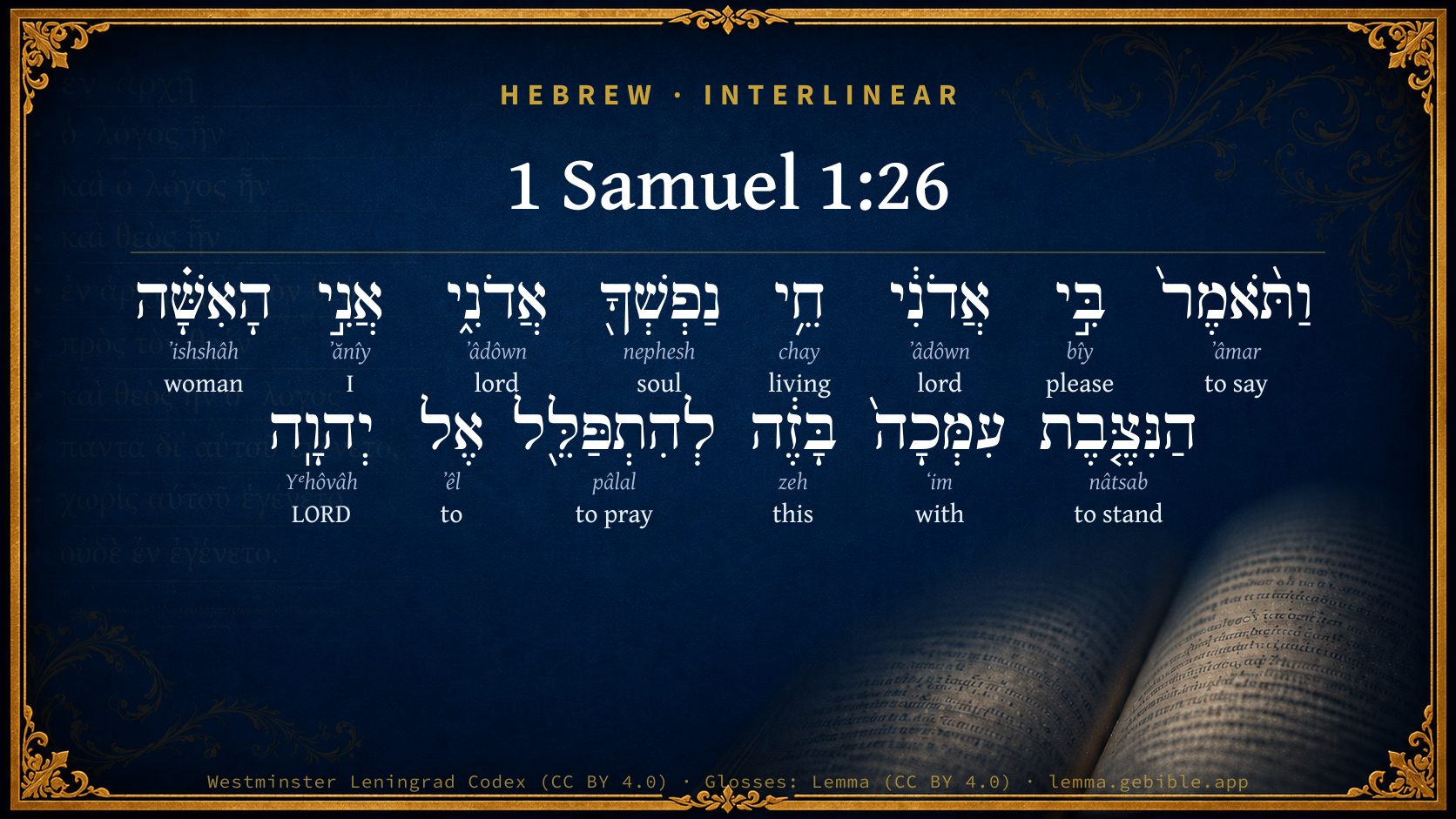
Hebrew (Westminster Leningrad Codex) 1 Samuel 1:26 appears in the Hebrew Old Testament. The text above is from the Westminster Leningrad Codex. Each word links to its Strong’s number, a concise gloss, and parsing drawn from the Open Scriptures Hebrew Bible morphology. Click any word for its full Brown-Driver-Briggs (BDB) entry.
Download image
Cite this verse

1 Samuel 1:26 (World English Bible). Public Domain. Lemma interlinear Bible study tool, https://lemma.gebible.app/v/1-samuel/1/26.

Show BibTeX & RIS
BibTeX
RIS
English Translation
She said, Oh, my lord, as your soul lives, my lord, I am the woman who stood by you here, praying to Yahweh.
World English Bible · Public Domain
Download a study sheet

One document with this verse’s original text, its word-by-word gloss line, the meaning frame, cross-references with their text, attributed commentary, and full source and license credits — printable, and it pastes into notes with its structure intact.

This verse Autodidact and up

Study sheet (.html) Plain text (.txt)

A passage Seminary Student

Up to 50 verses in one chapter. A passage sheet keeps up to 6 commentary sources and 12 cross-references per verse, in the order this page ranks them, and says so on the sheet whenever that leaves anything out. Ask for a single verse and you get the Autodidact verse sheet above.

Everything on this page stays free to read, with no account — the sheet is a download of what is already on screen, not access to it.

Want to remove ads? Support Godless Engineer
Compare translations 3

The same verse in 3 English versions, stacked beneath the original-language interlinear above. Click any original word for its lexicon entry.

Each is an independent rendering of the whole verse — the interlinear is not word-aligned to these translations.

Highlighted words mark where these versions differ — a whole-verse word diff, not a word-by-word alignment.

  • World English Bible Public Domain
    She said, Oh, my lord, as your soul lives, my lord, I am the woman who stood by you here, praying to Yahweh.
  • King James Version Public Domain
    And she said, Oh my lord, as thy soul liveth, my lord, I am the woman that stood by thee here, praying unto the LORD.
  • unfoldingWord Literal Text CC BY-SA 4.0
    And she said, “Please, my lord! The life of your soul, my lord, I the woman having stationed herself with you in this to pray to Yahweh.

unfoldingWord Literal Text — © unfoldingWord, licensed CC BY-SA 4.0. Word-aligned USFM3 via Door43 (git.door43.org/unfoldingWord/en_ult).

Versions to compare (up to 4)

3 of 4 selected

Show all 18 translations

Every available English version of this verse, each an independent rendering of the whole verse.

  • World English Bible Public Domain
    She said, Oh, my lord, as your soul lives, my lord, I am the woman who stood by you here, praying to Yahweh.
  • Berean Standard Bible Public Domain
    “Please, my lord,” said Hannah, “as surely as you live, my lord, I am the woman who stood here beside you praying to the LORD.
  • Majority Standard Bible Public Domain
    “Please, my lord,” said Hannah, “as surely as you live, my lord, I am the woman who stood here beside you praying to the LORD.
  • King James Version Public Domain
    And she said, Oh my lord, as thy soul liveth, my lord, I am the woman that stood by thee here, praying unto the LORD.
  • American Standard Version (1901) Public Domain
    And she said, Oh, my lord, as thy soul liveth, my lord, I am the woman that stood by thee here, praying unto Jehovah.
  • Revised Version (1885) Public Domain
    And she said, Oh my lord, as thy soul liveth, my lord, I am the woman that stood by thee here, praying unto the LORD.
  • Geneva Bible (1599) Public Domain
    And she said, Oh my Lord, as thy soule liueth, my lord, I am the woman that stoode with thee here praying vnto the Lord.
  • Douay-Rheims (1899) Public Domain
    And Anna said: I beseech thee, my lord, as thy soul liveth, my lord: I am that woman who stood before thee here praying to the Lord.
  • Young's Literal Translation Public Domain
    and she saith, `O, my lord, thy soul liveth! my lord, I `am' the woman who stood with thee in this `place', to pray unto Jehovah;
  • Literal Standard Version CC BY-SA 4.0
    and she says, “O my lord, your soul lives! My lord, I [am] the woman who stood with you in this [place], to pray to YHWH;
  • Unlocked Literal Bible CC BY-SA 4.0
    She said, “Oh, my master! As you live, my master, I am the woman who stood here next to you praying to Yahweh.
  • unfoldingWord Literal Text CC BY-SA 4.0
    And she said, “Please, my lord! The life of your soul, my lord, I the woman having stationed herself with you in this to pray to Yahweh.
  • Darby Bible Public Domain
    And she said, Oh my lord, [as] thy soul liveth, my lord, I am the woman that stood by thee here to pray to Jehovah.
  • World Messianic Bible Public Domain
    She said, “Oh, my lord, as your soul lives, my lord, I am the woman who stood by you here, praying to the LORD.
  • Webster's Bible Public Domain
    And she said, O my lord, as thy soul liveth, my lord, I am the woman that stood by thee here, praying to the LORD.
  • Free Bible Version CC BY-SA 4.0
    “Please, my lord,” said Hannah, “as surely as you live, my lord, I am the woman who stood here with you praying to the Lord.
  • Bible in Basic English Public Domain
    And she said, O my lord, as your soul is living, my lord, I am that woman who was making a prayer to the Lord here by your side:
  • JPS Tanakh (1917) Public Domain
    And she said: 'Oh, my lord, as thy soul liveth, my lord, I am the woman that stood by thee here, praying unto the LORD.

Literal Standard Version (2020), Covenant Press — licensed CC BY-SA 4.0. Text via the HelloAO Bible API (eBible.org). Unlocked Literal Bible (unfoldingWord) — licensed CC BY-SA 4.0. Text via the HelloAO Bible API (eBible.org). unfoldingWord Literal Text — © unfoldingWord, licensed CC BY-SA 4.0. Word-aligned USFM3 via Door43 (git.door43.org/unfoldingWord/en_ult). Free Bible Version, Dr. Jonathan Gallagher — licensed CC BY-SA 4.0. Text via the HelloAO Bible API (eBible.org).

Word by word

More ways to search: Search by grammar → Find every occurrence → Compare this word →

Practice this passage: Drill this verse → Learn its vocabulary →

בִּ֣י
bîy
H994
“please”
Particle, Exhortation
Part of Speech
Particle
Type
Exhortation
Full BDB Definition

Origin: perhaps from H1158 (sense of asking)

TWOT: 238a

if it please, pray excuse me, excuse me please - used to introduce an entreaty or request
  1. וַתֹּ֨אמֶר֙ ʼâmar H559 “and · to say” Conjunction + Verb, Qal, Sequential Imperfect, 3rd Person, Feminine, Singular
  2. אֲדֹנִ֔י ʼâdôwn H113 “lord · my” Noun, Common, Masculine, Singular, Construct + Suffix, Personal, 1st Person, Common, Singular
  3. חֵ֥י chay H2416 “living” Adjective, Adjective, Masculine, Singular, Absolute
  4. נַפְשְׁךָ֖ nephesh H5315 “soul · your” Noun, Common, Both, Singular, Construct + Suffix, Personal, 2nd Person, Masculine, Singular
  5. אֲדֹנִ֑י ʼâdôwn H113 “lord · my” Noun, Common, Masculine, Singular, Construct + Suffix, Personal, 1st Person, Common, Singular
  6. אֲנִ֣י ʼănîy H589 “I” Pronoun, Personal, 1st Person, Common, Singular
  7. הָאִשָּׁ֗ה ʼishshâh H802 “the · woman” Particle, Definite Article + Noun, Common, Feminine, Singular, Absolute
  8. הַנִּצֶּ֤בֶת nâtsab H5324 “the · standing” Particle, Definite Article + Verb, Niphal, Participle Active, Feminine, Singular, Absolute
  9. עִמְּכָה֙ ʻim H5973 “with · you” Preposition + Suffix, Personal, 2nd Person, Masculine, Singular
  10. בָּזֶ֔ה zeh H2088 “in/at · this” Preposition + Pronoun, Demonstrative, Masculine, Singular
  11. לְהִתְפַּלֵּ֖ל pâlal H6419 “to pray” Preposition + Verb, Hithpael, Infinitive Construct
  12. אֶל ʼêl H413 “to” Preposition
  13. יְהוָֽה Yᵉhôvâh H3068 “LORD” Noun, Proper

About this verse

These counts appear in no published source. They are computed here, from the morphology-tagged text and Lemma’s own curated glosses. What Lemma adds →

14
words
13
distinct lemmas
Historical
section

Notable vocabulary

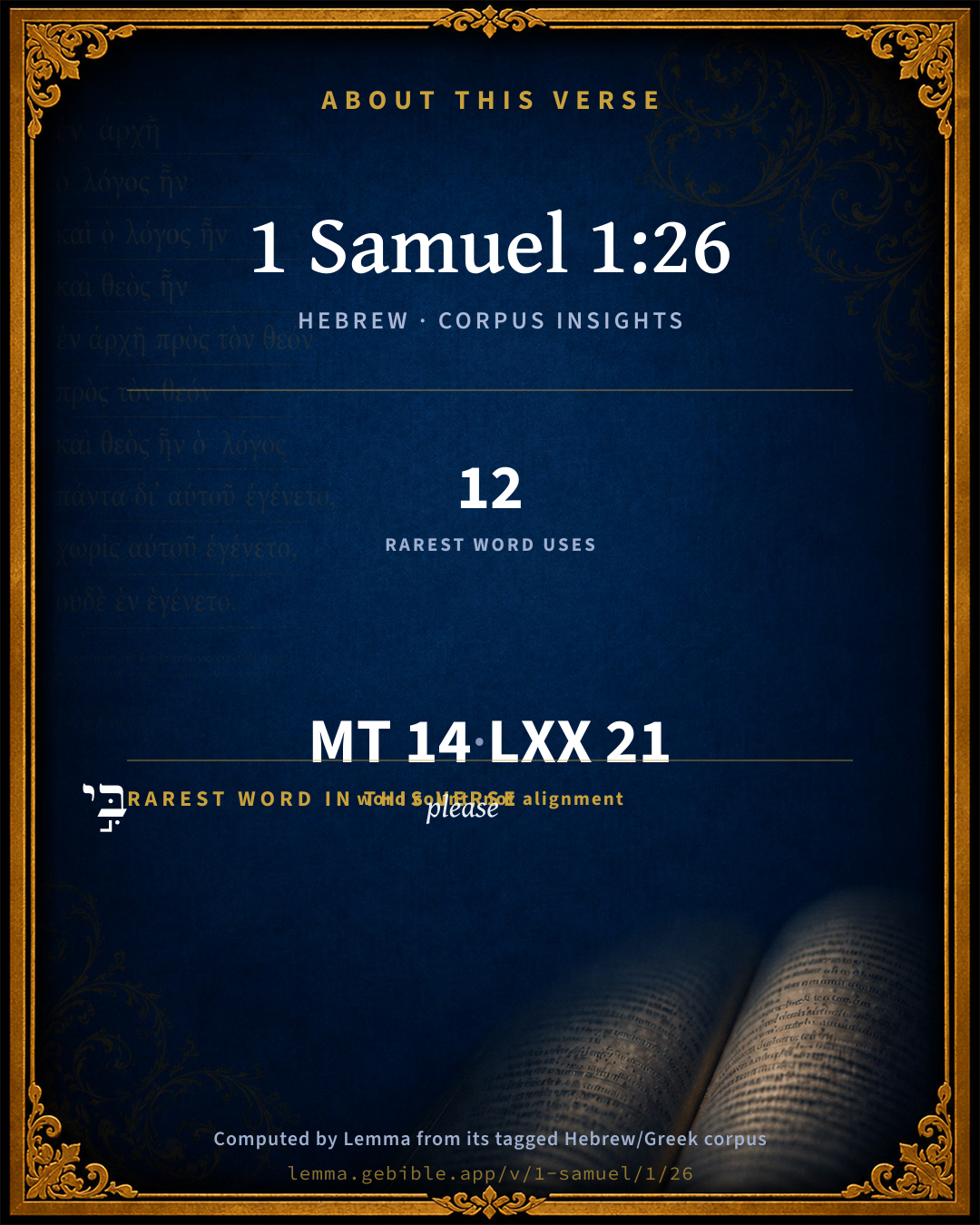
The rarest word here is בִּ֣י please H994 — appearing just 12 times in the whole Hebrew Bible.

Shared distinctive vocabulary

בִּ֣י please H994 occurs in 12 verses of the Hebrew Bible. Also found in:

Grammatical profile

  • 3 verbs
  • 5 nouns
  • 1 adjective
  • 2 pronouns
  • 2 prepositions
  • 1 particle

Verb forms

  • וַתֹּ֨אמֶר֙ Qal · Sequential Imperfect
  • הַנִּצֶּ֤בֶת Niphal · Participle Active
  • לְהִתְפַּלֵּ֖ל Hithpael · Infinitive Construct

Repetition

A word recurs within this verse — often emphatic in Hebrew:

  • אֲדֹנִ֔י lord H113 ×2

Hebrew & Septuagint length

In English translation the verse runs 23 words from the Hebrew and 28 from the Septuagint (LXX English) — closely comparable.

A rough comparison of the two English renderings, which tokenize alike — not a word-level alignment.

Word counts can differ between the Hebrew and the Greek without any difference in meaning — e.g. the Hebrew direct-object marker אֵת has no separate Greek word, and Greek often adds the article ὁ.

In the original languages it is 14 Hebrew tokens and 21 Greek tokens — but the two are counted differently (Hebrew bundles its prefixes and suffixes into one token; the Greek is in lemma form), so that isn’t a like-for-like length.

Cross-references

9

Topical passages linked to 1 Samuel 1:26 in the Treasury of Scripture Knowledge — connected by theme and wording, ordered by reader-vote popularity; previews shown in the World English Bible.

  • 2 Kings 2:2 Elijah said to Elisha, Please wait here, for Yahweh has sent me as far as Bethel. Elisha said, As Yahweh lives, and as your soul lives, I will not leave you. So they went down to Bethel.
  • 2 Kings 2:4 Elijah said to him, Elisha, please wait here, for Yahweh has sent me to Jericho. He said, As Yahweh lives, and as your soul lives, I will not leave you. So they came to Jericho.
  • 2 Kings 2:6 Elijah said to him, "Please wait here, for Yahweh has sent me to the Jordan." He said, "As Yahweh lives, and as your soul lives, I will not leave you." They two went on.
  • 2 Kings 4:30 The mother of the child said, As Yahweh lives, and as your soul lives, I will not leave you. He arose, and followed her.
  • 1 Samuel 17:55 When Saul saw David go forth against the Philistine, he said to Abner, the captain of the host, Abner, whose son is this youth? Abner said, As your soul lives, O king, I can't tell.
  • 1 Samuel 20:3 David swore moreover, and said, Your father knows well that I have found favor in your eyes; and he says, Don't let Jonathan know this, lest he be grieved: but truly as Yahweh lives, and as your soul lives, there is but a step between me and death.
  • 2 Samuel 11:11 Uriah said to David, The ark, and Israel, and Judah, abide in booths; and my lord Joab, and the servants of my lord, are encamped in the open field; shall I then go into my house, to eat and to drink, and to lie with my wife? as you live, and as your soul lives, I will not do this thing.
  • Genesis 42:15 Hereby you shall be tested. By the life of Pharaoh you shall not go forth from here, unless your youngest brother come here.
  • 2 Samuel 14:19 The king said, Is the hand of Joab with you in all this? The woman answered, As your soul lives, my lord the king, none can turn to the right hand or to the left from anything that my lord the king has spoken; for your servant Joab, he bade me, and he put all these words in the mouth of your handmaid;

Cross-references courtesy of OpenBible.info (CC BY 4.0).

Hebrew and Greek witnesses Masoretic Hebrew ↔ Greek Septuagint

The same verse in the two great witnesses to the Old Testament, shown verse-for-verse.

These are two independent witnesses, not word-aligned to each other, and the Septuagint is shown in lemma (dictionary) form.

Hebrew 1 Samuel 1:26 Masoretic · Westminster Leningrad Codex

וַתֹּ֨אמֶר֙ בִּ֣י אֲדֹנִ֔י חֵ֥י נַפְשְׁךָ֖ אֲדֹנִ֑י אֲנִ֣י הָאִשָּׁ֗ה הַנִּצֶּ֤בֶת עִמְּכָה֙ בָּזֶ֔ה לְהִתְפַּלֵּ֖ל אֶל יְהוָֽה

She said, Oh, my lord, as your soul lives, my lord, I am the woman who stood by you here, praying to Yahweh.

World English Bible · Public Domain

Greek LXX 1 Samuel 1:26 Septuagint · lemma form

καί εἶπον ἐν ἐγώ κύριος ζάω ὁ ψυχή σύ ἐγώ ὁ γυνή ὁ καταἵστημι ἐνώπιον σύ ἐν ὁ προςεὔχομαι πρός κύριος

And she said, I pray you, my lord, as your soul lives, I am the woman that stood in your presence with you while praying to the Lord.

LXX2012 (modern English Septuagint) · Public Domain

On this verse, Keil & Delitzsch discusses the Septuagint’s reading. Read the note in Commentary ↓

Hebrew: Westminster Leningrad Codex (CC BY 4.0). Greek: Septuagint (public domain); English from LXX2012 (modern English Septuagint) (Public Domain). How the Septuagint differs from the Hebrew →

Targum (Aramaic paraphrase)

1

The Targum is the ancient Jewish Aramaic paraphrase of the Hebrew Scriptures — an interpretive translation, not the Hebrew text itself. Onkelos (literal) and Pseudo-Jonathan (expansive) render the Torah, and Jonathan the Prophets. Coverage is partial: where no permissively-licensed English translation exists for a verse, only the Aramaic is shown. This is verse-level text, not a word-by-word alignment to the Hebrew.

  1. Targum Jonathan Prophets (Joshua–Malachi)
    וַאֲמַרַת בְּבָעוּ רִבּוֹנִי חַיֵי נַפְשָׁךְ רִבּוֹנִי אֲנָא אִתְּתָא דְאִתְעַתָּדַת עִמָךְ הָכָא לְצַלָאָה קֳדָם יְיָ:

    (no public-domain English translation for this verse)

    Targum Jonathan — Aramaic: “Mikraot Gedolot” (public domain). English: “Sefaria Community Translation” (CC0 1.0 (public-domain dedication)); “London "Chaldee Paraphrase," 1871” (public domain). Text via Sefaria.

Commentary

Notes on 1 Samuel 1:26 from classic Christian and Jewish commentators (each source and its license shown beneath its notes). The classic Christian expositions comment on the surrounding passage and are grouped to its opening verse, so a note may address several verses; the Jewish commentaries on the Tanakh (Rashi and others) are per-verse, so they appear only where the commentator wrote on this verse.

Lemma curates 59 commentaries, every one of them public domain or Creative Commons licensed, each selected and text-cleaned for this edition rather than reprinted as found. About our sources →

Trapp's Complete Commentary

John Trapp

1Sa 1:26 And she said, Oh my lord, [as] thy soul liveth, my lord, I [am] the woman that stood by thee here, praying unto the LORD.

Ver. 26. As thy soul liveth.] As sure as thou art alive. Her heart was full, her tongue fluent, in mentioning God’s mercy.

John Trapp, A Commentary or Exposition upon All the Books of the Old and New Testament (1647–1656) — public domain. Text from a community e-Sword module.

Geneva Bible (1599)

Geneva Bible translators

That is, most certainly.

Geneva Bible (1599) marginal notes — public domain. Text via Bolls.life.

Adam Clarke's Commentary

Verse 26. As thy soul liveth] As sure as thou art a living soul, so surely am I the person who stood by thee here praying.

Adam Clarke's Commentary on the Bible (1810–1826) — public domain. Text from a community e-Sword/MySword module.

Ellicott's Commentary for English Readers

(26) O my lord, as thy soul liveth.—“This oath is peculiar to the Books of Samuel, in which it occurs six times, and to the Books of Kings, in which, however, it is found only once. The similar oath, as Pharaoh liveth (by the life of Pharaoh), occurs in Gen_42:15; and as the Lord liveth is found almost exclusively in the books of which Judges is the first and 2 Kings the last, being especially frequent in the Books of Samuel. This accords with the fact of the age of the Judges and Saul being characteristically the age of vows.”—Speaker’s Commentary.

A Bible Commentary for English Readers, edited by Charles John Ellicott (1878–1897) — public domain. Text from a community e-Sword module.

The Cambridge Bible for Schools and Colleges

gen. ed. J. J. S. Perowne

26. as thy soul liveth] An oath peculiar to the books of Samuel and Kings.

that stood by thee] Prayer was offered either (a) standing, as by Hannah and Abraham (Gen_18:22), cp. Mat_6:5, Mar_11:25, Luk_18:11 : (b) kneeling, as by Solomon (1Ki_8:54), and by Daniel (Dan_6:10), cp. Act_9:40; Act_20:36; Act_21:5 : (c) prostrate, as by Moses and Aaron (Num_16:22), and by our Lord (Mat_26:39).

The Cambridge Bible for Schools and Colleges (gen. ed. J. J. S. Perowne; Cambridge University Press, 1878–1918) — public domain. Text from a community e-Sword module.

John Gill's Exposition

And she said, O my lord,.... According to the Targum, it is a supplication or request, I beseech thee, my lord; that is, to look upon her son, and take him under his care as his disciple or scholar, to instruct him in the law of God, and enter him into his service; to which Eli might be very backward and indifferent, and even treat it with some degree of contempt, that such a young Levite should be brought to him, when the soonest the Levites were admitted was at twenty five years of age:

as thy soul liveth, my lord; which Ben Gersom takes for the form of an oath, as if she swore to the truth of what follows by the life of the high priest; but as it was forbidden to swear by any but by the living God, by his life, it cannot be thought so good a woman as Hannah would be guilty of such a sinful and Heathenish practice; this rather is a wish or prayer for his life and health, and the continuance thereof, to bring up her son in the exercise of true religion:

I am the woman that stood by thee here, praying unto the Lord: by which it appears that Eli was now at the tabernacle, and in the same place he was, Sa1 1:9 when she was some years ago praying near him, at the distance of four cubits, as the Jews say: she takes no notice of his mistaking her for a drunken woman, nor of his censure on her, and the reproof he gave her; but puts him in mind only of her praying to the Lord standing near to him, which made him take the more notice of her; standing is a prayer posture; the Jews say there is no standing but what is prayer, or prayer is meant by it; See Gill on Mat 6:5.

John Gill's Exposition of the Whole Bible (1746–1763) — public domain (CC PDM 1.0). Text via the HelloAO Bible API.

Albert Barnes' Notes on the Bible

As thy soul liveth - This oath is unique to the Books of Samuel, in which it occurs six times, and to the Books of Kings, in which however, it is found only once. See the note to 1Sa 1:11.

Albert Barnes' Notes on the Bible (1834–1885) — public domain. Text from a community e-Sword/MySword module.

Haydock's Catholic Bible Commentary

Liveth: a strong attestation. (Menochius) --- As sure as you live; or, may you enjoy a long and happy life. See chap. xvii. 55., and xx. 3., Daniel iii. 9., and 2 Esdras ii. 3.

George Leo Haydock (1774–1849), Haydock's Catholic Family Bible and Commentary, 1859 edition — public domain. Excludes Psalms (Douay-Rheims chapter numbering differs from Protestant) and Deuterocanonical books (Catholic canon only).

Matthew Poole's English Annotations

Oh my lord; a form of speech to engage favourable attention.

As thy soul liveth; the usual form of an oath, as Gen 42:15; 1Sa 17:55; 20:3; as surely as thou livest: which asseverations seem necessary, because this was some years after it, and was quite forgotten by him.

Matthew Poole's English Annotations on the Holy Bible (1683–1685) — public domain. Text from a community e-Sword/MySword module.

Whedon's Commentary on the Bible

Daniel D. Whedon

26. As thy soul liveth — A form of oath peculiar to the books of Samuel. The age of the judges was noticeably an age of vows.

I am the woman — Eli had, perhaps, forgotten her, but she had kept his words in her heart. So, often, the minister of God may utter his benediction, which, though forgotten by himself, lives in another memory, and causes untold comfort.

Daniel D. Whedon (gen. ed.), Commentary on the Old and New Testaments (1874–1909) — public domain. Text from a community e-Sword module.

John Wesley's Explanatory Notes

Soul liveth - As surely as thou livest. Which asseveration seems necessary, because this was some years after it.

John Wesley, Explanatory Notes Upon the Whole Bible (1754–1765) — public domain. Text via the GEBible commentary corpus.

Keil & Delitzsch

C. F. Keil & F. Delitzsch

When the boy was presented, his mother made herself known to the high priest as the woman who had previously prayed to the Lord at that place (see Sa1 1:11.), and said, "For this child I prayed; and the Lord hath granted me my request which I asked of Him: therefore I also make him one asked of the Lord all the days that he liveth; he is asked of the Lord." וגם אנכי: I also; et ego vicissim (Cler.). השׁאיל, to let a person ask, to grant his request, to give him what he asks (Exo 12:36), signifies here to make a person "asked" (שׁאוּל). The meaning to lend, which the lexicons give to the word both here and Exo 12:36, has no other support than the false rendering of the lxx, and is altogether unsuitable both in the one and the other. Jehovah had not lent the son to Hannah, but had given him (see Sa1 1:11); still less could a man lend his son to the Lord. The last clause of Sa1 1:28, "and he worshipped the Lord there," refers to Elkanah, qui in votum Hannae consenserat, and not to Samuel. On a superficial glance, the plural ישׁתּחווּ, which is found in some Codd., and in the Vulgate, Syriac, and Arabic, appears the more suitable; but when we look more closely at the connection in which the clause stands, we see at once that it does not wind up the foregoing account, but simply introduces the closing act of the transference of Samuel. Consequently the singular is perfectly appropriate; and notwithstanding the fact that the subject is not mentioned, the allusion to Samuel is placed beyond all doubt. When Hannah had given up her son to the high priest, his father Elkanah first of all worshipped before the Lord in the sanctuary, and then Hannah worshipped in the song of praise, which follows in Sa1 2:1-10.

Keil & Delitzsch — Biblical Commentary on the Old Testament (1861–1891) — public domain (CC PDM 1.0). Text via the HelloAO Bible API. (Old Testament only.)

unfoldingWord translationNotes

Door43 World Missions Community

Oh, my master! As you live, my master

Here the idiom "As you live" shows that Hannah is being sincere and truthful. AT: "Sir, what I am going to tell you is certainly true" (See: Idiom)

has given me my petition which I asked of him

The noun "petition" refers to a formal request for another person to do something. It can be translated with a verb. The idiom "to give a petition" means to do what the person requests. AT: "has agreed to do what I solemnly requested that he do" (See: Abstract Nouns and Idiom)

he is lent to Yahweh

This can be translated in active form. AT: "I am loaning him to Yahweh" (See: Active or Passive)

he worshiped Yahweh

Possible meanings: 1) "He" refers to Elkanah or 2) "he" is a synecdoche referring to both Elkanah and his family. AT: "Elkanah and his family" (See: Synecdoche)

translationWords

lord

pray

unfoldingWord translationNotes — © Distant Shores Media and the Door43 World Missions Community, licensed CC BY-SA 4.0. Source: git.door43.org/Door43/en_tn.

Rashi

Rabbi Shlomo Yitzchaki (Rashi)

Please my lord. Take care of him, that he become your disciple. But according to the Midrash of our Sages, [she asked of Eili] not to punish him with death.

Rashi on the Tanakh — English translations: “The Judaica Press complete Tanach with Rashi, translated by A. J. Rosenberg” (CC BY 4.0); “Pentateuch with Rashi's commentary by M. Rosenbaum and A.M. Silbermann, 1929-1934” (public domain); “The Metsudah Tanach series, Lakewood, N.J” (CC BY 4.0); and “The Book of Joshua, Metsudah Publications, 1997” (CC BY 4.0). Text via Sefaria.

Radak

Rabbi David Kimhi (Radak)

Please, my lord: It is a matter of a supplication and a request - like its translation [in Targum Yonatan], "please, my master" - as you live, that you should keep your eyes upon this lad and teach him, for "I am the woman" who prayed to the Lord.

With you: Meaning to say, before you and in your presence - as you were there when I prayed. And I prayed for this lad and the Lord granted me what I asked, as you proclaimed to me. And the [letter,] hey [at the end of the word, imcha (with you)] is like the hey in (Jeremiah 29:25), "that you sent books in your name"; (Exodus 13:16) "and they will be a sign upon your hand"; and those that are similar to it. As leave it alone - sometimes it is written and sometimes it is not written. And there is a homiletical teaching about it - from here, [we learn about] the four cubits of prayer.

Radak on the Tanakh — English translations: “Sefaria Community Translation” (CC0 1.0 (public-domain dedication)); “Eliyahu Munk, HaChut Hameshulash” (CC BY 4.0); “Rabbi Mike Feuer, Jerusalem Anthology” (CC BY 4.0); and “R. David Kimhi on the first book of Psalms, Translated by R.G. Finch, London, 1919” (public domain). Text via Sefaria.

Lesson kit

Teaching starters — assembled from the data on this page, not authored interpretation. Every prompt links to the verse data it draws on. Edit before teaching.

1 Samuel, in the Historical, opens this verse with 14 words (13 distinct Hebrew lemmas). Its most distinctive word is bîy (“please”). A historical commentator’s framing appears above. Read the whole chapter for the surrounding context.

Discussion questions

  1. How does “please” (bîy) shape what this verse is saying?
  2. How does Genesis 43:20, which shares the word «please», read alongside this verse?
  3. What does the repetition of “lord” (2× in this one verse) do in this verse?
  4. These translations render this verse differently; the difference is in the English rendering, not the original. What questions does that raise?
  5. «וַתֹּ֨אמֶר֙» is a Qal Sequential Imperfect verb. How does that grammatical form shape the action described?
  6. Compare how Trapp's Complete Commentary and Geneva Bible (1599) read this verse. Where do they agree or differ?

Things to notice

Reading settings

Reading text

Shown beneath each verse's original-language words.

Old Testament
Old Testament edition

Read the OT as the Masoretic Hebrew (MT) or the Greek Septuagint (LXX).

English shown for the Greek Septuagint (in the Hebrew ↔ Greek comparison).

Comparing translations? Open the Compare panel on any verse page to stack up to four side by side.