
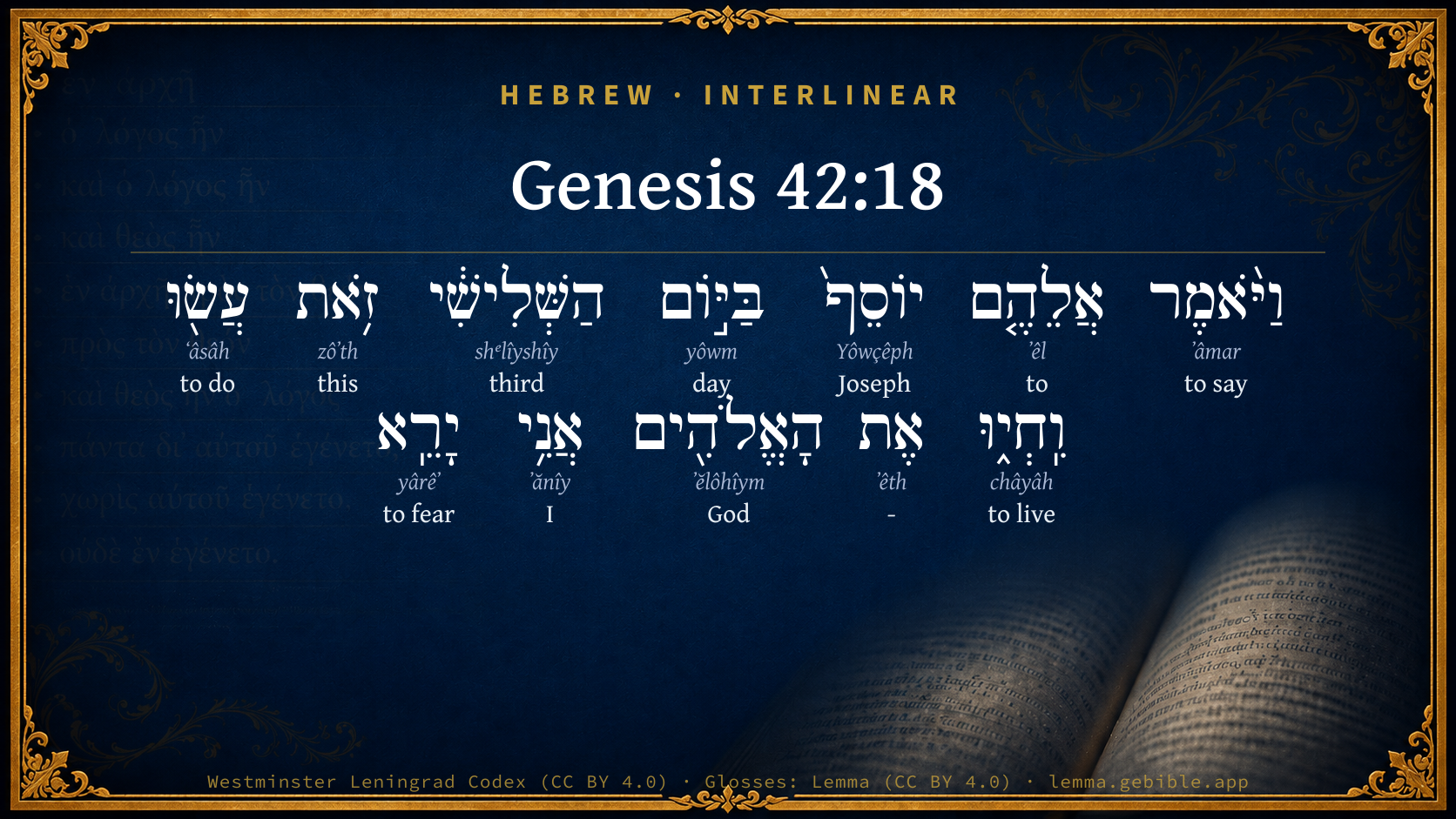
Genesis 42:18

Hebrew (Westminster Leningrad Codex) Genesis 42:18 appears in the Hebrew Old Testament. The text above is from the Westminster Leningrad Codex. Each word links to its Strong’s number, a concise gloss, and parsing drawn from the Open Scriptures Hebrew Bible morphology. Click any word for its full Brown-Driver-Briggs (BDB) entry.
Download image
Cite this verse

Genesis 42:18 (World English Bible). Public Domain. Lemma interlinear Bible study tool, https://lemma.gebible.app/v/genesis/42/18.

Show BibTeX & RIS
BibTeX
RIS
English Translation
Joseph said to them the third day, "Do this, and live, for I fear God.
World English Bible · Public Domain
Download a study sheet

One document with this verse’s original text, its word-by-word gloss line, the meaning frame, cross-references with their text, attributed commentary, and full source and license credits — printable, and it pastes into notes with its structure intact.

This verse Autodidact and up

Study sheet (.html) Plain text (.txt)

A passage Seminary Student

Up to 50 verses in one chapter. A passage sheet keeps up to 6 commentary sources and 12 cross-references per verse, in the order this page ranks them, and says so on the sheet whenever that leaves anything out. Ask for a single verse and you get the Autodidact verse sheet above.

Everything on this page stays free to read, with no account — the sheet is a download of what is already on screen, not access to it.

Want to remove ads? Support Godless Engineer
Compare translations 3

The same verse in 3 English versions, stacked beneath the original-language interlinear above. Click any original word for its lexicon entry.

Each is an independent rendering of the whole verse — the interlinear is not word-aligned to these translations.

Highlighted words mark where these versions differ — a whole-verse word diff, not a word-by-word alignment.

  • World English Bible Public Domain
    Joseph said to them the third day, "Do this, and live, for I fear God.
  • King James Version Public Domain
    And Joseph said unto them the third day, This do, and live; for I fear God:
  • unfoldingWord Literal Text CC BY-SA 4.0
    Then Joseph said to them on the third day, “Do this and live, I fear God:

unfoldingWord Literal Text — © unfoldingWord, licensed CC BY-SA 4.0. Word-aligned USFM3 via Door43 (git.door43.org/unfoldingWord/en_ult).

Versions to compare (up to 4)

3 of 4 selected

Show all 18 translations

Every available English version of this verse, each an independent rendering of the whole verse.

  • World English Bible Public Domain
    Joseph said to them the third day, "Do this, and live, for I fear God.
  • Berean Standard Bible Public Domain
    and on the third day he said to them, “I fear God. So do this and you will live:
  • Majority Standard Bible Public Domain
    and on the third day he said to them, “I fear God. So do this and you will live:
  • King James Version Public Domain
    And Joseph said unto them the third day, This do, and live; for I fear God:
  • American Standard Version (1901) Public Domain
    And Joseph said unto them the third day, This do, and live: for I fear God:
  • Revised Version (1885) Public Domain
    And Joseph said unto them the third day, This do, and live; for I fear God:
  • Geneva Bible (1599) Public Domain
    Then Ioseph said vnto them the third day, This do, and liue: for I feare God.
  • Douay-Rheims (1899) Public Domain
    And the third day he brought them out of prison, and said: Do as I have said, and you shall live: for I fear God.
  • Young's Literal Translation Public Domain
    And Joseph saith unto them on the third day, `This do and live; God I fear!
  • Literal Standard Version CC BY-SA 4.0
    And Joseph says to them on the third day, “Do this and live; I fear God!
  • Unlocked Literal Bible CC BY-SA 4.0
    Joseph said to them on the third day, “Do this and live, for I fear God.
  • unfoldingWord Literal Text CC BY-SA 4.0
    Then Joseph said to them on the third day, “Do this and live, I fear God:
  • Darby Bible Public Domain
    And Joseph said to them the third day, This do, that ye may live: I fear God.
  • World Messianic Bible Public Domain
    Joseph said to them the third day, “Do this, and live, for I fear God.
  • Webster's Bible Public Domain
    And Joseph said to them the third day, This do, and live; for I fear God:
  • Free Bible Version CC BY-SA 4.0
    On the third day he told them, “Since I'm someone who respects God, do as I tell you and you'll live.
  • Bible in Basic English Public Domain
    And on the third day Joseph said to them, Do this, if you would keep your lives: for I am a god-fearing man:
  • JPS Tanakh (1917) Public Domain
    And Joseph said unto them the third day. 'This do, and live; for I fear God:

Literal Standard Version (2020), Covenant Press — licensed CC BY-SA 4.0. Text via the HelloAO Bible API (eBible.org). Unlocked Literal Bible (unfoldingWord) — licensed CC BY-SA 4.0. Text via the HelloAO Bible API (eBible.org). unfoldingWord Literal Text — © unfoldingWord, licensed CC BY-SA 4.0. Word-aligned USFM3 via Door43 (git.door43.org/unfoldingWord/en_ult). Free Bible Version, Dr. Jonathan Gallagher — licensed CC BY-SA 4.0. Text via the HelloAO Bible API (eBible.org).

Word by word

More ways to search: Search by grammar → Find every occurrence → Compare this word →

Practice this passage: Drill this verse → Learn its vocabulary →

הַשְּׁלִישִׁ֔י
shᵉlîyshîy
H7992
“the · third”
Particle, Definite Article + Adjective, Ordinal number, Masculine, Singular, Absolute
Part of Speech
Particle + Adjective
Type
Ordinal number
Gender
Masculine
Number
Singular
State
Absolute
Full BDB Definition

Origin: ordinal from H7969

TWOT: 2403b

third, one third, third part, third time - ordinal number
  1. וַיֹּ֨אמֶר ʼâmar H559 “and · to say” Conjunction + Verb, Qal, Sequential Imperfect, 3rd Person, Masculine, Singular
  2. אֲלֵהֶ֤ם ʼêl H413 “to · them” Preposition + Suffix, Personal, 3rd Person, Masculine, Plural
  3. יוֹסֵף֙ Yôwçêph H3130 “Joseph” Noun, Proper
  4. בַּיּ֣וֹם yôwm H3117 “in/at the · day” Preposition, Determined + Noun, Common, Masculine, Singular, Absolute
  5. זֹ֥את zôʼth H2063 “this” Pronoun, Demonstrative, Feminine, Singular
  6. עֲשׂ֖וּ ʻâsâh H6213 “do” Verb, Qal, Imperative, 2nd Person, Masculine, Plural
  7. וִֽחְי֑וּ châyâh H2421 “and · live” Conjunction + Verb, Qal, Imperative, 2nd Person, Masculine, Plural
  8. אֶת ʼêth H853 “-” Particle, Direct Object
  9. הָאֱלֹהִ֖ים ʼĕlôhîym H430 “the · God(s)” Particle, Definite Article + Noun, Common, Masculine, Plural, Absolute
  10. אֲנִ֥י ʼănîy H589 “I” Pronoun, Personal, 1st Person, Common, Singular
  11. יָרֵֽא yârêʼ H3372 “fearing” Verb, Qal, Participle Active, Masculine, Singular, Absolute

About this verse

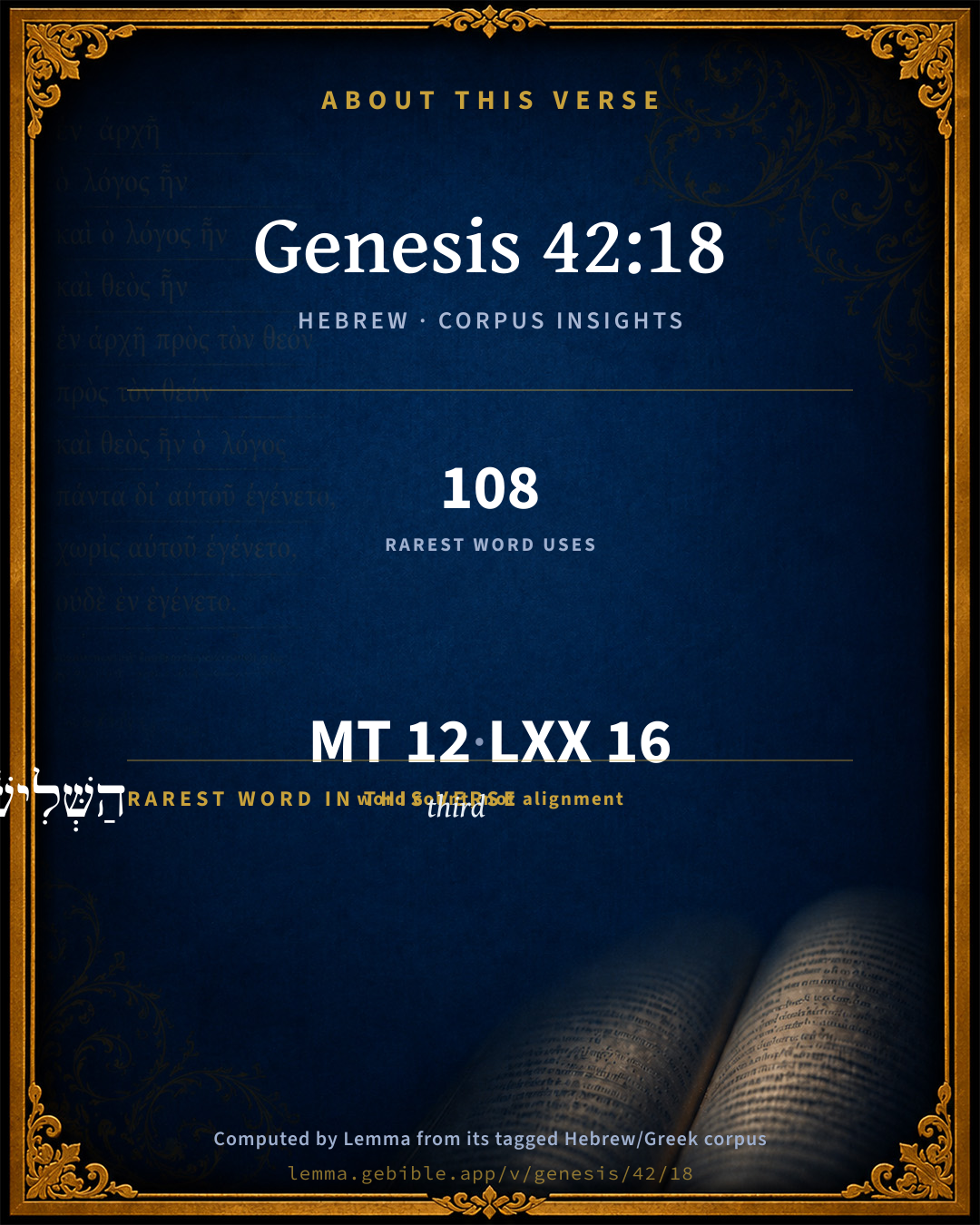
These counts appear in no published source. They are computed here, from the morphology-tagged text and Lemma’s own curated glosses. What Lemma adds →

12
words
12
distinct lemmas
Pentateuch
section

Grammatical profile

  • 4 verbs
  • 3 nouns
  • 1 adjective
  • 2 pronouns
  • 1 preposition
  • 1 particle

Verb forms

  • וַיֹּ֨אמֶר Qal · Sequential Imperfect
  • עֲשׂ֖וּ Qal · Imperative
  • וִֽחְי֑וּ Qal · Imperative
  • יָרֵֽא Qal · Participle Active

Hebrew & Septuagint length

In English translation the verse runs 15 words from the Hebrew and 19 from the Septuagint (LXX English) — closely comparable.

A rough comparison of the two English renderings, which tokenize alike — not a word-level alignment.

Word counts can differ between the Hebrew and the Greek without any difference in meaning — e.g. the Hebrew direct-object marker אֵת has no separate Greek word, and Greek often adds the article ὁ.

In the original languages it is 12 Hebrew tokens and 16 Greek tokens — but the two are counted differently (Hebrew bundles its prefixes and suffixes into one token; the Greek is in lemma form), so that isn’t a like-for-like length.

Cross-references

6

Topical passages linked to Genesis 42:18 in the Treasury of Scripture Knowledge — connected by theme and wording, ordered by reader-vote popularity; previews shown in the World English Bible.

  • Leviticus 25:43 You shall not rule over him with harshness, but shall fear your God.
  • Nehemiah 5:15 But the former governors who were before me were chargeable to the people, and took of them bread and wine, besides forty shekels of silver; yes, even their servants bore rule over the people: but I didn't do so, because of the fear of God.
  • Genesis 20:11 Abraham said, "Because I thought, 'Surely the fear of God is not in this place. They will kill me for my wife's sake.'
  • Luke 18:2 saying, "There was a judge in a certain city who didn't fear God, and didn't respect man.
  • Nehemiah 5:9 Also I said, The thing that you do is not good: ought you not to walk in the fear of our God, because of the reproach of the nations our enemies?
  • Luke 18:4 He wouldn't for a while, but afterward he said to himself, 'Though I neither fear God, nor respect man,

Cross-references courtesy of OpenBible.info (CC BY 4.0).

Hebrew and Greek witnesses Masoretic Hebrew ↔ Greek Septuagint

The same verse in the two great witnesses to the Old Testament, shown verse-for-verse.

These are two independent witnesses, not word-aligned to each other, and the Septuagint is shown in lemma (dictionary) form.

Hebrew Genesis 42:18 Masoretic · Westminster Leningrad Codex

וַיֹּ֨אמֶר אֲלֵהֶ֤ם יוֹסֵף֙ בַּיּ֣וֹם הַשְּׁלִישִׁ֔י זֹ֥את עֲשׂ֖וּ וִֽחְי֑וּ אֶת הָאֱלֹהִ֖ים אֲנִ֥י יָרֵֽא

Joseph said to them the third day, "Do this, and live, for I fear God.

World English Bible · Public Domain

Greek LXX Genesis 42:18 Septuagint · lemma form

εἶπον δέ αὐτός ὁ ἡμέρα ὁ τρίτος οὗτος ποιέω καί ζάω ὁ θεός γάρ ἐγώ φοβέω

And he said to them on the third day, This do, and you⌃ shall live, for I fear God.

LXX2012 (modern English Septuagint) · Public Domain

Hebrew: Westminster Leningrad Codex (CC BY 4.0). Greek: Septuagint (public domain); English from LXX2012 (modern English Septuagint) (Public Domain). How the Septuagint differs from the Hebrew →

Targum (Aramaic paraphrase)

2

The Targum is the ancient Jewish Aramaic paraphrase of the Hebrew Scriptures — an interpretive translation, not the Hebrew text itself. Onkelos (literal) and Pseudo-Jonathan (expansive) render the Torah, and Jonathan the Prophets. Coverage is partial: where no permissively-licensed English translation exists for a verse, only the Aramaic is shown. This is verse-level text, not a word-by-word alignment to the Hebrew.

  1. Targum Onkelos Torah (Genesis–Deuteronomy)
    וַאֲמַר לְהוֹן יוֹסֵף בְּיוֹמָא תְלִיתָאָה דָּא עִבִידוּ וְאִתְקַיָּמוּ מִן קֳדָם יְיָ אֲנָא דָּחֵל

    (no public-domain English translation for this verse)

    Targum Onkelos — Aramaic: “Onkelos Genesis” (public domain); “Onkelos Exodus” (public domain); “Onkelos Leviticus” (public domain); “Onkelos Numbers” (public domain); “Onkelos Deuteronomy” (public domain). English: “Sefaria Community Translation” (CC0 1.0 (public-domain dedication)); “J.W. Etheridge. The Targums of Onkelos and Jonathan Ben Uzziel on the Pentateuch. London: Longmans, Green, 1862” (public domain). Text via Sefaria.

  2. Targum Pseudo-Jonathan Torah (Genesis–Deuteronomy)
    וַאֲמַר לְהוֹם יוֹסֵף בְּיוֹמָא תְּלִיתָאָה דָא עִיבִידוּ וְאִתְקַיְימוּ מִן קֳדָם יְיָ אֲנָא דָחִיל

    And Joseph said to them on the third day, This do, that you may live; for I fear the Lord.

    Targum Pseudo-Jonathan — Aramaic: “Targum Jonathan on Genesis” (public domain); “Targum Jonathan on Exodus” (public domain); “Targum Jonathan on Leviticus” (public domain); “Targum Jonathan on Numbers” (public domain); “Targum Jonathan on Deuteronomy” (public domain). English: “The Targum of Jonathan ben Uzziel, trans. J. W. Etheridge, London, 1862” (public domain). Text via Sefaria.

Commentary

Notes on Genesis 42:18 from classic Christian and Jewish commentators (each source and its license shown beneath its notes). The classic Christian expositions comment on the surrounding passage and are grouped to its opening verse, so a note may address several verses; the Jewish commentaries on the Tanakh (Rashi and others) are per-verse, so they appear only where the commentator wrote on this verse.

Lemma curates 59 commentaries, every one of them public domain or Creative Commons licensed, each selected and text-cleaned for this edition rather than reprinted as found. About our sources →

Trapp's Complete Commentary

John Trapp

Gen 42:18 And Joseph said unto them the third day, This do, and live; [for] I fear God:

Ver. 18. And Joseph said unto them the third day.] So God, "after two days, will receive his; in the third day he will raise them up, and they shall live in his sight." {Hos 6:2} "The rod of the wicked shall not rest on the lot of the righteous, lest they put forth their hands to folly"; {Psa 125:3} lest their "spirits fail" before him. For others he cares not so much, as for the choice spirits of his faithful people. When we beat ordinary spices, we care not for every dust, but let some fly out, and fall on the ground; but if Bezoar stone, or some such precious stuff, every little is looked to. So here.

For I fear God.] Deum illum, saith Junias, that true God, the proper object of fear; and therefore you need not doubt of fair dealing. {See Trapp on "Gen 20:11"} Learn here, that confession of our faith is to be made as oft as thereby God may be glorified and our brethren edified.

John Trapp, A Commentary or Exposition upon All the Books of the Old and New Testament (1647–1656) — public domain. Text from a community e-Sword module.

The Biblical Illustrator

Joseph S. Exell

Gen_42:18

For I fear God

The fear of God

1.

The first impression which the human mind receives from the conviction of an over-ruling Power, is that of fear. It is a moral impression. It is made upon the conscience. A feeling of awe at the thought of an invisible witness, who judges and will requite.

2. For I fear God. The text begins with a word that connects it with something else; that supposes a reason for the assertion it makes. Why should we thus fear Him? Because He is present to every agreement that is made, to every promise that is spoken, to every purpose that is secretly devised, to every action, however silently done. Because He is holy, and the righteous Lord hateth iniquity. Because He is mighty, and who can stand before His displeasure? Because He requires the duty by which we feel ourselves bound. Because He appoints every law, and chastises for its infraction. Because, if through that subduing veneration, that salutary dread, we hold fast our integrity and depart from evil, we are encouraged by His assurances, we are encompassed by His defence.

3. There are various ways in which these effects are produced upon the children of disobedience.

(1) They fear the powers of the visible world, as if they were ready to betray or smite their delinquencies; as if their sounds might publish something concerning them, or their arrows upon the string had an aim towards them. The stormy wind or the voice of the waters may have a word to fulfil for their condemnation. The rustling leaf has a warning. The bare bough points. A bird of the air shall carry the matter. There is a Greek story of a poet who, falling under the daggers of robbers, called upon some cranes who was flying overhead to avenge his death. While his name and fate were yet upon the public tongue, in a great assembly of the people--when in the vast theatre of Corinth, open to the sky, the solemn chorus and personation of the Furies were exhibiting the truth, that there is no shadow of death where the workers of iniquity can hide themselves--a flock of those noisy birds darkened and shook the air. A cry escapedfrom the assassins, who were present at the spectacle. Their detection followed, and their just death was added as the terrible conclusion of the sacred song, and fulfilment of its prophecy. The story may be true, for doubtless such things have been. And they illustrate one part of the fact, that the creation, even in its innocent objects and pleasant forms, is the enemy of those who will not make the Author of it a friend.

(2) There are surprises of Providence, in disappointment, deprivation, pain. These are trials wherever they fall; but to persons sensible that they have given them the right to surprise, they are peculiarity full of dismay. Sudden accidents will occur. The usual order of our lives will be broken in upon by strange occurrences. Dangers springs up by the wayside. Sorrows invade the dearest neighbourhoods of our life. Many, like old Israels sons, find a journey made to the south terminate into captivity, and have to bear the burden of Egypt, while they were seeking for its corn. Wretched, indeed, if what they must suffer then admonishes them of their trespasses, and forces from them the confession, We are verily guilty concerning our brother. But, without imagining any of these casualties and violent interruptions, and troubles that may come, there are others that must come. The God whom we fear deals with us in the slow course of His appointments, through the gradual changes of time and age. If He continues our days upon the earth, we must pay for the privilege by parting with many of their delights, feeling some unwelcome alterations, and witnessing more. The soul will have to retire further inward for its satisfactions or its repose, as remembrance out-measures expectation, and the veils of the flesh grow thin. When the world is declining, its weight greater and its pleasure less, will not everything appear departing from us, if the answer of a good conscience and a hope towards an immortal possession do not remain behind? To feel forsaken of God, or obnoxious to His judgments then!--is not that a dreary and terrible occasion of fear?

4. The several topics hitherto mentioned touch upon what is outside of us. They have been immediately connected with natural objects, or distressful incidents, or waning powers. But all these are only circumstances. The individual consciousness of every one dwells in the midst of them, and impresses them with a character of its own. Here is the true seat of the principle. Let each stand in awe of what is within him; of the judgments that are pronounced beyond mortal hearing, and executed through the habits, the fancies, the passions, the memories, of the mind itself. Are these habits depraved--these fancies disordered? Do these passions start away from holy motives? Do these memories condemn the past, that cannot be restored to be tried again and live better? The hostilities of nature the utmost rage of the air and sea, are nothing to this. Pain and misadventure are nothing. The wear and losses of encroaching years are nothing. (N. L.Frothingham.)

The story of Joseph

Joseph punishes Simeon by imprisonment. It may be that he had reasons for it which we are not told. But when his brothers have endured the trial, and he finds that Benjamin is safe, he has nothing left but forgiveness. They are his brethren still--his own flesh and blood. And he fears God. He dare not do anything but forgive them. He forgives them utterly, and welcomes them with an agony of happy tears. He will even put out of their minds the very memory of their baseness. Now, therefore, be not grieved nor angry with yourselves that ye sold me hither, he says; for God, &c. Is not that Divine? Is not that the Spirit of God and of Christ? I say it is. For what is it but the likeness of Christ, who says for ever, out of heaven to all mankind, Be not grieved nor angry with yourselves that ye crucified me; for God, my Father, sent me to save your souls by a great salvation. My friends, learn from this story of Joseph, and the prominent place in the Bible which it occupies--learn, I say, how hateful to God are family quarrels; how pleasant to God are family unity and peace, and mutual trust, and duty, and helpfulness. And if you think that I speak too strongly on this point, recollect that I do no more than St. Paul does, when he sums up the most lofty and mystical of all his Epistles, the Epistle to the Ephesians, by simple commands to husbands and wives, parents and children, masters and servants, as if he should say: You wish to be holy? you wish to be spiritual? Then fulfil these plain family duties, for they, too are sacred and divine, and he who despises them, despises the ordinances of God. And if you despise the laws of God, they will surely avenge themselves on you. If you are bad husbands or bad wives, bad parents or bad children, bad brothers or sisters, bad masters or servants, you will smart for it, according to the eternal laws of God, which are at work around you all day long, making the sinner punish himself whether he likes or not. Examine yourselves--ask yourselves, each of you, Have I been a good brother? have I been a good son? have I been a good husband? have I been a good father? have I been a good servant? If not, all professions of religion will avail me nothing. If not, let me confess my sins to God, and repent and amend at once, whatever it may cost me. (C. Kingsley, M. A.)

The fear of God

This fear should daily control every Christian. No influence on the feelings, or the character, can be more salutary. What greater preservative from wrong can there be in youth, than the constant presence of a parent, whose feelings we regard, whose opinions we respect, and whose judgment we reverence. And if the presence of a parent is so salutary in restraining us from transgression, how much more so must the impression be, that we act in the view of the Almighty? And how appropriate to the condition of an immortal being is the state of mind, which is described in the saying, I fear God. I fear God. I know He is here. He is everywhere. I cannot go from His presence, nor flee from Him. To live, and move, and be in the presence of so great and adorable a being, cannot but excite emotions of awe. It cannot fail, if rightly considered, to produce a salutary fear in the heart of every child of Adam. I fear God. He knows all my actions. Not one of them has been concealed from His view. The sins of my childhood are known to Him. They are written in His book. The iniquities of my youth are kept in His remembrance. The transgressions of maturer years are not hidden from His eyes. No palliation nor excuse can cause Him to take a different view of them from that with which He beholds them. He understands my thoughts. There is not a thought in my heart, but He knows it altogether. There is no operation of my intellect, which He does not readily perceive. The subterfuges, which a perverted heart, or a soul full of prejudice, cast over its own doings, do not conceal it from the Most High. He knows all my opinions. If interest, or the fear of man, or the pride of consistency shall influence me to give, as my view of facts or of truths, a sentiment at variance with what seems to me to be according to truth, He sees it all. He fully comprehends the hyprocrisy of the transaction, and abhors the iniquity. He knows my motives. He knows what it is in us that moves us to retain His Word in our families; what it is that influences us to come to His house; what it is that incites any of us to profess to be His disciples. He knows all our feelings. There is no affection in our hearts which is not entirely open to His view. I fear God; for He is holy. To some, it may seem strange that the holiness of a being should be a ground of fear. But there is no other consideration which invests the character of Jehovah with such fearfulness, as that of His holiness. And this is as true of those who are holy, as of those whose sinfulness exposes them to His indignation. No other trait is more prominent in the character of devout men, than the fear of God. And this reverential regard for Him does not abate, even when the soul becomes perfect in glory. When John had a view of the heavenly world, he heard them sing the song of Moses, the servant of God, and the song of the Lamb, saying, Great and marvellous are Thy works, Lord God Almighty; just and true are Thy ways, Thou King of saints. Who shall not fear Thee, O Lord, and glory Thy name, for Thou only art holy! I fear God; for He has a settled aversion to sin. This is His nature, and He is immutable--immutable in His attachment to holiness, and in His opposition to sin. Now, who that knows the holiness of Jehovah, and His constant abhorrence of sin, will not fear Him? Can a human being, who is convinced that he has violated the law of God--who understands that during many years he was constantly engaged in rebellion against Him--who feels, that even if he has been born of God, he has not been perfect, but is chargeable every day, in the view of Infinite Holiness, with many transgressions--can he live without fear? Considering the strength of his unsubdued propensities to evil, will he not be apprehensive that he may incur the displeasure of a Holy God? I fear God; for He inflicts severe chastisements, even in this life, on such of His people as wander from Him. I fear God; by Him I must be judged. All my deeds, my words, and my feelings, must pass His scrutiny and receive His sentence. Do you say, if I am a Christian, I ought not to fear? The Saviour has not thus instructed me. I will forewarn you, said He to His disciples, whom ye shall fear--fear Him who has power to destroy both soul and body in hell; yea, I say unto you, fear Him. In view of such a Judge, who will not fear? Now, if such a fear of God occupy our souls, then it will be impossible not to speak reverentially respecting Him. Again: If this fear of God be in us, we shall have a happy influence on others. Our conversation will evince that there is something in our hearts, which is not known to the world, nor felt by such as are alienated from God. Our lives will tell to all around us that there is something in the fear of God which is calculated to diffuse a heavenly savour over all cur feelings and actions. In ways innumerable--in ways which, it is impossible for us to describe, or others to see--a grace will distil on those around us like drops of the morning dew; and blessings of immeasurable value, and eternal duration, will descend upon them. Brethren--let the fear of God dwell at all times in your hearts; for to that man, said Jehovah, will I look, who is humble, and of a contrite heart, and who trembleth at My word. (J. Foot, D. D.)

The Biblical Illustrator, edited by Joseph S. Exell (c. 1880s–1900s) — public domain. Text from a community e-Sword module.

Joseph Benson's Commentary

Gen 42:18. For I fear God — This was a very encouraging word unto them. It is as if he had said, You may assure yourselves I will do you no wrong; I dare not, for I know that, as high as I am, there is one higher than I. With those that fear God we have reason to expect fair dealing: the fear of God will be a check upon those that are in power, to restrain them from abusing their power to oppression and tyranny.

Joseph Benson's Commentary on the Old and New Testaments (1811–1818) — public domain. Text from a community e-Sword module.

Tyndale Open Study Notes

Tyndale Open Resources

42:18-20 Rather than keep all but one, Joseph would release all but one to take grain home to their starving families.

Tyndale Open Study Notes — © Tyndale Open Resources, licensed CC BY-SA 4.0. Text via the HelloAO Bible API.

Geneva Bible (1599)

Geneva Bible translators

And therefore am true and just.

Geneva Bible (1599) marginal notes — public domain. Text via Bolls.life.

Adam Clarke's Commentary

Verse 18. I fear God] את האלהים אני ירא eth haelohim ani yare, literally translated the passage runs thus, I also fear the gods; but the emphatic ה ha is probably added by Joseph, both here and in his conversation with Pharaoh, the more particularly to point out the eminence and perfection of the Supreme Being as contradistinguished from the gods of Egypt. He seems to say to his brethren, I am a worshipper of the true God, and ye have nothing to fear.

Adam Clarke's Commentary on the Bible (1810–1826) — public domain. Text from a community e-Sword/MySword module.

Ellicott's Commentary for English Readers

(18) I fear God (Elohim).—By the use of the name Elohim they would understand that he worshipped the same God as they did. For though he may himself have used the Egyptian word for the supreme Deity, yet doubtless he would take care that the interpreter used the word Elohim.

A Bible Commentary for English Readers, edited by Charles John Ellicott (1878–1897) — public domain. Text from a community e-Sword module.

The Cambridge Bible for Schools and Colleges

gen. ed. J. J. S. Perowne

18–26. The second Interview

18. for I fear God] See notes on Gen_20:3; Gen_20:11, Gen_22:12, Gen_39:9. Cf. Lev_25:43; Neh_5:15. Joseph reassures his brethren by representing to them that the potentate of Egypt is one who recognizes the universal Divine law of right and wrong. He fears God, who protects the stranger and the defenceless. Perhaps there is a reference to his brothers’ disregard of this fear of God in their former treatment of himself. He, in his treatment of them, has before his eyes the fear of God.

The Cambridge Bible for Schools and Colleges (gen. ed. J. J. S. Perowne; Cambridge University Press, 1878–1918) — public domain. Text from a community e-Sword module.

John Gill's Exposition

And Reuben answered them,.... Being the eldest, and who had been most concerned for the life of Joseph, and most tender and careful of him:

saying, spake I not unto you, saying, do not sin against the child,

and ye would not hear? it seems by this that Reuben endeavoured to dissuade his brethren from selling Joseph, when they first proposed it, to which they would not attend; since it is certain they did hearken to him as not to kill him directly, as they first consulted, and they hearkened to him to cast him into a pit, where he did not intend he should continue, but till he had an opportunity of taking him out, and returning him to his father: but it seems probable that Reuben was with them when they first spied the Ishmaelites, and proposed to sell Joseph to them, which he objected to, and entreated they would not do it; and perhaps he went out from them, and took a circuit, with a view to get to the pit and take Joseph out, but before he got thither his brethren had taken him out, and sold him: or this may refer to the general advice he always gave them, to do nothing that might endanger the life of Joseph, or be the means of his death, which selling him for a slave he supposed had been:

therefore, behold, also, his blood is required; the Targum of Jonathan adds, "of us"; they were accessary to his death, and guilty of it; for Reuben supposed he was dead, and now they must suffer for it, as a just retaliation, being threatened with death unless they could clear themselves.

John Gill's Exposition of the Whole Bible (1746–1763) — public domain (CC PDM 1.0). Text via the HelloAO Bible API.

Haydock's Catholic Bible Commentary

God. I shall do nothing contrary to justice or good faith, as I know I have a superior in heaven, to whom I must give an account. (Menochius)

George Leo Haydock (1774–1849), Haydock's Catholic Family Bible and Commentary, 1859 edition — public domain. Excludes Psalms (Douay-Rheims chapter numbering differs from Protestant) and Deuterocanonical books (Catholic canon only).

Matthew Poole's English Annotations

I will spare your lives, and not punish you with death as spies, and you shall carry provisions, that your family also may live;

for I fear God, and therefore will not be cruel to you, nor to your brother whom you shall leave with me. This might have raised some suspicion concerning Joseph, but that they knew there were divers among the heathens who did own the true God, though they worshipped idols with him.

Matthew Poole's English Annotations on the Holy Bible (1683–1685) — public domain. Text from a community e-Sword/MySword module.

Whedon's Commentary on the Bible

Daniel D. Whedon

18. I fear God — By this remark Joseph designedly shows them that he is a religious man, and will not do them wrong. “This language,” says Lange, “is the first definite sign of peace, the first fair self-betrayal of his heart. Agitated feelings lie concealed under these words.”

Daniel D. Whedon (gen. ed.), Commentary on the Old and New Testaments (1874–1909) — public domain. Text from a community e-Sword module.

The Pulpit Commentary

Vers. 18-20. And Joseph (whose bowels of mercy were already yearning towards them) said unto them the third day, This do, and live; i.e. this do that ye may live (vide Gesenius, "Grammar," 130, 2; Ewald"s "Hebrew Syntax," 348b)for I fear God literally, the Elohim I fear; the term Elohim being employed, since to have said Jehovah would have been to divulge, if not his Hebrew origin, at least his acquaintance with the Hebrew faith (Hengstenberg). At the same time its use would arrest them more than the preceding adjuration, By the life of Pharaoh! and, whether or not it implied that the true God was not yet unknown in Egypt (Murphy), was clearly designed to show that he was a religious and conscientious person, who would on no account condemn them on mere suspicion (Lange). If ye be true men, let one of your brethren be bound in the house of your prison. Joseph"s first proposal, that one should go for Benjamin while nine remained as hostages for their good faith, is now reversed, and only one is required to be detained while the other nine return. If the severity of the first proposal filled them with consternation, the singular clemency of the second could not fail to impress them. Not only were the nine to be released, but their original demand for grain to carry home to Palestine was to be complied with, the grand vizier adding, to their undoubted amazement, As for the rest of you, go ye, carry corn for the famine of your houses. "How differently had they acted towards their brother, whom they had intended to leave in the pit to starve" (Keil). The Egyptian governor feels compassion for their famishing households, only he will not abandon his proposition that they must return with Benjamin. But bring your youngest brother unto me or, more emphatically, and your brother, the little one, ye shall cause to come to me. That Joseph should have insisted on this stipulation, which he must have known would cause his aged father much anxiety and deep distress, is not to be explained as "almost designed" by Joseph as a chastisement on Jacob for his undue predilection in favor of Benjamin (Kalisch), but must be ascribed either to the intensity of his longing to see his brother (Murphy), or to a desire on his part to ascertain how his brethren were affected towards Benjamin (Lawson), or to a secret belief that the best mode of persuading his father to go down to him in Egypt was to bring Benjamin thither ("Speaker"s Commentary"), or to an inward conviction that the temporary concern which Benjamin"s absence might inflict on Jacob would be more than compensated for by the ultimate good which would thereby be secured to the whole family (Kurtz), or to the fact that God, under whose guidance throughout he acted, was unconsciously leading him in such a way as to secure the fulfillment of his dreams, which required the presence of both Benjamin and Jacob in Egypt (Wordsworth, " Speaker"s Commentary). The reason which Joseph himself gave to his brethren was that Benjamin"s presence was indispensable as a corroboration of their veracity. So (literally, and) shall your words be verified, and ye shall not die (the death due to spies): And they did soi.e. they consented to Joseph"s proposal.

The Pulpit Commentary (1880–1919), ed. H.D.M. Spence-Jones & Joseph S. Exell — public domain. Text from a community e-Sword module.

Keil & Delitzsch

C. F. Keil & F. Delitzsch

On the third day Joseph modified his severity. "This do and live," i.e., then ye shall live: "I fear God." One shall remain in prison, but let the rest of you take home "corn for the famine of your families," and fetch your youngest brother, that your words may be verified, and ye may not die, i.e., may not suffer the death that spies deserve. That he might not present the appearance of despotic caprice and tyranny by too great severity, and so render his brethren obdurate, Joseph stated as the reason for his new decision, that he feared God. From the fear of God, he, the lord of Egypt, would not punish or slay these strangers upon mere suspicion, but would judge them justly. How differently had they acted towards their brother! The ruler of all Egypt had compassion on their families who were in Canaan suffering from hunger; but they had intended to leave their brother in the pit to starve! These and similar thoughts could hardly fail to pass involuntarily through their minds at Joseph's words, and to lead them to a penitential acknowledgement of their sin and unrighteousness. The notion that Joseph altered his first intention merely from regard to his much afflicted father, appears improbable, for the simple reason, that he can only have given utterance to the threat that he should keep them all in prison till one of them had gone and fetched Benjamin, for the purpose of giving the greater force to his accusation, that they were spies. But as he was not serious in making this charge, he could not for a moment have thought of actually carrying out the threat. "And they did so:" in these words the writer anticipates the result of the colloquy which ensued, and which is more fully narrated afterwards. Joseph's intention was fulfilled. The brothers now saw in what had happened to them a divine retribution: "Surely we atone because of our brother, whose anguish of soul we saw, when he entreated us and we would not hear; therefore is this distress come upon us." And Reuben reminded them how he had warned them to no purpose, not to sin against the boy - "and even his blood...behold it is required" (cf. Gen 9:5); i.e., not merely the sin of casting him into the pit and then selling him, but his death also, of which we have been guilty through that sale. Thus they accused themselves in Joseph's presence, not knowing that he could understand; "for the interpreter was between them." Joseph had conversed with them through an interpreter, as an Egyptian who was ignorant of their language. "The interpreter," viz., the one appointed for that purpose; בּינות like Gen 26:28. But Joseph understood their words, and "turned away and wept" (Gen 42:24), with inward emotion at the wonderful leadings of divine grace, and at the change in his brothers' feelings. He then turned to them again, and, continuing the conversation with them, had Simeon bound before their eyes, to be detained as a hostage (not Reuben, who had dissuaded them from killing Joseph, and had taken no part in the sale, but Simeon, the next in age). He then ordered his men to fill their sacks with corn, to give every one (אישׁ as in Gen 15:10) his money back in his sack, and to provide them with food for the journey.

Keil & Delitzsch — Biblical Commentary on the Old Testament (1861–1891) — public domain (CC PDM 1.0). Text via the HelloAO Bible API. (Old Testament only.)

Scofield Reference Notes

C. I. Scofield

fear

(See Scofield "Psa 19:9").

The Scofield Reference Bible (1917 edition), notes by C. I. Scofield — public domain. Text from a community e-Sword module.

unfoldingWord translationNotes

Door43 World Missions Community

on the third day

The word "third" is an ordinal number. AT: "after the second day" (See: Ordinal Numbers)

Do this and live

The understood information can be stated clearly. AT: "If you will do what I say, I will let you live" (See: Ellipsis)

fear God

This refers to deeply respecting God and showing that respect by obeying him.

let one of your brothers be confined in this prison

This can be stated in active form. AT: "leave one of your brothers here in prison" (See: Active or Passive)

but you go

Here "you" is plural and refers to all the brothers that will not stay in prison. AT: "but the rest of you go" (See: Forms of You)

carry grain for the famine of your houses

Here "houses" stands for families. AT: "carry grain home to help your family during this famine" (See: Metonymy)

so your words will be verified

This can be stated in active form. AT: "so I may know what you say is true" (See: Active or Passive)

you will not die

This implies that Joseph would have his soldiers execute the brothers if he finds out they are spies. (See: Assumed Knowledge and Implicit Information)

translationWords

fear

God

prison

grain

famine

house

word

unfoldingWord translationNotes — © Distant Shores Media and the Door43 World Missions Community, licensed CC BY-SA 4.0. Source: git.door43.org/Door43/en_tn.

Radak

Rabbi David Kimhi (Radak)

את האלוקים אני ירא, therefore I will not detain all of you seeing that your families are starving and I would be to blame for this. I will only detain one of you in order to put your claim to the test.

Radak on the Tanakh — English translations: “Sefaria Community Translation” (CC0 1.0 (public-domain dedication)); “Eliyahu Munk, HaChut Hameshulash” (CC BY 4.0); “Rabbi Mike Feuer, Jerusalem Anthology” (CC BY 4.0); and “R. David Kimhi on the first book of Psalms, Translated by R.G. Finch, London, 1919” (public domain). Text via Sefaria.

Lesson kit

Teaching starters — assembled from the data on this page, not authored interpretation. Every prompt links to the verse data it draws on. Edit before teaching.

Genesis, in the Pentateuch, opens this verse with 12 words (12 distinct Hebrew lemmas). Its most distinctive word is shᵉlîyshîy (“third”). A historical commentator’s framing appears above. Read the whole chapter for the surrounding context.

Discussion questions

  1. What does “third” (shᵉlîyshîy) contribute to the verse as a whole?
  2. How does Leviticus 25:43, which shares this passage’s theme, read alongside this verse?
  3. «וַיֹּ֨אמֶר» is a Qal Sequential Imperfect verb. How does that grammatical form shape the action described?
  4. Compare how Trapp's Complete Commentary and The Biblical Illustrator read this verse. Where do they agree or differ?

Things to notice

Reading settings

Reading text

Shown beneath each verse's original-language words.

Old Testament
Old Testament edition

Read the OT as the Masoretic Hebrew (MT) or the Greek Septuagint (LXX).

English shown for the Greek Septuagint (in the Hebrew ↔ Greek comparison).

Comparing translations? Open the Compare panel on any verse page to stack up to four side by side.