
Job 9:20

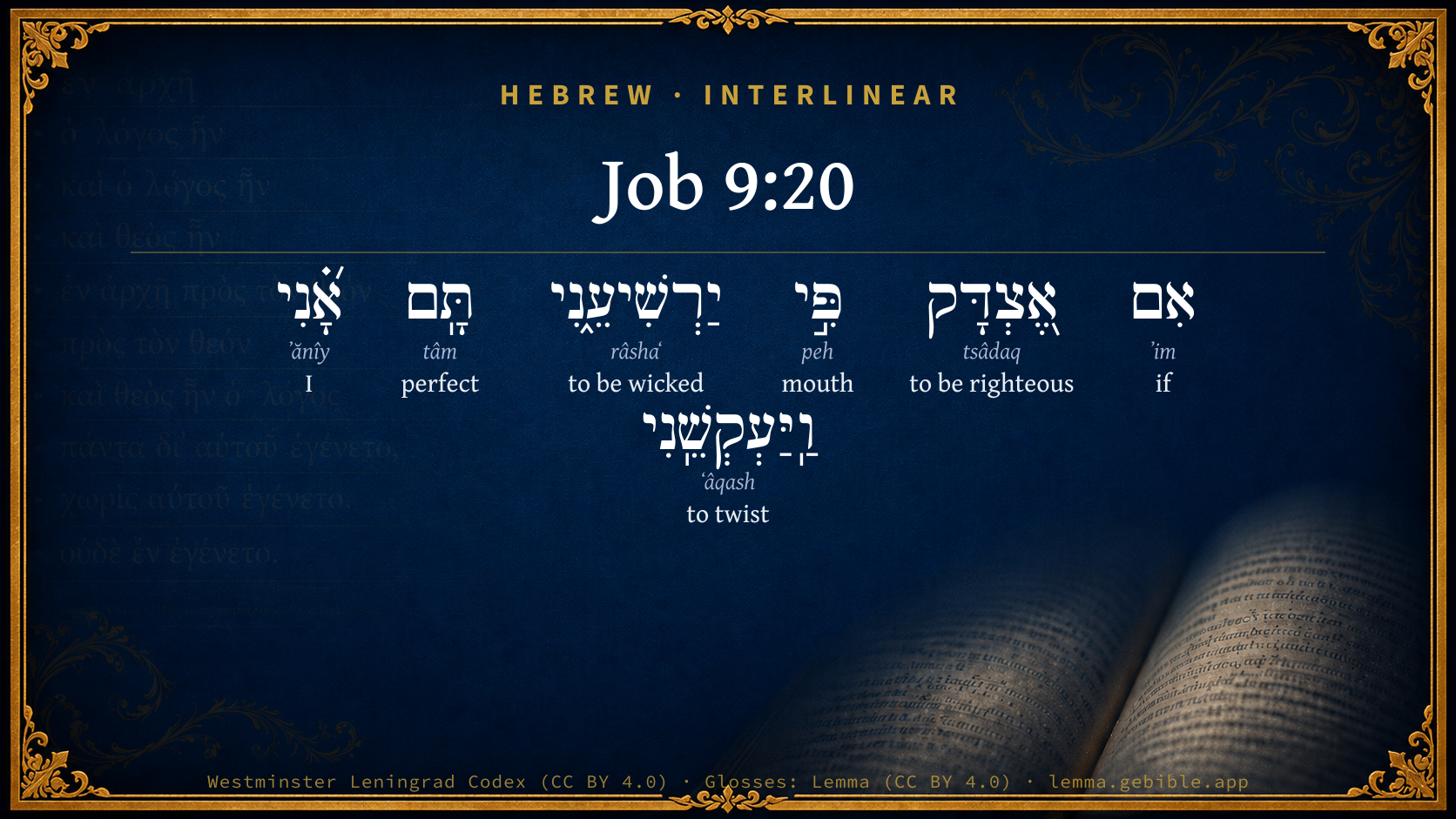
Hebrew (Westminster Leningrad Codex) Job 9:20 appears in the Hebrew Old Testament. The text above is from the Westminster Leningrad Codex. Each word links to its Strong’s number, a concise gloss, and parsing drawn from the Open Scriptures Hebrew Bible morphology. Click any word for its full Brown-Driver-Briggs (BDB) entry.
Download image
Cite this verse

Job 9:20 (World English Bible). Public Domain. Lemma interlinear Bible study tool, https://lemma.gebible.app/v/job/9/20.

Show BibTeX & RIS
BibTeX
RIS
English Translation
Though I am righteous, my own mouth shall condemn me. Though I am blameless, it shall prove me perverse.
World English Bible · Public Domain
Highlights
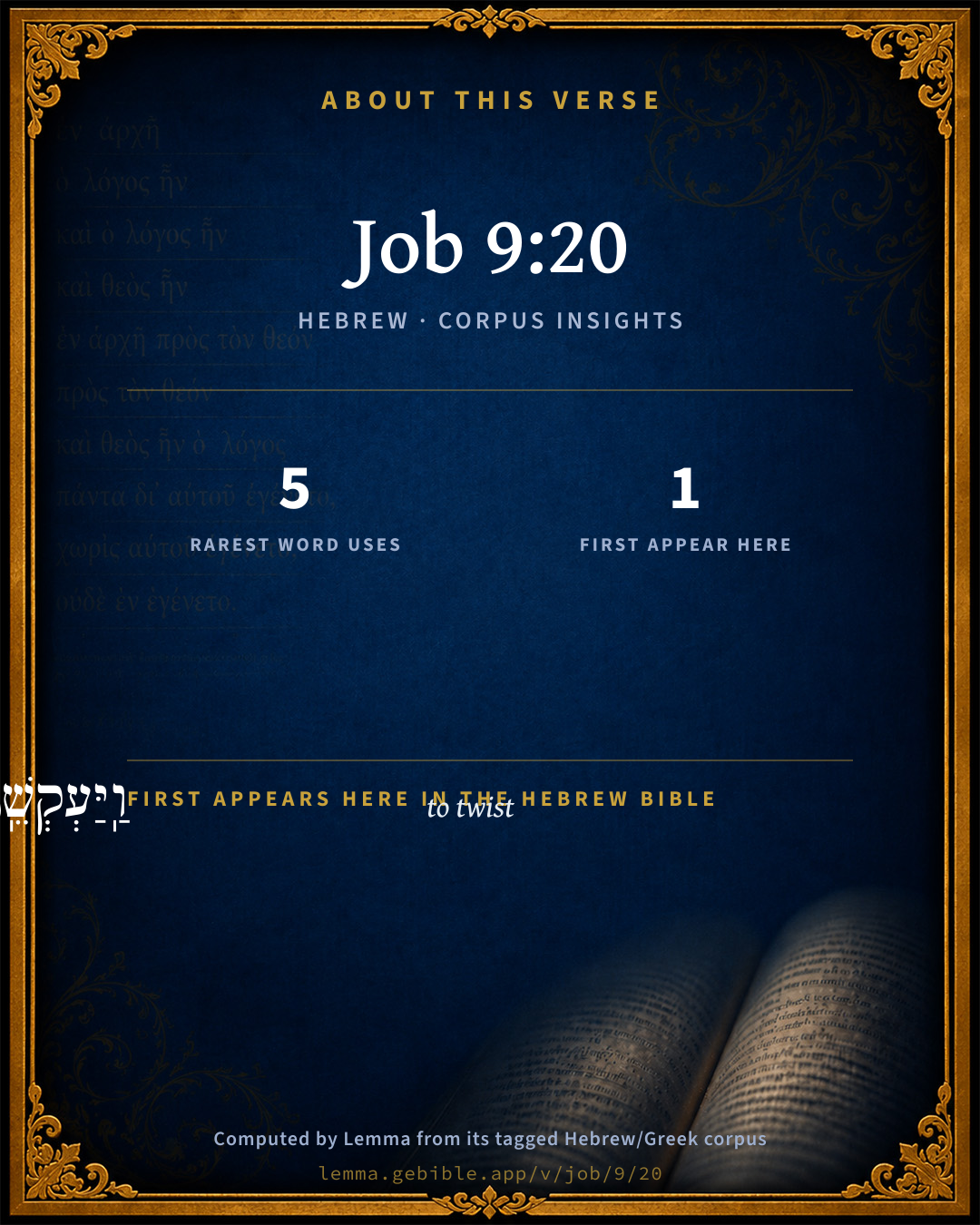
  • 1 first appearance in the Hebrew Bible
Full analysis ↓
Download a study sheet

One document with this verse’s original text, its word-by-word gloss line, the meaning frame, cross-references with their text, attributed commentary, and full source and license credits — printable, and it pastes into notes with its structure intact.

This verse Autodidact and up

Study sheet (.html) Plain text (.txt)

A passage Seminary Student

Up to 50 verses in one chapter. A passage sheet keeps up to 6 commentary sources and 12 cross-references per verse, in the order this page ranks them, and says so on the sheet whenever that leaves anything out. Ask for a single verse and you get the Autodidact verse sheet above.

Everything on this page stays free to read, with no account — the sheet is a download of what is already on screen, not access to it.

Want to remove ads? Support Godless Engineer
Compare translations 3

The same verse in 3 English versions, stacked beneath the original-language interlinear above. Click any original word for its lexicon entry.

Each is an independent rendering of the whole verse — the interlinear is not word-aligned to these translations.

Highlighted words mark where these versions differ — a whole-verse word diff, not a word-by-word alignment.

  • World English Bible Public Domain
    Though I am righteous, my own mouth shall condemn me. Though I am blameless, it shall prove me perverse.
  • King James Version Public Domain
    If I justify myself, mine own mouth shall condemn me: if I say, I am perfect, it shall also prove me perverse.
  • unfoldingWord Literal Text CC BY-SA 4.0
    If I were righteous, my mouth would condemn me; I blameless, yet it would convict me.

unfoldingWord Literal Text — © unfoldingWord, licensed CC BY-SA 4.0. Word-aligned USFM3 via Door43 (git.door43.org/unfoldingWord/en_ult).

Versions to compare (up to 4)

3 of 4 selected

Show all 18 translations

Every available English version of this verse, each an independent rendering of the whole verse.

  • World English Bible Public Domain
    Though I am righteous, my own mouth shall condemn me. Though I am blameless, it shall prove me perverse.
  • Berean Standard Bible Public Domain
    Even if I were righteous, my mouth would condemn me; if I were blameless, it would declare me guilty.
  • Majority Standard Bible Public Domain
    Even if I were righteous, my mouth would condemn me; if I were blameless, it would declare me guilty.
  • King James Version Public Domain
    If I justify myself, mine own mouth shall condemn me: if I say, I am perfect, it shall also prove me perverse.
  • American Standard Version (1901) Public Domain
    Though I be righteous, mine own mouth shall condemn me: Though I be perfect, it shall prove me perverse.
  • Revised Version (1885) Public Domain
    Though I be righteous, mine own mouth shall condemn me: though I be perfect, it shall prove me perverse.
  • Geneva Bible (1599) Public Domain
    If I woulde iustifie my selfe, mine owne mouth shall condemne mee: if I would be perfite, he shall iudge me wicked.
  • Douay-Rheims (1899) Public Domain
    If I would justify myself, my own mouth shall condemn me: if I would shew myself innocent, he shall prove me wicked.
  • Young's Literal Translation Public Domain
    If I be righteous, Mine mouth doth declare me wicked, Perfect I am! -- it declareth me perverse.
  • Literal Standard Version CC BY-SA 4.0
    If I am righteous, my mouth declares me wicked; [If] I am perfect, it declares me perverse.
  • Unlocked Literal Bible CC BY-SA 4.0
    Though I am in the right, my own mouth would condemn me; and though I am blameless, my words would prove me to be guilty.
  • unfoldingWord Literal Text CC BY-SA 4.0
    If I were righteous, my mouth would condemn me; I blameless, yet it would convict me.
  • Darby Bible Public Domain
    If I justified myself, mine own mouth would condemn me; were I perfect, he would prove me perverse.
  • World Messianic Bible Public Domain
    Though I am righteous, my own mouth will condemn me. Though I am blameless, it will prove me perverse.
  • Webster's Bible Public Domain
    If I justify myself, my own mouth will condemn me: if I say, I am perfect, that also will prove me perverse.
  • Free Bible Version CC BY-SA 4.0
    Even though I am right, my own mouth would condemn me; even though I am innocent, he would prove me wrong.
  • Bible in Basic English Public Domain
    Though I was in the right, he would say that I was in the wrong; I have done no evil; but he says that I am a sinner.
  • JPS Tanakh (1917) Public Domain
    Though I be righteous, mine own mouth shall condemn me; though I be innocent, He shall prove me perverse.

Literal Standard Version (2020), Covenant Press — licensed CC BY-SA 4.0. Text via the HelloAO Bible API (eBible.org). Unlocked Literal Bible (unfoldingWord) — licensed CC BY-SA 4.0. Text via the HelloAO Bible API (eBible.org). unfoldingWord Literal Text — © unfoldingWord, licensed CC BY-SA 4.0. Word-aligned USFM3 via Door43 (git.door43.org/unfoldingWord/en_ult). Free Bible Version, Dr. Jonathan Gallagher — licensed CC BY-SA 4.0. Text via the HelloAO Bible API (eBible.org).

Word by word

More ways to search: Search by grammar → Find every occurrence → Compare this word →

Practice this passage: Drill this verse → Learn its vocabulary →

וַֽיַּעְקְשֵֽׁנִי
ʻâqash
H6140
“and · to twist · me”
Conjunction + Verb, Hiphil, Sequential Imperfect, 3rd Person, Masculine, Singular + Suffix, Personal, 1st Person, Common, Singular
Part of Speech
Conjunction + Verb
Stem
Hiphil
Form
Sequential Imperfect
Person
3rd Person
Gender
Masculine
Number
Singular
Full BDB Definition

Origin: a primitive root

TWOT: 1684

to be perverse, twist, pervert, make crooked, prove perverse, declare perverse - (Niphal) to be crooked - (Piel) to twist, distort, pervert, make crooked - (Hiphil) to declare crooked - (Qal) perverse
  1. אִם ʼim H518 “if” Conjunction
  2. אֶ֭צְדָּק tsâdaq H6663 “to be righteous” Verb, Qal, Imperfect, 1st Person, Common, Singular
  3. פִּ֣י peh H6310 “mouth · my” Noun, Common, Masculine, Singular, Construct + Suffix, Personal, 1st Person, Common, Singular
  4. יַרְשִׁיעֵ֑נִי râshaʻ H7561 “to be wicked · me” Verb, Hiphil, Imperfect, 3rd Person, Masculine, Singular + Suffix, Personal, 1st Person, Common, Singular
  5. תָּֽם tâm H8535 “perfect” Adjective, Adjective, Masculine, Singular, Absolute
  6. אָ֝֗נִי ʼănîy H589 “I” Pronoun, Personal, 1st Person, Common, Singular

About this verse

These counts appear in no published source. They are computed here, from the morphology-tagged text and Lemma’s own curated glosses. What Lemma adds →

7
words
7
distinct lemmas
Wisdom
section

Notable vocabulary

The rarest word here is וַֽיַּעְקְשֵֽׁנִי to twist H6140 — appearing just 5 times in the whole Hebrew Bible.

First appearance in Scripture

This word makes its first canonical appearance in the Hebrew Bible here:

  • וַֽיַּעְקְשֵֽׁנִי to twist H6140

Shared distinctive vocabulary

וַֽיַּעְקְשֵֽׁנִי to twist H6140 occurs in 5 verses of the Hebrew Bible. Also found in:

Grammatical profile

  • 3 verbs
  • 1 noun
  • 1 adjective
  • 1 pronoun
  • 1 conjunction

Verb forms

  • אֶ֭צְדָּק Qal · Imperfect
  • יַרְשִׁיעֵ֑נִי Hiphil · Imperfect
  • וַֽיַּעְקְשֵֽׁנִי Hiphil · Sequential Imperfect

Hebrew & Septuagint length

In English translation the verse runs 19 words from the Hebrew and 22 from the Septuagint (LXX English) — closely comparable.

A rough comparison of the two English renderings, which tokenize alike — not a word-level alignment.

Word counts can differ between the Hebrew and the Greek without any difference in meaning — e.g. the Hebrew direct-object marker אֵת has no separate Greek word, and Greek often adds the article ὁ.

Cross-references

19

Topical passages linked to Job 9:20 in the Treasury of Scripture Knowledge — connected by theme and wording, ordered by reader-vote popularity; previews shown in the World English Bible.

  • Job 4:17 'Shall mortal man be more just than God? Shall a man be more pure than his Maker?
  • Job 9:2 "Truly I know that it is so, But how can man be just with God?
  • Job 15:5–6 For your iniquity teaches your mouth, And you choose the language of the crafty.
  • Job 32:1–2 So these three men ceased to answer Job, because he was righteous in his own eyes.
  • Job 34:35 'Job speaks without knowledge, His words are without wisdom.'
  • Psalms 130:3 If you, Yah, kept a record of sins, Lord, who could stand?
  • Psalms 143:2 Don't enter into judgment with your servant, For in your sight no man living is righteous.
  • Philippians 3:12–15 Not that I have already obtained, or am already made perfect; but I press on, if it is so that I may take hold of that for which also I was taken hold of by Christ Jesus.
  • Job 1:1 There was a man in the land of Uz, whose name was Job. That man was blameless and upright, and one who feared God, and turned away from evil.
  • Job 33:8–13 "Surely you have spoken in my hearing, I have heard the voice of your words, saying,
  • Job 35:16 Therefore Job opens his mouth with empty talk, And he multiplies words without knowledge."
  • Proverbs 10:19 In the multitude of words there is no lack of disobedience, But he who restrains his lips does wisely.
  • Proverbs 17:20 One who has a perverse heart doesn't find prosperity, And one who has a deceitful tongue falls into trouble.
  • Isaiah 6:5 Then I said, "Woe is me! For I am undone, because I am a man of unclean lips, and I dwell in the midst of a people of unclean lips: for my eyes have seen the King, Yahweh of Hosts!"
  • Matthew 12:36–37 I tell you that every idle word that men speak, they will give account of it in the day of judgment.
  • Luke 10:29 But he, desiring to justify himself, asked Jesus, "Who is my neighbor?"
  • Luke 16:15 He said to them, "You are those who justify yourselves in the sight of men, but God knows your hearts. For that which is exalted among men is an abomination in the sight of God.
  • 1 Timothy 6:5 constant friction of people of corrupt minds and destitute of the truth, who suppose that godliness is a means of gain. Withdraw yourself from such.
  • James 3:2 For in many things we all stumble. If anyone doesn't stumble in word, the same is a perfect man, able to bridle the whole body also.

Cross-references courtesy of OpenBible.info (CC BY 4.0).

Hebrew and Greek witnesses Masoretic Hebrew ↔ Greek Septuagint

The same verse in the two great witnesses to the Old Testament, shown verse-for-verse.

These are two independent witnesses, not word-aligned to each other, and the Septuagint is shown in lemma (dictionary) form.

Hebrew Job 9:20 Masoretic · Westminster Leningrad Codex

אִם אֶ֭צְדָּק פִּ֣י יַרְשִׁיעֵ֑נִי תָּֽם אָ֝֗נִי וַֽיַּעְקְשֵֽׁנִי

Though I am righteous, my own mouth shall condemn me. Though I am blameless, it shall prove me perverse.

World English Bible · Public Domain

Greek LXX Job 9:20 Septuagint · lemma form

ἐάν γάρ εἰμί δίκαιος ὁ στόμα ἐγώ ἀσεβέω ἐάν τε εἰμί ἄμεμπτος σκολιός ἀποβαίνω

For though I should seem righteous, my mouth will be profane: and though I should seem blameless, I shall be proved perverse.

LXX2012 (modern English Septuagint) · Public Domain

On this verse, Haydock's Catholic Bible Commentary discusses the Septuagint’s reading. Read the note in Commentary ↓

Hebrew: Westminster Leningrad Codex (CC BY 4.0). Greek: Septuagint (public domain); English from LXX2012 (modern English Septuagint) (Public Domain). How the Septuagint differs from the Hebrew →

Commentary

Notes on Job 9:20 from classic Christian and Jewish commentators (each source and its license shown beneath its notes). The classic Christian expositions comment on the surrounding passage and are grouped to its opening verse, so a note may address several verses; the Jewish commentaries on the Tanakh (Rashi and others) are per-verse, so they appear only where the commentator wrote on this verse.

Lemma curates 59 commentaries, every one of them public domain or Creative Commons licensed, each selected and text-cleaned for this edition rather than reprinted as found. About our sources →

The Cambridge Bible for Schools and Colleges

gen. ed. J. J. S. Perowne

20. Were I in the right, mine own mouth would condemn me,

Were I perfect, He would prove me perverse:

20. In Job_9:20 Job is the speaker; he describes the effect upon him of the might of God,—though he had right on his side his own mouth would make him out wrong; out of terror he would speak at random or say the opposite of what he should say. The word perfect is used as in ch. Job_1:1, not in an absolute sense, but to mean upright and free from transgression. The subject in the second clause is more probably God than it, i. e. my mouth; were Job perfect the effect of God’s power would be that he would appear perverse or wicked.

The Cambridge Bible for Schools and Colleges (gen. ed. J. J. S. Perowne; Cambridge University Press, 1878–1918) — public domain. Text from a community e-Sword module.

Trapp's Complete Commentary

John Trapp

Job 9:20 If I justify myself, mine own mouth shall condemn me: [if I say], I [am] perfect, it shall also prove me perverse.

Ver. 20. If I justify myself] If, in default of other pleaders, I should undertake to manage my cause myself, I should be never the nearer.

Mine own mouth shall condemn me] i.e. God out of mine own mouth, as finding mine arguments weak and worthless; he knows us better than we know ourselves; and when he comes to turn the bottom of the bag upwards (as once Joseph’s steward did theirs) all our secret thefts will be revealed, and those will appear to be faults that we little thought of. A Dutch divine, when dying, was full of fears and doubts; said some to him, You have been so employed, and so faithful, why should you fear? Oh, said he, the judgment of man and the judgment of God are different. Vae hominum vitae quantumvis laudabili, si remota misericordia iudicetur; Woe to the most praise worthy man alive, if he meet with judgment without mercy. The best lamb should abide the slaughter, except the ram were sacrificed, that Isaac might be saved.

lf I say I am perfect] What if God had said so, Job 1:1, yet Job might not, Pro 27:2 2Co 10:18. Or if he do at any time justify himself, as Job 29:1-25; Job 30:1-31 he doth, it is in his own necessary and just defence, against the charge of his friends. Real apologies we must ever make for ourselves when wronged; verbal, if any, must be managed with meekness of wisdom.

John Trapp, A Commentary or Exposition upon All the Books of the Old and New Testament (1647–1656) — public domain. Text from a community e-Sword module.

The Biblical Illustrator

Joseph S. Exell

Job_9:20-21

If I justify myself.

The folly of self-justification

One of Rev. Murray MCheynes elders was in deep darkness and distress for a few weeks, but one Sunday after the pastors faithful preaching he found his way to the Lord. At the close of the service, he told Mr. MCheyne, who knew of his spiritual concern, that he had found the Lord. When he was asked to explain how this happy change had come about, he said, I have been making a great mistake. I have always been coming to the Lord as something better than I was, and going to the wrong door to ask admittance; but this afternoon I went round to the sinners door, and for the first time cried, like the publican, Lord, be merciful to me a sinner; and, oh, sir, I received such a welcome from the Saviour! Are any of our readers like the self-righteous Pharisee? Such have no room for the Saviour; for the Lord came not to call the righteous, but sinners to repentance.

If I say I am perfect.

Our exact worth

A bright little fellow was on the scales, and being anxious to outweigh his playmate, he puffed out his cheeks and swelled up like a small frog. But the playmate was the wiser boy. Oho! he cried in scorn, that doesnt do any good; you can only weigh what you are! How true that is of us bigger children, who try to impress ourselves upon our neighbours and friends, and even upon ourselves, and--yes, sometimes upon God Almighty, by the virtues we would like to have! It doesnt do any good. You may impose upon your neighbours judgment, and get him to say you are a fine fellow--noble, generous, brave, faithful, loving; but if it is not true, you are a sham. You can only weigh what you are.

Not quite perfect

A London publisher once made up his mind to publish a book without a single typographical error. He had the proofs corrected by his own readers until they assured him that they were faultless. Then he sent proofs to the universities and to many other publishing houses, offering a prize of several pounds for every typographical mistake found. A few were discovered, and the book was published. It was considered a perfect specimen of the printers art. Six or eight months after publication the publisher received a letter calling his attention to an error in a certain line on a certain page. Then came another and another letter, until before the year was out half a dozen mistakes were found. St. Paul says that Christians are epistles read and known of all men; and it certainly does not require as much scrutiny as this to discover that we are not free from faults. We must look forward to the new edition of us that will be brought out in another world, revised and amended by the Author. (Quiver.)

A blow at self-righteousness

Ever since man became a sinner he has been self-righteous. When he had a righteousness of his own he never gloried of it, but ever since he has lost it, he has pretended to be the possessor of it.

I. The plea of self-righteousness contradicts itself. If I justify myself, mine own mouth shall condemn me. For the very plea itself is a piece of high and arrogant presumption. God hath said it, let Jew and Gentile stop his mouth, and let all the world stand guilty before God. We have it on inspired authority, that there is none righteous, no, not one. Besides, dost thou not see, thou vain and foolish creature, that thou hast been guilty of pride in the very language thou hast used? Who but a proud man would stand up and commend himself? But further, the plea of self-righteousness is self-contradictory upon another ground; for all that a self-righteous man pleads for, is comparative righteousness. Why, saith he, I am no worse than my neighbours, in fact a great deal better; I do not drink. Just so, but then all that you claim is that you are righteous as compared with others. Do you not see that this is a very vain and fatal plea, because you do in fact admit that you are not perfectly righteous;--that there is some sin in you, only you claim there is not so much in you as in another? Suppose now for a moment that a command is issued to the beasts of the forest that they should become sheep. It is quite in vain for the bear to come forward and plead that he was not so venomous a creature as the serpent; equally absurd would it be for the wolf to say that though stealthy, and cunning, and gaunt, and grim, yet he was not so great a grumbler nor so ugly a creature as the bear; and the lion might plead that he had not the craftiness of the fox. A holy God cannot look even upon the least degree of iniquity. But further, the plea of the self-conceited man is, that he has done his best, and can claim a partial righteousness. It is true, if you touch him in a tender place he acknowledges that his boyhood and his youth were stained with sin. A perfect righteousness you must have, or else you shall never be admitted to that wedding feast.

II. The man who uses this plea condemns the plea himself. Not only does the plea cut its own throat, but the man himself is aware when he uses it that it is an evil, and false, and vain refuge. Now this is a matter of conscience, and if I speak not what you have felt, then you can say I am mistaken. Men know that they are guilty. The conscience of the proudest man, when it is allowed to speak, tells him that he deserves the wrath of God.

III. The plea is itself evidence against the pleader. There is an unregenerated man here, who says, Am I blind also? I answer in the words of Jesus, But now ye say we see, therefore your sin remaineth. You have proved by your plea, in the first place, that you have never been enlightened of the Holy Spirit, but that you remain in a state of ignorance. A deaf man may declare that there is no such thing as music. A man who has never seen the stars, is very likely to say that there are no stars. But what does he prove? Does he prove that there are no stars? He only proves his own folly and his own ignorance. That man who can say half a word about his own righteousness has never been enlightened of God the Holy Spirit. But then again, inasmuch as you say that you are not guilty this proves that you are impenitent. Now the impenitent can never come where God is. Further than this, the self-righteous man, the moment that he says he has done anything which can recommend him to God, proves that he is not a believer. Now, salvation is for believers, and for believers only. The thirsty are welcome; but those who think they are good, are welcome neither to Sinai nor to Calvary. Ah! soul, I know not who thou art; but if thou hast any righteousness of thine own, thou art a graceless soul.

IV. It will ruin the pleader forever. Let me show you two suicides. There is a man who has sharpened a dagger, and seeking out his opportunity he stabs himself to the heart. Who shall blame any man for his death? He slew himself; his blood be on his own head. Here is another: he is very sick and ill; he can scarcely crawl about the streets. A physician waits upon him; he tells him, Sir, your disease is deadly; you must die; but I know a remedy which will certainly heal you. There it is; I freely give it to you. All I ask of you is, that you will freely take it. Sir, says the man, you insult me; I am as well as ever I was in my life; I am not sick. Who slew this man? His blood be on his own head; he is as base a suicide as the other. (C. H. Spurgeon.)

The Biblical Illustrator, edited by Joseph S. Exell (c. 1880s–1900s) — public domain. Text from a community e-Sword module.

Joseph Benson's Commentary

Job 9:20. If I justify myself — If I plead against God my own righteousness and innocence; my own mouth shall condemn me — God is so infinitely wise, and just, and holy, that he will find sufficient matter of condemnation from my own words, though spoken with all possible care and circumspection; or he will discover so much imperfection in me, of which I was not aware, that I shall be compelled to join with him in condemning myself. If I say, I am perfect — The words, I say, are not in the Hebrew, but seem to be properly supplied to complete the sense. The meaning is, If I were perfect in my own opinion, if I thought myself completely righteous and faultless; it shall prove me perverse — That is, my own mouth shall prove, as he had just said; or he, that is, God shall, who is easily understood from the former verses, where he is often mentioned.

Joseph Benson's Commentary on the Old and New Testaments (1811–1818) — public domain. Text from a community e-Sword module.

Geneva Bible (1599)

Geneva Bible translators

If I would stand in mine own defense, yet God hath just cause to condemn me, if he examine mine heart and conscience.

Geneva Bible (1599) marginal notes — public domain. Text via Bolls.life.

Jamieson, Fausset & Brown

Robert Jamieson, A. R. Fausset & David Brown

it-- (Job 15:6; Luk 19:22); or "He," God.

Jamieson, Fausset & Brown — Commentary Critical and Explanatory on the Whole Bible (1871) — public domain (CC PDM 1.0). Text via the HelloAO Bible API.

Adam Clarke's Commentary

Verse 20. If I justify myself] God must have some reason for his conduct towards me; I therefore do not pretend to justify myself; the attempt to do it would be an insult to his majesty and justice. Though I am conscious of none of the crimes of which you accuse me; and know not why he contends with me; yet he must have some reason, and that reason he does not choose to explain.

Adam Clarke's Commentary on the Bible (1810–1826) — public domain. Text from a community e-Sword/MySword module.

John Gill's Exposition

Though I were perfect,.... Really and truly so, not conscious of any sin in thought, word, or deed; this is only a case supposed:

yet would I not know my soul; I would not own myself to be so before God; I would not insist upon such perfection in his presence, as what would justify me before him; since I am sensible the highest perfection of a creature is imperfection when compared with him: or the sense may be, should I say I were "perfect, I should not know my own soul"; I should plainly appear to be ignorant of myself, as all perfectionists are; they do not know their own souls, the plague of their hearts, the evil of their thoughts, the vanity of their minds; they do not take notice of these things, or do not look upon them as sinful; they know not the nature of sin, and the exceeding sinfulness of it:

I would despise my life; even if ever so innocent, perfect, and just; his meaning is, that he would not insist upon the continuance of it on that account; he had no such value for it, such a love of life as to contend with God upon the foot of justice about it; nor did he think it worth asking for, so mean an opinion had he entertained of it, see Job 7:16.

John Gill's Exposition of the Whole Bible (1746–1763) — public domain (CC PDM 1.0). Text via the HelloAO Bible API.

Albert Barnes' Notes on the Bible

If I justify myself, mine own mouth shall condemn me - That is, referring still to the form of a judicial trial, if I should undertake to manage my own cause, I should lay myself open to condemnation even in my argument on the subject, and should show that I was far from the perfection which I had undertaken to maintain. By passionate expressions; by the language of complaint and murmuring; by a want of suitable reverence; by showing my ignorance of the principles of the divine government; by arguments unsound and based on false positions; or by contradictions and self-refutations, I should show that my position was untenable, and that God was right in charging me with guilt. In some or in all of these ways Job felt, probably, that in an argument before God he would be self-condemned, and that even an attempt to justify himself, or to prove that he was innocent, would prove that he was guilty. And is it not always so? Did a man ever yet undertake to repel the charges of guilt brought against him by his Maker, and to prove that he was innocent, in which he did not himself show the truth of what he was denying? Did not his false views of God and of his law; his passion, complaining, and irreverence; his unwillingness to admit the force of the palpable considerations urged to prove that he was guilty, demonstrate that he was at heart a sinner, and that he was insubmissive and rebellious? The very attempt to enter into such an argument against God, shows that the heart is not right; and the manner in which such an argument is commonly conducted demonstrates that he who does it is sinful.

If I say, I am perfect - Should I attempt to maintain such an argument, the very attempt would prove that my heart is perverse and evil. It would do this because God had adjudged the contrary, and because such an effort would show an insubmissive and a proud heart. This passage shows that Job did not regard himself as a man absolutely free from sin. He was indeed said Job 1:1 to be “perfect and upright;” but this verse proves that that testimony in regard to him was not inconsistent with his consciousness of guilt. See the notes at that verse. And is not the claim to absolute perfection in this world always a proof that the heart is perverse? Does not the very setting up of such a claim in fact indicate a pride of heart, a self-satisfaction, and an ignorance of the true state of the soul, which is full demonstration that the heart is far from being perfect? God adjudges man to be exceedingly sinful; and if I do not mistake the meaning of the Scriptures, this is his testimony of every human heart - totally until renewed - partially ever onward until death. If this be the account in the Scriptures, then the claim to absolute perfection is prima facie, if not full proof, that the heart is in some way perverse. It has come to a different conclusion from that of God. It sets up an argument against him - and there can be no more certain proof of a lack of perfection than such an attempt. There is in this verse an energy in the original which is very feebly conveyed by our translation. It is the language of strong and decided indignation at the very idea of asserting that he was perfect. תם אני tâm 'ănı̂y - “perfect I!” or, “I perfect! The thought is absurd! It can only prove that I am perverse to attempt to set up any such claim!” Stuhlman renders this,

“However good I may be, I must condemn myself;

However free from guilt, I must call myself evil:”

And explains it as meaning, “God can through the punishments which he inflicts constrain me to confess, against the clear consciousness of my innocence, that I am guilty.”

Albert Barnes' Notes on the Bible (1834–1885) — public domain. Text from a community e-Sword/MySword module.

Haydock's Catholic Bible Commentary

Condemn me, as this conduct would appear presumptuous. (Calmet) --- Septuagint, "if I be just, my mouth will utter impiety," (Haydock) in declaring it. (Olymp.)

George Leo Haydock (1774–1849), Haydock's Catholic Family Bible and Commentary, 1859 edition — public domain. Excludes Psalms (Douay-Rheims chapter numbering differs from Protestant) and Deuterocanonical books (Catholic canon only).

Matthew Poole's English Annotations

If I plead against God mine own righteousness and innocency, God is so infinitely wise and just, that he will find sufficient matter of condemnation from my own words, though spoken with all possible care and circumspection; or he will discover so much wickedness in me of which I was not aware, that I shall be forced to join with him in condemning myself.

If I say, I am perfect; if I were perfect in my own opinion; if I thought myself completely righteous and faultless, it, i.e. my own mouth, as he now said, or,

he, i.e. God, who is easily understood by comparing this with the former verses, where the same he is oft mentioned,

shall also prove me perverse.

Matthew Poole's English Annotations on the Holy Bible (1683–1685) — public domain. Text from a community e-Sword/MySword module.

Whedon's Commentary on the Bible

Daniel D. Whedon

20. I…

perfect — תם אני. Were I to declare myself innocent, it (my mouth, though some make “God” the subject of the verb) should show (literally, make) me perverse, “betray me.” Renan sees in this a bold hyperbole. “If Job plead against God, his own mouth would betray him and say the contrary of what he intended.”

Daniel D. Whedon (gen. ed.), Commentary on the Old and New Testaments (1874–1909) — public domain. Text from a community e-Sword module.

The Pulpit Commentary

If I justify myself, mine own mouth shall condemn me. Since he could not wholly justify himself. "All men have sinned, and come short of the glory of God". (Rom_3:23) Job has already admitted the utterance of "rash words", (Job_6:3) and, at least hypothetically, that he "has sinned", (Job_7:20) and needs "pardon" for his "transgression". (Job_7:2-4) Job, if he tried to "justify himself," would have to acknowledge such shortcomings, such imperfections, such sins at any rate, of infirmity as would make his attempted justification a real self-condemnation. If I say, I am perfect, it shall also prove me perverse; rather, even were I perfectit (i.e. my mouth) would prove me perverse; i.e. supposing I were actually perfect, and tried to prove it, my speech would be so hesitating and confused, that I should only seem to be perverse.

Self-justification.

I THE NEED TO BE JUSTIFIED. The burning necessity of justification lies at the root of Job"s terrible agony. Yet even he does not feel it in its deep moral and spiritual significance, as it would have been felt by one who was conscious of sin rather than of undeserved suffering and unjust accusations. We cannot endure to be out of right relations with God. Though our lost state may not trouble us as yet, the time will come when we shall see its terrible and fatal character.

II WE ARE TEMPTED TO JUSTIFY OURSELVES. The very need causes the temptation. Moreover, a self-flattering vanity urges us in the same direction. It is most painful and humiliating to have to own that we are sinners, deserving nothing but wrath and condemnation. When we feel ourself in danger, we are at once urged by very instinct to put ourselves in an attitude of self-defence.

III WE MAY BE DELUDED INTO A MISTAKEN BELIEF THAT WE ARE JUSTIFIED. No delusions are so powerful as those which flatter us. It is so easy to put things in a favourable light to ourselves. While we are our own judges, every motive of self-esteem urges us to a favourable judgment. Then there comes in the terrible mistake of determining according to our feelings rather than according to objective reality, so that when we have argued or soothed ourselves into a comfortable assurance that all is well, that very assurance is regarded as a proof of the fact on which it is supposed to be grounded. But this may be a pure hallucination. It is possible to be justified before God and yet to be tormented with needless fears of condemnation, and it is equally possible to be still under condemnation while we fancy ourselves in a state of justification.

IV SELF-JUSTIFICATION MUST FAIL. We cannot get outside ourselves or transcend our own experience. No lever by which a man can lift himself has ever been invented. We may make a fair show in the flesh, but we cannot change our own hearts. We have sinned against God; it is useless for us merely to forgive ourselves; we need God"s pardon. If sin were not real, we might find a defence which would clear our reputation. But it is real, most terribly and unquestionably real. This fact makes self-justification impossible.

V OUR OWN CONDUCT DEMONSTRATES THE DELUSION OF SELF-JUSTIFICATION, Job seems to think he is so hardly dealt with, and God so much greater than he is, that whatever he says in self-justification will be turned against him. That is a mistake, for God is just and merciful. But in a deeper sense God"s words are true. We may say we are just, but our deeds belie our words. Nay, our very mouth, that proclaims our justice, denies it; for our words arc often sinful, ungenerous when they are not untrue.

VI THE FAILURE OF SELF-JUSTIFICATION SHOULD DRIVE US TO GOD"S JUSTIFICATION IN CHRIST. We need not despair like Job, for we have a gospel to the unrighteous. Christ has brought a perfect justification, in pardon and renewal, for all who own their sin and trust his grace. W.F.A.

The Pulpit Commentary (1880–1919), ed. H.D.M. Spence-Jones & Joseph S. Exell — public domain. Text from a community e-Sword module.

John Wesley's Explanatory Notes

Justify - If I plead against God mine own righteousness and innocency.

John Wesley, Explanatory Notes Upon the Whole Bible (1754–1765) — public domain. Text via the GEBible commentary corpus.

Rashi

Rabbi Shlomo Yitzchaki (Rashi)

If I am innocent, my mouth will condemn me because my words will be silenced out of fear, and my mouth will make me crooked.

Rashi on the Tanakh — English translations: “The Judaica Press complete Tanach with Rashi, translated by A. J. Rosenberg” (CC BY 4.0); “Pentateuch with Rashi's commentary by M. Rosenbaum and A.M. Silbermann, 1929-1934” (public domain); “The Metsudah Tanach series, Lakewood, N.J” (CC BY 4.0); and “The Book of Joshua, Metsudah Publications, 1997” (CC BY 4.0). Text via Sefaria.

Lesson kit

Teaching starters — assembled from the data on this page, not authored interpretation. Every prompt links to the verse data it draws on. Edit before teaching.

Job, in the Wisdom, opens this verse with 7 words (7 distinct Hebrew lemmas). Its most distinctive word is ʻâqash (“to twist”). A historical commentator’s framing appears above. Read the whole chapter for the surrounding context.

Discussion questions

  1. The word ʻâqash carries the sense “to twist.” How does it shape the verse?
  2. The word “to twist” first appears here in Scripture. What is being introduced at this debut?
  3. Proverbs 10:9 shares the word «to twist» with this verse. How do the two illuminate each other?
  4. These translations render this verse differently; the difference is in the English rendering, not the original. What questions does that raise?
  5. The verb «אֶ֭צְדָּק» is Qal Imperfect. How does its form color the action?
  6. Reading how The Cambridge Bible for Schools and Colleges and Trapp's Complete Commentary read this verse, where do the two commentators agree and where do they part?

Things to notice

Reading settings

Reading text

Shown beneath each verse's original-language words.

Old Testament
Old Testament edition

Read the OT as the Masoretic Hebrew (MT) or the Greek Septuagint (LXX).

English shown for the Greek Septuagint (in the Hebrew ↔ Greek comparison).

Comparing translations? Open the Compare panel on any verse page to stack up to four side by side.