Leviticus 19:16

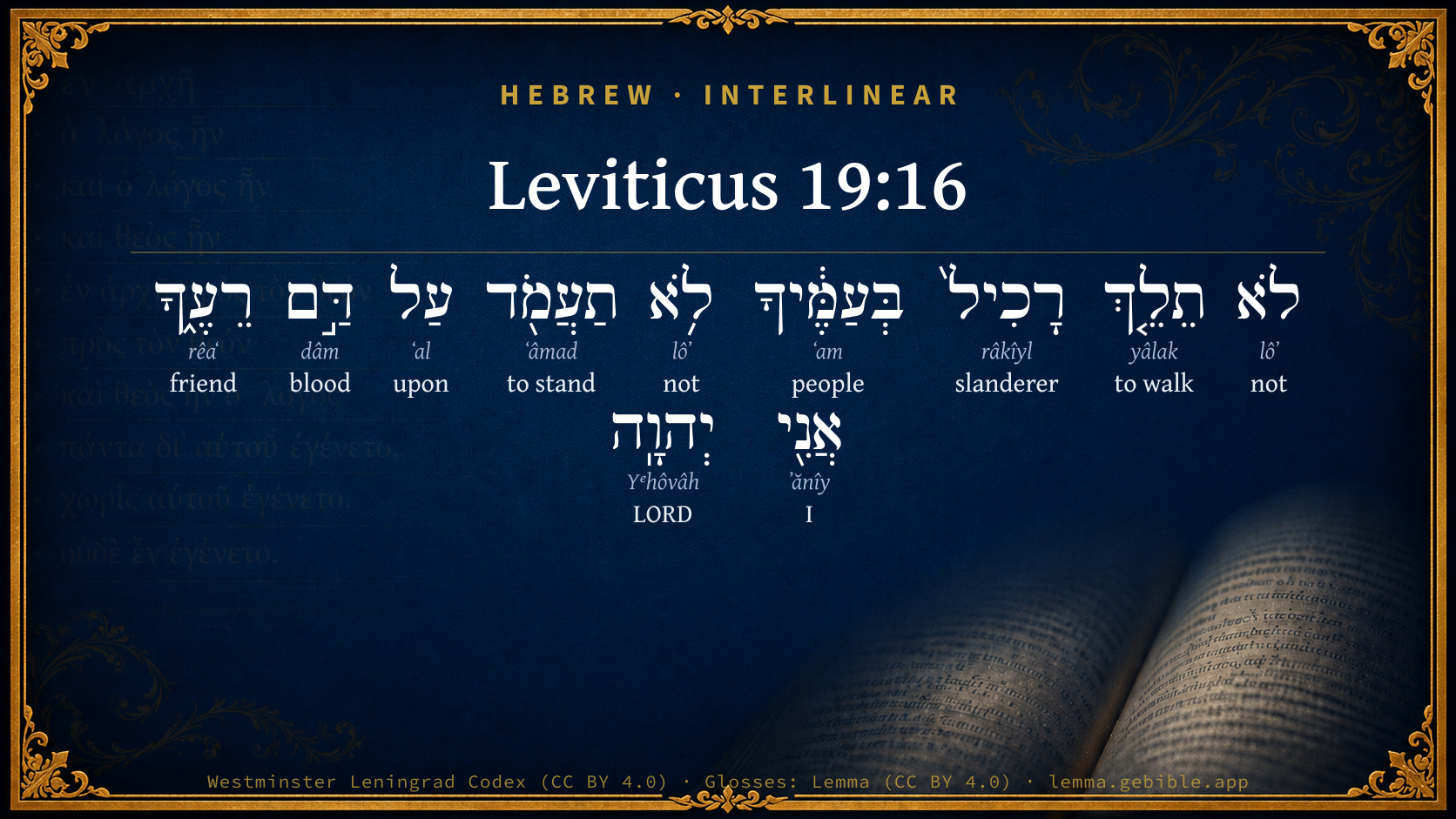
Hebrew (Westminster Leningrad Codex) Leviticus 19:16 appears in the Hebrew Old Testament. The text above is from the Westminster Leningrad Codex. Each word links to its Strong’s number, a concise gloss, and parsing drawn from the Open Scriptures Hebrew Bible morphology. Click any word for its full Brown-Driver-Briggs (BDB) entry.
Download image
Cite this verse

Leviticus 19:16 (World English Bible). Public Domain. Lemma interlinear Bible study tool, https://lemma.gebible.app/v/leviticus/19/16.

Show BibTeX & RIS
BibTeX
RIS
English Translation
"'You shall not go up and down as a slanderer among your people; neither shall you stand against the life of your neighbor. I am Yahweh.
World English Bible · Public Domain
Highlights
  • 1 first appearance in the Hebrew Bible
Full analysis ↓
Download a study sheet

One document with this verse’s original text, its word-by-word gloss line, the meaning frame, cross-references with their text, attributed commentary, and full source and license credits — printable, and it pastes into notes with its structure intact.

This verse Autodidact and up

Study sheet (.html) Plain text (.txt)

A passage Seminary Student

Up to 50 verses in one chapter. A passage sheet keeps up to 6 commentary sources and 12 cross-references per verse, in the order this page ranks them, and says so on the sheet whenever that leaves anything out. Ask for a single verse and you get the Autodidact verse sheet above.

Everything on this page stays free to read, with no account — the sheet is a download of what is already on screen, not access to it.

Want to remove ads? Support Godless Engineer
Compare translations 3

The same verse in 3 English versions, stacked beneath the original-language interlinear above. Click any original word for its lexicon entry.

Each is an independent rendering of the whole verse — the interlinear is not word-aligned to these translations.

Highlighted words mark where these versions differ — a whole-verse word diff, not a word-by-word alignment.

  • World English Bible Public Domain
    "'You shall not go up and down as a slanderer among your people; neither shall you stand against the life of your neighbor. I am Yahweh.
  • King James Version Public Domain
    Thou shalt not go up and down as a talebearer among thy people: neither shalt thou stand against the blood of thy neighbor; I am the LORD.
  • unfoldingWord Literal Text CC BY-SA 4.0
    You shall not walk a slanderer among your people. You shall not stand against the blood of your neighbor. I Yahweh.

unfoldingWord Literal Text — © unfoldingWord, licensed CC BY-SA 4.0. Word-aligned USFM3 via Door43 (git.door43.org/unfoldingWord/en_ult).

Versions to compare (up to 4)

3 of 4 selected

Show all 18 translations

Every available English version of this verse, each an independent rendering of the whole verse.

  • World English Bible Public Domain
    "'You shall not go up and down as a slanderer among your people; neither shall you stand against the life of your neighbor. I am Yahweh.
  • Berean Standard Bible Public Domain
    You must not go about spreading slander among your people. You must not endanger the life of your neighbor. I am the LORD.
  • Majority Standard Bible Public Domain
    You must not go about spreading slander among your people. You must not endanger the life of your neighbor. I am the LORD.
  • King James Version Public Domain
    Thou shalt not go up and down as a talebearer among thy people: neither shalt thou stand against the blood of thy neighbor; I am the LORD.
  • American Standard Version (1901) Public Domain
    Thou shalt not go up and down as a talebearer among thy people: neither shalt thou stand against the blood of thy neighbor: I am Jehovah.
  • Revised Version (1885) Public Domain
    Thou shalt not go up and down as a talebearer among thy people: neither shalt thou stand against the blood of thy neighbour: I am the LORD.
  • Geneva Bible (1599) Public Domain
    Thou shalt not walke about with tales among thy people. Thou shalt not stand against the blood of thy neighbour: I am the Lord.
  • Douay-Rheims (1899) Public Domain
    Thou shalt not be a detractor nor a whisperer among the people. Thou shalt not stand against the blood of thy neighbour. I am the Lord.
  • Young's Literal Translation Public Domain
    `Thou dost not go slandering among thy people; thou dost not stand against the blood of thy neighbour; I `am' Jehovah.
  • Literal Standard Version CC BY-SA 4.0
    You do not go slandering among your people; you do not stand against the blood of your neighbor; I [am] YHWH.
  • Unlocked Literal Bible CC BY-SA 4.0
    Do not walk around spreading slander among your people, but seek to protect your neighbor's life. I am Yahweh.
  • unfoldingWord Literal Text CC BY-SA 4.0
    You shall not walk a slanderer among your people. You shall not stand against the blood of your neighbor. I Yahweh.
  • Darby Bible Public Domain
    Thou shalt not go about as a talebearer among thy people; thou shalt not stand up against the life of thy neighbour: I am Jehovah.
  • World Messianic Bible Public Domain
    “‘You shall not go around as a slanderer among your people. “‘You shall not endanger the life of your neighbor. I am the LORD.
  • Webster's Bible Public Domain
    Thou shalt not go up and down as a tale-bearer among thy people; neither shalt thou stand against the blood of thy neighbor; I am the LORD.
  • Free Bible Version CC BY-SA 4.0
    Don't go around spreading false rumors about people. Don't keep quiet when the lives of others are at risk. I am the Lord.
  • Bible in Basic English Public Domain
    Do not go about saying untrue things among your people, or take away the life of your neighbour by false witness: I am the Lord.
  • JPS Tanakh (1917) Public Domain
    Thou shalt not go up and down as a talebearer among thy people; neither shalt thou stand idly by the blood of thy neighbour: I am the LORD.

Literal Standard Version (2020), Covenant Press — licensed CC BY-SA 4.0. Text via the HelloAO Bible API (eBible.org). Unlocked Literal Bible (unfoldingWord) — licensed CC BY-SA 4.0. Text via the HelloAO Bible API (eBible.org). unfoldingWord Literal Text — © unfoldingWord, licensed CC BY-SA 4.0. Word-aligned USFM3 via Door43 (git.door43.org/unfoldingWord/en_ult). Free Bible Version, Dr. Jonathan Gallagher — licensed CC BY-SA 4.0. Text via the HelloAO Bible API (eBible.org).

Word by word

More ways to search: Search by grammar → Find every occurrence → Compare this word →

Practice this passage: Drill this verse → Learn its vocabulary →

About this verse

These counts appear in no published source. They are computed here, from the morphology-tagged text and Lemma’s own curated glosses. What Lemma adds →

11
words
10
distinct lemmas
Pentateuch
section

Notable vocabulary

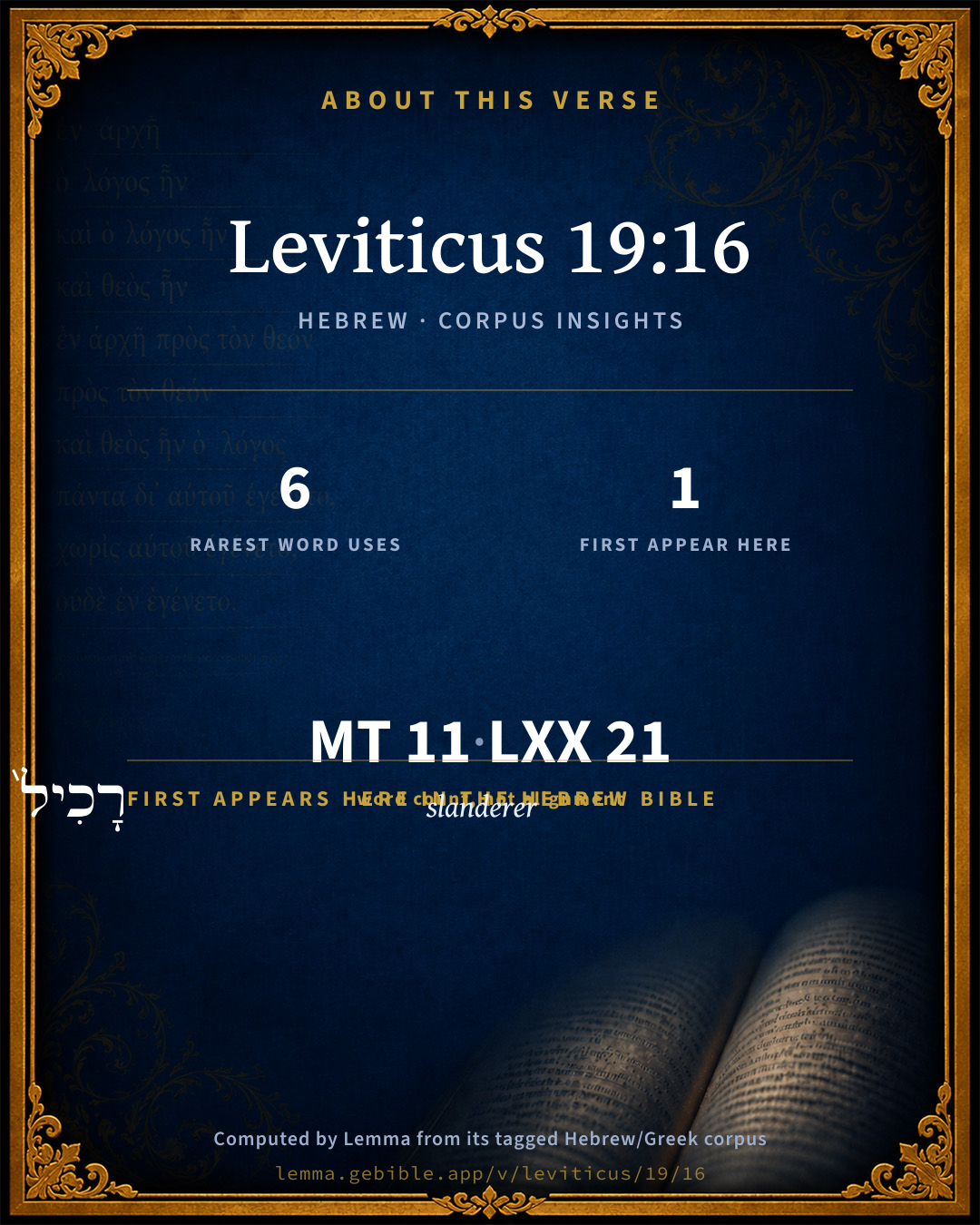
The rarest word here is רָכִיל֙ slanderer H7400 — appearing just 6 times in the whole Hebrew Bible.

First appearance in Scripture

This word makes its first canonical appearance in the Hebrew Bible here:

  • רָכִיל֙ slanderer H7400

Shared distinctive vocabulary

רָכִיל֙ slanderer H7400 occurs in 6 verses of the Hebrew Bible. Also found in:

Grammatical profile

  • 2 verbs
  • 5 nouns
  • 1 pronoun
  • 1 preposition
  • 2 particles

Verb forms

  • תֵלֵ֤ךְ Qal · Imperfect
  • תַעֲמֹ֖ד Qal · Imperfect

Repetition

A word recurs within this verse — often emphatic in Hebrew:

Hebrew & Septuagint length

In English translation the verse runs 26 words from the Hebrew and 25 from the Septuagint (LXX English) — closely comparable.

A rough comparison of the two English renderings, which tokenize alike — not a word-level alignment.

Word counts can differ between the Hebrew and the Greek without any difference in meaning — e.g. the Hebrew direct-object marker אֵת has no separate Greek word, and Greek often adds the article ὁ.

In the original languages it is 11 Hebrew tokens and 21 Greek tokens — but the two are counted differently (Hebrew bundles its prefixes and suffixes into one token; the Greek is in lemma form), so that isn’t a like-for-like length.

Cross-references

18

Topical passages linked to Leviticus 19:16 in the Treasury of Scripture Knowledge — connected by theme and wording, ordered by reader-vote popularity; previews shown in the World English Bible.

  • Exodus 23:1 "You shall not spread a false report. Don't join your hand with the wicked to be a malicious witness.
  • Exodus 23:7 "Keep far from a false charge, and don't kill the innocent and righteous: for I will not justify the wicked.
  • Proverbs 20:19 He who goes about as a tale-bearer reveals secrets; Therefore don't keep company with him who opens wide his lips.
  • Ezekiel 22:9 Slanderous men have been in you to shed blood; and in you they have eaten on the mountains: in the midst of you they have committed lewdness.
  • Proverbs 11:13 One who brings gossip betrays a confidence, But one who is of a trustworthy spirit is one who keeps a secret.
  • Jeremiah 6:28 They are all grievous rebels, going about with slanders; they are brass and iron: they all of them deal corruptly.
  • Jeremiah 9:4 Take you heed everyone of his neighbor, and don't you trust in any brother; for every brother will utterly supplant, and every neighbor will go about with slanders.
  • Exodus 20:16 "You shall not give false testimony against your neighbor.
  • 1 Kings 21:10–13 and set two men, base fellows, before him, and let them testify against him, saying, You did curse God and the king. Then carry him out, and stone him to death.
  • Psalms 15:3 He who doesn't slander with his tongue, Nor does evil to his friend, Nor casts slurs against his fellow man;
  • Acts 6:11–13 Then they secretly induced men to say, "We have heard him speak blasphemous words against Moses and God."
  • 1 Peter 2:1 Putting away therefore all wickedness, all deceit, hypocrisies, envies, and all evil speaking,
  • Matthew 26:60–61 and they found none. Even though many false witnesses came forward, they found none. But at last two false witnesses came forward,
  • 1 Timothy 3:11 Their wives in the same way must be reverent, not slanderers, temperate, faithful in all things.
  • 2 Timothy 3:3 without natural affection, unforgiving, slanderers, without self-control, fierce, no lovers of good,
  • Titus 2:3 and that older women likewise be reverent in behavior, not slanderers nor enslaved to much wine, teachers of that which is good;
  • Matthew 27:4 saying, "I have sinned in that I betrayed innocent blood." But they said, "What is that to us? You see to it."
  • Acts 24:4–9 But, that I don't delay you, I entreat you to bear with us and hear a few words.

Cross-references courtesy of OpenBible.info (CC BY 4.0).

Hebrew and Greek witnesses Masoretic Hebrew ↔ Greek Septuagint

The same verse in the two great witnesses to the Old Testament, shown verse-for-verse.

These are two independent witnesses, not word-aligned to each other, and the Septuagint is shown in lemma (dictionary) form.

Hebrew Leviticus 19:16 Masoretic · Westminster Leningrad Codex

לֹא תֵלֵ֤ךְ רָכִיל֙ בְּעַמֶּ֔יךָ לֹ֥א תַעֲמֹ֖ד עַל דַּ֣ם רֵעֶ֑ךָ אֲנִ֖י יְהוָֽה

"'You shall not go up and down as a slanderer among your people; neither shall you stand against the life of your neighbor. I am Yahweh.

World English Bible · Public Domain

Greek LXX Leviticus 19:16 Septuagint · lemma form

οὐ πορεύομαι δόλος ἐν ὁ ἔθνος σύ οὐ ἐπι συνἵστημι ἐπί αἷμα ὁ πλησίον σύ ἐγώ εἰμί κύριος ὁ θεός σύ

You shall not walk deceitfully among your people; you shall not rise up against the blood of your neighbor: I am the Lord your God.

LXX2012 (modern English Septuagint) · Public Domain

Hebrew: Westminster Leningrad Codex (CC BY 4.0). Greek: Septuagint (public domain); English from LXX2012 (modern English Septuagint) (Public Domain). How the Septuagint differs from the Hebrew →

Targum (Aramaic paraphrase)

2

The Targum is the ancient Jewish Aramaic paraphrase of the Hebrew Scriptures — an interpretive translation, not the Hebrew text itself. Onkelos (literal) and Pseudo-Jonathan (expansive) render the Torah, and Jonathan the Prophets. Coverage is partial: where no permissively-licensed English translation exists for a verse, only the Aramaic is shown. This is verse-level text, not a word-by-word alignment to the Hebrew.

  1. Targum Onkelos Torah (Genesis–Deuteronomy)
    לָא תֵיכוּל קוּרְצִין בְּעַמָךְ לָא תְקוּם עַל דְמָא דְחַבְרָךְ אֲנָא יְיָ

    (no public-domain English translation for this verse)

    Targum Onkelos — Aramaic: “Onkelos Genesis” (public domain); “Onkelos Exodus” (public domain); “Onkelos Leviticus” (public domain); “Onkelos Numbers” (public domain); “Onkelos Deuteronomy” (public domain). English: “Sefaria Community Translation” (CC0 1.0 (public-domain dedication)); “J.W. Etheridge. The Targums of Onkelos and Jonathan Ben Uzziel on the Pentateuch. London: Longmans, Green, 1862” (public domain). Text via Sefaria.

  2. Targum Pseudo-Jonathan Torah (Genesis–Deuteronomy)
    לָא תֶהֱווֹן אָזְלִין בָּתַר לִישַׁן תְּלִיתָאֵי דְהוּא קְשֵׁי הֵי כְּחַרְבָּא דִקְטַל מִן תְּרֵין חוּרְפוֹי לְמֵיכוּל קוּרְצִין לִמְעִיקָא לְבַר עַמָךְ לָא תִמְנַע זְכוּ דְחַבְרָךְ לְמִסְהֲדָא עֲלוֹי בְּדִינָא אֲנָא יְיָ

    Thou shalt not go after the slanderous tongue, which is cruel as a sword that killeth with its two edges in uttering false accusations to afflict thy people. Thou shalt not hinder the acquittal of thy neighbour in witnessing against him in the judgment: I am the Lord.

    Targum Pseudo-Jonathan — Aramaic: “Targum Jonathan on Genesis” (public domain); “Targum Jonathan on Exodus” (public domain); “Targum Jonathan on Leviticus” (public domain); “Targum Jonathan on Numbers” (public domain); “Targum Jonathan on Deuteronomy” (public domain). English: “The Targum of Jonathan ben Uzziel, trans. J. W. Etheridge, London, 1862” (public domain). Text via Sefaria.

Commentary

Notes on Leviticus 19:16 from classic Christian and Jewish commentators (each source and its license shown beneath its notes). The classic Christian expositions comment on the surrounding passage and are grouped to its opening verse, so a note may address several verses; the Jewish commentaries on the Tanakh (Rashi and others) are per-verse, so they appear only where the commentator wrote on this verse.

Lemma curates 59 commentaries, every one of them public domain or Creative Commons licensed, each selected and text-cleaned for this edition rather than reprinted as found. About our sources →

Trapp's Complete Commentary

John Trapp

Lev 19:16 Thou shalt not go up and down [as] a talebearer among thy people: neither shalt thou stand against the blood of thy neighbour: I [am] the LORD.

Ver. 16. Up and down as a talebearer.] Heb., As a pedlar, that first fills his pack with reports and rumours, and then goes peddling up and down, dropping a tale here and another there, to the taking away of the good name, and sometimes of the life of another. Hence it follows here, "Neither shalt thou stand against the life of thy brother." And agreeable hereunto is that of Eze 22:9, "In thee are men that carry tales to shed blood." Such a wretched pedlar was Doeg: and such is that backbiter spoken of in Psa 15:3. The word there used doth in the Hebrew properly signify such a one as footeth and trotteth it up and down, prying, and spying, and carrying tales and rumours. {2Sa 19:21}

John Trapp, A Commentary or Exposition upon All the Books of the Old and New Testament (1647–1656) — public domain. Text from a community e-Sword module.

The Biblical Illustrator

Joseph S. Exell

Lev_19:16

Thou shalt not go up and down as a talebearer.

Talebearing and slander

I. Character is in the keeping, and therefore at the mercy of acquaintances.

1. Therefore supremely value each others good name.

2. Jealously defend a worthy reputation.

3. Scornfully silence the unproved rumours of evils.

II. Character may be ruthlessly shattered by sinister whisperings.

1. For listeners are ready to entertain and repeat slander. Mans inhumanity to man!

2. Aspersions feed on the inventiveness of malice.

3. Reputation is easily damaged. That which only a lifetime can build an hour may defame.

III. Character is so precious that its traducers should be loathed.

1. Dread a talebearer as a destroying pestilence.

2. He who wrongs anothers reputation may next wrong yours. By heeding his slanders you encourage his vile trade, and slander must find new victims!

3. Put to shame all talebearers with ruthless severity.

Note--

1. There is enough of woe abroad without increasing it.

2. As we need our many evils to be pitied by man and pardoned by God, let us with charity hide sins, not expose them.

3. There is grace in Christ, and energy in the Holy Spirit, by which to perfect a good life and win a good name, which even enemies of religion shall be unable to defame or destroy.

4. The light of the final judgment will refute all slander, and bring every secret thing to the open gaze of the world. (W. H. Jellie.)

Mischief of talebearing

The carrying of a tale, and reporting what such an one said or such an one did, is the way to sow such grudges, to kindle such heart-burnings between persons, as oftentimes break forth and flame to the consumption of families, courts, and perhaps at length of cities and kingdoms. The mischief such incendiaries do is incredible, as being indeed for the most part inevitable. And a vine or a rose-tree may as well flourish when there is a secret worm lurking and gnawing at the root of them, as the peace of those societies thrive that have such concealed plagues wrapt up in their hearts and bowels. (R. South.)

Scandal rebuked

One day, in the presence of a pious tanner, at Elberfield, some people were tearing their neighbours characters to pieces. Diedrich, the tanner, was silent. You say nothing, said they. You see, replied he, I am a little like a bankrupt. He may be engaged in a most animated conversation, but I have always remarked, when the subject turns upon bankruptcy, he is suddenly dumb. I, too, am a bankrupt; the defects you are just reproaching your neighbours with I find in myself, and that shuts my mouth. (Pastor Krummacher.)

Talebearing condemned

The following is related of the late J. J. Gurney, by one who, as a child, was often of his family circle:--One night--I remember it well--I received a severe lesson on the sin of evil speaking. Severe I thought it then, and my heart rose in childish anger against him who gave it; but I had not lived long enough in this world to know how much mischief a childs thoughtless talk may do, and how often it happens that great talkers run off from the straight line of truth. I was talking very fast about some female relative, who did not stand very high in my esteem, and was about to speak further of her failings of temper. In a few moments my eyes caught a look of such calm and steady displeasure, that I stopped short. There was no mistaking the meaning of that dark, speaking eye; it brought the colour to my face, and confusion and shame to my heart. I was silent for a few moments, when Joseph John Gurney asked, very gravely, Dost thou not know any good thing to tell us of her? I did not answer. The question was more seriously asked, Think; is there nothing good thou canst tell us of her? Oh yes, I know some good things, certainly, but-- Would it not have been better, then, to relate these good things than to have told us that which must lower her in our esteem? Since there is good to relate, would it not be kinder to be silent on the evil? Charity rejoiceth not in iniquity, thou knowest. (Great Thoughts.)

The talebearer

One celebrated nation of antiquity used to express this mans character by a very significant figure. They called a talebearer a seed picker. They gave him the same name which they used for a bird which goes about everywhere picking up seeds. There are men in the world who live by their seed collecting; by going about here and there from house to house, and gathering together all the little stories which can be told or made about the neighbours who are dwelling all the time securely by them and ignorant of the calumnies by which they are assailed. Yes, the seed collector, the man who goes about gathering anecdotes, great and small, about his neighbours, and retailing them again as he goes, is a common character everywhere. I wish that I could hold up the mirror to him for his own conviction. I am sure he would be ashamed, I believe he would be sorry if he saw himself faithfully pourtrayed. (Dean Vaughan.)

The Biblical Illustrator, edited by Joseph S. Exell (c. 1880s–1900s) — public domain. Text from a community e-Sword module.

Joseph Benson's Commentary

Lev 19:16. Stand against the blood — In judgment, as a false accuser, or false witness, for accusers and witnesses use to stand, while the judges sit, in courts of judicature.

Joseph Benson's Commentary on the Old and New Testaments (1811–1818) — public domain. Text from a community e-Sword module.

Tyndale Open Study Notes

Tyndale Open Resources

19:16 Do not spread slanderous gossip: The image here is of a merchant who trades and sells harmful rumors and accusations. This practice would quickly erode and undermine the sense of community so valued in Israel (cp. Prov 11:13; 16:28; 20:19; 26:20; 2 Cor 12:20).

Tyndale Open Study Notes — © Tyndale Open Resources, licensed CC BY-SA 4.0. Text via the HelloAO Bible API.

Geneva Bible (1599)

Geneva Bible translators

By consenting to his death, or conspiring with the wicked.

As a slanderer, backbiter, or quarrel picker.

Geneva Bible (1599) marginal notes — public domain. Text via Bolls.life.

Adam Clarke's Commentary

Verse 16. Thou shalt not go up and down as a tale-bearer] רכיל rachil signifies a trader, a pedlar, and is here applied to the person who travels about dealing in scandal and calumny, getting the secrets of every person and family, and retailing them wherever he goes. A more despicable character exists not: such a person is a pest to society, and should be exiled from the habitations of men.

Neither shalt thou stand against the blood, &c.] Thou shalt not be as a false witness, because by such testimony the blood-the life of an innocent man may be endangered.

Adam Clarke's Commentary on the Bible (1810–1826) — public domain. Text from a community e-Sword/MySword module.

Ellicott's Commentary for English Readers

(16) Thou shalt not go up and down as a tale-bearer.—Better, Thou shalt not go about slandering, as the Authorised Version has it in Jer_6:28; Jer_9:4; Eze_22:9, Margin. Whilst giving just evidence in a court of justice is demanded by the law, it prohibits the circulation of slanderous reports about our neighbours. This dangerous habit, which has ruined the character and destroyed the life of many an innocent person (1Sa_22:9; 1Sa_22:18; Eze_22:9, &c.), was denounced by the spiritual authorities in the time of Christ as the greatest sin. Three things they declared remove a man from this world, and deprive him of happiness in the world to come—idolatry, incest, and murder, but slander surpasses them all. It kills three persons with one act, the person who slanders, the person who is slandered, and the person who listens to the slander. Hence the ancient Chaldee Version of Jonathan translates this clause: “Thou shalt not follow the thrice accursed tongue, for it is more fatal than the double-edged devouring sword.” (Comp. also Sir_28:14)

Neither shalt thou stand against the blood.—This part of the verse is evidently designed to express another line of conduct whereby our neighbour’s life might be endangered. In the former clause, “the going about” with slanderous reports imperilled the life of the slandered person, here “the standing still” is prohibited when it involves fatal consequences. The administrators of the law during the second Temple translating this clause literally, thou shalt not stand still by the blood, &c, interpreted it to mean that if we see any one in danger of his life, i.e., drowning, attacked by robbers or wild beasts, &c., we are not to stand still by it whilst his blood is being shed, but are to render him assistance at the peril of our own life. Or if we know that a man has shed the blood of his fellow creature, we are not to stand silently by whilst the cause is before the tribunal. Hence the Chaldee Version of Jonathan renders it, “Thou shalt not keep silent the blood of thy neighbour when thou knowest the truth in judgment.” Others, however, take it to denote to come forward, and try to obtain a false sentence of blood against our neighbours, so that this phrase is similar in import to Exo_23:1; Exo_23:7.

A Bible Commentary for English Readers, edited by Charles John Ellicott (1878–1897) — public domain. Text from a community e-Sword module.

The Cambridge Bible for Schools and Colleges

gen. ed. J. J. S. Perowne

16. a talebearer] Cp. Pro_11:13; Pro_20:19. Jewish teachers frequently insist on the heinousness of slander. See Otho, Lex. Rabb. s.v. Calumnia, and note the rendering of Targ. Jon., ‘Thou shalt not go after the slanderous (lit. triple) tongue.’ The epithet ‘triple’ implies that slander affects three persons: the slanderer, the slandered one, and anyone who repeats the slander. See Tal. Bab. ‘Arachin fol. 15a, and cp. Sir_28:14 ff. (C.B.) with notes.

stand against the blood of thy neighbour] This expression has been differently interpreted: taken in connexion with the preceding warning against being a talebearer, it seems to forbid endangering the life of an innocent man by bearing false witness. Cp. Eze_22:9, part of a passage which describes with verbal similarity many of the evil doings which are forbidden in this ch. and the preceding one. Witnessing truly against a murderer is not forbidden, and Targ. Ps-Jon. explains this clause so as to enforce that duty; ‘be not silent about thy neighbour’s blood, when thou knowest the truth.’ Another interpretation is, ‘thou shalt not stand (without rendering help) by the blood of thy neighbour,’ i.e. when he is in peril of his life.

The Cambridge Bible for Schools and Colleges (gen. ed. J. J. S. Perowne; Cambridge University Press, 1878–1918) — public domain. Text from a community e-Sword module.

John Gill's Exposition

Thou shall not go up and down as a talebearer among thy people,.... The word used signifies a merchant, and particularly one that deals in drugs and spices, and especially a peddler in those things, that goes about from place to place to sell them; and such having an opportunity and making use of it to carry stories of others, and report them to their disadvantage, hence it came to be used for one that carries tales from house to house, in order to curry favour for himself, and to the injury of others; and such a man is a detestable person, and ought not to be encouraged, see Ti1 5:13,

neither shall thou stand against the blood of thy neighbour; either by bearing a false testimony, whereby his blood is in danger of being shed when innocent; or by being silent, and not hearing a testimony for him, whereby the shedding of his innocent blood might have been prevented; either way may be interpreted standing against it: the Jewish writers think, that a man by this law, is bound to do all he can to preserve the life of his neighbour, when it is by any means in danger, by drowning, or by thieves and wild beasts, so Jarchi:

I am the Lord; the just and righteous One, who will resent and punish for all unjust proceedings in courts of judicature, secret tale bearing, doing any injury to another, or not preventing it when in the power of his hands.

John Gill's Exposition of the Whole Bible (1746–1763) — public domain (CC PDM 1.0). Text via the HelloAO Bible API.

Albert Barnes' Notes on the Bible

Stand against the blood of thy neighbor - Either, to put his life in danger by standing up as his accuser (compare Mat 26:60); or, to stand by idly when thy neighbor’s life is in danger. Whichever interpretation we adopt, the clause prohibits that which might interfere with the course of justice.

Albert Barnes' Notes on the Bible (1834–1885) — public domain. Text from a community e-Sword/MySword module.

Haydock's Catholic Bible Commentary

Detracter, whisperer. Hebrew rakil, stands for both these terms. Some translate a parasite, a merchant, vilifying the goods of others to enhance the price of his own; or a spy, seeking to discover and laugh at others’ faults. --- Neighbour; accusing him wrongfully, to the danger of his life; or lying in wait for him like an assassin. But strive rather to rescue those who are attacked. Those who neglect this duty, are responsible for the consequences, according to the Jews, (Selden, Jur. iv. 3,) and the laws of the Egyptians. (Diodorus 1.)

George Leo Haydock (1774–1849), Haydock's Catholic Family Bible and Commentary, 1859 edition — public domain. Excludes Psalms (Douay-Rheims chapter numbering differs from Protestant) and Deuterocanonical books (Catholic canon only).

Matthew Poole's English Annotations

As a tale-bearer, who makes it his business to go up and down from one to another, and divulge evil and false reports concerning others, which, though many times it proceeds only from levity and talkativeness, yet apparently tends to the great injury of our neighbour. See Pro 11:13; Jer 6:28; 9:4. Neither shalt thou stand, to wit, in judgment, as a false accuser or false witness; for accusers and witnesses use to stand, whilst the judges sat, in courts of judicature.

Matthew Poole's English Annotations on the Holy Bible (1683–1685) — public domain. Text from a community e-Sword/MySword module.

Whedon's Commentary on the Bible

Daniel D. Whedon

16. A talebearer — Literally, a peddler whose wares are slanders and detractions. Such a person, possessing himself of the secrets of individuals and of families and then whispering them abroad, falsely colouring motives and distorting facts, is a social pest worthy to be banished from the haunts of men. A significant lesson respecting the character of the calumniator is taught in the curious fact that the Greek slanderer, διαβολος, has become the English devil.

Neither… stand against the blood — That is, maliciously seek the life. This does not debar a person from giving testimony against a criminal. Such testimony is positively enjoined in Lev_5:1. See note.

Daniel D. Whedon (gen. ed.), Commentary on the Old and New Testaments (1874–1909) — public domain. Text from a community e-Sword module.

The Pulpit Commentary

Thou shalt not go up and down as a talebearer among thy people. For the evil done by mere idle talebearing, see Bishop Butler"s sermon, "Upon the Government of the Tongue," and four sermons by Bishop Jeremy Taylor, on "The Good and Evil Tongue; Slander and Flattery; the Duties of the Tongue." Neither shalt thou stand against the blood of thy neighbour; that is, thou shalt not endanger his life, which is the result of the worst kind of talebearing, namely, bearing false witness against him. Thus the effect of the false witness of the two men of Belial against Naboth was that "they carried him forth out of the city, and stoned him with stones, that he died". (1Ki_21:13; cf. Mat_26:60 Mat_27:4)

The Pulpit Commentary (1880–1919), ed. H.D.M. Spence-Jones & Joseph S. Exell — public domain. Text from a community e-Sword module.

John Wesley's Explanatory Notes

Stand against the blood - In judgment as a false accuser or false witness, for accusers and witnesses use to stand, whilst the Judges sit in courts of judicature.

John Wesley, Explanatory Notes Upon the Whole Bible (1754–1765) — public domain. Text via the GEBible commentary corpus.

Rashi

Rabbi Shlomo Yitzchaki (Rashi)

לא תלך רכיל THOU SHALT NOT GO ABOUT AS A TALE BEARER — I say that because all those who sow discord between people and all who speak slander go into their friends' houses in order to spy out what evil they can see there, or what evil they can hear there so that they may tell it in the streets —they are called הולכי רכיל which it the same as הולכי רגילה, "people who go about spying"; espiement in O. F. A proof of my statement is the fact that we do not find anywhere the term רגיל used in Scripture except in connection with the expression הלך "to go". Examples are: the phrase here, לא תלך רכיל; (Jeremiah 6:28) "[They are all] walking as spies: they are brass and iron". But as for any other expressions for “slander”, the verb הלך is not used with them. Examples are (Psalms 101:5) "whoso privily slandereth his neighbour”; (Psalms 120:2) "false tongue"; (Psalms 12:4) "the tongue that speaketh proud things (slander)". For this reason I say that this expression (הולך רכיל) means "going about ומרגל, and spying out” (רגל = רכל), because the כ may interchange with,ג since all letters the pronounciation of which are of the same place in the organs of speech may interchange with each other e. g., בי"ת with גימ"ל,פ"א with כ"ף or with נו"ן;קו"ף with זי"ן;למ"ד with צד"י. And in a similar sense we have, (II Samuel 19:28) "He spied against thy servant [to my lord]” which implies, "he spied me out with subtly in order to speak evil about me to my lord״ (and thus וירגל comes to mean "to slander”). Similar is (Psalms 15:8): לא רגל על לשונו which means, "he has not spied out in order to have evil on his tongue”. Similarly the רוכל, the trader, is one who goes round and searches for (spies out) all kinds of merchandise, and so also the seller of perfumes which women use to make themselves nice, because he constantly goes about in the villages, he is called רוכל, which has the same meaning as רוגל. And its translation in the Targum לא תיכול קורצין, has the same meaning as (Daniel 3:8) "and they slandered (אכלו קורציהון) the Jews”; and as (Berakhot 58a) "he slandered him (אכל ביה קורצא בי מלכא) to the king”. It seems to me that people had the custom to eat a little snack in the house of him who listened to their slanderous words, and this served as the final confirmation that his (the slanderer's) statements were well founded and that he would maintain the truth of them. This "snack” was called אכילת קורצין, the word קורצא being connected in meaning with the root קרץ in (Proverbs 6:13) "He winketh (קורץ) with his eyes”, for it is the manner of all who go about slandering to wink with their eyes and to suggest their slanderous statements by innuendos in order that others who happen to hear them should not understand them.

לא תעמד על דם רעך NEITHER SHALT THOU STAND AGAINST THE BLOOD OF THY FELLOW — witnessing his death, you being able to rescue him: if, for instance, he is drowning in the river or if a wild beast or a robber is attacking him (Sifra, Kedoshim, Chapter 4 8; Sanhedrin 73a).

‎'אני ה‎‎ I AM THE LORD — Who am faithful in paying reward to those who obey My commandments and Who am certain to punish those who transgress them.

Rashi on the Tanakh — English translations: “The Judaica Press complete Tanach with Rashi, translated by A. J. Rosenberg” (CC BY 4.0); “Pentateuch with Rashi's commentary by M. Rosenbaum and A.M. Silbermann, 1929-1934” (public domain); “The Metsudah Tanach series, Lakewood, N.J” (CC BY 4.0); and “The Book of Joshua, Metsudah Publications, 1997” (CC BY 4.0). Text via Sefaria.

Ramban (Nachmanides)

Rabbi Moshe ben Nachman (Ramban / Nachmanides)

THOU SHALT NOT ‘THEILEICH RACHIL’ (GO UP AND DOWN AS A TALEBEARER) AMONG THY PEOPLE. “I say that because all those who sow discord [among brethren] and speak slander go into their friends’ houses in order to spy out what evil they can see or hear, so that they may tell it in the street — therefore they are called holchei rachil or holchei regilah (‘those who go about spying’) etc. And so did Onkelos translate [the verse before us]: lo theichul kurtzin [literally: ‘thou shalt not eat kurtzin’, which has the same meaning as], ‘va’achalu kartzeihon’ (and they brought accusation against) the Jews; ‘achlu kurtza (they slandered him) to the king.’ It appears to me that it was their custom to eat something in the house of him who accepted their slanderous words, this being a sort of final confirmation that the slanderer’s words are well-founded, and that he would stand by them. It was this snack that was called ‘the eating of kurtzin,’ [the word being associated with] the [Hebrew] expression, ‘koreitz’ (he that winketh) with his eyes, for such is the manner of all who go about slandering, to wink with their eyes, and to insinuate slanderous matters in order that [others who happen to] hear them should not understand them.” All this is the language of the Rabbi [Rashi].But his explanation of this rendition of Onkelos has neither rhyme nor reason. For one who listens to a slanderer does not swear to him that he will believe his words, and [therefore the slanderer] need not give him a sign or token [to believe him]! Even when one slanders a servant to his master,. Ramban’s intention is therefore as follows: Even in slandering a slave, where the slanderer runs the risk of incurring his curse, the master nonetheless gives the slanderer no assurance that he will listen to him, and so what sense is there to this “eating” on the part of the slanderer which Rashi mentioned? the master does not assure him that he will listen to him, and so what sense is there to this “eating” [by the slanderer, as Rashi mentioned]? And Nebuchadnezzar did what he decided to do on the basis of his own decision about the righteous ones, and it is told that certain slanderers came and informed Nebuchadnezzar that Hananiah, Mishael, and Azariah, were not bowing to his image of gold. As a result he called them and asked them if it was true. When they told him that they had no intention ever of bowing to his image of gold, he had them thrown into a burning furnace. But when they were saved by an act of G-d from the fiery furnace, the king had it proclaimed that no one must henceforth speak against the G-d of these righteous ones. — Ramban now points out that when accepting the words of the slanderers, we find no reference to the king’s offering them any food, a custom which Rashi mentioned as having been the basis for this expression va’achalu kartzeihon. Furthermore, as is evidenced from the story, he did not even believe them at first, for he called Hananiah etc. and asked about it. And yet Scripture says ‘va’achalu kartzeihon’ of the Jews, which shows that this whole interpretation of Rashi in Onkelos’ translation of the verse is not borne out by Scripture. and He did not offer food to the slanderers [to establish the veracity of their report], neither did he swear to them [that he would believe them], nor did he in fact believe them. Instead, he asked [of the righteous ones], Is it true, O Shadrach, Meshach and Abednego etc., 1:7). and he commanded that if henceforth they were to bow to the image of gold that he had made, he would forgive them for their transgressions in the past! [All this shows that va’achalu kartzeihon does not refer to a meal eaten by the slanderers, to serve as the final confirmation that their slander was well-grounded, since in the case of Nebuchadnezzar, where this expression occurs, the king did not accept their report!] Nor did King Darius offer food to the slanderers of Daniel, 6:12-14. except for the wormwood and the gall, and yet it is written of them, those men that ‘achalu kartzohi’ of Daniel!,) it refers to them as those men that ‘achalu kartzohi’ of Daniel, which shows that it was not a meal that the king offered them, but quite the contrary. And even if it is true that it was so done in those [later] times, but since Scripture states thou shalt not go up and down as a talebearer among thy people, why should Onkelos have mentioned this foolish custom [of the slanderer eating a little snack in the house of him who listened to his slanderous words], when it does not affect the admonition itself? Instead, the essential meaning of the Aramaic expression here [i.e., lo theichul kurtzin, is not a prohibition against “eating kurtzin,” but] is only a term for the act of making a sound, this usage being common in the language of the Sages: “And even if it were but goats, would they not achluyei michlulei (have to be shouted at)? And would you not have [to hire] a person l’achluyei (to shout) at them?” Jonathan [ben Uziel] translated: Cry aloud — ‘achlei;’ and ‘He will hiss’ unto them from the end of the earth, 5:26. — ‘v’yachlilei;’ ‘and they shall roar’ against them like the roaring of the sea, 5:30. — ‘v’yachlei’ against them. Similarly [Jonathan has translated] in many places. Thus the term achal [in Aramaic] denotes every form of making sound, whereby one makes his wish known without uttering words. Therefore this term was used [by the Sages, as mentioned above] to describe one who shouts at goats that enter a field, and [Jonathan used the same term in translating the Hebrew for] hissing, 5:26. roaring, 5:30. and crying aloud. Now the way of talebearers is to come amongst a multitude of people, or before a ruler, and utter sounds in a guttural manner, and wink with their eyes, in order to hint that they have heard certain important matters until they press upon them that they tell them. This is why [talebearers in Aramaic] are called ochlei kurtzin, meaning “those who roar with hints.” And Onkelos who translated [the Hebrew] rechiluth (talebearing) [as theichul kurtzin — muttering hints], rendered into Aramaic the idea of the Hebrew, and was not particular to explain the precise meaning of the Scriptural expression. Such is always his style, since his intention is to make the subject understandable [and not necessarily to translate literally]. But in the Sacred Language talebearers are called holchei rachil, from the expressions, all powders of the ‘rachil’ (merchant); ‘rechulatheich’ (thy merchandise). For the rocheil (peddler) goes about the whole day, buying merchandise in various other places, just as the Sages mention, “peddlers that go around from town to town,” [and similarly the holchei rachil carry tales as if they were merchandise, from place to place]. And this is the sense of the word b’amecha (among thy people) — Thou shalt not go up and down as a talebearer ‘among thy people’ — since the talebearer walks among many people. To differentiate between the two [the talebearer and the peddler], the talebearer was called rocheil, in a verbal form, [as the term rocheil can also signify the act of talebearing], while the peddler was called rachil, which is an adjectival noun denoting the person himself, just like saris (chief), nazir (a Nazirite), the name rachil thus hinting that peddling is of his essence, and is an act which reflects upon his person.

Ramban (Nachmanides) on the Tanakh — English translation: “Commentary on the Torah by Ramban (Nachmanides). Translated and annotated by Charles B. Chavel. New York, Shilo Pub. House, 1971-1976” (CC BY 4.0). Text via Sefaria.

Ibn Ezra

Rabbi Abraham ibn Ezra

Tale-bearer. This is as in Yechezkel (26:12): “despoil your merchandise [רכולתך].” This is because one who bears tales resembles a merchant, who buys from one and sells to another. The tale bearer as well reveals to one what he heard from another.

You shall not stand idly by the blood of your fellow. You should not associate with men [that shed] blood, for it is known how many were murdered and killed because of slander, and Doeg HaEdomi is an example.

It concludes, I am Adonoy because He sees what you do in secrecy.

Ibn Ezra on the Tanakh — English translations: “Sefaria Community Translation” (CC0 1.0 (public-domain dedication)); “Yalkut, Sifsei Chachomim Chumash, Metsudah Publications, 2009” (CC BY 4.0); and “Commentary of Ibn Ezra on Isaiah - trans. by M. Friedlander, 1873” (public domain). Text via Sefaria.

Lesson kit

Teaching starters — assembled from the data on this page, not authored interpretation. Every prompt links to the verse data it draws on. Edit before teaching.

Leviticus, in the Pentateuch, opens this verse with 11 words (10 distinct Hebrew lemmas). Its most distinctive word is râkîyl (“slanderer”). A historical commentator’s framing appears above. Read the whole chapter for the surrounding context.

Discussion questions

  1. The word râkîyl carries the sense “slanderer.” How does it shape the verse?
  2. This is the first place “slanderer” appears in Scripture (first appears here). What does its debut here establish?
  3. How does Proverbs 11:13, which shares the word «slanderer», read alongside this verse?
  4. What does the repetition of “not” (2× in this one verse) do in this verse?
  5. These translations render this verse differently; the difference is in the English rendering, not the original. What questions does that raise?
  6. «תֵלֵ֤ךְ» is a Qal Imperfect verb. How does that grammatical form shape the action described?
  7. Compare how Trapp's Complete Commentary and The Biblical Illustrator read this verse. Where do they agree or differ?

Things to notice

Reading settings

Reading text

Shown beneath each verse's original-language words.

Old Testament
Old Testament edition

Read the OT as the Masoretic Hebrew (MT) or the Greek Septuagint (LXX).

English shown for the Greek Septuagint (in the Hebrew ↔ Greek comparison).

Comparing translations? Open the Compare panel on any verse page to stack up to four side by side.