Deuteronomy 29:6

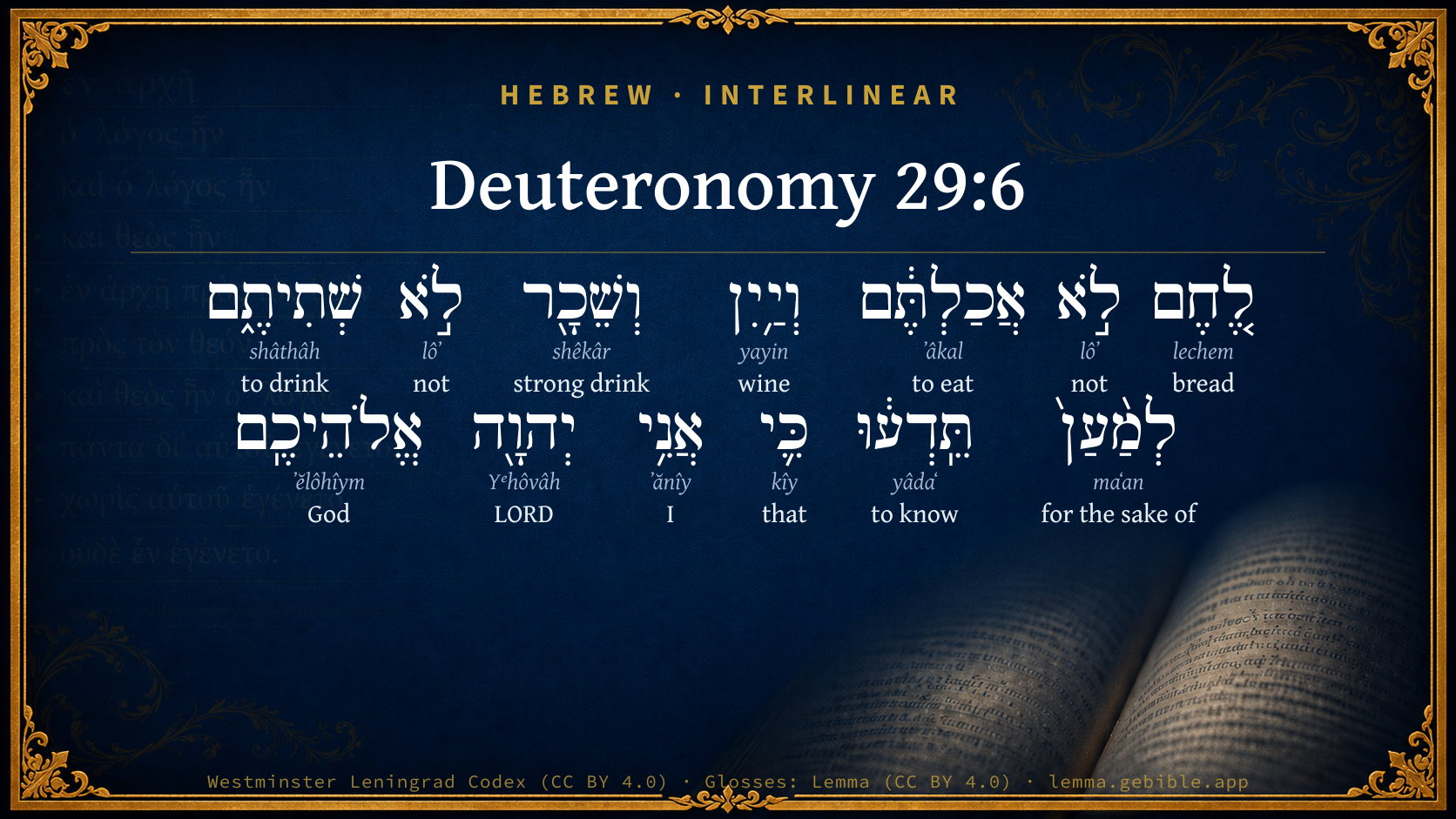
Hebrew (Westminster Leningrad Codex) Deuteronomy 29:6 appears in the Hebrew Old Testament. The text above is from the Westminster Leningrad Codex. Each word links to its Strong’s number, a concise gloss, and parsing drawn from the Open Scriptures Hebrew Bible morphology. Click any word for its full Brown-Driver-Briggs (BDB) entry.
Download image
Cite this verse

Deuteronomy 29:6 (World English Bible). Public Domain. Lemma interlinear Bible study tool, https://lemma.gebible.app/v/deuteronomy/29/6.

Show BibTeX & RIS
BibTeX
RIS
English Translation
You have not eaten bread, neither have you drunk wine or strong drink; that you may know that I am Yahweh your God.
World English Bible · Public Domain
Download a study sheet

One document with this verse’s original text, its word-by-word gloss line, the meaning frame, cross-references with their text, attributed commentary, and full source and license credits — printable, and it pastes into notes with its structure intact.

This verse Autodidact and up

Study sheet (.html) Plain text (.txt)

A passage Seminary Student

Up to 50 verses in one chapter. A passage sheet keeps up to 6 commentary sources and 12 cross-references per verse, in the order this page ranks them, and says so on the sheet whenever that leaves anything out. Ask for a single verse and you get the Autodidact verse sheet above.

Everything on this page stays free to read, with no account — the sheet is a download of what is already on screen, not access to it.

Want to remove ads? Support Godless Engineer
Compare translations 3

The same verse in 3 English versions, stacked beneath the original-language interlinear above. Click any original word for its lexicon entry.

Each is an independent rendering of the whole verse — the interlinear is not word-aligned to these translations.

Highlighted words mark where these versions differ — a whole-verse word diff, not a word-by-word alignment.

  • World English Bible Public Domain
    You have not eaten bread, neither have you drunk wine or strong drink; that you may know that I am Yahweh your God.
  • King James Version Public Domain
    Ye have not eaten bread, neither have ye drunk wine or strong drink: that ye might know that I am the LORD your God.
  • unfoldingWord Literal Text CC BY-SA 4.0
    You did not eat bread, and you did not drink wine or beer, so that you might know that I Yahweh your God.’

unfoldingWord Literal Text — © unfoldingWord, licensed CC BY-SA 4.0. Word-aligned USFM3 via Door43 (git.door43.org/unfoldingWord/en_ult).

Versions to compare (up to 4)

3 of 4 selected

Show all 18 translations

Every available English version of this verse, each an independent rendering of the whole verse.

  • World English Bible Public Domain
    You have not eaten bread, neither have you drunk wine or strong drink; that you may know that I am Yahweh your God.
  • Berean Standard Bible Public Domain
    You ate no bread and drank no wine or strong drink, so that you might know that I am the LORD your God.
  • Majority Standard Bible Public Domain
    You ate no bread and drank no wine or strong drink, so that you might know that I am the LORD your God.
  • King James Version Public Domain
    Ye have not eaten bread, neither have ye drunk wine or strong drink: that ye might know that I am the LORD your God.
  • American Standard Version (1901) Public Domain
    Ye have not eaten bread, neither have ye drunk wine or strong drink; that ye may know that I am Jehovah your God.
  • Revised Version (1885) Public Domain
    Ye have not eaten bread, neither have ye drunk wine or strong drink: that ye might know that I am the LORD your God.
  • Geneva Bible (1599) Public Domain
    Ye haue eaten no bread, neither drunke wine, nor strong drinke, that ye might know how that I am the Lord your God.
  • Douay-Rheims (1899) Public Domain
    You have not eaten bread, nor have you drunk wine or strong drink: that you might know that I am the Lord your God.
  • Young's Literal Translation Public Domain
    bread ye have not eaten, and wine and strong drink ye have not drunk, so that ye know that I `am' Jehovah your God.
  • Literal Standard Version CC BY-SA 4.0
    you have not eaten bread, and you have not drunk wine and strong drink, so that you know that I [am] your God YHWH.
  • Unlocked Literal Bible CC BY-SA 4.0
    You did not eat any bread, and you did not drink any wine or other alcoholic drinks, so that you might know that I am Yahweh your God.
  • unfoldingWord Literal Text CC BY-SA 4.0
    You did not eat bread, and you did not drink wine or beer, so that you might know that I Yahweh your God.’
  • Darby Bible Public Domain
    ye have not eaten bread, neither have ye drunk wine or strong drink, that ye might know that I am Jehovah your God.
  • World Messianic Bible Public Domain
    You have not eaten bread, neither have you drunk wine or strong drink, that you may know that I am the LORD your God.
  • Webster's Bible Public Domain
    Ye have not eaten bread, neither have ye drank wine or strong drink: that ye might know that I am the LORD your God.
  • Free Bible Version CC BY-SA 4.0
    You didn't have bread to eat, or wine or alcohol to drink in order that you would realize that I am the Lord your God.
  • Bible in Basic English Public Domain
    You have had no bread, or wine, or strong drink: so that you might see that I am the Lord your God.
  • JPS Tanakh (1917) Public Domain
    (29-5) Ye have not eaten bread, neither have ye drunk wine or strong drink; that ye might know that I am the LORD your God.

Literal Standard Version (2020), Covenant Press — licensed CC BY-SA 4.0. Text via the HelloAO Bible API (eBible.org). Unlocked Literal Bible (unfoldingWord) — licensed CC BY-SA 4.0. Text via the HelloAO Bible API (eBible.org). unfoldingWord Literal Text — © unfoldingWord, licensed CC BY-SA 4.0. Word-aligned USFM3 via Door43 (git.door43.org/unfoldingWord/en_ult). Free Bible Version, Dr. Jonathan Gallagher — licensed CC BY-SA 4.0. Text via the HelloAO Bible API (eBible.org).

Word by word

More ways to search: Search by grammar → Find every occurrence → Compare this word →

Practice this passage: Drill this verse → Learn its vocabulary →

וְשֵׁכָ֖ר
shêkâr
H7941
“and · strong drink”
Conjunction + Noun, Common, Masculine, Singular, Absolute
Part of Speech
Conjunction + Noun
Type
Common
Gender
Masculine
Number
Singular
State
Absolute
Full BDB Definition

Origin: from H7937

TWOT: 2388a

strong drink, intoxicating drink, fermented or intoxicating liquor
  1. לֶ֚חֶם lechem H3899 “bread” Noun, Common, Both, Singular, Absolute
  2. לֹ֣א lôʼ H3808 “not” Particle, Negative
  3. אֲכַלְתֶּ֔ם ʼâkal H398 “to eat” Verb, Qal, Perfect, 2nd Person, Masculine, Plural
  4. וְיַ֥יִן yayin H3196 “and · wine” Conjunction + Noun, Common, Masculine, Singular, Absolute
  5. לֹ֣א lôʼ H3808 “not” Particle, Negative
  6. שְׁתִיתֶ֑ם shâthâh H8354 “to drink” Verb, Qal, Perfect, 2nd Person, Masculine, Plural
  7. לְמַ֨עַן֙ maʻan H4616 “for the sake of” Preposition
  8. תֵּֽדְע֔וּ yâdaʻ H3045 “to know” Verb, Qal, Imperfect, 2nd Person, Masculine, Plural
  9. כִּ֛י kîy H3588 “that” Conjunction
  10. אֲנִ֥י ʼănîy H589 “I” Pronoun, Personal, 1st Person, Common, Singular
  11. יְהוָ֖ה Yᵉhôvâh H3068 “LORD” Noun, Proper
  12. אֱלֹהֵיכֶֽם ʼĕlôhîym H430 “God(s) · your” Noun, Common, Masculine, Plural, Construct + Suffix, Personal, 2nd Person, Masculine, Plural

About this verse

These counts appear in no published source. They are computed here, from the morphology-tagged text and Lemma’s own curated glosses. What Lemma adds →

13
words
12
distinct lemmas
Pentateuch
section

Notable vocabulary

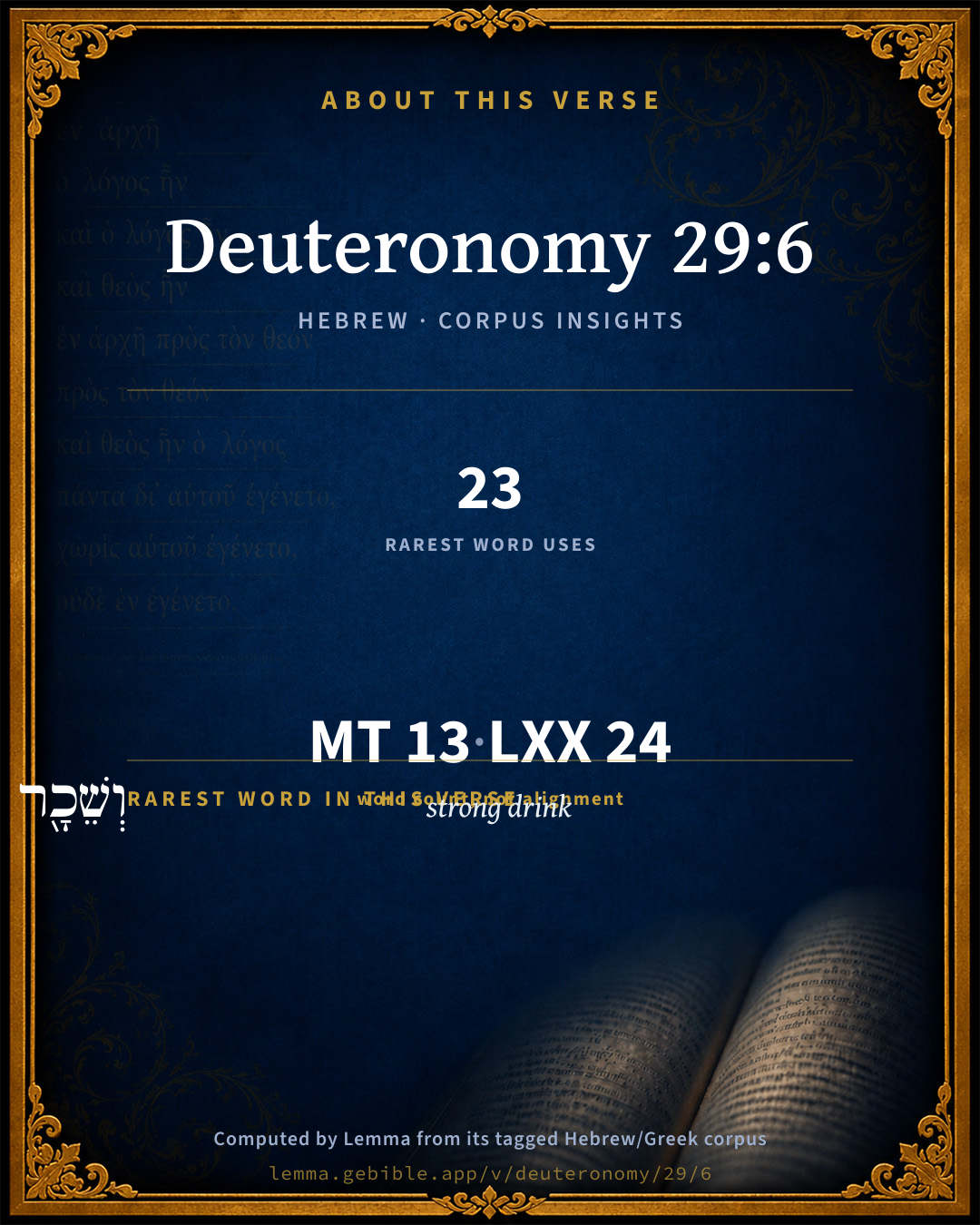
The rarest word here is וְשֵׁכָ֖ר strong drink H7941 — appearing just 23 times in the whole Hebrew Bible.

Shared distinctive vocabulary

וְשֵׁכָ֖ר strong drink H7941 occurs in 20 verses of the Hebrew Bible. Also found in:

Grammatical profile

  • 3 verbs
  • 5 nouns
  • 1 pronoun
  • 1 preposition
  • 1 conjunction
  • 2 particles

Verb forms

  • אֲכַלְתֶּ֔ם Qal · Perfect
  • שְׁתִיתֶ֑ם Qal · Perfect
  • תֵּֽדְע֔וּ Qal · Imperfect

Repetition

A word recurs within this verse — often emphatic in Hebrew:

Hebrew & Septuagint length

In English translation the verse runs 23 words from the Hebrew and 24 from the Septuagint (LXX English) — closely comparable.

A rough comparison of the two English renderings, which tokenize alike — not a word-level alignment.

Word counts can differ between the Hebrew and the Greek without any difference in meaning — e.g. the Hebrew direct-object marker אֵת has no separate Greek word, and Greek often adds the article ὁ.

In the original languages it is 13 Hebrew tokens and 24 Greek tokens — but the two are counted differently (Hebrew bundles its prefixes and suffixes into one token; the Greek is in lemma form), so that isn’t a like-for-like length.

Cross-references

10

Topical passages linked to Deuteronomy 29:6 in the Treasury of Scripture Knowledge — connected by theme and wording, ordered by reader-vote popularity; previews shown in the World English Bible.

  • Deuteronomy 8:3 He humbled you, and allowed you to hunger, and fed you with manna, which you didn't know, neither did your fathers know; that he might make you know that man does not live by bread only, but by everything that proceeds out of the mouth of Yahweh does man live.
  • Ephesians 5:18 Don't be drunken with wine, in which is dissipation, but be filled with the Spirit,
  • Exodus 16:12 "I have heard the murmurings of the children of Israel. Speak to them, saying, 'At evening you shall eat meat, and in the morning you shall be filled with bread: and you shall know that I am Yahweh your God.'"
  • Exodus 16:35 The children of Israel ate the manna forty years, until they came to an inhabited land. They ate the manna until they came to the borders of the land of Canaan.
  • Numbers 16:14 Moreover you haven't brought us into a land flowing with milk and honey, nor given us inheritance of fields and vineyards: will you put out the eyes of these men? we won't come up.
  • Numbers 20:8 Take the rod, and assemble the congregation, you, and Aaron your brother, and speak you to the rock before their eyes, that it give forth its water; and you shall bring forth to them water out of the rock; so you shall give the congregation and their cattle drink.
  • Nehemiah 9:15 and gave them bread from the sky for their hunger, and brought forth water for them out of the rock for their thirst, and commanded those who they should go in to possess the land which you had sworn to give them.
  • Psalms 78:24–25 He rained down manna on them to eat, And gave them food from the sky.
  • 1 Corinthians 9:25 Every man who strives in the games exercises self-control in all things. Now they do it to receive a corruptible crown, but we an incorruptible.
  • 1 Corinthians 10:4 and all drank the same spiritual drink. For they drank of a spiritual rock that followed them, and the rock was Christ.

Cross-references courtesy of OpenBible.info (CC BY 4.0).

Hebrew and Greek witnesses Masoretic Hebrew ↔ Greek Septuagint

The same verse in the two great witnesses to the Old Testament, shown verse-for-verse.

These are two independent witnesses, not word-aligned to each other, and the Septuagint is shown in lemma (dictionary) form.

Hebrew Deuteronomy 29:6 Masoretic · Westminster Leningrad Codex

לֶ֚חֶם לֹ֣א אֲכַלְתֶּ֔ם וְיַ֥יִן וְשֵׁכָ֖ר לֹ֣א שְׁתִיתֶ֑ם לְמַ֨עַן֙ תֵּֽדְע֔וּ כִּ֛י אֲנִ֥י יְהוָ֖ה אֱלֹהֵיכֶֽם

You have not eaten bread, neither have you drunk wine or strong drink; that you may know that I am Yahweh your God.

World English Bible · Public Domain

Greek LXX Deuteronomy 29:6 Septuagint · lemma form

καί ἔρχομαι ἕως ὁ τόπος οὗτος καί ἐκἔρχομαι σηων βασιλεύς εσεβων καί ωγ βασιλεύς ὁ βασαν εἰς συνάντησις ἐγώ ἐν πόλεμος καί πατάσσω αὐτός

You⌃ did not eat bread, you⌃ did not drink wine or strong drink, that you⌃ might know that I am the Lord your God.

LXX2012 (modern English Septuagint) · Public Domain

Hebrew: Westminster Leningrad Codex (CC BY 4.0). Greek: Septuagint (public domain); English from LXX2012 (modern English Septuagint) (Public Domain). How the Septuagint differs from the Hebrew →

Targum (Aramaic paraphrase)

2

The Targum is the ancient Jewish Aramaic paraphrase of the Hebrew Scriptures — an interpretive translation, not the Hebrew text itself. Onkelos (literal) and Pseudo-Jonathan (expansive) render the Torah, and Jonathan the Prophets. Coverage is partial: where no permissively-licensed English translation exists for a verse, only the Aramaic is shown. This is verse-level text, not a word-by-word alignment to the Hebrew.

  1. Targum Onkelos Torah (Genesis–Deuteronomy)
    וַאֲתֵתוּן לְאַתְרָא הָדֵין וּנְפַק סִיחוֹן מַ לְכָּא דְחֶשְׁבּוֹן וְעוֹג מַ לְכָּא דְמַתְנָן לָקֳדָמוּתָנָא לַאֲגָחָא קְרָבָא וּמְחוֹנוּן

    (no public-domain English translation for this verse)

    Targum Onkelos — Aramaic: “Onkelos Genesis” (public domain); “Onkelos Exodus” (public domain); “Onkelos Leviticus” (public domain); “Onkelos Numbers” (public domain); “Onkelos Deuteronomy” (public domain). English: “Sefaria Community Translation” (CC0 1.0 (public-domain dedication)); “J.W. Etheridge. The Targums of Onkelos and Jonathan Ben Uzziel on the Pentateuch. London: Longmans, Green, 1862” (public domain). Text via Sefaria.

  2. Targum Pseudo-Jonathan Torah (Genesis–Deuteronomy)
    וְאָתֵיתוּן לְאַתְרָא הָדֵין וּנְפַק סִיחוֹן מַלְכָּא דְחוּשְׁבְּנָא וְעוֹג מַלְכָּא דְמַתְנָן לִקְדָמוּתָנָא לְסִדְרֵי קְרָבָא וּמְחוּנוּן

    And you came to this place; and Sihon king of Heshbon and Og king of Mathnan came out to meet us in battle array, and we smote them,

    Targum Pseudo-Jonathan — Aramaic: “Targum Jonathan on Genesis” (public domain); “Targum Jonathan on Exodus” (public domain); “Targum Jonathan on Leviticus” (public domain); “Targum Jonathan on Numbers” (public domain); “Targum Jonathan on Deuteronomy” (public domain). English: “The Targum of Jonathan ben Uzziel, trans. J. W. Etheridge, London, 1862” (public domain). Text via Sefaria.

Commentary

Notes on Deuteronomy 29:6 from classic Christian and Jewish commentators (each source and its license shown beneath its notes). The classic Christian expositions comment on the surrounding passage and are grouped to its opening verse, so a note may address several verses; the Jewish commentaries on the Tanakh (Rashi and others) are per-verse, so they appear only where the commentator wrote on this verse.

Lemma curates 59 commentaries, every one of them public domain or Creative Commons licensed, each selected and text-cleaned for this edition rather than reprinted as found. About our sources →

Trapp's Complete Commentary

John Trapp

Deu 29:6 Ye have not eaten bread, neither have ye drunk wine or strong drink: that ye might know that I [am] the LORD your God.

Ver. 6. Ye have not eaten bread,] viz., Ordinary, {see Deu 2:6} but manna; et benefieium postulat officium.

John Trapp, A Commentary or Exposition upon All the Books of the Old and New Testament (1647–1656) — public domain. Text from a community e-Sword module.

Tyndale Open Study Notes

Tyndale Open Resources

29:6 but he provided for you: This clause does not appear in the Hebrew but is implied by its context.

Tyndale Open Study Notes — © Tyndale Open Resources, licensed CC BY-SA 4.0. Text via the HelloAO Bible API.

Geneva Bible (1599)

Geneva Bible translators

Made by man’s art, but Manna, which is called the bread of Angels.

Geneva Bible (1599) marginal notes — public domain. Text via Bolls.life.

Adam Clarke's Commentary

Verse 6. Ye have not eaten bread, c.] That is, ye have not been supported in an ordinary providential way I have been continually working miracles for you, that ye might know that I am the Lord. Thus we find that God had furnished them with all the means of this knowledge, and that the means were ineffectual, not because they were not properly calculated to answer God's gracious purpose, but because the people were not workers with God; consequently they received the grace of God in vain. See 2Co 6:1.

Adam Clarke's Commentary on the Bible (1810–1826) — public domain. Text from a community e-Sword/MySword module.

Ellicott's Commentary for English Readers

(6) Ye have not eaten bread—but manna (Deu_8:3).

Neither have ye drunk wine or strong drink.—A fact stated here only, and evidently coming from the lips of one who “knew their walking through the wilderness.” “They drank of that spiritual rock that followed them; and that Rock was Christ.” God cared for their physical health and strength by the natural food which He gave them, and made their natural food represent the act of feeding upon Him. It is observable also that God seems to have especially blessed the abstinence from wine and strong drink for His sake in Israel. (See Lam_4:7.)

(7,8) See Deu_3:1-17.

A Bible Commentary for English Readers, edited by Charles John Ellicott (1878–1897) — public domain. Text from a community e-Sword module.

The Cambridge Bible for Schools and Colleges

gen. ed. J. J. S. Perowne

6. The v. is parallel to Deu_8:3. The last clause is not found in D, but occurs (minus the deut. addition your God) in J, Exo_7:17; Exo_8:22; Exo_10:2; in P, Exo_6:7 (+ 5 times); and in Ezek. more than 50 times. Also the lighter form of the first personal pronoun is employed here as in all those passages, but in D it occurs only here and in Deu_12:30, q.v.

The Cambridge Bible for Schools and Colleges (gen. ed. J. J. S. Perowne; Cambridge University Press, 1878–1918) — public domain. Text from a community e-Sword module.

John Gill's Exposition

Ye have not eaten bread,.... Bread made of corn, common bread, of their own preparing, made by the labour of their own hands; but manna, the food of angelS, the bread of heaven:

neither have you drank wine, nor strong drink; only water out of the rock, at least chiefly, and for constancy; though it may be, when they were on the borders of other countries, as of the Edomites, they might obtain some wine for their money:

that ye might know that I am the Lord your God; who was both able and willing to provide food, drink, and raiment for them, and supply them with all good things, and support them without the use of the common necessaries of life; which were abundant proofs of his power and goodness.

John Gill's Exposition of the Whole Bible (1746–1763) — public domain (CC PDM 1.0). Text via the HelloAO Bible API.

Haydock's Catholic Bible Commentary

Bread, &c., as your ordinary food, (Menochius) though they might have both bread and wine on some occasions; as when they adored the calf, &c. (St. Augustine, q. 51.) See chap. viii. 4. (Calmet) --- Your God, providing a miraculous food for you. (Menochius)

George Leo Haydock (1774–1849), Haydock's Catholic Family Bible and Commentary, 1859 edition — public domain. Excludes Psalms (Douay-Rheims chapter numbering differs from Protestant) and Deuterocanonical books (Catholic canon only).

Matthew Poole's English Annotations

Not eaten bread, i.e. common bread purchased by your own money, or made by your own hands, but heavenly and angelical bread, Deu 8:3; Psa 78:24,25. You have subsisted without bread, the staff of life.

Neither wine or strong drink, but only water out of the rock.

The Lord your God; the Lord omnipotent and all-sufficient for your provision, without the help of any creatures, and your God in covenant with you, who hath a true affection to you, and fatherly care of you, even when ordinary means fail.

Matthew Poole's English Annotations on the Holy Bible (1683–1685) — public domain. Text from a community e-Sword/MySword module.

Whedon's Commentary on the Bible

Daniel D. Whedon

6. Not eaten bread, neither… drunk wine — The meaning is, that in their desert wandering they were not sustained by ordinary or natural means. Their provision was from God.

Daniel D. Whedon (gen. ed.), Commentary on the Old and New Testaments (1874–1909) — public domain. Text from a community e-Sword module.

John Wesley's Explanatory Notes

Ye have not eaten bread - Common bread purchased by your own money, or made by your own hands, but heavenly and angelical bread. Neither drank wine - But only water out of the rock. The Lord - Omnipotent and all-sufficient for your provision without the help of any creatures, and your God in covenant with you who hath a true affection to you, and fatherly care of you.

John Wesley, Explanatory Notes Upon the Whole Bible (1754–1765) — public domain. Text via the GEBible commentary corpus.

Rashi

Rabbi Shlomo Yitzchaki (Rashi)

ותבאו אל המקום הזה AND YOU CAME TO THIS PLACE — Now you see yourselves in greatness and glory (you have defeated Sihon and Og); do not rebel against the Omnipresent nor let your hearts be proud, ושמרתם את דברי הברית הזאת BUT KEEP THE WORDS OF THIS COVENANT. — Another explanation of AND THE LORD HAS NOT GIVEN YOU A HEART TO UNDERSTAND [UNTO THIS DAY] — for no-one can fathom the depths of his teacher’s mind nor the wisdom of his teaching until after forty years of study under him. Therefore the Omnipresent has not dealt with you so strictly until this day (after forty years’ instruction of the Torah), but from now and onward He will deal strictly with you — therefore ושמרתם את דברי הברית הזאת וגו׳ KEEP THE WORDS OF THIS COVENANT etc. (Avodah Zarah 5b).

Rashi on the Tanakh — English translations: “The Judaica Press complete Tanach with Rashi, translated by A. J. Rosenberg” (CC BY 4.0); “Pentateuch with Rashi's commentary by M. Rosenbaum and A.M. Silbermann, 1929-1934” (public domain); “The Metsudah Tanach series, Lakewood, N.J” (CC BY 4.0); and “The Book of Joshua, Metsudah Publications, 1997” (CC BY 4.0). Text via Sefaria.

Lesson kit

Teaching starters — assembled from the data on this page, not authored interpretation. Every prompt links to the verse data it draws on. Edit before teaching.

Deuteronomy, in the Pentateuch, opens this verse with 13 words (12 distinct Hebrew lemmas). Its most distinctive word is shêkâr (“strong drink”). A historical commentator’s framing appears above. Read the whole chapter for the surrounding context.

Discussion questions

  1. How does “strong drink” (shêkâr) shape what this verse is saying?
  2. Leviticus 10:9 shares the word «strong drink» with this verse. How do the two illuminate each other?
  3. “not” occurs 2× in this one verse. What is the effect of the repetition?
  4. These translations render this verse differently. What is at stake in choosing one wording over another?
  5. The verb «אֲכַלְתֶּ֔ם» is Qal Perfect. How does its form color the action?
  6. Reading how Trapp's Complete Commentary and Tyndale Open Study Notes read this verse, where do the two commentators agree and where do they part?

Things to notice

Reading settings

Reading text

Shown beneath each verse's original-language words.

Old Testament
Old Testament edition

Read the OT as the Masoretic Hebrew (MT) or the Greek Septuagint (LXX).

English shown for the Greek Septuagint (in the Hebrew ↔ Greek comparison).

Comparing translations? Open the Compare panel on any verse page to stack up to four side by side.