Numbers 14:28

Hebrew (Westminster Leningrad Codex) Numbers 14:28 appears in the Hebrew Old Testament. The text above is from the Westminster Leningrad Codex. Each word links to its Strong’s number, a concise gloss, and parsing drawn from the Open Scriptures Hebrew Bible morphology. Click any word for its full Brown-Driver-Briggs (BDB) entry.
Download image
Cite this verse

Numbers 14:28 (World English Bible). Public Domain. Lemma interlinear Bible study tool, https://lemma.gebible.app/v/numbers/14/28.

Show BibTeX & RIS
BibTeX
RIS
English Translation
Tell them, As I live, says Yahweh, surely as you have spoken in my ears, so will I do to you:
World English Bible · Public Domain
Download a study sheet

One document with this verse’s original text, its word-by-word gloss line, the meaning frame, cross-references with their text, attributed commentary, and full source and license credits — printable, and it pastes into notes with its structure intact.

This verse Autodidact and up

Study sheet (.html) Plain text (.txt)

A passage Seminary Student

Up to 50 verses in one chapter. A passage sheet keeps up to 6 commentary sources and 12 cross-references per verse, in the order this page ranks them, and says so on the sheet whenever that leaves anything out. Ask for a single verse and you get the Autodidact verse sheet above.

Everything on this page stays free to read, with no account — the sheet is a download of what is already on screen, not access to it.

Want to remove ads? Support Godless Engineer
Compare translations 3

The same verse in 3 English versions, stacked beneath the original-language interlinear above. Click any original word for its lexicon entry.

Each is an independent rendering of the whole verse — the interlinear is not word-aligned to these translations.

Highlighted words mark where these versions differ — a whole-verse word diff, not a word-by-word alignment.

  • World English Bible Public Domain
    Tell them, As I live, says Yahweh, surely as you have spoken in my ears, so will I do to you:
  • King James Version Public Domain
    Say unto them, As truly as I live, saith the LORD, as ye have spoken in mine ears, so will I do to you:
  • unfoldingWord Literal Text CC BY-SA 4.0
    Say to them, ‘ I live—the declaration of Yahweh—if not just as you spoke in my ears, thus I will do to you:

unfoldingWord Literal Text — © unfoldingWord, licensed CC BY-SA 4.0. Word-aligned USFM3 via Door43 (git.door43.org/unfoldingWord/en_ult).

Versions to compare (up to 4)

3 of 4 selected

Show all 18 translations

Every available English version of this verse, each an independent rendering of the whole verse.

  • World English Bible Public Domain
    Tell them, As I live, says Yahweh, surely as you have spoken in my ears, so will I do to you:
  • Berean Standard Bible Public Domain
    So tell them: As surely as I live, declares the LORD, I will do to you exactly as I heard you say.
  • Majority Standard Bible Public Domain
    So tell them: As surely as I live, declares the LORD, I will do to you exactly as I heard you say.
  • King James Version Public Domain
    Say unto them, As truly as I live, saith the LORD, as ye have spoken in mine ears, so will I do to you:
  • American Standard Version (1901) Public Domain
    Say unto them, As I live, saith Jehovah, surely as ye have spoken in mine ears, so will I do to you:
  • Revised Version (1885) Public Domain
    Say unto them, As I live, saith the LORD, surely as ye have spoken in mine ears, so will I do to you:
  • Geneva Bible (1599) Public Domain
    Tell them, As I liue (saith the Lord) I wil surely do vnto you, euen as ye haue spoken in mine eares.
  • Douay-Rheims (1899) Public Domain
    Say therefore to them: As I live, saith the Lord: According as you have spoken in my hearing, so will I do to you.
  • Young's Literal Translation Public Domain
    say unto them, I live -- an affirmation of Jehovah -- if, as ye have spoken in Mine ears -- so I do not to you;
  • Literal Standard Version CC BY-SA 4.0
    say to them: As I live—a declaration of YHWH—if, as you have spoken in My ears, do I not do so to you?
  • Unlocked Literal Bible CC BY-SA 4.0
    Say to them, 'As I live,' says Yahweh, 'as you have spoken in my hearing, I will do this to you:
  • unfoldingWord Literal Text CC BY-SA 4.0
    Say to them, ‘ I live—the declaration of Yahweh—if not just as you spoke in my ears, thus I will do to you:
  • Darby Bible Public Domain
    Say unto them, As surely as I live, saith Jehovah, if I do not do unto you as ye have spoken in mine ears!
  • World Messianic Bible Public Domain
    Tell them, ‘As I live, says the LORD, surely as you have spoken in my ears, so I will do to you.
  • Webster's Bible Public Domain
    Say to them, As truly as I live, saith the LORD, as ye have spoken in my ears, so will I do to you:
  • Free Bible Version CC BY-SA 4.0
    Go and tell them, ‘As I live, declares the Lord, I'll do just what I heard you say you wanted, believe me!
  • Bible in Basic English Public Domain
    Say to them, By my life, says the Lord, as certainly as your words have come to my ears, so certainly will I do this to you:
  • JPS Tanakh (1917) Public Domain
    Say unto them: As I live, saith the LORD, surely as ye have spoken in Mine ears, so will I do to you:

Literal Standard Version (2020), Covenant Press — licensed CC BY-SA 4.0. Text via the HelloAO Bible API (eBible.org). Unlocked Literal Bible (unfoldingWord) — licensed CC BY-SA 4.0. Text via the HelloAO Bible API (eBible.org). unfoldingWord Literal Text — © unfoldingWord, licensed CC BY-SA 4.0. Word-aligned USFM3 via Door43 (git.door43.org/unfoldingWord/en_ult). Free Bible Version, Dr. Jonathan Gallagher — licensed CC BY-SA 4.0. Text via the HelloAO Bible API (eBible.org).

Word by word

More ways to search: Search by grammar → Find every occurrence → Compare this word →

Practice this passage: Drill this verse → Learn its vocabulary →

בְּאָזְנָ֑י
ʼôzen
H241
“in/at · ears · my”
Preposition + Noun, Common, Feminine, Dual, Construct + Suffix, Personal, 1st Person, Common, Singular
Part of Speech
Preposition + Noun
Type
Common
Gender
Feminine
Number
Dual
State
Construct
Full BDB Definition

Origin: from H238

TWOT: 57a

ear, as part of the body - ear, as organ of hearing - (subjective) to uncover the ear to reveal; the receiver of divine revelation
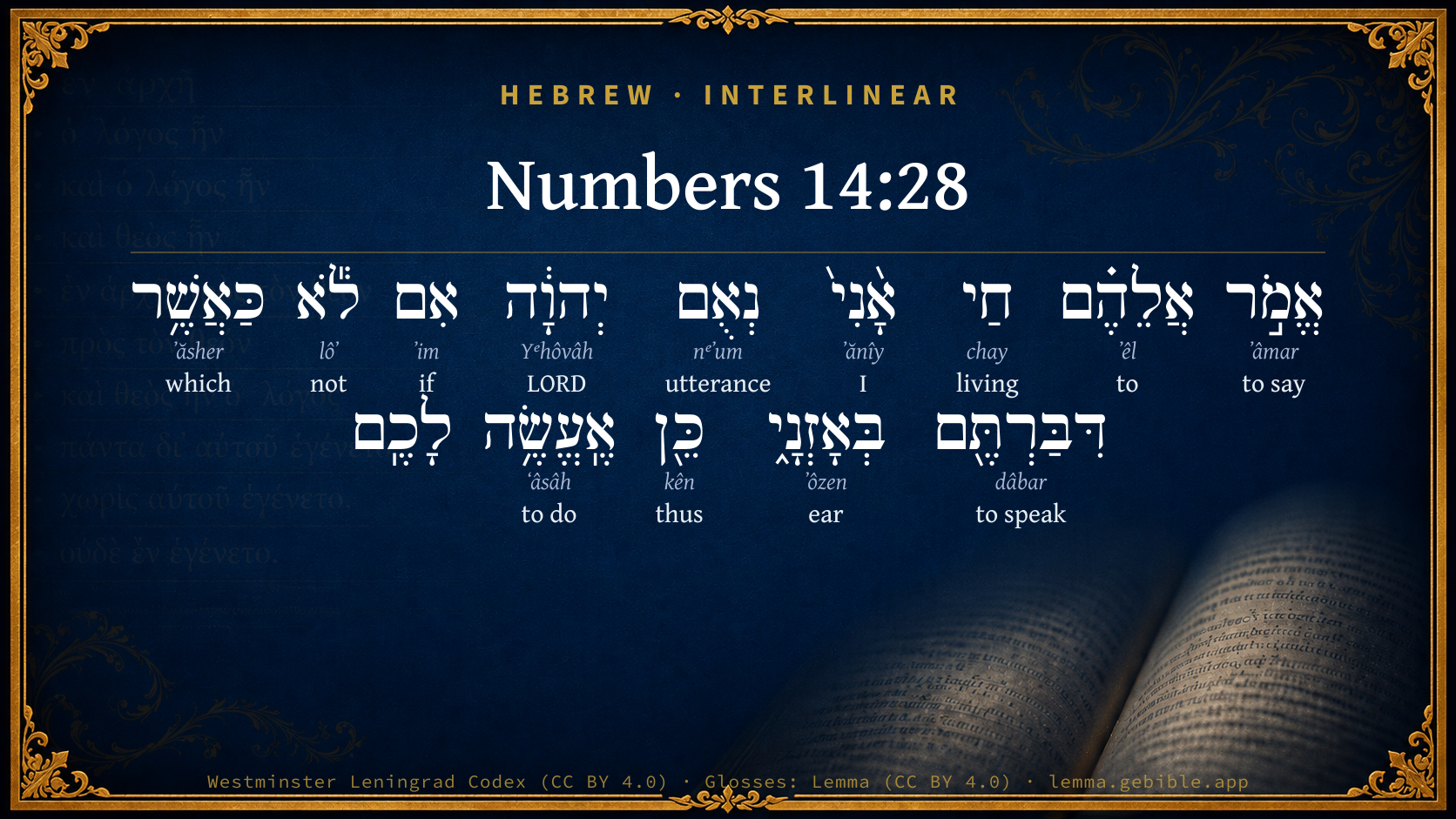
  1. אֱמֹ֣ר ʼâmar H559 “say” Verb, Qal, Imperative, 2nd Person, Masculine, Singular
  2. אֲלֵהֶ֗ם ʼêl H413 “to · them” Preposition + Suffix, Personal, 3rd Person, Masculine, Plural
  3. חַי chay H2416 “living” Adjective, Adjective, Masculine, Singular, Absolute
  4. אָ֨נִי֙ ʼănîy H589 “I” Pronoun, Personal, 1st Person, Common, Singular
  5. נְאֻם nᵉʼum H5002 “utterance of” Noun, Common, Masculine, Singular, Construct
  6. יְהוָ֔ה Yᵉhôvâh H3068 “LORD” Noun, Proper
  7. אִם ʼim H518 “if” Conjunction
  8. לֹ֕א lôʼ H3808 “not” Particle, Negative
  9. כַּאֲשֶׁ֥ר ʼăsher H834 “like/as · which” Preposition + Particle, Relative
  10. דִּבַּרְתֶּ֖ם dâbar H1696 “to speak” Verb, Piel, Perfect, 2nd Person, Masculine, Plural
  11. כֵּ֖ן kên H3651 “thus” Particle, Demonstrative
  12. אֶֽעֱשֶׂ֥ה ʻâsâh H6213 “to do” Verb, Qal, Imperfect, 1st Person, Common, Singular

About this verse

These counts appear in no published source. They are computed here, from the morphology-tagged text and Lemma’s own curated glosses. What Lemma adds →

14
words
13
distinct lemmas
Pentateuch
section

Grammatical profile

  • 3 verbs
  • 3 nouns
  • 1 adjective
  • 1 pronoun
  • 2 prepositions
  • 1 conjunction
  • 3 particles

Verb forms

  • אֱמֹ֣ר Qal · Imperative
  • דִּבַּרְתֶּ֖ם Piel · Perfect
  • אֶֽעֱשֶׂ֥ה Qal · Imperfect

Hebrew & Septuagint length

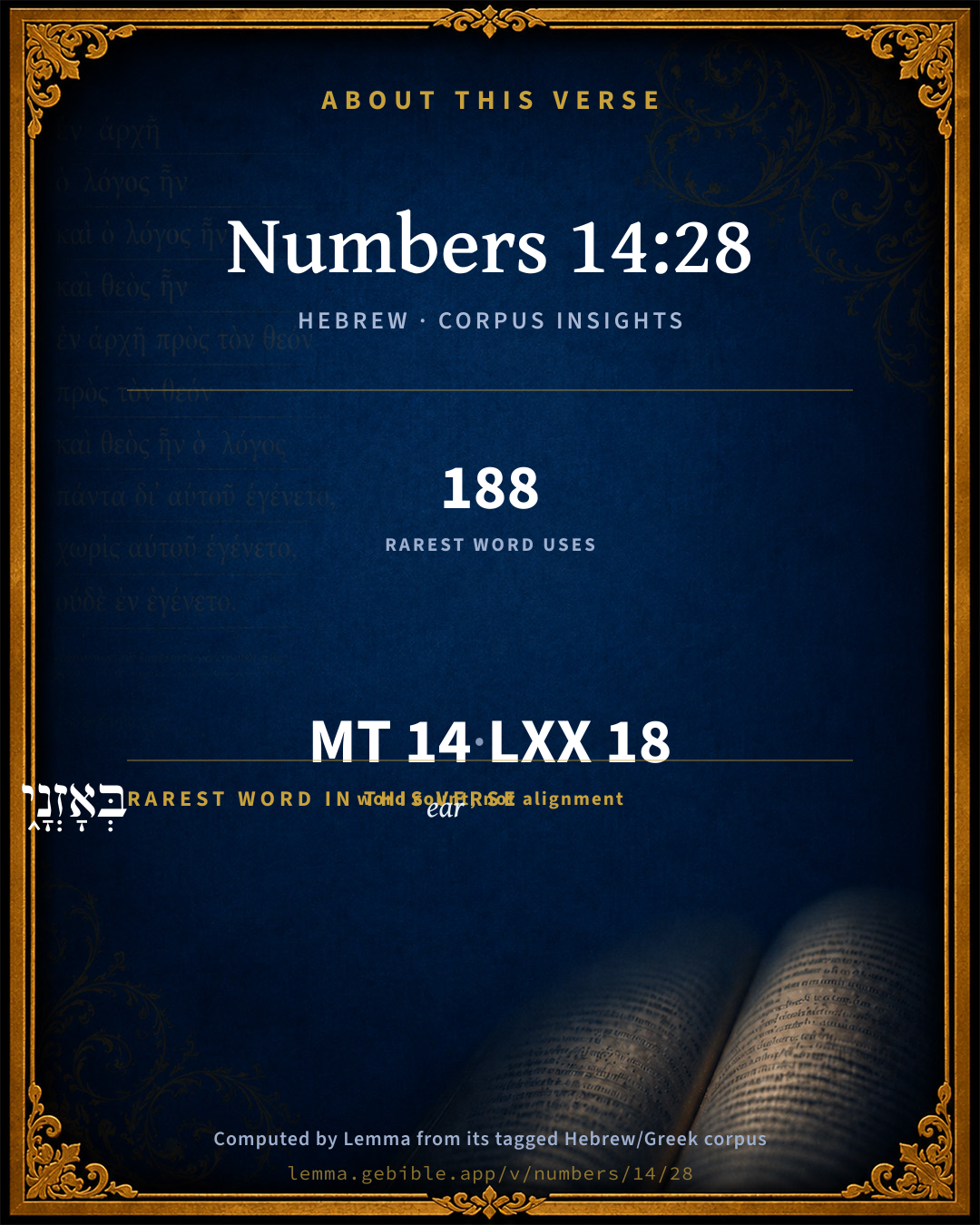
In English translation the verse runs 21 words from the Hebrew and 22 from the Septuagint (LXX English) — closely comparable.

A rough comparison of the two English renderings, which tokenize alike — not a word-level alignment.

Word counts can differ between the Hebrew and the Greek without any difference in meaning — e.g. the Hebrew direct-object marker אֵת has no separate Greek word, and Greek often adds the article ὁ.

In the original languages it is 14 Hebrew tokens and 18 Greek tokens — but the two are counted differently (Hebrew bundles its prefixes and suffixes into one token; the Greek is in lemma form), so that isn’t a like-for-like length.

Cross-references

8

Topical passages linked to Numbers 14:28 in the Treasury of Scripture Knowledge — connected by theme and wording, ordered by reader-vote popularity; previews shown in the World English Bible.

  • Numbers 14:21 but in very deed, as I live, and as all the earth shall be filled with the glory of Yahweh;
  • Hebrews 3:17 With whom was he displeased forty years? Wasn't it with those who sinned, whose bodies fell in the wilderness?
  • Numbers 14:2 All the children of Israel murmured against Moses and against Aaron: and the whole congregation said to them, Would that we had died in the land of Egypt! or would that we had died in this wilderness!
  • Numbers 14:23 surely they shall not see the land which I swore to their fathers, neither shall any of those who despised me see it:
  • Numbers 26:64–65 But among these there was not a man of them who were numbered by Moses and Aaron the priest, who numbered the children of Israel in the wilderness of Sinai.
  • Numbers 32:11 Surely none of the men who came up out of Egypt, from twenty years old and upward, shall see the land which I swore to Abraham, to Isaac, and to Jacob; because they have not wholly followed me:
  • Deuteronomy 1:35 Surely there shall not one of these men of this evil generation see the good land, which I swore to give to your fathers,
  • Psalms 90:8–9 You have set our iniquities before you, Our secret sins in the light of your presence.

Cross-references courtesy of OpenBible.info (CC BY 4.0).

Hebrew and Greek witnesses Masoretic Hebrew ↔ Greek Septuagint

The same verse in the two great witnesses to the Old Testament, shown verse-for-verse.

These are two independent witnesses, not word-aligned to each other, and the Septuagint is shown in lemma (dictionary) form.

Hebrew Numbers 14:28 Masoretic · Westminster Leningrad Codex

אֱמֹ֣ר אֲלֵהֶ֗ם חַי אָ֨נִי֙ נְאֻם יְהוָ֔ה אִם לֹ֕א כַּאֲשֶׁ֥ר דִּבַּרְתֶּ֖ם בְּאָזְנָ֑י כֵּ֖ן אֶֽעֱשֶׂ֥ה לָכֶֽם

Tell them, As I live, says Yahweh, surely as you have spoken in my ears, so will I do to you:

World English Bible · Public Domain

Greek LXX Numbers 14:28 Septuagint · lemma form

εἶπον αὐτός ζάω ἐγώ λέγω κύριος ἤ μήν ὅς τρόπος λαλέω εἰς ὁ οὖς ἐγώ οὕτως ποιέω σύ

Say to them, As I live, says the Lord: surely as you⌃ spoke into my ears, so will I do to you.

LXX2012 (modern English Septuagint) · Public Domain

Hebrew: Westminster Leningrad Codex (CC BY 4.0). Greek: Septuagint (public domain); English from LXX2012 (modern English Septuagint) (Public Domain). How the Septuagint differs from the Hebrew →

Targum (Aramaic paraphrase)

2

The Targum is the ancient Jewish Aramaic paraphrase of the Hebrew Scriptures — an interpretive translation, not the Hebrew text itself. Onkelos (literal) and Pseudo-Jonathan (expansive) render the Torah, and Jonathan the Prophets. Coverage is partial: where no permissively-licensed English translation exists for a verse, only the Aramaic is shown. This is verse-level text, not a word-by-word alignment to the Hebrew.

  1. Targum Onkelos Torah (Genesis–Deuteronomy)
    אֱמַר לְהוֹן קַיָם אֲנָא אֲמַר יְיָ אִם לָא כְּמָא דִי מַלֵילְתּוּן קֳדָמָי כֵּן אֶעְבֵּד לְכוֹן

    (no public-domain English translation for this verse)

    Targum Onkelos — Aramaic: “Onkelos Genesis” (public domain); “Onkelos Exodus” (public domain); “Onkelos Leviticus” (public domain); “Onkelos Numbers” (public domain); “Onkelos Deuteronomy” (public domain). English: “Sefaria Community Translation” (CC0 1.0 (public-domain dedication)); “J.W. Etheridge. The Targums of Onkelos and Jonathan Ben Uzziel on the Pentateuch. London: Longmans, Green, 1862” (public domain). Text via Sefaria.

  2. Targum Pseudo-Jonathan Torah (Genesis–Deuteronomy)
    אֵימַר לְהוֹן בִּשְׁבוּעָא קְיַים אֲנָא אִין לָא הֵיכְמָא דְמַלֵילְתּוּן קֳדָמַי הֵיכְדֵין אַעֲבֵיד לְכוֹן

    Say to them, By oath I decree that according to (what) you have spoken, so will I do to you.

    Targum Pseudo-Jonathan — Aramaic: “Targum Jonathan on Genesis” (public domain); “Targum Jonathan on Exodus” (public domain); “Targum Jonathan on Leviticus” (public domain); “Targum Jonathan on Numbers” (public domain); “Targum Jonathan on Deuteronomy” (public domain). English: “The Targum of Jonathan ben Uzziel, trans. J. W. Etheridge, London, 1862” (public domain). Text via Sefaria.

Commentary

Notes on Numbers 14:28 from classic Christian and Jewish commentators (each source and its license shown beneath its notes). The classic Christian expositions comment on the surrounding passage and are grouped to its opening verse, so a note may address several verses; the Jewish commentaries on the Tanakh (Rashi and others) are per-verse, so they appear only where the commentator wrote on this verse.

Lemma curates 59 commentaries, every one of them public domain or Creative Commons licensed, each selected and text-cleaned for this edition rather than reprinted as found. About our sources →

Trapp's Complete Commentary

John Trapp

Num 14:28 Say unto them, [As truly as] I live, saith the LORD, as ye have spoken in mine ears, so will I do to you:

Ver. 28. So will I do to you.] God took them at their words: so he may well do our desperate swearers, since the mercy they desire God to show is to damn them. This self-cursing seldom escapeth God’s visible vengeance: witness those Jews of old, who cried, "His blood be on us," &c., besides many others of late that might be instanced. Mr Perkins tells of certain English soldiers in King Edward VI’s time, who were cast upon the French shore by a storm, in which stress they went to prayer, that they might be delivered; but one soldier among the rest, instead of praying, cried out, Gallows take thy right, or claim thy due: when he came home he was hanged indeed. So was Sir Gervaise Ellowayes, Lieutenant of the Tower in King James’ time, whose usual word at his playing at cards and dice had been, as he sorrowfully confessed at the gallows, I would I might be hanged if it be not so or so. {a}

{a} Looking glass for Malignants.

John Trapp, A Commentary or Exposition upon All the Books of the Old and New Testament (1647–1656) — public domain. Text from a community e-Sword module.

Joseph Benson's Commentary

Num 14:28-30. As ye have spoken — When you wickedly wished you might die in the wilderness. To make you dwell — That is, your nation; for God did not swear to do so to these particular persons.

Joseph Benson's Commentary on the Old and New Testaments (1811–1818) — public domain. Text from a community e-Sword module.

Tyndale Open Study Notes

Tyndale Open Resources

14:28 Israel’s disobedience brought on the consequences they feared would come from obeying.

Tyndale Open Study Notes — © Tyndale Open Resources, licensed CC BY-SA 4.0. Text via the HelloAO Bible API.

Ellicott's Commentary for English Readers

(28) As ye have spoken in mine ears, so will I do unto you.—The Israelites had exclaimed in their sinful murmuring against God, “Would God we had died in the wilderness” (Num_14:2); and God declares in His wrathful displeasure that the judgment which they had thus invoked should be inflicted upon them, and that their carcases should fall in the wilderness.

A Bible Commentary for English Readers, edited by Charles John Ellicott (1878–1897) — public domain. Text from a community e-Sword module.

The Cambridge Bible for Schools and Colleges

gen. ed. J. J. S. Perowne

28. as ye have spoken] i.e. in Num_14:2.

The Cambridge Bible for Schools and Colleges (gen. ed. J. J. S. Perowne; Cambridge University Press, 1878–1918) — public domain. Text from a community e-Sword module.

John Gill's Exposition

Your carcasses shall fall in this wilderness,.... They had wished they had died in it, Num 14:2, and the Lord here declares they should, which is signified by the falling of their carcasses in it, or their bodies, which when dead fall to the ground, having no strength to support themselves:

and all that were numbered of you: but a few months before this time, when their number was 603,550, Num 1:46,

according to your number from twenty years old and upward; which is observed, as Jarchi thinks, to except the Levites, for they were not numbered with the other tribes; and when they were numbered by themselves, their number was taken from a month old and upwards; wherefore it need not be wondered at, if we find that there were of them who did not fall in the wilderness, but entered into the land of Canaan, as it is certain Eleazar the priest, the son of Aaron, did, Num 34:17,

which have murmured against me; which shows, that not the spies only, who caused the people to murmur, but the people themselves who murmured, and had been numbered, from twenty years old and upward, are the evil congregation the Lord thus threatened with death.

John Gill's Exposition of the Whole Bible (1746–1763) — public domain (CC PDM 1.0). Text via the HelloAO Bible API.

Matthew Poole's English Annotations

As you wickedly wished you might have died in the wilderness, Num 14:2, I will bring your imprecations upon your heads.

Matthew Poole's English Annotations on the Holy Bible (1683–1685) — public domain. Text from a community e-Sword/MySword module.

John Wesley's Explanatory Notes

As ye have spoken - When you wickedly wished you might die in the wilderness.

John Wesley, Explanatory Notes Upon the Whole Bible (1754–1765) — public domain. Text via the GEBible commentary corpus.

unfoldingWord translationNotes

Door43 World Missions Community

as you have spoken in my hearing

"as I have heard you say"

Your dead bodies will fall

Their dead bodies falling represents them dying. AT: "You will die" (See: Metonymy)

you who were counted in the census

This can be stated in active form. AT: "you whom Moses counted in the census" (See: Active or Passive)

from twenty years old and upward

"twenty years old and older"

translationWords

life

die

body

census

promise

Joshua

unfoldingWord translationNotes — © Distant Shores Media and the Door43 World Missions Community, licensed CC BY-SA 4.0. Source: git.door43.org/Door43/en_tn.

Rashi

Rabbi Shlomo Yitzchaki (Rashi)

חי אני AS TRULY AS I LIVE — This is a formula of taking an oath: If I do not do so, then — if this were at all possible to say of God — I do not live.

כאשר דברתם AS YE HAVE SPOKEN … [YOUR CARCASSES WILL FALL IN THE WILDERNESS] — because you made the request of Me: “Would that we had died in this wilderness” (Numbers 14:2).

Rashi on the Tanakh — English translations: “The Judaica Press complete Tanach with Rashi, translated by A. J. Rosenberg” (CC BY 4.0); “Pentateuch with Rashi's commentary by M. Rosenbaum and A.M. Silbermann, 1929-1934” (public domain); “The Metsudah Tanach series, Lakewood, N.J” (CC BY 4.0); and “The Book of Joshua, Metsudah Publications, 1997” (CC BY 4.0). Text via Sefaria.

Ramban (Nachmanides)

Rabbi Moshe ben Nachman (Ramban / Nachmanides)

IM LO’ (IF NOT) AS YE HAVE SPOKEN IN MINE EARS. The meaning thereof is as an expression of wonder: “Will I not do to you as ye have spoken?” Such is the way of the [Sacred] Language: [Thou art sent] not to many people of an unintelligible speech and of a slow tongue, whose words thou canst not understand. ‘Im lo’ (would they not) have hearkened unto thee if I sent thee to them? Similarly, ‘im lo’ (if not) as I have thought did it come to pass?

Ramban (Nachmanides) on the Tanakh — English translation: “Commentary on the Torah by Ramban (Nachmanides). Translated and annotated by Charles B. Chavel. New York, Shilo Pub. House, 1971-1976” (CC BY 4.0). Text via Sefaria.

Lesson kit

Teaching starters — assembled from the data on this page, not authored interpretation. Every prompt links to the verse data it draws on. Edit before teaching.

Numbers, in the Pentateuch, opens this verse with 14 words (13 distinct Hebrew lemmas). Its most distinctive word is ʼôzen (“ear”). A historical commentator’s framing appears above. Read the whole chapter for the surrounding context.

Discussion questions

  1. What does “ear” (ʼôzen) contribute to the verse as a whole?
  2. How does Numbers 14:21, which shares this passage’s theme, read alongside this verse?
  3. These translations render this verse differently; the difference is in the English rendering, not the original. What questions does that raise?
  4. «אֱמֹ֣ר» is a Qal Imperative verb. How does that grammatical form shape the action described?
  5. Compare how Trapp's Complete Commentary and Joseph Benson's Commentary read this verse. Where do they agree or differ?

Things to notice

Reading settings

Reading text

Shown beneath each verse's original-language words.

Old Testament
Old Testament edition

Read the OT as the Masoretic Hebrew (MT) or the Greek Septuagint (LXX).

English shown for the Greek Septuagint (in the Hebrew ↔ Greek comparison).

Comparing translations? Open the Compare panel on any verse page to stack up to four side by side.