
1 Samuel 23:4

Hebrew (Westminster Leningrad Codex) 1 Samuel 23:4 appears in the Hebrew Old Testament. The text above is from the Westminster Leningrad Codex. Each word links to its Strong’s number, a concise gloss, and parsing drawn from the Open Scriptures Hebrew Bible morphology. Click any word for its full Brown-Driver-Briggs (BDB) entry.
Download image
Cite this verse

1 Samuel 23:4 (World English Bible). Public Domain. Lemma interlinear Bible study tool, https://lemma.gebible.app/v/1-samuel/23/4.

Show BibTeX & RIS
BibTeX
RIS
English Translation
Then David inquired of Yahweh yet again. Yahweh answered him, and said, Arise, go down to Keilah; for I will deliver the Philistines into your hand.
World English Bible · Public Domain
Download a study sheet

One document with this verse’s original text, its word-by-word gloss line, the meaning frame, cross-references with their text, attributed commentary, and full source and license credits — printable, and it pastes into notes with its structure intact.

This verse Autodidact and up

Study sheet (.html) Plain text (.txt)

A passage Seminary Student

Up to 50 verses in one chapter. A passage sheet keeps up to 6 commentary sources and 12 cross-references per verse, in the order this page ranks them, and says so on the sheet whenever that leaves anything out. Ask for a single verse and you get the Autodidact verse sheet above.

Everything on this page stays free to read, with no account — the sheet is a download of what is already on screen, not access to it.

Want to remove ads? Support Godless Engineer
Compare translations 3

The same verse in 3 English versions, stacked beneath the original-language interlinear above. Click any original word for its lexicon entry.

Each is an independent rendering of the whole verse — the interlinear is not word-aligned to these translations.

Highlighted words mark where these versions differ — a whole-verse word diff, not a word-by-word alignment.

  • World English Bible Public Domain
    Then David inquired of Yahweh yet again. Yahweh answered him, and said, Arise, go down to Keilah; for I will deliver the Philistines into your hand.
  • King James Version Public Domain
    Then David inquired of the LORD yet again. And the LORD answered him and said, Arise, go down to Keilah; for I will deliver the Philistines into thine hand.
  • unfoldingWord Literal Text CC BY-SA 4.0
    So David added yet to inquire of Yahweh. And Yahweh answered him and said, “Arise, go down to Keilah, for I am giving the Philistines into your hand.”

unfoldingWord Literal Text — © unfoldingWord, licensed CC BY-SA 4.0. Word-aligned USFM3 via Door43 (git.door43.org/unfoldingWord/en_ult).

Versions to compare (up to 4)

3 of 4 selected

Show all 18 translations

Every available English version of this verse, each an independent rendering of the whole verse.

  • World English Bible Public Domain
    Then David inquired of Yahweh yet again. Yahweh answered him, and said, Arise, go down to Keilah; for I will deliver the Philistines into your hand.
  • Berean Standard Bible Public Domain
    Once again, David inquired of the LORD, and the LORD answered him: “Go at once to Keilah, for I will deliver the Philistines into your hand.”
  • Majority Standard Bible Public Domain
    Once again, David inquired of the LORD, and the LORD answered him: “Go at once to Keilah, for I will deliver the Philistines into your hand.”
  • King James Version Public Domain
    Then David inquired of the LORD yet again. And the LORD answered him and said, Arise, go down to Keilah; for I will deliver the Philistines into thine hand.
  • American Standard Version (1901) Public Domain
    Then David inquired of Jehovah yet again. And Jehovah answered him, and said, Arise, go down to Keilah; for I will deliver the Philistines into thy hand.
  • Revised Version (1885) Public Domain
    Then David inquired of the LORD yet again. And the LORD answered him and said, Arise, go down to Keilah; for I will deliver the Philistines into thine hand.
  • Geneva Bible (1599) Public Domain
    Then Dauid asked counsell of the Lord againe. And the Lord answered him, and sayd, Arise, go downe to Keilah: for I wil deliuer the Philistims into thine hand.
  • Douay-Rheims (1899) Public Domain
    Therefore David consulted the Lord again. And he answered and said to him: Arise, and go to Ceila: for I will deliver the Philistines into thy hand.
  • Young's Literal Translation Public Domain
    And David addeth again to ask at Jehovah, and Jehovah answereth him, and saith, `Rise, go down to Keilah, for I am giving the Philistines into thy hand.'
  • Literal Standard Version CC BY-SA 4.0
    And David adds again to inquire of YHWH, and YHWH answers him and says, “Rise, go down to Keilah, for I am giving the Philistines into your hand.”
  • Unlocked Literal Bible CC BY-SA 4.0
    Then David prayed to Yahweh for help yet again. Yahweh answered him, “Arise, go down to Keilah. For I will give you victory over the Philistines.”
  • unfoldingWord Literal Text CC BY-SA 4.0
    So David added yet to inquire of Yahweh. And Yahweh answered him and said, “Arise, go down to Keilah, for I am giving the Philistines into your hand.”
  • Darby Bible Public Domain
    And David inquired of Jehovah yet again. And Jehovah answered him and said, Arise, go down to Keilah; for I will give the Philistines into thy hand.
  • World Messianic Bible Public Domain
    Then David inquired of the LORD yet again. The LORD answered him, and said, “Arise, go down to Keilah; for I will deliver the Philistines into your hand.”
  • Webster's Bible Public Domain
    Then David inquired of the LORD yet again. And the LORD answered him and said, Arise, go down to Keilah; for I will deliver the Philistines into thy hand.
  • Free Bible Version CC BY-SA 4.0
    So David asked advice from the Lord again, and the Lord told him, “Go immediately to Keilah, for I will give you victory over the Philistines.”
  • Bible in Basic English Public Domain
    Then David put the question to the Lord again, and the Lord answering said, Up! go down to Keilah; for I will give the Philistines into your hands.
  • JPS Tanakh (1917) Public Domain
    Then David inquired of the LORD yet again. And the LORD answered him and said: 'Arise, go down to Keilah; for I will deliver the Philistines into thy hand.'

Literal Standard Version (2020), Covenant Press — licensed CC BY-SA 4.0. Text via the HelloAO Bible API (eBible.org). Unlocked Literal Bible (unfoldingWord) — licensed CC BY-SA 4.0. Text via the HelloAO Bible API (eBible.org). unfoldingWord Literal Text — © unfoldingWord, licensed CC BY-SA 4.0. Word-aligned USFM3 via Door43 (git.door43.org/unfoldingWord/en_ult). Free Bible Version, Dr. Jonathan Gallagher — licensed CC BY-SA 4.0. Text via the HelloAO Bible API (eBible.org).

Word by word

More ways to search: Search by grammar → Find every occurrence → Compare this word →

Practice this passage: Drill this verse → Learn its vocabulary →

קְעִילָ֔ה
Qᵉʻîylâh
H7084
“Keilah”
Noun, Proper
Part of Speech
Noun
Type
Proper
Full BDB Definition

Origin: perhaps from H7049 in the sense of inclosing

TWOT: None

Keilah = "fortress" - a city in the lowlands of Judah northwest of Hebron
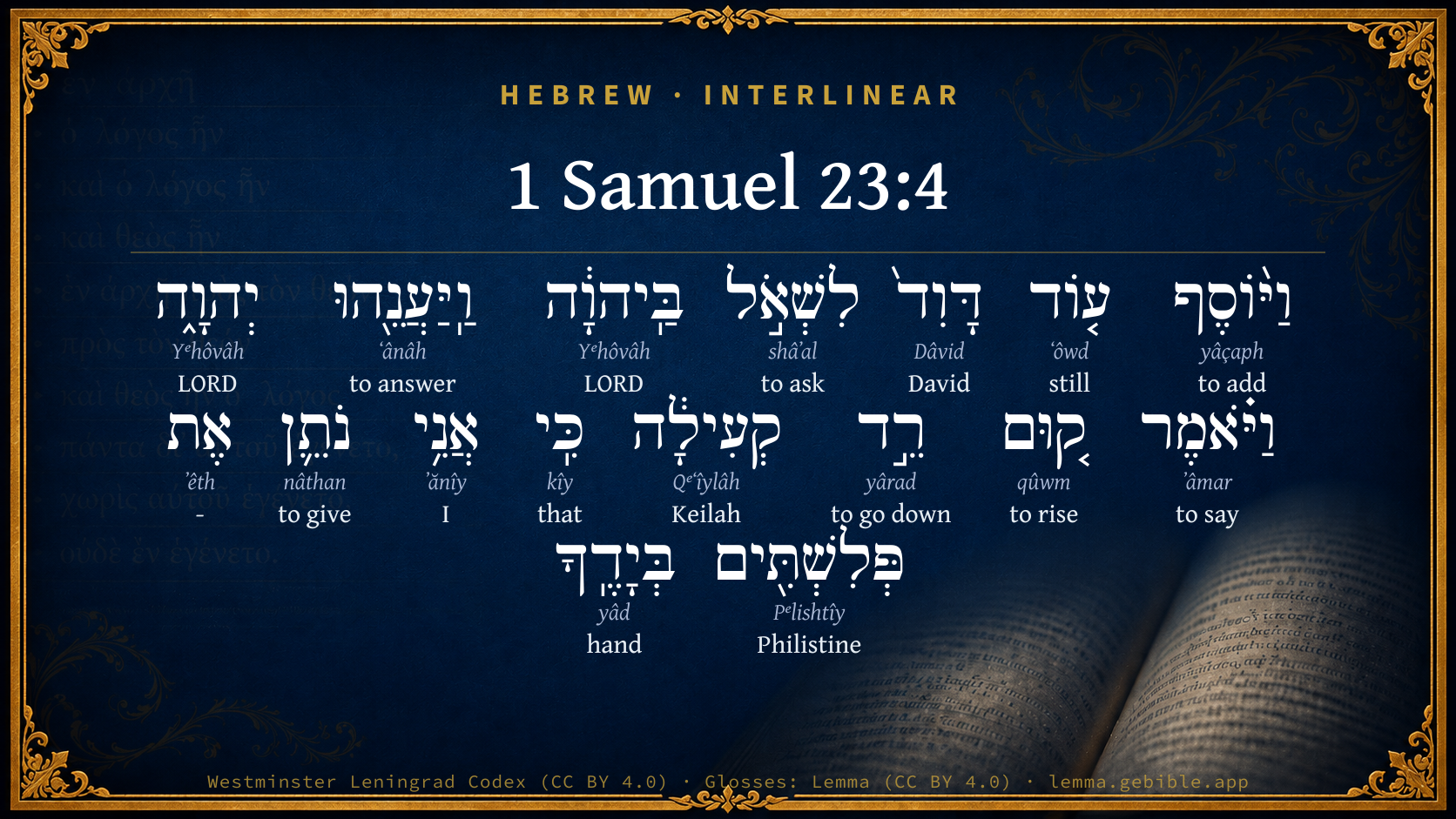
  1. וַיּ֨וֹסֶף yâçaph H3254 “and · to add” Conjunction + Verb, Hiphil, Sequential Imperfect, 3rd Person, Masculine, Singular
  2. ע֤וֹד ʻôwd H5750 “still” Adverb
  3. דָּוִד֙ Dâvid H1732 “David” Noun, Proper
  4. לִשְׁאֹ֣ל shâʼal H7592 “to ask” Preposition + Verb, Qal, Infinitive Construct
  5. בַּֽיהוָ֔ה Yᵉhôvâh H3068 “in/at · LORD” Preposition + Noun, Proper
  6. וַֽיַּעֲנֵ֖הוּ ʻânâh H6030 “and · to answer · him” Conjunction + Verb, Qal, Sequential Imperfect, 3rd Person, Masculine, Singular + Suffix, Personal, 3rd Person, Masculine, Singular
  7. יְהוָ֑ה Yᵉhôvâh H3068 “LORD” Noun, Proper
  8. וַיֹּ֗אמֶר ʼâmar H559 “and · to say” Conjunction + Verb, Qal, Sequential Imperfect, 3rd Person, Masculine, Singular
  9. ק֚וּם qûwm H6965 “rise” Verb, Qal, Imperative, 2nd Person, Masculine, Singular
  10. רֵ֣ד yârad H3381 “go down” Verb, Qal, Imperative, 2nd Person, Masculine, Singular
  11. כִּֽי kîy H3588 “that” Conjunction
  12. אֲנִ֥י ʼănîy H589 “I” Pronoun, Personal, 1st Person, Common, Singular
  13. נֹתֵ֛ן nâthan H5414 “giving” Verb, Qal, Participle Active, Masculine, Singular, Absolute
  14. אֶת ʼêth H853 “-” Particle, Direct Object
  15. פְּלִשְׁתִּ֖ים Pᵉlishtîy H6430 “Philistines” Noun, Gentilic, Masculine, Plural, Absolute
  16. בְּיָדֶֽךָ yâd H3027 “in/at · hand · your” Preposition + Noun, Common, Both, Singular, Construct + Suffix, Personal, 2nd Person, Masculine, Singular

About this verse

These counts appear in no published source. They are computed here, from the morphology-tagged text and Lemma’s own curated glosses. What Lemma adds →

17
words
16
distinct lemmas
Historical
section

Notable vocabulary

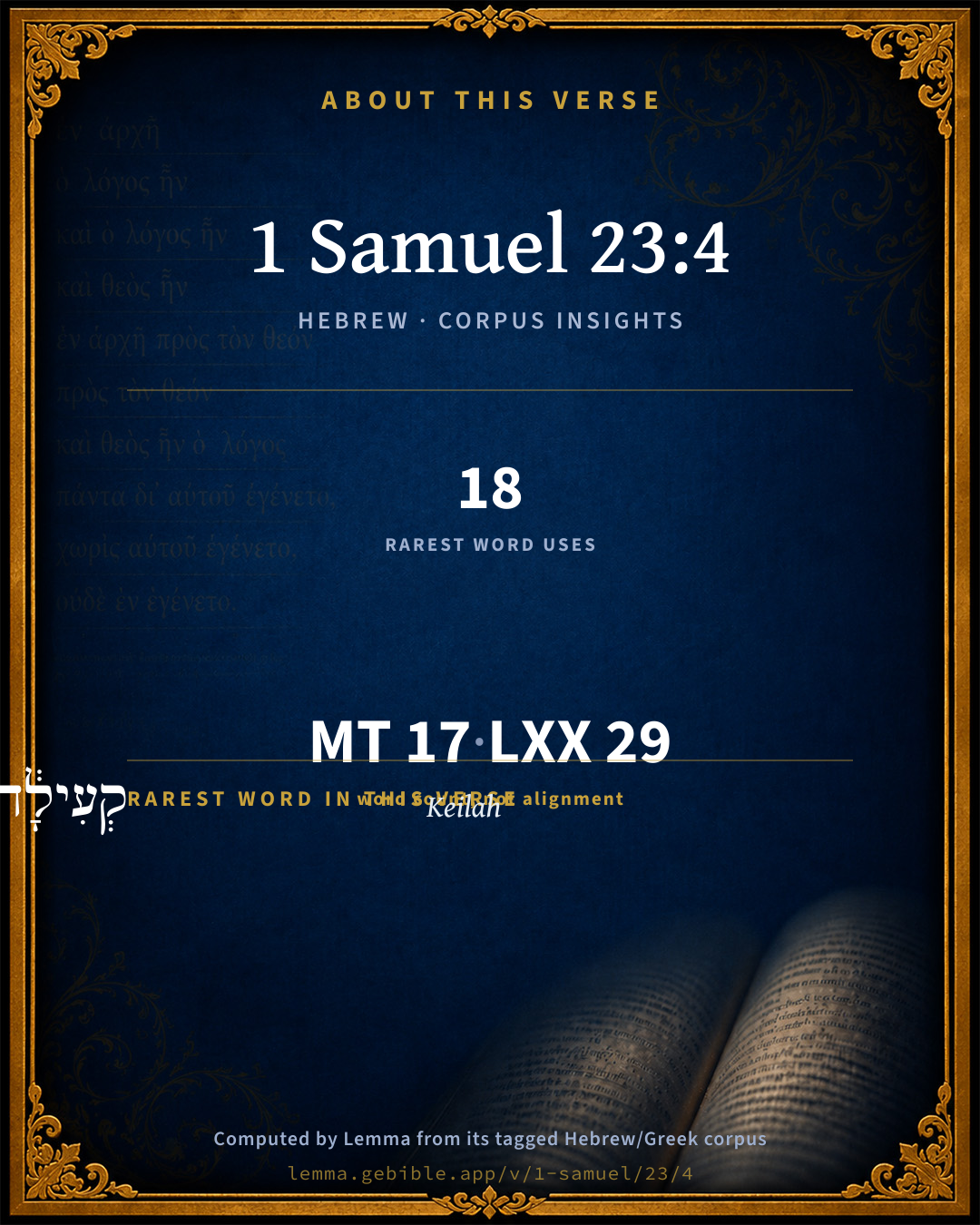
The rarest word here is קְעִילָ֔ה Keilah H7084 — appearing just 18 times in the whole Hebrew Bible.

Shared distinctive vocabulary

קְעִילָ֔ה Keilah H7084 occurs in 16 verses of the Hebrew Bible. Also found in:

Grammatical profile

  • 7 verbs
  • 6 nouns
  • 1 pronoun
  • 1 conjunction
  • 1 adverb
  • 1 particle

Verb forms

  • וַיּ֨וֹסֶף Hiphil · Sequential Imperfect
  • לִשְׁאֹ֣ל Qal · Infinitive Construct
  • וַֽיַּעֲנֵ֖הוּ Qal · Sequential Imperfect
  • וַיֹּ֗אמֶר Qal · Sequential Imperfect
  • ק֚וּם Qal · Imperative
  • רֵ֣ד Qal · Imperative
  • נֹתֵ֛ן Qal · Participle Active

Repetition

A word recurs within this verse — often emphatic in Hebrew:

  • בַּֽיהוָ֔ה LORD H3068 ×2

Hebrew & Septuagint length

In English translation the verse runs 26 words from the Hebrew and 32 from the Septuagint (LXX English) — closely comparable.

A rough comparison of the two English renderings, which tokenize alike — not a word-level alignment.

Word counts can differ between the Hebrew and the Greek without any difference in meaning — e.g. the Hebrew direct-object marker אֵת has no separate Greek word, and Greek often adds the article ὁ.

In the original languages it is 17 Hebrew tokens and 29 Greek tokens — but the two are counted differently (Hebrew bundles its prefixes and suffixes into one token; the Greek is in lemma form), so that isn’t a like-for-like length.

Cross-references

6

Topical passages linked to 1 Samuel 23:4 in the Treasury of Scripture Knowledge — connected by theme and wording, ordered by reader-vote popularity; previews shown in the World English Bible.

  • Judges 7:7 Yahweh said to Gideon, By the three hundred men who lapped will I save you, and deliver the Midianites into your hand; and let all the people go every man to his place.
  • Joshua 8:7 and you shall rise up from the ambush, and take possession of the city: for Yahweh your God will deliver it into your hand.
  • Judges 6:39 Gideon said to God, Don't let your anger be kindled against me, and I will speak but this once: Please let me make a trial just this once with the fleece; let it now be dry only on the fleece, and on all the ground let there be dew.
  • 1 Samuel 28:6 When Saul inquired of Yahweh, Yahweh didn't answer him, neither by dreams, nor by Urim, nor by prophets.
  • 2 Samuel 5:19 David inquired of Yahweh, saying, Shall I go up against the Philistines? will you deliver them into my hand? Yahweh said to David, Go up; for I will certainly deliver the Philistines into your hand.
  • 2 Kings 3:18 This is but a light thing in the sight of Yahweh: he will also deliver the Moabites into your hand.

Cross-references courtesy of OpenBible.info (CC BY 4.0).

Hebrew and Greek witnesses Masoretic Hebrew ↔ Greek Septuagint

The same verse in the two great witnesses to the Old Testament, shown verse-for-verse.

These are two independent witnesses, not word-aligned to each other, and the Septuagint is shown in lemma (dictionary) form.

Hebrew 1 Samuel 23:4 Masoretic · Westminster Leningrad Codex

וַיּ֨וֹסֶף ע֤וֹד דָּוִד֙ לִשְׁאֹ֣ל בַּֽיהוָ֔ה וַֽיַּעֲנֵ֖הוּ יְהוָ֑ה וַיֹּ֗אמֶר ק֚וּם רֵ֣ד קְעִילָ֔ה כִּֽי אֲנִ֥י נֹתֵ֛ן אֶת פְּלִשְׁתִּ֖ים בְּיָדֶֽךָ

Then David inquired of Yahweh yet again. Yahweh answered him, and said, Arise, go down to Keilah; for I will deliver the Philistines into your hand.

World English Bible · Public Domain

Greek LXX 1 Samuel 23:4 Septuagint · lemma form

καί προςτίθημι δαυίδ ἐρωτάω ἔτι διά ὁ κύριος καί ἀποκρίνω αὐτός κύριος καί εἶπον πρός αὐτός ἀναἵστημι καί καταβαίνω εἰς κεϊλα ὅτι ἐγώ παραδίδωμι ὁ ἀλλόφυλος εἰς χείρ σύ

And David enquired yet again of the Lord; and the Lord answered him, and said to him, Arise and go down to Keila, for I will deliver the Philistines into your hands.

LXX2012 (modern English Septuagint) · Public Domain

Hebrew: Westminster Leningrad Codex (CC BY 4.0). Greek: Septuagint (public domain); English from LXX2012 (modern English Septuagint) (Public Domain). How the Septuagint differs from the Hebrew →

Targum (Aramaic paraphrase)

1

The Targum is the ancient Jewish Aramaic paraphrase of the Hebrew Scriptures — an interpretive translation, not the Hebrew text itself. Onkelos (literal) and Pseudo-Jonathan (expansive) render the Torah, and Jonathan the Prophets. Coverage is partial: where no permissively-licensed English translation exists for a verse, only the Aramaic is shown. This is verse-level text, not a word-by-word alignment to the Hebrew.

  1. Targum Jonathan Prophets (Joshua–Malachi)
    וְאוֹסִיף עוֹד דָוִד לְמִשְׁאַל בְּמֵימְרָא דַייָ וְקַבֵּיל צְלוֹתֵיהּ יְיָ וַאֲמַר קוּם חוֹת לִקְעִילָה אֲרֵי אֲנָא מְסַר יַת פְלִשְׁתָּאֵי בִּידָךְ:

    (no public-domain English translation for this verse)

    Targum Jonathan — Aramaic: “Mikraot Gedolot” (public domain). English: “Sefaria Community Translation” (CC0 1.0 (public-domain dedication)); “London "Chaldee Paraphrase," 1871” (public domain). Text via Sefaria.

Commentary

Notes on 1 Samuel 23:4 from classic Christian and Jewish commentators (each source and its license shown beneath its notes). The classic Christian expositions comment on the surrounding passage and are grouped to its opening verse, so a note may address several verses; the Jewish commentaries on the Tanakh (Rashi and others) are per-verse, so they appear only where the commentator wrote on this verse.

Lemma curates 59 commentaries, every one of them public domain or Creative Commons licensed, each selected and text-cleaned for this edition rather than reprinted as found. About our sources →

Trapp's Complete Commentary

John Trapp

1Sa 23:4 Then David enquired of the LORD yet again. And the LORD answered him and said, Arise, go down to Keilah; for I will deliver the Philistines into thine hand.

Ver. 4. Then David enquired of the Lord yet again,] viz., For the confirmation and encouragement of his soldiers, whose rule should have been Nec temere, nec timide, Neither rashly nor timorously.

For I will deliver.] Heb., I am delivering; illico traditurus, sc., before that Saul can set upon thee.

John Trapp, A Commentary or Exposition upon All the Books of the Old and New Testament (1647–1656) — public domain. Text from a community e-Sword module.

The Biblical Illustrator

Joseph S. Exell

1Sa_23:4-26

Arise, go down to Keilah.

The training in the wilderness

The contrast between David at Nob or Gath and at Hareth and Keilah is most marked.

1. It is Gods will he desires to know (1Sa_23:4). Truly David at this time waited only upon God, and his expectation was from Jehovah (Psa_62:1-12). Hunger for Divine guidance is a gracious sign! The Master blessed such (Mat_5:6). Such a state of heart is preparation surely for larger blessing.

2. Obedience and humble reliance upon God may not lessen difficulties? Davids own people oppose his advance upon Keilah. So he and his enter Keilah. All now is well surely! Yes, all is well, but it looked not so. Strange that in obeying God he found more difficulties! Not so if we understand he is in training for the crown. Is this not so of all those who are unto God a nation of priestly kings? Not a murmur escapes Davids lips. Into Ziph, a small place at the edge of the Southern desert, David enters, concealing himself in the ravines there. The time spent in Ziph was a time of separation and solitariness.

3. Obedience leading to apparently hopeless disaster. To seek the favour of the king the Ziphites send word to him of David. Deceit generally sets its face toward power. It is well to be on the side which looks like winning at any rate. From their point of view their part might be justified. What can we say, however, concerning Souls reception of these Ziphites? What a whimpering, hypocritical utterance: Blessed be ye of the Lord, for ye have compassion on me! How horrid the forms of piety when the thing itself is gone! A benediction in the name of God from Saul! Success is with these plotters! They track their prey. Before Saul and his men David flees down the face of the rock into the wilderness. Here truly they are enclosing him in the net they have spread. Strangers had risen up against him, and the oppressor sought for his soul. (Psa_54:3). Hope began to droop her wings. (1Sa_23:27). Times of deepest distress are hours of Gods deliverances. Have we no record indelibly written of Gods delivering mercy?--no place called Sela-hammahlekoth (1Sa_23:28), or Rock of Divisions, to which memory leads? Psa_54:1-7, ascribed to this period, tells of calmness of heart during this exciting time, Behold, God is mine helper (verse 4). (H. E. Stone.)

The Biblical Illustrator, edited by Joseph S. Exell (c. 1880s–1900s) — public domain. Text from a community e-Sword module.

Tyndale Open Study Notes

Tyndale Open Resources

23:4 David asked the Lord either directly in prayer or by using the ephod (see 23:6, 9; 2 Sam 2:1; 5:23-24). God’s answers were a sign of his blessing and protection (cp. 1 Sam 28:6).

Tyndale Open Study Notes — © Tyndale Open Resources, licensed CC BY-SA 4.0. Text via the HelloAO Bible API.

Adam Clarke's Commentary

Verse 4. David inquired of the Lord yet again] This was to satisfy his men, who made the strong objections mentioned in the preceding verse.

Adam Clarke's Commentary on the Bible (1810–1826) — public domain. Text from a community e-Sword/MySword module.

Ellicott's Commentary for English Readers

(4) David enquired . . . yet again.—This second enquiry, made for the sake of inspiring his little army with confidence before embarking on the seemingly desperate attempt, was, as in the previous case mentioned in 1Sa_23:2, no doubt through the prophet Gad. Abiathar had not yet arrived with the ephod.

A Bible Commentary for English Readers, edited by Charles John Ellicott (1878–1897) — public domain. Text from a community e-Sword module.

John Gill's Exposition

Then David inquired of the Lord yet again,.... Not for his own sake, who firmly believed it was the will of God he should go and succeed, but for the sake of his men, and to remove the doubts and fears that hung on their minds:

and the Lord answered him, and said, arise, go down to Keilah; immediately, make no stay, nor hesitate about it, but go with all haste to the relief of the place:

for I will deliver the Philistines into thine hands; which is still more explicit, and is a promise not only of delivering Keilah out of the hands of the Philistines, but of delivering them into David's hands, and so of an entire: victory; and therefore none of David's men had anything to fear after such a declaration of the will of God.

John Gill's Exposition of the Whole Bible (1746–1763) — public domain (CC PDM 1.0). Text via the HelloAO Bible API.

Haydock's Catholic Bible Commentary

Again, in the presence of his soldiers. (Calmet) --- Thus Gedeon requested a double miracle of the Lord, to encourage his men. (Menochius)

George Leo Haydock (1774–1849), Haydock's Catholic Family Bible and Commentary, 1859 edition — public domain. Excludes Psalms (Douay-Rheims chapter numbering differs from Protestant) and Deuterocanonical books (Catholic canon only).

Matthew Poole's English Annotations

David inquired of the Lord yet again; not for his own, but for his soldiers’ satisfaction and encouragement, as Gideon did, Jdg 7.

Matthew Poole's English Annotations on the Holy Bible (1683–1685) — public domain. Text from a community e-Sword/MySword module.

John Wesley's Explanatory Notes

Inquired again - Not for his own, but for his soldiers satisfaction.

John Wesley, Explanatory Notes Upon the Whole Bible (1754–1765) — public domain. Text via the GEBible commentary corpus.

Lesson kit

Teaching starters — assembled from the data on this page, not authored interpretation. Every prompt links to the verse data it draws on. Edit before teaching.

1 Samuel, in the Historical, opens this verse with 17 words (16 distinct Hebrew lemmas). Its most distinctive word is Qᵉʻîylâh (“Keilah”). A historical commentator’s framing appears above. Read the whole chapter for the surrounding context.

Discussion questions

  1. The word Qᵉʻîylâh carries the sense “Keilah.” How does it shape the verse?
  2. How does Joshua 15:44, which shares the word «Keilah», read alongside this verse?
  3. What does the repetition of “LORD” (2× in this one verse) do in this verse?
  4. The translations on this page render this verse differently — a whole-verse word diff, not a word-by-word alignment. What might account for the different wordings?
  5. «וַיּ֨וֹסֶף» is a Hiphil Sequential Imperfect verb. How does that grammatical form shape the action described?
  6. Compare how Trapp's Complete Commentary and The Biblical Illustrator read this verse. Where do they agree or differ?

Things to notice

Reading settings

Reading text

Shown beneath each verse's original-language words.

Old Testament
Old Testament edition

Read the OT as the Masoretic Hebrew (MT) or the Greek Septuagint (LXX).

English shown for the Greek Septuagint (in the Hebrew ↔ Greek comparison).

Comparing translations? Open the Compare panel on any verse page to stack up to four side by side.