
Numbers 35:34

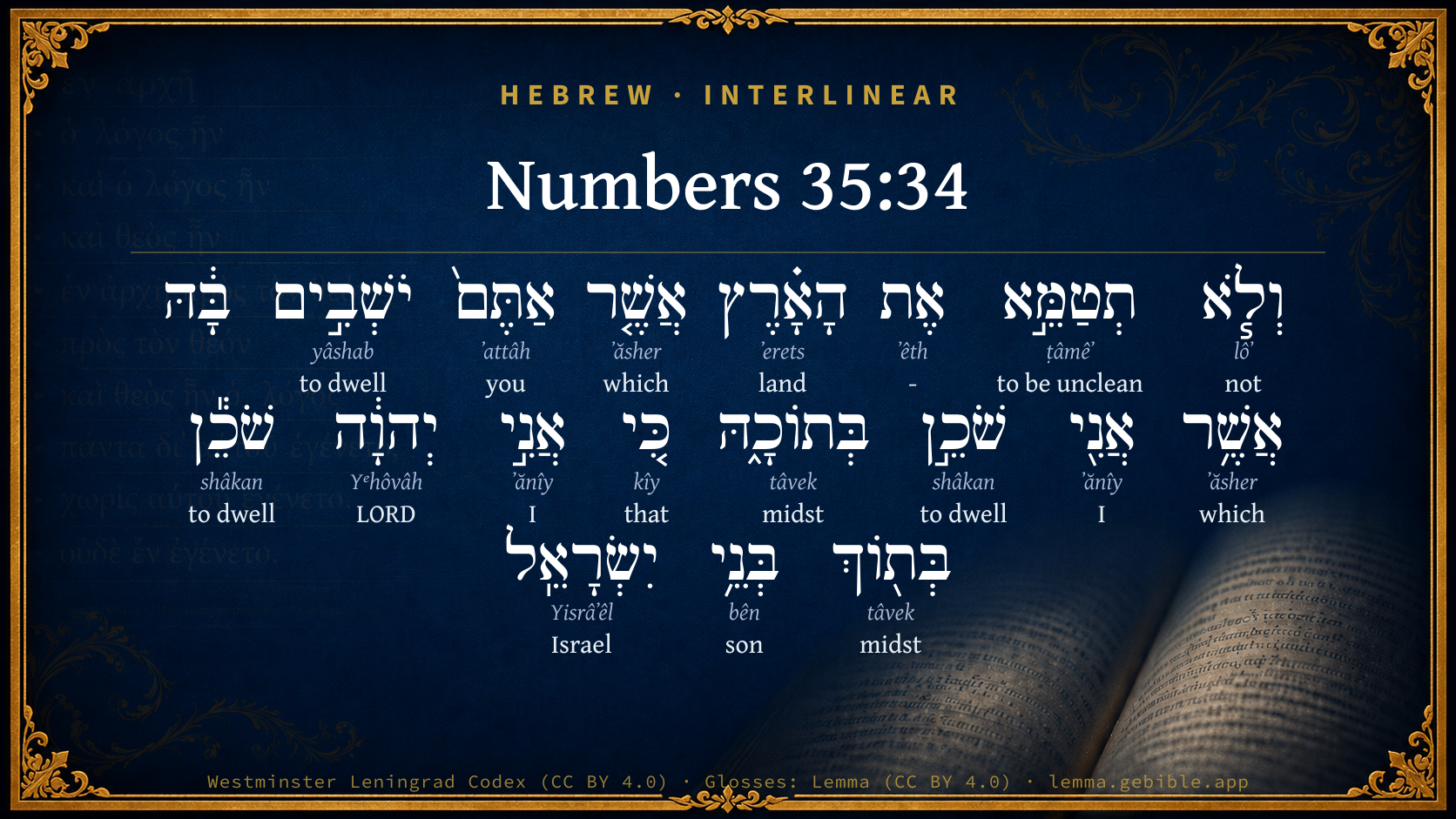
Hebrew (Westminster Leningrad Codex) Numbers 35:34 appears in the Hebrew Old Testament. The text above is from the Westminster Leningrad Codex. Each word links to its Strong’s number, a concise gloss, and parsing drawn from the Open Scriptures Hebrew Bible morphology. Click any word for its full Brown-Driver-Briggs (BDB) entry.
Download image
Cite this verse

Numbers 35:34 (World English Bible). Public Domain. Lemma interlinear Bible study tool, https://lemma.gebible.app/v/numbers/35/34.

Show BibTeX & RIS
BibTeX
RIS
English Translation
You shall not defile the land which you inhabit, in the midst of which I dwell: for I, Yahweh, dwell in the midst of the children of Israel.
World English Bible · Public Domain
Download a study sheet

One document with this verse’s original text, its word-by-word gloss line, the meaning frame, cross-references with their text, attributed commentary, and full source and license credits — printable, and it pastes into notes with its structure intact.

This verse Autodidact and up

Study sheet (.html) Plain text (.txt)

A passage Seminary Student

Up to 50 verses in one chapter. A passage sheet keeps up to 6 commentary sources and 12 cross-references per verse, in the order this page ranks them, and says so on the sheet whenever that leaves anything out. Ask for a single verse and you get the Autodidact verse sheet above.

Everything on this page stays free to read, with no account — the sheet is a download of what is already on screen, not access to it.

Want to remove ads? Support Godless Engineer
Compare translations 3

The same verse in 3 English versions, stacked beneath the original-language interlinear above. Click any original word for its lexicon entry.

Each is an independent rendering of the whole verse — the interlinear is not word-aligned to these translations.

Highlighted words mark where these versions differ — a whole-verse word diff, not a word-by-word alignment.

  • World English Bible Public Domain
    You shall not defile the land which you inhabit, in the midst of which I dwell: for I, Yahweh, dwell in the midst of the children of Israel.
  • King James Version Public Domain
    Defile not therefore the land which ye shall inhabit, wherein I dwell: for I the LORD dwell among the children of Israel.
  • unfoldingWord Literal Text CC BY-SA 4.0
    And you shall not defile the land which you are dwelling in, which I am dwelling in the midst of, because I, Yahweh, am dwelling in the midst of the sons of Israel.’”

unfoldingWord Literal Text — © unfoldingWord, licensed CC BY-SA 4.0. Word-aligned USFM3 via Door43 (git.door43.org/unfoldingWord/en_ult).

Versions to compare (up to 4)

3 of 4 selected

Show all 18 translations

Every available English version of this verse, each an independent rendering of the whole verse.

  • World English Bible Public Domain
    You shall not defile the land which you inhabit, in the midst of which I dwell: for I, Yahweh, dwell in the midst of the children of Israel.
  • Berean Standard Bible Public Domain
    Do not defile the land where you live and where I dwell. For I, the LORD, dwell among the Israelites.”
  • Majority Standard Bible Public Domain
    Do not defile the land where you live and where I dwell. For I, the LORD, dwell among the Israelites.”
  • King James Version Public Domain
    Defile not therefore the land which ye shall inhabit, wherein I dwell: for I the LORD dwell among the children of Israel.
  • American Standard Version (1901) Public Domain
    And thou shalt not defile the land which ye inhabit, in the midst of which I dwell: for I, Jehovah, dwell in the midst of the children of Israel.
  • Revised Version (1885) Public Domain
    And thou shalt not defile the land which ye inhabit, in the midst of which I dwell: for I the LORD dwell in the midst of the children of Israel.
  • Geneva Bible (1599) Public Domain
    Defile not therefore the lande which yee shall inhabite, For I dwell in the middes thereof: for I the Lord dwel among the children of Israel.
  • Douay-Rheims (1899) Public Domain
    And thus shall your possession he cleansed, myself abiding with you. For I am the Lord that dwell among the children of Israel.
  • Young's Literal Translation Public Domain
    and ye defile not the land in which ye are dwelling, in the midst of which I do tabernacle, for I Jehovah do tabernacle in the midst of the sons of Israel.'
  • Literal Standard Version CC BY-SA 4.0
    and you do not defile the land in which you are dwelling, in the midst of which I dwell, for I, YHWH, dwell in the midst of the sons of Israel.”
  • Unlocked Literal Bible CC BY-SA 4.0
    So you must not defile the land in which you live because I am living in it. I, Yahweh, live among the people of Israel.'”
  • unfoldingWord Literal Text CC BY-SA 4.0
    And you shall not defile the land which you are dwelling in, which I am dwelling in the midst of, because I, Yahweh, am dwelling in the midst of the sons of Israel.’”
  • Darby Bible Public Domain
    And ye shall not defile the land that ye inhabit, in the midst whereof I dwell; for I am Jehovah who dwell in the midst of the children of Israel.
  • World Messianic Bible Public Domain
    You shall not defile the land which you inhabit, where I dwell; for I, the LORD, dwell among the children of Israel.’”
  • Webster's Bible Public Domain
    Defile not therefore the land which ye shall inhabit, in which I dwell: for I the LORD dwell among the children of Israel.
  • Free Bible Version CC BY-SA 4.0
    Don't make the land impure where you live because I live there too. I am the Lord, and I live with the Israelites.’”
  • Bible in Basic English Public Domain
    Do not make unclean the land where you are living and in which is my House: for I the Lord am present among the children of Israel.
  • JPS Tanakh (1917) Public Domain
    And thou shalt not defile the land which ye inhabit, in the midst of which I dwell; for I the LORD dwell in the midst of the children of Israel.'

Literal Standard Version (2020), Covenant Press — licensed CC BY-SA 4.0. Text via the HelloAO Bible API (eBible.org). Unlocked Literal Bible (unfoldingWord) — licensed CC BY-SA 4.0. Text via the HelloAO Bible API (eBible.org). unfoldingWord Literal Text — © unfoldingWord, licensed CC BY-SA 4.0. Word-aligned USFM3 via Door43 (git.door43.org/unfoldingWord/en_ult). Free Bible Version, Dr. Jonathan Gallagher — licensed CC BY-SA 4.0. Text via the HelloAO Bible API (eBible.org).

Word by word

More ways to search: Search by grammar → Find every occurrence → Compare this word →

Practice this passage: Drill this verse → Learn its vocabulary →

שֹׁכֵ֣ן
shâkan
H7931
“dwelling”
Verb, Qal, Participle Active, Masculine, Singular, Absolute
Part of Speech
Verb
Stem
Qal
Form
Participle Active
Gender
Masculine
Number
Singular
State
Absolute
Full BDB Definition

Origin: a primitive root [apparently akin (by transmission) to H7901 through the idea of lodging]

TWOT: 2387

to settle down, abide, dwell, tabernacle, reside - (Qal) - to settle down to abide - to abide, dwell, reside - (Piel) - to make settle down, establish - to make or cause to dwell - (Hiphil) - to lay, place, set, establish, settle, fix - to cause to dwell or abide
  1. וְלֹ֧א lôʼ H3808 “and · not” Conjunction + Particle, Negative
  2. תְטַמֵּ֣א ṭâmêʼ H2930 “to be unclean” Verb, Piel, Imperfect, 2nd Person, Masculine, Singular
  3. אֶת ʼêth H853 “-” Particle, Direct Object
  4. הָאָ֗רֶץ ʼerets H776 “the · land” Particle, Definite Article + Noun, Common, Both, Singular, Absolute
  5. אֲשֶׁ֤ר ʼăsher H834 “which” Particle, Relative
  6. אַתֶּם֙ ʼattâh H859 “you” Pronoun, Personal, 2nd Person, Masculine, Plural
  7. יֹשְׁבִ֣ים yâshab H3427 “dwelling” Verb, Qal, Participle Active, Masculine, Plural, Absolute
  8. אֲשֶׁ֥ר ʼăsher H834 “which” Particle, Relative
  9. אֲנִ֖י ʼănîy H589 “I” Pronoun, Personal, 1st Person, Common, Singular
  10. בְּתוֹכָ֑הּ tâvek H8432 “in/at · midst · her” Preposition + Noun, Common, Masculine, Singular, Construct + Suffix, Personal, 3rd Person, Feminine, Singular
  11. כִּ֚י kîy H3588 “that” Conjunction
  12. אֲנִ֣י ʼănîy H589 “I” Pronoun, Personal, 1st Person, Common, Singular
  13. יְהוָ֔ה Yᵉhôvâh H3068 “LORD” Noun, Proper
  14. שֹׁכֵ֕ן shâkan H7931 “dwelling” Verb, Qal, Participle Active, Masculine, Singular, Absolute
  15. בְּת֖וֹךְ tâvek H8432 “in/at · midst of” Preposition + Noun, Common, Masculine, Singular, Construct
  16. בְּנֵ֥י bên H1121 “sons of” Noun, Common, Masculine, Plural, Construct
  17. יִשְׂרָאֵֽל Yisrâʼêl H3478 “Israel” Noun, Proper

About this verse

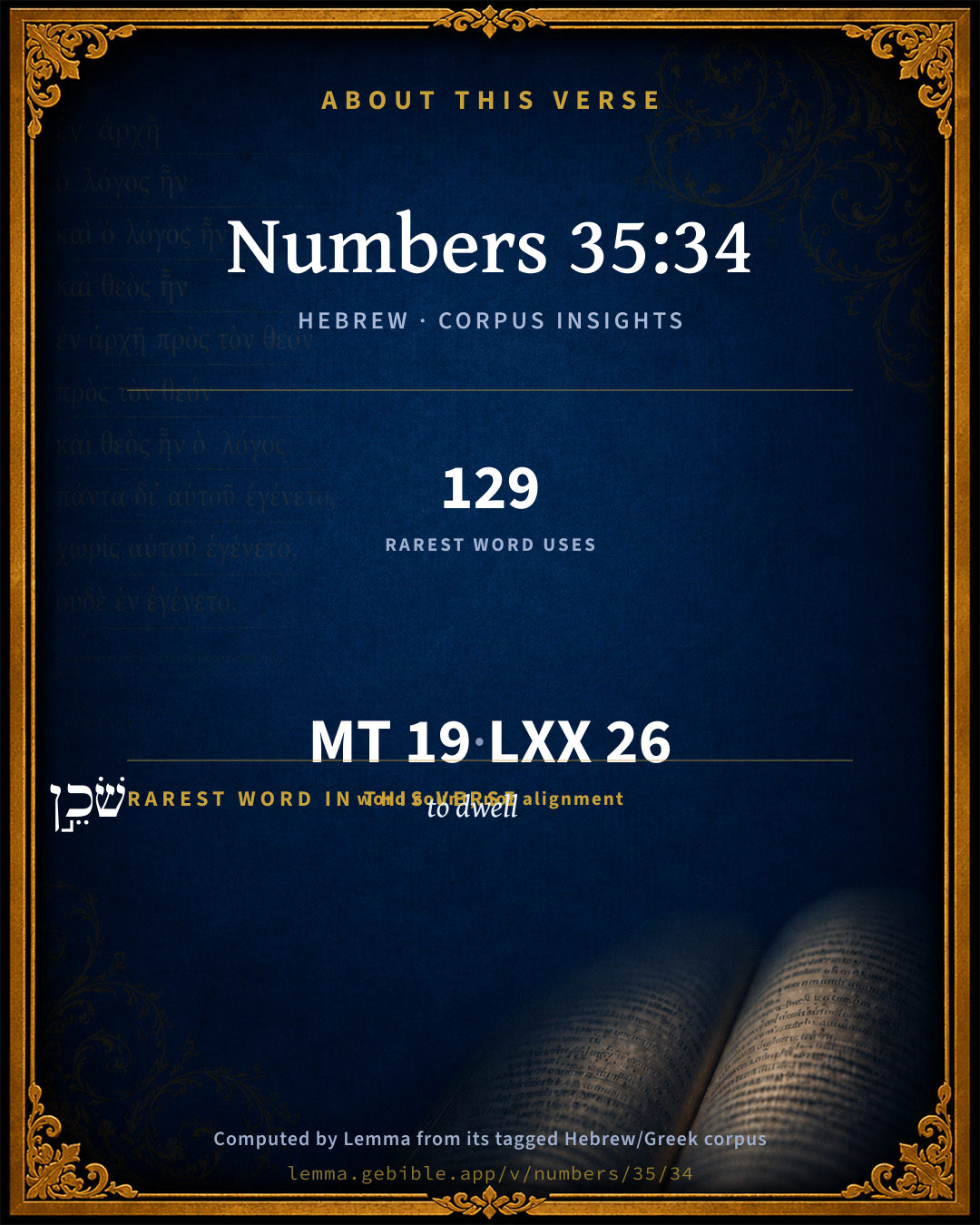
These counts appear in no published source. They are computed here, from the morphology-tagged text and Lemma’s own curated glosses. What Lemma adds →

19
words
14
distinct lemmas
Pentateuch
section

Grammatical profile

  • 4 verbs
  • 6 nouns
  • 3 pronouns
  • 1 preposition
  • 1 conjunction
  • 4 particles

Verb forms

  • תְטַמֵּ֣א Piel · Imperfect
  • יֹשְׁבִ֣ים Qal · Participle Active
  • שֹׁכֵ֣ן Qal · Participle Active
  • שֹׁכֵ֕ן Qal · Participle Active

Repetition

Words recur within this verse — often emphatic in Hebrew:

  • שֹׁכֵ֣ן to dwell H7931 ×2
  • בְּתוֹכָ֑הּ midst H8432 ×2
  • אֲשֶׁ֤ר which H834 ×2
  • אֲנִ֖י I H589 ×2

Hebrew & Septuagint length

In English translation the verse runs 28 words from the Hebrew and 33 from the Septuagint (LXX English) — closely comparable.

A rough comparison of the two English renderings, which tokenize alike — not a word-level alignment.

Word counts can differ between the Hebrew and the Greek without any difference in meaning — e.g. the Hebrew direct-object marker אֵת has no separate Greek word, and Greek often adds the article ὁ.

In the original languages it is 19 Hebrew tokens and 26 Greek tokens — but the two are counted differently (Hebrew bundles its prefixes and suffixes into one token; the Greek is in lemma form), so that isn’t a like-for-like length.

Cross-references

14

Topical passages linked to Numbers 35:34 in the Treasury of Scripture Knowledge — connected by theme and wording, ordered by reader-vote popularity; previews shown in the World English Bible.

  • Numbers 5:3 Both male and female shall you put out, outside of the camp shall you put them; that they not defile their camp, in the midst of which I dwell."
  • Psalms 135:21 Blessed be Yahweh from Zion, Who dwells at Jerusalem. Praise Yah!
  • Revelation 21:27 There will in no way enter into it anything profane, or one who causes an abomination or a lie, but only those who are written in the Lamb's book of life.
  • 2 Corinthians 6:16–17 What agreement has a temple of God with idols? For you are a temple of the living God. Even as God said, "I will dwell in them, and walk in them; and I will be their God, and they will be my people."
  • Exodus 25:8 Let them make me a sanctuary, that I may dwell among them.
  • Exodus 29:45–46 I will dwell among the children of Israel, and will be their God.
  • Leviticus 20:24–26 But I have said to you, "You shall inherit their land, and I will give it to you to possess it, a land flowing with milk and honey." I am Yahweh your God, who has separated you from the peoples.
  • 1 Kings 6:13 I will dwell among the children of Israel, and will not forsake my people Israel.
  • Psalms 132:14 "This is my resting place forever. Here I will live, for I have desired it.
  • Isaiah 57:15 For thus says the high and lofty One who inhabits eternity, whose name is Holy: I dwell in the high and holy place, with him also who is of a contrite and humble spirit, to revive the spirit of the humble, and to revive the heart of the contrite.
  • Hosea 9:3 They won't dwell in Yahweh's land; But Ephraim will return to Egypt, And they will eat unclean food in Assyria.
  • Leviticus 18:24–25 "'Don't defile yourselves in any of these things: for in all these the nations which I am casting out before you were defiled.
  • Isaiah 8:12 Don't you say, "A conspiracy!" concerning all about which this people shall say, "A conspiracy!" neither fear their fear, nor be in dread [of it].
  • Revelation 21:3 I heard a loud voice out of heaven saying, "Behold, God's dwelling is with people, and he will dwell with them, and they will be his people, and God himself will be with them as their God.

Cross-references courtesy of OpenBible.info (CC BY 4.0).

Hebrew and Greek witnesses Masoretic Hebrew ↔ Greek Septuagint

The same verse in the two great witnesses to the Old Testament, shown verse-for-verse.

These are two independent witnesses, not word-aligned to each other, and the Septuagint is shown in lemma (dictionary) form.

Hebrew Numbers 35:34 Masoretic · Westminster Leningrad Codex

וְלֹ֧א תְטַמֵּ֣א אֶת הָאָ֗רֶץ אֲשֶׁ֤ר אַתֶּם֙ יֹשְׁבִ֣ים בָּ֔הּ אֲשֶׁ֥ר אֲנִ֖י שֹׁכֵ֣ן בְּתוֹכָ֑הּ כִּ֚י אֲנִ֣י יְהוָ֔ה שֹׁכֵ֕ן בְּת֖וֹךְ בְּנֵ֥י יִשְׂרָאֵֽל

You shall not defile the land which you inhabit, in the midst of which I dwell: for I, Yahweh, dwell in the midst of the children of Israel.

World English Bible · Public Domain

Greek LXX Numbers 35:34 Septuagint · lemma form

καί οὐ μιαίνω ὁ γῆ ἐπί ὅς καταοἰκέω ἐπί αὐτός ἐπί ὅς ἐγώ κατασκηνόω ἐν σύ ἐγώ γάρ εἰμί κύριος κατασκηνόω ἐν μέσος ὁ υἱός ἰσραήλ

And you⌃ shall not defile the land whereon you⌃ dwell, on which I dwell in the midst of you; for I am the Lord dwelling in the midst of the children of Israel.

LXX2012 (modern English Septuagint) · Public Domain

Hebrew: Westminster Leningrad Codex (CC BY 4.0). Greek: Septuagint (public domain); English from LXX2012 (modern English Septuagint) (Public Domain). How the Septuagint differs from the Hebrew →

Targum (Aramaic paraphrase)

2

The Targum is the ancient Jewish Aramaic paraphrase of the Hebrew Scriptures — an interpretive translation, not the Hebrew text itself. Onkelos (literal) and Pseudo-Jonathan (expansive) render the Torah, and Jonathan the Prophets. Coverage is partial: where no permissively-licensed English translation exists for a verse, only the Aramaic is shown. This is verse-level text, not a word-by-word alignment to the Hebrew.

  1. Targum Onkelos Torah (Genesis–Deuteronomy)
    וְלָא תְסַאֲבוּן יָת אַרְעָא דִי אַתּוּן יָתְבִין בָּהּ דִי שְׁכִנְתִּי שַׁרְיָא בְּגַוָהּ אֲרֵי אֲנָא יְיָ דִשְׁכִנְתִּי שַׁרְיָא בְּגוֹ בְּנֵי יִשְׂרָאֵל

    (no public-domain English translation for this verse)

    Targum Onkelos — Aramaic: “Onkelos Genesis” (public domain); “Onkelos Exodus” (public domain); “Onkelos Leviticus” (public domain); “Onkelos Numbers” (public domain); “Onkelos Deuteronomy” (public domain). English: “Sefaria Community Translation” (CC0 1.0 (public-domain dedication)); “J.W. Etheridge. The Targums of Onkelos and Jonathan Ben Uzziel on the Pentateuch. London: Longmans, Green, 1862” (public domain). Text via Sefaria.

  2. Targum Pseudo-Jonathan Torah (Genesis–Deuteronomy)
    וְלָא תְסַאֲבוּן יַת אַרְעָא דְאַתּוּן בָּהּ אֲרוּם דִשְׁכִינְתִּי שַׁרְיָא בְּגַוָהּ אֲרוּם אֲנָא הוּא יְיָ דִשְׁכִינְתִּי שַׁרְיָא בְּגוֹ בְּנֵי יִשְרָאֵל

    Therefore defile not the land in which you are; for My Shekinah dwelleth in the midst of it; for I am the Lord whose Shekinah dwelleth among the children of Israel.

    Targum Pseudo-Jonathan — Aramaic: “Targum Jonathan on Genesis” (public domain); “Targum Jonathan on Exodus” (public domain); “Targum Jonathan on Leviticus” (public domain); “Targum Jonathan on Numbers” (public domain); “Targum Jonathan on Deuteronomy” (public domain). English: “The Targum of Jonathan ben Uzziel, trans. J. W. Etheridge, London, 1862” (public domain). Text via Sefaria.

Commentary

Notes on Numbers 35:34 from classic Christian and Jewish commentators (each source and its license shown beneath its notes). The classic Christian expositions comment on the surrounding passage and are grouped to its opening verse, so a note may address several verses; the Jewish commentaries on the Tanakh (Rashi and others) are per-verse, so they appear only where the commentator wrote on this verse.

Lemma curates 59 commentaries, every one of them public domain or Creative Commons licensed, each selected and text-cleaned for this edition rather than reprinted as found. About our sources →

Joseph Benson's Commentary

Num 35:34. Defile not the land wherein I dwell — It is often assigned as a reason why they should put away all polluted persons and things out of their camp and land, because God dwelt in them, by his peculiar presence, whence this land was called the Holy Land. It is the case of all crimes, that they defile the land in which they are committed, and render it odious and unclean in the sight of God; but it is more especially true of murder, which is the highest of all injuries against human society, and against God, in whose image man was created.

Joseph Benson's Commentary on the Old and New Testaments (1811–1818) — public domain. Text from a community e-Sword module.

Tyndale Open Study Notes

Tyndale Open Resources

35:34 The Lord lived among the people of Israel even as the Tabernacle stood in the middle of the Hebrew camp (see chs 1–4). This meant that they must not defile their land by ignoring God’s commands or by failing to uphold justice (cp. 5:1-4).

Tyndale Open Study Notes — © Tyndale Open Resources, licensed CC BY-SA 4.0. Text via the HelloAO Bible API.

The Cambridge Bible for Schools and Colleges

gen. ed. J. J. S. Perowne

34. See note on Num_35:1-4.

The Cambridge Bible for Schools and Colleges (gen. ed. J. J. S. Perowne; Cambridge University Press, 1878–1918) — public domain. Text from a community e-Sword module.

John Gill's Exposition

Defile not therefore the land which ye shall inherit,.... By the commission of such atrocious crimes, or suffering them to go unpunished, or by taking a compensation for the life of the guilty person:

wherein I dwell; which is added to strengthen the exhortation, and as giving a reason why care should be taken not to pollute it, because the Holy God dwells there; as he did in the tabernacle erected for him, and in such a peculiar manner as he did not in other lands:

for I the Lord dwell among the children of Israel; he now dwelt among them as their God, and their King; his tent or tabernacle being pitched in the midst of the camps of Israel; and so he would continue to dwell among them when they were come to the land of Canaan, so long as they observed his laws, statutes, and ordinances; and therefore it behoved them to be careful that they did not pollute themselves and their land, and cause him to depart from them.

Next: Numbers Chapter 36

John Gill's Exposition of the Whole Bible (1746–1763) — public domain (CC PDM 1.0). Text via the HelloAO Bible API.

Albert Barnes' Notes on the Bible

For I the Lord dwell ... - An emphatic protest against all enactment or relaxation of laws by men for their own private convenience.

Albert Barnes' Notes on the Bible (1834–1885) — public domain. Text from a community e-Sword/MySword module.

Matthew Poole's English Annotations

Be not cruel to your own land by making it a den of murderers.

Matthew Poole's English Annotations on the Holy Bible (1683–1685) — public domain. Text from a community e-Sword/MySword module.

Whedon's Commentary on the Bible

Daniel D. Whedon

34. The land… wherein I dwell — The omnipresent Deity specially manifested his presence in Israel, and so sanctified their land. This was a special reason why the people might not pollute it. Exo_25:8; Num_5:3, notes.

Daniel D. Whedon (gen. ed.), Commentary on the Old and New Testaments (1874–1909) — public domain. Text from a community e-Sword module.

The Pulpit Commentary

For I the Lord dwell among the children of Israel. Therefore the murderer"s hand is raised against me; the blood of the slain is ever before my eyes, its cry for vengeance ever in my ears. (cf. Gen_4:10 Mat_23:35 Rev_6:10)

The Pulpit Commentary (1880–1919), ed. H.D.M. Spence-Jones & Joseph S. Exell — public domain. Text from a community e-Sword module.

Keil & Delitzsch

C. F. Keil & F. Delitzsch

And they were not to desecrate the land in which they dwelt by tolerating murderers, because Jehovah, the Holy One, dwelt in it, among the children of Israel (cf. Lev 18:25.).

Keil & Delitzsch — Biblical Commentary on the Old Testament (1861–1891) — public domain (CC PDM 1.0). Text via the HelloAO Bible API. (Old Testament only.)

Rashi

Rabbi Shlomo Yitzchaki (Rashi)

אשר אני שכן בתוכה [AND YE SHALL NOT DEFILE THE LAND] … IN WHICH I DWELL — It means: Do not do anything defiling to the land so that you will make Me dwell amidst its uncleanness,

‎'כי אני ה שכן בתוך בני ישראל FOR I, THE LORD, DWELL AMONG THE CHILDREN OF ISRAEL — for even when they (the Israelites) are unclean My Shechinah remains amongst them (Sifrei Bamidbar 160:15).

Rashi on the Tanakh — English translations: “The Judaica Press complete Tanach with Rashi, translated by A. J. Rosenberg” (CC BY 4.0); “Pentateuch with Rashi's commentary by M. Rosenbaum and A.M. Silbermann, 1929-1934” (public domain); “The Metsudah Tanach series, Lakewood, N.J” (CC BY 4.0); and “The Book of Joshua, Metsudah Publications, 1997” (CC BY 4.0). Text via Sefaria.

Ibn Ezra

Rabbi Abraham ibn Ezra

You must not defile. The pollution should not defile the land, or alternatively it is a commandment: Since I dwell amongst you, it is not for the honor of the Land but for the honor of Yisroel, therefore Scripture says, for I Adonoy dwell among Bnei Yisroel.

Ibn Ezra on the Tanakh — English translations: “Sefaria Community Translation” (CC0 1.0 (public-domain dedication)); “Yalkut, Sifsei Chachomim Chumash, Metsudah Publications, 2009” (CC BY 4.0); and “Commentary of Ibn Ezra on Isaiah - trans. by M. Friedlander, 1873” (public domain). Text via Sefaria.

Lesson kit

Teaching starters — assembled from the data on this page, not authored interpretation. Every prompt links to the verse data it draws on. Edit before teaching.

Numbers, in the Pentateuch, opens this verse with 19 words (14 distinct Hebrew lemmas). Its most distinctive word is shâkan (“to dwell”). A historical commentator’s framing appears above. Read the whole chapter for the surrounding context.

Discussion questions

  1. The word shâkan carries the sense “to dwell.” How does it shape the verse?
  2. How does Numbers 5:3, which shares this passage’s theme, read alongside this verse?
  3. What does the repetition of “to dwell” (2× in this one verse) do in this verse?
  4. The translations on this page render this verse differently — a whole-verse word diff, not a word-by-word alignment. What might account for the different wordings?
  5. «תְטַמֵּ֣א» is a Piel Imperfect verb. How does that grammatical form shape the action described?
  6. Compare how Joseph Benson's Commentary and Tyndale Open Study Notes read this verse. Where do they agree or differ?

Things to notice

Reading settings

Reading text

Shown beneath each verse's original-language words.

Old Testament
Old Testament edition

Read the OT as the Masoretic Hebrew (MT) or the Greek Septuagint (LXX).

English shown for the Greek Septuagint (in the Hebrew ↔ Greek comparison).

Comparing translations? Open the Compare panel on any verse page to stack up to four side by side.