
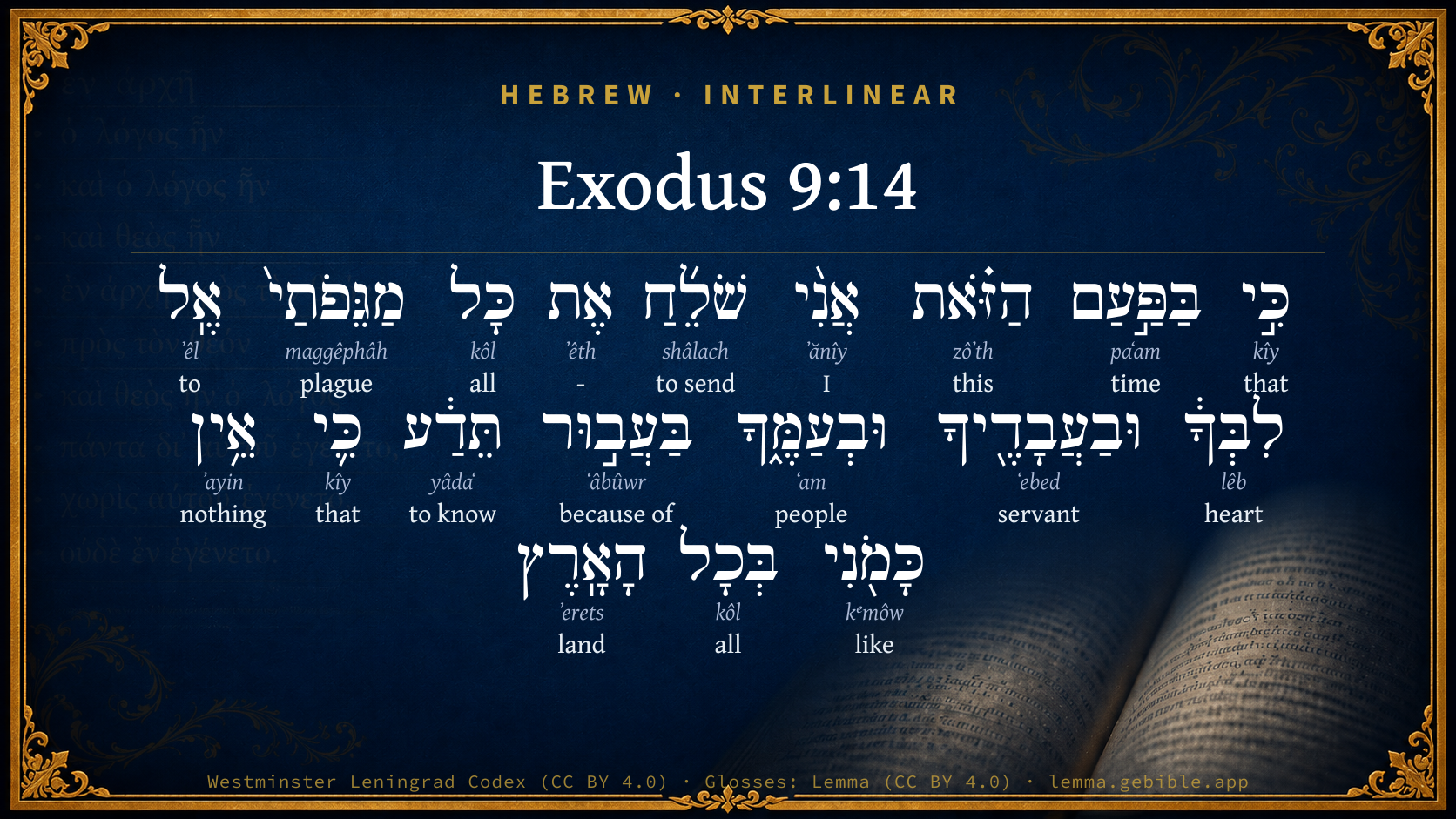
Exodus 9:14

Hebrew (Westminster Leningrad Codex) Exodus 9:14 appears in the Hebrew Old Testament. The text above is from the Westminster Leningrad Codex. Each word links to its Strong’s number, a concise gloss, and parsing drawn from the Open Scriptures Hebrew Bible morphology. Click any word for its full Brown-Driver-Briggs (BDB) entry.
Download image
Cite this verse

Exodus 9:14 (World English Bible). Public Domain. Lemma interlinear Bible study tool, https://lemma.gebible.app/v/exodus/9/14.

Show BibTeX & RIS
BibTeX
RIS
English Translation
For this time I will send all my plagues against your heart, against your officials, and against your people; that you may know that there is none like me in all the earth.
World English Bible · Public Domain
Highlights
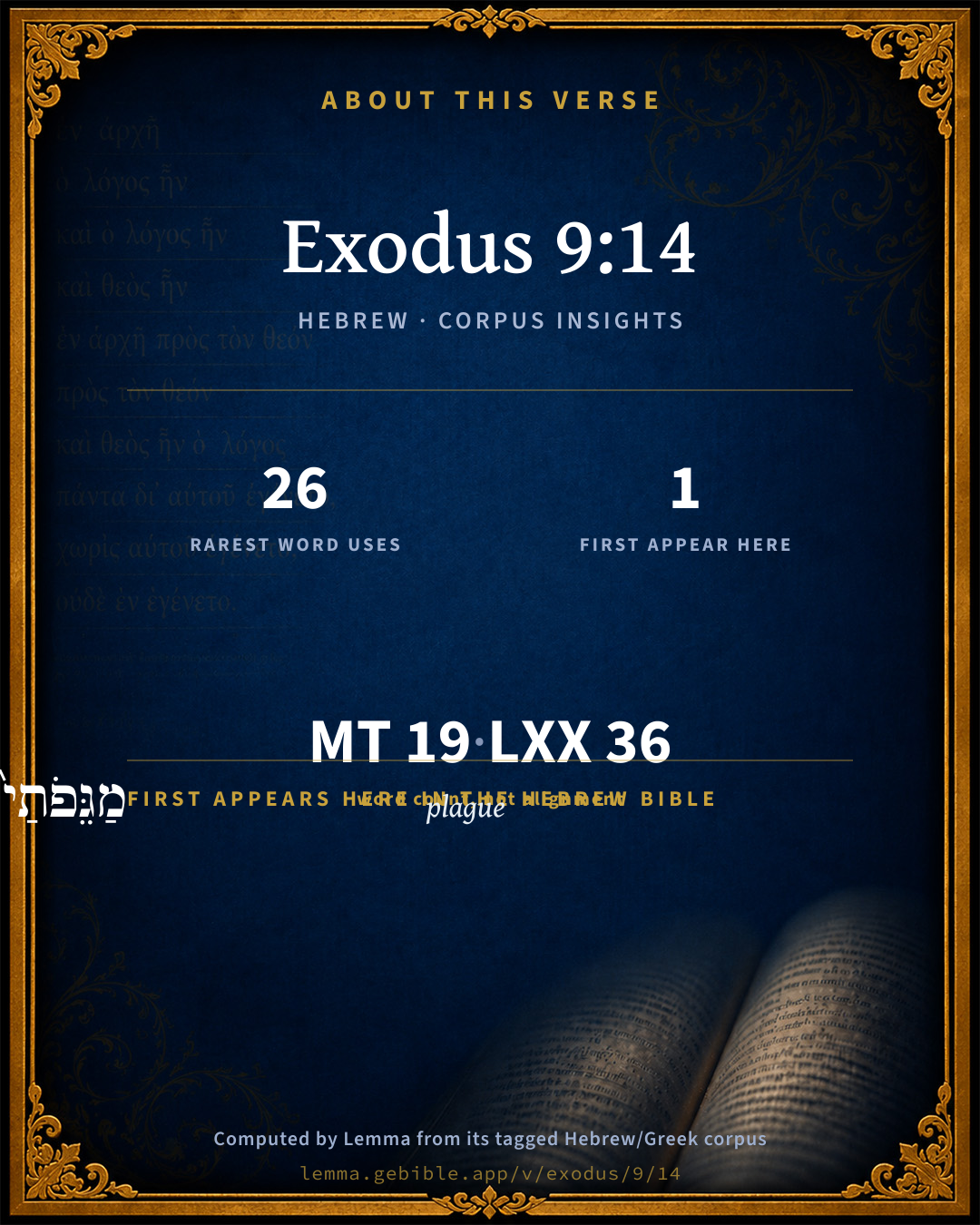
  • 1 first appearance in the Hebrew Bible
Full analysis ↓
Download a study sheet

One document with this verse’s original text, its word-by-word gloss line, the meaning frame, cross-references with their text, attributed commentary, and full source and license credits — printable, and it pastes into notes with its structure intact.

This verse Autodidact and up

Study sheet (.html) Plain text (.txt)

A passage Seminary Student

Up to 50 verses in one chapter. A passage sheet keeps up to 6 commentary sources and 12 cross-references per verse, in the order this page ranks them, and says so on the sheet whenever that leaves anything out. Ask for a single verse and you get the Autodidact verse sheet above.

Everything on this page stays free to read, with no account — the sheet is a download of what is already on screen, not access to it.

Want to remove ads? Support Godless Engineer
Compare translations 3

The same verse in 3 English versions, stacked beneath the original-language interlinear above. Click any original word for its lexicon entry.

Each is an independent rendering of the whole verse — the interlinear is not word-aligned to these translations.

Highlighted words mark where these versions differ — a whole-verse word diff, not a word-by-word alignment.

  • World English Bible Public Domain
    For this time I will send all my plagues against your heart, against your officials, and against your people; that you may know that there is none like me in all the earth.
  • King James Version Public Domain
    For I will at this time send all my plagues upon thine heart, and upon thy servants, and upon thy people; that thou mayest know that there is none like me in all the earth.
  • unfoldingWord Literal Text CC BY-SA 4.0
    For this time I am about to send all my plagues to your heart, and on your servants, and on your people, in order that you may know that there is nothing like me in all the earth.

unfoldingWord Literal Text — © unfoldingWord, licensed CC BY-SA 4.0. Word-aligned USFM3 via Door43 (git.door43.org/unfoldingWord/en_ult).

Versions to compare (up to 4)

3 of 4 selected

Show all 18 translations

Every available English version of this verse, each an independent rendering of the whole verse.

  • World English Bible Public Domain
    For this time I will send all my plagues against your heart, against your officials, and against your people; that you may know that there is none like me in all the earth.
  • Berean Standard Bible Public Domain
    Otherwise, I will send all My plagues against you and your officials and your people, so you may know that there is no one like Me in all the earth.
  • Majority Standard Bible Public Domain
    Otherwise, I will send all My plagues against you and your officials and your people, so you may know that there is no one like Me in all the earth.
  • King James Version Public Domain
    For I will at this time send all my plagues upon thine heart, and upon thy servants, and upon thy people; that thou mayest know that there is none like me in all the earth.
  • American Standard Version (1901) Public Domain
    For I will this time send all my plagues upon thy heart, and upon thy servants, and upon thy people; that thou mayest know that there is none like me in all the earth.
  • Revised Version (1885) Public Domain
    For I will this time send all my plagues upon thine heart, and upon thy servants, and upon thy people; that thou mayest know that there is none like me in all the earth.
  • Geneva Bible (1599) Public Domain
    For I will at this time send all my plagues vpon thine heart, and vpon thy seruants, and vpon thy people, that thou mayest knowe that there is none like me in all the earth.
  • Douay-Rheims (1899) Public Domain
    For I will at this time send all my plagues upon thy heart, and upon thy servants, and upon thy people: that thou mayst know there is none like me in all the earth.
  • Young's Literal Translation Public Domain
    for, at this time I am sending all My plagues unto thy heart, and on thy servants, and on thy people, so that thou knowest that there is none like Me in all the earth,
  • Literal Standard Version CC BY-SA 4.0
    for at this time I am sending all My plagues to your heart, and on your servants, and on your people, so that you know that there is none like Me in all the earth,
  • Unlocked Literal Bible CC BY-SA 4.0
    For this time I will send all my plagues on you yourself, on your servants and your people. I will do this so that you may know that there is no one like me in all the earth.
  • unfoldingWord Literal Text CC BY-SA 4.0
    For this time I am about to send all my plagues to your heart, and on your servants, and on your people, in order that you may know that there is nothing like me in all the earth.
  • Darby Bible Public Domain
    For I will at this time send all my plagues to thy heart, and on thy bondmen, and on thy people; that thou mayest know that there is none like me in all the earth.
  • World Messianic Bible Public Domain
    For this time I will send all my plagues against your heart, against your officials, and against your people; that you may know that there is no one like me in all the earth.
  • Webster's Bible Public Domain
    For I will at this time send all my plagues upon thy heart, and upon thy servants, and upon thy people: that thou mayest know that there is none like me in all the earth.
  • Free Bible Version CC BY-SA 4.0
    This time I will direct all my plagues against you and your officials and your people, so you will realize that there is no one like me in all the earth.
  • Bible in Basic English Public Domain
    For this time I will send all my punishments on yourself and on your servants and on your people; so that you may see that there is no other like me in all the earth.
  • JPS Tanakh (1917) Public Domain
    For I will this time send all My plagues upon thy person, and upon thy servants, and upon thy people; that thou mayest know that there is none like Me in all the earth.

Literal Standard Version (2020), Covenant Press — licensed CC BY-SA 4.0. Text via the HelloAO Bible API (eBible.org). Unlocked Literal Bible (unfoldingWord) — licensed CC BY-SA 4.0. Text via the HelloAO Bible API (eBible.org). unfoldingWord Literal Text — © unfoldingWord, licensed CC BY-SA 4.0. Word-aligned USFM3 via Door43 (git.door43.org/unfoldingWord/en_ult). Free Bible Version, Dr. Jonathan Gallagher — licensed CC BY-SA 4.0. Text via the HelloAO Bible API (eBible.org).

Word by word

More ways to search: Search by grammar → Find every occurrence → Compare this word →

Practice this passage: Drill this verse → Learn its vocabulary →

מַגֵּפֹתַי֙
maggêphâh
H4046
“plagues · my”
Noun, Common, Feminine, Plural, Construct + Suffix, Personal, 1st Person, Common, Singular
Part of Speech
Noun
Type
Common
Gender
Feminine
Number
Plural
State
Construct
Full BDB Definition

Origin: from H5062

TWOT: 1294b

blow, slaughter, plague, pestilence, strike, smite - blow (fatal stroke) - slaughter (of battle) - plague, pestilence (divine judgment)
  1. כִּ֣י kîy H3588 “that” Conjunction
  2. בַּפַּ֣עַם paʻam H6471 “in/at the · time” Preposition, Determined + Noun, Common, Feminine, Singular, Absolute
  3. הַזֹּ֗את zôʼth H2063 “the · this” Particle, Definite Article + Pronoun, Demonstrative, Feminine, Singular
  4. אֲנִ֨י ʼănîy H589 “I” Pronoun, Personal, 1st Person, Common, Singular
  5. שֹׁלֵ֜חַ shâlach H7971 “sending” Verb, Qal, Participle Active, Masculine, Singular, Absolute
  6. אֶת ʼêth H853 “-” Particle, Direct Object
  7. כָּל kôl H3605 “all of” Noun, Common, Masculine, Singular, Construct
  8. אֶֽל ʼêl H413 “to” Preposition
  9. לִבְּךָ֔ lêb H3820 “heart · your” Noun, Common, Masculine, Singular, Construct + Suffix, Personal, 2nd Person, Masculine, Singular
  10. וּבַעֲבָדֶ֖יךָ ʻebed H5650 “and · in/at · servants · your” Conjunction + Preposition + Noun, Common, Masculine, Plural, Construct + Suffix, Personal, 2nd Person, Masculine, Singular
  11. וּבְעַמֶּ֑ךָ ʻam H5971 “and · in/at · people · your” Conjunction + Preposition + Noun, Common, Masculine, Singular, Construct + Suffix, Personal, 2nd Person, Masculine, Singular
  12. בַּעֲב֣וּר ʻâbûwr H5668 “in/at · because of of” Preposition + Noun, Common, Masculine, Singular, Construct
  13. תֵּדַ֔ע yâdaʻ H3045 “to know” Verb, Qal, Imperfect, 2nd Person, Masculine, Singular
  14. כִּ֛י kîy H3588 “that” Conjunction
  15. אֵ֥ין ʼayin H369 “nothing” Particle, Negative
  16. כָּמֹ֖נִי kᵉmôw H3644 “like · me” Preposition + Suffix, Personal, 1st Person, Common, Singular
  17. בְּכָל kôl H3605 “in/at · all of” Preposition + Noun, Common, Masculine, Singular, Construct
  18. הָאָֽרֶץ ʼerets H776 “the · land” Particle, Definite Article + Noun, Common, Both, Singular, Absolute

About this verse

These counts appear in no published source. They are computed here, from the morphology-tagged text and Lemma’s own curated glosses. What Lemma adds →

19
words
17
distinct lemmas
Pentateuch
section

First appearance in Scripture

This word makes its first canonical appearance in the Hebrew Bible here:

  • מַגֵּפֹתַי֙ plague H4046

Shared distinctive vocabulary

מַגֵּפֹתַי֙ plague H4046 occurs in 25 verses of the Hebrew Bible. Also found in:

Grammatical profile

  • 2 verbs
  • 9 nouns
  • 2 pronouns
  • 2 prepositions
  • 2 conjunctions
  • 2 particles

Verb forms

  • שֹׁלֵ֜חַ Qal · Participle Active
  • תֵּדַ֔ע Qal · Imperfect

Repetition

Words recur within this verse — often emphatic in Hebrew:

  • כָּל all H3605 ×2
  • כִּ֣י that H3588 ×2

Hebrew & Septuagint length

In English translation the verse runs 33 words from the Hebrew and 41 from the Septuagint (LXX English) — closely comparable.

A rough comparison of the two English renderings, which tokenize alike — not a word-level alignment.

Word counts can differ between the Hebrew and the Greek without any difference in meaning — e.g. the Hebrew direct-object marker אֵת has no separate Greek word, and Greek often adds the article ὁ.

In the original languages it is 19 Hebrew tokens and 36 Greek tokens — but the two are counted differently (Hebrew bundles its prefixes and suffixes into one token; the Greek is in lemma form), so that isn’t a like-for-like length.

Cross-references

19

Topical passages linked to Exodus 9:14 in the Treasury of Scripture Knowledge — connected by theme and wording, ordered by reader-vote popularity; previews shown in the World English Bible.

  • Exodus 8:10 He said, "Tomorrow." He said, "Be it according to your word, that you may know that there is none like Yahweh our God.
  • Leviticus 26:18 "'If you in spite of these things will not listen to me, then I will chastise you seven times more for your sins.
  • Leviticus 26:21 "'If you walk contrary to me, and won't listen to me, then I will bring seven times more plagues on you according to your sins.
  • Leviticus 26:28 then I will walk contrary to you in wrath; and I also will chastise you seven times for your sins.
  • Deuteronomy 28:15–17 But it shall come to pass, if you will not listen to the voice of Yahweh your God, to observe to do all his commandments and his statutes which I command you this day, that all these curses shall come on you, and overtake you.
  • Deuteronomy 28:59–61 then Yahweh will make your plagues wonderful, and the plagues of your seed, even great plagues, and of long continuance, and sore sicknesses, and of long continuance.
  • Deuteronomy 29:20–22 Yahweh will not pardon him, but then the anger of Yahweh and his jealousy will smoke against that man, and all the curse that is written in this book shall lie on him, and Yahweh will blot out his name from under the sky.
  • Deuteronomy 32:39–42 See now that I, even I, am he, There is no god with me: I kill, and I make alive; I wound, and I heal; There is none who can deliver out of my hand.
  • 1 Samuel 4:8 Woe to us! who shall deliver us out of the hand of these mighty gods? these are the gods that struck the Egyptians with all manner of plagues in the wilderness.
  • 2 Samuel 7:22 Therefore you are great, Yahweh God: for there is none like you, neither is there any God besides you, according to all that we have heard with our ears.
  • 1 Kings 8:38 whatever prayer and supplication be made by any man, [or] by all your people Israel, who shall know every man the plague of his own heart, and spread forth his hands toward this house:
  • 1 Chronicles 17:20 Yahweh, there is none like you, neither is there any God besides you, according to all that we have heard with our ears.
  • Psalms 86:8 There is no one like you among the gods, Lord, Nor any deeds like your deeds.
  • Isaiah 46:9 Remember the former things of old: for I am God, and there is none else; [I am] God, and there is none like me;
  • Jeremiah 10:6 There is none like you, Yahweh; you are great, and your name is great in might.
  • Jeremiah 19:8 I will make this city an astonishment, and a hissing; everyone who passes thereby shall be astonished and hiss because of all the plagues of it.
  • Micah 6:13 Therefore I also have struck you with a grievous wound. I have made you desolate because of your sins.
  • Revelation 18:8 Therefore in one day her plagues will come: death, mourning, and famine; and she will be utterly burned with fire; for the Lord God who has judged her is strong.
  • Revelation 22:18 I testify to everyone who hears the words of the prophecy of this book, if anyone adds to them, may God add to him the plagues which are written in this book.

Cross-references courtesy of OpenBible.info (CC BY 4.0).

Hebrew and Greek witnesses Masoretic Hebrew ↔ Greek Septuagint

The same verse in the two great witnesses to the Old Testament, shown verse-for-verse.

These are two independent witnesses, not word-aligned to each other, and the Septuagint is shown in lemma (dictionary) form.

Hebrew Exodus 9:14 Masoretic · Westminster Leningrad Codex

כִּ֣י בַּפַּ֣עַם הַזֹּ֗את אֲנִ֨י שֹׁלֵ֜חַ אֶת כָּל מַגֵּפֹתַי֙ אֶֽל לִבְּךָ֔ וּבַעֲבָדֶ֖יךָ וּבְעַמֶּ֑ךָ בַּעֲב֣וּר תֵּדַ֔ע כִּ֛י אֵ֥ין כָּמֹ֖נִי בְּכָל הָאָֽרֶץ

For this time I will send all my plagues against your heart, against your officials, and against your people; that you may know that there is none like me in all the earth.

World English Bible · Public Domain

Greek LXX Exodus 9:14 Septuagint · lemma form

ἐν ὁ γάρ νῦν καιρός ἐγώ ἐκ ἀποστέλλω πᾶς ὁ συνάντημα ἐγώ εἰς ὁ καρδία σύ καί ὁ θεράπων σύ καί ὁ λαός σύ ἵνα οἶδα ὅτι οὐ εἰμί ὡς ἐγώ ἄλλος ἐν πᾶς ὁ γῆ

For at this present time do I send forth all my plagues into your heart, and the heart of your servants and of your people; that you may know that there is not another such as I in all the earth.

LXX2012 (modern English Septuagint) · Public Domain

Hebrew: Westminster Leningrad Codex (CC BY 4.0). Greek: Septuagint (public domain); English from LXX2012 (modern English Septuagint) (Public Domain). How the Septuagint differs from the Hebrew →

Targum (Aramaic paraphrase)

2

The Targum is the ancient Jewish Aramaic paraphrase of the Hebrew Scriptures — an interpretive translation, not the Hebrew text itself. Onkelos (literal) and Pseudo-Jonathan (expansive) render the Torah, and Jonathan the Prophets. Coverage is partial: where no permissively-licensed English translation exists for a verse, only the Aramaic is shown. This is verse-level text, not a word-by-word alignment to the Hebrew.

  1. Targum Onkelos Torah (Genesis–Deuteronomy)
    אֲרֵי בְּזִמְנָא הָדָא אֲנָא שָׁלַח יָת כָּל מְחָתַי לְלִבָּךְ וּבְעַבְדָיךְ וּבְעַמָךְ בְּדִיל דְתִדַע אֲרֵי לֵית דִכְוָתִי שַׁלִיט בְּכָל אַרְעָא:

    (no public-domain English translation for this verse)

    Targum Onkelos — Aramaic: “Onkelos Genesis” (public domain); “Onkelos Exodus” (public domain); “Onkelos Leviticus” (public domain); “Onkelos Numbers” (public domain); “Onkelos Deuteronomy” (public domain). English: “Sefaria Community Translation” (CC0 1.0 (public-domain dedication)); “J.W. Etheridge. The Targums of Onkelos and Jonathan Ben Uzziel on the Pentateuch. London: Longmans, Green, 1862” (public domain). Text via Sefaria.

  2. Targum Pseudo-Jonathan Torah (Genesis–Deuteronomy)
    אַרוּם בְּזִימְנָא הָדָא אֲנָא שַׁלַח מַחְתָּא לָךְ מִן שְׁמַיָא וְתָתֵיב יַת כָּל מַחֲתַי דִמְחִיתָךְ לְלִבָּךְ וּבְעַבְדָךְ וּבְעַמָךְ דְמִן קֳדָמַי הַוָון מִשְׁתַּלְחוּן וְלָא מִן חַרְשְׁיוּתָא דִבְנֵי נְשָׁא בְּגִין דְתִנְדַע אֲרוּם לֵית דְדָמַי לִי בְכָל אַרְעָא

    For at this time I will send upon thee a plague from the heavens, and all My plagues Wherewith I have plagued thee thou wilt cause to return upon thy heart, and upon thy servants, and upon thy people, (plagues) which have been sent from before Me, and not from the magic of the sons of men, that thou mayest know that there is none like Me in all the earth.

    Targum Pseudo-Jonathan — Aramaic: “Targum Jonathan on Genesis” (public domain); “Targum Jonathan on Exodus” (public domain); “Targum Jonathan on Leviticus” (public domain); “Targum Jonathan on Numbers” (public domain); “Targum Jonathan on Deuteronomy” (public domain). English: “The Targum of Jonathan ben Uzziel, trans. J. W. Etheridge, London, 1862” (public domain). Text via Sefaria.

Commentary

Notes on Exodus 9:14 from classic Christian and Jewish commentators (each source and its license shown beneath its notes). The classic Christian expositions comment on the surrounding passage and are grouped to its opening verse, so a note may address several verses; the Jewish commentaries on the Tanakh (Rashi and others) are per-verse, so they appear only where the commentator wrote on this verse.

Lemma curates 59 commentaries, every one of them public domain or Creative Commons licensed, each selected and text-cleaned for this edition rather than reprinted as found. About our sources →

Trapp's Complete Commentary

John Trapp

Exo 9:14 For I will at this time send all my plagues upon thine heart, and upon thy servants, and upon thy people; that thou mayest know that [there is] none like me in all the earth.

Ver. 14. All my plagues upon thine heart.] Heart plagues are the worst plagues of all. A hard heart is in some respects worse than hell: since one of the greatest sins is greater in evil, than any of the greatest punishments.

John Trapp, A Commentary or Exposition upon All the Books of the Old and New Testament (1647–1656) — public domain. Text from a community e-Sword module.

Joseph Benson's Commentary

Exo 9:14-15. I will at this time send all my plagues — Either these verses relate to what was to happen some time afterward, namely, the slaying of the firstborn, or the latter verse is to be read as follows, a translation which is equally agreeable to the Hebrew: “For now I had stretched out my hand, to smite thee and thy people with pestilence, and thou hadst been cut off, &c., but that thou wast preserved” (as follows in the succeeding verse) “that it might be known that there is none like me in all the earth.” All my plagues upon thy heart — Hitherto thou hast not felt my plagues on thy own person; but I will shortly reach and wound it: will give thee a wound that will pierce thy very heart; an irrecoverable and mortal wound. Who can tell the greatness of his wrath, or what a fearful thing it is to fall under the righteous judgment of a holy and offended God?

Joseph Benson's Commentary on the Old and New Testaments (1811–1818) — public domain. Text from a community e-Sword module.

Tyndale Open Study Notes

Tyndale Open Resources

9:14-17 God explained the purpose of the plagues to Pharaoh: They were revelatory, designed to demonstrate (especially to Pharaoh) that there is no one like me in all the earth (9:14; see also Isa 46:9; Jer 10:6-7). God had not destroyed Pharaoh and Egypt in a single blow, as he could have done. Rather he had spared them (Exod 9:16), giving them an opportunity to submit to his power. But Pharaoh refused to humble himself and stop lording it over the Lord’s people (9:17).

Tyndale Open Study Notes — © Tyndale Open Resources, licensed CC BY-SA 4.0. Text via the HelloAO Bible API.

Geneva Bible (1599)

Geneva Bible translators

So that thine own conscience shall condemn thee of ingratitude and malice.

Geneva Bible (1599) marginal notes — public domain. Text via Bolls.life.

Ellicott's Commentary for English Readers

(14) I will . . . send all my plagues upon thine heart.—The naturally obdurate heart of Pharaoh, which he had further indurated by his own voluntary action (Exo_8:15; Exo_8:32), and which God had begun to harden penally (Exo_9:12), was now to be softened by a repetition of blow after blow, until it should finally succumb, and yield, and humble itself under the mighty hand of God, and consent to the departure of the whole people, with flocks, and herds, and “little ones.”

A Bible Commentary for English Readers, edited by Charles John Ellicott (1878–1897) — public domain. Text from a community e-Sword module.

The Cambridge Bible for Schools and Colleges

gen. ed. J. J. S. Perowne

14. this time … all my plagues] The two expressions seem hardly consistent: ‘this time’ shews that the hail is referred to, while ‘all my plagues’ points to much more than a single plague. J writes as a rule so clearly that the inconsistency is urged as one reason for supposing that vv. 14–16 are not from his hand.

plagues] Heb. maggçphâh, properly a severe stroke or blow, only here of the ‘plagues’ of Egypt (cf. the cognate verb ‘smite’ in Exo_8:2 Exo_12:23; Exo_12:27, Jos_24:5); of a great defeat in war (EVV. slaughter), 1Sa_4:17 (vv. 2, 10 the cognate verb, ‘smitten’), 2Sa_18:7 (with ‘smitten’) al.; of various supernatural chastisements, Num_14:37; Num_16:48-50; Num_25:8-9; Num_25:18, 2Sa_24:21; 2Sa_24:25, Zec_14:12; Zec_14:15; Zec_14:18.

upon thine heart] The expression (though it might be interpreted with Di. as a reference to the Pharaoh’s hardened heart) is strange: read, probably, changing one letter, all these my plagues (cf. Exo_10:1) upon thee (אלה בך for אל לבך), and upon thy servants, &c.; cf. Exo_8:4; Exo_8:9; Exo_8:11; Exo_8:21; Exo_8:29.

that thou mayest know, &c.] See on Exo_8:10.

14–16. The announcement of the plague (vv. 13, 17–18) is interrupted by a passage, intended evidently (Di.) to explain why, when so many plagues have produced no impression upon the Pharaoh, God continues to send fresh ones upon him: He does so in order to extort from him the recognition of Himself, and that His name may be made known throughout the world; had this not been His motive, He would ere now have summarily removed him from the earth. By Di. and others this explanation (vv. 14–16) is considered to be a didactic addition of the compiler’s (cf. on Exo_10:1 b–2). Cf. the Introd. p. xvii.

The Cambridge Bible for Schools and Colleges (gen. ed. J. J. S. Perowne; Cambridge University Press, 1878–1918) — public domain. Text from a community e-Sword module.

John Gill's Exposition

For I will at this time send all my plagues upon thine heart,.... Not meaning particularly the plague of the hail, which next follows, so called, because it consisted of various things, as hail, rain, lightning, and thunder, as Aben Ezra, and who observes, that Pharaoh was more terrified with this plague than with any other; but rather all the plagues yet to come, for by them are not meant all the plagues that were in the power of God to inflict, which how many and great they are none can say, but all that he had determined in his mind to bring upon him; and these should not so much affect and afflict his body, as the boils and ulcers had the magicians, but should reach his heart, and fill him with horror and terror:

and upon thy servants, and upon thy people; even all that he intended to bring not only upon himself, but upon his subjects, both high and low:

that thou mayest know, that there is none like unto me in all the earth; for the perfections of his nature, and the works of his hands, particularly his providential dealings with the sons of men, and especially with him.

John Gill's Exposition of the Whole Bible (1746–1763) — public domain (CC PDM 1.0). Text via the HelloAO Bible API.

Haydock's Catholic Bible Commentary

Plagues of fire and hail, that thy heart may relent. But as all my chastisements will not produce this effect, I will be glorified in thy fall. (Haydock) --- I could now strike thee dead; (ver. 15,) but I reserve thee for a more dreadful punishment, (ver. 17,) in the waters of the Red Sea. (Calmet)

George Leo Haydock (1774–1849), Haydock's Catholic Family Bible and Commentary, 1859 edition — public domain. Excludes Psalms (Douay-Rheims chapter numbering differs from Protestant) and Deuterocanonical books (Catholic canon only).

Matthew Poole's English Annotations

Upon thine heart, or, into thy heart: thou hast hitherto not felt my plagues upon thy own person or thy body, but I shall shortly reach and wound it, and that not only in the skin, as the magicians and others are now smitten, but even to thy heart, such as shall make thy heart sick, Mic 6:13, such as shall give thee a mortal and irrecoverable wound. Some understand it of inward and spiritual judgments upon Pharaoh’s heart, such as hardness of heart; but that plague had been inflicted upon him, and is recorded before this time. And Pharaoh’s heart being here opposed to his servants and people, seems rather to denote his person, the heart or soul being often put synecdochically for the whole man.

Matthew Poole's English Annotations on the Holy Bible (1683–1685) — public domain. Text from a community e-Sword/MySword module.

Whedon's Commentary on the Bible

Daniel D. Whedon

14. For I will at this time send all my plagues — Only lighter strokes had fallen hitherto, but now more dreadful judgments impend.

Daniel D. Whedon (gen. ed.), Commentary on the Old and New Testaments (1874–1909) — public domain. Text from a community e-Sword module.

The Pulpit Commentary

I will at this time send all my plagues upon thine heart. A very emphatic announcement. At this time contrasts the immediate future with the past, and tells Pharaoh that the hour of mild warnings and slight plagues is gone by. Now he is to expect something far more terrible God will send all his plagues every worst form of evil in rapid succession; and will send them against his heart. Each will strike a blow on that perverse and obdurate heart each will stir his nature to its inmost depths. Conscience will wake up and insist on being heard. All the numerous brood of selfish fears and alarms will bestir themselves. He will tremble, and be amazed and perplexed. He will forego his pride and humble himself, and beg the Israelites to be gone, and even intreat that, ere they depart, the leaders whom he has so long opposed, will give him their blessing. (Exo_12:32) That thou mayest know. Pharaoh was himself to be convinced that the Lord God of Israel was, at any rate, the greatest of all gods. He was not likely to desert at once and altogether the religion in which he had been brought up, or to regard its gods as nonexistent. But he might be persuaded of one thing that Jehovah was far above them. And this he practically acknowledges in vers. 27 and 28.

The Pulpit Commentary (1880–1919), ed. H.D.M. Spence-Jones & Joseph S. Exell — public domain. Text from a community e-Sword module.

John Wesley's Explanatory Notes

I will find all my plagues upon thy heart - Hitherto thou hast not felt my plagues on thy own person, the heart is put for the whole man.

John Wesley, Explanatory Notes Upon the Whole Bible (1754–1765) — public domain. Text via the GEBible commentary corpus.

Rashi

Rabbi Shlomo Yitzchaki (Rashi)

את כל מגפתי [FOR I WILL THIS TIME SEND] ALL MY PLAGUES — We may gather from this that the plague on the first ripe ears outweighed all the previous plagues.

Rashi on the Tanakh — English translations: “The Judaica Press complete Tanach with Rashi, translated by A. J. Rosenberg” (CC BY 4.0); “Pentateuch with Rashi's commentary by M. Rosenbaum and A.M. Silbermann, 1929-1934” (public domain); “The Metsudah Tanach series, Lakewood, N.J” (CC BY 4.0); and “The Book of Joshua, Metsudah Publications, 1997” (CC BY 4.0). Text via Sefaria.

Lesson kit

Teaching starters — assembled from the data on this page, not authored interpretation. Every prompt links to the verse data it draws on. Edit before teaching.

Exodus, in the Pentateuch, opens this verse with 19 words (17 distinct Hebrew lemmas). Its most distinctive word is maggêphâh (“plague”). A historical commentator’s framing appears above. Read the whole chapter for the surrounding context.

Discussion questions

  1. How does “plague” (maggêphâh) shape what this verse is saying?
  2. The word “plague” first appears here in Scripture. What is being introduced at this debut?
  3. Numbers 14:37 shares the word «plague» with this verse. How do the two illuminate each other?
  4. “all” occurs 2× in this one verse. What is the effect of the repetition?
  5. These translations render this verse differently; the difference is in the English rendering, not the original. What questions does that raise?
  6. The verb «שֹׁלֵ֜חַ» is Qal Participle Active. How does its form color the action?
  7. Reading how Trapp's Complete Commentary and Joseph Benson's Commentary read this verse, where do the two commentators agree and where do they part?

Things to notice

Reading settings

Reading text

Shown beneath each verse's original-language words.

Old Testament
Old Testament edition

Read the OT as the Masoretic Hebrew (MT) or the Greek Septuagint (LXX).

English shown for the Greek Septuagint (in the Hebrew ↔ Greek comparison).

Comparing translations? Open the Compare panel on any verse page to stack up to four side by side.