
Exodus 8:22

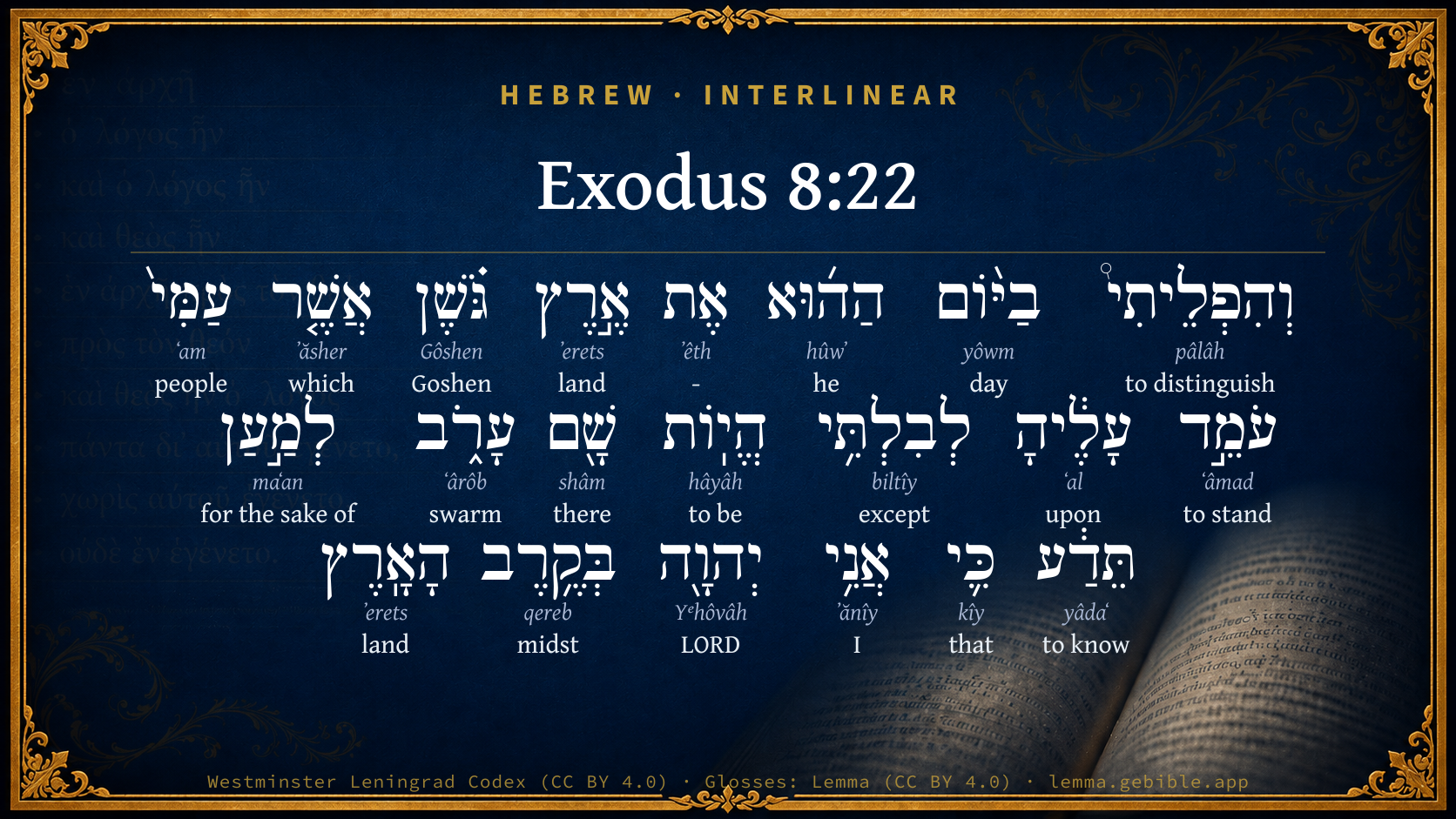
Hebrew (Westminster Leningrad Codex) Exodus 8:22 appears in the Hebrew Old Testament. The text above is from the Westminster Leningrad Codex. Each word links to its Strong’s number, a concise gloss, and parsing drawn from the Open Scriptures Hebrew Bible morphology. Click any word for its full Brown-Driver-Briggs (BDB) entry.
Download image
Cite this verse

Exodus 8:22 (World English Bible). Public Domain. Lemma interlinear Bible study tool, https://lemma.gebible.app/v/exodus/8/22.

Show BibTeX & RIS
BibTeX
RIS
English Translation
I will set apart in that day the land of Goshen, in which my people dwell, that no swarms of flies shall be there; to the end you may know that I am Yahweh in the midst of the earth.
World English Bible · Public Domain
Highlights
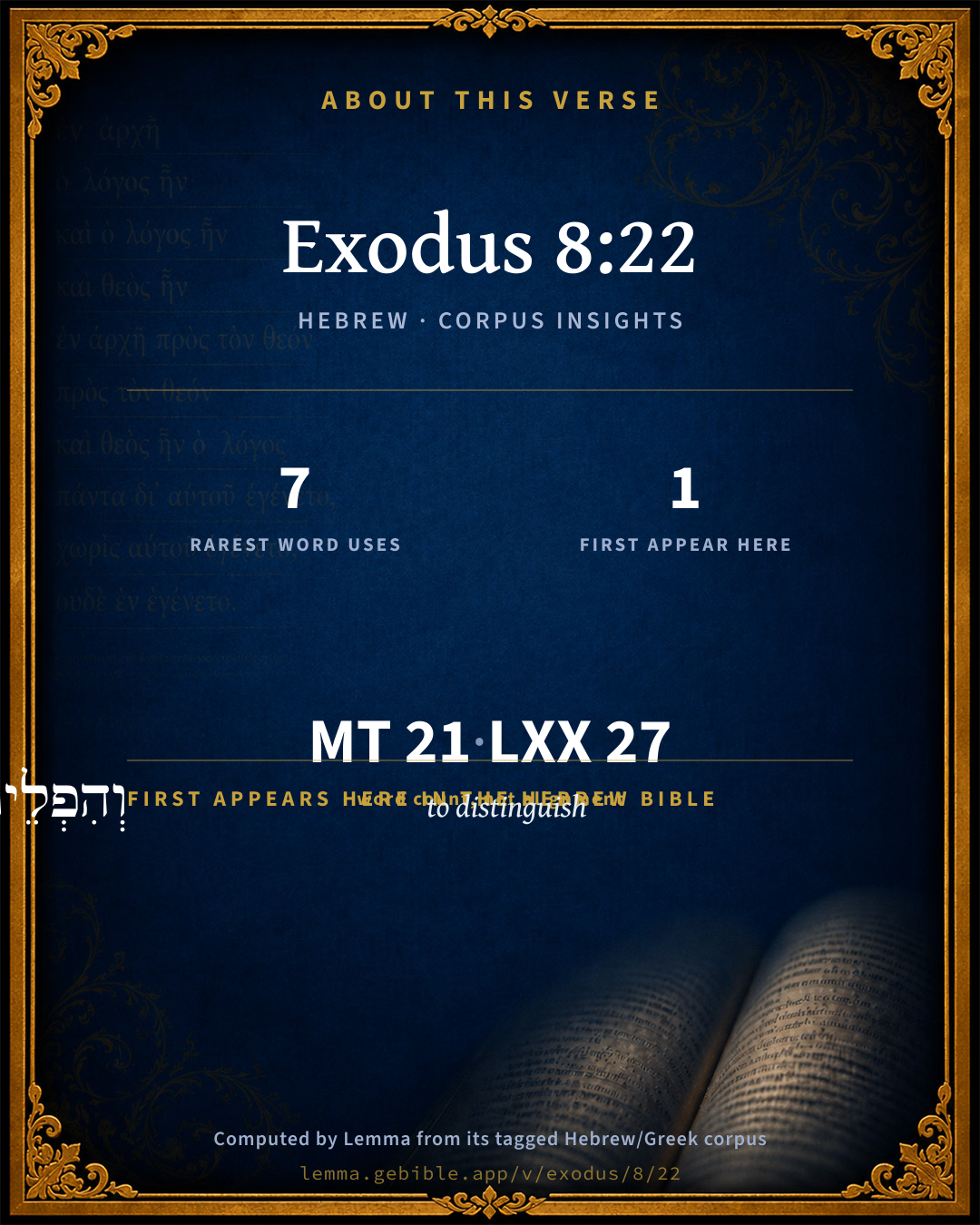
  • 1 first appearance in the Hebrew Bible
Full analysis ↓
Download a study sheet

One document with this verse’s original text, its word-by-word gloss line, the meaning frame, cross-references with their text, attributed commentary, and full source and license credits — printable, and it pastes into notes with its structure intact.

This verse Autodidact and up

Study sheet (.html) Plain text (.txt)

A passage Seminary Student

Up to 50 verses in one chapter. A passage sheet keeps up to 6 commentary sources and 12 cross-references per verse, in the order this page ranks them, and says so on the sheet whenever that leaves anything out. Ask for a single verse and you get the Autodidact verse sheet above.

Everything on this page stays free to read, with no account — the sheet is a download of what is already on screen, not access to it.

Want to remove ads? Support Godless Engineer
Compare translations 3

The same verse in 3 English versions, stacked beneath the original-language interlinear above. Click any original word for its lexicon entry.

Each is an independent rendering of the whole verse — the interlinear is not word-aligned to these translations.

Highlighted words mark where these versions differ — a whole-verse word diff, not a word-by-word alignment.

  • World English Bible Public Domain
    I will set apart in that day the land of Goshen, in which my people dwell, that no swarms of flies shall be there; to the end you may know that I am Yahweh in the midst of the earth.
  • King James Version Public Domain
    And I will sever in that day the land of Goshen, in which my people dwell, that no swarms of flies shall be there; to the end thou mayest know that I am the LORD in the midst of the earth.
  • unfoldingWord Literal Text CC BY-SA 4.0
    And in that day, I will distinguish the land of Goshen, on which my people dwell, so that the swarm will not be there, in order that you may know that I am Yahweh in the middle of the land.

unfoldingWord Literal Text — © unfoldingWord, licensed CC BY-SA 4.0. Word-aligned USFM3 via Door43 (git.door43.org/unfoldingWord/en_ult).

Versions to compare (up to 4)

3 of 4 selected

Show all 18 translations

Every available English version of this verse, each an independent rendering of the whole verse.

  • World English Bible Public Domain
    I will set apart in that day the land of Goshen, in which my people dwell, that no swarms of flies shall be there; to the end you may know that I am Yahweh in the midst of the earth.
  • Berean Standard Bible Public Domain
    But on that day I will give special treatment to the land of Goshen, where My people live; no swarms of flies will be found there. In this way you will know that I, the LORD, am in the land.
  • Majority Standard Bible Public Domain
    But on that day I will give special treatment to the land of Goshen, where My people live; no swarms of flies will be found there. In this way you will know that I, the LORD, am in the land.
  • King James Version Public Domain
    And I will sever in that day the land of Goshen, in which my people dwell, that no swarms of flies shall be there; to the end thou mayest know that I am the LORD in the midst of the earth.
  • American Standard Version (1901) Public Domain
    And I will set apart in that day the land of Goshen, in which my people dwell, that no swarms of flies shall be there; to the end thou mayest know that I am Jehovah in the midst of the earth.
  • Revised Version (1885) Public Domain
    And I will sever in that day the land of Goshen, in which my people dwell, that no swarms of flies shall be there; to the end thou mayest know that I am the LORD in the midst of the earth.
  • Geneva Bible (1599) Public Domain
    But ye land of Goshe, where my people are, wil I cause to be wonderfull in that day, so that no swarmes of flies shalbe there, that thou maiest know that I am the Lord in the middes of the earth.
  • Douay-Rheims (1899) Public Domain
    And I will make the land of Gessen wherein my people is, wonderful in that lay, so that flies shall not be there: and thou shalt know that I am the Lord in the midst of the earth.
  • Young's Literal Translation Public Domain
    `And I have separated in that day the land of Goshen, in which My people are staying, that the beetle is not there, so that thou knowest that I `am' Jehovah in the midst of the land,
  • Literal Standard Version CC BY-SA 4.0
    And I have separated in that day the land of Goshen, in which My people are staying, that the beetle is not there, so that you know that I [am] YHWH in the midst of the land,
  • Unlocked Literal Bible CC BY-SA 4.0
    But on that day I will treat the land of Goshen differently, the land in which my people are living, so that no swarms of flies will be there. This will happen so that you may know that I am Yahweh in the midst of this land.
  • unfoldingWord Literal Text CC BY-SA 4.0
    And in that day, I will distinguish the land of Goshen, on which my people dwell, so that the swarm will not be there, in order that you may know that I am Yahweh in the middle of the land.
  • Darby Bible Public Domain
    And I will distinguish in that day the land of Goshen, in which my people dwell, that no dog-flies shall be there; that thou mayest know that I Jehovah am in the midst of the land.
  • World Messianic Bible Public Domain
    I will set apart in that day the land of Goshen, in which my people dwell, that no swarms of flies shall be there, to the end you may know that I am the LORD on the earth.
  • Webster's Bible Public Domain
    And I will sever in that day the land of Goshen, in which my people dwell, that no swarms of flies shall be there; to the end thou mayest know that I am the LORD in the midst of the earth.
  • Free Bible Version CC BY-SA 4.0
    However, on this occasion I will treat the land of Goshen differently—that's where my people live—there won't be any swarms of flies there. This is how you will know that I, the Lord, am here in your country.
  • Bible in Basic English Public Domain
    And at that time I will make a division between your land and the land of Goshen where my people are, and no flies will be there; so that you may see that I am the Lord over all the earth.
  • JPS Tanakh (1917) Public Domain
    (8-18) And I will set apart in that day the land of Goshen, in which My people dwell, that no swarms of flies shall be there; to the end that thou mayest know that I am the LORD in the midst of the earth.

Literal Standard Version (2020), Covenant Press — licensed CC BY-SA 4.0. Text via the HelloAO Bible API (eBible.org). Unlocked Literal Bible (unfoldingWord) — licensed CC BY-SA 4.0. Text via the HelloAO Bible API (eBible.org). unfoldingWord Literal Text — © unfoldingWord, licensed CC BY-SA 4.0. Word-aligned USFM3 via Door43 (git.door43.org/unfoldingWord/en_ult). Free Bible Version, Dr. Jonathan Gallagher — licensed CC BY-SA 4.0. Text via the HelloAO Bible API (eBible.org).

Word by word

More ways to search: Search by grammar → Find every occurrence → Compare this word →

Practice this passage: Drill this verse → Learn its vocabulary →

וְהִפְלֵיתִי֩
pâlâh
H6395
“and · to distinguish”
Conjunction + Verb, Hiphil, Sequential Perfect, 1st Person, Common, Singular
Part of Speech
Conjunction + Verb
Stem
Hiphil
Form
Sequential Perfect
Person
1st Person
Gender
Common
Number
Singular
Full BDB Definition

Origin: a primitive root

TWOT: 1772

to be distinct, marked out, be separated, be distinguished - (Niphal) - to be distinct, be separated, be distinguished - to be wonderful - (Hiphil) to make separate, set apart
  1. בַיּ֨וֹם yôwm H3117 “in/at the · day” Preposition, Determined + Noun, Common, Masculine, Singular, Absolute
  2. הַה֜וּא hûwʼ H1931 “the · he” Particle, Definite Article + Pronoun, Personal, 3rd Person, Masculine, Singular
  3. אֶת ʼêth H853 “-” Particle, Direct Object
  4. אֶ֣רֶץ ʼerets H776 “land of” Noun, Common, Both, Singular, Construct
  5. גֹּ֗שֶׁן Gôshen H1657 “Goshen” Noun, Proper
  6. אֲשֶׁ֤ר ʼăsher H834 “which” Particle, Relative
  7. עַמִּי֙ ʻam H5971 “people · my” Noun, Common, Masculine, Singular, Construct + Suffix, Personal, 1st Person, Common, Singular
  8. עֹמֵ֣ד ʻâmad H5975 “standing” Verb, Qal, Participle Active, Masculine, Singular, Absolute
  9. עָלֶ֔יהָ ʻal H5921 “upon · her” Preposition + Suffix, Personal, 3rd Person, Feminine, Singular
  10. לְבִלְתִּ֥י biltîy H1115 “to/for · except” Preposition + Conjunction
  11. הֱיֽוֹת hâyâh H1961 “to be” Verb, Qal, Infinitive Construct
  12. שָׁ֖ם shâm H8033 “there” Adverb
  13. עָרֹ֑ב ʻârôb H6157 “swarm” Noun, Common, Masculine, Singular, Absolute
  14. לְמַ֣עַן maʻan H4616 “for the sake of” Preposition
  15. תֵּדַ֔ע yâdaʻ H3045 “to know” Verb, Qal, Imperfect, 2nd Person, Masculine, Singular
  16. כִּ֛י kîy H3588 “that” Conjunction
  17. אֲנִ֥י ʼănîy H589 “I” Pronoun, Personal, 1st Person, Common, Singular
  18. יְהוָ֖ה Yᵉhôvâh H3068 “LORD” Noun, Proper
  19. בְּקֶ֥רֶב qereb H7130 “in/at · midst of” Preposition + Noun, Common, Masculine, Singular, Construct
  20. הָאָֽרֶץ ʼerets H776 “the · land” Particle, Definite Article + Noun, Common, Both, Singular, Absolute

About this verse

These counts appear in no published source. They are computed here, from the morphology-tagged text and Lemma’s own curated glosses. What Lemma adds →

21
words
20
distinct lemmas
Pentateuch
section

Notable vocabulary

The rarest word here is וְהִפְלֵיתִי֩ to distinguish H6395 — appearing just 7 times in the whole Hebrew Bible.

First appearance in Scripture

This word makes its first canonical appearance in the Hebrew Bible here:

  • וְהִפְלֵיתִי֩ to distinguish H6395

Shared distinctive vocabulary

וְהִפְלֵיתִי֩ to distinguish H6395 occurs in 7 verses of the Hebrew Bible. Also found in:

Grammatical profile

  • 4 verbs
  • 8 nouns
  • 2 pronouns
  • 2 prepositions
  • 2 conjunctions
  • 1 adverb
  • 2 particles

Verb forms

  • וְהִפְלֵיתִי֩ Hiphil · Sequential Perfect
  • עֹמֵ֣ד Qal · Participle Active
  • הֱיֽוֹת Qal · Infinitive Construct
  • תֵּדַ֔ע Qal · Imperfect

Repetition

A word recurs within this verse — often emphatic in Hebrew:

  • אֶ֣רֶץ land H776 ×2

Hebrew & Septuagint length

In English translation the verse runs 40 words from the Hebrew and 39 from the Septuagint (LXX English) — closely comparable.

A rough comparison of the two English renderings, which tokenize alike — not a word-level alignment.

Word counts can differ between the Hebrew and the Greek without any difference in meaning — e.g. the Hebrew direct-object marker אֵת has no separate Greek word, and Greek often adds the article ὁ.

In the original languages it is 21 Hebrew tokens and 27 Greek tokens — but the two are counted differently (Hebrew bundles its prefixes and suffixes into one token; the Greek is in lemma form), so that isn’t a like-for-like length.

Cross-references

13

Topical passages linked to Exodus 8:22 in the Treasury of Scripture Knowledge — connected by theme and wording, ordered by reader-vote popularity; previews shown in the World English Bible.

  • Exodus 9:4 Yahweh will make a distinction between the cattle of Israel and the cattle of Egypt; and there shall nothing die of all that belongs to the children of Israel."'"
  • Malachi 3:18 Then you shall return and discern between the righteous and the wicked, between him who serves God and him who doesn't serve him.
  • Exodus 10:23 They didn't see one another, neither did anyone rise from his place for three days; but all the children of Israel had light in their dwellings.
  • Exodus 9:6 Yahweh did that thing on the next day; and all the cattle of Egypt died, but of the cattle of the children of Israel, not one died.
  • Ezekiel 30:19 Thus will I execute judgments on Egypt; and they shall know that I am Yahweh.
  • Psalms 110:2 Yahweh will send forth the rod of your strength out of Zion. Rule in the midst of your enemies.
  • Exodus 11:6–7 There shall be a great cry throughout all the land of Egypt, such as there has not been, nor shall be any more.
  • Exodus 12:13 The blood shall be to you for a token on the houses where you are: and when I see the blood, I will pass over you, and there shall no plague be on you to destroy you, when I strike the land of Egypt.
  • Exodus 7:17 Thus says Yahweh, "In this you shall know that I am Yahweh. Behold, I will strike with the rod that is in my hand on the waters which are in the river, and they shall be turned to blood.
  • Exodus 8:10 He said, "Tomorrow." He said, "Be it according to your word, that you may know that there is none like Yahweh our God.
  • Exodus 9:26 Only in the land of Goshen, where the children of Israel were, there was no hail.
  • Exodus 9:29 Moses said to him, "As soon as I have gone out of the city, I will spread abroad my hands to Yahweh. The thunders shall cease, neither shall there be any more hail; that you may know that the earth is Yahweh's.
  • Psalms 74:12 Yet God is my King of old, Working salvation in the midst of the earth.

Cross-references courtesy of OpenBible.info (CC BY 4.0).

Hebrew and Greek witnesses Masoretic Hebrew ↔ Greek Septuagint

The same verse in the two great witnesses to the Old Testament, shown verse-for-verse.

These are two independent witnesses, not word-aligned to each other, and the Septuagint is shown in lemma (dictionary) form.

Hebrew Exodus 8:22 Masoretic · Westminster Leningrad Codex

וְהִפְלֵיתִי֩ בַיּ֨וֹם הַה֜וּא אֶת אֶ֣רֶץ גֹּ֗שֶׁן אֲשֶׁ֤ר עַמִּי֙ עֹמֵ֣ד עָלֶ֔יהָ לְבִלְתִּ֥י הֱיֽוֹת שָׁ֖ם עָרֹ֑ב לְמַ֣עַן תֵּדַ֔ע כִּ֛י אֲנִ֥י יְהוָ֖ה בְּקֶ֥רֶב הָאָֽרֶץ

I will set apart in that day the land of Goshen, in which my people dwell, that no swarms of flies shall be there; to the end you may know that I am Yahweh in the midst of the earth.

World English Bible · Public Domain

Greek LXX Exodus 8:22 Septuagint · lemma form

καί εἶπον μωυσῆς οὐ δυνατός γίγνομαι οὕτως ὁ γάρ βδέλυγμα ὁ αἰγύπτιος θύω κύριος ὁ θεός ἐγώ ἐάν γάρ θύω ὁ βδέλυγμα ὁ αἰγύπτιος ἐναντίον αὐτός λιθοβολέω

and I will distinguish marvelously in that day the land of Gesem, on which my people dwell, in which the dog-fly shall not be: that you may know that I am the Lord the God of all the earth.

LXX2012 (modern English Septuagint) · Public Domain

On this verse, Joseph Benson's Commentary discusses the Septuagint’s reading. Read the note in Commentary ↓

Hebrew: Westminster Leningrad Codex (CC BY 4.0). Greek: Septuagint (public domain); English from LXX2012 (modern English Septuagint) (Public Domain). How the Septuagint differs from the Hebrew →

Targum (Aramaic paraphrase)

2

The Targum is the ancient Jewish Aramaic paraphrase of the Hebrew Scriptures — an interpretive translation, not the Hebrew text itself. Onkelos (literal) and Pseudo-Jonathan (expansive) render the Torah, and Jonathan the Prophets. Coverage is partial: where no permissively-licensed English translation exists for a verse, only the Aramaic is shown. This is verse-level text, not a word-by-word alignment to the Hebrew.

  1. Targum Onkelos Torah (Genesis–Deuteronomy)
    וַאֲמַר משֶׁה לָא תַקֵן לְמֶעְבַּד כֵּן אֲרֵי בְעִירָא דְמִצְרָאֵי דָחֲלִין לֵהּ מִנֵהּ אֲנַחְנָא נָסְבִין לְדַבָּחָא קֳדָם יְיָ אֱלָהָנָא הָא נְדַבַּח יָת בְּעִירָא דְמִצְרָאֵי דָחֲלִין לֵהּ וְאִנוּן יְהוֹן חָזָן הֲלָא יֵימְרוּן לְמִרְגְמָנָא:

    (no public-domain English translation for this verse)

    Targum Onkelos — Aramaic: “Onkelos Genesis” (public domain); “Onkelos Exodus” (public domain); “Onkelos Leviticus” (public domain); “Onkelos Numbers” (public domain); “Onkelos Deuteronomy” (public domain). English: “Sefaria Community Translation” (CC0 1.0 (public-domain dedication)); “J.W. Etheridge. The Targums of Onkelos and Jonathan Ben Uzziel on the Pentateuch. London: Longmans, Green, 1862” (public domain). Text via Sefaria.

  2. Targum Pseudo-Jonathan Torah (Genesis–Deuteronomy)
    וַאֲמַר משֶׁה לָא תַקִין לְמֶעֱבַד כֵּן אֲרוּם אִמְרַיָא דְהִינוּן טַעֲוַותְהוֹן דְמִצְרָאֵי מִנְהוֹן נִיסַב וְנִקְרְבָא קֳדָם יְיָ אֱלָהֵן הָא אִין מְקַרְבִין אֲנָן יַת טַעֲוַותְהוֹן דְמִצְרָאֵי קֳדָמֵיהוֹן הוּא מִן דִינָא הוּא לְאַטָלָא יָתָן בְּאַבְנִין

    But Mosheh said, It will not be right to do so; because we shall take sheep, which are the abomination of the Mizraee, and offer them before the Lord our God. Behold if we offer the abomination of the Mizraee before them, they would stone us with stones as an act of justice.

    Targum Pseudo-Jonathan — Aramaic: “Targum Jonathan on Genesis” (public domain); “Targum Jonathan on Exodus” (public domain); “Targum Jonathan on Leviticus” (public domain); “Targum Jonathan on Numbers” (public domain); “Targum Jonathan on Deuteronomy” (public domain). English: “The Targum of Jonathan ben Uzziel, trans. J. W. Etheridge, London, 1862” (public domain). Text via Sefaria.

Commentary

Notes on Exodus 8:22 from classic Christian and Jewish commentators (each source and its license shown beneath its notes). The classic Christian expositions comment on the surrounding passage and are grouped to its opening verse, so a note may address several verses; the Jewish commentaries on the Tanakh (Rashi and others) are per-verse, so they appear only where the commentator wrote on this verse.

Lemma curates 59 commentaries, every one of them public domain or Creative Commons licensed, each selected and text-cleaned for this edition rather than reprinted as found. About our sources →

Trapp's Complete Commentary

John Trapp

Exo 8:22 And I will sever in that day the land of Goshen, in which my people dwell, that no swarms [of flies] shall be there; to the end thou mayest know that I [am] the LORD in the midst of the earth.

Ver. 22. And I will sever.] Heb., Marvellously separate, by setting upon them my signum salutare. {Eze 9:4} So that the worst that are "shall return and discern betwixt the righteous and the wicked." {Mal 3:18} See Exo 33:16.

In the midst of the earth.] Not in heaven only, whereunto Aristotle and other atheists would confine his providence. {a} Lysippus made Alexander’s picture with this poesy: -

“ Iupiter asserui terram mihi, tu assere coelum. ”

{a} Docuit Aristoteles Providentiam Dei ad coelum Lunae usque protendi, non ultra.

John Trapp, A Commentary or Exposition upon All the Books of the Old and New Testament (1647–1656) — public domain. Text from a community e-Sword module.

Joseph Benson's Commentary

Exo 8:22. I will sever in that day — The Hebrew properly means, I will marvellously sever. The LXX. render it παραδοξασω , I will make a glorious distinction. Although the Israelites were probably not afflicted with any of the plagues which went before this, yet as Goshen, where they lived, was at a considerable distance, it might be thought that the frogs and lice, in the common course of things, considering their nature, would not extend as far; but it being natural to flies to be carried by the air everywhere, this was the more astonishing and distinguishing, that such creatures, whose nature it is to spread themselves in all places, should not any of them extend to the land of Goshen. Know that I am the Lord in the midst of the earth — In every part of it. Swarms of flies, which seem to us to fly at random, shall be manifestly under the conduct of an intelligent mind. Hither they shall go, saith Moses, and thither they shall come, and the performance is punctual according to this appointment; and both compared amount to a demonstration, that he that said it and he that did it was the same — even a Being of infinite power and wisdom.

Joseph Benson's Commentary on the Old and New Testaments (1811–1818) — public domain. Text from a community e-Sword module.

Geneva Bible (1599)

Geneva Bible translators

Or, land of Egypt.

Or, I will separate.

Geneva Bible (1599) marginal notes — public domain. Text via Bolls.life.

Adam Clarke's Commentary

Verse 22. I will sever in that day] הפליתי hiphleythi, has been translated by some good critics, I will miraculously separate; so the Vulgate: Faciam mirabilem, "I will do a marvellous thing." And the Septuagint, παραδοξασω, I will render illustrious the land of Goshen in that day; and this he did, by exempting that land, and its inhabitants the Israelites, from the plagues by which he afflicted the land of Egypt.

Adam Clarke's Commentary on the Bible (1810–1826) — public domain. Text from a community e-Sword/MySword module.

Ellicott's Commentary for English Readers

(22) I will sever in that day the land of Goshen.—This was a new feature, and one calculated to make a deep impression both on king and people. The “land of Goshen” can only have been some portion of the Eastern Delta, a tract in unwise different from the rest of Egypt—low, flat, well-watered, fertile. Nature had put no severance between it and the regions where the Egyptians dwelt; so the severance to be made would be a manifest miracle.

A Bible Commentary for English Readers, edited by Charles John Ellicott (1878–1897) — public domain. Text from a community e-Sword module.

The Cambridge Bible for Schools and Colleges

gen. ed. J. J. S. Perowne

22. ‘Such swarms may advance along particular lines, and so spare a given district. The promise here given may stand in some connexion with this fact’ (Di.).

sever] as Exo_9:4, Exo_11:7 (EVV. put a difference): both J.

the land of Goshen] to which, according to J, the Israelites were confined (Exo_9:26; Gen_45:10; Gen_46:28 b, Gen_46:29; Gen_46:34, Gen_47:1; Gen_47:4; Gen_47:6; Gen_47:27, Gen_50:8 : all J); E pictures them as living side by side with the Egyptians (Exo_3:22, Exo_11:2). The site of Goshen has been fixed by recent discoveries. Ancient hieroglyphic lists of the ‘nomes’ of Egypt mention Kesem as the 20th nome of Lower Egypt, and state that its religious capital was P-sapṭ, i.e. the modern ‘Ṣafṭ el-Ḥenna,’ a village about 40 miles NE. of Cairo, the ancient name of which M. Naville ascertained in 1885, from inscriptions found on the spot, to be Kes. ‘Goshen’ (LXX. Γεσεμ) must thus have been the fertile district around Ṣafṭ, where the Wâdy Ṭumîlât opens out at its W. end towards Bubastis, ‘within the triangle lying between the villages of Ṣafṭ, Belbeis, and Tel el-Kebir’ (Naville), embracing an area of 60–80 sq. miles (Petrie, Sinai, p. 208), about 40–50 miles NE. of Cairo. The Wâdy Ṭumîlât is a narrow strip of cultivated soil stretching out, like an arm from the Delta (see the map), across the desert, about 50 miles NE. of Cairo, to Lake Timsâḥ: in pre-historic times, a branch of the Nile ran down it1[123], discharging its waters into a northern extension of the Gulf of Suez’ (see p. 126); within the historic period canals have been at different times constructed along it, connecting the Nile with the Red Sea (p. 4 n.); on each side of this strip of soil the country is desert, but the Wâdy itself is irrigated by a fresh water canal, and fertile: and the part of the Delta adjoining it on the W. (where ‘Goshen’ will have been) affords excellent arable land and pasture (cf. Dawson, Egypt and Syria, p. 55 f.). See further Goshen in DB. or EB.

[123] Borings revealed at the depth of 22ft. below the surface the shells of fresh-water mussels of species still living in the Nile (ZDPV. Exo 1885, p. 227).

On Kes, the ancient town of ‘Goshen,’ see Duncan, Exploration of Egypt and the OT. (1908), pp. 106 f., 113 ff.: few remains of it are now visible. The cemetery of Kes was excavated in 1905–6 by Petrie, and found by him to contain numerous tombs of the 18th and 19th dynasties; but the tombs, as the objects found in them shewed, were entirely those of Egyptians. If, therefore, as J represents (see esp. Gen_46:34), the Israelites lived apart from the Egyptians, we must suppose that the Egyptians in Goshen lived only in the town, while the Israelites were in the country.

to the end … that, &c.] Cf. Exo_8:10, with the references.

The Cambridge Bible for Schools and Colleges (gen. ed. J. J. S. Perowne; Cambridge University Press, 1878–1918) — public domain. Text from a community e-Sword module.

John Gill's Exposition

And I will put a division between my people and thy people,.... Or, a "redemption" (p); for by distinguishing them in his providence from the Egyptians, he might be said to redeem or deliver them; thus God makes a difference between his chosen people and the rest of the world, through his Son's redemption of them by his blood, out of every kindred, tongue, people, and nation:

tomorrow shall this sign be: which, according to Bishop Usher, must be the twenty nineth day of Adar or February.

(p) "redemptionem", Pagninus, Montanus, &c.

John Gill's Exposition of the Whole Bible (1746–1763) — public domain (CC PDM 1.0). Text via the HelloAO Bible API.

Albert Barnes' Notes on the Bible

I will sever ... - This severance constituted a specific difference between this and the preceding plagues. Pharaoh could not of course attribute the exemption of Goshen from a scourge, which fell on the valley of the Nile, to an Egyptian deity, certainly not to Chepera (see the last note), a special object of worship in Lower Egypt.

Albert Barnes' Notes on the Bible (1834–1885) — public domain. Text from a community e-Sword/MySword module.

Haydock's Catholic Bible Commentary

CHAPTER VIII.

Gessen, where the Hebrews dwelt. The Egyptians who lived among them would not, however, escape this plague.

George Leo Haydock (1774–1849), Haydock's Catholic Family Bible and Commentary, 1859 edition — public domain. Excludes Psalms (Douay-Rheims chapter numbering differs from Protestant) and Deuterocanonical books (Catholic canon only).

Matthew Poole's English Annotations

Either,

1. Of the whole earth, and consequently of Egypt, that I am not only the Lord of Israel, but of thee and thy dominions too. God is here spoken of after the manner of earthly princes, who use to reside in the midst of their kingdoms, that they may more conveniently rule and influence them. Or rather,

2. Of Goshen; the words being properly thus rendered, that I the Lord am in the midst of that land, to wit, the land of Goshen now spoken of, to defend and preserve it. For God is said to be in the midst of them whom he protects, Deu 7:21; 23:14; Jos 3:10; Psa 46:5; and not to be in the midst of others whom he forsakes, and designs or threatens to destroy, Num 14:42; Deu 1:42; 31:17. Compare Exo 33:3, with Exo 34:9.

Matthew Poole's English Annotations on the Holy Bible (1683–1685) — public domain. Text from a community e-Sword/MySword module.

Whedon's Commentary on the Bible

Daniel D. Whedon

22. I will sever in that day the land of Goshen — Here also is now a marked advance, a more distinctive character in the judgment. The putrid Nile had afflicted Egypt and Israel alike; the frogs and the lice had been found, at least to some extent, in the land of Goshen; but henceforth the Israelitish province was to be protected from the inflictions that were to fall upon heathen Egypt. Here was to be a decisive proof of Jehovah’s supremacy, to the end thou mayest know that I am JEHOVAH. I will put a division (or deliverance) between my people and thy people — It is also to be considered, that while at the beginning of these inflictions the Israelites had been considerably scattered from Goshen throughout the land in the great public works, these successive judgments would have greatly hindered, if not by this time have totally suspended, the industrial activities of the nation. By this time there must have been a great national anxiety, and soon there was a general panic. Under these circumstances the Israelites would naturally gather together into their own province, and be no more mingled among the Egyptians. Thus this marked distinction in regard to Goshen would be now, perhaps, for the first time possible.

Daniel D. Whedon (gen. ed.), Commentary on the Old and New Testaments (1874–1909) — public domain. Text from a community e-Sword module.

The Pulpit Commentary

I will sever in that day the land of Goshen. On the position of the land of Goshen, see the Excursus on the Geography. The "severance" is a new feature, and one distinguishing the later from the earlier plagues. It was an additional mark of the miraculous character of the visitations, well calculated to impress all thoughtful and honest minds. By all such it would be seen that the God who could make this severance was no local God of the Hebrews only, but one whose power extended over the whole earth.

HOMILETICS.

Vers. 22, 23. God puts division between the good and bad, both here and hereafter

In some respects the good and the bad appear to be treated alike in this life, and no difference to be made between them. "God maketh his sun to rise on the evil and on the good, and sendeth rain on the just and on the unjust". (Mat_5:45) The Preacher"s experience was that "all things come alike to all; there is one event to the righteous and to the wicked; to the clean and to the unclean; to him that sacrificeth and to him that sacrificeth not; as is the good, so is the sinner; and he that sweareth as he that feareth an oath". (Ecc_9:2) If God sends a pestilence upon a land, or a drought, or an excess of rain, or any other calamity, the good and the bad seem to suffer equally; no difference to be put between them. This is the first impression of the contemplative philosopher when he looks upon human life; and it is a true impression to a great extent. But there are limitations, which, though easily overlooked at the first glance, become apparent upon more careful examination. God does not treat all nations alike he favours those which observe his laws; punishes those who disobey them. He seems sometimes especially to bless certain faithful families, as that of David, and to rain plagues upon others, as those of Saul, Herod the Great, and Napoleon. He gives, on the whole, to good men certain temporal advantages over bad men, as those which flow naturally (i.e. by his appointment) from industry, honesty, prudence, sobriety, and other virtues. The result is that "godliness" is said in Scripture to "have the promise of this life". (1Ti_4:8) And if we take into consideration the satisfaction of a good conscience, the confidence towards God, the calm trust, and the certain hope which sustain the good, and set in the opposite scale the doubts and fears and horrors of an evil conscience which afflict the bad, we shall have little doubt that the balance of happiness, even in this life, is with the servants of God. Still, no doubt the great "division" is put hereafter. "When the Son of Man shall come in his glory, and all the holy angels with him, before him shall be gathered all nations; and he shall separate them one from another, as a shepherd divideth his sheep from the goats and he shall set the sheep on his right hand, but the goats on the. (Mat 25:31-3) Awful the separation, where between the two "there is a great gulf fixed". (Luk_16:26) on the one side heavenly joy and perfect felicity on the other, "the blackness of darkness for ever". (Jud_1:13)

The Pulpit Commentary (1880–1919), ed. H.D.M. Spence-Jones & Joseph S. Exell — public domain. Text from a community e-Sword module.

John Wesley's Explanatory Notes

Know that I am the Lord in the midst of the earth - In every part of it. Swarms of flies, which seem to us to fly at random, shall be manifestly under the conduct of an intelligent mind. Hither they shall go, saith Moses, and thither they shall come, and the performance is punctual according to this appointment; and both compared amount to a demonstration, that he that said it, and he that did it, was the same, even a being of infinite power and wisdom.

John Wesley, Explanatory Notes Upon the Whole Bible (1754–1765) — public domain. Text via the GEBible commentary corpus.

unfoldingWord translationNotes

Door43 World Missions Community

General Information:

Yahweh continues to speak to Pharaoh through Moses.

the land was ruined because of the swarms of flies

This can be translated in active form. AT: "the swarms of flies devastated the land" (See: Active or Passive)

translationWords

Goshen

people of God

know

sign

unfoldingWord translationNotes — © Distant Shores Media and the Door43 World Missions Community, licensed CC BY-SA 4.0. Source: git.door43.org/Door43/en_tn.

Rashi

Rabbi Shlomo Yitzchaki (Rashi)

תועבת מצרים THE ABOMINATION OF THE EGYPTIANS — This means: that which the Egyptians reverence (their idol), just as, (2 Kings 23:13) “and for Milcom the abomination (תועבת) of the children of Ammon”, but in relation to the Israelites it (Scripture) calls it תועבה. We may explain these words in another sense also: תועבת מצרים — The act of sacrifice which we practise is a hateful thing to the Egyptians seing that we sacrifice their god (sheep which were reverenced as gods in Egypt).

ולא יסקלנו — This must be read in the intonation of a question (although there is no interrogative prefix הֲ) AND WILL THEY NOT STONE US?

Rashi on the Tanakh — English translations: “The Judaica Press complete Tanach with Rashi, translated by A. J. Rosenberg” (CC BY 4.0); “Pentateuch with Rashi's commentary by M. Rosenbaum and A.M. Silbermann, 1929-1934” (public domain); “The Metsudah Tanach series, Lakewood, N.J” (CC BY 4.0); and “The Book of Joshua, Metsudah Publications, 1997” (CC BY 4.0). Text via Sefaria.

Lesson kit

Teaching starters — assembled from the data on this page, not authored interpretation. Every prompt links to the verse data it draws on. Edit before teaching.

Exodus, in the Pentateuch, opens this verse with 21 words (20 distinct Hebrew lemmas). Its most distinctive word is pâlâh (“to distinguish”). A historical commentator’s framing appears above. Read the whole chapter for the surrounding context.

Discussion questions

  1. How does “to distinguish” (pâlâh) shape what this verse is saying?
  2. The word “to distinguish” first appears here in Scripture. What is being introduced at this debut?
  3. Exodus 9:4 shares the word «to distinguish» with this verse. How do the two illuminate each other?
  4. “land” occurs 2× in this one verse. What is the effect of the repetition?
  5. The translations on this page render this verse differently — a whole-verse word diff, not a word-by-word alignment. What might account for the different wordings?
  6. The verb «וְהִפְלֵיתִי֩» is Hiphil Sequential Perfect. How does its form color the action?
  7. Reading how Trapp's Complete Commentary and Joseph Benson's Commentary read this verse, where do the two commentators agree and where do they part?

Things to notice

Reading settings

Reading text

Shown beneath each verse's original-language words.

Old Testament
Old Testament edition

Read the OT as the Masoretic Hebrew (MT) or the Greek Septuagint (LXX).

English shown for the Greek Septuagint (in the Hebrew ↔ Greek comparison).

Comparing translations? Open the Compare panel on any verse page to stack up to four side by side.