
Numbers 18:20

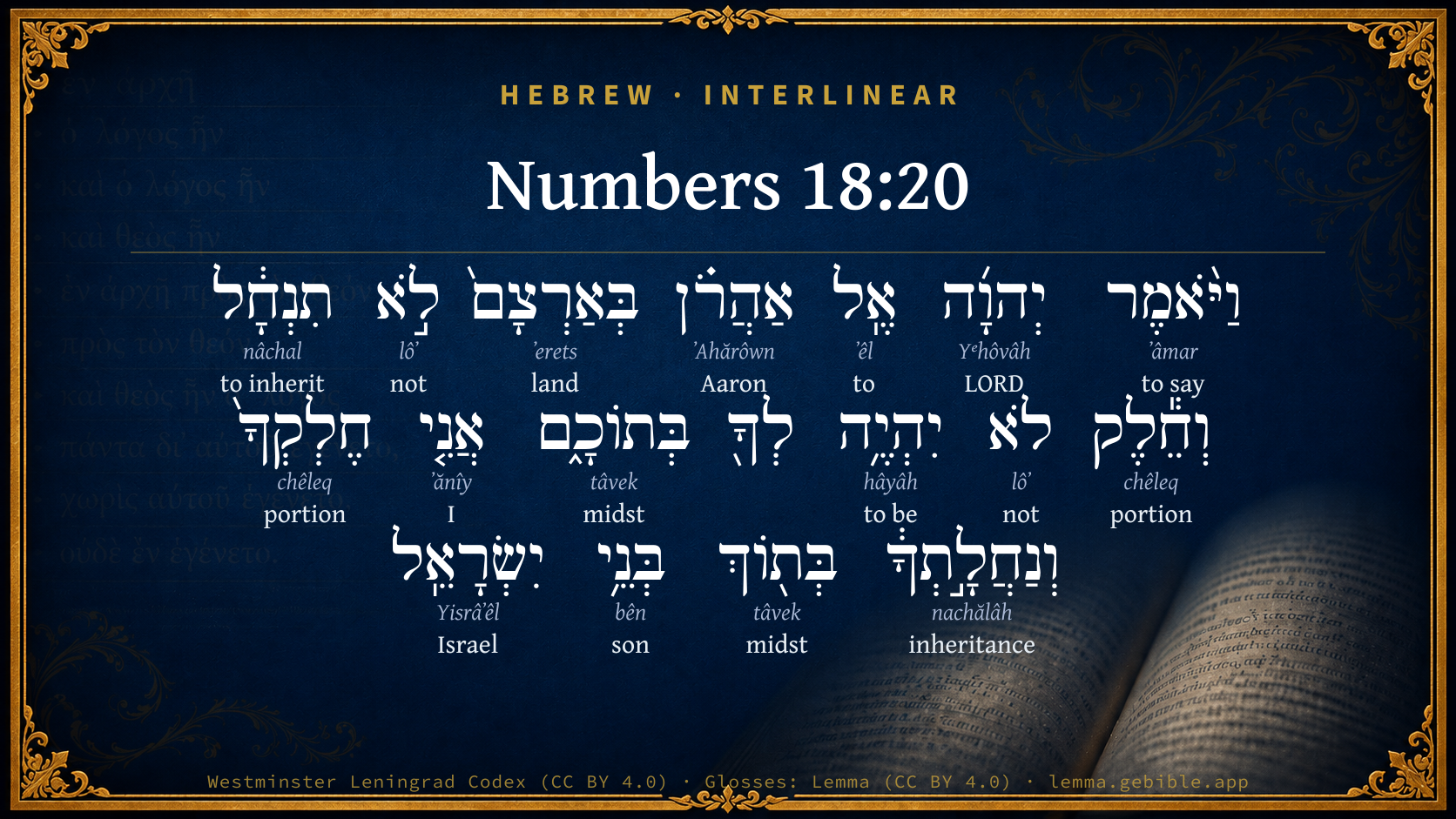
Hebrew (Westminster Leningrad Codex) Numbers 18:20 appears in the Hebrew Old Testament. The text above is from the Westminster Leningrad Codex. Each word links to its Strong’s number, a concise gloss, and parsing drawn from the Open Scriptures Hebrew Bible morphology. Click any word for its full Brown-Driver-Briggs (BDB) entry.
Download image
Cite this verse

Numbers 18:20 (World English Bible). Public Domain. Lemma interlinear Bible study tool, https://lemma.gebible.app/v/numbers/18/20.

Show BibTeX & RIS
BibTeX
RIS
English Translation
Yahweh said to Aaron, You shall have no inheritance in their land, neither shall you have any portion among them: I am your portion and your inheritance among the children of Israel.
World English Bible · Public Domain
Download a study sheet

One document with this verse’s original text, its word-by-word gloss line, the meaning frame, cross-references with their text, attributed commentary, and full source and license credits — printable, and it pastes into notes with its structure intact.

This verse Autodidact and up

Study sheet (.html) Plain text (.txt)

A passage Seminary Student

Up to 50 verses in one chapter. A passage sheet keeps up to 6 commentary sources and 12 cross-references per verse, in the order this page ranks them, and says so on the sheet whenever that leaves anything out. Ask for a single verse and you get the Autodidact verse sheet above.

Everything on this page stays free to read, with no account — the sheet is a download of what is already on screen, not access to it.

Want to remove ads? Support Godless Engineer
Compare translations 3

The same verse in 3 English versions, stacked beneath the original-language interlinear above. Click any original word for its lexicon entry.

Each is an independent rendering of the whole verse — the interlinear is not word-aligned to these translations.

Highlighted words mark where these versions differ — a whole-verse word diff, not a word-by-word alignment.

  • World English Bible Public Domain
    Yahweh said to Aaron, You shall have no inheritance in their land, neither shall you have any portion among them: I am your portion and your inheritance among the children of Israel.
  • King James Version Public Domain
    And the LORD spake unto Aaron, Thou shalt have no inheritance in their land, neither shalt thou have any part among them: I am thy part and thine inheritance among the children of Israel.
  • unfoldingWord Literal Text CC BY-SA 4.0
    And Yahweh said to Aaron, “In their land you shall not inherit, and a portion shall not be for you in their midst. I your portion and your inheritance in the midst of the sons of Israel.

unfoldingWord Literal Text — © unfoldingWord, licensed CC BY-SA 4.0. Word-aligned USFM3 via Door43 (git.door43.org/unfoldingWord/en_ult).

Versions to compare (up to 4)

3 of 4 selected

Show all 18 translations

Every available English version of this verse, each an independent rendering of the whole verse.

  • World English Bible Public Domain
    Yahweh said to Aaron, You shall have no inheritance in their land, neither shall you have any portion among them: I am your portion and your inheritance among the children of Israel.
  • Berean Standard Bible Public Domain
    Then the LORD said to Aaron, “You will have no inheritance in their land, nor will you have any portion among them. I am your portion and your inheritance among the Israelites.
  • Majority Standard Bible Public Domain
    Then the LORD said to Aaron, “You will have no inheritance in their land, nor will you have any portion among them. I am your portion and your inheritance among the Israelites.
  • King James Version Public Domain
    And the LORD spake unto Aaron, Thou shalt have no inheritance in their land, neither shalt thou have any part among them: I am thy part and thine inheritance among the children of Israel.
  • American Standard Version (1901) Public Domain
    And Jehovah said unto Aaron, Thou shalt have no inheritance in their land, neither shalt thou have any portion among them: I am thy portion and thine inheritance among the children of Israel.
  • Revised Version (1885) Public Domain
    And the LORD said unto Aaron, Thou shalt have no inheritance in their land, neither shalt thou have any portion among them: I am thy portion and thine inheritance among the children of Israel.
  • Geneva Bible (1599) Public Domain
    And the Lord sayde vnto Aaron, Thou shalt haue none inheritance in their lande, neyther shalt thou haue any parte among them: I am thy part and thine inheritance among the children of Israel.
  • Douay-Rheims (1899) Public Domain
    And the Lord said to Aaron: You shall possess nothing in their land, neither shall you have a portion among them: I am thy portion and inheritance in the midst of the children of Israel.
  • Young's Literal Translation Public Domain
    And Jehovah saith unto Aaron, `In their land thou dost not inherit, and a portion thou hast not in their midst: I `am' thy portion, and thine inheritance in the midst of the sons of Israel;
  • Literal Standard Version CC BY-SA 4.0
    And YHWH says to Aaron, “You do not inherit in their land, and you do not have a portion in their midst: I [am] your portion and your inheritance in the midst of the sons of Israel;
  • Unlocked Literal Bible CC BY-SA 4.0
    Yahweh said to Aaron, “You will have no inheritance in the people's land, nor will you have any share of property among the people. I am your share and inheritance among the people of Israel.
  • unfoldingWord Literal Text CC BY-SA 4.0
    And Yahweh said to Aaron, “In their land you shall not inherit, and a portion shall not be for you in their midst. I your portion and your inheritance in the midst of the sons of Israel.
  • Darby Bible Public Domain
    And Jehovah said to Aaron, In their land thou shalt have no inheritance, neither shalt thou have any portion among them: I am thy portion and thine inheritance among the children of Israel.
  • World Messianic Bible Public Domain
    The LORD said to Aaron, “You shall have no inheritance in their land, neither shall you have any portion among them. I am your portion and your inheritance among the children of Israel.
  • Webster's Bible Public Domain
    And the LORD spoke to Aaron, Thou shalt have no inheritance in their land, neither shalt thou have any part among them: I am thy part and thy inheritance among the children of Israel.
  • Free Bible Version CC BY-SA 4.0
    You won't possess property in their country, and you won't have a share in their land. I am your share and your possession among the Israelites.
  • Bible in Basic English Public Domain
    And the Lord said to Aaron, You will have no heritage in their land, or any part among them; I am your part and your heritage among the children of Israel.
  • JPS Tanakh (1917) Public Domain
    And the LORD said unto Aaron: 'Thou shalt have no inheritance in their land, neither shalt thou have any portion among them; I am thy portion and thine inheritance among the children of Israel.

Literal Standard Version (2020), Covenant Press — licensed CC BY-SA 4.0. Text via the HelloAO Bible API (eBible.org). Unlocked Literal Bible (unfoldingWord) — licensed CC BY-SA 4.0. Text via the HelloAO Bible API (eBible.org). unfoldingWord Literal Text — © unfoldingWord, licensed CC BY-SA 4.0. Word-aligned USFM3 via Door43 (git.door43.org/unfoldingWord/en_ult). Free Bible Version, Dr. Jonathan Gallagher — licensed CC BY-SA 4.0. Text via the HelloAO Bible API (eBible.org).

Word by word

More ways to search: Search by grammar → Find every occurrence → Compare this word →

Practice this passage: Drill this verse → Learn its vocabulary →

תִנְחָ֔ל
nâchal
H5157
“to inherit”
Verb, Qal, Imperfect, 2nd Person, Masculine, Singular
Part of Speech
Verb
Stem
Qal
Form
Imperfect
Person
2nd Person
Gender
Masculine
Number
Singular
Full BDB Definition

Origin: a primitive root

TWOT: 1342

to get as a possession, acquire, inherit, possess - (Qal) - to take possession, inherit - to have or get as a possession or property (figuratively) - to divide the land for a possession - to acquire (testimonies) (figuratively) - (Piel) to divide for a possession - (Hithpael) to possess oneself of - (Hiphil) - to give as a possession - to cause to inherit, give as an inheritance - (Hophal) to be allotted, be made to possess
  1. וַיֹּ֨אמֶר ʼâmar H559 “and · to say” Conjunction + Verb, Qal, Sequential Imperfect, 3rd Person, Masculine, Singular
  2. יְהוָ֜ה Yᵉhôvâh H3068 “LORD” Noun, Proper
  3. אֶֽל ʼêl H413 “to” Preposition
  4. אַהֲרֹ֗ן ʼAhărôwn H175 “Aaron” Noun, Proper
  5. בְּאַרְצָם֙ ʼerets H776 “in/at · land · their” Preposition + Noun, Common, Both, Singular, Construct + Suffix, Personal, 3rd Person, Masculine, Plural
  6. לֹ֣א lôʼ H3808 “not” Particle, Negative
  7. וְחֵ֕לֶק chêleq H2506 “and · portion” Conjunction + Noun, Common, Masculine, Singular, Absolute
  8. לֹא lôʼ H3808 “not” Particle, Negative
  9. יִהְיֶ֥ה hâyâh H1961 “to be” Verb, Qal, Imperfect, 3rd Person, Masculine, Singular
  10. בְּתוֹכָ֑ם tâvek H8432 “in/at · midst · their” Preposition + Noun, Common, Masculine, Singular, Construct + Suffix, Personal, 3rd Person, Masculine, Plural
  11. אֲנִ֤י ʼănîy H589 “I” Pronoun, Personal, 1st Person, Common, Singular
  12. חֶלְקְךָ֙ chêleq H2506 “portion · your” Noun, Common, Masculine, Singular, Construct + Suffix, Personal, 2nd Person, Masculine, Singular
  13. וְנַחֲלָ֣תְךָ֔ nachălâh H5159 “and · inheritance · your” Conjunction + Noun, Common, Feminine, Singular, Construct + Suffix, Personal, 2nd Person, Masculine, Singular
  14. בְּת֖וֹךְ tâvek H8432 “in/at · midst of” Preposition + Noun, Common, Masculine, Singular, Construct
  15. בְּנֵ֥י bên H1121 “sons of” Noun, Common, Masculine, Plural, Construct
  16. יִשְׂרָאֵֽל Yisrâʼêl H3478 “Israel” Noun, Proper

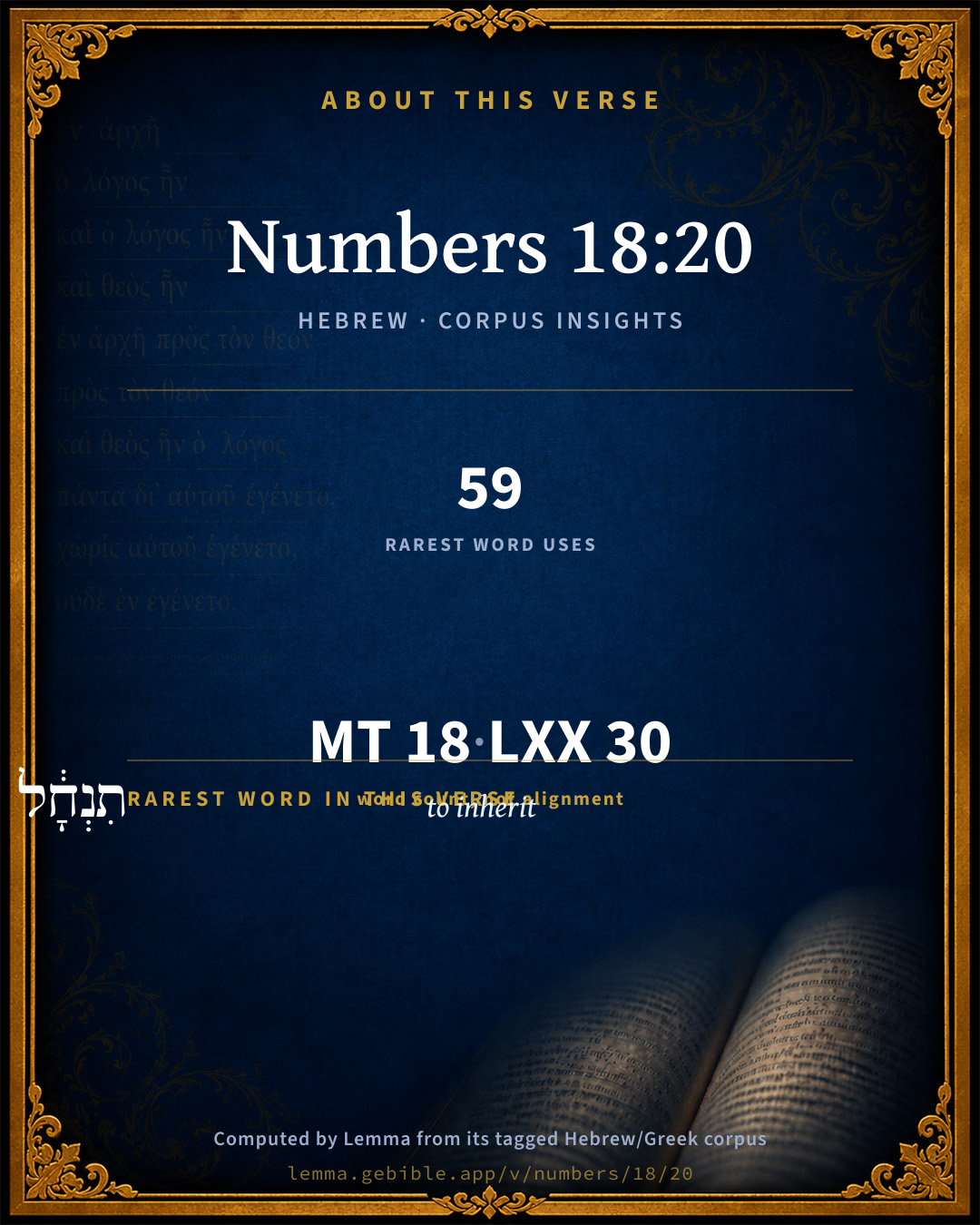
About this verse

These counts appear in no published source. They are computed here, from the morphology-tagged text and Lemma’s own curated glosses. What Lemma adds →

18
words
14
distinct lemmas
Pentateuch
section

Shared distinctive vocabulary

תִנְחָ֔ל to inherit H5157 occurs in 57 verses of the Hebrew Bible. Also found in:

Grammatical profile

  • 3 verbs
  • 10 nouns
  • 1 pronoun
  • 2 prepositions
  • 2 particles

Verb forms

  • וַיֹּ֨אמֶר Qal · Sequential Imperfect
  • תִנְחָ֔ל Qal · Imperfect
  • יִהְיֶ֥ה Qal · Imperfect

Repetition

Words recur within this verse — often emphatic in Hebrew:

  • וְחֵ֕לֶק portion H2506 ×2
  • בְּתוֹכָ֑ם midst H8432 ×2
  • לֹ֣א not H3808 ×2

Hebrew & Septuagint length

In English translation the verse runs 32 words from the Hebrew and 38 from the Septuagint (LXX English) — closely comparable.

A rough comparison of the two English renderings, which tokenize alike — not a word-level alignment.

Word counts can differ between the Hebrew and the Greek without any difference in meaning — e.g. the Hebrew direct-object marker אֵת has no separate Greek word, and Greek often adds the article ὁ.

In the original languages it is 18 Hebrew tokens and 30 Greek tokens — but the two are counted differently (Hebrew bundles its prefixes and suffixes into one token; the Greek is in lemma form), so that isn’t a like-for-like length.

Cross-references

17

Topical passages linked to Numbers 18:20 in the Treasury of Scripture Knowledge — connected by theme and wording, ordered by reader-vote popularity; previews shown in the World English Bible.

  • Ezekiel 44:28 They shall have an inheritance: I am their inheritance; and you shall give them no possession in Israel; I am their possession.
  • Deuteronomy 10:9 Therefore Levi has no portion nor inheritance with his brothers; Yahweh is his inheritance, according as Yahweh your God spoke to him.)
  • Joshua 13:33 But to the tribe of Levi Moses gave no inheritance: Yahweh, the God of Israel, is their inheritance, as he spoke to them.
  • Deuteronomy 18:1–2 The priests the Levites, [even] all the tribe of Levi, shall have no portion nor inheritance with Israel: they shall eat the offerings of Yahweh made by fire, and his inheritance.
  • Lamentations 3:24 Yahweh is my portion, says my soul; therefore will I hope in him.
  • Deuteronomy 12:12 You shall rejoice before Yahweh your God, you, and your sons, and your daughters, and your men-servants, and your maid-servants, and the Levite who is within your gates, because he has no portion nor inheritance with you.
  • Deuteronomy 14:27 The Levite who is within your gates, you shall not forsake him; for he has no portion nor inheritance with you.
  • Joshua 14:3 For Moses had given the inheritance of the two tribes and the half-tribe beyond the Jordan: but to the Levites he gave no inheritance among them.
  • Joshua 18:7 For the Levites have no portion among you; for the priesthood of Yahweh is their inheritance: and Gad and Reuben and the half-tribe of Manasseh have received their inheritance beyond the Jordan eastward, which Moses the servant of Yahweh gave them.
  • Psalms 16:5 Yahweh assigned my portion and my cup. You made my lot secure.
  • Psalms 142:5 I cried to you, Yahweh. I said, "You are my refuge, My portion in the land of the living."
  • Revelation 21:3 I heard a loud voice out of heaven saying, "Behold, God's dwelling is with people, and he will dwell with them, and they will be his people, and God himself will be with them as their God.
  • Numbers 18:23–24 But the Levites shall do the service of the tent of meeting, and they shall bear their iniquity: it shall be a statute forever throughout your generations; and among the children of Israel they shall have no inheritance.
  • Psalms 73:26 My flesh and my heart fails, But God is the strength of my heart and my portion forever.
  • Deuteronomy 14:29 and the Levite, because he has no portion nor inheritance with you, and the foreigner living among you, and the fatherless, and the widow, who are within your gates, shall come, and shall eat and be satisfied; that Yahweh your God may bless you in all the work of your hand which you do.
  • Numbers 26:62 Those who were numbered of them were twenty-three thousand, every male from a month old and upward: for they were not numbered among the children of Israel, because there was no inheritance given them among the children of Israel.

Cross-references courtesy of OpenBible.info (CC BY 4.0).

Hebrew and Greek witnesses Masoretic Hebrew ↔ Greek Septuagint

The same verse in the two great witnesses to the Old Testament, shown verse-for-verse.

These are two independent witnesses, not word-aligned to each other, and the Septuagint is shown in lemma (dictionary) form.

Hebrew Numbers 18:20 Masoretic · Westminster Leningrad Codex

וַיֹּ֨אמֶר יְהוָ֜ה אֶֽל אַהֲרֹ֗ן בְּאַרְצָם֙ לֹ֣א תִנְחָ֔ל וְחֵ֕לֶק לֹא יִהְיֶ֥ה לְךָ֖ בְּתוֹכָ֑ם אֲנִ֤י חֶלְקְךָ֙ וְנַחֲלָ֣תְךָ֔ בְּת֖וֹךְ בְּנֵ֥י יִשְׂרָאֵֽל

Yahweh said to Aaron, You shall have no inheritance in their land, neither shall you have any portion among them: I am your portion and your inheritance among the children of Israel.

World English Bible · Public Domain

Greek LXX Numbers 18:20 Septuagint · lemma form

καί λαλέω κύριος πρός ἀαρών ἐν ὁ γῆ αὐτός οὐ κληρονομέω καί μερίς οὐ εἰμί σύ ἐν αὐτός ὅτι ἐγώ μερίς σύ καί κληρονομία σύ ἐν μέσος ὁ υἱός ἰσραήλ

And the Lord said to Aaron, You shall have no inheritance in their land, neither shall you have any portion among them; for I am your portion and your inheritance in the midst of the children of Israel.

LXX2012 (modern English Septuagint) · Public Domain

On this verse, The Pulpit Commentary discusses the Septuagint’s reading. Read the note in Commentary ↓

Hebrew: Westminster Leningrad Codex (CC BY 4.0). Greek: Septuagint (public domain); English from LXX2012 (modern English Septuagint) (Public Domain). How the Septuagint differs from the Hebrew →

Targum (Aramaic paraphrase)

2

The Targum is the ancient Jewish Aramaic paraphrase of the Hebrew Scriptures — an interpretive translation, not the Hebrew text itself. Onkelos (literal) and Pseudo-Jonathan (expansive) render the Torah, and Jonathan the Prophets. Coverage is partial: where no permissively-licensed English translation exists for a verse, only the Aramaic is shown. This is verse-level text, not a word-by-word alignment to the Hebrew.

  1. Targum Onkelos Torah (Genesis–Deuteronomy)
    וַאֲמַר יְיָ לְאַהֲרֹן בְּאַרְעֲהוֹן לָא תַחֲסִין וְחוּלַק לָא יְהֵי לָךְ בֵּינֵיהוֹן מַתְּנָן דִי יְהָבִית לָךְ אִנוּן חוּלְקָךְ וְאַחֲסַנְתָּךְ בְּגוֹ בְּנֵי יִשְׂרָאֵל

    (no public-domain English translation for this verse)

    Targum Onkelos — Aramaic: “Onkelos Genesis” (public domain); “Onkelos Exodus” (public domain); “Onkelos Leviticus” (public domain); “Onkelos Numbers” (public domain); “Onkelos Deuteronomy” (public domain). English: “Sefaria Community Translation” (CC0 1.0 (public-domain dedication)); “J.W. Etheridge. The Targums of Onkelos and Jonathan Ben Uzziel on the Pentateuch. London: Longmans, Green, 1862” (public domain). Text via Sefaria.

  2. Targum Pseudo-Jonathan Torah (Genesis–Deuteronomy)
    וַאֲמַר יְיָ לְאַהֲרן בְּאַרְעֲהוֹן לָא תְקַבֵּל אַחְסָנָא כְּמִשְׁאַר שִׁבְטַיָא וְחוּלְקָא לָא יֶהֱוֵי לָךְ בֵּינֵיהוֹן אֲנָא חֶלְקָךְ וְאַחְסַנְתָּךְ בְּגוֹ בְּנֵי יִשְרָאֵל

    And the Lord said to Aharon, Thou wilt not receive a possession in their land as the rest of the tribes, nor wilt thou have a portion among them: I am thy Portion and thy Inheritance in the midst of the children of Israel.

    Targum Pseudo-Jonathan — Aramaic: “Targum Jonathan on Genesis” (public domain); “Targum Jonathan on Exodus” (public domain); “Targum Jonathan on Leviticus” (public domain); “Targum Jonathan on Numbers” (public domain); “Targum Jonathan on Deuteronomy” (public domain). English: “The Targum of Jonathan ben Uzziel, trans. J. W. Etheridge, London, 1862” (public domain). Text via Sefaria.

Commentary

Notes on Numbers 18:20 from classic Christian and Jewish commentators (each source and its license shown beneath its notes). The classic Christian expositions comment on the surrounding passage and are grouped to its opening verse, so a note may address several verses; the Jewish commentaries on the Tanakh (Rashi and others) are per-verse, so they appear only where the commentator wrote on this verse.

Lemma curates 59 commentaries, every one of them public domain or Creative Commons licensed, each selected and text-cleaned for this edition rather than reprinted as found. About our sources →

Matthew Henry's Commentary

Here is a further account of the provision that was made both for the Levites and for the priests, out of the country.

I. They must have no inheritance in the land; only cities to dwell in were afterwards allowed them, but no ground to occupy: Thou shalt not have any part among them, Num 18:20. It is repeated again Num 18:23, and again Num 18:24, Among the children of Israel they shall have no inheritance, either by purchase or descent. God would have them comfortably provided for, but would not have their families over-rich, lest they should think themselves above that work which their wages supposed and obliged them constantly to attend upon. As Israel was a peculiar people, and not to be numbered among the nations, so Levi was a peculiar tribe, and not to be settled as the rest of the tribes, but in all respects distinguished from them. A good reason is given why they must have no inheritance in the land, for, says God, I am thy part, and thy inheritance. Note, Those that have God for their inheritance and their portion for ever ought to look with a holy contempt and indifference upon the inheritances of this world, and not covet their portion in it. "The Lord is my portion, therefore will I hope in him, and not depend upon any thing I have on this earth," Lam 3:24. The Levites shall have no inheritance, and yet they shall live very comfortably and plentifully - to teach us that Providence has various ways of supporting those that live in a dependence upon it; the fowls reap not, and yet are fed, the lilies spin not, and yet are clothed, the Levites have no inheritance in Israel, and yet live better than any other tribe. The repetition of that caution, that no Israelite should approach the tabernacle, comes in suitable, though somewhat abruptly, Num 18:22. It seems set in opposition to that order concerning the priests and Levites that they should have no inheritance in Israel, to show how God dispenses his favours variously. The Levites have the honour of attending the tabernacle, which is denied the Israelites; but then the Israelites have the honour of inheritances in Canaan, which is denied the Levites; thus each is kept from either envying or despising the other, and both have reason to rejoice in their lot. The Israelites must not come nigh the tabernacle, but then the Levites must have no inheritance in the land; if ministers expect that people should keep in their sphere, and not intermeddle with sacred offices, let them keep in theirs, and not entangle themselves in secular affairs.

II. But they must both have tithes of the land. Besides the first-fruits which were appropriated to the priests, which, the Jews say, were to be a fiftieth part, or at least a sixtieth, the tithe also was appropriated. 1. The Levites had the tithes of the people's increase (Num 18:21): I have given (whose the whole is) all the tenths in Israel, of all the productions of the land, to the children of Levi, to be divided among them in just proportions, for their service which they serve. The Levites were the smallest tribe of the twelve, and yet, besides all other advantages, they had a tenth part of the yearly profits, without the trouble and expense of ploughing and sowing; such care did God take of those that were devoted to his service; not only that they might be well maintained, but that they might be honoured with a national acknowledgment of the good services they did to the public, and owned as God's agents and receivers; for that which was a heave-offering, or an offering lifted heavenward unto the Lord, was by him consigned to the Levites. 2. The priests had the tenths of the Levites' tithes settled upon them. The order for this Moses is directed to give to the Levites, whom God would have to pay it with cheerfulness, rather than the priests to demand it with authority: Speak to the Levites that it be offered by them, rather than levied upon them. Now observe, (1.) The Levites were to give God his dues out of their tithes, as well as the Israelites out of their increase. They were God's tenants, and rent was expected from them, nor were they exempted by their office. Thus now, ministers must be charitable out of what they receive; and the more freely they have received the more freely they must give, and be examples of liberality. You shall offer a heave-offering to the Lord, Num 18:26. Those that are employed to assist the devotions of others must be sure to pay their own, as a heave-offering to the Lord. Prayers and praises lifted up to God, or rather the heart lifted up in them, are now our heave-offerings. This (says God) shall be reckoned to you as though it were the corn of the threshing-floor; that is, though it was not the fruit of their ground, nor of their own labour, as the tithes of other Israelites were, yet being of such as they had it should be accepted, to the sanctifying of all the rest. (2.) This was to be given to Aaron the priest (Num 18:28), and to his successors the high priests, to be divided and disposed of in such proportions as they should think fit among the inferior priests. Most of the profits of the priests' office, which were appointed in the former part of the chapter, arising from the sacrifices, those priests had the benefit of who constantly attended at the altar; but, forasmuch as there were many priests employed in the country to teach and rule, those tithes taken by the Levites, it is probable, were directed by the high priest for their maintenance. It is the probable conjecture of the learned bishop Patrick that the tenth of this last tenth was reserved for the high priest himself, to support his state and dignity; for otherwise we read not of any peculiar provision made for him. (3.) When the Levites had thus paid the tenth of their income, as a heave-offering to the Lord, they had themselves the comfortable enjoyment of the other nine parts (Num 18:30): "When you have thus heaved the best from it (for still God's part must be the best) then you shall eat the rest, not as a holy thing, but with the same freedom that the other Israelites eat their part with, in every place, you and your households," Num 18:31. See here what is the way to have the comfort of all our worldly possessions so as to bear no sin by reason of them, as it follows, Num 18:32. [1.] We must be sure that what we have be got honestly and in the service of God. It is your reward for your service; that meat is the best eating that is first earned; but, if any will not work, neither shall he eat, Th2 3:10. And that seems to be spoken of as having a particular comfort and satisfaction in it which is the reward of faithful service done in the tabernacle of the congregation. [2.] We must be sure that God has his dues out of it. Then we have the comfort of our substance when we have honoured the Lord with it. The you shall bear no sin by reason of it, when you have heaved the best from it. This intimates that we must never feed ourselves without fear, lest our table become a snare, and we bear sin by reason of it; and that therefore we are concerned to give alms of such things as we have, that all may be clean and comfortable to us.

Matthew Henry's Commentary on the Whole Bible (1708–1710) — public domain (CC PDM 1.0). Text via the HelloAO Bible API.

The Biblical Illustrator

Joseph S. Exell

Num_18:20

Thou Shalt have no inheritance in their land.

Are ministers debarred from owning property

No, this was a legal ceremony, and bindeth not now more than that prohibition to drink wine (Lev_10:9), with such like. The yoke of the law is taken from us, and not to be reduced again. In the twenty-first chapter of Joshua, see what provision for cities and grounds for them and their cattle. The like in this Book of Numbers (chap. 35.; Jer_32:8). A purchase and land and title, descent and right, by kindred and blood. Origen mentioneth rents and revenues of the Church. Sabellicus writeth that Lucina, a noble and rich gentlewoman of Rome, made the Church her heir. Sozomen, how Constantine out of the tribute of every city gave a portion to the Churches for maintenance of their ministers. Ambrose saith that the Churchs lands paid tribute, therefore the Church had lands. Basil saith that bishops were rich and able to give to Churches. Nicephorus telleth how the worthy Empress Theodosiuss wife adorned the bishops house with all goodly furniture, and gave a yearly revenue. Thus have not all ages and persons dealt sparingly or grudgingly with their clergy; but both thought them worthy respect, and most worthily respected them in their maintenance and otherwise. (Bp. Babington.)

.

The Biblical Illustrator, edited by Joseph S. Exell (c. 1880s–1900s) — public domain. Text from a community e-Sword module.

Joseph Benson's Commentary

Num 18:20. Thou shalt have no inheritance in their land — In the land of the children of Israel. You shall not have a distinct portion of land, as the other tribes shall. The reason of this law was partly because God would have them wholly devoted to his service, and therefore free from worldly encumbrances, partly because God had abundantly provided for them otherwise, by tithes, and first-fruits, and oblations, and partly that, by this means, being dispersed among the several tribes, they might have the better opportunity for teaching and watching over the people. I am thy part — I have appointed thee a liberal maintenance out of my oblations.

Joseph Benson's Commentary on the Old and New Testaments (1811–1818) — public domain. Text from a community e-Sword module.

Tyndale Open Study Notes

Tyndale Open Resources

18:20-21 The priests and Levites did not have a tribal homeland but were scattered among Israel’s other tribes (cp. 35:1-8; Deut 12:12; Josh 21:1-42). • I am your share and your allotment: Instead of their own territory, Israel’s priests received the assurance that God himself would be their homeland, while the tribe of Levi received tithes in compensation for their sacred service.

Tyndale Open Study Notes — © Tyndale Open Resources, licensed CC BY-SA 4.0. Text via the HelloAO Bible API.

Geneva Bible (1599)

Geneva Bible translators

Of Canaan.

Deut. 10:9; Deut. 18:2; Josh. 13:14,33; Exod. 44:28

Geneva Bible (1599) marginal notes — public domain. Text via Bolls.life.

Adam Clarke's Commentary

Verse 20. I am thy part and thine inheritance] The principal part of what was offered to God was the portion of the priests, therefore they had no inheritance of land in Israel; independently of that they had a very ample provision for their support. The rabbins say twenty-four gifts were given to the priests, and they are all expressed in the law. Eight of those gifts the priests ate nowhere but in the sanctuary: these eight are the following: -

1. The flesh of the SIN-OFFERING, whether of beasts or fowls, Le 6:25-26.

2. The flesh of the TRESPASS-OFFERING, Le 7:1; Le 7:6.

3. The PEACE-OFFERINGS of the congregation, Le 23:19-20.

4. The remainder of the OMER or SHEAF, Le 23:10, c.

5. The remnants of the MEAT-OFFERINGS of the Israelites, Le 6:16.

6. The two LOAVES, Le 23:17.

7. The SHEW-BREAD, Le 24:9.

8. The LOG of OIL offered by the leper, Le 14:10, c.

Five of those gifts they ate only in Jerusalem: -

1. The breast and shoulder of the PEACE-OFFERINGS, Le 7:31 Le 7:34.

2. The HEAVE-OFFERING of the sacrifice of confession, Le 7:12-14.

3. The HEAVE-OFFERING of the Nazarite's ram, Le 6:17-20.

4. The FIRSTLING of the clean beast, Nu 18:15; De 15:19-20.

5. The FIRST-FRUITS, Nu 18:13.

FIVE gifts were not due unto them by the law, but in the land of Israel only: -

1. The heave-offering or FIRST-FRUITS, Nu 18:12.

2. The heave-offering of the TITHE, Nu 18:28.

3. The CAKE, Nu 15:20.

These three were holy.

4. The first-fruits of the FLEECE, De 18:4.

5. The FIELD of POSSESSION, Nu 35:2 c.

These two were common.

FIVE gifts were due unto them both within and without the land: -

1. The gifts of the BEASTS SLAIN, De 18:3.

2. The redemption of the FIRST-BORN SON, Nu 18:15.

3. The LAMB for the firstling of an ass, Ex 4:20; Nu 18:15-16.

4. The restitution of that taken by violence from a stranger, Nu 5:8.

5. All DEVOTED things, Nu 18:14.

ONE gift was due unto them from the sanctuary: -

1. The skins of the burnt-offering, and all the skins of the other most holy things, Le 7:8.

In all 24. See Ainsworth.

The gifts which the females of the priests' families had a part in were these: -

1. The heave-offering, or first-fruits.

2. The heave-offering of the tithe.

3. The cake.

4. The gifts of the beast, De 18:3.

5. The first of the fleece.

-See Mishna, Tract. Biccurim, and Ainsworth on the Pentateuch.

Besides all this the priests had the tribute money mentioned Nu 31:28-29.

Adam Clarke's Commentary on the Bible (1810–1826) — public domain. Text from a community e-Sword/MySword module.

Ellicott's Commentary for English Readers

(20) Thou shalt have no inheritance . . . —Aaron is addressed in this verse as the representative of the priesthood. He himself did not enter into the land of Canaan.

I am thy part and thine inheritance . . . —All that are admitted into the number of Christ’s royal priesthood have God for their portion and inheritance—in life, in death, and throughout eternity. (Comp. Psa_73:26; Psa_142:5.)

A Bible Commentary for English Readers, edited by Charles John Ellicott (1878–1897) — public domain. Text from a community e-Sword module.

The Cambridge Bible for Schools and Colleges

gen. ed. J. J. S. Perowne

20. The reason why the priests are to receive all these dues is that they are to possess no landed property in Canaan. Cf. Num_26:62, Jos_14:3. This ordinance, however, did not exclude the assignment of certain cities, with their surrounding land, to the priests and Levites (Num_35:1-8, Jos_21:1-42).

The Cambridge Bible for Schools and Colleges (gen. ed. J. J. S. Perowne; Cambridge University Press, 1878–1918) — public domain. Text from a community e-Sword module.

John Gill's Exposition

And, behold, I have given the children of Levi all the tenth in Israel for an inheritance,.... The tenth part of the produce of the land; of the wheat, barley, oil, and wine; the tenth part of their harvest and vintage; so that though they were the least of the tribes, they had the greatest share of the increase of the land, and that without any labour or expense; the other having but nine parts among them all, and at the charge and labour of manuring, cultivating, &c. and this they were to have

for their service which they serve, even the service of the tabernacle of the congregation; see Num 18:3.

John Gill's Exposition of the Whole Bible (1746–1763) — public domain (CC PDM 1.0). Text via the HelloAO Bible API.

Albert Barnes' Notes on the Bible

I am thy part and thine inheritance - Compare the marginal references.

Albert Barnes' Notes on the Bible (1834–1885) — public domain. Text from a community e-Sword/MySword module.

Haydock's Catholic Bible Commentary

Nothing. No portion of land, like the other tribes; but only some towns and suburbs, allotted to thy children in the midst of the Israelites. They might purchase land as well as others, and might obtain a property by the vows of their brethren, Leviticus xxvii. 14. Jeremias (xxxii. 7) and St. Barnabas had land, Acts. iv. 37. God had provided for his ministers abundantly, without exposing them to much trouble. The Levites enjoyed the tithes of all the produce of the country, besides the first-fruits of corn, dough, &c., and some parts of each beast that was killed in the town, Deuteronomy xviii. 3. The priests, who were still fewer in number, enjoyed the 100th part of the revenue of all Israel, receiving tithes from the Levites, and innumerable accidental offerings of wine, &c., which made Philo say (de præm. Sacerd.) that "the law of Moses gave the priests all the splendour of kings." They might, therefore, be zealous to preserve religion for their own temporal advantages. --- I am, &c. God promises to reward those who serve him with fidelity, Deuteronomy xviii. 1., and Josue xiii. 14. The priests of the new law ought more particularly to serve him with disinterestedness, for his own sake. (Calmet) --- Of this they are reminded, when they take the first step towards holy orders. The bishop cuts off some of their hair in the form of a cross, while they recite, The Lord is the portion of my inheritance, and of my cup: it is Thou that will restore my inheritance to me, Psalm xv. 5. (Pontif. Rom.) (Haydock) --- "Some possess riches, while they serve Christ, who appeared in the garb of poverty." (St. Jerome, ad Nepot.)

George Leo Haydock (1774–1849), Haydock's Catholic Family Bible and Commentary, 1859 edition — public domain. Excludes Psalms (Douay-Rheims chapter numbering differs from Protestant) and Deuterocanonical books (Catholic canon only).

Matthew Poole's English Annotations

In their land, i.e. in the land of the children of Israel, mentioned Num 18:13. You shall not have a distinct and separate portion of land, as the other tribes shall. The reason of this law was, partly, because God would have them wholly devoted to and employed in his service, and therefore; free from worldly encumbrances and businesses; partly, because God had abundantly provided for them otherwise by tithes and first-fruits and oblations of all sorts; partly, because God would have their worldly comfort and happiness depend singly upon him and his service, and so would; oblige them to use more zeal and diligence in the advancement of piety, even for their own interest, which was either better or worse as true religion flourished or decayed; see Jdg 17:9,10; 19:18; 2Ch 13:; 30:22; 31:4; partly, that this might be a firm bond of hearty love and affection between the people and their teachers, the Levites, who, as they performed religious services for the people, so they received their subsistence from them; and partly, that by this means being dispersed among the several tribes, they might have the better opportunity for teaching and watching over the people, which was their duty, Deu 33:10; 2Ch 30:22; Mal 2:4-7.

I am thy part, i.e. I have appointed thee a liberal maintenance out of my oblations.

Matthew Poole's English Annotations on the Holy Bible (1683–1685) — public domain. Text from a community e-Sword/MySword module.

Whedon's Commentary on the Bible

Daniel D. Whedon

20. I am… thine inheritance — Peter describes this inheritance by the use of three negatives. 1Pe_1:4. No positive terms can compass its greatness. It does not exclude temporal good, since the principal part of what was offered to God was the portion of the priests.

Daniel D. Whedon (gen. ed.), Commentary on the Old and New Testaments (1874–1909) — public domain. Text from a community e-Sword module.

The Pulpit Commentary

Thou shalt have no inheritance in their land. The priests had of necessity homes wherein to live when not on duty, but they had no territory of their own in the same sense as Jews of other tribes. I am thy part and thine inheritance. Septuagint, egw meriv sou kai klhronomia sou . This is not to be explained away, as if it meant only that they were to live "of the altar." Just as the priests (and in a lesser sense all the Levites) were the special possession of the Lord, so the Lord was the special possession of the priests; and inasmuch as all the whole earth belonged to him, the portion of the priests was, potentially in all cases, actually for those who were capable of realizing it, infinitely more desirable than any other portion. The spiritual meaning of the promise was so clearly felt that it was constantly claimed by the devout in Israel, irrespective of their ecclesiastical status. (cf. Psa_16:5 Lam_3:24, &c.);

God, the best inheritance.

The tribe of Levi was left out in the division of the land. Some of its members might have wished to be landowners rather than Levites. Yet their loss was a special privilege, for they were selected that they might "come nigh to God," and serve in his tabernacle. God who called them did not forget them. They received houses, gardens, pasture lands, (Num_35:1-8) and tithes (verse 21), and were commended to the care and sympathy of the nation. (Deu_12:12, Deu_12:14, Deu_12:27-29) Just so, under the gospel, those called to give up their lives to the service of God, though they may not have even manses or glebes, are provided for by God through the law of Christ, (1Co_9:13, 1Co_9:14) and are commended to the care of his people. (Gal_6:6 1Th_5:12, 1Th_5:13) Let no young Christians who hear God"s call to be pastors, evangelists, or missionaries hesitate to obey it. They may have many trials and heart-aches, but they know God"s word: "Them that honour me I will honor." Their experience may be that of the Apostle"s, (Luk_22:35) for their Master"s promise stands good. (Mat_19:29) But the privilege of the Levites may be enjoyed by all God"s servants who can say with David, "The Lord is the portion of my inheritance.

I THE CHRISTIAN"S INHERITANCE. Wisdom is needed in choosing an earthly inheritance or investing our "portion" of this world"s goods. It may be invested in a freehold, embarked in a business venture, spent on one"s own education, or squandered in riotous living. Much more is wisdom needed in regard to the soul"s inheritance. Other portions allure some: modern idolatries, worldly wealth or ease. (Psa_17:14 Isa_57:6) But the Christian, like a loyal Levite, prefers God without the land to the land without God. He has committed his soul entirely to God. He has no second spiritual portion to fall back upon if this should fail him. Of this he has no fear. He has accepted God"s offer to be his God and his portion, and he can say 2Ti_1:12.

II THE RESPONSIBILITIES AND PRIVILEGES OF HAVING SUCH AN INHERITANCE. The grave responsibilities of the Levites have their parallel in the entire consecration needed from every Christian. (Psa_119:57 Tit_2:14) But we need not shrink from our responsibilities when we remember our privileges. The two things most needed in our inheritance are safety and sufficiency.

1. Safety. If God is our portion, he himself is our security. (Deu_33:27) When be invited us to take him as our portion, it was because he took us as his inheritance. (Deu_32:9 Isa_43:1 1Co_3:23) "Be thou my God, and the whole world is mine. Whilst thou art Sovereign, I"m secure; I shall be rich till thou art poor; For all I hope and all I fear, heaven, earth, and hell, are thine.

2. Sufficiency. So was it with the Levites (verse 21, &c.), David, ; (Psa_16:6) Jacob, (cf. Gen_28:21 Gen_48:15, Gen_48:16) and so is it with all Christians. In God they have sufficiency for both spiritual wants (Joh_1:16; 1Co_3:21, 22 Jam_4:6) and temporal also. (Psa_84:11, 12 Mat_6:33 Php_4:19)

We can thus recommend God as the best portion for all.

1. A good portion for the young, who, like those born heirs to an estate, are entitled to this inheritance if they will claim it.

2. A good marriage portion. Illustration Ruth, who brought Boaz an excellent portion. (Rth_1:16, 17 2:11, 12)

3. A good inheritance in troublous times when banks and companies are failing. None of these vicissitudes in our inheritance. (Deu_32:31)

4. A good inheritance in reserve. (Lam_3:24) That hope cannot be disappointed; the heirs of God know that "still there"s more to follow". (Psa_31:19)

5. A good inheritance on a dying bed. Then all earthly inheritance daily drop in value to the proprietor, and at last "flesh and heart fail." But the Christian can say Psa_73:26. Because God has been the "portion of his inheritance" he can add Psa_16:8, Psa_16:9, Psa_16:11. P.

The Pulpit Commentary (1880–1919), ed. H.D.M. Spence-Jones & Joseph S. Exell — public domain. Text from a community e-Sword module.

John Wesley's Explanatory Notes

In their land - In the land of the children of Israel. You shall not have a distinct portion of land, as the other tribes shall. The reason of this law, was, partly because God would have them wholly devoted to his service, and therefore free from worldly incumbrances; partly, because God had abundantly provided for them otherwise, by tithes and first-fruits and oblations; and partly that by this means being dispersed among the several tribes, they might have the better opportunity for teaching and watching over the people. I am thy part - I have appointed thee a liberal maintenance out of my oblations.

John Wesley, Explanatory Notes Upon the Whole Bible (1754–1765) — public domain. Text via the GEBible commentary corpus.

Keil & Delitzsch

C. F. Keil & F. Delitzsch

For this reason, Aaron was to received no inheritance in the land among the children of Israel. Aaron, as the head of the priests, represents the whole priesthood; and with regard to the possession, the whole tribe of Levi is placed, in Num 18:23, on an equality with the priests. The Levites were to receive no portion of the land as an inheritance in Canaan (cf. Num 26:62; Deu 12:12; Deu 14:27; Jos 14:3). Jehovah was the portion and inheritance, not only of Aaron and his sons, but of the whole tribe of Levi (cf. Deu 10:9; Deu 18:2; Jos 13:33); or, as it is expressed in Jos 18:7, "the priesthood of Jehovah was their inheritance," though not in the sense that Knobel supposes viz., "the priesthood with its revenues," which would make the expression "Jehovah, the God of Israel" (Jos 13:33), to be metonymical for "sacrificial gifts, first-fruits, and tenths." The possession of the priests and Levites did not consist in the revenues assigned to them by God, but in the possession of Jehovah, the God of Israel. In the same sense in which the tribe of Levi was the peculiar possession of Jehovah out of the whole of the people of possession, was Jehovah also the peculiar possession of Levi; and just as the other tribes were to live upon what was afforded by the land assigned them as a possession, Levi was to live upon what Jehovah bestowed upon it. And inasmuch as not only the whole land of the twelve tribes, with which Jehovah had enfeoffed them, but the whole earth, belonged to Jehovah (Exo 19:5), He was necessarily to be regarded as the greatest possession of all, beyond which nothing greater is conceivable, and in comparison with which every other possession is to be regarded as nothing. Hence it was evidently the greatest privilege and highest honour to have Him for a portion and possession (Bhr, Symbolik, ii. p. 44). "For truly," as Masius writes (Com. on Josh.), "he who possesses God possesses all things; and the worship (cultus) of Him is infinitely fuller of delight, and far more productive, than the cultivation (cultus) of any soil."

Keil & Delitzsch — Biblical Commentary on the Old Testament (1861–1891) — public domain (CC PDM 1.0). Text via the HelloAO Bible API. (Old Testament only.)

Kretzmann's Popular Commentary

Paul E. Kretzmann

Of Tithes

v. 20. And the Lord spake unto Aaron, Thou shalt have no inheritance in their land, neither shalt thou have any part among them, Aaron in this case representing the entire priesthood, Num 26:62; Deu 12:12; Deu 14:27; Jos 14:3. I am thy part and thine inheritance among the children of Israel; to the covenant God they were to devote their services, and He would, in turn, provide for all their needs.

v. 21. And, behold, I have given the children of Levi all the tenth in Israel for an inheritance, Lev 27:30-33, for their service which they serve, even the service of the Tabernacle of the Congregation. The tithes of all the income among the children of Israel were the Temple revenue; out of these the Levites and priests received their salaries.

v. 22. Neither must the children of Israel, those that did not belong to the tribe of Levi, henceforth come nigh the Tabernacle of the Congregation, lest they bear sin and die, since such unauthorized approach was an act of presumption which was punished in that manner.

v. 23. But the Levites shall do the service of the Tabernacle of the Congregation, and they shall bear their iniquity, be responsible and make atonement for all the sins of which they would be guilty in connection with their service. It shall be a statute forever throughout your generations that among the children of Israel they have no inheritance.

v. 24. But the tithes of the children of Israel which they offer as an heave-offering unto the Lord I have given to the Levites to inherit; therefore I have said unto them, Among the children of Israel they shall have no inheritance.

v. 25. And the Lord spake unto Moses, saying,

v. 26. Thus speak unto the Levites and say unto them, When ye take of the children of Israel the tithes which I have given you from them for your inheritance, which was to be their regular income, upon which they should be able to depend, then ye shall offer up an heave-offering of it for the Lord, even a tenth part of the tithe. So the Levites also were obliged to set aside ten per cent. of their income for the Lord, this amount being given to the priests.

v. 27. And this your heave-offering shall be reckoned unto you, as though it were the corn of the threshing-floor and as the fullness of the winepress, like grain or wine which they themselves had harvested.

v. 28. Thus ye also shall offer an heave-offering unto the Lord of all your tithes which ye receive of the children of Israel; and ye shall give thereof the Lord’s heave-offering to Aaron, the priest, for the tithe of their tithe was consecrated to the Lord.

v. 29. Out of all your gifts ye shall offer every heave-offering of the Lord, of all the best thereof, even the hallowed part thereof out of it.

v. 30. Therefore thou shall say unto them, When ye have heaved the best thereof from it, as the revenue due to the priests, then it shall be counted unto the Levites as the increase of the threshing-floor and as the increase of the wine-press, as though they had harvested this in fields belonging to them.

v. 31. And ye shall eat it in every place, ye and your households; after paying their own tithes they were at liberty to do this; for it is your reward for your service in the Tabernacle of the Congregation. In this way the Levites were relieved of the cares and worries of every-day life, and could devote themselves exclusively to their ministry in observing the statutes of Jehovah.

v. 32. And ye shall bear no sin by reason of it, of enjoying their income with their own families, when ye have heaved from it the best of it, if only this provision were observed; neither shall ye pollute the holy things of the children of Israel by disregarding these ordinances, or by bringing the gifts of the Sanctuary into an unclean place, lest ye die. If so much depended upon the precepts of the types and the shadows of things to come, how much more does it behoove us Christians to observe the will of the Lord in all respects!

Paul E. Kretzmann, Popular Commentary of the Bible (1921–1924) — public domain. Text from a community e-Sword module.

Rashi

Rabbi Shlomo Yitzchaki (Rashi)

וחלק לא יהיה לך בתוכם [THOU SHALT NOT INHERIT THEIR LAND,] NEITHER SHALT THOU HAVE ANY PORTION IN THE MIDST OF THEM even in the spoil (Sifrei Bamidbar 119:1).

Rashi on the Tanakh — English translations: “The Judaica Press complete Tanach with Rashi, translated by A. J. Rosenberg” (CC BY 4.0); “Pentateuch with Rashi's commentary by M. Rosenbaum and A.M. Silbermann, 1929-1934” (public domain); “The Metsudah Tanach series, Lakewood, N.J” (CC BY 4.0); and “The Book of Joshua, Metsudah Publications, 1997” (CC BY 4.0). Text via Sefaria.

Ramban (Nachmanides)

Rabbi Moshe ben Nachman (Ramban / Nachmanides)

THOU [Aaron] SHALT HAVE NO INHERITANCE IN THEIR LAND. This means that you [Aaron] will not inherit a share amongst any one of all the tribes of Israel. Neither shalt thou have [even] a small portion in their land at all, for the cities which were given to them [the Levites] were [also] cities of refuge, and were used by the rest of Israel. Now this admonition applies to the priests, and afterwards He mentioned with respect to the Levites: among the children of Israel they shall have no inheritance, just as He had admonished the priests. And our Rabbis interpreted the verse: 118. “Thou shalt have no inheritance in their land, as referring to the time when the Land was divided up [amongst the tribes]. Neither shalt thou have any portion among them, that is, a portion of the spoil [taken from a defeated enemy]. I am thy portion — you eat at My table.” Chukath

Ramban (Nachmanides) on the Tanakh — English translation: “Commentary on the Torah by Ramban (Nachmanides). Translated and annotated by Charles B. Chavel. New York, Shilo Pub. House, 1971-1976” (CC BY 4.0). Text via Sefaria.

Lesson kit

Teaching starters — assembled from the data on this page, not authored interpretation. Every prompt links to the verse data it draws on. Edit before teaching.

Numbers, in the Pentateuch, opens this verse with 18 words (14 distinct Hebrew lemmas). Its most distinctive word is nâchal (“to inherit”). A historical commentator’s framing appears above. Read the whole chapter for the surrounding context.

Discussion questions

  1. How does “to inherit” (nâchal) shape what this verse is saying?
  2. How does Exodus 23:30, which shares the word «to inherit», read alongside this verse?
  3. What does the repetition of “portion” (2× in this one verse) do in this verse?
  4. The translations on this page render this verse differently — a whole-verse word diff, not a word-by-word alignment. What might account for the different wordings?
  5. «וַיֹּ֨אמֶר» is a Qal Sequential Imperfect verb. How does that grammatical form shape the action described?
  6. Compare how Matthew Henry's Commentary and The Biblical Illustrator read this verse. Where do they agree or differ?

Things to notice

Reading settings

Reading text

Shown beneath each verse's original-language words.

Old Testament
Old Testament edition

Read the OT as the Masoretic Hebrew (MT) or the Greek Septuagint (LXX).

English shown for the Greek Septuagint (in the Hebrew ↔ Greek comparison).

Comparing translations? Open the Compare panel on any verse page to stack up to four side by side.