1 Samuel 21:15

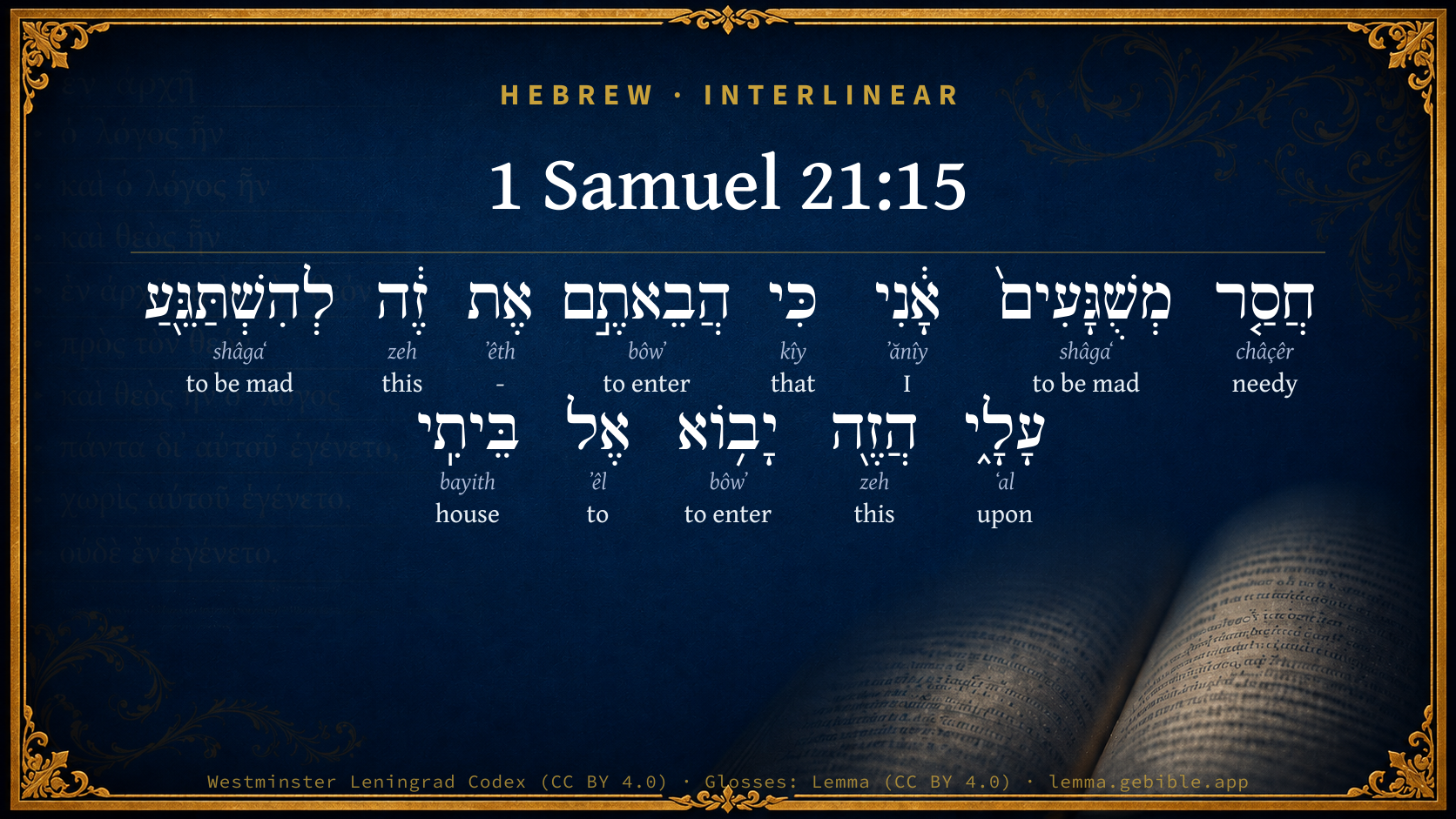
Hebrew (Westminster Leningrad Codex) 1 Samuel 21:15 appears in the Hebrew Old Testament. The text above is from the Westminster Leningrad Codex. Each word links to its Strong’s number, a concise gloss, and parsing drawn from the Open Scriptures Hebrew Bible morphology. Click any word for its full Brown-Driver-Briggs (BDB) entry.
Download image
Cite this verse

1 Samuel 21:15 (World English Bible). Public Domain. Lemma interlinear Bible study tool, https://lemma.gebible.app/v/1-samuel/21/15.

Show BibTeX & RIS
BibTeX
RIS
English Translation
Do I lack madmen, that you have brought this fellow to play the madman in my presence? shall this fellow come into my house?
World English Bible · Public Domain
Highlights
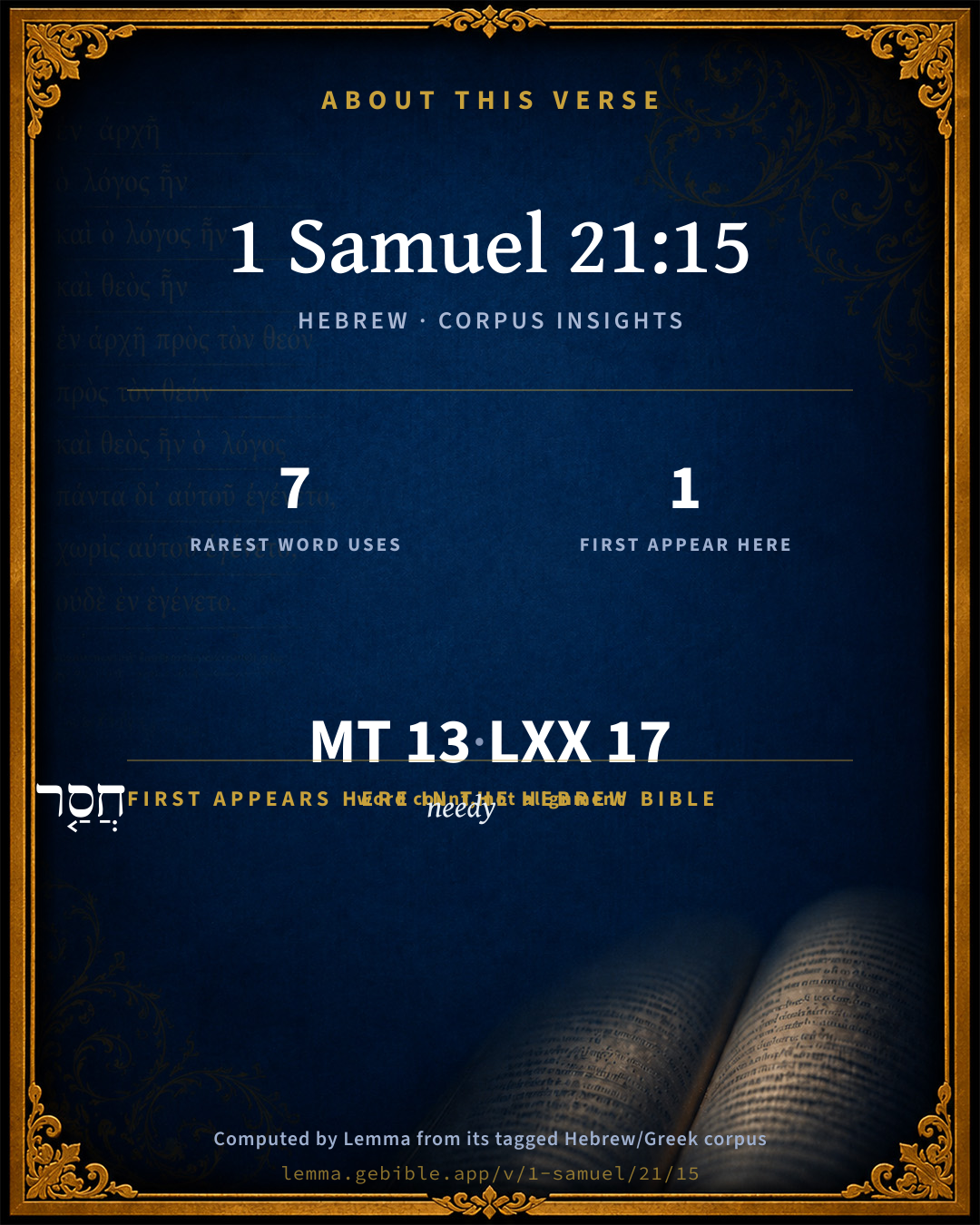
  • 1 first appearance in the Hebrew Bible
Full analysis ↓
Download a study sheet

One document with this verse’s original text, its word-by-word gloss line, the meaning frame, cross-references with their text, attributed commentary, and full source and license credits — printable, and it pastes into notes with its structure intact.

This verse Autodidact and up

Study sheet (.html) Plain text (.txt)

A passage Seminary Student

Up to 50 verses in one chapter. A passage sheet keeps up to 6 commentary sources and 12 cross-references per verse, in the order this page ranks them, and says so on the sheet whenever that leaves anything out. Ask for a single verse and you get the Autodidact verse sheet above.

Everything on this page stays free to read, with no account — the sheet is a download of what is already on screen, not access to it.

Want to remove ads? Support Godless Engineer
Compare translations 3

The same verse in 3 English versions, stacked beneath the original-language interlinear above. Click any original word for its lexicon entry.

Each is an independent rendering of the whole verse — the interlinear is not word-aligned to these translations.

Highlighted words mark where these versions differ — a whole-verse word diff, not a word-by-word alignment.

  • World English Bible Public Domain
    Do I lack madmen, that you have brought this fellow to play the madman in my presence? shall this fellow come into my house?
  • King James Version Public Domain
    Have I need of mad men, that ye have brought this fellow to play the mad man in my presence? shall this fellow come into my house?
  • unfoldingWord Literal Text CC BY-SA 4.0
    Am I lacking ravers, that you have brought this to rave near me? Should this enter into my house?”

unfoldingWord Literal Text — © unfoldingWord, licensed CC BY-SA 4.0. Word-aligned USFM3 via Door43 (git.door43.org/unfoldingWord/en_ult).

Versions to compare (up to 4)

3 of 4 selected

Show all 18 translations

Every available English version of this verse, each an independent rendering of the whole verse.

  • World English Bible Public Domain
    Do I lack madmen, that you have brought this fellow to play the madman in my presence? shall this fellow come into my house?
  • Berean Standard Bible Public Domain
    Am I in need of madmen, that you have brought this man to rave in my presence? Must this man come into my house?”
  • Majority Standard Bible Public Domain
    Am I in need of madmen, that you have brought this man to rave in my presence? Must this man come into my house?”
  • King James Version Public Domain
    Have I need of mad men, that ye have brought this fellow to play the mad man in my presence? shall this fellow come into my house?
  • American Standard Version (1901) Public Domain
    Do I lack madmen, that ye have brought this fellow to play the madman in my presence? shall this fellow come into my house?
  • Revised Version (1885) Public Domain
    Do I lack mad men, that ye have brought this fellow to play the mad man in my presence? shall this fellow come into my house?
  • Geneva Bible (1599) Public Domain
    Haue I neede of mad men, that ye haue brought this fellowe to play the mad man in my presence? shall he come into mine house?
  • Douay-Rheims (1899) Public Domain
    Have we need of madmen, that you have brought in this fellow, to play the madman in my presence? shall this fellow come into my house?
  • Young's Literal Translation Public Domain
    A lack of madmen `have' I, that ye have brought in this one to act as a madman by me! doth this one come in unto my house?'
  • Literal Standard Version CC BY-SA 4.0
    Am I lacking madmen, that you have brought in this one to act as a madman before me? Does this one come into my house?”
  • Unlocked Literal Bible CC BY-SA 4.0
    Do I lack madmen, so that you have brought this fellow to behave like one in my presence? Will this fellow really come into my house?”
  • unfoldingWord Literal Text CC BY-SA 4.0
    Am I lacking ravers, that you have brought this to rave near me? Should this enter into my house?”
  • Darby Bible Public Domain
    have I lack of madmen, that ye have brought this one to rave in my presence? shall this [man] come into my house?
  • World Messianic Bible Public Domain
    Do I lack madmen, that you have brought this fellow to play the madman in my presence? Should this fellow come into my house?”
  • Webster's Bible Public Domain
    Have I need of mad-men, that ye have brought this man to play the mad-man in my presence? shall this man come into my house?
  • Free Bible Version CC BY-SA 4.0
    Is it because I need more mad people that you've brought this man to go crazy right in front of me? Do you think I'm going to let him come into my house?”
  • Bible in Basic English Public Domain
    Are there not enough unbalanced men about me, that you have let this person come and do such tricks before me? is such a man to come into my house?
  • JPS Tanakh (1917) Public Domain
    (21-16) Do I lack madmen, that ye have brought this fellow to play the madman in my presence? shall this fellow come into my house?'

Literal Standard Version (2020), Covenant Press — licensed CC BY-SA 4.0. Text via the HelloAO Bible API (eBible.org). Unlocked Literal Bible (unfoldingWord) — licensed CC BY-SA 4.0. Text via the HelloAO Bible API (eBible.org). unfoldingWord Literal Text — © unfoldingWord, licensed CC BY-SA 4.0. Word-aligned USFM3 via Door43 (git.door43.org/unfoldingWord/en_ult). Free Bible Version, Dr. Jonathan Gallagher — licensed CC BY-SA 4.0. Text via the HelloAO Bible API (eBible.org).

Word by word

More ways to search: Search by grammar → Find every occurrence → Compare this word →

Practice this passage: Drill this verse → Learn its vocabulary →

מְשֻׁגָּעִים֙
shâgaʻ
H7696
“mad”
Verb, Pual, Participle Passive, Masculine, Plural, Absolute
Part of Speech
Verb
Stem
Pual
Form
Participle Passive
Gender
Masculine
Number
Plural
State
Absolute
Full BDB Definition

Origin: a primitive root

TWOT: 2328

to be mad - (Pual) - to be mad - to be maddened (participle) - (Hithpael) to show madness
  1. חֲסַ֤ר châçêr H2638 “needy of” Adjective, Adjective, Masculine, Singular, Construct
  2. אָ֔נִי ʼănîy H589 “I” Pronoun, Personal, 1st Person, Common, Singular
  3. כִּי kîy H3588 “that” Conjunction
  4. הֲבֵאתֶ֣ם bôwʼ H935 “to enter” Verb, Hiphil, Perfect, 2nd Person, Masculine, Plural
  5. אֶת ʼêth H853 “-” Particle, Direct Object
  6. זֶ֔ה zeh H2088 “this” Pronoun, Demonstrative, Masculine, Singular
  7. לְהִשְׁתַּגֵּ֖עַ shâgaʻ H7696 “to be mad” Preposition + Verb, Hithpael, Infinitive Construct
  8. עָלָ֑י ʻal H5921 “upon · me” Preposition + Suffix, Personal, 1st Person, Common, Singular
  9. הֲזֶ֖ה zeh H2088 “this” Particle, Interrogative + Pronoun, Demonstrative, Masculine, Singular
  10. יָב֥וֹא bôwʼ H935 “to enter” Verb, Qal, Imperfect, 3rd Person, Masculine, Singular
  11. אֶל ʼêl H413 “to” Preposition
  12. בֵּיתִֽי bayith H1004 “house · my” Noun, Common, Masculine, Singular, Construct + Suffix, Personal, 1st Person, Common, Singular

About this verse

These counts appear in no published source. They are computed here, from the morphology-tagged text and Lemma’s own curated glosses. What Lemma adds →

13
words
10
distinct lemmas
Historical
section

Notable vocabulary

The rarest word here is מְשֻׁגָּעִים֙ to be mad H7696 — appearing just 7 times in the whole Hebrew Bible.

First appearance in Scripture

This word makes its first canonical appearance in the Hebrew Bible here:

  • חֲסַ֤ר needy H2638

Shared distinctive vocabulary

מְשֻׁגָּעִים֙ to be mad H7696 occurs in 6 verses of the Hebrew Bible. Also found in:

Grammatical profile

  • 4 verbs
  • 1 noun
  • 1 adjective
  • 3 pronouns
  • 2 prepositions
  • 1 conjunction
  • 1 particle

Verb forms

  • מְשֻׁגָּעִים֙ Pual · Participle Passive
  • הֲבֵאתֶ֣ם Hiphil · Perfect
  • לְהִשְׁתַּגֵּ֖עַ Hithpael · Infinitive Construct
  • יָב֥וֹא Qal · Imperfect

Repetition

Words recur within this verse — often emphatic in Hebrew:

  • מְשֻׁגָּעִים֙ to be mad H7696 ×2
  • הֲבֵאתֶ֣ם to enter H935 ×2
  • זֶ֔ה this H2088 ×2

Hebrew & Septuagint length

In English translation the verse runs 24 words from the Hebrew and 25 from the Septuagint (LXX English) — closely comparable.

A rough comparison of the two English renderings, which tokenize alike — not a word-level alignment.

Word counts can differ between the Hebrew and the Greek without any difference in meaning — e.g. the Hebrew direct-object marker אֵת has no separate Greek word, and Greek often adds the article ὁ.

In the original languages it is 13 Hebrew tokens and 17 Greek tokens — but the two are counted differently (Hebrew bundles its prefixes and suffixes into one token; the Greek is in lemma form), so that isn’t a like-for-like length.

Hebrew and Greek witnesses Masoretic Hebrew ↔ Greek Septuagint

The same verse in the two great witnesses to the Old Testament, shown verse-for-verse.

These are two independent witnesses, not word-aligned to each other, and the Septuagint is shown in lemma (dictionary) form.

Hebrew 1 Samuel 21:15 Masoretic · Westminster Leningrad Codex

חֲסַ֤ר מְשֻׁגָּעִים֙ אָ֔נִי כִּי הֲבֵאתֶ֣ם אֶת זֶ֔ה לְהִשְׁתַּגֵּ֖עַ עָלָ֑י הֲזֶ֖ה יָב֥וֹא אֶל בֵּיתִֽי

Do I lack madmen, that you have brought this fellow to play the madman in my presence? shall this fellow come into my house?

World English Bible · Public Domain

Greek LXX 1 Samuel 21:15 Septuagint · lemma form

καί εἶπον αγχους πρός ὁ παῖς αὐτός ἰδού ὁράω ἀνήρ ἐπίληπτος ἵνα τίς εἰςἄγω αὐτός πρός ἐγώ

Am I in lack of madmen, that you⌃ have brought him in to me to play the madman? He shall not come into the house.

LXX2012 (modern English Septuagint) · Public Domain

Hebrew: Westminster Leningrad Codex (CC BY 4.0). Greek: Septuagint (public domain); English from LXX2012 (modern English Septuagint) (Public Domain). How the Septuagint differs from the Hebrew →

Targum (Aramaic paraphrase)

1

The Targum is the ancient Jewish Aramaic paraphrase of the Hebrew Scriptures — an interpretive translation, not the Hebrew text itself. Onkelos (literal) and Pseudo-Jonathan (expansive) render the Torah, and Jonathan the Prophets. Coverage is partial: where no permissively-licensed English translation exists for a verse, only the Aramaic is shown. This is verse-level text, not a word-by-word alignment to the Hebrew.

  1. Targum Jonathan Prophets (Joshua–Malachi)
    וַאֲמַר אָכִישׁ לְעַבְדוֹהִי הָא כַד חֲזֵיתוּן דִגְבַר שָׁטֵי הוּא לְמָא אַיְתֵיתוּן יָתֵיהּ לְוָתִי:

    (no public-domain English translation for this verse)

    Targum Jonathan — Aramaic: “Mikraot Gedolot” (public domain). English: “Sefaria Community Translation” (CC0 1.0 (public-domain dedication)); “London "Chaldee Paraphrase," 1871” (public domain). Text via Sefaria.

Commentary

Notes on 1 Samuel 21:15 from classic Christian and Jewish commentators (each source and its license shown beneath its notes). The classic Christian expositions comment on the surrounding passage and are grouped to its opening verse, so a note may address several verses; the Jewish commentaries on the Tanakh (Rashi and others) are per-verse, so they appear only where the commentator wrote on this verse.

Lemma curates 59 commentaries, every one of them public domain or Creative Commons licensed, each selected and text-cleaned for this edition rather than reprinted as found. About our sources →

Trapp's Complete Commentary

John Trapp

1Sa 21:15 Have I need of mad men, that ye have brought this [fellow] to play the mad man in my presence? shall this [fellow] come into my house?

Ver. 15. Have I need of mad men?] The Rabbis say that Achish’s wife and daughter were mad: and therefore was he so loath to be further troubled with any such creatures.

John Trapp, A Commentary or Exposition upon All the Books of the Old and New Testament (1647–1656) — public domain. Text from a community e-Sword module.

Joseph Benson's Commentary

1Sa 21:15. Have I need of madmen? — It is highly probable that Achish was aware this madness was counterfeit. But, being desirous to preserve David, he spoke as if he thought it real.

Joseph Benson's Commentary on the Old and New Testaments (1811–1818) — public domain. Text from a community e-Sword module.

Geneva Bible (1599)

Geneva Bible translators

Is he meet to be in a king’s house?

Geneva Bible (1599) marginal notes — public domain. Text via Bolls.life.

Adam Clarke's Commentary

Verse 15. Shall this fellow come into my house?] I will not take into my service a man who is liable to so grievous a disease. Chandler, who vindicates David's feigning himself, mad, concludes thus: "To deceive the deceiver is in many instances meritorious, in none criminal. And what so likely to deceive as the very reverse of that character which they had so misconstrued? He was undone as a wise man, he had a chance to escape as a madman; he tried, and the experiment succeeded." I confess I can neither feel the force nor the morality of this. Deceit and hypocrisy can never be pleasing in the sight of God.

Adam Clarke's Commentary on the Bible (1810–1826) — public domain. Text from a community e-Sword/MySword module.

The Cambridge Bible for Schools and Colleges

gen. ed. J. J. S. Perowne

15. come into my house] Be taken into my service. Cp. Psa_101:7.

The Cambridge Bible for Schools and Colleges (gen. ed. J. J. S. Perowne; Cambridge University Press, 1878–1918) — public domain. Text from a community e-Sword module.

John Gill's Exposition

Have I need of madmen?.... Or fools, do I want them? have not I enough of them already at my court? I want wise men, and not fools and madmen. The Jews say (w) that the wife and daughter of Achish were mad; that while David was playing the fool and madman without, they were acting the same part within; so that Achish had enough of that sort of diversion, if it was to be reckoned such; as it was according to the taste of some persons, who used, as in later so in earlier times, to keep fools in their houses to make them sport; but Achish had enough of that, and too much, at least needed no more:

that ye have brought this fellow to play the madman in my presence? or act the part of a fool before me:

shall this fellow come into mine house? court or palace, and have a post there; you need be in no pain about it; he is neither agreeable to me, nor fit for any; and therefore Achish drove him away as a fool or madman, instead of imprisoning him as an enemy, or taking away his life; see the title of the thirty fourth psalm, Psa 34:1.

(w) Midrash Tillim apud Abarbinel. in loc.

Next: 1 Samuel Chapter 22

John Gill's Exposition of the Whole Bible (1746–1763) — public domain (CC PDM 1.0). Text via the HelloAO Bible API.

Haydock's Catholic Bible Commentary

House. David had not rushed into the palace of his own accord, but wished to remain concealed. Some of the people however knew him, and would have him to enlist as one of the soldiers of Achis; (Menochius) or even designed to get him put to death, which made him have recourse to this expedient. Some of the saints have imitated him, to avoid worldly honours and dignities of the Church. (Haydock) --- Thus the conduct of Jesus Christ himself, was accounted foolishness by worldlings, Mark iii. 21., Luke xxiii. 11., and 1 Corinthians i. 23. (Ven. Bede) (Worthington)

George Leo Haydock (1774–1849), Haydock's Catholic Family Bible and Commentary, 1859 edition — public domain. Excludes Psalms (Douay-Rheims chapter numbering differs from Protestant) and Deuterocanonical books (Catholic canon only).

Matthew Poole's English Annotations

I need wise men, not such fools or madmen as this is. I will not have my court disgraced with entertaining such fellows.

Matthew Poole's English Annotations on the Holy Bible (1683–1685) — public domain. Text from a community e-Sword/MySword module.

John Wesley's Explanatory Notes

Mad men - It is highly probable, Achish was aware, that this madness was counterfeit. But being desirous to preserve David, he speaks as if he thought it real.

John Wesley, Explanatory Notes Upon the Whole Bible (1754–1765) — public domain. Text via the GEBible commentary corpus.

Lesson kit

Teaching starters — assembled from the data on this page, not authored interpretation. Every prompt links to the verse data it draws on. Edit before teaching.

1 Samuel, in the Historical, opens this verse with 13 words (10 distinct Hebrew lemmas). Its most distinctive word is shâgaʻ (“to be mad”). A historical commentator’s framing appears above. Read the whole chapter for the surrounding context.

Discussion questions

  1. How does “to be mad” (shâgaʻ) shape what this verse is saying?
  2. This is the first place “needy” appears in Scripture (first appears here). What does its debut here establish?
  3. How does Deuteronomy 28:34, which shares the word «to be mad», read alongside this verse?
  4. What does the repetition of “to be mad” (2× in this one verse) do in this verse?
  5. These translations render this verse differently. What is at stake in choosing one wording over another?
  6. «מְשֻׁגָּעִים֙» is a Pual Participle Passive verb. How does that grammatical form shape the action described?
  7. Compare how Trapp's Complete Commentary and Joseph Benson's Commentary read this verse. Where do they agree or differ?

Things to notice

Reading settings

Reading text

Shown beneath each verse's original-language words.

Old Testament
Old Testament edition

Read the OT as the Masoretic Hebrew (MT) or the Greek Septuagint (LXX).

English shown for the Greek Septuagint (in the Hebrew ↔ Greek comparison).

Comparing translations? Open the Compare panel on any verse page to stack up to four side by side.