
Leviticus 20:7

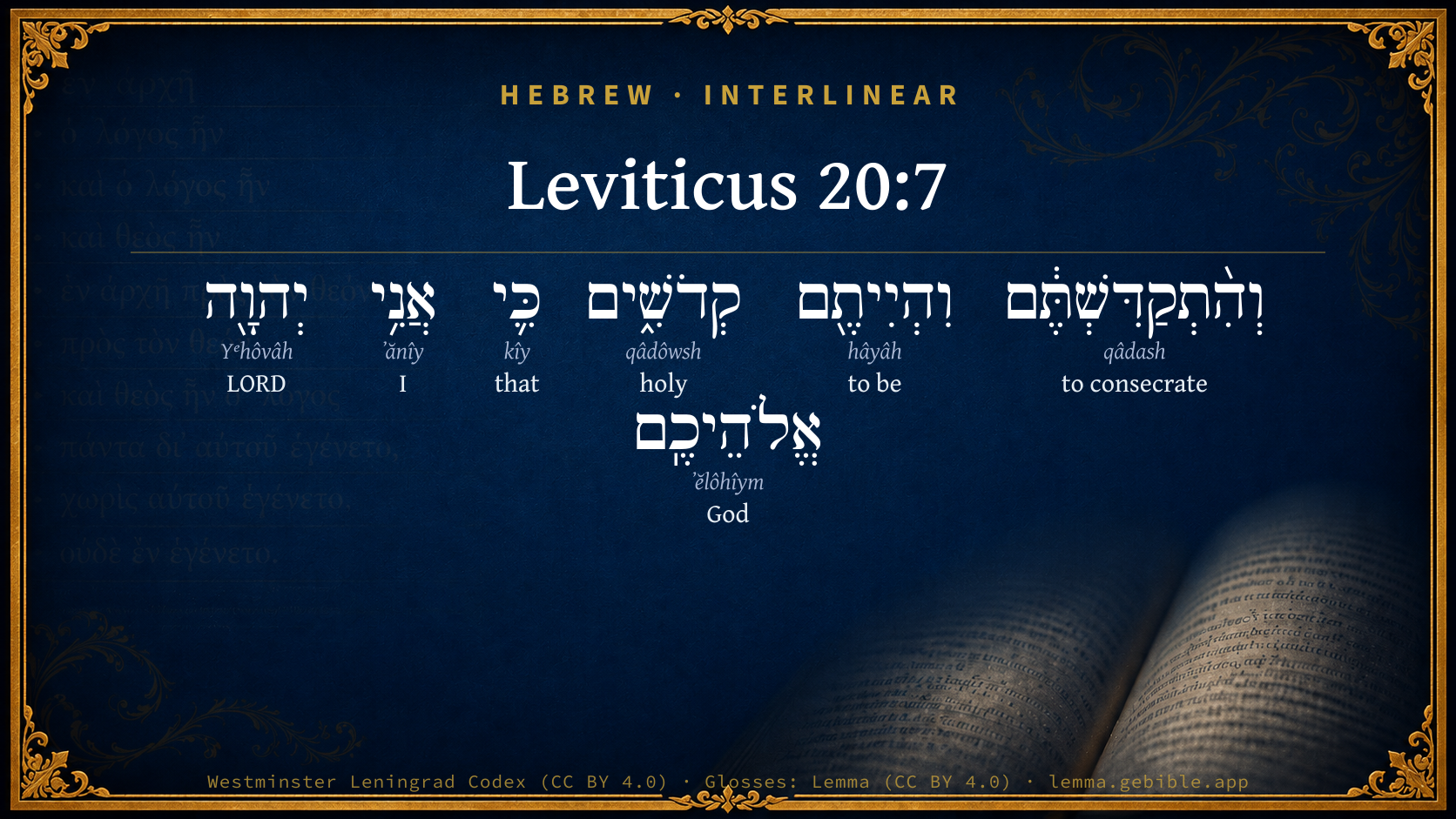
Hebrew (Westminster Leningrad Codex) Leviticus 20:7 appears in the Hebrew Old Testament. The text above is from the Westminster Leningrad Codex. Each word links to its Strong’s number, a concise gloss, and parsing drawn from the Open Scriptures Hebrew Bible morphology. Click any word for its full Brown-Driver-Briggs (BDB) entry.
Download image
Cite this verse

Leviticus 20:7 (World English Bible). Public Domain. Lemma interlinear Bible study tool, https://lemma.gebible.app/v/leviticus/20/7.

Show BibTeX & RIS
BibTeX
RIS
English Translation
"'Sanctify yourselves therefore, and be holy; for I am Yahweh your God.
World English Bible · Public Domain
Download a study sheet

One document with this verse’s original text, its word-by-word gloss line, the meaning frame, cross-references with their text, attributed commentary, and full source and license credits — printable, and it pastes into notes with its structure intact.

This verse Autodidact and up

Study sheet (.html) Plain text (.txt)

A passage Seminary Student

Up to 50 verses in one chapter. A passage sheet keeps up to 6 commentary sources and 12 cross-references per verse, in the order this page ranks them, and says so on the sheet whenever that leaves anything out. Ask for a single verse and you get the Autodidact verse sheet above.

Everything on this page stays free to read, with no account — the sheet is a download of what is already on screen, not access to it.

Want to remove ads? Support Godless Engineer
Compare translations 3

The same verse in 3 English versions, stacked beneath the original-language interlinear above. Click any original word for its lexicon entry.

Each is an independent rendering of the whole verse — the interlinear is not word-aligned to these translations.

Highlighted words mark where these versions differ — a whole-verse word diff, not a word-by-word alignment.

  • World English Bible Public Domain
    "'Sanctify yourselves therefore, and be holy; for I am Yahweh your God.
  • King James Version Public Domain
    Sanctify yourselves therefore, and be ye holy: for I am the LORD your God.
  • unfoldingWord Literal Text CC BY-SA 4.0
    So you shall make yourselves holy and you shall be holy, because I Yahweh your God.

unfoldingWord Literal Text — © unfoldingWord, licensed CC BY-SA 4.0. Word-aligned USFM3 via Door43 (git.door43.org/unfoldingWord/en_ult).

Versions to compare (up to 4)

3 of 4 selected

Show all 18 translations

Every available English version of this verse, each an independent rendering of the whole verse.

  • World English Bible Public Domain
    "'Sanctify yourselves therefore, and be holy; for I am Yahweh your God.
  • Berean Standard Bible Public Domain
    Consecrate yourselves, therefore, and be holy, because I am the LORD your God.
  • Majority Standard Bible Public Domain
    Consecrate yourselves, therefore, and be holy, because I am the LORD your God.
  • King James Version Public Domain
    Sanctify yourselves therefore, and be ye holy: for I am the LORD your God.
  • American Standard Version (1901) Public Domain
    Sanctify yourselves therefore, and be ye holy; for I am Jehovah your God.
  • Revised Version (1885) Public Domain
    Sanctify yourselves therefore, and be ye holy: for I am the LORD your God.
  • Geneva Bible (1599) Public Domain
    Sanctifie your selues therefore, and be holie, for I am the Lord your God.
  • Douay-Rheims (1899) Public Domain
    Sanctify yourselves, and be ye holy because I am the Lord your God.
  • Young's Literal Translation Public Domain
    `And ye have sanctified yourselves, and ye have been holy, for I `am' Jehovah your God;
  • Literal Standard Version CC BY-SA 4.0
    And you have sanctified yourselves, and you have been holy, for I [am] your God YHWH;
  • Unlocked Literal Bible CC BY-SA 4.0
    Therefore consecrate yourselves and be holy, because I am Yahweh your God.
  • unfoldingWord Literal Text CC BY-SA 4.0
    So you shall make yourselves holy and you shall be holy, because I Yahweh your God.
  • Darby Bible Public Domain
    Hallow yourselves therefore, and be holy; for I am Jehovah your God.
  • World Messianic Bible Public Domain
    “‘Sanctify yourselves therefore, and be holy; for I am the LORD your God.
  • Webster's Bible Public Domain
    Sanctify yourselves therefore and be ye holy: for I am the LORD your God.
  • Free Bible Version CC BY-SA 4.0
    So dedicate yourselves and be holy, because I am the Lord your God.
  • Bible in Basic English Public Domain
    So make and keep yourselves holy, for I am the Lord your God.
  • JPS Tanakh (1917) Public Domain
    Sanctify yourselves therefore, and be ye holy; for I am the LORD your God.

Literal Standard Version (2020), Covenant Press — licensed CC BY-SA 4.0. Text via the HelloAO Bible API (eBible.org). Unlocked Literal Bible (unfoldingWord) — licensed CC BY-SA 4.0. Text via the HelloAO Bible API (eBible.org). unfoldingWord Literal Text — © unfoldingWord, licensed CC BY-SA 4.0. Word-aligned USFM3 via Door43 (git.door43.org/unfoldingWord/en_ult). Free Bible Version, Dr. Jonathan Gallagher — licensed CC BY-SA 4.0. Text via the HelloAO Bible API (eBible.org).

Word by word

More ways to search: Search by grammar → Find every occurrence → Compare this word →

Practice this passage: Drill this verse → Learn its vocabulary →

About this verse

These counts appear in no published source. They are computed here, from the morphology-tagged text and Lemma’s own curated glosses. What Lemma adds →

7
words
7
distinct lemmas
Pentateuch
section

Grammatical profile

  • 2 verbs
  • 2 nouns
  • 1 adjective
  • 1 pronoun
  • 1 conjunction

Verb forms

  • וְהִ֨תְקַדִּשְׁתֶּ֔ם Hithpael · Sequential Perfect
  • וִהְיִיתֶ֖ם Qal · Sequential Perfect

Hebrew & Septuagint length

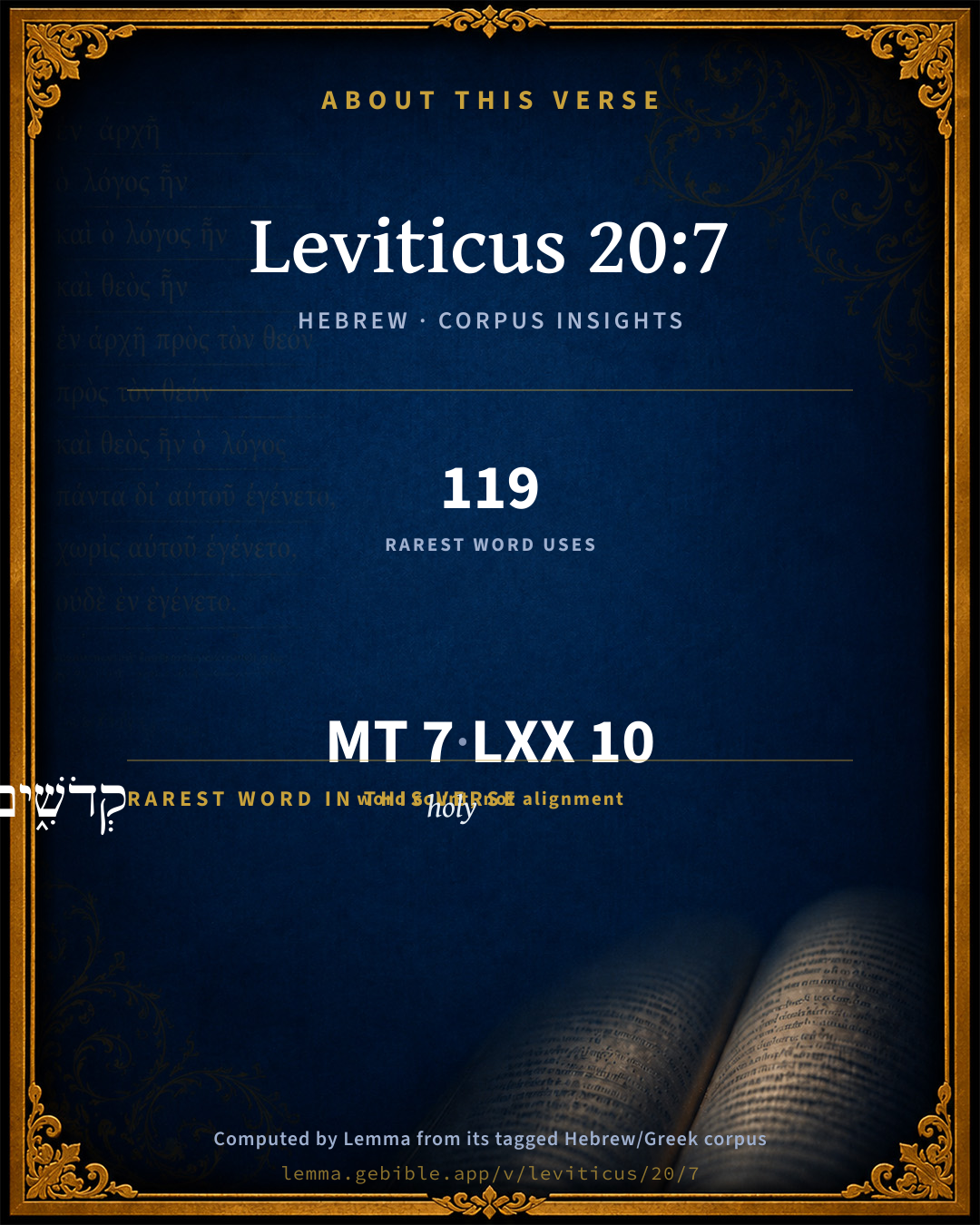
In English translation the verse runs 12 words from the Hebrew and 13 from the Septuagint (LXX English) — closely comparable.

A rough comparison of the two English renderings, which tokenize alike — not a word-level alignment.

Word counts can differ between the Hebrew and the Greek without any difference in meaning — e.g. the Hebrew direct-object marker אֵת has no separate Greek word, and Greek often adds the article ὁ.

In the original languages it is 7 Hebrew tokens and 10 Greek tokens — but the two are counted differently (Hebrew bundles its prefixes and suffixes into one token; the Greek is in lemma form), so that isn’t a like-for-like length.

Cross-references

9

Topical passages linked to Leviticus 20:7 in the Treasury of Scripture Knowledge — connected by theme and wording, ordered by reader-vote popularity; previews shown in the World English Bible.

  • Leviticus 11:44 For I am Yahweh your God. Sanctify yourselves therefore, and be holy; for I am holy: neither shall you defile yourselves with any kind of creeping thing that moves on the earth.
  • Leviticus 19:2 "Speak to all the congregation of the children of Israel, and tell them, 'You shall be holy; for I Yahweh your God am holy.
  • 1 Peter 1:15–16 but just as he who called you is holy, you yourselves also be holy in all of your behavior;
  • Ephesians 1:4 even as he chose us in him before the foundation of the world, that we would be holy and without blemish before him in love;
  • Colossians 3:12 Put on therefore, as God's chosen ones, holy and beloved, a heart of compassion, kindness, lowliness, humility, and perseverance;
  • 1 Thessalonians 4:7 For God called us not for uncleanness, but in sanctification.
  • 1 Thessalonians 4:3 For this is the will of God: your sanctification, that you abstain from sexual immorality,
  • Hebrews 12:14 Follow after peace with all men, and the sanctification without which no man will see the Lord,
  • Philippians 2:12–13 So then, my beloved, even as you have always obeyed, not only in my presence, but now much more in my absence, work out your own salvation with fear and trembling.

Cross-references courtesy of OpenBible.info (CC BY 4.0).

Hebrew and Greek witnesses Masoretic Hebrew ↔ Greek Septuagint

The same verse in the two great witnesses to the Old Testament, shown verse-for-verse.

These are two independent witnesses, not word-aligned to each other, and the Septuagint is shown in lemma (dictionary) form.

Hebrew Leviticus 20:7 Masoretic · Westminster Leningrad Codex

וְהִ֨תְקַדִּשְׁתֶּ֔ם וִהְיִיתֶ֖ם קְדֹשִׁ֑ים כִּ֛י אֲנִ֥י יְהוָ֖ה אֱלֹהֵיכֶֽם

"'Sanctify yourselves therefore, and be holy; for I am Yahweh your God.

World English Bible · Public Domain

Greek LXX Leviticus 20:7 Septuagint · lemma form

καί εἰμί ἅγιος ὅτι ἅγιος ἐγώ κύριος ὁ θεός σύ

And you⌃ shall be holy, for I the Lord your God am holy.

LXX2012 (modern English Septuagint) · Public Domain

Hebrew: Westminster Leningrad Codex (CC BY 4.0). Greek: Septuagint (public domain); English from LXX2012 (modern English Septuagint) (Public Domain). How the Septuagint differs from the Hebrew →

Targum (Aramaic paraphrase)

2

The Targum is the ancient Jewish Aramaic paraphrase of the Hebrew Scriptures — an interpretive translation, not the Hebrew text itself. Onkelos (literal) and Pseudo-Jonathan (expansive) render the Torah, and Jonathan the Prophets. Coverage is partial: where no permissively-licensed English translation exists for a verse, only the Aramaic is shown. This is verse-level text, not a word-by-word alignment to the Hebrew.

  1. Targum Onkelos Torah (Genesis–Deuteronomy)
    וְתִתְקַדְשׁוּן וּתְהוֹן קַדִישִׁין אֲרֵי אֲנָא יְיָ אֱלָהָכוֹן

    (no public-domain English translation for this verse)

    Targum Onkelos — Aramaic: “Onkelos Genesis” (public domain); “Onkelos Exodus” (public domain); “Onkelos Leviticus” (public domain); “Onkelos Numbers” (public domain); “Onkelos Deuteronomy” (public domain). English: “Sefaria Community Translation” (CC0 1.0 (public-domain dedication)); “J.W. Etheridge. The Targums of Onkelos and Jonathan Ben Uzziel on the Pentateuch. London: Longmans, Green, 1862” (public domain). Text via Sefaria.

  2. Targum Pseudo-Jonathan Torah (Genesis–Deuteronomy)
    וְתִתְקַדְשׁוּן וּתְהוֹן קַדִישִׁין בְּגוּפֵיכוֹן מְטוֹל דַאֲקַבֵּל בְּרַעֲוָא צְלוֹתְכוֹן אֲנָא הוּא יְיָ מְקַדִשְׁכוֹן

    But sanctify yourselves, and be holy in your bodies, that your prayers may be received with acceptance: I am the Lord who sanctifies you.

    Targum Pseudo-Jonathan — Aramaic: “Targum Jonathan on Genesis” (public domain); “Targum Jonathan on Exodus” (public domain); “Targum Jonathan on Leviticus” (public domain); “Targum Jonathan on Numbers” (public domain); “Targum Jonathan on Deuteronomy” (public domain). English: “The Targum of Jonathan ben Uzziel, trans. J. W. Etheridge, London, 1862” (public domain). Text via Sefaria.

Commentary

Notes on Leviticus 20:7 from classic Christian and Jewish commentators (each source and its license shown beneath its notes). The classic Christian expositions comment on the surrounding passage and are grouped to its opening verse, so a note may address several verses; the Jewish commentaries on the Tanakh (Rashi and others) are per-verse, so they appear only where the commentator wrote on this verse.

Lemma curates 59 commentaries, every one of them public domain or Creative Commons licensed, each selected and text-cleaned for this edition rather than reprinted as found. About our sources →

Trapp's Complete Commentary

John Trapp

Lev 20:7 Sanctify yourselves therefore, and be ye holy: for I [am] the LORD your God.

Ver. 7. For I am the Lord your God.] And God that is holy should be sanctified in righteousness. {Isa 5:16}

John Trapp, A Commentary or Exposition upon All the Books of the Old and New Testament (1647–1656) — public domain. Text from a community e-Sword module.

Jamieson, Fausset & Brown

Robert Jamieson, A. R. Fausset & David Brown

Sanctify yourselves therefore, and be ye holy--The minute specification of the incestuous and unnatural crimes here enumerated shows their sad prevalence amongst the idolatrous nations around, and the extreme proneness of the Israelites to follow the customs of their neighbors. It is to be understood, that, whenever mention is made that the offender was "to be put to death" without describing the mode, stoning is meant. The only instance of another form of capital punishment occurs in Lev 20:14, that of being burnt with fire; and yet it is probable that even here death was first inflicted by stoning, and the body of the criminal afterwards consumed by fire (Jos 7:15).

Jamieson, Fausset & Brown — Commentary Critical and Explanatory on the Whole Bible (1871) — public domain (CC PDM 1.0). Text via the HelloAO Bible API.

Ellicott's Commentary for English Readers

(7, 8) Sanctify yourselves therefore, and be ye holy.—Rather, Ye shall therefore sanctify yourselves, and ye shall be holy, as the same phrase is rendered in the Authorised Version in Lev_11:44. Though it is immaterial which of the two renderings is adopted, it is important that it should be the same in both passages, since the phrase is exactly the same in the original. It is only by keeping the Divine ordinances that the Israelites will attain to that state of holiness which will not only arm them to resist the abominable rites and idolatrous practices denounced in the foregoing verses, but which will enable them to reflect the holiness of their Lord.

A Bible Commentary for English Readers, edited by Charles John Ellicott (1878–1897) — public domain. Text from a community e-Sword module.

The Cambridge Bible for Schools and Colleges

gen. ed. J. J. S. Perowne

7. Almost verbally identical with Lev_11:44 a.

The Cambridge Bible for Schools and Colleges (gen. ed. J. J. S. Perowne; Cambridge University Press, 1878–1918) — public domain. Text from a community e-Sword module.

John Gill's Exposition

Sanctify yourselves therefore,.... By abstaining from such impious and idolatrous practices, and separating themselves from all that gave into them, as well as by observing the holy commandments of the Lord; otherwise internal sanctification is not the work of man, but of the Lord himself, as in Lev 20:8,

and be ye holy; or a separate people from all others in worship and conversation:

for I am the Lord your God; who is a holy God, and therefore it became them to be holy, in imitation of him, Lev 19:2.

John Gill's Exposition of the Whole Bible (1746–1763) — public domain (CC PDM 1.0). Text via the HelloAO Bible API.

Whedon's Commentary on the Bible

Daniel D. Whedon

7. Sanctify yourselves — An important part of sanctification, which lies within the gracious ability of men, is to refrain from acts of impurity. See

1Th_4:3. But until the soul is cleansed by the Sanctifier this abstinence will cost a struggle. This is the difference between a justified soul and one entirely sanctified. “The impress of consecration to a holy God is to be stamped on the life of the Israelites in ordinances extending to all important relations and conditions; in every important affair of life the Israelite has to accomplish something demanded by God.” — Oehler.

Daniel D. Whedon (gen. ed.), Commentary on the Old and New Testaments (1874–1909) — public domain. Text from a community e-Sword module.

The Pulpit Commentary

Vers. 7, 8. A positive command, Sanctify yourselves therefore, and he ye holy: for I am the Lord your God, is introduced early in the list of penalties to show what is the main purpose of the latter. The only way in which the nation can recover holiness lost by the sins of its members, is by the punishment of the latter, or by their purification by means of sacrifice, according to the nature of the offense.

Vers. 7, 8. Sanctity demand, inducement, promise.

Once "again" (verse 2) Moses utters the Divine will in this great matter of holiness. (see Lev_11:44 Lev_19:2) We have

I GOD"S IMPERATIVE DEMAND OF SANCTITY. "Sanctify yourselves." "Ye shall keep my statutes, and do them." The Creator of the universe, the Author of our being, the Father and Sustainer of our spirits, has sovereign right to speak to us in such decisive tones. He demands of us that we shall be "holy," i.e.,

(1) that we shall expel from heart and life all those sinful habits by which men have defiled themselves: thus shall we "be severed from other people" (verse 26), whose spirit and life are hateful; and

(2) that we shall approach him, honour him, and pay him the tribute he asks of us, and also act righteously and blamelessly toward our fellows, "keeping his statutes and doing them.

II THE HIGH INDUCEMENT HE PRESENTS TO US. "Be ye holy: for I am the Lord your God." We may gird ourselves to good and great things, animated by different motives; of these some may be higher, others lower. God summons us to be holy for the highest reason of all, viz. because we shall thus resemble him. "Be ye holy; for I am holy". (1Pe_1:16) Other reasons abound: holiness

(1) is the best thing in itself;

(2) saves us from many and great spiritual evils;

(3) delivers us from dark and awful penalties;

(4) allies us to the noblest created beings, etc.; but the best and loftiest of all considerations is that

(5) it makes us like God, the Holy One, himself. His spirit is our spirit; his principles, our principles; his life, our life. We are "the children of our Father who is in heaven.

III HIS PROMISED HELP. "I am the Lord which sanctify you." The action of God upon our souls has been treated, both by the foolish and by the wicked, as a reason for human impassiveness. Foolish men have said, "God is working for us and in us, therefore it would be irreverent for us to attempt to do anything; we should only interfere." Wicked men have said, "God works for us, therefore we may safely live in comfortable unconcern and guilt while we wait his time of deliverance." The "children of wisdom" have said, "God is ready to work with us, therefore let us strive with all our energies, for, with his help, we shall not strive in vain." This is the apostle"s argument: "Work out your own salvation,... for it is God which worketh in you," etc. (Php_2:12, 13) All our endeavours might be unavailing; we might contend against the strong current of sin and be baffled and borne along its stream, but if God himself is sanctifying us, we shall prevail. Let us go forth unto the struggle, for we shall assuredly succeed. God sanctifies us in such wise that he acts with us while he acts in us and for us. He sanctifies us by

(1) the truth of his Word: (Joh_17:17) this we are to consult; by

(2) the privileges of the sanctuary: (Eze_37:28) of these we are to avail ourselves; by

(3) his providential discipline: (Heb_12:10) to this we are to submit; by

(4) the indwelling of his Holy Spirit: (Rom_15:16) for this we are earnestly to pray and expectantly to wait. C.

The Pulpit Commentary (1880–1919), ed. H.D.M. Spence-Jones & Joseph S. Exell — public domain. Text from a community e-Sword module.

Keil & Delitzsch

C. F. Keil & F. Delitzsch

For the Israelites were to sanctify themselves, i.e., to keep themselves pure from all idolatrous abominations, to be holy because Jehovah was holy (Lev 11:44; Lev 19:2), and to keep the statutes of their God who sanctified them (Exo 31:13).

Keil & Delitzsch — Biblical Commentary on the Old Testament (1861–1891) — public domain (CC PDM 1.0). Text via the HelloAO Bible API. (Old Testament only.)

Rashi

Rabbi Shlomo Yitzchaki (Rashi)

והתקדשתם SANCTIFY YOURSELVES — This implies keeping aloof from all idolatry (Sifra, Kedoshim, Chapter 10 2).

Rashi on the Tanakh — English translations: “The Judaica Press complete Tanach with Rashi, translated by A. J. Rosenberg” (CC BY 4.0); “Pentateuch with Rashi's commentary by M. Rosenbaum and A.M. Silbermann, 1929-1934” (public domain); “The Metsudah Tanach series, Lakewood, N.J” (CC BY 4.0); and “The Book of Joshua, Metsudah Publications, 1997” (CC BY 4.0). Text via Sefaria.

Lesson kit

Teaching starters — assembled from the data on this page, not authored interpretation. Every prompt links to the verse data it draws on. Edit before teaching.

Leviticus, in the Pentateuch, opens this verse with 7 words (7 distinct Hebrew lemmas). Its most distinctive word is qâdôwsh (“holy”). A historical commentator’s framing appears above. Read the whole chapter for the surrounding context.

Discussion questions

  1. How does “holy” (qâdôwsh) shape what this verse is saying?
  2. How does Leviticus 11:44, which shares this passage’s theme, read alongside this verse?
  3. These translations render this verse differently. What is at stake in choosing one wording over another?
  4. «וְהִ֨תְקַדִּשְׁתֶּ֔ם» is a Hithpael Sequential Perfect verb. How does that grammatical form shape the action described?
  5. Compare how Trapp's Complete Commentary and Jamieson, Fausset & Brown read this verse. Where do they agree or differ?

Things to notice

Reading settings

Reading text

Shown beneath each verse's original-language words.

Old Testament
Old Testament edition

Read the OT as the Masoretic Hebrew (MT) or the Greek Septuagint (LXX).

English shown for the Greek Septuagint (in the Hebrew ↔ Greek comparison).

Comparing translations? Open the Compare panel on any verse page to stack up to four side by side.