
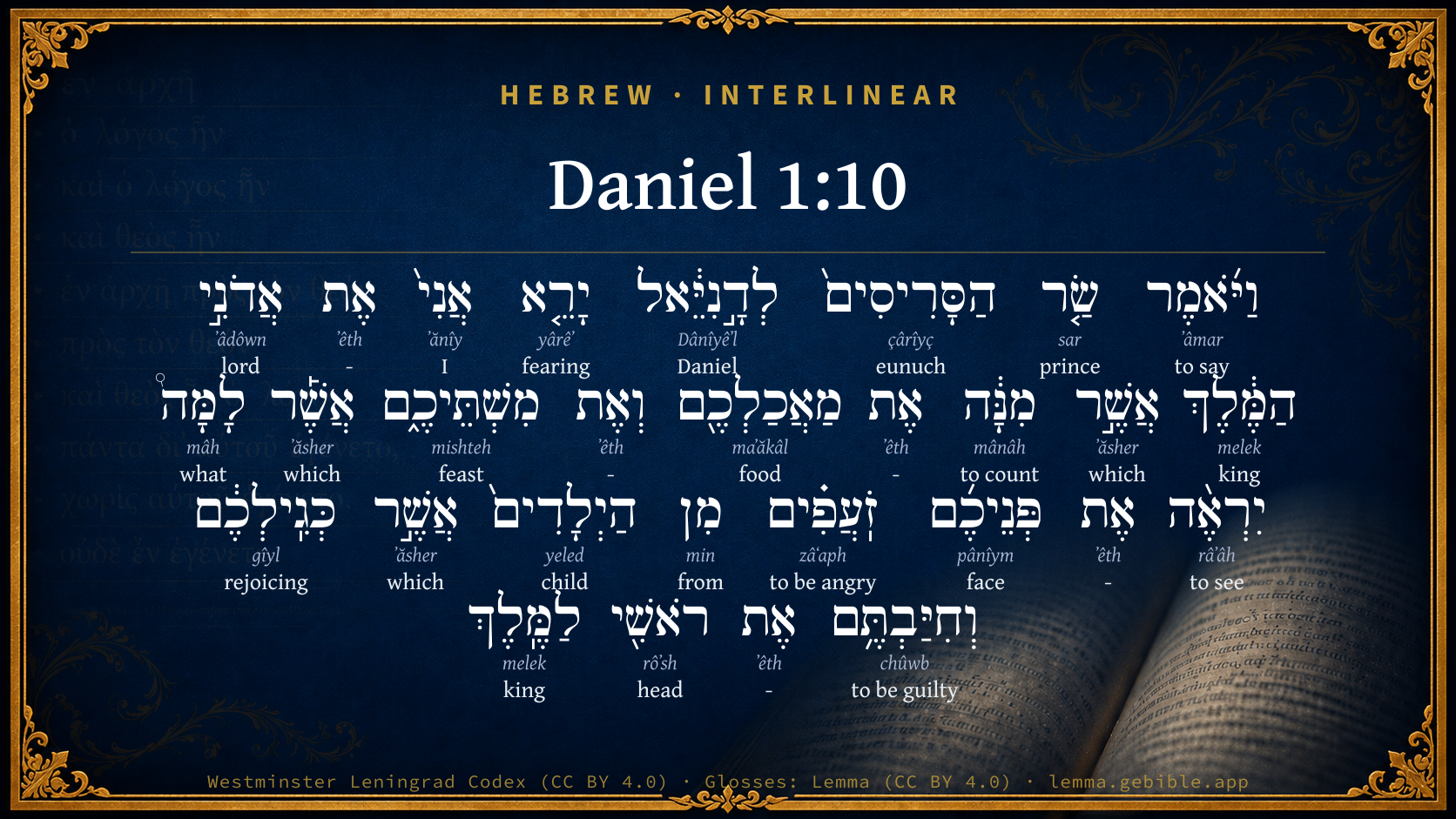
Daniel 1:10

Hebrew (Westminster Leningrad Codex) Daniel 1:10 appears in the Hebrew Old Testament. The text above is from the Westminster Leningrad Codex. Each word links to its Strong’s number, a concise gloss, and parsing drawn from the Open Scriptures Hebrew Bible morphology. Click any word for its full Brown-Driver-Briggs (BDB) entry.
Download image
Cite this verse

Daniel 1:10 (World English Bible). Public Domain. Lemma interlinear Bible study tool, https://lemma.gebible.app/v/daniel/1/10.

Show BibTeX & RIS
BibTeX
RIS
English Translation
The prince of the eunuchs said to Daniel, I fear my lord the king, who has appointed your food and your drink: for why should he see your faces worse looking than the youths who are of your own age? so would you endanger my head with the king.
World English Bible · Public Domain
Highlights
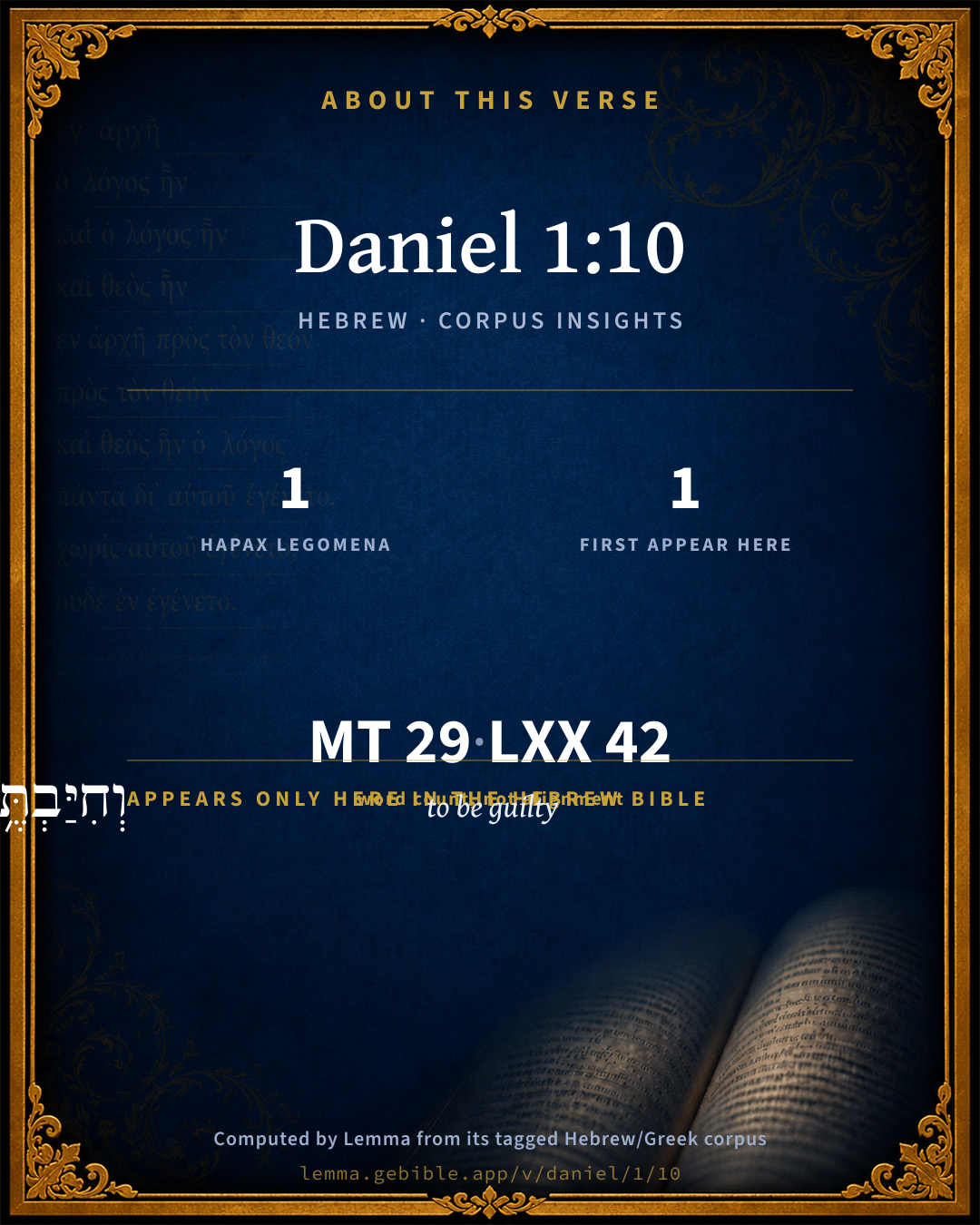
  • 1 hapax legomenon — only here in the Hebrew Bible
  • 1 first appearance in the Hebrew Bible
Full analysis ↓
Download a study sheet

One document with this verse’s original text, its word-by-word gloss line, the meaning frame, cross-references with their text, attributed commentary, and full source and license credits — printable, and it pastes into notes with its structure intact.

This verse Autodidact and up

Study sheet (.html) Plain text (.txt)

A passage Seminary Student

Up to 50 verses in one chapter. A passage sheet keeps up to 6 commentary sources and 12 cross-references per verse, in the order this page ranks them, and says so on the sheet whenever that leaves anything out. Ask for a single verse and you get the Autodidact verse sheet above.

Everything on this page stays free to read, with no account — the sheet is a download of what is already on screen, not access to it.

Want to remove ads? Support Godless Engineer
Compare translations 3

The same verse in 3 English versions, stacked beneath the original-language interlinear above. Click any original word for its lexicon entry.

Each is an independent rendering of the whole verse — the interlinear is not word-aligned to these translations.

Highlighted words mark where these versions differ — a whole-verse word diff, not a word-by-word alignment.

  • World English Bible Public Domain
    The prince of the eunuchs said to Daniel, I fear my lord the king, who has appointed your food and your drink: for why should he see your faces worse looking than the youths who are of your own age? so would you endanger my head with the king.
  • King James Version Public Domain
    And the prince of the eunuchs said unto Daniel, I fear my lord the king, who hath appointed your meat and your drink: for why should he see your faces worse liking than the children which are of your sort? then shall ye make me endanger my head to the king.
  • unfoldingWord Literal Text CC BY-SA 4.0
    The chief of the officials said to Daniel, “I am afraid of my lord the king, who has assigned your food and your drink; for why should he see your faces looking worse than the youths who are of your own age? Then you would endanger my head with the king.”

unfoldingWord Literal Text — © unfoldingWord, licensed CC BY-SA 4.0. Word-aligned USFM3 via Door43 (git.door43.org/unfoldingWord/en_ult).

Versions to compare (up to 4)

3 of 4 selected

Show all 18 translations

Every available English version of this verse, each an independent rendering of the whole verse.

  • World English Bible Public Domain
    The prince of the eunuchs said to Daniel, I fear my lord the king, who has appointed your food and your drink: for why should he see your faces worse looking than the youths who are of your own age? so would you endanger my head with the king.
  • Berean Standard Bible Public Domain
    but he said to Daniel, “I fear my lord the king, who has assigned your food and drink. For why should he see your faces looking thinner than those of the other young men your age? You would endanger my head before the king!”
  • Majority Standard Bible Public Domain
    but he said to Daniel, “I fear my lord the king, who has assigned your food and drink. For why should he see your faces looking thinner than those of the other young men your age? You would endanger my head before the king!”
  • King James Version Public Domain
    And the prince of the eunuchs said unto Daniel, I fear my lord the king, who hath appointed your meat and your drink: for why should he see your faces worse liking than the children which are of your sort? then shall ye make me endanger my head to the king.
  • American Standard Version (1901) Public Domain
    And the prince of the eunuchs said unto Daniel, I fear my lord the king, who hath appointed your food and your drink: for why should he see your faces worse looking than the youths that are of your own age? so would ye endanger my head with the king.
  • Revised Version (1885) Public Domain
    And the prince of the eunuchs said unto Darnel, I fear my lord the king, who hath appointed your meat and your drink: for why should he see your faces worse liking than the youths which are of your own age? so should ye endanger my head with the king.
  • Geneva Bible (1599) Public Domain
    And the chiefe of the Eunuches sayd vnto Daniel, I feare my lord the King, who hath appointed your meate and your drinke: therefore if he see your faces worse liking then the other children, which are of your sort, then shall you make me lose mine head vnto the King.
  • Douay-Rheims (1899) Public Domain
    And the prince of the eunuchs said to Daniel: I fear my lord the king, who hath appointed you meat and drink: who if he should see your faces leaner than those of the other youths your equals, you shall endanger my head to the king.
  • Young's Literal Translation Public Domain
    and the chief of the eunuchs saith to Daniel, `I am fearing my lord the king, who hath appointed your food and your drink, for why doth he see your faces sadder than `those of' the lads which `are' of your circle? then ye have made my head indebted to the king,'
  • Literal Standard Version CC BY-SA 4.0
    and the chief of the eunuchs says to Daniel, “I am fearing my lord the king, who has appointed your food and your drink, for why does he see your faces sadder than [those of] the boys which [are] of your circle? Then you have made my head indebted to the king,”
  • Unlocked Literal Bible CC BY-SA 4.0
    The chief official said to Daniel, “I am afraid of my master the king. He has commanded what food and drink you should have. Why should he see you looking worse than the other young men of your own age? The king might have my head because of you.”
  • unfoldingWord Literal Text CC BY-SA 4.0
    The chief of the officials said to Daniel, “I am afraid of my lord the king, who has assigned your food and your drink; for why should he see your faces looking worse than the youths who are of your own age? Then you would endanger my head with the king.”
  • Darby Bible Public Domain
    And the prince of the eunuchs said unto Daniel, I fear my lord the king who hath appointed your food and your drink; for why should he see your faces worse liking than the youths who are of your age? and ye would endanger my head with the king.
  • World Messianic Bible Public Domain
    The prince of the eunuchs said to Daniel, “I fear my lord the king, who has appointed your food and your drink. For why should he see your faces worse looking than the youths who are of your own age? Then you would endanger my head with the king.”
  • Webster's Bible Public Domain
    And the prince of the eunuchs said to Daniel, I fear my lord the king, who hath appointed your provision and your drink: for why should he see your faces more meager than the children who are of your sort? then will ye make me endanger my head to the king.
  • Free Bible Version CC BY-SA 4.0
    But the chief eunuch told Daniel, “I'm afraid of what my lord the king would do to me. He's the one who decided what you should eat and drink. What if he were to see you looking pale and sickly compared to the other young men of your age. Because of you the king would have my head!”
  • Bible in Basic English Public Domain
    And the captain of the unsexed servants said to Daniel, I am in fear of my lord the king, who has given orders about your food and your drink; what if he sees you looking less happy than the other young men of your generation? then you would have put my head in danger from the king.
  • JPS Tanakh (1917) Public Domain
    And the chief of the officers said unto Daniel: 'I fear my lord the king, who hath appointed your food and your drink; for why should he see your faces sad in comparison with the youths that are of your own age? so would ye endanger my head with the king.'

Literal Standard Version (2020), Covenant Press — licensed CC BY-SA 4.0. Text via the HelloAO Bible API (eBible.org). Unlocked Literal Bible (unfoldingWord) — licensed CC BY-SA 4.0. Text via the HelloAO Bible API (eBible.org). unfoldingWord Literal Text — © unfoldingWord, licensed CC BY-SA 4.0. Word-aligned USFM3 via Door43 (git.door43.org/unfoldingWord/en_ult). Free Bible Version, Dr. Jonathan Gallagher — licensed CC BY-SA 4.0. Text via the HelloAO Bible API (eBible.org).

Word by word

More ways to search: Search by grammar → Find every occurrence → Compare this word →

Practice this passage: Drill this verse → Learn its vocabulary →

וְחִיַּבְתֶּ֥ם
chûwb
H2325
“and · to be guilty”
Conjunction + Verb, Piel, Sequential Perfect, 2nd Person, Masculine, Plural
Part of Speech
Conjunction + Verb
Stem
Piel
Form
Sequential Perfect
Person
2nd Person
Gender
Masculine
Number
Plural
Full BDB Definition

Origin: a primitive root

TWOT: 614

to be guilty, make guilty - (Piel) to endanger
  1. וַיֹּ֜אמֶר ʼâmar H559 “and · to say” Conjunction + Verb, Qal, Sequential Imperfect, 3rd Person, Masculine, Singular
  2. שַׂ֤ר sar H8269 “prince of” Noun, Common, Masculine, Singular, Construct
  3. הַסָּרִיסִים֙ çârîyç H5631 “the · eunuchs” Particle, Definite Article + Noun, Common, Masculine, Plural, Absolute
  4. לְדָ֣נִיֵּ֔אל Dânîyêʼl H1840 “to/for · Daniel” Preposition + Noun, Proper
  5. יָרֵ֤א yârêʼ H3373 “fearing” Verb, Qal, Participle Active, Masculine, Singular, Absolute
  6. אֲנִי֙ ʼănîy H589 “I” Pronoun, Personal, 1st Person, Common, Singular
  7. אֶת ʼêth H853 “-” Particle, Direct Object
  8. אֲדֹנִ֣י ʼâdôwn H113 “lord · my” Noun, Common, Masculine, Singular, Construct + Suffix, Personal, 1st Person, Common, Singular
  9. הַמֶּ֔לֶךְ melek H4428 “the · king” Particle, Definite Article + Noun, Common, Masculine, Singular, Absolute
  10. אֲשֶׁ֣ר ʼăsher H834 “which” Particle, Relative
  11. מִנָּ֔ה mânâh H4487 “to count” Verb, Piel, Perfect, 3rd Person, Masculine, Singular
  12. אֶת ʼêth H853 “-” Particle, Direct Object
  13. מַאֲכַלְכֶ֖ם maʼăkâl H3978 “food · your” Noun, Common, Masculine, Singular, Construct + Suffix, Personal, 2nd Person, Masculine, Plural
  14. וְאֶת ʼêth H853 “and · -” Conjunction + Particle, Direct Object
  15. מִשְׁתֵּיכֶ֑ם mishteh H4960 “feast · your” Noun, Common, Masculine, Singular, Construct + Suffix, Personal, 2nd Person, Masculine, Plural
  16. אֲשֶׁ֡ר ʼăsher H834 “which” Particle, Relative
  17. לָמָּה֩ mâh H4100 “to/for · what” Preposition + Particle, Interrogative
  18. יִרְאֶ֨ה râʼâh H7200 “to see” Verb, Qal, Imperfect, 3rd Person, Masculine, Singular
  19. אֶת ʼêth H853 “-” Particle, Direct Object
  20. פְּנֵיכֶ֜ם pânîym H6440 “face(s) · your” Noun, Common, Both, Plural, Construct + Suffix, Personal, 2nd Person, Masculine, Plural
  21. זֹֽעֲפִ֗ים zâʻaph H2196 “being angry” Verb, Qal, Participle Active, Masculine, Plural, Absolute
  22. מִן min H4480 “from” Preposition
  23. הַיְלָדִים֙ yeled H3206 “the · children” Particle, Definite Article + Noun, Common, Masculine, Plural, Absolute
  24. אֲשֶׁ֣ר ʼăsher H834 “which” Particle, Relative
  25. כְּגִֽילְכֶ֔ם gîyl H1524 “like/as · rejoicing · your” Preposition + Noun, Common, Masculine, Singular, Construct + Suffix, Personal, 2nd Person, Masculine, Plural
  26. אֶת ʼêth H853 “-” Particle, Direct Object
  27. רֹאשִׁ֖י rôʼsh H7218 “head · my” Noun, Common, Masculine, Singular, Construct + Suffix, Personal, 1st Person, Common, Singular
  28. לַמֶּֽלֶךְ melek H4428 “to/for the · king” Preposition, Determined + Noun, Common, Masculine, Singular, Absolute

About this verse

These counts appear in no published source. They are computed here, from the morphology-tagged text and Lemma’s own curated glosses. What Lemma adds →

29
words
22
distinct lemmas
Prophets
section

Notable vocabulary

1 hapax legomenon — a word that appears only here in the entire Hebrew Bible:

  • וְחִיַּבְתֶּ֥ם to be guilty H2325

First appearance in Scripture

This word makes its first canonical appearance in the Hebrew Bible here:

  • וְחִיַּבְתֶּ֥ם to be guilty H2325

Shared distinctive vocabulary

זֹֽעֲפִ֗ים to be angry H2196 occurs in 4 verses of the Hebrew Bible. Also found in:

Grammatical profile

  • 6 verbs
  • 12 nouns
  • 1 pronoun
  • 1 preposition
  • 9 particles

Verb forms

  • וַיֹּ֜אמֶר Qal · Sequential Imperfect
  • יָרֵ֤א Qal · Participle Active
  • מִנָּ֔ה Piel · Perfect
  • יִרְאֶ֨ה Qal · Imperfect
  • זֹֽעֲפִ֗ים Qal · Participle Active
  • וְחִיַּבְתֶּ֥ם Piel · Sequential Perfect

Repetition

Words recur within this verse — often emphatic in Hebrew:

  • הַמֶּ֔לֶךְ king H4428 ×2
  • אֲשֶׁ֣ר which H834 ×3

Hebrew & Septuagint length

In English translation the verse runs 49 words from the Hebrew and 46 from the Septuagint (LXX English) — closely comparable.

A rough comparison of the two English renderings, which tokenize alike — not a word-level alignment.

Word counts can differ between the Hebrew and the Greek without any difference in meaning — e.g. the Hebrew direct-object marker אֵת has no separate Greek word, and Greek often adds the article ὁ.

In the original languages it is 29 Hebrew tokens and 42 Greek tokens — but the two are counted differently (Hebrew bundles its prefixes and suffixes into one token; the Greek is in lemma form), so that isn’t a like-for-like length.

Cross-references

3

Topical passages linked to Daniel 1:10 in the Treasury of Scripture Knowledge — connected by theme and wording, ordered by reader-vote popularity; previews shown in the World English Bible.

  • Matthew 6:16–18 "Moreover when you fast, don't be like the hypocrites, with sad faces. For they disfigure their faces, that they may be seen by men to be fasting. Most assuredly I tell you, they have received their reward.
  • Proverbs 29:25 The fear of man proves to be a snare, But whoever puts his trust in Yahweh is kept safe.
  • John 12:42–43 Nevertheless even of the rulers many believed in him, but because of the Pharisees they didn't confess it, so that they wouldn't be put out of the synagogue,

Cross-references courtesy of OpenBible.info (CC BY 4.0).

Hebrew and Greek witnesses Masoretic Hebrew ↔ Greek Septuagint

The same verse in the two great witnesses to the Old Testament, shown verse-for-verse.

These are two independent witnesses, not word-aligned to each other, and the Septuagint is shown in lemma (dictionary) form.

Hebrew Daniel 1:10 Masoretic · Westminster Leningrad Codex

וַיֹּ֜אמֶר שַׂ֤ר הַסָּרִיסִים֙ לְדָ֣נִיֵּ֔אל יָרֵ֤א אֲנִי֙ אֶת אֲדֹנִ֣י הַמֶּ֔לֶךְ אֲשֶׁ֣ר מִנָּ֔ה אֶת מַאֲכַלְכֶ֖ם וְאֶת מִשְׁתֵּיכֶ֑ם אֲשֶׁ֡ר לָמָּה֩ יִרְאֶ֨ה אֶת פְּנֵיכֶ֜ם זֹֽעֲפִ֗ים מִן הַיְלָדִים֙ אֲשֶׁ֣ר כְּגִֽילְכֶ֔ם וְחִיַּבְתֶּ֥ם אֶת רֹאשִׁ֖י לַמֶּֽלֶךְ

The prince of the eunuchs said to Daniel, I fear my lord the king, who has appointed your food and your drink: for why should he see your faces worse looking than the youths who are of your own age? so would you endanger my head with the king.

World English Bible · Public Domain

Greek LXX Daniel 1:10 Septuagint · lemma form

καί εἶπον ὁ ἀρχιευνοῦχος ὁ δανιηλ ἀγωνιάω ὁ κύριος ἐγώ ὁ βασιλεύς ὁ ἐκτάσσω ὁ βρῶσις σύ καί ὁ πόσις σύ ἵνα μή ὁράω ὁ πρόσωπον σύ διατρέπω καί ἀσθενής παρά ὁ συντρέφω σύ νεανίας ὁ ἀλλογενής καί κινδυνεύω ὁ ἴδιος τράχηλος

And the chief of the eunuchs said to Daniel, I fear my lord the king, who has appointed your meat and your drink, lest he see your countenances gloomy in comparison of the young men your equals; also shall you⌃ endanger my head to the king.

LXX2012 (modern English Septuagint) · Public Domain

On this verse, Joseph Benson's Commentary discusses the Septuagint’s reading. Read the note in Commentary ↓

Hebrew: Westminster Leningrad Codex (CC BY 4.0). Greek: Septuagint (public domain); English from LXX2012 (modern English Septuagint) (Public Domain). How the Septuagint differs from the Hebrew →

Commentary

Notes on Daniel 1:10 from classic Christian and Jewish commentators (each source and its license shown beneath its notes). The classic Christian expositions comment on the surrounding passage and are grouped to its opening verse, so a note may address several verses; the Jewish commentaries on the Tanakh (Rashi and others) are per-verse, so they appear only where the commentator wrote on this verse.

Lemma curates 59 commentaries, every one of them public domain or Creative Commons licensed, each selected and text-cleaned for this edition rather than reprinted as found. About our sources →

Trapp's Complete Commentary

John Trapp

Dan 1:10 And the prince of the eunuchs said unto Daniel, I fear my lord the king, who hath appointed your meat and your drink: for why should he see your faces worse liking than the children which [are] of your sort? then shall ye make [me] endanger my head to the king.

Ver. 10. I fear my lord the king.] This made him stand off as he did, in pretence at least. Tertullian taxeth the heathens for this, quod maiore formidine Caesarem observarent quam ipsum de Olympo Iovem, that they feared Caesar more than they did their greatest god Jupiter. But he who truly feareth God, needeth not fear any else. {Act 4:19}

John Trapp, A Commentary or Exposition upon All the Books of the Old and New Testament (1647–1656) — public domain. Text from a community e-Sword module.

Joseph Benson's Commentary

Dan 1:10. The prince of the eunuchs said, I fear my lord the king — He objects that he should incur the king’s displeasure, and bring his life into danger, if he complied with Daniel’s request; the king having appointed what sort of meat and drink Daniel and his young friends should use, and having given no one authority to change it for any other, especially for a kind less calculated to preserve their health, and increase the strength and vigour of their constitutions, and beauty of their appearance. For why should he see your faces worse liking — Hebrew, זעפים, σκυθρωπα, as the LXX. render it, more sad and dejected, or meager and lean; than the children which are of your sort — Or, which are of your age, as the Hebrew word גילsignifies in the Arabic, and as the LXX. understand it. Probably, however, the word may include the condition also.

Joseph Benson's Commentary on the Old and New Testaments (1811–1818) — public domain. Text from a community e-Sword module.

Tyndale Open Study Notes

Tyndale Open Resources

1:10 Ashpenaz was understandably afraid of the king.

Tyndale Open Study Notes — © Tyndale Open Resources, licensed CC BY-SA 4.0. Text via the HelloAO Bible API.

Ibn Ezra

Rabbi Abraham ibn Ezra

[Daniel 1:10] Vayomer (וַיֹּאמֶר - And the chief officer said): It is written “your food” (ma’achalkhem - מַאֲכַלְכֶם), and this refers to the pat (פַּת - food) and the bag (בַּג - provisions/meat). And “your drinkings” (mishteikhem - מִשְׁתֵּיכֶם) is a plural form, [meaning] from whatever the king drinks in the summer and winter seasons, they too would drink.

[Daniel 1:10] P’neikhem zo’afim (פְּנֵיכֶם זֹעֲפִים - Your faces looking troubled/out of sorts): like the faces of troubled/angry people.

[Daniel 1:10] Ke-gilchem (כְּגִילְכֶם - Like your age group): This word [gil (גִּיל) meaning age group/peer] has no parallel (re’a - רֵעַ) in Scripture [used this way], only in the words of our predecessors (kadmoneinu - קַדְמוֹנֵינוּ, i.e., the Sages of the Rabbinic period), [as in the common Rabbinic phrase] ben gilo (בֶּן גִּילוֹ - "one of his age group").

[Daniel 1:10] Ve-chiyavtem (וְחִיַּבְתֶּם - And you will endanger/obligate): This is derived from the root [ח-י/ו-ב] related to “his pledge” (chavolato - חֲבֹלָתוֹ) [cf. Ezekiel 18:7, Ezekiel 18:16] and “debt/liability” (chov - חוֹב). And they [words derived from this root] exist in two grammatical structures (binyanim - בִּנְיָנִים), but their root is [the same]. Similar to [the variation between] kam (קָם - he arose) and kiyyeim (קִיַּם - he confirmed/established) [in the phrase] “confirming (kiyyam - קִיַּם) these days of Purim” [Esther 9:32, where kiyyam is the Piel form from the root ק-ו-ם, usually conjugated as kam in the Qal].

Ibn Ezra on the Tanakh — English translations: “Sefaria Community Translation” (CC0 1.0 (public-domain dedication)); “Yalkut, Sifsei Chachomim Chumash, Metsudah Publications, 2009” (CC BY 4.0); and “Commentary of Ibn Ezra on Isaiah - trans. by M. Friedlander, 1873” (public domain). Text via Sefaria.

Geneva Bible (1599)

Geneva Bible translators

He supposed they did this for their religion, which was contrary to the Babylonians, and therefore herein he representeth them, which are of no religion: for neither he would condemn theirs, nor maintain his own.

Geneva Bible (1599) marginal notes — public domain. Text via Bolls.life.

Jamieson, Fausset & Brown

Robert Jamieson, A. R. Fausset & David Brown

worse liking--looking less healthy.

your sort--of your age, or class; literally, "circle."

endanger my head--An arbitrary Oriental despot could, in a fit of wrath at his orders having been disobeyed, command the offender to be instantly decapitated.

Jamieson, Fausset & Brown — Commentary Critical and Explanatory on the Whole Bible (1871) — public domain (CC PDM 1.0). Text via the HelloAO Bible API.

John Calvin's Commentaries

Daniel suffers a repulse from the prefect; and truly, as I have lately remarked, his humanity is not praised through his listening to Daniel’s wish and prayer; but through his burying in silence whatever might have brought him into difficulties. And his friendship appears in this; for although he denies his request, yet he does so mildly and civilly, as if he had said he would willingly grant it unless he had feared the king’s anger. This, therefore, is the meaning, — the prefect, though he did not dare to comply with Daniel’s request, yet treated both him and his companions kindly by not endangering their lives. He says, — he was afraid of the king who had ordered the food He is not to be blamed as if he feared man more than the living God, for he could not have any knowledge of God. Although he may have been persuaded that Daniel made his request in the earnest, pursuit of piety, yet he did not think himself authorized to comply; for he thought the Jews had their peculiar method of worship, but meanwhile he clung entirely to the religion of Babylon. Just as many profane persons now think us quite right in casting away superstitions, but yet they slumber in this error, — it is lawful for themselves to live in the ancient manner, since they were so brought up and instructed by their forefathers. Hence they use rites which they allow to be disapproved by us. So also this prefect might feel rightly concerning Daniel and his associates; at the same time he was not so touched by them as to desire to learn the difference between the two religions. Therefore he simply excuses himself, as not being at liberty to grant Daniel’s request, since this would endanger his own head with the king. It now follows —

John Calvin's Commentaries (1540-1563) — public domain. Text from the Calvin Translation Society English edition (1840s-50s) via the Christian Classics Ethereal Library (ccel.org). Calvin's coverage is partial (roughly two-thirds of the Bible); uncommented books and verses are honest gaps, never fabricated. The 19th-century editor's footnotes and remarks are omitted so the notes are faithfully Calvin's own voice.

Ellicott's Commentary for English Readers

(10) Of your sort, i.e., of your contemporaries, those who are of the same age with you.

A Bible Commentary for English Readers, edited by Charles John Ellicott (1878–1897) — public domain. Text from a community e-Sword module.

The Cambridge Bible for Schools and Colleges

gen. ed. J. J. S. Perowne

10. for why should] i.e. ‘lest,’ which would in fact be the better rendering. The expression is the translation into Hebrew of the ordinary Aramaic idiom for ‘lest’ (cf. Theod. μή ποτε).

worse liking] An old English expression for ‘in worse condition.’ Cf. ‘well-liking’ in Psa_92:13, P. B. V.; properly ‘well-pleasing,’ i.e. in good condition; and 2 Hen. IV. iii. 2, 92, ‘You like well, and bear your years very well.’ The Heb. is zô‘ǎphîm, ‘gloomy,’ ‘sad,’—in Gen_40:6 used of Pharaoh’s butler and baker, who were troubled mentally, here of the dejected appearance produced by insufficient nutriment. Theod. σκυθρωπά; cf. Mat_6:16.

than the youths (Dan_1:4) which are of your own age (R.V.); so should ye (Bevan) make my head a forfeit (lit. make my head guilty) to the king] The two sentences might be rendered more concisely, ‘lest he see …, and ye make my head a forfeit,’ &c. The officer who had charge of the Hebrew youths dreaded his master’s displeasure if he should see them thriving badly under his care.

age] The word (gîl), which occurs only here in the O. T., is found in the same sense in the Talmud (Levy, NHWB[185] i. 324); and in Samaritan, as Gen_6:9; Gen_15:16; Gen_17:12, and often (not always), for the Heb. dôr (‘generation’).

[185] HWB. M. Levy, Neuhebräisches und Chaldäisches Wörterbuch, 1876–89.

The Cambridge Bible for Schools and Colleges (gen. ed. J. J. S. Perowne; Cambridge University Press, 1878–1918) — public domain. Text from a community e-Sword module.

Albert Barnes' Notes on the Bible

And the prince of the eunuchs said unto Daniel, I fear my lord the king - He was apprehensive that if Daniel appeared less healthful, or cheerful, or beautiful, than it was supposed he would under the prescribed mode of life, it would be construed as disobedience of the commands of the king on his part, and that it would be inferred that the wan and emaciated appearance of Daniel was caused by the fact that the food which had been ordered had not been furnished, but had been embezzled by the officer who had it in charge. We have only to remember the strict and arbitrary nature of Oriental monarchies to see that there were just grounds for the apprehensions here expressed.

For why should he see your faces worse liking - Margin, “sadder.” The Hebrew word (זעפים zo‛ăpı̂ym) means, properly, angry; and then morose, gloomy, sad. The primary idea seems to be, that of “any” painful, or unpleasant emotion of the mind which depicts itself on the countenance - whether anger, sorrow, envy, lowness of spirits, etc. Greek, σκυθρωπὰ skuthrōpa - stern, gloomy, sad, Mat 6:16; Luk 24:17. Here the reference is not to the expression of angry feelings in the countenance, but to the countenance as fallen away by fasting, or poor living. “Than the children.” The youths, or young men. The same word is here used which occurs in Dan 1:4. Compare the note at that verse.

Which are of your sort - Margin, “term,” or “continuance.” The Hebrew word here used (גיל gı̂yl) means, properly, a circle, or circuit; hence an age, and then the men of an age, a generation. - “Gesenius.” The word is not used, however, in the Scriptures elsewhere in this sense. Elsewhere it is rendered “joy,” or “rejoicing,” Job 3:22; Psa 43:4; Psa 45:15; Psa 65:12; Pro 23:24; Isa 16:10; Isa 35:2; Isa 65:18; Jer 48:33; Hos 9:1; Joe 1:16. This meaning it has from the usual sense of the verb (גיל gı̂yl) “to exult,” or “rejoice.” The verb properly means, to move in a circle; then to “dance” in a circle; and then to exult or rejoice. The word “circle,” as often used now to denote those of a certain class, rank, or character, would accurately express the sense here. Thus we speak of those in the “religious” circles, in the social circles, etc. The reference here is to those of the same class with Daniel; to wit, in the arrangements made for presenting them before the king. Greek, συνήλικα ὑμῶν sunēlika humōn, of your age.

Then shall ye make me endanger my head to the king - As if he had disregarded the orders given him, or had embezzled what had been provided for these youths, and had furnished them with inferior fare. In the arbitrary courts of the East, nothing would be more natural than that such an apparent failure in the performance of what was enjoined would peril his life. The word used here, and rendered “make me endanger” - חוב chûb - occurs nowhere else in the Bible. It means, in Piel, to make guilty; to cause to forfeit. Greek, καταδικάσητε katadikasēte - you will condemn, or cause me to be condemned.

Albert Barnes' Notes on the Bible (1834–1885) — public domain. Text from a community e-Sword/MySword module.

Matthew Poole's English Annotations

He believed their countenances would betray them; and the king having appointed it, he dares not disobey, for his life lay at stake.

Matthew Poole's English Annotations on the Holy Bible (1683–1685) — public domain. Text from a community e-Sword/MySword module.

The Pulpit Commentary

And the prince of the eunuchs said unto Daniel, I fear my lord the king, who hath appointed your meat and your drink: for why should he see your faces worse liking than the children which are of your sort? then shall ye make me endanger my head to the king. In the Hebrew of this verse there are traces that it has been translated from an Aramaic original. We shall consider the differences of the versions from the Massoretic below. The word (sar) for "prince" is continued from the preceding verse, I fear. In the Massoretic text, the word is not a verb, but an adjective. If the phrase were rendered "I am afraid," this would represent the construction, it is one that is specially frequent with this adjective; it resembles the construction so common in Aramaic of participle with pronoun where an ordinary preterite or imperfect would be used in Hebrew. Your meat and your drink. In this phrase the enigmatic word path-bag has disappeared; lka (ma"achal), the ordinary word for "food," has replaced it. For why should he see your face. The construction here is decidedly Aramaic, and resembles a word-for-word rendering from an Aramaic original. The Targumic phrase here is amlydi (deelma). (Onkelos, Gen_3:3) The Peshitta rendering here is dalton. The construction occurs in Son_1:7, shallama, only with the northern shortened relative. In worse liking. The word zo"apheem means "sad," "troubled"; (Gen_40:6) the verb from which it comes means "to be angry". (2Ch_26:19) It is to be noted that the Septuagint here has two renderings, probably a case of "doublet." The first diatetrammena may refer to the mental confusion or sadness that they might be in if on account of their poor nourishment they were unable to answer the king"s questions; the second, ajsqenh, "weak," may refer to the body: skuqrwpa is Theodotion"s rendering, which may be rendered "scowling" (it is used along with lupoumenon, Plato, "Syrup."). The Peshitta has m"karan, "ashamed;" that they would feel shame were they much inferior in looks or acquirements to their neighbours would be natural. The intimate connection between food and good looks and good mental qualities is well known as one much held, especially in ancient days. Than the children of your sort. Keqilkem; this word, lgi or lyiG, is maintained by Professor Bevan to be unused in early Hebrew in the sense of "generation" or "age" Furst would regard the name Abigail as exhibiting the word as existing in early times. The only difficulty in this is that the name may have another derivation. The real meaning of the word in this connection is "a circle;" hence then a revolution of the heavens. It is explained by Buxtorf as meaning "constellation, planet;" wlyn B, "son of his star born under the same constellation, contemporary. The Syriac paraphrases the word, and renders "of your year." Theodotion renders sunhlika, "of like age." When we turn to the Septuagint, we find evidence either that the word was not there at all, or that it was misunderstood; the Septuagint rendering is "than the stranger (ajllogenwn) youths brought up with you (suntrefomenouv)." This is an evident case of doublet. The first that stands in the Greek is suntrefomenouv: this represents a various reading, WldG (gad"lu itkem), by no means an impossible reading. The other, ajllogenwn, represents (geereem): this is still more like the Massoretic reading (geelkem). The Massoretic is possibly the reading from which the other two have sprung; if so, it is clear that the word lyg has not in this sense been known to either of the two Egyptian translators. It is not Targumic, for Levy has it not in his Lexicon. Professor Bevan says it is Aramaic and Arabic. This, then, is a case where the Aramaic original shines through; the chief of the eunuchs would naturally speak in Aramaic. Then shall ye make me endanger my head to the king. Here again is a word which Professor Bevan declares is late, the word here translated "make me endanger (yehigyabetem)." There is no difficulty as to the reading in the versions, save that the Septuagint reads the first person singular instead of the second person plural, in other words, vehiyyabti, "and I shall endanger," and "my neck," reading, instead of "my head," possibly yriaWx (tzavvari) or yTiqrpm (maphraqti), the latter reading due to the mere, the sign of the second person plural being transferred to the following word. It may certainly have been a paraphrase, but the phrase as it stands in the Massoretic seems awkward. Professor Bevan brings forward this word as Aramaic, and a proof of the lateness of Daniel. If we are correct, it is a case where the Aramaic of the original shines through. The word indubitably occurs in Eze_18:7. As counsel for the prosecution, Professor Bevan must get rid of this awkward fact. Cornill, one of his colleagues in the case against Daniel, suggests that another word should be read in Ezekiel, and Professor Bevan agrees, but differs as to the word. There is no indication in any of the versions that there is any uncertainty as to the reading in Ezekiel. It is a most convenient method of getting rid of an awkward fact; little extension of it might make any word one pleased a hapax legomenon. The critics might have tried the method more reasonably on Daniel than on Ezekiel; but as their brief was against Daniel, that did not occur to them. The picture presented to us in this verse is one that in the circumstances is full of naturalness. We have, on the one hand, the eager entreaty of the Hebrew youth; the kindly look of the prince, willing to grant anything he possibly can to his favourite, yet hindered by fear for himself, and at the same time a desire that Daniel, his favourite, should stand well with the king. The chief of the eunuchs knew that personal good looks were an important matter with Nebuchadnezzar. If they were badly nourished, these Hebrew youths would be handicapped in their examination before the king. But more, shame at their own appearance would disturb them mentally, even if they were able to study as well on this plain food they desired. If the failure were egregious, then investigation might be demanded, and then the fact that he had transgressed the orders of the king would be a serious offence the king knew no mercy when enraged. It is to be observed that the chief of the eunuchs first appeals to the self-interest of the youths before him, that they would endanger their own prospects; but as that does not move them, he next tells them that his own life would be endangered. In this case we must remember we have merely a summary, and a very condensed summary, of what was probably a prolonged argument. We have only the heads, and probably the succession of the arguments. It may, perhaps, be regarded as a proof of the authenticity of this speech that two Aramaic words are preserved in it. The Rabsaris most certainly would speak in Aramaic, and technical words such as geel and heyyabtem might be retained even in a translation, if there were no word which was quite an exact equivalent. Thus in translations from French or German into English, how frequently are words transferred from the original tongue "One-sided" is a case in point.

The Pulpit Commentary (1880–1919), ed. H.D.M. Spence-Jones & Joseph S. Exell — public domain. Text from a community e-Sword module.

Rashi

Rabbi Shlomo Yitzchaki (Rashi)

who allotted who prepared and provided.

like you כְּגִילְכֶם, of your likeness. It is the language of the Mishnah; one of his likeness.

and you will forfeit my head to the king You shall bring about that I will be condemned to be beheaded.

Rashi on the Tanakh — English translations: “The Judaica Press complete Tanach with Rashi, translated by A. J. Rosenberg” (CC BY 4.0); “Pentateuch with Rashi's commentary by M. Rosenbaum and A.M. Silbermann, 1929-1934” (public domain); “The Metsudah Tanach series, Lakewood, N.J” (CC BY 4.0); and “The Book of Joshua, Metsudah Publications, 1997” (CC BY 4.0). Text via Sefaria.

Lesson kit

Teaching starters — assembled from the data on this page, not authored interpretation. Every prompt links to the verse data it draws on. Edit before teaching.

Daniel, in the Prophets, opens this verse with 29 words (22 distinct Hebrew lemmas). Its most distinctive word is chûwb (“to be guilty”). A historical commentator’s framing appears above. Read the whole chapter for the surrounding context.

Discussion questions

  1. What does “to be guilty” (chûwb) contribute to the verse as a whole?
  2. 1 word here appears nowhere else in the Hebrew Bible. Why might the author reach for such rare wording?
  3. This is the first place “to be guilty” appears in Scripture (first appears here). What does its debut here establish?
  4. How does Genesis 40:6, which shares the word «to be angry», read alongside this verse?
  5. What does the repetition of “king” (2× in this one verse) do in this verse?
  6. The translations on this page render this verse differently — a whole-verse word diff, not a word-by-word alignment. What might account for the different wordings?
  7. «וַיֹּ֜אמֶר» is a Qal Sequential Imperfect verb. How does that grammatical form shape the action described?
  8. Compare how Trapp's Complete Commentary and Joseph Benson's Commentary read this verse. Where do they agree or differ?

Things to notice

  • 1 word in this verse appears nowhere else in the Hebrew Bible.
  • 1 word makes its first canonical appearance in Scripture here.
  • This verse counts 29 Hebrew ↔ 42 Greek words.
  • These translations choose different wording for 25 words in this verse.
  • “king” occurs 2× in this single verse.

Reading settings

Reading text

Shown beneath each verse's original-language words.

Old Testament
Old Testament edition

Read the OT as the Masoretic Hebrew (MT) or the Greek Septuagint (LXX).

English shown for the Greek Septuagint (in the Hebrew ↔ Greek comparison).

Comparing translations? Open the Compare panel on any verse page to stack up to four side by side.