
Deuteronomy 12:30

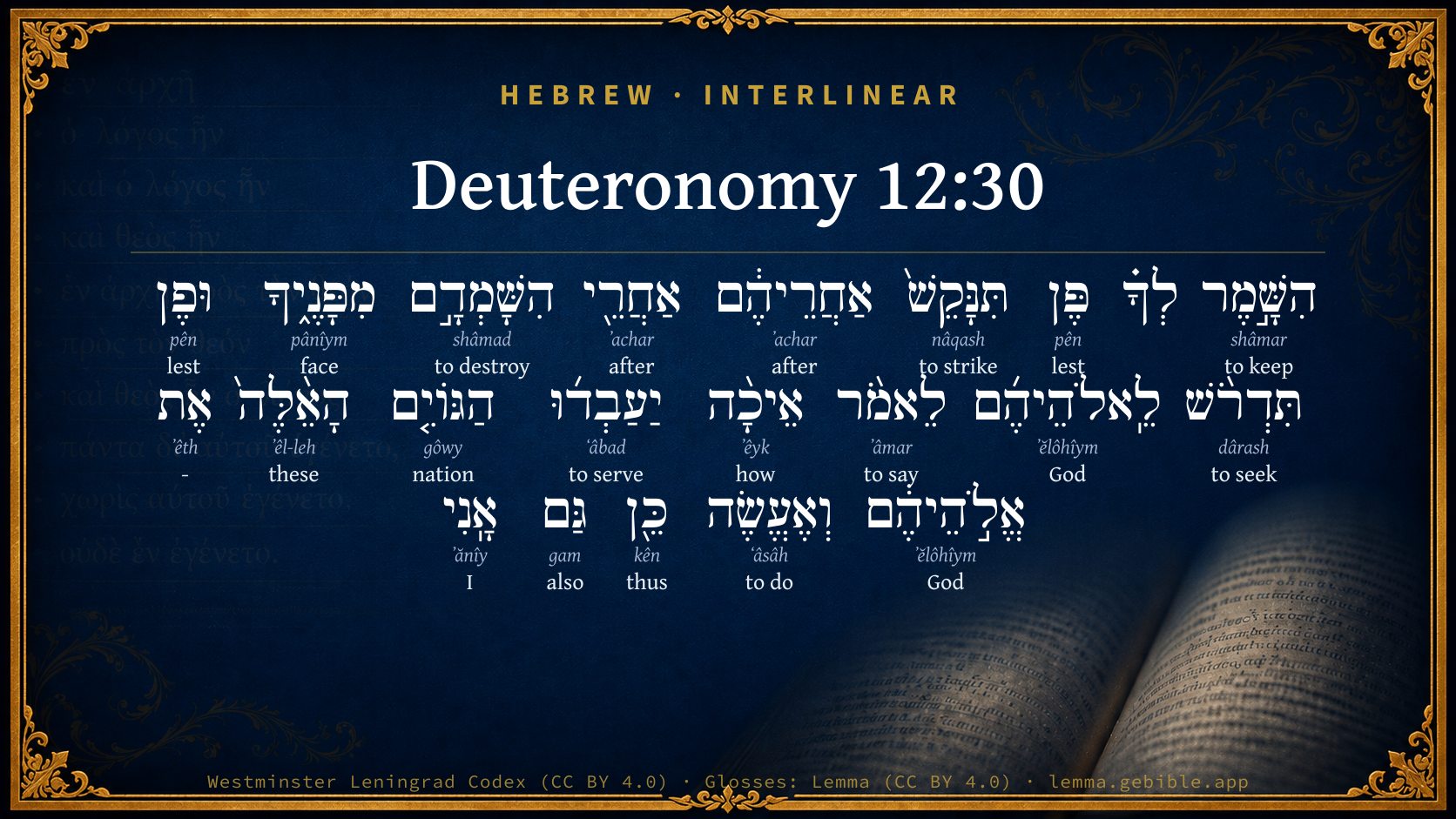
Hebrew (Westminster Leningrad Codex) Deuteronomy 12:30 appears in the Hebrew Old Testament. The text above is from the Westminster Leningrad Codex. Each word links to its Strong’s number, a concise gloss, and parsing drawn from the Open Scriptures Hebrew Bible morphology. Click any word for its full Brown-Driver-Briggs (BDB) entry.
Download image
Cite this verse

Deuteronomy 12:30 (World English Bible). Public Domain. Lemma interlinear Bible study tool, https://lemma.gebible.app/v/deuteronomy/12/30.

Show BibTeX & RIS
BibTeX
RIS
English Translation
take heed to yourself that you not be ensnared to follow them, after that they are destroyed from before you; and that you not inquire after their gods, saying, How do these nations serve their gods? even so will I do likewise.
World English Bible · Public Domain
Highlights Full analysis ↓
Download a study sheet

One document with this verse’s original text, its word-by-word gloss line, the meaning frame, cross-references with their text, attributed commentary, and full source and license credits — printable, and it pastes into notes with its structure intact.

This verse Autodidact and up

Study sheet (.html) Plain text (.txt)

A passage Seminary Student

Up to 50 verses in one chapter. A passage sheet keeps up to 6 commentary sources and 12 cross-references per verse, in the order this page ranks them, and says so on the sheet whenever that leaves anything out. Ask for a single verse and you get the Autodidact verse sheet above.

Everything on this page stays free to read, with no account — the sheet is a download of what is already on screen, not access to it.

Want to remove ads? Support Godless Engineer
Compare translations 3

The same verse in 3 English versions, stacked beneath the original-language interlinear above. Click any original word for its lexicon entry.

Each is an independent rendering of the whole verse — the interlinear is not word-aligned to these translations.

Highlighted words mark where these versions differ — a whole-verse word diff, not a word-by-word alignment.

  • World English Bible Public Domain
    take heed to yourself that you not be ensnared to follow them, after that they are destroyed from before you; and that you not inquire after their gods, saying, How do these nations serve their gods? even so will I do likewise.
  • King James Version Public Domain
    Take heed to thyself that thou be not snared by following them, after that they be destroyed from before thee; and that thou inquire not after their gods, saying, How did these nations serve their gods? even so will I do likewise.
  • unfoldingWord Literal Text CC BY-SA 4.0
    watch yourself, lest you become trapped after them, after they are destroyed from your face, and lest you inquire for their gods, saying, ‘How do these nations serve their gods? And thus I also will do.’

unfoldingWord Literal Text — © unfoldingWord, licensed CC BY-SA 4.0. Word-aligned USFM3 via Door43 (git.door43.org/unfoldingWord/en_ult).

Versions to compare (up to 4)

3 of 4 selected

Show all 18 translations

Every available English version of this verse, each an independent rendering of the whole verse.

  • World English Bible Public Domain
    take heed to yourself that you not be ensnared to follow them, after that they are destroyed from before you; and that you not inquire after their gods, saying, How do these nations serve their gods? even so will I do likewise.
  • Berean Standard Bible Public Domain
    be careful not to be ensnared by their ways after they have been destroyed before you. Do not inquire about their gods, asking, “How do these nations serve their gods? I will do likewise.”
  • Majority Standard Bible Public Domain
    be careful not to be ensnared by their ways after they have been destroyed before you. Do not inquire about their gods, asking, “How do these nations serve their gods? I will do likewise.”
  • King James Version Public Domain
    Take heed to thyself that thou be not snared by following them, after that they be destroyed from before thee; and that thou inquire not after their gods, saying, How did these nations serve their gods? even so will I do likewise.
  • American Standard Version (1901) Public Domain
    take heed to thyself that thou be not ensnared to follow them, after that they are destroyed from before thee; and that thou inquire not after their gods, saying, How do these nations serve their gods? even so will I do likewise.
  • Revised Version (1885) Public Domain
    take heed to thyself that thou be not ensnared to follow them, after that they be destroyed from before thee; and that thou inquire not after their gods, saying, How do these nations serve their gods? even so will I do likewise.
  • Geneva Bible (1599) Public Domain
    Beware, lest thou be taken in a snare after them, after that they be destroied before thee, and lest thou aske after their gods, saying, Howe did these nations serue their gods, that I may doe so likewise?
  • Douay-Rheims (1899) Public Domain
    Beware lest thou imitate them, after they are destroyed at thy coming in, and lest thou seek after their ceremonies, saying: As these nations have worshipped their gods, so will I also worship.
  • Young's Literal Translation Public Domain
    take heed to thee, lest thou be snared after them, after their being destroyed out of thy presence, and lest thou enquire about their gods, saying, How do these nations serve their gods, and I do so -- even I?
  • Literal Standard Version CC BY-SA 4.0
    take heed to yourself lest you are ensnared after them, after their being destroyed out of your presence, and lest you inquire about their gods, saying, How do these nations serve their gods, that I also do so?
  • Unlocked Literal Bible CC BY-SA 4.0
    pay attention to yourself that you are not trapped into following them, after they are destroyed from before you—trapped into investigating their gods, into asking, 'How do these nations worship their gods? I will do the same.'
  • unfoldingWord Literal Text CC BY-SA 4.0
    watch yourself, lest you become trapped after them, after they are destroyed from your face, and lest you inquire for their gods, saying, ‘How do these nations serve their gods? And thus I also will do.’
  • Darby Bible Public Domain
    take heed to thyself that thou be not ensnared [to follow] after them, after that they are destroyed from before thee; and that thou inquire not after their gods, saying, How did these nations serve their gods? even so will I do likewise.
  • World Messianic Bible Public Domain
    be careful that you are not ensnared to follow them after they are destroyed from before you, and that you not inquire after their gods, saying, “How do these nations serve their gods? I will do likewise.”
  • Webster's Bible Public Domain
    Take heed to thyself that thou be not snared by following them, after that they are destroyed from before thee; and that thou inquire not after their gods, saying, How did these nations serve their gods? even so will I do likewise.
  • Free Bible Version CC BY-SA 4.0
    make sure you don't fall into the trap of following their ways after they have been destroyed right in front of you. Don't try and find out about their gods, asking, “I wonder how these people worship their gods? I'll do like they did.”
  • Bible in Basic English Public Domain
    After their destruction take care that you do not go in their ways, and that you do not give thought to their gods, saying, How did these nations give worship to their gods? I will do as they did.
  • JPS Tanakh (1917) Public Domain
    take heed to thyself that thou be not ensnared to follow them, after that they are destroyed from before thee; and that thou inquire not after their gods, saying: 'How used these nations to serve their gods? even so will I do likewise.'

Literal Standard Version (2020), Covenant Press — licensed CC BY-SA 4.0. Text via the HelloAO Bible API (eBible.org). Unlocked Literal Bible (unfoldingWord) — licensed CC BY-SA 4.0. Text via the HelloAO Bible API (eBible.org). unfoldingWord Literal Text — © unfoldingWord, licensed CC BY-SA 4.0. Word-aligned USFM3 via Door43 (git.door43.org/unfoldingWord/en_ult). Free Bible Version, Dr. Jonathan Gallagher — licensed CC BY-SA 4.0. Text via the HelloAO Bible API (eBible.org).

Word by word

More ways to search: Search by grammar → Find every occurrence → Compare this word →

Practice this passage: Drill this verse → Learn its vocabulary →

תִּנָּקֵשׁ֙
nâqash
H5367
“to strike”
Verb, Niphal, Imperfect, 2nd Person, Masculine, Singular
Part of Speech
Verb
Stem
Niphal
Form
Imperfect
Person
2nd Person
Gender
Masculine
Number
Singular
Full BDB Definition

Origin: a primitive root

TWOT: 1419

to knock, strike, bring down - (Qal) to strike down - (Niphal) to be thrust after, be impelled - (Piel) to strike at, take aim at - (Hithpael) to be struck - (CLBL) to ensnare - (Qal) to ensnare - (Niphal) to be ensnared - (Piel) to lay snares - (Hithpael) to lay snares
  1. הִשָּׁ֣מֶר shâmar H8104 “keep” Verb, Niphal, Imperative, 2nd Person, Masculine, Singular
  2. פֶּן pên H6435 “lest” Conjunction
  3. אַחֲרֵיהֶ֔ם ʼachar H310 “after · them” Preposition + Suffix, Personal, 3rd Person, Masculine, Plural
  4. אַחֲרֵ֖י ʼachar H310 “after” Preposition
  5. הִשָּׁמְדָ֣ם shâmad H8045 “to destroy · them” Verb, Niphal, Infinitive Construct + Suffix, Personal, 3rd Person, Masculine, Plural
  6. מִפָּנֶ֑יךָ pânîym H6440 “from · face(s) · your” Preposition + Noun, Common, Both, Plural, Construct + Suffix, Personal, 2nd Person, Masculine, Singular
  7. וּפֶן pên H6435 “and · lest” Conjunction + Conjunction
  8. תִּדְרֹ֨שׁ dârash H1875 “to seek” Verb, Qal, Imperfect, 2nd Person, Masculine, Singular
  9. לֵֽאלֹהֵיהֶ֜ם ʼĕlôhîym H430 “to/for · God(s) · their” Preposition + Noun, Common, Masculine, Plural, Construct + Suffix, Personal, 3rd Person, Masculine, Plural
  10. לֵאמֹ֨ר ʼâmar H559 “to say” Preposition + Verb, Qal, Infinitive Construct
  11. אֵיכָ֨ה ʼêyk H349 “how” Particle, Interrogative
  12. יַעַבְד֜וּ ʻâbad H5647 “to serve” Verb, Qal, Imperfect, 3rd Person, Masculine, Plural
  13. הַגּוֹיִ֤ם gôwy H1471 “the · nations” Particle, Definite Article + Noun, Common, Masculine, Plural, Absolute
  14. הָאֵ֨לֶּה֙ ʼêl-leh H428 “the · these” Particle, Definite Article + Pronoun, Demonstrative, Common, Plural
  15. אֶת ʼêth H853 “-” Particle, Direct Object
  16. אֱלֹ֣הֵיהֶ֔ם ʼĕlôhîym H430 “God(s) · their” Noun, Common, Masculine, Plural, Construct + Suffix, Personal, 3rd Person, Masculine, Plural
  17. וְאֶעֱשֶׂה ʻâsâh H6213 “and · to do” Conjunction + Verb, Qal, Imperfect, 1st Person, Common, Singular
  18. כֵּ֖ן kên H3651 “thus” Particle, Demonstrative
  19. גַּם gam H1571 “also” Particle, Accusative
  20. אָֽנִי ʼănîy H589 “I” Pronoun, Personal, 1st Person, Common, Singular

About this verse

These counts appear in no published source. They are computed here, from the morphology-tagged text and Lemma’s own curated glosses. What Lemma adds →

22
words
18
distinct lemmas
Pentateuch
section

Notable vocabulary

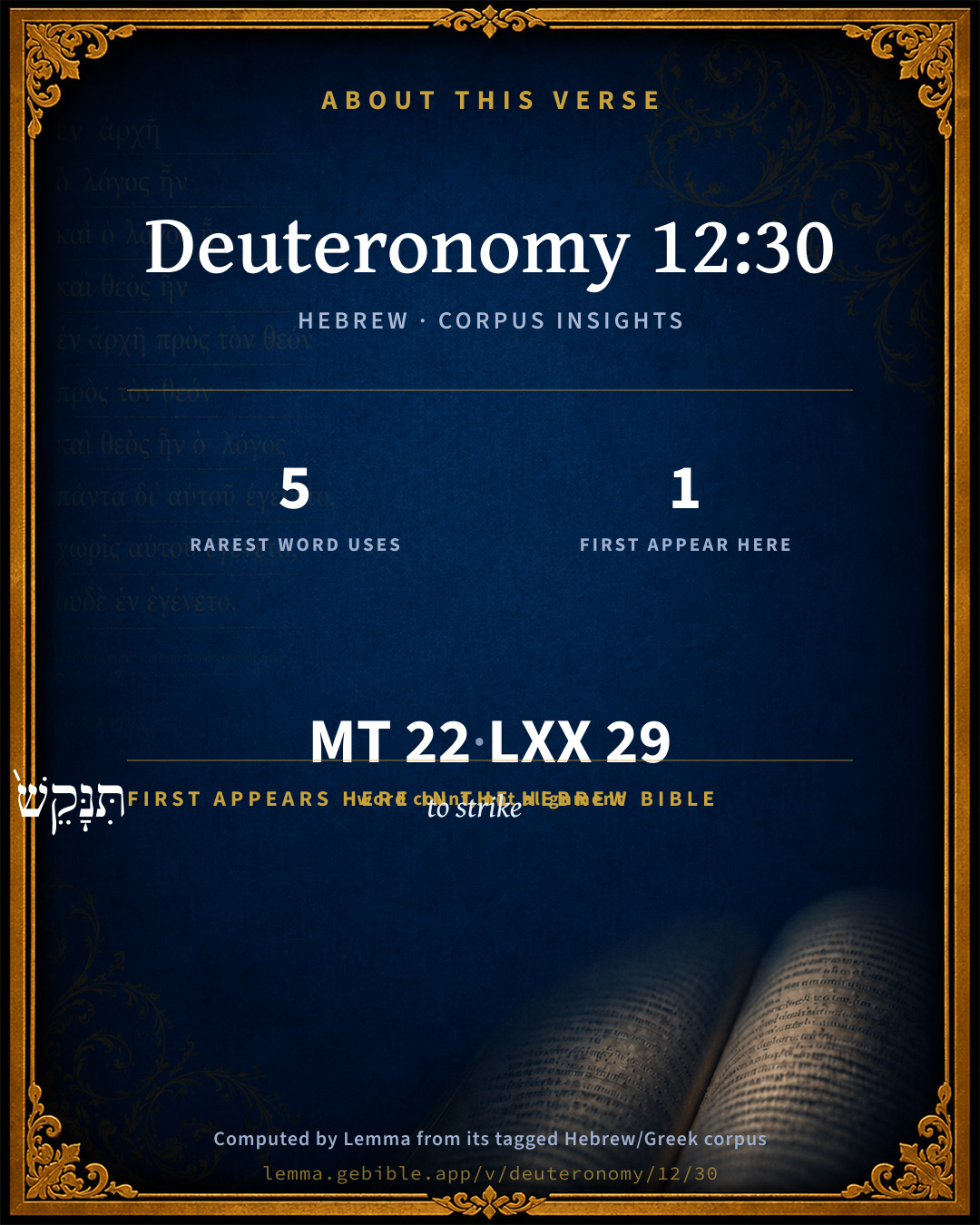
The rarest word here is תִּנָּקֵשׁ֙ to strike H5367 — appearing just 5 times in the whole Hebrew Bible.

First appearance in Scripture

This word makes its first canonical appearance in the Hebrew Bible here:

  • תִּנָּקֵשׁ֙ to strike H5367

Shared distinctive vocabulary

תִּנָּקֵשׁ֙ to strike H5367 occurs in 5 verses of the Hebrew Bible. Also found in:

Grammatical profile

  • 7 verbs
  • 4 nouns
  • 2 pronouns
  • 3 prepositions
  • 2 conjunctions
  • 4 particles

Verb forms

  • הִשָּׁ֣מֶר Niphal · Imperative
  • תִּנָּקֵשׁ֙ Niphal · Imperfect
  • הִשָּׁמְדָ֣ם Niphal · Infinitive Construct
  • תִּדְרֹ֨שׁ Qal · Imperfect
  • לֵאמֹ֨ר Qal · Infinitive Construct
  • יַעַבְד֜וּ Qal · Imperfect
  • וְאֶעֱשֶׂה Qal · Imperfect

Repetition

Words recur within this verse — often emphatic in Hebrew:

  • פֶּן lest H6435 ×2
  • אַחֲרֵיהֶ֔ם after H310 ×2
  • לֵֽאלֹהֵיהֶ֜ם God H430 ×2

Hebrew & Septuagint length

In English translation the verse runs 42 words from the Hebrew and 30 from the Septuagint (LXX English) — the Septuagint runs noticeably shorter here. See the side-by-side →

A rough comparison of the two English renderings, which tokenize alike — not a word-level alignment.

Word counts can differ between the Hebrew and the Greek without any difference in meaning — e.g. the Hebrew direct-object marker אֵת has no separate Greek word, and Greek often adds the article ὁ.

In the original languages it is 22 Hebrew tokens and 29 Greek tokens — but the two are counted differently (Hebrew bundles its prefixes and suffixes into one token; the Greek is in lemma form), so that isn’t a like-for-like length.

Cross-references

13

Topical passages linked to Deuteronomy 12:30 in the Treasury of Scripture Knowledge — connected by theme and wording, ordered by reader-vote popularity; previews shown in the World English Bible.

  • Jeremiah 10:2 Thus says Yahweh, "Don't learn the way of the nations, and don't be dismayed at the signs of the sky; for the nations are dismayed at them.
  • Ezekiel 20:32 and that which comes into your mind shall not be at all, in that you say, We will be as the nations, as the families of the countries, to serve wood and stone.
  • Exodus 23:31–33 I will set your border from the Red Sea even to the sea of the Philistines, and from the wilderness to the River; for I will deliver the inhabitants of the land into your hand, and you shall drive them out before you.
  • Deuteronomy 7:16 You shall consume all the peoples who Yahweh your God shall deliver to you; your eye shall not pity them: neither shall you serve their gods; for that will be a snare to you.
  • Psalms 106:34–38 They didn't destroy the peoples, As Yahweh commanded them,
  • Ezekiel 20:28 For when I had brought them into the land, which I swore to give to them, then they saw every high hill, and every thick tree, and they offered there their sacrifices, and there they presented the provocation of their offering; there also they made their sweet savor, and they poured out there their drink-offerings.
  • Ephesians 4:17 This I say therefore, and testify in the Lord, that you no longer walk as the rest of the Gentiles also walk, in the futility of their mind,
  • Leviticus 18:3 You shall not do as they do in the land of Egypt, where you lived: and you shall not do as they do in the land of Canaan, where I am bringing you; neither shall you walk in their statutes.
  • Numbers 33:52 then you shall drive out all the inhabitants of the land from before you, and destroy all their figured [stones], and destroy all their molten images, and demolish all their high places:
  • Judges 2:2–3 and you shall make no covenant with the inhabitants of this land; you shall break down their altars. But you have not listened to my voice: why have you done this?
  • 2 Kings 17:15 They rejected his statutes, and his covenant that he made with their fathers, and his testimonies which he testified to them; and they followed vanity, and became vain, and [went] after the nations that were round about them, concerning whom Yahweh had charged those who they should not do like them.
  • 1 Peter 4:3–4 For we have spent enough of our past time doing the desire of the Gentiles, and having walked in lewdness, lusts, drunken binges, orgies, carousings, and abominable idolatries.
  • Romans 12:2 Don't be conformed to this world, but be transformed by the renewing of your mind, so that you may prove what is the good, well-pleasing, and perfect will of God.

Cross-references courtesy of OpenBible.info (CC BY 4.0).

Hebrew and Greek witnesses Masoretic Hebrew ↔ Greek Septuagint

The same verse in the two great witnesses to the Old Testament, shown verse-for-verse.

Here the Septuagint runs noticeably shorter than the Hebrew — LXX2012 (modern English Septuagint) 30 words vs World English Bible 42. A rough length comparison of the two English translations, not a word-level alignment — read both below.

These are two independent witnesses, not word-aligned to each other, and the Septuagint is shown in lemma (dictionary) form.

Hebrew Deuteronomy 12:30 Masoretic · Westminster Leningrad Codex

הִשָּׁ֣מֶר לְךָ֗ פֶּן תִּנָּקֵשׁ֙ אַחֲרֵיהֶ֔ם אַחֲרֵ֖י הִשָּׁמְדָ֣ם מִפָּנֶ֑יךָ וּפֶן תִּדְרֹ֨שׁ לֵֽאלֹהֵיהֶ֜ם לֵאמֹ֨ר אֵיכָ֨ה יַעַבְד֜וּ הַגּוֹיִ֤ם הָאֵ֨לֶּה֙ אֶת אֱלֹ֣הֵיהֶ֔ם וְאֶעֱשֶׂה כֵּ֖ן גַּם אָֽנִי

take heed to yourself that you not be ensnared to follow them, after that they are destroyed from before you; and that you not inquire after their gods, saying, How do these nations serve their gods? even so will I do likewise.

World English Bible · Public Domain

Greek LXX Deuteronomy 12:30 Septuagint · lemma form

προςἔχω σεαυτοῦ μή ἐκζητέω ἐπιἀκολουθέω αὐτός μετά ὁ ἐκὀλεθρεύω αὐτός ἀπό πρόσωπον σύ οὐ μή ἐκζητέω ὁ θεός αὐτός λέγω πῶς ποιέω ὁ ἔθνος οὗτος ὁ θεός αὐτός ποιέω

take heed to yourself that you seek not to follow them after they are destroyed before you, saying, How do these nations act towards their gods? I will do likewise.

LXX2012 (modern English Septuagint) · Public Domain

Hebrew: Westminster Leningrad Codex (CC BY 4.0). Greek: Septuagint (public domain); English from LXX2012 (modern English Septuagint) (Public Domain). How the Septuagint differs from the Hebrew →

Targum (Aramaic paraphrase)

2

The Targum is the ancient Jewish Aramaic paraphrase of the Hebrew Scriptures — an interpretive translation, not the Hebrew text itself. Onkelos (literal) and Pseudo-Jonathan (expansive) render the Torah, and Jonathan the Prophets. Coverage is partial: where no permissively-licensed English translation exists for a verse, only the Aramaic is shown. This is verse-level text, not a word-by-word alignment to the Hebrew.

  1. Targum Onkelos Torah (Genesis–Deuteronomy)
    אִסְתַּמַר לָךְ דִילְמָא תִתָּקַל בַּתְרֵיהוֹן בָּתַר דְיִשְׁתֵּצוּן מִקֳדָמָךְ וְדִילְמָא תִתְבַּע לְטַעֲוָתְהוֹן לְמֵימַר אֶכְדֵין פָּלְחִין עַמְמַיָא הָאִלֵין יָת טַעֲוָתְהוֹן וְאֶעְבֵּד כֵּן אַף אֲנָא

    (no public-domain English translation for this verse)

    Targum Onkelos — Aramaic: “Onkelos Genesis” (public domain); “Onkelos Exodus” (public domain); “Onkelos Leviticus” (public domain); “Onkelos Numbers” (public domain); “Onkelos Deuteronomy” (public domain). English: “Sefaria Community Translation” (CC0 1.0 (public-domain dedication)); “J.W. Etheridge. The Targums of Onkelos and Jonathan Ben Uzziel on the Pentateuch. London: Longmans, Green, 1862” (public domain). Text via Sefaria.

  2. Targum Pseudo-Jonathan Torah (Genesis–Deuteronomy)
    אִסְתַּמָּרוּ לְכוֹן דִּלְמָא תִיתּוֹקְלוּן בָּתַר טַעֲוַותְהוֹן מִן בָּתַר דְּיִשְׁתֵּיצוּן מִן קֳדָמֵיכוֹן אוֹ דִלְמָא תִּתְבְּעוּן לְטַעֲוַותְהוֹן לְמֵימָר הֵיכְדֵין פַּלְחִין עַמְמַיָא הָאִלֵּין לְטַעֲוַותְהוֹן וְנַעֲבֵיד כְּדֵין אוּף אֲנָן

    beware that you stumble not after their idols when they shall have been destroyed before you, or lest you seek after their idols, saying, How did these peoples worship their gods, that we may worship as they did?

    Targum Pseudo-Jonathan — Aramaic: “Targum Jonathan on Genesis” (public domain); “Targum Jonathan on Exodus” (public domain); “Targum Jonathan on Leviticus” (public domain); “Targum Jonathan on Numbers” (public domain); “Targum Jonathan on Deuteronomy” (public domain). English: “The Targum of Jonathan ben Uzziel, trans. J. W. Etheridge, London, 1862” (public domain). Text via Sefaria.

Commentary

Notes on Deuteronomy 12:30 from classic Christian and Jewish commentators (each source and its license shown beneath its notes). The classic Christian expositions comment on the surrounding passage and are grouped to its opening verse, so a note may address several verses; the Jewish commentaries on the Tanakh (Rashi and others) are per-verse, so they appear only where the commentator wrote on this verse.

Lemma curates 59 commentaries, every one of them public domain or Creative Commons licensed, each selected and text-cleaned for this edition rather than reprinted as found. About our sources →

The Biblical Illustrator

Joseph S. Exell

Deu_12:30

Take heed to thyself that thou be not snared by following after them.

Danger of a conquered foe

It is a remarkable fact, and is proved by Dr. Bell (in his History of British Insects), that the poison of the rattlesnake is even secreted after death. Dr. Bell, in his dissections of the rattlesnakes which have been dead many hours, has found that the poison continued to be secreted so fast as to require to be dried up occasionally with sponge or rag. The immoral author, like these rattlesnakes, not only poisons during his lifetime, but after death: because his books possess the subtle power of secreting the venom to a horrible degree. A moral sponge is constantly called into requisition to obliterate his poison for many years after he himself has been dead. (Scientific Illustrations.)

Revival of a conquered sin

As the bough of a tree bent from its usual course returns to its old position as soon as the force by which it had yielded is removed; so do men return to their old habits as soon as the motives, whether of interest or fear, which had influenced them, are done away. Nature, says Lord Bacon, is often hidden, sometimes overcome, seldom extinguished. Let not a man trust his victory over his nature too far, for nature will lie buried a great time, and yet revive upon the occasion or temptation; like as it was with AEsops damsel, turned from a cat to a woman, who sat very demurely at the boards end till a mouse ran before her. The same philosopher gives the following admirable caution:--A mans nature runs either to herbs or weeds; therefore let him seasonably water the one and destroy the other.

Need for watchfulness

None are so likely to maintain watchful guard over their hearts and lives as those who know the comfort of living in near communion with God. They feel their privilege and will fear losing it. They will dread failing from their high estate, and marring their own comfort by bringing clouds between themselves and Christ. He that goes on a journey with little money about him takes little thought of danger, and cares little how late he travels. He, on the contrary, that carries gold and jewels, will be a cautious traveller; he will look well to his roads, his horses, and his company, and run no risks. The fixed stars are those that tremble most. The man that most fully enjoys the light of Gods countenance, will be a man tremblingly afraid of losing its blessed consolations, and jealously fearful of doing anything to grieve the Holy Ghost. (Bp. Ryle.)

.

The Biblical Illustrator, edited by Joseph S. Exell (c. 1880s–1900s) — public domain. Text from a community e-Sword module.

Joseph Benson's Commentary

Deu 12:30. By following them — By following the example they left, when their persons are destroyed.

Joseph Benson's Commentary on the Old and New Testaments (1811–1818) — public domain. Text from a community e-Sword module.

Geneva Bible (1599)

Geneva Bible translators

By following their superstitions and idolatries, and thinking to serve me thereby.

Geneva Bible (1599) marginal notes — public domain. Text via Bolls.life.

Ellicott's Commentary for English Readers

(30) Take heed to thyself that thou be not snared.—A necessary caution. “The fear” of heathen deities often attached itself to their seats of worship. It was found necessary to caution Israel against the fear of them and the dread of them in much later times. (See Jer_10:2-5.)

A Bible Commentary for English Readers, edited by Charles John Ellicott (1878–1897) — public domain. Text from a community e-Sword module.

John Gill's Exposition

Take heed to thyself, that thou be not snared by following them,.... Their examples and customs, and so be drawn into the same idolatrous practices; see Psa 106:35, after that they be destroyed from before thee; for their idolatries and other sins:

and that thou inquire not after their gods; what they were, their names, forms, and figures:

saying, how did these nations serve their gods? what was the manner of worship they gave them? what rites, customs, and ceremonies did they use in their adoration of them?

even so will I do likewise; or however, if this was not determined on when the inquiries were made, there was danger that this would be the result of them, and therefore the caution is given.

John Gill's Exposition of the Whole Bible (1746–1763) — public domain (CC PDM 1.0). Text via the HelloAO Bible API.

Albert Barnes' Notes on the Bible

This caution is based upon the notion generally entertained in the ancient pagan world, that each country had its own tutelary deities whom it would be perilous to neglect; compare 1Ki 20:23; 2Ki 17:26. Israel was to shun such superstitions as unworthy of the elect people of God.

Albert Barnes' Notes on the Bible (1834–1885) — public domain. Text from a community e-Sword/MySword module.

Haydock's Catholic Bible Commentary

Imitate. Hebrew, "be ensnared by imitation them." The example of the wicked, is one of the most dangerous snares which the devil can place in our way. Notwithstanding these repeated admonitions of God, we see how prone the Hebrews were to adopt the superstitious customs of these nations, whose destruction ought surely to have warned them to keep at a distance. (Haydock)

George Leo Haydock (1774–1849), Haydock's Catholic Family Bible and Commentary, 1859 edition — public domain. Excludes Psalms (Douay-Rheims chapter numbering differs from Protestant) and Deuterocanonical books (Catholic canon only).

Matthew Poole's English Annotations

Snared; drawn into their sin and ruin.

After that they be destroyed; i.e. by following the example they left, when their persons are destroyed.

That thou inquire not after their gods, through curiosity to know their gods, and the manner of the worship, lest thy vain and foolish mind be seduced by its speciousness or newness.

Matthew Poole's English Annotations on the Holy Bible (1683–1685) — public domain. Text from a community e-Sword/MySword module.

John Wesley's Explanatory Notes

By following them - By following the example they left, when their persons are destroyed.

John Wesley, Explanatory Notes Upon the Whole Bible (1754–1765) — public domain. Text via the GEBible commentary corpus.

Rashi

Rabbi Shlomo Yitzchaki (Rashi)

פן תנקש [TAKE HEED TO THYSELF] LEST THOU BE SNARED — Onkelos renders תנקש as an expression of the same root and meaning as מוקש, a snare. But I say that he was not particular to examine carefully the expression, for we never find a נ in the term that means to snare, not even as a root letter that is sometimes omitted from it; but in the term denoting movement from place to place and knocking we do find a נ, as in (Daniel 5:6) “and his knees knocked (נקש) one against the other”. Here, too, I say that פן תנקש means lest thou run after them so that you cling to their doings. Similar is (Psalms 109:11) “Let the creditor be מנקש to all that he has” — he (the speaker) is cursing the wicked that he may have many creditors and that these may go about running after his money.

אחרי השמדם מפניך [TAKE HEED THAT THOU BE NOT SNARED] (according to Rashi, THAT THOU DO NOT RUN AFTER THEM) AFTER THAT THEY BE EXTERMINATED BEFORE THEE — The meaning is: after you see that I exterminate them from before you, you ought to pay attention to why these were exterminated — because of the depraved doings which they practiced. Consequently you should not act likewise lest others come and exterminate you (cf. Sifrei Devarim 81:3).

איכה יעבדו HOW DID [THESE NATIONS] SERVE [THEIR GODS? EVEN SO WILL I DO LIKEWISE] — Because Scripture has laid down a punishment for idolatrous worship only in the case of sacrifice, offering incense, libation and prostration, as it is written (Exodus 22:19), “[He that sacrifices unto any god] save unto the Lord only [shall be doomed to death]” — which thus puts under the death penalty only kinds of worship that are performed in honor of the Most High God (i.e. such as have characteristics similar to “sacrifice”; cf. Rashi on Exodus 22:19), Scripture comes and teaches you here that if the usual way of worshiping any idol is by some other rite, as e.g., that one exposes himself in front of Baal Peor, or casts a stone before Mercury — then this is its cult and one who performs it is therefore liable to the death penalty, but for sacrifice, offering incense, libation and prostration one becomes liable to the death penalty even though this be not the usual way of worshiping it (Sanhedrin 60b).

Rashi on the Tanakh — English translations: “The Judaica Press complete Tanach with Rashi, translated by A. J. Rosenberg” (CC BY 4.0); “Pentateuch with Rashi's commentary by M. Rosenbaum and A.M. Silbermann, 1929-1934” (public domain); “The Metsudah Tanach series, Lakewood, N.J” (CC BY 4.0); and “The Book of Joshua, Metsudah Publications, 1997” (CC BY 4.0). Text via Sefaria.

Ramban (Nachmanides)

Rabbi Moshe ben Nachman (Ramban / Nachmanides)

TAKE HEED TO THYSELF THAT THOU BE NOT ENSNARED TO FOLLOW THEM, AFTER THEY ARE DESTROYED FROM BEFORE THEE. “After you see that I destroy them from before you, [you should] pay attention as to why these [nations] were destroyed — because of their corrupt practices. So you too, should not do the same so that others should not come and destroy you.” This is Rashi’s language. And if so, this verse becomes an admonition and warning against idol-worship. And Rashi also wrote on the expression [in the verse before us]: “How did these nations serve their gods, even so will I do likewise. Because Scripture has punished idolatry only for sacrificing, burning incense, pouring a libation, and bowing down, as it is written, [He that sacrificeth unto the gods] save unto the Eternal only, [shall be utterly destroyed, thus establishing the penalty only for those] acts which are performed in the service of G-d, therefore it comes and teaches you here that if the method of worshipping a [particular] idol was something other [than the four ways specified above,] — for example, excreting to [Baal] Peor or throwing a stone to Merkulis, this being its customary manner of worship — he is liable [to the death penalty]. One is also liable for [worshipping any idol whatever, in any one of the four specified ways] sacrificing, burning incense, pouring a libation, and bowing down even if it is not the customary way.” Thus far Rashi’s language. But this is not correct, for the [following] verse states, Thou shalt not do so unto the Eternal thy G-d. If so, the verse [before us] is not an admonition against worshipping their gods, [for it would be incongruous to follow this prohibition with an admonition not to worship G-d] but only that we should not worship the Glorious G-d with their forms of worship, just as he gave the reason, for every abomination to the Eternal, which He hateth, have they done unto their gods etc. Rather, the meaning of this section is as follows: Up to here he has commanded many times that when we come into the Land we are to uproot the idols and their appurtenances, and destroy their names, and he further commanded that we do this immediately upon dispossessing the nations. Now he stated that when the Eternal will cut off these nations from before us, and the names of the idols will be forgotten in the Land, and we shall dwell in their land securely, we should not think in our hearts thus: “Now G-d has cut away from before us the worshippers of other gods because they gave honor and reverential service to [the idols, which are] the work of men’s hands. And it is not proper to give His glory to another, neither His praise to graven images, for so He prohibited sacrificing, burning incense, pouring a libation, and bowing down, save unto the Eternal only, and it is customary among kings that anyone who glorifies himself with their honor, putting the crown on his own head or wearing the royal raiment like kings there is one law for him, that he be put to death. If so, I will do unto the Glorious Name just as the nations did to their gods and it will be pleasing unto Him.” Therefore he warned, Thou shalt not do so, for they would do to their gods things that are abominable to Him. He did not prohibit them [these ways with which they worshipped the idols] because of those acts that are reputable and appropriate to be done before G-d alone [i.e. sacrificing, burning incense, pouring a libation, and bowing down]; rather, because of the intent they had in performing them to serve idols [they had to be prohibited]. For even their sons and their daughters do they burn in the fire to their gods, it being an abominable thing before G-d to shed innocent blood, and all the more to be cruel and have no pity on the fruit of the womb., 13:18. [Hence any form of service instituted by people capable of such cruelty is considered an abomination by G-d and no ceremony of theirs is to be adopted by us.] Therefore, he stated All this word which I command you, that shall ye observe to do, the reference being to the performance of the offerings and the Service in the Sanctuary that thou art not to add thereto, nor diminish from it. This is in truth the purport of this section.Our Rabbis, however, have deduced from here that for worshipping an idol in its normal manner, one is always guilty even if he excreted to [Baal] Peor, [an act that would be an expression of contempt everywhere except in the temple of Peor]. The principle is derived from the expression, how did these nations serve their gods?, teaching that if it is considered “worship” in terms of that [idol] it is included in the prohibition nor shalt thou serve them. But if he throws a stone at [Baal] Peor [which is a manner of worship peculiar only to Merkulis] or even if it be some manifestation of respect, such as sweeping or sprinkling [before the idol] he is not guilty of a capital offense [since that is not a mode of “worship”].In line with the plain meaning of Scripture, he warned at the beginning of the section, Ye shall not do so unto the Eternal your G-d meaning that we are not to worship Him like [they worship] the gods of the nations upon the high mountains, Verse 2. with offerings to Him, and now in this section he warned, Thou shalt not do so unto the Eternal thy G-d — to worship Him in His Sanctuary with their manners of worship.

Ramban (Nachmanides) on the Tanakh — English translation: “Commentary on the Torah by Ramban (Nachmanides). Translated and annotated by Charles B. Chavel. New York, Shilo Pub. House, 1971-1976” (CC BY 4.0). Text via Sefaria.

Sforno

Rabbi Ovadia Sforno

Let me do so, too. Let me worship Hashem using the types of service that they use for their idols.

Sforno on the Tanakh — English translation: “Yalkut, Sifsei Chachomim Chumash, Metsudah Publications, 2009” (CC BY 4.0). Text via Sefaria.

Lesson kit

Teaching starters — assembled from the data on this page, not authored interpretation. Every prompt links to the verse data it draws on. Edit before teaching.

Deuteronomy, in the Pentateuch, opens this verse with 22 words (18 distinct Hebrew lemmas). Its most distinctive word is nâqash (“to strike”). The Greek Septuagint runs shorter here. A historical commentator’s framing appears above. Read the whole chapter for the surrounding context.

Discussion questions

  1. What does “to strike” (nâqash) contribute to the verse as a whole?
  2. This is the first place “to strike” appears in Scripture (first appears here). What does its debut here establish?
  3. How does 1 Samuel 28:9, which shares the word «to strike», read alongside this verse?
  4. What does the repetition of “lest” (2× in this one verse) do in this verse?
  5. The Septuagint runs shorter here than the Hebrew. What might account for the difference?
  6. These translations render this verse differently; the difference is in the English rendering, not the original. What questions does that raise?
  7. «הִשָּׁ֣מֶר» is a Niphal Imperative verb. How does that grammatical form shape the action described?
  8. Compare how The Biblical Illustrator and Joseph Benson's Commentary read this verse. Where do they agree or differ?

Things to notice

Reading settings

Reading text

Shown beneath each verse's original-language words.

Old Testament
Old Testament edition

Read the OT as the Masoretic Hebrew (MT) or the Greek Septuagint (LXX).

English shown for the Greek Septuagint (in the Hebrew ↔ Greek comparison).

Comparing translations? Open the Compare panel on any verse page to stack up to four side by side.