
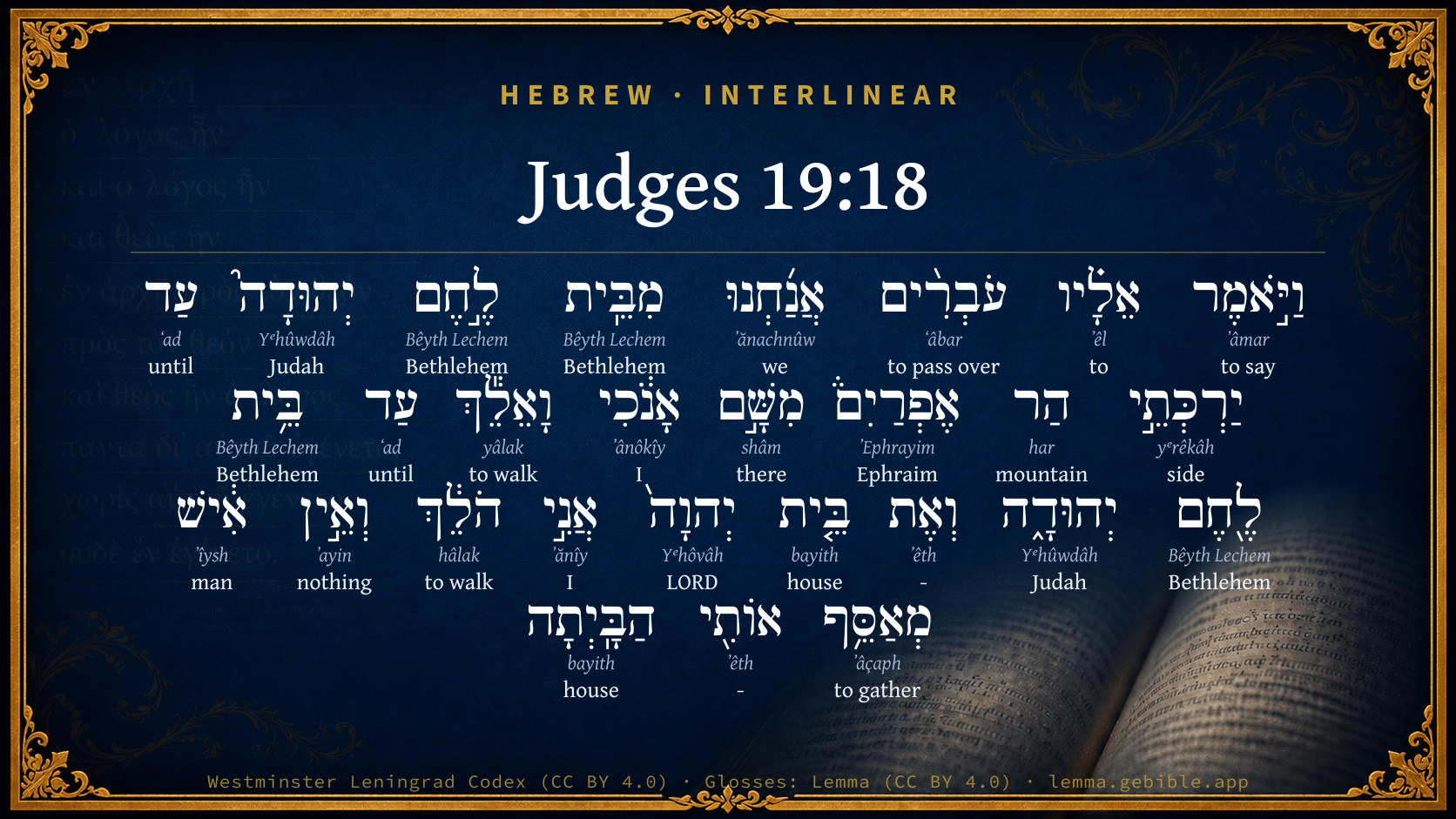
Judges 19:18

Hebrew (Westminster Leningrad Codex) Judges 19:18 appears in the Hebrew Old Testament. The text above is from the Westminster Leningrad Codex. Each word links to its Strong’s number, a concise gloss, and parsing drawn from the Open Scriptures Hebrew Bible morphology. Click any word for its full Brown-Driver-Briggs (BDB) entry.
Download image
Cite this verse

Judges 19:18 (World English Bible). Public Domain. Lemma interlinear Bible study tool, https://lemma.gebible.app/v/judges/19/18.

Show BibTeX & RIS
BibTeX
RIS
English Translation
He said to him, We are passing from Bethlehem Judah to the farther side of the hill-country of Ephraim; from there am I, and I went to Bethlehem Judah: and I am [now] going to the house of Yahweh; and there is no man who takes me into his house.
World English Bible · Public Domain
Download a study sheet

One document with this verse’s original text, its word-by-word gloss line, the meaning frame, cross-references with their text, attributed commentary, and full source and license credits — printable, and it pastes into notes with its structure intact.

This verse Autodidact and up

Study sheet (.html) Plain text (.txt)

A passage Seminary Student

Up to 50 verses in one chapter. A passage sheet keeps up to 6 commentary sources and 12 cross-references per verse, in the order this page ranks them, and says so on the sheet whenever that leaves anything out. Ask for a single verse and you get the Autodidact verse sheet above.

Everything on this page stays free to read, with no account — the sheet is a download of what is already on screen, not access to it.

Want to remove ads? Support Godless Engineer
Compare translations 3

The same verse in 3 English versions, stacked beneath the original-language interlinear above. Click any original word for its lexicon entry.

Each is an independent rendering of the whole verse — the interlinear is not word-aligned to these translations.

Highlighted words mark where these versions differ — a whole-verse word diff, not a word-by-word alignment.

  • World English Bible Public Domain
    He said to him, We are passing from Bethlehem Judah to the farther side of the hill-country of Ephraim; from there am I, and I went to Bethlehem Judah: and I am [now] going to the house of Yahweh; and there is no man who takes me into his house.
  • King James Version Public Domain
    And he said unto him, We are passing from Bethlehemjudah toward the side of mount Ephraim; from thence am I: and I went to Bethlehemjudah, but I am now going to the house of the LORD; and there is no man that receiveth me to house.
  • unfoldingWord Literal Text CC BY-SA 4.0
    He said to him, “We crossing over from Bethlehem Judah to the flanks of the hill country of Ephraim. I from there, and I went to Bethlehem Judah, and I going the house of Yahweh. But there is not a man receiving me into the house.

unfoldingWord Literal Text — © unfoldingWord, licensed CC BY-SA 4.0. Word-aligned USFM3 via Door43 (git.door43.org/unfoldingWord/en_ult).

Versions to compare (up to 4)

3 of 4 selected

Show all 18 translations

Every available English version of this verse, each an independent rendering of the whole verse.

  • World English Bible Public Domain
    He said to him, We are passing from Bethlehem Judah to the farther side of the hill-country of Ephraim; from there am I, and I went to Bethlehem Judah: and I am [now] going to the house of Yahweh; and there is no man who takes me into his house.
  • Berean Standard Bible Public Domain
    The Levite replied, “We are traveling from Bethlehem in Judah to the remote hill country of Ephraim, where I am from. I went to Bethlehem in Judah, and now I am going to the house of the LORD; but no one has taken me into his home,
  • Majority Standard Bible Public Domain
    The Levite replied, “We are traveling from Bethlehem in Judah to the remote hill country of Ephraim, where I am from. I went to Bethlehem in Judah, and now I am going to the house of the LORD; but no one has taken me into his home,
  • King James Version Public Domain
    And he said unto him, We are passing from Bethlehemjudah toward the side of mount Ephraim; from thence am I: and I went to Bethlehemjudah, but I am now going to the house of the LORD; and there is no man that receiveth me to house.
  • American Standard Version (1901) Public Domain
    And he said unto him, We are passing from Beth-lehem-judah unto the farther side of the hill-country of Ephraim; from thence am I, and I went to Beth-lehem-judah: and I am `now' going to the house of Jehovah; and there is no man that taketh me into his house.
  • Revised Version (1885) Public Domain
    And he said unto him, We are passing from Beth-lehem-judah unto the farther side of the hill country of Ephraim; from thence am I, and I went to Beth-lehem-judah: and I am now going to the house of the LORD; and there is no man that taketh me into his house.
  • Geneva Bible (1599) Public Domain
    And hee answered him, Wee came from Beth-lehem Iudah, vnto the side of Mout Ephraim: from thence am I: and I went to Beth-lehem Iudah, and go now to the house of the Lord: and no man receiueth mee to house,
  • Douay-Rheims (1899) Public Domain
    He answered him: We came out from Bethlehem Juda, and we are going to our home, which is on the side of mount Ephraim, from whence we went to Bethlehem: and now we go to the house of God, and none will receive us under his roof:
  • Young's Literal Translation Public Domain
    And he saith unto him, `We are passing over from Beth-Lehem-Judah unto the sides of the hill-country of Ephraim -- thence I `am', and I go unto Beth-Lehem-Judah; and to the house of Jehovah I am going, and there is no man gathering me into the house,
  • Literal Standard Version CC BY-SA 4.0
    And he says to him, “We are passing over from Beth-Lehem-Judah to the sides of the hill-country of Ephraim—I [am] from there, and I go to Beth-Lehem-Judah; and I am going to the house of YHWH, and there is no man gathering me into the house,
  • Unlocked Literal Bible CC BY-SA 4.0
    The Levite said to him, “We are on our way from Bethlehem in Judah to the most remote part of the hill country of Ephraim, which is where I come from. I went to Bethlehem in Judah, and I am going to the house of Yahweh, but there is no one who will take me into his house.
  • unfoldingWord Literal Text CC BY-SA 4.0
    He said to him, “We crossing over from Bethlehem Judah to the flanks of the hill country of Ephraim. I from there, and I went to Bethlehem Judah, and I going the house of Yahweh. But there is not a man receiving me into the house.
  • Darby Bible Public Domain
    And he said to him, "We are passing from Bethlehem in Judah to the remote parts of the hill country of E'phraim, from which I come. I went to Bethlehem in Judah; and I am going to my home; and nobody takes me into his house.
  • World Messianic Bible Public Domain
    He said to him, “We are passing from Bethlehem Judah to the farther side of the hill country of Ephraim. I am from there, and I went to Bethlehem Judah. I am going to the LORD’s house; and there is no one who has taken me into his house.
  • Webster's Bible Public Domain
    And he said to him, We are passing from Beth-lehem-Judah towards the side of mount Ephraim; from thence am I: and I went to Beth-lehem-judah, but I am now going to the house of the LORD; and there is no man that receiveth me into his house.
  • Free Bible Version CC BY-SA 4.0
    “We've come from Bethlehem in Judah and we're going to a remote area in the hill country of Ephraim,” the man replied. “I'm from there and I went to Bethlehem, and now I'm going to the Lord's Temple. No one here has invited me to stay.
  • Bible in Basic English Public Domain
    And he said to him, We are on our way from Beth-lehem-judah to the inmost parts of the hill-country of Ephraim: I came from there and went to Beth-lehem-judah: now I am on my way back to my house, but no man will take me into his house.
  • JPS Tanakh (1917) Public Domain
    And he said unto him: 'We are passing from Beth-lehem in Judah unto the farther side of the hill-country of Ephraim; from thence am I, and I went to Beth-lehem in Judah, and I am now going to the house of the LORD; and there is no man that taketh me into his house.

Literal Standard Version (2020), Covenant Press — licensed CC BY-SA 4.0. Text via the HelloAO Bible API (eBible.org). Unlocked Literal Bible (unfoldingWord) — licensed CC BY-SA 4.0. Text via the HelloAO Bible API (eBible.org). unfoldingWord Literal Text — © unfoldingWord, licensed CC BY-SA 4.0. Word-aligned USFM3 via Door43 (git.door43.org/unfoldingWord/en_ult). Free Bible Version, Dr. Jonathan Gallagher — licensed CC BY-SA 4.0. Text via the HelloAO Bible API (eBible.org).

Word by word

More ways to search: Search by grammar → Find every occurrence → Compare this word →

Practice this passage: Drill this verse → Learn its vocabulary →

יַרְכְּתֵ֣י
yᵉrêkâh
H3411
“sides of”
Noun, Common, Feminine, Dual, Construct
Part of Speech
Noun
Type
Common
Gender
Feminine
Number
Dual
State
Construct
Full BDB Definition

Origin: from H3409

TWOT: 916b

flank, side, extreme parts, recesses - side - sides, recesses (dual)
  1. וַיֹּ֣אמֶר ʼâmar H559 “and · to say” Conjunction + Verb, Qal, Sequential Imperfect, 3rd Person, Masculine, Singular
  2. אֵלָ֗יו ʼêl H413 “to · him” Preposition + Suffix, Personal, 3rd Person, Masculine, Singular
  3. עֹבְרִ֨ים ʻâbar H5674 “passing over” Verb, Qal, Participle Active, Masculine, Plural, Absolute
  4. אֲנַ֜חְנוּ ʼănachnûw H587 “we” Pronoun, Personal, 1st Person, Common, Plural
  5. מִבֵּֽית Bêyth Lechem H1035 “from · Bethlehem” Preposition + Noun, Proper
  6. לֶ֣חֶם Bêyth Lechem H1035 “Bethlehem” Noun, Proper
  7. יְהוּדָה֮ Yᵉhûwdâh H3063 “Judah” Noun, Proper
  8. עַד ʻad H5704 “until” Preposition
  9. הַר har H2022 “mountain of” Noun, Common, Masculine, Singular, Construct
  10. אֶפְרַיִם֒ ʼEphrayim H669 “Ephraim” Noun, Proper
  11. מִשָּׁ֣ם shâm H8033 “from · there” Preposition + Adverb
  12. אָנֹ֔כִי ʼânôkîy H595 “I” Pronoun, Personal, 1st Person, Common, Singular
  13. וָאֵלֵ֕ךְ yâlak H3212 “and · to walk” Conjunction + Verb, Qal, Sequential Imperfect, 1st Person, Common, Singular
  14. עַד ʻad H5704 “until” Preposition
  15. בֵּ֥ית Bêyth Lechem H1035 “Bethlehem” Noun, Proper
  16. לֶ֖חֶם Bêyth Lechem H1035 “Bethlehem” Noun, Proper
  17. יְהוּדָ֑ה Yᵉhûwdâh H3063 “Judah” Noun, Proper
  18. וְאֶת ʼêth H853 “and · -” Conjunction + Particle, Direct Object
  19. בֵּ֤ית bayith H1004 “house of” Noun, Common, Masculine, Singular, Construct
  20. יְהוָה֙ Yᵉhôvâh H3068 “LORD” Noun, Proper
  21. אֲנִ֣י ʼănîy H589 “I” Pronoun, Personal, 1st Person, Common, Singular
  22. הֹלֵ֔ךְ hâlak H1980 “walking” Verb, Qal, Participle Active, Masculine, Singular, Absolute
  23. וְאֵ֣ין ʼayin H369 “and · nothing” Conjunction + Particle, Negative
  24. אִ֔ישׁ ʼîysh H376 “man” Noun, Common, Masculine, Singular, Absolute
  25. מְאַסֵּ֥ף ʼâçaph H622 “gathering” Verb, Piel, Participle Active, Masculine, Singular, Absolute
  26. אוֹתִ֖י ʼêth H853 “- · me” Particle, Direct Object + Suffix, Personal, 1st Person, Common, Singular
  27. הַבָּֽיְתָה bayith H1004 “the · house · toward” Particle, Definite Article + Noun, Common, Masculine, Singular, Absolute + Suffix, Demonstrative

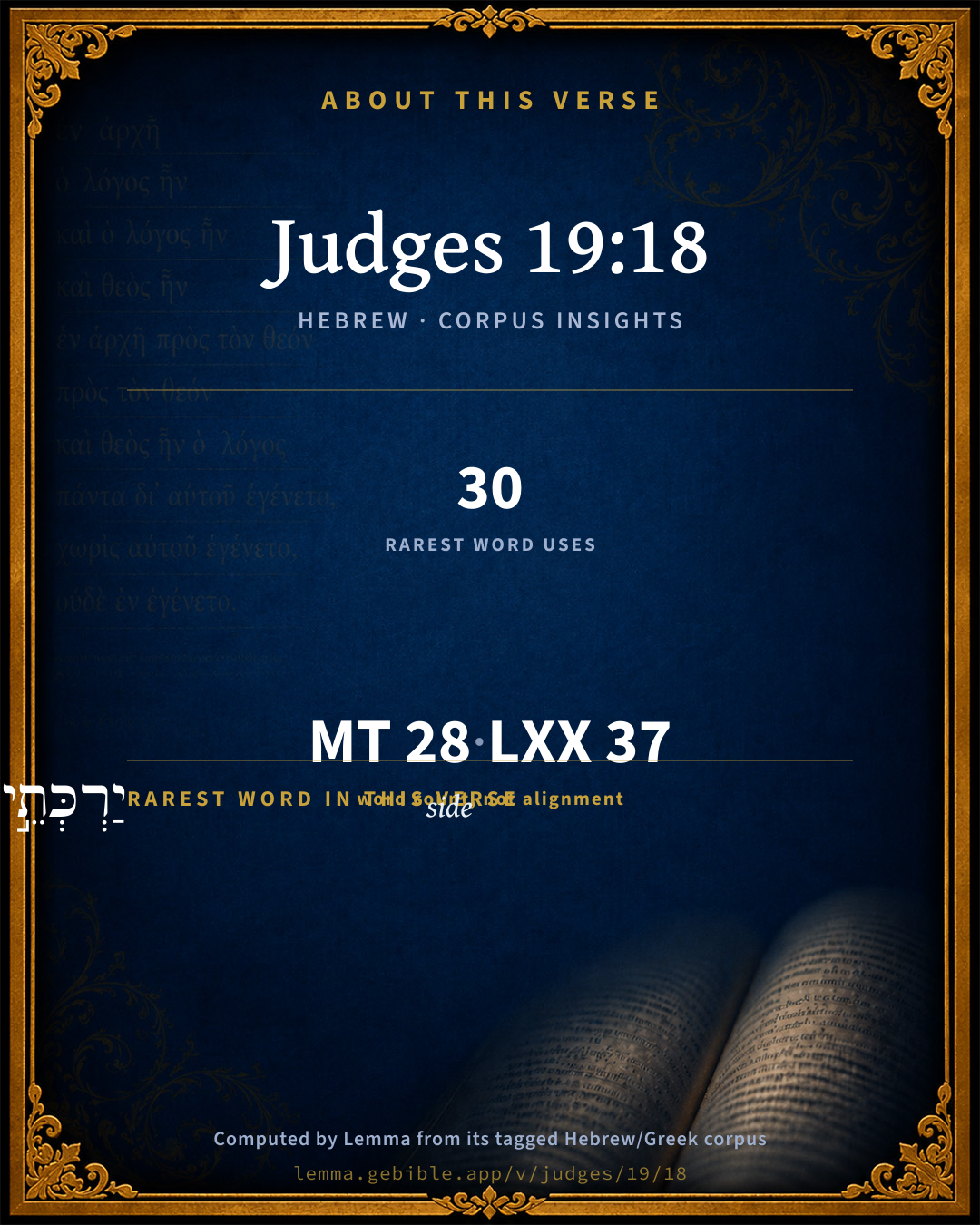
About this verse

These counts appear in no published source. They are computed here, from the morphology-tagged text and Lemma’s own curated glosses. What Lemma adds →

28
words
21
distinct lemmas
Historical
section

Shared distinctive vocabulary

יַרְכְּתֵ֣י side H3411 occurs in 28 verses of the Hebrew Bible. Also found in:

Grammatical profile

  • 5 verbs
  • 13 nouns
  • 3 pronouns
  • 3 prepositions
  • 1 adverb
  • 3 particles

Verb forms

  • וַיֹּ֣אמֶר Qal · Sequential Imperfect
  • עֹבְרִ֨ים Qal · Participle Active
  • וָאֵלֵ֕ךְ Qal · Sequential Imperfect
  • הֹלֵ֔ךְ Qal · Participle Active
  • מְאַסֵּ֥ף Piel · Participle Active

Repetition

Words recur within this verse — often emphatic in Hebrew:

  • מִבֵּֽית Bethlehem H1035 ×4
  • יְהוּדָה֮ Judah H3063 ×2
  • עַד until H5704 ×2
  • בֵּ֤ית house H1004 ×2

Hebrew & Septuagint length

In English translation the verse runs 50 words from the Hebrew and 46 from the Septuagint (LXX English) — closely comparable.

A rough comparison of the two English renderings, which tokenize alike — not a word-level alignment.

Word counts can differ between the Hebrew and the Greek without any difference in meaning — e.g. the Hebrew direct-object marker אֵת has no separate Greek word, and Greek often adds the article ὁ.

In the original languages it is 28 Hebrew tokens and 37 Greek tokens — but the two are counted differently (Hebrew bundles its prefixes and suffixes into one token; the Greek is in lemma form), so that isn’t a like-for-like length.

Cross-references

8

Topical passages linked to Judges 19:18 in the Treasury of Scripture Knowledge — connected by theme and wording, ordered by reader-vote popularity; previews shown in the World English Bible.

  • Judges 18:31 So they set them up Micah's engraved image which he made, all the time that the house of God was in Shiloh.
  • Joshua 18:1 The whole congregation of the children of Israel assembled themselves together at Shiloh, and set up the tent of meeting there: and the land was subdued before them.
  • Psalms 26:9 Don't gather my soul with sinners, Nor my life with bloodthirsty men;
  • John 15:6 If a man doesn't remain in me, he is thrown out as a branch, and is withered; and they gather them, throw them into the fire, and they are burned.
  • Judges 19:5 It happened on the fourth day, that they arose early in the morning, and he rose up to depart: and the young lady's father said to his son-in-law, Strengthen your heart with a morsel of bread, and afterward you shall go your way.
  • Judges 20:18 The children of Israel arose, and went up to Bethel, and asked counsel of God; and they said, Who shall go up for us first to battle against the children of Benjamin? Yahweh said, Judah [shall go up] first.
  • 1 Samuel 1:3 This man went up out of his city from year to year to worship and to sacrifice to Yahweh of Hosts in Shiloh. The two sons of Eli, Hophni and Phinehas, priests to Yahweh, were there.
  • 1 Samuel 1:7 [as] he did so year by year, when she went up to the house of Yahweh, so she provoked her; therefore she wept, and did not eat.

Cross-references courtesy of OpenBible.info (CC BY 4.0).

Hebrew and Greek witnesses Masoretic Hebrew ↔ Greek Septuagint

The same verse in the two great witnesses to the Old Testament, shown verse-for-verse.

These are two independent witnesses, not word-aligned to each other, and the Septuagint is shown in lemma (dictionary) form.

Hebrew Judges 19:18 Masoretic · Westminster Leningrad Codex

וַיֹּ֣אמֶר אֵלָ֗יו עֹבְרִ֨ים אֲנַ֜חְנוּ מִבֵּֽית לֶ֣חֶם יְהוּדָה֮ עַד יַרְכְּתֵ֣י הַר אֶפְרַיִם֒ מִשָּׁ֣ם אָנֹ֔כִי וָאֵלֵ֕ךְ עַד בֵּ֥ית לֶ֖חֶם יְהוּדָ֑ה וְאֶת בֵּ֤ית יְהוָה֙ אֲנִ֣י הֹלֵ֔ךְ וְאֵ֣ין אִ֔ישׁ מְאַסֵּ֥ף אוֹתִ֖י הַבָּֽיְתָה

He said to him, We are passing from Bethlehem Judah to the farther side of the hill-country of Ephraim; from there am I, and I went to Bethlehem Judah: and I am [now] going to the house of Yahweh; and there is no man who takes me into his house.

World English Bible · Public Domain

Greek LXX Judges 19:18 Septuagint · lemma form

καί εἶπον πρός αὐτός παραπορεύομαι ἐγώ ἀπό βηθλεεμ ιουδα ἕως μηρός ὄρος ἐφράιμ ἐκεῖθεν ἐγώ εἰμί καί πορεύομαι ἕως βηθλεεμ ιουδα καί εἰς ὁ οἶκος ἐγώ ἐγώ πορεύομαι καί οὐ εἰμί ἀνήρ συνἄγω ἐγώ εἰς ὁ οἰκία

And he said to him, We are passing by from Bethleem Juda to the sides of mount Ephraim: I am from thence, and I went as far as Bethleem Juda, and I am going home, and there is no man to take me into his house.

LXX2012 (modern English Septuagint) · Public Domain

On this verse, The Cambridge Bible for Schools and Colleges discusses the Septuagint’s reading. Read the note in Commentary ↓

Hebrew: Westminster Leningrad Codex (CC BY 4.0). Greek: Septuagint (public domain); English from LXX2012 (modern English Septuagint) (Public Domain). How the Septuagint differs from the Hebrew →

Targum (Aramaic paraphrase)

1

The Targum is the ancient Jewish Aramaic paraphrase of the Hebrew Scriptures — an interpretive translation, not the Hebrew text itself. Onkelos (literal) and Pseudo-Jonathan (expansive) render the Torah, and Jonathan the Prophets. Coverage is partial: where no permissively-licensed English translation exists for a verse, only the Aramaic is shown. This is verse-level text, not a word-by-word alignment to the Hebrew.

  1. Targum Jonathan Prophets (Joshua–Malachi)
    וַאֲמַר לֵיהּ עָבְרִין אֲנַחֲנָא מִבֵּית לֶחֶם דְבֵית יְהוּדָה עַד סְיָפֵי טוּרָא דְבֵית אֶפְרַיִם מִתַּמָן אֲנָא וַאֲנָא אָזֵיל עַד בֵּית לֶחֶם דְבֵית יְהוּדָה וּלְבֵית מַקְדְשָׁא דַייָ אֲנָא אָזִיל וְלֵית אֱנַשׁ דְכָנֵישׁ יָתִי לְבֵיתָא:

    (no public-domain English translation for this verse)

    Targum Jonathan — Aramaic: “Mikraot Gedolot” (public domain). English: “Sefaria Community Translation” (CC0 1.0 (public-domain dedication)); “London "Chaldee Paraphrase," 1871” (public domain). Text via Sefaria.

Commentary

Notes on Judges 19:18 from classic Christian and Jewish commentators (each source and its license shown beneath its notes). The classic Christian expositions comment on the surrounding passage and are grouped to its opening verse, so a note may address several verses; the Jewish commentaries on the Tanakh (Rashi and others) are per-verse, so they appear only where the commentator wrote on this verse.

Lemma curates 59 commentaries, every one of them public domain or Creative Commons licensed, each selected and text-cleaned for this edition rather than reprinted as found. About our sources →

Trapp's Complete Commentary

John Trapp

Jdg 19:18 And he said unto him, We [are] passing from Bethlehemjudah toward the side of mount Ephraim; from thence [am] I: and I went to Bethlehemjudah, but I [am now] going to the house of the LORD; and there [is] no man that receiveth me to house.

Ver. 18. , But I am now going to the house of the Lord,] viz., at Shiloh, there to wait upon mine office as a Levite, which is my chief care. Verbi Minister es, hoc age, was Mr Perkins’s motto. Thou art a minister, mind thy work.

And there is no man that receiveth me to house.] Heb., That gathereth me. A sure sign of gasping devotion, of a settled godlessness, when a Levite is suffered to lie without doors. Hesiod reckoneth it one of the greatest wickednesses that can be, not to show kindness to a stranger.

John Trapp, A Commentary or Exposition upon All the Books of the Old and New Testament (1647–1656) — public domain. Text from a community e-Sword module.

Joseph Benson's Commentary

Jdg 19:18. House of the Lord — Which was in Shiloh. Thither he went, either because he lived there for that was in the tribe of Ephraim; or, rather, because he would there offer prayers and praises, and sacrifices to God, for his mercy in reconciling him and his wife.

Joseph Benson's Commentary on the Old and New Testaments (1811–1818) — public domain. Text from a community e-Sword module.

Geneva Bible (1599)

Geneva Bible translators

To Shiloh of Mizpah where the Ark was.

Geneva Bible (1599) marginal notes — public domain. Text via Bolls.life.

The Cambridge Bible for Schools and Colleges

gen. ed. J. J. S. Perowne

18. the farther side] See on Jdg_19:1.

the house of the Lord] The marg. is to be preferred; the last letter of bêthî = my house was taken as the initial of the divine name Yahweh. A converse mistake occurs in Jer_6:11, where fury of Yahweh has become my fury in the LXX There is nothing in the context to suggest that the Levite was going to Shiloh.

The Cambridge Bible for Schools and Colleges (gen. ed. J. J. S. Perowne; Cambridge University Press, 1878–1918) — public domain. Text from a community e-Sword module.

John Gill's Exposition

And he said unto him, we are passing from Bethlehemjudah,.... He answers to his last question first, for this was the place from whence they came:

towards the side of Mount Ephraim: thither they were going, which is an answer to the first question: and then adds, which is more than what was requested:

from thence am I; that is, he was an inhabitant of a city on one side of Mount Ephraim, but what that city was, he says not, nor is it elsewhere said:

and I went to Bethlehemjudah; on what account he does not declare, but the above narrative clearly shows for what reason he went thither:

but I am now going to the house of the Lord; that is, the tabernacle in Shiloh, there he proposed to go first to offer sacrifice for the success of his journey, and for the reconciliation of his wife to him, and to pray to God for happiness in his family yet to come, and where some think his habitation was; but rather it was at some distance, not far from Mount Ephraim, and on the side of it, whither he should return when he had performed those acts of religion and devotion, which he judged were his duty:

and there is no man that receiveth me to house: that had invited him to his house to take a lodging there, as was common to do to travellers, as the instances of Abraham, Lot, Job, and others, show. It was a law with the Lucani (a people in Italy), that if a stranger came at sun setting, and was desirous of coming under the roof of anyone, if such an one did not receive him, he was to be fined, and suffer the punishment of inhospitality (t).

(t) Aelian. Var. Hist. l. 4. c. 1.

John Gill's Exposition of the Whole Bible (1746–1763) — public domain (CC PDM 1.0). Text via the HelloAO Bible API.

Albert Barnes' Notes on the Bible

The house of the Lord - Probably at Shiloh (marginal references). The Levite was probably one of those who ministered at the tabernacle. His two donkeys and servant show him to have been in good circumstances, and he had a home of his own.

Albert Barnes' Notes on the Bible (1834–1885) — public domain. Text from a community e-Sword/MySword module.

Haydock's Catholic Bible Commentary

Of God. Septuagint, "to my house I return in haste; and no one brings me into his house." The tabernacle was fixed at Silo in Ephraim. (Haydock) --- Chaldean, "the house of the sanctuary of God." (Menochius) (Ver. 1.)

George Leo Haydock (1774–1849), Haydock's Catholic Family Bible and Commentary, 1859 edition — public domain. Excludes Psalms (Douay-Rheims chapter numbering differs from Protestant) and Deuterocanonical books (Catholic canon only).

Matthew Poole's English Annotations

The house of the Lord was in Shiloh, Jos 18:1; 22:12 Thither he went, either because he lived there, for that in the tribe of Ephraim; or rather, because he would there offer prayers, and praises, and sacrifices unto God, for his mercy in reconciling him and his wife together, and for his blessing upon them again, and to make atonement for his wife.

Matthew Poole's English Annotations on the Holy Bible (1683–1685) — public domain. Text from a community e-Sword/MySword module.

The Pulpit Commentary

The side of mount Ephraim. See ver. 1, note. I am going to the house of the Lord, i.e. to the tabernacle at Shiloh. But some translate the words I frequent, am conversant with, walk in, the house of the Lord, i.e. am a Levite. But the former seems the best rendering on the whole.

The Pulpit Commentary (1880–1919), ed. H.D.M. Spence-Jones & Joseph S. Exell — public domain. Text from a community e-Sword module.

John Wesley's Explanatory Notes

House of the Lord - Which was in Shiloh. Thither he went, either because he lived there, for that was in the tribe of Ephraim; or, rather, because he would there offer prayers and praises, and sacrifices to God, for his mercy in reconciling him and his wife.

John Wesley, Explanatory Notes Upon the Whole Bible (1754–1765) — public domain. Text via the GEBible commentary corpus.

unfoldingWord translationNotes

Door43 World Missions Community

who will take me into his house

This phrase refers to someone inviting other people into his house to spend the night there. AT: "who has invited me to stay in his house" (See: Idiom)

will take me

Here the Levite says "me," but he is actually referring to himself along with his servant and his concubine. AT: "will take us" (See: Synecdoche)

there is bread and wine

Change to active voice. AT: "we have plenty of bread and wine" (See: Active or Passive)

me and your female servant here, and for this young man with your servants

The Levite speaks of himself and the others as servants and in the third person to show respect. AT: "me, my concubine, and my servant" (See: First, Second, or Third Person)

We lack nothing

This can be written as a positive statement. AT: "We have everything we need" (See: Litotes)

translationWords

Levi

Bethlehem

Judah

Ephraim

house of God

Yahweh

donkey

wine

servant

unfoldingWord translationNotes — © Distant Shores Media and the Door43 World Missions Community, licensed CC BY-SA 4.0. Source: git.door43.org/Door43/en_tn.

Rashi

Rabbi Shlomo Yitzchaki (Rashi)

To the Sanctuary of Adonoy. I am going to Shiloh.

Rashi on the Tanakh — English translations: “The Judaica Press complete Tanach with Rashi, translated by A. J. Rosenberg” (CC BY 4.0); “Pentateuch with Rashi's commentary by M. Rosenbaum and A.M. Silbermann, 1929-1934” (public domain); “The Metsudah Tanach series, Lakewood, N.J” (CC BY 4.0); and “The Book of Joshua, Metsudah Publications, 1997” (CC BY 4.0). Text via Sefaria.

Lesson kit

Teaching starters — assembled from the data on this page, not authored interpretation. Every prompt links to the verse data it draws on. Edit before teaching.

Judges, in the Historical, opens this verse with 28 words (21 distinct Hebrew lemmas). Its most distinctive word is yᵉrêkâh (“side”). A historical commentator’s framing appears above. Read the whole chapter for the surrounding context.

Discussion questions

  1. The word yᵉrêkâh carries the sense “side.” How does it shape the verse?
  2. How does Genesis 49:13, which shares the word «side», read alongside this verse?
  3. What does the repetition of “Bethlehem” (4× in this one verse) do in this verse?
  4. These translations render this verse differently. What is at stake in choosing one wording over another?
  5. «וַיֹּ֣אמֶר» is a Qal Sequential Imperfect verb. How does that grammatical form shape the action described?
  6. Compare how Trapp's Complete Commentary and Joseph Benson's Commentary read this verse. Where do they agree or differ?

Things to notice

Reading settings

Reading text

Shown beneath each verse's original-language words.

Old Testament
Old Testament edition

Read the OT as the Masoretic Hebrew (MT) or the Greek Septuagint (LXX).

English shown for the Greek Septuagint (in the Hebrew ↔ Greek comparison).

Comparing translations? Open the Compare panel on any verse page to stack up to four side by side.