
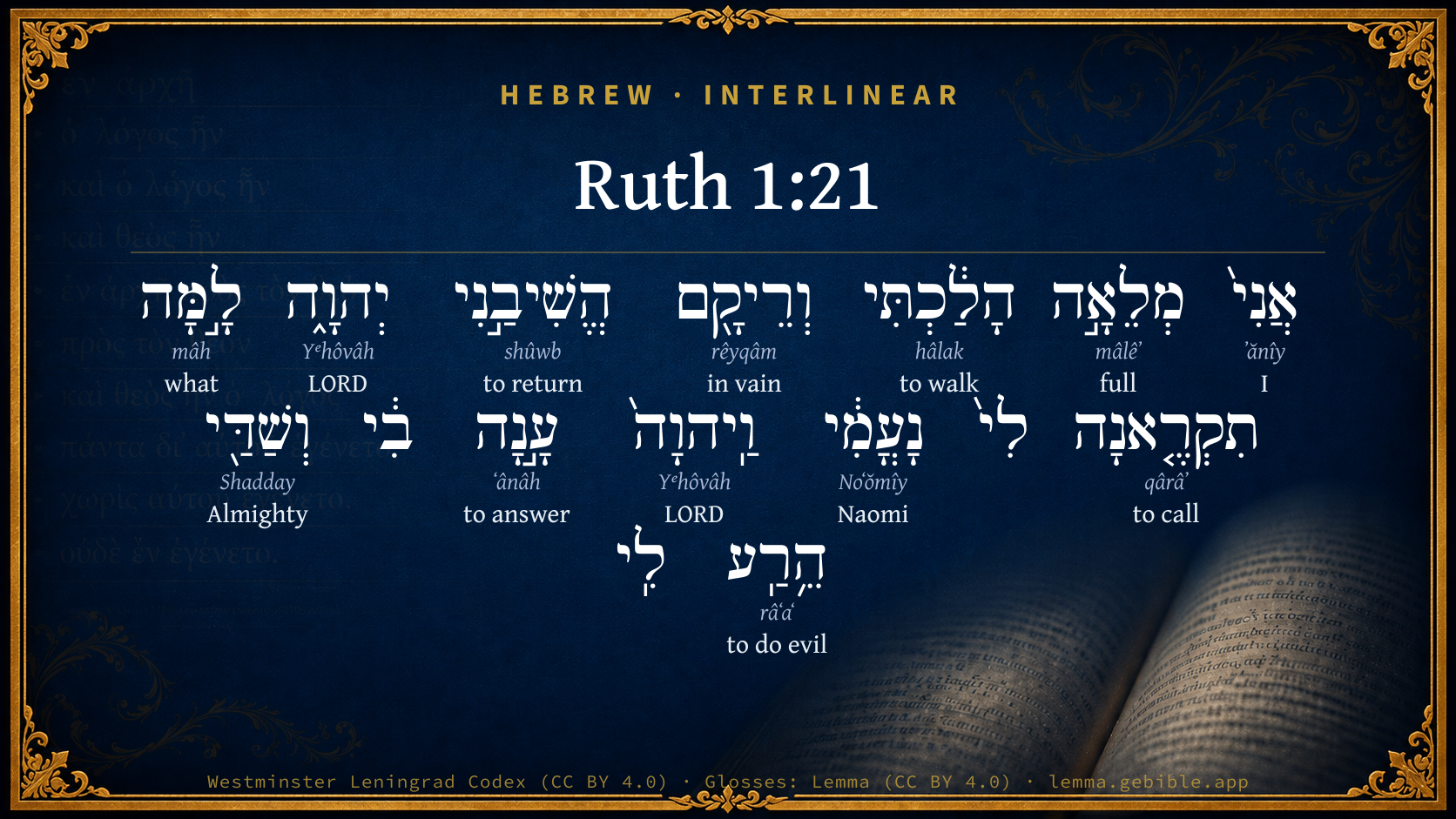
Ruth 1:21

Hebrew (Westminster Leningrad Codex) Ruth 1:21 appears in the Hebrew Old Testament. The text above is from the Westminster Leningrad Codex. Each word links to its Strong’s number, a concise gloss, and parsing drawn from the Open Scriptures Hebrew Bible morphology. Click any word for its full Brown-Driver-Briggs (BDB) entry.
Download image
Cite this verse

Ruth 1:21 (World English Bible). Public Domain. Lemma interlinear Bible study tool, https://lemma.gebible.app/v/ruth/1/21.

Show BibTeX & RIS
BibTeX
RIS
English Translation
I went out full, and Yahweh has brought me home again empty; why do you call me Naomi, seeing Yahweh has testified against me, and the Almighty has afflicted me?"
World English Bible · Public Domain
Download a study sheet

One document with this verse’s original text, its word-by-word gloss line, the meaning frame, cross-references with their text, attributed commentary, and full source and license credits — printable, and it pastes into notes with its structure intact.

This verse Autodidact and up

Study sheet (.html) Plain text (.txt)

A passage Seminary Student

Up to 50 verses in one chapter. A passage sheet keeps up to 6 commentary sources and 12 cross-references per verse, in the order this page ranks them, and says so on the sheet whenever that leaves anything out. Ask for a single verse and you get the Autodidact verse sheet above.

Everything on this page stays free to read, with no account — the sheet is a download of what is already on screen, not access to it.

Want to remove ads? Support Godless Engineer
Compare translations 3

The same verse in 3 English versions, stacked beneath the original-language interlinear above. Click any original word for its lexicon entry.

Each is an independent rendering of the whole verse — the interlinear is not word-aligned to these translations.

Highlighted words mark where these versions differ — a whole-verse word diff, not a word-by-word alignment.

  • World English Bible Public Domain
    I went out full, and Yahweh has brought me home again empty; why do you call me Naomi, seeing Yahweh has testified against me, and the Almighty has afflicted me?"
  • King James Version Public Domain
    I went out full and the LORD hath brought me home again empty: why then call ye me Naomi, seeing the LORD hath testified against me, and the Almighty hath afflicted me?
  • unfoldingWord Literal Text CC BY-SA 4.0
    As for me, I went out full, but Yahweh has brought me back empty. Why would you call me Naomi? But as for Yahweh, he has testified against me, and the Almighty has done evil to me.”

unfoldingWord Literal Text — © unfoldingWord, licensed CC BY-SA 4.0. Word-aligned USFM3 via Door43 (git.door43.org/unfoldingWord/en_ult).

Versions to compare (up to 4)

3 of 4 selected

Show all 18 translations

Every available English version of this verse, each an independent rendering of the whole verse.

  • World English Bible Public Domain
    I went out full, and Yahweh has brought me home again empty; why do you call me Naomi, seeing Yahweh has testified against me, and the Almighty has afflicted me?"
  • Berean Standard Bible Public Domain
    I went away full, but the LORD has brought me back empty. Why call me Naomi? After all, the LORD has testified against me, and the Almighty has afflicted me.”
  • Majority Standard Bible Public Domain
    I went away full, but the LORD has brought me back empty. Why call me Naomi? After all, the LORD has testified against me, and the Almighty has afflicted me.”
  • King James Version Public Domain
    I went out full and the LORD hath brought me home again empty: why then call ye me Naomi, seeing the LORD hath testified against me, and the Almighty hath afflicted me?
  • American Standard Version (1901) Public Domain
    I went out full, and Jehovah hath brought me home again empty; why call ye me Naomi, seeing Jehovah hath testified against me, and the Almighty hath afflicted me?
  • Revised Version (1885) Public Domain
    I went out full, and the LORD hath brought me home again empty: why call ye me Naomi, seeing the LORD hath testified against me, and the Almighty hath afflicted me?
  • Geneva Bible (1599) Public Domain
    I went out full, and the Lord hath caused me to returne emptie: why call ye me Naomi, seeing the Lord hath humbled me, and the Almightie hath brought me vnto aduersitie?
  • Douay-Rheims (1899) Public Domain
    I went out full, and the Lord hath brought me back empty. Why then do you call me Noemi, whom the Lord hath humbled and the Almighty hath afflicted?
  • Young's Literal Translation Public Domain
    I went out full, and empty hath Jehovah brought me back, why do ye call me Naomi, and Jehovah hath testified against me, and the Almighty hath done evil to me?'
  • Literal Standard Version CC BY-SA 4.0
    I went out full, and YHWH has brought me back empty, why do you call me Naomi, and YHWH has testified against me, and the Almighty has done evil to me?”
  • Unlocked Literal Bible CC BY-SA 4.0
    I went out full, but Yahweh has brought me home again empty. So why do you call me Naomi, seeing Yahweh has condemned me, that the Almighty has afflicted me?”
  • unfoldingWord Literal Text CC BY-SA 4.0
    As for me, I went out full, but Yahweh has brought me back empty. Why would you call me Naomi? But as for Yahweh, he has testified against me, and the Almighty has done evil to me.”
  • Darby Bible Public Domain
    I went out full, and Jehovah has brought me home again empty. Why do ye call me Naomi, seeing Jehovah has brought me low, and the Almighty has afflicted me?
  • World Messianic Bible Public Domain
    I went out full, and the LORD has brought me home again empty. Why do you call me Naomi, since the LORD has testified against me, and the Almighty has afflicted me?”
  • Webster's Bible Public Domain
    I went out full, and the LORD hath brought me home again empty: why then call ye me Naomi, seeing the LORD hath testified against me, and the Almighty hath afflicted me?
  • Free Bible Version CC BY-SA 4.0
    I left here full, but the Lord has brought me home empty. Why call me Naomi when the Lord has condemned me, when the Almighty has brought disaster on me?”
  • Bible in Basic English Public Domain
    I went out full, and the Lord has sent me back again with nothing; why do you give me the name Naomi, seeing that the Lord has given witness against me, and the Ruler of all has sent sorrow on me?
  • JPS Tanakh (1917) Public Domain
    I went out full, and the LORD hath brought me back home empty; why call ye me Naomi, seeing the LORD hath testified against me, and the Almighty hath afflicted me?'

Literal Standard Version (2020), Covenant Press — licensed CC BY-SA 4.0. Text via the HelloAO Bible API (eBible.org). Unlocked Literal Bible (unfoldingWord) — licensed CC BY-SA 4.0. Text via the HelloAO Bible API (eBible.org). unfoldingWord Literal Text — © unfoldingWord, licensed CC BY-SA 4.0. Word-aligned USFM3 via Door43 (git.door43.org/unfoldingWord/en_ult). Free Bible Version, Dr. Jonathan Gallagher — licensed CC BY-SA 4.0. Text via the HelloAO Bible API (eBible.org).

Word by word

More ways to search: Search by grammar → Find every occurrence → Compare this word →

Practice this passage: Drill this verse → Learn its vocabulary →

וְרֵיקָ֖ם
rêyqâm
H7387
“and · in vain”
Conjunction + Adverb
Part of Speech
Conjunction + Adverb
Full BDB Definition

Origin: from H7386

TWOT: 2161c

vainly, emptily - in empty condition, empty, emptily - in vain, without effect, vainly
  1. אֲנִי֙ ʼănîy H589 “I” Pronoun, Personal, 1st Person, Common, Singular
  2. מְלֵאָ֣ה mâlêʼ H4392 “full” Adjective, Adjective, Feminine, Singular, Absolute
  3. הָלַ֔כְתִּי hâlak H1980 “to walk” Verb, Qal, Perfect, 1st Person, Common, Singular
  4. הֱשִׁיבַ֣נִי shûwb H7725 “to return · me” Verb, Hiphil, Perfect, 3rd Person, Masculine, Singular + Suffix, Personal, 1st Person, Common, Singular
  5. יְהוָ֑ה Yᵉhôvâh H3068 “LORD” Noun, Proper
  6. לָ֣מָּה mâh H4100 “to/for · what” Preposition + Particle, Interrogative
  7. תִקְרֶ֤אנָה qârâʼ H7121 “to call” Verb, Qal, Imperfect, 2nd Person, Feminine, Plural
  8. נָעֳמִ֔י Noʻŏmîy H5281 “Naomi” Noun, Proper
  9. וַֽיהוָה֙ Yᵉhôvâh H3068 “and · LORD” Conjunction + Noun, Proper
  10. עָ֣נָה ʻânâh H6030 “to answer” Verb, Qal, Perfect, 3rd Person, Masculine, Singular
  11. וְשַׁדַּ֖י Shadday H7706 “and · Almighty” Conjunction + Noun, Proper
  12. הֵ֥רַֽע râʻaʻ H7489 “to do evil” Verb, Hiphil, Perfect, 3rd Person, Masculine, Singular

About this verse

These counts appear in no published source. They are computed here, from the morphology-tagged text and Lemma’s own curated glosses. What Lemma adds →

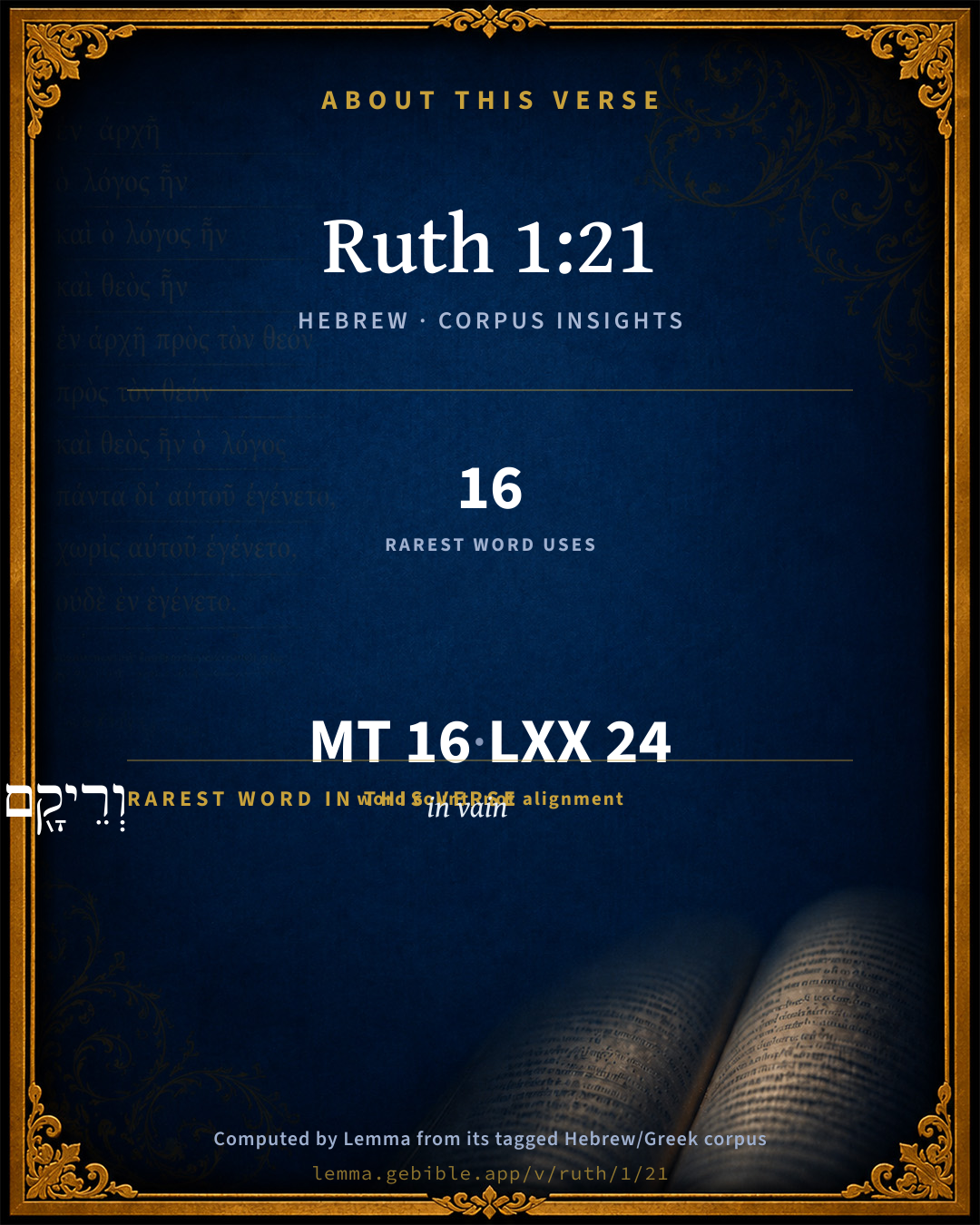
16
words
12
distinct lemmas
Historical
section

Notable vocabulary

The rarest word here is וְרֵיקָ֖ם in vain H7387 — appearing just 16 times in the whole Hebrew Bible.

Shared distinctive vocabulary

וְרֵיקָ֖ם in vain H7387 occurs in 16 verses of the Hebrew Bible. Also found in:

Grammatical profile

  • 5 verbs
  • 4 nouns
  • 1 adjective
  • 1 pronoun
  • 3 prepositions
  • 1 adverb
  • 1 particle

Verb forms

  • הָלַ֔כְתִּי Qal · Perfect
  • הֱשִׁיבַ֣נִי Hiphil · Perfect
  • תִקְרֶ֤אנָה Qal · Imperfect
  • עָ֣נָה Qal · Perfect
  • הֵ֥רַֽע Hiphil · Perfect

Repetition

A word recurs within this verse — often emphatic in Hebrew:

  • יְהוָ֑ה LORD H3068 ×2

Hebrew & Septuagint length

In English translation the verse runs 30 words from the Hebrew and 31 from the Septuagint (LXX English) — closely comparable.

A rough comparison of the two English renderings, which tokenize alike — not a word-level alignment.

Word counts can differ between the Hebrew and the Greek without any difference in meaning — e.g. the Hebrew direct-object marker אֵת has no separate Greek word, and Greek often adds the article ὁ.

In the original languages it is 16 Hebrew tokens and 24 Greek tokens — but the two are counted differently (Hebrew bundles its prefixes and suffixes into one token; the Greek is in lemma form), so that isn’t a like-for-like length.

Cross-references

5

Topical passages linked to Ruth 1:21 in the Treasury of Scripture Knowledge — connected by theme and wording, ordered by reader-vote popularity; previews shown in the World English Bible.

  • 1 Samuel 2:7–8 Yahweh makes poor, and makes rich: He brings low, he also lifts up.
  • Job 1:21 He said, "Naked I came out of my mother's womb, and naked shall I return there. Yahweh gave, and Yahweh has taken away. Blessed be the name of Yahweh."
  • Job 13:26 For you write bitter things against me, And make me inherit the iniquities of my youth:
  • Job 16:8 You have shriveled me up. This is a witness against me. My leanness rises up against me, It testifies to my face.
  • Job 10:17 You renew your witnesses against me, And increase your indignation on me. Changes and warfare are with me.

Cross-references courtesy of OpenBible.info (CC BY 4.0).

Hebrew and Greek witnesses Masoretic Hebrew ↔ Greek Septuagint

The same verse in the two great witnesses to the Old Testament, shown verse-for-verse.

These are two independent witnesses, not word-aligned to each other, and the Septuagint is shown in lemma (dictionary) form.

Hebrew Ruth 1:21 Masoretic · Westminster Leningrad Codex

אֲנִי֙ מְלֵאָ֣ה הָלַ֔כְתִּי וְרֵיקָ֖ם הֱשִׁיבַ֣נִי יְהוָ֑ה לָ֣מָּה תִקְרֶ֤אנָה לִי֙ נָעֳמִ֔י וַֽיהוָה֙ עָ֣נָה בִ֔י וְשַׁדַּ֖י הֵ֥רַֽע לִֽי

I went out full, and Yahweh has brought me home again empty; why do you call me Naomi, seeing Yahweh has testified against me, and the Almighty has afflicted me?"

World English Bible · Public Domain

Greek LXX Ruth 1:21 Septuagint · lemma form

ἐγώ πλήρης πορεύομαι καί κενός ἀποστρέφω ἐγώ ὁ κύριος καί ἵνα τίς καλέω ἐγώ νωεμιν καί κύριος ταπεινόω ἐγώ καί ὁ ἱκανός κακόω ἐγώ

I went out full, and the Lord has brought me back empty: and why call you⌃ me Noemin, whereas the Lord has humbled me and the Mighty One has afflicted me?

LXX2012 (modern English Septuagint) · Public Domain

On this verse, The Cambridge Bible for Schools and Colleges discusses the Septuagint’s reading. Read the note in Commentary ↓

Hebrew: Westminster Leningrad Codex (CC BY 4.0). Greek: Septuagint (public domain); English from LXX2012 (modern English Septuagint) (Public Domain). How the Septuagint differs from the Hebrew →

Commentary

Notes on Ruth 1:21 from classic Christian and Jewish commentators (each source and its license shown beneath its notes). The classic Christian expositions comment on the surrounding passage and are grouped to its opening verse, so a note may address several verses; the Jewish commentaries on the Tanakh (Rashi and others) are per-verse, so they appear only where the commentator wrote on this verse.

Lemma curates 59 commentaries, every one of them public domain or Creative Commons licensed, each selected and text-cleaned for this edition rather than reprinted as found. About our sources →

Trapp's Complete Commentary

John Trapp

Rth 1:21 I went out full, and the LORD hath brought me home again empty: why [then] call ye me Naomi, seeing the LORD hath testified against me, and the Almighty hath afflicted me?

Ver. 21. I went out full.] Not for want, but for fear of want. This she now regretteth, as done out of distrust. God’s voice is, "Dwell in the land, and verily thou shalt be fed." {Psa 37:3}

Home again empty.] By weeping cross. They that go out of God’s precincts, go out of his protection: Jehoshaphat’s ships were broken; Lot lost all; Josiah came short home.

Hath testified against me.] As a witness of my sin, and of his just displeasure; - see Job 10:17; Job 16:8; {See Trapp on "Job 10:17"} {See Trapp on "Job 16:8"} - a metaphor from adversaries at law.

Hath afflicted me.] Howbeit, Quos amat, hos non vult, spero, perire Deus.

John Trapp, A Commentary or Exposition upon All the Books of the Old and New Testament (1647–1656) — public domain. Text from a community e-Sword module.

Adam Clarke's Commentary

Verse 21. I went out full] Having a husband and two sons.

The Lord hath brought me home again empty] Having lost all three by death. It is also likely that Elimelech took considerable property with him into the land of Moab; for as he fled from the face of the famine, he would naturally take his property with him; and on this Naomi subsisted till her return to Bethlehem, which she might not have thought of till all was spent.

Adam Clarke's Commentary on the Bible (1810–1826) — public domain. Text from a community e-Sword/MySword module.

The Cambridge Bible for Schools and Colleges

gen. ed. J. J. S. Perowne

21. hath testified against me] i. e. hath marked His displeasure by the misfortunes which have overtaken me; for the idiom cf. Num_35:30, 1Sa_12:3. The Targ. characteristically moralizes: it was on account of Naomi’s sin (in migrating to a heathen country). The LXX. and Vulg., pronouncing the verb differently, render hath humbled me, but against the Hebr. construction. Underlying the words is the conviction, so deeply rooted in the Hebrew mind, that all must go well with the righteous and that misfortune was a sign of Jehovah’s wrath.

The Cambridge Bible for Schools and Colleges (gen. ed. J. J. S. Perowne; Cambridge University Press, 1878–1918) — public domain. Text from a community e-Sword module.

John Gill's Exposition

I went out full,.... Of my husband and children, as the Targum; of children and riches, as Aben Ezra and Jarchi; wherefore some Jewish writers blame her and her husband for going abroad at such a time, and ascribe it to a covetous disposition, and an unwillingness to relieve the poor that came to them in their distress, and therefore got out of the way of them, on account of which they were punished, so Jarchi on Rut 1:1, see Jdg 2:15 but this is said without any just cause or reason that appears:

and the Lord hath brought me home again empty: deprived of her husband, children, and substance; she acknowledges the hand of God in it, and seems not to murmur at it, but to submit to it quietly, and bear it patiently:

why then call ye me Naomi; when there is nothing pleasant and agreeable in me, nor in my circumstances:

seeing the Almighty hath testified against me, and the Almighty hath afflicted me? had bore witness that that was not a name suitable for her; or that she had sinned, and had not done what was well pleasing in his sight, as appeared by his afflicting her; she seemed therefore to be humbled under a sense of sin, and to consider afflictions as coming from the Lord on account of it, and submitted to his sovereign will; the affliction she means was the loss of her husband, children, and substance; see Job 10:17.

John Gill's Exposition of the Whole Bible (1746–1763) — public domain (CC PDM 1.0). Text via the HelloAO Bible API.

Albert Barnes' Notes on the Bible

The Lord hath testified against me - The phrase is very commonly applied to a man who gives witness concerning (usually against) another in a court of justice Exo 20:16; 2Sa 1:16; Isa 3:9. Naomi in the bitterness of her spirit complains that the Lord Himself turned against her, and was bringing her sins up for judgment.

Albert Barnes' Notes on the Bible (1834–1885) — public domain. Text from a community e-Sword/MySword module.

Haydock's Catholic Bible Commentary

Almighty. Hebrew Sadai, ("the self-sufficient) hath afflicted."

George Leo Haydock (1774–1849), Haydock's Catholic Family Bible and Commentary, 1859 edition — public domain. Excludes Psalms (Douay-Rheims chapter numbering differs from Protestant) and Deuterocanonical books (Catholic canon only).

Matthew Poole's English Annotations

Full; with my husband and sons, and a plentiful estate for our support.

Hath testified against me, i.e. hath borne witness, as it were, in judgment, and given sentence against me, and declared my sin by my punishment.

Matthew Poole's English Annotations on the Holy Bible (1683–1685) — public domain. Text from a community e-Sword/MySword module.

Whedon's Commentary on the Bible

Daniel D. Whedon

21. I went out full — That is, in the rich possession of a husband and two sons.

Home again empty — Bereft of my most precious treasures, so that the cause of my pleasantness is gone.

Daniel D. Whedon (gen. ed.), Commentary on the Old and New Testaments (1874–1909) — public domain. Text from a community e-Sword module.

The Pulpit Commentary

I went forth full, and Yahveh has caused me to return in emptiness. Why should you call me Naomi, and Yahveh has testified against me, and the Almighty has brought evil upon me? She went forth "full," with husband and sons, not to speak of goods. She was under the necessity of returning in emptiness, or with empty hands. The Hebrew word yre does not exactly mean empty, as it is rendered in the Septuagint, the Vulgate, and King James"s version. It is not an adjective, but an adverb, emptily. This lamentable change of circumstances she attributed to the action of Yahveh. He had, she believed, been testifying against her by means of the trials through which she had passed. She was right in a certain conditional acceptation of her language; but only on condition of that condition. And, let us condition her declarations as we may, she was probably in danger of making the same mistake concerning herself and her trials which was made by Job"s comforters in reference to the calamities by which he was overwhelmed. In so far as penal evil is concerned, it may be traced directly or circuitously to the will and government of God. Shall there be evil that is, penal evil in a city, and the Lord hath not done it?". (Amo_3:6) But there are many sufferings that are not penal. The evil that is penal is only one segment of physical evil; and then there is besides, metaphysical evil, or the evil that consists in the inevitable imperfection of finite being. It is noteworthy that the participle of the Hiphilic verb rhe employed by Naomi is always translated in King James s version evil doer , or wicked doer, or evil, or wicked, Naomi, in using such a term, and applying it to Yahveh, was walking on a theological precipice, where it is not needful that we should accompany her. Instead of the literal expression, andYahveh, we may, with our English wealth of conjunctions freely say, when" Yahveh. There is a charm in the original simplicity. There is likewise a charm in the more complex structure of the free translation.

"I went out full, and the Lord hath brought me home again empty.

It seemed, indeed, a via dolorosa, this path homeward. How expressive the words.

I LOVE MAKES LIFE FULL. Why, I thought they went out poor? Yes. Seeking bread? Yes. Yet Naomi"s description is true and beautiful. We are "full" when we have that which makes home, home indeed, and we are poor if, having all wealth of means, we have not love. Well, indeed, has it been said that "the golden moments in the stream of life rush past us, and we see nothing but sand; the angels come to visit us, and we only know them when they are gone." We never know how empty life is till the loved are lost to us.

II THE LORD IS THE DISPOSER OF ALL EVENTS. "The Lord hath brought me home." We talk of Providence when all goes well with us, when the harvests are ripened, and the fruits hang on the wall. But we must not limit Providence to the pleasant. The Lord "takes away" as well as gives. It is said that, in the order of reading at the family altar, when the late John Angell James was about to conduct worship after a severe bereavement, the Psalm to be read was the hundred and third. The good man stopped, tears rolled down his face; and then, gathering up his strength, he said, "Why not? It is the Father!" and he read on, Bless the Lord, O my soul!

III THE FULLEST HOME MAY SOON BE EMPTIED. Yes! We too should feel it so. A husband and two sons gone! What converse there had been! what interest in each other"s pursuits I what affectionate concern for each other"s weal and happiness! and what a wealth of love for Naomi, the center of all I We feel at such seasons that death would be blessed relief for us. The thought comes across us, "I have got to live;" to live on from day to day, attending to the minutiae of duty, and coming here and there so often on the little relics of the dead. Home again! That has music in it for the school-children, who come back to the bright home; but to the widow, oh, how different! Home again, but how empty! Yet we may learn, even from Naomi, that rest and refreshment come to hearts that trust in God their Savior; and we may learn too what mistakes we make. Naomi said, "Why call ye me Naomi, seeing that the Lord hath testified against me?" Natural enough; but life was still to have a pleasant side for her. W.M.S.

The Pulpit Commentary (1880–1919), ed. H.D.M. Spence-Jones & Joseph S. Exell — public domain. Text from a community e-Sword module.

John Wesley's Explanatory Notes

Full - With my husband and sons, and a plentiful estate for our support. Testified - That is, hath born witness, as it were, in judgment, and given sentence against me.

John Wesley, Explanatory Notes Upon the Whole Bible (1754–1765) — public domain. Text via the GEBible commentary corpus.

Rashi

Rabbi Shlomo Yitzchaki (Rashi)

I went away full with wealth and sons. Another interpretation is that she was pregnant.

has testified Heb. עָנָה, has testified against me that I dealt wickedly before Him. Another explanation: The Divine Standard of Justice has humbled me, as (Hosea 5:5): “And the pride of Israel shall be humbled (וְעָנָה).”

Rashi on the Tanakh — English translations: “The Judaica Press complete Tanach with Rashi, translated by A. J. Rosenberg” (CC BY 4.0); “Pentateuch with Rashi's commentary by M. Rosenbaum and A.M. Silbermann, 1929-1934” (public domain); “The Metsudah Tanach series, Lakewood, N.J” (CC BY 4.0); and “The Book of Joshua, Metsudah Publications, 1997” (CC BY 4.0). Text via Sefaria.

Ibn Ezra

Rabbi Abraham ibn Ezra

"Full.": with sons and wealth.

"And the Lord has testified against me.": Some say it comes from the root to answer because of me, but in my opinion, it is from the root of 'you shall not testify against your neighbor,' as in 'bring forth your witnesses against me.'

"And the Almighty has afflicted me.": Like a plague. Similar to 'creates evil,' either it afflicted me because of my sins, or the text speaks in the language of humans, and this is correct."

"The 'heh' of the response." The 'heh' of knowledge, as is found here."

"And the reason Naomi returned." Another time, to specify the time they came at the beginning of the barley harvest, for the gleaning of Ruth."

Ibn Ezra on the Tanakh — English translations: “Sefaria Community Translation” (CC0 1.0 (public-domain dedication)); “Yalkut, Sifsei Chachomim Chumash, Metsudah Publications, 2009” (CC BY 4.0); and “Commentary of Ibn Ezra on Isaiah - trans. by M. Friedlander, 1873” (public domain). Text via Sefaria.

Lesson kit

Teaching starters — assembled from the data on this page, not authored interpretation. Every prompt links to the verse data it draws on. Edit before teaching.

Ruth, in the Historical, opens this verse with 16 words (12 distinct Hebrew lemmas). Its most distinctive word is rêyqâm (“in vain”). A historical commentator’s framing appears above. Read the whole chapter for the surrounding context.

Discussion questions

  1. The word rêyqâm carries the sense “in vain.” How does it shape the verse?
  2. How does Genesis 31:42, which shares the word «in vain», read alongside this verse?
  3. What does the repetition of “LORD” (2× in this one verse) do in this verse?
  4. These translations render this verse differently; the difference is in the English rendering, not the original. What questions does that raise?
  5. «הָלַ֔כְתִּי» is a Qal Perfect verb. How does that grammatical form shape the action described?
  6. Compare how Trapp's Complete Commentary and Adam Clarke's Commentary read this verse. Where do they agree or differ?

Things to notice

Reading settings

Reading text

Shown beneath each verse's original-language words.

Old Testament
Old Testament edition

Read the OT as the Masoretic Hebrew (MT) or the Greek Septuagint (LXX).

English shown for the Greek Septuagint (in the Hebrew ↔ Greek comparison).

Comparing translations? Open the Compare panel on any verse page to stack up to four side by side.