
Exodus 33:16

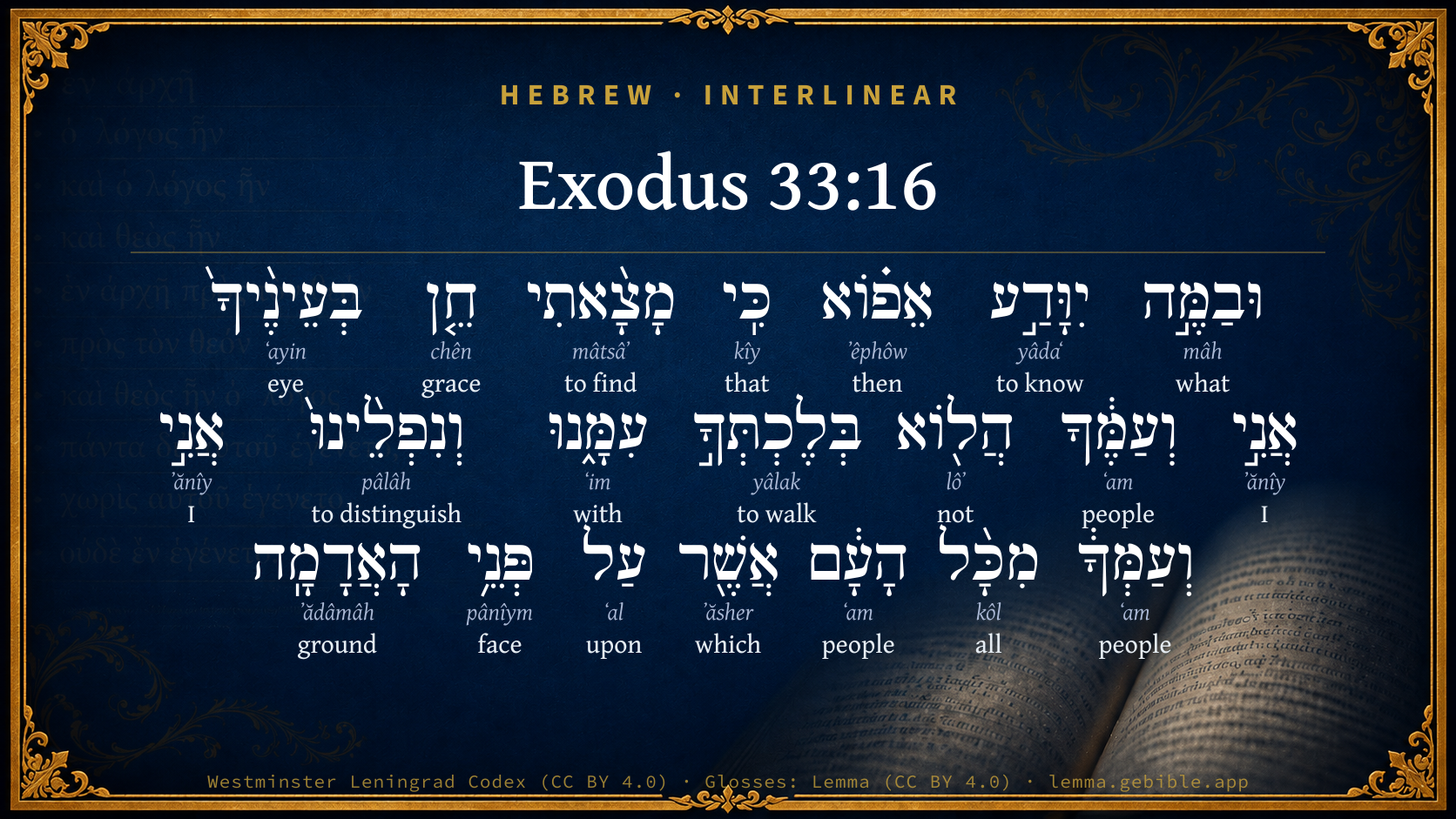
Hebrew (Westminster Leningrad Codex) Exodus 33:16 appears in the Hebrew Old Testament. The text above is from the Westminster Leningrad Codex. Each word links to its Strong’s number, a concise gloss, and parsing drawn from the Open Scriptures Hebrew Bible morphology. Click any word for its full Brown-Driver-Briggs (BDB) entry.
Download image
Cite this verse

Exodus 33:16 (World English Bible). Public Domain. Lemma interlinear Bible study tool, https://lemma.gebible.app/v/exodus/33/16.

Show BibTeX & RIS
BibTeX
RIS
English Translation
For how would people know that I have found favor in your sight, I and your people? Isn't it in that you go with us, so that we are separated, I and your people, from all the people who are on the surface of the earth?"
World English Bible · Public Domain
Download a study sheet

One document with this verse’s original text, its word-by-word gloss line, the meaning frame, cross-references with their text, attributed commentary, and full source and license credits — printable, and it pastes into notes with its structure intact.

This verse Autodidact and up

Study sheet (.html) Plain text (.txt)

A passage Seminary Student

Up to 50 verses in one chapter. A passage sheet keeps up to 6 commentary sources and 12 cross-references per verse, in the order this page ranks them, and says so on the sheet whenever that leaves anything out. Ask for a single verse and you get the Autodidact verse sheet above.

Everything on this page stays free to read, with no account — the sheet is a download of what is already on screen, not access to it.

Want to remove ads? Support Godless Engineer
Compare translations 3

The same verse in 3 English versions, stacked beneath the original-language interlinear above. Click any original word for its lexicon entry.

Each is an independent rendering of the whole verse — the interlinear is not word-aligned to these translations.

Highlighted words mark where these versions differ — a whole-verse word diff, not a word-by-word alignment.

  • World English Bible Public Domain
    For how would people know that I have found favor in your sight, I and your people? Isn't it in that you go with us, so that we are separated, I and your people, from all the people who are on the surface of the earth?"
  • King James Version Public Domain
    For wherein shall it be known here that I and thy people have found grace in thy sight? is it not in that thou goest with us? so shall we be separated, I and thy people, from all the people that are upon the face of the earth.
  • unfoldingWord Literal Text CC BY-SA 4.0
    And in what then will it be known that I have found favor in your eyes, I and your people? not in your going with us? And I and your people shall be distinct from all of the people that on the face of the earth.”

unfoldingWord Literal Text — © unfoldingWord, licensed CC BY-SA 4.0. Word-aligned USFM3 via Door43 (git.door43.org/unfoldingWord/en_ult).

Versions to compare (up to 4)

3 of 4 selected

Show all 18 translations

Every available English version of this verse, each an independent rendering of the whole verse.

  • World English Bible Public Domain
    For how would people know that I have found favor in your sight, I and your people? Isn't it in that you go with us, so that we are separated, I and your people, from all the people who are on the surface of the earth?"
  • Berean Standard Bible Public Domain
    For how then can it be known that Your people and I have found favor in Your sight, unless You go with us? How else will we be distinguished from all the other people on the face of the earth?”
  • Majority Standard Bible Public Domain
    For how then can it be known that Your people and I have found favor in Your sight, unless You go with us? How else will we be distinguished from all the other people on the face of the earth?”
  • King James Version Public Domain
    For wherein shall it be known here that I and thy people have found grace in thy sight? is it not in that thou goest with us? so shall we be separated, I and thy people, from all the people that are upon the face of the earth.
  • American Standard Version (1901) Public Domain
    For wherein now shall it be known that I have found favor in thy sight, I and thy people? is it not in that thou goest with us, so that we are separated, I and thy people, from all the people that are upon the face of the earth?
  • Revised Version (1885) Public Domain
    For wherein now shall it be known that I have found grace in thy sight, I and thy people? is it not in that thou goest with us, so that we be separated, I and thy people, from all the people that are upon the face of the earth?
  • Geneva Bible (1599) Public Domain
    And wherein nowe shall it be knowen, that I and thy people haue found fauour in thy sight? shall it not be when thou goest with vs? so I, and thy people shall haue preeminence before all the people that are vpon the earth.
  • Douay-Rheims (1899) Public Domain
    For how shall we be able to know, I and thy people, that we have found grace in thy sight, unless thou walk with us, that we may be glorified by all people that dwell upon the earth?
  • Young's Literal Translation Public Domain
    and in what is it known now, that I have found grace in Thine eyes -- I and Thy people -- is it not in Thy going with us? and we have been distinguished -- I and Thy people -- from all the people who `are' on the face of the ground.'
  • Literal Standard Version CC BY-SA 4.0
    and in what is it known now, that I have found grace in Your eyes—I and Your people—is it not in Your going with us? And we have been distinguished—I and Your people—from all the people who [are] on the face of the ground.”
  • Unlocked Literal Bible CC BY-SA 4.0
    For otherwise, how will it be known that I have found favor in your eyes, I and your people? Will it not only be if you go with us so that I and your people are different from all the other peoples that are on the surface of the earth?”
  • unfoldingWord Literal Text CC BY-SA 4.0
    And in what then will it be known that I have found favor in your eyes, I and your people? not in your going with us? And I and your people shall be distinct from all of the people that on the face of the earth.”
  • Darby Bible Public Domain
    And how shall it be known then that I have found grace in thine eyes -- I and thy people? [Is it] not by thy going with us? so shall we be distinguished, I and thy people, from every people that is on the face of the earth.
  • World Messianic Bible Public Domain
    For how would people know that I have found favor in your sight, I and your people? Isn’t it that you go with us, so that we are separated, I and your people, from all the people who are on the surface of the earth?”
  • Webster's Bible Public Domain
    For wherein shall it be known here that I and thy people have found grace in thy sight? Is it not in that thou goest with us? So shall we be separated, I and thy people, from all the people that are upon the face of the earth.
  • Free Bible Version CC BY-SA 4.0
    “How will others know that you are happy with me, and with your people, if you don't accompany us? How would anyone tell us apart—me and your people—from every other people who live on the earth?”
  • Bible in Basic English Public Domain
    For is not the fact of your going with us the sign that I and this people have grace in your eyes, so that we, that is, I and your people, are separate from all other people on the face of the earth?
  • JPS Tanakh (1917) Public Domain
    For wherein now shall it be known that I have found grace in Thy sight, I and Thy people? is it not in that Thou goest with us, so that we are distinguished, I and Thy people, from all the people that are upon the face of the earth?'

Literal Standard Version (2020), Covenant Press — licensed CC BY-SA 4.0. Text via the HelloAO Bible API (eBible.org). Unlocked Literal Bible (unfoldingWord) — licensed CC BY-SA 4.0. Text via the HelloAO Bible API (eBible.org). unfoldingWord Literal Text — © unfoldingWord, licensed CC BY-SA 4.0. Word-aligned USFM3 via Door43 (git.door43.org/unfoldingWord/en_ult). Free Bible Version, Dr. Jonathan Gallagher — licensed CC BY-SA 4.0. Text via the HelloAO Bible API (eBible.org).

Word by word

More ways to search: Search by grammar → Find every occurrence → Compare this word →

Practice this passage: Drill this verse → Learn its vocabulary →

וְנִפְלֵ֨ינוּ֙
pâlâh
H6395
“and · to distinguish”
Conjunction + Verb, Niphal, Sequential Perfect, 1st Person, Common, Plural
Part of Speech
Conjunction + Verb
Stem
Niphal
Form
Sequential Perfect
Person
1st Person
Gender
Common
Number
Plural
Full BDB Definition

Origin: a primitive root

TWOT: 1772

to be distinct, marked out, be separated, be distinguished - (Niphal) - to be distinct, be separated, be distinguished - to be wonderful - (Hiphil) to make separate, set apart
  1. וּבַמֶּ֣ה mâh H4100 “and · in/at · what” Conjunction + Preposition + Particle, Interrogative
  2. יִוָּדַ֣ע yâdaʻ H3045 “to know” Verb, Niphal, Imperfect, 3rd Person, Masculine, Singular
  3. אֵפ֗וֹא ʼêphôw H645 “then” Adverb
  4. כִּֽי kîy H3588 “that” Conjunction
  5. מָצָ֨אתִי mâtsâʼ H4672 “to find” Verb, Qal, Perfect, 1st Person, Common, Singular
  6. חֵ֤ן chên H2580 “grace” Noun, Common, Masculine, Singular, Absolute
  7. בְּעֵינֶ֨יךָ֙ ʻayin H5869 “in/at · eyes · your” Preposition + Noun, Common, Both, Dual, Construct + Suffix, Personal, 2nd Person, Masculine, Singular
  8. אֲנִ֣י ʼănîy H589 “I” Pronoun, Personal, 1st Person, Common, Singular
  9. וְעַמֶּ֔ךָ ʻam H5971 “and · people · your” Conjunction + Noun, Common, Masculine, Singular, Construct + Suffix, Personal, 2nd Person, Masculine, Singular
  10. הֲל֖וֹא lôʼ H3808 “not” Particle, Interrogative + Particle, Negative
  11. בְּלֶכְתְּךָ֣ yâlak H3212 “in/at · to walk · you” Preposition + Verb, Qal, Infinitive Construct + Suffix, Personal, 2nd Person, Masculine, Singular
  12. עִמָּ֑נוּ ʻim H5973 “with · us” Preposition + Suffix, Personal, 1st Person, Common, Plural
  13. אֲנִ֣י ʼănîy H589 “I” Pronoun, Personal, 1st Person, Common, Singular
  14. וְעַמְּךָ֔ ʻam H5971 “and · people · your” Conjunction + Noun, Common, Masculine, Singular, Construct + Suffix, Personal, 2nd Person, Masculine, Singular
  15. מִכָּ֨ל kôl H3605 “from · all of” Preposition + Noun, Common, Masculine, Singular, Construct
  16. הָעָ֔ם ʻam H5971 “the · people” Particle, Definite Article + Noun, Common, Masculine, Singular, Absolute
  17. אֲשֶׁ֖ר ʼăsher H834 “which” Particle, Relative
  18. עַל ʻal H5921 “upon” Preposition
  19. פְּנֵ֥י pânîym H6440 “face(s) of” Noun, Common, Both, Plural, Construct
  20. הָאֲדָמָֽה ʼădâmâh H127 “the · ground” Particle, Definite Article + Noun, Common, Feminine, Singular, Absolute

About this verse

These counts appear in no published source. They are computed here, from the morphology-tagged text and Lemma’s own curated glosses. What Lemma adds →

21
words
18
distinct lemmas
Pentateuch
section

Notable vocabulary

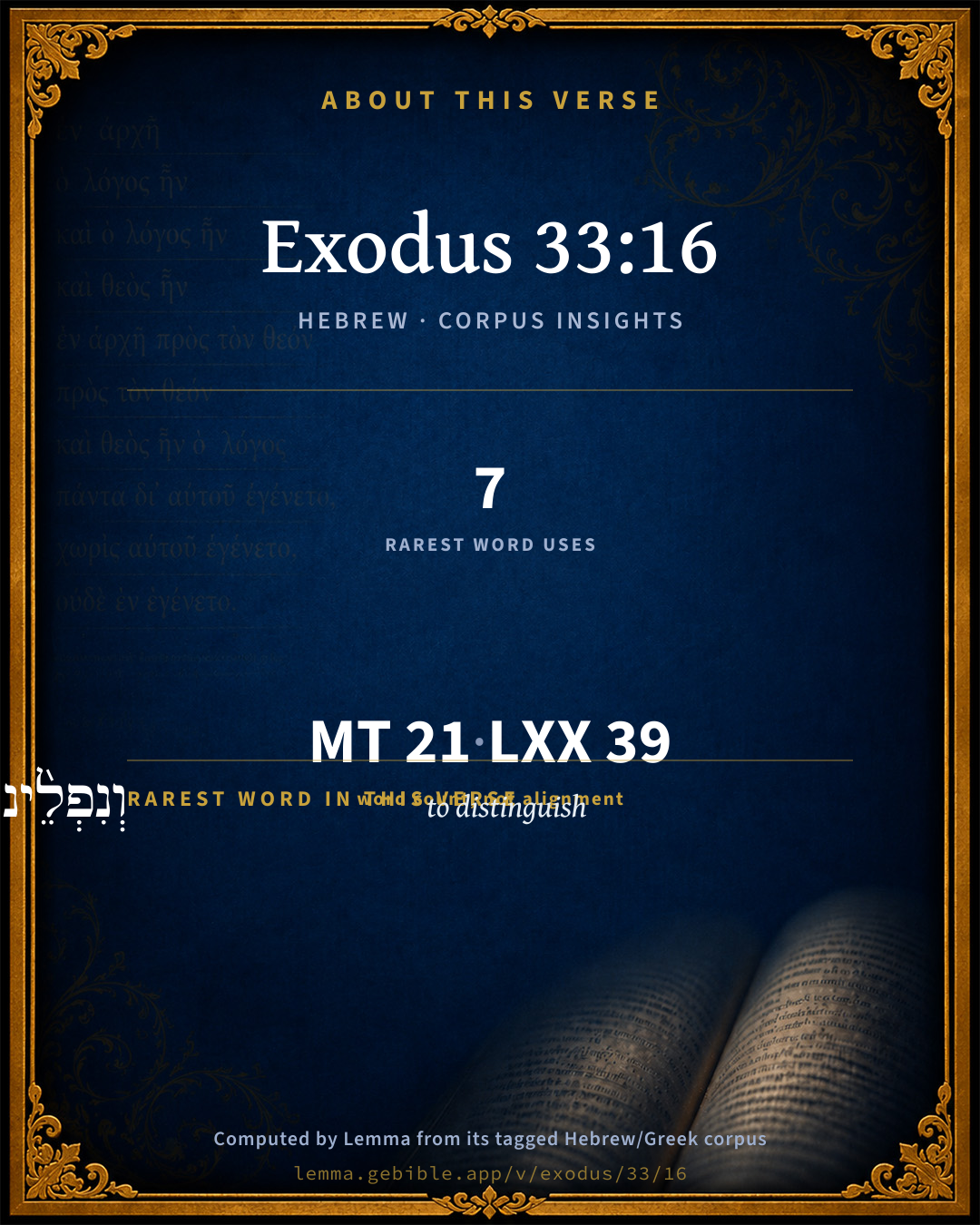
The rarest word here is וְנִפְלֵ֨ינוּ֙ to distinguish H6395 — appearing just 7 times in the whole Hebrew Bible.

Shared distinctive vocabulary

וְנִפְלֵ֨ינוּ֙ to distinguish H6395 occurs in 7 verses of the Hebrew Bible. Also found in:

Grammatical profile

  • 4 verbs
  • 8 nouns
  • 2 pronouns
  • 2 prepositions
  • 1 conjunction
  • 1 adverb
  • 3 particles

Verb forms

  • יִוָּדַ֣ע Niphal · Imperfect
  • מָצָ֨אתִי Qal · Perfect
  • בְּלֶכְתְּךָ֣ Qal · Infinitive Construct
  • וְנִפְלֵ֨ינוּ֙ Niphal · Sequential Perfect

Repetition

Words recur within this verse — often emphatic in Hebrew:

  • וְעַמֶּ֔ךָ people H5971 ×3
  • אֲנִ֣י I H589 ×2

Hebrew & Septuagint length

In English translation the verse runs 46 words from the Hebrew and 45 from the Septuagint (LXX English) — closely comparable.

A rough comparison of the two English renderings, which tokenize alike — not a word-level alignment.

Word counts can differ between the Hebrew and the Greek without any difference in meaning — e.g. the Hebrew direct-object marker אֵת has no separate Greek word, and Greek often adds the article ὁ.

In the original languages it is 21 Hebrew tokens and 39 Greek tokens — but the two are counted differently (Hebrew bundles its prefixes and suffixes into one token; the Greek is in lemma form), so that isn’t a like-for-like length.

Cross-references

12

Topical passages linked to Exodus 33:16 in the Treasury of Scripture Knowledge — connected by theme and wording, ordered by reader-vote popularity; previews shown in the World English Bible.

  • Deuteronomy 4:7 For what great nation is there, that has a god so near to them, as Yahweh our God is whenever we call on him?
  • Numbers 14:14 and they will tell it to the inhabitants of this land. They have heard that you Yahweh are in the midst of this people; for you Yahweh are seen face to face, and your cloud stands over them, and you go before them, in a pillar of cloud by day, and in a pillar of fire by night.
  • 1 Kings 8:53 For you did separate them from among all the peoples of the earth, to be your inheritance, as you spoke by Moses your servant, when you brought our fathers out of Egypt, Lord Yahweh.
  • Matthew 1:23 "Behold, the virgin shall be with child, And shall bring forth a son. They shall call his name Immanuel;" Which is, being interpreted, "God with us."
  • Exodus 34:10 He said, "Behold, I make a covenant: before all your people I will do marvels, such as have not been worked in all the earth, nor in any nation; and all the people among which you are shall see the work of Yahweh; for it is an awesome thing that I do with you.
  • Exodus 8:22 I will set apart in that day the land of Goshen, in which my people dwell, that no swarms of flies shall be there; to the end you may know that I am Yahweh in the midst of the earth.
  • Exodus 19:5–6 Now therefore, if you will indeed obey my voice, and keep my covenant, then you shall be my own possession from among all peoples; for all the earth is mine;
  • 2 Samuel 7:23 What one nation in the earth is like your people, even like Israel, whom God went to redeem to himself for a people, and to make him a name, and to do great things for you, and awesome things for your land, before your people, whom you redeem to you out of Egypt, [from] the nations and their gods?
  • 2 Corinthians 6:17 Therefore, "'Come out from among them, And be separate,' says the Lord, 'Touch no unclean thing. I will receive you.
  • Numbers 23:9 For from the top of the rocks I see him, From the hills I see him: behold, it is a people that dwells alone, And shall not be reckoned among the nations.
  • Deuteronomy 4:34 Or has God tried to go and take him a nation from the midst of [another] nation, by trials, by signs, and by wonders, and by war, and by a mighty hand, and by an outstretched arm, and by great terrors, according to all that Yahweh your God did for you in Egypt before your eyes?
  • Psalms 147:20 He has not done this for just any nation. They don't know his ordinances. Praise Yah!

Cross-references courtesy of OpenBible.info (CC BY 4.0).

Hebrew and Greek witnesses Masoretic Hebrew ↔ Greek Septuagint

The same verse in the two great witnesses to the Old Testament, shown verse-for-verse.

These are two independent witnesses, not word-aligned to each other, and the Septuagint is shown in lemma (dictionary) form.

Hebrew Exodus 33:16 Masoretic · Westminster Leningrad Codex

וּבַמֶּ֣ה יִוָּדַ֣ע אֵפ֗וֹא כִּֽי מָצָ֨אתִי חֵ֤ן בְּעֵינֶ֨יךָ֙ אֲנִ֣י וְעַמֶּ֔ךָ הֲל֖וֹא בְּלֶכְתְּךָ֣ עִמָּ֑נוּ וְנִפְלֵ֨ינוּ֙ אֲנִ֣י וְעַמְּךָ֔ מִכָּ֨ל הָעָ֔ם אֲשֶׁ֖ר עַל פְּנֵ֥י הָאֲדָמָֽה

For how would people know that I have found favor in your sight, I and your people? Isn't it in that you go with us, so that we are separated, I and your people, from all the people who are on the surface of the earth?"

World English Bible · Public Domain

Greek LXX Exodus 33:16 Septuagint · lemma form

καί πῶς γνωστός εἰμί ἀληθῶς ὅτι εὑρίσκω χάρις παρά σύ ἐγώ τε καί ὁ λαός σύ ἀλλά ἤ συνπορεύομαι σύ μετά ἐγώ καί ἐνδοξάζομαι ἐγώ τε καί ὁ λαός σύ παρά πᾶς ὁ ἔθνος ὅσος ἐπί ὁ γῆ εἰμί

And how shall it be surely known, that both I and this people have found favor with you, except only if you go with us? So both I and your people shall be glorified beyond all the nations, as many as are upon the earth.

LXX2012 (modern English Septuagint) · Public Domain

Hebrew: Westminster Leningrad Codex (CC BY 4.0). Greek: Septuagint (public domain); English from LXX2012 (modern English Septuagint) (Public Domain). How the Septuagint differs from the Hebrew →

Targum (Aramaic paraphrase)

2

The Targum is the ancient Jewish Aramaic paraphrase of the Hebrew Scriptures — an interpretive translation, not the Hebrew text itself. Onkelos (literal) and Pseudo-Jonathan (expansive) render the Torah, and Jonathan the Prophets. Coverage is partial: where no permissively-licensed English translation exists for a verse, only the Aramaic is shown. This is verse-level text, not a word-by-word alignment to the Hebrew.

  1. Targum Onkelos Torah (Genesis–Deuteronomy)
    וּבַמֶה יִתְיַדַע הָכָא אֲרֵי אַשְׁכָּחִית רַחֲמִין קֳדָמָךְ אֲנָא וְעַמָךְ הֲלָא בְּמֵהַךְ שְׁכִנְתָּךְ עִמָנָא וְיִתְעַבְּדַן לָנָא פְרִישָׁן לִי וּלְעַמָךְ מְשַׁנֵי מִכָּל עַמָא דִי עַל אַפֵּי אַרְעָא:

    (no public-domain English translation for this verse)

    Targum Onkelos — Aramaic: “Onkelos Genesis” (public domain); “Onkelos Exodus” (public domain); “Onkelos Leviticus” (public domain); “Onkelos Numbers” (public domain); “Onkelos Deuteronomy” (public domain). English: “Sefaria Community Translation” (CC0 1.0 (public-domain dedication)); “J.W. Etheridge. The Targums of Onkelos and Jonathan Ben Uzziel on the Pentateuch. London: Longmans, Green, 1862” (public domain). Text via Sefaria.

  2. Targum Pseudo-Jonathan Torah (Genesis–Deuteronomy)
    וּבְמָה יִתְיְדַע כְּדוּן אֲרוּם אַשְׁכָּחִית רַחֲמִין קֳדָמָךְ אֲנָא וְעַמָּךְ אֱלָהֵן בְּמַלָלוּת שְׁכִינְתָּךְ עִמָּן וְיִתְעַבְדָן לָנָא פְּרִישָׁן בְּסַלְקוּתָךְ רוּחַ נְבוּאָה מֵיעִילַוֵי אוּמַיָא וּתְהֵי מִתְמַלֵּיל בְּרוּחַ קוּדְשָׁא לִי וּלְעַמָּךְ מִן בִּגְלַל דְּנֵיהֵי מְשַׁנְיֵי מִכָּל עַמְמַיָא דְעַל אַנְפֵּי אַרְעָא

    In what will it be known that I have found mercy before Thee but in the converse of Thy Shekinah with us, that distinguishing signs may be wrought for us, in the withholdment of the Spirit of prophecy from the nations, and by Thy speaking by the Holy Spirit to me and to Thy people, that we may be distinguished from all the peoples upon the face of the earth?

    Targum Pseudo-Jonathan — Aramaic: “Targum Jonathan on Genesis” (public domain); “Targum Jonathan on Exodus” (public domain); “Targum Jonathan on Leviticus” (public domain); “Targum Jonathan on Numbers” (public domain); “Targum Jonathan on Deuteronomy” (public domain). English: “The Targum of Jonathan ben Uzziel, trans. J. W. Etheridge, London, 1862” (public domain). Text via Sefaria.

Commentary

Notes on Exodus 33:16 from classic Christian and Jewish commentators (each source and its license shown beneath its notes). The classic Christian expositions comment on the surrounding passage and are grouped to its opening verse, so a note may address several verses; the Jewish commentaries on the Tanakh (Rashi and others) are per-verse, so they appear only where the commentator wrote on this verse.

Lemma curates 59 commentaries, every one of them public domain or Creative Commons licensed, each selected and text-cleaned for this edition rather than reprinted as found. About our sources →

Trapp's Complete Commentary

John Trapp

Exo 33:16 For wherein shall it be known here that I and thy people have found grace in thy sight? [is it] not in that thou goest with us? so shall we be separated, I and thy people, from all the people that [are] upon the face of the earth.

Ver. 16. So shall we be separated.] Heb., Marvellously separated. The separation of the saints is a wonderful separation. See Deu 4:7; also Isa 20:6, where Judea is for this cause called an "isle."

John Trapp, A Commentary or Exposition upon All the Books of the Old and New Testament (1647–1656) — public domain. Text from a community e-Sword module.

Adam Clarke's Commentary

Verse 16. So shall we be separated] By having this Divine protection we shall be saved from idolatry, and be preserved in thy truth and in the true worshipping of thee; and thus shall we be separated from all the people that are upon the face of the earth: as all the nations of the world, the Jews only excepted, were at this time idolaters.

Adam Clarke's Commentary on the Bible (1810–1826) — public domain. Text from a community e-Sword/MySword module.

The Cambridge Bible for Schools and Colleges

gen. ed. J. J. S. Perowne

16. For how can it be known that they stand in Jehovah’s favour except by His personally accompanying them, and thereby shewing that they are distinguished from all other nations of the earth?

separated, &c.] The word, as Exo_8:22, Exo_9:4, Exo_11:7 (Heb.): for the thought, cf. Exo_19:5, Deu_7:6, 1Ki_8:53 (a different Heb. word).

The Cambridge Bible for Schools and Colleges (gen. ed. J. J. S. Perowne; Cambridge University Press, 1878–1918) — public domain. Text from a community e-Sword module.

John Gill's Exposition

For wherein shall it be known here,.... At Sinai, among the mountains in the wilderness:

that I and thy people have found grace in thy sight: were acceptable to him, highly esteemed by him, and had received peculiar favours from him; what evidence would there be of this? how would it appear to others? what knowledge could they have of it?

is it not in that thou goest with us? in such a grand majestic manner, and so visible as in a pillar of cloud by day, and a pillar of fire by night: this is a full proof, and a strong and convincing argument, even to a demonstration, that they were a special and peculiar people, the favourites of God, highly esteemed and honoured by him; but should this be discontinued, as seemed to be threatened, there would be nothing to demonstrate that they had found more grace and favour than other people; but this being the case:

so shall we be separated, I and thy people, from all the people that are upon the face of the earth; distinguished by this favour from them, and that in a very wonderful and marvellous manner, as the word signifies; and so some render it, "marvellously separated" (a); for the pillar of cloud and fire was a very marvellous thing, and distinguished the people of Israel from all others in a surprising manner, none having been ever favoured in the like manner.

(a) "marvellously separated", Ainsworth.

John Gill's Exposition of the Whole Bible (1746–1763) — public domain (CC PDM 1.0). Text via the HelloAO Bible API.

Albert Barnes' Notes on the Bible

Thou goest with us - It was this which alone distinguished (rather than “separated”) them from other nations, and which alone would render the land of promise a home to be desired. Compare 2Sa 7:23.

Albert Barnes' Notes on the Bible (1834–1885) — public domain. Text from a community e-Sword/MySword module.

Matthew Poole's English Annotations

Wherein shall it be known here? by what other token shall other nations and after-ages know?

So shall we be separated, i.e. distinguished by thy peculiar kindness and privileges afforded to us. Or,

be made wonderful, or eminent, or glorious above all other people.

Matthew Poole's English Annotations on the Holy Bible (1683–1685) — public domain. Text from a community e-Sword/MySword module.

Whedon's Commentary on the Bible

Daniel D. Whedon

16. So shall we be separated — That is, notably distinguished from all the people that are upon the face of the earth, in having the manifest presence of Jehovah among them. If this glorious presence was not to go with them and thus distinguish them from all other peoples, Moses prefers not to go up from Sinai. Here we notice, further, the persistency of Moses’s intercession, and in the next verse we observe how powerfully it prevails with God.

Daniel D. Whedon (gen. ed.), Commentary on the Old and New Testaments (1874–1909) — public domain. Text from a community e-Sword module.

The Pulpit Commentary

So shall we be separated. Rather, "So shall we be distinguished." God"s presence with them would distinguish them from all the other nations of the earth place them in a category alone and apart from all others. Angelic guidance would not have done this; for even heathen nations had their protecting angels. (Dan_10:13, 20 11:1)

The Pulpit Commentary (1880–1919), ed. H.D.M. Spence-Jones & Joseph S. Exell — public domain. Text from a community e-Sword module.

John Wesley's Explanatory Notes

Wherein shall it be known to the nations that have their eyes upon us, that I, and thy people, have found grace in thy sight; so as to be separated from all people upon earth? Is it not that thou goest with us? Nothing short of that can answer these characters.

John Wesley, Explanatory Notes Upon the Whole Bible (1754–1765) — public domain. Text via the GEBible commentary corpus.

Rashi

Rabbi Shlomo Yitzchaki (Rashi)

ובמה יודע אפוא FOR WHEREIN SHALL IT BE KNOWN HERE [THAT I AND THY PEOPLE HAVE FOUND FAVOUR IN THY EYES] — i. e. wherein shall the “finding of favour” be known, הלא בלכתך עמנו IF NOT BY YOUR GOING WITH US!? And yet another thing do I ask You: that You should not let Your Shechinah rest upon the other peoples of the world (Berakhot 7a).

ונפלינו אני ועמך SO SHALL WE BE DISTINGUISHED, I AND THY PEOPLE — through this very thing we shall become different from all the peoples. נפלינו is of the same root and meaning as in (Exodus 9:4) “And the Lord shall make a separation (והפלה) between the cattle of Israel etc.”

Rashi on the Tanakh — English translations: “The Judaica Press complete Tanach with Rashi, translated by A. J. Rosenberg” (CC BY 4.0); “Pentateuch with Rashi's commentary by M. Rosenbaum and A.M. Silbermann, 1929-1934” (public domain); “The Metsudah Tanach series, Lakewood, N.J” (CC BY 4.0); and “The Book of Joshua, Metsudah Publications, 1997” (CC BY 4.0). Text via Sefaria.

Ramban (Nachmanides)

Rabbi Moshe ben Nachman (Ramban / Nachmanides)

V’NIPHLINU’ (SO THAT WE BE DISTINGUISHED) I AND THY PEOPLE. This means that our portion be that which is unique, something which is not to be found amongst all the people that are upon the face of the earth.

Ramban (Nachmanides) on the Tanakh — English translation: “Commentary on the Torah by Ramban (Nachmanides). Translated and annotated by Charles B. Chavel. New York, Shilo Pub. House, 1971-1976” (CC BY 4.0). Text via Sefaria.

Lesson kit

Teaching starters — assembled from the data on this page, not authored interpretation. Every prompt links to the verse data it draws on. Edit before teaching.

Exodus, in the Pentateuch, opens this verse with 21 words (18 distinct Hebrew lemmas). Its most distinctive word is pâlâh (“to distinguish”). A historical commentator’s framing appears above. Read the whole chapter for the surrounding context.

Discussion questions

  1. What does “to distinguish” (pâlâh) contribute to the verse as a whole?
  2. How does Exodus 8:22, which shares the word «to distinguish», read alongside this verse?
  3. What does the repetition of “people” (3× in this one verse) do in this verse?
  4. These translations render this verse differently. What is at stake in choosing one wording over another?
  5. «יִוָּדַ֣ע» is a Niphal Imperfect verb. How does that grammatical form shape the action described?
  6. Compare how Trapp's Complete Commentary and Adam Clarke's Commentary read this verse. Where do they agree or differ?

Things to notice

Reading settings

Reading text

Shown beneath each verse's original-language words.

Old Testament
Old Testament edition

Read the OT as the Masoretic Hebrew (MT) or the Greek Septuagint (LXX).

English shown for the Greek Septuagint (in the Hebrew ↔ Greek comparison).

Comparing translations? Open the Compare panel on any verse page to stack up to four side by side.