
Ecclesiastes 1:16

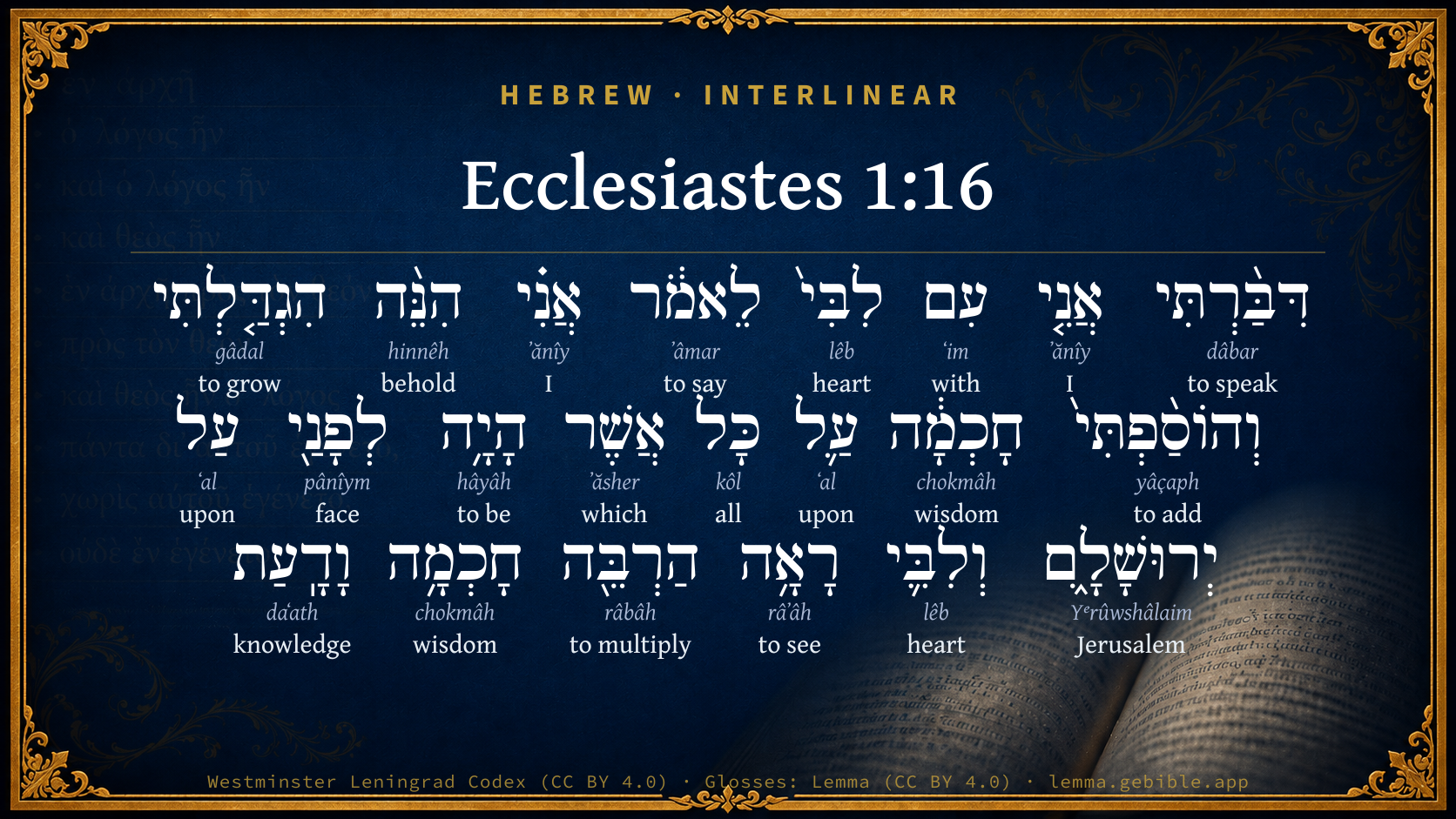
Hebrew (Westminster Leningrad Codex) Ecclesiastes 1:16 appears in the Hebrew Old Testament. The text above is from the Westminster Leningrad Codex. Each word links to its Strong’s number, a concise gloss, and parsing drawn from the Open Scriptures Hebrew Bible morphology. Click any word for its full Brown-Driver-Briggs (BDB) entry.
Download image
Cite this verse

Ecclesiastes 1:16 (World English Bible). Public Domain. Lemma interlinear Bible study tool, https://lemma.gebible.app/v/ecclesiastes/1/16.

Show BibTeX & RIS
BibTeX
RIS
English Translation
I said to myself, "Behold, I have obtained for myself great wisdom above all who were before me in Jerusalem. Yes, my heart has had great experience of wisdom and knowledge."
World English Bible · Public Domain
Download a study sheet

One document with this verse’s original text, its word-by-word gloss line, the meaning frame, cross-references with their text, attributed commentary, and full source and license credits — printable, and it pastes into notes with its structure intact.

This verse Autodidact and up

Study sheet (.html) Plain text (.txt)

A passage Seminary Student

Up to 50 verses in one chapter. A passage sheet keeps up to 6 commentary sources and 12 cross-references per verse, in the order this page ranks them, and says so on the sheet whenever that leaves anything out. Ask for a single verse and you get the Autodidact verse sheet above.

Everything on this page stays free to read, with no account — the sheet is a download of what is already on screen, not access to it.

Want to remove ads? Support Godless Engineer
Compare translations 3

The same verse in 3 English versions, stacked beneath the original-language interlinear above. Click any original word for its lexicon entry.

Each is an independent rendering of the whole verse — the interlinear is not word-aligned to these translations.

Highlighted words mark where these versions differ — a whole-verse word diff, not a word-by-word alignment.

  • World English Bible Public Domain
    I said to myself, "Behold, I have obtained for myself great wisdom above all who were before me in Jerusalem. Yes, my heart has had great experience of wisdom and knowledge."
  • King James Version Public Domain
    I communed with mine own heart, saying, Lo, I am come to great estate, and have gotten more wisdom than all they that have been before me in Jerusalem: yea, my heart had great experience of wisdom and knowledge.
  • unfoldingWord Literal Text CC BY-SA 4.0
    I spoke, I, with my heart, saying, “I—look—I have grown and increased wisdom, over all who were before my face over Jerusalem, and my heart has seen much wisdom and knowledge.”

unfoldingWord Literal Text — © unfoldingWord, licensed CC BY-SA 4.0. Word-aligned USFM3 via Door43 (git.door43.org/unfoldingWord/en_ult).

Versions to compare (up to 4)

3 of 4 selected

Show all 18 translations

Every available English version of this verse, each an independent rendering of the whole verse.

  • World English Bible Public Domain
    I said to myself, "Behold, I have obtained for myself great wisdom above all who were before me in Jerusalem. Yes, my heart has had great experience of wisdom and knowledge."
  • Berean Standard Bible Public Domain
    I said to myself, “Behold, I have grown and increased in wisdom beyond all those before me who were over Jerusalem, and my mind has observed a wealth of wisdom and knowledge.”
  • Majority Standard Bible Public Domain
    I said to myself, “Behold, I have grown and increased in wisdom beyond all those before me who were over Jerusalem, and my mind has observed a wealth of wisdom and knowledge.”
  • King James Version Public Domain
    I communed with mine own heart, saying, Lo, I am come to great estate, and have gotten more wisdom than all they that have been before me in Jerusalem: yea, my heart had great experience of wisdom and knowledge.
  • American Standard Version (1901) Public Domain
    I communed with mine own hear, saying, Lo, I have gotten me great wisdom above all that were before me in Jerusalem; yea, my heart hath had great experience of wisdom and knowledge.
  • Revised Version (1885) Public Domain
    I communed with mine own heart, saying, Lo, I have gotten me great wisdom above all that were before me in Jerusalem: yea, my heart hath had great experience of wisdom and knowledge.
  • Geneva Bible (1599) Public Domain
    I thought in mine heart, and said, Behold, I am become great, and excell in wisdome all them that haue bene before me in Ierusalem: and mine heart hath seene much wisedome and knowledge.
  • Douay-Rheims (1899) Public Domain
    I have spoken in my heart, saying: Behold I am become great, and have gone beyond all in wisdom, that were before me in Jerusalem: and my mind hath contemplated many things wisely, and I have learned.
  • Young's Literal Translation Public Domain
    I -- I spake with my heart, saying, `I, lo, I have magnified and added wisdom above every one who hath been before me at Jerusalem, and my heart hath seen abundantly wisdom and knowledge.
  • Literal Standard Version CC BY-SA 4.0
    I spoke with my heart, saying, “I, behold, have magnified and added wisdom above everyone who has been before me at Jerusalem, and my heart has seen wisdom and knowledge abundantly.
  • Unlocked Literal Bible CC BY-SA 4.0
    I have spoken to my heart saying, “Look, I have acquired greater wisdom than all who were before me in Jerusalem. My mind has seen great wisdom and knowledge.”
  • unfoldingWord Literal Text CC BY-SA 4.0
    I spoke, I, with my heart, saying, “I—look—I have grown and increased wisdom, over all who were before my face over Jerusalem, and my heart has seen much wisdom and knowledge.”
  • Darby Bible Public Domain
    I communed with mine own heart, saying, Lo, I have become great and have acquired wisdom more than all they that have been before me over Jerusalem; and my heart hath seen much of wisdom and knowledge.
  • World Messianic Bible Public Domain
    I said to myself, “Behold, I have obtained for myself great wisdom above all who were before me in Jerusalem. Yes, my heart has had great experience of wisdom and knowledge.”
  • Webster's Bible Public Domain
    I communed with my own heart, saying, Lo, I have come to great estate, and have gained more wisdom than all they that have been before me in Jerusalem: and my heart had great experience of wisdom and knowledge.
  • Free Bible Version CC BY-SA 4.0
    I thought to myself, “I've become very wise, wiser than all the kings of Jerusalem before me. My mind has gained a great deal of wisdom and knowledge.”
  • Bible in Basic English Public Domain
    I said to my heart, See, I have become great and am increased in wisdom more than any who were before me in Jerusalem--yes, my heart has seen much wisdom and knowledge.
  • JPS Tanakh (1917) Public Domain
    I spoke with my own heart, saying: 'Lo, I have gotten great wisdom, more also than all that were before me over Jerusalem'; yea, my heart hath had great experience of wisdom and knowledge.

Literal Standard Version (2020), Covenant Press — licensed CC BY-SA 4.0. Text via the HelloAO Bible API (eBible.org). Unlocked Literal Bible (unfoldingWord) — licensed CC BY-SA 4.0. Text via the HelloAO Bible API (eBible.org). unfoldingWord Literal Text — © unfoldingWord, licensed CC BY-SA 4.0. Word-aligned USFM3 via Door43 (git.door43.org/unfoldingWord/en_ult). Free Bible Version, Dr. Jonathan Gallagher — licensed CC BY-SA 4.0. Text via the HelloAO Bible API (eBible.org).

Word by word

More ways to search: Search by grammar → Find every occurrence → Compare this word →

Practice this passage: Drill this verse → Learn its vocabulary →

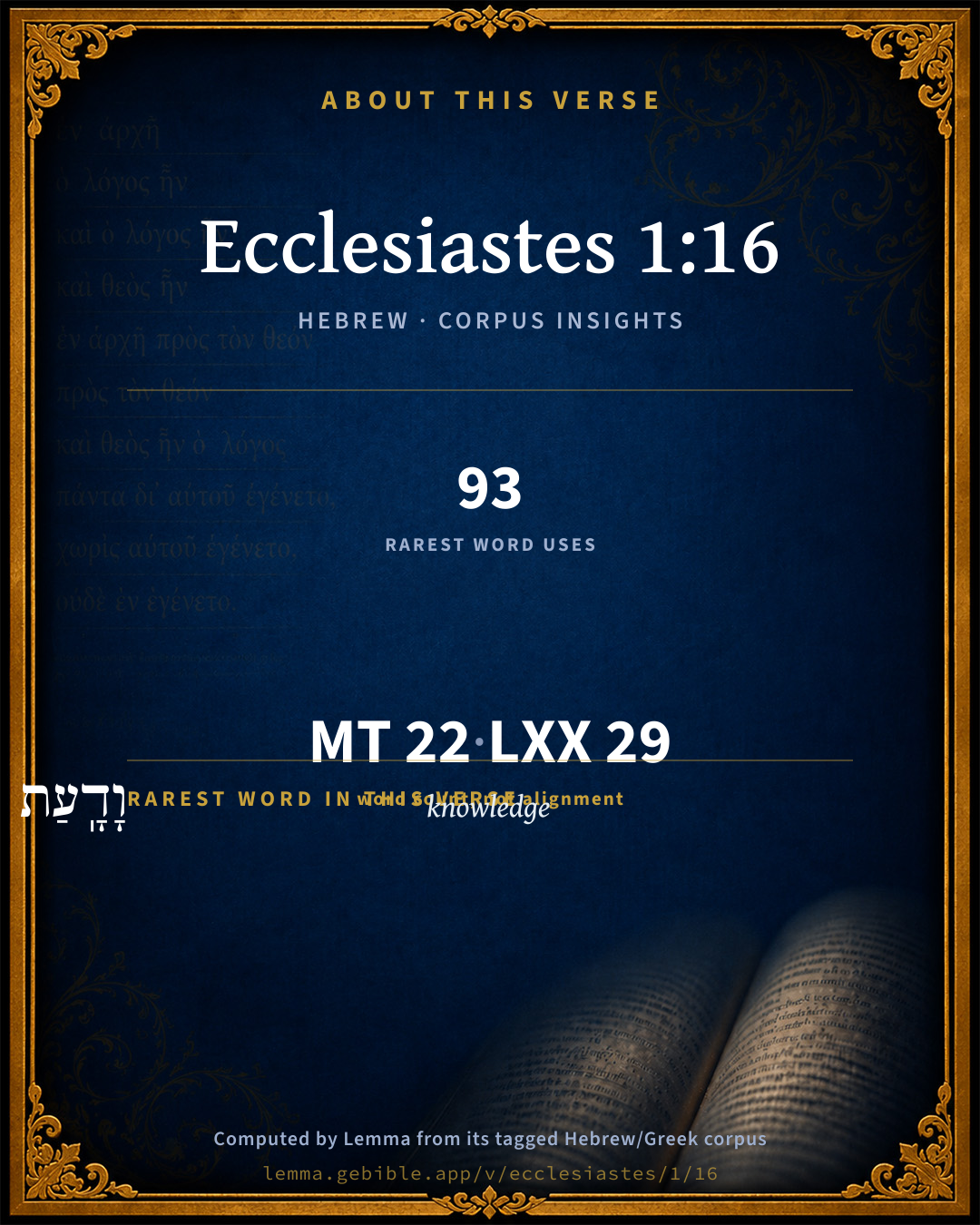
וָדָֽעַת
daʻath
H1847
“and · knowledge”
Conjunction + Noun, Common, Feminine, Singular, Absolute
Part of Speech
Conjunction + Noun
Type
Common
Gender
Feminine
Number
Singular
State
Absolute
Full BDB Definition

Origin: from H3045

TWOT: 848c

knowledge - knowledge, perception, skill - discernment, understanding, wisdom
  1. דִּבַּ֨רְתִּי dâbar H1696 “to speak” Verb, Piel, Perfect, 1st Person, Common, Singular
  2. אֲנִ֤י ʼănîy H589 “I” Pronoun, Personal, 1st Person, Common, Singular
  3. עִם ʻim H5973 “with” Preposition
  4. לִבִּי֙ lêb H3820 “heart · my” Noun, Common, Masculine, Singular, Construct + Suffix, Personal, 1st Person, Common, Singular
  5. לֵאמֹ֔ר ʼâmar H559 “to say” Preposition + Verb, Qal, Infinitive Construct
  6. אֲנִ֗י ʼănîy H589 “I” Pronoun, Personal, 1st Person, Common, Singular
  7. הִנֵּ֨ה hinnêh H2009 “behold” Particle, Demonstrative
  8. הִגְדַּ֤לְתִּי gâdal H1431 “to grow” Verb, Hiphil, Perfect, 1st Person, Common, Singular
  9. וְהוֹסַ֨פְתִּי֙ yâçaph H3254 “and · to add” Conjunction + Verb, Hiphil, Perfect, 1st Person, Common, Singular
  10. חָכְמָ֔ה chokmâh H2451 “wisdom” Noun, Common, Feminine, Singular, Absolute
  11. עַ֛ל ʻal H5921 “upon” Preposition
  12. כָּל kôl H3605 “all” Noun, Common, Masculine, Singular, Absolute
  13. אֲשֶׁר ʼăsher H834 “which” Particle, Relative
  14. הָיָ֥ה hâyâh H1961 “to be” Verb, Qal, Perfect, 3rd Person, Masculine, Singular
  15. לְפָנַ֖י pânîym H6440 “to/for · face(s) · my” Preposition + Noun, Common, Both, Plural, Construct + Suffix, Personal, 1st Person, Common, Singular
  16. עַל ʻal H5921 “upon” Preposition
  17. יְרוּשָׁלִָ֑ם Yᵉrûwshâlaim H3389 “Jerusalem” Noun, Proper
  18. וְלִבִּ֛י lêb H3820 “and · heart · my” Conjunction + Noun, Common, Masculine, Singular, Construct + Suffix, Personal, 1st Person, Common, Singular
  19. רָאָ֥ה râʼâh H7200 “to see” Verb, Qal, Perfect, 3rd Person, Masculine, Singular
  20. הַרְבֵּ֖ה râbâh H7235 “to multiply” Verb, Hiphil, Infinitive Absolute
  21. חָכְמָ֥ה chokmâh H2451 “wisdom” Noun, Common, Feminine, Singular, Absolute

About this verse

These counts appear in no published source. They are computed here, from the morphology-tagged text and Lemma’s own curated glosses. What Lemma adds →

22
words
18
distinct lemmas
Wisdom
section

Grammatical profile

  • 7 verbs
  • 8 nouns
  • 2 pronouns
  • 3 prepositions
  • 2 particles

Verb forms

  • דִּבַּ֨רְתִּי Piel · Perfect
  • לֵאמֹ֔ר Qal · Infinitive Construct
  • הִגְדַּ֤לְתִּי Hiphil · Perfect
  • וְהוֹסַ֨פְתִּי֙ Hiphil · Perfect
  • הָיָ֥ה Qal · Perfect
  • רָאָ֥ה Qal · Perfect
  • הַרְבֵּ֖ה Hiphil · Infinitive Absolute

Repetition

Words recur within this verse — often emphatic in Hebrew:

  • לִבִּי֙ heart H3820 ×2
  • חָכְמָ֔ה wisdom H2451 ×2
  • עַ֛ל upon H5921 ×2
  • אֲנִ֤י I H589 ×2

Hebrew & Septuagint length

In English translation the verse runs 31 words from the Hebrew and 32 from the Septuagint (LXX English) — closely comparable.

A rough comparison of the two English renderings, which tokenize alike — not a word-level alignment.

Word counts can differ between the Hebrew and the Greek without any difference in meaning — e.g. the Hebrew direct-object marker אֵת has no separate Greek word, and Greek often adds the article ὁ.

In the original languages it is 22 Hebrew tokens and 29 Greek tokens — but the two are counted differently (Hebrew bundles its prefixes and suffixes into one token; the Greek is in lemma form), so that isn’t a like-for-like length.

Cross-references

16

Topical passages linked to Ecclesiastes 1:16 in the Treasury of Scripture Knowledge — connected by theme and wording, ordered by reader-vote popularity; previews shown in the World English Bible.

  • Ecclesiastes 2:9 So I was great, and increased more than all who were before me in Jerusalem. My wisdom also remained with me.
  • 1 Kings 4:30 Solomon's wisdom excelled the wisdom of all the children of the east, and all the wisdom of Egypt.
  • 1 Kings 10:7 However I didn't believe the words, until I came, and my eyes had seen it: and, behold, the half was not told me; your wisdom and prosperity exceed the fame which I heard.
  • 1 Kings 3:12–13 behold, I have done according to your word: behold, I have given you a wise and an understanding heart; so that there has been none like you before you, neither after you shall any arise like you.
  • 2 Chronicles 1:10–12 Give me now wisdom and knowledge, that I may go out and come in before this people; for who can judge this your people, that is so great?
  • 2 Chronicles 2:12 Huram said moreover, Blessed be Yahweh, the God of Israel, that made heaven and earth, who has given to David the king a wise son, endowed with discretion and understanding, that should build a house for Yahweh, and a house for his kingdom.
  • Psalms 4:4 Stand in awe, and don't sin. Search your own heart on your bed, and be still. Selah.
  • Hebrews 5:14 But solid food is for those who are full grown, who by reason of use have their senses exercised to discern good and evil.
  • 1 Kings 10:23–24 So king Solomon exceeded all the kings of the earth in riches and in wisdom.
  • 2 Kings 5:20 But Gehazi the servant of Elisha the man of God, said, Behold, my master has spared this Naaman the Syrian, in not receiving at his hands that which he brought: as Yahweh lives, I will run after him, and take somewhat of him.
  • 2 Chronicles 9:22–23 So king Solomon exceeded all the kings of the earth in riches and wisdom.
  • Psalms 77:6 I remember my song in the night. I consider in my own heart; My spirit diligently inquires:
  • Isaiah 10:7–14 However he doesn't mean so, neither does his heart think so; but it is in his heart to destroy, and to cut off not a few nations.
  • Jeremiah 22:14 who says, I will build me a wide house and spacious chambers, and cuts him out windows; and it is ceiling with cedar, and painted with vermilion.
  • Ezekiel 38:10–11 Thus says the Lord Yahweh: It shall happen in that day, that things shall come into your mind, and you shall devise an evil device:
  • Daniel 4:30 The king spoke and said, Is not this great Babylon, which I have built for the royal dwelling-place, by the might of my power and for the glory of my majesty?

Cross-references courtesy of OpenBible.info (CC BY 4.0).

Hebrew and Greek witnesses Masoretic Hebrew ↔ Greek Septuagint

The same verse in the two great witnesses to the Old Testament, shown verse-for-verse.

These are two independent witnesses, not word-aligned to each other, and the Septuagint is shown in lemma (dictionary) form.

Hebrew Ecclesiastes 1:16 Masoretic · Westminster Leningrad Codex

דִּבַּ֨רְתִּי אֲנִ֤י עִם לִבִּי֙ לֵאמֹ֔ר אֲנִ֗י הִנֵּ֨ה הִגְדַּ֤לְתִּי וְהוֹסַ֨פְתִּי֙ חָכְמָ֔ה עַ֛ל כָּל אֲשֶׁר הָיָ֥ה לְפָנַ֖י עַל יְרוּשָׁלִָ֑ם וְלִבִּ֛י רָאָ֥ה הַרְבֵּ֖ה חָכְמָ֥ה וָדָֽעַת

I said to myself, "Behold, I have obtained for myself great wisdom above all who were before me in Jerusalem. Yes, my heart has had great experience of wisdom and knowledge."

World English Bible · Public Domain

Greek LXX Ecclesiastes 1:16 Septuagint · lemma form

λαλέω ἐγώ ἐν καρδία ἐγώ ὁ λέγω ἐγώ ἰδού μεγαλύνω καί προςτίθημι σοφία ἐπί πᾶς ὅς γίγνομαι ἔμπροσθεν ἐγώ ἐν ἰερουσαλήμ καί καρδία ἐγώ ὁράω πολύς σοφία καί γνῶσις

I spoke in my heart, saying, Behold, I am increased, and have acquired wisdom beyond all who were before me in Jerusalem: also I applied my heart to know wisdom and knowledge.

LXX2012 (modern English Septuagint) · Public Domain

On this verse, Keil & Delitzsch discusses the Septuagint’s reading. Read the note in Commentary ↓

Hebrew: Westminster Leningrad Codex (CC BY 4.0). Greek: Septuagint (public domain); English from LXX2012 (modern English Septuagint) (Public Domain). How the Septuagint differs from the Hebrew →

Commentary

Notes on Ecclesiastes 1:16 from classic Christian and Jewish commentators (each source and its license shown beneath its notes). The classic Christian expositions comment on the surrounding passage and are grouped to its opening verse, so a note may address several verses; the Jewish commentaries on the Tanakh (Rashi and others) are per-verse, so they appear only where the commentator wrote on this verse.

Lemma curates 59 commentaries, every one of them public domain or Creative Commons licensed, each selected and text-cleaned for this edition rather than reprinted as found. About our sources →

Trapp's Complete Commentary

John Trapp

Ecc 1:16 I communed with mine own heart, saying, Lo, I am come to great estate, and have gotten more wisdom than all [they] that have been before me in Jerusalem: yea, my heart had great experience of wisdom and knowledge.

Ver. 16. I communed with mine own heart, saying, &c.] Here Hugo de Sancto Victore proceeds to censure Solomon (as he had done before, Ecc 1:13) {See Trapp on "Ecc 1:13"} of pride and vain-glory, but with greater pride. For puerilis iactantiae est accusando illustres viros suo nomini famam quaerere. {a} It is a childish vanity to seek for fame by aspersing better men. Solomon might, without boasting, say of himself, as here he doth, Lo, I am come to great estate, or, I have greatened and added wisdom above all that have been before me. Doth not God say as much of him? {1Ki 3:11-13; 1Ki 4:29-34; 1Ki 5:7; 1Ki 10:4-9} And had he not good reason to praise himself in this sort? For, whereas some might here object that the cause that men get not happiness by the knowledge of natural philosophy is, because they understand it not. That cannot be, saith the wise man, for I have out-gone all that went before me in wisdom and perspicacity, and yet I can do no good on it; try you another while if you think you can outdo me. I think a man may break his neck before his fast of these sublunary felicities.

{a} Jerome.

John Trapp, A Commentary or Exposition upon All the Books of the Old and New Testament (1647–1656) — public domain. Text from a community e-Sword module.

The Biblical Illustrator

Joseph S. Exell

Ecc_1:16

I communed with mine own heart.

The wisdom, of self-communion

I communed with mine own heart. Solomon, by self-communion, by questioning his own consciousness, and by contemplating the facts of his career, guided by the Spirit of his God, evolved a theory of morals concerning the highest good for man. This royal genius, and genius royal, gives us a list of all his experiences undertaken in the search after What was that good for the sons of men which they should do. I communed with mine own heart. Yes, and he communicated the result of his self-communings for the benefit of mankind. Like all who approach him nearest in genius he was communicative and not secretive. A cunning man would have hidden his experiences as the hypocrite hides his sin; but this man was too wise to be cunning. Solomons self-communing was not of the sort of one of your hermit philosophers, who write about a world with which they have little consorted, and whose throbbing life-pulse they have seldom felt; who are busy dissecting the body of its dead past while the living present is dying before them. His self-communing was not the brooding pessimism and acrid egotism of the lonely, self-isolated cynic: his chair of study was the seat of judgment; his college, the thronged courts of royalty; his books, the men and women of his time. He was a philosopher who was a man of affairs and busy, not with theories and truisms alone, but with the political and social commerce of his epoch. He stood in the eye of the world, and the world lay open to his eye; and this man, who with largest outsight could look abroad upon the world, could also look with keenest insight upon the world within himself. These powers of prospection and introspection lifted him, and according to the degree in which we possess them, lift us out of the dust of mere animal existence: they are the motor of our wills responsibility. Self-introspection, self-communion, is as a mirror, wherein the ego beholds the reflection of itself, and plays the spy upon the secret movements of the soul; it is the keenest detector of furtive faults, and the severest monitor of sly sins. Commune with your own heart frequently, if you would learn to know your own self truly. Commune with your own heart, and you will learn the necessity of its closer communion with Sod, in order that you may gain from Him the wisdom and knowledge necessary to reform and renew its sad estate. Do you ever commune with your own hearts, saying, Lo, I am come to great estate in the kingdom of Jesus Christ;--lo, that kingdom which, if it be not, should be within you? Are you able to say, in the words of the text, Yea, my heart hath great experience of wisdom and knowledge--experience of Him who is the Wisdom of God and the First Fruits of knowledge? Have your hearts this experience, this knowledge? If you have, you shall obtain your allotted part in the freehold of a spiritual estate unencumbered by vanity and vexation of spirit, to which you are called to be heirs in the everlasting kingdom of Jesus Christ. (C. R. Panter, LL. D.)

My heart had great experience of wisdom and knowledge.--

The experience of wisdom and knowledge

In order to realize the goodness or badness of a thing, there is nothing like experience: not simply under favourable circumstances alone, but under unfavourable ones; not now and then, by mere fits and starts, but uniformly so. Now, we do not hesitate to affirm that the general experience of a careless and sinfully-disposed person is, on the whole, one of a most unsatisfactory character: for, while such an individual may appear to the eye of others free from all alarm of danger, and under the most pleasurable excitements, yet, as long as the conscience is not absolutely deadened, and there is any impressive idea of Gods existence and power, and an apprehension of a future retribution, the soul of such an individual cannot be otherwise than restless, and far from peaceful. On the other hand, the upright, honest, sincere, and trustful Christian, although struggling against his own corrupt tendencies, and daily striving to obtain a mastery over himself, experiences within his own heart the unspeakable satisfaction of knowing that he is on the path of duty and of safety. That path, we all know, is sometimes a troubled one: yet, withal, the Christian is more substantially and lastingly happy than the ungodly and reckless, be their outward circumstances ever so flourishing, and their aspect ever so imposing. And this fact is palpably and unmistakably so, when the test of experience is brought to the bar of death.

I. The experimental knowledge of the life which is temporal.

1. With respect to wisdom, the word has various meanings in Scripture. Thus it is put for prudence and discretion, which enables us to perceive what is fit to be done, at the right time, in the right place, and by the right person. The word wisdom is taken for the faculty of invention, skill, and ingenuity, as when God told Moses He had filled with wisdom, and understanding, and knowledge, Bezaleel and Aholiab; to invent several sorts of work for completing the tabernacle. Wisdom is used for craft or subtilty--as when Pharaoh said, Come on, let us deal wisely with the Israelites. It is also taken for doctrine, learning, and experience. There can be no doubt about the excellency of this wisdom, when judiciously, or rather legitimately employed. We do not blame the artisan for his skill, the man of science for his discoveries, the politician for his conscientious part in legislation, the tradesman for his forethought, industry and skill of management, and the housewife for her careful economy. No; but the evil of worldly wisdom is when it is exercised in the pursuit of worthless objects; when it schemes and plans for the mere gratification of some fleshly passion; when it wraps itself up in disguise, in order to lead astray the innocent, and to entrap wickedly the virtuous; when it plans only for time, without a due reference to eternity: when all its superstructures bear the character of earth, and have written upon their portals, Ichabod: their glory vain, perishable, and passing away.

2. And then, with respect to the knowledge of Solomon: he was well acquainted with the various principles, and passions, and objects, and pursuits, and tendencies of human nature. This royal king, gifted with a large and capacious intellect, well versed in the affairs of human life, as they apply to human character and station, raised to a throne in his day among the greatest seats of royal power, fed with every dainty the earth could produce, and constantly encircled with the charms of beauty, and all the enchanting glory of a rich and prosperous princedom, was nevertheless a stranger to the sweet peace of the humble-minded, of the Divinely trustful and obedient--a peace which sometimes passes by the couch of the palace, and rests softly and sweetly upon the hard pillow of the cottage.

II. Consider experience as it applies itself to the wisdom and knowledge of the Christian.

1. Here also is a knowledge which is experimental, that is to say, not a mere thing of hearsay or of theory, but something which is felt; realized as a daily matter-of-fact truth. It is not altogether a knowledge gathered from books, or from intercourse with man, but it is a Divinely communicated knowledge. It is a light from above, revealing new and striking aspects of God, as He stands related to us under the titles of Father, Saviour, Friend.

2. The experimental fact of Christian wisdom is very strikingly illustrated in the conduct of the five wise virgins waiting at midnight for the coming of the bridegroom; and it is practically exemplified in the daily life and character of the man who acts in strict accordance with the laws of God, and with the dictates of conscience. Wisdom, in this instance, is the very opposite of folly. It is not seen to build upon the sand of earthly trust, but upon the rock of Divine faith. It is not seen in the midst of widely built up barns, but in the calm of patience, and in the endurance of hope. (W. D. Horwood.)

The Biblical Illustrator, edited by Joseph S. Exell (c. 1880s–1900s) — public domain. Text from a community e-Sword module.

Joseph Benson's Commentary

Ecc 1:16-17. I communed with mine own heart — I considered within myself in what condition I was, and what degrees of knowledge I had gained; and whether it was not my ignorance that made me unable to rectify those errors, and supply those wants of which I complain; and whether wiser men could not do it, though I could not; saying, Lo! I am come to great estate — Hebrew, הגדלתי, I am grown great, namely, in wisdom, or, I have magnified, or greatly enlarged; and have gotten —

Hebrew, והוספתי, have added, more wisdom — As I had a large stock of wisdom infused into me by God, so I have greatly improved it by conversation, study, and experience; than all they that were before me — Whether governors, priests, or private persons. This was no vain boast, but a known and confessed truth, and the profession of it was necessary to demonstrate his assertion; in Jerusalem — Which was then the most eminent place in the world for wisdom and knowledge. I gave my heart to know wisdom, &c. — That I might thoroughly understand the nature and difference of truth, and error, of virtue and vice. I perceived that this is vexation, &c. — Or, feeding upon wind, as the Hebrew רעיון רוח, may be properly rendered, and as a similar phrase is rendered by many, both ancient and modern translators, in Ecc 1:14, and by our translators, Hos 12:1.

Joseph Benson's Commentary on the Old and New Testaments (1811–1818) — public domain. Text from a community e-Sword module.

Keil & Delitzsch

C. F. Keil & F. Delitzsch

"Is there anything whereof it may be said: See, this is new? - it was long ago through the ages (aeons) which have been before us." The Semit. substantive verb ישׁ (Assyr. isu) has here the force of a hypothetical antecedent: supposing that there is a thing of which one might say, etc. The זה, with Makkeph, belongs as subject, as at Ecc 7:27, Ecc 7:29 as object, to that which follows. כּבר (vid., List, p. 193) properly denotes length or greatness of time (as כּברה, length of way). The ל of לע is that of measure: this "long ago" measured (Hitz.) after infinitely long periods of time. מלּ, ante nos, follows the usage of מלּף, Isa 41:26, and lpaa', Jdg 1:10, etc.; the past time is spoken of as that which was before, for it is thought of as the beginning of the succession of time (vid., Orelli, Synon. der Zeit u. Ewigkeit, p. 14f.). The singular היה may also be viewed as pred. of a plur. inhumanus in order; but in connection, Ecc 2:7, Ecc 2:9 (Gesen. 147, An. 2), it is more probable that it is taken as a neut. verb. That which newly appears has already been, but had been forgotten; for generations come and generations go, and the one forgets the other.

Ecclesiastes 1:11

ecc 1:11

"There is no remembrance of ancestors; and also of the later ones who shall come into existence, there will be no remembrance for them with those who shall come into existence after them." With זכּרון (with Kametz) there is also זכרון, the more common form by our author, in accordance with the usage of his age; Gesen., Elst., and others regard it here and at Ecc 2:16 as constr., and thus לרא as virtually object-gen. (Jerome, non est priorum memoria); but such refinements of the old syntaxis ornata are not to be expected in our author: he changes (according to the traditional punctuation) here the initial sound, as at Ecc 1:17 the final sound, to oth and uth. אין ל is the contrast of היה ל: to attribute to one, to become partaker of. The use of the expression, "for them," gives emphasis to the statement. "With those who shall come after," points from the generation that is future to a remoter future, cf. Gen 33:2. The Kametz of the prep. is that of the recompens. art.; cf. Num 2:31, where it denotes "the last" among the four hosts; for there הא is meant of the last in order, as here it is meant of the remotely future time.

Ecclesiastes 1:12

ecc 1:12

"I, Koheleth, have been king over Israel in Jerusalem." That of the two possible interpretations of הייתי, "I have become" and "I have been," not the former (Grtz), but the latter, is to be here adopted, has been already shown. We translate better by "I have been" - for the verb here used is a pure perfect - than by "I was" (Ew., Elst., Hengst., Zck.), with which Bullock (Speaker's Comm., vol. IV, 1873) compares the expression Quand j'tois roi ! which was often used by Louis XIV towards the end of his life. But here the expression is not a cry of complaint, like the "fuimus Troes," but a simple historical statement, by which the Preacher of the vanity of all earthly things here introduces himself, - it is Solomon, resuscitated by the author of the book, who here looks back on his life as king. "Israel" is the whole of Israel, and points to a period before the division of the kingdom; a king over Judah alone would not so describe himself. Instead of "king על (over) Israel," the old form of the language uses frequently simply "king of Israel," although also the former expression is sometimes found; cf. Sa1 15:26; Sa2 19:23; Kg1 11:37. He has been king, - king over a great, peaceful, united people; king in Jerusalem, the celebrated, populous, highly-cultivated city, - and thus placed on an elevation having the widest survey, and having at his disposal whatever can make a man happy; endowed, in particular, with all the means of gaining knowledge, which accorded with the disposition of his heart searching after wisdom (cf. Kg1 3:9-11; Kg1 5:9).

But in his search after worldly knowledge he found no satisfaction.

Ecclesiastes 1:13

ecc 1:13

"And I gave my heart to seek and to hold survey with wisdom over all that is done under the sun: a sore trouble it is which God has given to the children of men to be exercised therewith." The synonyms דּרשׁ(to seek) and תּוּר (to hold survey over) do not represent a lower and a higher degree of search (Zck.), but two kinds of searching: one penetrating in depth, the other going out in extent; for the former of these verbs (from the root-idea of grinding, testing) signifies to investigate an object which one already has in hand, to penetrate into it, to search into it thoroughly; and the latter verb (from the root-idea of moving round about)

(Note: Vid., the investigation of these roots (Assyr. utîr, he brought back) in Eth's Schlafgemach der Phantasie, pp. 86-89.)

signifies to hold a survey, - look round in order to bring that which is unknown, or not comprehensively known, within the sphere of knowledge, and thus has the meaning of bǎkkēsh, one going the rounds. It is the usual word for the exploring of a country, i.e., the acquiring personal knowledge of its as yet unknown condition; the passing over to an intellectual search is peculiar to the Book of Koheleth, as it has the phrase ל לב נתן, animum advertere, or applicare ad aliquid, in common only with Dan 10:12. The beth of bahhochemah is that of the instrument; wisdom must be the means (organon) of knowledge in this searching and inquiry. With על is introduced the sphere into which it extends. Grotius paraphrases: Historiam animalium et satorum diligentissime inquisivi. But נעשׂה does not refer to the world of nature, but to the world of men; only within this can anything be said of actions, only this has a proper history. But that which offers itself for research and observation there, brings neither joy nor contentment. Hitzig refers הוּא to human activity; but it relates to the research which has this activity as its object, and is here, on that account, called "a sore trouble," because the attainment and result gained by the laborious effort are of so unsatisfactory a nature. Regarding ענין, which here goes back to ענה ב, to fatigue oneself, to trouble oneself with anything, and then to be engaged with it. The words ענין רע would mean trouble of an evil nature (vid., at Psa 78:49; Pro 6:24); but better attested is the reading ענין רע "a sore trouble." הוּא is the subj., as at Ecc 2:1 and elsewhere; the author uses it also in expressions where it is pred. And as frequently as he uses asher and שׁ, so also, when form and matter commend it, he uses the scheme of the attributive clause (elliptical relative clause), as here (cf. Ecc 3:16), where certainly, in conformity with the old style, נתנו was to be used.

Ecclesiastes 1:14

ecc 1:14

He adduces proof of the wearisomeness of this work of research: "I saw all the works that are done under the sun; and, behold, all is vanity and striving after the wind." The point of the sentence lies in והנּה = וארא וה, so that thus rathi is the expression of the parallel fact (circumst. perfect). The result of his seeing, and that, as he has said Ecc 1:13, of a by no means superficial and limited seeing, was a discovery of the fleeting, unsubstantial, fruitless nature of all human actions and endeavours. They had, as hevel expresses, not reality in them; and also, as denoted by reuth ruahh (the lxx render well by προαίρεσις πνεύματος), they had no actual consequences, no real issue. Hos 12:1 also says: "Ephraim feedeth on wind," i.e., follows after, as the result of effort obtains, the wind, roěh ruahh; but only in the Book of Koheleth is this sentence transformed into an abstract terminus technicus (vid., under Reth).

Ecclesiastes 1:15

ecc 1:15

The judgment contained in the words, "vanity and a striving after the wind," is confirmed: "That which is crooked cannot become straight; and a deficit cannot be numerable," i.e., cannot be taken into account (thus Theod., after the Syro-Hex.), as if as much were present as is actually wanting; for, according to the proverb, "Where there is nothing, nothing further is to be counted." Hitzig thinks, by that which is crooked and wanting, according to Ecc 7:13, of the divine order of the world: that which is unjust in it, man cannot alter; its wants he cannot complete. But the preceding statement refers only to labour under the sun, and to philosophical research and observation directed thereto. This places before the eyes of the observer irregularities and wants, brings such irregularities and wants to his consciousness, - which are certainly partly brought about and destined by God, but for the most part are due to the transgressions of man himself, - and what avails the observer the discovery and investigation? - he has only lamentation over it, for with all his wisdom he can bring no help. Instead of לתקן (vid., under תקן), לתקן was to be expected. However, the old language also formed intransitive infinitives with transitive modification of the final vowels, e.g., יבשׁ, etc. (cf. ישׁון, Ecc 5:11).

Having now gained such a result in his investigation and research by means of wisdom, he reaches the conclusion that wisdom itself is nothing.

Ecclesiastes 1:16

ecc 1:16

"I have communed with mine own heart, saying: Lo, I have gained great and always greater wisdom above all who were before me over Jerusalem; and my heart hath seen wisdom and knowledge in fulness. And I gave my heart to know what was in wisdom and knowledge, madness and folly - I have perceived that this also is a grasping after the wind." The evidence in which he bears witness to himself that striving after wisdom and knowledge brings with it no true satisfaction, reaches down to the close of Ecc 1:17; ידעתּי is the conclusion which is aimed at. The manner of expression is certainly so far involved, as he speaks of his heart to his heart what it had experienced, and to what he had purposely directed it. The אני leads us to think that a king speaks, for whom it is appropriate to write a capital I, or to multiply it into we; vid., regarding this "I," more pleonastic than emphatic, subordinated to its verb.

It is a question whether עם־לבּי, after the phrase (את) עם דּבּר, is meant of speaking with any one, colloqui, or of the place of speaking, as in "thou shalt consider in thine heart," Deu 8:5, it is used of the place of consciousness; cf. Job 15:9, (עמּדי) עמּי היה = σύνοιδα ἐμαυτῷ, and what is said in my Psychol. p. 134, regarding συνείδησις, consciousness, and συμμαρτυρεῖν. בּלבּי, interchanging with עם־לבּי, Ecc 2:1, Ecc 2:15, commends the latter meaning: in my heart (lxx, Targ., Jerome, Luther); but the cogn. expressions, medabběrěth ǎl-libbah, Sa1 1:13, and ledabbēr ěl-libbi, Gen 24:45, suggest as more natural the former rendering, viz., as of a dialogue, which is expressed by the Gr. Venet. (more distinctly than by Aquila, Symm., and Syr.): διείλεγμαι ἐγὼ ξὺν τῇ καρδίᾳ μου. Also לאמר, occurring only here in the Book of Koheleth, brings it near that the following oratio directa is directed to the heart, as it also directly assumes the form of an address, Ecc 2:1, after בלבי. The expression, הג הך, "to make one's wisdom great," i.e., "to gain great wisdom," is without a parallel; for the words, הג תו, Isa 28:29, quoted by Hitzig, signify to show and attest truly useful (beneficial) knowledge in a noble way. The annexed והו refers to the continued increase made to the great treasure already possessed (cf. Ecc 2:9 and Kg1 10:7). The al connected therewith signifies, "above" (Gen 49:26) all those who were over Jerusalem before me. This is like the sarrâni âlik maḥrija, "the kings who were my predecessors," which was frequently used by the Assyrian kings. The Targumist seeks to accommodate the words to the actual Solomon by thus distorting them: "above all the wise men who have been in Jerusalem before me," as if the word in the text were בירושלם,

(Note: In F. the following note is added: "Several Codd. have, erroneously, birushalam instead of al-jerushalam." Kennicott counts about 60 such Codd. It stands thus also in J; and at first it thus stood in H, but was afterwards corrected to al-yerushalam. Cf. Elias Levita's Masoreth hamasoreth, II 8, at the end.)

as it is indeed found in several Codd., and according to which also the lxx, Syr., Jerome, and the Venet. translate. Rather than think of the wise (הכּימיּא), we are led to think of all those who from of old stood at the head of the Israelitish community. But there must have been well-known great men with whom Solomon measures himself, and these could not be such dissimilarly great men as the Canaanitish kings to the time of Melchizedek; and since the Jebusites, even under Saul, were in possession of Zion, and Jerusalem was for the first time completely subdued by David (Sa2 5:7, cf. Jos 15:63), it is evident that only one predecessor of Solomon in the office of ruler over Jerusalem can be spoken of, and that here an anachronism lies before us, occasioned by the circumstance that the Salomo revivivus, who has behind him the long list of kings whom in truth he had before him, here speaks.

Regarding היה אשׁר, qu'il y uet, for היו אשׁר, qui furent, vid., at Ecc 1:10. The seeing here ascribed to the heart (here = νοῦς, Psychol. p. 249) is meant of intellectual observation and apprehension; for "all perception, whether it be mediated by the organs of sense or not (as prophetic observing and contemplating), comprehends all, from mental discernment down to suffering, which veils itself in unconsciousness, and the Scripture designates it as a seeing" (Psychol. 234); the Book of Koheleth also uses the word ראה of every kind of human experience, bodily or mental, Ecc 2:24; Ecc 5:17; Ecc 6:6; Ecc 9:9. It is commonly translated: "My heart saw much wisdom and knowledge" (thus e.g., Ewald); but that is contrary to the gram. structure of the sentence (Ew. 287c). The adject. harbēh

(Note: Regarding the form הרבה, which occurs once (Jer 42:2), vid., Ew. 240c.)

is always, and by Koheleth also, Ecc 2:7; Ecc 5:6, Ecc 5:16; Ecc 6:11; Ecc 9:18; Ecc 11:8; Ecc 12:9, Ecc 12:12, placed after its subst.; thus it is here adv., as at Ecc 5:19; Ecc 7:16. Rightly the Venet.: ἡ καρδία μου τεθέαται κατὰ πολὺ σοφίαν καί γνῶσιν Chokma signifies, properly, solidity, compactness; and then, like πυκνότης, mental ability, secular wisdom; and, generally, solid knowledge of the true and the right. Dǎǎth is connected with chokma here and at Isa 33:6, as at Rom 11:33, γνῶσις is with σοφία. Baumggarten-Crusius there remarks that σοφία refers to the general ordering of things, γνῶσις to the determination of individual things; and Harless, that σοφία is knowledge which proposes the right aim, and γνῶσις that which finds the right means thereto. In general, we may say that chokma is the fact of a powerful knowledge of the true and the right, and the property which arises out of this intellectual possession; but dǎǎth is knowledge penetrating into the depth of the essence of things, by which wisdom is acquired and in which wisdom establishes itself.

Ecc 1:17

By the consecutive modus ואתּנה (aor. with ah, like Gen 32:6; Gen 41:11, and particularly in more modern writings; vid., p. 198, regarding the rare occurrence of the aorist form in the Book of Koheleth) he bears evidence to himself as to the end which, thus equipped with wisdom and knowledge, he gave his heart to attain unto (cf. 13a), i.e., toward which he directed the concentration of his intellectual strength. He wished to be clear regarding the real worth of wisdom and knowledge in their contrasts; he wished to become conscious of this, and to have joy in knowing what he had in wisdom and knowledge as distinguished from madness and folly. After the statement of the object lādǎǎth, stands vedaath, briefly for ולדעת. Ginsburg wishes to get rid of the words holēloth vesikluth, or at least would read in their stead תּבוּנית ושׂכלוּת (rendering them "intelligence and prudence"); Grtz, after the lxx παραβολὰς καὶ ἐπιστήμην, reads משׁלות ושׂכלות. But the text can remain as it is: the object of Koheleth is, on the one hand, to become acquainted with wisdom and knowledge; and, on the other, with their contraries, and to hold these opposite to each other in their operations and consequences. The lxx, Targ., Venet., and Luther err when they render sikluth here by ἐπιστήμη, etc. As sikluth, insight, intelligence, is in the Aram. written with the letter samek (instead of sin), so here, according to the Masora סכלות, madness is for once written with ס, being everywhere else in the book written with שׂ; the word is an ἐναντιόφωνον,

(Note: Vid., Th. M. Redslob's Die Arab. Wrter, u.s.w. (1873).)

and has, whether written in the one way or in the other, a verb, sakal (שׂכל, סכל), which signifies "to twist together," as its root, and is referred partly to a complication and partly to a confusion of ideas. הללות, from הלל, in the sense of "to cry out," "to rage," always in this book terminates in th, and only at Ecc 10:13 in th; the termination th is that of the abstr. sing.; but th, as we think we have shown at Pro 1:20, is that of a fem. plur., meant intensively, like bogdoth, Zep 2:4; binoth, chokmoth, cf. bogdim, Pro 23:28; hhovlim, Zac 11:7, Zac 11:14; toqim, Pro 11:15 (Bttch. 700g E). Twice vesikluth presents what, speaking to his own heart, he bears testimony to before himself. By yādǎ'ti, which is connected with dibbarti (Ecc 1:16) in the same rank, he shows the facit. זה refers to the striving to become conscious of the superiority of secular wisdom and science to the love of pleasure and to ignorance. He perceived that this striving also was a grasping after the wind; with רעוּת, 14b, is here interchanged רעיון. He proves to himself that nothing showed itself to be real, i.e., firm and enduring, unimpeachable and imperishable. And why not?

Ecc 1:18

"For in much wisdom is much grief; and he that increaseth knowledge increaseth sorrow." The German proverb: "Much wisdom causeth headache," is compared, Ecc 12:12, but not here, where כּעס and מכאוב express not merely bodily suffering, but also mental grief. Spinoza hits one side of the matter in his Ethics, IV 17, where he remarks: "Veram boni et mali cognitionem saepe non satis valere ad cupiditates coercendas, quo facto homo imbecillitatem suam animadvertens cogitur exclamare: Video meliora proboque, deteriora sequor." In every reference, not merely in that which is moral, there is connected with knowledge the shadow of a sorrowful consciousness, in spite of every effort to drive it away. The wise man gains an insight into the thousand-fold woes of the natural world, and of the world of human beings, and this reflects itself in him without his being able to change it; hence the more numerous the observed forms of evil, suffering, and discord, so much greater the sadness (כּעס, R. כס, cogn. הס, perstringere) and the heart-sorrow (מכאוב, crve-cour) which the inutility of knowledge occasions. The form of 18a is like Ecc 5:6, and that of 18b like e.g., Pro 18:22. We change the clause veyosiph daath into an antecedent, but in reality the two clauses stand together as the two members of a comparison: if one increaseth knowledge, he increaseth (at the same time) sorrow. "יוסיף, Isa 29:14; Isa 38:5; Ecc 2:18," says Ewald, 169a, "stands alone as a part. act., from the stem reverting from Hiph. to Kal with י instead of ." But this is not unparalleled; in הן יוסיף the verb יוסף is fin., in the same manner as יסּד, Isa 28:16; תּומיך, Psa 16:5, is Hiph., in the sense of amplificas, from ימך; יפיח, Pro 6:19 (vid., l.c.), is an attribut. clause, qui efflat, used as an adj.; and, at least, we need to suppose in the passage before us the confusion that the ē of kātēl (from kātil, originally kātal), which is only long, has somehow passed over into î. Bttcher's remark to the contrary, "An impersonal fiens thus repeated is elsewhere altogether without a parallel," is set aside by the proverb formed exactly thus: "He that breathes the love of truth says what is right," Pro 12:17.

Next: Ecclesiastes Chapter 2

Keil & Delitzsch — Biblical Commentary on the Old Testament (1861–1891) — public domain (CC PDM 1.0). Text via the HelloAO Bible API. (Old Testament only.)

Jamieson, Fausset & Brown

Robert Jamieson, A. R. Fausset & David Brown

communed with . . . heart-- (Gen 24:45).

come to great estate--Rather, "I have magnified and gotten" (literally, "added," increased), &c.

all . . . before me in Jerusalem--namely, the priests, judges, and two kings that preceded Solomon. His wisdom exceeded that of all before Jesus Christ, the antitypical Koheleth, or "Gatherer of men," (Luk 13:34), and "Wisdom" incarnate (Mat 11:19; Mat 12:42).

had . . . experience--literally, "had seen" (Jer 2:31). Contrast with this glorying in worldly wisdom (Jer 9:23-24).

Jamieson, Fausset & Brown — Commentary Critical and Explanatory on the Whole Bible (1871) — public domain (CC PDM 1.0). Text via the HelloAO Bible API.

Adam Clarke's Commentary

Verse 16. I communed with mine own heart] Literally, "I spoke, I, with my heart, saying." When successful in my researches, but not happy in my soul, though easy in my circumstances, I entered into my own heart, and there inquired the cause of my discontent. He found that, though -

1. He had gotten wisdom beyond all men;

2. Wealth and honours more than any other;

3. Practical wisdom more than all his predecessors;

4. Had tried pleasure and animal gratification, even to their extremes; yet after all this he had nothing but vexation of spirit.

None of these four things, nor the whole of them conjoined, could afford him such a happiness as satisfies the soul. Why was all this? Because the soul was made for God, and in the possession of him alone can it find happiness.

Adam Clarke's Commentary on the Bible (1810–1826) — public domain. Text from a community e-Sword/MySword module.

Ellicott's Commentary for English Readers

(16) Wisdom and knowledge.—Isa_30:6; Rom_11:33.

A Bible Commentary for English Readers, edited by Charles John Ellicott (1878–1897) — public domain. Text from a community e-Sword module.

The Cambridge Bible for Schools and Colleges

gen. ed. J. J. S. Perowne

16. Lo, I am come to great estate] The pronoun is used emphatically. The verb in the Hebrew is connected closely with what follows and speaks not of outward majesty but of “becoming great,” in wisdom. So taken we may read, “I became great and increased in wisdom more than all.” We note again, as in Ecc_1:13, the kind of dialogue which the Debater holds with his inner consciousness. He “communes with his heart” (comp. Psa_4:4; Psa_77:6). So Marcus Aurelius gave to the book which we call his Meditations, the title τὰ εἰς ἑαυτόν—literally, “Things for myself” or “Self-communings.”

they that have been before me in Jerusalem] Better, “over Jerusalem.” Those who maintain the late origin of the book point to this apparent retrospect over a long series of predecessors as betraying, or possibly as intended to indicate, the pseudonymous authorship. The historical Solomon, it is said, had but one predecessor over Jerusalem. The inference is, however, scarcely conclusive. Even on the theory of personated authorship, the writer would scarcely have slipped into so glaring an anachronism, and the words admit of being referred, on either view, either to the line of unknown Jebusite rulers, including perhaps Melchizedek (Gen_14:18), Adonizedek (Jos_15:63; 2Sa_5:7) and others, or to the sages “Ethan the Ezrahite and Heman and Chalcol and Darda the sons of Mahol,” who are named in 1Ki_4:31, and who may, in some sense, as teachers and guides, have been “over” as well as “in” Jerusalem. Some MSS. indeed give the preposition “in” instead of “over.”

my heart had great experience] More literally, and at the same time more poetically, my heart hath seen much wisdom and knowledge. The two nouns are related, like the Greek σοφία and ἐπιστημὴ, the former expressing the ethical, the latter the speculative, scientific side of knowledge.

The Cambridge Bible for Schools and Colleges (gen. ed. J. J. S. Perowne; Cambridge University Press, 1878–1918) — public domain. Text from a community e-Sword module.

John Gill's Exposition

I communed with my own heart,.... That is, looked into it, examined it, and considered what a stock and fund of knowledge he had in it, after all his researches into it; what happiness accrued to him by it, and what judgment upon the whole was to be formed upon it; and he spoke within himself after this manner:

saying, lo, I am come to great estate; or become a great man; famous for wisdom, arrived to a very great pitch of it; greatly increased in it, through a diligent application to it;

and have gotten more wisdom than all they that have been before me in Jerusalem; or, "that before me were over Jerusalem" (p); governors of it, or in it; not only than the Jebusites, but than Saul, the first king of Israel, or than even his father David; or, as Gussetius (q), than any princes, rulers, and civil magistrates in Jerusalem, in his own days or in the days of his father; and also than all the priests and prophets, as well as princes, that ever had been there: and indeed he was wiser than all men, Kg1 4:30; and even than any that had been in Jerusalem, or any where else, or that should be hereafter, excepting the Messiah; see Kg1 3:12. And seeing this is said of him by others, and even by the Lord himself, it might not only be said with truth by himself, but without ostentation; seeing it was necessary it should be said to answer his purpose, which was to show the vanity of human wisdom in its highest pitch; and it was nowhere to be found higher than in himself;

yea, my heart had great experience of wisdom and knowledge; or, "saw much wisdom and knowledge" (r); he thoroughly understood it, he was a complete master of it; it was not a superficial knowledge he had attained unto, or a few lessons of it he had committed to memory; some slight notions in his head, or scraps of things he had collected together, in an undigested manner; but he had made himself thoroughly acquainted with everything worthy to be known, and had digested it in his mind.

(p) "super Jerusalaim", Montanus, Cocceius, Schmidt; "qui praefueriut ante me Jeruscthalamis", Junius & Tremellius. (q) Comment. Heb. p. 604. (r) "vidit multum sapientiae et scientiae", Montanus, Amama; "vidit plurimam sapientiam et scientiam", Tigurine version.

John Gill's Exposition of the Whole Bible (1746–1763) — public domain (CC PDM 1.0). Text via the HelloAO Bible API.

Albert Barnes' Notes on the Bible

I am come ... - Rather, I have accumulated (literally “enlarged and added”) wisdom more than etc.

They that have been ... - The reference is probably to the line of Canaanite kings who lived in Jerusalem before David took it, such as Melchizedek Gen 14:18, Adonizedek Jos 10:1, and Araunah 2Sa 24:23; or, it may be, to Solomon’s contemporaries of his own country 1Ki 4:31 and of other countries who visited him 1Ki 4:34; 1Ki 10:24. for “in” Jerusalem render over.

Albert Barnes' Notes on the Bible (1834–1885) — public domain. Text from a community e-Sword/MySword module.

Haydock's Catholic Bible Commentary

Learned. Solomon was blessed both with a natural genius, which he improved by study, and also he had the gift of supernatural wisdom. Yet he declares that all is vanity and pain.

George Leo Haydock (1774–1849), Haydock's Catholic Family Bible and Commentary, 1859 edition — public domain. Excludes Psalms (Douay-Rheims chapter numbering differs from Protestant) and Deuterocanonical books (Catholic canon only).

Matthew Poole's English Annotations

I communed with mine own heart; I considered within myself in what condition I was, and what degrees of knowledge I had gained, and whether it was not my ignorance that made me unable to rectify those errors, and supply those wants, and wiser men could do it, though I could not.

I am come to great estate, Heb. I am grown great, to wit, in wisdom; or, I have magnified, or greatly enlarged. Have gotten, Heb. have added. As I had a large stock of wisdom infused into me by God, 1Ki 3:12; 4:29, so I have greatly improved it by conversation, and study, and experience.

More wisdom than all they that have been before me, whether governors, or priests, or private persons; which was no vain boast, but a known and confessed truth, and profession hereof was necessary to demonstrate his assertion.

In Jerusalem; which was then the most eminent place in the world for wisdom and knowledge.

Had great experience, Heb. had seen much; which intimates that his knowledge was clear, and certain, and experimental, as that is which we have from our own eyesight.

Wisdom and knowledge; two words signifying the same thing, as may be gathered from Ecc 1:18, and from the promiscuous use of them in this book, and in the Proverbs, and elsewhere, and implying all manner of knowledge, Divine or human, speculative or practical, political or philosophical.

Matthew Poole's English Annotations on the Holy Bible (1683–1685) — public domain. Text from a community e-Sword/MySword module.

Whedon's Commentary on the Bible

Daniel D. Whedon

16. After his first failure Koheleth computes his resources for a new effort.

Communed — That is, “conversed.” The entire phrase, I am come to great estate, and have gotten more wisdom, is in Hebrew, I made great and increased in wisdom, that is, “I gained a very great amount of wisdom.” It has been remarked above that Koheleth refers here to a long succession of kings at Jerusalem, which the real Solomon could not have done. [Nothing, however, is said about kings. The all means all preceding thoughtful men, or sages.] 17. I gave… to know — Here is stated how this wisdom and knowledge had been gained. Hebrew, Indeed I had given my heart to know wisdom and knowledge, though this devotion to wisdom, etc., is a grasping at wind.

Daniel D. Whedon (gen. ed.), Commentary on the Old and New Testaments (1874–1909) — public domain. Text from a community e-Sword module.

The Pulpit Commentary

Koheleth now arrives at his first conclusion, that wisdom is vanity. I communed with mine own heart. The expression suggests, as it were, an internal dialogue, as the Greek Venetian puts it, Dieilegmai ejgw xua mou (comp. Ecc_2:1, Ecc_2:15) Lo, I am come to great estate. If this be taken by itself, it makes Koheleth speak of his power and majesty first, and of his progress in wisdom afterwards; but it is best to connect it with what follows, and to confine the clause to one idea; thus: "I have obtained great and ever greater wisdom I have continually added to my stores of knowledge and experience. Than all they (above all) that have been before me in ( over) Jerusalem. Who are the rulers alluded to? Solomon himself was only the second of the Israelite kings who reigned there; of the Canaanite princes who may have made that their capital, we have no knowledge, nor is R likely that Solomon would compare himself with them. The Targum has altered the approved reading, and gives, "Above all the wise men that were in Jerusalem before me." The reading, "in instead of "over" Jerusalem," has indeed some manuscript authority, and is confirmed by the Septuagint, Vulgate, and Syriac, but it is evidently a correction of the text by critics who saw the difficulty of the authorized wording. Motais and others assert that the preposition in the Masoretic text, l(all, often means "in," as well as "over," when the reference is to an elevated spot; e.g. Isa_38:20; Hos_11:11. But even granting this, we are still uncertain who are the persons meant. Commentators point to Melchizedek, Adonizedek, and Araunah among rulers, and to Ethan, Heman, Chalcol, and Darda (1Ki_4:31) among sages. But we know nothing of the wisdom of the former, and there is no tangible reason why the latter should be designated "before me in Jerusalem." Doubtless the words point to a succession of kings who had reigned in Jerusalem, and the writer, involuntarily, perhaps, betrays his assumed character, in relying an excusable anachronism, while giving to the personated monarch a position which could not belong to the historical Solomon. Yea, my heart had great experience of (hath seen abundantly, kata Venetian) wisdom and knowledge, hberh used adverbially qualifies the word before it, "hath seen." The heart, as we have observed (ver. 13), is considered the seat of the intellectual life. In saying that the heart hath seen wisdom, the writer means that his mind has taken it in, apprehended and appropriated it (comp. Ecc_8:16 Job_4:8) Wisdom and knowledge; chokmah and daath; sofian kai gnwsin (Septuagint), the former regarding the ethical and practical side, the latter the speculative, which leads to the other. (comp. Isa_33:6; Rom_11:33)

The Pulpit Commentary (1880–1919), ed. H.D.M. Spence-Jones & Joseph S. Exell — public domain. Text from a community e-Sword module.

John Wesley's Explanatory Notes

Communed - I considered within myself. Great - In wisdom. Have gotten - As I had a large stock of wisdom infused into me by God, so I have greatly improved it by conversation, and study, and experience. Than all - Whether governors, or priests, or private persons. In Jerusalem - Which was then the most eminent place in the world for wisdom.

John Wesley, Explanatory Notes Upon the Whole Bible (1754–1765) — public domain. Text via the GEBible commentary corpus.

unfoldingWord translationNotes

Door43 World Missions Community

I have spoken to my heart

Here the author refers to himself by his "heart" to emphasize his feelings. AT: "I have spoken to myself" (See: Synecdoche)

My mind has seen

Here the author refers to himself by his "mind" to emphasize what he has learned. AT: "I have gained" or "I have learned"

I applied my heart

Here the author refers to himself by his "heart" to emphasize his feelings. AT: "I determined" or "I applied myself" (See: Synecdoche)

madness and folly

The words "madness" and "folly" share similar meanings and refer to foolish thinking and behavior, respectively. (See: Doublet)

an attempt to shepherd the wind

The author says learning wisdom and madness and folly is as useless as trying to control the wind. See how you translated this in Ecclesiastes 1:14. AT: "as useless as trying to control the wind" (See: Metaphor)

translationWords

heart

Jerusalem

wise

know

fool

unfoldingWord translationNotes — © Distant Shores Media and the Door43 World Missions Community, licensed CC BY-SA 4.0. Source: git.door43.org/Door43/en_tn.

Rashi

Rabbi Shlomo Yitzchaki (Rashi)

I spoke to myself Now that I have sunk from my greatness, I set my heart, saying, “Who would have said about me that I would come to such a state?” Look, I have acquired great wisdom, etc.

Rashi on the Tanakh — English translations: “The Judaica Press complete Tanach with Rashi, translated by A. J. Rosenberg” (CC BY 4.0); “Pentateuch with Rashi's commentary by M. Rosenbaum and A.M. Silbermann, 1929-1934” (public domain); “The Metsudah Tanach series, Lakewood, N.J” (CC BY 4.0); and “The Book of Joshua, Metsudah Publications, 1997” (CC BY 4.0). Text via Sefaria.

Lesson kit

Teaching starters — assembled from the data on this page, not authored interpretation. Every prompt links to the verse data it draws on. Edit before teaching.

Ecclesiastes, in the Wisdom, opens this verse with 22 words (18 distinct Hebrew lemmas). Its most distinctive word is daʻath (“knowledge”). A historical commentator’s framing appears above. Read the whole chapter for the surrounding context.

Discussion questions

  1. The word daʻath carries the sense “knowledge.” How does it shape the verse?
  2. Ecclesiastes 2:9 shares this passage’s theme. How do the two illuminate each other?
  3. “heart” occurs 2× in this one verse. What is the effect of the repetition?
  4. These translations render this verse differently; the difference is in the English rendering, not the original. What questions does that raise?
  5. The verb «דִּבַּ֨רְתִּי» is Piel Perfect. How does its form color the action?
  6. Reading how Trapp's Complete Commentary and The Biblical Illustrator read this verse, where do the two commentators agree and where do they part?

Things to notice

Reading settings

Reading text

Shown beneath each verse's original-language words.

Old Testament
Old Testament edition

Read the OT as the Masoretic Hebrew (MT) or the Greek Septuagint (LXX).

English shown for the Greek Septuagint (in the Hebrew ↔ Greek comparison).

Comparing translations? Open the Compare panel on any verse page to stack up to four side by side.