
Leviticus 18:3

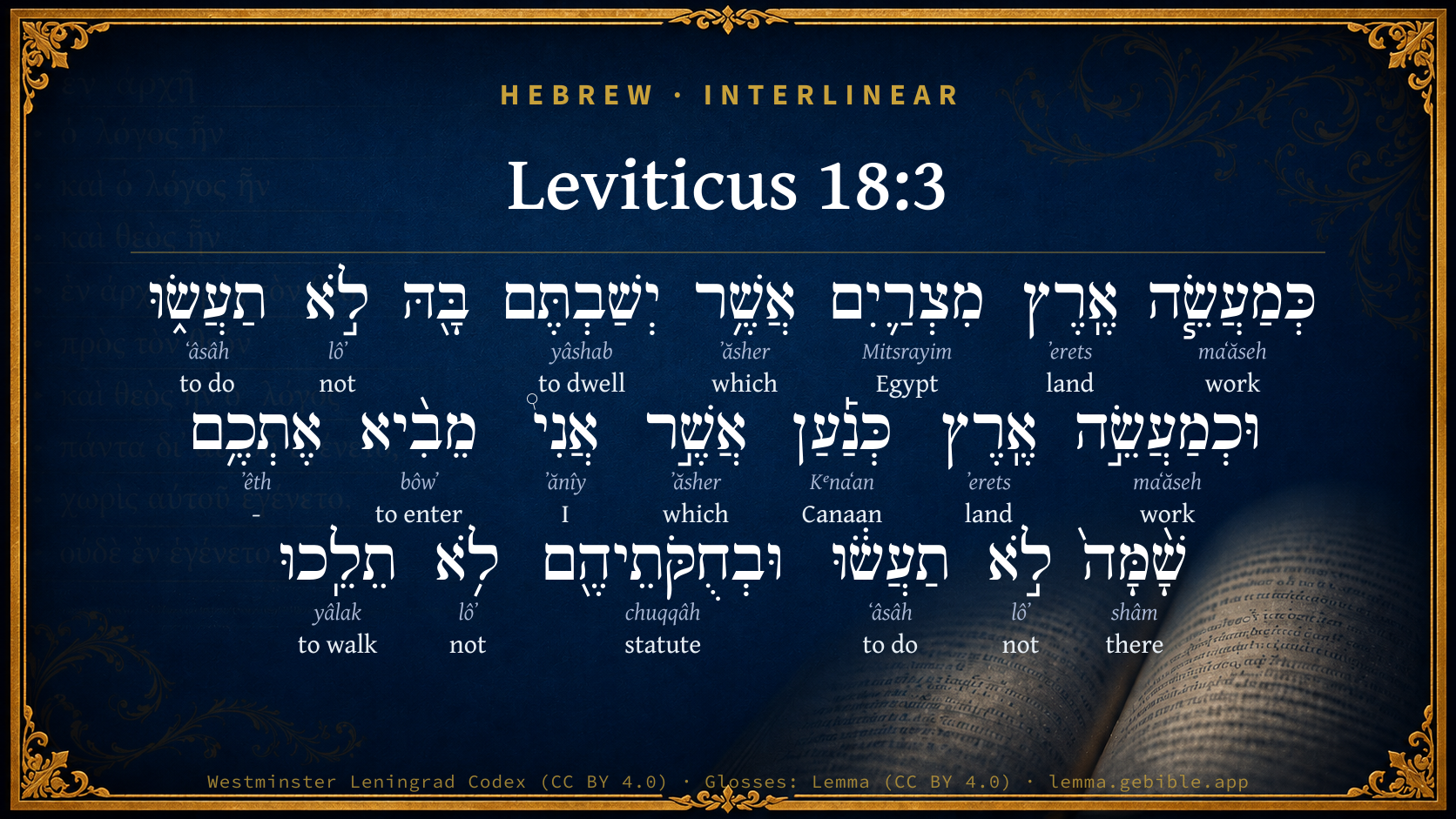
Hebrew (Westminster Leningrad Codex) Leviticus 18:3 appears in the Hebrew Old Testament. The text above is from the Westminster Leningrad Codex. Each word links to its Strong’s number, a concise gloss, and parsing drawn from the Open Scriptures Hebrew Bible morphology. Click any word for its full Brown-Driver-Briggs (BDB) entry.
Download image
Cite this verse

Leviticus 18:3 (World English Bible). Public Domain. Lemma interlinear Bible study tool, https://lemma.gebible.app/v/leviticus/18/3.

Show BibTeX & RIS
BibTeX
RIS
English Translation
You shall not do as they do in the land of Egypt, where you lived: and you shall not do as they do in the land of Canaan, where I am bringing you; neither shall you walk in their statutes.
World English Bible · Public Domain
Download a study sheet

One document with this verse’s original text, its word-by-word gloss line, the meaning frame, cross-references with their text, attributed commentary, and full source and license credits — printable, and it pastes into notes with its structure intact.

This verse Autodidact and up

Study sheet (.html) Plain text (.txt)

A passage Seminary Student

Up to 50 verses in one chapter. A passage sheet keeps up to 6 commentary sources and 12 cross-references per verse, in the order this page ranks them, and says so on the sheet whenever that leaves anything out. Ask for a single verse and you get the Autodidact verse sheet above.

Everything on this page stays free to read, with no account — the sheet is a download of what is already on screen, not access to it.

Want to remove ads? Support Godless Engineer
Compare translations 3

The same verse in 3 English versions, stacked beneath the original-language interlinear above. Click any original word for its lexicon entry.

Each is an independent rendering of the whole verse — the interlinear is not word-aligned to these translations.

Highlighted words mark where these versions differ — a whole-verse word diff, not a word-by-word alignment.

  • World English Bible Public Domain
    You shall not do as they do in the land of Egypt, where you lived: and you shall not do as they do in the land of Canaan, where I am bringing you; neither shall you walk in their statutes.
  • King James Version Public Domain
    After the doings of the land of Egypt, wherein ye dwelt, shall ye not do: and after the doings of the land of Canaan, whither I bring you, shall ye not do: neither shall ye walk in their ordinances.
  • unfoldingWord Literal Text CC BY-SA 4.0
    According to the work of the land of Egypt in which you dwelt, you shall not do. And according to the work of the land of Canaan to which I am bringing you, you shall not do. And you shall not walk in their statutes.

unfoldingWord Literal Text — © unfoldingWord, licensed CC BY-SA 4.0. Word-aligned USFM3 via Door43 (git.door43.org/unfoldingWord/en_ult).

Versions to compare (up to 4)

3 of 4 selected

Show all 18 translations

Every available English version of this verse, each an independent rendering of the whole verse.

  • World English Bible Public Domain
    You shall not do as they do in the land of Egypt, where you lived: and you shall not do as they do in the land of Canaan, where I am bringing you; neither shall you walk in their statutes.
  • Berean Standard Bible Public Domain
    You must not follow the practices of the land of Egypt, where you used to live, and you must not follow the practices of the land of Canaan, into which I am bringing you. You must not walk in their customs.
  • Majority Standard Bible Public Domain
    You must not follow the practices of the land of Egypt, where you used to live, and you must not follow the practices of the land of Canaan, into which I am bringing you. You must not walk in their customs.
  • King James Version Public Domain
    After the doings of the land of Egypt, wherein ye dwelt, shall ye not do: and after the doings of the land of Canaan, whither I bring you, shall ye not do: neither shall ye walk in their ordinances.
  • American Standard Version (1901) Public Domain
    After the doings of the land of Egypt, wherein ye dwelt, shall ye not do: and after the doings of the land of Canaan, whither I bring you, shall ye not do; neither shall ye walk in their statutes.
  • Revised Version (1885) Public Domain
    After the doings of the land of Egypt, wherein ye dwelt, shall ye not do: and after the doings of the land of Canaan, whither I bring you, shall ye not do: neither shall ye walk in their statutes.
  • Geneva Bible (1599) Public Domain
    After ye doings of the land of Egypt, wherin ye dwelt, shall ye not doe: and after the maner of the land of Canaan, whither I will bring you, shall ye not do, neither walke in their ordinances,
  • Douay-Rheims (1899) Public Domain
    You shall not do according to the custom of the land of Egypt, in which you dwelt: neither shall you act according to the manner of the country of Chanaan, into which I will bring you, nor shall you walk in their ordinances.
  • Young's Literal Translation Public Domain
    according to the work of the land of Egypt in which ye have dwelt ye do not, and according to the work of the land of Canaan whither I am bringing you in, ye do not, and in their statutes ye walk not.
  • Literal Standard Version CC BY-SA 4.0
    you do not do according to the work of the land of Egypt in which you have dwelt, and you do not do according to the work of the land of Canaan to where I am bringing you in, and you do not walk in their statutes.
  • Unlocked Literal Bible CC BY-SA 4.0
    You must not do the things that the people do in Egypt, where you lived previously. You must not do the things that the people do in Canaan, the land to which I am taking you. Do not follow their customs.
  • unfoldingWord Literal Text CC BY-SA 4.0
    According to the work of the land of Egypt in which you dwelt, you shall not do. And according to the work of the land of Canaan to which I am bringing you, you shall not do. And you shall not walk in their statutes.
  • Darby Bible Public Domain
    After the doings of the land of Egypt, wherein ye dwelt, shall ye not do; and after the doings of the land of Canaan, whither I bring you, shall ye not do; neither shall ye walk in their customs.
  • World Messianic Bible Public Domain
    You shall not do as they do in the land of Egypt, where you lived. You shall not do as they do in the land of Canaan, where I am bringing you. You shall not follow their statutes.
  • Webster's Bible Public Domain
    After the doings of the land of Egypt in which ye dwelt, shall ye not do: and after the doings of the land of Canaan whither I bring you, shall ye not do: neither shall ye walk in their ordinances.
  • Free Bible Version CC BY-SA 4.0
    Don't follow the ways of Egypt where you used to live, and don't follow the ways of Canaan where I'm going to take you. Don't adopt their practices.
  • Bible in Basic English Public Domain
    You may not do those things which were done in the land of Egypt where you were living; and you may not do those things which are done in the land of Canaan where I am taking you, or be guided in your behaviour by their rules.
  • JPS Tanakh (1917) Public Domain
    After the doings of the land of Egypt, wherein ye dwelt, shall ye not do; and after the doings of the land of Canaan, whither I bring you, shall ye not do; neither shall ye walk in their statutes.

Literal Standard Version (2020), Covenant Press — licensed CC BY-SA 4.0. Text via the HelloAO Bible API (eBible.org). Unlocked Literal Bible (unfoldingWord) — licensed CC BY-SA 4.0. Text via the HelloAO Bible API (eBible.org). unfoldingWord Literal Text — © unfoldingWord, licensed CC BY-SA 4.0. Word-aligned USFM3 via Door43 (git.door43.org/unfoldingWord/en_ult). Free Bible Version, Dr. Jonathan Gallagher — licensed CC BY-SA 4.0. Text via the HelloAO Bible API (eBible.org).

Word by word

More ways to search: Search by grammar → Find every occurrence → Compare this word →

Practice this passage: Drill this verse → Learn its vocabulary →

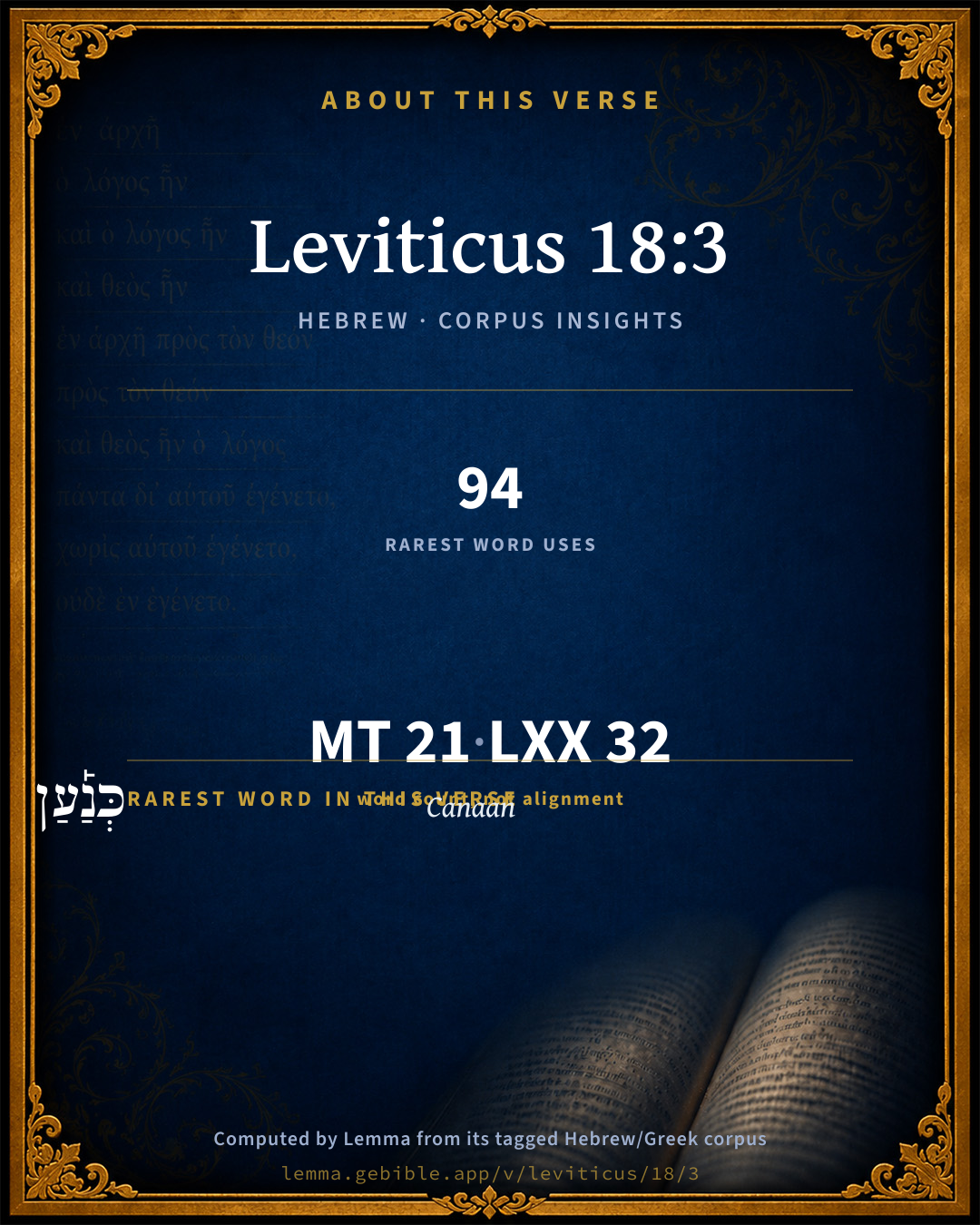
כְּנַ֡עַן
Kᵉnaʻan
H3667
“Canaan”
Noun, Proper
Part of Speech
Noun
Type
Proper
Full BDB Definition

Origin: from H3665

TWOT: 1002 , 1002b

Canaan = "lowland" - the 4th son of Ham and the progenitor of the Phoenicians and of the various nations who peopled the seacoast of Palestine (noun proper masculine) - the land west of the Jordan peopled by the descendants of Canaan and subsequently conquered by the Israelites under Joshua (noun proper locative) - merchant, trader (noun masculine)
  1. כְּמַעֲשֵׂ֧ה maʻăseh H4639 “like/as · work of” Preposition + Noun, Common, Masculine, Singular, Construct
  2. אֶֽרֶץ ʼerets H776 “land of” Noun, Common, Both, Singular, Construct
  3. מִצְרַ֛יִם Mitsrayim H4714 “Egypt” Noun, Proper
  4. אֲשֶׁ֥ר ʼăsher H834 “which” Particle, Relative
  5. יְשַׁבְתֶּם yâshab H3427 “to dwell” Verb, Qal, Perfect, 2nd Person, Masculine, Plural
  6. לֹ֣א lôʼ H3808 “not” Particle, Negative
  7. תַעֲשׂ֑וּ ʻâsâh H6213 “to do” Verb, Qal, Imperfect, 2nd Person, Masculine, Plural
  8. וּכְמַעֲשֵׂ֣ה maʻăseh H4639 “and · like/as · work of” Conjunction + Preposition + Noun, Common, Masculine, Singular, Construct
  9. אֶֽרֶץ ʼerets H776 “land of” Noun, Common, Both, Singular, Construct
  10. אֲשֶׁ֣ר ʼăsher H834 “which” Particle, Relative
  11. אֲנִי֩ ʼănîy H589 “I” Pronoun, Personal, 1st Person, Common, Singular
  12. מֵבִ֨יא bôwʼ H935 “entering” Verb, Hiphil, Participle Active, Masculine, Singular, Absolute
  13. אֶתְכֶ֥ם ʼêth H853 “- · you” Particle, Direct Object + Suffix, Personal, 2nd Person, Masculine, Plural
  14. שָׁ֨מָּה֙ shâm H8033 “there · toward” Adverb + Suffix, Demonstrative
  15. לֹ֣א lôʼ H3808 “not” Particle, Negative
  16. תַעֲשׂ֔וּ ʻâsâh H6213 “to do” Verb, Qal, Imperfect, 2nd Person, Masculine, Plural
  17. וּבְחֻקֹּתֵיהֶ֖ם chuqqâh H2708 “and · in/at · statutes · their” Conjunction + Preposition + Noun, Common, Both, Plural, Construct + Suffix, Personal, 3rd Person, Masculine, Plural
  18. לֹ֥א lôʼ H3808 “not” Particle, Negative
  19. תֵלֵֽכוּ yâlak H3212 “to walk” Verb, Qal, Imperfect, 2nd Person, Masculine, Plural

About this verse

These counts appear in no published source. They are computed here, from the morphology-tagged text and Lemma’s own curated glosses. What Lemma adds →

21
words
14
distinct lemmas
Pentateuch
section

Grammatical profile

  • 5 verbs
  • 7 nouns
  • 1 pronoun
  • 1 preposition
  • 1 adverb
  • 6 particles

Verb forms

  • יְשַׁבְתֶּם Qal · Perfect
  • תַעֲשׂ֑וּ Qal · Imperfect
  • מֵבִ֨יא Hiphil · Participle Active
  • תַעֲשׂ֔וּ Qal · Imperfect
  • תֵלֵֽכוּ Qal · Imperfect

Repetition

Words recur within this verse — often emphatic in Hebrew:

  • כְּמַעֲשֵׂ֧ה work H4639 ×2
  • אֶֽרֶץ land H776 ×2
  • תַעֲשׂ֑וּ to do H6213 ×2
  • לֹ֣א not H3808 ×3
  • אֲשֶׁ֥ר which H834 ×2

Hebrew & Septuagint length

In English translation the verse runs 40 words from the Hebrew and 41 from the Septuagint (LXX English) — closely comparable.

A rough comparison of the two English renderings, which tokenize alike — not a word-level alignment.

Word counts can differ between the Hebrew and the Greek without any difference in meaning — e.g. the Hebrew direct-object marker אֵת has no separate Greek word, and Greek often adds the article ὁ.

In the original languages it is 21 Hebrew tokens and 32 Greek tokens — but the two are counted differently (Hebrew bundles its prefixes and suffixes into one token; the Greek is in lemma form), so that isn’t a like-for-like length.

Cross-references

12

Topical passages linked to Leviticus 18:3 in the Treasury of Scripture Knowledge — connected by theme and wording, ordered by reader-vote popularity; previews shown in the World English Bible.

  • Exodus 23:24 You shall not bow down to their gods, nor serve them, nor follow their practices, but you shall utterly overthrow them and demolish their pillars.
  • Leviticus 20:23 You shall not walk in the customs of the nation, which I am casting out before you: for they did all these things, and therefore I abhorred them.
  • Ezekiel 20:7–8 I said to them, Cast you away every man the abominations of his eyes, and don't defile yourselves with the idols of Egypt; I am Yahweh your God.
  • Ezekiel 23:8 Neither has she left her prostitution since [the days of] Egypt; for in her youth they lay with her, and they handled the bosom of her virginity; and they poured out their prostitution on her.
  • 1 Peter 4:2–4 that you no longer should live the rest of your time in the flesh for the lusts of men, but for the will of God.
  • Deuteronomy 12:30–31 take heed to yourself that you not be ensnared to follow them, after that they are destroyed from before you; and that you not inquire after their gods, saying, How do these nations serve their gods? even so will I do likewise.
  • Deuteronomy 12:4 You shall not do so to Yahweh your God.
  • Psalms 106:35 But mixed themselves with the nations, And learned their works.
  • Jeremiah 10:2–3 Thus says Yahweh, "Don't learn the way of the nations, and don't be dismayed at the signs of the sky; for the nations are dismayed at them.
  • Romans 12:2 Don't be conformed to this world, but be transformed by the renewing of your mind, so that you may prove what is the good, well-pleasing, and perfect will of God.
  • Ephesians 5:7–11 Therefore don't be partakers with them.
  • Leviticus 18:24–30 "'Don't defile yourselves in any of these things: for in all these the nations which I am casting out before you were defiled.

Cross-references courtesy of OpenBible.info (CC BY 4.0).

Hebrew and Greek witnesses Masoretic Hebrew ↔ Greek Septuagint

The same verse in the two great witnesses to the Old Testament, shown verse-for-verse.

These are two independent witnesses, not word-aligned to each other, and the Septuagint is shown in lemma (dictionary) form.

Hebrew Leviticus 18:3 Masoretic · Westminster Leningrad Codex

כְּמַעֲשֵׂ֧ה אֶֽרֶץ מִצְרַ֛יִם אֲשֶׁ֥ר יְשַׁבְתֶּם בָּ֖הּ לֹ֣א תַעֲשׂ֑וּ וּכְמַעֲשֵׂ֣ה אֶֽרֶץ כְּנַ֡עַן אֲשֶׁ֣ר אֲנִי֩ מֵבִ֨יא אֶתְכֶ֥ם שָׁ֨מָּה֙ לֹ֣א תַעֲשׂ֔וּ וּבְחֻקֹּתֵיהֶ֖ם לֹ֥א תֵלֵֽכוּ

You shall not do as they do in the land of Egypt, where you lived: and you shall not do as they do in the land of Canaan, where I am bringing you; neither shall you walk in their statutes.

World English Bible · Public Domain

Greek LXX Leviticus 18:3 Septuagint · lemma form

κατά ὁ ἐπιτήδευμα γῆ αἴγυπτος ἐν ὅς καταοἰκέω ἐπί αὐτός οὐ ποιέω καί κατά ὁ ἐπιτήδευμα γῆ χανααν εἰς ὅς ἐγώ εἰςἄγω σύ ἐκεῖ οὐ ποιέω καί ὁ νόμιμος αὐτός οὐ πορεύομαι

You⌃ shall not do according to the devices of Egypt, in which you⌃ lived: and according to the devices of the land of Chanaan, into which I bring you, you⌃ shall not do; and you⌃ shall not walk in their ordinances.

LXX2012 (modern English Septuagint) · Public Domain

Hebrew: Westminster Leningrad Codex (CC BY 4.0). Greek: Septuagint (public domain); English from LXX2012 (modern English Septuagint) (Public Domain). How the Septuagint differs from the Hebrew →

Targum (Aramaic paraphrase)

2

The Targum is the ancient Jewish Aramaic paraphrase of the Hebrew Scriptures — an interpretive translation, not the Hebrew text itself. Onkelos (literal) and Pseudo-Jonathan (expansive) render the Torah, and Jonathan the Prophets. Coverage is partial: where no permissively-licensed English translation exists for a verse, only the Aramaic is shown. This is verse-level text, not a word-by-word alignment to the Hebrew.

  1. Targum Onkelos Torah (Genesis–Deuteronomy)
    כְּעוֹבָדֵי עַמָא דְאַרְעָא דְמִצְרַיִם דִי יְתֶבְתּוּן בַּהּ לָא תַעְבְּדוּן וּכְעוֹבָדֵי עַמָא דְאַרְעָא דִכְנַעַן דִי אֲנָא מָעֵל יָתְכוֹן תַּמָן לָא תַעְבְּדוּן וּבְנִימוֹסֵיהוֹן לָא תְהָכוּן

    (no public-domain English translation for this verse)

    Targum Onkelos — Aramaic: “Onkelos Genesis” (public domain); “Onkelos Exodus” (public domain); “Onkelos Leviticus” (public domain); “Onkelos Numbers” (public domain); “Onkelos Deuteronomy” (public domain). English: “Sefaria Community Translation” (CC0 1.0 (public-domain dedication)); “J.W. Etheridge. The Targums of Onkelos and Jonathan Ben Uzziel on the Pentateuch. London: Longmans, Green, 1862” (public domain). Text via Sefaria.

  2. Targum Pseudo-Jonathan Torah (Genesis–Deuteronomy)
    כְּעוֹבְדִין בִּישִׁין דְעַמָא אַרְעָא דְמִצְרַיִם דִי תֵיתְבוּן בָּהּ לָא תַעַבְדוּן וְהֵי כְּעוֹבְדִין בִּישִׁין דְעַמָא דְאַרְעָא דִכְנָעַן דַאֲנָא מָעִיל יַתְכוֹן לְתַמָן לָא תַעַבְדוּן וּבְנִימוּסֵיהוֹן לָא תְהָכוּן

    After the evil work of the people of the land of Mizraim, among whom you have dwelt, you shall not do; so likewise, after the evil work of the people of the land of Kenaan, whither I am bringing you, ye shall not do, neither shall you walk according to their laws;

    Targum Pseudo-Jonathan — Aramaic: “Targum Jonathan on Genesis” (public domain); “Targum Jonathan on Exodus” (public domain); “Targum Jonathan on Leviticus” (public domain); “Targum Jonathan on Numbers” (public domain); “Targum Jonathan on Deuteronomy” (public domain). English: “The Targum of Jonathan ben Uzziel, trans. J. W. Etheridge, London, 1862” (public domain). Text via Sefaria.

Commentary

Notes on Leviticus 18:3 from classic Christian and Jewish commentators (each source and its license shown beneath its notes). The classic Christian expositions comment on the surrounding passage and are grouped to its opening verse, so a note may address several verses; the Jewish commentaries on the Tanakh (Rashi and others) are per-verse, so they appear only where the commentator wrote on this verse.

Lemma curates 59 commentaries, every one of them public domain or Creative Commons licensed, each selected and text-cleaned for this edition rather than reprinted as found. About our sources →

Trapp's Complete Commentary

John Trapp

Lev 18:3 After the doings of the land of Egypt, wherein ye dwelt, shall ye not do: and after the doings of the land of Canaan, whither I bring you, shall ye not do: neither shall ye walk in their ordinances.

Ver. 3. After the doings of the land of Egypt.] Where, and in Canaan, these heinous sins are counted peccadillos; as at this day also they are in Spain, Italy, Turkey, where their catamites are their serious loves; sodomy is hardly held a vice; bestiality was boasted of by Mohammed their prophet.

In their ordinances.] The Egyptians made it lawful, so did the Persians, for brother and sister to couple together in marriage. Of this and the like ordinances it might be rightly said, as once it was of the ceremonial law, that they were statutes that were not good, and judgments whereby they should not live. {Eze 20:25}

John Trapp, A Commentary or Exposition upon All the Books of the Old and New Testament (1647–1656) — public domain. Text from a community e-Sword module.

Joseph Benson's Commentary

Lev 18:3. Egypt and Canaan — These two nations he mentions, because their habitation and conversation among them made their evil example in the following matters more dangerous. But under them he includes all other nations.

Joseph Benson's Commentary on the Old and New Testaments (1811–1818) — public domain. Text from a community e-Sword module.

Geneva Bible (1599)

Geneva Bible translators

Ye shall preserve yourselves from these abominations following, which the Egyptians and Canaanites use.

Geneva Bible (1599) marginal notes — public domain. Text via Bolls.life.

Adam Clarke's Commentary

Verse 3. The doings of the land of Egypt - the land of Canaan] The worshipping of demons, beasts, &c., as mentioned in the preceding chapters, Le 17:7, and the abominations mentioned in this chapter from Le 18:21-23.

Adam Clarke's Commentary on the Bible (1810–1826) — public domain. Text from a community e-Sword/MySword module.

Ellicott's Commentary for English Readers

(3) After the doings of the land of Egypt.—During their sojourn in Egypt the Israelites became familiar with the practices which obtained in the land of their bondage, and as they adopted some of them (see Lev_17:7), they are here solemnly warned to eschew those which are especially proscribed in the sequel.

And after the doings of the land of Canaan. The danger of imitating the customs which they had for centuries witnessed in the land they quitted, was greatly increased by the fact that these licentious practices obtained in worse forms in the land which they were to inherit. It is therefore against the past and the future that they are here warned.

Neither shall ye walk in their ordinances. As some of “the doings” referred to may have been simple custom, not based upon the law of the country where they obtained, the Lawgiver here emphatically condemns the acts which were legalised, declaring them to have no authority whatever. (See Lev_18:30.)

A Bible Commentary for English Readers, edited by Charles John Ellicott (1878–1897) — public domain. Text from a community e-Sword module.

John Gill's Exposition

After the doings of the land of Egypt, wherein ye dwelt, shall ye not do,.... Where they had dwelt many years, and were just come out from thence, and where they had learned many of their evil practices; not only their idolatrous ones referred to in the preceding chapter, which it is certain they followed, Eze 20:7; but also their immoral practices, particularly respecting incestuous marriages, after insisted on, some of which were established by a law among them; so Diodorus Siculus relates (q), that it passed into a law with the Egyptians, contrary to the common custom of all others, that men might marry their own sisters; which is one of the incestuous marriages taken notice of in this chapter, and forbid:

and after the doings of the land of Canaan, whither I bring you, shall ye not do: which land had been promised to their ancestors and to them long ago, and whither they were now going under divine direction and guidance, to inherit it, and are here particularly warned of the evil practices among them, that they might avoid them: Maimonides (r) says, these are what our Rabbins call "the ways of the Amorites" (the principal people of the nations of the land of Canaan), and which, he adds, are as branches of the magic art; namely, such which do not follow from natural reason, but from magical operation, and depend upon the dispositions and orders of the stars, and so were necessarily led to worship them: hence, they say, in whatsoever is anything of medicine, in it is nothing of the way of the Amorites; by which they mean nothing else than this, that everything is lawful in which there appears a natural reason for it; and on the contrary, all others are unlawful: but here respect is had not to magical operations but to incestuous marriages, which prevailed among that people, and which they might have received from their ancestor Canaan, who learned them from his father Ham, of whom Berosus (s) writes, that even before the flood he corrupted mankind; asserting and putting it in practice, that men might lie with their mothers, sisters, daughters, and with males and brutes, or any other, for which he was cast out by Noah:

neither shall ye walk in their ordinances: which they ordained, appointed, and settled, for they were such a people the Psalmist speaks of, which framed mischief or wickedness by a law, Psa 94:2; so Diodorus Siculus says of the incestuous marriage before referred to, and which the above writer, Berosus, derives from Ham their ancestor, that they are said "to pass into a law"; but Aben Ezra puts another sense on these words, let no man use himself to walk in this way until it becomes an ordinance or statute unto him; custom is second nature, and in course of time has the force of a law, wherefore bad customs should be strictly guarded against.

(q) Bibliothec. l. 1. p. 23. (r) Moreh Nevochim, par. 3. c. 37. (s) Antiqu. l. 3. fol. 25.

John Gill's Exposition of the Whole Bible (1746–1763) — public domain (CC PDM 1.0). Text via the HelloAO Bible API.

Albert Barnes' Notes on the Bible

See the Lev 18:24-30 note.

Albert Barnes' Notes on the Bible (1834–1885) — public domain. Text from a community e-Sword/MySword module.

Haydock's Catholic Bible Commentary

Ordinances respecting marriages, divine worship, &c. (Haydock)

George Leo Haydock (1774–1849), Haydock's Catholic Family Bible and Commentary, 1859 edition — public domain. Excludes Psalms (Douay-Rheims chapter numbering differs from Protestant) and Deuterocanonical books (Catholic canon only).

Matthew Poole's English Annotations

Egypt and Canaan: these two nations he mentions, because their habitation and conversation among them made their evil example in the following matters more dangerous. But under them he includes all other nations, as he elsewhere expresseth it. In their ordinances, or statutes; either because their laws did indeed allow such things, or because prevailing customs have the force of laws.

Matthew Poole's English Annotations on the Holy Bible (1683–1685) — public domain. Text from a community e-Sword/MySword module.

Whedon's Commentary on the Bible

Daniel D. Whedon

3. After the doings of… Egypt — The Israelites appear during the oppression, for the most part, to have adopted the religion of their masters, (Jos_24:14; Eze_20:7-8,) and, of course, were morally defiled. Ashtoreth, the oriental Venus, was worshipped in Memphis with all the pollutions attendant upon such a cultus, as is shown by a tablet recently discovered. The sculptures and paintings of the tombs give a very full insight into the domestic life of the ancient Egyptians, as exhibited by Sir G. Wilkinson. Licentious and naked festal dances are conspicuous in the stony record, exactly corroborating Exo_32:25. Concubines, or trains of inferior wives, also appear on the tablets. The gross and unnatural vices of the Egyptians are hinted at in this chapter.

After the doings of… Canaan — Outside of the Old Testament we have no clew to the manners or customs of this people; but within, the sacred annals are abundant proofs of the moral abominations by which the land was defiled. Lev_20:23; Deu_12:30-31.

Whither I bring you — These words point to the sojourn in the wilderness prior to the occupation of Canaan; and they are an insuperable objection to the theory that the Levitical legislation was an invention of crafty men centuries after Moses died.

Ordinances — The extent and pervasiveness of Canaanitish depravity may be inferred from the fact that their very laws, in which moral purity lingers longest, had been changed from guardians of virtue to patrons of vice.

Daniel D. Whedon (gen. ed.), Commentary on the Old and New Testaments (1874–1909) — public domain. Text from a community e-Sword module.

John Wesley's Explanatory Notes

Egypt and Canaan - These two nations he mentions, because their habitation and conversation among them made their evil example in the following matters more dangerous. But under them he includes all other nations.

John Wesley, Explanatory Notes Upon the Whole Bible (1754–1765) — public domain. Text via the GEBible commentary corpus.

Rashi

Rabbi Shlomo Yitzchaki (Rashi)

כמעשה ארץ מצרים AFTER THE DEEDS OF THE LAND OF EGYPT… [SHALL YE NOT DO] — This tells us that the deeds of the Egyptians and the Canaanites were more corrupt than those of all other nations, and that the district of Egypt in which the Israelites had resided (אשר ישבתם בה) was even more corrupt than all the rest of Egypt (Sifra, Acharei Mot, Section 8 3).

אשר אני מביא אתכם שמה [AND AFTER THE DEEDS OF THE LAND OF CANAAN] WHITHER I BRING YOU [SHALL YE NOT DO] — This again tells us that those Canaanitish clans whom Israel subdued were more corrupt than all the others of them (Sifra, Acharei Mot, Section 8 4).

ובחקתיהם לא תלכו NEITHER SHALL YE WALK IN THEIR ORDINANCES — What has Scripture left unsaid when it spoke of the deeds of the Egyptians and Canaanites that it felt compelled to add ובחקתיהם לא תלכו But by these latter words it refers to their social customs — things which have assumed for them the character of a law as, for instance, the frequenting of theaters and race-courses. Rabbi Meir, however, said: These (חקתיהם) refer to the "ways of the Amorites" (superstitious practices) which our Rabbis have enumerated (Shabbat 67a; Sifra, Acharei Mot, Section 8 8; cf. also Tosefta Shabbat 7).

Rashi on the Tanakh — English translations: “The Judaica Press complete Tanach with Rashi, translated by A. J. Rosenberg” (CC BY 4.0); “Pentateuch with Rashi's commentary by M. Rosenbaum and A.M. Silbermann, 1929-1934” (public domain); “The Metsudah Tanach series, Lakewood, N.J” (CC BY 4.0); and “The Book of Joshua, Metsudah Publications, 1997” (CC BY 4.0). Text via Sefaria.

Ramban (Nachmanides)

Rabbi Moshe ben Nachman (Ramban / Nachmanides)

According to the opinion of Rabbi Abraham ibn Ezra, the Scriptural command, After the doings of the land of Egypt … shall ye not do, is a reference to [the practice of sacrificing to] the demons mentioned above [in 17:7]; and after the doings of the land of Canaan … shall ye not do is an allusion to the forbidden sexual relationships, in which the Canaanites were very bad and sinful, as He stated at the end of this section, For all these abominations have the men of the Land done. And in the opinion of our Rabbis in the Torath Kohanim, 9:3. the Egyptians were also addicted to carnality, in all forms of the forbidden relationships, and with males and cattle. This is the truth, [as Scripture states] that there were also sodomites in the Land,. referring [to the abominations of the nations] which were there from the beginning till now. Scripture further testifies concerning them, the Egyptians, thy neighbors, great of flesh, and it further says, whose flesh is as the flesh of asses, and whose issue is like the issue of horses, 23:20. the term “flesh” being a euphemism [for the sexual organ]. Similarly, in the expressions, his flesh ran with his issue, and her issue in her flesh be blood, Verse 19. [the term “flesh” is an allusion to the sexual organ].

Ramban (Nachmanides) on the Tanakh — English translation: “Commentary on the Torah by Ramban (Nachmanides). Translated and annotated by Charles B. Chavel. New York, Shilo Pub. House, 1971-1976” (CC BY 4.0). Text via Sefaria.

Lesson kit

Teaching starters — assembled from the data on this page, not authored interpretation. Every prompt links to the verse data it draws on. Edit before teaching.

Leviticus, in the Pentateuch, opens this verse with 21 words (14 distinct Hebrew lemmas). Its most distinctive word is Kᵉnaʻan (“Canaan”). A historical commentator’s framing appears above. Read the whole chapter for the surrounding context.

Discussion questions

  1. What does “Canaan” (Kᵉnaʻan) contribute to the verse as a whole?
  2. Exodus 23:24 shares this passage’s theme. How do the two illuminate each other?
  3. “work” occurs 2× in this one verse. What is the effect of the repetition?
  4. These translations render this verse differently; the difference is in the English rendering, not the original. What questions does that raise?
  5. The verb «יְשַׁבְתֶּם» is Qal Perfect. How does its form color the action?
  6. Reading how Trapp's Complete Commentary and Joseph Benson's Commentary read this verse, where do the two commentators agree and where do they part?

Things to notice

Reading settings

Reading text

Shown beneath each verse's original-language words.

Old Testament
Old Testament edition

Read the OT as the Masoretic Hebrew (MT) or the Greek Septuagint (LXX).

English shown for the Greek Septuagint (in the Hebrew ↔ Greek comparison).

Comparing translations? Open the Compare panel on any verse page to stack up to four side by side.