
Leviticus 26:13

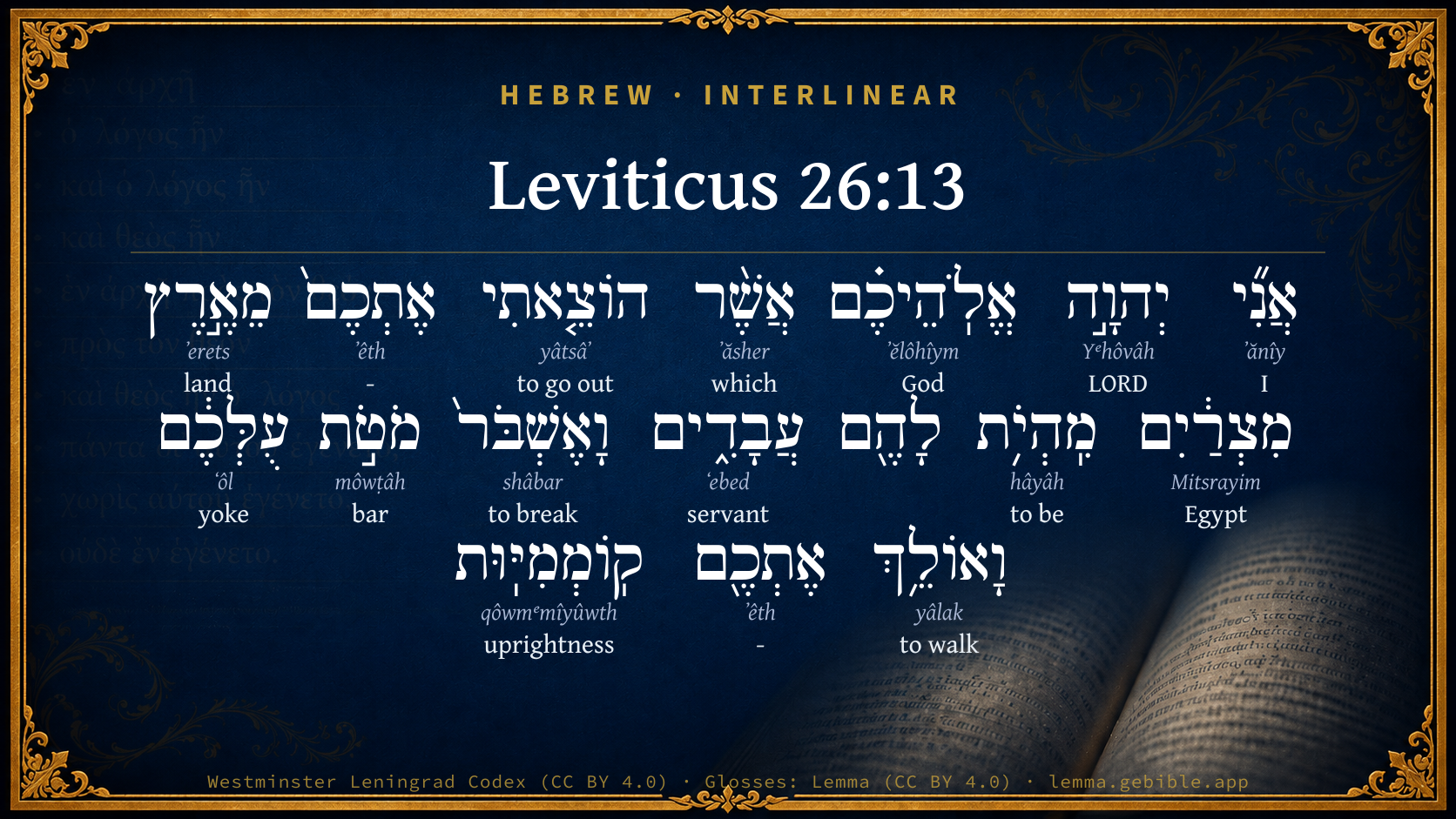
Hebrew (Westminster Leningrad Codex) Leviticus 26:13 appears in the Hebrew Old Testament. The text above is from the Westminster Leningrad Codex. Each word links to its Strong’s number, a concise gloss, and parsing drawn from the Open Scriptures Hebrew Bible morphology. Click any word for its full Brown-Driver-Briggs (BDB) entry.
Download image
Cite this verse

Leviticus 26:13 (World English Bible). Public Domain. Lemma interlinear Bible study tool, https://lemma.gebible.app/v/leviticus/26/13.

Show BibTeX & RIS
BibTeX
RIS
English Translation
I am Yahweh your God, who brought you forth out of the land of Egypt, that you should not be their slaves; and I have broken the bars of your yoke, and made you go upright.
World English Bible · Public Domain
Highlights
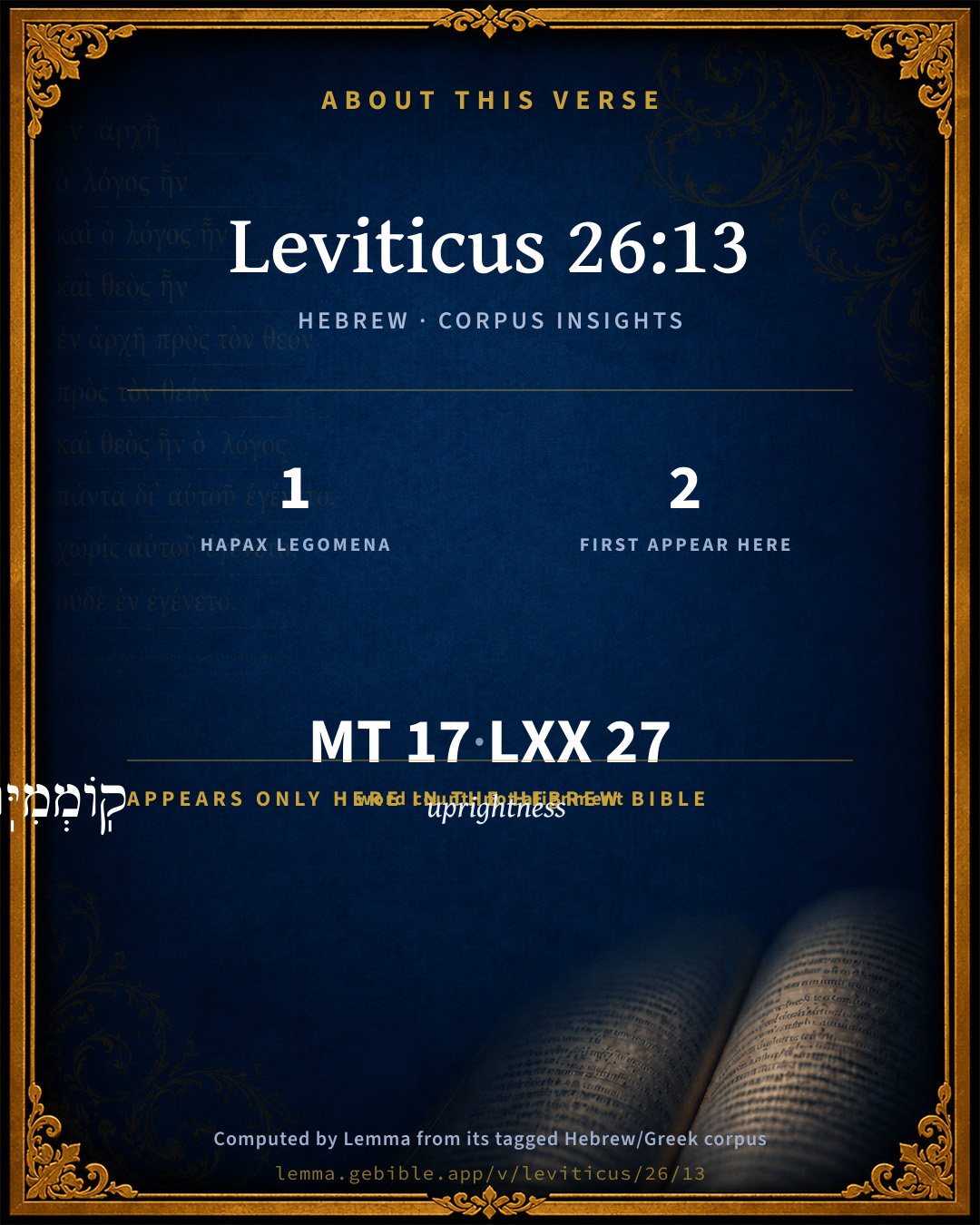
  • 1 hapax legomenon — only here in the Hebrew Bible
  • 2 first appearances in the Hebrew Bible
Full analysis ↓
Download a study sheet

One document with this verse’s original text, its word-by-word gloss line, the meaning frame, cross-references with their text, attributed commentary, and full source and license credits — printable, and it pastes into notes with its structure intact.

This verse Autodidact and up

Study sheet (.html) Plain text (.txt)

A passage Seminary Student

Up to 50 verses in one chapter. A passage sheet keeps up to 6 commentary sources and 12 cross-references per verse, in the order this page ranks them, and says so on the sheet whenever that leaves anything out. Ask for a single verse and you get the Autodidact verse sheet above.

Everything on this page stays free to read, with no account — the sheet is a download of what is already on screen, not access to it.

Want to remove ads? Support Godless Engineer
Compare translations 3

The same verse in 3 English versions, stacked beneath the original-language interlinear above. Click any original word for its lexicon entry.

Each is an independent rendering of the whole verse — the interlinear is not word-aligned to these translations.

Highlighted words mark where these versions differ — a whole-verse word diff, not a word-by-word alignment.

  • World English Bible Public Domain
    I am Yahweh your God, who brought you forth out of the land of Egypt, that you should not be their slaves; and I have broken the bars of your yoke, and made you go upright.
  • King James Version Public Domain
    I am the LORD your God, which brought you forth out of the land of Egypt, that ye should not be their bondmen; and I have broken the bands of your yoke, and made you go upright.
  • unfoldingWord Literal Text CC BY-SA 4.0
    I Yahweh your God who brought you out from the land of Egypt from being slaves to them, and I broke the bars of your yoke and made you walk upright.

unfoldingWord Literal Text — © unfoldingWord, licensed CC BY-SA 4.0. Word-aligned USFM3 via Door43 (git.door43.org/unfoldingWord/en_ult).

Versions to compare (up to 4)

3 of 4 selected

Show all 18 translations

Every available English version of this verse, each an independent rendering of the whole verse.

  • World English Bible Public Domain
    I am Yahweh your God, who brought you forth out of the land of Egypt, that you should not be their slaves; and I have broken the bars of your yoke, and made you go upright.
  • Berean Standard Bible Public Domain
    I am the LORD your God, who brought you out of the land of Egypt so that you would no longer be slaves to the Egyptians. I broke the bars of your yoke and enabled you to walk in uprightness.
  • Majority Standard Bible Public Domain
    I am the LORD your God, who brought you out of the land of Egypt so that you would no longer be slaves to the Egyptians. I broke the bars of your yoke and enabled you to walk in uprightness.
  • King James Version Public Domain
    I am the LORD your God, which brought you forth out of the land of Egypt, that ye should not be their bondmen; and I have broken the bands of your yoke, and made you go upright.
  • American Standard Version (1901) Public Domain
    I am Jehovah your God, who brought you forth out of the land of Egypt, that ye should not be their bondmen; and I have broken the bars of your yoke, and made you go upright.
  • Revised Version (1885) Public Domain
    I am the LORD your God, which brought you forth out of the land of Egypt, that ye should not be their bondmen; and I have broken the bars of your yoke, and made you go upright.
  • Geneva Bible (1599) Public Domain
    I am the Lord your God which haue brought you out of the lande of Egypt, that yee should not be their bondmen, and I haue broken ye bonds of your yoke, and made you goe vpright.
  • Douay-Rheims (1899) Public Domain
    I am the Lord your God: who have brought you out of the land of the Egyptians, that you should not serve them, and who have broken the chains of your necks, that you might go upright.
  • Young's Literal Translation Public Domain
    I `am' Jehovah your God, who have brought you out of the land of the Egyptians, from being their servants; and I break the bars of your yoke, and cause you to go erect.
  • Literal Standard Version CC BY-SA 4.0
    I [am] your God YHWH, who has brought you out of the land of the Egyptians, from being their servants; and I break the bars of your yoke and cause you to go erect.
  • Unlocked Literal Bible CC BY-SA 4.0
    I am Yahweh your God, who brought you out of the land of Egypt, so that you would not be their slaves. I have broken the bars of your yoke and made you to walk standing up straight.
  • unfoldingWord Literal Text CC BY-SA 4.0
    I Yahweh your God who brought you out from the land of Egypt from being slaves to them, and I broke the bars of your yoke and made you walk upright.
  • Darby Bible Public Domain
    I am Jehovah your God, who brought you forth out of the land of Egypt, that ye should not be their bondmen; and I have broken the bands of your yoke, and made you walk upright.
  • World Messianic Bible Public Domain
    I am the LORD your God, who brought you out of the land of Egypt, that you should not be their slaves. I have broken the bars of your yoke, and made you walk upright.
  • Webster's Bible Public Domain
    I am the LORD your God, who brought you out of the land of Egypt, that ye should not be their bond-men, and I have broken the bands of your yoke, and made you go upright.
  • Free Bible Version CC BY-SA 4.0
    I am the Lord your God, who led you out of Egypt so you wouldn't have to be slaves to the Egyptians any longer. I smashed the yoke that kept you bent down and helped you to stand up straight.
  • Bible in Basic English Public Domain
    I am the Lord your God, who took you out of the land of Egypt so that you might not be servants to them; by me the cords of your yoke were broken and I made you go upright.
  • JPS Tanakh (1917) Public Domain
    I am the LORD your God, who brought you forth out of the land of Egypt, that ye should not be their bondmen; and I have broken the bars of your yoke, and made you go upright.

Literal Standard Version (2020), Covenant Press — licensed CC BY-SA 4.0. Text via the HelloAO Bible API (eBible.org). Unlocked Literal Bible (unfoldingWord) — licensed CC BY-SA 4.0. Text via the HelloAO Bible API (eBible.org). unfoldingWord Literal Text — © unfoldingWord, licensed CC BY-SA 4.0. Word-aligned USFM3 via Door43 (git.door43.org/unfoldingWord/en_ult). Free Bible Version, Dr. Jonathan Gallagher — licensed CC BY-SA 4.0. Text via the HelloAO Bible API (eBible.org).

Word by word

More ways to search: Search by grammar → Find every occurrence → Compare this word →

Practice this passage: Drill this verse → Learn its vocabulary →

קֽוֹמְמִיּֽוּת
qôwmᵉmîyûwth
H6968
“uprightness”
Adverb
Part of Speech
Adverb
Full BDB Definition

Origin: from H6965

TWOT: 1999e

uprightness (as adverb)
  1. אֲנִ֞י ʼănîy H589 “I” Pronoun, Personal, 1st Person, Common, Singular
  2. יְהוָ֣ה Yᵉhôvâh H3068 “LORD” Noun, Proper
  3. אֱלֹֽהֵיכֶ֗ם ʼĕlôhîym H430 “God(s) · your” Noun, Common, Masculine, Plural, Construct + Suffix, Personal, 2nd Person, Masculine, Plural
  4. אֲשֶׁ֨ר ʼăsher H834 “which” Particle, Relative
  5. הוֹצֵ֤אתִי yâtsâʼ H3318 “to go out” Verb, Hiphil, Perfect, 1st Person, Common, Singular
  6. אֶתְכֶם֙ ʼêth H853 “- · you” Particle, Direct Object + Suffix, Personal, 2nd Person, Masculine, Plural
  7. מֵאֶ֣רֶץ ʼerets H776 “from · land of” Preposition + Noun, Common, Both, Singular, Construct
  8. מִצְרַ֔יִם Mitsrayim H4714 “Egypt” Noun, Proper
  9. מִֽהְיֹ֥ת hâyâh H1961 “from · to be” Preposition + Verb, Qal, Infinitive Construct
  10. עֲבָדִ֑ים ʻebed H5650 “servants” Noun, Common, Masculine, Plural, Absolute
  11. וָאֶשְׁבֹּר֙ shâbar H7665 “and · to break” Conjunction + Verb, Qal, Sequential Imperfect, 1st Person, Common, Singular
  12. מֹטֹ֣ת môwṭâh H4133 “bars of” Noun, Common, Feminine, Plural, Construct
  13. עֻלְּכֶ֔ם ʻôl H5923 “yoke · your” Noun, Common, Masculine, Singular, Construct + Suffix, Personal, 2nd Person, Masculine, Plural
  14. וָאוֹלֵ֥ךְ yâlak H3212 “and · to walk” Conjunction + Verb, Hiphil, Sequential Imperfect, 1st Person, Common, Singular
  15. אֶתְכֶ֖ם ʼêth H853 “- · you” Particle, Direct Object + Suffix, Personal, 2nd Person, Masculine, Plural

About this verse

These counts appear in no published source. They are computed here, from the morphology-tagged text and Lemma’s own curated glosses. What Lemma adds →

17
words
15
distinct lemmas
Pentateuch
section

Notable vocabulary

1 hapax legomenon — a word that appears only here in the entire Hebrew Bible:

  • קֽוֹמְמִיּֽוּת uprightness H6968

First appearance in Scripture

These words make their first canonical appearance in the Hebrew Bible here:

  • מֹטֹ֣ת bar H4133
  • קֽוֹמְמִיּֽוּת uprightness H6968

Shared distinctive vocabulary

מֹטֹ֣ת bar H4133 occurs in 10 verses of the Hebrew Bible. Also found in:

Grammatical profile

  • 4 verbs
  • 7 nouns
  • 1 pronoun
  • 1 preposition
  • 1 adverb
  • 3 particles

Verb forms

  • הוֹצֵ֤אתִי Hiphil · Perfect
  • מִֽהְיֹ֥ת Qal · Infinitive Construct
  • וָאֶשְׁבֹּר֙ Qal · Sequential Imperfect
  • וָאוֹלֵ֥ךְ Hiphil · Sequential Imperfect

Hebrew & Septuagint length

In English translation the verse runs 36 words from the Hebrew and 32 from the Septuagint (LXX English) — closely comparable.

A rough comparison of the two English renderings, which tokenize alike — not a word-level alignment.

Word counts can differ between the Hebrew and the Greek without any difference in meaning — e.g. the Hebrew direct-object marker אֵת has no separate Greek word, and Greek often adds the article ὁ.

In the original languages it is 17 Hebrew tokens and 27 Greek tokens — but the two are counted differently (Hebrew bundles its prefixes and suffixes into one token; the Greek is in lemma form), so that isn’t a like-for-like length.

Cross-references

10

Topical passages linked to Leviticus 26:13 in the Treasury of Scripture Knowledge — connected by theme and wording, ordered by reader-vote popularity; previews shown in the World English Bible.

  • Ezekiel 34:27 The tree of the field shall yield its fruit, and the earth shall yield its increase, and they shall be secure in their land; and they shall know that I am Yahweh, when I have broken the bars of their yoke, and have delivered them out of the hand of those who made slaves of them.
  • Exodus 20:2 "I am Yahweh your God, who brought you out of the land of Egypt, out of the house of bondage.
  • Leviticus 25:38 I am Yahweh your God, who brought you forth out of the land of Egypt, to give you the land of Canaan, and to be your God.
  • Psalms 116:16 Yahweh, truly I am your servant. I am your servant, the son of your handmaid. You have freed me from my chains.
  • Leviticus 25:55 For to me the children of Israel are servants; they are my servants whom I brought forth out of the land of Egypt. I am Yahweh your God.
  • Jeremiah 2:20 For of old time I have broken your yoke, and burst your bonds; and you said, I will not serve; for on every high hill and under every green tree you did bow yourself, playing the prostitute.
  • 1 Corinthians 6:19–20 Or don't you know that your body is a temple of the Holy Spirit which is in you, which you have from God? You are not your own,
  • Psalms 81:6–10 "I removed his shoulder from the burden. His hands were freed from the basket.
  • Leviticus 25:42 For they are my servants, whom I brought forth out of the land of Egypt. They shall not be sold as slaves.
  • Isaiah 51:23 and I will put it into the hand of those who afflict you, who have said to your soul, Bow down, that we may go over; and you have laid your back as the ground, and as the street, to those who go over.

Cross-references courtesy of OpenBible.info (CC BY 4.0).

Hebrew and Greek witnesses Masoretic Hebrew ↔ Greek Septuagint

The same verse in the two great witnesses to the Old Testament, shown verse-for-verse.

These are two independent witnesses, not word-aligned to each other, and the Septuagint is shown in lemma (dictionary) form.

Hebrew Leviticus 26:13 Masoretic · Westminster Leningrad Codex

אֲנִ֞י יְהוָ֣ה אֱלֹֽהֵיכֶ֗ם אֲשֶׁ֨ר הוֹצֵ֤אתִי אֶתְכֶם֙ מֵאֶ֣רֶץ מִצְרַ֔יִם מִֽהְיֹ֥ת לָהֶ֖ם עֲבָדִ֑ים וָאֶשְׁבֹּר֙ מֹטֹ֣ת עֻלְּכֶ֔ם וָאוֹלֵ֥ךְ אֶתְכֶ֖ם קֽוֹמְמִיּֽוּת

I am Yahweh your God, who brought you forth out of the land of Egypt, that you should not be their slaves; and I have broken the bars of your yoke, and made you go upright.

World English Bible · Public Domain

Greek LXX Leviticus 26:13 Septuagint · lemma form

ἐγώ εἰμί κύριος ὁ θεός σύ ὁ ἐκἄγω σύ ἐκ γῆ αἴγυπτος εἰμί σύ δοῦλος καί συντρίβω ὁ δεσμός ὁ ζυγόν σύ καί ἄγω σύ μετά παρρησία

I am the Lord your God, who brought you out of the land of Egypt, where you⌃ were slaves; and I broke the band of your yoke, and brought you forth openly.

LXX2012 (modern English Septuagint) · Public Domain

Hebrew: Westminster Leningrad Codex (CC BY 4.0). Greek: Septuagint (public domain); English from LXX2012 (modern English Septuagint) (Public Domain). How the Septuagint differs from the Hebrew →

Targum (Aramaic paraphrase)

2

The Targum is the ancient Jewish Aramaic paraphrase of the Hebrew Scriptures — an interpretive translation, not the Hebrew text itself. Onkelos (literal) and Pseudo-Jonathan (expansive) render the Torah, and Jonathan the Prophets. Coverage is partial: where no permissively-licensed English translation exists for a verse, only the Aramaic is shown. This is verse-level text, not a word-by-word alignment to the Hebrew.

  1. Targum Onkelos Torah (Genesis–Deuteronomy)
    אֲנָא יְיָ אֱלָהֲכוֹן דִי אַפֵּקִית יָתְכוֹן מֵאַרְעָא דְמִצְרַיִם מִלְמֶהֱוֵי לְהוֹן עַבְדִין וְתַבָּרִית נִיר עַמְמַיָא מִנְכוֹן וְדַבָּרִית יָתְכוֹן לְחֵרוּתָא

    (no public-domain English translation for this verse)

    Targum Onkelos — Aramaic: “Onkelos Genesis” (public domain); “Onkelos Exodus” (public domain); “Onkelos Leviticus” (public domain); “Onkelos Numbers” (public domain); “Onkelos Deuteronomy” (public domain). English: “Sefaria Community Translation” (CC0 1.0 (public-domain dedication)); “J.W. Etheridge. The Targums of Onkelos and Jonathan Ben Uzziel on the Pentateuch. London: Longmans, Green, 1862” (public domain). Text via Sefaria.

  2. Targum Pseudo-Jonathan Torah (Genesis–Deuteronomy)
    אֲנָא יְיָ אֱלָהָכוֹן דְאַפֵּיקִית יַתְכוֹן פְּרִיקִין מִן אַרְעָא דְמִצְרַיִם לְמֶהֱוֵי לְהוֹן מְשַׁעְבְּדִין וּתְבָרִית נִיר שִׁעֲבּוּדְהוֹן מֵעִלַוֵיכוֹן וּדְבָרִית יַתְכוֹן מִבֵּינֵיהוֹן בְּנֵי חוֹרֵי וְהַלְכִית יַתְכוֹן בְּקוֹמָא זְקוּפָא

    I am the Lord your God, who brought you out redeemed from the land of Mizraim, that you should not be bondmen to them, and brake the yoke of their bondage from off you, and brought you out from among them, the children of liberty, and led you forth with an erect stature.

    Targum Pseudo-Jonathan — Aramaic: “Targum Jonathan on Genesis” (public domain); “Targum Jonathan on Exodus” (public domain); “Targum Jonathan on Leviticus” (public domain); “Targum Jonathan on Numbers” (public domain); “Targum Jonathan on Deuteronomy” (public domain). English: “The Targum of Jonathan ben Uzziel, trans. J. W. Etheridge, London, 1862” (public domain). Text via Sefaria.

Commentary

Notes on Leviticus 26:13 from classic Christian and Jewish commentators (each source and its license shown beneath its notes). The classic Christian expositions comment on the surrounding passage and are grouped to its opening verse, so a note may address several verses; the Jewish commentaries on the Tanakh (Rashi and others) are per-verse, so they appear only where the commentator wrote on this verse.

Lemma curates 59 commentaries, every one of them public domain or Creative Commons licensed, each selected and text-cleaned for this edition rather than reprinted as found. About our sources →

Trapp's Complete Commentary

John Trapp

Lev 26:13 I [am] the LORD your God, which brought you forth out of the land of Egypt, that ye should not be their bondmen; and I have broken the bands of your yoke, and made you go upright.

Ver. 13. Which brought you forth.] This they often hear of, not by way of exprobration, {Jas 1:5} but to incite them to thankful obedience. {Deu 8:11 Jos 24:1-33} Servati sumus, ut serviamus.

John Trapp, A Commentary or Exposition upon All the Books of the Old and New Testament (1647–1656) — public domain. Text from a community e-Sword module.

MacLaren's Expositions of Holy Scripture

Alexander MacLaren

Leviticus

EMANCIPATED SLAVES

Lev 26:13.

The history of Israel is a parable and a prophecy as well as a history.

The great central word of the New Testament has been drawn from it, viz. ‘redemption,’ i.e. a buying out of bondage.

The Hebrew slaves in Egypt were ‘delivered.’ The deliverance made them a nation. God acquired them for Himself, and they became His servants.

The great truths of the gospel are all there.

Henceforth the fact of their deliverance became the basis of all His appeals to them; the ground of His law; the reason for their obedience. In the previous context it has shaped the institution of slavery. Here it is the foundation of a general exhortation to obedience. The emphatic picture of the men stooping beneath the yoke, and then straightening themselves up, erect, illustrates the joyful freedom which Christ gives. That freedom is our subject.

I. Jesus gives freedom from the slavery of sin.

Freedom consists in power to follow unhindered the law of our being. So sin is slavery because it is contrary to that law.

When Jesus promised freedom through the truth, the Jews indignantly spurned the offer with the proud boast, which the presence of a Roman garrison in Jerusalem should have made to stick in their throats: ‘We were never in bondage to any man.’ A like hardy shutting of eyes to plain facts characterises the attitude of multitudes to the Christian view of man’s condition. Jesus answered the Jews by the deep saying: ‘He that committeth sin is the servant of sin.’ A man fancies himself showing off his freedom by throwing off the restraints of morality or law, and by ‘doing as he likes,’ but he is really showing his servitude. Self-will looks like liberty, but it is serfdom. The libertine is a slave. That slavery under sin takes two forms. The man who sins is a slave to the power of sin. Will and conscience are meant to guide and impel us, and we never sin without first coercing or silencing them and subjecting them to the upstart tyranny of desires and senses which should obey and not command. The ‘beggars’ are on horseback, and the ‘princes’ walking. There is a servile revolt, and we know what horrors accompany that.

But that slavery under sin is shown also by the terrible force with which any sin, if once committed, appeals to the doer to repeat it. It is not only in regard to sensual sins that the awful insistence of habit grips the doer, and makes it the rarest thing that evil once done is done only once.

But he who sins is also a slave to the guilt of sin. True, that sense of guilt is for the most part and in most men dormant, but the snake is but hibernating, and often wakes and stings at most unexpected moments. ‘The deceitfulness of sin’ lies to the sinner, so that for the most part he ‘wipes his mouth, saying I have done no harm,’ but some chance incident may at any time, and certainly something will at some time, dissipate the illusion, as a stray sunbeam might scatter a wisp of mist and show startled eyes the grim fact that had always been there. And even while not consciously felt, guilt hampers the soul’s insight into divine realities, clips its wings so that it cannot soar, paralyses its efforts after noble aims, and inclines it to ignoble grovelling as far away from thoughts of God and goodness as may be.

Christ makes the man bound and tied by the cords of his sins lift himself up and stand erect. By His death He brings forgiveness which removes guilt and the consciousness of it. By His inbreathed life He gives a new nature akin to His own, and brings into force a new motive, even transforming love, which is stronger than the death with which sin has cursed its doers. ‘The law of the Spirit of Life in Christ Jesus has made me free from the law of sin and death.’

II. Jesus gives freedom from a slavish relation to God.

Apart from Him, God, if recognised at all, is for the most part thought of as ‘austere, reaping where He did not sow,’ and His commandments as grievous. Men may sullenly recognise that they cannot resist, but they do not submit. They may obey in act, but there is no obedience in their wills, nor any cheerfulness in their hearts. The elder brother in the parable could say, ‘Neither transgressed I at any time thy commandment,’ but his service had been joyless, and he never remembered having received gifts that made him ‘merry with his friends.’

But from all such slavish, and therefore worthless, obedience, and all such reluctant, and therefore unreal, submission, Jesus liberates those who believe on Him and abide in His word. He declares God as our loving Father, and through Him we have authority to become sons of God. He ‘sends forth the Spirit of His Son into our hearts,’ and that makes us to be no more slaves but sons. Sullen obedience becomes glad choice, and it is the inmost desire, and the deepest delight, of the loving child to do always the things that please the loving Father. ‘I ought’ and ‘I will’ coalesce, and so there is no slavery, but perfect freedom, in recognising and bowing to the great ‘I must’ which sweetly rules the life.

III. Christ gives deliverance from servility to men.

We need not touch on the historical connection, plain as that is, between modern conceptions of individual freedom and the influence of Christ’s teaching. Modern democracy is rooted in Christ, though it is often unaware of its genesis, and blindly attacks the force to which it owes its existence.

Because all men are redeemed by Christ, because by that redemption all stand in the same relation to Him, because all have equal access to Him, and are taught and guided by His Spirit, because ‘we must all appear before the judgment-seat of Christ,’ therefore class prerogatives and subject classes fade away, and there is ‘neither bond nor free,’ but ‘all are one in Christ Jesus.’

But there are other ways in which men tyrannise over men and in which Christ’s redemption sets us free.

There is the undue authority of favourite teachers and examples.

There is the tyranny of public opinion.

There is undue regard to human approbation.

There is the sway of priestcraft.

How does Christianity deliver from these? It makes Christ’s law our unconditional duty. It makes His approbation our highest joy. It gives legitimate scope to the instinct of loyalty, submission, and imitation, and of subjection to authority. It reduces to insignificance men’s judgment, and all their loud voices to a babble of nothings. ‘With me it is a very small matter to be judged of man’s judgment.’ It brings the soul into direct communion with God, and sweeps away all intermediaries.

‘Not for that we have dominion over your faith but are helpers of your joy; for by faith ye stand.’

So personal independence and individuality of character are the result of Christianity. ‘I have made you go upright.

IV. Christ gives us freedom from the power of circumstances.

Most men are made by these. We need not here enter on questions of the influence of their environment on all men’s development.

But Christ gives us-

{a} A great aim for our lives high above these.

{b} A foothold in Him outside of them. We are not the slaves of our circumstances, but their masters.

{c} The power to utilise them.

So Christians are ‘free’ in all senses of the word.

The great Act of Emancipation has been passed for us all. Only Christ has rule over us, and we have our perfect freedom in His service. We have been sitting in the prison-house, and He has come and declared ‘The Spirit of the Lord is upon Me to proclaim liberty to the captives.’

Alexander MacLaren, Expositions of Holy Scripture (1904–1910) — public domain. Text from a community e-Sword module.

Tyndale Open Study Notes

Tyndale Open Resources

26:13 yoke of slavery: A yoke would fit over a slave’s shoulders and behind the base of the neck for carrying pairs of heavy items, such as pails of water. Cp. Rom 6:16-22.

Tyndale Open Study Notes — © Tyndale Open Resources, licensed CC BY-SA 4.0. Text via the HelloAO Bible API.

Geneva Bible (1599)

Geneva Bible translators

I have set you at full liberty, whereas before ye were as beasts tied in bands.

Geneva Bible (1599) marginal notes — public domain. Text via Bolls.life.

Jamieson, Fausset & Brown

Robert Jamieson, A. R. Fausset & David Brown

I have broken the bands of your yoke, and made you go upright--a metaphorical expression to denote their emancipation from Egyptian slavery.

Jamieson, Fausset & Brown — Commentary Critical and Explanatory on the Whole Bible (1871) — public domain (CC PDM 1.0). Text via the HelloAO Bible API.

Ellicott's Commentary for English Readers

(13) I have broken the bands of your yoke.—The promises thus made to the Israelites of the extraordinary fertility of their land, of peace within and immunity from war without, and of the Divine presence constantly sojourning amongst them, if they will faithfully obey the commandments of the Lord, now conclude with the oft-repeated solemn appeal to the obligation they are under to the God who had so marvellously delivered them from cruel bondage and made them His servants. To remind them of the abject state from which they were rescued, the illustration is taken from the way in which oxen are still harnessed in the East. The bands or the rods are straight pieces of wood, which are inserted in the yoke, or laid across the necks of the animals, to fasten together their heads and keep them level with each other. These bands, which are then attached to the pole of the waggon, are not only oppressive, but exhibit the beasts as perfectly helpless to resist the cruel treatment of the driver. This phrase is often used to denote oppression and tyranny (Deu_28:48; Isa_9:3; Isa_10:27; Isa_14:25, &c.), but nowhere are the words as like those in the passage before us as in Eze_34:27.

A Bible Commentary for English Readers, edited by Charles John Ellicott (1878–1897) — public domain. Text from a community e-Sword module.

The Cambridge Bible for Schools and Colleges

gen. ed. J. J. S. Perowne

13. the bars] with which the yoke was fastened to the animal’s neck.

The Cambridge Bible for Schools and Colleges (gen. ed. J. J. S. Perowne; Cambridge University Press, 1878–1918) — public domain. Text from a community e-Sword module.

John Gill's Exposition

But if ye will not hearken unto me,.... To his commandments, as the rule of their duty, and to his promises, as an encouragement to it, or to his prophets and ministers, explaining and enforcing his law, and exhorting to a cheerful obedience to it; so the Targum of Jonathan,"if ye will not hearken to the doctrine of them that teach my laws;''which was the sin of the Jews in later times, for which captivity and other calamities befell them, Jer 7:25,

and will not do all these commandments; which he had delivered to them by Moses, whether moral, ceremonial, or judicial, recorded in this book and in the preceding; even all of them were to be respected, attended to, and performed, for the law curses everyone that does not do all things it requires, Gal 3:10.

John Gill's Exposition of the Whole Bible (1746–1763) — public domain (CC PDM 1.0). Text via the HelloAO Bible API.

Haydock's Catholic Bible Commentary

Upright; and be no longer bowed down with a heavy yoke, like oxen. "I have broken the locks of your prison, and have set you at liberty," Arabic. (Calmet) --- A Greek proverb says, "Never was a slave’s head right, but always crooked, like his neck." (Menochius)

George Leo Haydock (1774–1849), Haydock's Catholic Family Bible and Commentary, 1859 edition — public domain. Excludes Psalms (Douay-Rheims chapter numbering differs from Protestant) and Deuterocanonical books (Catholic canon only).

Matthew Poole's English Annotations

With heads lifted up, not pressed down with a yoke. It notes their liberty, security, confidence, and glory. See Exo 14:8 Num 33:3.

Matthew Poole's English Annotations on the Holy Bible (1683–1685) — public domain. Text from a community e-Sword/MySword module.

Whedon's Commentary on the Bible

Daniel D. Whedon

13. Made you go upright — The crushing yoke bowed the wearer to the earth, and assimilated him to the beast of burden often his yoke-fellow. Emancipation gave to him the erect form, and repeated the miracle of creation, “God will have no slavery of a social kind. He is against all bonds and restrictions that keep down the true aspirations of the human soul. God has always proceeded upon the principle of enlargement and the inheritance of liberty.” — Joseph Parker.

Os homini sublime dedit, coelumque tueri

Jussit, et erectos ad sidera tollere vultus. — Ovid.

To man he gave an upturned face,

And bade him scan the heavenly space,

And view, with countenance erect,

The firmament with stars bedecked.

Daniel D. Whedon (gen. ed.), Commentary on the Old and New Testaments (1874–1909) — public domain. Text from a community e-Sword module.

The Pulpit Commentary

And I have broken the bands of your yoke. This expression, used also in the parallel passage of Ezekiel above referred to, (Eze_34:27) and Jer_27:2 receives an illustration from the ancient method of harnessing oxen, still kept up in the East and South. The band means the straight piece of wood laid across the necks of the oxen, by which their heads are fastened together to keep them level with each other, and by which they are attached to the pole of the wagon. The single collars worn by horses in more northern countries have not the same oppressive effect.

The Pulpit Commentary (1880–1919), ed. H.D.M. Spence-Jones & Joseph S. Exell — public domain. Text from a community e-Sword module.

John Wesley's Explanatory Notes

Upright - With heads lifted up, not pressed down with a yoke. It notes their liberty, security, confidence and glory.

John Wesley, Explanatory Notes Upon the Whole Bible (1754–1765) — public domain. Text via the GEBible commentary corpus.

Keil & Delitzsch

C. F. Keil & F. Delitzsch

For He was their God, who had brought them out of the land of the Egyptians, that they might no longer be servants to them, and had broken the bands of their yokes and made them go upright. על מטת, lit., the poles of the yoke (cf. Eze 34:27), i.e., the poles which are laid upon the necks of beasts of burden (Jer 27:2) as a yoke, to bend their necks and harness them for work. It was with the burden of such a yoke that Egypt had pressed down the Israelites, so that they could no longer walk upright, till God by breaking the yoke helped them to walk upright again. As the yoke is a figurative description of severe oppression, so going upright is a figurative description of emancipation from bondage. קוממיּוּת, lit., a substantive, an upright position; here it is an adverb (cf. Ges. 100, 2).

Keil & Delitzsch — Biblical Commentary on the Old Testament (1861–1891) — public domain (CC PDM 1.0). Text via the HelloAO Bible API. (Old Testament only.)

Rashi

Rabbi Shlomo Yitzchaki (Rashi)

אני ה׳ אלהיכם I AM THE LORD YOUR GOD [WHO BROUGHT YOU FORTH FROM THE LAND OF EGYPT] — I deserve that you should put your trust in Me that I am able to do all these things, for, behold, I brought you forth from the land of Egypt and have wrought great miracles for you (Sifra, Bechukotai, Chapter 3 4).

מטות are a kind of peg inserted in both ends of the yoke which hold back the strap from slipping off the head of the ox whereby the knot might become undone. Similar is (Jeremiah 27:2). “Make thee strips and poles (מטות)”; cheville, in old French, English pins.

קוממיות means erect in stature (in contrast to the bent position of a person who is under a yoke) (Sifra, Bechukotai, Chapter 3 7).

Rashi on the Tanakh — English translations: “The Judaica Press complete Tanach with Rashi, translated by A. J. Rosenberg” (CC BY 4.0); “Pentateuch with Rashi's commentary by M. Rosenbaum and A.M. Silbermann, 1929-1934” (public domain); “The Metsudah Tanach series, Lakewood, N.J” (CC BY 4.0); and “The Book of Joshua, Metsudah Publications, 1997” (CC BY 4.0). Text via Sefaria.

Lesson kit

Teaching starters — assembled from the data on this page, not authored interpretation. Every prompt links to the verse data it draws on. Edit before teaching.

Leviticus, in the Pentateuch, opens this verse with 17 words (15 distinct Hebrew lemmas). Its most distinctive word is qôwmᵉmîyûwth (“uprightness”). A historical commentator’s framing appears above. Read the whole chapter for the surrounding context.

Discussion questions

  1. What does “uprightness” (qôwmᵉmîyûwth) contribute to the verse as a whole?
  2. This verse holds 1 word here found nowhere else in the Hebrew Bible. What might the rare word draw attention to?
  3. 2 words here appear for the first time in Scripture. What is being introduced at this debut?
  4. 1 Chronicles 15:15 shares the word «bar» with this verse. How do the two illuminate each other?
  5. These translations render this verse differently. What is at stake in choosing one wording over another?
  6. The verb «הוֹצֵ֤אתִי» is Hiphil Perfect. How does its form color the action?
  7. Reading how Trapp's Complete Commentary and MacLaren's Expositions of Holy Scripture read this verse, where do the two commentators agree and where do they part?

Things to notice

Reading settings

Reading text

Shown beneath each verse's original-language words.

Old Testament
Old Testament edition

Read the OT as the Masoretic Hebrew (MT) or the Greek Septuagint (LXX).

English shown for the Greek Septuagint (in the Hebrew ↔ Greek comparison).

Comparing translations? Open the Compare panel on any verse page to stack up to four side by side.