
Daniel 10:12

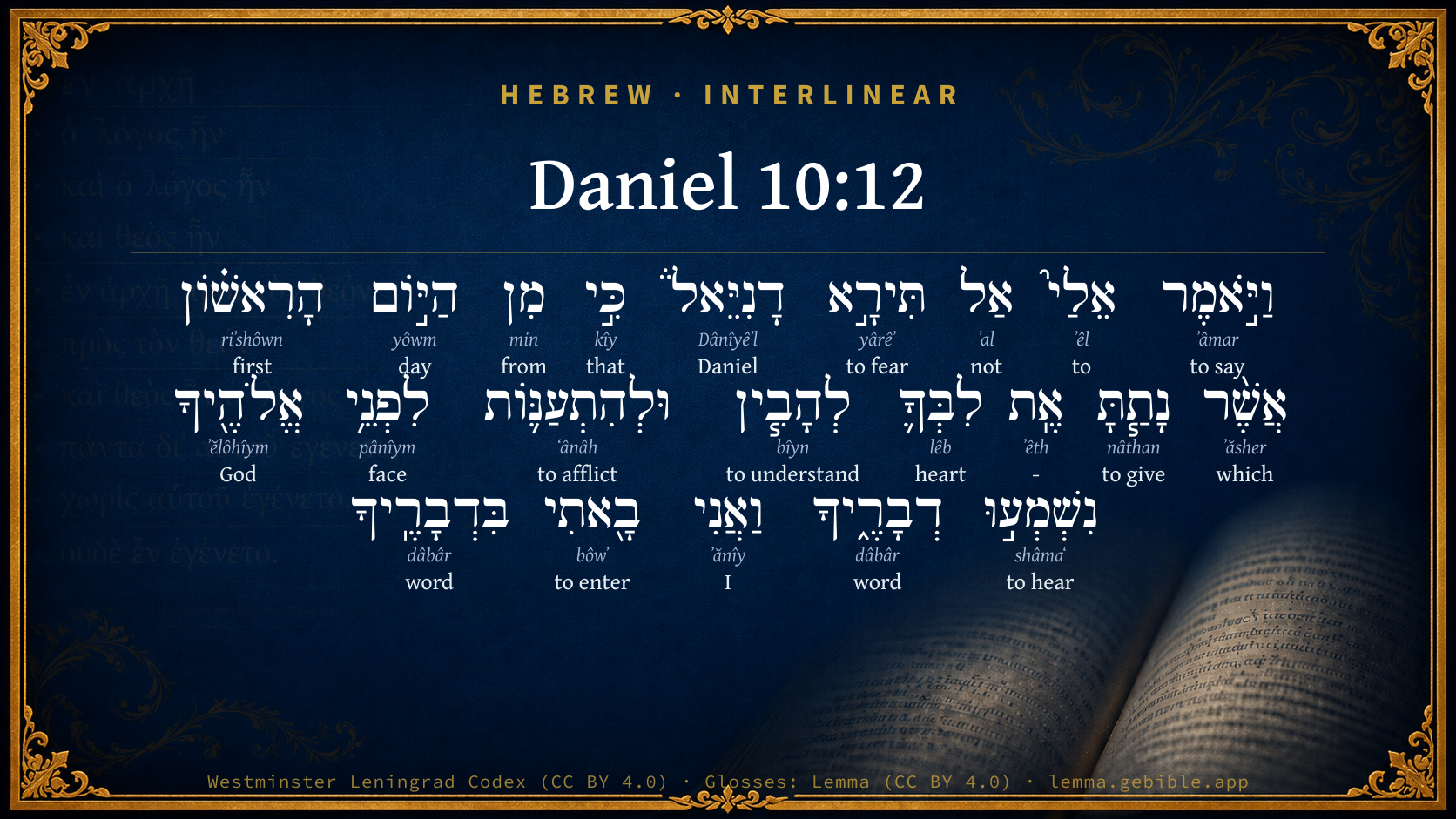
Hebrew (Westminster Leningrad Codex) Daniel 10:12 appears in the Hebrew Old Testament. The text above is from the Westminster Leningrad Codex. Each word links to its Strong’s number, a concise gloss, and parsing drawn from the Open Scriptures Hebrew Bible morphology. Click any word for its full Brown-Driver-Briggs (BDB) entry.
Download image
Cite this verse

Daniel 10:12 (World English Bible). Public Domain. Lemma interlinear Bible study tool, https://lemma.gebible.app/v/daniel/10/12.

Show BibTeX & RIS
BibTeX
RIS
English Translation
Then said he to me, Don't be afraid, Daniel; for from the first day that you did set your heart to understand, and to humble yourself before your God, your words were heard: and I am come for your words' sake.
World English Bible · Public Domain
Download a study sheet

One document with this verse’s original text, its word-by-word gloss line, the meaning frame, cross-references with their text, attributed commentary, and full source and license credits — printable, and it pastes into notes with its structure intact.

This verse Autodidact and up

Study sheet (.html) Plain text (.txt)

A passage Seminary Student

Up to 50 verses in one chapter. A passage sheet keeps up to 6 commentary sources and 12 cross-references per verse, in the order this page ranks them, and says so on the sheet whenever that leaves anything out. Ask for a single verse and you get the Autodidact verse sheet above.

Everything on this page stays free to read, with no account — the sheet is a download of what is already on screen, not access to it.

Want to remove ads? Support Godless Engineer
Compare translations 3

The same verse in 3 English versions, stacked beneath the original-language interlinear above. Click any original word for its lexicon entry.

Each is an independent rendering of the whole verse — the interlinear is not word-aligned to these translations.

Highlighted words mark where these versions differ — a whole-verse word diff, not a word-by-word alignment.

  • World English Bible Public Domain
    Then said he to me, Don't be afraid, Daniel; for from the first day that you did set your heart to understand, and to humble yourself before your God, your words were heard: and I am come for your words' sake.
  • King James Version Public Domain
    Then said he unto me, Fear not, Daniel: for from the first day that thou didst set thine heart to understand, and to chasten thyself before thy God, thy words were heard, and I am come for thy words.
  • unfoldingWord Literal Text CC BY-SA 4.0
    Then he said to me, “Do not be afraid, Daniel, for from the first day that you set your heart to understand and to humble yourself before your God, your words were heard, and I have come because of your words.

unfoldingWord Literal Text — © unfoldingWord, licensed CC BY-SA 4.0. Word-aligned USFM3 via Door43 (git.door43.org/unfoldingWord/en_ult).

Versions to compare (up to 4)

3 of 4 selected

Show all 18 translations

Every available English version of this verse, each an independent rendering of the whole verse.

  • World English Bible Public Domain
    Then said he to me, Don't be afraid, Daniel; for from the first day that you did set your heart to understand, and to humble yourself before your God, your words were heard: and I am come for your words' sake.
  • Berean Standard Bible Public Domain
    “Do not be afraid, Daniel,” he said, “for from the first day that you purposed to understand and to humble yourself before your God, your words were heard, and I have come in response to them.
  • Majority Standard Bible Public Domain
    “Do not be afraid, Daniel,” he said, “for from the first day that you purposed to understand and to humble yourself before your God, your words were heard, and I have come in response to them.
  • King James Version Public Domain
    Then said he unto me, Fear not, Daniel: for from the first day that thou didst set thine heart to understand, and to chasten thyself before thy God, thy words were heard, and I am come for thy words.
  • American Standard Version (1901) Public Domain
    Then said he unto me, Fear not, Daniel; for from the first day that thou didst set thy heart to understand, and to humble thyself before thy God, thy words were heard: and I am come for thy words' sake.
  • Revised Version (1885) Public Domain
    Then said he unto me, Fear not, Daniel; for from the first day that thou didst set thine heart to understand, and, to humble thyself before thy God, thy words were heard: and I am come for thy words’ sake.
  • Geneva Bible (1599) Public Domain
    Then sayd he vnto me, Feare not, Daniel: for from the first day that thou diddest set thine heart to vnderstand, and to humble thy selfe before thy God, thy wordes were heard, and I am come for thy wordes.
  • Douay-Rheims (1899) Public Domain
    And he said to me: Fear not, Daniel: for from the first day that thou didst set thy heart to understand, to afflict thyself in the sight of thy God, thy words have been heard: and I am come for thy words.
  • Young's Literal Translation Public Domain
    And he saith unto me: Do not fear, Daniel, for from the first day that thou didst give thy heart to understand, and to humble thyself before thy God, thy words have been heard, and I have come because of thy words.
  • Literal Standard Version CC BY-SA 4.0
    And he says to me: Do not fear, Daniel, for from the first day that you gave your heart to understand, and to humble yourself before your God, your words have been heard, and I have come because of your words.
  • Unlocked Literal Bible CC BY-SA 4.0
    Then he said to me, “Do not be afraid, Daniel. Since the first day you set your mind to understand and to humble yourself before your God, your words were heard, and I have come because of your words.
  • unfoldingWord Literal Text CC BY-SA 4.0
    Then he said to me, “Do not be afraid, Daniel, for from the first day that you set your heart to understand and to humble yourself before your God, your words were heard, and I have come because of your words.
  • Darby Bible Public Domain
    And he said unto me, Fear not, Daniel; for from the first day that thou didst set thy heart to understand, and to humble thyself before thy God, thy words were heard, and I am come because of thy words.
  • World Messianic Bible Public Domain
    Then he said to me, “Don’t be afraid, Daniel; for from the first day that you set your heart to understand, and to humble yourself before your God, your words were heard. I have come for your words’ sake.
  • Webster's Bible Public Domain
    Then said he to me, Fear not, Daniel: for from the first day that thou didst set thy heart to understand, and to chasten thyself before thy God, thy words were heard, and I am come for thy words.
  • Free Bible Version CC BY-SA 4.0
    “Don't be afraid, Daniel,” he said. “From the first day you concentrated on trying to understand this, and to humble yourself before God, your prayer was heard, and I have come to answer you.
  • Bible in Basic English Public Domain
    Then he said to me, Have no fear, Daniel; for from the first day when you gave your heart to getting wisdom and making yourself poor in spirit before your God, your words have come to his ears: and I have come because of your words.
  • JPS Tanakh (1917) Public Domain
    Then said he unto me: 'Fear not, Daniel; for from the first day that thou didst set thy heart to understand, and to humble thyself before thy God, thy words were heard; and I am come because of thy words.

Literal Standard Version (2020), Covenant Press — licensed CC BY-SA 4.0. Text via the HelloAO Bible API (eBible.org). Unlocked Literal Bible (unfoldingWord) — licensed CC BY-SA 4.0. Text via the HelloAO Bible API (eBible.org). unfoldingWord Literal Text — © unfoldingWord, licensed CC BY-SA 4.0. Word-aligned USFM3 via Door43 (git.door43.org/unfoldingWord/en_ult). Free Bible Version, Dr. Jonathan Gallagher — licensed CC BY-SA 4.0. Text via the HelloAO Bible API (eBible.org).

Word by word

More ways to search: Search by grammar → Find every occurrence → Compare this word →

Practice this passage: Drill this verse → Learn its vocabulary →

דָנִיֵּאל֒
Dânîyêʼl
H1840
“Daniel”
Noun, Proper
Part of Speech
Noun
Type
Proper
Full BDB Definition

Origin: from H1835 and H410

TWOT: None

Daniel = "God is my judge" - the 2nd son of David, by Abigail the Carmelitess - the 4th of the greater prophets, taken as hostage in the first deportation to Babylon, because of the gift of God of the interpretation of dreams, he became the 2nd in command of the Babylon empire and lasted through the end of the Babylonian empire and into the Persian empire. His prophecies are the key to the understanding of end time events. Noted for his purity and holiness by contemporary prophet, Ezekiel - a priest of the line of Ithamar who sealed the covenant with Nehemiah
  1. וַיֹּ֣אמֶר ʼâmar H559 “and · to say” Conjunction + Verb, Qal, Sequential Imperfect, 3rd Person, Masculine, Singular
  2. אֵלַי֮ ʼêl H413 “to · me” Preposition + Suffix, Personal, 1st Person, Common, Singular
  3. אַל ʼal H408 “not” Particle, Negative
  4. תִּירָ֣א yârêʼ H3372 “to fear” Verb, Qal, Jussive, 2nd Person, Masculine, Singular
  5. כִּ֣י kîy H3588 “that” Conjunction
  6. מִן min H4480 “from” Preposition
  7. הַיּ֣וֹם yôwm H3117 “the · day” Particle, Definite Article + Noun, Common, Masculine, Singular, Absolute
  8. הָרִאשׁ֗וֹן riʼshôwn H7223 “the · first” Particle, Definite Article + Adjective, Ordinal number, Masculine, Singular, Absolute
  9. אֲשֶׁ֨ר ʼăsher H834 “which” Particle, Relative
  10. נָתַ֧תָּ nâthan H5414 “to give” Verb, Qal, Perfect, 2nd Person, Masculine, Singular
  11. אֶֽת ʼêth H853 “-” Particle, Direct Object
  12. לִבְּךָ֛ lêb H3820 “heart · your” Noun, Common, Masculine, Singular, Construct + Suffix, Personal, 2nd Person, Masculine, Singular
  13. לְהָבִ֧ין bîyn H995 “to understand” Preposition + Verb, Hiphil, Infinitive Construct
  14. וּלְהִתְעַנּ֛וֹת ʻânâh H6031 “and · to afflict” Conjunction + Preposition + Verb, Hithpael, Infinitive Construct
  15. לִפְנֵ֥י pânîym H6440 “to/for · face(s) of” Preposition + Noun, Common, Both, Plural, Construct
  16. אֱלֹהֶ֖יךָ ʼĕlôhîym H430 “God(s) · your” Noun, Common, Masculine, Plural, Construct + Suffix, Personal, 2nd Person, Masculine, Singular
  17. נִשְׁמְע֣וּ shâmaʻ H8085 “to hear” Verb, Niphal, Perfect, 3rd Person, Common, Plural
  18. דְבָרֶ֑יךָ dâbâr H1697 “words · your” Noun, Common, Masculine, Plural, Construct + Suffix, Personal, 2nd Person, Masculine, Singular
  19. וַאֲנִי ʼănîy H589 “and · I” Conjunction + Pronoun, Personal, 1st Person, Common, Singular
  20. בָ֖אתִי bôwʼ H935 “to enter” Verb, Qal, Perfect, 1st Person, Common, Singular
  21. בִּדְבָרֶֽיךָ dâbâr H1697 “in/at · words · your” Preposition + Noun, Common, Masculine, Plural, Construct + Suffix, Personal, 2nd Person, Masculine, Singular

About this verse

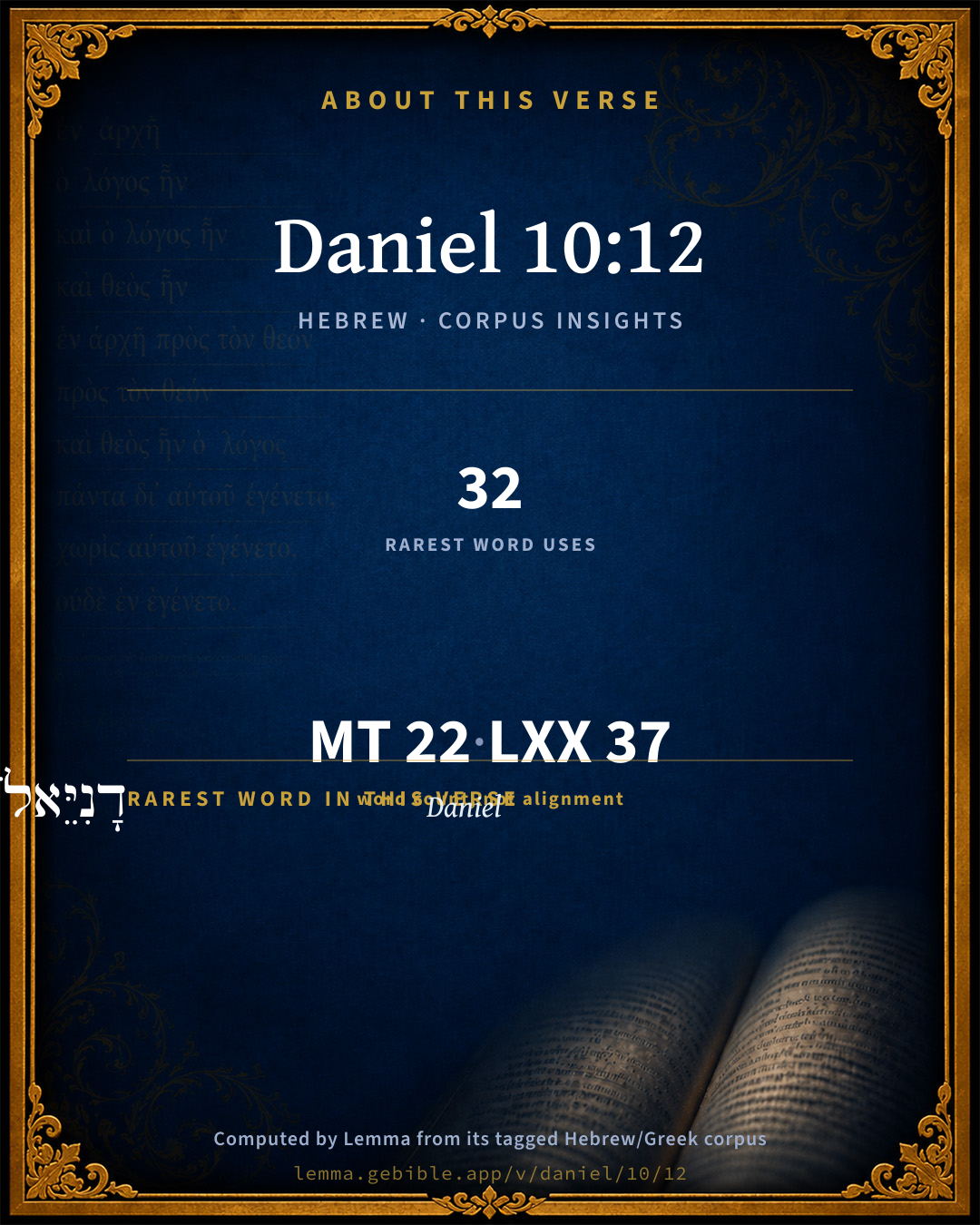
These counts appear in no published source. They are computed here, from the morphology-tagged text and Lemma’s own curated glosses. What Lemma adds →

22
words
21
distinct lemmas
Prophets
section

Shared distinctive vocabulary

דָנִיֵּאל֒ Daniel H1840 occurs in 28 verses of the Hebrew Bible. Also found in:

Grammatical profile

  • 7 verbs
  • 7 nouns
  • 1 adjective
  • 1 pronoun
  • 2 prepositions
  • 1 conjunction
  • 3 particles

Verb forms

  • וַיֹּ֣אמֶר Qal · Sequential Imperfect
  • תִּירָ֣א Qal · Jussive
  • נָתַ֧תָּ Qal · Perfect
  • לְהָבִ֧ין Hiphil · Infinitive Construct
  • וּלְהִתְעַנּ֛וֹת Hithpael · Infinitive Construct
  • נִשְׁמְע֣וּ Niphal · Perfect
  • בָ֖אתִי Qal · Perfect

Repetition

A word recurs within this verse — often emphatic in Hebrew:

  • דְבָרֶ֑יךָ word H1697 ×2

Hebrew & Septuagint length

In English translation the verse runs 41 words from the Hebrew and 42 from the Septuagint (LXX English) — closely comparable.

A rough comparison of the two English renderings, which tokenize alike — not a word-level alignment.

Word counts can differ between the Hebrew and the Greek without any difference in meaning — e.g. the Hebrew direct-object marker אֵת has no separate Greek word, and Greek often adds the article ὁ.

In the original languages it is 22 Hebrew tokens and 37 Greek tokens — but the two are counted differently (Hebrew bundles its prefixes and suffixes into one token; the Greek is in lemma form), so that isn’t a like-for-like length.

Cross-references

26

Topical passages linked to Daniel 10:12 in the Treasury of Scripture Knowledge — connected by theme and wording, ordered by reader-vote popularity; previews shown in the World English Bible.

  • Acts 10:30–31 Cornelius said, "Four days ago, I was fasting until this hour, and at the ninth hour, I prayed in my house, and behold, a man stood before me in bright clothing,
  • Daniel 10:19 He said, "Greatly beloved man, don't be afraid: peace be to you, be strong, yes, be strong." When he spoke to me, I was strengthened, and said, "Let my lord speak; for you have strengthened me."
  • Isaiah 58:9 Then shall you call, and Yahweh will answer; you shall cry, and he will say, Here I am. If you take away from the midst of you the yoke, the putting forth of the finger, and speaking wickedly;
  • Daniel 9:20–23 While I was speaking, and praying, and confessing my sin and the sin of my people Israel, and presenting my supplication before Yahweh my God for the holy mountain of my God;
  • Acts 18:9–10 The Lord said to Paul in the night by a vision, "Don't be afraid, but speak and don't be silent;
  • Isaiah 41:10 Don't you be afraid, for I am with you; don't be dismayed, for I am your God; I will strengthen you; yes, I will help you; yes, I will uphold you with the right hand of my righteousness.
  • Isaiah 65:24 It shall happen that, before they call, I will answer; and while they are yet speaking, I will hear.
  • Matthew 28:5 The angel answered the women, "Don't be afraid, for I know that you seek Jesus, who has been crucified.
  • Isaiah 35:4 Tell those who are of a fearful heart, Be strong, don't be afraid: behold, your God will come [with] vengeance, [with] the recompense of God; he will come and save you.
  • Isaiah 41:14 Don't be afraid, you worm Jacob, and you men of Israel; I will help you, says Yahweh, and your Redeemer is the Holy One of Israel.
  • Daniel 9:3–4 I set my face to the Lord God, to seek by prayer and petitions, with fasting and sackcloth and ashes.
  • Acts 10:3–5 At about the ninth hour of the day, he clearly saw in a vision an angel of God coming to him, and saying to him, "Cornelius!"
  • Leviticus 16:29 "It shall be a statute to you forever: in the seventh month, on the tenth day of the month, you shall afflict your souls, and shall do no manner of work, the native-born, or the stranger who lives as a foreigner among you:
  • Leviticus 16:31 It is a Sabbath of solemn rest to you, and you shall afflict your souls; it is a statute forever.
  • Daniel 10:2–3 In those days I, Daniel, was mourning three whole weeks.
  • Luke 24:38 He said to them, "Why are you troubled? Why do doubts arise in your hearts?
  • Acts 27:24 saying, 'Don't be afraid, Paul. You must stand before Caesar. Behold, God has granted you all those who sail with you.'
  • Revelation 1:17 When I saw him, I fell at his feet like a dead man. He laid his right hand on me, saying, "Don't be afraid. I am the first and the last,
  • Numbers 29:7 On the tenth day of this seventh month you shall have a holy convocation; and you shall afflict your souls: you shall do no manner of work;
  • Psalms 69:10 When I wept and I fasted, That was to my reproach.
  • Daniel 10:11 He said to me, Daniel, you man greatly beloved, understand the words that I speak to you, and stand upright; for to you am I now sent. When he had spoken this word to me, I stood trembling.
  • Matthew 28:10 Then Jesus said to them, "Don't be afraid. Go tell my brothers that they should go into Galilee, and there they will see me."
  • Mark 16:6 He said to them, "Don't be amazed. You seek Jesus, the Nazarene, who has been crucified. He has risen. He is not here. Behold, the place where they laid him!
  • Luke 1:13 But the angel said to him, "Don't be afraid, Zacharias, because your request has been heard, and your wife, Elizabeth, will bear you a son, and you shall call his name John.
  • Luke 1:30 The angel said to her, "Don't be afraid, Mary, for you have found favor with God.
  • Luke 2:10 The angel said to them, "Don't be afraid, for behold, I bring you good news of great joy which will be to all the people.

Cross-references courtesy of OpenBible.info (CC BY 4.0).

Hebrew and Greek witnesses Masoretic Hebrew ↔ Greek Septuagint

The same verse in the two great witnesses to the Old Testament, shown verse-for-verse.

These are two independent witnesses, not word-aligned to each other, and the Septuagint is shown in lemma (dictionary) form.

Hebrew Daniel 10:12 Masoretic · Westminster Leningrad Codex

וַיֹּ֣אמֶר אֵלַי֮ אַל תִּירָ֣א דָנִיֵּאל֒ כִּ֣י מִן הַיּ֣וֹם הָרִאשׁ֗וֹן אֲשֶׁ֨ר נָתַ֧תָּ אֶֽת לִבְּךָ֛ לְהָבִ֧ין וּלְהִתְעַנּ֛וֹת לִפְנֵ֥י אֱלֹהֶ֖יךָ נִשְׁמְע֣וּ דְבָרֶ֑יךָ וַאֲנִי בָ֖אתִי בִּדְבָרֶֽיךָ

Then said he to me, Don't be afraid, Daniel; for from the first day that you did set your heart to understand, and to humble yourself before your God, your words were heard: and I am come for your words' sake.

World English Bible · Public Domain

Greek LXX Daniel 10:12 Septuagint · lemma form

καί εἶπον πρός ἐγώ μή φοβέω δανιηλ ὅτι ἀπό ὁ ἡμέρα ὁ πρῶτος ὅς δίδωμι ὁ πρόσωπον σύ διανοέομαι καί ταπεινόω ἐναντίον κύριος ὁ θεός σύ εἰςἀκούω ὁ ῥῆμα σύ καί ἐγώ εἰςἔρχομαι ἐν ὁ ῥῆμα σύ

And he said to me, Fear not, Daniel: for from the first day that you did set your heart to understand, and to afflict yourself before the Lord your God, they words were heard, and I am come because of your words.

LXX2012 (modern English Septuagint) · Public Domain

On this verse, The Pulpit Commentary discusses the Septuagint’s reading. Read the note in Commentary ↓

Hebrew: Westminster Leningrad Codex (CC BY 4.0). Greek: Septuagint (public domain); English from LXX2012 (modern English Septuagint) (Public Domain). How the Septuagint differs from the Hebrew →

Commentary

Notes on Daniel 10:12 from classic Christian and Jewish commentators (each source and its license shown beneath its notes). The classic Christian expositions comment on the surrounding passage and are grouped to its opening verse, so a note may address several verses; the Jewish commentaries on the Tanakh (Rashi and others) are per-verse, so they appear only where the commentator wrote on this verse.

Lemma curates 59 commentaries, every one of them public domain or Creative Commons licensed, each selected and text-cleaned for this edition rather than reprinted as found. About our sources →

Trapp's Complete Commentary

John Trapp

Dan 10:12 Then said he unto me, Fear not, Daniel: for from the first day that thou didst set thine heart to understand, and to chasten thyself before thy God, thy words were heard, and I am come for thy words.

Ver. 12. Fear not, Daniel.] Disquieting and expectorating fears should be laid aside. {1Jn 4:18}

For from the first day.] See on Dan 9:23. Let us but find a praying heart, and God will presently find a pitying heart, though he may delay for a season to send in an answer. Though Daniel heard nothing of his prayers for three weeks’ time, yet was the angel at work all that while for the removal of impediments. Daniel in the meanwhile wrought hard with God, as it is elsewhere said of Jonathan. {1Sa 14:45}

And I am come for thy word.] Brought hither by thy prayers. God will come, but he will have his people’s prayers lead him into the field as it were.

John Trapp, A Commentary or Exposition upon All the Books of the Old and New Testament (1647–1656) — public domain. Text from a community e-Sword module.

The Biblical Illustrator

Joseph S. Exell

Dan_10:12

And to chasten thyself before thy God.

Soul Discipline

I. Its action on SELF. It is concentration of soul. Set thy heart is setting the whole soul to the work.

1. Concentration to spiritual study. Set thy heart to understand. To understand what ? Thyself, thy capabilities, thy moral obligations, thy spiritual condition.

2. Concentration to correction. To chasten thyself. Quench corrupt lusts, conquer wrong prejudices, expel pernicious errors, etc.

3. Concentrated to devotion. Before thy God, doing the whole as under the eye of God. Truthful, earnest, solemn.

II. Its action on GOD. God observes all this soul work. He is interested in it and He is represented as being influenced by it. God here says to Daniel, Thy words were heard, and I am come for thy words. The idea is, because thou hast been disciplining thy soul, I am come to answer thy prayers. True soul discipline is essential to successful prayer. If thou prepare thine heart and stretch out thine hands towards him; if iniquity be in thine hand, put it away, and let not wickedness dwell in thy tabernacles, for there shalt thou lift up thy face without spot; yea, thou shalt be steadfast, and shalt not fear. Because thou shalt forget thy misery and remember it as waters that pass away; and thine age shall be clearer than the noonday; thou shalt shine forth, thou shalt be as the morning. (Homilist.)

Thy words were heard.

A Gracious Answer from Heaven

Our text is part of the angels address to Daniel

I. THE OCCASION WAS ONE OF DISAPPOINTMENT AND PERPLEXITY. High were the expectations raised by the decree of Cyrus. But year after year passed and no deliverance came.. Then Darnel spent three weeks in retirement, self-denial, and prayer. Mysterious dispensations of providence are permitted to thwart our fair expectations. Adverse changes take place which disappoint our hopes. Wise ends are answered by these trials of our faith and patience. Whenever God tries us, and by whatsoever means, he gives an opportunity for the exercise of graces and virtues, which are thus not only proved but also improved.

II. THE COURSE DANIEL PURSUED UNDER THE TRYING CIRCUMSTANCES. Three things are specified in our text.

1. Inquiry. He did set his heart to understand, that he might find out the path of duty; what to do and what to recommend. If in similar circumstances we search, we shall probably find some errors to be corrected, some negligences and sins to be repented of, some feelings to be humbled for, or some attainments to be pursued, which might have been overlooked or forgotten had not the Almighty arrested us in our career.

2. Humiliation. He chastened himself before his God. His fasting was an outward sign of inward humiliation, and also calculated to promote it. A voluntary devotedness to extraordinary exercises of piety in his judgment was called for by the extraordinary circumstances of the times. And God was pleased to honour his servant by a gracious regard to his offerings.

3. Prayer. Thy words are heard. No doubt, words of prayer. In the day of trouble there is a peculiar need and call for prayer. In such reasons we feel most dependent upon God; and then there is often a more than ordinary disposition to pray.

III. THE SUCCESSFUL RESULT. This is described in our text.

1. He is bidden not to fear. No doubt his fears had been strong concerning the execution of the monarchs decree. In this present world, so full of uncertainty, it is not to be expected that we shall be altogether without our fears as to what may befal us. The best way of soothing the mind is to do as Daniel did, refer the case to God, with humility, prayer, and holy trust.

2. Daniel was assured that his prayers were heard. And this is the privilege of all the devout. His promise to hear their prayers not only denotes attention to them, but acceptance of them.

3. Daniel received divine manifestations in answer to his prayers. He was honoured by the heavenly visitant. Reviewing the whole we find in this subject an instructive comment on the gracious assurance that they who wait upon the Lord shall renew their strength. Daniels strength was renewed, his courage was revived, his hopes were brightened, when he had waited upon his God. (W. Chaplin.)

The Biblical Illustrator, edited by Joseph S. Exell (c. 1880s–1900s) — public domain. Text from a community e-Sword module.

Keil & Delitzsch

C. F. Keil & F. Delitzsch

According to this verse, the words of Daniel, i.e., his prayer from the first day of his seeking to understand the future, and of his self-mortification in sorrow and fasting (Dan 10:2, Dan 10:3), was heard of God, and the angel was immediately sent forth by God to convey to him revelations. And, he adds, בּדבריך בּאתי, I am come for thy words, i.e., in consequence of thy prayer, according to it. The בּאתי most interpreters understand of the coming to Daniel; Hofmann (Schriftbew. i. p. 331) and Kliefoth, on the contrary, understand it of the coming of the angel to Persia (Dan 10:13). According to the matter, both views are correct, but in the form in which they are presented they are incorrect. Against the latter stands the adversative וin ושׂר (but the prince), Dan 10:13, by which the contents of Dan 10:13 are introduced; for, according to this, Dan 10:13 cannot represent the object of the coming. Against the former stands the fact, that the angel does not come to Daniel immediately, but only after having gained a victory over the prince of the kingdom. The בּאתי is again taken up in Dan 10:14, and must have here the same meaning that it has there. But in Dan 10:14 it is connected with להבינך, "I am come to bring thee understanding," in Dan 10:12 with בּדבריך, which only denotes that the "coming" corresponded to Daniel's prayer, but not that he came immediately to him. Daniel had, without doubt, prayed for the accomplishment of the salvation promised to his people, and eo ipso for the removal of all the hindrances that stood in the way of that accomplishment. The hearing of his prayer may be regarded, therefore, as containing in it not merely the fact that God directed an angel to convey to him disclosures regarding the future fortunes of his people, but also at the same time as implying that on the side of God steps were taken for the removal of these hindrances.

The thirteenth verse speaks of this, not as denoting that the angel came to Persia for the purpose of working for Israel, but much rather as announcing the reason of the twenty-one days' delay in the coming of the angel to Daniel, in the form of a parenthetical clause. His coming to Daniel was hindered by this, that the prince of the kingdom of Persia withstood him twenty-one days. The twenty-one days are those three weeks of Daniel's fasting and prayer, Dan 10:2. Hence we see that the coming of the angel had its reference to Daniel, for he came to bring him a comforting answer from God; but in order that he might be able to do this, he must first, according to Dan 10:13, enter into war with and overcome the spirit of the king of Persia, hostile to the people of God. The contents of Dan 10:13 are hence not to be understood as showing that the angel went to Persia in order that he might there arrange the cause of Israel with the king; the verse much rather speaks of a war in the kingdom of the supernatural spirits, which could not relate to the court of the king of Persia. The prince (שׂר) of the kingdom of Persia, briefly designated in Dan 10:21 "the prince of Persia," is not king Cyrus, or the collectivum of the kings of Persia, as Hv. and Kran., with Calvin and most of the Reformers, think, but the guardian spirit or the protecting genius of the Persian kingdom, as the Rabbis and most of the Christian interpreters have rightly acknowledged. For the angel that appeared to Daniel did not fight with the kings of Persia, but with a spiritual intelligence of a like nature, for the victory, or precedence with the kings of Persia. This spirit of the kingdom of Persia, whom, after the example of Jerome, almost all interpreters call the guardian angel of his kingdom, is as little the nature-power of this kingdom as Michael is the nature-power of Israel, but is a spirit-being; yet not the heathen national god of the Persians, but, according to the view of Scripture (Co1 10:20.), the δαιμόνιον of the Persian kingdom, i.e., the supernatural spiritual power standing behind the national gods, which we may properly call the guardian spirit of this kingdom. In the לנגדּי עמד lies, according to the excellent remark of Kliefoth, the idea, that "the שׂר of the kingdom of Persian stood beside the kings of the Persians to influence them against Israel, and to direct against Israel the power lying in Persian heathendom, so as to support the insinuations of the Samaritans; that the angel, Dan 10:5, came on account of Daniel's prayer to dislodge this 'prince' from his position and deprive him of his influence, but he kept his place for twenty-one days, till Michael came to his help; then he so gained the mastery over him, that he now stood in his place beside the kings of Persia, so as henceforth to influence them in favour of Israel." He who appeared to Daniel, Dan 10:5, and spake with him, Dan 10:11, is not "the angel who had his dominion among the nations of the world," or "his sphere of action in the embodiments of the heathen world-power, to which the Jewish people were now in subjection, to promote therein the working out of God's plan of salvation" (Hofm. Schriftbew. i. p. 334). This supposition is destitute of support from the Scriptures. It is rather the Angel of the Lord who carries out God's plans in the world, and for their accomplishment and execution makes war against the hostile spirit of the heathen world-power. The subjugation of this spirit supposes a particular angel ruling in the heathen world just as little as Jehovah's contending against the heathen nations that oppress and persecute His kingdom and people.

In the war against the hostile spirit of the kingdom of Persia, the archangel Michael came to the help of the Angel of the Lord. The name מיכאל, who is as God, comes into view, as does the name Gabriel, only according to the appellative signification of the word, and expresses, after the analogy of Exo 15:11; Psa 89:7., the idea of God's unparalleled helping power. Michael is thus the angel possessing the unparalleled power of God. He is here said to be "one of the chief princes," i.e., of the highest angel-princes, - Dan 10:21, "your prince," i.e., the prince who contends for Israel, who conducts the cause of Israel. The first title points undoubtedly to an arrangement of orders and degrees among the angels, designating Michael as one of the most distinguished of the angel-princes; hence called in Jde 1:9 ἀρχάγγελος, also in Rev 12:7, where he is represented as contending with his angels against the dragon. The opinion that Michael is called "one of the chief princes," not as in contrast with the angels, but only with the demons of the heathen gods (Kliefoth), is opposed by the words themselves and by the context. From the circumstance that the guardian spirit of Persia is called שׂר it does not follow that שׂרים is not a designation of the angels generally, but only of the princes of the people, who are the spirits ruling in the social affairs of nations and kingdoms (Hofmann, p. 337); and even though this conclusion may be granted, this meaning for השׂרים with the article and the predicate הראשׁנים is undemonstrable. For the Scripture does not place the demon-powers of heathendom so on a line with the angels that both are designated as ראשׁנים שׂרים. The ראשׁנים שׁרים can only be the princes, chiefs, of the good angels remaining in communion with God, and working for the kingdom of God. Though what is said by the angel Michael, for the sake of the Israelitish people, among whom he has the sphere of his activity, may be said for their comfort, yet it does not follow therefrom that that which is said "cannot give disclosures regarding the relation within the angel-world, but only regarding the relation to the great historical nations and powers of the world" (Hofm. p. 338). For as regards the statement adduced in support of this opinion - "the greatness and importance of the work entrusted to him makes him one of the ראשׁנים, not that the work is entrusted to him because he is so" - just the contrary is true. To a subordinate spirit God will not entrust a work demanding special power and greatness; much rather the being entrusted with a great and important work supposes a man exalted above the common mass. And for the comforting of Israel the words, "Michael, one of the foremost princes, came to my help," affirm that Israel is under very powerful protection, because its guardian spirit is one of the foremost of the angel-princes, whereby implic. it is said at the same time that the people, though they be little esteemed before the world, yet cannot be destroyed by the nations of the world. This thought follows as a conclusion from what is said regarding the dignity of their guardian angel, but it does not form the contents of the saying regarding Michael and his place among the heavenly spirits.

But we learn from Dan 10:21 the reason why the archangel Michael, and no other angel, came to the help of him who was clothed with linen. It was because Michael was the prince of Israel, i.e., "the high angel-prince who had to maintain the cause of the people of God in the invisible spirit-world against opposing powers" (Auberlen, p. 289); and as such he appears also in Jde 1:9 and Rev 12:7. The coming of Michael to give help does not include in it this, that he was superior in might or in position to the angel that spake, and thus supplies no proof that the angel that spake was Gabriel, or an angel different from him who was clothed with linen. For even a subordinate servant can bring help to his master, and in a conflict render him aid in gaining the victory. Against the idea of the subjection of Michael to the angel that spake, or the man clothed with linen, stands the further unfolding of the angel's message, the statement in Dan 10:21 and Dan 11:1, according to which the angel that spake gave strength and help to Michael in the first year of the Median Darius, from which we have more reason to conclude that the angel who spake stood above the angel Michael; see under Dan 11:1.

In consequence of the assistance on the part of Michael, the Angel of the Lord obtained the place of superiority by the side of the king of Persia. נותר has not here the usual meaning, to be over and above, to remain, but is to be translated after הותיר, Gen 49:4, to have the pre-eminence, to excel, in the passive signification of the Hiphil: "to be provided with the preference, to gain the superiority." The translation, "I have maintained the place" (Hofm.), cannot be proved. אצל, at the side of, near, is explained from the idea of the protecting spirit standing by the side of his protege. The plural, "kings of Persia," neither refers to Cyrus and Cambyses, nor to Cyrus and the conquered kings living with him (Croesus, etc.), nor to Cyrus and the prince, i.e., his guardian spirit (Hitzig). The plural denotes, that by the subjugation of the demon of the Persian kingdom, his influence not merely over Cyrus, but over all the following kings of Persia, was brought to an end, so that the whole of the Persian kings became accessible to the influence of the spirit proceeding from God and advancing the welfare of Israel.

Keil & Delitzsch — Biblical Commentary on the Old Testament (1861–1891) — public domain (CC PDM 1.0). Text via the HelloAO Bible API. (Old Testament only.)

Jamieson, Fausset & Brown

Robert Jamieson, A. R. Fausset & David Brown

Fear not--Be not affrighted at my presence.

didst set thine heart to understand--what shall come to pass to thy people at the last times (compare Dan 10:14).

chasten thyself-- (Dan 10:2-3).

thy words were heard-- (Act 10:4). Prayer is heard at once in heaven, though the sensible answer may seem to be delayed. God's messenger was detained on the way (Dan 10:13) by the opposition of the powers of darkness. If in our prayers amidst long protracted sorrows we believed God's angel is on his way to us, what consolation it would give us!

for thy words--because of thy prayers.

Jamieson, Fausset & Brown — Commentary Critical and Explanatory on the Whole Bible (1871) — public domain (CC PDM 1.0). Text via the HelloAO Bible API.

Adam Clarke's Commentary

Verse 12. I am come for thy words] On account of thy prayers I am sent to comfort and instruct thee.

Adam Clarke's Commentary on the Bible (1810–1826) — public domain. Text from a community e-Sword/MySword module.

John Calvin's Commentaries

By the angel’s commanding the Prophet to be of a serene and tranquil mind, we gather the continuance of his fright, and his being as yet unable to listen with composure. And yet this trembling improved his teachableness. Without the slightest doubt, God desired to prepare his servant in this way to render him more attentive to his disciples, and yet this very terror prevented Daniel from summoning all his senses to listen to the address of the angel. The remedy is exhibited in these words, O Daniel, fear not The angel did not wish to remove all fear from the Prophet’s mind, but rather to calm it, lest his trembling should prevent him from giving due attention to the prophecies which we shall soon discuss. I have already said enough on the subject of this address. As God knows fear to be useful to us, he does not wish us to be entirely free from it, as too great self-confidence would immediately produce slothfulness and pride. God, therefore, wishes our fears to restrain us like a bridle, but meanwhile he moderates this dread in his servants, lest their minds become stricken and disturbed, and thus disabled from approaching him with calmness.

The angel adds, From the first day on which thou didst begin to apply thy mind to understanding, and to afflict thyself before God, thy prayers were heard This reason sufficiently shews in what sense and with what intention the angel forbade the Prophet’s fears — because, says he, thy prayers have been heard He was unwilling to banish all fear, but he offered some hope and consolation; and relying on this expectation, he might wait for the revelation which he so earnestly desired. He states his prayers to have been heard from the time of his applying his mind to understanding, and from his afflicting himself before God These two points may be noticed: first, by the word “understanding” the angel informs us of God’s being propitious to the prayers of his servant, because they were sincere and legitimate. For what spectacle did Daniel behold? He saw the condition of the Church entirely confused, and he desired the communication of some mark of favor, which might assure him of God’s being still mindful of His covenant, and of his not despising those wretched Israelites whom he had adopted. As this was the object of the Prophet’s prayer, he so far obtained his request, and the angel bears witness to God’s being entreated by him. We are taught then by this passage, if we are anxious for our supplications to be both heard and approved by God, not to give way to those foolish lusts and appetites, which solicit and entice us. We ought to observe the rule here prescribed by the angel, and fashion our entreaties according to God’s will. We know, says John, that if we ask anything according to his will, he will hear us. (1 John 5:14.) This is the first point. The second is the addition of penitence to fervor in devotion, when the angel says, Daniel’s mind was afflicted or humbled. A second condition of true prayer is here set before us, when the faithful humble themselves before God, and being touched with true penitence, pour out their groans before him. The angel, therefore, shews how Daniel obtained his requests, by suppliantly afflicting himself before God. He did not utter prayers for the Church in a mere formal manner, but as we have previously seen, he united fasting with entreaty, and abstained from all delicacies. For this reason God did not reject his petitions. He says, before thy God; this expression of the angel’s implying that the Prophet’s supplication sprang from true faith. The prayers of the impious, on the other hand, always repel the Almighty, and they can never be sure of his being propitious to them. In consequence of the hesitation and vacillation of unbelievers, this testimony to true faith is set before Daniel — he prayed to his own God Whoever approaches God, says the Apostle, (Hebrews 11:6,) ought to acknowledge his existence, and his being easily entreated by all those who seek and invoke him. We ought diligently to notice this, as this fault is most manifest in all ages, men often pray to God, but yet through their hesitation they pour forth their petitions into the air. They do not realize God as their Father. Another passage also reminds us how useless is the hope of obtaining anything by prayer, if we are agitated and tossed about in our emotions. (James 1:6, 7.) Unless faith shine forth, we must not feel surprise at those who call upon God losing all their labor through their profanation of his name. Lastly, by this expression, the angel shews us how Daniel’s prayer was founded on faith; he had not sought God with rashness, but was clearly persuaded of his being welcomed among the sons of God. He prayed, therefore, to his own God, and for this reason, his petitions were heard. Then the angel adds, he came at his words; as it is said in the Psalms. (Psalm 145:19.) God inclines with desire towards those who fear him; and in this sense the angel waits upon Daniel. It now follows, —

John Calvin's Commentaries (1540-1563) — public domain. Text from the Calvin Translation Society English edition (1840s-50s) via the Christian Classics Ethereal Library (ccel.org). Calvin's coverage is partial (roughly two-thirds of the Bible); uncommented books and verses are honest gaps, never fabricated. The 19th-century editor's footnotes and remarks are omitted so the notes are faithfully Calvin's own voice.

Ellicott's Commentary for English Readers

(12) From the first day.—The meaning appears to be that this vision was vouchsafed to him in consequence of his prayer to understand what would befal his people in the future. The prayer was heard from the first day that he offered it, but it had been impossible for him to realise the answer before the present time, for reasons mentioned in the next verse.

A Bible Commentary for English Readers, edited by Charles John Ellicott (1878–1897) — public domain. Text from a community e-Sword module.

The Cambridge Bible for Schools and Colleges

gen. ed. J. J. S. Perowne

12. set thine heart] lit. give thine heart, i.e. apply thyself: a late idiom, found otherwise only in 1Ch_22:19; 2Ch_11:16; Ecc_1:13; Ecc_1:17; Ecc_7:21; Ecc_8:9; Ecc_8:16.

to understand] viz. the future destiny of Israel. Anxious questionings on the future of his people were the occasion of his prolonged mourning and abstinence (Dan_10:2-3).

and to humble thyself before thy God] The verb, though it may be used more generally (Psa_107:17), is applied here, as in Ezr_8:21 (‘then I proclaimed a fast there, at the river Ahava, that we might humble ourselves before our God, to seek of him a straight way,’ &c.), to the self-denial and mortification accompanying a fast. The more common (and technical) expression in the same sense is to humble (or [R.V.] afflict) the soul: see Lev_16:29; Lev_16:31; Lev_23:27; Lev_23:29; Lev_23:32; Num_29:7 (all of the fast of the Day of Atonement); Isa_58:3; Isa_58:5; Psa_35:13 (‘I humbled my soul in fasting’); in a more general sense, Num_30:13 (of a vow of self-denial). The corresponding subst. ta‘ãnith has the same meaning in Ezr_9:5 (R.V. marg.); and regularly in post-Biblical Hebrew (the Mishnic treatise ‘Ta‘anith’ deals with fasting).

and I am come because of thy words] i.e. the prayer implied in Dan_10:2-3. ‘I am come’ is resumed at the beginning of Dan_10:14, the explanation of the angel’s delay in Dan_10:13 being parenthetical.

The Cambridge Bible for Schools and Colleges (gen. ed. J. J. S. Perowne; Cambridge University Press, 1878–1918) — public domain. Text from a community e-Sword module.

John Gill's Exposition

Then said he unto me, fear not, Daniel,.... Perceiving him to shake and tremble, and to be intimidated at his presence, he speaks comfortably to him, and encourages him to lay aside his fears, that he might be more capable of attending to what he was about to say to him; and which had a tendency of themselves to remove his fears, and increase his confidence in the Lord:

for from the first day thou didst set thine heart to understand; not so much the former visions which he had an understanding of, as the future state of his people; or rather, the reason of their present distressed condition, being hindered by their enemies in rebuilding their city and temple:

and to chasten thyself before thy God; to humble himself in prayer, and to afflict himself by fasting:

thy words were heard; his prayers were heard, and an answer ordered to be given, the very first day he began to pray, and fast, and mourn, though it was now full three weeks since; just as, at the beginning of his former supplications, Gabriel had a commandment to go and show him that they were heard, Dan 9:23,

and I am come forth for thy words; on account of his prayers, to bring an answer to them; the reason why he came no sooner, when it was three weeks since he received his order, is as follows:

John Gill's Exposition of the Whole Bible (1746–1763) — public domain (CC PDM 1.0). Text via the HelloAO Bible API.

Albert Barnes' Notes on the Bible

Then said he unto me, Fear not - Be not alarmed at my presence; do not fear that your devotions are not accepted, and that your prayers are not heard.

For from the first day that thou didst set thine heart to understand - That is, by a season of extraordinary devotion. Daniel had devoted three full weeks to such a service Dan 10:2-3, and it would seem from this that one object which he had in view was to make inquiry about the future condition of his people, or to learn what was his own duty in the present circumstances, or what methods he might use to secure the return of his countrymen to their own land. The circumstances of the case were such as to make either of these inquiries proper; and the angel now affirms that, from the first day when he entered on these investigations, he was despatched to come to him, and to assure him that his prayer was heard. The reason why he had not sooner arrived, and why Daniel was left to continue his prayers so long without any answer being returned, is stated in the following verses. Compare the notes at Dan 9:23.

And to chasten thyself before thy God - That is, by fasting and humiliation. Literally, to afflict thyself.

Thy words were heard - In heaven. Another proof that prayer is at once heard, though the answer may be long delayed. The instance before us shows that the answer to prayer may seem, to be delayed, from causes unknown to us, though the prayer ascends at once to heaven, and God designs to answer it. In this case, it was deferred by the detention of the messenger on the way Dan 10:13; in other cases it may be from a different cause; but it should never be set down as a proof that prayer is not heard, and that it will not be answered, because the answer is not granted at once. Weeks, or months, or years may elapse before the Divine purpose shall be made known, though, so to speak, the messenger may be on his way to us. Something may prevent the answer being borne to us; some “prince of the kingdom of Persia” may withstand the messenger; some cause which we may not know may hinder the immediate answer of our prayer, either in our own hearts, or in outward events which cannot at once be controlled without a miracle, or in the feelings and views of our friends whom we seek to have converted and saved; but the purpose to answer the prayer may have been simultaneous with its being offered, and a train of measures may have been commenced at once to bring about the result, though many weeks or months of delay, of anxiety, of tears, may elapse before we attain the object we desired.

Daniel would have been cheered in his days of fasting and service if he had known that an angel was on his way to him to comfort him, and to communicate to him an answer from God; often - if not always - in our days of deepest anxiety and trouble; when our prayers seem not to penetrate the skies; when we meet with no response; when the thing for which we pray seems to be withheld; when our friends remain unconverted; when irreligion abounds and prevails; when we seem to be doing no good, and when calamity presses upon us, if we saw the arrangement which God was already making to answer the prayer, and could see the messenger on the way, our hearts would exult, and our tears would cease to flow. And why, in our days of trouble and anxiety, should we not believe that it is so; and that God, even though the delay may seem to be long, will yet show himself to be a hearer and an answerer of prayer?

Albert Barnes' Notes on the Bible (1834–1885) — public domain. Text from a community e-Sword/MySword module.

Matthew Poole's English Annotations

1. The Lord is quick in hearing the fervent prayer of a humble soul, though he doth not presently let them know it. God heard the first day, though he sent not his angel to tell Daniel of it till three weeks after.

2. A soul that would obtain great things from God by prayer must be solemn and fervent in seeking God.

3. The fervent and constant prayers of the saints make God to send from heaven and save. Thus in Peter’s case, Act 12:5-15, and here in Daniel’s.

Matthew Poole's English Annotations on the Holy Bible (1683–1685) — public domain. Text from a community e-Sword/MySword module.

Whedon's Commentary on the Bible

Daniel D. Whedon

12. For thy words — Rather, with R.V., “for thy words’ sake.” What power in prayer! It moves all heaven and brings the powers of heaven with help. Sometimes the answer to the prayer comes only after many years of waiting; sometimes after a few weeks of continuous fasting and beseeching as in this case; sometimes “in the day” when one cries (Dan_9:20; Dan_10:2; <19D803>Psa_138:3).

Daniel D. Whedon (gen. ed.), Commentary on the Old and New Testaments (1874–1909) — public domain. Text from a community e-Sword module.

The Pulpit Commentary

Then said he unto me, Fear not, Daniel; for from the first day that thou didst set thine heart to understand, and to chasten thyself before thy God, thy words were heard, and I am come for thy words. Both the LXX and Theodotion insert Kepler before Qeou. This is the more remarkable as Kuriov stands for "Jehovah" usually in the Greek versions a title rarely occurring in Daniel in, and only in, the prayer of the preceding chapter. This addition does not occur in the Peshitta or Vulgate. He said unto me, Fear not, Daniel. Still the signs of terror were manifest in Daniel, and the angel spoke encouragingly to him. For from the first day, etc. When Daniel had begun his petition to God and his effort to understand God"s purpose concerning his people, then God had commissioned Gabriel. The whole process of humiliation, fasting, and prayer was allowed to go on to its completion before Gabriel came, in order to deepen in Daniel the desire for the hoped-for revelation, and thus enhance the joy of it when it came, and, perchance, also to justify to higher intelligences the giving of this special communication (comp. Dan_9:20) as to the answer being ready even while the petition was being put up. And I am come for thy words. Professor Fuller sees in this an additional tenderness. Zockler sees in it that in the Divine counsel Gabriel was commissioned, but was hindered for reasons assigned in the next verse.

The Pulpit Commentary (1880–1919), ed. H.D.M. Spence-Jones & Joseph S. Exell — public domain. Text from a community e-Sword module.

John Wesley's Explanatory Notes

He - Not Christ, but Gabriel.

John Wesley, Explanatory Notes Upon the Whole Bible (1754–1765) — public domain. Text via the GEBible commentary corpus.

unfoldingWord translationNotes

Door43 World Missions Community

you set your mind to understand

"you determined to understand the vision"

your words were heard

This can be expressed in active form. AT: "God heard your words" (See: Active or Passive)

prince

Here this refers to a spirit who has authority over a human nation. AT: "spirit prince"

the kings of Persia

This probably refers to the various kings who ruled over nations in the Persian Empire, and who had to obey the king of Persia.

Michael, one of the chief princes

"Michael, on of the chief angels" or "Michael, one of the archangels"

translationWords

fear

Daniel

mind

humble

God

word

prince

kingdom

Persia

Michael

chief

king

unfoldingWord translationNotes — © Distant Shores Media and the Door43 World Missions Community, licensed CC BY-SA 4.0. Source: git.door43.org/Door43/en_tn.

Rashi

Rabbi Shlomo Yitzchaki (Rashi)

and I have come because of your words I have come on this mission because of your words. Our Rabbis, however, explained in Tractate Yoma (77a): “and I came within the curtain because of you, for I was banned from its midst.”

Rashi on the Tanakh — English translations: “The Judaica Press complete Tanach with Rashi, translated by A. J. Rosenberg” (CC BY 4.0); “Pentateuch with Rashi's commentary by M. Rosenbaum and A.M. Silbermann, 1929-1934” (public domain); “The Metsudah Tanach series, Lakewood, N.J” (CC BY 4.0); and “The Book of Joshua, Metsudah Publications, 1997” (CC BY 4.0). Text via Sefaria.

Lesson kit

Teaching starters — assembled from the data on this page, not authored interpretation. Every prompt links to the verse data it draws on. Edit before teaching.

Daniel, in the Prophets, opens this verse with 22 words (21 distinct Hebrew lemmas). Its most distinctive word is Dânîyêʼl (“Daniel”). A historical commentator’s framing appears above. Read the whole chapter for the surrounding context.

Discussion questions

  1. How does “Daniel” (Dânîyêʼl) shape what this verse is saying?
  2. How does 1 Chronicles 3:1, which shares the word «Daniel», read alongside this verse?
  3. What does the repetition of “word” (2× in this one verse) do in this verse?
  4. These translations render this verse differently; the difference is in the English rendering, not the original. What questions does that raise?
  5. «וַיֹּ֣אמֶר» is a Qal Sequential Imperfect verb. How does that grammatical form shape the action described?
  6. Compare how Trapp's Complete Commentary and The Biblical Illustrator read this verse. Where do they agree or differ?

Things to notice

Reading settings

Reading text

Shown beneath each verse's original-language words.

Old Testament
Old Testament edition

Read the OT as the Masoretic Hebrew (MT) or the Greek Septuagint (LXX).

English shown for the Greek Septuagint (in the Hebrew ↔ Greek comparison).

Comparing translations? Open the Compare panel on any verse page to stack up to four side by side.