
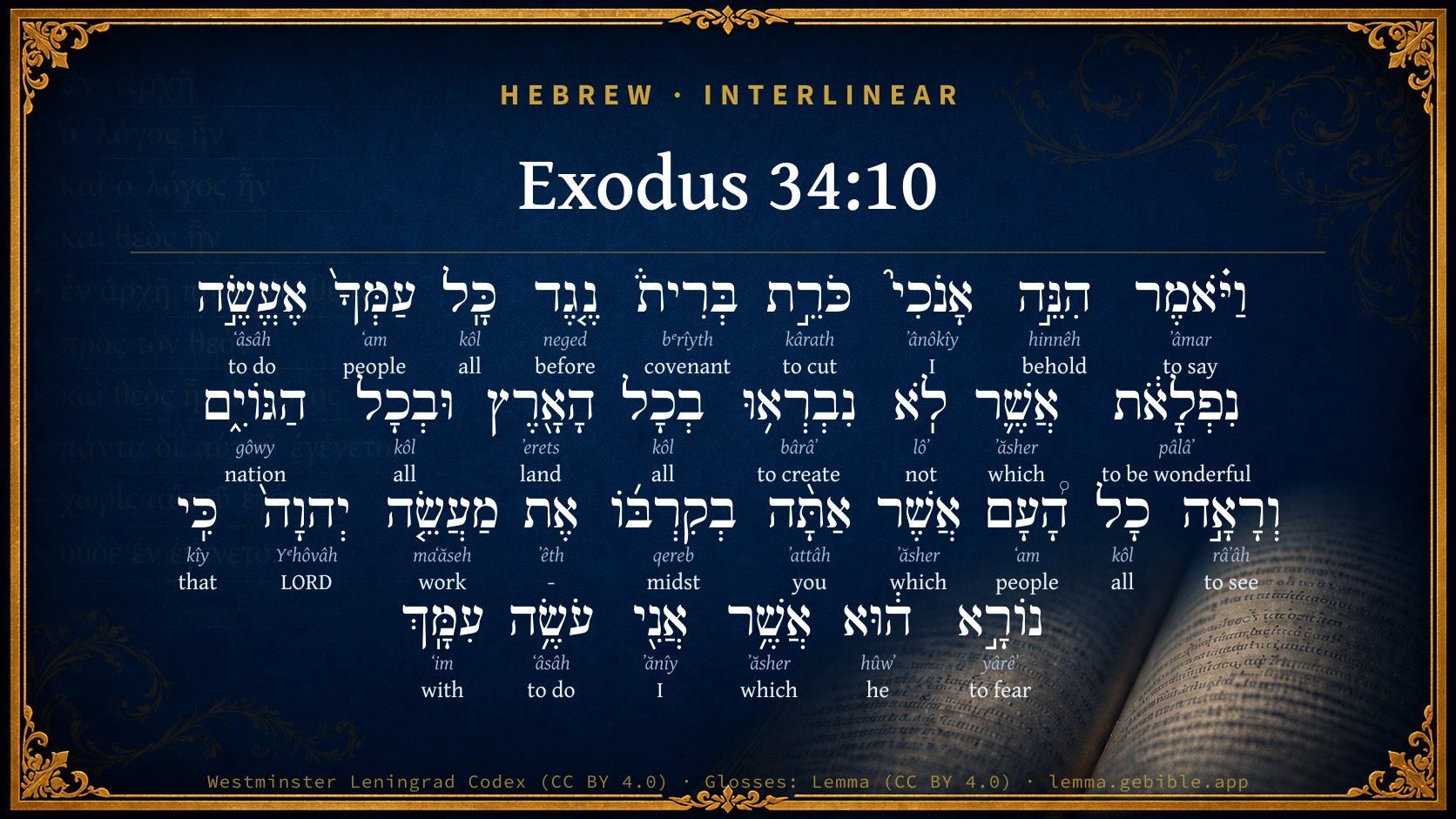
Exodus 34:10

Hebrew (Westminster Leningrad Codex) Exodus 34:10 appears in the Hebrew Old Testament. The text above is from the Westminster Leningrad Codex. Each word links to its Strong’s number, a concise gloss, and parsing drawn from the Open Scriptures Hebrew Bible morphology. Click any word for its full Brown-Driver-Briggs (BDB) entry.
Download image
Cite this verse

Exodus 34:10 (World English Bible). Public Domain. Lemma interlinear Bible study tool, https://lemma.gebible.app/v/exodus/34/10.

Show BibTeX & RIS
BibTeX
RIS
English Translation
He said, "Behold, I make a covenant: before all your people I will do marvels, such as have not been worked in all the earth, nor in any nation; and all the people among which you are shall see the work of Yahweh; for it is an awesome thing that I do with you.
World English Bible · Public Domain
Download a study sheet

One document with this verse’s original text, its word-by-word gloss line, the meaning frame, cross-references with their text, attributed commentary, and full source and license credits — printable, and it pastes into notes with its structure intact.

This verse Autodidact and up

Study sheet (.html) Plain text (.txt)

A passage Seminary Student

Up to 50 verses in one chapter. A passage sheet keeps up to 6 commentary sources and 12 cross-references per verse, in the order this page ranks them, and says so on the sheet whenever that leaves anything out. Ask for a single verse and you get the Autodidact verse sheet above.

Everything on this page stays free to read, with no account — the sheet is a download of what is already on screen, not access to it.

Want to remove ads? Support Godless Engineer
Compare translations 3

The same verse in 3 English versions, stacked beneath the original-language interlinear above. Click any original word for its lexicon entry.

Each is an independent rendering of the whole verse — the interlinear is not word-aligned to these translations.

Highlighted words mark where these versions differ — a whole-verse word diff, not a word-by-word alignment.

  • World English Bible Public Domain
    He said, "Behold, I make a covenant: before all your people I will do marvels, such as have not been worked in all the earth, nor in any nation; and all the people among which you are shall see the work of Yahweh; for it is an awesome thing that I do with you.
  • King James Version Public Domain
    And he said, Behold, I make a covenant: before all thy people I will do marvels, such as have not been done in all the earth, nor in any nation: and all the people among which thou art shall see the work of the LORD: for it is a terrible thing that I will do with thee.
  • unfoldingWord Literal Text CC BY-SA 4.0
    And he said, “Behold, I am about to cut a covenant: before all of your people, I will do wonders that have not been created in all of the earth and in all of the nations. And all of the people that you are in the midst of will see the work of Yahweh, for it fear-filling, what I doing with you.

unfoldingWord Literal Text — © unfoldingWord, licensed CC BY-SA 4.0. Word-aligned USFM3 via Door43 (git.door43.org/unfoldingWord/en_ult).

Versions to compare (up to 4)

3 of 4 selected

Show all 18 translations

Every available English version of this verse, each an independent rendering of the whole verse.

  • World English Bible Public Domain
    He said, "Behold, I make a covenant: before all your people I will do marvels, such as have not been worked in all the earth, nor in any nation; and all the people among which you are shall see the work of Yahweh; for it is an awesome thing that I do with you.
  • Berean Standard Bible Public Domain
    And the LORD said, “Behold, I am making a covenant. Before all your people I will perform wonders that have never been done in any nation in all the world. All the people among whom you live will see the LORD’s work, for it is an awesome thing that I am doing with you.
  • Majority Standard Bible Public Domain
    And the LORD said, “Behold, I am making a covenant. Before all your people I will perform wonders that have never been done in any nation in all the world. All the people among whom you live will see the LORD’s work, for it is an awesome thing that I am doing with you.
  • King James Version Public Domain
    And he said, Behold, I make a covenant: before all thy people I will do marvels, such as have not been done in all the earth, nor in any nation: and all the people among which thou art shall see the work of the LORD: for it is a terrible thing that I will do with thee.
  • American Standard Version (1901) Public Domain
    And he said, Behold, I make a covenant: before all thy people I will do marvels, such as have not been wrought in all the earth, nor in any nation; and all the people among which thou art shall see the work of Jehovah; for it is a terrible thing that I do with thee.
  • Revised Version (1885) Public Domain
    And he said, Behold, I make a covenant: before all thy people I will do marvels, such as have not been wrought in all the earth, nor in any nation: and all the people among which thou art shall see the work of the LORD, for it is a terrible thing that I do with thee.
  • Geneva Bible (1599) Public Domain
    And he answered, Behold, I will make a couenant before all thy people, and will do marueiles, such as haue not bene done in all the worlde, neyther in all nations: and all the people among whom thou art, shall see the worke of the Lord: for it is a terrible thing that I will do with thee.
  • Douay-Rheims (1899) Public Domain
    The Lord answered: I will make a covenant in the sight of all. I will do signs such as were never seen upon the earth, nor in any nation: that this people, in the midst of whom thou art, may see the terrible work of the Lord which I will do.
  • Young's Literal Translation Public Domain
    And He saith, `Lo, I am making a covenant: before all thy people I do wonders, which have not been done in all the earth, or in any nation, and all the people in whose midst thou `art' have seen the work of Jehovah, for it `is' fearful that which I am doing with thee.
  • Literal Standard Version CC BY-SA 4.0
    And He says, “Behold, I am making a covenant. I do wonders before all your people, which have not been done in all the earth, or in any nation, and all the people in whose midst you [are in] have seen the work of YHWH, for it [is] fearful—that which I am doing with you.
  • Unlocked Literal Bible CC BY-SA 4.0
    Yahweh said, “See, I am about to make a covenant. Before all your people, I will do marvels such as have not been done in all the earth nor in any nation. All the people among you will see my deeds, for it is a fearful thing that I am doing with you.
  • unfoldingWord Literal Text CC BY-SA 4.0
    And he said, “Behold, I am about to cut a covenant: before all of your people, I will do wonders that have not been created in all of the earth and in all of the nations. And all of the people that you are in the midst of will see the work of Yahweh, for it fear-filling, what I doing with you.
  • Darby Bible Public Domain
    And he said, Behold, I make a covenant: before all thy people I will do marvels that have not been done in all the earth, nor in any nation; and all the people in the midst of which thou [art] shall see the work of Jehovah; for a terrible thing it shall be that I will do with thee.
  • World Messianic Bible Public Domain
    He said, “Behold, I make a covenant: before all your people I will do marvels, such as have not been worked in all the earth, nor in any nation; and all the people among whom you are shall see the work of the LORD; for it is an awesome thing that I do with you.
  • Webster's Bible Public Domain
    And he said, Behold, I make a covenant: before all thy people I will do wonders, such as have not been done in all the earth, nor in any nation: and all the people among which thou art, shall see the work of the LORD: for it is a terrible thing that I will do with thee.
  • Free Bible Version CC BY-SA 4.0
    The Lord said, “Look, I'm making an agreement with you. Right in front of all of you I will do miracles that have never been done before—not among anyone anywhere on earth. Everyone here and those around will see the Lord at work, for what I'm going to do for you will be incredible.
  • Bible in Basic English Public Domain
    And the Lord said, See, this is what I will undertake: before the eyes of your people I will do wonders, such as have not been done in all the earth or in any nation: and all your people will see the work of the Lord, for what I am about to do for you is greatly to be feared.
  • JPS Tanakh (1917) Public Domain
    And He said: 'Behold, I make a covenant; before all thy people I will do marvels, such as have not been wrought in all the earth, nor in any nation; and all the people among which thou art shall see the work of the LORD that I am about to do with thee, that it is tremendous.

Literal Standard Version (2020), Covenant Press — licensed CC BY-SA 4.0. Text via the HelloAO Bible API (eBible.org). Unlocked Literal Bible (unfoldingWord) — licensed CC BY-SA 4.0. Text via the HelloAO Bible API (eBible.org). unfoldingWord Literal Text — © unfoldingWord, licensed CC BY-SA 4.0. Word-aligned USFM3 via Door43 (git.door43.org/unfoldingWord/en_ult). Free Bible Version, Dr. Jonathan Gallagher — licensed CC BY-SA 4.0. Text via the HelloAO Bible API (eBible.org).

Word by word

More ways to search: Search by grammar → Find every occurrence → Compare this word →

Practice this passage: Drill this verse → Learn its vocabulary →

נִבְרְא֥וּ
bârâʼ
H1254
“to create”
Verb, Niphal, Perfect, 3rd Person, Common, Plural
Part of Speech
Verb
Stem
Niphal
Form
Perfect
Person
3rd Person
Gender
Common
Number
Plural
Full BDB Definition

Origin: a primitive root

TWOT: 278

to create, shape, form - (Qal) to shape, fashion, create (always with God as subject) - of heaven and earth - of individual man - of new conditions and circumstances - of transformations - (Niphal) to be created - of heaven and earth - of birth - of something new - of miracles - (Piel) - to cut down - to cut out - to be fat - (Hiphil) to make yourselves fat
  1. וַיֹּ֗אמֶר ʼâmar H559 “and · to say” Conjunction + Verb, Qal, Sequential Imperfect, 3rd Person, Masculine, Singular
  2. הִנֵּ֣ה hinnêh H2009 “behold” Particle, Demonstrative
  3. אָנֹכִי֮ ʼânôkîy H595 “I” Pronoun, Personal, 1st Person, Common, Singular
  4. כֹּרֵ֣ת kârath H3772 “cutting” Verb, Qal, Participle Active, Masculine, Singular, Absolute
  5. בְּרִית֒ bᵉrîyth H1285 “covenant” Noun, Common, Feminine, Singular, Absolute
  6. נֶ֤גֶד neged H5048 “before” Preposition
  7. כָּֽל kôl H3605 “all of” Noun, Common, Masculine, Singular, Construct
  8. עַמְּךָ֙ ʻam H5971 “people · your” Noun, Common, Masculine, Singular, Construct + Suffix, Personal, 2nd Person, Masculine, Singular
  9. אֶעֱשֶׂ֣ה ʻâsâh H6213 “to do” Verb, Qal, Imperfect, 1st Person, Common, Singular
  10. נִפְלָאֹ֔ת pâlâʼ H6381 “being wonderful” Verb, Niphal, Participle Active, Feminine, Plural, Absolute
  11. אֲשֶׁ֛ר ʼăsher H834 “which” Particle, Relative
  12. לֹֽא lôʼ H3808 “not” Particle, Negative
  13. בְכָל kôl H3605 “in/at · all of” Preposition + Noun, Common, Masculine, Singular, Construct
  14. הָאָ֖רֶץ ʼerets H776 “the · land” Particle, Definite Article + Noun, Common, Both, Singular, Absolute
  15. וּבְכָל kôl H3605 “and · in/at · all of” Conjunction + Preposition + Noun, Common, Masculine, Singular, Construct
  16. הַגּוֹיִ֑ם gôwy H1471 “the · nations” Particle, Definite Article + Noun, Common, Masculine, Plural, Absolute
  17. וְרָאָ֣ה râʼâh H7200 “and · to see” Conjunction + Verb, Qal, Sequential Perfect, 3rd Person, Masculine, Singular
  18. כָל kôl H3605 “all of” Noun, Common, Masculine, Singular, Construct
  19. הָ֠עָם ʻam H5971 “the · people” Particle, Definite Article + Noun, Common, Masculine, Singular, Absolute
  20. אֲשֶׁר ʼăsher H834 “which” Particle, Relative
  21. אַתָּ֨ה ʼattâh H859 “you” Pronoun, Personal, 2nd Person, Masculine, Singular
  22. בְקִרְבּ֜וֹ qereb H7130 “in/at · midst · his” Preposition + Noun, Common, Masculine, Singular, Construct + Suffix, Personal, 3rd Person, Masculine, Singular
  23. אֶת ʼêth H853 “-” Particle, Direct Object
  24. מַעֲשֵׂ֤ה maʻăseh H4639 “work of” Noun, Common, Masculine, Singular, Construct
  25. יְהוָה֙ Yᵉhôvâh H3068 “LORD” Noun, Proper
  26. כִּֽי kîy H3588 “that” Conjunction
  27. נוֹרָ֣א yârêʼ H3372 “fearing” Verb, Niphal, Participle Active, Masculine, Singular, Absolute
  28. ה֔וּא hûwʼ H1931 “he” Pronoun, Personal, 3rd Person, Masculine, Singular
  29. אֲשֶׁ֥ר ʼăsher H834 “which” Particle, Relative
  30. אֲנִ֖י ʼănîy H589 “I” Pronoun, Personal, 1st Person, Common, Singular
  31. עֹשֶׂ֥ה ʻâsâh H6213 “doing” Verb, Qal, Participle Active, Masculine, Singular, Absolute
  32. עִמָּֽךְ ʻim H5973 “with · you” Preposition + Suffix, Personal, 2nd Person, Feminine, Singular

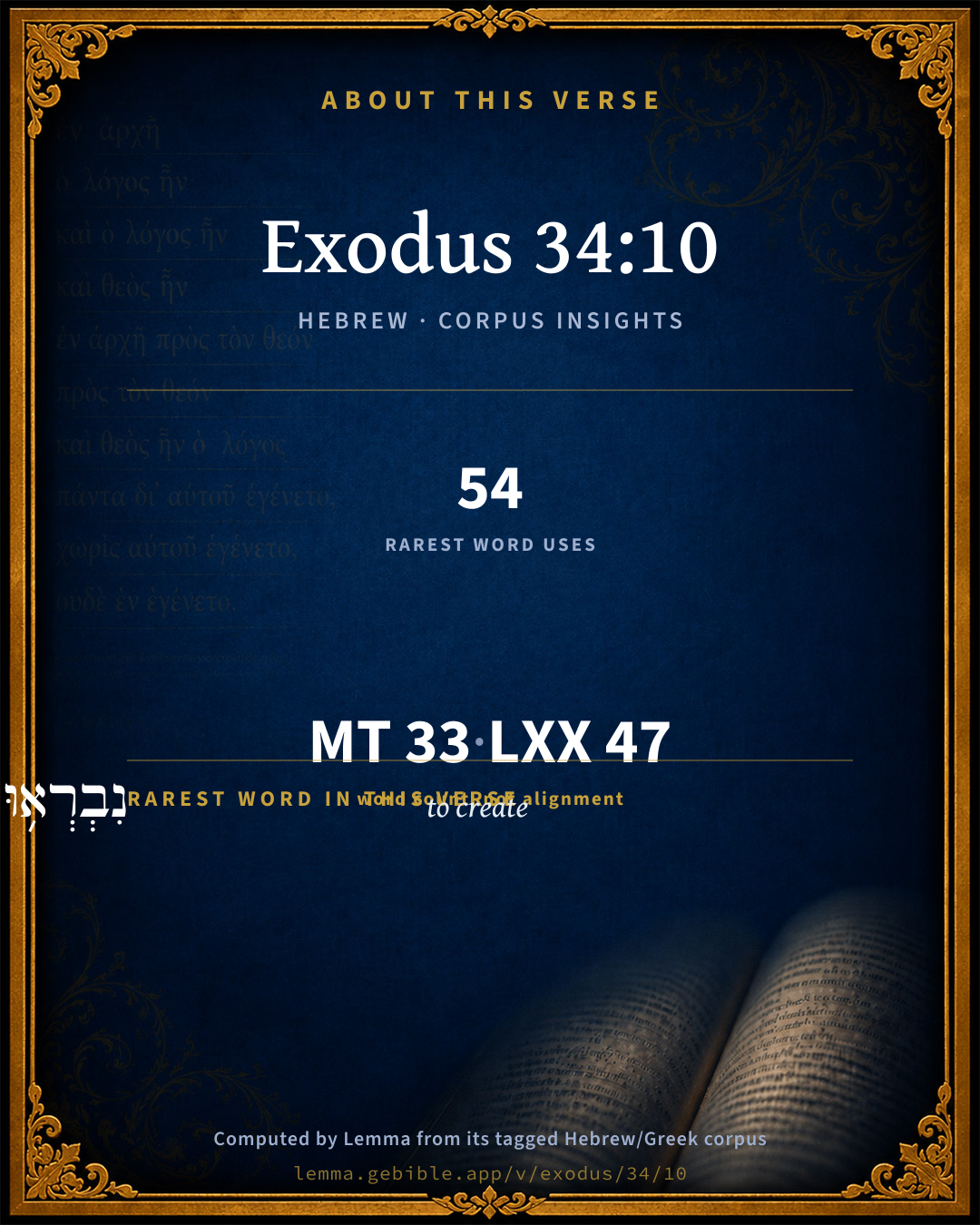
About this verse

These counts appear in no published source. They are computed here, from the morphology-tagged text and Lemma’s own curated glosses. What Lemma adds →

33
words
26
distinct lemmas
Pentateuch
section

Shared distinctive vocabulary

נִבְרְא֥וּ to create H1254 occurs in 46 verses of the Hebrew Bible. Also found in:

Grammatical profile

  • 8 verbs
  • 12 nouns
  • 4 pronouns
  • 2 prepositions
  • 1 conjunction
  • 6 particles

Verb forms

  • וַיֹּ֗אמֶר Qal · Sequential Imperfect
  • כֹּרֵ֣ת Qal · Participle Active
  • אֶעֱשֶׂ֣ה Qal · Imperfect
  • נִפְלָאֹ֔ת Niphal · Participle Active
  • נִבְרְא֥וּ Niphal · Perfect
  • וְרָאָ֣ה Qal · Sequential Perfect
  • נוֹרָ֣א Niphal · Participle Active
  • עֹשֶׂ֥ה Qal · Participle Active

Repetition

Words recur within this verse — often emphatic in Hebrew:

  • כָּֽל all H3605 ×4
  • עַמְּךָ֙ people H5971 ×2
  • אֶעֱשֶׂ֣ה to do H6213 ×2
  • אֲשֶׁ֛ר which H834 ×3

Hebrew & Septuagint length

In English translation the verse runs 54 words from the Hebrew and 63 from the Septuagint (LXX English) — closely comparable.

A rough comparison of the two English renderings, which tokenize alike — not a word-level alignment.

Word counts can differ between the Hebrew and the Greek without any difference in meaning — e.g. the Hebrew direct-object marker אֵת has no separate Greek word, and Greek often adds the article ὁ.

In the original languages it is 33 Hebrew tokens and 47 Greek tokens — but the two are counted differently (Hebrew bundles its prefixes and suffixes into one token; the Greek is in lemma form), so that isn’t a like-for-like length.

Cross-references

23

Topical passages linked to Exodus 34:10 in the Treasury of Scripture Knowledge — connected by theme and wording, ordered by reader-vote popularity; previews shown in the World English Bible.

  • Deuteronomy 10:21 He is your praise, and he is your God, who has done for you these great and awesome things, which your eyes have seen.
  • Psalms 77:14 You are the God who does wonders. You have made your strength known among the peoples.
  • Psalms 66:5 Come, and see God's deeds-- Awesome work on behalf of the children of men.
  • Isaiah 64:3 When you did terrible things which we didn't look for, you came down, the mountains quaked at your presence.
  • Jeremiah 32:21 and brought forth your people Israel out of the land of Egypt with signs, and with wonders, and with a strong hand, and with an outstretched arm, and with great terror;
  • 2 Samuel 7:23 What one nation in the earth is like your people, even like Israel, whom God went to redeem to himself for a people, and to make him a name, and to do great things for you, and awesome things for your land, before your people, whom you redeem to you out of Egypt, [from] the nations and their gods?
  • Psalms 66:3 Tell God, "How awesome are your deeds! Through the greatness of your power, your enemies submit themselves to you.
  • Psalms 78:12 He did marvelous things in the sight of their fathers, In the land of Egypt, in the field of Zoan.
  • Joshua 10:12–13 Then spoke Joshua to Yahweh in the day when Yahweh delivered up the Amorites before the children of Israel; and he said in the sight of Israel, Sun, stand you still on Gibeon; You, Moon, in the valley of Aijalon.
  • Deuteronomy 5:2–3 Yahweh our God made a covenant with us in Horeb.
  • Deuteronomy 32:30 How should one chase a thousand, Two put ten thousand to flight, Except their Rock had sold them, Yahweh had delivered them up?
  • Exodus 24:7–8 He took the book of the covenant and read it in the hearing of the people, and they said, "All that Yahweh has spoken will we do, and be obedient."
  • Deuteronomy 4:32–37 For ask now of the days that are past, which were before you, since the day that God created man on the earth, and from the one end of the sky to the other, whether there has been [any such thing] as this great thing is, or has been heard like it?
  • Joshua 6:20 So the people shouted, and [the priests] blew the trumpets; and it happened, when the people heard the sound of the trumpet, that the people shouted with a great shout, and the wall fell down flat, so that the people went up into the city, every man straight before him, and they took the city.
  • Psalms 145:6 Men will speak of the might of your awesome acts. I will declare your greatness.
  • Exodus 34:27 Yahweh said to Moses, "Write you these words: for in accordance with these words I have made a covenant with you and with Israel."
  • Deuteronomy 29:12–14 that you may enter into the covenant of Yahweh your God, and into his oath, which Yahweh your God makes with you this day;
  • Psalms 65:5 By awesome deeds of righteousness, you answer us, God of our salvation. You who are the hope of all the ends of the earth, Of those who are far away on the sea;
  • Deuteronomy 4:13 He declared to you his covenant, which he commanded you to perform, even the ten commandments; and he wrote them on two tables of stone.
  • Psalms 76:12 He will cut off the spirit of princes. He is feared by the kings of the earth.
  • Psalms 106:22 Wondrous works in the land of Ham, And awesome things by the Red Sea.
  • Psalms 147:20 He has not done this for just any nation. They don't know his ordinances. Praise Yah!
  • Psalms 68:35 You are awesome, God, in your sanctuaries. The God of Israel gives strength and power to his people. Praise be to God!

Cross-references courtesy of OpenBible.info (CC BY 4.0).

Hebrew and Greek witnesses Masoretic Hebrew ↔ Greek Septuagint

The same verse in the two great witnesses to the Old Testament, shown verse-for-verse.

These are two independent witnesses, not word-aligned to each other, and the Septuagint is shown in lemma (dictionary) form.

Hebrew Exodus 34:10 Masoretic · Westminster Leningrad Codex

וַיֹּ֗אמֶר הִנֵּ֣ה אָנֹכִי֮ כֹּרֵ֣ת בְּרִית֒ נֶ֤גֶד כָּֽל עַמְּךָ֙ אֶעֱשֶׂ֣ה נִפְלָאֹ֔ת אֲשֶׁ֛ר לֹֽא נִבְרְא֥וּ בְכָל הָאָ֖רֶץ וּבְכָל הַגּוֹיִ֑ם וְרָאָ֣ה כָל הָ֠עָם אֲשֶׁר אַתָּ֨ה בְקִרְבּ֜וֹ אֶת מַעֲשֵׂ֤ה יְהוָה֙ כִּֽי נוֹרָ֣א ה֔וּא אֲשֶׁ֥ר אֲנִ֖י עֹשֶׂ֥ה עִמָּֽךְ

He said, "Behold, I make a covenant: before all your people I will do marvels, such as have not been worked in all the earth, nor in any nation; and all the people among which you are shall see the work of Yahweh; for it is an awesome thing that I do with you.

World English Bible · Public Domain

Greek LXX Exodus 34:10 Septuagint · lemma form

καί εἶπον κύριος πρός μωυσῆς ἰδού ἐγώ τίθημι σύ διαθήκη ἐνώπιον πᾶς ὁ λαός σύ ποιέω ἔνδοξος ὅς οὐ γίγνομαι ἐν πᾶς ὁ γῆ καί ἐν πᾶς ἔθνος καί ὁράω πᾶς ὁ λαός ἐν ὅς εἰμί σύ ὁ ἔργον κύριος ὅτι θαυμαστός εἰμί ὅς ἐγώ ποιέω σύ

And the Lord said to Moses, Behold, I establish a covenant for you in the presence of all your people; I will do glorious things, which have not been done in all the earth, or in any nation; and all the people among whom you are shall see the works of the Lord, that they are wonderful, which I will do for you.

LXX2012 (modern English Septuagint) · Public Domain

Hebrew: Westminster Leningrad Codex (CC BY 4.0). Greek: Septuagint (public domain); English from LXX2012 (modern English Septuagint) (Public Domain). How the Septuagint differs from the Hebrew →

Targum (Aramaic paraphrase)

2

The Targum is the ancient Jewish Aramaic paraphrase of the Hebrew Scriptures — an interpretive translation, not the Hebrew text itself. Onkelos (literal) and Pseudo-Jonathan (expansive) render the Torah, and Jonathan the Prophets. Coverage is partial: where no permissively-licensed English translation exists for a verse, only the Aramaic is shown. This is verse-level text, not a word-by-word alignment to the Hebrew.

  1. Targum Onkelos Torah (Genesis–Deuteronomy)
    וַאֲמַר הָא אֲנָא גְזַר קְיַם קֳדָם כָּל עַמָךְ אֶעְבֵּד פְּרִישָׁן דִי לָא אִתְבְּרִיאוּ בְּכָל אַרְעָא וּבְכָל עַמְמַיָא וְיֶחֱזֵי כָל עַמָא דִי אַתְּ בֵּינֵיהוֹן יָת עוֹבָדָא דַיְיָ אֲרֵי דָחֵל הוּא דִי אֲנָא עָבֵד עִמָךְ:

    (no public-domain English translation for this verse)

    Targum Onkelos — Aramaic: “Onkelos Genesis” (public domain); “Onkelos Exodus” (public domain); “Onkelos Leviticus” (public domain); “Onkelos Numbers” (public domain); “Onkelos Deuteronomy” (public domain). English: “Sefaria Community Translation” (CC0 1.0 (public-domain dedication)); “J.W. Etheridge. The Targums of Onkelos and Jonathan Ben Uzziel on the Pentateuch. London: Longmans, Green, 1862” (public domain). Text via Sefaria.

  2. Targum Pseudo-Jonathan Torah (Genesis–Deuteronomy)
    וַאֲמַר הָא אֲנָא גְזַר קְיַים דְּלָא אַשַׁלְחִיף עַמָּא הָדֵין בְּעַם אוֹחְרַן בְּרַם מִינָךְ יִפְקוּן אוֹכְלוֹסִין דְּצַדִּיקִין קְבֵיל כָּל עַמָּךְ אַעֲבֵּיד פְּרִישַׁן לְהוֹן בִּזְמַן דִּיהָכוּן בְּשִׁבְיָיתָא עַל נַהַרְוַות בָּבֶל וְאֵסֵילֵיקִינוּן מִתַּמָּן וְאֵשְׁרִינוּן מִן לְגֵיו לִנְהַר סַמְבַּטְיוֹן וּכְהִינוּן פְּרִישַׁן לָא אִתְבְּרִיוּ בְּכָל דַּיְירֵי אַרְעָא וּבְכָל עַמְמַיָא וְיֶחֱמוּן כָּל עַמָּא דְאַנְתְּ שָׁרֵי בֵּינֵיהוֹן בְּיוֹמָא הַהוּא יַת עוּבְדָא דַיְיָ אֲרוּם דָּחִיל הוּא דַאֲנָא עָבִיד עִמָךְ

    And He said, Behold, I make covenant that I will not change this people to become an alien people; nevertheless from thee shall proceed a multitude of the righteous; and with all thy people will I do wondrous things in the time when they go into captivity by the rivers of Bavel: for I will bring them up from thence, and make them dwell from within the river Sambation; and like wonders shall not be created among all the inhabitants of the earth, nor among any nation. And all the people among whom thou wilt dwell shall see in that day the work of the Lord; for terrible is the thing that I will do with thee.

    Targum Pseudo-Jonathan — Aramaic: “Targum Jonathan on Genesis” (public domain); “Targum Jonathan on Exodus” (public domain); “Targum Jonathan on Leviticus” (public domain); “Targum Jonathan on Numbers” (public domain); “Targum Jonathan on Deuteronomy” (public domain). English: “The Targum of Jonathan ben Uzziel, trans. J. W. Etheridge, London, 1862” (public domain). Text via Sefaria.

Commentary

Notes on Exodus 34:10 from classic Christian and Jewish commentators (each source and its license shown beneath its notes). The classic Christian expositions comment on the surrounding passage and are grouped to its opening verse, so a note may address several verses; the Jewish commentaries on the Tanakh (Rashi and others) are per-verse, so they appear only where the commentator wrote on this verse.

Lemma curates 59 commentaries, every one of them public domain or Creative Commons licensed, each selected and text-cleaned for this edition rather than reprinted as found. About our sources →

Matthew Henry's Commentary

Reconciliation being made, a covenant of friendship is here settled between God and Israel. The traitors are not only pardoned, but preferred and made favourites again. Well may the assurances of this be ushered in with a behold, a word commanding attention and admiration: Behold, I make a covenant. When the covenant was broken, it was Israel that broke it; now that it comes to be renewed, it is God that makes it. If there be quarrels, we must bear all the blame; if there be peace, God must have all the glory. Here is,

I. God's part of this covenant, what he would do for them, Exo 34:10, Exo 34:11. 1. In general: Before all thy people, I will do marvels. Note, Covenant-blessings are marvellous things (Psa 98:1), marvels in the kingdom of grace; those mentioned here were marvels in the kingdom of nature, the drying up of Jordan, the standing still of the sun, etc. Marvels indeed, for they were without precedent, such as have not been done in all the earth. They were the joy of Israel, and the confirmation of their faith: Thy people shall see, and own the work of the Lord. And they were the terror of their enemies: It is a terrible thing that I will do. Nay, even God's own people should see them with astonishment. 2. In particular: I drive out before thee the Amorite. God, as King of nations, plucks up some, to plant others, as it pleases him; as King of saints, he made room for the vine he brought out of Egypt, Psa 80:8, Psa 80:9. Kingdoms are sacrificed to Israel's interests, Isa 43:3, Isa 43:4.

II. Their part of the covenant: Observe that which I command thee. We cannot expect the benefit of the promises unless we make conscience of the precepts.

1. The two great precepts are, (1.) Thou shalt worship no other gods (Exo 34:14), not give divine honour to any creature, or any name whatsoever, the creature of fancy. A good reason is annexed. It is at thy peril if thou do: For the Lord, whose name is Jealous, is a jealous God, as tender in the matters of his worship as the husband is of the honour of the marriage-bed. Jealousy is called the rage of a man (Pro 6:34), but it is God's holy and just displeasure. Those cannot worship God aright who do not worship him alone. (2.) "Thou shalt make thee no molten god (Exo 34:17); thou shalt not worship the true God by images." This was the sin they had lately fallen into, which therefore they are particularly cautioned against.

2. Fences are here erected about these two precepts by two others: (1.) That they might not be tempted to worship other gods, they must not join in affinity or friendship with those that did (Exo 34:12): "Take heed to thyself, for thou art upon thy good behaviour. It is a sin that thou art prone to and that will easily beset thee, and therefore be very cautious, and carefully abstain from all appearances of it and advances towards it. Make no covenant with the inhabitants of the land." If God, in kindness to them, drove out the Canaanites, they ought, in duty to God, not to harbour them. What could be insisted on more reasonable than this? If God make war with the Canaanites, let not Israel make peace with them. If God take care that the Canaanites be not their lords, let them take care that they be not their snares. It was for their civil interest to complete the conquest of the land; so much does God consult our benefit in the laws he gives us. They must particularly take heed of intermarrying with them, Exo 34:15, Exo 34:16. If they espoused their children, they would be in danger of espousing their gods; such is the corruption of nature that the bad are much more likely to debauch the good than the good to reform the bad. The way of sin is downhill: those that are in league with idolaters will come by degrees to be in love with idolatry; and those that are prevailed upon to eat of the idolatrous sacrifice will come at length to offer it. Obsta principiis - Nip the mischief in the bud. (2.) That they might not be tempted to make molten gods, they must utterly destroy those they found and all that belong to them, the altars and groves (Exo 34:13), lest, if these were left standing, they should be brought, in process of time, either to use them or to take pattern by them, or to abate in their detestation and dread of idolatry. The relics of idolatry ought to be abolished as affronts to the holy God and a great reproach to human nature. Let it never be said that men who pretend to reason were ever guilty of such absurdities as to make gods of their own and worship them.

Matthew Henry's Commentary on the Whole Bible (1708–1710) — public domain (CC PDM 1.0). Text via the HelloAO Bible API.

Ellicott's Commentary for English Readers

(10) I make a covenant—i.e., “I lay down afresh the terms of the covenant which I am content to make with Israel. I will go with them, and drive out the nations before them (Exo_34:11), and work miracles on their behalf (Exo_34:10), and enlarge their borders (Exo_34:24), and prevent their enemies from desiring their land at the festival seasons (Exo_34:24); they, on their part, must ‘observe that which I command them this day.’” The “command” given included the moral law, as laid down in the Ten Commandments (Exo_34:28), and a summary of the chief points contained in the “Book of the Covenant,” which must be regarded as a re-publication and re-authorisation of that book.

Marvels, such as have not been done in all the earth—e.g., the drying up of Jordan (Jos_3:16-17), the falling down of the walls of Jericho (Jos_6:20), the destruction of the army of the five kings by hailstones (Jos_10:11), and the like.

A terrible thing.—Comp. Deu_10:21; Psa_106:22; Psa_145:6. God is “terrible” to the enemies of His people.

A Bible Commentary for English Readers, edited by Charles John Ellicott (1878–1897) — public domain. Text from a community e-Sword module.

Trapp's Complete Commentary

John Trapp

Exo 34:10 And he said, Behold, I make a covenant: before all thy people I will do marvels, such as have not been done in all the earth, nor in any nation: and all the people among which thou [art] shall see the work of the LORD: for it [is] a terrible thing that I will do with thee.

Ver. 10. Behold, I make a covenant,] i.e., I re-establish it with this backsliding people. God receiveth returning sinners with much sweetness "He retaineth not his anger for ever, because he delighteth in mercy." His mercy, to us, is greater than his justice, though in themselves they are equal, yea, the same.

I will do marvels.] See this fulfilled and recorded in Jos 10:12-13.

John Trapp, A Commentary or Exposition upon All the Books of the Old and New Testament (1647–1656) — public domain. Text from a community e-Sword module.

Joseph Benson's Commentary

Exo 34:10. Behold I make a covenant — When the covenant was broken, it was Israel that broke it; now it comes to be renewed, it is God that makes it; if there be quarrels, we must bear all the blame; if there be peace, God must have all the glory. Before all thy people I will do marvels — Such as the drying up of Jordan, the causing of the sun to stand still. Marvels indeed, for they were without precedent; and they were the terror of their enemies: it is a terrible thing that I will do.

Joseph Benson's Commentary on the Old and New Testaments (1811–1818) — public domain. Text from a community e-Sword module.

The Preacher's Complete Homiletical Commentary

Joseph S. Exell (gen. ed.)

MAIN HOMILETICS OF THE PARAGRAPH.—Exo_34:10-26

THE RENEWAL OF THE COVENANT

The engagements which man had made with God being broken, the covenant had to be commenced de novo. All the ground must be again covered. The subject naturally divides itself into promises, prohibitions, injunctions. For the other circumstances, see Exodus 23; Exodus 24.

I. Promises. “Before all the people I will do marvels,” &c.

1. God’s marvels are indefinite, to leave a margin for Him “to do exceeding abundantly more than we can ask or think.” No man would wish for God to tie Himself exclusively down to certain undertakings and nothing more. In that case, God having literally executed His promise, there would be no more room for faith and hope. So all the great Christian privileges are indefinite—faith, conversion, sanctification, heaven. However—

2. God executes definite marvels. God gives us a little that we may have a sample of what He can give, and that little is real, tangible, and experimental, Exo_34:11. God promises us definite destruction of our enemies, and a definite inheritance in the Promised Land.

3. All God’s definite promises include the indefinite, and vice versa.

4. God’s promises to His people are for general instruction. “All the people among which thou art shall see,” &c.

II. Prohibitions.

1. Covenants with the people of the land, Exo_34:12. All alliances—matrimonial or religious—were sternly forbidden, from whatever motive, “lest it be for a snare,” Exo_34:15-16; (2Co_6:14-15).

2. Idolatry, Exo_34:13-14. They were neither to serve nor to spare other gods. This prohibition is binding to-day. All those idols which intervene between us and the service of the true God must be overthrown. Now they excite the righteous jealousy of God!

3. The manufacture of symbols of God, Exo_34:17, lest they should fall again into their recent sin. Christians should cut themselves off from all that would be likely to drag them back into their “former conversation.”

III. Injunctions.

1. The religious feasts. Unless religion be based upon joy, and unless God’s service is joyous and free, they are unpracticable. This first injunction is based upon this fact. God is not a hard master, and desires His people to delight in His service.

2. The religious rest of the Sabbath-day. Sabbath observance is one of the root principles of religion. Where that is neglected or desecrated, religion is extinct. This, by the way, is one of the Sabbath arguments which cannot be refuted.

3. The religious consecration of the first-fruits as recognising God’s right to all. This is also part of the Christian covenant. We must recognise God’s right to our time, our property, and ourselves. In conclusion—our text

i. Has a special reference to backsliders. God offers to renew His covenant with them on the specified terms (Hos_14:1-3). ii. To all (Isa_1:18-20).

—J. W. Burn.

ILLUSTRATIONS

BY

REV. WILLIAM ADAMSON

Law-Lights! Exo_34:1-35. Pressense says, that whatever opinions men may hold as to the integrity of that primitive witness, all must own that it contains pages in which one beholds, as it were, the reflection of the lustre which caused Moses’s face to shine when he held converse with God. It has ever been the pious mind which has through the eyes beheld the chain of revelation and the long series of Divine manifestations gradually unwind themselves. Just as they that watch for the morning gaze out from the height of the tower, longing with inexpressible desire for the approach of dawn; so does religious consciousness cast glances of fire upon the horizon as she looks out for the Divine Sunrise. The whole of the Old Testament pants and throbs with this Divine yearning, and it also shows us the finger of God writing in the heart of man the great preparation for the Gospel. The angels ever

“Draw strength from gazing on its glance,

Though none its meaning fathom may;

The Word’s unwithered countenance

Is bright as at Mount Sinai’s day.”

—Goëthe.

Christ and Exodus! Exo_34:18-26. Take that prism to-morrow and let the sun shine through it, and you will see marvels. The white pure light is divided into many colours. Even so, bring Christ and let His mediatorial glory pour its concentrated flood upon this prism in Exodus 34. Lo! glorious truths of Gospel grace shine with varied, vivid lustre. What glorious rays of saving, sanctifying beauty! We behold the glory of Christ in marvellous combination then in this Mosaic prism. Each ray may be contemplated in itself, but all blend in the glory of God our Saviour.

“Flooded with splendour bright and broad,

The glorious light of the Love of God.”

Vision-Media! Exo_34:18-22.

(1.) We do not say to a person of diseased sight, Come out and look at the noonday sun. But we provide the coloured glass as the medium through which he may behold the brightness of the sun.

(2.) Israel could not gaze upon the glory of God, except through the media of rites and ceremonies, &c. The supernal splendour of a direct vision of God would only have dazzled their sight, and not illuminated their soul.

(3.) Under the Gospel, Christians have their media through which to behold the Divine glory. Christ the Son of Man, His words of tenderness and truth, His works of solace and sympathies; these are the coloured media through which we “gaze upon God.”

“O Love! O Life! our faith and sight

Thy presence maketh one;

As through transfigured clouds of white

We trace the noonday sun.

“So, to our mortal eyes subdued,

Flesh-veiled, but not concealed,

We know in Thee the Fatherhood

And heart of God revealed.”

—Whittier.

Divine-Tribute! Exo_34:20.

(1.) Arrowsmith says, The sun shines by his own nature, the air only by participation of light from the sun. So whatever good the creatures have, is by derivation from Jehovah, the fountain of being. Take away the light of the sun, the air ceaseth to shine, and so it is here.

(2.) Williams says, A right view of benefits received, of the source from whence they flow and of our own demerit, has a direct tendency to excite gratitude; and while the mind is influenced by sovereign grace this will be the pleasing effect.

(3.) The great ocean is in a constant state of evaporation. But there are men who do not believe in evaporation, i.e., in giving back to God of what they received from Him. They get and keep all they can; forgetting the duty of gratitude, overlooking the law of Divine tribute.

“I yield Thee back Thy gifts again,

Thy gifts which most I prize;

Desirous only to retain

The notice of Thine eyes.”

—Guyon.

The Preacher's Complete Homiletical Commentary (gen. ed. Joseph S. Exell; Funk & Wagnalls, c. 1892) — public domain (pre-1929). A full-Bible homiletical/sermon-outline anthology covering 65 of 66 books (2 John is absent from the source module). Text from a community e-Sword module.

Tyndale Open Study Notes

Tyndale Open Resources

34:10-26 Some of the terms of the covenant are restated, particularly those that prohibit the worship of other gods and that describe the proper worship of the Lord.

34:10-11 God committed himself again to the miraculous care of his people in bringing them into the land of Canaan. That care was contingent on obedience. In Hebrew, the word translated listen (34:11) also means obey. There is no distinction as there is in English, in which a disobedient person can hear a command but not obey.

Tyndale Open Study Notes — © Tyndale Open Resources, licensed CC BY-SA 4.0. Text via the HelloAO Bible API.

Adam Clarke's Commentary

Verse 10. I will do marvels] This seems to refer to what God did in putting them in possession of the land of Canaan, causing the walls of Jericho to fall down; making the sun and moon to stand still, c. And thus God made his covenant with them binding himself to put them in possession of the promised land, and binding them to observe the precepts laid down in the following verses, from Ex 34:11-26 inclusive.

Adam Clarke's Commentary on the Bible (1810–1826) — public domain. Text from a community e-Sword/MySword module.

The Cambridge Bible for Schools and Colleges

gen. ed. J. J. S. Perowne

10. Jehovah declares His purpose of concluding a covenant with His people, to be confirmed by wonders of a character to convince all of His power and greatness. The wonders meant are such as those narrated in Numbers 11, 16, 20, 21, &c. The verse, however, is hardly an answer to v. 9, whereas Exo_33:14 would answer it directly: the conjecture (p. 361) that Exo_33:14-16 should follow here is thus confirmed.

I make] Heb. am making, i.e. am about to make: the partic. after Behold, as Exo_7:17, Exo_8:2, Exo_19:9, and frequently.

marvels] Exo_3:20, Jos_3:5, Jdg_6:13, Psa_78:4; Psa_78:11, &c.

wrought] lit. created (marg.), of an event—not, as usually, of a material object—requiring superhuman power to produce it: cf. Num_16:30 (RVm.), Jer_31:22, Isa_45:7; Isa_48:7.

with thee] i.e. in dealing with thee: cf. Deu_1:30; Deu_10:21 (also with ‘terrible’): in both these passages ‘for’ is lit. with.

10–28. The (re-)establishment of the covenant, with the laws upon which it is based. The passage belongs in the main to E; but it has probably been enlarged in parts with hortatory additions by the compiler. We have met with some such additions before, in Exo_20:22 to Exo_23:33; and they are found elsewhere also in connexion with laws, as in Lev_18:1-5; Lev_18:24-29; Lev_20:22-24 (H), and Deuteronomy 12-26 passim.

The Cambridge Bible for Schools and Colleges (gen. ed. J. J. S. Perowne; Cambridge University Press, 1878–1918) — public domain. Text from a community e-Sword module.

John Gill's Exposition

And he said, behold, I will make a covenant,.... Or renew the covenant before made the people had broke; which on his part was, that he would, as Moses had entreated, forgive the sin of the people, go along with them, and introduce them into the land of Canaan, and drive out the inhabitants of it before them; and, on their part, that they should avoid idolatry, and everything that led unto it, particularly making covenants, and entering into alliances with the idolatrous nations cast out:

before all thy people I will do marvels, such as have not been done in all the earth, nor in any nation; both in their passage through the wilderness, and entrance into Canaan's land, and the conquest of that; such as the earth opening its mouth and swallowing alive Korah, Dathan, and Abiram, and was a new thing God created; the smiting of the rock at Kadesh, from whence flowed waters abundantly; the healing of such as were bit by fiery serpents through looking at a serpent of brass; Balaam's ass speaking, and reproving the madness of the prophet; the division of the waters of Jordan; the fall of the walls of Jericho at the sound of rams' horns; the sun and moon standing still, until the Lord had avenged himself of his enemies:

and all the people among which thou art shall see the work of the Lord; for it should be visible, as the above things were, and plainly appear to be the Lord's doing, and not man's, being above the power of any created being to perform:

for it is a terrible thing that I will do with thee; Aben Ezra restrains this to Moses's person, and interprets this of the wonderful shining of the skin of his face, when he came down from the mount, which made the children of Israel afraid to come nigh him; and of his vigorous constitution at the time of his death, when his eye was not dim, nor his natural force abated, contrary to the nature of ancient persons: but it is better to understand it of the ministry of Moses, and of the awful things that God would do by him; or rather of the people of Israel, among whom, and for whose sake, God would do such things as should cause a panic among the nations all around them; particularly what he did for them to Og king of Bashan, and Sihon king of the Amorites, on account of which terror fell, as on the king of Moab, so on the inhabitants of Canaan; see Num 21:33 Jos 2:9.

John Gill's Exposition of the Whole Bible (1746–1763) — public domain (CC PDM 1.0). Text via the HelloAO Bible API.

Albert Barnes' Notes on the Bible

Marvels - Explained in the following verse. Compare 2Sa 7:23; Psa 77:14.

Albert Barnes' Notes on the Bible (1834–1885) — public domain. Text from a community e-Sword/MySword module.

Haydock's Catholic Bible Commentary

Covenant. The first had been made void by idolatry. (Calmet) --- Notwithstanding the former threats, (chap. xxxiii. 3,) God here promises new benefits. (Worthington)

George Leo Haydock (1774–1849), Haydock's Catholic Family Bible and Commentary, 1859 edition — public domain. Excludes Psalms (Douay-Rheims chapter numbering differs from Protestant) and Deuterocanonical books (Catholic canon only).

Matthew Poole's English Annotations

Behold, I make a covenant, i.e. I do hereby renew my covenant with thy people which they had violated and voided by their sin. But the shortness of the phrase, there being no mention here of any with whom this covenant is made or renewed, and the following words, make it more probable that this covenant is nothing but a solemn promise or engagement that God will do the thing which here follows. And the word covenant is oft used for a mere promise, as Gen 9:9, &c.; Lev 24:8; Num 18:19; 25:12.

It is a terrible thing that I will do with thee; either,

1. By thy ministry, as that phrase is sometimes used, as 1Co 15:10. Or,

2. In the midst of thee, i.e. of thy people, as Exo 34:11, before thee, i.e. before thy people. This I prefer, because the next verse explains this of such things as were not done by Moses’s ministry, nor in his time, but afterwards.

Matthew Poole's English Annotations on the Holy Bible (1683–1685) — public domain. Text from a community e-Sword/MySword module.

Whedon's Commentary on the Bible

Daniel D. Whedon

10. Before all thy people I will do marvels — This refers to the unparalleled displays of divine help during the journey to Palestine, at the crossing of the Jordan, and during the conquest and settlement of the land of promise. These distinguished Israel in all the earth, and put the fear of them upon all the nations that saw or heard. Comp. Jos_2:9; Jos_2:11.

Daniel D. Whedon (gen. ed.), Commentary on the Old and New Testaments (1874–1909) — public domain. Text from a community e-Sword module.

The Pulpit Commentary

I make a covenanti.e. , "I lay down afresh the terms of the covenant between me and Israel." On my part, I will go with them (implied, not expressed), and do miracles for them, and drive out the nations before them (vers. 10, 11), and enlarge their borders, and not allow their land to be invaded at the festival seasons (ver. 24): on their part, they must "observe that which I command them" (ver. 11). Marvels such as have not been done in all the earth. As the drying up of the Jordan; (Jos_3:16, Jos_3:17) the falling down of the walls of Jericho, (Jos_6:20) the slaughter of the army of the five kings by hailstones. (Jos_10:11) and the like. It is a terrible thing that I will do with thee. Terrible, not to Israel, but to Israel"s enemies. Compare Psa_106:22 Psa_145:6, etc.

HOMILIES BY J. ORR Ver. 10. I make a covenant.

I A COVENANT RENEWED. Mark how in connection with this there is

(1) A new command to ascend the mount.

(2) A new command that the mount shall not be touched.

(3) A new manifestation of the Divine glory. Yet how different!

(4) A new giving of the law.

(5) A new rehearsal (in summary) of the "rights.

(6) A new fast of forty days and forty nights.

II A COVENANT RENEWED ON THE BASIS OF INTERCESSION. We have even more than this we have a "shadow of the Cross" (ch. 32:32). Peace made by

(1) mediation,

(2) atonement,

(3) intercession.

The bestowal of the blessing on this ground

1. Prevented the people from looking lightly on sin, or from imagining thatGod looked lightly on it.

2. Conserved the Divine honour.

3. Gave a higher value to the gift.

4. Put honour upon Moses.

5. Taught that blessings can be won from God by intercession. J.O.

Vers. 10-29. Revived obligations.

Former instructions are renewed; only, however, so far as relates to the duties of religion. Renewal of the civil code was not required. Subject to this limit, the new book of the covenant (ver. 27) revives, supplements, expands, and endorses the teachings and precepts of the old one. We have in it

I PROMISE (vers. 10, 11). God, as on the former occasion, (Exo_23:23-30) pledges himself to drive out all their enemies. The work would be

1. Wonderful all the people will I do marvels," etc.

2. Terrible it is a terrible thing which I will do with thee." Men have passed the same judgment upon it. God however, called it terrible before they did. They should remember this when they build on it an objection to the Bible. God can do terrible things.

3. Thorough. The extirpation would be complete.

II CAUTION (vers. 12-18). The Israelites were to beware of being snared into idolatry. To this end they were

1. To make no league with the Canaanites. "Evil communications corrupt good manners". (1Co_15:33)

2. To destroy all signs of their idolatrous worship. No good comes of retaining in our midst that which can only be a snare to us.

3. To avoid intermarriages. "Be ye not unequally yoked together with unbelievers". (2Co_6:14)

III COMMAND (vers. 18-27). The command relates to the three feasts. See former Homilies. J.O.

The Pulpit Commentary (1880–1919), ed. H.D.M. Spence-Jones & Joseph S. Exell — public domain. Text from a community e-Sword module.

John Wesley's Explanatory Notes

Behold I make a covenant - When the covenant was broke, it was Israel that broke it; now it comes to be renewed, it is God that makes it. If there be quarrels, we must bear all the blame; if there be peace, God must have all the glory. Before all thy people I will do marvels - Such as the drying up of Jordan, the standing still of the sun. Marvels indeed, for they were without precedent, such as have not been done in all the earth; the people shall see, and own the work of the Lord; and they were the terror of their enemies: it is a terrible thing that I will do.

John Wesley, Explanatory Notes Upon the Whole Bible (1754–1765) — public domain. Text via the GEBible commentary corpus.

Kretzmann's Popular Commentary

Paul E. Kretzmann

The Gracious Promise

v. 10. And He said, Behold, I make a covenant, in the place of or in addition to that which had been broken by Israel’s idolatry: Before all the people, in their presence, in their sight, I will do marvels, such as have not been done in all the earth nor in any nation, namely, in bringing His people safely into the Land of Promise. And all the people among which thou art shall see the work of the Lord; for it is a terrible thing that I will do with thee, a thing which would strike fear and terror to the hearts of all enemies and adversaries, as the majesty of the mighty God would sweep them away.

v. 11. Observe thou (Israel) that which I command thee this day: behold, I drive out before thee the Amorite, and the Canaanite, and the Hittite, and the Perizzite, and the Hivite, and the Jebusite.

v. 12. Take heed to thyself, lest thou make a covenant with the inhabitants of the land whither thou goest, lest it be for a snare in the midst of thee. All intimate alliances were absolutely forbidden at the outset, because the danger of introducing heathen abominations and thus repeating the offense of Mount Horeb was too great.

v. 13. But ye shall destroy their altars, which were devoted to the worship of false gods, break their images, the statues or pillars erected in honor of their idols, and cut down their groves, the pillarlike tree-trunks devoted to the service of Asherah or Astarte, whose voluptuous worship was found throughout Canaan.

v. 14. For thou shalt worship no other god, idols to which the divine name was applied by the heathen; for the Lord, whose name is Jealous, is a jealous God, having revealed Himself as such in the recent transgression of the people;

v. 15. lest thou make a covenant with the inhabitants of the land, and they go a-whoring after their gods, idolatry being considered throughout Scriptures as spiritual adultery, and do sacrifice unto their gods, and one call, that is, invite, thee to the idolatrous feast, and thou eat of his sacrifice;

v. 16. and thou take of their daughters unto thy sons, and their daughters go a-whoring after their gods, and make thy sons go a-whoring after their gods, the husbands being led into idolatry, into spiritual unfaithfulness, by their wives.

v. 17. Thou shalt make thee no molten gods, idols cast out of any metal. While the participation in sacrificial meals of the heathen and intermarriages with heathen women only led to idolatry, the making of images was in itself a transgression of the First Commandment and a breaking of God’s covenant. That is the distinct command of the Lord, that he who has forgiveness of sins should fear God and guard against backsliding, also by avoiding social intimacy with the godless world.

Paul E. Kretzmann, Popular Commentary of the Bible (1921–1924) — public domain. Text from a community e-Sword module.

unfoldingWord translationNotes

Door43 World Missions Community

your people

Here "your" refers to Moses. (See: Forms of You)

it is a fearful thing that I am doing with you

A fearful thing is a thing that causes people to be afraid. In this case, people will fear God when they see what he does. AT: "what I do for you will cause people to fear me" (See: Idiom)

I am doing with you

Here "you" refers to Moses and the people of Israel. (See: Forms of You)

translationWords

Yahweh

covenant

people group

amazed

nation

works

fear

obey

command

cast out

Amorite

Canaan

Hittite

Perizzite

Hivite

Jebus

unfoldingWord translationNotes — © Distant Shores Media and the Door43 World Missions Community, licensed CC BY-SA 4.0. Source: git.door43.org/Door43/en_tn.

Rashi

Rabbi Shlomo Yitzchaki (Rashi)

כרת ברית [BEHOLD, I] MAKE A COVENANT about this.

אעשה נפלאת — The word נפלאת is an expression of the same meaning as ונפלינו (Exodus 33:16; so that the phrase means: I will make a difference) meaning that you shall be different in this respect from all other peoples — in that My Shechinah will not rest upon them.

Rashi on the Tanakh — English translations: “The Judaica Press complete Tanach with Rashi, translated by A. J. Rosenberg” (CC BY 4.0); “Pentateuch with Rashi's commentary by M. Rosenbaum and A.M. Silbermann, 1929-1934” (public domain); “The Metsudah Tanach series, Lakewood, N.J” (CC BY 4.0); and “The Book of Joshua, Metsudah Publications, 1997” (CC BY 4.0). Text via Sefaria.

Lesson kit

Teaching starters — assembled from the data on this page, not authored interpretation. Every prompt links to the verse data it draws on. Edit before teaching.

Exodus, in the Pentateuch, opens this verse with 33 words (26 distinct Hebrew lemmas). Its most distinctive word is bârâʼ (“to create”). A historical commentator’s framing appears above. Read the whole chapter for the surrounding context.

Discussion questions

  1. How does “to create” (bârâʼ) shape what this verse is saying?
  2. Genesis 1:1 shares the word «to create» with this verse. How do the two illuminate each other?
  3. “all” occurs 4× in this one verse. What is the effect of the repetition?
  4. The translations on this page render this verse differently — a whole-verse word diff, not a word-by-word alignment. What might account for the different wordings?
  5. The verb «וַיֹּ֗אמֶר» is Qal Sequential Imperfect. How does its form color the action?
  6. Reading how Matthew Henry's Commentary and Ellicott's Commentary for English Readers read this verse, where do the two commentators agree and where do they part?

Things to notice

Reading settings

Reading text

Shown beneath each verse's original-language words.

Old Testament
Old Testament edition

Read the OT as the Masoretic Hebrew (MT) or the Greek Septuagint (LXX).

English shown for the Greek Septuagint (in the Hebrew ↔ Greek comparison).

Comparing translations? Open the Compare panel on any verse page to stack up to four side by side.