
1 Samuel 14:40

Hebrew (Westminster Leningrad Codex) 1 Samuel 14:40 appears in the Hebrew Old Testament. The text above is from the Westminster Leningrad Codex. Each word links to its Strong’s number, a concise gloss, and parsing drawn from the Open Scriptures Hebrew Bible morphology. Click any word for its full Brown-Driver-Briggs (BDB) entry.
Download image
Cite this verse

1 Samuel 14:40 (World English Bible). Public Domain. Lemma interlinear Bible study tool, https://lemma.gebible.app/v/1-samuel/14/40.

Show BibTeX & RIS
BibTeX
RIS
English Translation
Then said he to all Israel, Be you on one side, and I and Jonathan my son will be on the other side. The people said to Saul, Do what seems good to you.
World English Bible · Public Domain
Download a study sheet

One document with this verse’s original text, its word-by-word gloss line, the meaning frame, cross-references with their text, attributed commentary, and full source and license credits — printable, and it pastes into notes with its structure intact.

This verse Autodidact and up

Study sheet (.html) Plain text (.txt)

A passage Seminary Student

Up to 50 verses in one chapter. A passage sheet keeps up to 6 commentary sources and 12 cross-references per verse, in the order this page ranks them, and says so on the sheet whenever that leaves anything out. Ask for a single verse and you get the Autodidact verse sheet above.

Everything on this page stays free to read, with no account — the sheet is a download of what is already on screen, not access to it.

Want to remove ads? Support Godless Engineer
Compare translations 3

The same verse in 3 English versions, stacked beneath the original-language interlinear above. Click any original word for its lexicon entry.

Each is an independent rendering of the whole verse — the interlinear is not word-aligned to these translations.

Highlighted words mark where these versions differ — a whole-verse word diff, not a word-by-word alignment.

  • World English Bible Public Domain
    Then said he to all Israel, Be you on one side, and I and Jonathan my son will be on the other side. The people said to Saul, Do what seems good to you.
  • King James Version Public Domain
    Then said he unto all Israel, Be ye on one side, and I and Jonathan my son will be on the other side. And the people said unto Saul, Do what seemeth good unto thee.
  • unfoldingWord Literal Text CC BY-SA 4.0
    So he said to all of Israel, “You will be to one side, and I and Jonathan my son will be to one side.” And the people said to Saul, “Do the good in your eyes.”

unfoldingWord Literal Text — © unfoldingWord, licensed CC BY-SA 4.0. Word-aligned USFM3 via Door43 (git.door43.org/unfoldingWord/en_ult).

Versions to compare (up to 4)

3 of 4 selected

Show all 18 translations

Every available English version of this verse, each an independent rendering of the whole verse.

  • World English Bible Public Domain
    Then said he to all Israel, Be you on one side, and I and Jonathan my son will be on the other side. The people said to Saul, Do what seems good to you.
  • Berean Standard Bible Public Domain
    Then Saul said to all Israel, “You stand on one side, and I and my son Jonathan will stand on the other side.” “Do what seems good to you,” the troops replied.
  • Majority Standard Bible Public Domain
    Then Saul said to all Israel, “You stand on one side, and I and my son Jonathan will stand on the other side.” “Do what seems good to you,” the troops replied.
  • King James Version Public Domain
    Then said he unto all Israel, Be ye on one side, and I and Jonathan my son will be on the other side. And the people said unto Saul, Do what seemeth good unto thee.
  • American Standard Version (1901) Public Domain
    Then said he unto all Israel, Be ye on one side, and I and Jonathan my son will be on the other side. And the people said unto Saul, Do what seemeth good unto thee.
  • Revised Version (1885) Public Domain
    Then said he unto all Israel, Be ye on one side, and I and Jonathan my son will be on the other side. And the people said unto Saul, Do what seemeth good unto thee.
  • Geneva Bible (1599) Public Domain
    Then he saide vnto all Israel, Be ye on one side, and I and Ionathan my sonne will be on the other side. And the people saide vnto Saul, Doe what thou thinkest best.
  • Douay-Rheims (1899) Public Domain
    And he said to all Israel: Be you on one side, and I with Jonathan my son will be on the other side. And the people answered Saul: Do what seemeth good in thy eyes.
  • Young's Literal Translation Public Domain
    And he saith unto all Israel, `Ye -- ye are on one side, and I and Jonathan my son are on another side;' and the people say unto Saul, `That which is good in thine eyes do.'
  • Literal Standard Version CC BY-SA 4.0
    And he says to all Israel, “You are on one side, and I and my son Jonathan are on another side”; and the people say to Saul, “Do that which is good in your eyes.”
  • Unlocked Literal Bible CC BY-SA 4.0
    Then he said to all Israel, “You must stand on one side, and I and Jonathan my son will be on the other.” The people said to Saul, “Do what seems good to you.”
  • unfoldingWord Literal Text CC BY-SA 4.0
    So he said to all of Israel, “You will be to one side, and I and Jonathan my son will be to one side.” And the people said to Saul, “Do the good in your eyes.”
  • Darby Bible Public Domain
    Then said he to all Israel, Be ye on one side, and I and Jonathan my son will be on the other side. And the people said to Saul, Do what is good in thy sight.
  • World Messianic Bible Public Domain
    Then he said to all Israel, “You be on one side, and I and Jonathan my son will be on the other side.” The people said to Saul, “Do what seems good to you.”
  • Webster's Bible Public Domain
    Then said he to all Israel, Be ye on one side, and I and Jonathan my son will be on the other side. And the people said to Saul, Do what seemeth good to thee.
  • Free Bible Version CC BY-SA 4.0
    Saul told them all, “You stand over to one side, and I and my son Jonathan will stand on the opposite side.” “Do what you think best,” the army replied.
  • Bible in Basic English Public Domain
    Then he said to all Israel, You be on one side, and I with Jonathan my son will be on the other side. And the people said to Saul, Do whatever seems good to you.
  • JPS Tanakh (1917) Public Domain
    Then said he unto all Israel: 'Be ye on one side, and I and Jonathan my son will be on the other side.' And the people said unto Saul: 'Do what seemeth good unto thee.'

Literal Standard Version (2020), Covenant Press — licensed CC BY-SA 4.0. Text via the HelloAO Bible API (eBible.org). Unlocked Literal Bible (unfoldingWord) — licensed CC BY-SA 4.0. Text via the HelloAO Bible API (eBible.org). unfoldingWord Literal Text — © unfoldingWord, licensed CC BY-SA 4.0. Word-aligned USFM3 via Door43 (git.door43.org/unfoldingWord/en_ult). Free Bible Version, Dr. Jonathan Gallagher — licensed CC BY-SA 4.0. Text via the HelloAO Bible API (eBible.org).

Word by word

More ways to search: Search by grammar → Find every occurrence → Compare this word →

Practice this passage: Drill this verse → Learn its vocabulary →

וְיוֹנָתָ֣ן
Yôwnâthân
H3129
“and · Jonathan”
Conjunction + Noun, Proper
Part of Speech
Conjunction + Noun
Type
Proper
Full BDB Definition

Origin: a form of H3083

TWOT: None

Jonathan or Jehonathan = "Jehovah has given" - a son of king Saul and a friend of David - a son of the high priest Abiathar and the last descendant of Eli of whom we hear - one of David's mighty warriors - a Levite and father of Zechariah, a priest who blew the trumpet at the dedication of the wall - a son of Kareah and a brother of Johanan; a Judaite captain after the fall of Jerusalem - another Judaite - father of Ebed in the time of Ezra - son of Asahel in the time of Ezra - a priest of the family of Melicu in the time of Nehemiah - son of Joiada and his successor to the high priesthood in the time of Nehemiah
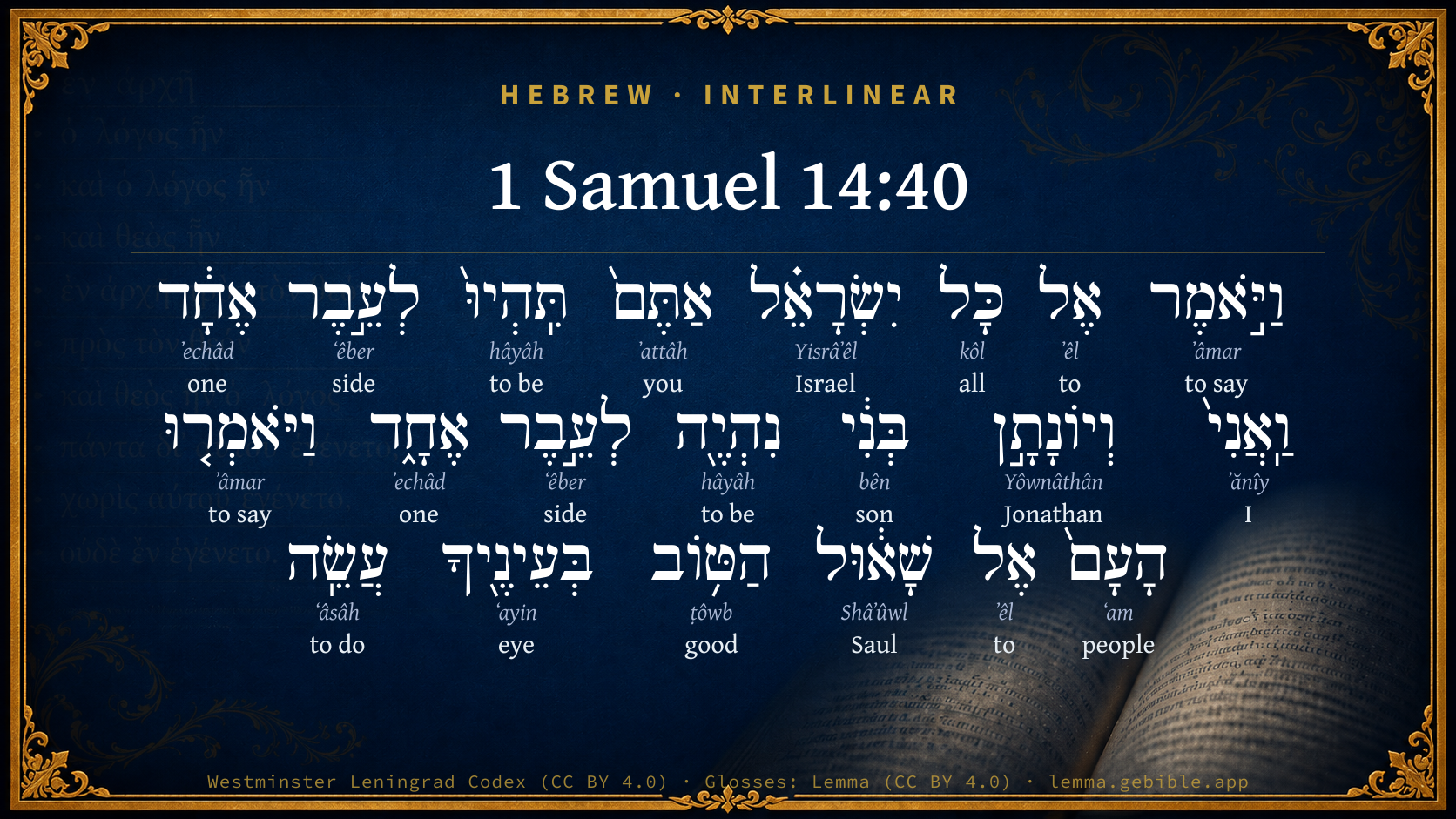
  1. וַיֹּ֣אמֶר ʼâmar H559 “and · to say” Conjunction + Verb, Qal, Sequential Imperfect, 3rd Person, Masculine, Singular
  2. אֶל ʼêl H413 “to” Preposition
  3. כָּל kôl H3605 “all of” Noun, Common, Masculine, Singular, Construct
  4. יִשְׂרָאֵ֗ל Yisrâʼêl H3478 “Israel” Noun, Proper
  5. אַתֶּם֙ ʼattâh H859 “you” Pronoun, Personal, 2nd Person, Masculine, Plural
  6. תִּֽהְיוּ֙ hâyâh H1961 “to be” Verb, Qal, Imperfect, 2nd Person, Masculine, Plural
  7. לְעֵ֣בֶר ʻêber H5676 “to/for · side” Preposition + Noun, Common, Masculine, Singular, Absolute
  8. אֶחָ֔ד ʼechâd H259 “one” Adjective, Cardinal number, Masculine, Singular, Absolute
  9. וַֽאֲנִי֙ ʼănîy H589 “and · I” Conjunction + Pronoun, Personal, 1st Person, Common, Singular
  10. בְּנִ֔י bên H1121 “son · my” Noun, Common, Masculine, Singular, Construct + Suffix, Personal, 1st Person, Common, Singular
  11. נִהְיֶ֖ה hâyâh H1961 “to be” Verb, Qal, Imperfect, 1st Person, Common, Plural
  12. לְעֵ֣בֶר ʻêber H5676 “to/for · side” Preposition + Noun, Common, Masculine, Singular, Absolute
  13. אֶחָ֑ד ʼechâd H259 “one” Adjective, Cardinal number, Masculine, Singular, Absolute
  14. וַיֹּאמְר֤וּ ʼâmar H559 “and · to say” Conjunction + Verb, Qal, Sequential Imperfect, 3rd Person, Masculine, Plural
  15. הָעָם֙ ʻam H5971 “the · people” Particle, Definite Article + Noun, Common, Masculine, Singular, Absolute
  16. אֶל ʼêl H413 “to” Preposition
  17. שָׁא֔וּל Shâʼûwl H7586 “Saul” Noun, Proper
  18. הַטּ֥וֹב ṭôwb H2896 “the · good” Particle, Definite Article + Adjective, Adjective, Masculine, Singular, Absolute
  19. בְּעֵינֶ֖יךָ ʻayin H5869 “in/at · eyes · your” Preposition + Noun, Common, Both, Dual, Construct + Suffix, Personal, 2nd Person, Masculine, Singular
  20. עֲשֵֽׂה ʻâsâh H6213 “do” Verb, Qal, Imperative, 2nd Person, Masculine, Singular

About this verse

These counts appear in no published source. They are computed here, from the morphology-tagged text and Lemma’s own curated glosses. What Lemma adds →

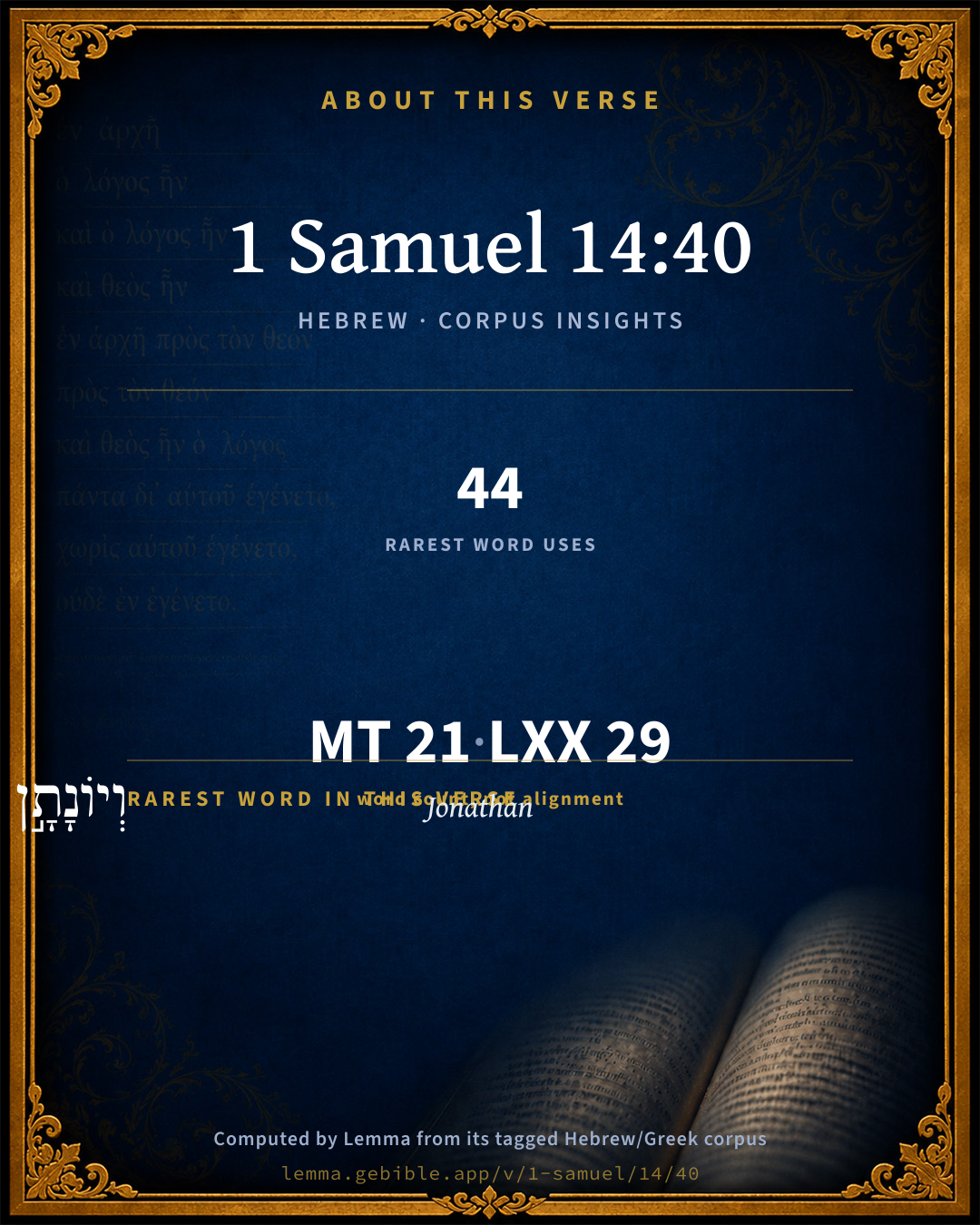
21
words
16
distinct lemmas
Historical
section

Shared distinctive vocabulary

וְיוֹנָתָ֣ן Jonathan H3129 occurs in 36 verses of the Hebrew Bible. Also found in:

Grammatical profile

  • 5 verbs
  • 9 nouns
  • 3 adjectives
  • 2 pronouns
  • 2 prepositions

Verb forms

  • וַיֹּ֣אמֶר Qal · Sequential Imperfect
  • תִּֽהְיוּ֙ Qal · Imperfect
  • נִהְיֶ֖ה Qal · Imperfect
  • וַיֹּאמְר֤וּ Qal · Sequential Imperfect
  • עֲשֵֽׂה Qal · Imperative

Repetition

Words recur within this verse — often emphatic in Hebrew:

  • וַיֹּ֣אמֶר to say H559 ×2
  • תִּֽהְיוּ֙ to be H1961 ×2
  • לְעֵ֣בֶר side H5676 ×2
  • אֶחָ֔ד one H259 ×2
  • אֶל to H413 ×2

Hebrew & Septuagint length

In English translation the verse runs 34 words from the Hebrew and 38 from the Septuagint (LXX English) — closely comparable.

A rough comparison of the two English renderings, which tokenize alike — not a word-level alignment.

Word counts can differ between the Hebrew and the Greek without any difference in meaning — e.g. the Hebrew direct-object marker אֵת has no separate Greek word, and Greek often adds the article ὁ.

In the original languages it is 21 Hebrew tokens and 29 Greek tokens — but the two are counted differently (Hebrew bundles its prefixes and suffixes into one token; the Greek is in lemma form), so that isn’t a like-for-like length.

Cross-references

3

Topical passages linked to 1 Samuel 14:40 in the Treasury of Scripture Knowledge — connected by theme and wording, ordered by reader-vote popularity; previews shown in the World English Bible.

  • 1 Samuel 14:7 His armor bearer said to him, Do all that is in your heart: turn you, behold, I am with you according to your heart.
  • 1 Samuel 14:36 Saul said, Let us go down after the Philistines by night, and take spoil among them until the morning light, and let us not leave a man of them. They said, Do whatever seems good to you. Then said the priest, Let us draw near here to God.
  • 2 Samuel 15:15 The king's servants said to the king, Behold, your servants are ready to do whatever my lord the king shall choose.

Cross-references courtesy of OpenBible.info (CC BY 4.0).

Hebrew and Greek witnesses Masoretic Hebrew ↔ Greek Septuagint

The same verse in the two great witnesses to the Old Testament, shown verse-for-verse.

These are two independent witnesses, not word-aligned to each other, and the Septuagint is shown in lemma (dictionary) form.

Hebrew 1 Samuel 14:40 Masoretic · Westminster Leningrad Codex

וַיֹּ֣אמֶר אֶל כָּל יִשְׂרָאֵ֗ל אַתֶּם֙ תִּֽהְיוּ֙ לְעֵ֣בֶר אֶחָ֔ד וַֽאֲנִי֙ וְיוֹנָתָ֣ן בְּנִ֔י נִהְיֶ֖ה לְעֵ֣בֶר אֶחָ֑ד וַיֹּאמְר֤וּ הָעָם֙ אֶל שָׁא֔וּל הַטּ֥וֹב בְּעֵינֶ֖יךָ עֲשֵֽׂה

Then said he to all Israel, Be you on one side, and I and Jonathan my son will be on the other side. The people said to Saul, Do what seems good to you.

World English Bible · Public Domain

Greek LXX 1 Samuel 14:40 Septuagint · lemma form

καί εἶπον πᾶς ἰσραήλ σύ εἰμί εἰς δουλεία καί ἐγώ καί ιωναθαν ὁ υἱός ἐγώ εἰμί εἰς δουλεία καί εἶπον ὁ λαός πρός σαούλ ὁ ἀγαθός ἐνώπιον σύ ποιέω

And he said to all the men of Israel, You⌃ shall be under subjection, and I an Jonathan my son will be under subjection: and the people said to Saul, Do that which is good in your sight.

LXX2012 (modern English Septuagint) · Public Domain

On this verse, The Pulpit Commentary discusses the Septuagint’s reading. Read the note in Commentary ↓

Hebrew: Westminster Leningrad Codex (CC BY 4.0). Greek: Septuagint (public domain); English from LXX2012 (modern English Septuagint) (Public Domain). How the Septuagint differs from the Hebrew →

Targum (Aramaic paraphrase)

1

The Targum is the ancient Jewish Aramaic paraphrase of the Hebrew Scriptures — an interpretive translation, not the Hebrew text itself. Onkelos (literal) and Pseudo-Jonathan (expansive) render the Torah, and Jonathan the Prophets. Coverage is partial: where no permissively-licensed English translation exists for a verse, only the Aramaic is shown. This is verse-level text, not a word-by-word alignment to the Hebrew.

  1. Targum Jonathan Prophets (Joshua–Malachi)
    וַאֲמַר לְכָל יִשְׂרָאֵל אַתּוּן תְּהוֹן לְעֶבְרָא חָד וַאֲנָא וְיוֹנָתָן בְּרִי נְהֵי לְעֶבְרָא חָד וַאֲמַרוּ עַמָא לְשָׁאוּל דְתַקִין בְּעֵינָךְ עֲבֵיד:

    (no public-domain English translation for this verse)

    Targum Jonathan — Aramaic: “Mikraot Gedolot” (public domain). English: “Sefaria Community Translation” (CC0 1.0 (public-domain dedication)); “London "Chaldee Paraphrase," 1871” (public domain). Text via Sefaria.

Commentary

Notes on 1 Samuel 14:40 from classic Christian and Jewish commentators (each source and its license shown beneath its notes). The classic Christian expositions comment on the surrounding passage and are grouped to its opening verse, so a note may address several verses; the Jewish commentaries on the Tanakh (Rashi and others) are per-verse, so they appear only where the commentator wrote on this verse.

Lemma curates 59 commentaries, every one of them public domain or Creative Commons licensed, each selected and text-cleaned for this edition rather than reprinted as found. About our sources →

Trapp's Complete Commentary

John Trapp

1Sa 14:40 Then said he unto all Israel, Be ye on one side, and I and Jonathan my son will be on the other side. And the people said unto Saul, Do what seemeth good unto thee.

Ver. 40. Do what seemeth good unto thee.] So they had said once before. {1Sa 14:36} Silken words must be given to princes as she in the story said. {a} But when Saul spake of putting Jonathan to death, there was first altum silentium {1Sa 14:39} and then an absolute opposition, {1Sa 14:45} and a forcible rescue.

{a} Plut.

John Trapp, A Commentary or Exposition upon All the Books of the Old and New Testament (1647–1656) — public domain. Text from a community e-Sword module.

John Gill's Exposition

Then said he unto all Israel,.... As many of them as were present; not the principal men only, but the common people; not the officers only, but the common soldiers in the army:

be ye on one side, and I and Jonathan my son will be on the other side: so they divided to the right and left, one went one way, and the other the other; there were two boxes or urns, as Kimchi says, in one of which were the names of Saul and Jonathan, and in the other Israel; though Abarbinel observes, that such a partition of them on one side, and the other, is not according to the manner of lots; and he suspects that Saul knew that Jonathan had tasted of honey, being told it by the man that saw him eat it; and who said to him then, "thy father straitly charged", &c. Sa1 14:27 but chose this way to make it manifest to the people, and to show what a strict regard he had to justice:

and the people said unto Saul, do what seemeth good unto thee; they were very obsequious to him in everything, see Sa1 14:36.

John Gill's Exposition of the Whole Bible (1746–1763) — public domain (CC PDM 1.0). Text via the HelloAO Bible API.

The Pulpit Commentary

Vers. 40, 41. As God also condemned Saul by his silence, the Urim and Thummim giving no answer, he places himself and Jonathan on one side, and the people on the other, and determines to cast lots. He then prays, Give a perfect lot, or, as in the margin, "Show" (literally, give) "the innocent." This is undoubtedly the meaning of the Hebrew, while the rendering of the text is taken from Kimchi. There are few mistranslations of the A.V which have not some good Jewish authority for them, as King James"s translators were singularly well versed in Jewish literature, while they seem strangely to have neglected the still higher authority of the ancient versions. These generally translate "Give holiness," a phrase equivalent to "Show the truth." The Septuagint and Vulgate add explanations, which, however, throw no light upon the passage.

The Pulpit Commentary (1880–1919), ed. H.D.M. Spence-Jones & Joseph S. Exell — public domain. Text from a community e-Sword module.

unfoldingWord translationNotes

Door43 World Missions Community

Then he said to all Israel

This was a generalization since only the Israelite soldiers were present. AT: "Then he said to the Israelite soldiers who were there" (See: Hyperbole and Generalization)

give the Thummim

The Israelites at that time used special stones called the Urim and the Thummim to receive direction from God. AT: "Show us by means of the Thummim" (See: Assumed Knowledge and Implicit Information)

Thummim

This is a borrowed word from the original language. (See: Copy or Borrow Words)

Jonathan and Saul were taken by lot, but the army was exonerated

This can be stated in active form. AT: "The lots indicated that either Jonathan or Saul was guilty, but the army was not guilty" (See: Active or Passive)

Then Jonathan was taken by lot

This can be stated in active form. AT: "Then the lot indicated that Jonathan was guilty" (See: Active or Passive)

translationWords

lots

unfoldingWord translationNotes — © Distant Shores Media and the Door43 World Missions Community, licensed CC BY-SA 4.0. Source: git.door43.org/Door43/en_tn.

Rashi

Rabbi Shlomo Yitzchaki (Rashi)

On one side. To cast lots between all of you, and us.

Rashi on the Tanakh — English translations: “The Judaica Press complete Tanach with Rashi, translated by A. J. Rosenberg” (CC BY 4.0); “Pentateuch with Rashi's commentary by M. Rosenbaum and A.M. Silbermann, 1929-1934” (public domain); “The Metsudah Tanach series, Lakewood, N.J” (CC BY 4.0); and “The Book of Joshua, Metsudah Publications, 1997” (CC BY 4.0). Text via Sefaria.

Lesson kit

Teaching starters — assembled from the data on this page, not authored interpretation. Every prompt links to the verse data it draws on. Edit before teaching.

1 Samuel, in the Historical, opens this verse with 21 words (16 distinct Hebrew lemmas). Its most distinctive word is Yôwnâthân (“Jonathan”). A historical commentator’s framing appears above. Read the whole chapter for the surrounding context.

Discussion questions

  1. How does “Jonathan” (Yôwnâthân) shape what this verse is saying?
  2. How does Judges 18:30, which shares the word «Jonathan», read alongside this verse?
  3. What does the repetition of “to say” (2× in this one verse) do in this verse?
  4. These translations render this verse differently; the difference is in the English rendering, not the original. What questions does that raise?
  5. «וַיֹּ֣אמֶר» is a Qal Sequential Imperfect verb. How does that grammatical form shape the action described?
  6. Compare how Trapp's Complete Commentary and John Gill's Exposition read this verse. Where do they agree or differ?

Things to notice

Reading settings

Reading text

Shown beneath each verse's original-language words.

Old Testament
Old Testament edition

Read the OT as the Masoretic Hebrew (MT) or the Greek Septuagint (LXX).

English shown for the Greek Septuagint (in the Hebrew ↔ Greek comparison).

Comparing translations? Open the Compare panel on any verse page to stack up to four side by side.