
Exodus 14:4

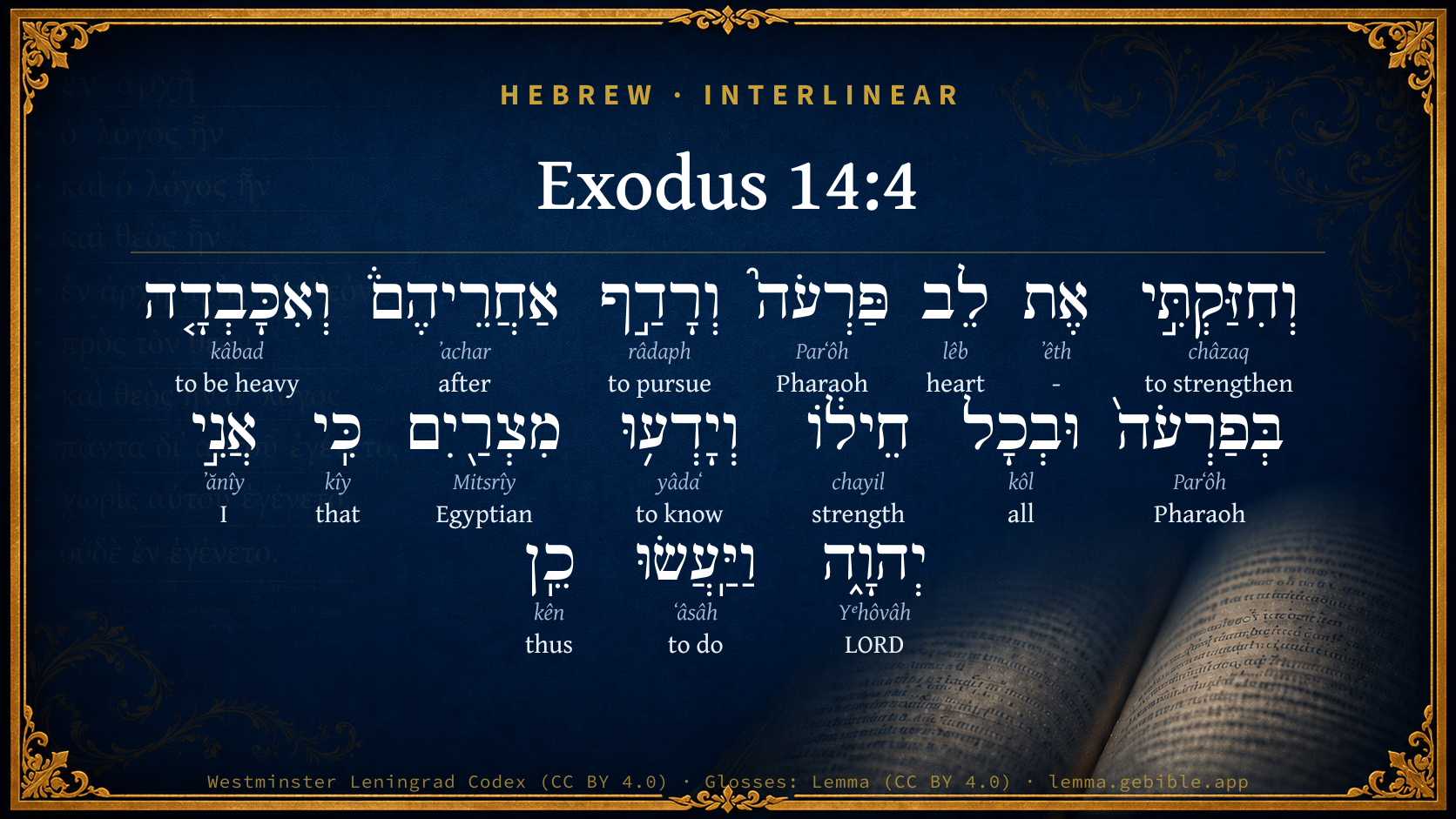
Hebrew (Westminster Leningrad Codex) Exodus 14:4 appears in the Hebrew Old Testament. The text above is from the Westminster Leningrad Codex. Each word links to its Strong’s number, a concise gloss, and parsing drawn from the Open Scriptures Hebrew Bible morphology. Click any word for its full Brown-Driver-Briggs (BDB) entry.
Download image
Cite this verse

Exodus 14:4 (World English Bible). Public Domain. Lemma interlinear Bible study tool, https://lemma.gebible.app/v/exodus/14/4.

Show BibTeX & RIS
BibTeX
RIS
English Translation
I will harden Pharaoh's heart, and he will follow after them; and I will get honor over Pharaoh, and over all his host; and the Egyptians shall know that I am Yahweh." They did so.
World English Bible · Public Domain
Download a study sheet

One document with this verse’s original text, its word-by-word gloss line, the meaning frame, cross-references with their text, attributed commentary, and full source and license credits — printable, and it pastes into notes with its structure intact.

This verse Autodidact and up

Study sheet (.html) Plain text (.txt)

A passage Seminary Student

Up to 50 verses in one chapter. A passage sheet keeps up to 6 commentary sources and 12 cross-references per verse, in the order this page ranks them, and says so on the sheet whenever that leaves anything out. Ask for a single verse and you get the Autodidact verse sheet above.

Everything on this page stays free to read, with no account — the sheet is a download of what is already on screen, not access to it.

Want to remove ads? Support Godless Engineer
Compare translations 3

The same verse in 3 English versions, stacked beneath the original-language interlinear above. Click any original word for its lexicon entry.

Each is an independent rendering of the whole verse — the interlinear is not word-aligned to these translations.

Highlighted words mark where these versions differ — a whole-verse word diff, not a word-by-word alignment.

  • World English Bible Public Domain
    I will harden Pharaoh's heart, and he will follow after them; and I will get honor over Pharaoh, and over all his host; and the Egyptians shall know that I am Yahweh." They did so.
  • King James Version Public Domain
    And I will harden Pharaoh's heart, that he shall follow after them; and I will be honored upon Pharaoh, and upon all his host; that the Egyptians may know that I am the LORD. And they did so.
  • unfoldingWord Literal Text CC BY-SA 4.0
    And I will strengthen the heart of Pharaoh, and he will pursue after them. And I will be glorified because of Pharaoh and because of all his army. And the Egyptians will know that I am Yahweh.” And they did so.

unfoldingWord Literal Text — © unfoldingWord, licensed CC BY-SA 4.0. Word-aligned USFM3 via Door43 (git.door43.org/unfoldingWord/en_ult).

Versions to compare (up to 4)

3 of 4 selected

Show all 18 translations

Every available English version of this verse, each an independent rendering of the whole verse.

  • World English Bible Public Domain
    I will harden Pharaoh's heart, and he will follow after them; and I will get honor over Pharaoh, and over all his host; and the Egyptians shall know that I am Yahweh." They did so.
  • Berean Standard Bible Public Domain
    And I will harden Pharaoh’s heart so that he will pursue them. But I will gain honor by means of Pharaoh and all his army, and the Egyptians will know that I am the LORD.” So this is what the Israelites did.
  • Majority Standard Bible Public Domain
    And I will harden Pharaoh’s heart so that he will pursue them. But I will gain honor by means of Pharaoh and all his army, and the Egyptians will know that I am the LORD.” So this is what the Israelites did.
  • King James Version Public Domain
    And I will harden Pharaoh's heart, that he shall follow after them; and I will be honored upon Pharaoh, and upon all his host; that the Egyptians may know that I am the LORD. And they did so.
  • American Standard Version (1901) Public Domain
    And I will harden Pharaoh's heart, and he shall follow after them; and I will get me honor upon Pharaoh, and upon all his host: and the Egyptians shall know that I am Jehovah. And they did so.
  • Revised Version (1885) Public Domain
    And I will harden Pharaoh’s heart, and he shall follow after them; and I will get me honour upon Pharaoh, and upon all his host; and the Egyptians shall know that I am the LORD. And they did so.
  • Geneva Bible (1599) Public Domain
    And I will harden Pharaohs heart that hee shall follow after you: so I will get mee honour vpon Pharaoh, and vpon all his hoste: the Egyptians also shall knowe that I am the Lord: and they did so.
  • Douay-Rheims (1899) Public Domain
    And I shall harden his heart, and he will pursue you: and I shall be glorified in Pharao, and in all his army: and the Egyptians shall know that I am the Lord. And they did so.
  • Young's Literal Translation Public Domain
    and I have strengthened the heart of Pharaoh, and he hath pursued after them, and I am honoured on Pharaoh, and on all his force, and the Egyptians have known that I `am' Jehovah;' and they do so.
  • Literal Standard Version CC BY-SA 4.0
    and I have strengthened the heart of Pharaoh, and he has pursued after them, and I am honored by Pharaoh, and by all his force, and the Egyptians have known that I [am] YHWH”; and they do so.
  • Unlocked Literal Bible CC BY-SA 4.0
    I will harden Pharaoh's heart, and he will pursue them. I will get honor because of Pharaoh and all his army. The Egyptians will know that I am Yahweh.” So the Israelites camped as they were instructed.
  • unfoldingWord Literal Text CC BY-SA 4.0
    And I will strengthen the heart of Pharaoh, and he will pursue after them. And I will be glorified because of Pharaoh and because of all his army. And the Egyptians will know that I am Yahweh.” And they did so.
  • Darby Bible Public Domain
    And I will harden Pharaoh's heart, that he may pursue after them; and I will glorify myself in Pharaoh, and in all his host; and the Egyptians shall know that I am Jehovah. And they did so.
  • World Messianic Bible Public Domain
    I will harden Pharaoh’s heart, and he will follow after them; and I will get honor over Pharaoh, and over all his armies; and the Egyptians shall know that I am the LORD.” They did so.
  • Webster's Bible Public Domain
    And I will harden Pharaoh's heart, that he shall follow them; and I will be honored upon Pharaoh, and upon all his host; that the Egyptians may know that I am the LORD. And they did so.
  • Free Bible Version CC BY-SA 4.0
    I will give Pharaoh a stubborn attitude so that he will chase after them to get them back. But I will gain respect through what happens to Pharaoh and all his army, and the Egyptians will know that I am the Lord.” So the Israelites did as they were instructed.
  • Bible in Basic English Public Domain
    And I will make Pharaoh's heart hard, and he will come after them and I will be honoured over Pharaoh and all his army, so that the Egyptians may see that I am the Lord. And they did so.
  • JPS Tanakh (1917) Public Domain
    And I will harden Pharaoh's heart, and he shall follow after them; and I will get Me honour upon Pharaoh, and upon all his host; and the Egyptians shall know that I am the LORD.' And they did so.

Literal Standard Version (2020), Covenant Press — licensed CC BY-SA 4.0. Text via the HelloAO Bible API (eBible.org). Unlocked Literal Bible (unfoldingWord) — licensed CC BY-SA 4.0. Text via the HelloAO Bible API (eBible.org). unfoldingWord Literal Text — © unfoldingWord, licensed CC BY-SA 4.0. Word-aligned USFM3 via Door43 (git.door43.org/unfoldingWord/en_ult). Free Bible Version, Dr. Jonathan Gallagher — licensed CC BY-SA 4.0. Text via the HelloAO Bible API (eBible.org).

Word by word

More ways to search: Search by grammar → Find every occurrence → Compare this word →

Practice this passage: Drill this verse → Learn its vocabulary →

מִצְרַ֖יִם
Mitsrîy
H4713
“Egyptian”
Noun, Proper
Part of Speech
Noun
Type
Proper
Full BDB Definition

Origin: from H4714

TWOT: None

Egyptian = see Egypte " double straits" - Egyptian - an inhabitant or citizen of Egypt - an Egyptian - the Egyptian
  1. וְחִזַּקְתִּ֣י châzaq H2388 “and · to strengthen” Conjunction + Verb, Piel, Sequential Perfect, 1st Person, Common, Singular
  2. אֶת ʼêth H853 “-” Particle, Direct Object
  3. לֵב lêb H3820 “heart of” Noun, Common, Masculine, Singular, Construct
  4. פַּרְעֹה֮ Parʻôh H6547 “Pharaoh” Noun, Proper
  5. וְרָדַ֣ף râdaph H7291 “and · to pursue” Conjunction + Verb, Qal, Sequential Perfect, 3rd Person, Masculine, Singular
  6. אַחֲרֵיהֶם֒ ʼachar H310 “after · them” Preposition + Suffix, Personal, 3rd Person, Masculine, Plural
  7. וְאִכָּבְדָ֤ה kâbad H3513 “and · to be heavy” Conjunction + Verb, Niphal, Cohortative, 1st Person, Common, Singular
  8. בְּפַרְעֹה֙ Parʻôh H6547 “in/at · Pharaoh” Preposition + Noun, Proper
  9. וּבְכָל kôl H3605 “and · in/at · all of” Conjunction + Preposition + Noun, Common, Masculine, Singular, Construct
  10. חֵיל֔וֹ chayil H2428 “strength · his” Noun, Common, Masculine, Singular, Construct + Suffix, Personal, 3rd Person, Masculine, Singular
  11. וְיָדְע֥וּ yâdaʻ H3045 “and · to know” Conjunction + Verb, Qal, Sequential Perfect, 3rd Person, Common, Plural
  12. כִּֽי kîy H3588 “that” Conjunction
  13. אֲנִ֣י ʼănîy H589 “I” Pronoun, Personal, 1st Person, Common, Singular
  14. יְהוָ֑ה Yᵉhôvâh H3068 “LORD” Noun, Proper
  15. וַיַּֽעֲשׂוּ ʻâsâh H6213 “and · to do” Conjunction + Verb, Qal, Sequential Imperfect, 3rd Person, Masculine, Plural
  16. כֵֽן kên H3651 “thus” Adverb

About this verse

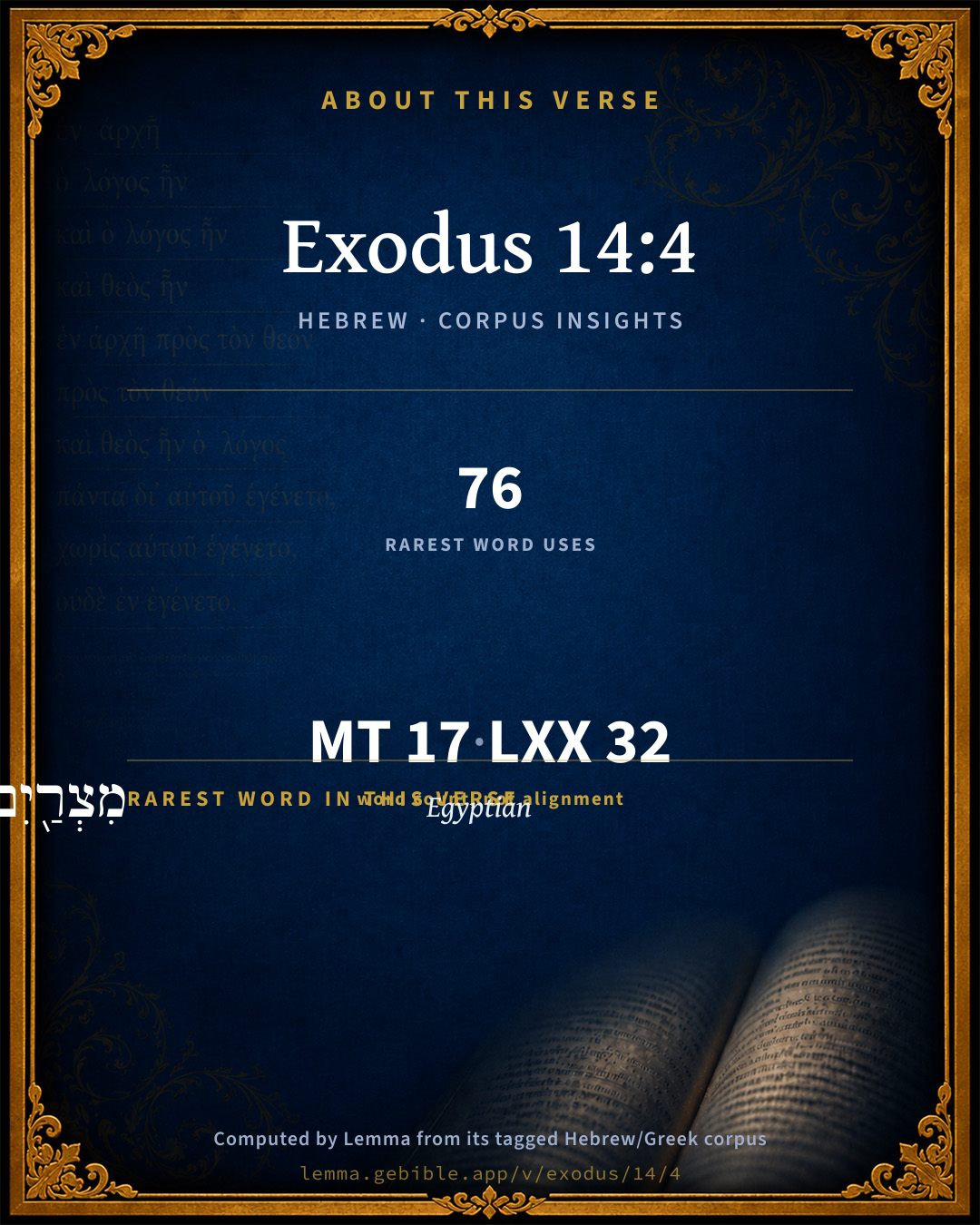
These counts appear in no published source. They are computed here, from the morphology-tagged text and Lemma’s own curated glosses. What Lemma adds →

17
words
16
distinct lemmas
Pentateuch
section

Grammatical profile

  • 5 verbs
  • 7 nouns
  • 1 pronoun
  • 1 preposition
  • 1 conjunction
  • 1 adverb
  • 1 particle

Verb forms

  • וְחִזַּקְתִּ֣י Piel · Sequential Perfect
  • וְרָדַ֣ף Qal · Sequential Perfect
  • וְאִכָּבְדָ֤ה Niphal · Cohortative
  • וְיָדְע֥וּ Qal · Sequential Perfect
  • וַיַּֽעֲשׂוּ Qal · Sequential Imperfect

Repetition

A word recurs within this verse — often emphatic in Hebrew:

  • פַּרְעֹה֮ Pharaoh H6547 ×2

Hebrew & Septuagint length

In English translation the verse runs 35 words from the Hebrew and 41 from the Septuagint (LXX English) — closely comparable.

A rough comparison of the two English renderings, which tokenize alike — not a word-level alignment.

Word counts can differ between the Hebrew and the Greek without any difference in meaning — e.g. the Hebrew direct-object marker אֵת has no separate Greek word, and Greek often adds the article ὁ.

In the original languages it is 17 Hebrew tokens and 32 Greek tokens — but the two are counted differently (Hebrew bundles its prefixes and suffixes into one token; the Greek is in lemma form), so that isn’t a like-for-like length.

Cross-references

21

Topical passages linked to Exodus 14:4 in the Treasury of Scripture Knowledge — connected by theme and wording, ordered by reader-vote popularity; previews shown in the World English Bible.

  • Romans 9:22–23 What if God, willing to show his wrath, and to make his power known, endured with much patience vessels of wrath made for destruction,
  • Exodus 7:5 The Egyptians shall know that I am Yahweh, when I stretch forth my hand on Egypt, and bring out the children of Israel from among them."
  • Romans 9:17 For the Scripture says to Pharaoh, "For this very purpose I caused you to be raised up, that I might show in you my power, and that my name might be published abroad in all the earth."
  • Exodus 7:3 I will harden Pharaoh's heart, and multiply my signs and my wonders in the land of Egypt.
  • Exodus 9:16 but indeed for this cause I have made you stand: to show you my power, and that my name may be declared throughout all the earth;
  • Exodus 4:21–31 Yahweh said to Moses, "When you go back into Egypt, see that you do before Pharaoh all the wonders which I have put in your hand, but I will harden his heart and he will not let the people go.
  • Exodus 7:17 Thus says Yahweh, "In this you shall know that I am Yahweh. Behold, I will strike with the rod that is in my hand on the waters which are in the river, and they shall be turned to blood.
  • Ezekiel 28:22 and say, Thus says the Lord Yahweh: Behold, I am against you, Sidon; and I will be glorified in the midst of you; and they shall know that I am Yahweh, when I shall have executed judgments in her, and shall be sanctified in her.
  • Exodus 7:13–14 Pharaoh's heart was hardened, and he didn't listen to them; as Yahweh had spoken.
  • Exodus 14:8 Yahweh hardened the heart of Pharaoh king of Egypt, and he pursued after the children of Israel; for the children of Israel went out with a high hand.
  • Exodus 14:17–18 I, behold, I will harden the hearts of the Egyptians, and they shall go in after them: and I will get myself honor over Pharaoh, and over all his host, over his chariots, and over his horsemen.
  • Exodus 15:10–11 You blew with your wind. The sea covered them. They sank like lead in the mighty waters.
  • Exodus 15:14–16 The peoples have heard. They tremble. Pangs have taken hold on the inhabitants of Philistia.
  • Exodus 18:11 Now I know that Yahweh is greater than all gods because of the thing in which they dealt arrogantly against them."
  • Nehemiah 9:10 and shown signs and wonders on Pharaoh, and on all his servants, and on all the people of his land; for you knew that they dealt proudly against them, and did get you a name, as it is this day.
  • Isaiah 2:11–12 The lofty looks of man will be brought low, The haughtiness of men will be bowed down, And Yahweh alone will be exalted in that day.
  • Ezekiel 20:9 But I worked for my name's sake, that it should not be profaned in the sight of the nations, among which they were, in whose sight I made myself known to them, in bringing them forth out of the land of Egypt.
  • Ezekiel 39:13 Yes, all the people of the land shall bury them; and it shall be to them a renown in the day that I shall be glorified, says the Lord Yahweh.
  • Daniel 4:30–37 The king spoke and said, Is not this great Babylon, which I have built for the royal dwelling-place, by the might of my power and for the glory of my majesty?
  • Romans 11:8 According as it is written, "God gave them a spirit of stupor, eyes that they should not see, and ears that they should not hear, to this very day."
  • Revelation 19:1–6 After these things I heard something like a loud voice of a great multitude in heaven, saying, "Hallelujah! Salvation, power, and glory belong to our God:

Cross-references courtesy of OpenBible.info (CC BY 4.0).

Hebrew and Greek witnesses Masoretic Hebrew ↔ Greek Septuagint

The same verse in the two great witnesses to the Old Testament, shown verse-for-verse.

These are two independent witnesses, not word-aligned to each other, and the Septuagint is shown in lemma (dictionary) form.

Hebrew Exodus 14:4 Masoretic · Westminster Leningrad Codex

וְחִזַּקְתִּ֣י אֶת לֵב פַּרְעֹה֮ וְרָדַ֣ף אַחֲרֵיהֶם֒ וְאִכָּבְדָ֤ה בְּפַרְעֹה֙ וּבְכָל חֵיל֔וֹ וְיָדְע֥וּ מִצְרַ֖יִם כִּֽי אֲנִ֣י יְהוָ֑ה וַיַּֽעֲשׂוּ כֵֽן

I will harden Pharaoh's heart, and he will follow after them; and I will get honor over Pharaoh, and over all his host; and the Egyptians shall know that I am Yahweh." They did so.

World English Bible · Public Domain

Greek LXX Exodus 14:4 Septuagint · lemma form

ἐγώ δέ σκληρύνω ὁ καρδία φαραώ καί καταδιώκω ὀπίσω αὐτός καί ἐνδοξάζομαι ἐν φαραώ καί ἐν πᾶς ὁ στρατιά αὐτός καί γιγνώσκω πᾶς ὁ αἰγύπτιος ὅτι ἐγώ εἰμί κύριος καί ποιέω οὕτως

And I will harden the heart of Pharao, and he shall pursue after them; and I will be glorified in Pharao, and in all his host, and all the Egyptians shall know that I am the Lord. And they did so.

LXX2012 (modern English Septuagint) · Public Domain

Hebrew: Westminster Leningrad Codex (CC BY 4.0). Greek: Septuagint (public domain); English from LXX2012 (modern English Septuagint) (Public Domain). How the Septuagint differs from the Hebrew →

Targum (Aramaic paraphrase)

2

The Targum is the ancient Jewish Aramaic paraphrase of the Hebrew Scriptures — an interpretive translation, not the Hebrew text itself. Onkelos (literal) and Pseudo-Jonathan (expansive) render the Torah, and Jonathan the Prophets. Coverage is partial: where no permissively-licensed English translation exists for a verse, only the Aramaic is shown. This is verse-level text, not a word-by-word alignment to the Hebrew.

  1. Targum Onkelos Torah (Genesis–Deuteronomy)
    וְאַתְקֵף יָת לִבָּא דְפַרְעֹה וְיִרְדַף בַּתְרֵיהוֹן וְאֶתְיַקַר בְּפַרְעֹה וּבְכָל מַשִׁרְיָתֵהּ וְיִדְעוּן מִצְרָאֵי אֲרֵי אֲנָא יְיָ וַעֲבָדוּ כֵן:

    (no public-domain English translation for this verse)

    Targum Onkelos — Aramaic: “Onkelos Genesis” (public domain); “Onkelos Exodus” (public domain); “Onkelos Leviticus” (public domain); “Onkelos Numbers” (public domain); “Onkelos Deuteronomy” (public domain). English: “Sefaria Community Translation” (CC0 1.0 (public-domain dedication)); “J.W. Etheridge. The Targums of Onkelos and Jonathan Ben Uzziel on the Pentateuch. London: Longmans, Green, 1862” (public domain). Text via Sefaria.

  2. Targum Pseudo-Jonathan Torah (Genesis–Deuteronomy)
    וְאַתְקֵיף יַת יִצְרָא דְּלִבָּא דְּפַרְעה וְיִרְדוֹף בַּתְרֵיהוֹן וְאִתְיַקַר בְּפַרְעה וּבְכָל מִשְׁרְיָיתֵיהּ וְיִנְדְעוּן מִצְרָאֵי אֲרוּם אֲנָא הוּא יְיָ וַעֲבָדוּ הֵיכְדֵין

    And I will strengthen the design of Pharoh's heart to pursue after them, and I will be glorified upon Pharoh and upon his hosts, and the Mizraee shall know that I am the Lord. And they did so.

    Targum Pseudo-Jonathan — Aramaic: “Targum Jonathan on Genesis” (public domain); “Targum Jonathan on Exodus” (public domain); “Targum Jonathan on Leviticus” (public domain); “Targum Jonathan on Numbers” (public domain); “Targum Jonathan on Deuteronomy” (public domain). English: “The Targum of Jonathan ben Uzziel, trans. J. W. Etheridge, London, 1862” (public domain). Text via Sefaria.

Commentary

Notes on Exodus 14:4 from classic Christian and Jewish commentators (each source and its license shown beneath its notes). The classic Christian expositions comment on the surrounding passage and are grouped to its opening verse, so a note may address several verses; the Jewish commentaries on the Tanakh (Rashi and others) are per-verse, so they appear only where the commentator wrote on this verse.

Lemma curates 59 commentaries, every one of them public domain or Creative Commons licensed, each selected and text-cleaned for this edition rather than reprinted as found. About our sources →

Trapp's Complete Commentary

John Trapp

Exo 14:4 And I will harden Pharaoh’s heart, that he shall follow after them; and I will be honoured upon Pharaoh, and upon all his host; that the Egyptians may know that I [am] the LORD. And they did so.

Ver. 4. And I will be honoured.] By subduing this sturdy rebel, and bringing "his violent dealing upon his own pate." {Psa 7:16} When the prophet cried to Jeroboam’s altar, it clave presently asunder. {1Ki 13:2-3} But the mighty "hammer" of "God’s word," {Jer 23:29} with ten miracles, gave ten mighty strokes at Pharaoh’s heart, and yet could find no entrance. God will therefore now take another course with him.

John Trapp, A Commentary or Exposition upon All the Books of the Old and New Testament (1647–1656) — public domain. Text from a community e-Sword module.

Tyndale Open Study Notes

Tyndale Open Resources

14:4 know that I am the Lord: This event was the climactic demonstration of the Lord’s character and power in the Exodus. Rescue for humans is by means of God’s self-revelation as he incarnates himself in our life and experience. • as they were told: In this part of the book, the Israelites were obedient to God’s commands (12:35, 50). Unfortunately, this was not their continued pattern after the crossing.

Tyndale Open Study Notes — © Tyndale Open Resources, licensed CC BY-SA 4.0. Text via the HelloAO Bible API.

Geneva Bible (1599)

Geneva Bible translators

By punishing his obstinate rebellion.

Geneva Bible (1599) marginal notes — public domain. Text via Bolls.life.

Adam Clarke's Commentary

Verse 4. I will harden Pharaoh's heart] After relenting and giving them permission to depart, he now changes his mind and determines to prevent them; and without any farther restraining grace, God permits him to rush on to his final ruin, for the cup of his iniquity was now full.

Adam Clarke's Commentary on the Bible (1810–1826) — public domain. Text from a community e-Sword/MySword module.

The Cambridge Bible for Schools and Colleges

gen. ed. J. J. S. Perowne

4. harden] lit. make strong or firm: P’s regular word (on Exo_7:13).

follow] better, pursue, as vv. 8, 9, 23.

get me honour (or glory)] viz. by Pharaoh’s overthrow: cf. especially Eze_28:22; Eze_39:13 (EVV. ‘will be glorified’). So vv. 17, 18.

and the Egyptians shall know, &c.] as Exo_7:5. Cf. on Exo_6:7.

V. 4 is not to be understood as giving the actual reason why the Israelites ‘turned back’ (for which see Exo_13:17): rather (Di.) ‘it gives merely the ideal ground, deduced correctly from the event, that God would get Him glory by the Egyptians’ overthrow.’

5–7 (J). The Pharaoh prepares to follow after them.

The Cambridge Bible for Schools and Colleges (gen. ed. J. J. S. Perowne; Cambridge University Press, 1878–1918) — public domain. Text from a community e-Sword module.

John Gill's Exposition

And I will harden Pharaoh's heart,.... Once more, as he had often done:

that he shall follow after them: to Pihahiroth, and even into the sea after them:

and I will be honoured upon Pharaoh, and upon all his host; in his wisdom, faithfulness, power, and justice, by the destruction of them:

that the Egyptians may know that I am the Lord; the only Jehovah, the Lord God omnipotent; even those that feel the weight of his hand while troubling their host, and bringing the waters upon them; especially those that shall remain in the land, and will not be involved in the catastrophe:

and they did so: the Israelites turned to the right to Pihahiroth, instead of going by Bishbesh and Tinah (Bubastis and Pelusium), and so along the sea coast towards Gaza and Ascalon, and encamped there between Migdol and the sea over against Baalzephon, as they were ordered and directed.

John Gill's Exposition of the Whole Bible (1746–1763) — public domain (CC PDM 1.0). Text via the HelloAO Bible API.

Haydock's Catholic Bible Commentary

And he will. Protestants falsely translate, "that he may," &c., contrary to the Hebrew and other versions. (Worthington)

George Leo Haydock (1774–1849), Haydock's Catholic Family Bible and Commentary, 1859 edition — public domain. Excludes Psalms (Douay-Rheims chapter numbering differs from Protestant) and Deuterocanonical books (Catholic canon only).

Matthew Poole's English Annotations

I will be honoured, by the manifestation of my power and justice. I will be honoured, by the manifestation of my power and justice.

Matthew Poole's English Annotations on the Holy Bible (1683–1685) — public domain. Text from a community e-Sword/MySword module.

The Pulpit Commentary

I will be honoured. See the comment on Exo_9:16. That the Egyptians may know that I am the Lord. Compare above, ch. 7.

The Pulpit Commentary (1880–1919), ed. H.D.M. Spence-Jones & Joseph S. Exell — public domain. Text from a community e-Sword module.

unfoldingWord translationNotes

Door43 World Missions Community

General Information:

Yahweh continues to instruct Moses on where to go and what Yahweh will do.

I will harden Pharaoh's heart

Here "heart" refers to the Pharaoh. His stubborn attitude is spoken of as if his heart was hard. See how you translated a similar phrase in Exodus 9:12. AT: "I will cause Pharaoh to became more defiant" (See: Synecdoche and Metaphor)

he will pursue them

"Pharaoh will pursue the Israelites"

I will get honor

"People will honor me"

The Egyptians will know that I am Yahweh

"The Egyptians will understand that I am Yahweh, the one true God"

So the Israelites camped as they were instructed

This can be stated in active form. AT: "So the Israelites camped as Yahweh had instructed them" (See: Active or Passive)

When the king of Egypt was told

This can be stated in active form. AT: "When someone told the king of Egypt" (See: Active or Passive)

the king of Egypt

This refers to Pharaoh.

had fled

"had run away"

the minds of Pharaoh and his servants turned against the people

Here the word "minds" refers to their attitudes towards the Israelites. AT: "Pharaoh and his servants changed their attitudes about the people" (See: Metonymy)

What have we done? We have released Israel from serving us.

They asked this question to show they thought they had done a foolish thing. This rhetorical question can be translated as a statement. AT: "We have done a stupid thing by letting Israel go free from working for us!" (See: Rhetorical Question)

translationWords

hard

heart

honor

Egypt

know

instruct

king

mind

servant

people of God

unfoldingWord translationNotes — © Distant Shores Media and the Door43 World Missions Community, licensed CC BY-SA 4.0. Source: git.door43.org/Door43/en_tn.

Rashi

Rabbi Shlomo Yitzchaki (Rashi)

ואכבדה בפרעה AND I WILL BE HONOURED THROUGH PHARAOH — When the Holy One, blessed be He, takes vengeance on the wicked His name is magnified and honoured. Thus, too, it states, (Ezekiel 38:22, 23) “And I will plead against him [with pestilence and with blood etc.]”, and afterwards, “Thus I shall be magnified and sanctified etc.” And it states, (Psalms 76:3) “There He broke the fiery shafts of the bow”, and afterwards (after He has done this) (v. 2) “In Judah is God known. “Further it states, (Psalms 9:17) “The Lord is known because He executeth judgment” (Mekhilta).

בפרעה ובכל חילו THROUGH PHARAOH AND THROUGH ALL HIS FORCES — He began the wrongdoing and with him began the punishment (Mekhilta; cf. Rashi on Exodus 7:28).

ויעשו כן AND THEY DID SO — This is stated in order to tell their praise — that they hearkened to Moses and did not say, How can we move nearer to our enemies; we ought rather to flee,” but they said, ‘‘It is ours only to carry out the bidding of the son of Amram” (cf. Mekhilta).

Rashi on the Tanakh — English translations: “The Judaica Press complete Tanach with Rashi, translated by A. J. Rosenberg” (CC BY 4.0); “Pentateuch with Rashi's commentary by M. Rosenbaum and A.M. Silbermann, 1929-1934” (public domain); “The Metsudah Tanach series, Lakewood, N.J” (CC BY 4.0); and “The Book of Joshua, Metsudah Publications, 1997” (CC BY 4.0). Text via Sefaria.

Ramban (Nachmanides)

Rabbi Moshe ben Nachman (Ramban / Nachmanides)

AND I WILL HARDEN PHARAOH’S HEART, AND HE SHALL PURSUE AFTER THEM. Because Pharaoh feared them at the plague of the firstborn and he asked them and bless me also, he was not disposed to pursue after the Israelites even if they were to flee, and he would rather have Moses do with them as he pleases. Therefore, it was necessary to state that G-d hardened his heart to pursue after them. Further on, it says once more, And I, behold, I will harden the hearts of the Egyptians, and they shall go in after them. After the Egyptians saw that the sea had split before the children of Israel and that they walked in the midst of the sea upon dry land, which is the most outstanding wonder of all wonders, how could they be disposed to come in after them to harm them! This was indeed madness on their part. But it was He Who turned their counsel into foolishness and strengthened their hearts to enter the sea.

Ramban (Nachmanides) on the Tanakh — English translation: “Commentary on the Torah by Ramban (Nachmanides). Translated and annotated by Charles B. Chavel. New York, Shilo Pub. House, 1971-1976” (CC BY 4.0). Text via Sefaria.

Lesson kit

Teaching starters — assembled from the data on this page, not authored interpretation. Every prompt links to the verse data it draws on. Edit before teaching.

Exodus, in the Pentateuch, opens this verse with 17 words (16 distinct Hebrew lemmas). Its most distinctive word is Mitsrîy (“Egyptian”). A historical commentator’s framing appears above. Read the whole chapter for the surrounding context.

Discussion questions

  1. How does “Egyptian” (Mitsrîy) shape what this verse is saying?
  2. How does Romans 9:22–23, which shares this passage’s theme, read alongside this verse?
  3. What does the repetition of “Pharaoh” (2× in this one verse) do in this verse?
  4. These translations render this verse differently. What is at stake in choosing one wording over another?
  5. «וְחִזַּקְתִּ֣י» is a Piel Sequential Perfect verb. How does that grammatical form shape the action described?
  6. Compare how Trapp's Complete Commentary and Tyndale Open Study Notes read this verse. Where do they agree or differ?

Things to notice

Reading settings

Reading text

Shown beneath each verse's original-language words.

Old Testament
Old Testament edition

Read the OT as the Masoretic Hebrew (MT) or the Greek Septuagint (LXX).

English shown for the Greek Septuagint (in the Hebrew ↔ Greek comparison).

Comparing translations? Open the Compare panel on any verse page to stack up to four side by side.