
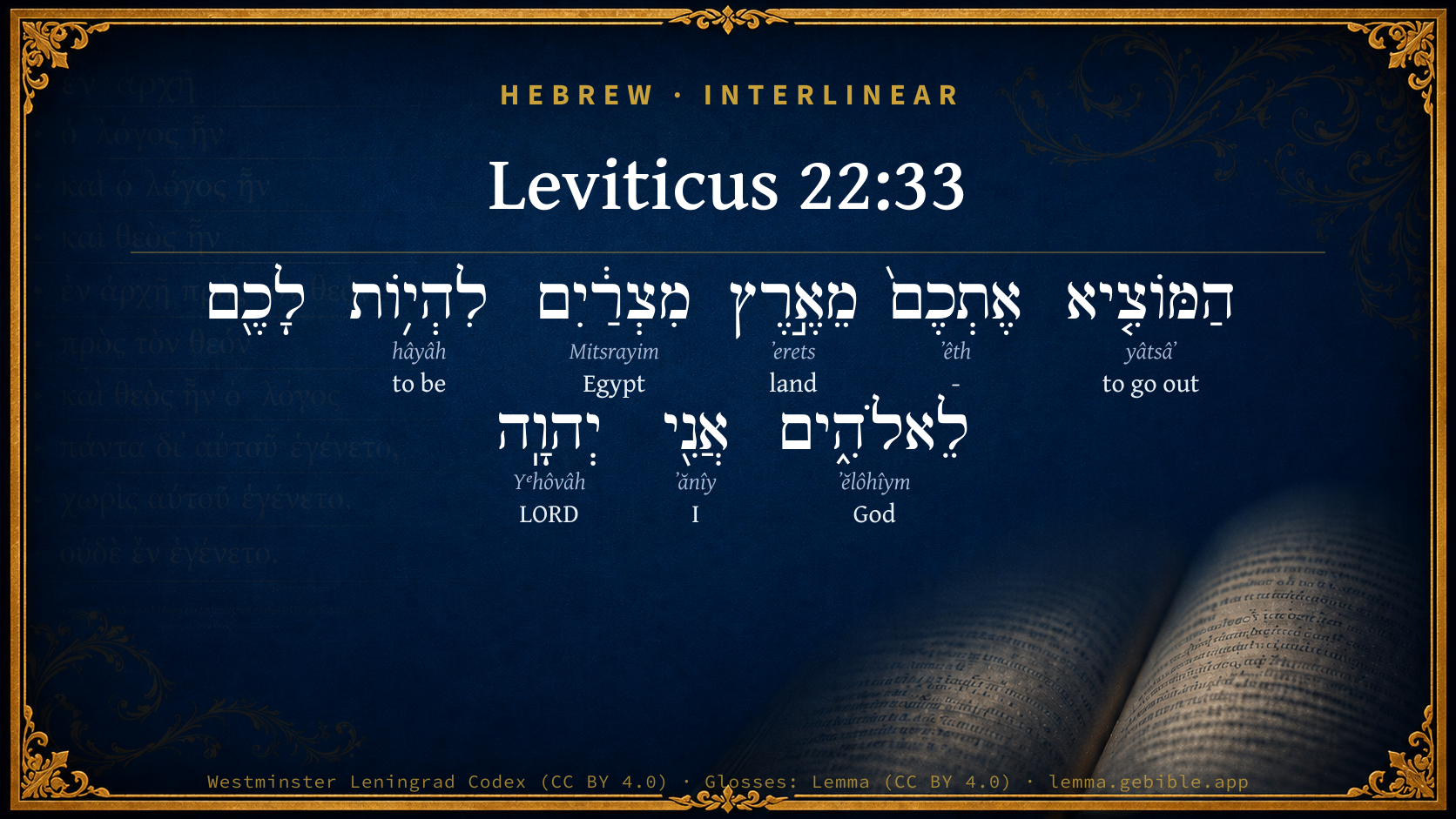
Leviticus 22:33

Hebrew (Westminster Leningrad Codex) Leviticus 22:33 appears in the Hebrew Old Testament. The text above is from the Westminster Leningrad Codex. Each word links to its Strong’s number, a concise gloss, and parsing drawn from the Open Scriptures Hebrew Bible morphology. Click any word for its full Brown-Driver-Briggs (BDB) entry.
Download image
Cite this verse

Leviticus 22:33 (World English Bible). Public Domain. Lemma interlinear Bible study tool, https://lemma.gebible.app/v/leviticus/22/33.

Show BibTeX & RIS
BibTeX
RIS
English Translation
who brought you out of the land of Egypt, to be your God. I am Yahweh."
World English Bible · Public Domain
Download a study sheet

One document with this verse’s original text, its word-by-word gloss line, the meaning frame, cross-references with their text, attributed commentary, and full source and license credits — printable, and it pastes into notes with its structure intact.

This verse Autodidact and up

Study sheet (.html) Plain text (.txt)

A passage Seminary Student

Up to 50 verses in one chapter. A passage sheet keeps up to 6 commentary sources and 12 cross-references per verse, in the order this page ranks them, and says so on the sheet whenever that leaves anything out. Ask for a single verse and you get the Autodidact verse sheet above.

Everything on this page stays free to read, with no account — the sheet is a download of what is already on screen, not access to it.

Want to remove ads? Support Godless Engineer
Compare translations 3

The same verse in 3 English versions, stacked beneath the original-language interlinear above. Click any original word for its lexicon entry.

Each is an independent rendering of the whole verse — the interlinear is not word-aligned to these translations.

Highlighted words mark where these versions differ — a whole-verse word diff, not a word-by-word alignment.

  • World English Bible Public Domain
    who brought you out of the land of Egypt, to be your God. I am Yahweh."
  • King James Version Public Domain
    That brought you out of the land of Egypt, to be your God: I am the LORD.
  • unfoldingWord Literal Text CC BY-SA 4.0
    the one bringing you out of the land of Egypt to be your God: I Yahweh.”

unfoldingWord Literal Text — © unfoldingWord, licensed CC BY-SA 4.0. Word-aligned USFM3 via Door43 (git.door43.org/unfoldingWord/en_ult).

Versions to compare (up to 4)

3 of 4 selected

Show all 18 translations

Every available English version of this verse, each an independent rendering of the whole verse.

  • World English Bible Public Domain
    who brought you out of the land of Egypt, to be your God. I am Yahweh."
  • Berean Standard Bible Public Domain
    who brought you out of the land of Egypt to be your God. I am the LORD.”
  • Majority Standard Bible Public Domain
    who brought you out of the land of Egypt to be your God. I am the LORD.”
  • King James Version Public Domain
    That brought you out of the land of Egypt, to be your God: I am the LORD.
  • American Standard Version (1901) Public Domain
    who brought you out of the land of Egypt, to be your God: I am Jehovah.
  • Revised Version (1885) Public Domain
    that brought you out of the land of Egypt, to be your God: I am the LORD.
  • Geneva Bible (1599) Public Domain
    Which haue brought you out of the land of Egypt, to be your God: I am the Lord.
  • Douay-Rheims (1899) Public Domain
    And who brought you out of the land of Egypt, that I might be your God: I am the Lord.
  • Young's Literal Translation Public Domain
    who am bringing you up out of the land of Egypt, to become your God; I `am' Jehovah.'
  • Literal Standard Version CC BY-SA 4.0
    who am bringing you up out of the land of Egypt, to become your God; I [am] YHWH.”
  • Unlocked Literal Bible CC BY-SA 4.0
    who brought you out of the land of Egypt to be your God: I am Yahweh.”
  • unfoldingWord Literal Text CC BY-SA 4.0
    the one bringing you out of the land of Egypt to be your God: I Yahweh.”
  • Darby Bible Public Domain
    who brought you out of the land of Egypt, to be your God: I am Jehovah.
  • World Messianic Bible Public Domain
    who brought you out of the land of Egypt, to be your God. I am the LORD.”
  • Webster's Bible Public Domain
    That brought you out of the land of Egypt, to be your God: I am the LORD.
  • Free Bible Version CC BY-SA 4.0
    I am the one who led you out of Egypt to be your God. I am the Lord.”
  • Bible in Basic English Public Domain
    Who took you out of the land of Egypt that I might be your God: I am the Lord.
  • JPS Tanakh (1917) Public Domain
    that brought you out of the land of Egypt, to be your God: I am the LORD.

Literal Standard Version (2020), Covenant Press — licensed CC BY-SA 4.0. Text via the HelloAO Bible API (eBible.org). Unlocked Literal Bible (unfoldingWord) — licensed CC BY-SA 4.0. Text via the HelloAO Bible API (eBible.org). unfoldingWord Literal Text — © unfoldingWord, licensed CC BY-SA 4.0. Word-aligned USFM3 via Door43 (git.door43.org/unfoldingWord/en_ult). Free Bible Version, Dr. Jonathan Gallagher — licensed CC BY-SA 4.0. Text via the HelloAO Bible API (eBible.org).

Word by word

More ways to search: Search by grammar → Find every occurrence → Compare this word →

Practice this passage: Drill this verse → Learn its vocabulary →

About this verse

These counts appear in no published source. They are computed here, from the morphology-tagged text and Lemma’s own curated glosses. What Lemma adds →

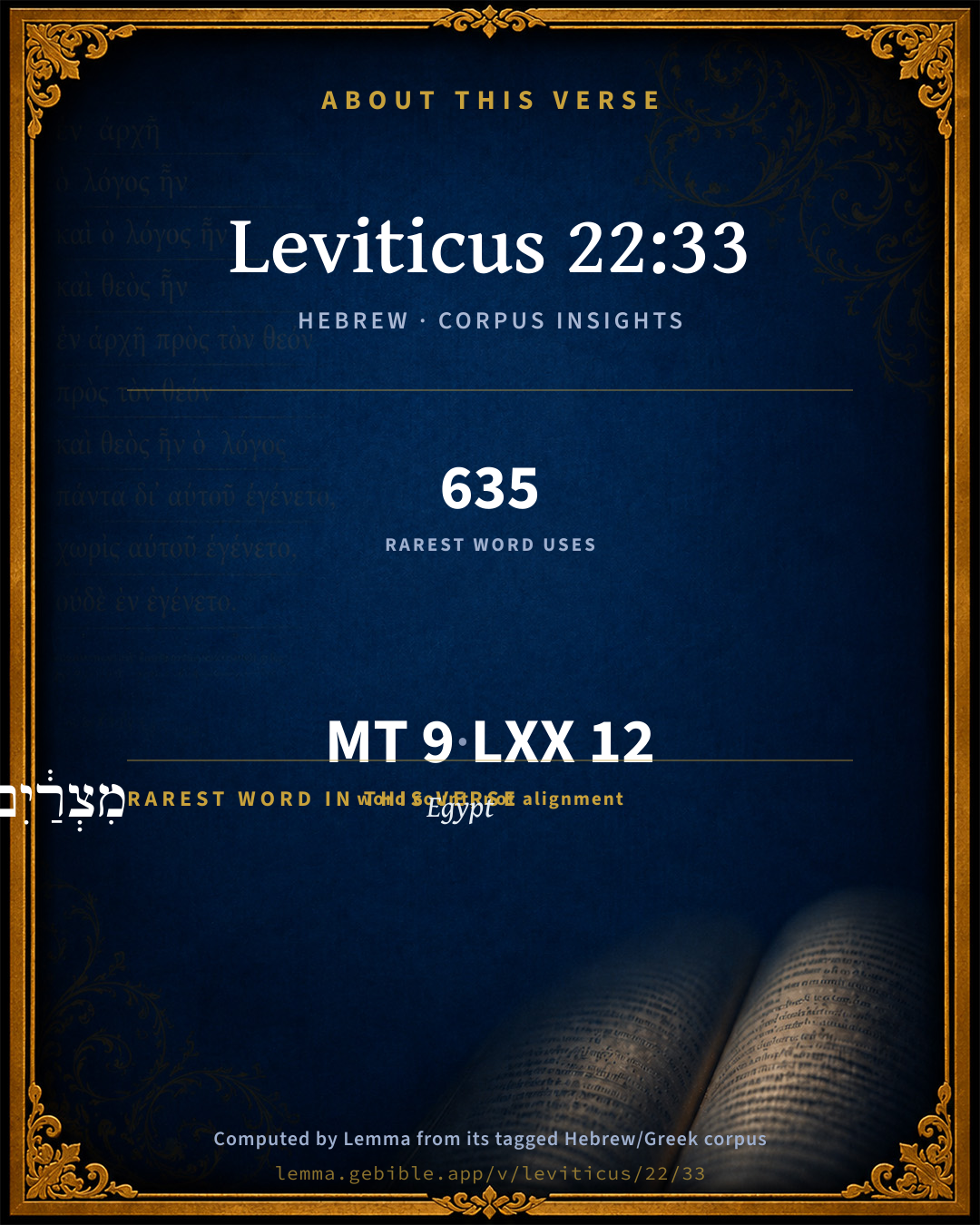
9
words
8
distinct lemmas
Pentateuch
section

Grammatical profile

  • 2 verbs
  • 4 nouns
  • 1 pronoun
  • 1 preposition
  • 1 particle

Verb forms

  • הַמּוֹצִ֤יא Hiphil · Participle Active
  • לִהְי֥וֹת Qal · Infinitive Construct

Hebrew & Septuagint length

In English translation the verse runs 16 words from the Hebrew and 17 from the Septuagint (LXX English) — closely comparable.

A rough comparison of the two English renderings, which tokenize alike — not a word-level alignment.

Word counts can differ between the Hebrew and the Greek without any difference in meaning — e.g. the Hebrew direct-object marker אֵת has no separate Greek word, and Greek often adds the article ὁ.

In the original languages it is 9 Hebrew tokens and 12 Greek tokens — but the two are counted differently (Hebrew bundles its prefixes and suffixes into one token; the Greek is in lemma form), so that isn’t a like-for-like length.

Cross-references

6

Topical passages linked to Leviticus 22:33 in the Treasury of Scripture Knowledge — connected by theme and wording, ordered by reader-vote popularity; previews shown in the World English Bible.

  • Leviticus 11:45 For I am Yahweh who brought you up out of the land of Egypt, to be your God. You shall therefore be holy, for I am holy.
  • Exodus 6:7 and I will take you to me for a people, and I will be to you a God; and you shall know that I am Yahweh your God, who brings you out from under the burdens of the Egyptians.
  • Exodus 20:2 "I am Yahweh your God, who brought you out of the land of Egypt, out of the house of bondage.
  • Leviticus 19:36 Just balances, just weights, a just ephah, and a just hin, shall you have. I am Yahweh your God, who brought you out of the land of Egypt.
  • Leviticus 25:38 I am Yahweh your God, who brought you forth out of the land of Egypt, to give you the land of Canaan, and to be your God.
  • Numbers 15:41 I am Yahweh your God, who brought you out of the land of Egypt, to be your God: I am Yahweh your God.

Cross-references courtesy of OpenBible.info (CC BY 4.0).

Hebrew and Greek witnesses Masoretic Hebrew ↔ Greek Septuagint

The same verse in the two great witnesses to the Old Testament, shown verse-for-verse.

These are two independent witnesses, not word-aligned to each other, and the Septuagint is shown in lemma (dictionary) form.

Hebrew Leviticus 22:33 Masoretic · Westminster Leningrad Codex

הַמּוֹצִ֤יא אֶתְכֶם֙ מֵאֶ֣רֶץ מִצְרַ֔יִם לִהְי֥וֹת לָכֶ֖ם לֵאלֹהִ֑ים אֲנִ֖י יְהוָֽה

who brought you out of the land of Egypt, to be your God. I am Yahweh."

World English Bible · Public Domain

Greek LXX Leviticus 22:33 Septuagint · lemma form

ὁ ἐκἄγω σύ ἐκ γῆ αἴγυπτος ὥστε εἰμί σύ θεός ἐγώ κύριος

who brought you out of the land of Egypt, to be your God: I am the Lord.

LXX2012 (modern English Septuagint) · Public Domain

Hebrew: Westminster Leningrad Codex (CC BY 4.0). Greek: Septuagint (public domain); English from LXX2012 (modern English Septuagint) (Public Domain). How the Septuagint differs from the Hebrew →

Targum (Aramaic paraphrase)

2

The Targum is the ancient Jewish Aramaic paraphrase of the Hebrew Scriptures — an interpretive translation, not the Hebrew text itself. Onkelos (literal) and Pseudo-Jonathan (expansive) render the Torah, and Jonathan the Prophets. Coverage is partial: where no permissively-licensed English translation exists for a verse, only the Aramaic is shown. This is verse-level text, not a word-by-word alignment to the Hebrew.

  1. Targum Onkelos Torah (Genesis–Deuteronomy)
    דְאַפִּיק יָתְכוֹן מֵאַרְעָא דְמִצְרַיִם לְמֶהֱוֵי לְכוֹן לֵאלָהָא אֲנָא יְיָ

    (no public-domain English translation for this verse)

    Targum Onkelos — Aramaic: “Onkelos Genesis” (public domain); “Onkelos Exodus” (public domain); “Onkelos Leviticus” (public domain); “Onkelos Numbers” (public domain); “Onkelos Deuteronomy” (public domain). English: “Sefaria Community Translation” (CC0 1.0 (public-domain dedication)); “J.W. Etheridge. The Targums of Onkelos and Jonathan Ben Uzziel on the Pentateuch. London: Longmans, Green, 1862” (public domain). Text via Sefaria.

  2. Targum Pseudo-Jonathan Torah (Genesis–Deuteronomy)
    דְהַנְפִּיק יַתְכוֹן פְּרִיקִין מֵאַרְעָא דְמִצְרַיִם מְטוּל לְמֶהֱוֵי לְכוֹן לֶאֱלָהָא אֲנָא יְיָ

    having brought you forth redeemed from the land of Mizraim, that I may be to you Eloah: I am the Lord.

    Targum Pseudo-Jonathan — Aramaic: “Targum Jonathan on Genesis” (public domain); “Targum Jonathan on Exodus” (public domain); “Targum Jonathan on Leviticus” (public domain); “Targum Jonathan on Numbers” (public domain); “Targum Jonathan on Deuteronomy” (public domain). English: “The Targum of Jonathan ben Uzziel, trans. J. W. Etheridge, London, 1862” (public domain). Text via Sefaria.

Commentary

Notes on Leviticus 22:33 from classic Christian and Jewish commentators (each source and its license shown beneath its notes). The classic Christian expositions comment on the surrounding passage and are grouped to its opening verse, so a note may address several verses; the Jewish commentaries on the Tanakh (Rashi and others) are per-verse, so they appear only where the commentator wrote on this verse.

Lemma curates 59 commentaries, every one of them public domain or Creative Commons licensed, each selected and text-cleaned for this edition rather than reprinted as found. About our sources →

Adam Clarke's Commentary

Verse 33. Brought you out of the land of Egypt] By such a series of miraculous interferences, to be your God - to save you from all idolatry, false and superstitious worship, teach you the right way, lead and support you in it, and preserve you to my eternal kingdom and glory. God, infinite in his own perfections, has no need of his creatures; but they need him; and, as a source of endless felicity, he opens himself to all his intelligent offspring.

Adam Clarke's Commentary on the Bible (1810–1826) — public domain. Text from a community e-Sword/MySword module.

Ellicott's Commentary for English Readers

(33) That brought you out.—By this signal act of redemption from bondage, and by choosing them as His peculiar people, God has a special claim upon His redeemed people that they should keep His commandments. (See Lev_11:45.)

A Bible Commentary for English Readers, edited by Charles John Ellicott (1878–1897) — public domain. Text from a community e-Sword module.

Whedon's Commentary on the Bible

Daniel D. Whedon

33. That brought you out of… Egypt — The interposition of Jehovah as the emancipator of Israel from the burdens and bonds of Pharaoh was a weighty reason for holiness of life. Moral obligations are impressively seen when the relations out of which they spring are exhibited to the mind. The deliverance of the justified soul from the guilt of sin affords a strong motive for “perfecting holiness in the fear of God.” Israel was not commanded to be holy till the yoke of Egypt was broken.

CONCLUDING NOTES.

(1.) Since this chapter contains the last directions respecting sacrifices found in this book, it is appropriate to append some general remarks, showing first the difference between Hebrew and pagan sacrifices, and secondly, the significance of the Hebrew sacrifices. 1.) There is no mention of any thing preceding the slaying of the animal, except that it be of a proper age and without blemish. It was not brought decked with garlands, nor sprinkled with barley-cakes and salt, nor was wine poured upon its horns, nor was a lock of hair taken from its forehead to be cast into the fire on the altar. 2.) Nothing is said about inspecting the entrails for ascertaining the future, which was a principal object in all heathen sacrifices. 3.) All the altar-ritual is dignified, impressive, and worthy of its divine origin; indicating the sinfulness of man, the holiness of God, and the necessity of an atonement to bring man into harmony with his Maker, and to raise him to that spiritual excellence and happiness for which he was created. These sacrifices and oblations were admirably adapted to enlighten the minds of the Jews and to prepare them to appreciate “the Lamb of God which taketh away the sins of the world.” In respect to all that relates to the expiation of sin, the words of Jerome are not too strong, “Almost every syllable in this book breathes a spiritual sacrament.” The best comment on the Levitical sacrifices is the epistle to the Hebrews 4.) The scriptural conception of the effect of sacrifices upon the object of worship is totally different from that of any pagan cultus. The Homeric gods smell the savour of the burning hecatombs, and are pleased and placated. True that at a later date Jehovah declares that he has no pleasure in burnt offerings, (Psa_51:16,) but that was because of the insincerity and wickedness of the offerers. Says Epiphanius: “The people sacrificed, not because God would be pleased with the act, but because such an inveterate habit of sacrificing had been acquired in Egypt, and Jehovah, by temporary indulgence, would allure them away from idolatrous worship.” Chrysostom gives the following statement of the origin of Hebrew sacrifices: “God, in his care for the salvation of men, allowed such forms to be used in his own worship as had been employed in the worship of idols; those only which were of a positively sinful character being excluded. It was intended by this to lead men by a gradual progress to a purer and less carnal form of worship.” Says Theophylact: “God allowed them to sacrifice to himself, lest, if they were forbidden to do so, they should sacrifice to idols.” Thus also Justin Martyr and Tertullian. For strictures on Baehr, see Numbers 15, concluding note. 5.) Much objection has been made to the similarity of the Levitical ritual to that of the Egyptians, as if it was derogatory to Jehovah to employ any thing used by them. “It is altogether a natural supposition that a man like Moses, learned in all the wisdom of the Egyptians, and whose task it was to digest a religious system for a people who, like the Israelites, had lived for centuries in Egypt, would adopt spontaneously a form of language by which those whom he wished to instruct could be reached most readily and effectively. Nor is it at all strange that he should not only use the same form of language in general, but should, besides, when trying to express, as he must often have had occasion to do, the same ideas, have had recourse to the same symbols as were employed by the Egyptians. There is nothing, necessarily, any more objectionable in this than there is in printing the Scriptures by the use of the same press and types as are employed in printing the vilest books.” — Bib. Sacra.

(2.) THE SIGNIFICANCE OF SACRIFICES.

1.) THE VICARIOUS THEORY. — The Mosaic sacrifices typify Christ’s death, and have exclusive reference to God. They were not designed merely to express the feelings of the worshippers, but to affect the mind of Jehovah, being vicarious punishments, and intended to accomplish the same purposes that real punishments have in view. — Outram.

2.) THEORY OF RESTORED FELLOWSHIP. — The blood of the offered animal is its life, which is offered on the altar in the place of the life of the worshipper, not as an expiation for sin, but as a surrender of selfishness, the principle of sin, thus removing sin and restoring fellowship with God. — Bahr. “One (way set before the Jews) was the way of sacrifice, by which expiation and atonement were to be made; and which was to be a type and sign of the slaying and offering up of the carnal will, the carnal nature, to God.” — Archdeacon Hare.

3.) FEDERAL THEORY. — Sacrifices are not expiations but federal rites, or festive observances, shared in at once by Jehovah and by men in token of friendship, either such as had never been broken or such as had been restored. — Dr. Sykes.

4.) GIFT THEORY. — It becomes those who, like men, have received many and great benefits from their Creator, to present him some of his own gifts in return, as an expression of gratitude and acknowledgment of dependence. Thus pious men endeavour to recommend themselves to the offended Deity. — Portall and Taylor.

5.) UNITARIAN THEORY. — Sacrifices owe their efficacy to the purity of the feeling which they represent, and not to any element of expiation. The faith required was not a faith in God, nor in any future Redeemer, but simply faith in himself — his distinct recognition of his own inward rectitude. — F.D. Maurice.

6.) THE EVANGELICAL THEORY extends the vicarious theory of Outram, and makes the sacrifice satisfactory to the justice of God as a moral Governor, and to all moral intelligences, and influential with man; thus removing all barriers God-ward and man-ward which were obstructing reconciliation.

(3.) In explanation of the variety of sacrifices, we quote from Jukes: “The fact is, that our perceptions do not grasp realities, but forms. If, therefore, what is seen is to be described, we must have many representations even of the same object; and this not only because it may be viewed on different sides, but because the amount of what is seen, even on the same side, will depend on the light and capacity of the beholder. He who made us knew this and provided for it. Hence in type and figure we have view after view of Him who was to come, not only because his offices and perfections were many, but also because we were weak and needed such a revelation. Thus in the single relation of offering, Christ is seen as burnt offering, peace offering, and sin offering, each but a different view of the same offering. In the self-same act of dying on the cross, our Lord was at the same moment a sweet-savour offering, willingly offering to God a perfect obedience, and also a sin offering, penally bearing the judgment due to sin, and as such made a curse for us.”

(4.) In the nature and order of the three great feasts we have emblems of the three stages of salvation. The feast of unleavened bread prefigures the forgiveness of sins through “the Lamb of God that taketh away the sin of the world.” The feast of weeks, the end of the grain harvest, fifty days after the Passover, symbolizes Christ as the source of spiritual life through the Pentecostal gift in consequence of the atonement. The feast of tabernacles is typical of the repose, the gladness, the gratitude, and the enjoyment of souls still dwelling on earth, entirely sanctified and filled with the Spirit, but it more especially foreshadows the realization of all spiritual blessings in heavenly places after the harvest of the earth has been completed.

Daniel D. Whedon (gen. ed.), Commentary on the Old and New Testaments (1874–1909) — public domain. Text from a community e-Sword module.

Rashi

Rabbi Shlomo Yitzchaki (Rashi)

המוציא אתכם THAT HATH BROUGHT YOU OUT [OF THE LAND OF EGYPT] — for the sake of this (that you should hallow His name).

'אני ה‎‎ I AM THE LORD — Who is faithful in paying you your reward (Sifra, Emor, Chapter 9 6).

Rashi on the Tanakh — English translations: “The Judaica Press complete Tanach with Rashi, translated by A. J. Rosenberg” (CC BY 4.0); “Pentateuch with Rashi's commentary by M. Rosenbaum and A.M. Silbermann, 1929-1934” (public domain); “The Metsudah Tanach series, Lakewood, N.J” (CC BY 4.0); and “The Book of Joshua, Metsudah Publications, 1997” (CC BY 4.0). Text via Sefaria.

Lesson kit

Teaching starters — assembled from the data on this page, not authored interpretation. Every prompt links to the verse data it draws on. Edit before teaching.

Leviticus, in the Pentateuch, opens this verse with 9 words (8 distinct Hebrew lemmas). Its most distinctive word is Mitsrayim (“Egypt”). A historical commentator’s framing appears above. Read the whole chapter for the surrounding context.

Discussion questions

  1. What does “Egypt” (Mitsrayim) contribute to the verse as a whole?
  2. Leviticus 11:45 shares this passage’s theme. How do the two illuminate each other?
  3. These translations render this verse differently. What is at stake in choosing one wording over another?
  4. The verb «הַמּוֹצִ֤יא» is Hiphil Participle Active. How does its form color the action?
  5. Reading how Adam Clarke's Commentary and Ellicott's Commentary for English Readers read this verse, where do the two commentators agree and where do they part?

Things to notice

Reading settings

Reading text

Shown beneath each verse's original-language words.

Old Testament
Old Testament edition

Read the OT as the Masoretic Hebrew (MT) or the Greek Septuagint (LXX).

English shown for the Greek Septuagint (in the Hebrew ↔ Greek comparison).

Comparing translations? Open the Compare panel on any verse page to stack up to four side by side.