Leviticus 18:24

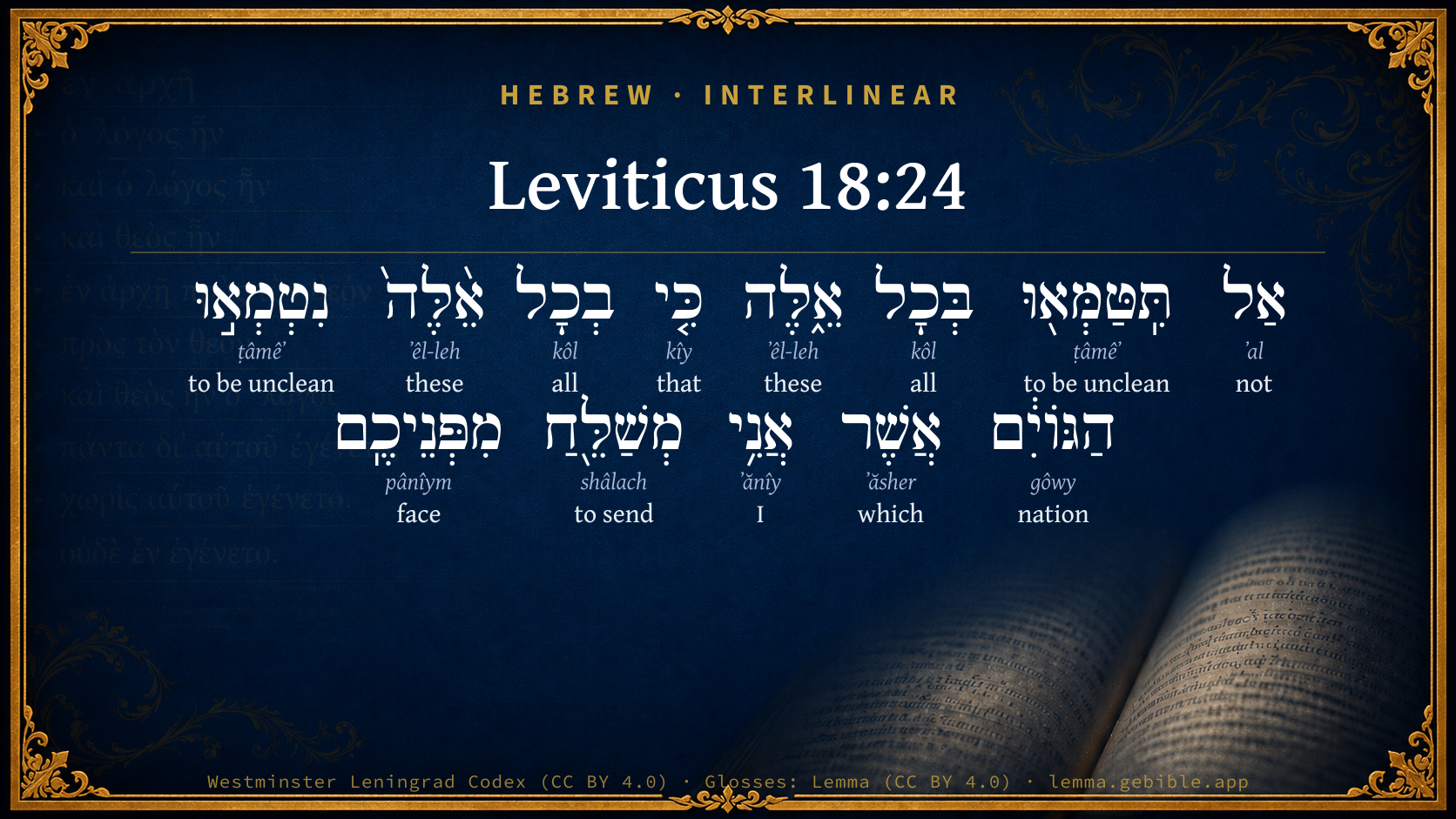
Hebrew (Westminster Leningrad Codex) Leviticus 18:24 appears in the Hebrew Old Testament. The text above is from the Westminster Leningrad Codex. Each word links to its Strong’s number, a concise gloss, and parsing drawn from the Open Scriptures Hebrew Bible morphology. Click any word for its full Brown-Driver-Briggs (BDB) entry.
Download image
Cite this verse

Leviticus 18:24 (World English Bible). Public Domain. Lemma interlinear Bible study tool, https://lemma.gebible.app/v/leviticus/18/24.

Show BibTeX & RIS
BibTeX
RIS
English Translation
"'Don't defile yourselves in any of these things: for in all these the nations which I am casting out before you were defiled.
World English Bible · Public Domain
Download a study sheet

One document with this verse’s original text, its word-by-word gloss line, the meaning frame, cross-references with their text, attributed commentary, and full source and license credits — printable, and it pastes into notes with its structure intact.

This verse Autodidact and up

Study sheet (.html) Plain text (.txt)

A passage Seminary Student

Up to 50 verses in one chapter. A passage sheet keeps up to 6 commentary sources and 12 cross-references per verse, in the order this page ranks them, and says so on the sheet whenever that leaves anything out. Ask for a single verse and you get the Autodidact verse sheet above.

Everything on this page stays free to read, with no account — the sheet is a download of what is already on screen, not access to it.

Want to remove ads? Support Godless Engineer
Compare translations 3

The same verse in 3 English versions, stacked beneath the original-language interlinear above. Click any original word for its lexicon entry.

Each is an independent rendering of the whole verse — the interlinear is not word-aligned to these translations.

Highlighted words mark where these versions differ — a whole-verse word diff, not a word-by-word alignment.

  • World English Bible Public Domain
    "'Don't defile yourselves in any of these things: for in all these the nations which I am casting out before you were defiled.
  • King James Version Public Domain
    Defile not ye yourselves in any of these things: for in all these the nations are defiled which I cast out before you:
  • unfoldingWord Literal Text CC BY-SA 4.0
    Do not make yourselves unclean in any of these ways, for in all these ways the nations that I am sending out from your faces make themselves unclean.

unfoldingWord Literal Text — © unfoldingWord, licensed CC BY-SA 4.0. Word-aligned USFM3 via Door43 (git.door43.org/unfoldingWord/en_ult).

Versions to compare (up to 4)

3 of 4 selected

Show all 18 translations

Every available English version of this verse, each an independent rendering of the whole verse.

  • World English Bible Public Domain
    "'Don't defile yourselves in any of these things: for in all these the nations which I am casting out before you were defiled.
  • Berean Standard Bible Public Domain
    Do not defile yourselves by any of these practices, for by all these things the nations I am driving out before you have defiled themselves.
  • Majority Standard Bible Public Domain
    Do not defile yourselves by any of these practices, for by all these things the nations I am driving out before you have defiled themselves.
  • King James Version Public Domain
    Defile not ye yourselves in any of these things: for in all these the nations are defiled which I cast out before you:
  • American Standard Version (1901) Public Domain
    Defile not ye yourselves in any of these things: for in all these the nations are defiled which I cast out from before you;
  • Revised Version (1885) Public Domain
    Defile not ye yourselves in any of these things: for in all these the nations are defiled which I cast out from before you:
  • Geneva Bible (1599) Public Domain
    Yee shall not defile your selues in any of these things: for in al these the nations are defiled, which I will cast out before you:
  • Douay-Rheims (1899) Public Domain
    Defile not yourselves with any of these things with which all the nations have been defiled, which I will cast out before you,
  • Young's Literal Translation Public Domain
    `Ye are not defiled with all these, for with all these have the nations been defiled which I am sending away from before you;
  • Literal Standard Version CC BY-SA 4.0
    Do not defile yourselves with all these, for with all these the nations have been defiled which I am sending away from before you;
  • Unlocked Literal Bible CC BY-SA 4.0
    Do not defile yourselves in any of these ways, for in all these ways the nations are defiled, the nations that I will drive out from before you.
  • unfoldingWord Literal Text CC BY-SA 4.0
    Do not make yourselves unclean in any of these ways, for in all these ways the nations that I am sending out from your faces make themselves unclean.
  • Darby Bible Public Domain
    Make not yourselves unclean in any of these things; for in all these have the nations which I am casting out before you made themselves unclean.
  • World Messianic Bible Public Domain
    “‘Don’t defile yourselves in any of these things; for in all these the nations which I am casting out before you were defiled.
  • Webster's Bible Public Domain
    Defile not ye yourselves in any of these things; for in all these the nations are defiled which I cast out before you:
  • Free Bible Version CC BY-SA 4.0
    A woman must not give herself to an animal to have sex with it. That is something disgusting. Don't pollute yourselves and make yourselves unclean by doing anything like this. That's the reason I'm expelling these nations from the land—they polluted themselves because of all these practices.
  • Bible in Basic English Public Domain
    Do not make yourself unclean in any of these ways; for so have those nations whom I am driving out from before you made themselves unclean:
  • JPS Tanakh (1917) Public Domain
    Defile not ye yourselves in any of these things; for in all these the nations are defiled, which I cast out from before you.

Literal Standard Version (2020), Covenant Press — licensed CC BY-SA 4.0. Text via the HelloAO Bible API (eBible.org). Unlocked Literal Bible (unfoldingWord) — licensed CC BY-SA 4.0. Text via the HelloAO Bible API (eBible.org). unfoldingWord Literal Text — © unfoldingWord, licensed CC BY-SA 4.0. Word-aligned USFM3 via Door43 (git.door43.org/unfoldingWord/en_ult). Free Bible Version, Dr. Jonathan Gallagher — licensed CC BY-SA 4.0. Text via the HelloAO Bible API (eBible.org).

Word by word

More ways to search: Search by grammar → Find every occurrence → Compare this word →

Practice this passage: Drill this verse → Learn its vocabulary →

תִּֽטַּמְּא֖וּ
ṭâmêʼ
H2930
“to be unclean”
Verb, Hithpael, Jussive, 2nd Person, Masculine, Plural
Part of Speech
Verb
Stem
Hithpael
Form
Jussive
Person
2nd Person
Gender
Masculine
Number
Plural
Full BDB Definition

Origin: a primitive root

TWOT: 809

to be unclean, become unclean, become impure - (Qal) to be or become unclean - sexually - religiously - ceremonially - (Niphal) - to defile oneself, be defiled - sexually - by idolatry - ceremonially - to be regarded as unclean - (Piel) - to defile - sexually - religiously - ceremonially - to pronounce unclean, declare unclean (ceremonially) - to profane (God's name) - (Pual) to be defiled - (Hithpael) to be unclean - (Hothpael) to be defiled
  1. אַל ʼal H408 “not” Particle, Negative
  2. בְּכָל kôl H3605 “in/at · all of” Preposition + Noun, Common, Masculine, Singular, Construct
  3. אֵ֑לֶּה ʼêl-leh H428 “these” Pronoun, Demonstrative, Common, Plural
  4. כִּ֤י kîy H3588 “that” Conjunction
  5. בְכָל kôl H3605 “in/at · all of” Preposition + Noun, Common, Masculine, Singular, Construct
  6. אֵ֨לֶּה֙ ʼêl-leh H428 “these” Pronoun, Demonstrative, Common, Plural
  7. נִטְמְא֣וּ ṭâmêʼ H2930 “to be unclean” Verb, Niphal, Perfect, 3rd Person, Common, Plural
  8. הַגּוֹיִ֔ם gôwy H1471 “the · nations” Particle, Definite Article + Noun, Common, Masculine, Plural, Absolute
  9. אֲשֶׁר ʼăsher H834 “which” Particle, Relative
  10. אֲנִ֥י ʼănîy H589 “I” Pronoun, Personal, 1st Person, Common, Singular
  11. מְשַׁלֵּ֖חַ shâlach H7971 “sending” Verb, Piel, Participle Active, Masculine, Singular, Absolute
  12. מִפְּנֵיכֶֽם pânîym H6440 “from · face(s) · your” Preposition + Noun, Common, Both, Plural, Construct + Suffix, Personal, 2nd Person, Masculine, Plural

About this verse

These counts appear in no published source. They are computed here, from the morphology-tagged text and Lemma’s own curated glosses. What Lemma adds →

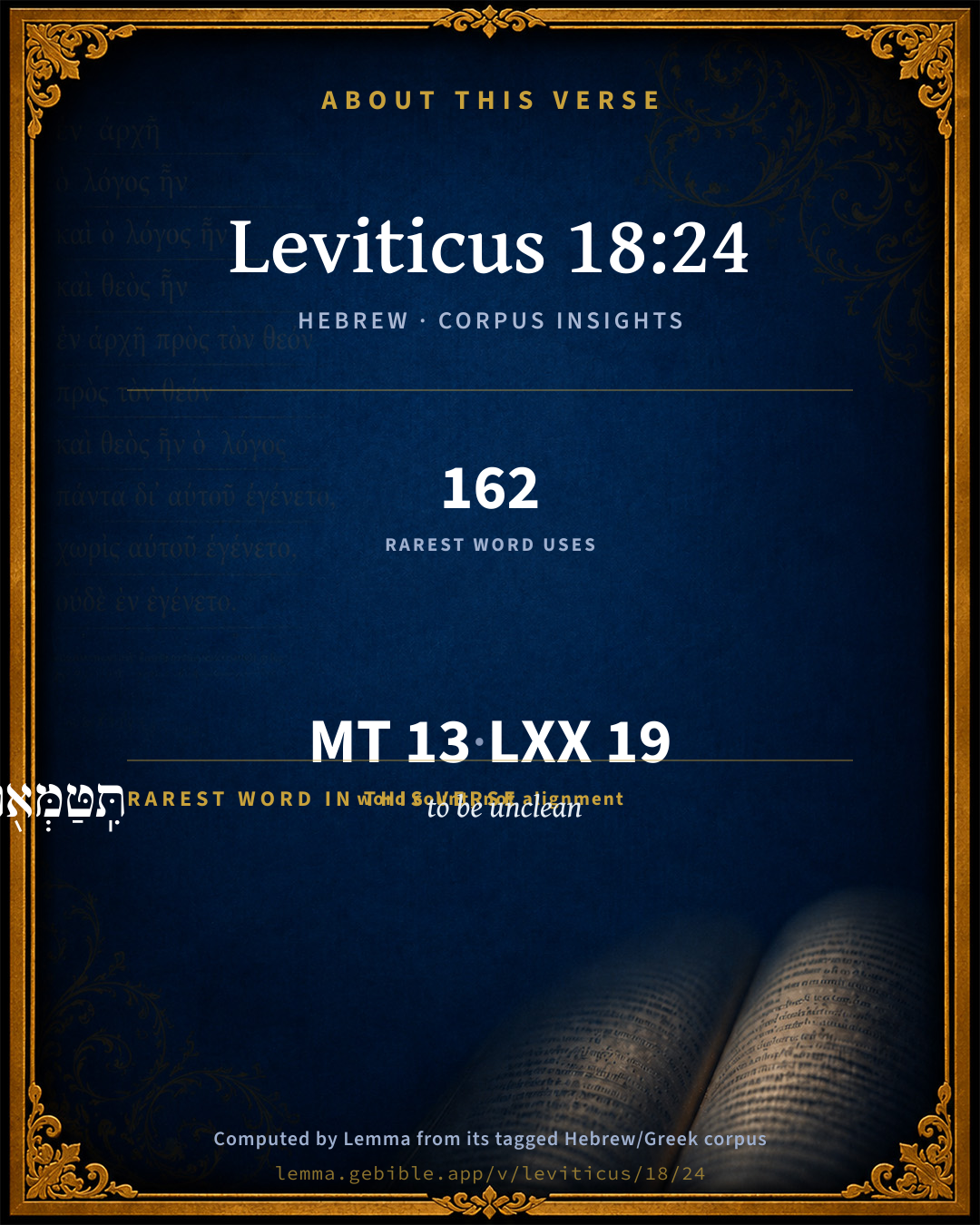
13
words
10
distinct lemmas
Pentateuch
section

Grammatical profile

  • 3 verbs
  • 4 nouns
  • 3 pronouns
  • 1 conjunction
  • 2 particles

Verb forms

  • תִּֽטַּמְּא֖וּ Hithpael · Jussive
  • נִטְמְא֣וּ Niphal · Perfect
  • מְשַׁלֵּ֖חַ Piel · Participle Active

Repetition

Words recur within this verse — often emphatic in Hebrew:

  • תִּֽטַּמְּא֖וּ to be unclean H2930 ×2
  • בְּכָל all H3605 ×2
  • אֵ֑לֶּה these H428 ×2

Hebrew & Septuagint length

In English translation the verse runs 23 words from the Hebrew and 24 from the Septuagint (LXX English) — closely comparable.

A rough comparison of the two English renderings, which tokenize alike — not a word-level alignment.

Word counts can differ between the Hebrew and the Greek without any difference in meaning — e.g. the Hebrew direct-object marker אֵת has no separate Greek word, and Greek often adds the article ὁ.

In the original languages it is 13 Hebrew tokens and 19 Greek tokens — but the two are counted differently (Hebrew bundles its prefixes and suffixes into one token; the Greek is in lemma form), so that isn’t a like-for-like length.

Cross-references

10

Topical passages linked to Leviticus 18:24 in the Treasury of Scripture Knowledge — connected by theme and wording, ordered by reader-vote popularity; previews shown in the World English Bible.

  • Deuteronomy 18:12 For whoever does these things is an abomination to Yahweh: and because of these abominations Yahweh your God does drive them out from before you.
  • Leviticus 18:30 Therefore you shall keep my charge, that you do not practice any of these abominable customs, which were practiced before you, and that you do not defile yourselves with them: I am Yahweh your God.'"
  • Leviticus 20:22–23 "'You shall therefore keep all my statutes, and all my ordinances, and do them; that the land, where I am bringing you to dwell, may not vomit you out.
  • Leviticus 18:3 You shall not do as they do in the land of Egypt, where you lived: and you shall not do as they do in the land of Canaan, where I am bringing you; neither shall you walk in their statutes.
  • Deuteronomy 12:31 You shall not do so to Yahweh your God: for every abomination to Yahweh, which he hates, have they done to their gods; for even their sons and their daughters do they burn in the fire to their gods.
  • Jeremiah 44:4 However I sent to you all my servants the prophets, rising up early and sending them, saying, Oh, don't do this abominable thing that I hate.
  • Matthew 15:18–20 But the things which proceed out of the mouth come out of the heart, and they defile the man.
  • 1 Corinthians 3:17 If anyone destroys the temple of God, God will destroy him; for God's temple is holy, which you are.
  • Leviticus 18:6–23 "'None of you shall approach anyone who are his close relatives, to uncover their nakedness: I am Yahweh.
  • Mark 7:10–23 For Moses said, 'Honor your father and your mother;' and, 'He who speaks evil of father or mother, let him be put to death.'

Cross-references courtesy of OpenBible.info (CC BY 4.0).

Hebrew and Greek witnesses Masoretic Hebrew ↔ Greek Septuagint

The same verse in the two great witnesses to the Old Testament, shown verse-for-verse.

These are two independent witnesses, not word-aligned to each other, and the Septuagint is shown in lemma (dictionary) form.

Hebrew Leviticus 18:24 Masoretic · Westminster Leningrad Codex

אַל תִּֽטַּמְּא֖וּ בְּכָל אֵ֑לֶּה כִּ֤י בְכָל אֵ֨לֶּה֙ נִטְמְא֣וּ הַגּוֹיִ֔ם אֲשֶׁר אֲנִ֥י מְשַׁלֵּ֖חַ מִפְּנֵיכֶֽם

"'Don't defile yourselves in any of these things: for in all these the nations which I am casting out before you were defiled.

World English Bible · Public Domain

Greek LXX Leviticus 18:24 Septuagint · lemma form

μή μιαίνω ἐν πᾶς οὗτος ἐν πᾶς γάρ οὗτος μιαίνω ὁ ἔθνος ὅς ἐγώ ἐκ ἀποστέλλω πρό πρόσωπον σύ

Do not defile yourselves with any of these things; for in all these things the nations are defiled, which I drive out before you,

LXX2012 (modern English Septuagint) · Public Domain

Hebrew: Westminster Leningrad Codex (CC BY 4.0). Greek: Septuagint (public domain); English from LXX2012 (modern English Septuagint) (Public Domain). How the Septuagint differs from the Hebrew →

Targum (Aramaic paraphrase)

2

The Targum is the ancient Jewish Aramaic paraphrase of the Hebrew Scriptures — an interpretive translation, not the Hebrew text itself. Onkelos (literal) and Pseudo-Jonathan (expansive) render the Torah, and Jonathan the Prophets. Coverage is partial: where no permissively-licensed English translation exists for a verse, only the Aramaic is shown. This is verse-level text, not a word-by-word alignment to the Hebrew.

  1. Targum Onkelos Torah (Genesis–Deuteronomy)
    לָא תִסְתַּאֲבוּן בְּכָל אִלֵין אֲרֵי בְּכָל אִלֵין אִסְתַּאָבוּ עַמְמַיָא דִי אֲנָא מַגְלֵי מִן קֳדָמֵיכוֹן

    (no public-domain English translation for this verse)

    Targum Onkelos — Aramaic: “Onkelos Genesis” (public domain); “Onkelos Exodus” (public domain); “Onkelos Leviticus” (public domain); “Onkelos Numbers” (public domain); “Onkelos Deuteronomy” (public domain). English: “Sefaria Community Translation” (CC0 1.0 (public-domain dedication)); “J.W. Etheridge. The Targums of Onkelos and Jonathan Ben Uzziel on the Pentateuch. London: Longmans, Green, 1862” (public domain). Text via Sefaria.

  2. Targum Pseudo-Jonathan Torah (Genesis–Deuteronomy)
    לָא תִסְתַּאֲבוּן בַּחֲדָא מִכָּל אִילֵין אֲרוּם בְּכָל אִילֵין אִיסְתַּאֲבוּ עַמְמַיָא דַאֲנָא מַגְלֵי מִן קָדָמֵיכוֹן

    Defile not yourselves by any one of all these; for by all these have the peoples defiled themselves whom I am about to drive away from before you.

    Targum Pseudo-Jonathan — Aramaic: “Targum Jonathan on Genesis” (public domain); “Targum Jonathan on Exodus” (public domain); “Targum Jonathan on Leviticus” (public domain); “Targum Jonathan on Numbers” (public domain); “Targum Jonathan on Deuteronomy” (public domain). English: “The Targum of Jonathan ben Uzziel, trans. J. W. Etheridge, London, 1862” (public domain). Text via Sefaria.

Commentary

Notes on Leviticus 18:24 from classic Christian and Jewish commentators (each source and its license shown beneath its notes). The classic Christian expositions comment on the surrounding passage and are grouped to its opening verse, so a note may address several verses; the Jewish commentaries on the Tanakh (Rashi and others) are per-verse, so they appear only where the commentator wrote on this verse.

Lemma curates 59 commentaries, every one of them public domain or Creative Commons licensed, each selected and text-cleaned for this edition rather than reprinted as found. About our sources →

The Cambridge Bible for Schools and Colleges

gen. ed. J. J. S. Perowne

24–30. See general note at the beginning of the ch. These vv. are probably expanded from earlier materials. After the warning in Lev_18:24 the standpoint changes, and the remainder of the passage is a reflection on the past, the verbs being really in the past tense, were defiled, was defiled, I visited, (the land) vomited.

The Cambridge Bible for Schools and Colleges (gen. ed. J. J. S. Perowne; Cambridge University Press, 1878–1918) — public domain. Text from a community e-Sword module.

Trapp's Complete Commentary

John Trapp

Lev 18:24 Defile not ye yourselves in any of these things: for in all these the nations are defiled which I cast out before you:

Ver. 24. The nations are defiled.] And yet are not the Scriptures defiled, by providing against such filthinesses, no more than the sunbeams are by shining upon a stinking lake.

John Trapp, A Commentary or Exposition upon All the Books of the Old and New Testament (1647–1656) — public domain. Text from a community e-Sword module.

Tyndale Open Study Notes

Tyndale Open Resources

18:24-25 any of these ways: Pagan worship (18:21), homosexuality (18:22), and bestiality (18:23). • The land was so nauseated by Canaanite practices that it would dramatically vomit them out (see 18:28).

Tyndale Open Study Notes — © Tyndale Open Resources, licensed CC BY-SA 4.0. Text via the HelloAO Bible API.

Jamieson, Fausset & Brown

Robert Jamieson, A. R. Fausset & David Brown

Defile not yourselves in any of these things--In the preceding verses seventeen express cases of incest are enumerated; comprehending eleven of affinity [Lev 18:7-16], and six of consanguinity [Lev 18:17-20], together with some criminal enormities of an aggravated and unnatural character. In such prohibitions it was necessary for the instruction of a people low in the scale of moral perception, that the enumeration should be very specific as well as minute; and then, on completing it, the divine lawgiver announces his own views of these crimes, without any exception or modification, in the remarkable terms employed in this verse.

in all these the nations are defiled which I cast out before you, &c.--Ancient history gives many appalling proofs that the enormous vices described in this chapter were very prevalent, nay, were regularly practised from religious motives in the temples of Egypt and the groves of Canaan; and it was these gigantic social disorders that occasioned the expulsion, of which the Israelites were, in the hands of a righteous and retributive Providence, the appointed instruments (Gen 15:16). The strongly figurative language of "the land itself vomiting out her inhabitants" [Lev 18:25], shows the hopeless depth of their moral corruption.

Jamieson, Fausset & Brown — Commentary Critical and Explanatory on the Whole Bible (1871) — public domain (CC PDM 1.0). Text via the HelloAO Bible API.

Ellicott's Commentary for English Readers

(24) Defile not ye yourselves.—The Lawgiver who solemnly introduced these precepts by five verses of preamble at the beginning of the chapter (Lev_18:1-5), now concludes by an equally solemn appeal to God’s people sacredly to observe them in all their integrity, since the violation of them (Lev_18:6-23) has branded those nations with infamy, and brought about their national destruction, and expulsion from the very land which is now to be given to the Israelites.

A Bible Commentary for English Readers, edited by Charles John Ellicott (1878–1897) — public domain. Text from a community e-Sword module.

John Gill's Exposition

Defile not ye yourselves in any of these things,.... In incestuous copulations and marriages, in adultery, corporeal and spiritual, and bestiality:

for in all these the nations are defiled which I cast out before you; that is, the seven nations of the land of Canaan, which God was about to eject out of their land to make room for the Israelites, and that on account of the above shocking vices which abounded among them; so that in some sense the land they dwelt upon was defiled by them, and called for vengeance on them, as even loathing its inhabitants, as afterwards suggested.

John Gill's Exposition of the Whole Bible (1746–1763) — public domain (CC PDM 1.0). Text via the HelloAO Bible API.

Albert Barnes' Notes on the Bible

The land designed and consecrated for His people by Yahweh Lev 25:23 is here impersonated, and represented as vomiting forth its present inhabitants, in consequence of their indulgence in the abominations that have been mentioned. The iniquity of the Canaanites was now full. See Gen 15:16; compare Isa 24:1-6. The Israelites in this place, and throughout the chapter, are exhorted to a pure and holy life, on the ground that Yahweh, the Holy One, is their God and that they are His people. Compare Lev 19:2. It is upon this high sanction that they are peremptorily forbidden to defile themselves with the pollutions of the pagan. The only punishment here pronounced upon individual transgressors is, that they shall “bear their iniquity” and be “cut off from among their people.” We must understand this latter phrase as expressing an “ipso facto” excommunication or outlawry, the divine Law pronouncing on the offender an immediate forfeiture of the privileges which belonged to him as one of the people in covenant with Yahweh. See Exo 31:14 note. The course which the Law here takes seems to be first to appeal to the conscience of the individual man on the ground of his relation to Yahweh, and then Lev. 20 to enact such penalties as the order of the state required, and as represented the collective conscience of the nation put into operation.

Albert Barnes' Notes on the Bible (1834–1885) — public domain. Text from a community e-Sword/MySword module.

Matthew Poole's English Annotations

In all these, to wit, above-mentioned sins. Whence it is apparent that the several incests here prohibited are not only against the positive and particular law given by God to the Jews, but also against the general law and light of nature. And therefore the law about these things was one of the seven precepts of Noah. And the sober heathens condemned such incestuous marriages. The Roman historians observe, that when Claudius the emperor had married his niece, (which is one of the lowest kinds of incest here mentioned,) and the senate in complaisance with him had made it lawful for any to do so, yet there was but one, and he too an obscure person, that followed his example.

Matthew Poole's English Annotations on the Holy Bible (1683–1685) — public domain. Text from a community e-Sword/MySword module.

The Pulpit Commentary

Vers. 24-30. These verses contain a warning against the sins of incest and impurity already specified. The reason why the Canaanites were east out before the Israelites was that they were defiled in all these things,... and the land was defiled by them. God visited the iniquity of these debased races, and the land itself vomited out her inhabitants on account of their abominations. The fate of the Canaanites was therefore a witness to them of what would be their fate if they did like them. Defile not ye yourselves in any of these things... Ye shall not commit any of these abominations,... that the land spue not you out also, when ye defile it. Special penalties are appointed for particular sins further on. Here there are but two punishments denounced, one for individual sinners, the other national. The individual sinner is to be cut off from the nation by excommunication, For whosoever shall commit any of these abominations, even the souls that commit them shall be cut off from among their people. The nation, if it does not thus purify itself by cutting off from itself the authors of these corruptions, is to perish like the Canaanites. The words vomiteth (verse 25) and spued out (verse 28) are in that tense of the Hebrew verb which is generally called by grammarians a preterite, but this tense does not necessarily imply a past time; the time referred to depends on the context. The previous verbs, "I cast out," "I do visit," being present in sense, the two verbs, "vomiteth out (her inhabitants)," and "spued out (the nations that were before you)," are present also (see Introduction).

Vers. 24-30. Dissolute morals in respect to the relations of the sexes is always a symptom which precedes the ruin of an empire or the fall of a nation. It is both a sign and a cause a sign of a general corruption, which will show itself elsewhere and under other forms; and a cause of the coming evils, as indulgence in bodily pleasures and. Sybarite excesses takes away the firmness of will and readiness to endure hardness which are necessary conditions of both soldiers and citizens doing their duty to the State. When a country is sunk in dissoluteness there is, generally speaking, no renovation for it except by the irruption of a new race, as of the Israelites in Canaan, or of the barbarous nations on the breaking up of the old Roman Empire. The moral reason of the extermination of the Canaanites was the danger of their licentiousness spreading, as has often been the case, to the conquerors. (cf. Num_25:17, Num_25:18)

Vers. 24-30. The penalty of sin.

The disastrous consequences of iniquity are clearly and strongly expressed in these concluding words of the chapter. We have the truth brought out

I THAT BY SIN WE CORRUPT OURSELVES. "Defile not ye yourselves in any of these things" (verse 24); "that ye defile not yourselves therein" (verse 30). Our Lord tells us that "out of the heart proceed evil thoughts, murders, adulteries, fornications," etc., and that "these things defile a man". (Mat_7:19, Mat_7:20) And Paul tells us that we "are the temple of God," and that "if any man defile the temple of God, him shall God destroy". (1Co_3:16, 1Co_3:17) Those sins which a man commits against his own spirit or his own body those wrongs which a man does himself end in positive and serious injury. They enfeeble, they degrade, they brutalize, they bring down a man"s tastes and appetites to the meanest levels, they lay and leave his nature open to the worst temptations. In the practice of vice a man sinks down daily until he becomes thoroughly corrupt, averse to all that is holy, prone to everything impure.

II THAT BY SIN WE CONTAMINATE SOCIETY. "In all these the nations are defiled" (verse 24); "and the land is defiled" (verses 25, 27). Societies as well as individuals become corrupt. Even one Achan defiled the whole camp of Israel and paralyzed its power. One incestuous member of the Corinthian Church infected and stained that Christian society. How much more will many evil-doers corrupt the community! It may not take a large number of unholy, impure, unrighteous souls to make a Church or society "defiled" in the sight of the Holy One, no longer a fit dwelling-place for his Holy Spirit, a community to be abandoned to itself.

III THAT BY SIN WE INCUR THE HIGH DISPLEASURE OF ALMIGHTY GOD. "Ye shall not commit any of these abominations (verses 26, 27, 29), "of these abominable customs (verse 30). The Holy One, in his righteous indignation, threatens that "the land shall spue them out" if they indulge in such iniquities. No stronger language could be employed to indicate the uttermost conceivable detestation and abhorrence which God has of such sins as these described. "It is a fearful thing to fall into the hands of the living God"; (Heb_10:31) and it is a fearful thing to have done or to have become that which God regards with Divine abomination, to be the object of his awful resentment and indignation; to have to feel that he, the Divine Father and the righteous Judge, cannot look on us without terrible aversion.

IV THAT BY SIN WE ARE DETERMINING OUR DOOM. (Verse 29.) Whether by being "cut off from among the people" we understand excommunication and exile or death, the penalty is severe. It is certain that verse 28 points to stern rejection and utter destruction.

1. It is certain that by open sin we expose ourselves to exile from the Christian Church, and even to banishment from all decent and honourable society. The Church, the family, and the social circle must exclude the wanton offender for the sake of their pure and innocent members.

2. Also that by continuance in deliberate sin, whether open or secret, whether of the body or of the soul, we shall be rejected from the city of God. "There shall in no wise enter into it any thing that defileth, neither whatsoever worketh abomination". C. (Rev_21:27)

Vers. 24, 25. Abominations denounced.

Some chapters of law, as of history, are not pleasant reading. That they should have been found necessary is a proof of the fearful depravity into which man may fall, sinning against natural instincts, hurried away and blinded by passion so as to overstep the bounds of decency. The prohibitions of this chapter were designed to hallow marriage and the family relationship. Their observance would tend to benefit the entire nation, for the laws of God are framed with benevolent wisdom. To sin against them is to wrong one"s own soul.

I THE DENUNCIATIONS AND THREATENINGS EVINCE GOD"S HATRED OF ABOMINABLE CONDUCT. "That the land spue not you out also." "The souls that commit them shall be cut off from among their people." Strong is the language applied to sinful practices they are "wickedness" (verse 17), "abomination (verse 22), "confusion" (verse 23). The Law will have no compromise, admits of no alternative amongst God"s people, the command is, "Thou shalt not." Wickedness is not to be tolerated even in the stranger (verse 26); he is not obliged to conform to all the ceremonies, but he must rigidly abstain from every moral offense. The New Testament relaxes not one jot in condemnation of all that is impure and filthy in conduct and even language. (see Rom_1:18, 32 1Co_6:9, 10 Eph_5:3-5 Rev_21:8)

II THE DELAY BETWEEN SIN AND PUNISHMENT IS A MARK OF THE KINDNESS AND LONG-SUFFERING OF GOD. (See Peter"s argument in 2Pe_3:9) In Gen_15:16 it was expressly declared, "the iniquity of the Amorites is not yet full." They were allowed four hundred years to repent, or to fill up the cup of their iniquity, and they chose the latter. This is the clearest answer to any who would impugn the justice of God"s dealing with the Canaanites in exterminating them with fire and sword. Oh, the folly of men who abuse precious time by laughing at solemn announcements of coming woe, instead of employing it in making their peace with God! By every moment that intervenes between the sinner and death God urges him to seek pardon and amendment.

III THE INSTANCES RECORDED SHOW THE CERTAIN VISITATION OF SIN WITH GOD"S DISPLEASURE. Delay is no guarantee of final immunity from punishment. The heathen were at last driven out of the land, and likewise the Israelites who succeeded felt the wrath of God on account of the shameful customs in which they indulged. God is impartial, and does not spare sin in his people or his enemies. As the denunciation shows God in principle and language, so the fulfillment of his threat demonstrates him in act, and is a further vivid evidence of his dislike of all wickedness. Nathan was God"s messenger to rebuke and threaten David, as afterwards John the Baptist denounced Herod for taking his brother"s wife. Just retribution foretells a day of judgment, when inequalities of punishment shall be righted and God"s equity triumphantly vindicated. Here we see sufficient to establish the fact of the existence of a moral government. (Ecc_8:11-13)

IV THE CLIMAX OF SIN IS REACHED WHEN NATURE HERSELF SEEMS TO ABHOR THE SINNER. Graphic is the picture of the land loathing its burden and vomiting forth its inhabitants. As a leprosy infected walls and garments, so the abominations of the heathen defiled the land itself that it stank. The results of immorality upon the state of society and of individuals have been appalling. Eventually everything has sunk into ruin, disintegration and corruption have prevailed. The population decreases by sickness and barrenness and murder. The arts and sciences decay, literature is blighted, philanthropy unknown. The text reminds us that a closer connection exists between man and inanimate nature than we sometimes think. (see this also suggested in Rom_8:20 and Gen_3:17)

CONCLUSION. If the subject is painful, the lesson may be salutary. Sin is widespread. "Let him that thinketh he standeth take heed lest he fall." We may be glad of the healthful influence of Christianity, rightly directing public opinion, and erecting it into a safeguard against evil. "Having these promises, let us cleanse ourselves from all filthiness of the fleash and spirit, perfecting holiness in the fear of God. S.R.A.

The Pulpit Commentary (1880–1919), ed. H.D.M. Spence-Jones & Joseph S. Exell — public domain. Text from a community e-Sword module.

Keil & Delitzsch

C. F. Keil & F. Delitzsch

In the concluding exhortation God pointed expressly to the fact, that the nations which He was driving out before the Israelites (the participle משׁלּח is used of that which is certainly and speedily coming to pass) had defiled the land by such abominations as those, that He had visited their iniquity and the land had spat out its inhabitants, and warned the Israelites to beware of these abominations, that the land might not spit them out as it had the Canaanites before them. The pret. ותּקא (Lev 18:25) and קאה (Lev 18:28) are prophetic (cf. Lev 20:22-23), and the expression is poetical. The land is personified as a living creature, which violently rejects food that it dislikes. "Hoc enim tropo vult significare Scriptura enormitatem criminum, quod scilicet ipsae creaturae irrationales suo creatori semper obedientes et pro illo pugnantes detestentur peccatores tales eosque terra quasi evomat, cum illi expelluntur ab ea" (C. a Lap.).

Keil & Delitzsch — Biblical Commentary on the Old Testament (1861–1891) — public domain (CC PDM 1.0). Text via the HelloAO Bible API. (Old Testament only.)

unfoldingWord translationNotes

Door43 World Missions Community

the nations are defiled

This refers to the people groups already living in Canaan. Translate this so the term "nations" is clarified as people. AT: "the people of the nations defiled themselves" (See: Metonymy)

The land became defiled

"The people defiled the land"

the land vomited out its inhabitants

Yahweh forcibly removing the people from the land is spoken of as if the land were a person who vomited the people out. AT: "I forcibly removed the people from the land, like a person vomits up food" (See: Metaphor and Personification)

translationWords

defile

nation

cast out

punish

sin

unfoldingWord translationNotes — © Distant Shores Media and the Door43 World Missions Community, licensed CC BY-SA 4.0. Source: git.door43.org/Door43/en_tn.

Lesson kit

Teaching starters — assembled from the data on this page, not authored interpretation. Every prompt links to the verse data it draws on. Edit before teaching.

Leviticus, in the Pentateuch, opens this verse with 13 words (10 distinct Hebrew lemmas). Its most distinctive word is ṭâmêʼ (“to be unclean”). A historical commentator’s framing appears above. Read the whole chapter for the surrounding context.

Discussion questions

  1. The word ṭâmêʼ carries the sense “to be unclean.” How does it shape the verse?
  2. How does Deuteronomy 18:12, which shares this passage’s theme, read alongside this verse?
  3. What does the repetition of “to be unclean” (2× in this one verse) do in this verse?
  4. The translations on this page render this verse differently — a whole-verse word diff, not a word-by-word alignment. What might account for the different wordings?
  5. «תִּֽטַּמְּא֖וּ» is a Hithpael Jussive verb. How does that grammatical form shape the action described?
  6. Compare how The Cambridge Bible for Schools and Colleges and Trapp's Complete Commentary read this verse. Where do they agree or differ?

Things to notice

Reading settings

Reading text

Shown beneath each verse's original-language words.

Old Testament
Old Testament edition

Read the OT as the Masoretic Hebrew (MT) or the Greek Septuagint (LXX).

English shown for the Greek Septuagint (in the Hebrew ↔ Greek comparison).

Comparing translations? Open the Compare panel on any verse page to stack up to four side by side.