
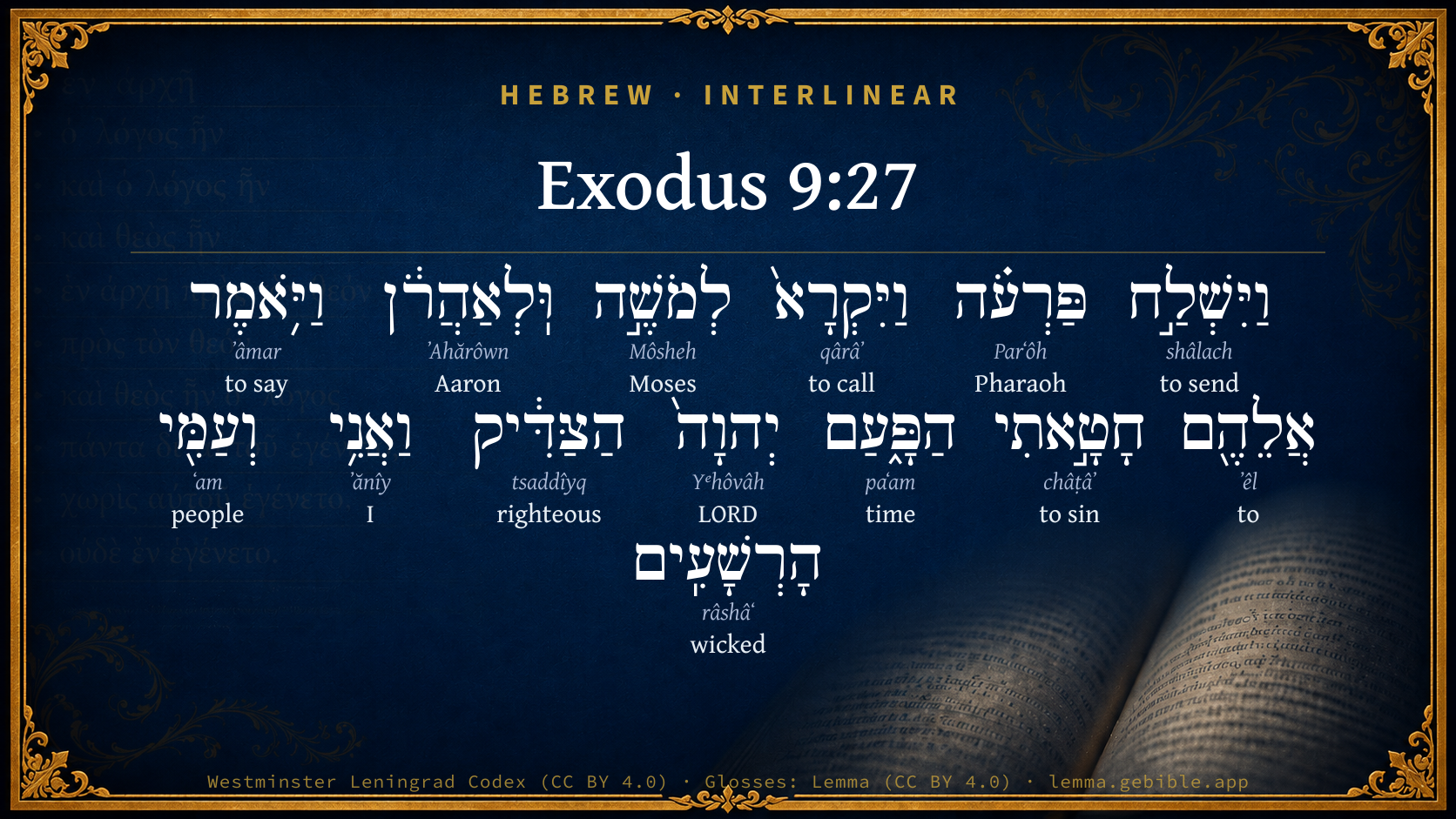
Exodus 9:27

Hebrew (Westminster Leningrad Codex) Exodus 9:27 appears in the Hebrew Old Testament. The text above is from the Westminster Leningrad Codex. Each word links to its Strong’s number, a concise gloss, and parsing drawn from the Open Scriptures Hebrew Bible morphology. Click any word for its full Brown-Driver-Briggs (BDB) entry.
Download image
Cite this verse

Exodus 9:27 (World English Bible). Public Domain. Lemma interlinear Bible study tool, https://lemma.gebible.app/v/exodus/9/27.

Show BibTeX & RIS
BibTeX
RIS
English Translation
Pharaoh sent, and called for Moses and Aaron, and said to them, "I have sinned this time. Yahweh is righteous, and I and my people are wicked.
World English Bible · Public Domain
Download a study sheet

One document with this verse’s original text, its word-by-word gloss line, the meaning frame, cross-references with their text, attributed commentary, and full source and license credits — printable, and it pastes into notes with its structure intact.

This verse Autodidact and up

Study sheet (.html) Plain text (.txt)

A passage Seminary Student

Up to 50 verses in one chapter. A passage sheet keeps up to 6 commentary sources and 12 cross-references per verse, in the order this page ranks them, and says so on the sheet whenever that leaves anything out. Ask for a single verse and you get the Autodidact verse sheet above.

Everything on this page stays free to read, with no account — the sheet is a download of what is already on screen, not access to it.

Want to remove ads? Support Godless Engineer
Compare translations 3

The same verse in 3 English versions, stacked beneath the original-language interlinear above. Click any original word for its lexicon entry.

Each is an independent rendering of the whole verse — the interlinear is not word-aligned to these translations.

Highlighted words mark where these versions differ — a whole-verse word diff, not a word-by-word alignment.

  • World English Bible Public Domain
    Pharaoh sent, and called for Moses and Aaron, and said to them, "I have sinned this time. Yahweh is righteous, and I and my people are wicked.
  • King James Version Public Domain
    And Pharaoh sent, and called for Moses and Aaron, and said unto them, I have sinned this time: the LORD is righteous, and I and my people are wicked.
  • unfoldingWord Literal Text CC BY-SA 4.0
    And Pharaoh sent, and he called for Moses and for Aaron. And he said to them, “I have sinned this time. Yahweh is righteous, and I and my people are guilty.

unfoldingWord Literal Text — © unfoldingWord, licensed CC BY-SA 4.0. Word-aligned USFM3 via Door43 (git.door43.org/unfoldingWord/en_ult).

Versions to compare (up to 4)

3 of 4 selected

Show all 18 translations

Every available English version of this verse, each an independent rendering of the whole verse.

  • World English Bible Public Domain
    Pharaoh sent, and called for Moses and Aaron, and said to them, "I have sinned this time. Yahweh is righteous, and I and my people are wicked.
  • Berean Standard Bible Public Domain
    Then Pharaoh summoned Moses and Aaron. “This time I have sinned,” he said. “The LORD is righteous, and I and my people are wicked.
  • Majority Standard Bible Public Domain
    Then Pharaoh summoned Moses and Aaron. “This time I have sinned,” he said. “The LORD is righteous, and I and my people are wicked.
  • King James Version Public Domain
    And Pharaoh sent, and called for Moses and Aaron, and said unto them, I have sinned this time: the LORD is righteous, and I and my people are wicked.
  • American Standard Version (1901) Public Domain
    And Pharaoh sent, and called for Moses and Aaron, and said unto them, I have sinned this time: Jehovah is righteous, and I and my people are wicked.
  • Revised Version (1885) Public Domain
    And Pharaoh sent, and called for Moses and Aaron, and said unto them, I have sinned this time: the LORD is righteous, and I and my people are wicked.
  • Geneva Bible (1599) Public Domain
    Then Pharaoh sent and called for Moses and Aaron, and said vnto them, I haue now sinned: the Lord is righteous, but I and my people are wicked.
  • Douay-Rheims (1899) Public Domain
    And Pharao sent and called Moses and Aaron, saying to them: I have sinned this time also; the Lord is just: I and my people are wicked.
  • Young's Literal Translation Public Domain
    And Pharaoh sendeth, and calleth for Moses and for Aaron, and saith unto them, `I have sinned this time, Jehovah `is' the Righteous, and I and my people `are' the Wicked,
  • Literal Standard Version CC BY-SA 4.0
    And Pharaoh sends, and calls for Moses and for Aaron, and says to them, “I have sinned this time—YHWH [is] the righteous, and I and my people [are] the wicked,
  • Unlocked Literal Bible CC BY-SA 4.0
    Then Pharaoh sent men to summon Moses and Aaron. He said to them, “I have sinned this time. Yahweh is righteous, and I and my people are wicked.
  • unfoldingWord Literal Text CC BY-SA 4.0
    And Pharaoh sent, and he called for Moses and for Aaron. And he said to them, “I have sinned this time. Yahweh is righteous, and I and my people are guilty.
  • Darby Bible Public Domain
    And Pharaoh sent, and called Moses and Aaron, and said to them, I have sinned this time: Jehovah is the righteous [one], but I and my people are the wicked [ones].
  • World Messianic Bible Public Domain
    Pharaoh sent and called for Moses and Aaron, and said to them, “I have sinned this time. The LORD is righteous, and I and my people are wicked.
  • Webster's Bible Public Domain
    And Pharaoh sent, and called for Moses and Aaron, and said to them, I have sinned this time: the LORD is righteous, and I and my people are wicked.
  • Free Bible Version CC BY-SA 4.0
    Pharaoh called for Moses and Aaron and told them, “I admit that I sinned this time! The Lord is right, and I and my people are wrong!
  • Bible in Basic English Public Domain
    Then Pharaoh sent for Moses and Aaron, and said to them, I have done evil this time: the Lord is upright, and I and my people are sinners.
  • JPS Tanakh (1917) Public Domain
    And Pharaoh sent, and called for Moses and Aaron, and said unto them: 'I have sinned this time; the LORD is righteous, and I and my people are wicked.

Literal Standard Version (2020), Covenant Press — licensed CC BY-SA 4.0. Text via the HelloAO Bible API (eBible.org). Unlocked Literal Bible (unfoldingWord) — licensed CC BY-SA 4.0. Text via the HelloAO Bible API (eBible.org). unfoldingWord Literal Text — © unfoldingWord, licensed CC BY-SA 4.0. Word-aligned USFM3 via Door43 (git.door43.org/unfoldingWord/en_ult). Free Bible Version, Dr. Jonathan Gallagher — licensed CC BY-SA 4.0. Text via the HelloAO Bible API (eBible.org).

Word by word

More ways to search: Search by grammar → Find every occurrence → Compare this word →

Practice this passage: Drill this verse → Learn its vocabulary →

הַפָּ֑עַם
paʻam
H6471
“the · time”
Particle, Definite Article + Noun, Common, Feminine, Singular, Absolute
Part of Speech
Particle + Noun
Type
Common
Gender
Feminine
Number
Singular
State
Absolute
Full BDB Definition

Origin: from H6470

TWOT: 1793a

stroke, beat, foot, step, anvil, occurrence - foot, hoof-beat, footfall, footstep - anvil - occurrence, time, stroke, beat - one time, once, twice, thrice, as time on time, at this repetition, this once, now at length, now...now, at one time...at another
  1. וַיִּשְׁלַ֣ח shâlach H7971 “and · to send” Conjunction + Verb, Qal, Sequential Imperfect, 3rd Person, Masculine, Singular
  2. פַּרְעֹ֗ה Parʻôh H6547 “Pharaoh” Noun, Proper
  3. וַיִּקְרָא֙ qârâʼ H7121 “and · to call” Conjunction + Verb, Qal, Sequential Imperfect, 3rd Person, Masculine, Singular
  4. לְמֹשֶׁ֣ה Môsheh H4872 “to/for · Moses” Preposition + Noun, Proper
  5. וּֽלְאַהֲרֹ֔ן ʼAhărôwn H175 “and · to/for · Aaron” Conjunction + Preposition + Noun, Proper
  6. וַיֹּ֥אמֶר ʼâmar H559 “and · to say” Conjunction + Verb, Qal, Sequential Imperfect, 3rd Person, Masculine, Singular
  7. אֲלֵהֶ֖ם ʼêl H413 “to · them” Preposition + Suffix, Personal, 3rd Person, Masculine, Plural
  8. חָטָ֣אתִי châṭâʼ H2398 “to sin” Verb, Qal, Perfect, 1st Person, Common, Singular
  9. יְהוָה֙ Yᵉhôvâh H3068 “LORD” Noun, Proper
  10. הַצַּדִּ֔יק tsaddîyq H6662 “the · righteous” Particle, Definite Article + Adjective, Adjective, Masculine, Singular, Absolute
  11. וַאֲנִ֥י ʼănîy H589 “and · I” Conjunction + Pronoun, Personal, 1st Person, Common, Singular
  12. וְעַמִּ֖י ʻam H5971 “and · people · my” Conjunction + Noun, Common, Masculine, Singular, Construct + Suffix, Personal, 1st Person, Common, Singular
  13. הָרְשָׁעִֽים râshâʻ H7563 “the · wicked” Particle, Definite Article + Adjective, Adjective, Masculine, Plural, Absolute

About this verse

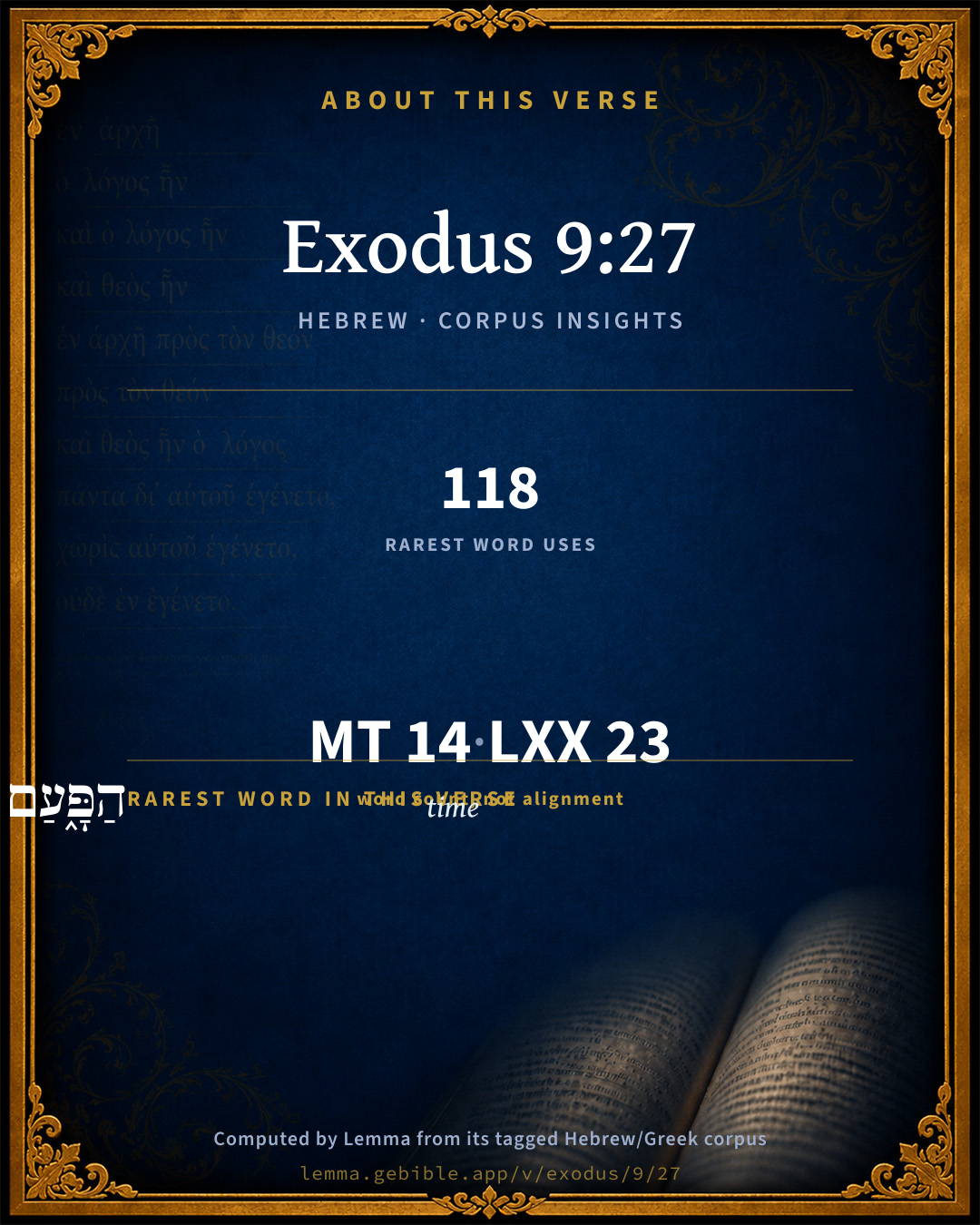
These counts appear in no published source. They are computed here, from the morphology-tagged text and Lemma’s own curated glosses. What Lemma adds →

14
words
14
distinct lemmas
Pentateuch
section

Grammatical profile

  • 4 verbs
  • 6 nouns
  • 2 adjectives
  • 1 pronoun
  • 1 preposition

Verb forms

  • וַיִּשְׁלַ֣ח Qal · Sequential Imperfect
  • וַיִּקְרָא֙ Qal · Sequential Imperfect
  • וַיֹּ֥אמֶר Qal · Sequential Imperfect
  • חָטָ֣אתִי Qal · Perfect

Hebrew & Septuagint length

In English translation the verse runs 27 words from the Hebrew and 28 from the Septuagint (LXX English) — closely comparable.

A rough comparison of the two English renderings, which tokenize alike — not a word-level alignment.

Word counts can differ between the Hebrew and the Greek without any difference in meaning — e.g. the Hebrew direct-object marker אֵת has no separate Greek word, and Greek often adds the article ὁ.

In the original languages it is 14 Hebrew tokens and 23 Greek tokens — but the two are counted differently (Hebrew bundles its prefixes and suffixes into one token; the Greek is in lemma form), so that isn’t a like-for-like length.

Cross-references

14

Topical passages linked to Exodus 9:27 in the Treasury of Scripture Knowledge — connected by theme and wording, ordered by reader-vote popularity; previews shown in the World English Bible.

  • Exodus 10:16 Then Pharaoh called for Moses and Aaron in haste, and he said, "I have sinned against Yahweh your God, and against you.
  • 2 Chronicles 12:6 Then the princes of Israel and the king humbled themselves; and they said, Yahweh is righteous.
  • Psalms 129:4 Yahweh is righteous. He has cut apart the cords of the wicked.
  • Lamentations 1:18 Yahweh is righteous; for I have rebelled against his commandment: Please hear all you peoples, and see my sorrow: My virgins and my young men are gone into captivity.
  • Psalms 145:17 Yahweh is righteous in all his ways, And gracious in all his works.
  • Numbers 22:34 Balaam said to the angel of Yahweh, I have sinned; for I didn't know that you stood in the way against me: now therefore, if it displease you, I will get me back again.
  • Daniel 9:14 Therefore has Yahweh watched over the evil, and brought it on us; for Yahweh our God is righteous in all his works which he does, and we have not obeyed his voice.
  • Matthew 27:4 saying, "I have sinned in that I betrayed innocent blood." But they said, "What is that to us? You see to it."
  • Romans 2:5 But according to your hardness and unrepentant heart you are treasuring up for yourself wrath in the day of wrath, revelation, and of the righteous judgment of God;
  • Romans 3:19 Now we know that whatever things the law says, it speaks to those who are under the law, that every mouth may be closed, and all the world may be brought under the judgment of God.
  • 1 Samuel 15:24 Saul said to Samuel, I have sinned; for I have transgressed the commandment of Yahweh, and your words, because I feared the people, and obeyed their voice.
  • 1 Samuel 26:21 Then said Saul, I have sinned: return, my son David; for I will no more do you harm, because my life was precious in your eyes this day: behold, I have played the fool, and have erred exceedingly.
  • Psalms 9:16 Yahweh has made himself known. He has executed judgment. The wicked is snared by the work of his own hands. Meditation. Selah.
  • 1 Samuel 15:30 Then he said, I have sinned: yet honor me now, Please, before the elders of my people, and before Israel, and turn again with me, that I may worship Yahweh your God.

Cross-references courtesy of OpenBible.info (CC BY 4.0).

Hebrew and Greek witnesses Masoretic Hebrew ↔ Greek Septuagint

The same verse in the two great witnesses to the Old Testament, shown verse-for-verse.

These are two independent witnesses, not word-aligned to each other, and the Septuagint is shown in lemma (dictionary) form.

Hebrew Exodus 9:27 Masoretic · Westminster Leningrad Codex

וַיִּשְׁלַ֣ח פַּרְעֹ֗ה וַיִּקְרָא֙ לְמֹשֶׁ֣ה וּֽלְאַהֲרֹ֔ן וַיֹּ֥אמֶר אֲלֵהֶ֖ם חָטָ֣אתִי הַפָּ֑עַם יְהוָה֙ הַצַּדִּ֔יק וַאֲנִ֥י וְעַמִּ֖י הָרְשָׁעִֽים

Pharaoh sent, and called for Moses and Aaron, and said to them, "I have sinned this time. Yahweh is righteous, and I and my people are wicked.

World English Bible · Public Domain

Greek LXX Exodus 9:27 Septuagint · lemma form

ἀποστέλλω δέ φαραώ καλέω μωυσῆς καί ααρων καί εἶπον αὐτός ἁμαρτάνω ὁ νῦν ὁ κύριος δίκαιος ἐγώ δέ καί ὁ λαός ἐγώ ἀσεβής

And Pharao sent and called Moses and Aaron, and said to them, I have sinned this time: the Lord is righteous, and I and my people are wicked.

LXX2012 (modern English Septuagint) · Public Domain

Hebrew: Westminster Leningrad Codex (CC BY 4.0). Greek: Septuagint (public domain); English from LXX2012 (modern English Septuagint) (Public Domain). How the Septuagint differs from the Hebrew →

Targum (Aramaic paraphrase)

2

The Targum is the ancient Jewish Aramaic paraphrase of the Hebrew Scriptures — an interpretive translation, not the Hebrew text itself. Onkelos (literal) and Pseudo-Jonathan (expansive) render the Torah, and Jonathan the Prophets. Coverage is partial: where no permissively-licensed English translation exists for a verse, only the Aramaic is shown. This is verse-level text, not a word-by-word alignment to the Hebrew.

  1. Targum Onkelos Torah (Genesis–Deuteronomy)
    וּשְׁלַח פַּרְעֹה וּקְרָא לְמשֶׁה וּלְאַהֲרֹן וַאֲמַר לְהוֹן חָבִית זִמְנָא הָדָא יְיָ זַכָּאָה וַאֲנָא וְעַמִי חַיָבִין:

    (no public-domain English translation for this verse)

    Targum Onkelos — Aramaic: “Onkelos Genesis” (public domain); “Onkelos Exodus” (public domain); “Onkelos Leviticus” (public domain); “Onkelos Numbers” (public domain); “Onkelos Deuteronomy” (public domain). English: “Sefaria Community Translation” (CC0 1.0 (public-domain dedication)); “J.W. Etheridge. The Targums of Onkelos and Jonathan Ben Uzziel on the Pentateuch. London: Longmans, Green, 1862” (public domain). Text via Sefaria.

  2. Targum Pseudo-Jonathan Torah (Genesis–Deuteronomy)
    וְשַׁדַר פַּרְעה פּוּלִין לְמִקְרֵי לְמשֶׁה וּלְאַהֲרן וַאֲמַר לְהוֹן חָבִית בְּזִמְנָא הָדָא יְדָעִית דַיְיָ הוּא אֱלָהָא זַכָּאָה וּבְרַם אֲנָא וְעַמִי חַיָיבִין בְּכָל מַחְתָא וּמַחְתָא

    And Pharoh sent certain to call Mosheh and Aharon; and he said to them, This time I have sinned. I know that the Lord is a righteous God, and that I and my people have deserved every one of these plagues.

    Targum Pseudo-Jonathan — Aramaic: “Targum Jonathan on Genesis” (public domain); “Targum Jonathan on Exodus” (public domain); “Targum Jonathan on Leviticus” (public domain); “Targum Jonathan on Numbers” (public domain); “Targum Jonathan on Deuteronomy” (public domain). English: “The Targum of Jonathan ben Uzziel, trans. J. W. Etheridge, London, 1862” (public domain). Text via Sefaria.

Commentary

Notes on Exodus 9:27 from classic Christian and Jewish commentators (each source and its license shown beneath its notes). The classic Christian expositions comment on the surrounding passage and are grouped to its opening verse, so a note may address several verses; the Jewish commentaries on the Tanakh (Rashi and others) are per-verse, so they appear only where the commentator wrote on this verse.

Lemma curates 59 commentaries, every one of them public domain or Creative Commons licensed, each selected and text-cleaned for this edition rather than reprinted as found. About our sources →

Trapp's Complete Commentary

John Trapp

Exo 9:27 And Pharaoh sent, and called for Moses and Aaron, and said unto them, I have sinned this time: the LORD [is] righteous, and I and my people [are] wicked.

Ver. 27. The Lord is righteous.] {See Trapp on "Exo 5:2"}

John Trapp, A Commentary or Exposition upon All the Books of the Old and New Testament (1647–1656) — public domain. Text from a community e-Sword module.

The Biblical Illustrator

Joseph S. Exell

Exo_9:27-28

I have sinned.

Pharaohs I have sinned

There are no more beautiful words ever spoken on this earth--none to which an angel listens more complacently--none which wing their way more surely to heaven--none which more surely enter into the ears of the Lord God of Sabaoth--than those three--so personal, so true, so simple, and so full, I have sinned. They occur nine times in the Bible; and of the nine we may except two. For where they stand--in the seventh chapter of Micah--they are the language, not of an individual, but of a Church. And the prodigals use of them is, of course, not matter of fact or history; but only part of a parable. There remain, therefore, seven; seven persons of whom it is written that they said, I have sinned. Ii may surprise some of you to know that, of those seven, four are utterly hollow and worthless; in Gods scales, wanting, unreal, and unprofitable. It is a humbling and teaching fact that in three only--of the seven instances in which persons are recorded in the Scriptures to have said, I have sinned, was the confession true, and the repentance valid.

I. At what time Gods hardening of Pharaohs heart began, it is impossible exactly to determine. But evidently from the first it was judicial. A common story. A sin indulged till the man is given over to his sin; and then the sin made its own punishment. It is not that if you repent you would not be forgiven; but it is that you reduce your heart to such a state that it places repentance out of your reach. You become like Esau. Esau, after he sold his birthright, never repented, nor wished to repent. He wished his father to repent, though he himself did not repent. Pharaoh could say, I have sinned, and never felt it,--because his heart was hard. Many of you are very young, and you have tender hearts. Take care; take care of that dew of your spiritual birth-lest it be brushed away! If you love the world, you will be hardened. You say, I will repent of my worldliness. You cannot. Your worldliness will have left you too hard to repent.

II. What, then, was pharaohs I have sinned? Where did it tend?

1. It Was a mere hasty impulse. There was no thought in it; no careful dealing with his own soul; no depth.

2. The moving principle was nothing but fear. He was agitated--greatly agitated--only agitated. Now, fear may be, and probably must be, a part of real repentance. I do not despise fear. Fear is a sign of penitence. Fear is a very good thing. But I doubt whether there was ever a real repentance that was promoted by fear only.

3. Pharaohs thoughts were directed far too much to man. It was not the against Thee, Thee only, I have sinned. He never went straight to God. Hence his confession was not thorough.

III. And here comes the solemn thought--for comfort or for fear--in everything that is true, there is a germ, and God sees and recognizes, at once, the germ. It may not have expanded. Perhaps the person--who has it--may not live long enough for it to be expanded in this world. But God knows that it can expand, and that it would expand. God judges by that germ. If it is not--that germ of love and holiness--the rest all goes for nothing. But if it be there--God accepts all for that germ. (J. Vaughan, M. A.)

The transient repentance of a wicked soul

I. That moods of transient repentance are sometimes awakened by the retributive judgments of God. The penitence of the hypocrite; not a godly sorrow. Induced by the infliction of punishment, rather than by the gentle convictions of the Divine Spirit. True repentance will have reference to God and to the violated law, rather than to self-comfort and immunity from pain.

II. That in moods of transient repentance men call for the ministers of God whom they have previously despised. Ministers must be forbearing toward their people, and embrace any opportunity of leading them to the mercy of God. But the repentance that sends for the minister under the impulse of fear, will be likely to dismiss him when the plague is removed. It is well to heed the voice of the servants of God before the hoar of retribution.

III. That in moods of transient repentance men make promises they will never perform. We should remember in joy the vows made in sorrow, in health, those made in sickness, and then painful discipline will become happy and glorious.

IV. That in moods of transient repentance men will acknowledge that prayer to God for mercy is their only method of help.

V. That in moods of transient repentance men sometimes obtain the removal of the judgments of God. Token of mercy. Discipline of love to lead to duty. Lessons:--

1. That trials are calculated to lead the soul to repentance.

2. That under trials the repentance of men may be transient.

3. That the mercy of God is rich to the proudest sinner.

4. That the servants of God should be helpful to penitent souls.

(1) By fidelity.

(2) By sympathy.

(3) By prayer. (J. S. Exell, M. A.)

Repentance inspired by fear

I. That repentance inspired by fear is experienced by men of the proudest moral character. This shows the all-conquering power of the truth, in that it can subdue the tyrant-heart. It also shows the mercy of God, in that the most degenerate life is blessed with the refreshing mood of repentance. No heart is utterly destitute of better feelings.

II. That repentance inspired by fear anxiously seeks the aid of the servants of God.

III. That repentance inspired by fear is just in its condemnation of self, and in its acknowledgment of sin. There are times when confession is a necessity of the soul. When sin is as a fire, which must burn through all subterfuges and manifest itself to the public eye. Hence open confession of sin is not an infallible token of repentance; it may be the outcome of necessity or of terror.

IV. That repentance inspired by fear is just in its vindication of the divine character. Repentance is not to be gauged by the utterance of the lips.

V. That repentance inspired by fear promises future obedience to the claims of God. (J. S. Exell, M. A.)

Repentings and relapsings

I. The theistic constitution of the soul.

1. It shots a primitive belief in the existence of God.

2. It shows a primitive belief in the providential government of God.

II. The unnaturalness of our spiritual existence.

III. The unreliableness of deathbed confessions. Genuine repentance for sin is not the fear of misery, but the relentings of love.

IV. The supreme interest of every man. (Homilist.)

Sense of guilt

I. Under its influence man feels humbled.

II. Under its influence man respects godliness.

III. Under its influence man vindicates the almighty. (Homilist.)

I have sinned

1. A good confession.

2. A simple confession.

3. A faithful confession.

4. A welcome confession.

5. Sometimes an unreal confession. (J. S. Exell, M. A.)

The Lord is righteous

1. Then admire His administration.

2. Then worship His glory.

3. Then fear His justice.

4. Then vindicate His operations.

5. Then make known His praise. (J. S. Exell, M. A.)

A wicked people and a wicked monarch

1. Sad.

2. Afflicted.

3. Repentant. (J. S. Exell, M. A.)

Intreat the Lord

1. For He hears prayer.

2. For He has respect to the good.

3. For wicked men need Divine help.

4. For He is merciful. (J. S. Exell, M. A.)

The confession of Pharaoh

I. The resemblance of the confession before us to the language of true contrition, is close.

1. It was open, made not to a partizan or friend in the secrecy of retirement, but to Moses and Aaron in public; to the very man whose presence was likely to fill the sinner with the greatest shame, and to require of him the most mortifying concessions.

2. It was accompanied also with a sense of guilt, and that not confined to one transgression only, but extending to the general conduct of himself and his subjects.

3. It is remarkable too that, like David, he considered his guilt as an offence against God.

4. But this was not all. The confession of Pharaoh included in it an acknowledgment of the justice of God in inflicting these judgments. They were great and heavy, but he does not complain of their severity. He complains only of his own sins, which had so justly drawn them on his head. The Lord, he says, is righteous, and I and my people are wicked.

5. There were also some good resolutions connected with the confession of Pharaoh.

II. Pharaoh was not a penitent, though he bore so strong a resemblance to one. His confession was sincere, but it was not godly. It resembled the language of true repentance, but at the same time it differed essentially from it.

1. In attempting to trace this difference, we may observe that it was a forced confession, extorted from him by the suffering he endured, and the fear of still heavier judgments. The point to be ascertained is not what kind of men we are in affliction or in sickness, in the house of God or in the society of His servants; but what is the frame of our minds when these excitements are withdrawn? What are we in retirement? What are we in our families? What are we in daily intercourse with the world?

2. The confession of Pharaoh differed from true confession in this respect also--it was unaccompanied with humiliation before God. He repeatedly besought Moses and Aaron to entreat for him, but he disdained to bend the knee himself. He trembled at the judgments of the Lord, but though they laid waste his country and cut off his first-born, he still refused to humble himself before Him. This spirit of independence is the bane and curse of our fallen nature. The very essence of our depravity consists in it. We will not have God to reign over us. Judgments can terrify, but they cannot humble us.

3. The confession of Pharaoh was defective also in another respect--it was not succeeded by an entire renunciation of sin. The true penitent does not ask, How far may I indulge my lusts, and yet be safe? How much love may I have for the world and yet escape condemnation? but, What right hand have I yet to cut off? What right eye have I yet to pluck out? What lurking sin still remains to be discovered and overcome?

4. But even if the confession of Pharaoh had not been defective in these things, there was yet another point of difference between it and a genuine confession, and that a most important and ruinous difference--it was not habitual and lasting. The convictions from which it sprung were as temporary as the judgments which gave rise to them, so that he who feared and trembled one hour, hardened his heart the next. Repentance is not an act, it is a habit; not a duty to be performed once in a mans life, and then to be thought of no more; it is to be our daily work, our hourly employment.

III. Such was the confession of Pharaoh. The lessons it teaches are obvious.

1. It shows us, first, the great need we have of self-examination. We may have confessed our sins from our heart; but has that heart been humbled, lowly, obedient? Instead of going about to establish our own righteousness, are we submitting ourselves to the righteousness of God? Are we praying, as well as trembling?

2. This shows us also the extreme depravity of the human heart. We need the transforming power, the effectual working, of the Holy Ghost. We must seek repentance as a gift of mercy at the throne of God.

3. We may see, further, the folly of trusting in convictions. Remorse is not penitence. Conviction is not conversion. Fear is not grace.

4. But while we are reminded of the folly of trusting in convictions, we are at the same time taught the guilt and danger of stifling them. They cannot save the soul, but they are designed to make us feel our need of salvation, and to lead us for it to the great Saviour of the lost.

5. There is yet another lesson to be learned from this subject. It seems indeed, on the first view, to speak to us only of the depravity of man and the awful justice of God, but to what subject of meditation can we turn, which does not remind us of the Divine mercy? A hardened Pharaoh, as well as a weeping Peter, declares to us, that the guilty will never seek pardon in vain. (C. Bradley, M. A.)

The Biblical Illustrator, edited by Joseph S. Exell (c. 1880s–1900s) — public domain. Text from a community e-Sword module.

Joseph Benson's Commentary

Exo 9:27. Pharaoh said, I have sinned; the Lord is righteous — These, professions were only produced by his fears: his heart was still untouched with any true veneration for, or humiliation before, the God of Israel, or with compunction and sorrow for his own obstinacy.

Joseph Benson's Commentary on the Old and New Testaments (1811–1818) — public domain. Text from a community e-Sword module.

The Preacher's Complete Homiletical Commentary

Joseph S. Exell (gen. ed.)

MAIN HOMILETICS OF THE PARAGRAPH.—Exo_9:27-28

REPENTANCE INSPIRED BY FEAR

We now see Pharaoh as a penitent. The proud King is humbled. He confesses his sin. He resolves to amend his conduct. He sends for the ministers of the truth. We have seen him in this mood before, and we thought that it was a hopeful token. But the repentance then manifested passed away with the pain that awakened it. How frequently do moods of repentance come upon the soul, but how soon are they over, and leave no lasting benediction behind. God awakens men to repentance by varied agencies. Sometimes by the stroke of retribution, and sometimes by the look of love and compassion; men who repent under the influence of fear are very likely to relapse into sin when the fear has passed away. We have an instance of this in the incident before us.

I. That repentance inspired by fear is experienced by men of the proudest moral character. Pharaoh, the proud monarch of Egypt, was overtaken by the repentance of terror. He was the last man we should have expected to find in such a condition. He is haughty, he will not submit to God. He is bold, he will withstand the Divine message and plague. But no, he is suppliant before the servants of God. And so it is, the worst men, the most stubborn, the proudest and the most unlikely, are sometimes rendered penitent by the discipline of life, and by the corrective judgments of God. This shows the all-conquering power of the truth, in that it can subdue the tyrant-heart. It also shows the mercy of God, in that the most degenerate life is blessed with the refreshing mood of repentance. No heart is utterly destitute of better feelings. The worst men are often on the borders of a new life, but even then they are not beyond the reach of Satan. Bad men are capable of good emotions, and of open confessions, which seem well, but which are the outcome of unhallowed motive.

II. That repentance inspired by fear anxiously seeks the aid of the servants of God. Here we have the great King of Egypt sending for Moses and Aaron the despised servants of God. Moses and Aaron have no social accidents to commend them to Pharaoh, but they are known to be the servants of heaven, and that is their recommendation to him. When men are in moods of repentance they are glad to find the poorest child of God, and to obtain any help he can render. Deep repentance is oblivious of social distinctions, and looks only at moral qualifications. When wicked men are in trouble they generally send for good men to help them out of it, and thus render an unconscious homage to the worth of piety. But it not unfrequently happens that the servants of God are called to aid a repentance inspired by fear of pain rather than by a conviction of sin. At such times they need true wisdom and fidelity.

III. That repentance inspired by fear is just in its condemnation of self, and in its acknowledgment of sin. “I have sinned this time.” Thus we find that Pharaoh made an open acknowledgment of his sin. This was right. This was humiliating as it was made to men whom he had previously despised. Here is some token of a right spirit. And wicked men in the agony of repentance, under pain and calamity, often confess their wrong doing. They are prompted to do so by the sheer force of conscience, they hope by such a confession to appease the anger of God, and to avert the calamity under which they suffer. There are times when confession is a necessity of the soul. When sin is as a fire, which must burn through all subterfuges and manifest itself to the public eye. Hence open confession of sin is not an infallible token of repentance; it may be the outcome of necessity or of terror.

IV.—That repentance inspired by fear is just in its vindication of the Divine character. “The Lord is righteous.” This was the acknowledgment of Pharaoh; and certainly it appears strange language for him to utter, as he had but poor notions of righteousness, and but little inclination a short time ago to predicate it of Jehovah. But wicked men, in moments of repentance are loud in their talk about the rectitude of the Almighty. But the words spoken at such a time are deeper than the heart imagines. To a truly penitent soul the righteousness of God is the supreme thought. His law appears righteous. His government is righteous. The soul is unrighteous and is consequently opposed to God. It is possible for wicked men in moments of repentance, inspired by fear, to utter beautiful words about the great God, and about sublime truth without any adequate conception of their meaning. Repentance is not to be gauged by the utterance of the lips.

V. That repentance inspired by fear promises future obedience to the claims of God. “And I will let you go.” Thus Pharaoh promises to submit to the command of God in reference to the freedom of Israel. This was the outcome of self-conflict, wicked men do not like to give up their sins. It is not easy for them. But in moods of repentance inspired by fear they promise future attention to the word of God. Fair promises are not infallible tokens of repentance.

VI. That repentance inspired by fear is much more anxious for the removal of a calamity than for the removal of sin. “Intreat the Lord (for it is enough) that there be no more mighty thunderings and hail.” And thus we see that Pharaoh was much more anxious that the temporal perils by which he was afflicted should be removed, than that his sin and guilt should be pardoned. And so it is ever with those whose repentance is inspired by fear. They seek not Jesus. They seek exemption from pain. True repentance is not generated by thunder and hail. It is produced by the gentle dew of the Spirit of God. LESSONS:

1. How difficult to tell true repentance from false.

2. How wicked men are humbled by the power of God.

3. How promises of amendment are broken by the sinner.

SUGGESTIVE COMMENTS ON THE VERSES

Exo_9:27-28. God’s discriminating vengeance considered makes the vilest sinners seek help.

The most cruel persecutors are sometimes obliged to call in the persecuted for their helpers.

Justification of God is wrested out of the mouths of His bitterest enemies.

Prayers from the righteous to God may be desired by the wicked in their difficulties.

The liberty of the Church will be granted when God oppresses the oppressor.

“I have sinned”:—

1. A good confession.

2. A simple confession.

3. A faithful confession.

4. A welcome confession.

5. Sometimes an unreal confession.

“The Lord is righteous”:—

1. Then admire His administration.

2. Then worship His glory.

3. Then fear His justice.

4. Then vindicate His operations.

5. Then make known His praise.

A wicked people and a wicked monarch:—

1. Sad.

2. Afflicted.

3. Repentant.

“Intreat the Lord”:—

1. For He hears prayer.

2. For He has respect to the good.

3. For wicked men need Divine help.

4. For He is merciful.

ILLUSTRATIONS

BY

REV. WM. ADAMSON

Retraction! Exo_9:28. A great prince once had a sick son. He was the only child—a Benoni—the offspring of his father’s sorrow, for his beautiful queen had died in giving birth to his royal heir. When the physicians from all parts pronounced the child’s recovery hopeless, the stricken father found refuge in a solemn vow, that if God spared the babe’s life, he would present a magnificent golden chalice adorned and filled with dazzling diamonds to the neighbouring church. Gradually day by day, the son gained strength—in spite of the medical testimony of hopelessness, and by the time the presentation-cup arrived from the goldsmith, there was no longer danger. But the gift was too costly—with its rare engraving and its glittering gems; so that the father had another of an inferior character made and presented. No doubt his vow was so far sincere at the outset; and probably that of Pharaoh was equally so: “I will let you go.” But the pressure over, the man died. As Matthew Henry says, there was a mighty struggle between Pharaoh’s convictions and corruptions. His convictions said; Let them go. His corruptions said: Not very far away. But he sided with his corruptions, and decided not to let Israel go.

“Said I not so—that I would sin no more?

Witness my God I did;

Yet I am run again upon the score.”

—Herbert.

The Preacher's Complete Homiletical Commentary (gen. ed. Joseph S. Exell; Funk & Wagnalls, c. 1892) — public domain (pre-1929). A full-Bible homiletical/sermon-outline anthology covering 65 of 66 books (2 John is absent from the source module). Text from a community e-Sword module.

Tyndale Open Study Notes

Tyndale Open Resources

9:27 Pharaoh was driven to a logical conclusion. In the face of such clear evidence to the contrary, pride was not merely a failure, it was a sin.

Tyndale Open Study Notes — © Tyndale Open Resources, licensed CC BY-SA 4.0. Text via the HelloAO Bible API.

Geneva Bible (1599)

Geneva Bible translators

The wicked confess their sins to their condemnation, but they cannot believe to obtain remission.

Geneva Bible (1599) marginal notes — public domain. Text via Bolls.life.

Jamieson, Fausset & Brown

Robert Jamieson, A. R. Fausset & David Brown

Pharaoh sent, and called for Moses and Aaron, and said unto them, I have sinned--This awful display of divine displeasure did seriously impress the mind of Pharaoh, and, under the weight of his convictions, he humbles himself to confess he has done wrong in opposing the divine will. At the same time he calls for Moses to intercede for cessation of the calamity. Moses accedes to his earnest wishes, and this most awful visitation ended. But his repentance proved a transient feeling, and his obduracy soon became as great as before.

Jamieson, Fausset & Brown — Commentary Critical and Explanatory on the Whole Bible (1871) — public domain (CC PDM 1.0). Text via the HelloAO Bible API.

Adam Clarke's Commentary

Verse 27. The Lord is righteous, and I and my people are wicked.] The original is very emphatic: The Lord is THE RIGHTEOUS ONE, (הצדיק hatstaddik), and I and my people are THE SINNERS, (הרשעים hareshaim); i.e., He is alone righteous, and we alone are transgressors. Who could have imagined that after such an acknowledgment and confession, Pharaoh should have again hardened his heart?

Adam Clarke's Commentary on the Bible (1810–1826) — public domain. Text from a community e-Sword/MySword module.

Ellicott's Commentary for English Readers

(27) Pharaoh sent.—It is evident that the Pharaoh was more impressed by this plague than by any preceding one. This may have been partly because it caused destruction of human life, partly on account of its extraordinary and awful character. It must be borne in mind that the storm was still continuing, and gave no sign of coming to a natural end (Exo_9:29; Exo_9:33).

I have sinned this time—i.e., This time I confess that I have sinned in resisting Jehovah; I do not any more maintain that I have acted right.

The Lord is righteous.—Heb., Jehovah is the Just One—a form of speech implying that Jehovah, and He alone, was just.

Wicked.—Heb., the sinners. “I and my people” stand in contrast with God and His people. Previously Pharaoh had denounced the Israelites as idlers and hypocrites (Exo_5:8; Exo_5:17); now he admits that it is only he and his people that are to blame. The confession is satisfactory, except in so far as it divides between Pharaoh and the Egyptians the blame which was almost wholly his.

A Bible Commentary for English Readers, edited by Charles John Ellicott (1878–1897) — public domain. Text from a community e-Sword module.

The Cambridge Bible for Schools and Colleges

gen. ed. J. J. S. Perowne

27. The Pharaoh this time, impressed, it may be supposed, by the spectacle of the storm, confesses his fault, as he has never done before. His penitence, however, as the sequel shews, is not very deep.

I have sinned] Exo_10:16.

righteous … wicked] rather, the (with the art.) one in the right … those in the wrong. The words are used not in their ethical, but in their forensic sense, as Exo_2:13 (where ‘him that did the wrong’ is lit. the wicked one), Deu_25:1.

27–33. The Pharaoh craves a third time (see Exo_8:8; Exo_8:28) for a cessation of the plague.

The Cambridge Bible for Schools and Colleges (gen. ed. J. J. S. Perowne; Cambridge University Press, 1878–1918) — public domain. Text from a community e-Sword module.

John Gill's Exposition

Entreat the Lord, for it is enough,.... Hail, thunder, and lightning enough; or pray that this may be enough, and thought sufficient, and that there may be no more; or "entreat the Lord, and much" (l); pray, and pray much, pray earnestly and without intermission until the plague ceases:

that there be no more mighty thunderings and hail; or "voices of God" (m); for thunder is the voice of God, and these thunderings or voices were very loud, the claps were very terrible to hear, and the hail was very grievous and heavy, and the whole was very amazing and frightful, and the more to Pharaoh, who perhaps had never heard the voice of thunder, or seen an hail storm before, even a common one, these being rare in the land of Egypt:

and I will let you go, and ye shall stay no longer; go the three days' journey into the wilderness, directly and immediately; he would not put it off, on any account, and much less refuse to let them go at all, as he had often done.

(l) "orate multam", Rivet. (m) "voces Dei", Montanus, Drusius.

John Gill's Exposition of the Whole Bible (1746–1763) — public domain (CC PDM 1.0). Text via the HelloAO Bible API.

Matthew Poole's English Annotations

I now plainly see and freely acknowledge my sin in striving with God. He seems not to deny that he had sinned before, for even the light of nature would discover his sin, in breaking his faith, and the word of a King given to Moses for Israel’s dismission.

Matthew Poole's English Annotations on the Holy Bible (1683–1685) — public domain. Text from a community e-Sword/MySword module.

Whedon's Commentary on the Bible

Daniel D. Whedon

27. I have sinned this time — Now I see and own my sin. For the first time Pharaoh confesses sin, and attests the righteousness of Jehovah, but it is simply a lip acknowledgment. He owns the weight of God’s hand rather than the righteousness of his commandments. Pain can reveal that law is violated, but it cannot convert, cannot make penitent, the heart that chooses to rebel.

Daniel D. Whedon (gen. ed.), Commentary on the Old and New Testaments (1874–1909) — public domain. Text from a community e-Sword module.

The Pulpit Commentary

Vers. 27-35. The plague of hail impressed the Pharaoh more than any previous one. It was the first which had inflicted death on men. It was a most striking and terrible manifestation. It was quite unlike anything which the Egyptians had ever experienced before (vers. 18, 24). It was, by manifest miracle, made to fall on the Egyptians only (ver. 26). Pharaoh was therefore more humbled than ever previously. He acknowledged that he "had sinned" (ver. 27); he added a confession that "Jehovah alone was righteous, he and his people wicked" (ibid. ). And, as twice before, he expressed his willingness to let the Israelites take their departure if the plague were removed (ver. 28). The ultimate results, however, were not any better than before. No sooner had Moses prayed to God, and procured the cessation of the plague, than the king repented of his repentance, "hardened his heart;" and, once more casting his promise to the winds, refused to permit the Israelites to depart (vers. 33-35). His people joined him in this act of obduracy (ver. 34), perhaps thinking that they had now suffered the worst that could befall them.

And Pharaoh sent. Compare Exo_8:8, Exo_8:25-28. Pharaoh had been driven to entreat only twice before. I have sinned this time. The meaning is, "I acknowledge this time that I have sinned" (Kaliseh, Cook). "I do not any longer maintain that my conduct has been right." The confession is made for the first time, and seems to have been extorted by the terrible nature of the plague, which, instead of passing off, like most storms, continued. The Lord is righteous, etc. Literally, "Jehovah is the Just One; and I and my people are the sinners." The confession seems, at first sight, ample and satisfactory; but there is perhaps some shifting of sin, that was all his own, upon the Egyptian people," which indicates disingenuousness.

Vers. 27-30. The mock repentance of a half-awakened sinner counterfeits the true, but has features by which it may be known.

It is not always easy to distinguish between a true and a mock repentance. Here was the Pharaoh at this time very visibly it might have seemed deeply impressed. He was disquieted he was alarmed he was ready to humble himself to make confession to promise obedience in the future. In what did his repentance differ from true, godly penitence? What points did it possess in common with such penitence? What points did it lack?

I IT POSSESSED THE FEATURE OF SELF-HUMILIATION. "I have sinned this time I and my people are wicked." Confession of sin is a very important point in true penitence. There can be no true penitence without it. "I said, I will Confess my sin unto the Lord, and so thou forgavest the wickedness of my sin". (Psa_32:5) But it may be made, under a sort of compulsion, as a necessity, without the rightful feeling of contrition, or sorrow for sin, out of which it should spring, and apart from which it is valueless. We may doubt whether Pharaoh"s confession sprang from a true, contrite heart. There was a ring of insincerity in it. "I, and my people," he said, "are wicked." True penitence leads us to confess our own sins, not those of others. There was no occasion for introducing the mention of his people"s sins, and, as it were, merging his own in theirs. The people had not been appealed to, in order that they might say whether the Israelites should be allowed to depart or not. They had no doubt many sins of their own to answer for; but they had had no part in this particular sin. There is a covert self-justification in the introduction of the words "and my people," as if the national sentiment had been too strong for him, and he had only "refused to let Israel go" in consequence of it.

II IT POSSESSED THE FEATURE OF VINDICATING GOD"S HONOUR. "The Lord is righteous," or "Jehovah is the righteous one," was such a full and frank acknowledgment of the perfect justice and righteousness of God as the heart of man does not very readily make, unless.in moments of exaltation. We need not suppose that the monarch was insincere in his utterance. He was temporarily lifted up out of himself so impressed with the power and greatness of Jehovah, that he had forthe time true thoughts and high thoughts concerning him. He had doubtless a very insufficient feeling or appreciation of the awful purity and holiness of God; but he did feel his justice. He knew in his inmost heart that he had deserved the judgments sent upon him, and meant to acknowledge this. He was willing that God should be "justified in his sayings, and overcome when He was judged". (Rom_3:4) He may not have had an adequate sense of the full meaning of his own words, but he had some sense of their meaning, and did not merely repeat, parrot-like, phrases from a ritual.

III IT POSSESSED THE FEATURES OF SELF-DISTRUST AND OF APPEAL TO THE MINISTERS OF GOD FOR AID. Pharaoh "sent and called for Moses and Aaron." Not very long before, he had dismissed them from his presence as impertinent intruders, with the words, "Get you to your burdens". (Exo_5:4) Now he appeals to them for succour. He asks their prayers for me." Such appeals are constantly made, both by the true and by the mock penitent. Reliance on self disappears. God"s ministers take their due place as ambassadors for him and stewards of his mysteries. They are asked to intercede for the sinner, to frame a prayer for him, and offer it on his behalf. All this is fitting under the circumstances; for lips long unaccustomed to prayer cannot at once offer it acceptably, and intercessory prayer is especially valuable at the time when the half-awakened soul feels a yearning towards God, to which, if unassisted, it is unable to give effect.

IV IT POSSESSED THE FEATURE OF MAKING PROMISE OF AMENDMENT. "I will let you go." Let but his prayer be granted, let but the plague be removed, and the king promises that all his opposition to the will of Jehovah shall cease the children of Israel shall be "let go," they shall not be detained any longer. Amendment of life is the crown and apex of repentance, and is rightly first resolved upon, then professed, finally practised by the true penitent. But profession alone is no criterion of the nature of the repentance. The sole certain criterion is the result. If the resolutions made are kept, if the profession is carried out in act, then the repentance is proved to have been genuine; if the reverse is the case, then it was spurious. The event, however, can alone show how the case stands. Meanwhile, as we must "judge nothing before the time," it would seem to be best that in every case a professed repentance should be treated as real when it is put forward, whatever suspicions may be entertained respecting it. No harm is done by treating a mock penitent as if he were a real one. Great harm might be done by a mistaken rejection of a true penitent.

V IT LACKED, HOWEVER, THE FEATURE OF INTENSE HATRED OF SIN. The sinner who truly repents desires above all things the pardon and removal of his sin. He cares little, comparatively, for the removal of its chastisement. Sin, which separates him from God, is the great object of his abhorrence; and when he asks the prayers of ministers or other pious persons, he requests them to intercede for him, that he may find pardon and cleansing, may have his past sins forgiven, and strength granted him to forsake sin in the future. When Pharaoh, instead of such a prayer as this, asked for nothing but the removal of the temporal evil which had been sent upon him as a punishment, it was easy for one experienced in the words of man to see that his was not a real, genuine repentance. And this Moses seems to have perceived. "As for thee and thy servants," he said to the king, "I know that ye will not yet fear the Lord God." I know that the fear which now fills your hearts is not the true fear of God not a dread of his displeasure, but of the pains and sufferings that he can inflict. I know that what you seek is not reconcilement with God, but exemption from calamity. You are driven upon your course by alarm and terror, not drawn by love. I know that when the affliction is removed you will relapse into your former condition. Some more terrible judgment will be needed to make you really yield. Note, then, that the minister, if he possesses spiritual discernment, may generally detect an unreal repentance, and, however closely it apes the true, may escape being deceived by it.

The Pulpit Commentary (1880–1919), ed. H.D.M. Spence-Jones & Joseph S. Exell — public domain. Text from a community e-Sword module.

unfoldingWord translationNotes

Door43 World Missions Community

to summon

"to call"

translationWords

Pharaoh

Moses

Aaron

sin

Yahweh

righteous

evil

pray

unfoldingWord translationNotes — © Distant Shores Media and the Door43 World Missions Community, licensed CC BY-SA 4.0. Source: git.door43.org/Door43/en_tn.

Ramban (Nachmanides)

Rabbi Moshe ben Nachman (Ramban / Nachmanides)

I HAVE SINNED THIS TIME. The explanation thereof is: “This time I will acknowledge the Eternal, and explains them as follows: “This time I acknowledge the Eternal, for I have sinned against Him, etc.” for I have sinned against Him, and He is the righteous One, and I and my people are wicked, for we have rebelled against His word from then until now.”

Ramban (Nachmanides) on the Tanakh — English translation: “Commentary on the Torah by Ramban (Nachmanides). Translated and annotated by Charles B. Chavel. New York, Shilo Pub. House, 1971-1976” (CC BY 4.0). Text via Sefaria.

Lesson kit

Teaching starters — assembled from the data on this page, not authored interpretation. Every prompt links to the verse data it draws on. Edit before teaching.

Exodus, in the Pentateuch, opens this verse with 14 words (14 distinct Hebrew lemmas). Its most distinctive word is paʻam (“time”). A historical commentator’s framing appears above. Read the whole chapter for the surrounding context.

Discussion questions

  1. The word paʻam carries the sense “time.” How does it shape the verse?
  2. Exodus 10:16 shares this passage’s theme. How do the two illuminate each other?
  3. The translations on this page render this verse differently — a whole-verse word diff, not a word-by-word alignment. What might account for the different wordings?
  4. The verb «וַיִּשְׁלַ֣ח» is Qal Sequential Imperfect. How does its form color the action?
  5. Reading how Trapp's Complete Commentary and The Biblical Illustrator read this verse, where do the two commentators agree and where do they part?

Things to notice

Reading settings

Reading text

Shown beneath each verse's original-language words.

Old Testament
Old Testament edition

Read the OT as the Masoretic Hebrew (MT) or the Greek Septuagint (LXX).

English shown for the Greek Septuagint (in the Hebrew ↔ Greek comparison).

Comparing translations? Open the Compare panel on any verse page to stack up to four side by side.