
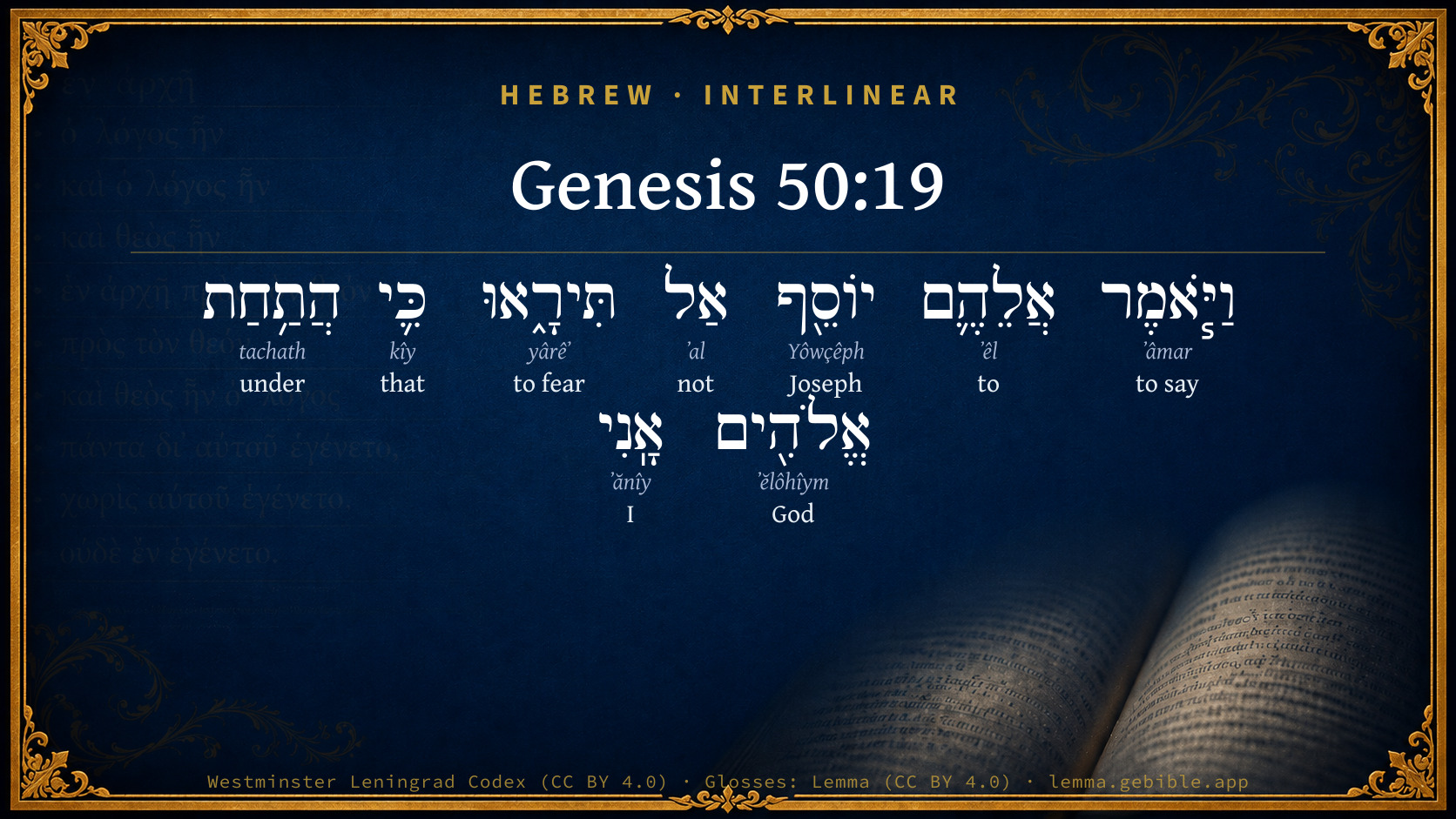
Genesis 50:19

Hebrew (Westminster Leningrad Codex) Genesis 50:19 appears in the Hebrew Old Testament. The text above is from the Westminster Leningrad Codex. Each word links to its Strong’s number, a concise gloss, and parsing drawn from the Open Scriptures Hebrew Bible morphology. Click any word for its full Brown-Driver-Briggs (BDB) entry.
Download image
Cite this verse

Genesis 50:19 (World English Bible). Public Domain. Lemma interlinear Bible study tool, https://lemma.gebible.app/v/genesis/50/19.

Show BibTeX & RIS
BibTeX
RIS
English Translation
Joseph said to them, "Don't be afraid, for am I in the place of God?
World English Bible · Public Domain
Download a study sheet

One document with this verse’s original text, its word-by-word gloss line, the meaning frame, cross-references with their text, attributed commentary, and full source and license credits — printable, and it pastes into notes with its structure intact.

This verse Autodidact and up

Study sheet (.html) Plain text (.txt)

A passage Seminary Student

Up to 50 verses in one chapter. A passage sheet keeps up to 6 commentary sources and 12 cross-references per verse, in the order this page ranks them, and says so on the sheet whenever that leaves anything out. Ask for a single verse and you get the Autodidact verse sheet above.

Everything on this page stays free to read, with no account — the sheet is a download of what is already on screen, not access to it.

Want to remove ads? Support Godless Engineer
Compare translations 3

The same verse in 3 English versions, stacked beneath the original-language interlinear above. Click any original word for its lexicon entry.

Each is an independent rendering of the whole verse — the interlinear is not word-aligned to these translations.

Highlighted words mark where these versions differ — a whole-verse word diff, not a word-by-word alignment.

  • World English Bible Public Domain
    Joseph said to them, "Don't be afraid, for am I in the place of God?
  • King James Version Public Domain
    And Joseph said unto them, Fear not: for am I in the place of God?
  • unfoldingWord Literal Text CC BY-SA 4.0
    But Joseph said to them, “Do not be afraid. For I in place of God?

unfoldingWord Literal Text — © unfoldingWord, licensed CC BY-SA 4.0. Word-aligned USFM3 via Door43 (git.door43.org/unfoldingWord/en_ult).

Versions to compare (up to 4)

3 of 4 selected

Show all 18 translations

Every available English version of this verse, each an independent rendering of the whole verse.

  • World English Bible Public Domain
    Joseph said to them, "Don't be afraid, for am I in the place of God?
  • Berean Standard Bible Public Domain
    But Joseph replied, “Do not be afraid. Am I in the place of God?
  • Majority Standard Bible Public Domain
    But Joseph replied, “Do not be afraid. Am I in the place of God?
  • King James Version Public Domain
    And Joseph said unto them, Fear not: for am I in the place of God?
  • American Standard Version (1901) Public Domain
    And Joseph said unto them, Fear not: for am I in the place of God?
  • Revised Version (1885) Public Domain
    And Joseph said unto them, Fear not: for am I in the place of God?
  • Geneva Bible (1599) Public Domain
    To whome Ioseph sayde, Feare not: for am not I vnder God?
  • Douay-Rheims (1899) Public Domain
    And he answered them: Fear not: can we resist the will of God?
  • Young's Literal Translation Public Domain
    And Joseph saith unto them, `Fear not, for `am' I in the place of God?
  • Literal Standard Version CC BY-SA 4.0
    And Joseph says to them, “Do not fear, for [am] I in the place of God?
  • Unlocked Literal Bible CC BY-SA 4.0
    But Joseph answered them, “Do not be afraid. Am I in the place of God?
  • unfoldingWord Literal Text CC BY-SA 4.0
    But Joseph said to them, “Do not be afraid. For I in place of God?
  • Darby Bible Public Domain
    And Joseph said to them, Fear not: am I then in the place of God?
  • World Messianic Bible Public Domain
    Joseph said to them, “Don’t be afraid, for am I in the place of God?
  • Webster's Bible Public Domain
    And Joseph said to them, Fear not: for am I in the place of God?
  • Free Bible Version CC BY-SA 4.0
    “You don't need to be afraid!” he told them. “I don't stand in the place of God, do I?
  • Bible in Basic English Public Domain
    And Joseph said, Have no fear: am I in the place of God?
  • JPS Tanakh (1917) Public Domain
    And Joseph said unto them: 'Fear not; for am I in the place of God?

Literal Standard Version (2020), Covenant Press — licensed CC BY-SA 4.0. Text via the HelloAO Bible API (eBible.org). Unlocked Literal Bible (unfoldingWord) — licensed CC BY-SA 4.0. Text via the HelloAO Bible API (eBible.org). unfoldingWord Literal Text — © unfoldingWord, licensed CC BY-SA 4.0. Word-aligned USFM3 via Door43 (git.door43.org/unfoldingWord/en_ult). Free Bible Version, Dr. Jonathan Gallagher — licensed CC BY-SA 4.0. Text via the HelloAO Bible API (eBible.org).

Word by word

More ways to search: Search by grammar → Find every occurrence → Compare this word →

Practice this passage: Drill this verse → Learn its vocabulary →

About this verse

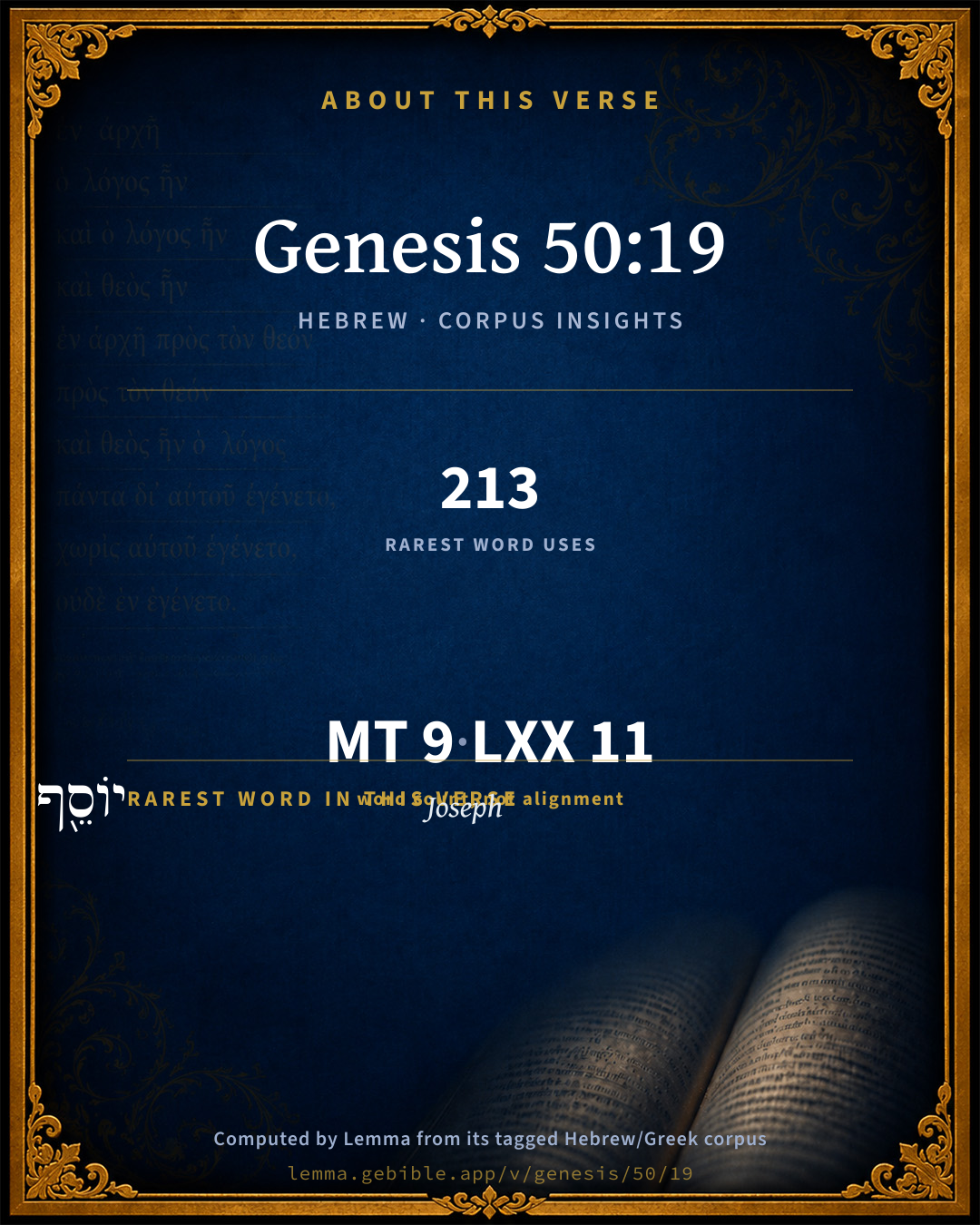
These counts appear in no published source. They are computed here, from the morphology-tagged text and Lemma’s own curated glosses. What Lemma adds →

9
words
9
distinct lemmas
Pentateuch
section

Grammatical profile

  • 2 verbs
  • 2 nouns
  • 1 pronoun
  • 2 prepositions
  • 1 conjunction
  • 1 particle

Verb forms

  • וַיֹּ֧אמֶר Qal · Sequential Imperfect
  • תִּירָ֑אוּ Qal · Jussive

Hebrew & Septuagint length

In English translation the verse runs 15 words from the Hebrew and 11 from the Septuagint (LXX English) — closely comparable.

A rough comparison of the two English renderings, which tokenize alike — not a word-level alignment.

Word counts can differ between the Hebrew and the Greek without any difference in meaning — e.g. the Hebrew direct-object marker אֵת has no separate Greek word, and Greek often adds the article ὁ.

In the original languages it is 9 Hebrew tokens and 11 Greek tokens — but the two are counted differently (Hebrew bundles its prefixes and suffixes into one token; the Greek is in lemma form), so that isn’t a like-for-like length.

Cross-references

8

Topical passages linked to Genesis 50:19 in the Treasury of Scripture Knowledge — connected by theme and wording, ordered by reader-vote popularity; previews shown in the World English Bible.

  • Romans 12:19 Don't seek revenge yourselves, beloved, but give place to God's wrath. For it is written, "Vengeance belongs to me; I will repay, says the Lord."
  • Genesis 30:2 Jacob's anger was kindled against Rachel, and he said, "Am I in God's place, who has withheld from you the fruit of the womb?"
  • Genesis 45:5 Now don't be grieved, nor angry with yourselves, that you sold me here, for God sent me before you to preserve life.
  • 2 Kings 5:7 It happened, when the king of Israel had read the letter, that he tore his clothes, and said, Am I God, to kill and to make alive, that this man does send to me to recover a man of his leprosy? but consider, I pray you, and see how he seeks a quarrel against me.
  • Hebrews 10:30 For we know him who said, "Vengeance belongs to me," says the Lord, "I will repay." Again, "The Lord will judge his people."
  • Deuteronomy 32:35 Vengeance is mine, and recompense, At the time when their foot shall slide: For the day of their calamity is at hand, The things that are to come on them shall make haste.
  • Job 34:19–29 Who doesn't respect the persons of princes, Nor regards the rich more than the poor; For they all are the work of his hands.
  • Matthew 14:27 But immediately Jesus spoke to them, saying "Cheer up! I AM! Don't be afraid."

Cross-references courtesy of OpenBible.info (CC BY 4.0).

Hebrew and Greek witnesses Masoretic Hebrew ↔ Greek Septuagint

The same verse in the two great witnesses to the Old Testament, shown verse-for-verse.

These are two independent witnesses, not word-aligned to each other, and the Septuagint is shown in lemma (dictionary) form.

Hebrew Genesis 50:19 Masoretic · Westminster Leningrad Codex

וַיֹּ֧אמֶר אֲלֵהֶ֛ם יוֹסֵ֖ף אַל תִּירָ֑אוּ כִּ֛י הֲתַ֥חַת אֱלֹהִ֖ים אָֽנִי

Joseph said to them, "Don't be afraid, for am I in the place of God?

World English Bible · Public Domain

Greek LXX Genesis 50:19 Septuagint · lemma form

καί εἶπον αὐτός ιωσηφ μή φοβέω ὁ γάρ θεός εἰμί ἐγώ

And Joseph said to them, Fear not, for I am God's.

LXX2012 (modern English Septuagint) · Public Domain

On this verse, The Cambridge Bible for Schools and Colleges discusses the Septuagint’s reading. Read the note in Commentary ↓

Hebrew: Westminster Leningrad Codex (CC BY 4.0). Greek: Septuagint (public domain); English from LXX2012 (modern English Septuagint) (Public Domain). How the Septuagint differs from the Hebrew →

Targum (Aramaic paraphrase)

2

The Targum is the ancient Jewish Aramaic paraphrase of the Hebrew Scriptures — an interpretive translation, not the Hebrew text itself. Onkelos (literal) and Pseudo-Jonathan (expansive) render the Torah, and Jonathan the Prophets. Coverage is partial: where no permissively-licensed English translation exists for a verse, only the Aramaic is shown. This is verse-level text, not a word-by-word alignment to the Hebrew.

  1. Targum Onkelos Torah (Genesis–Deuteronomy)
    וַאֲמַר לְהוֹן יוֹסֵף לָא תִדַחֲלוּן אֲרֵי דַחֲלָא דַּיְיָ אֲנָא

    (no public-domain English translation for this verse)

    Targum Onkelos — Aramaic: “Onkelos Genesis” (public domain); “Onkelos Exodus” (public domain); “Onkelos Leviticus” (public domain); “Onkelos Numbers” (public domain); “Onkelos Deuteronomy” (public domain). English: “Sefaria Community Translation” (CC0 1.0 (public-domain dedication)); “J.W. Etheridge. The Targums of Onkelos and Jonathan Ben Uzziel on the Pentateuch. London: Longmans, Green, 1862” (public domain). Text via Sefaria.

  2. Targum Pseudo-Jonathan Torah (Genesis–Deuteronomy)
    וַאֲמַר לְהוֹם יוֹסֵף לָא תִידַחֲלוּן אֲרוּם לָא נִיגְמוֹל לְכוֹן בִּישְׁתָּא אֱלָהֵן טַבְתָא אֲרוּם דָחִיל וּמִתְבַר מִן קֳדָם יְיָ אֲנָא

    And Joseph said to them, Fear not, for I will not do you evil, but good; for I fear and humble myself before the Lord.

    Targum Pseudo-Jonathan — Aramaic: “Targum Jonathan on Genesis” (public domain); “Targum Jonathan on Exodus” (public domain); “Targum Jonathan on Leviticus” (public domain); “Targum Jonathan on Numbers” (public domain); “Targum Jonathan on Deuteronomy” (public domain). English: “The Targum of Jonathan ben Uzziel, trans. J. W. Etheridge, London, 1862” (public domain). Text via Sefaria.

Commentary

Notes on Genesis 50:19 from classic Christian and Jewish commentators (each source and its license shown beneath its notes). The classic Christian expositions comment on the surrounding passage and are grouped to its opening verse, so a note may address several verses; the Jewish commentaries on the Tanakh (Rashi and others) are per-verse, so they appear only where the commentator wrote on this verse.

Lemma curates 59 commentaries, every one of them public domain or Creative Commons licensed, each selected and text-cleaned for this edition rather than reprinted as found. About our sources →

Trapp's Complete Commentary

John Trapp

Gen 50:19 And Joseph said unto them, Fear not: for [am] I in the place of God?

Ver. 19. Am I in the place of God?] q.d., Can I hurt you when God intends good to you? Is it for me to cross his decree?

John Trapp, A Commentary or Exposition upon All the Books of the Old and New Testament (1647–1656) — public domain. Text from a community e-Sword module.

Joseph Benson's Commentary

Gen 50:19. Am I in the place of God? — Dare I usurp the prerogative of God, to whom it belongs to take vengeance? Or, can I do what I please with you, without God’s leave? Fear him rather than me, and upon your experience of his wonderful care of and kindness to you, be persuaded he will still befriend you, and therefore I will. Or, perhaps, in his great humility, he thought they showed him too much respect, and saith to them, in effect, as Peter to Cornelius, “Stand up; I myself also am a man.” Make your peace with God, and then you will find it an easy matter to make your peace with me.

Joseph Benson's Commentary on the Old and New Testaments (1811–1818) — public domain. Text from a community e-Sword module.

Tyndale Open Study Notes

Tyndale Open Resources

50:19-21 Joseph reassured his brothers that God planned to fulfill the promised blessing (cp. 45:5, 7-9), and he promised kindness and provision (cp. 45:11).

Tyndale Open Study Notes — © Tyndale Open Resources, licensed CC BY-SA 4.0. Text via the HelloAO Bible API.

Geneva Bible (1599)

Geneva Bible translators

Or, am I in God’s stead, meaning to take vengeance.

Who by the good success seemeth to remit it, and therefore it ought not to be revenged by me.

Geneva Bible (1599) marginal notes — public domain. Text via Bolls.life.

Adam Clarke's Commentary

Verse 19. Am I in the place of God?] These words may be understood either as a question, or an affirmative proposition. How should I take any farther notice of your transgression? I have passed it by, the matter lies now between God and you. Or, in the order of Divine providence I am now in God's place; he has furnished me with means, and made me a distributor of his bounty; I will therefore not only nourish you, but also your little ones, Ge 50:21: and therefore he spake comfortably unto them, as in Ge 45:8, telling them that he attributed the whole business to the particular providence of God rather than to any ill will or malice in them, and that, in permitting him to be brought into Egypt, God had graciously saved their lives, the life of their father, the lives of the people of Canaan, and of the Egyptians: as therefore God had honoured him by making him vicegerent in the dispensations of his especial bounty towards so many people, it was impossible he should be displeased with the means by which this was brought about.

Adam Clarke's Commentary on the Bible (1810–1826) — public domain. Text from a community e-Sword/MySword module.

John Calvin's Commentaries

19. Am I in the place of God? Some think that, in these words, he was rejecting the honor paid him: as if he would say, that it was unjustly offered to him, because it was due to God alone. But this interpretation is destitute of probability, since he often permitted himself to be addressed in this manner, and knew that the minds of his brethren were utterly averse to transfer the worship of God to mortal man. And I equally disapprove another meaning given to the passage, which makes Joseph refuse to exact punishment, because he is not God: for he does not restrain himself from retaliating the injury, in the hope that God will prove his avenger. Others adduce a third signification; namely, that the whole affair was conducted by the counsel of God, and not by his own: which though I do not entirely reject, because it approaches the truth, yet I do not embrace the interpretation as true. For the word תחת(tachat) sometimes signifies instead of, sometimes it means subjection. Therefore if the note of interrogation were not in the way, it might well be rendered, “Because I am under God;” and then the sense would be, “Fear not, for I am under God;” so that Joseph would teach them, that because he is subject to the authority of God, it is not his business to lead the way, but to follow. But, whereas ה(he,) the note of interrogation, is prefixed to the word, it cannot be otherwise expounded than to mean that it would be wrong for him, a mortal man, to presume to thwart the counsel of God. But as to the sum of the matter, there is no ambiguity. For seeing that Joseph considers the design of divine providence, he restrains his feelings as with a bridle, lest they should carry him to excess. He was indeed of a mild and humane disposition; but nothing is better or more suitable to assuage his anger, than to submit himself to be governed by God. When, therefore, the desire of revenge urges us, let all our feelings be subjected to the same authority. Moreover, since he desires his brethren to be tranquil and secure, from the consideration, that he, ascribing due honor to God, willingly submits to obey the Divine command; let us learn, hence, that it is most to our advantage to deal with men of moderation, who set God before them as their leader, and who not only submit to his will, but also cheerfully obey him. For if any one is impotently carried away by the lust of the flesh, we must fear a thousand deaths from him, unless God should forcibly break his fury. Now as it is the one remedy for assuaging our anger, to acknowledge what we ourselves are, and what right God has over us; so, on the other hand, when this thought has taken full possession of our minds, there is no ardor, however furious, which it will not suffice to mitigate.

John Calvin's Commentaries (1540-1563) — public domain. Text from the Calvin Translation Society English edition (1840s-50s) via the Christian Classics Ethereal Library (ccel.org). Calvin's coverage is partial (roughly two-thirds of the Bible); uncommented books and verses are honest gaps, never fabricated. The 19th-century editor's footnotes and remarks are omitted so the notes are faithfully Calvin's own voice.

Ellicott's Commentary for English Readers

(19) Am I in the place of God?—That is, am I to act as judge, and punish? Judges are sometimes in Hebrew even called God (as in Exo_21:6; Exo_22:8-9; 1Sa_2:25), as exercising His authority.

A Bible Commentary for English Readers, edited by Charles John Ellicott (1878–1897) — public domain. Text from a community e-Sword module.

The Cambridge Bible for Schools and Colleges

gen. ed. J. J. S. Perowne

19. am I in the place of God] i.e. “am I the person to punish for wrongdoing? God alone knows the hearts.” LXX mistakes the meaning, τοῦ γὰρ θεοῦ ἐγὼ εἰμί = “for do I belong to God”; Lat. num Dei possumus resistere voluntati. Symmachus is correct, μὴ γὰρ ἀντὶ θεοῦ εἰμι ἐγώ. Cf. the occurrence of the same words in Gen_30:2 and 2Ki_5:7.

The Cambridge Bible for Schools and Colleges (gen. ed. J. J. S. Perowne; Cambridge University Press, 1878–1918) — public domain. Text from a community e-Sword module.

John Gill's Exposition

But as for you, ye thought evil against me,.... That must be said and owned, that their intentions were bad; they thought to have contradicted his dreams, and made them of none effect, to have token away his life, or however to have made him a slave all his days:

but God meant it unto good; he designed good should come by it, and he brought good out of it: this shows that this action, which was sinful in itself, fell under the decree of God, or was the object of it, and that there was a concourse of providence in it; not that God was the author of sin, which neither his decree about it, nor the concourse of providence with the action as such supposes; he leaving the sinner wholly to his own will in it, and having no concern in the ataxy or disorder of it, but in the issue, through his infinite wisdom, causes it to work for good, as follows:

to bring to pass, as it is this day, to save much people alive; the nation of the Egyptians and the neighbouring nations, as the Canaanites and others, and particularly his father's family: thus the sin of the Jews in crucifying Christ, which, notwithstanding the determinate counsel of God, they most freely performed, was what wrought about the greatest good, the salvation of men.

John Gill's Exposition of the Whole Bible (1746–1763) — public domain (CC PDM 1.0). Text via the HelloAO Bible API.

Haydock's Catholic Bible Commentary

Resist, &c. Hebrew, "Am I not subject to God; or, Am I a God," to oppose his will. Septuagint, "I belong to the Lord." You see that your designs against me have turned to our mutual advantage. Can I, therefore, think of punishing you? Repent, and obtain pardon of God: I certainly forgive you. (Haydock) --- Thus God drew good out of the evil, in which he had no share. (St. Augustine, City of God xiv. 27; St. Chrysostom, hom. 67.)

George Leo Haydock (1774–1849), Haydock's Catholic Family Bible and Commentary, 1859 edition — public domain. Excludes Psalms (Douay-Rheims chapter numbering differs from Protestant) and Deuterocanonical books (Catholic canon only).

Matthew Poole's English Annotations

It is God’s prerogative to take vengeance, which I dare not usurp. See Deu 32:35. Or, can I do what I please with you without God’s leave? Therefore fear him rather than me, and upon your experience of his wonderful care and kindness to you, believe that God will not, and therefore that I neither can nor will do you any hurt. But it is not unusual to put the Hebrew he for halo, as it is Gen 27:36; 1Sa 2:28; 2Sa 23:19; 1Ki 16:31, &c.; and so the words may be very well rendered, Am not I under God, i.e. subject to his will, a minister of his providence? Dare I destroy those whom God so eminently designed to save? Dare I punish those whom God hath pardoned.

Matthew Poole's English Annotations on the Holy Bible (1683–1685) — public domain. Text from a community e-Sword/MySword module.

Whedon's Commentary on the Bible

Daniel D. Whedon

19. Am I in the place of God — “It is true that you have sinned, but it is not mine to punish; God is your judge and mine.” — Newhall.

Daniel D. Whedon (gen. ed.), Commentary on the Old and New Testaments (1874–1909) — public domain. Text from a community e-Sword module.

The Pulpit Commentary

And Joseph said unto them, Fear not: for am I in the place of God?i.e. either reading the words as a question, Should I arrogate to myself what obviously belongs to Elohim, viz., the power and right of vengeance (Calvin, Kalisch, Murphy, "Speaker"s Commentary"), or the power to interfere with the purposes of God? (Keil, Rosenm or, regarding them as an assertion, I am in God"s stead, i.e. a minister to you for good (Wordsworth).

The Pulpit Commentary (1880–1919), ed. H.D.M. Spence-Jones & Joseph S. Exell — public domain. Text from a community e-Sword module.

John Wesley's Explanatory Notes

Am I in the place of God? - He in his great humility thought they shewed him too much respect, and faith to them in effect, as Peter to Cornelius, Stand up, I myself also am a man. Make your peace with God, and then you will find it an easy matter to make your peace with me.

John Wesley, Explanatory Notes Upon the Whole Bible (1754–1765) — public domain. Text via the GEBible commentary corpus.

Rashi

Rabbi Shlomo Yitzchaki (Rashi)

כי התחת אלהים אני FOR AM I INSTEAD OF GOD — Am I perhaps (do you think that I am) in His stead? The ה of התחת expresses a question. Even if I wished to do you harm would I at all be able to do so? For did you not all design evil against me, and you did not succeed because the Holy One, blessed be He, designed it for good. How, then, can I alone, without God’s consent, do evil to you.

Rashi on the Tanakh — English translations: “The Judaica Press complete Tanach with Rashi, translated by A. J. Rosenberg” (CC BY 4.0); “Pentateuch with Rashi's commentary by M. Rosenbaum and A.M. Silbermann, 1929-1934” (public domain); “The Metsudah Tanach series, Lakewood, N.J” (CC BY 4.0); and “The Book of Joshua, Metsudah Publications, 1997” (CC BY 4.0). Text via Sefaria.

Lesson kit

Teaching starters — assembled from the data on this page, not authored interpretation. Every prompt links to the verse data it draws on. Edit before teaching.

Genesis, in the Pentateuch, opens this verse with 9 words (9 distinct Hebrew lemmas). Its most distinctive word is Yôwçêph (“Joseph”). A historical commentator’s framing appears above. Read the whole chapter for the surrounding context.

Discussion questions

  1. How does “Joseph” (Yôwçêph) shape what this verse is saying?
  2. How does Romans 12:19, which shares this passage’s theme, read alongside this verse?
  3. These translations render this verse differently. What is at stake in choosing one wording over another?
  4. «וַיֹּ֧אמֶר» is a Qal Sequential Imperfect verb. How does that grammatical form shape the action described?
  5. Compare how Trapp's Complete Commentary and Joseph Benson's Commentary read this verse. Where do they agree or differ?

Things to notice

Reading settings

Reading text

Shown beneath each verse's original-language words.

Old Testament
Old Testament edition

Read the OT as the Masoretic Hebrew (MT) or the Greek Septuagint (LXX).

English shown for the Greek Septuagint (in the Hebrew ↔ Greek comparison).

Comparing translations? Open the Compare panel on any verse page to stack up to four side by side.