
Leviticus 26:41

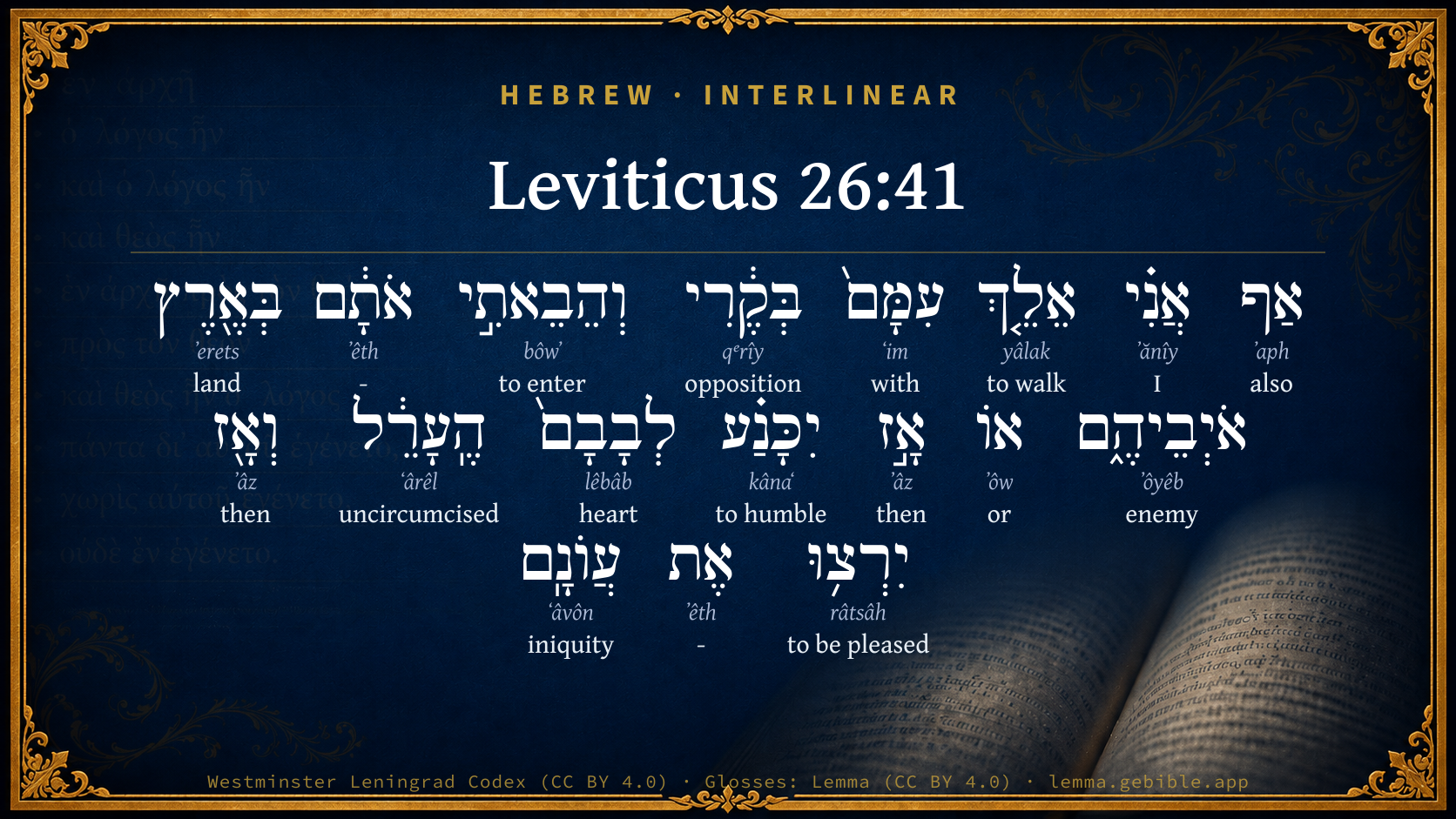
Hebrew (Westminster Leningrad Codex) Leviticus 26:41 appears in the Hebrew Old Testament. The text above is from the Westminster Leningrad Codex. Each word links to its Strong’s number, a concise gloss, and parsing drawn from the Open Scriptures Hebrew Bible morphology. Click any word for its full Brown-Driver-Briggs (BDB) entry.
Download image
Cite this verse

Leviticus 26:41 (World English Bible). Public Domain. Lemma interlinear Bible study tool, https://lemma.gebible.app/v/leviticus/26/41.

Show BibTeX & RIS
BibTeX
RIS
English Translation
I also walked contrary to them, and brought them into the land of their enemies: if then their uncircumcised heart is humbled, and they then accept the punishment of their iniquity;
World English Bible · Public Domain
Highlights
  • 1 first appearance in the Hebrew Bible
Full analysis ↓
Download a study sheet

One document with this verse’s original text, its word-by-word gloss line, the meaning frame, cross-references with their text, attributed commentary, and full source and license credits — printable, and it pastes into notes with its structure intact.

This verse Autodidact and up

Study sheet (.html) Plain text (.txt)

A passage Seminary Student

Up to 50 verses in one chapter. A passage sheet keeps up to 6 commentary sources and 12 cross-references per verse, in the order this page ranks them, and says so on the sheet whenever that leaves anything out. Ask for a single verse and you get the Autodidact verse sheet above.

Everything on this page stays free to read, with no account — the sheet is a download of what is already on screen, not access to it.

Want to remove ads? Support Godless Engineer
Compare translations 3

The same verse in 3 English versions, stacked beneath the original-language interlinear above. Click any original word for its lexicon entry.

Each is an independent rendering of the whole verse — the interlinear is not word-aligned to these translations.

Highlighted words mark where these versions differ — a whole-verse word diff, not a word-by-word alignment.

  • World English Bible Public Domain
    I also walked contrary to them, and brought them into the land of their enemies: if then their uncircumcised heart is humbled, and they then accept the punishment of their iniquity;
  • King James Version Public Domain
    And that I also have walked contrary unto them, and have brought them into the land of their enemies; if then their uncircumcised hearts be humbled, and they then accept of the punishment of their iniquity:
  • unfoldingWord Literal Text CC BY-SA 4.0
    (I also, I walked with them in hostility and brought them into the land of their enemies)—if then their uncircumcised heart is humbled, and they accept their iniquity,

unfoldingWord Literal Text — © unfoldingWord, licensed CC BY-SA 4.0. Word-aligned USFM3 via Door43 (git.door43.org/unfoldingWord/en_ult).

Versions to compare (up to 4)

3 of 4 selected

Show all 18 translations

Every available English version of this verse, each an independent rendering of the whole verse.

  • World English Bible Public Domain
    I also walked contrary to them, and brought them into the land of their enemies: if then their uncircumcised heart is humbled, and they then accept the punishment of their iniquity;
  • Berean Standard Bible Public Domain
    and I acted with hostility toward them and brought them into the land of their enemies—and if their uncircumcised hearts will be humbled and they will make amends for their iniquity,
  • Majority Standard Bible Public Domain
    and I acted with hostility toward them and brought them into the land of their enemies—and if their uncircumcised hearts will be humbled and they will make amends for their iniquity,
  • King James Version Public Domain
    And that I also have walked contrary unto them, and have brought them into the land of their enemies; if then their uncircumcised hearts be humbled, and they then accept of the punishment of their iniquity:
  • American Standard Version (1901) Public Domain
    I also walked contrary unto them, and brought them into the land of their enemies: if then their uncircumcised heart be humbled, and they then accept of the punishment of their iniquity;
  • Revised Version (1885) Public Domain
    I also walked contrary unto them, and brought them into the land of their enemies: if then their uncircumcised heart be humbled, and they then accept of the punishment of their iniquity;
  • Geneva Bible (1599) Public Domain
    Therefore I wil walke stubburnly against them, and bring them into the land of their enemies: so then their vncircumcised hearts shalbe humbled, and then they shalt willingly beare the punishment of their iniquitie.
  • Douay-Rheims (1899) Public Domain
    Therefore I also will walk them, and bring them into their enemies' land until their uncircumcised mind be ashamed: then shall they pray for their sins.
  • Young's Literal Translation Public Domain
    also I walk to them in opposition, and have brought them into the land of their enemies -- or then their uncircumcised heart is humbled, and then they accept the punishment of their iniquity, --
  • Literal Standard Version CC BY-SA 4.0
    when I also walk in opposition to them, and have brought them into the land of their enemies—if then their uncircumcised heart is humbled, and then they accept the punishment of their iniquity—
  • Unlocked Literal Bible CC BY-SA 4.0
    which caused me to turn against them and I brought them into the land of their enemies—if their uncircumcised hearts become humbled, and if they accept the punishment for their sins,
  • unfoldingWord Literal Text CC BY-SA 4.0
    (I also, I walked with them in hostility and brought them into the land of their enemies)—if then their uncircumcised heart is humbled, and they accept their iniquity,
  • Darby Bible Public Domain
    so that I also walked contrary unto them, and brought them into the land of their enemies. If then their uncircumcised heart be humbled, and they then accept the punishment of their iniquity,
  • World Messianic Bible Public Domain
    I also walked contrary to them, and brought them into the land of their enemies; if then their uncircumcised heart is humbled, and they then accept the punishment of their iniquity,
  • Webster's Bible Public Domain
    And that I also have walked contrary to them, and have brought them into the land of their enemies; if then their uncircumcised hearts shall be humbled, and they then accept of the punishment of their iniquity:
  • Free Bible Version CC BY-SA 4.0
    Because of this I took action against them and exiled them in the countries of their enemies. However, if they humbly give up their stubborn attitude and accept their punishment for their sins,
  • Bible in Basic English Public Domain
    So that I went against them and sent them away into the land of their haters: if then the pride of their hearts is broken and they take the punishment of their sins,
  • JPS Tanakh (1917) Public Domain
    I also will walk contrary unto them, and bring them into the land of their enemies; if then perchance their uncircumcised heart be humbled, and they then be paid the punishment of their iniquity;

Literal Standard Version (2020), Covenant Press — licensed CC BY-SA 4.0. Text via the HelloAO Bible API (eBible.org). Unlocked Literal Bible (unfoldingWord) — licensed CC BY-SA 4.0. Text via the HelloAO Bible API (eBible.org). unfoldingWord Literal Text — © unfoldingWord, licensed CC BY-SA 4.0. Word-aligned USFM3 via Door43 (git.door43.org/unfoldingWord/en_ult). Free Bible Version, Dr. Jonathan Gallagher — licensed CC BY-SA 4.0. Text via the HelloAO Bible API (eBible.org).

Word by word

More ways to search: Search by grammar → Find every occurrence → Compare this word →

Practice this passage: Drill this verse → Learn its vocabulary →

בְּקֶ֔רִי
qᵉrîy
H7147
“in/at · opposition”
Preposition + Noun, Common, Masculine, Singular, Absolute
Part of Speech
Preposition + Noun
Type
Common
Gender
Masculine
Number
Singular
State
Absolute
Full BDB Definition

Origin: from H7136

TWOT: 2068b

opposition, contrariness, encounter, contrary or hostile encounter
  1. אַף ʼaph H637 “also” Particle, Accusative
  2. אֲנִ֗י ʼănîy H589 “I” Pronoun, Personal, 1st Person, Common, Singular
  3. אֵלֵ֤ךְ yâlak H3212 “to walk” Verb, Qal, Imperfect, 1st Person, Common, Singular
  4. עִמָּם֙ ʻim H5973 “with · them” Preposition + Suffix, Personal, 3rd Person, Masculine, Plural
  5. וְהֵבֵאתִ֣י bôwʼ H935 “and · to enter” Conjunction + Verb, Hiphil, Sequential Perfect, 1st Person, Common, Singular
  6. אֹתָ֔ם ʼêth H853 “- · them” Particle, Direct Object + Suffix, Personal, 3rd Person, Masculine, Plural
  7. בְּאֶ֖רֶץ ʼerets H776 “in/at · land of” Preposition + Noun, Common, Both, Singular, Construct
  8. אֹיְבֵיהֶ֑ם ʼôyêb H341 “enemy · them” Verb, Qal, Participle Active, Masculine, Plural, Construct + Suffix, Personal, 3rd Person, Masculine, Plural
  9. אוֹ ʼôw H176 “or” Conjunction
  10. אָ֣ז ʼâz H227 “then” Adverb
  11. יִכָּנַ֗ע kânaʻ H3665 “to humble” Verb, Niphal, Imperfect, 3rd Person, Masculine, Singular
  12. לְבָבָם֙ lêbâb H3824 “heart · their” Noun, Common, Masculine, Singular, Construct + Suffix, Personal, 3rd Person, Masculine, Plural
  13. הֶֽעָרֵ֔ל ʻârêl H6189 “the · uncircumcised” Particle, Definite Article + Adjective, Adjective, Masculine, Singular, Absolute
  14. וְאָ֖ז ʼâz H227 “and · then” Conjunction + Adverb
  15. יִרְצ֥וּ râtsâh H7521 “to be pleased” Verb, Qal, Imperfect, 3rd Person, Masculine, Plural
  16. אֶת ʼêth H853 “-” Particle, Direct Object
  17. עֲוֺנָֽם ʻâvôn H5771 “iniquity · their” Noun, Common, Both, Singular, Construct + Suffix, Personal, 3rd Person, Masculine, Plural

About this verse

These counts appear in no published source. They are computed here, from the morphology-tagged text and Lemma’s own curated glosses. What Lemma adds →

18
words
16
distinct lemmas
Pentateuch
section

Notable vocabulary

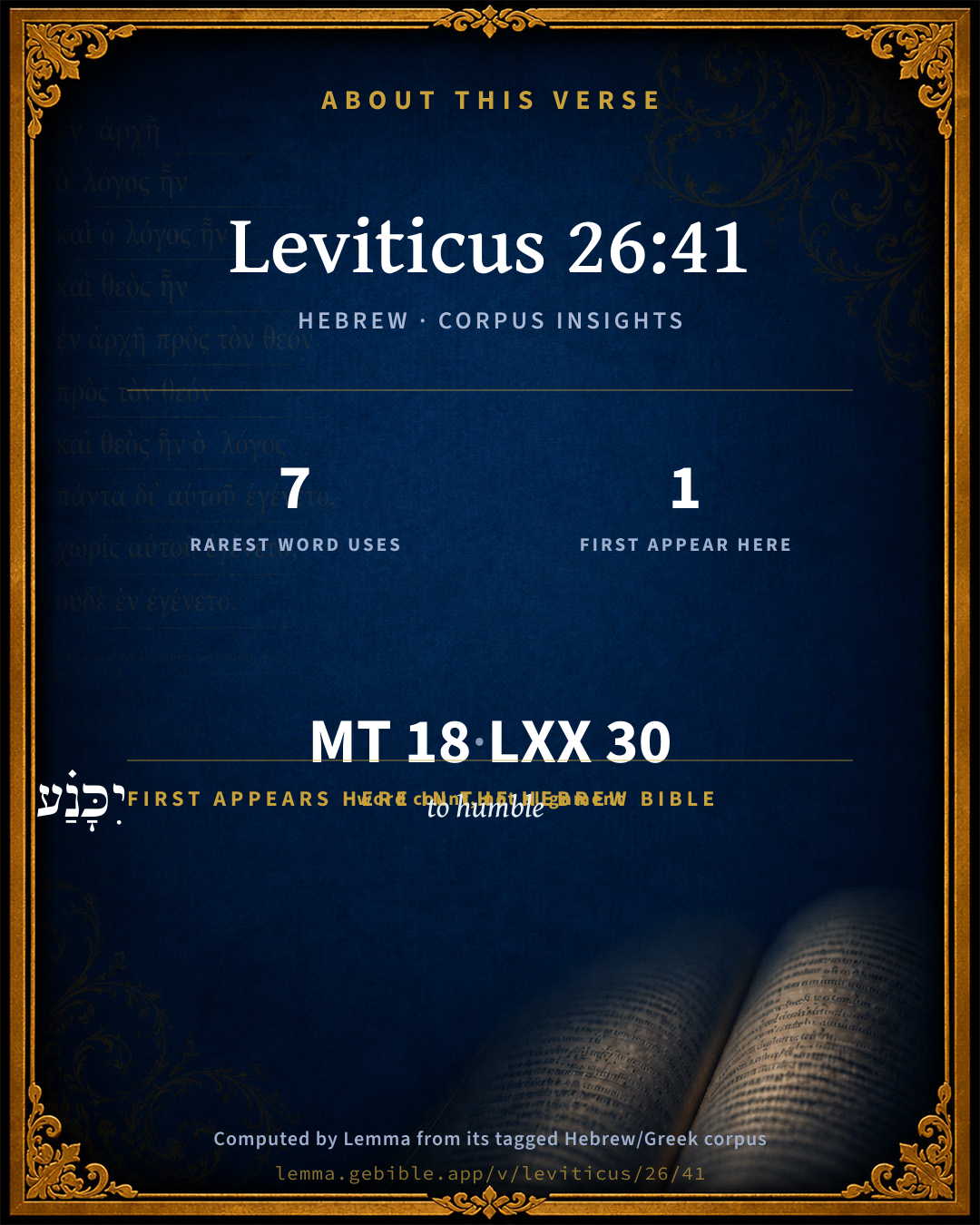
The rarest word here is בְּקֶ֔רִי opposition H7147 — appearing just 7 times in the whole Hebrew Bible.

First appearance in Scripture

This word makes its first canonical appearance in the Hebrew Bible here:

  • יִכָּנַ֗ע to humble H3665

Shared distinctive vocabulary

בְּקֶ֔רִי opposition H7147 occurs in 7 verses of the Hebrew Bible. Also found in:

Grammatical profile

  • 5 verbs
  • 4 nouns
  • 1 adjective
  • 1 pronoun
  • 1 preposition
  • 1 conjunction
  • 2 adverbs
  • 3 particles

Verb forms

  • אֵלֵ֤ךְ Qal · Imperfect
  • וְהֵבֵאתִ֣י Hiphil · Sequential Perfect
  • אֹיְבֵיהֶ֑ם Qal · Participle Active
  • יִכָּנַ֗ע Niphal · Imperfect
  • יִרְצ֥וּ Qal · Imperfect

Repetition

A word recurs within this verse — often emphatic in Hebrew:

  • אָ֣ז then H227 ×2

Hebrew & Septuagint length

In English translation the verse runs 31 words from the Hebrew and 38 from the Septuagint (LXX English) — closely comparable.

A rough comparison of the two English renderings, which tokenize alike — not a word-level alignment.

Word counts can differ between the Hebrew and the Greek without any difference in meaning — e.g. the Hebrew direct-object marker אֵת has no separate Greek word, and Greek often adds the article ὁ.

In the original languages it is 18 Hebrew tokens and 30 Greek tokens — but the two are counted differently (Hebrew bundles its prefixes and suffixes into one token; the Greek is in lemma form), so that isn’t a like-for-like length.

Cross-references

33

Topical passages linked to Leviticus 26:41 in the Treasury of Scripture Knowledge — connected by theme and wording, ordered by reader-vote popularity; previews shown in the World English Bible.

  • Ezekiel 44:7 in that you have brought in foreigners, uncircumcised in heart and uncircumcised in flesh, to be in my sanctuary, to profane it, even my house, when you offer my bread, the fat and the blood, and they have broken my covenant, [to add] to all your abominations.
  • 1 Kings 21:29 See you how Ahab humbles himself before me? because he humbles himself before me, I will not bring the evil in his days; but in his son's days will I bring the evil on his house.
  • 2 Chronicles 12:6–7 Then the princes of Israel and the king humbled themselves; and they said, Yahweh is righteous.
  • 2 Chronicles 32:26 Notwithstanding Hezekiah humbled himself for the pride of his heart, both he and the inhabitants of Jerusalem, so that the wrath of Yahweh didn't come on them in the days of Hezekiah.
  • Jeremiah 4:4 Circumcise yourselves to Yahweh, and take away the foreskins of your heart, you men of Judah and inhabitants of Jerusalem; lest my wrath go forth like fire, and burn so that none can quench it, because of the evil of your doings.
  • Jeremiah 9:25–26 Behold, the days come, says Yahweh, that I will punish all those who are circumcised in [their] uncircumcision:
  • Acts 7:51 "You stiff-necked and uncircumcised in heart and ears, you always resist the Holy Spirit! As your fathers did, so you do.
  • Deuteronomy 30:6 Yahweh your God will circumcise your heart, and the heart of your seed, to love Yahweh your God with all your heart, and with all your soul, that you may live.
  • 2 Chronicles 33:12–13 When he was in distress, he begged Yahweh his God, and humbled himself greatly before the God of his fathers.
  • Jeremiah 6:10 To whom shall I speak and testify, that they may hear? behold, their ear is uncircumcised, and they can't listen: behold, the word of Yahweh is become to them a reproach; they have no delight in it.
  • Ezekiel 20:43 There shall you remember your ways, and all your doings, in which you have polluted yourselves; and you shall loathe yourselves in your own sight for all your evils that you have committed.
  • Philippians 3:3 For we are the circumcision, who worship God in the Spirit, and rejoice in Christ Jesus, and have no confidence in the flesh;
  • Colossians 2:11 in whom you were also circumcised with a circumcision not made with hands, in the putting off of the body of the sins of the flesh, in the circumcision of Christ;
  • 2 Chronicles 12:12 When he humbled himself, the wrath of Yahweh turned from him, so as not to destroy him altogether: and moreover in Judah there were good things [found].
  • 2 Chronicles 33:19 His prayer also, and how [God] was entreated of him, and all his sin and his trespass, and the places in which he built high places, and set up the Asherim and the engraved images, before he humbled himself: behold, they are written in the history of Hozai.
  • 2 Chronicles 33:23 He didn't humble himself before Yahweh, as Manasseh his father had humbled himself; but this same Amon trespassed more and more.
  • Ezra 9:13 After all that is come on us for our evil deeds, and for our great guilt, seeing that you our God have punished us less than our iniquities deserve, and have given us such a remnant,
  • Ezra 9:15 Yahweh, the God of Israel, you are righteous; for we are left a remnant that is escaped, as it is this day: behold, we are before you in our guiltiness; for none can stand before you because of this.
  • Nehemiah 9:33 However you are just in all that is come on us; for you have dealt truly, but we have done wickedly;
  • Psalms 39:9 I was mute. I didn't open my mouth, Because you did it.
  • Psalms 51:3–4 For I know my transgressions. My sin is constantly before me.
  • Ezekiel 6:9 Those of you that escape shall remember me among the nations where they shall be carried captive, how that I have been broken with their lewd heart, which has departed from me, and with they eyes, which play the prostitute after their idols: and they shall loathe themselves in their own sight for the evils which they have committed in all their abominations.
  • Ezekiel 44:9 Thus says the Lord Yahweh, No foreigner, uncircumcised in heart and uncircumcised in flesh, shall enter into my sanctuary, of any foreigners who are among the children of Israel.
  • Daniel 9:7–14 Lord, righteousness belongs to you, but to us confusion of face, as at this day; to the men of Judah, and to the inhabitants of Jerusalem, and to all Israel, who are near, and who are far off, through all the countries where you have driven them, because of their trespass that they have trespassed against you.
  • Daniel 9:18–19 My God, turn your ear, and hear; open your eyes, and see our desolations, and the city which is called by your name: for we do not present our petitions before you for our righteousness, but for your great mercies' sake.
  • Matthew 23:12 Whoever exalts himself will be humbled, and whoever humbles himself will be exalted.
  • Luke 14:11 For everyone who exalts himself will be humbled, and whoever humbles himself will be exalted."
  • Luke 18:14 I tell you, this man went down to his house justified rather than the other; for everyone who exalts himself will be humbled, but he who humbles himself will be exalted."
  • Romans 2:28–29 For he is not a Jew who is one outwardly, neither is that circumcision which is outward in the flesh;
  • Galatians 5:6 For in Christ Jesus neither circumcision amounts to anything, nor uncircumcision, but faith working through love.
  • James 4:6–9 But he gives more grace. Therefore it says, "God resists the proud, but gives grace to the humble."
  • 1 Peter 5:5–6 Likewise, you younger ones, be subject to the elder. Yes, all of you gird yourselves with humility, to subject yourselves to one another; for "God resists the proud, but gives grace to the humble."
  • Exodus 10:3 Moses and Aaron went in to Pharaoh, and said to him, "This is what Yahweh, the God of the Hebrews, says: 'How long will you refuse to humble yourself before me? Let my people go, that they may serve me.

Cross-references courtesy of OpenBible.info (CC BY 4.0).

Hebrew and Greek witnesses Masoretic Hebrew ↔ Greek Septuagint

The same verse in the two great witnesses to the Old Testament, shown verse-for-verse.

These are two independent witnesses, not word-aligned to each other, and the Septuagint is shown in lemma (dictionary) form.

Hebrew Leviticus 26:41 Masoretic · Westminster Leningrad Codex

אַף אֲנִ֗י אֵלֵ֤ךְ עִמָּם֙ בְּקֶ֔רִי וְהֵבֵאתִ֣י אֹתָ֔ם בְּאֶ֖רֶץ אֹיְבֵיהֶ֑ם אוֹ אָ֣ז יִכָּנַ֗ע לְבָבָם֙ הֶֽעָרֵ֔ל וְאָ֖ז יִרְצ֥וּ אֶת עֲוֺנָֽם

I also walked contrary to them, and brought them into the land of their enemies: if then their uncircumcised heart is humbled, and they then accept the punishment of their iniquity;

World English Bible · Public Domain

Greek LXX Leviticus 26:41 Septuagint · lemma form

καί ἐγώ πορεύομαι μετά αὐτός ἐν θυμός πλάγιος καί ἀποὀλλύω αὐτός ἐν ὁ γῆ ὁ ἐχθρός αὐτός τότε ἐντρέπω ὁ καρδία αὐτός ὁ ἀπερίτμητος καί τότε εὐδοκέω ὁ ἁμαρτία αὐτός

and I walked with them with a perverse mind; and I will destroy them in the land of their enemies: then shall their uncircumcised heart be ashamed, and then shall they acquiesce in the punishment of their sins.

LXX2012 (modern English Septuagint) · Public Domain

Hebrew: Westminster Leningrad Codex (CC BY 4.0). Greek: Septuagint (public domain); English from LXX2012 (modern English Septuagint) (Public Domain). How the Septuagint differs from the Hebrew →

Targum (Aramaic paraphrase)

2

The Targum is the ancient Jewish Aramaic paraphrase of the Hebrew Scriptures — an interpretive translation, not the Hebrew text itself. Onkelos (literal) and Pseudo-Jonathan (expansive) render the Torah, and Jonathan the Prophets. Coverage is partial: where no permissively-licensed English translation exists for a verse, only the Aramaic is shown. This is verse-level text, not a word-by-word alignment to the Hebrew.

  1. Targum Onkelos Torah (Genesis–Deuteronomy)
    אַף אֲנָא אֱהַךְ עִמְהוֹן בְּקַשְׁיוּ וְאָעֵיל יָתְהוֹן בְּאַרַע בַּעֲלֵי דְבָבֵיהוֹן אוֹ בְּכֵן יִתָּבַר לִבְּהוֹן טַפְשָׁא וּבְכֵן יִרְעוּן יָת חוֹבֵיהוֹן

    (no public-domain English translation for this verse)

    Targum Onkelos — Aramaic: “Onkelos Genesis” (public domain); “Onkelos Exodus” (public domain); “Onkelos Leviticus” (public domain); “Onkelos Numbers” (public domain); “Onkelos Deuteronomy” (public domain). English: “Sefaria Community Translation” (CC0 1.0 (public-domain dedication)); “J.W. Etheridge. The Targums of Onkelos and Jonathan Ben Uzziel on the Pentateuch. London: Longmans, Green, 1862” (public domain). Text via Sefaria.

  2. Targum Pseudo-Jonathan Torah (Genesis–Deuteronomy)
    בְּרַם אֲנָא אִידַבֵּר יַתְהוֹן בְּעַרַאי בְּעַלְמָא וְאָעֵיל יַתְהוֹן בְּגָלוּתָא בְּאַרַע בַּעֲלֵי דְבָבֵיהוֹן הָא בְּכֵן יִתְבַּר לִבְּהוֹן זְדָנָא וּבְכֵן יַרְעוּן יַת חוֹבֵיהוֹן

    so that I have remembered them adversely in the world, and brought them into captivity in the land of their enemies; behold, then will their proud heart have been broken, and they will make confession of their sins,

    Targum Pseudo-Jonathan — Aramaic: “Targum Jonathan on Genesis” (public domain); “Targum Jonathan on Exodus” (public domain); “Targum Jonathan on Leviticus” (public domain); “Targum Jonathan on Numbers” (public domain); “Targum Jonathan on Deuteronomy” (public domain). English: “The Targum of Jonathan ben Uzziel, trans. J. W. Etheridge, London, 1862” (public domain). Text via Sefaria.

Commentary

Notes on Leviticus 26:41 from classic Christian and Jewish commentators (each source and its license shown beneath its notes). The classic Christian expositions comment on the surrounding passage and are grouped to its opening verse, so a note may address several verses; the Jewish commentaries on the Tanakh (Rashi and others) are per-verse, so they appear only where the commentator wrote on this verse.

Lemma curates 59 commentaries, every one of them public domain or Creative Commons licensed, each selected and text-cleaned for this edition rather than reprinted as found. About our sources →

Trapp's Complete Commentary

John Trapp

Lev 26:41 And [that] I also have walked contrary unto them, and have brought them into the land of their enemies; if then their uncircumcised hearts be humbled, and they then accept of the punishment of their iniquity:

Ver. 41. Accept of the punishment of their iniquity.] Taking all in good part, as less than their deserts; yea, taking God’s part against themselves, humbly submitting to his justice, and imploring his mercy.

John Trapp, A Commentary or Exposition upon All the Books of the Old and New Testament (1647–1656) — public domain. Text from a community e-Sword module.

Joseph Benson's Commentary

Lev 26:41. If they accept of — The meaning is, if they sincerely acknowledge the righteousness of God and their own wickedness, and patiently submit to his correcting hand; if, with David, they are ready to say, It is good for us that we are afflicted, that we may learn God’s statutes — And yield obedience to them for the future, which is a good evidence of true repentance.

Joseph Benson's Commentary on the Old and New Testaments (1811–1818) — public domain. Text from a community e-Sword module.

Tyndale Open Study Notes

Tyndale Open Resources

26:41 Physical circumcision of males was the mark of God’s covenant with Israel (Gen 17:9-14; Exod 4:25-26). Stubborn hearts (literally uncircumcised hearts) do not love God and demonstrate it by persistent disobedience. God promised to “circumcise” Israel’s uncircumcised hearts so that the people could love him (see also Deut 10:16; 30:6; Jer 4:4; Ezek 36:25-27).

Tyndale Open Study Notes — © Tyndale Open Resources, licensed CC BY-SA 4.0. Text via the HelloAO Bible API.

Geneva Bible (1599)

Geneva Bible translators

Or, pray for their sin.

Geneva Bible (1599) marginal notes — public domain. Text via Bolls.life.

Ellicott's Commentary for English Readers

(41) And that I also have walked contrary unto them.—That is, and they shall also confess that through their walking contrary unto God, He also walked contrary unto them, and brought them into the land of their enemies.

If then their uncircumcised hearts be humbled.—Better, or rather, their uncircumcised hearts shall be humbled. This is a resumption of the statement made at the beginning of Lev_26:40, viz., “And they shall confess their iniquity . . . ;” or rather, their uncircumcised hearts shall be humbled. That is, perverse and stubborn hearts; too proud to make an humble confession. (See Lev_19:23, with Jer_9:26.) The same metaphor is used by the Apostle: “Ye stiffnecked and uncircumcised in heart and ears, ye do always resist the Holy Ghost” (Act_7:51).

Accept of the punishment of their iniquity.—Rather, accept willingly, that is, they will acknowledge the justice of their punishment, and be in that frame of mind when they will freely own that the punishment is not commensurate with their guilt, and willingly accept the Divine retribution. The exact shade of meaning covered by this phrase in the original cannot adequately be given in a translation, since the verb here translated “accept,” or “accept willingly,” is the same which is translated “enjoy” in Lev_26:34. The whole phrase denotes literally, they shall rejoice in their iniquity, or in the punishment of their iniquity; they will take it joyfully, as the best and most appropriate means to bring them to repentance. The nearest approach to it is the passage, “I will bear the indignation of the Lord, for I have sinned against him” (Mic_7:9).

A Bible Commentary for English Readers, edited by Charles John Ellicott (1878–1897) — public domain. Text from a community e-Sword module.

The Cambridge Bible for Schools and Colleges

gen. ed. J. J. S. Perowne

41. accept of] acknowledge that the punishment was deserved and has had its remedial effect.

The Cambridge Bible for Schools and Colleges (gen. ed. J. J. S. Perowne; Cambridge University Press, 1878–1918) — public domain. Text from a community e-Sword module.

John Gill's Exposition

Then i will also remember my covenant with Jacob,.... Would fulfil and make good all that he had promised in covenant with Jacob, and his posterity: the account begins with him, and rises upwards to Abraham, whereas it usually begins with Abraham, and descends to Jacob; no sufficient reason is given for this alteration, though several are attempted by the Jewish writers (e):

and also my covenant with Isaac, and also my covenant with Abraham will I remember; which chiefly respects the multiplication of their seed, the continuance of them, and the Messiah springing from them; which is the mercy promised to these fathers, and the principal part of the covenant made with them, and which was remembered and performed when God visited and redeemed his people by him, Luk 1:68,

and I will remember the land; the land of Judea, and return the Jews to it, and make it fruitful, after he had given it rest from tillage for many years, which was fulfilled at their return from the captivity of Babylon.

(e) Saadiah Gaon apud Aben Ezram in loc. Pesikta & alii.

John Gill's Exposition of the Whole Bible (1746–1763) — public domain (CC PDM 1.0). Text via the HelloAO Bible API.

Haydock's Catholic Bible Commentary

Mind. Hebrew, "heart," wicked, rebellious, and unclean. (Menochius) --- Pray for. Hebrew and Syriac, "please themselves in," &c. They shall see what advantage they have derived from their sins. (Calmet) --- Then they shall enter into themselves, like the prodigal son. (Haydock)

George Leo Haydock (1774–1849), Haydock's Catholic Family Bible and Commentary, 1859 edition — public domain. Excludes Psalms (Douay-Rheims chapter numbering differs from Protestant) and Deuterocanonical books (Catholic canon only).

Matthew Poole's English Annotations

The Hebrew word avou commonly signifies iniquity, but it is oft used for

the punishment of iniquity, as here and 1Sa 28:10; Psa 31:10; Isa 53:6,11. The meaning is, if they sincerely acknowledge the righteousness of God, and their own wickedness, and patiently submit to his correcting hand, and would rather be in their present suffering condition than in their former sinful, though prosperous estate; if with David they are ready to say, it is good for them that they are afflicted, that they may learn God’s statutes, and obedience to them for the future, which is a good evidence of true repentance.

Matthew Poole's English Annotations on the Holy Bible (1683–1685) — public domain. Text from a community e-Sword/MySword module.

Whedon's Commentary on the Bible

Daniel D. Whedon

41. And that… I have brought — Their captivity should be ascribed not merely to natural causes, after the style of the modern deist, but to the direct interposition of the personal God whose law had been broken.

Uncircumcised hearts — Circumcision — “the putting away the filthiness of the flesh” — symbolizes the cleansing of the spiritual being through sanctification of the Spirit and belief of the truth. Rom_2:29, note. Till this is accomplished, the people of God are uncircumcised in heart, and are very often in humiliating captivity to the world. For the entire Hebrew nation was in a true and vastly important sense a typical people, whose history is full of spiritual lessons to the Christian Church.

Accept of the punishment — Recognise its justice and their own ill desert. The Hebrew verb ratsah is here used figuratively, and signifies to pay off, as a debt, and not, as Drs. Keil and Murphy render it, to enjoy.

Daniel D. Whedon (gen. ed.), Commentary on the Old and New Testaments (1874–1909) — public domain. Text from a community e-Sword module.

John Wesley's Explanatory Notes

If they accept of - The meaning is, if they sincerely acknowledge the righteousness of God and their own wickedness, and patiently submit to his correcting hand; if with David they are ready to say, it is good for them that they are afflicted, that they may learn God's statutes, and yield obedience to them for the future, which is a good evidence of true repentance.

John Wesley, Explanatory Notes Upon the Whole Bible (1754–1765) — public domain. Text via the GEBible commentary corpus.

Rashi

Rabbi Shlomo Yitzchaki (Rashi)

והבאתי אתם AND I SHALL BRING THEM [INTO THE LAND OF THEIR ENEMIES] — I Myself shall bring them; this is a kindly measure for Israel in order that they should not say, “Since we are banished among the nations let us do like their doings”. “For”, says God “I will not suffer them to do this, but I will raise up My prophets and so bring them back under My wings, as it is said, (Ezekiel 20:30) “And that which cometh into your mind shall not be at all, — [that ye say, We will be as the heathens, as the families of the countries, to serve wood and stone]. As I live, saith the Lord God, surely with a mighty hand, and with an outstretched arm and with fury poured out, will “I” be king over you etc.” (Sifra, Bechukotai, Chapter 8 5).

או אז יכנע — The word או here has the same meaning as in (Exodus 21:36) או נודע כי שור נגח הוא (cf. Rashi on that verse and our Note thereon). The translation therefore is: “If then [their uncircumcised hearts] will be humbled”. Another explanation is that או means perhaps, — “perhaps then their uncircumcised hearts will be humbled”.

ואז ירצו את עונם means, and they will atone for their iniquities by the punishments they will have suffered.

Rashi on the Tanakh — English translations: “The Judaica Press complete Tanach with Rashi, translated by A. J. Rosenberg” (CC BY 4.0); “Pentateuch with Rashi's commentary by M. Rosenbaum and A.M. Silbermann, 1929-1934” (public domain); “The Metsudah Tanach series, Lakewood, N.J” (CC BY 4.0); and “The Book of Joshua, Metsudah Publications, 1997” (CC BY 4.0). Text via Sefaria.

Ramban (Nachmanides)

Rabbi Moshe ben Nachman (Ramban / Nachmanides)

O’ (OR) THEN PERCHANCE THEIR UNCIRCUMCISED HEART BE HUMBLED. “[The word o here has the same meaning] as in ‘o’ (or) it is known that the ox was wont to gore. Another interpretation is [that the word o means] ‘perhaps’ — perhaps then their uncircumcised heart will be humbled; and they then be paid the punishment of their iniquity, meaning that they will achieve atonement for their iniquities through their sufferings.” This is Rashi’s language. The correct interpretation appears to me to be that He is stating: “And I will bring them into the land of their enemies, o (either) until such time when their uncircumcised heart will be humbled, o (or) until the time when they will have been paid the punishment of their iniquity by the length of the exile.”Now it is after [the verse], and they shall confess their iniquity that He should have said, Then will I remember My covenant with Jacob etc., for what reason is there [to state here, between these two verses] and I will bring them into the lands of their enemies, since this is not a time when He would exile them and bring them into the lands of their enemies [since they have just confessed their sins]! Therefore Rabbi Abraham ibn Ezra interpreted [the verse to mean]: “This also I did with them, that I punished them by bringing them into the land of their enemies in order to humble their uncircumcised heart.” And He mentioned this here [in order to indicate] that they confessed their sin “because it was I Who brought this about, for even at the time that they became corrupted, My intent was that they should repent and confess.”In my opinion He hints here [by placing the verses in this order] that [even] after the confession [of their sins], He will walk contrary to them and will still bring them into the land of their enemies until their uncircumcised heart is humbled, this being an allusion that He will bring them back into the Land but it will not be subdued before them; rather, they will have adversaries and enemies there, as it is said, And our adversaries said; And it came to pass when our enemies heard., Verse 9. The Land [at that time, when they returned from Babylon], was in the hands of foreign peoples, just as Ezra said in his prayer: Behold, we are servants this day, and as for the Land that Thou gavest unto our fathers to eat the fruit thereof and the good thereof, behold we are servants in it. And it yieldeth much increase unto the kings whom Thou hast set over us because of our sins; also they have power over us, and over our cattle, at their pleasure, and we are in great distress., 9:36-37.

Ramban (Nachmanides) on the Tanakh — English translation: “Commentary on the Torah by Ramban (Nachmanides). Translated and annotated by Charles B. Chavel. New York, Shilo Pub. House, 1971-1976” (CC BY 4.0). Text via Sefaria.

Lesson kit

Teaching starters — assembled from the data on this page, not authored interpretation. Every prompt links to the verse data it draws on. Edit before teaching.

Leviticus, in the Pentateuch, opens this verse with 18 words (16 distinct Hebrew lemmas). Its most distinctive word is qᵉrîy (“opposition”). A historical commentator’s framing appears above. Read the whole chapter for the surrounding context.

Discussion questions

  1. How does “opposition” (qᵉrîy) shape what this verse is saying?
  2. This is the first place “to humble” appears in Scripture (first appears here). What does its debut here establish?
  3. How does Leviticus 26:21, which shares the word «opposition», read alongside this verse?
  4. What does the repetition of “then” (2× in this one verse) do in this verse?
  5. These translations render this verse differently. What is at stake in choosing one wording over another?
  6. «אֵלֵ֤ךְ» is a Qal Imperfect verb. How does that grammatical form shape the action described?
  7. Compare how Trapp's Complete Commentary and Joseph Benson's Commentary read this verse. Where do they agree or differ?

Things to notice

Reading settings

Reading text

Shown beneath each verse's original-language words.

Old Testament
Old Testament edition

Read the OT as the Masoretic Hebrew (MT) or the Greek Septuagint (LXX).

English shown for the Greek Septuagint (in the Hebrew ↔ Greek comparison).

Comparing translations? Open the Compare panel on any verse page to stack up to four side by side.