Numbers 15:41

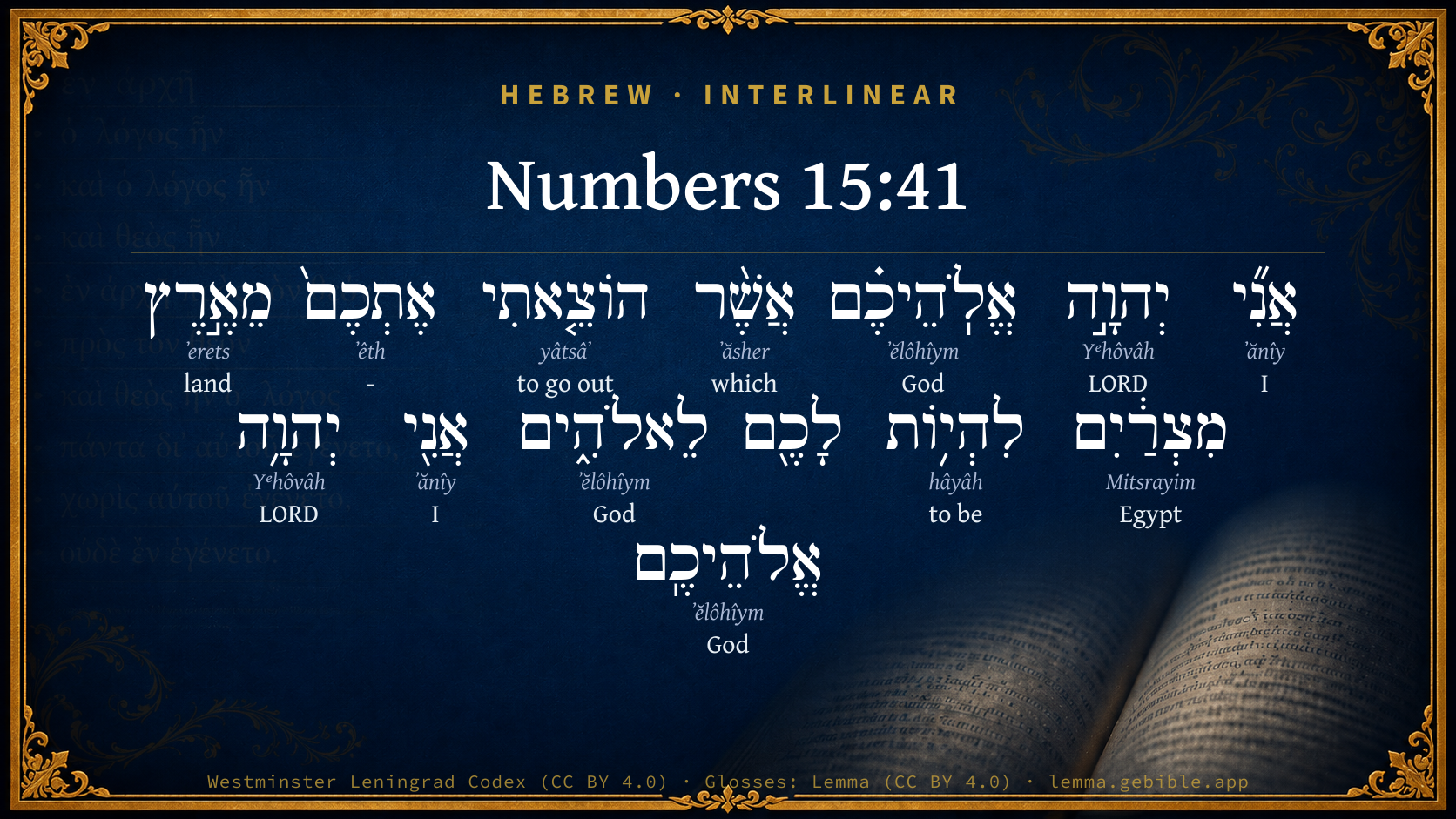
Hebrew (Westminster Leningrad Codex) Numbers 15:41 appears in the Hebrew Old Testament. The text above is from the Westminster Leningrad Codex. Each word links to its Strong’s number, a concise gloss, and parsing drawn from the Open Scriptures Hebrew Bible morphology. Click any word for its full Brown-Driver-Briggs (BDB) entry.
Download image
Cite this verse

Numbers 15:41 (World English Bible). Public Domain. Lemma interlinear Bible study tool, https://lemma.gebible.app/v/numbers/15/41.

Show BibTeX & RIS
BibTeX
RIS
English Translation
I am Yahweh your God, who brought you out of the land of Egypt, to be your God: I am Yahweh your God.
World English Bible · Public Domain
Download a study sheet

One document with this verse’s original text, its word-by-word gloss line, the meaning frame, cross-references with their text, attributed commentary, and full source and license credits — printable, and it pastes into notes with its structure intact.

This verse Autodidact and up

Study sheet (.html) Plain text (.txt)

A passage Seminary Student

Up to 50 verses in one chapter. A passage sheet keeps up to 6 commentary sources and 12 cross-references per verse, in the order this page ranks them, and says so on the sheet whenever that leaves anything out. Ask for a single verse and you get the Autodidact verse sheet above.

Everything on this page stays free to read, with no account — the sheet is a download of what is already on screen, not access to it.

Want to remove ads? Support Godless Engineer
Compare translations 3

The same verse in 3 English versions, stacked beneath the original-language interlinear above. Click any original word for its lexicon entry.

Each is an independent rendering of the whole verse — the interlinear is not word-aligned to these translations.

Highlighted words mark where these versions differ — a whole-verse word diff, not a word-by-word alignment.

  • World English Bible Public Domain
    I am Yahweh your God, who brought you out of the land of Egypt, to be your God: I am Yahweh your God.
  • King James Version Public Domain
    I am the LORD your God, which brought you out of the land of Egypt, to be your God: I am the LORD your God.
  • unfoldingWord Literal Text CC BY-SA 4.0
    I am Yahweh your God, who brought you out from the land of Egypt to be for you for a God. I am Yahweh your God.’”

unfoldingWord Literal Text — © unfoldingWord, licensed CC BY-SA 4.0. Word-aligned USFM3 via Door43 (git.door43.org/unfoldingWord/en_ult).

Versions to compare (up to 4)

3 of 4 selected

Show all 18 translations

Every available English version of this verse, each an independent rendering of the whole verse.

  • World English Bible Public Domain
    I am Yahweh your God, who brought you out of the land of Egypt, to be your God: I am Yahweh your God.
  • Berean Standard Bible Public Domain
    I am the LORD your God who brought you out of the land of Egypt to be your God. I am the LORD your God.”
  • Majority Standard Bible Public Domain
    I am the LORD your God who brought you out of the land of Egypt to be your God. I am the LORD your God.”
  • King James Version Public Domain
    I am the LORD your God, which brought you out of the land of Egypt, to be your God: I am the LORD your God.
  • American Standard Version (1901) Public Domain
    I am Jehovah your God, who brought you out of the land of Egypt, to be your God: I am Jehovah your God.
  • Revised Version (1885) Public Domain
    I am the LORD your God, which brought you out of the land of Egypt, to be your God: I am the LORD your God.
  • Geneva Bible (1599) Public Domain
    I am the Lord your God, which brought you out of the lande of Egypt, to bee your God: I am the Lord your God.
  • Douay-Rheims (1899) Public Domain
    I am the Lord your God, who brought you out of the land of Egypt, that I might be your God.
  • Young's Literal Translation Public Domain
    I `am' Jehovah your God, who hath brought you out from the land of Egypt to become your God; I, Jehovah, `am' your God.'
  • Literal Standard Version CC BY-SA 4.0
    I [am] your God YHWH, who has brought you out from the land of Egypt to become your God; I [am] your God YHWH.”
  • Unlocked Literal Bible CC BY-SA 4.0
    I am Yahweh your God, who brought you out of the land of Egypt, to become your God. I am Yahweh your God.”
  • unfoldingWord Literal Text CC BY-SA 4.0
    I am Yahweh your God, who brought you out from the land of Egypt to be for you for a God. I am Yahweh your God.’”
  • Darby Bible Public Domain
    I am Jehovah your God, who brought you out of the land of Egypt to be your God: I am Jehovah your God.
  • World Messianic Bible Public Domain
    I am the LORD your God, who brought you out of the land of Egypt, to be your God: I am the LORD your God.”
  • Webster's Bible Public Domain
    I am the LORD your God, who brought you out of the land of Egypt, to be your God: I am the LORD your God.
  • Free Bible Version CC BY-SA 4.0
    I am the Lord your God!”
  • Bible in Basic English Public Domain
    I am the Lord your God, who took you out of the land of Egypt, so that I might be your God: I am the Lord your God.
  • JPS Tanakh (1917) Public Domain
    I am the LORD your God, who brought you out of the land of Egypt, to be your God: I am the LORD your God.'

Literal Standard Version (2020), Covenant Press — licensed CC BY-SA 4.0. Text via the HelloAO Bible API (eBible.org). Unlocked Literal Bible (unfoldingWord) — licensed CC BY-SA 4.0. Text via the HelloAO Bible API (eBible.org). unfoldingWord Literal Text — © unfoldingWord, licensed CC BY-SA 4.0. Word-aligned USFM3 via Door43 (git.door43.org/unfoldingWord/en_ult). Free Bible Version, Dr. Jonathan Gallagher — licensed CC BY-SA 4.0. Text via the HelloAO Bible API (eBible.org).

Word by word

More ways to search: Search by grammar → Find every occurrence → Compare this word →

Practice this passage: Drill this verse → Learn its vocabulary →

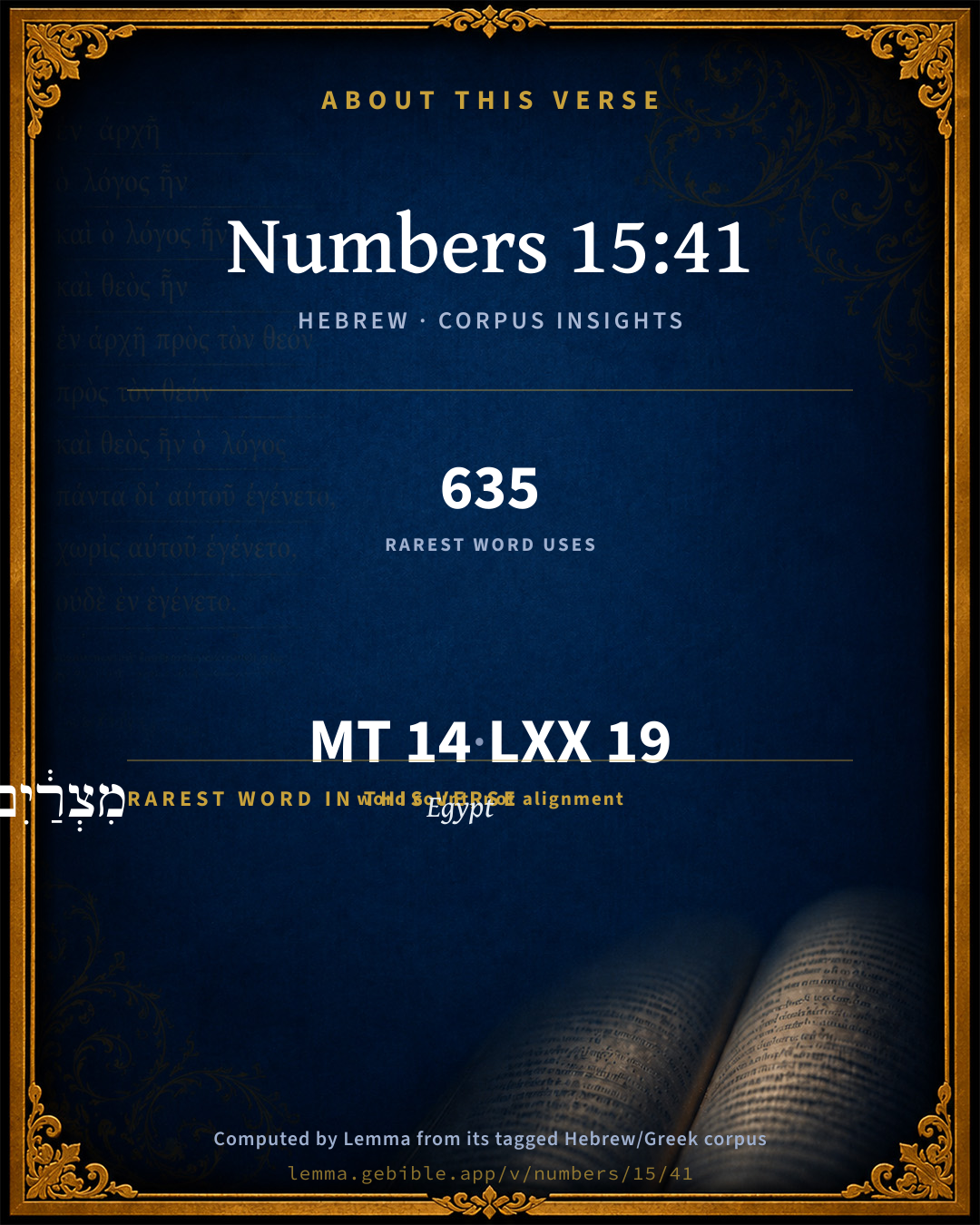
מִצְרַ֔יִם
Mitsrayim
H4714
“Egypt”
Noun, Proper
Part of Speech
Noun
Type
Proper
Full BDB Definition

Origin: dual of H4693

TWOT: 1235

Egyptians = "double straits" - a country at the northeastern section of Africa, adjacent to Palestine, and through which the Nile flows (noun proper locative) - the inhabitants or natives of Egypt (adjective)
  1. אֲנִ֞י ʼănîy H589 “I” Pronoun, Personal, 1st Person, Common, Singular
  2. יְהוָ֣ה Yᵉhôvâh H3068 “LORD” Noun, Proper
  3. אֱלֹֽהֵיכֶ֗ם ʼĕlôhîym H430 “God(s) · your” Noun, Common, Masculine, Plural, Construct + Suffix, Personal, 2nd Person, Masculine, Plural
  4. אֲשֶׁ֨ר ʼăsher H834 “which” Particle, Relative
  5. הוֹצֵ֤אתִי yâtsâʼ H3318 “to go out” Verb, Hiphil, Perfect, 1st Person, Common, Singular
  6. אֶתְכֶם֙ ʼêth H853 “- · you” Particle, Direct Object + Suffix, Personal, 2nd Person, Masculine, Plural
  7. מֵאֶ֣רֶץ ʼerets H776 “from · land of” Preposition + Noun, Common, Both, Singular, Construct
  8. לִהְי֥וֹת hâyâh H1961 “to be” Preposition + Verb, Qal, Infinitive Construct
  9. לֵאלֹהִ֑ים ʼĕlôhîym H430 “to/for · God(s)” Preposition + Noun, Common, Masculine, Plural, Absolute
  10. אֲנִ֖י ʼănîy H589 “I” Pronoun, Personal, 1st Person, Common, Singular
  11. יְהוָ֥ה Yᵉhôvâh H3068 “LORD” Noun, Proper
  12. אֱלֹהֵיכֶֽם ʼĕlôhîym H430 “God(s) · your” Noun, Common, Masculine, Plural, Construct + Suffix, Personal, 2nd Person, Masculine, Plural

About this verse

These counts appear in no published source. They are computed here, from the morphology-tagged text and Lemma’s own curated glosses. What Lemma adds →

14
words
9
distinct lemmas
Pentateuch
section

Grammatical profile

  • 2 verbs
  • 7 nouns
  • 2 pronouns
  • 1 preposition
  • 2 particles

Verb forms

  • הוֹצֵ֤אתִי Hiphil · Perfect
  • לִהְי֥וֹת Qal · Infinitive Construct

Repetition

Words recur within this verse — often emphatic in Hebrew:

  • אֱלֹֽהֵיכֶ֗ם God H430 ×3
  • יְהוָ֣ה LORD H3068 ×2
  • אֲנִ֞י I H589 ×2

Hebrew & Septuagint length

In English translation the verse runs 23 words from the Hebrew and 25 from the Septuagint (LXX English) — closely comparable.

A rough comparison of the two English renderings, which tokenize alike — not a word-level alignment.

Word counts can differ between the Hebrew and the Greek without any difference in meaning — e.g. the Hebrew direct-object marker אֵת has no separate Greek word, and Greek often adds the article ὁ.

In the original languages it is 14 Hebrew tokens and 19 Greek tokens — but the two are counted differently (Hebrew bundles its prefixes and suffixes into one token; the Greek is in lemma form), so that isn’t a like-for-like length.

Cross-references

8

Topical passages linked to Numbers 15:41 in the Treasury of Scripture Knowledge — connected by theme and wording, ordered by reader-vote popularity; previews shown in the World English Bible.

  • 1 Peter 2:9–10 But you are a chosen race, a royal priesthood, a holy nation, a people for God's own possession, that you may show forth the excellencies of him who called you out of darkness into his marvelous light:
  • Leviticus 22:33 who brought you out of the land of Egypt, to be your God. I am Yahweh."
  • Leviticus 25:38 I am Yahweh your God, who brought you forth out of the land of Egypt, to give you the land of Canaan, and to be your God.
  • Psalms 105:45 That they might keep his statutes, And observe his laws. Praise Yah!
  • Jeremiah 31:31–33 Behold, the days come, says Yahweh, that I will make a new covenant with the house of Israel, and with the house of Judah:
  • Jeremiah 32:37–41 Behold, I will gather them out of all the countries, where I have driven them in my anger, and in my wrath, and in great indignation; and I will bring them again to this place, and I will cause them to dwell safely:
  • Ezekiel 36:25–27 I will sprinkle clean water on you, and you shall be clean: from all your filthiness, and from all your idols, will I cleanse you.
  • Hebrews 11:16 But now they desire a better country, that is, a heavenly one. Therefore God is not ashamed of them, to be called their God, for he has prepared a city for them.

Cross-references courtesy of OpenBible.info (CC BY 4.0).

Hebrew and Greek witnesses Masoretic Hebrew ↔ Greek Septuagint

The same verse in the two great witnesses to the Old Testament, shown verse-for-verse.

These are two independent witnesses, not word-aligned to each other, and the Septuagint is shown in lemma (dictionary) form.

Hebrew Numbers 15:41 Masoretic · Westminster Leningrad Codex

אֲנִ֞י יְהוָ֣ה אֱלֹֽהֵיכֶ֗ם אֲשֶׁ֨ר הוֹצֵ֤אתִי אֶתְכֶם֙ מֵאֶ֣רֶץ מִצְרַ֔יִם לִהְי֥וֹת לָכֶ֖ם לֵאלֹהִ֑ים אֲנִ֖י יְהוָ֥ה אֱלֹהֵיכֶֽם

I am Yahweh your God, who brought you out of the land of Egypt, to be your God: I am Yahweh your God.

World English Bible · Public Domain

Greek LXX Numbers 15:41 Septuagint · lemma form

ἐγώ κύριος ὁ θεός σύ ὁ ἐκἄγω σύ ἐκ γῆ αἴγυπτος εἰμί σύ θεός ἐγώ κύριος ὁ θεός σύ

I am the Lord your God that brought you out of the land of Egypt, to be your God: I am the Lord your God.

LXX2012 (modern English Septuagint) · Public Domain

Hebrew: Westminster Leningrad Codex (CC BY 4.0). Greek: Septuagint (public domain); English from LXX2012 (modern English Septuagint) (Public Domain). How the Septuagint differs from the Hebrew →

Targum (Aramaic paraphrase)

2

The Targum is the ancient Jewish Aramaic paraphrase of the Hebrew Scriptures — an interpretive translation, not the Hebrew text itself. Onkelos (literal) and Pseudo-Jonathan (expansive) render the Torah, and Jonathan the Prophets. Coverage is partial: where no permissively-licensed English translation exists for a verse, only the Aramaic is shown. This is verse-level text, not a word-by-word alignment to the Hebrew.

  1. Targum Onkelos Torah (Genesis–Deuteronomy)
    אֲנָא יְיָ אֱלָהָכוֹן דִי אַפֵּקִית יָתְכוֹן מֵאַרְעָא דְמִצְרַיִם לְמֵהֲוֵי לְכוֹן לֶאֱלָהָא אֲנָא יְיָ אֱלָהָכוֹן

    (no public-domain English translation for this verse)

    Targum Onkelos — Aramaic: “Onkelos Genesis” (public domain); “Onkelos Exodus” (public domain); “Onkelos Leviticus” (public domain); “Onkelos Numbers” (public domain); “Onkelos Deuteronomy” (public domain). English: “Sefaria Community Translation” (CC0 1.0 (public-domain dedication)); “J.W. Etheridge. The Targums of Onkelos and Jonathan Ben Uzziel on the Pentateuch. London: Longmans, Green, 1862” (public domain). Text via Sefaria.

  2. Targum Pseudo-Jonathan Torah (Genesis–Deuteronomy)
    אֲנָא הוּא יְיָ אֱלָהָכוֹן דִי פְרָקִית וְאַפֵּקִית יַתְכוֹן פְּרִיקִין מֵאַרְעָא דְמִצְרַיִם מְטוֹל לְמֶהֱוֵי לְכוֹן לֶאֱלָהָא אֲנָא הוּא יְיָ אֱלָהָכוֹן

    I am the Lord your God who have delivered and brought you free out of the land of Mizraim, to be to you Eloha. I am the Lord your God.

    Targum Pseudo-Jonathan — Aramaic: “Targum Jonathan on Genesis” (public domain); “Targum Jonathan on Exodus” (public domain); “Targum Jonathan on Leviticus” (public domain); “Targum Jonathan on Numbers” (public domain); “Targum Jonathan on Deuteronomy” (public domain). English: “The Targum of Jonathan ben Uzziel, trans. J. W. Etheridge, London, 1862” (public domain). Text via Sefaria.

Commentary

Notes on Numbers 15:41 from classic Christian and Jewish commentators (each source and its license shown beneath its notes). The classic Christian expositions comment on the surrounding passage and are grouped to its opening verse, so a note may address several verses; the Jewish commentaries on the Tanakh (Rashi and others) are per-verse, so they appear only where the commentator wrote on this verse.

Lemma curates 59 commentaries, every one of them public domain or Creative Commons licensed, each selected and text-cleaned for this edition rather than reprinted as found. About our sources →

The Biblical Illustrator

Joseph S. Exell

Num_15:41

I am the Lord your God.

Everlasting relationship

Can anything be more blessed to Gods people than the assurance of the everlasting relationship existing between Himself and them? This everlasting relationship is a hiding-place, refuge, and defence in this desert land; a safe retreat, where the soul may obtain repose, satisfaction, in trying moments.

I. To say that eternal relationship leads to licentiousness, and induces a disregard to all moral and social duties, is the same as to say, that to bring any individual into the clear, bright light of the sun will cause a pebble to become a stumbling-block unto him. Here is a threefold assertion of relationship in my text, which relationship now is but rarely understood, still less enjoyed, and often reviled. But, now, notice the nature of this relationship. It is a relationship of a father, a Brother, a Comforter, a Guide, a Preceptor. It is a relationship of King and subject, Parent and child, Husband and wife, Friend and friend.

II. The deliverance effected as a proof of this relationship. The proof is that He brought His people out of Egypt. Oh! says one timid soul, but I do not belong to Him. I do not think the Lord speaks to me. Well, I do not desire you to make the assertion, unless God has brought you from Egypt. But mock not His love, deny not His grace, insult not His Spirit by questioning the relationship if He has rescued you from the bondage of sin, Satan, and self, the world, and the devil. He has delivered you on purpose to be your God, openly and avowedly.

III. The claim of God is upon us, for devotedness to His glory and activity in His cause. He has brought you out for His own use; and He has a right to all the ardour of your spirit, all the activity of your life, all the affections of your soul. Remember, you are not your own, but bought with a price; therefore glorify God with your body and spirit, which are His. Oh! what ties bind us to devotedness to His name--ties of blood, ties of love, ties of grace. As a King, He created me His subject; as a Deliverer, He brought me to liberty; as my God, He allied me to Himself in everlasting relationship. And if all these ties fail to produce the effect of consecration of heart, and soul, and life to Him, I have one more tie left--namely, the constraint of love. (J. Irons.)

.

The Biblical Illustrator, edited by Joseph S. Exell (c. 1880s–1900s) — public domain. Text from a community e-Sword module.

Jamieson, Fausset & Brown

Robert Jamieson, A. R. Fausset & David Brown

I am the Lord your God--The import of this solemn conclusion is, that though He was displeased with them for their frequent rebellions, for which they would be doomed to forty years' wanderings, He would not abandon them but continue His divine protection and care of them till they were brought into the land of promise.

Next: Numbers Chapter 16

Jamieson, Fausset & Brown — Commentary Critical and Explanatory on the Whole Bible (1871) — public domain (CC PDM 1.0). Text via the HelloAO Bible API.

Matthew Poole's English Annotations

Though I am justly displeased with you, for your frequent and horrid rebellions, for which also I will keep you forty years in the wilderness, yet I will not utterly cast you off, but will continue to be your God, to preserve and provide for you there, and after that time to bring you into Canaan.

Matthew Poole's English Annotations on the Holy Bible (1683–1685) — public domain. Text from a community e-Sword/MySword module.

The Pulpit Commentary

I am the Lord your God. This intensely solemn formula, here twice repeated, may serve to show how intimately the smallest observances of the Law were connected with the profoundest and most comforting of spiritual truths, if only observed in faith and true obedience. The whole of religion, theoretical and practical, lay in those words, and that whole was hung upon a tassel. It is further to be noted that this precept was given during the years of exile, and probably given as one which they could keep, and which would be helpful to them, at a time when almost all other distinctive observances were suspended.

God recalls a great deed and the purpose of it.

I GOD RECALLED A GREAT DEED. I brought you out of the land of Egypt.

1. It was deliverance from a bitter bondage. The Israelites had been making light of it of late, but in Egypt it was grievous indeed. (Exo_1:13, 14 2:23 3:7 6:9) So God, by the work of his incarnate Son, delivered the world from a bitter bondage. "Behold the Lamb of God which taketh away the sin of the whole world." The act of Divine power by which Jesus rose from the grave did not sweep away all difficulties and make life henceforth a path of roses. But it is a great deal to stand on this side, historically, of the sepulcher from which the stone was rolled away. The generations before the resurrection of Jesus were, as we may say, in Egypt, waiting deliverance. The world since that event stands, as it were, delivered. He who brought life and immortality to light destroyed him that had the power of death, that is, the devil, and delivered them who through fear of death were all their lifetime subject to bondage. (Heb_2:14, Heb_2:15)

2. It was a deliverance worked out entirely by God. "I brought you out, &c." There was no struggle against Pharaoh on the part of the people. We do not see the prisoner within conspiring with the deliverer outside. The bondage was so bitter, the subjection so complete, that the people were not moved to conspiracy and insurrection. We read constantly in history of servile and subject races winning their way to freedom through the bloody struggles of many generations, but these Israelites before Pharaoh were like oxen broken to the plough. They groaned, but they submitted. And in this Egyptian sort of bondage the world was fast before Christ came to deliver. Men groaned under the burdens of life; they were filled with the fruits of sin; they yielded at last to tile grasp of death. All was accepted as a mysterious necessity; men did not protest and struggle against calamity and death. The deliverance is from Jesus, and in it we have no hand. "When we were yet without strength, in due time Christ died for the ungodly". (Rom_5:6) A delivered world was even incredulous as to its deliverance. It could not believe that as by one man came sin and death, so by one also had come conquest over sin, death, and the devil. Thomas, the very disciple, doubts, and before long Paul has to write 1Co 15. Jesus may say to the world for which he died and rose again, "I brought you out of spiritual Egypt.

3. While the deliverance was being worked out, the Israelites were scarcely conscious of what was being done. They saw the plagues, but only as wonders, stupendous physical calamities. They felt the grasp of Pharaoh alternately tightening and relaxing, but little did they comprehend of that great, significant struggle going on between Jehovah and Pharaoh. They waited, as the prize of victory waits on the athletes while they contend; it knows nothing of the energy and endurance it has evoked. And so it was and is in Christ"s redeeming work. It is wonderful to notice how unconscious the world was of that great work which was transacted between Bethlehem and Jerusalem, between the cradle of Jesus and his opened grave. The world looked upon him, and to a large extent it still looks, in any light but the right one. Let us know him first then, and fully in all that the work means, as Deliverer from spiritual Egypt.

II THE PURPOSE OF THIS GREAT DEED. "I brought you out of the land of Egypt to be your God." It is one thing for Israel to be brought out of Egypt; quite another for it to understand why it has been brought out. And so we find the people complaining of the wilderness quite as much as they had done of Egypt. Their expectations pointed in a direction opposite to God"s purpose, and never could the wilderness become a better place than Egypt until they did appreciate God"s purpose and make it their own. God did not bring them out as one might bring a man out of prison, and then say, "Go where you like." They were brought out of a bitter bondage to enter upon a reasonable service, otherwise the wilderness would prove only an exchange of suffering, not a release from it. In like manner we need to ask how the world may be made better by the redeeming work of Christ. The difference between the state of the world before the death of Christ and since does not look as great from certain points of view as one might expect. A countless host of those for whom he died and rose again nevertheless goes about in a bewilderment and unbelief equal to that of the Israelites in the wilderness. Christ died for us and rose again, that we, rising with him, might live not to ourselves, but to him. (Rom_6:4, Rom_6:10-13, indeed the whole chapter; Rom_12:1 Rom_14:7-9 1Co_3:22, 23 2Co_5:15-18 2Co_10:5 Eph_2:10 Php_1:20, 21Col_3:1-3) Deliverance from Egypt is not equivalent to entrance into the promised land. The wilderness is a critical place for us, and all depends on what heed we take to this purpose of God. We must receive the gospel in its integrity. If the full purpose of God becomes our full purpose, then all will be right. Christ died for us, not that we might just escape the penalty and power of sin, as something painful to ourselves, and know the luxury of a washed conscience; not that we might just pass into a perfect blessedness beyond the tomb; but that, becoming pure and blessed, we might engage in the service of God and set forth his glory. We must be pleased with what pleases him. The work of Christ brings us that highest of all joy, to serve God with a perfect heart and a willing mind. Y.

The Pulpit Commentary (1880–1919), ed. H.D.M. Spence-Jones & Joseph S. Exell — public domain. Text from a community e-Sword module.

John Wesley's Explanatory Notes

I am the Lord your God - Though I am justly displeased with you for your frequent rebellions, for which also I will keep you forty years in the wilderness, yet I will not utterly cast you off, but will continue to be your God.

John Wesley, Explanatory Notes Upon the Whole Bible (1754–1765) — public domain. Text via the GEBible commentary corpus.

Rashi

Rabbi Shlomo Yitzchaki (Rashi)

אני ה׳ I AM THE LORD Who am faithful to give reward.

אלהיכם YOUR GOD Who am certain to exact punishment (cf. Sifrei Bamidbar 115:1).

אשר הוצאתי אתכם [I AM THE LORD YOUR GOD] WHO BROUGHT YOU OUT [OF THE LAND OF EGYPT TO BE YOUR GOD] — On this condition I delivered you — that you should take upon yourselves My decrees (i.e. that I should be your God) (Sifrei Bamidbar 115:1).

אני ה׳ אלהיכם I AM THE LORD YOUR GOD — Why is this stated again? In order that the Israelites should not say, “Why has the Omnipresent said it ('אני ה)? Is it not in order that we should perform the commandments and receive reward (cf. Rashi on previous verse)!? We will not perform them and we shall not receive (we shall not expect) any reward!” Therefore it states again in general terms and without reference to the Exodus from Egypt, “I will be the Lord your God: in spite of yourselves I will be your King (I will exercise My sovereignty upon you). — In a similar sense it states, (Ezekiel 20:23) “Surely with a strong hand … will I reign over you” (Sifrei Bamidbar 115:1). — Another explanation: Why is the exodus from Egypt mentioned in connection with the fringes? In order to intimate: It was I who distinguished in Egypt between one who was a firstborn and one who was not (cf. Rashi on Leviticus 19:36); I shall also find out and exact punishment from him who attaches indigo-dyed wool (which resembles תכלת in colour) on his garments and pretends that it is תכלת (Bava Metzia 61b). From the work of Rabbi Moses the Preacher I copy the following: Why is the section speaking of the stick-gatherer placed in juxtaposition with the section (vv. 22—31) dealing with idolatry? In order to tell you that whoever desecrates the Sabbath is regarded as having worshipped idols, for it (the law of the Sabbath) also is alone of equal importance with the entire sum of the commandments (just as is the law of idolatry; cf. Rashi on v. 22). And so, too, it is said in the Book of Ezra, (Nehemia 9:13—14) “And Thou camest down upon Mount Sinai and gavest to Thy people … the Torah and commandments and Thou madest known unto them Thy holy Sabbath”. And the section dealing with the “Zizith” is also for the same reason placed in juxtaposition with these two sections, because it, too, is of equal importance with the sum total of the commandments, as it is said, (v. 40) “[That ye may remember] and do all My commandments".

על כנפי בגדיהם ON THE BORDERS (lit., wings) OF THEIR GARMENTS — an allusion to God having delivered them from Egypt, as it states, (Exodus 19:4) “And I bore you on eagles’ wings” (cf. Rashi on this verse). The Zizith are to be placed on a garment having four corners but not on one that has three or on one that has five corners (cf. Zevachim 18b), thereby alluding to the four different terms used by God in describing the deliverance from Egypt, for it states, (Exodus 6:6—7) “And I will bring forth”, “and I shall deliver”, “and I shall redeem”, “and I shall take out”.

פתיל תכלת A THREAD OF BLUE PURPLE — an allusion to the bereavement (שכול) which the Egyptians suffered through the death of their firstborn, for the Targum (Aramaic) word corresponding to שכול, bereavement, is תכלה (similar in sound to תכלת). Further, the plague that befell them was at night, and so, too, the colour תכלת resembles the sky when it darkens at eventide (cf. Sifrei Bamidbar 115:1; Menachot 43b). The eight threads in it (the ציצית) are an allusion to the eight days that Israel waited from the time they went forth from Egypt until they sang the Song of Praise at the Red Sea.

Rashi on the Tanakh — English translations: “The Judaica Press complete Tanach with Rashi, translated by A. J. Rosenberg” (CC BY 4.0); “Pentateuch with Rashi's commentary by M. Rosenbaum and A.M. Silbermann, 1929-1934” (public domain); “The Metsudah Tanach series, Lakewood, N.J” (CC BY 4.0); and “The Book of Joshua, Metsudah Publications, 1997” (CC BY 4.0). Text via Sefaria.

Lesson kit

Teaching starters — assembled from the data on this page, not authored interpretation. Every prompt links to the verse data it draws on. Edit before teaching.

Numbers, in the Pentateuch, opens this verse with 14 words (9 distinct Hebrew lemmas). Its most distinctive word is Mitsrayim (“Egypt”). A historical commentator’s framing appears above. Read the whole chapter for the surrounding context.

Discussion questions

  1. What does “Egypt” (Mitsrayim) contribute to the verse as a whole?
  2. How does 1 Peter 2:9–10, which shares this passage’s theme, read alongside this verse?
  3. What does the repetition of “God” (3× in this one verse) do in this verse?
  4. These translations render this verse differently; the difference is in the English rendering, not the original. What questions does that raise?
  5. «הוֹצֵ֤אתִי» is a Hiphil Perfect verb. How does that grammatical form shape the action described?
  6. Compare how The Biblical Illustrator and Jamieson, Fausset & Brown read this verse. Where do they agree or differ?

Things to notice

Reading settings

Reading text

Shown beneath each verse's original-language words.

Old Testament
Old Testament edition

Read the OT as the Masoretic Hebrew (MT) or the Greek Septuagint (LXX).

English shown for the Greek Septuagint (in the Hebrew ↔ Greek comparison).

Comparing translations? Open the Compare panel on any verse page to stack up to four side by side.