
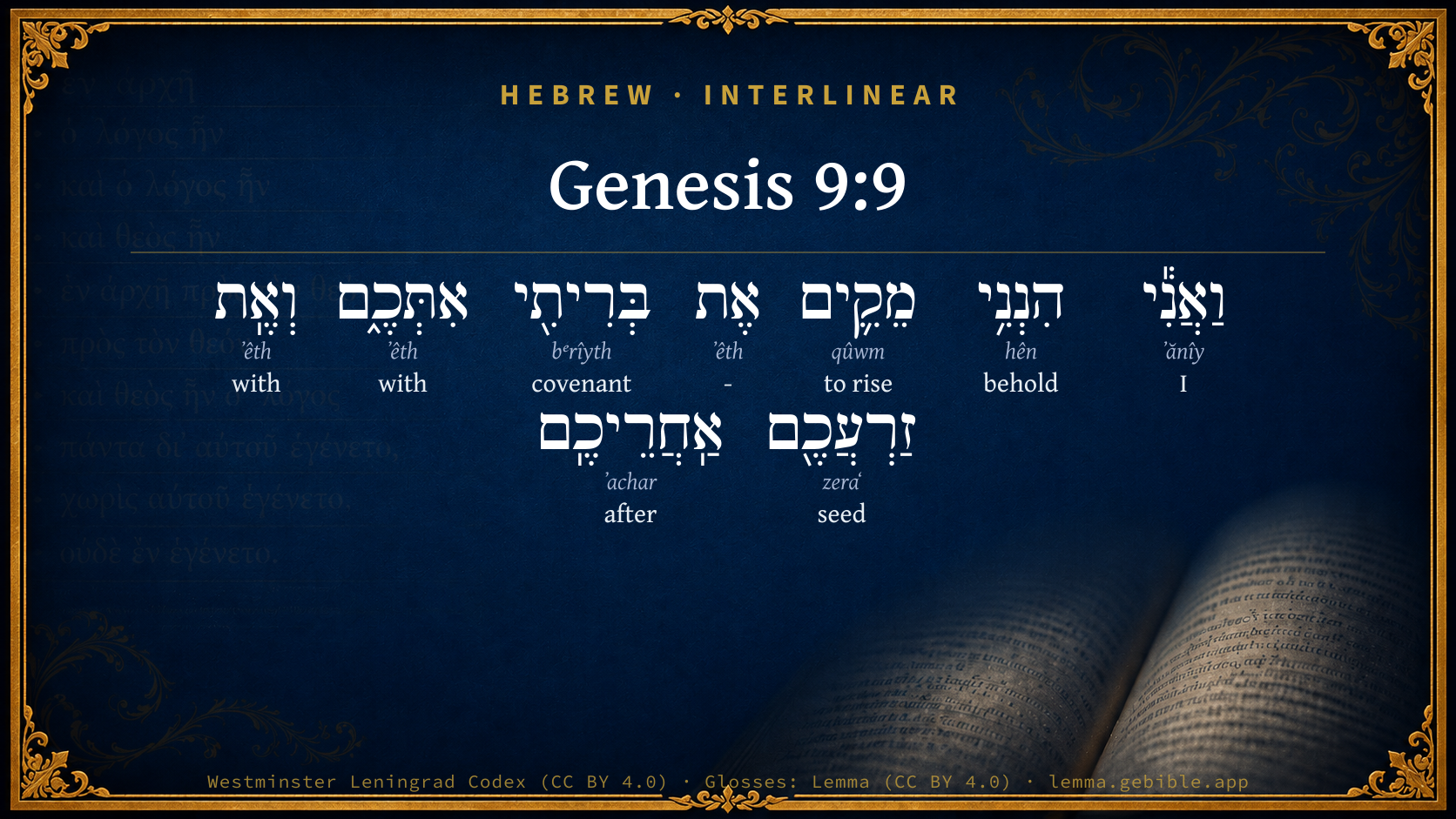
Genesis 9:9

Hebrew (Westminster Leningrad Codex) Genesis 9:9 appears in the Hebrew Old Testament. The text above is from the Westminster Leningrad Codex. Each word links to its Strong’s number, a concise gloss, and parsing drawn from the Open Scriptures Hebrew Bible morphology. Click any word for its full Brown-Driver-Briggs (BDB) entry.
Download image
Cite this verse

Genesis 9:9 (World English Bible). Public Domain. Lemma interlinear Bible study tool, https://lemma.gebible.app/v/genesis/9/9.

Show BibTeX & RIS
BibTeX
RIS
English Translation
"As for me, behold, I establish my covenant with you, and with your offspring after you,
World English Bible · Public Domain
Download a study sheet

One document with this verse’s original text, its word-by-word gloss line, the meaning frame, cross-references with their text, attributed commentary, and full source and license credits — printable, and it pastes into notes with its structure intact.

This verse Autodidact and up

Study sheet (.html) Plain text (.txt)

A passage Seminary Student

Up to 50 verses in one chapter. A passage sheet keeps up to 6 commentary sources and 12 cross-references per verse, in the order this page ranks them, and says so on the sheet whenever that leaves anything out. Ask for a single verse and you get the Autodidact verse sheet above.

Everything on this page stays free to read, with no account — the sheet is a download of what is already on screen, not access to it.

Want to remove ads? Support Godless Engineer
Compare translations 3

The same verse in 3 English versions, stacked beneath the original-language interlinear above. Click any original word for its lexicon entry.

Each is an independent rendering of the whole verse — the interlinear is not word-aligned to these translations.

Highlighted words mark where these versions differ — a whole-verse word diff, not a word-by-word alignment.

  • World English Bible Public Domain
    "As for me, behold, I establish my covenant with you, and with your offspring after you,
  • King James Version Public Domain
    And I, behold, I establish my covenant with you, and with your seed after you;
  • unfoldingWord Literal Text CC BY-SA 4.0
    “And I, behold, I am establishing my covenant with you and with your offspring after you,

unfoldingWord Literal Text — © unfoldingWord, licensed CC BY-SA 4.0. Word-aligned USFM3 via Door43 (git.door43.org/unfoldingWord/en_ult).

Versions to compare (up to 4)

3 of 4 selected

Show all 18 translations

Every available English version of this verse, each an independent rendering of the whole verse.

  • World English Bible Public Domain
    "As for me, behold, I establish my covenant with you, and with your offspring after you,
  • Berean Standard Bible Public Domain
    “Behold, I now establish My covenant with you and your descendants after you,
  • Majority Standard Bible Public Domain
    “Behold, I now establish My covenant with you and your descendants after you,
  • King James Version Public Domain
    And I, behold, I establish my covenant with you, and with your seed after you;
  • American Standard Version (1901) Public Domain
    And I, behold, I establish my covenant with you, and with your seed after you;
  • Revised Version (1885) Public Domain
    And I, behold, I establish my covenant with you, and with your seed after you;
  • Geneva Bible (1599) Public Domain
    Behold, I, euen I establish my couenant with you, and with your seede after you,
  • Douay-Rheims (1899) Public Domain
    Behold I will establish my covenant with you, and with your seed after you:
  • Young's Literal Translation Public Domain
    `And I, lo, I am establishing My covenant with you, and with your seed after you,
  • Literal Standard Version CC BY-SA 4.0
    “And I, behold, I am establishing My covenant with you, and with your seed after you,
  • Unlocked Literal Bible CC BY-SA 4.0
    “As for me, listen! I am going to confirm my covenant with you and with your descendants after you,
  • unfoldingWord Literal Text CC BY-SA 4.0
    “And I, behold, I am establishing my covenant with you and with your offspring after you,
  • Darby Bible Public Domain
    And I, behold, I establish my covenant with you, and with your seed after you;
  • World Messianic Bible Public Domain
    “As for me, behold, I establish my covenant with you, and with your offspring after you,
  • Webster's Bible Public Domain
    And I, behold, I establish my covenant with you, and with your seed after you;
  • Free Bible Version CC BY-SA 4.0
    “Listen, I'm making my agreement with you and your descendants,
  • Bible in Basic English Public Domain
    Truly, I will make my agreement with you and with your seed after you,
  • JPS Tanakh (1917) Public Domain
    'As for Me, behold, I establish My covenant with you, and with your seed after you;

Literal Standard Version (2020), Covenant Press — licensed CC BY-SA 4.0. Text via the HelloAO Bible API (eBible.org). Unlocked Literal Bible (unfoldingWord) — licensed CC BY-SA 4.0. Text via the HelloAO Bible API (eBible.org). unfoldingWord Literal Text — © unfoldingWord, licensed CC BY-SA 4.0. Word-aligned USFM3 via Door43 (git.door43.org/unfoldingWord/en_ult). Free Bible Version, Dr. Jonathan Gallagher — licensed CC BY-SA 4.0. Text via the HelloAO Bible API (eBible.org).

Word by word

More ways to search: Search by grammar → Find every occurrence → Compare this word →

Practice this passage: Drill this verse → Learn its vocabulary →

זַרְעֲכֶ֖ם
zeraʻ
H2233
“seed · your”
Noun, Common, Masculine, Singular, Construct + Suffix, Personal, 2nd Person, Masculine, Plural
Part of Speech
Noun
Type
Common
Gender
Masculine
Number
Singular
State
Construct
Full BDB Definition

Origin: from H2232

TWOT: 582a

seed, sowing, offspring - a sowing - seed - semen virile - offspring, descendants, posterity, children - of moral quality - a practitioner of righteousness (figuratively) - sowing time (by metonymy)
  1. וַאֲנִ֕י ʼănîy H589 “and · I” Conjunction + Pronoun, Personal, 1st Person, Common, Singular
  2. הִנְנִ֥י hên H2005 “behold · me” Particle, Interjection + Suffix, Personal, 1st Person, Common, Singular
  3. מֵקִ֛ים qûwm H6965 “rising” Verb, Hiphil, Participle Active, Masculine, Singular, Absolute
  4. אֶת ʼêth H853 “-” Particle, Direct Object
  5. בְּרִיתִ֖י bᵉrîyth H1285 “covenant · my” Noun, Common, Feminine, Singular, Construct + Suffix, Personal, 1st Person, Common, Singular
  6. אִתְּכֶ֑ם ʼêth H854 “with · you” Preposition + Suffix, Personal, 2nd Person, Masculine, Plural
  7. וְאֶֽת ʼêth H854 “and · with” Conjunction + Preposition
  8. אַֽחֲרֵיכֶֽם ʼachar H310 “after · you” Preposition + Suffix, Personal, 2nd Person, Masculine, Plural

About this verse

These counts appear in no published source. They are computed here, from the morphology-tagged text and Lemma’s own curated glosses. What Lemma adds →

9
words
8
distinct lemmas
Pentateuch
section

Grammatical profile

  • 1 verb
  • 2 nouns
  • 1 pronoun
  • 3 prepositions
  • 2 particles

Verb forms

  • מֵקִ֛ים Hiphil · Participle Active

Repetition

A word recurs within this verse — often emphatic in Hebrew:

  • אִתְּכֶ֑ם with H854 ×2

Hebrew & Septuagint length

In English translation the verse runs 16 words from the Hebrew and 14 from the Septuagint (LXX English) — closely comparable.

A rough comparison of the two English renderings, which tokenize alike — not a word-level alignment.

Word counts can differ between the Hebrew and the Greek without any difference in meaning — e.g. the Hebrew direct-object marker אֵת has no separate Greek word, and Greek often adds the article ὁ.

In the original languages it is 9 Hebrew tokens and 13 Greek tokens — but the two are counted differently (Hebrew bundles its prefixes and suffixes into one token; the Greek is in lemma form), so that isn’t a like-for-like length.

Cross-references

9

Topical passages linked to Genesis 9:9 in the Treasury of Scripture Knowledge — connected by theme and wording, ordered by reader-vote popularity; previews shown in the World English Bible.

  • Genesis 6:18 But I will establish my covenant with you. You shall come into the ark, you, your sons, your wife, and your sons' wives with you.
  • Isaiah 54:9–10 For this is [as] the waters of Noah to me; for as I have sworn that the waters of Noah shall no more go over the earth, so have I sworn that I will not be angry with you, nor rebuke you.
  • Romans 1:3 concerning his Son, who was born of the seed of David according to the flesh,
  • Genesis 9:11 I will establish my covenant with you; neither will all flesh be cut off any more by the waters of the flood; neither will there any more be a flood to destroy the earth."
  • Genesis 9:17 God said to Noah, "This is the token of the covenant which I have established between me and all flesh that is on the earth."
  • Genesis 17:7–8 I will establish my covenant between me and you and your seed after you throughout their generations for an everlasting covenant, to be a God to you and to your seed after you.
  • Genesis 22:17 that in blessing I will bless you, and in multiplying I will multiply your seed as the stars of the heavens, and as the sand which is on the seashore. Your seed will possess the gate of his enemies.
  • Jeremiah 33:20 Thus says Yahweh: If you can break my covenant of the day, and my covenant of the night, so that there shall not be day and night in their season;
  • Jeremiah 31:35–36 Thus says Yahweh, who gives the sun for a light by day, and the ordinances of the moon and of the stars for a light by night, who stirs up the sea, so that the waves of it roar; Yahweh of hosts is his name:

Cross-references courtesy of OpenBible.info (CC BY 4.0).

Hebrew and Greek witnesses Masoretic Hebrew ↔ Greek Septuagint

The same verse in the two great witnesses to the Old Testament, shown verse-for-verse.

These are two independent witnesses, not word-aligned to each other, and the Septuagint is shown in lemma (dictionary) form.

Hebrew Genesis 9:9 Masoretic · Westminster Leningrad Codex

וַאֲנִ֕י הִנְנִ֥י מֵקִ֛ים אֶת בְּרִיתִ֖י אִתְּכֶ֑ם וְאֶֽת זַרְעֲכֶ֖ם אַֽחֲרֵיכֶֽם

"As for me, behold, I establish my covenant with you, and with your offspring after you,

World English Bible · Public Domain

Greek LXX Genesis 9:9 Septuagint · lemma form

ἐγώ ἰδού ἀναἵστημι ὁ διαθήκη ἐγώ σύ καί ὁ σπέρμα σύ μετά σύ

And behold I establish my covenant with you, and with your seed after you,

LXX2012 (modern English Septuagint) · Public Domain

On this verse, The Pulpit Commentary discusses the Septuagint’s reading. Read the note in Commentary ↓

Hebrew: Westminster Leningrad Codex (CC BY 4.0). Greek: Septuagint (public domain); English from LXX2012 (modern English Septuagint) (Public Domain). How the Septuagint differs from the Hebrew →

Targum (Aramaic paraphrase)

2

The Targum is the ancient Jewish Aramaic paraphrase of the Hebrew Scriptures — an interpretive translation, not the Hebrew text itself. Onkelos (literal) and Pseudo-Jonathan (expansive) render the Torah, and Jonathan the Prophets. Coverage is partial: where no permissively-licensed English translation exists for a verse, only the Aramaic is shown. This is verse-level text, not a word-by-word alignment to the Hebrew.

  1. Targum Onkelos Torah (Genesis–Deuteronomy)
    וַאֲנָא הָא אֲנָא מֵקִים יָת קְיָמִי עִמְּכוֹן וְעִם בְּנֵיכוֹן בַּתְרֵיכוֹן

    And I, behold, I establish my covenant with you and with your children after you,

    Targum Onkelos — Aramaic: “Onkelos Genesis” (public domain); “Onkelos Exodus” (public domain); “Onkelos Leviticus” (public domain); “Onkelos Numbers” (public domain); “Onkelos Deuteronomy” (public domain). English: “Sefaria Community Translation” (CC0 1.0 (public-domain dedication)); “J.W. Etheridge. The Targums of Onkelos and Jonathan Ben Uzziel on the Pentateuch. London: Longmans, Green, 1862” (public domain). Text via Sefaria.

  2. Targum Pseudo-Jonathan Torah (Genesis–Deuteronomy)
    אֲנָא הָא אֲנָא מְקַיֵים קְיָמַי עִמְכוֹן וְעִם בְּנֵיכוֹן בַּתְרֵיכוֹן

    I, behold, I establish my covenant with you, and with your children after you;

    Targum Pseudo-Jonathan — Aramaic: “Targum Jonathan on Genesis” (public domain); “Targum Jonathan on Exodus” (public domain); “Targum Jonathan on Leviticus” (public domain); “Targum Jonathan on Numbers” (public domain); “Targum Jonathan on Deuteronomy” (public domain). English: “The Targum of Jonathan ben Uzziel, trans. J. W. Etheridge, London, 1862” (public domain). Text via Sefaria.

Commentary

Notes on Genesis 9:9 from classic Christian and Jewish commentators (each source and its license shown beneath its notes). The classic Christian expositions comment on the surrounding passage and are grouped to its opening verse, so a note may address several verses; the Jewish commentaries on the Tanakh (Rashi and others) are per-verse, so they appear only where the commentator wrote on this verse.

Lemma curates 59 commentaries, every one of them public domain or Creative Commons licensed, each selected and text-cleaned for this edition rather than reprinted as found. About our sources →

Trapp's Complete Commentary

John Trapp

Gen 9:9 And I, behold, I establish my covenant with you, and with your seed after you;

Ver. 9. And I, behold, I establish my covenant with you.] This covenant God had made with them before the flood; but here he renews it for their further confirmation: for he knows our infirmities, and therefore seals again. This covenant is said to be made with an oath, {Isa 54:9} yet we find no such thing here expressed, because God’s bare word is as sure as an oath. So God is said to have sworn to Abraham, that which he said to him only. {Exo 32:13, with Gen 12:7}

John Trapp, A Commentary or Exposition upon All the Books of the Old and New Testament (1647–1656) — public domain. Text from a community e-Sword module.

Joseph Benson's Commentary

Gen 9:9. Behold, I establish my covenant, &c. — We have here the general establishment of God’s covenant with this new world, and the extent of that covenant.

Joseph Benson's Commentary on the Old and New Testaments (1811–1818) — public domain. Text from a community e-Sword module.

Tyndale Open Study Notes

Tyndale Open Resources

9:9-10 God had promised this covenant before the flood (6:18). Its scope extends beyond humanity to include the earth and all animals.

Tyndale Open Study Notes — © Tyndale Open Resources, licensed CC BY-SA 4.0. Text via the HelloAO Bible API.

Geneva Bible (1599)

Geneva Bible translators

To assure you that the world shall be no more destroyed by a flood.

The children which are not yet born, are comprehended in God’s covenant made with their fathers.

Geneva Bible (1599) marginal notes — public domain. Text via Bolls.life.

Ellicott's Commentary for English Readers

(9) I, behold, I establish my covenant . . . The covenant between God and man is thus solemnly introduced as Elohim’s personal act. No covenant is mentioned as existing between Elohim and the antediluvian world; but distinctly now there is a step onward in all respects, and man, in the renovated earth after the flood, is brought nearer to God by being admitted into covenant with Him. And not only is man included in the covenant, but, first, those animals which had been with Noah in the ark; and, secondly, those which had not been admitted there. For the words of Gen_9:10 are: “From all that go out of the ark unto every beast of the earth” (the larger world). To such straits are those reduced who hold to the theory of a universal deluge, that Kalisch argues that it means the fish, as if fishes would be destroyed by a second flood any more than they were by the first. Plainly, the words imply the existence of a larger world-sphere than that in connection with Noah, and give the assurance that not only those now providentially preserved, but the animals everywhere, shall never again be in danger of a similar extinction.

A Bible Commentary for English Readers, edited by Charles John Ellicott (1878–1897) — public domain. Text from a community e-Sword module.

The Cambridge Bible for Schools and Colleges

gen. ed. J. J. S. Perowne

8–17b. The Covenant with Noah

9. I, behold, I] Cf. Gen_6:17, “I, behold, I do bring the flood of waters.” The same personal emphasis is expressed in proclaiming the mercy of the covenant as previously in the sentence of doom.

establish my covenant] See Gen_6:18. The Pentateuch mentions three covenants between God and man: (1) with Noah, and its token is the rainbow; (2) with Abraham, 15 and 17, and its token is circumcision, chap. 17; (3) with the people of Israel at Mt Sinai, and its tokens are “the blood of the covenant,” the Tabernacle, and the Levitical system (Exodus 24, 25.).

In a covenant between God and man, God makes the promise and lays down the conditions. Man accepts the terms unconditionally, while God “establishes,” or ratifies, them.

There is no equality of relationship as in a covenant agreement between men. Man is pledged to obedience on the strength of God’s promise of blessing. An outward sign is the “sacrament” of the relation.

The Cambridge Bible for Schools and Colleges (gen. ed. J. J. S. Perowne; Cambridge University Press, 1878–1918) — public domain. Text from a community e-Sword module.

John Gill's Exposition

And I, behold, I establish my covenant with you,.... Not the covenant of grace in Christ, but of the preservation of the creatures in common, a promise that they should not be destroyed any more by a flood; to which promise it seems an oath was annexed, as appears from Isa 54:9 which passage refers to this covenant, as Aben Ezra on the place observes; and both to raise attention to what is here affirmed, and to show the certainty of it, the word "behold" is prefixed to it; nor is it amiss what Jarchi observes, that this follows upon the direction and exhortation to procreation of children, and is an encouragement to it; since it is assured that posterity should be no more cut off in the manner it had been; for this covenant was made and established not only with Noah, and his sons, but with all their succeeding offspring, as follows:

and with your seed after you; with all their posterity to the end of the world; so that this covenant was made with all the world, and all the individuals in it, from Noah's time to the end of it; for from him and his sons sprung the whole race of men that peopled the world, and still continue to inhabit it; hence here is nothing in it peculiar to the seed of believers.

John Gill's Exposition of the Whole Bible (1746–1763) — public domain (CC PDM 1.0). Text via the HelloAO Bible API.

Matthew Poole's English Annotations

i.e. My promise, for the beasts included in this covenant, Gen 9:10, are not capable of a covenant properly so called. And the word

covenant is oft used for a simple promise, as we shall see hereafter.

With your seed, i.e. your posterity, as that word is frequently taken, as Gen 12:7; Exo 28:43, &c.

Matthew Poole's English Annotations on the Holy Bible (1683–1685) — public domain. Text from a community e-Sword/MySword module.

The Pulpit Commentary

And I, behold, I establish literally, am causing to rise up or stand; ajnisthmi (LXX)my covenant (cf. Gen_6:18) with you, and with your seed after you. Ie. the covenant contemplated all subsequent posterity in its provisions, and, along with the human family, the entire animal creation.

The Pulpit Commentary (1880–1919), ed. H.D.M. Spence-Jones & Joseph S. Exell — public domain. Text from a community e-Sword module.

John Wesley's Explanatory Notes

We have here the general establishment of God's covenant with this new world, and the extent of that covenant.

John Wesley, Explanatory Notes Upon the Whole Bible (1754–1765) — public domain. Text via the GEBible commentary corpus.

Rashi

Rabbi Shlomo Yitzchaki (Rashi)

ואני הנני AND I BEHOLD I — “I am in agreement with you”; He said this because Noah feared to fulfil the duty of propagating the species until the Holy One, blessed be He, promised him that he would not again destroy the world and this promise God made (Midrash Tanchuma, Noach 11). Ultimately He said to him, “If you are still anxious I am willing to give to My promise the permanence and strength of a covenant and I will give you a sign.”

Rashi on the Tanakh — English translations: “The Judaica Press complete Tanach with Rashi, translated by A. J. Rosenberg” (CC BY 4.0); “Pentateuch with Rashi's commentary by M. Rosenbaum and A.M. Silbermann, 1929-1934” (public domain); “The Metsudah Tanach series, Lakewood, N.J” (CC BY 4.0); and “The Book of Joshua, Metsudah Publications, 1997” (CC BY 4.0). Text via Sefaria.

Radak

Rabbi David Kimhi (Radak)

ואני הנני מקים, the letter ו before the word אניintroduces an addition to the previous words ואתם פרו ורבו, meaning if you will do your part in trying to populate the earth, I for My part promise to keep My covenant with you, making sure that life on earth will not again be drastically disrupted. G’d can be relied upon to keep His promises and assurances, as distinct from man, as has been pointed out already by Bileam in Numbers 23, 19.

Radak on the Tanakh — English translations: “Sefaria Community Translation” (CC0 1.0 (public-domain dedication)); “Eliyahu Munk, HaChut Hameshulash” (CC BY 4.0); “Rabbi Mike Feuer, Jerusalem Anthology” (CC BY 4.0); and “R. David Kimhi on the first book of Psalms, Translated by R.G. Finch, London, 1919” (public domain). Text via Sefaria.

Lesson kit

Teaching starters — assembled from the data on this page, not authored interpretation. Every prompt links to the verse data it draws on. Edit before teaching.

Genesis, in the Pentateuch, opens this verse with 9 words (8 distinct Hebrew lemmas). Its most distinctive word is zeraʻ (“seed”). A historical commentator’s framing appears above. Read the whole chapter for the surrounding context.

Discussion questions

  1. What does “seed” (zeraʻ) contribute to the verse as a whole?
  2. Genesis 6:18 shares this passage’s theme. How do the two illuminate each other?
  3. “with” occurs 2× in this one verse. What is the effect of the repetition?
  4. These translations render this verse differently. What is at stake in choosing one wording over another?
  5. The verb «מֵקִ֛ים» is Hiphil Participle Active. How does its form color the action?
  6. Reading how Trapp's Complete Commentary and Joseph Benson's Commentary read this verse, where do the two commentators agree and where do they part?

Things to notice

Reading settings

Reading text

Shown beneath each verse's original-language words.

Old Testament
Old Testament edition

Read the OT as the Masoretic Hebrew (MT) or the Greek Septuagint (LXX).

English shown for the Greek Septuagint (in the Hebrew ↔ Greek comparison).

Comparing translations? Open the Compare panel on any verse page to stack up to four side by side.