Leviticus 19:32

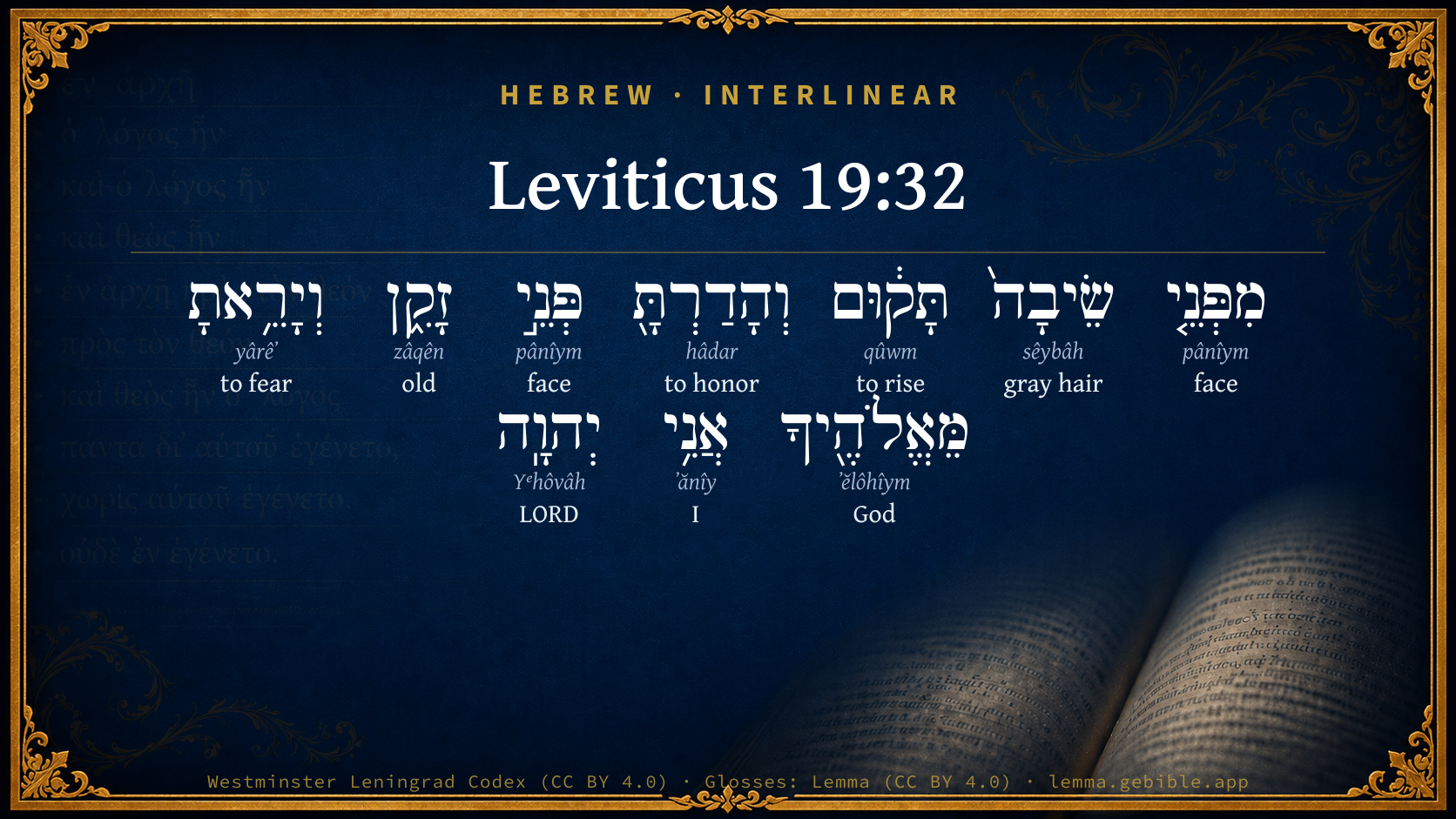
Hebrew (Westminster Leningrad Codex) Leviticus 19:32 appears in the Hebrew Old Testament. The text above is from the Westminster Leningrad Codex. Each word links to its Strong’s number, a concise gloss, and parsing drawn from the Open Scriptures Hebrew Bible morphology. Click any word for its full Brown-Driver-Briggs (BDB) entry.
Download image
Cite this verse

Leviticus 19:32 (World English Bible). Public Domain. Lemma interlinear Bible study tool, https://lemma.gebible.app/v/leviticus/19/32.

Show BibTeX & RIS
BibTeX
RIS
English Translation
You shall rise up before the gray head, and honor the face of an old man, and you shall fear your God. I am Yahweh.
World English Bible · Public Domain
Download a study sheet

One document with this verse’s original text, its word-by-word gloss line, the meaning frame, cross-references with their text, attributed commentary, and full source and license credits — printable, and it pastes into notes with its structure intact.

This verse Autodidact and up

Study sheet (.html) Plain text (.txt)

A passage Seminary Student

Up to 50 verses in one chapter. A passage sheet keeps up to 6 commentary sources and 12 cross-references per verse, in the order this page ranks them, and says so on the sheet whenever that leaves anything out. Ask for a single verse and you get the Autodidact verse sheet above.

Everything on this page stays free to read, with no account — the sheet is a download of what is already on screen, not access to it.

Want to remove ads? Support Godless Engineer
Compare translations 3

The same verse in 3 English versions, stacked beneath the original-language interlinear above. Click any original word for its lexicon entry.

Each is an independent rendering of the whole verse — the interlinear is not word-aligned to these translations.

Highlighted words mark where these versions differ — a whole-verse word diff, not a word-by-word alignment.

  • World English Bible Public Domain
    You shall rise up before the gray head, and honor the face of an old man, and you shall fear your God. I am Yahweh.
  • King James Version Public Domain
    Thou shalt rise up before the hoary head, and honor the face of the old man, and fear thy God: I am the LORD.
  • unfoldingWord Literal Text CC BY-SA 4.0
    From the face of gray hair, you shall rise, and you shall honor the face of an elderly. You shall fear your God. I Yahweh.

unfoldingWord Literal Text — © unfoldingWord, licensed CC BY-SA 4.0. Word-aligned USFM3 via Door43 (git.door43.org/unfoldingWord/en_ult).

Versions to compare (up to 4)

3 of 4 selected

Show all 18 translations

Every available English version of this verse, each an independent rendering of the whole verse.

  • World English Bible Public Domain
    You shall rise up before the gray head, and honor the face of an old man, and you shall fear your God. I am Yahweh.
  • Berean Standard Bible Public Domain
    You are to rise in the presence of the elderly, honor the aged, and fear your God. I am the LORD.
  • Majority Standard Bible Public Domain
    You are to rise in the presence of the elderly, honor the aged, and fear your God. I am the LORD.
  • King James Version Public Domain
    Thou shalt rise up before the hoary head, and honor the face of the old man, and fear thy God: I am the LORD.
  • American Standard Version (1901) Public Domain
    Thou shalt rise up before the hoary head, and honor the face of the old man, and thou shalt fear thy God: I am Jehovah.
  • Revised Version (1885) Public Domain
    Thou shalt rise up before the hoary head, and honour the face of the old man, and thou shalt fear thy God: I am the LORD.
  • Geneva Bible (1599) Public Domain
    Thou shalt rise vp before the horehead, and honour the person of the old man, and dread thy God: I am the Lord.
  • Douay-Rheims (1899) Public Domain
    Rise up before the hoary head, and honour the person of the aged man: and fear the Lord thy God. I am the Lord.
  • Young's Literal Translation Public Domain
    `At the presence of grey hairs thou dost rise up, and thou hast honoured the presence of an old man, and hast been afraid of thy God; I `am' Jehovah.
  • Literal Standard Version CC BY-SA 4.0
    You rise up at the presence of grey hairs, and you have honored the presence of an old man, and have been afraid of your God; I [am] YHWH.
  • Unlocked Literal Bible CC BY-SA 4.0
    You must rise before the gray-headed person and honor the presence of an old man. You must fear your God. I am Yahweh.
  • unfoldingWord Literal Text CC BY-SA 4.0
    From the face of gray hair, you shall rise, and you shall honor the face of an elderly. You shall fear your God. I Yahweh.
  • Darby Bible Public Domain
    Before the hoary head thou shalt rise up, and shalt honour the face of an old man; and thou shalt fear thy God: I am Jehovah.
  • World Messianic Bible Public Domain
    “‘You shall rise up before the gray head and honor the face of the elderly; and you shall fear your God. I am the LORD.
  • Webster's Bible Public Domain
    Thou shalt rise up before the hoary head, and honor the face of the old man, and fear thy God: I am the LORD.
  • Free Bible Version CC BY-SA 4.0
    Stand up and be respectful of older people. Show reverence for your God. I am the Lord.
  • Bible in Basic English Public Domain
    Get up from your seats before the white-haired, and give honour to the old, and let the fear of your God be before you: I am the Lord.
  • JPS Tanakh (1917) Public Domain
    Thou shalt rise up before the hoary head, and honour the face of the old man, and thou shalt fear thy God: I am the LORD.

Literal Standard Version (2020), Covenant Press — licensed CC BY-SA 4.0. Text via the HelloAO Bible API (eBible.org). Unlocked Literal Bible (unfoldingWord) — licensed CC BY-SA 4.0. Text via the HelloAO Bible API (eBible.org). unfoldingWord Literal Text — © unfoldingWord, licensed CC BY-SA 4.0. Word-aligned USFM3 via Door43 (git.door43.org/unfoldingWord/en_ult). Free Bible Version, Dr. Jonathan Gallagher — licensed CC BY-SA 4.0. Text via the HelloAO Bible API (eBible.org).

Word by word

More ways to search: Search by grammar → Find every occurrence → Compare this word →

Practice this passage: Drill this verse → Learn its vocabulary →

וְהָדַרְתָּ֖
hâdar
H1921
“and · to honor”
Conjunction + Verb, Qal, Sequential Perfect, 2nd Person, Masculine, Singular
Part of Speech
Conjunction + Verb
Stem
Qal
Form
Sequential Perfect
Person
2nd Person
Gender
Masculine
Number
Singular
Full BDB Definition

Origin: a primitive root

TWOT: 477

to honour, adorn, glorify, be high - (Qal) - to swell - swelling (passive participle) - to honour, pay honour to, show partiality - to adorn - adorned (passive participle) - (Niphal) to be honoured - (Hithpael) to honour oneself, claim honour
  1. מִפְּנֵ֤י pânîym H6440 “from · face(s) of” Preposition + Noun, Common, Both, Plural, Construct
  2. שֵׂיבָה֙ sêybâh H7872 “gray hair” Noun, Common, Feminine, Singular, Absolute
  3. תָּק֔וּם qûwm H6965 “to rise” Verb, Qal, Imperfect, 2nd Person, Masculine, Singular
  4. פְּנֵ֣י pânîym H6440 “face(s) of” Noun, Common, Both, Plural, Construct
  5. זָקֵ֑ן zâqên H2205 “old” Adjective, Adjective, Masculine, Singular, Absolute
  6. וְיָרֵ֥אתָ yârêʼ H3372 “and · to fear” Conjunction + Verb, Qal, Sequential Perfect, 2nd Person, Masculine, Singular
  7. מֵּאֱלֹהֶ֖יךָ ʼĕlôhîym H430 “from · God(s) · your” Preposition + Noun, Common, Masculine, Plural, Construct + Suffix, Personal, 2nd Person, Masculine, Singular
  8. אֲנִ֥י ʼănîy H589 “I” Pronoun, Personal, 1st Person, Common, Singular
  9. יְהוָֽה Yᵉhôvâh H3068 “LORD” Noun, Proper

About this verse

These counts appear in no published source. They are computed here, from the morphology-tagged text and Lemma’s own curated glosses. What Lemma adds →

10
words
9
distinct lemmas
Pentateuch
section

Notable vocabulary

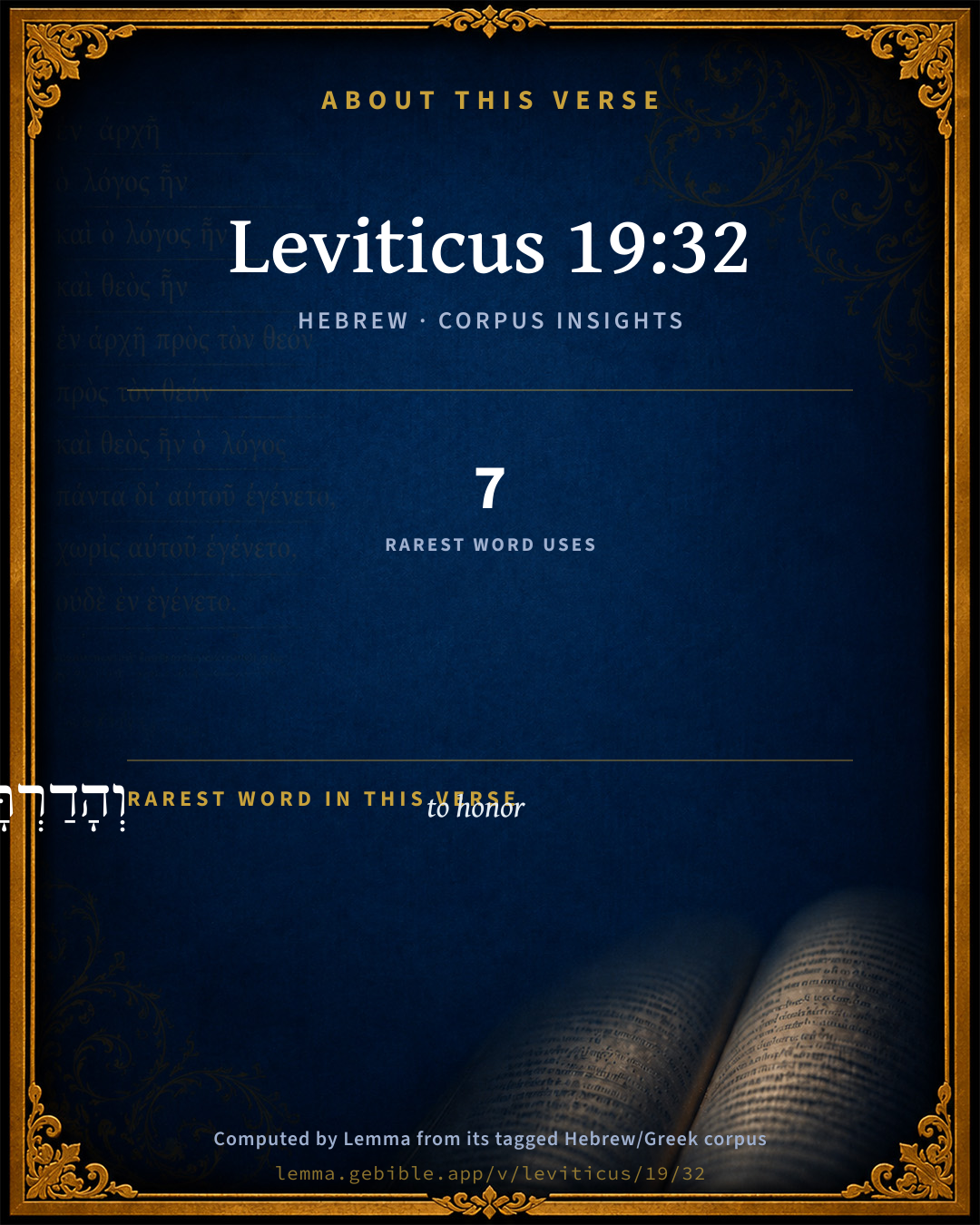
The rarest word here is וְהָדַרְתָּ֖ to honor H1921 — appearing just 7 times in the whole Hebrew Bible.

Shared distinctive vocabulary

וְהָדַרְתָּ֖ to honor H1921 occurs in 7 verses of the Hebrew Bible. Also found in:

Grammatical profile

  • 3 verbs
  • 5 nouns
  • 1 adjective
  • 1 pronoun

Verb forms

  • תָּק֔וּם Qal · Imperfect
  • וְהָדַרְתָּ֖ Qal · Sequential Perfect
  • וְיָרֵ֥אתָ Qal · Sequential Perfect

Repetition

A word recurs within this verse — often emphatic in Hebrew:

  • מִפְּנֵ֤י face H6440 ×2

Hebrew & Septuagint length

In English translation the verse runs 25 words from the Hebrew and 27 from the Septuagint (LXX English) — closely comparable.

A rough comparison of the two English renderings, which tokenize alike — not a word-level alignment.

Word counts can differ between the Hebrew and the Greek without any difference in meaning — e.g. the Hebrew direct-object marker אֵת has no separate Greek word, and Greek often adds the article ὁ.

Cross-references

11

Topical passages linked to Leviticus 19:32 in the Treasury of Scripture Knowledge — connected by theme and wording, ordered by reader-vote popularity; previews shown in the World English Bible.

  • 1 Timothy 5:1 Don't rebuke an older man, but exhort him as a father; the younger men as brothers;
  • Proverbs 16:31 Gray hair is a crown of glory. It is attained by a life of righteousness.
  • Lamentations 5:12 Princes were hanged up by their hand: The faces of elders were not honored.
  • Proverbs 20:29 The glory of young men is their strength. The splendor of old men is their gray hair.
  • Job 32:4 Now Elihu had waited to speak to Job, because they were elder than he.
  • Job 32:6 Elihu the son of Barachel the Buzite answered, "I am young, and you are very old; Therefore I held back, and didn't dare show you my opinion.
  • Leviticus 19:14 "'You shall not curse the deaf, nor put a stumbling block before the blind; but you shall fear your God. I am Yahweh.
  • Romans 13:7 Give therefore to everyone what you owe: taxes to whom taxes are due; customs to whom customs; respect to whom respect; honor to whom honor.
  • 1 Peter 2:17 Honor all men. Love the brotherhood. Fear God. Honor the king.
  • Isaiah 3:5 The people will be oppressed, Everyone by another, And everyone by his neighbor. The child will behave himself proudly against the old man, And the base against the honorable.
  • 1 Kings 2:19 Bathsheba therefore went to king Solomon, to speak to him for Adonijah. The king rose up to meet her, and bowed himself to her, and sat down on his throne, and caused a throne to be set for the king's mother; and she sat on his right hand.

Cross-references courtesy of OpenBible.info (CC BY 4.0).

Hebrew and Greek witnesses Masoretic Hebrew ↔ Greek Septuagint

The same verse in the two great witnesses to the Old Testament, shown verse-for-verse.

These are two independent witnesses, not word-aligned to each other, and the Septuagint is shown in lemma (dictionary) form.

Hebrew Leviticus 19:32 Masoretic · Westminster Leningrad Codex

מִפְּנֵ֤י שֵׂיבָה֙ תָּק֔וּם וְהָדַרְתָּ֖ פְּנֵ֣י זָקֵ֑ן וְיָרֵ֥אתָ מֵּאֱלֹהֶ֖יךָ אֲנִ֥י יְהוָֽה

You shall rise up before the gray head, and honor the face of an old man, and you shall fear your God. I am Yahweh.

World English Bible · Public Domain

Greek LXX Leviticus 19:32 Septuagint · lemma form

ἀπό πρόσωπον πολιός ἐκ ἀνἵστημι καί τιμάω πρόσωπον πρεσβύτερος καί φοβέω ὁ θεός σύ ἐγώ εἰμί κύριος ὁ θεός σύ

You shall rise up before the hoary head, and honor the face of the old man, and shall fear your God: I am the Lord your God.

LXX2012 (modern English Septuagint) · Public Domain

Hebrew: Westminster Leningrad Codex (CC BY 4.0). Greek: Septuagint (public domain); English from LXX2012 (modern English Septuagint) (Public Domain). How the Septuagint differs from the Hebrew →

Targum (Aramaic paraphrase)

2

The Targum is the ancient Jewish Aramaic paraphrase of the Hebrew Scriptures — an interpretive translation, not the Hebrew text itself. Onkelos (literal) and Pseudo-Jonathan (expansive) render the Torah, and Jonathan the Prophets. Coverage is partial: where no permissively-licensed English translation exists for a verse, only the Aramaic is shown. This is verse-level text, not a word-by-word alignment to the Hebrew.

  1. Targum Onkelos Torah (Genesis–Deuteronomy)
    מִן קֳדָם דְסַבַּר בְּאוֹרַיְתָא תְּקוּם וּתְהַדַר אַפֵּי סָבָא וְתִדְחַל מֵאֳלָהָךְ אֲנָא יְיָ

    (no public-domain English translation for this verse)

    Targum Onkelos — Aramaic: “Onkelos Genesis” (public domain); “Onkelos Exodus” (public domain); “Onkelos Leviticus” (public domain); “Onkelos Numbers” (public domain); “Onkelos Deuteronomy” (public domain). English: “Sefaria Community Translation” (CC0 1.0 (public-domain dedication)); “J.W. Etheridge. The Targums of Onkelos and Jonathan Ben Uzziel on the Pentateuch. London: Longmans, Green, 1862” (public domain). Text via Sefaria.

  2. Targum Pseudo-Jonathan Torah (Genesis–Deuteronomy)
    מִן קֳדָם סָבִין דִסְבִירִין בְּאוֹרַיְתָא תְּקוּמוּן וּתְיַיקֵר אַפֵּי חַכִּימָא וְתִדְחַל מֵאֱלָהָךְ אֲנָא יְיָ

    You shall rise up before the aged who instruct in the law and honour the presence of the wise, and fear thy God: I am the Lord.

    Targum Pseudo-Jonathan — Aramaic: “Targum Jonathan on Genesis” (public domain); “Targum Jonathan on Exodus” (public domain); “Targum Jonathan on Leviticus” (public domain); “Targum Jonathan on Numbers” (public domain); “Targum Jonathan on Deuteronomy” (public domain). English: “The Targum of Jonathan ben Uzziel, trans. J. W. Etheridge, London, 1862” (public domain). Text via Sefaria.

Commentary

Notes on Leviticus 19:32 from classic Christian and Jewish commentators (each source and its license shown beneath its notes). The classic Christian expositions comment on the surrounding passage and are grouped to its opening verse, so a note may address several verses; the Jewish commentaries on the Tanakh (Rashi and others) are per-verse, so they appear only where the commentator wrote on this verse.

Lemma curates 59 commentaries, every one of them public domain or Creative Commons licensed, each selected and text-cleaned for this edition rather than reprinted as found. About our sources →

Trapp's Complete Commentary

John Trapp

Lev 19:32 Thou shalt rise up before the hoary head, and honour the face of the old man, and fear thy God: I [am] the LORD.

Ver. 32. Thou shalt rise up.] Cognata sunt γηρας et γερας, old age and honour are near akin in the Greek tongue, ut ηθος et εθος. See Pro 20:29 Lam 5:12.

John Trapp, A Commentary or Exposition upon All the Books of the Old and New Testament (1647–1656) — public domain. Text from a community e-Sword module.

The Biblical Illustrator

Joseph S. Exell

Lev_19:32

Rise up before the hoary head.

Homage for age

1. Because the aged represent mature wisdom.

2. Because the aged record long years spent in our service.

3. Because the aged demonstrate Gods providential care.

4. Because the aged are solemn admonitions of lifes decay.

5. Because the aged suggest nearness to eternity.

6. Because the aged exhibit the richest fruits of grace.

7. Because the aged mark the line of Gods covenant blessings for descendants.

8. Because the aged represent on earth Him who is the Ancient of Days.

(1) Youth should venerate the aged (Job_30:1; Job_30:12; Isa_3:4-5).

(2) Age should influence and hallow the young (2Ti_1:5). (W. H. Jellie.)

Reverence the aged

When you meet them in public places, or they come to where you are, show them reverence.. Infirmity, wisdom, nay, age in itself, have each a claim on us. Age, apart from its qualities, has in it solemnity. The Lord would thus solemnise us in the midst of our pursuits. Lo! the shadow of eternity! for one cometh who is almost in eternity already. His head and beard white as snow, indicate his speedy appearance before the Ancient of Days, the hair of whose head is as pure wool. Every object, too, that is feeble seems to be recommended to our care by God; for these, are types of the condition wherein He finds us when His grace comes to save. It is, therefore, exhibiting His grace in a shadow, when the helpless are relieved, the fatherless find mercy (Hos_14:3), the orphans relieved, and the widow (Psa_146:9), and the stranger preserved. (A. A. Bonar.)

Reverence for superiors

The institutions of Sparta have everywhere been praised for the encouragement which they gave to the duty of showing respect for the aged, but the language of the Jewish lawgiver is much more emphatic: Thou shalt rise up before the hoary head, and honour the face of the old man. Beautiful examples are recorded in the Bible, as patterns for our imitation, in this important particular of filial reverence and obedience. The behaviour of Isaac towards Abraham, and that of Jacob to both father and mother; Josephs deference to his aged father, even when he himself was surrounded by the splendours of the Egyptian Court; Ruth with her mother-in-law; Solomon in the grandeur of royalty, paying respect to his mother; and, more than all, our blessed Saviours tender care for His mother in the hour of His dying agonies--all afford suggestive lessons to us. It is, however, not merely concerning reverence to parents that the text would lead us to speak. The very appearance of age is calculated to soften our hearts and to call forth our respect. No snow falls lighter than that which sprinkles the head in advancing years; and yet none is really heavier, because it never melts. Vale and mountain-top are covered alike with the white flakes which winter scatters broadcast and with unstinted hand, but the cheerful sun will soon cause them to disappear. There is no returning spring whose genial warmth can penetrate the eternal frost of age. The decrepitude of age can claim neither enterprise nor courage. He is afraid of that which is high, and fears are in the way, and with the load of infirmities which press him down, the additional weight of a grasshopper would be burdensome. Desire has failed, and ambition can no longer tempt him to put forth ventures and submit to toil. Only one wish remains to be fulfilled--to depart from this weary life. With this vivid picture before him, who can help feeling a sympathy for the old? It must be confessed that the present generation are sadly unmindful of the lesson taught us in the Catechism, To submit myself to all my governors, teachers, spiritual pastors, and masters; to order myself lowly and reverently to all my betters. Betters, indeed! Verily, the young people of this age have no betters! Some years ago Governor Everett, of Massachusetts, was riding out of Boston in a sleigh, with another gentleman of high social position, when they approached a school-house, from which a score of noisy boys rushed forth to enjoy their afternoons recess. The governor said to his friend, Let us observe whether these lads show the marks of politeness to us which we were taught to practise fifty years ago. At the same time he expressed his fears that the habits of civility were not much thought of in later times. As the sleigh passed the school-house all doubt on the subject was instantly dispelled, for the rude lads did their best at pelting the dignitaries with snowballs as they drove rapidly along the way. Every right-minded person must acknowledge that such conduct was outrageous and inexcusable. We ought, however, to go behind this astonishing act of boorish rudeness, and remember what long-continued neglect of proper instruction and training, on the part of parents and teachers, had suffered such a shocking state of manners to grow up in a civilised land. There never was anything quite equal to the presumption of the young or the meekness and acquiescence of the old in this matter. A shrewd observer remarked, not long ago, to a friend, If, as you are going down town, you should approach a dozen boys playing on the sidewalk, so that no room was left for you to pass, which would you do? would you say, Boys, you must not block up the walk in this way! or would you get down into the muddy street and go round? The prompt answer was, Go round, of course! This reply shows the shameful pass to which things have come. Men of mature years must abdicate all rights, and truckle under with cowardly submission, lest they provoke the ill-will of boys! Parents and teachers! it is your bounden duty to correct this evil, cost what it may. The Church Catechism must again be made what it was in past generations when the young showed respect to their betters, a text-book in our families and schools. I trust that the young persons who bear me will not only be convinced by what has just been said of the imperative duty of honouring their parents, but that the kindred obligation of showing respect to old age will be much more thought of and observed. If your lives are spared, it will not be many years before you will be old yourselves, and you will need the sympathy and consideration which I am now recommending you to practise. The rules of ordinary politeness would require you to attend to this matter, but the duty rests on much higher ground. It is God Himself who gives the command, Thou shalt rise up before the hoary head, and honour the face of the old man. (J. N. Norton, D. D.)

Reverence due to age

This is one of those duties which are derived from the instinctive feelings of the heart. The old man was honoured before the reasonableness of the obligation was considered or the benefit of it understood. From that sensibility with which the Almighty Father has impressed the human soul, men often feel before they think, and act before they have considered their motives of action. From the same source many of the most refined pleasures of life originate. Ask the contemplative man why he delights to view the fragments of antiquity--the hanging arch, the mutilated column, the moss-grown tower! Ask him why he sometimes watches the closing twilight, wanders through the gloomy valley, or listens with peculiar pleasure to the distant murmur of the sea! He will find it difficult, perhaps, to account for his sensations, to analyse his satisfactions, or to trace them to their cause; but he will tell you that he felt and enjoyed them before he knew why or considered wherefore. In the same manner those who can contemplate the hoary head without some prepossession of respect and tenderness want the essential requisite of nature for performing their duty to the aged as they ought. But if they wish to discover other motives, such may be found in abundance. It is to the pious aged that the young are to look for superior knowledge and conspicuous virtue. They have enjoyed the benefits of experience, and are therefore qualified to act as monitors and guides. They may be considered, too, as oracles, who speak to the serious and well-disposed with overwhelming authority. They have encountered the temptations and difficulties which yet await their younger brethren, and can point out to others the way by which they escaped. They, probably, have been exposed to trials from which our fortitude would shrink in terror, and have mortified those evil dispositions of nature which might be preparing for us disappointments, misery, and guilt. To render our veneration more personal and endearing we should consider them, also, as dead to those pleasures and enjoyments which we regard as our chief felicity, and labouring with those infirmities under which we must one day sink. Besides, therefore, the precepts of religion and the arguments of reason, there are other motives arising from sensibility and the humane affections of the heart, which render it an indispensable duty in the young to reverence the old.

On the relative duties of the young to the aged

Let us consider the motives for honouring the hoary head, as they are deprived from the principles and connected with the duties of Christianity. But we must remember it is not merely to age that this reverence is due, but to the hoary head only when it is found in the way of righteousness. From its very nature this must be one of the relative duties of the young, and its obligations are founded on the genuine sentiments of the heart, on the deductions of reason, as well as the precepts of religion, and on the peculiar advantages resulting from it. The gospel of Christ strongly inculcates the principles of general deference and humility. In lowliness of mind, says the apostle, let each esteem other better than himself, and to the exhortation of being kindly affectioned towards our fellow-creatures, is added the precept of preferring one another in honour. The young, considered in their relation to the aged, have many additional reasons for showing this deference and honour; and farther, the sentiments of reverence should be accompanied with tenderness and affection. It is to them that the young are to look for superior knowledge, and, in general, superior virtue. They have enjoyed the benefits of experience, as well as reflection, and are therefore qualified to be our monitors and guides. The claims to deference arising from the distinctions of birth and fortune, when compared to these, are trifling and inconsiderable. If reverence be due from one human being to another it can never be offered with more propriety than as the price of knowledge from the ignorant to tile wise. The aged may be considered, in this respect, as oracles that speak to the serious and the well-disposed with such conviction as they can nowhere find but in their own experience. They are a sort of living chronicles, that impress the memory and imagination with all the energy of truth. Let us consider them as having husbanded and improved the talent well, which we perhaps shall squander away, and as preparing, with humble confidence, to enter into the joy of their Lord. But let me observe that these observations relate only to the hoary head, when crowned with wisdom, virtue, and piety. Viewed in this light, the aged cannot but impress us with the deepest sense of reverence and honour. They have encountered difficulties and temptations, in which we perhaps shall be enthralled, and can point out to us the means by which they escaped. They have been exposed to trials from which our fortitude would shrink with terror, and have mortified those evil dispositions of nature which might be preparing for us disappointment, misery, and guilt. To the hero who has retired from the field, crowned with the wreath of fame, men look up with admiration and applause; and shall we withhold our reverence from Him who has fought the good fight of Christian faith, and obtained a victory over the temptations of the world? But as every human being is subject to sin, we should be careful, in all the examples that are set before us, to avoid the evil and to imitate the good. In short, let us joyfully embrace every means in our power of improving that inestimable talent which is entrusted to our care, and by which alone we can grow wise unto salvation. (J. Hewlett, B. D.)

Old age

The eye of age looks meek into my heart; the voice of age echoes mournfully through it; the hoary head and palsied hand of age plead irresistibly for its sympathies. I venerate old age; and I love not the man who can look without emotion upon the sunset of life, when the dusk of evening begins to gather over the watery eye, and the shadows of twilight grow broader and deeper upon the understanding. (Longfellow.)

Respect for the aged

One day (Cicero tells the story in his treatise on Old Age,) an aged Athenian came into the theatre, but not one of his fellow-citizens in that immense crowd would incommode himself to make room for him. As, however, he approached the ambassadors from Lacedaemon, who had their own special seat, they all rose to receive him into their midst. The whole assembly burst into applause, whereupon somebody said, The Athenians know what is good, but they will not practise it. Many people know what is right but turn a deaf ear to conscience, and neglect their duty, although it has been made clear to them what that duty is. (S. S. Chronicle.)

Reverence of old age

God hath put a signal honour upon it by styling Himself the Ancient of Days, and He threatens it as a great judgment upon a people (Isa_3:5), that the children shall behave themselves proudly against the ancients. A reverent awe before them is not only a point of manners, but a part of a moral and express duty; and therefore it is said of Elihu (Job_32:4), that he waited till Job had spoken because he was elder than he, and in verse 6 he saith, I am young and ye are very old: wherefore I was afraid and durst not show you mine opinion. (Bp. E. Hopkins.)

The Biblical Illustrator, edited by Joseph S. Exell (c. 1880s–1900s) — public domain. Text from a community e-Sword module.

Joseph Benson's Commentary

Lev 19:32. Rise up — To do them reverence when they pass by, for which end they were obliged, as the Jews say, presently to sit down again when they were past, that it might be manifest they arose out of respect to them. Fear thy God — This respect is due to such, if not for themselves, yet for God’s sake, who requires this reverence, and whose singular blessing old age is.

Joseph Benson's Commentary on the Old and New Testaments (1811–1818) — public domain. Text from a community e-Sword module.

Tyndale Open Study Notes

Tyndale Open Resources

19:32 In the ancient world, the elderly and the aged were respected for their wisdom (Job 32:7). Honoring the elderly also honors God.

Tyndale Open Study Notes — © Tyndale Open Resources, licensed CC BY-SA 4.0. Text via the HelloAO Bible API.

Geneva Bible (1599)

Geneva Bible translators

In token of reverence.

Geneva Bible (1599) marginal notes — public domain. Text via Bolls.life.

Adam Clarke's Commentary

Verse 32. Before the hoary head] See Clarke on Ge 48:12.

Adam Clarke's Commentary on the Bible (1810–1826) — public domain. Text from a community e-Sword/MySword module.

Ellicott's Commentary for English Readers

(32) Rise up before the hoary head.—But though no regard is to be paid to these soothsayers and cunning men, the greatest reverence is to be shown to the aged, for “with the old is wisdom, and in length of days understanding” (Job_12:12; Job_32:7, &c.). If we, therefore, are to attain to the holiness which, as it is set forth in the beginning of this chapter, is to reflect the holiness of God, we must have reverence for the ancients, since God himself is called “the Ancient of days” (Dan_7:9; Dan_7:13; Dan_7:22). This precept, which is so often inculcated in Holy Writ, is beautifully enforced in the maxims of the authorities during the second Temple. “He who receives and takes care of an old man is rewarded as if he received and sought God,” is one of their sayings. Again, “Prophets are only believed if they come armed with Divine miracles, but old men always.” To this day, when, among the orthodox Jews, an aged person enters into a house where young people are, they all rise up, and will not sit down till he asks them to do it. An exception, however, is made with regard to workmen. When an aged person passes by artisans who are en. gaged in their work, they need not stand up, and thus be interrupted in their labour.

A Bible Commentary for English Readers, edited by Charles John Ellicott (1878–1897) — public domain. Text from a community e-Sword module.

The Cambridge Bible for Schools and Colleges

gen. ed. J. J. S. Perowne

32. rise up, etc.] Herodotus (ii. 80) speaks of this and other acts of respect on the part of youth to age as practised by the Egyptians, to whom, according to him, the Lacedaemonians alone of the Greeks furnish a parallel.

The Cambridge Bible for Schools and Colleges (gen. ed. J. J. S. Perowne; Cambridge University Press, 1878–1918) — public domain. Text from a community e-Sword module.

John Gill's Exposition

Thou shall rise up before the hoary head,.... Or "before old age" (q), which may be discerned by the hoary or grey hairs upon the head; that is, before a grey-headed man, or an old man, and one was reckoned so when he was of seventy years of age; for so it is said (r), one of sixty years is arrived to old age, and one of seventy to grey hairs. Fagius relates, that according to the tradition of the Hebrews, a young man was obliged to rise up when an ancient man was at the distance of four cubits from him, and to sit down again as soon as he had passed by him, that it might appear it was done in honour of him. And this was not only observed among the Jews, but anciently among Heathens, who reckoned it abominable wickedness, and a capital crime, if a young man did not rise up to an old man, and a boy to a bearded person (s). Herodotus (t) reports, that the Egyptians agreed in this with the Lacedaemonians, and with them only of the Grecians, that the younger, when they met the elder, gave them the way and turned aside, and when coming towards them rose up out of their seat; and this law was enjoined them by Lycurgus, and which Aelianus (u) commends as of all the most humane. And this respect to ancient persons is due to them from younger persons, because of their having been in the world before them, and of their long continuance in it, and because of the favour and honour God has bestowed upon them in granting them long life, as also because of the experience, knowledge, and wisdom, they may be supposed to have attained unto: the Targums of Onkelos and Jonathan restrain this to such as are expert in the law; so Jarchi says, there is no old man but he that has acquired wisdom; but it seems not to be the intention of this law to limit the respect to such only; though it must be allowed that ancient persons, who are wise and good, are worthy of special regard, see Pro 16:31,

and honour the face of the old man; who for the wrinkles of it, and his withered countenance, might be liable to be despised. The Targum of Jonathan interprets it, the face of a wise man, which agrees with what is observed before; and so Jarchi, Ben Gersom, and other Jewish writers explain it; and the former asks, what is this honour? he may not sit in his place, nor contradict his words. All this may be applied to elders by office, as well as in age, to magistrates, masters, and teachers; and particularly, as Ben Gersom observes, this may admonish us to give honour to God, who is the Ancient of days, who always was, and ever will be:

and fear thy God, I am the Lord; who has commanded such reverence of ancient persons, and will punish for any marks of irreverence shown them; and who is himself to be feared and reverenced above all, being, from everlasting to everlasting, God, and whose name is holy and reverend.

(q) "ante canitiem", Pagninus; so Tigurine version, Junius & Tremellius, Piscator. (r) Pirke Abot, c. 5. sect. 21. (s) "Improbitas illo fuit", &c. Juvenal. Satyr. 13. v. 53, 54, 55, 56. (t) Euterpe, sive, l. 2. c. 80. (u) Hist. Animal. l. 6. c. 61.

John Gill's Exposition of the Whole Bible (1746–1763) — public domain (CC PDM 1.0). Text via the HelloAO Bible API.

Albert Barnes' Notes on the Bible

The outward respect due to old age is here immediately connected with the fear of God. Compare the margin reference.

Albert Barnes' Notes on the Bible (1834–1885) — public domain. Text from a community e-Sword/MySword module.

Haydock's Catholic Bible Commentary

Aged man. Such are supposed to be possessed of wisdom and experience. The Egyptians and Lacedemonians rose up out of respect to an old man. (Herod., ii. 80.) The Rabbins pretend that a person ought to rise up when the old man is four cubits distant, provided he be, as he ought, a man of wisdom; for otherwise he is entitled to no honour. But this would be making inferior judges of their merit. The Chaldean, Philo, &c., comprise those "learned in the law," under the name of old men.

George Leo Haydock (1774–1849), Haydock's Catholic Family Bible and Commentary, 1859 edition — public domain. Excludes Psalms (Douay-Rheims chapter numbering differs from Protestant) and Deuterocanonical books (Catholic canon only).

Matthew Poole's English Annotations

Thou shalt rise up, to do them reverence when they pass by, for which end they were obliged, as the Jews say, presently to sit down again when they were past, that it might be manifest they arose out of respect to them.

Fear thy God; a reason of the former precept, both because old men in some respects do most resemble God, who is styled the Ancient of days, Dan 7:9,13, and because this respect is due to such, if not for themselves, who may be unworthy or contemptible, yet for God’s sake, who requires this reverence, and whose singular blessing old age is.

Matthew Poole's English Annotations on the Holy Bible (1683–1685) — public domain. Text from a community e-Sword/MySword module.

Whedon's Commentary on the Bible

Daniel D. Whedon

32. Honour the face of the old man, and fear thy God — Respect for age is here associated with the fear of God. The two virtues are beautifully blended in the Latin word pietas, signifying dutiful conduct towards one’s parents and the gods. In Exo_22:28, the law connects respect towards civil rulers with piety towards God. In the East age is invested with authority more than in the Western nations. Hence honour rendered to the old implies, in an eminent degree, obedience to parents, the germ of all good citizenship and of all reverence towards God. The converse is true, that contempt for the old and disobedience to parents is the germ of all lawlessness and irreligion.

Daniel D. Whedon (gen. ed.), Commentary on the Old and New Testaments (1874–1909) — public domain. Text from a community e-Sword module.

The Pulpit Commentary

Reverence for the old is inculcated as being a part, not merely of natural respect, but of the fear of God. In the East this virtue, implying deference on the part of the strong to the weak, and of the inexperienced to the wise, exists in larger influence for good than in the West, where, however, its place has been, but only partially, supplied by the greater deference paid by man to woman. (cf. Pro_16:31 Pro_20:29)

Respect for old age

is not only inculcated as a preservative against the rule of brute force, but as a part of the fear of God, the parent"s relation to the child representing that of God to his creature.

The Pulpit Commentary (1880–1919), ed. H.D.M. Spence-Jones & Joseph S. Exell — public domain. Text from a community e-Sword module.

John Wesley's Explanatory Notes

Rise up - To do them reverence when they pass by, for which end they were obliged, as the Jews say, presently to sit down again when they were past, that it might be manifest they arose out of respect to them. Fear thy God - This respect is due to such, if not for themselves, yet for God's sake, who requires this reverence, and whose singular blessing old age is.

John Wesley, Explanatory Notes Upon the Whole Bible (1754–1765) — public domain. Text via the GEBible commentary corpus.

Scofield Reference Notes

C. I. Scofield

fear

(See Scofield "Psa 19:9").

The Scofield Reference Bible (1917 edition), notes by C. I. Scofield — public domain. Text from a community e-Sword module.

unfoldingWord translationNotes

Door43 World Missions Community

You must rise

Standing up in front of someone is a sign of respect. (See: Symbolic Action)

the gray-headed person

This refers to a person whose hair has turned gray from age, or "an old person."

translationWords

honor

fear

unfoldingWord translationNotes — © Distant Shores Media and the Door43 World Missions Community, licensed CC BY-SA 4.0. Source: git.door43.org/Door43/en_tn.

Rashi

Rabbi Shlomo Yitzchaki (Rashi)

מפני שיבה תקום THOU SHALT RISE UP BEFORE A HOARY HEAD — One might think this reverence is also due to an ignorant old man! Scripture however says זקן — "thou shalt honour the face of the ״זקן — and זקן denotes only one who has acquired wisdom (Sifra, Kedoshim, Chapter 7 12;Kiddushin 32b).

AND THOU SHALT HONOR THE FACE OF THE OLD — What does the term "honoring” an old man imply? That one should not sit in his seat nor contradict his statements. One might think that one is allowed to close one’s eyes as though one does not see him (the old man)! Scripture however states "but be afraid of thy God”, because in this thing it is given to the heart of him only who does the action to know the motive that prompts him for no one has an insight into this except himself, and in reference to any thing where it is given only to the heart to know, Scripture states “and thou shalt be afraid of thy God Who knows thy secret thoughts״ (Sifra, Kedoshim, Chapter 7 14; Kiddushin 32b).

Rashi on the Tanakh — English translations: “The Judaica Press complete Tanach with Rashi, translated by A. J. Rosenberg” (CC BY 4.0); “Pentateuch with Rashi's commentary by M. Rosenbaum and A.M. Silbermann, 1929-1934” (public domain); “The Metsudah Tanach series, Lakewood, N.J” (CC BY 4.0); and “The Book of Joshua, Metsudah Publications, 1997” (CC BY 4.0). Text via Sefaria.

Ramban (Nachmanides)

Rabbi Moshe ben Nachman (Ramban / Nachmanides)

THOU SHALT RISE UP BEFORE THE HOARY HEAD. “I might think that one is to rise before an uncultured old man; Scripture therefore states, and thou shalt honor the face of ‘zakein’ (the old man). Zakein [from the root kanah, acquire] means only one who has ‘acquired’ wisdom.” This is Rashi’s language. And the text of the Torath Kohanim, 7:12. as it is taught in the Gemara of Tractate Kiddushin [is as follows: “I might think that one is to rise before an uncultured old man;] Scripture therefore states zakein, the word zakein meaning only one who is wise, as it is said, Gather unto Me seventy men ‘miziknei’ (of the elders) of Israel. means “of the wise men” of Israel. And Rabbi Yosei the Galilean says: The word zakein means only one who has ‘acquired’ wisdom, as it is said, The Eternal ‘kanani’ (made me) [literally: acquired me, i.e., wisdom] at the beginning of His way.” Now according to the words of both of them [i.e., the First Sage in this Beraitha and Rabbi Yosei the Galilean], this commandment [of honoring the aged] applies only if he is a scholar. And Onkelos who rendered the verse before us: “thou shalt rise up before him who understands [the knowledge of] the Torah, and honor the face of the aged,” would also seem to agree with this opinion [that zakein is one who “acquired” wisdom]. Yet despite all this, the concluding opinion of the Gemara in accordance with the final decision of the law is not so, for the Rabbis have said [in the Gemara]: “Isi the son of Yehudah says: Any hoary head is included [under the terms of this commandment], and Rabbi Yochanan said: The final decision of the law is as Isi the son of Yehudah interpreted it.” Thus Scripture is commanding [in the first half of the verse] to honor any old man, even the uncultured, that is, the unlearned, and then [in the second half of the verse] it gives another commandment concerning the zakein, that is one who has acquired wisdom, even if he be young and learned. It is possible that this is also the opinion of Onkelos, except that he translated the hoary head as “young and learned” [and hence the first half of his translation reads, “thou shalt rise up before him who understands — the knowledge of the Torah,” meaning even if he is young and learned], since the term zakein [in the second half of the verse, which clearly means “one who has acquired wisdom”] came and indicated that the term hoary head includes all kinds of old age, whether old in the knowledge of the Torah or old in days. (the hoary head) and zakein (the old man)? Onkelos thus reasoned that since zakein definitely means “he who has acquired wisdom,” it shows that seiva must mean all kinds of old people, whether learned or not learned. Hence in translating the verse he rendered zakein first and then seiva, although in the Hebrew text the order of the terms is the opposite. In short, then, it may be that Onkelos also agrees with the opinion of Isi the son of Yehudah that one must show honor to all kinds of old people, whether aged in the knowledge of the Torah or just aged in years.

Ramban (Nachmanides) on the Tanakh — English translation: “Commentary on the Torah by Ramban (Nachmanides). Translated and annotated by Charles B. Chavel. New York, Shilo Pub. House, 1971-1976” (CC BY 4.0). Text via Sefaria.

Sforno

Rabbi Ovadia Sforno

If a proselyte comes to live. After it has cautioned about honor for the holy matters it cautions about shaming the lowly, and says, “if a proselyte comes to live with you do not cause him anguish,” even anguish caused by words.

Sforno on the Tanakh — English translation: “Yalkut, Sifsei Chachomim Chumash, Metsudah Publications, 2009” (CC BY 4.0). Text via Sefaria.

Lesson kit

Teaching starters — assembled from the data on this page, not authored interpretation. Every prompt links to the verse data it draws on. Edit before teaching.

Leviticus, in the Pentateuch, opens this verse with 10 words (9 distinct Hebrew lemmas). Its most distinctive word is hâdar (“to honor”). A historical commentator’s framing appears above. Read the whole chapter for the surrounding context.

Discussion questions

  1. How does “to honor” (hâdar) shape what this verse is saying?
  2. How does Exodus 23:3, which shares the word «to honor», read alongside this verse?
  3. What does the repetition of “face” (2× in this one verse) do in this verse?
  4. The translations on this page render this verse differently — a whole-verse word diff, not a word-by-word alignment. What might account for the different wordings?
  5. «תָּק֔וּם» is a Qal Imperfect verb. How does that grammatical form shape the action described?
  6. Compare how Trapp's Complete Commentary and The Biblical Illustrator read this verse. Where do they agree or differ?

Things to notice

Reading settings

Reading text

Shown beneath each verse's original-language words.

Old Testament
Old Testament edition

Read the OT as the Masoretic Hebrew (MT) or the Greek Septuagint (LXX).

English shown for the Greek Septuagint (in the Hebrew ↔ Greek comparison).

Comparing translations? Open the Compare panel on any verse page to stack up to four side by side.