
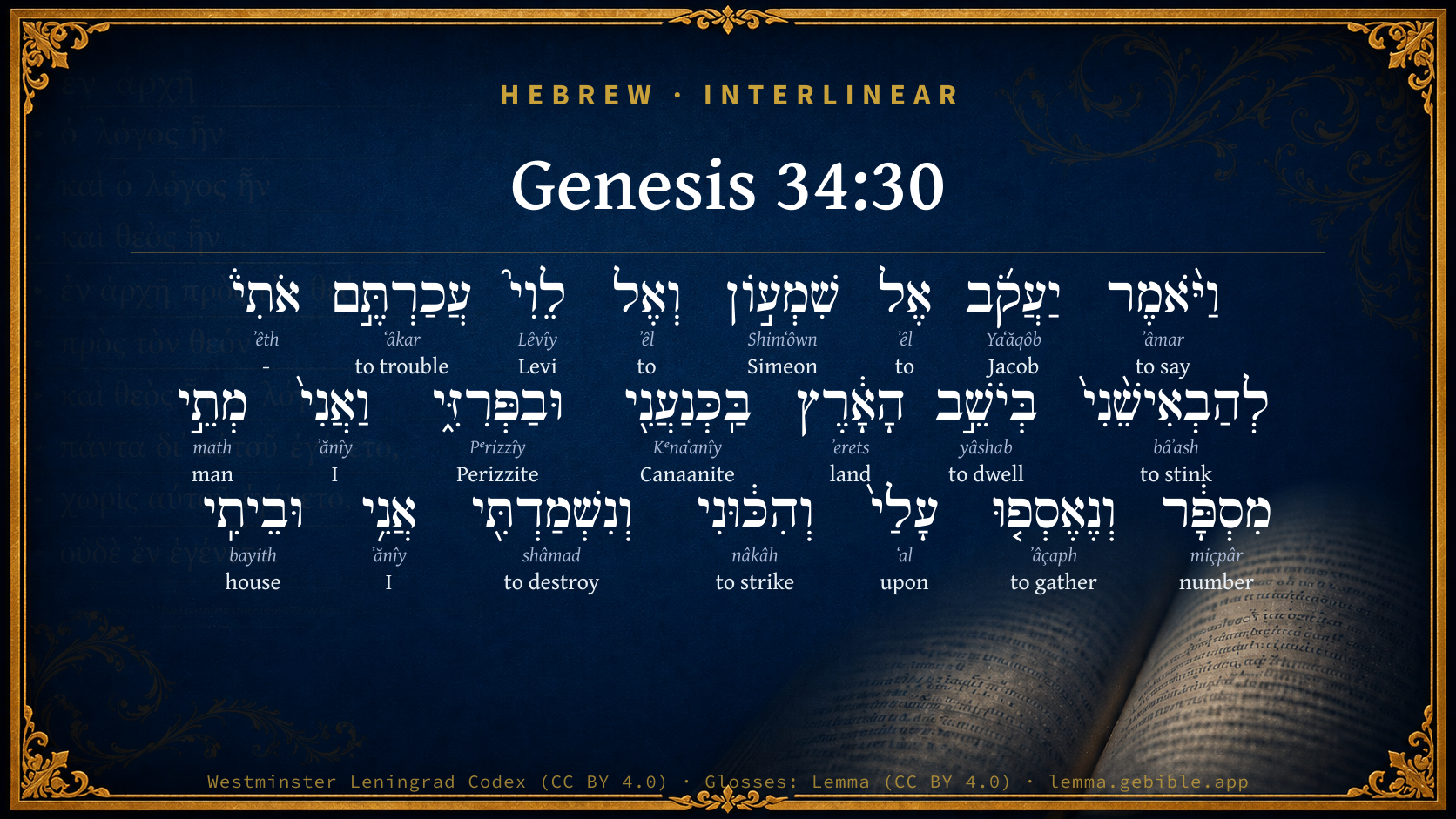
Genesis 34:30

Hebrew (Westminster Leningrad Codex) Genesis 34:30 appears in the Hebrew Old Testament. The text above is from the Westminster Leningrad Codex. Each word links to its Strong’s number, a concise gloss, and parsing drawn from the Open Scriptures Hebrew Bible morphology. Click any word for its full Brown-Driver-Briggs (BDB) entry.
Download image
Cite this verse

Genesis 34:30 (World English Bible). Public Domain. Lemma interlinear Bible study tool, https://lemma.gebible.app/v/genesis/34/30.

Show BibTeX & RIS
BibTeX
RIS
English Translation
Jacob said to Simeon and Levi, "You have troubled me, to make me odious to the inhabitants of the land, among the Canaanites and the Perizzites. I am few in number. They will gather themselves together against me and strike me, and I will be destroyed, I and my house."
World English Bible · Public Domain
Highlights
  • 5 first appearances in the Hebrew Bible
Full analysis ↓
Download a study sheet

One document with this verse’s original text, its word-by-word gloss line, the meaning frame, cross-references with their text, attributed commentary, and full source and license credits — printable, and it pastes into notes with its structure intact.

This verse Autodidact and up

Study sheet (.html) Plain text (.txt)

A passage Seminary Student

Up to 50 verses in one chapter. A passage sheet keeps up to 6 commentary sources and 12 cross-references per verse, in the order this page ranks them, and says so on the sheet whenever that leaves anything out. Ask for a single verse and you get the Autodidact verse sheet above.

Everything on this page stays free to read, with no account — the sheet is a download of what is already on screen, not access to it.

Want to remove ads? Support Godless Engineer
Compare translations 3

The same verse in 3 English versions, stacked beneath the original-language interlinear above. Click any original word for its lexicon entry.

Each is an independent rendering of the whole verse — the interlinear is not word-aligned to these translations.

Highlighted words mark where these versions differ — a whole-verse word diff, not a word-by-word alignment.

  • World English Bible Public Domain
    Jacob said to Simeon and Levi, "You have troubled me, to make me odious to the inhabitants of the land, among the Canaanites and the Perizzites. I am few in number. They will gather themselves together against me and strike me, and I will be destroyed, I and my house."
  • King James Version Public Domain
    And Jacob said to Simeon and Levi, Ye have troubled me to make me to stink among the inhabitants of the land, among the Canaanites and the Perizzites: and I being few in number, they shall gather themselves together against me, and slay me; and I shall be destroyed, I and my house.
  • unfoldingWord Literal Text CC BY-SA 4.0
    Then Jacob said to Simeon and to Levi, “You have brought trouble on me by making me stink among who live in the land, among the Canaanites and among the Perizzites! And I am few of number, and if they gather together against me and attack me, then I will be destroyed, I and my house!”

unfoldingWord Literal Text — © unfoldingWord, licensed CC BY-SA 4.0. Word-aligned USFM3 via Door43 (git.door43.org/unfoldingWord/en_ult).

Versions to compare (up to 4)

3 of 4 selected

Show all 18 translations

Every available English version of this verse, each an independent rendering of the whole verse.

  • World English Bible Public Domain
    Jacob said to Simeon and Levi, "You have troubled me, to make me odious to the inhabitants of the land, among the Canaanites and the Perizzites. I am few in number. They will gather themselves together against me and strike me, and I will be destroyed, I and my house."
  • Berean Standard Bible Public Domain
    Then Jacob said to Simeon and Levi, “You have brought trouble upon me by making me a stench to the Canaanites and Perizzites, the people of this land. We are few in number; if they unite against me and attack me, I and my household will be destroyed.”
  • Majority Standard Bible Public Domain
    Then Jacob said to Simeon and Levi, “You have brought trouble upon me by making me a stench to the Canaanites and Perizzites, the people of this land. We are few in number; if they unite against me and attack me, I and my household will be destroyed.”
  • King James Version Public Domain
    And Jacob said to Simeon and Levi, Ye have troubled me to make me to stink among the inhabitants of the land, among the Canaanites and the Perizzites: and I being few in number, they shall gather themselves together against me, and slay me; and I shall be destroyed, I and my house.
  • American Standard Version (1901) Public Domain
    And Jacob said to Simeon and Levi, Ye have troubled me, to make me odious to the inhabitants of the land, among the Canaanites and the Perizzites: and, I being few in number, they will gather themselves together against me and smite me; and I shall be destroyed, I and my house.
  • Revised Version (1885) Public Domain
    And Jacob said to Simeon and Levi, Ye have troubled me, to make me to stink among the inhabitants of the land, among the Canaanites and the Perizzites: and, I being few in number, they will gather themselves together against me and smite me; and I shall be destroyed, I and my house.
  • Geneva Bible (1599) Public Domain
    Then Iaakob said to Simeon and Leui, Ye haue troubled me, and made me stinke among the inhabitats of the land, aswell the Canaanites, as the Perizzites, and and I being few in nomber, they shall gather theselues together against me, and slay me, and so shall I, and my house be destroied.
  • Douay-Rheims (1899) Public Domain
    And when they had boldly perpetrated these things, Jacob said to Simeon and Levi: You have troubled me, and made me hateful to the Chanaanites and Pherezites, the inhabitants of this land: we are few: they will gather themselves together and kill me; and both I, and my house, shall be destroyed.
  • Young's Literal Translation Public Domain
    And Jacob saith unto Simeon and unto Levi, `Ye have troubled me, by causing me to stink among the inhabitants of the land, among the Canaanite, and among the Perizzite: and I `am' few in number, and they have been gathered against me, and have smitten me, and I have been destroyed, I and my house.'
  • Literal Standard Version CC BY-SA 4.0
    And Jacob says to Simeon and to Levi, “You have troubled me, by causing me to stink among the inhabitants of the land, among the Canaanite, and among the Perizzite: and I [am] few in number, and they have been gathered against me, and have struck me, and I have been destroyed, I and my house.”
  • Unlocked Literal Bible CC BY-SA 4.0
    Jacob said to Simeon and Levi, “You have brought trouble on me, to make me stink to the inhabitants of the land, the Canaanites and the Perizzites. I am few in number. If they gather themselves together against me and attack me, then I will be destroyed, I and my household.”
  • unfoldingWord Literal Text CC BY-SA 4.0
    Then Jacob said to Simeon and to Levi, “You have brought trouble on me by making me stink among who live in the land, among the Canaanites and among the Perizzites! And I am few of number, and if they gather together against me and attack me, then I will be destroyed, I and my house!”
  • Darby Bible Public Domain
    And Jacob said to Simeon and Levi, Ye have troubled me, in that ye make me odious among the inhabitants of the land -- among the Canaanites and the Perizzites; and I am few men in number, and they will gather themselves against me and smite me, and I shall be destroyed, I and my house.
  • World Messianic Bible Public Domain
    Jacob said to Simeon and Levi, “You have troubled me, to make me odious to the inhabitants of the land, among the Canaanites and the Perizzites. I am few in number. They will gather themselves together against me and strike me, and I will be destroyed, I and my house.”
  • Webster's Bible Public Domain
    And Jacob said to Simeon and Levi, Ye have troubled me to make me odious among the inhabitants of the land, among the Canaanites, and the Perizzites: and I being few in number, they will assemble themselves against me, and slay me, and I shall be destroyed, I and my house.
  • Free Bible Version CC BY-SA 4.0
    But Jacob criticized Simeon and Levi, telling them, “You've just caused me a lot of trouble! You've made me like a bad smell among the people in this country, among the Canaanites and the Perizzites. I only have a few men, and if these people gather to attack me, I and my whole family will be wiped out.”
  • Bible in Basic English Public Domain
    And Jacob said to Simeon and Levi, You have made trouble for me and given me a bad name among the people of this country, among the Canaanites and the Perizzites: and because we are small in number they will come together against me and make war on me; and it will be the end of me and all my people.
  • JPS Tanakh (1917) Public Domain
    And Jacob said to Simeon and Levi: 'Ye have troubled me, to make me odious unto the inhabitants of the land, even unto the Canaanites and the Perizzites; and, I being few in number, they will gather themselves together against me and smite me; and I shall be destroyed, I and my house.'

Literal Standard Version (2020), Covenant Press — licensed CC BY-SA 4.0. Text via the HelloAO Bible API (eBible.org). Unlocked Literal Bible (unfoldingWord) — licensed CC BY-SA 4.0. Text via the HelloAO Bible API (eBible.org). unfoldingWord Literal Text — © unfoldingWord, licensed CC BY-SA 4.0. Word-aligned USFM3 via Door43 (git.door43.org/unfoldingWord/en_ult). Free Bible Version, Dr. Jonathan Gallagher — licensed CC BY-SA 4.0. Text via the HelloAO Bible API (eBible.org).

Word by word

More ways to search: Search by grammar → Find every occurrence → Compare this word →

Practice this passage: Drill this verse → Learn its vocabulary →

עֲכַרְתֶּ֣ם
ʻâkar
H5916
“to trouble”
Verb, Qal, Perfect, 2nd Person, Masculine, Plural
Part of Speech
Verb
Stem
Qal
Form
Perfect
Person
2nd Person
Gender
Masculine
Number
Plural
Full BDB Definition

Origin: a primitive root

TWOT: 1621

to trouble, stir up, disturb, make (someone) taboo - (Qal) to disturb, trouble - (Niphal) - to be disturbed, be stirred up - disturbance, calamity (participle)
  1. וַיֹּ֨אמֶר ʼâmar H559 “and · to say” Conjunction + Verb, Qal, Sequential Imperfect, 3rd Person, Masculine, Singular
  2. יַעֲקֹ֜ב Yaʻăqôb H3290 “Jacob” Noun, Proper
  3. אֶל ʼêl H413 “to” Preposition
  4. שִׁמְע֣וֹן Shimʻôwn H8095 “Simeon” Noun, Proper
  5. וְאֶל ʼêl H413 “and · to” Conjunction + Preposition
  6. לֵוִי֮ Lêvîy H3878 “Levi” Noun, Proper
  7. אֹתִי֒ ʼêth H853 “- · me” Particle, Direct Object + Suffix, Personal, 1st Person, Common, Singular
  8. לְהַבְאִישֵׁ֨נִי֙ bâʼash H887 “to stink · me” Preposition + Verb, Hiphil, Infinitive Construct + Suffix, Personal, 1st Person, Common, Singular
  9. בְּיֹשֵׁ֣ב yâshab H3427 “in/at · dwelling” Preposition + Verb, Qal, Participle Active, Masculine, Singular, Construct
  10. הָאָ֔רֶץ ʼerets H776 “the · land” Particle, Definite Article + Noun, Common, Both, Singular, Absolute
  11. בַּֽכְּנַעֲנִ֖י Kᵉnaʻanîy H3669 “in/at the · Canaanite” Preposition, Determined + Noun, Gentilic, Masculine, Singular, Absolute
  12. וּבַפְּרִזִּ֑י Pᵉrizzîy H6522 “and · in/at the · Perizzite” Conjunction + Preposition, Determined + Noun, Gentilic, Masculine, Singular, Absolute
  13. וַאֲנִי֙ ʼănîy H589 “and · I” Conjunction + Pronoun, Personal, 1st Person, Common, Singular
  14. מְתֵ֣י math H4962 “men of” Noun, Common, Masculine, Plural, Construct
  15. מִסְפָּ֔ר miçpâr H4557 “number” Noun, Common, Masculine, Singular, Absolute
  16. וְנֶאֶסְפ֤וּ ʼâçaph H622 “and · to gather” Conjunction + Verb, Niphal, Perfect, 3rd Person, Common, Plural
  17. עָלַי֙ ʻal H5921 “upon · me” Preposition + Suffix, Personal, 1st Person, Common, Singular
  18. וְהִכּ֔וּנִי nâkâh H5221 “and · to strike · me” Conjunction + Verb, Hiphil, Perfect, 3rd Person, Common, Plural + Suffix, Personal, 1st Person, Common, Singular
  19. וְנִשְׁמַדְתִּ֖י shâmad H8045 “and · to destroy” Conjunction + Verb, Niphal, Perfect, 1st Person, Common, Singular
  20. אֲנִ֥י ʼănîy H589 “I” Pronoun, Personal, 1st Person, Common, Singular
  21. וּבֵיתִֽי bayith H1004 “and · house · my” Conjunction + Noun, Common, Masculine, Singular, Construct + Suffix, Personal, 1st Person, Common, Singular

About this verse

These counts appear in no published source. They are computed here, from the morphology-tagged text and Lemma’s own curated glosses. What Lemma adds →

22
words
20
distinct lemmas
Pentateuch
section

Notable vocabulary

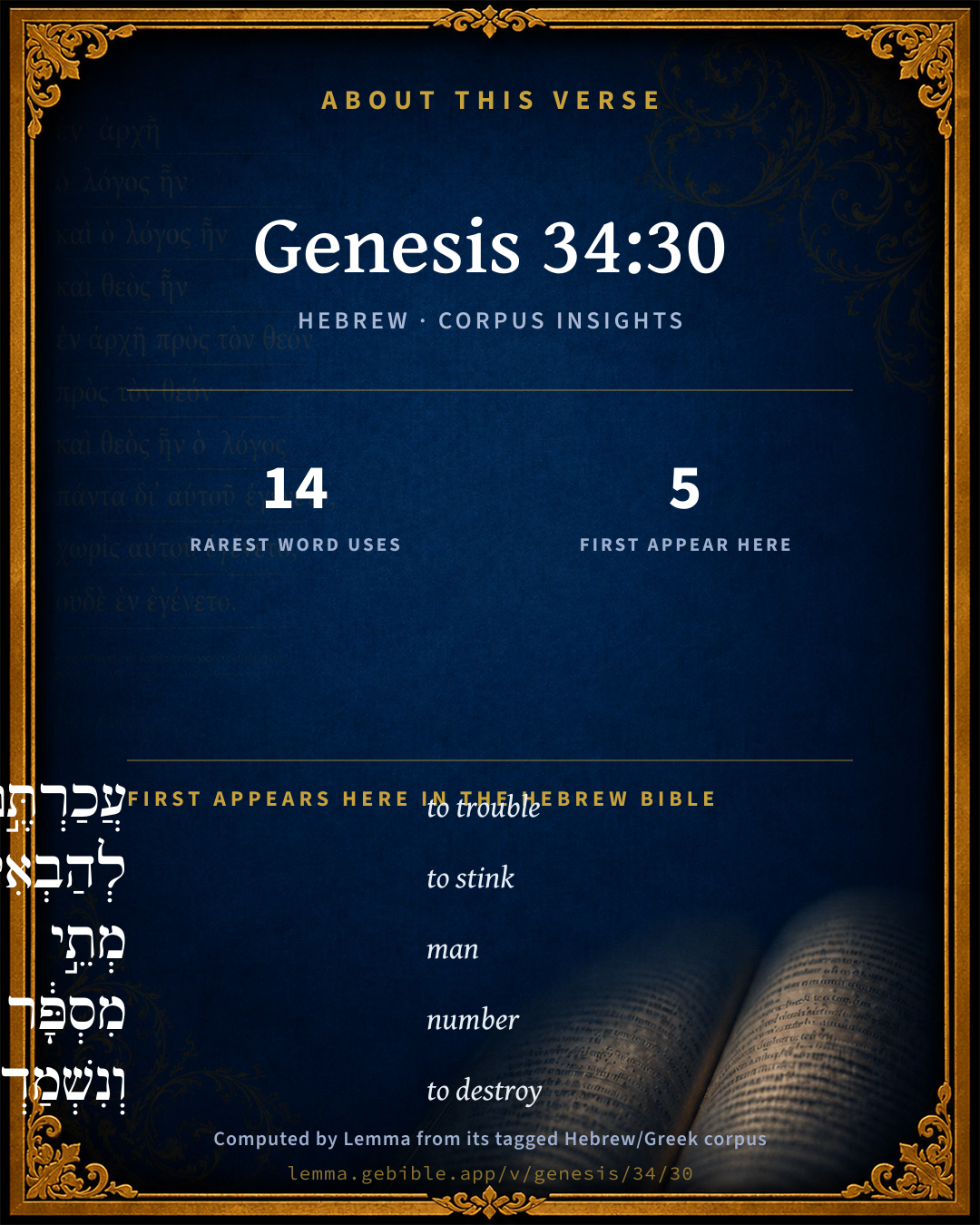
The rarest word here is עֲכַרְתֶּ֣ם to trouble H5916 — appearing just 14 times in the whole Hebrew Bible.

First appearance in Scripture

These words make their first canonical appearance in the Hebrew Bible here:

  • עֲכַרְתֶּ֣ם to trouble H5916
  • לְהַבְאִישֵׁ֨נִי֙ to stink H887
  • מְתֵ֣י man H4962
  • מִסְפָּ֔ר number H4557
  • וְנִשְׁמַדְתִּ֖י to destroy H8045

Shared distinctive vocabulary

עֲכַרְתֶּ֣ם to trouble H5916 occurs in 13 verses of the Hebrew Bible. Also found in:

Grammatical profile

  • 7 verbs
  • 9 nouns
  • 2 pronouns
  • 3 prepositions
  • 1 particle

Verb forms

  • וַיֹּ֨אמֶר Qal · Sequential Imperfect
  • עֲכַרְתֶּ֣ם Qal · Perfect
  • לְהַבְאִישֵׁ֨נִי֙ Hiphil · Infinitive Construct
  • בְּיֹשֵׁ֣ב Qal · Participle Active
  • וְנֶאֶסְפ֤וּ Niphal · Perfect
  • וְהִכּ֔וּנִי Hiphil · Perfect
  • וְנִשְׁמַדְתִּ֖י Niphal · Perfect

Repetition

Words recur within this verse — often emphatic in Hebrew:

  • אֶל to H413 ×2
  • וַאֲנִי֙ I H589 ×2

Hebrew & Septuagint length

In English translation the verse runs 50 words from the Hebrew and 58 from the Septuagint (LXX English) — closely comparable.

A rough comparison of the two English renderings, which tokenize alike — not a word-level alignment.

Word counts can differ between the Hebrew and the Greek without any difference in meaning — e.g. the Hebrew direct-object marker אֵת has no separate Greek word, and Greek often adds the article ὁ.

Cross-references

25

Topical passages linked to Genesis 34:30 in the Treasury of Scripture Knowledge — connected by theme and wording, ordered by reader-vote popularity; previews shown in the World English Bible.

  • Exodus 5:21 and they said to them, "May Yahweh look at you, and judge, because you have made us a stench to be abhorred in the eyes of Pharaoh, and in the eyes of his servants, to put a sword in their hand to kill us."
  • Joshua 7:25 Joshua said, Why have you troubled us? Yahweh shall trouble you this day. All Israel stoned him with stones; and they burned them with fire, and stoned them with stones.
  • 1 Samuel 13:4 All Israel heard say that Saul had struck the garrison of the Philistines, and also that Israel was had in abomination with the Philistines. The people were gathered together after Saul to Gilgal.
  • Psalms 105:12 When they were but a few men in number, Yes, very few, and foreigners in it.
  • Genesis 13:7 There was a strife between the herdsmen of Abram's cattle and the herdsmen of Lot's cattle: and the Canaanite and the Perizzite lived then in the land.
  • Genesis 28:13–14 Behold, Yahweh stood above it, and said, "I am Yahweh, the God of Abraham your father, and the God of Isaac. The land whereon you lie, to you will I give it, and to your seed.
  • Genesis 49:5–7 "Simeon and Levi are brothers; Weapons of violence are their swords.
  • 1 Samuel 27:12 Achish believed David, saying, He has made his people Israel utterly to abhor him; therefore he shall be my servant forever.
  • 1 Chronicles 16:19 When you were but a few men in number, Yes, very few, and foreigners in it;
  • 1 Chronicles 19:6 When the children of Ammon saw that they had made themselves odious to David, Hanun and the children of Ammon sent one thousand talents of silver to hire them chariots and horsemen out of Mesopotamia, and out of Arammaacah, and out of Zobah.
  • Genesis 12:2 I will make of you a great nation. I will bless you, and make your name great. You will be a blessing.
  • Genesis 12:12 It will happen, when the Egyptians will see you, that they will say, 'This is his wife.' They will kill me, but they will save you alive.
  • Genesis 46:27 The sons of Joseph, who were born to him in Egypt, were two souls. All the souls of the house of Jacob, who came into Egypt, were seventy.
  • Deuteronomy 4:17 the likeness of any animal that is on the earth, the likeness of any winged bird that flies in the sky,
  • Deuteronomy 7:7 Yahweh didn't set his love on you, nor choose you, because you were more in number than any people; for you were the fewest of all peoples:
  • 1 Samuel 16:2 Samuel said, How can I go? if Saul hear it, he will kill me. Yahweh said, Take a heifer with you, and say, I am come to sacrifice to Yahweh.
  • 1 Samuel 27:1 David said in his heart, I shall now perish one day by the hand of Saul: there is nothing better for me than that I should escape into the land of the Philistines; and Saul will despair of me, to seek me any more in all the borders of Israel: so shall I escape out of his hand.
  • 2 Samuel 10:6 When the children of Ammon saw that they were become odious to David, the children of Ammon sent and hired the Syrians of Beth Rehob, and the Syrians of Zobah, twenty thousand footmen, and the king of Maacah with one thousand men, and the men of Tob twelve thousand men.
  • 1 Kings 18:18 He answered, I have not troubled Israel; but you, and your father's house, in that you have forsaken the commandments of Yahweh, and you have followed the Baals.
  • 1 Chronicles 2:7 The sons of Carmi: Achar, the troubler of Israel, who committed a trespass in the devoted thing.
  • 1 Chronicles 16:12 Remember his marvelous works that he has done, His wonders, and the judgments of his mouth,
  • Proverbs 11:17 The merciful man does good to his own soul, But he who is cruel troubles his own flesh.
  • Proverbs 11:29 He who troubles his own house shall inherit the wind. The foolish shall be servant to the wise of heart.
  • Proverbs 15:27 He who is greedy for gain troubles his own house, But he who hates bribes will live.
  • Romans 4:18–20 Who in hope believed against hope, to the end that he might become a father of many nations, according to that which had been spoken, "So will your seed be."

Cross-references courtesy of OpenBible.info (CC BY 4.0).

Hebrew and Greek witnesses Masoretic Hebrew ↔ Greek Septuagint

The same verse in the two great witnesses to the Old Testament, shown verse-for-verse.

These are two independent witnesses, not word-aligned to each other, and the Septuagint is shown in lemma (dictionary) form.

Hebrew Genesis 34:30 Masoretic · Westminster Leningrad Codex

וַיֹּ֨אמֶר יַעֲקֹ֜ב אֶל שִׁמְע֣וֹן וְאֶל לֵוִי֮ עֲכַרְתֶּ֣ם אֹתִי֒ לְהַבְאִישֵׁ֨נִי֙ בְּיֹשֵׁ֣ב הָאָ֔רֶץ בַּֽכְּנַעֲנִ֖י וּבַפְּרִזִּ֑י וַאֲנִי֙ מְתֵ֣י מִסְפָּ֔ר וְנֶאֶסְפ֤וּ עָלַי֙ וְהִכּ֔וּנִי וְנִשְׁמַדְתִּ֖י אֲנִ֥י וּבֵיתִֽי

Jacob said to Simeon and Levi, "You have troubled me, to make me odious to the inhabitants of the land, among the Canaanites and the Perizzites. I am few in number. They will gather themselves together against me and strike me, and I will be destroyed, I and my house."

World English Bible · Public Domain

Greek LXX Genesis 34:30 Septuagint · lemma form

εἶπον δέ ἰακώβ συμεων καί λευί μισητός ἐγώ ποιέω ὥστε πονηρός ἐγώ εἰμί πᾶς ὁ καταοἰκέω ὁ γῆ ἐν τε ὁ χαναναῖος καί ὁ φερεζαῖος ἐγώ δέ ὀλιγοστός εἰμί ἐν ἀριθμός καί συνἄγω ἐπί ἐγώ συνκόπτω ἐγώ καί ἐκτρίβω ἐγώ καί ὁ οἶκος ἐγώ

And Jacob said to Symeon and Levi, You⌃ have made me hateful so that I should be evil to all the inhabitants of the land, both among the Chananites and the Pherezites, and I am few in number; they will gather themselves against me and cut me in pieces, and I shall be utterly destroyed, and my house.

LXX2012 (modern English Septuagint) · Public Domain

On this verse, The Pulpit Commentary discusses the Septuagint’s reading. Read the note in Commentary ↓

Hebrew: Westminster Leningrad Codex (CC BY 4.0). Greek: Septuagint (public domain); English from LXX2012 (modern English Septuagint) (Public Domain). How the Septuagint differs from the Hebrew →

Targum (Aramaic paraphrase)

2

The Targum is the ancient Jewish Aramaic paraphrase of the Hebrew Scriptures — an interpretive translation, not the Hebrew text itself. Onkelos (literal) and Pseudo-Jonathan (expansive) render the Torah, and Jonathan the Prophets. Coverage is partial: where no permissively-licensed English translation exists for a verse, only the Aramaic is shown. This is verse-level text, not a word-by-word alignment to the Hebrew.

  1. Targum Onkelos Torah (Genesis–Deuteronomy)
    וַאֲמַר יַעֲקֹב לְשִׁמְעוֹן וּלְלֵוִי עֲכַרְתּוּן יָתִי לְמִתַּן דְּבָבוּ בֵּינָנָא וּבֵין יָתְבֵי אַרְעָא בִּכְנַעֲנָאָה וּבַפְּרִזָּאָה וַאֲנָא עַם דְּמִנְיַן וְיִתְכַּנְשׁוּן עֲלַי וְיִמְחִנּוּנִי וְאֶשְׁתֵּצֵי אֲנָא וְאֱנַשׁ בֵּיתִי

    (no public-domain English translation for this verse)

    Targum Onkelos — Aramaic: “Onkelos Genesis” (public domain); “Onkelos Exodus” (public domain); “Onkelos Leviticus” (public domain); “Onkelos Numbers” (public domain); “Onkelos Deuteronomy” (public domain). English: “Sefaria Community Translation” (CC0 1.0 (public-domain dedication)); “J.W. Etheridge. The Targums of Onkelos and Jonathan Ben Uzziel on the Pentateuch. London: Longmans, Green, 1862” (public domain). Text via Sefaria.

  2. Targum Pseudo-Jonathan Torah (Genesis–Deuteronomy)
    וַאֲמַר יַעֲקב לְשִׁמְעוֹן וּלְלֵוִי עֲכַרְתּוּן יָתִי לְמִפְקָא שְׁמִי בִּישׁ בְּיַתְבֵי אַרְעָא בִּכְנַעֲנָאָה וּבִפְרִיזָאֵי וַאֲנָא עַם דְמִנְיַן וְיִתְכַּנְשׁוּן עָלָי וְיִמְחוּנַנִי וְאִישְׁתְּצֵי אֲנָא וְאֵינַשׁ בֵּיתִי

    And Jakob said to Shimeon and Levi, You have made my name to go forth as evil among the inhabitants of the land, among the Kenaanites and Phezerites. And I am a people of (small) number, and they will gather together against me, and destroy me and the men of my house.

    Targum Pseudo-Jonathan — Aramaic: “Targum Jonathan on Genesis” (public domain); “Targum Jonathan on Exodus” (public domain); “Targum Jonathan on Leviticus” (public domain); “Targum Jonathan on Numbers” (public domain); “Targum Jonathan on Deuteronomy” (public domain). English: “The Targum of Jonathan ben Uzziel, trans. J. W. Etheridge, London, 1862” (public domain). Text via Sefaria.

Commentary

Notes on Genesis 34:30 from classic Christian and Jewish commentators (each source and its license shown beneath its notes). The classic Christian expositions comment on the surrounding passage and are grouped to its opening verse, so a note may address several verses; the Jewish commentaries on the Tanakh (Rashi and others) are per-verse, so they appear only where the commentator wrote on this verse.

Lemma curates 59 commentaries, every one of them public domain or Creative Commons licensed, each selected and text-cleaned for this edition rather than reprinted as found. About our sources →

Trapp's Complete Commentary

John Trapp

Gen 34:30 And Jacob said to Simeon and Levi, Ye have troubled me to make me to stink among the inhabitants of the land, among the Canaanites and the Perizzites: and I [being] few in number, they shall gather themselves together against me, and slay me; and I shall be destroyed, I and my house.

Ver. 30. Are have troubled me.] In mind and estate, {a} and many such trouble houses and trouble towns there are abroad. All places are full of them, and so is hell too. There God will trouble them another while, as he did Achan, {Jos 7:25} when he will show mercy to such Jacobs in whose families that is committed that they abhor.

I being few in, number.] So the saints were ever a little flock, a poor few to the many; jewels, nothing so much in bulk as lumber; strangers, few, in respect of home dwellers; sons of God, few, to common subjects. When Christ "came to his own, his own received him not." {Joh 1:12} He wondered at one good Nathanael, and set a "Behold" upon him, as a rare bird. {Joh 1:47}

{a} Cum in animo tum in rationibus. - Jun.

John Trapp, A Commentary or Exposition upon All the Books of the Old and New Testament (1647–1656) — public domain. Text from a community e-Sword module.

Joseph Benson's Commentary

Gen 34:30. Ye have troubled me, to make me to stink — That is, you have rendered me and my family odious among the inhabitants of the land. Abraham and Isaac had been much respected, though strangers in the country, and their wise, righteous, and benevolent conduct, and that of their families, had gained honour to their religion: but Jacob was apprehensive, and not without reason, that these shameful proceedings of his sons would cause him and his religion to be execrated among these Canaanites, whose crimes they had exceeded. Well might he say, they had troubled him! Well might he always keep their conduct in remembrance and mention it with indignation on his death-bed, for nothing could be more treacherous, base, and cruel. I shall be destroyed, I and my house — Indeed, what else could he expect, but that, numerous and formidable as the Canaanites were, they would unite together against him, and that he and his little family would be an easy prey to them? He knew, indeed, that God had promised to preserve his house; but he might justly fear that these vile practices of his children would amount to a forfeiture, and cut off the entail. When sin is in the house, there is reason to fear ruin at the door.

Joseph Benson's Commentary on the Old and New Testaments (1811–1818) — public domain. Text from a community e-Sword module.

Tyndale Open Study Notes

Tyndale Open Resources

34:30 Jacob responded again out of fear of what would happen to him, but God caused the people of this land to fear him instead (35:5).

Tyndale Open Study Notes — © Tyndale Open Resources, licensed CC BY-SA 4.0. Text via the HelloAO Bible API.

Geneva Bible (1599)

Geneva Bible translators

Or, to be abhorred.

Geneva Bible (1599) marginal notes — public domain. Text via Bolls.life.

Jamieson, Fausset & Brown

Robert Jamieson, A. R. Fausset & David Brown

Jacob said . . . Ye have troubled me--This atrocious outrage perpetrated on the defenseless citizens and their families made the cup of Jacob's affliction overflow. We may wonder that, in speaking of it to his sons, he did not represent it as a heinous sin, an atrocious violation of the laws of God and man, but dwelt solely on the present consequences. It was probably because that was the only view likely to rouse the cold-blooded apathy, the hardened consciences of those ruffian sons. Nothing but the restraining power of God saved him and his family from the united vengeance of the people (compare Gen 35:5). All his sons had not been engaged in the massacre. Joseph was a boy, Benjamin not yet born, and the other eight not concerned in it. Simeon and Levi alone, with their retainers, had been the guilty actors in the bloody tragedy. But the Canaanites would not be discriminating in their vengeance; and if all the Shechemites were put to death for the offense of their chief's son, what wonder if the natives should extend their hatred to all the family of Jacob; and who probably equalled, in number, the inhabitants of that village.

Next: Genesis Chapter 35

Jamieson, Fausset & Brown — Commentary Critical and Explanatory on the Whole Bible (1871) — public domain (CC PDM 1.0). Text via the HelloAO Bible API.

Adam Clarke's Commentary

Verse 30. Ye have troubled me] Brought my mind into great distress, and endangered my personal safety; to make me to stink-to render me odious to the surrounding tribes, so that there is every reason to suspect that when this deed is come abroad they will join in a confederacy against me, and extirpate my whole family. And had he not been under the peculiar protection of God, this in all human probability would have been the case; but he had prevailed with God, and he was also to prevail with men. That Jacob's resentment was not dissembled we have the fullest proof in his depriving these two sons of the birthright, which otherwise they had doubtless enjoyed. See Ge 49:5; Ge 49:7, where some additional circumstances are related.

Adam Clarke's Commentary on the Bible (1810–1826) — public domain. Text from a community e-Sword/MySword module.

John Calvin's Commentaries

30. And Jacob said. Moses declares that the crime was condemned by the holy man, lest any one should think that he had participated in their counsel. He also expostulates with his sons, because they had caused him to stink among the inhabitants of the land; that is, they had rendered him so odious, that no one would be able to bear him. If then the neighboring nations should conspire among themselves, he would be unable to resist them, seeing he had so small a band, in comparison with their great number. He also expressly names the Canaanites and Perizzites, who, though they had received no wrong, were yet by nature exceedingly prone to inflict injury. But Jacob may seem to act preposterously, in overlooking the offense committed against God, and in considering only his own danger. Why is he not rather angry at their cruelty? why is he not offended at their perfidy? why does he not reprove their rapaciousness? It is however probable, that when he saw them terror — stricken at their recent crime, he suited miswords to their state of mind. For he acts as if he were complaining that he, rather than the Shechemites, was slain by them. We know that men are seldom if ever drawn to repentance, except by the fear of punishment: especially when they have any specious pretext as a covering for their fault. Besides, we know not whether Moses may not have selected this as a part out of a long expostulation, to cause his readers to understand that the fury of Simon and Levi was so outrageous, that they were more insensible than brute beasts to their own destruction and that of their whole family. This is clear from their own answer, which not only breathes a barbarous ferocity, but shows that they had no feeling. It was barbarous, first, because they excuse themselves for having destroyed a whole people and plundered their city, on account of the injury done by one man; secondly, because they answer their father so shortly and contumaciously; thirdly, because they obstinately defend the revenge which they had rashly taken. Moreover, their insensibility was prodigious, because they were not affected by the thought of their own death, and that of their parents, wives, and children, which seemed just at hand. Thus we are taught, how intemperate anger deprives men of their senses. We are also admonished, that it is not enough for us to be able to lay blame on our opponents; but we must always see how far it is lawful for us to proceed.

John Calvin's Commentaries (1540-1563) — public domain. Text from the Calvin Translation Society English edition (1840s-50s) via the Christian Classics Ethereal Library (ccel.org). Calvin's coverage is partial (roughly two-thirds of the Bible); uncommented books and verses are honest gaps, never fabricated. The 19th-century editor's footnotes and remarks are omitted so the notes are faithfully Calvin's own voice.

Ellicott's Commentary for English Readers

(30) Ye have troubled me.—Jacob’s timidity led him to think first of the danger that would result from the conduct of his sons, and only afterwards of the cruelty and treacherousness of their deed. He commented upon this on his dying bed in words of fitting reprobation, but his reproof now is singularly weak, and the retort of his sons just. If the danger were all, this could have no weight when a shameful wrong had been done; but in avenging this wrong they had committed a crime of a deeper dye

A Bible Commentary for English Readers, edited by Charles John Ellicott (1878–1897) — public domain. Text from a community e-Sword module.

The Cambridge Bible for Schools and Colleges

gen. ed. J. J. S. Perowne

30. And Jacob, &c.] This and the following verse continue the narrative of Gen_34:26. Jacob reproaches his two sons for the murder, on account of which the people of the land will be infuriated with Jacob and his house. Cf. Gen_49:5-7.

troubled] The same word used in the story of Achan (Jos_6:18; Jos_7:25; 1Ch_2:7). Jacob’s rebuke turns, not so much upon the dastardly treachery and cruelty of his sons, as upon the evil effects it will produce, and upon the insecurity it will bring upon himself and his house.

make me to stink] A common Heb. metaphor: cf. Exo_5:21 (“make savour to be abhorred”); 1Sa_13:4 (“had in abomination”), Gen_27:12 (“made … abhor”); 1Ch_19:6 (“made … odious”).

the Canaanites and the Perizzites] See note on Gen_13:7.

being few in number] Cf. 1Ch_16:19.

The Cambridge Bible for Schools and Colleges (gen. ed. J. J. S. Perowne; Cambridge University Press, 1878–1918) — public domain. Text from a community e-Sword module.

John Gill's Exposition

And they said,.... Simeon and Levi, in a very pert and unseemly manner:

should he deal with our sister as with an harlot? make a whore of her, and then keep her in his house as such? is this to be borne with? or should we take no more notice of his behaviour to our sister, or show no more regard to her than if she was a common prostitute, whom no man will defend or protect? so say the Targums of Jonathan and Jerusalem,"nor let Shechem the son of Hamor mock at us, or boast and say, as an harlot whom no man seeks after, or no man seeks to avenge her; so it is done by Dinah the daughter of Jacob:''they tacitly insinuate as if Jacob had not that regard for the honour of his daughter and family, and showed his resentment at the wicked behaviour of Shechem, as he ought to have done. It is observed that there is a letter in the word for "harlot" greater than usual, which may either denote the greatness of the sin of Shechem in dealing with Dinah as an harlot, or the great impudence and boldness of Jacob's sons, in their answer to him, and their audaciousness in justifying such baseness and cruelty they had been guilty of. The whole of this history, as related in this chapter, is given by Polyhistor out of Theodotus the poet (q).

(q) Apud Euseb. Evangel. Praepar. l. 9. c. 22. p. 427, &c.

Next: Genesis Chapter 35

John Gill's Exposition of the Whole Bible (1746–1763) — public domain (CC PDM 1.0). Text via the HelloAO Bible API.

Matthew Poole's English Annotations

You have not only discomposed my mind, but perplexed my affairs, and brought me into such troubles and dangers as I am never likely to escape. You have made me odious to

the inhabitants of the land, who will impute this perfidious and bloody fact to my contrivance.

Few in number; Heb. men of number, i.e. few; for such can easily be numbered. So this phrase is used Deu 4:27; 33:6, opposite to which are men without number, 2Ch 12:3.

They shall slay me: he could expect no other in human reason, and they were hindered from so doing only by the hand of the great God smiting them with terror, Gen 35:5.

Matthew Poole's English Annotations on the Holy Bible (1683–1685) — public domain. Text from a community e-Sword/MySword module.

Whedon's Commentary on the Bible

Daniel D. Whedon

30. Jacob said to Simeon and Levi — His words of reproof partake here largely of worldly policy and prudence. He fears the bad odour in which he will be held by his Canaanitish neighbours, and the danger of their combining together to destroy him. But in the inspiration of his dying psalm, when utterly lifted above all earthly policies and dangers, he cursed the wrath and anger which prompted the bitter cruelties at Shechem.

Gen_49:5-7.

I being few in number — Hebrews, I, males of number; that is, the males of my family, capable of fighting, are so few as to be easily numbered.

Daniel D. Whedon (gen. ed.), Commentary on the Old and New Testaments (1874–1909) — public domain. Text from a community e-Sword module.

The Pulpit Commentary

And Jacob said to Simeon and Levi, Ye have troubled me (i.e. brought trouble upon me) to make me to stink or, to cause me to become hateful; mishton me pepoihkate (LXX)among the inhabitants of the land, among the Canaanites and the Perizzites: (vide Gen_13:7) and I (sc. with my attendants) being few in number, literally, men of number, i.e. that can be easily numbered, a small band (cf. Deu_4:27 Psa_105:12; Jer_44:28) they (literally, and they) shall gather themselves together against me, and slay me; and I shall be destroyed, I and my house. That Jacob should have spoken to his sons only of his own danger, and not of their guilt, has been ascribed to his belief that this was the only motive which their carnal minds could understand (Keil, Gerlach); to a remembrance of his own deceitfulness, which disqualified him in a measure from being the censor of his sons (Kalisch, Wordsworth); to the lowered moral and spiritual tone of his own mind (Candlish, "Speaker"s Commentary"); to the circumstance that, having indulged his children in their youth, be was now afraid to reprove them (Inglis). That Jacob afterwards attained to a proper estimate of their bloody deed his last prophetic utterance reveals. (Gen_49:5-7) By some it is supposed that he even now felt the crime in all its heinousness (Kalisch), though his reproach was somewhat leniently expressed in the word "trouble" (Lange); while others, believing Jacob"s abhorrence of his sons" fanatical cruelty to have been deep and real, account for its omission by the historian on the ground that he aimed merely at showing the protection of God, (Gen_35:5) through which Jacob escaped the evil consequences of their conduct" (Hengstenberg, Kurtz).

HOMILIES BY J.F. MONTGOMERY Ver. 30.

Anger unrestrained.

Jacob said to Simeon and Levi, Ye have troubled me." It was not merely the fear of retaliation by neighboring tribes. He felt the act was; (Gen_49:5-7) God"s blessing could not rest upon it; (cf. Psa_34:7) and he and his family were involved in that wrong (cf. Jos_7:13; 1Co_12:26) But was not the anger of Simeon and Levi just? No doubt there was cause, and no doubt a measure of righteous indignation. But

(1) they thought more of the wrong against themselves than of the gin against God (ver. 31).

(2) Their anger was unrestrained by mercy, or even by justice (ver. 25).

(3) It led them into acts of sin deceit, murder, robbery.

(4) It was soiled by selfish gain (ver. 27). Anger may be right; but need of special, watchfulness. (Eph_4:26) For under its influence the heart is not in a state fitted to judge; and much danger of self-deception, of mistaking a selfish for a godly anger.

I A JUST CAUSE FOR ANGER DOES NOT EXCUSE ITS EXCESS. Anger may be called for

(1) as a protest against wrong;

(2) to deter others from wrong.

But vengeance, retribution, belongs to God. (Rom_12:19) He alone has the knowledge to apportion it, looking both to the past and to the future. But anger tempts to retaliation. (Mat_5:38) The wrong fills the mind. Our own errors and acts of wrong, (cf. Joh_8:7) and the plea, Thine anger brings harm to the innocent, are unheeded. The fact that there was cause for anger blinds to its real nature; for unrestrained anger is in truth an offering to self-love. The plea of zeal for right and of godly indignation may seem sincere; but "ye know not what manner of spirit ye are of.

II A JUST CAUSE FOR ANGER DOES NOT EXCUSE WRONGDOING. God"s laws cannot be set aside. And he who takes on himself the office of judge should be especially watchful not to transgress. (Psa_37:3) To do wrong on the plea of doing God"s work is to distrust his providential care. (Rom_12:19-21) It is to do evil that good may come; a form of being drawn aside by our own lusts (cf. 1Sa_24:7 1Sa_26:9) Such acts of wrong are especially evil in Christians. They are "a city set on a hill." Men are ever ready to point to their errors as excusing their own. Men see and judge the act, but cannot estimate the provocation, or, it may be, the sorrow, for a hasty action.

III WORKS DONE IN ANGER HINDER THE WORK OF THE CHURCH. That work is to draw men together in one. (Joh_17:21) The power by which this is done is love. The love of Christ reflected in us. (1Jn_4:7) Love wins men"s hearts, reason only their minds. And the presence of anger hinders love; not merely in him against whom it is directed; like a stone thrown into still water, it disturbs its surface far and wide.

IV THE POWER BY WHICH ANGER MUST BE CONTROLLED. Dwelling on the work and example of Christ. He bore all for us. Is not wrath rebuked in the presence of his patience? And if as a "strange work" we are constrained to indignation, must we not watch and pray that no selfish feeling may mingle with it; and, knowing in how many things we offend, that we be "slow to wrath," ready to forgive, and ever "looking unto Jesus"? M.

The Pulpit Commentary (1880–1919), ed. H.D.M. Spence-Jones & Joseph S. Exell — public domain. Text from a community e-Sword module.

John Wesley's Explanatory Notes

Ye have troubled me, to make me to stink among the inhabitants of the land - That is, You have rendered my family odious among them. And what could be expected but that the Canaanites, who were numerous and formidable, would confederate against him, and he and his little family would become an easy prey to them? I shall be destroyed, I and my house - Jacob knew indeed that God had promised to preserve his house; but he might justly fear that these vile practices of his children would amount to a forfeiture, and cut off the entail. When sin is in the house, there is reason to fear ruin at the door.

John Wesley, Explanatory Notes Upon the Whole Bible (1754–1765) — public domain. Text via the GEBible commentary corpus.

Keil & Delitzsch

C. F. Keil & F. Delitzsch

Jacob reproved the originators of this act most severely for their wickedness: "Ye have brought me into trouble (conturbare), to make me stink (an abomination) among the inhabitants of the land;...and yet I (with my attendants) am a company that can be numbered (lit., people of number, easily numbered, a small band, Deu 4:27, cf. Isa 10:19); and if they gather together against me, they will slay me," etc. If Jacob laid stress simply upon the consequences which this crime was likely to bring upon himself and his house, the reason was, that this was the view most adapted to make an impression upon his sons. For his last words concerning Simeon and Levi (Gen 49:5-7) are a sufficient proof that the wickedness of their conduct was also an object of deep abhorrence. And his fear was not groundless. Only God in His mercy averted all the evil consequences from Jacob and his house (Gen 35:5-6). But his sons answered, "Are they to treat our sister like a harlot?" עשׂה: as in Lev 16:15, etc. Their indignation was justifiable enough; and their seeking revenge, as Absalom avenged the violation of his sister on Amnon (Sa2 13:22.), was in accordance with the habits of nomadic tribes. In this way, for example, seduction is still punished by death among the Arabs, and the punishment is generally inflicted by the brothers (cf. Niebuhr, Arab. p. 39; Burckhardt, Syr. p. 361, and Beduinen, p. 89, 224-5). In addition to this, Jacob's sons looked upon the matter not merely as a violation of their sister's chastity, but as a crime against the peculiar vocation of their tribe. But for all that, the deception they practised, the abuse of the covenant sign of circumcision as a means of gratifying their revenge, and the extension of that revenge to the whole town, together with the plundering of the slain, were crimes deserving of the strongest reprobation. The crafty character of Jacob degenerated into malicious cunning in Simeon and Levi; and jealousy for the exalted vocation of their family, into actual sin. This event "shows us in type all the errors into which the belief in the pre-eminence of Israel was sure to lead in the course of history, whenever that belief was rudely held by men of carnal minds" (O. v. Gerlach).

Keil & Delitzsch — Biblical Commentary on the Old Testament (1861–1891) — public domain (CC PDM 1.0). Text via the HelloAO Bible API. (Old Testament only.)

unfoldingWord translationNotes

Door43 World Missions Community

brought trouble on me

Causing someone to experience trouble is spoken of as if trouble were an object that is brought and placed on a person. AT: "caused great problems for me" (See: Metaphor)

to make me stink to the inhabitants of the land

Causing the people in the surrounding areas to hate Jacob is spoken of as if Jacob's sons made him smell bad physically. This can be translated as a new sentence. AT: "You have made me repulsive to the people who live in the land" (See: Metaphor)

I am few in number ... against me and attack me, then I will be destroyed, I and my household

Here the words "I" and "me" refer to all of Jacob's household. Jacob only says "I" or "me" since he is the leader. AT: "My household is small ... against us and attack us, then they will destroy all of us" (See: Synecdoche)

gather themselves together against me and attack me

"form an army and attack me" or "form an army and attack us"

then I will be destroyed

This can be stated in active form. AT: "they will destroy me" or "they will destroy us" (See: Active or Passive)

Should Shechem have dealt with our sister as with a prostitute?

Simeon and Levi use a question to emphasize that Shechem did what was wrong and deserved to die. AT: "Shechem should not have treated our sister as if she were a prostitute!" (See: Rhetorical Question)

translationWords

Jacob

Simeon

Levi

Canaan

Perizzite

household

Shechem

prostitute

unfoldingWord translationNotes — © Distant Shores Media and the Door43 World Missions Community, licensed CC BY-SA 4.0. Source: git.door43.org/Door43/en_tn.

Rashi

Rabbi Shlomo Yitzchaki (Rashi)

עכרתם YE HAVE TROUBLED ME — This has the same meaning as (Berakhot 25b) “troubled (עכורים) waters” (i.e. waters that are disturbed, not clear). He meant “Now my mind will never be clear (without worry)”. There is an Agada, (Genesis Rabbah 80:12) “He said: the wine in the cask was clear but you have troubled it”. The Canaanites had a tradition that they would fall by the hands of the sons of Jacob, but they thought that this would happen only when the condition was fulfilled as expressed in the verse (Exodus 23:30) “when thou shalt in-crease, then shalt thou inherit the land”; consequently they had been silent until now (i.e. they had not attacked them).

מתי מספר means A FEW MEN.

Rashi on the Tanakh — English translations: “The Judaica Press complete Tanach with Rashi, translated by A. J. Rosenberg” (CC BY 4.0); “Pentateuch with Rashi's commentary by M. Rosenbaum and A.M. Silbermann, 1929-1934” (public domain); “The Metsudah Tanach series, Lakewood, N.J” (CC BY 4.0); and “The Book of Joshua, Metsudah Publications, 1997” (CC BY 4.0). Text via Sefaria.

Radak

Rabbi David Kimhi (Radak)

ויאמר...עכרתם, an expression meaning “destruction.” The word is used in this sense in Samuel I 14,29 עכר אבי את הארץ, “my father has destroyed the land.” [I do not see this meaning in the root עכר either here or in Samuel. I would translate it more appropriately as “confused, caused confusion. Ed.]

להבאשני, to cause me shame. The Canaanites in the region will despise me and try to remove me from the district as one removes a person who exudes a putrid stench. Yaakov reacted in the time-honoured fashion of being afraid, almost a trademark of his, whereas his sons were stout-hearted men willing to avenge the shame inflicted upon their very personalities.

Radak on the Tanakh — English translations: “Sefaria Community Translation” (CC0 1.0 (public-domain dedication)); “Eliyahu Munk, HaChut Hameshulash” (CC BY 4.0); “Rabbi Mike Feuer, Jerusalem Anthology” (CC BY 4.0); and “R. David Kimhi on the first book of Psalms, Translated by R.G. Finch, London, 1919” (public domain). Text via Sefaria.

Lesson kit

Teaching starters — assembled from the data on this page, not authored interpretation. Every prompt links to the verse data it draws on. Edit before teaching.

Genesis, in the Pentateuch, opens this verse with 22 words (20 distinct Hebrew lemmas). Its most distinctive word is ʻâkar (“to trouble”). A historical commentator’s framing appears above. Read the whole chapter for the surrounding context.

Discussion questions

  1. What does “to trouble” (ʻâkar) contribute to the verse as a whole?
  2. 5 words here appear for the first time in Scripture. What is being introduced at this debut?
  3. Joshua 6:18 shares the word «to trouble» with this verse. How do the two illuminate each other?
  4. “to” occurs 2× in this one verse. What is the effect of the repetition?
  5. These translations render this verse differently; the difference is in the English rendering, not the original. What questions does that raise?
  6. The verb «וַיֹּ֨אמֶר» is Qal Sequential Imperfect. How does its form color the action?
  7. Reading how Trapp's Complete Commentary and Joseph Benson's Commentary read this verse, where do the two commentators agree and where do they part?

Things to notice

  • 5 words make their first canonical appearance in Scripture here.
  • These translations choose different wording for 19 words in this verse.
  • “to” occurs 2× in this single verse.
  • 20 distinct Hebrew lemmas span 22 words in this verse.

Reading settings

Reading text

Shown beneath each verse's original-language words.

Old Testament
Old Testament edition

Read the OT as the Masoretic Hebrew (MT) or the Greek Septuagint (LXX).

English shown for the Greek Septuagint (in the Hebrew ↔ Greek comparison).

Comparing translations? Open the Compare panel on any verse page to stack up to four side by side.