Leviticus 19:18

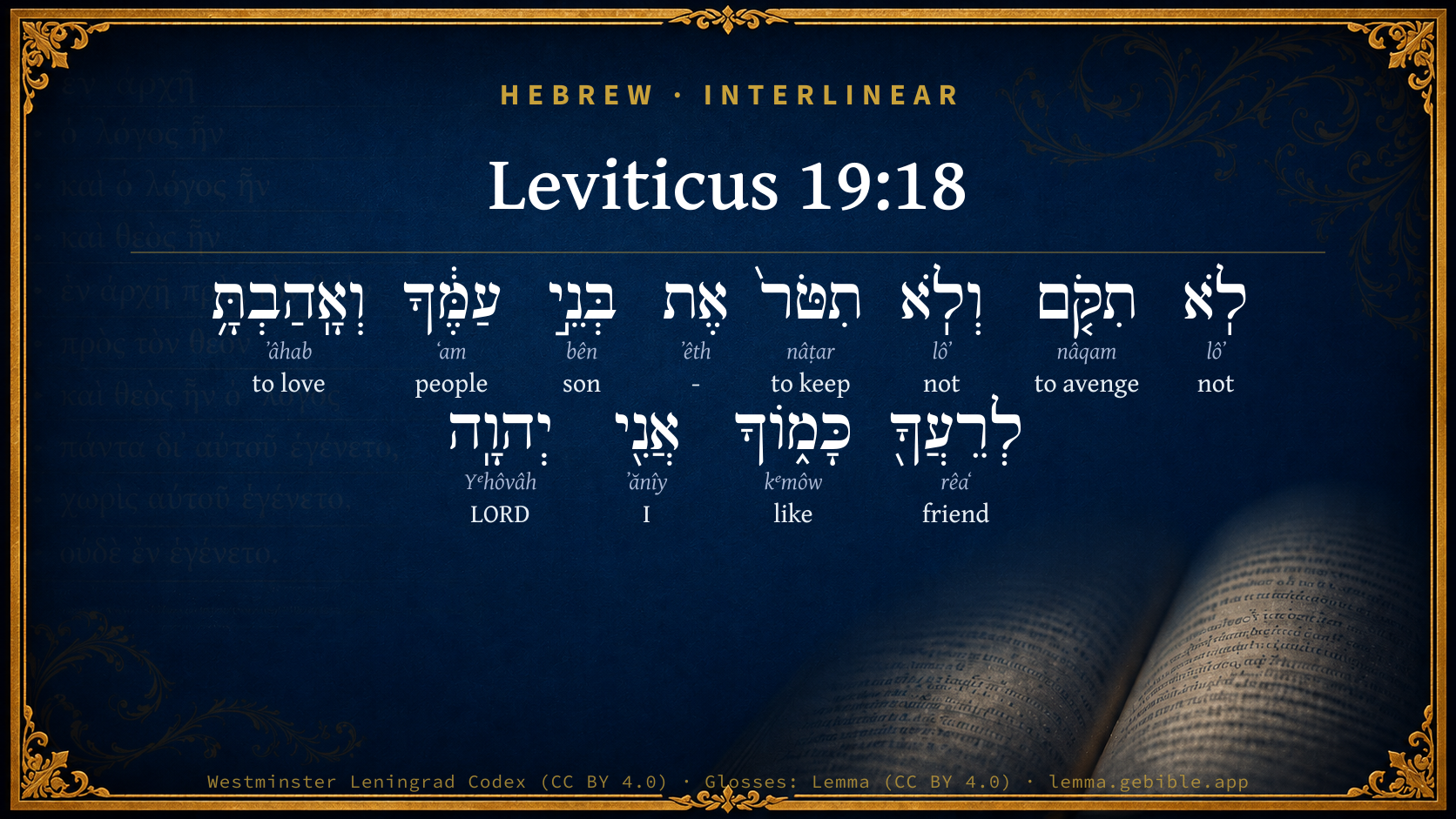
Hebrew (Westminster Leningrad Codex) Leviticus 19:18 appears in the Hebrew Old Testament. The text above is from the Westminster Leningrad Codex. Each word links to its Strong’s number, a concise gloss, and parsing drawn from the Open Scriptures Hebrew Bible morphology. Click any word for its full Brown-Driver-Briggs (BDB) entry.
Download image
Cite this verse

Leviticus 19:18 (World English Bible). Public Domain. Lemma interlinear Bible study tool, https://lemma.gebible.app/v/leviticus/19/18.

Show BibTeX & RIS
BibTeX
RIS
English Translation
You shall not take vengeance, nor bear any grudge against the children of your people; but you shall love your neighbor as yourself. I am Yahweh.
World English Bible · Public Domain
Highlights
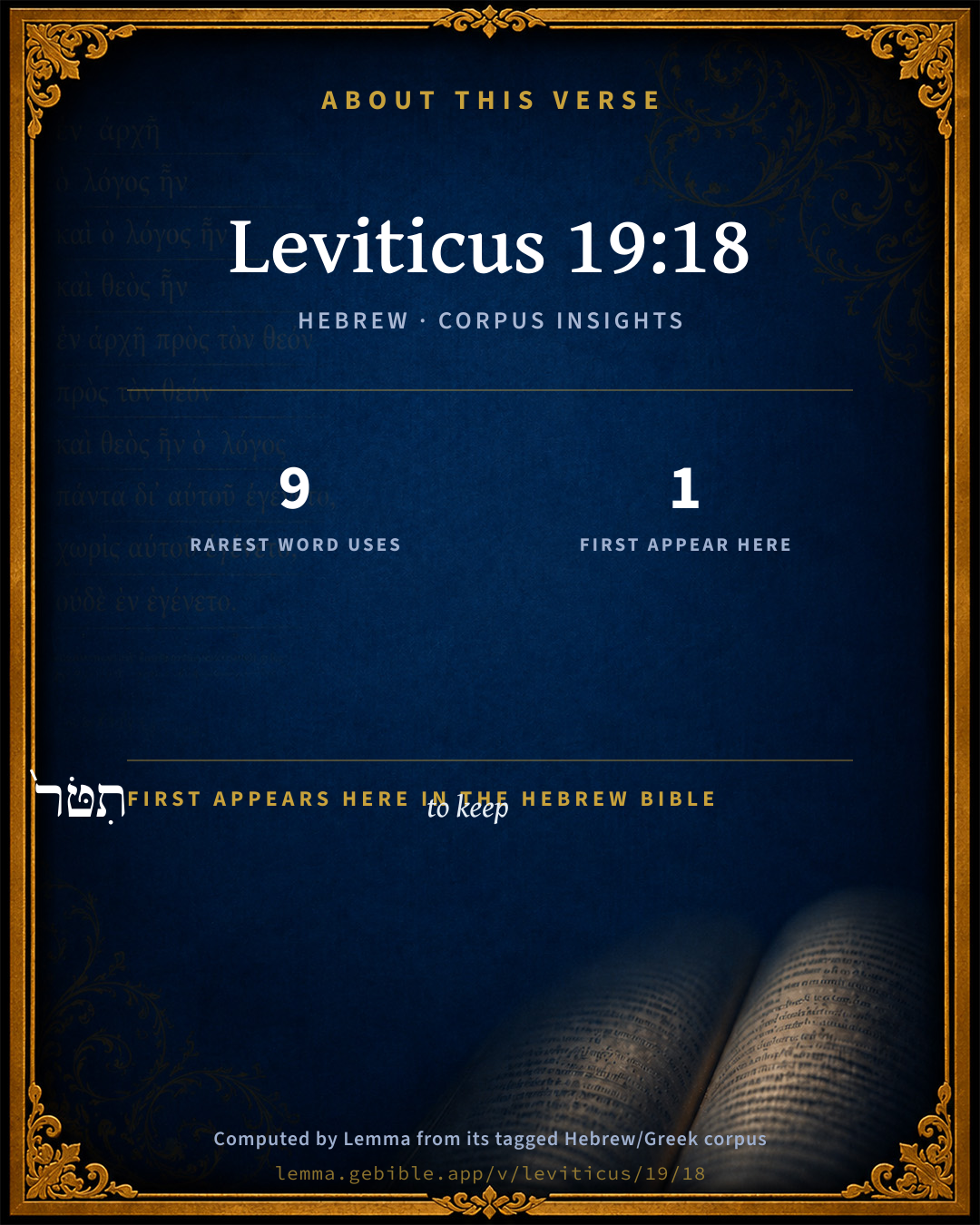
  • 1 first appearance in the Hebrew Bible
Full analysis ↓
Download a study sheet

One document with this verse’s original text, its word-by-word gloss line, the meaning frame, cross-references with their text, attributed commentary, and full source and license credits — printable, and it pastes into notes with its structure intact.

This verse Autodidact and up

Study sheet (.html) Plain text (.txt)

A passage Seminary Student

Up to 50 verses in one chapter. A passage sheet keeps up to 6 commentary sources and 12 cross-references per verse, in the order this page ranks them, and says so on the sheet whenever that leaves anything out. Ask for a single verse and you get the Autodidact verse sheet above.

Everything on this page stays free to read, with no account — the sheet is a download of what is already on screen, not access to it.

Want to remove ads? Support Godless Engineer
Compare translations 3

The same verse in 3 English versions, stacked beneath the original-language interlinear above. Click any original word for its lexicon entry.

Each is an independent rendering of the whole verse — the interlinear is not word-aligned to these translations.

Highlighted words mark where these versions differ — a whole-verse word diff, not a word-by-word alignment.

  • World English Bible Public Domain
    You shall not take vengeance, nor bear any grudge against the children of your people; but you shall love your neighbor as yourself. I am Yahweh.
  • King James Version Public Domain
    Thou shalt not avenge, nor bear any grudge against the children of thy people, but thou shalt love thy neighbor as thyself: I am the LORD.
  • unfoldingWord Literal Text CC BY-SA 4.0
    You shall not avenge, and you shall not guard the sons of your people, but you shall love your neighbor as yourself. I Yahweh.

unfoldingWord Literal Text — © unfoldingWord, licensed CC BY-SA 4.0. Word-aligned USFM3 via Door43 (git.door43.org/unfoldingWord/en_ult).

Versions to compare (up to 4)

3 of 4 selected

Show all 18 translations

Every available English version of this verse, each an independent rendering of the whole verse.

  • World English Bible Public Domain
    You shall not take vengeance, nor bear any grudge against the children of your people; but you shall love your neighbor as yourself. I am Yahweh.
  • Berean Standard Bible Public Domain
    Do not seek revenge or bear a grudge against any of your people, but love your neighbor as yourself. I am the LORD.
  • Majority Standard Bible Public Domain
    Do not seek revenge or bear a grudge against any of your people, but love your neighbor as yourself. I am the LORD.
  • King James Version Public Domain
    Thou shalt not avenge, nor bear any grudge against the children of thy people, but thou shalt love thy neighbor as thyself: I am the LORD.
  • American Standard Version (1901) Public Domain
    Thou shalt not take vengeance, nor bear any grudge against the children of thy people; but thou shalt love thy neighbor as thyself: I am Jehovah.
  • Revised Version (1885) Public Domain
    Thou shalt not take vengeance, nor bear any grudge against the children of thy people, but thou shalt love thy neighbour as thyself: I am the LORD.
  • Geneva Bible (1599) Public Domain
    Thou shalt not auenge, nor be mindful of wrong against ye childre of thy people, but shalt loue thy neighbour as thy selfe: I am the Lord.
  • Douay-Rheims (1899) Public Domain
    Seek not revenge, nor be mindful of the injury of thy citizens. Thou shalt love thy friend as thyself. I am the Lord.
  • Young's Literal Translation Public Domain
    `Thou dost not take vengeance, nor watch the sons of thy people; and thou hast had love to thy neighbour as thyself; I `am' Jehovah.
  • Literal Standard Version CC BY-SA 4.0
    You do not take vengeance, nor watch the sons of your people; and you have had love for your neighbor as yourself; I [am] YHWH.
  • Unlocked Literal Bible CC BY-SA 4.0
    Do not take vengeance or hold any grudge against any of your people, but instead love your neighbor as yourself. I am Yahweh.
  • unfoldingWord Literal Text CC BY-SA 4.0
    You shall not avenge, and you shall not guard the sons of your people, but you shall love your neighbor as yourself. I Yahweh.
  • Darby Bible Public Domain
    Thou shalt not avenge thyself, nor bear any grudge against the children of thy people, but thou shalt love thy neighbour as thyself: I am Jehovah.
  • World Messianic Bible Public Domain
    “‘You shall not take vengeance, nor bear any grudge against the children of your people; but you shall love your neighbor as yourself. I am the LORD.
  • Webster's Bible Public Domain
    Thou shalt not avenge, nor bear any grudge against the children of thy people, but thou shalt love thy neighbor as thyself; I am the LORD.
  • Free Bible Version CC BY-SA 4.0
    Don't look for revenge or hold a grudge against anybody, but love your neighbor as yourself. I am the Lord.
  • Bible in Basic English Public Domain
    Do not make attempts to get equal with one who has done you wrong, or keep hard feelings against the children of your people, but have love for your neighbour as for yourself: I am the Lord.
  • JPS Tanakh (1917) Public Domain
    Thou shalt not take vengeance, nor bear any grudge against the children of thy people, but thou shalt love thy neighbour as thyself: I am the LORD.

Literal Standard Version (2020), Covenant Press — licensed CC BY-SA 4.0. Text via the HelloAO Bible API (eBible.org). Unlocked Literal Bible (unfoldingWord) — licensed CC BY-SA 4.0. Text via the HelloAO Bible API (eBible.org). unfoldingWord Literal Text — © unfoldingWord, licensed CC BY-SA 4.0. Word-aligned USFM3 via Door43 (git.door43.org/unfoldingWord/en_ult). Free Bible Version, Dr. Jonathan Gallagher — licensed CC BY-SA 4.0. Text via the HelloAO Bible API (eBible.org).

Word by word

More ways to search: Search by grammar → Find every occurrence → Compare this word →

Practice this passage: Drill this verse → Learn its vocabulary →

תִטֹּר֙
nâṭar
H5201
“to keep”
Verb, Qal, Imperfect, 2nd Person, Masculine, Singular
Part of Speech
Verb
Stem
Qal
Form
Imperfect
Person
2nd Person
Gender
Masculine
Number
Singular
Full BDB Definition

Origin: a primitive root

TWOT: 1356

to keep, keep guard, reserve, maintain - (Qal) - to keep, maintain - to keep, guard
  1. לֹֽא lôʼ H3808 “not” Particle, Negative
  2. תִקֹּ֤ם nâqam H5358 “to avenge” Verb, Qal, Imperfect, 2nd Person, Masculine, Singular
  3. וְלֹֽא lôʼ H3808 “and · not” Conjunction + Particle, Negative
  4. אֶת ʼêth H853 “-” Particle, Direct Object
  5. בְּנֵ֣י bên H1121 “sons of” Noun, Common, Masculine, Plural, Construct
  6. עַמֶּ֔ךָ ʻam H5971 “people · your” Noun, Common, Masculine, Singular, Construct + Suffix, Personal, 2nd Person, Masculine, Singular
  7. וְאָֽהַבְתָּ֥ ʼâhab H157 “and · to love” Conjunction + Verb, Qal, Sequential Perfect, 2nd Person, Masculine, Singular
  8. לְרֵעֲךָ֖ rêaʻ H7453 “to/for · friend · your” Preposition + Noun, Common, Masculine, Singular, Construct + Suffix, Personal, 2nd Person, Masculine, Singular
  9. כָּמ֑וֹךָ kᵉmôw H3644 “like · you” Preposition + Suffix, Personal, 2nd Person, Masculine, Singular
  10. אֲנִ֖י ʼănîy H589 “I” Pronoun, Personal, 1st Person, Common, Singular
  11. יְהוָֽה Yᵉhôvâh H3068 “LORD” Noun, Proper

About this verse

These counts appear in no published source. They are computed here, from the morphology-tagged text and Lemma’s own curated glosses. What Lemma adds →

12
words
11
distinct lemmas
Pentateuch
section

Notable vocabulary

The rarest word here is תִטֹּר֙ to keep H5201 — appearing just 9 times in the whole Hebrew Bible.

First appearance in Scripture

This word makes its first canonical appearance in the Hebrew Bible here:

  • תִטֹּר֙ to keep H5201

Shared distinctive vocabulary

תִטֹּר֙ to keep H5201 occurs in 8 verses of the Hebrew Bible. Also found in:

Grammatical profile

  • 3 verbs
  • 4 nouns
  • 1 pronoun
  • 1 preposition
  • 3 particles

Verb forms

  • תִקֹּ֤ם Qal · Imperfect
  • תִטֹּר֙ Qal · Imperfect
  • וְאָֽהַבְתָּ֥ Qal · Sequential Perfect

Repetition

A word recurs within this verse — often emphatic in Hebrew:

Hebrew & Septuagint length

In English translation the verse runs 26 words from the Hebrew and 31 from the Septuagint (LXX English) — closely comparable.

A rough comparison of the two English renderings, which tokenize alike — not a word-level alignment.

Word counts can differ between the Hebrew and the Greek without any difference in meaning — e.g. the Hebrew direct-object marker אֵת has no separate Greek word, and Greek often adds the article ὁ.

Cross-references

22

Topical passages linked to Leviticus 19:18 in the Treasury of Scripture Knowledge — connected by theme and wording, ordered by reader-vote popularity; previews shown in the World English Bible.

  • Matthew 22:39–40 A second likewise is this, 'You shall love your neighbor as yourself.'
  • Romans 13:9 For the commandments, "You shall not commit adultery," "You shall not murder," "You shall not steal," "You shall not give false testimony," "You shall not covet," and whatever other commandments there are, are all summed up in this saying, namely, "You shall love your neighbor as yourself."
  • Mark 12:31–34 The second is like this, 'You shall love your neighbor as yourself.' There is no other commandment greater than these."
  • Luke 10:27–37 He answered, "You shall love the Lord your God with all your heart, with all your soul, with all your strength, and with all your mind; and your neighbor as yourself."
  • Galatians 5:14 For the whole law is fulfilled in one word, in this: "You shall love your neighbor as yourself."
  • James 2:8 However, if you fulfill the royal law, according to the Scripture, "You shall love your neighbor as yourself," you do well.
  • Matthew 5:43–44 "You have heard that it was said, 'You shall love your neighbor, and hate your enemy.'
  • Matthew 19:19 'Honor your father and mother.' And, 'You shall love your neighbor as yourself.'"
  • Romans 12:19 Don't seek revenge yourselves, beloved, but give place to God's wrath. For it is written, "Vengeance belongs to me; I will repay, says the Lord."
  • Exodus 23:4–5 "If you meet your enemy's ox or his donkey going astray, you shall surely bring it back to him again.
  • Romans 12:17 Repay no one evil for evil. Respect what is honorable in the sight of all men.
  • Proverbs 20:22 Don't say, "I will pay back evil." Wait for Yahweh, and he will save you.
  • Ephesians 4:31 Let all bitterness, wrath, anger, outcry, and slander, be put away from you, with all malice.
  • Colossians 3:8 but now you also put them all away: anger, wrath, malice, slander, and shameful speaking out of your mouth.
  • Matthew 19:16 Behold, one came to him and said, "Good teacher, what good thing shall I do, that I may have eternal life?"
  • Hebrews 10:30 For we know him who said, "Vengeance belongs to me," says the Lord, "I will repay." Again, "The Lord will judge his people."
  • 1 Peter 2:1 Putting away therefore all wickedness, all deceit, hypocrisies, envies, and all evil speaking,
  • Deuteronomy 32:25 Outside shall the sword bereave, In the chambers terror; [It shall destroy] both young man and virgin, The suckling with the man of gray hairs.
  • 2 Samuel 13:22 Absalom spoke to Amnon neither good nor bad; for Absalom hated Amnon, because he had forced his sister Tamar.
  • 2 Samuel 13:28 Absalom commanded his servants, saying, Mark you now, when Amnon's heart is merry with wine; and when I tell you, Smite Amnon, then kill him; don't be afraid; haven't I commanded you? be courageous, and be valiant.
  • Romans 13:4 for he is a servant of God to you for good. But if you do that which is evil, be afraid, for he doesn't bear the sword in vain; for he is a minister of God, an avenger for wrath to him who does evil.
  • Galatians 5:20 idolatry, sorcery, hatred, strife, jealousies, outbursts of anger, rivalries, divisions, heresies,

Cross-references courtesy of OpenBible.info (CC BY 4.0).

Hebrew and Greek witnesses Masoretic Hebrew ↔ Greek Septuagint

The same verse in the two great witnesses to the Old Testament, shown verse-for-verse.

These are two independent witnesses, not word-aligned to each other, and the Septuagint is shown in lemma (dictionary) form.

Hebrew Leviticus 19:18 Masoretic · Westminster Leningrad Codex

לֹֽא תִקֹּ֤ם וְלֹֽא תִטֹּר֙ אֶת בְּנֵ֣י עַמֶּ֔ךָ וְאָֽהַבְתָּ֥ לְרֵעֲךָ֖ כָּמ֑וֹךָ אֲנִ֖י יְהוָֽה

You shall not take vengeance, nor bear any grudge against the children of your people; but you shall love your neighbor as yourself. I am Yahweh.

World English Bible · Public Domain

Greek LXX Leviticus 19:18 Septuagint · lemma form

καί οὐ ἐκδικάζω σύ ὁ χείρ καί οὐ μηνίω ὁ υἱός ὁ λαός σύ καί ἀγαπάω ὁ πλησίον σύ ὡς σεαυτοῦ ἐγώ εἰμί κύριος

And your hand shall not avenge you; and you shall not be angry with the children of your people; and you shall love your neighbor as yourself; I am the Lord.

LXX2012 (modern English Septuagint) · Public Domain

On this verse, Haydock's Catholic Bible Commentary discusses the Septuagint’s reading. Read the note in Commentary ↓

Hebrew: Westminster Leningrad Codex (CC BY 4.0). Greek: Septuagint (public domain); English from LXX2012 (modern English Septuagint) (Public Domain). How the Septuagint differs from the Hebrew →

Targum (Aramaic paraphrase)

2

The Targum is the ancient Jewish Aramaic paraphrase of the Hebrew Scriptures — an interpretive translation, not the Hebrew text itself. Onkelos (literal) and Pseudo-Jonathan (expansive) render the Torah, and Jonathan the Prophets. Coverage is partial: where no permissively-licensed English translation exists for a verse, only the Aramaic is shown. This is verse-level text, not a word-by-word alignment to the Hebrew.

  1. Targum Onkelos Torah (Genesis–Deuteronomy)
    לָא תִקוֹם וְלָא תִטַר דְבָבוּ לִבְנֵי עַמָךְ וּתְרַחֵם לְחַבְרָךְ כְּוָתָךְ אֲנָא יְיָ

    (no public-domain English translation for this verse)

    Targum Onkelos — Aramaic: “Onkelos Genesis” (public domain); “Onkelos Exodus” (public domain); “Onkelos Leviticus” (public domain); “Onkelos Numbers” (public domain); “Onkelos Deuteronomy” (public domain). English: “Sefaria Community Translation” (CC0 1.0 (public-domain dedication)); “J.W. Etheridge. The Targums of Onkelos and Jonathan Ben Uzziel on the Pentateuch. London: Longmans, Green, 1862” (public domain). Text via Sefaria.

  2. Targum Pseudo-Jonathan Torah (Genesis–Deuteronomy)
    לָא תֶהֱווֹן נַקְמִין וְלָא נַטְרִין דְבָבוּ לִבְנֵי עַמָךְ וּתְרַחֲמֵי לְחַבְרָךְ דְמַן אַנְתְּ סַנֵי לָךְ לָא תַעֲבֵיד לֵיהּ אֲנָא יְיָ

    Be not revengeful, nor cherish animosity against the children of thy people; but thou shalt love thy neighbour himself, as that though there be (cause of) hatred with thee thou mayest not do (evil) to him: I am the Lord.

    Targum Pseudo-Jonathan — Aramaic: “Targum Jonathan on Genesis” (public domain); “Targum Jonathan on Exodus” (public domain); “Targum Jonathan on Leviticus” (public domain); “Targum Jonathan on Numbers” (public domain); “Targum Jonathan on Deuteronomy” (public domain). English: “The Targum of Jonathan ben Uzziel, trans. J. W. Etheridge, London, 1862” (public domain). Text via Sefaria.

Commentary

Notes on Leviticus 19:18 from classic Christian and Jewish commentators (each source and its license shown beneath its notes). The classic Christian expositions comment on the surrounding passage and are grouped to its opening verse, so a note may address several verses; the Jewish commentaries on the Tanakh (Rashi and others) are per-verse, so they appear only where the commentator wrote on this verse.

Lemma curates 59 commentaries, every one of them public domain or Creative Commons licensed, each selected and text-cleaned for this edition rather than reprinted as found. About our sources →

Trapp's Complete Commentary

John Trapp

Lev 19:18 Thou shalt not avenge, nor bear any grudge against the children of thy people, but thou shalt love thy neighbour as thyself: I [am] the LORD.

Ver. 18. Nor bear any grudge.] Heb., Nor keep. There is nothing that a man is more ready to keep than his wrath. Therefore the Hebrews both here and Jer 3:5 Psa 103:9, put servare for servare iram. But we must neither revenge nor remember; we must not throw away the dagger, and keep the sheath, but both forgive and forget.

But thou shalt love thy neighbour.] {See Trapp on "Mat 22:37"} {See Trapp on "Mat 22:38"} {See Trapp on "Mat 22:39"} {See Trapp on "Mat 22:40"} {See Trapp on "Rom 13:9"}

John Trapp, A Commentary or Exposition upon All the Books of the Old and New Testament (1647–1656) — public domain. Text from a community e-Sword module.

The Biblical Illustrator

Joseph S. Exell

Lev_19:18

Thou shalt not avenge.

Forgive and forget

In another place we read, For vengeance is Mine, and I will repay. Wrest not Gods sword therefore out of His hand, sit not down in His seat, nor make thyself a god, for fear of the end. Well, let Him go then, I will not avenge, but sure I will remember Him; forgive I may, but never forget, &c. See what followeth in the very next words of this verse, Neither shalt thou be mindful of a wrong against the children of thy people. Remembering, then, you see, is condemned as well as avenging, and therefore it standeth you upon both to forgive and to forget, or else the Lord shall forget you out of His Book of Life. Nay, see more: all this is not yet enough, but we must love also our neighbours, and that even as ourselves, or else we perish. For, I am the Lord, saith the verse, that is, One that seeth and hateth and will smite thee in that strength that thou canst not resist nor endure. Foolish politic, think, then, of piety, and abhor that policy that devoureth piety and destroyeth thee. Thou canst not live ever, but must die, and come unto judgment. (Bp. Babington.)

Penalty of the desire to avenge

Small birds have an intense natural antipathy of nocturnal birds of prey. If one of these birds happens to be seen out of its lurking-place during the day they assail it vigorously, resent its intrusion, and avenge the oppression exercised over them during the night by combined attacks. This antipathy has been taken advantage of for the purpose of catching birds ever since the days of Aristotle. The catcher imitates, for instance, the voice of an owl about an hour before sunset, when the birds will flock together and perch on the trees or bushes in the suspected neighbourhood. The twigs, &c., having been previously covered with bird-lime, the birds pay their liberty and perhaps life as the penalty of their desire to avenge themselves on the owl. (Scientific lllustrations.)

Brotherly affection

Euclid showed in himself the true symptoms of brotherly affection, who, when his brother in his rage made a rash vow, saying, Let me not live, if I be not revenged on my brother; Euclid turns the speech contrary way, Nay, let me not live, if I be not reconciled to my brother; let me not live, if we be not as good friends as ever we were before. Shall a heathen thus outstrip us Christians? nature be stronger than grace? the bonds of flesh tie faster and surer than the bonds of grace? We call on God our Father, we acknowledge, or should do, one Church our mother, we are bred up in the same school of the Cross, fed at the same table of the Lord, incorporated into the same communion of saints. If these and the like considerations cannot knit our hearts in love one to another, the very heathens will rise up in judgment against us, and condemn us. (J. Spencer.)

Victory over self the best way to gain others

Winthrop, the Puritan Governor of Massachusetts, had a wonderful control of his own passions. On one occasion, one of the officers of the colony wrote him a sharp letter, complaining of his official acts. He sent back the letter--would not keep such a letter of provocation by him. By and by, the writer of the letter, while there was a scarcity of food in the colony, sent to buy some of Winthrops cattle. Receive them, said the governor, as a gift in token of my goodwill. The offender wrote back: Sir, your overcoming of yourself hath overcome me. This way of dealing with offenders was loved by him.

The Biblical Illustrator, edited by Joseph S. Exell (c. 1880s–1900s) — public domain. Text from a community e-Sword module.

Joseph Benson's Commentary

Lev 19:18. Thy neighbour — Every man, as plainly appears, 1st, By comparing this place with Lev 19:34, where this law is applied to strangers. 2d, Because the word neighbour is explained by another man, Lev 20:10; Rom 13:8. As thyself — With the same sincerity, though not equality of affection.

Joseph Benson's Commentary on the Old and New Testaments (1811–1818) — public domain. Text from a community e-Sword module.

Tyndale Open Study Notes

Tyndale Open Resources

19:18 love your neighbor as yourself: This is the cornerstone for biblical ethics in both the Old Testament and the New Testament (see Matt 22:39; Mark 12:31; Luke 10:27; Rom 13:8-9; Gal 5:14; Jas 2:8). It includes foreigners (Lev 19:34; cp. Luke 10:30-37). Conversely, hate leads to a grudge that can bear violent fruit (see 1 Jn 2:10-11; 4:20).

Tyndale Open Study Notes — © Tyndale Open Resources, licensed CC BY-SA 4.0. Text via the HelloAO Bible API.

Jamieson, Fausset & Brown

Robert Jamieson, A. R. Fausset & David Brown

thou shalt love thy neighbour as thyself--The word "neighbour" is used as synonymous with "fellow creature." The Israelites in a later age restricted its meaning as applicable only to their own countrymen. This narrow interpretation was refuted by our Lord in a beautiful parable (Luk 10:30-37).

Jamieson, Fausset & Brown — Commentary Critical and Explanatory on the Whole Bible (1871) — public domain (CC PDM 1.0). Text via the HelloAO Bible API.

Ellicott's Commentary for English Readers

(18) Thou shalt not avenge.—As the preceding verse enjoins upon us to reprove the offender, this verse forbids us to avenge the wrong even when the rebuke has proved ineffectual, thus demanding the greatest sacrifice on the part of the injured person. The administrators of the law during the second Temple illustrate what is meant by avenge by the following example. “When a disobliging person who is in need applies to you to lend him something, and you reply, ‘I will not lend you even as you would not lend me,’ this is to avenge.” (Comp. also Rom_12:19.)

Nor bear any grudge.—The law goes further still. It enjoins that the injured man is to banish from memory the injury he has suffered, though the offender has made no reparation. The spiritual authorities during the time of Christ regarded the simple reference to the injury when a kindly act is performed to our adversary as a violation of this injunction. They illustrated it by the following example. When an adversary applies to you to lend him something, and you actually comply with his request, but in so doing you say, “I lend it you, I will not act as you have acted, for you have refused to lend me,” this is a violation of the command not to bear any grudge. “He who at the reconciliation with his adversary readily forgives his transgressions, his own trespasses will also be readily forgiven in the day of judgment,” is the oft-repeated precept of the sages during the second Temple. Again, “He who suffers injuries and does not return injury for injury, he who is reviled? 1 does not revile again, fulfils acts of love and rejoice in suffering; of him it is said, ‘Those that love him are like the sun, which comes forth in its might from all dark clouds beaming with light’” (Jdg_5:31).

Thou shalt love thy neighbour as thyself.—This sublime precept formed the centre around which clustered the ethical systems propounded by some of the most distinguished Jewish teachers during the second Temple. When Hillel was asked by one who wished to learn the sum and substance of the Divine Law in the shortest possible time, this sage replied by giving a paraphrase of the precept before us in a negative form, “What thou dost not wish that others should do to thee, that do not thou to others; this is the whole Law, the rest is only its interpretation. Now go and learn.” Christ gives it in the positive form (Mat_7:12; Luk_6:31; Rom_13:8-10).

A Bible Commentary for English Readers, edited by Charles John Ellicott (1878–1897) — public domain. Text from a community e-Sword module.

John Gill's Exposition

Thou shalt not avenge,.... That is, not avenge ourselves on him that has done us an ill thing, but leave it to him to whom vengeance belongs, see Rom 12:19; which is done when a man does an ill thing for another, or denies to grant a favour which he has been denied by another; Jarchi thus illustrates it, one says to him (his neighbour) lend me thy sickle; he answers, no (I will not); on the morrow (the neighbour comes, who had refused, and) says to him, lend me thy hatchet; he replies, I will not lend thee, even as thou wouldest not lend me; this is vengeance: this was reckoned mean and little, a piece of weakness with the very Heathens (b):

nor bear any grudge against the children of thy people; those of the same place, city, or kingdom; or "not observe" (c) the injury done, take no notice of it, nor lay it up in the mind and memory, but forget it; or "not keep" (d) or retain enmity, as the Targum of Jonathan supplies it; and so do an ill turn, or refuse to do a good one; or if that is done, yet upbraids with the former unkindness; for upbraiding with unkindness shows that a grudge is retained, though the suit is not denied:

but thou shalt love thy neighbour as thyself; sincerely and heartily, as a man loves himself, doing all the good to him as a man does to himself, or would have done to himself, and hindering all the mischief done to him he would have himself preserved from: Jarchi observes, that it was a saying of R. Akiba, that this is"the great universal in the law,''and it does indeed comprehend the whole of the second table of the law, and is the summary of it, and is pretty much the same our Lord says of it, that it is the second and great commandment, and like unto the first, on which two all the law and the prophets hang, Mat 22:37; and so the Apostle Paul makes all the laws of the second table to be comprehended in this, Rom 13:9,

I am the Lord; the Creator of all men, and who has commanded them to love one another, and to whom alone vengeance belongs, and who expects obedience to the above laws of his.

(b) -----quippe minuti, &c. Juvenal. Satyr. 13. (c) "et non observabis", Montanus. (d) "Non servabis", Pagninus, Drusius; "neque iram asservato"; Junius & Tremellius, Piscator.

John Gill's Exposition of the Whole Bible (1746–1763) — public domain (CC PDM 1.0). Text via the HelloAO Bible API.

Haydock's Catholic Bible Commentary

Revenge, by private authority, or out of passion, which the pagans themselves acknowledged was more becoming a brute than a man, feræ est. (Muson. Sen. de ira ii. 32.) --- Citizens. Hebrew, "observe or lie not in wait." Septuagint, "act not with fury against the son of thy people." (Calmet) --- Hebrew notor, means to upbraid when doing a kindness. --- Thy friend. Hebrew rehaka, may denote thy neighbour, or any one with whom we have any thing to do. Thus God orders us to love strangers as ourselves, (ver. 34,) and to help our enemy, Exodus xxiii. 4. The false insinuations of the Jews are fully exploded by Jesus Christ, Matthew xxii. 39. We must love the offender, but detest the offence. (St. Augustine, contra Faust. xix. 24.) If God required his people to exterminate the Chanaanites, he did not authorized them to entertain any personal animosity against their persons, but they were to act as ministers of his justice. "O Lord, (said Philo very justly) we do not rejoice at the misfortune of our enemy, (Flaccus) having learnt from thy holy laws to compassionate the distress of others. But we thank thee for....delivering us from our afflictions." (Calmet)

George Leo Haydock (1774–1849), Haydock's Catholic Family Bible and Commentary, 1859 edition — public domain. Excludes Psalms (Douay-Rheims chapter numbering differs from Protestant) and Deuterocanonical books (Catholic canon only).

Matthew Poole's English Annotations

Nor bear any grudge, Heb. nor keep, either,

1. The injury here supposed in thy memory: so it is opposed to those who say they will forgive, but not forget an injury. Or,

2. Anger or hatred in thy heart: so this verb is used Jer 3:12; Nah 1:2. Thy neighbour; by which he understands not the Israelites only, as some would persuade us, but every other man with whom we converse, as plainly appears,

1. By comparing this place with Lev 19:34, where this very law is applied to strangers.

2. Because the word

neighbour is explained by another man, Lev 20:10; Rom 13:8; see more on Exo 20:16.

As thyself; with the same sincerity, though not equality, of affection, as to thyself.

Matthew Poole's English Annotations on the Holy Bible (1683–1685) — public domain. Text from a community e-Sword/MySword module.

Whedon's Commentary on the Bible

Daniel D. Whedon

18. Love thy neighbour — See Mat_5:43, note. “The traditional division of the law of Moses into moral, ceremonial, and juristic laws may serve to facilitate a general view of theocratic ordinances; but it is incorrect if it seeks to express a distinction within the law, and to claim various dignity for various parts. For the most inward commandment, “Thou shalt love thy neighbour as thyself,” stands beside “Thou shalt not sow thy field with two kinds of seed.” — Oehler.

Daniel D. Whedon (gen. ed.), Commentary on the Old and New Testaments (1874–1909) — public domain. Text from a community e-Sword module.

The Pulpit Commentary

Revenge and malice are forbidden as well as hatred, and the negative precepts culminate in the positive law. Thou shalt love thy neighbour as thyself, which sums up in itself one half of the Decalogue. (Mat_22:40) "For he that loveth another hath fulfilled the Law. For this, Thou shalt not commit adultery, Thou shalt not kill, Thou shalt not steal, Thou shalt not bear false witness, Thou shalt not covet; and if there be any other commandment, it is briefly comprehended in this saying, namely, Thou shalt love thy neighbour as thyself. Love worketh no ill to his neighbour: therefore love is the fulfilling of the Law". (Rom_13:8-10)

Vers. 18, 34. We have the testimony of our Lord (Mat_22:9) and of the Apostle St. Paul (Rom_13:9 Gal_5:14) that to obey the injunction, "Thou shalt love thy neighbour as thyself, is to fulfill all the commandments of the second table of the Law; and for that reason St. James calls it a royal law. (Jam_2:8) Here, therefore, the Levitical Law culminates in its highest point, so far as our duties towards men are concerned. Lest the Jew should confine the idea of thy neighbour to his own kindred and race, an equal love is specifically commanded for the stranger that dwelleth with you. Not only, Thou shalt love thy Jewish neighbour as thyself, but also Thou shalt love the stranger that dwelleth among you as thyself. The force of the comparison, as thyself, may be studied in Bishop Butler"s sermon "Upon the Love of our Neighbour.

But though the Law. culminates in the two kindred commands, "Thou shalt love the Lord thy God;" "Thou shalt love thy neighbour as thyself;" Christianity does not. Christianity goes beyond the highest point to which the Law soars. Not only does it name the neighbour and the stranger as those whom we are to love, but also the enemy. "Ye have heard that it hath been said, Thou shalt love thy neighbour, and hate thine enemy. But I say unto you, Love your enemies, bless them that curse you, do good to them that hate you, and pray for them which despitefully use you, and persecute you; that ye may be the children of your Father which is in heaven". (Mat_5:43-45) The motive in the gospel is also higher than the Law. In the Law the motive in the case of the stranger is human sympathy arising from common suffering, "for ye were strangers in the land of Egypt. In the gospel it is the desire to be like God in his dealings with men, "for he maketh his sun to rise on the evil and on the good, and sendeth rain on the just and on the unjust", (Mat_5:45) "for he is kind unto the unthankful and to the evil. Be ye therefore merciful, as your Father also is merciful". (Luk_6:35, Luk_6:36)

The Pulpit Commentary (1880–1919), ed. H.D.M. Spence-Jones & Joseph S. Exell — public domain. Text from a community e-Sword module.

John Wesley's Explanatory Notes

Thy neighbour - Every man, as plainly appears,

1. By comparing this place with ver. 34, where this law is applied to strangers.

2. Because the word neighbour is explained by another man, chap. xx, 10 Rom. xiii, 8. As thyself - With the same sincerity, though not equality of affection.

John Wesley, Explanatory Notes Upon the Whole Bible (1754–1765) — public domain. Text via the GEBible commentary corpus.

Rashi

Rabbi Shlomo Yitzchaki (Rashi)

לא תקם THOU SHALT NOT AVENGE — If one says to another “Lend me your sickle", and he replies, “No!", and the next day he (the latter) says to him (the former), “Lend me your hatchet”, and he retorts, “I am not going to lend it to you, just as you refused to lend me your sickle״ — this is avenging. And what is “bearing a grudge”? If one says to another, “Lend me your hatchet”, and he replies “No!” and on the next day he says to him “Lend me your sickle”, and he replies: “Here it is; I am not like you, because you would not lend me” — this is called “bearing a grudge (נטירה)” because he retains (נוטר) enmity in his heart although he does not actually avenge himself (Sifra, Kedoshim, Chapter 4 10-11; Yoma 23a).

ואהבת לרעך כמוך THOU SHALT LOVE THY FELLOW MAN AS THYSELF —Rabbi Akiba said: “This is a fundamental principle of the Torah” (Sifra, Kedoshim, Chapter 4 12; Talmud Yerushalmi Nedarim 9:3).

Rashi on the Tanakh — English translations: “The Judaica Press complete Tanach with Rashi, translated by A. J. Rosenberg” (CC BY 4.0); “Pentateuch with Rashi's commentary by M. Rosenbaum and A.M. Silbermann, 1929-1934” (public domain); “The Metsudah Tanach series, Lakewood, N.J” (CC BY 4.0); and “The Book of Joshua, Metsudah Publications, 1997” (CC BY 4.0). Text via Sefaria.

Ramban (Nachmanides)

Rabbi Moshe ben Nachman (Ramban / Nachmanides)

AND THOU SHALT LOVE THY NEIGHBOR AS THYSELF. This is an expression by way of overstatement, for a human heart is not able to accept a command to love one’s neighbor as oneself. Moreover, Rabbi Akiba has already come and taught, (further, 25:36), thy life takes precedence over the life of thy brother.” “Your life takes precedence over the life of your fellow-being.” Rather, the commandment of the Torah means that one is to love one’s fellow-being in all matters, as one loves all good for oneself., 6:3). It is possible that since it does not say “and thou shalt love ‘eth rei’acha’ of one’s neighbor as much as one loves one’s own self. But instead the verse says l’rei’acha, which means “to [or ‘for’] your neighbor,” thus teaching that that which is good “for” your neighbor you should love as if it were good for youself. as thyself,” but instead it likened them in the word ‘l’rei’acha’ [which literally means “to” thy neighbor], and similarly it states with reference to a proselyte, and thou shalt love ‘lo’ (him) [but literally: “to” him] as thyself, that the meaning thereof is to equate the love of both [himself and his neighbor, or himself and the proselyte] in his mind. For sometimes a person will love his neighbor in certain matters, such as doing good to him in material wealth but not with wisdom and similar matters. But if he loves him completely, he will want his beloved friend to gain riches, properties, honor, knowledge and wisdom. However [because of human nature] he will still not want him to be his equal, for there will always be a desire in his heart that he should have more of these good things than his neighbor. Therefore Scripture commanded that this degrading jealousy should not exist in his heart, but instead a person should love to do abundance of good for his fellow-being as he does for himself, and he should place no limitations upon his love for him. It is for this reason that it is said of Jonathan’s [love for David], for he loved him as he loved his own soul, because Jonathan had removed [altogether] the attribute of jealousy from his heart, and he said [to David], and thou shalt be king over Israel, 23:17. etc.Our Rabbis have already explained 4:10-11. the matters of taking vengeance and guarding a grudge [which are here forbidden], that they apply to cases where there is no monetary obligation, such as, “Lend me your sickle, lend me your hatchet.” For in a case where his friend owes him money, such as because of damage that he caused him or for similar reasons, one is not obliged to let his friend go free. On the contrary, he should sue him before the court and receive payment from him, on the basis of the verse which states, as he hath done, so shall it be done to him, and he [who caused the damage] is himself obliged to pay just as he must pay back that which he borrowed or robbed; and how much more so in matters of life, [the next of kin] should take vengeance and guard the grudge against the murderer, until the blood of his brother be redeemed by a court that will render judgment according to the laws of the Torah.

Ramban (Nachmanides) on the Tanakh — English translation: “Commentary on the Torah by Ramban (Nachmanides). Translated and annotated by Charles B. Chavel. New York, Shilo Pub. House, 1971-1976” (CC BY 4.0). Text via Sefaria.

Lesson kit

Teaching starters — assembled from the data on this page, not authored interpretation. Every prompt links to the verse data it draws on. Edit before teaching.

Leviticus, in the Pentateuch, opens this verse with 12 words (11 distinct Hebrew lemmas). Its most distinctive word is nâṭar (“to keep”). A historical commentator’s framing appears above. Read the whole chapter for the surrounding context.

Discussion questions

  1. What does “to keep” (nâṭar) contribute to the verse as a whole?
  2. This is the first place “to keep” appears in Scripture (first appears here). What does its debut here establish?
  3. How does Psalms 103:9, which shares the word «to keep», read alongside this verse?
  4. What does the repetition of “not” (2× in this one verse) do in this verse?
  5. These translations render this verse differently. What is at stake in choosing one wording over another?
  6. «תִקֹּ֤ם» is a Qal Imperfect verb. How does that grammatical form shape the action described?
  7. Compare how Trapp's Complete Commentary and The Biblical Illustrator read this verse. Where do they agree or differ?

Things to notice

  • 1 word makes its first canonical appearance in Scripture here.
  • These translations choose different wording for 17 words in this verse.
  • “not” occurs 2× in this single verse.
  • 11 distinct Hebrew lemmas span 12 words in this verse.

Reading settings

Reading text

Shown beneath each verse's original-language words.

Old Testament
Old Testament edition

Read the OT as the Masoretic Hebrew (MT) or the Greek Septuagint (LXX).

English shown for the Greek Septuagint (in the Hebrew ↔ Greek comparison).

Comparing translations? Open the Compare panel on any verse page to stack up to four side by side.