Judges 8:23

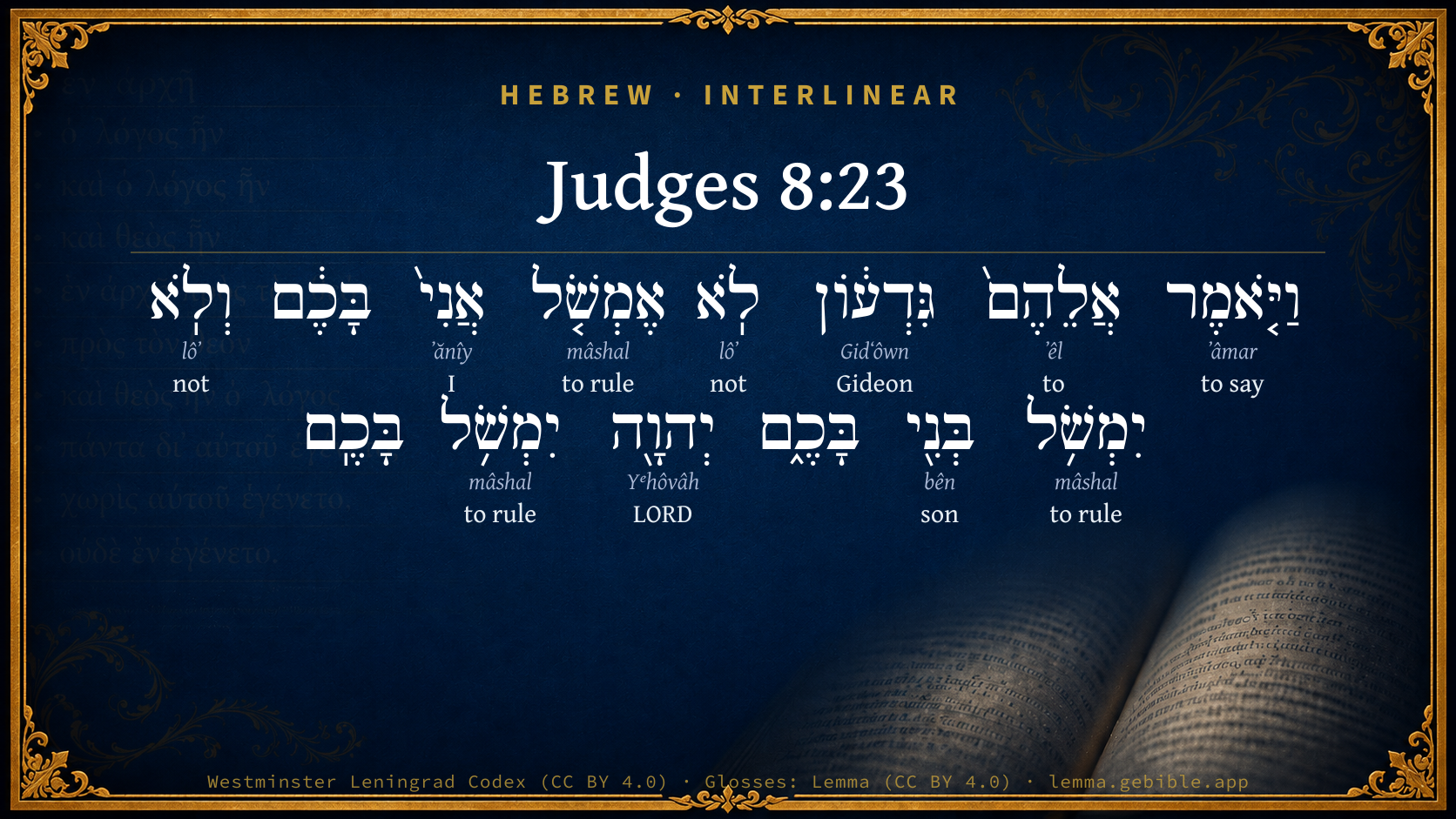
Hebrew (Westminster Leningrad Codex) Judges 8:23 appears in the Hebrew Old Testament. The text above is from the Westminster Leningrad Codex. Each word links to its Strong’s number, a concise gloss, and parsing drawn from the Open Scriptures Hebrew Bible morphology. Click any word for its full Brown-Driver-Briggs (BDB) entry.
Download image
Cite this verse

Judges 8:23 (World English Bible). Public Domain. Lemma interlinear Bible study tool, https://lemma.gebible.app/v/judges/8/23.

Show BibTeX & RIS
BibTeX
RIS
English Translation
Gideon said to them, I will not rule over you, neither shall my son rule over you: Yahweh shall rule over you.
World English Bible · Public Domain
Download a study sheet

One document with this verse’s original text, its word-by-word gloss line, the meaning frame, cross-references with their text, attributed commentary, and full source and license credits — printable, and it pastes into notes with its structure intact.

This verse Autodidact and up

Study sheet (.html) Plain text (.txt)

A passage Seminary Student

Up to 50 verses in one chapter. A passage sheet keeps up to 6 commentary sources and 12 cross-references per verse, in the order this page ranks them, and says so on the sheet whenever that leaves anything out. Ask for a single verse and you get the Autodidact verse sheet above.

Everything on this page stays free to read, with no account — the sheet is a download of what is already on screen, not access to it.

Want to remove ads? Support Godless Engineer
Compare translations 3

The same verse in 3 English versions, stacked beneath the original-language interlinear above. Click any original word for its lexicon entry.

Each is an independent rendering of the whole verse — the interlinear is not word-aligned to these translations.

Highlighted words mark where these versions differ — a whole-verse word diff, not a word-by-word alignment.

  • World English Bible Public Domain
    Gideon said to them, I will not rule over you, neither shall my son rule over you: Yahweh shall rule over you.
  • King James Version Public Domain
    And Gideon said unto them, I will not rule over you, neither shall my son rule over you: the LORD shall rule over you.
  • unfoldingWord Literal Text CC BY-SA 4.0
    But Gideon said to them, “I will not rule over you myself, and my son will not rule over you. Yahweh will rule over you.”

unfoldingWord Literal Text — © unfoldingWord, licensed CC BY-SA 4.0. Word-aligned USFM3 via Door43 (git.door43.org/unfoldingWord/en_ult).

Versions to compare (up to 4)

3 of 4 selected

Show all 18 translations

Every available English version of this verse, each an independent rendering of the whole verse.

  • World English Bible Public Domain
    Gideon said to them, I will not rule over you, neither shall my son rule over you: Yahweh shall rule over you.
  • Berean Standard Bible Public Domain
    But Gideon replied, “I will not rule over you, nor will my son. The LORD shall rule over you.”
  • Majority Standard Bible Public Domain
    But Gideon replied, “I will not rule over you, nor will my son. The LORD shall rule over you.”
  • King James Version Public Domain
    And Gideon said unto them, I will not rule over you, neither shall my son rule over you: the LORD shall rule over you.
  • American Standard Version (1901) Public Domain
    And Gideon said unto them, I will not rule over you, neither shall my son rule over you: Jehovah shall rule over you.
  • Revised Version (1885) Public Domain
    And Gideon said unto them, I will not rule over you, neither shall my son rule over you: the LORD shall rule over you.
  • Geneva Bible (1599) Public Domain
    And Gideon sayde vnto them, I will not reigne ouer you, neither shall my childe reigne ouer you, but the Lord shall reigne ouer you.
  • Douay-Rheims (1899) Public Domain
    And he said to them: I will not rule over you, neither shall my son rule over you, but the Lord shall rule over you.
  • Young's Literal Translation Public Domain
    And Gideon saith unto them, `I do not rule over you, nor doth my son rule over you; Jehovah doth rule over you.'
  • Literal Standard Version CC BY-SA 4.0
    And Gideon says to them, “I do not rule over you, nor does my son rule over you; YHWH rules over you.”
  • Unlocked Literal Bible CC BY-SA 4.0
    Gideon said to them, “I will not rule over you, neither will my son rule over you. Yahweh will rule over you.”
  • unfoldingWord Literal Text CC BY-SA 4.0
    But Gideon said to them, “I will not rule over you myself, and my son will not rule over you. Yahweh will rule over you.”
  • Darby Bible Public Domain
    Gideon said to them, "I will not rule over you, and my son will not rule over you; the LORD will rule over you."
  • World Messianic Bible Public Domain
    Gideon said to them, “I will not rule over you, neither shall my son rule over you. The LORD shall rule over you.”
  • Webster's Bible Public Domain
    And Gideon said to them, I will not rule over you, neither shall my son rule over you: the LORD shall rule over you.
  • Free Bible Version CC BY-SA 4.0
    “I won't be your ruler, and my son won't either,” Gideon replied. “The Lord will be your ruler.”
  • Bible in Basic English Public Domain
    But Gideon said to them, I will not be a ruler over you, and my son will not be a ruler over you: it is the Lord who will be ruler over you.
  • JPS Tanakh (1917) Public Domain
    And Gideon said unto them: 'I will not rule over you, neither shall my son rule over you; the LORD shall rule over you.'

Literal Standard Version (2020), Covenant Press — licensed CC BY-SA 4.0. Text via the HelloAO Bible API (eBible.org). Unlocked Literal Bible (unfoldingWord) — licensed CC BY-SA 4.0. Text via the HelloAO Bible API (eBible.org). unfoldingWord Literal Text — © unfoldingWord, licensed CC BY-SA 4.0. Word-aligned USFM3 via Door43 (git.door43.org/unfoldingWord/en_ult). Free Bible Version, Dr. Jonathan Gallagher — licensed CC BY-SA 4.0. Text via the HelloAO Bible API (eBible.org).

Word by word

More ways to search: Search by grammar → Find every occurrence → Compare this word →

Practice this passage: Drill this verse → Learn its vocabulary →

גִּדְע֔וֹן
Gidʻôwn
H1439
“Gideon”
Noun, Proper
Part of Speech
Noun
Type
Proper
Full BDB Definition

Origin: from H1438

TWOT: 316a

Gideon = "hewer" - youngest son of Joash of the Abiezrites, fifth judge of Israel who led the Israelites against the Midianites
  1. וַיֹּ֤אמֶר ʼâmar H559 “and · to say” Conjunction + Verb, Qal, Sequential Imperfect, 3rd Person, Masculine, Singular
  2. אֲלֵהֶם֙ ʼêl H413 “to · them” Preposition + Suffix, Personal, 3rd Person, Masculine, Plural
  3. לֹֽא lôʼ H3808 “not” Particle, Negative
  4. אֶמְשֹׁ֤ל mâshal H4910 “to rule” Verb, Qal, Imperfect, 1st Person, Common, Singular
  5. אֲנִי֙ ʼănîy H589 “I” Pronoun, Personal, 1st Person, Common, Singular
  6. וְלֹֽא lôʼ H3808 “and · not” Conjunction + Particle, Negative
  7. יִמְשֹׁ֥ל mâshal H4910 “to rule” Verb, Qal, Imperfect, 3rd Person, Masculine, Singular
  8. בְּנִ֖י bên H1121 “son · my” Noun, Common, Masculine, Singular, Construct + Suffix, Personal, 1st Person, Common, Singular
  9. יְהוָ֖ה Yᵉhôvâh H3068 “LORD” Noun, Proper
  10. יִמְשֹׁ֥ל mâshal H4910 “to rule” Verb, Qal, Imperfect, 3rd Person, Masculine, Singular

About this verse

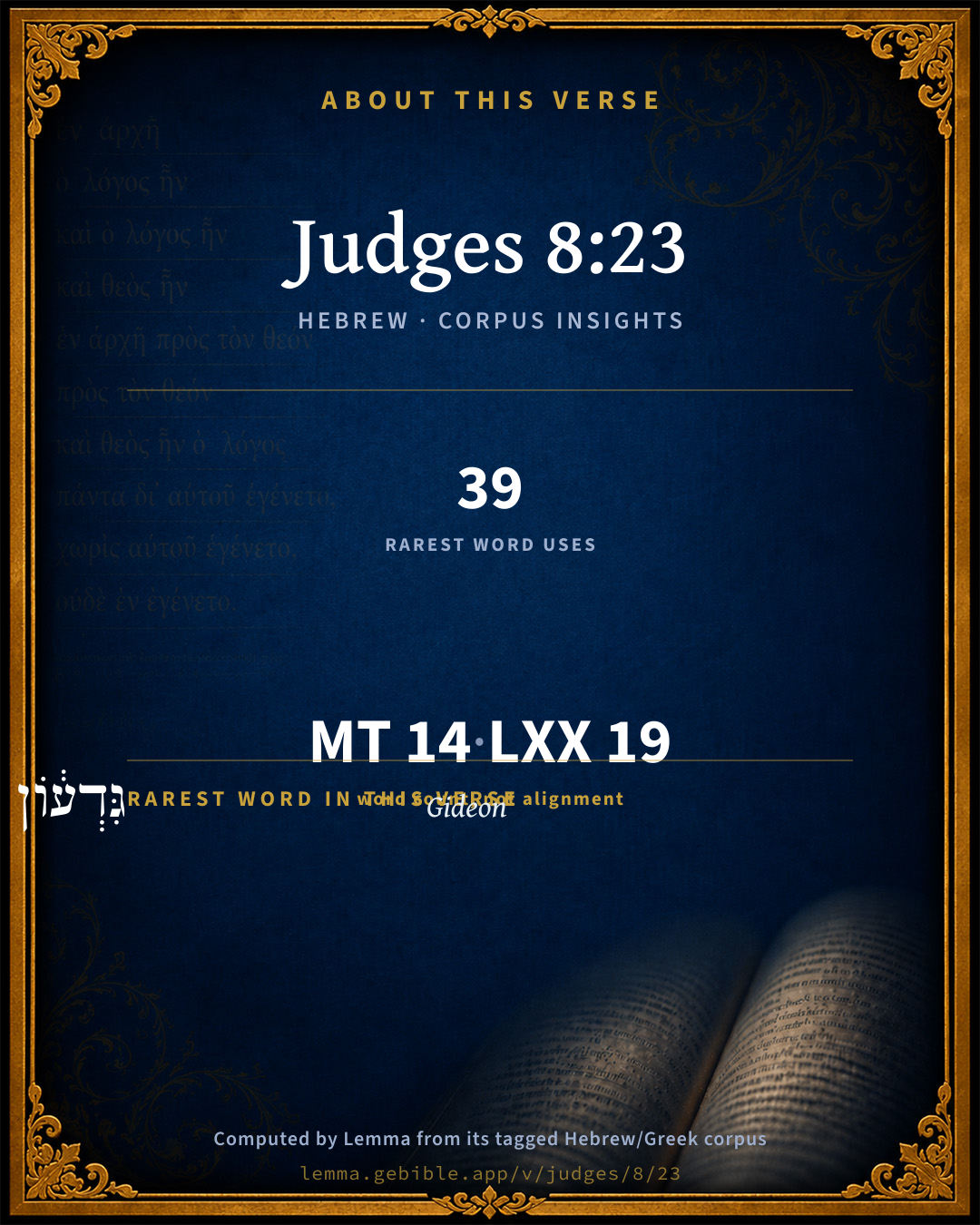
These counts appear in no published source. They are computed here, from the morphology-tagged text and Lemma’s own curated glosses. What Lemma adds →

14
words
8
distinct lemmas
Historical
section

Shared distinctive vocabulary

גִּדְע֔וֹן Gideon H1439 occurs in 37 verses of the Hebrew Bible. Also found in:

Grammatical profile

  • 4 verbs
  • 3 nouns
  • 1 pronoun
  • 4 prepositions
  • 2 particles

Verb forms

  • וַיֹּ֤אמֶר Qal · Sequential Imperfect
  • אֶמְשֹׁ֤ל Qal · Imperfect
  • יִמְשֹׁ֥ל Qal · Imperfect
  • יִמְשֹׁ֥ל Qal · Imperfect

Repetition

Words recur within this verse — often emphatic in Hebrew:

  • אֶמְשֹׁ֤ל to rule H4910 ×3
  • לֹֽא not H3808 ×2

Hebrew & Septuagint length

In English translation the verse runs 22 words from the Hebrew and 23 from the Septuagint (LXX English) — closely comparable.

A rough comparison of the two English renderings, which tokenize alike — not a word-level alignment.

Word counts can differ between the Hebrew and the Greek without any difference in meaning — e.g. the Hebrew direct-object marker אֵת has no separate Greek word, and Greek often adds the article ὁ.

In the original languages it is 14 Hebrew tokens and 19 Greek tokens — but the two are counted differently (Hebrew bundles its prefixes and suffixes into one token; the Greek is in lemma form), so that isn’t a like-for-like length.

Cross-references

11

Topical passages linked to Judges 8:23 in the Treasury of Scripture Knowledge — connected by theme and wording, ordered by reader-vote popularity; previews shown in the World English Bible.

  • Isaiah 33:22 For Yahweh is our judge, Yahweh is our lawgiver, Yahweh is our king; he will save us.
  • 1 Samuel 12:12 When you saw that Nahash the king of the children of Ammon came against you, you said to me, No, but a king shall reign over us; when Yahweh your God was your king.
  • 1 Samuel 10:19 but you have this day rejected your God, who himself saves you out of all your calamities and your distresses; and you have said to him, [No], but set a king over us. Now therefore present yourselves before Yahweh by your tribes, and by your thousands.
  • 2 Corinthians 1:24 Not that we have lordship over your faith, but are fellow workers with you for your joy. For you stand firm in faith.
  • Judges 2:18 When Yahweh raised them up judges, then Yahweh was with the judge, and saved them out of the hand of their enemies all the days of the judge: for it repented Yahweh because of their groaning by reason of those who oppressed them and vexed them.
  • Judges 10:18 The people, the princes of Gilead, said one to another, What man is he who will begin to fight against the children of Ammon? he shall be head over all the inhabitants of Gilead.
  • Judges 11:9–11 Jephthah said to the elders of Gilead, If you bring me home again to fight with the children of Ammon, and Yahweh deliver them before me, shall I be your head?
  • 1 Samuel 8:6–7 But the thing displeased Samuel, when they said, Give us a king to judge us. Samuel prayed to Yahweh.
  • 1 Peter 5:3 neither as lording it over the charge allotted to you, but making yourselves examples to the flock.
  • Isaiah 63:19 We are become as they over whom you never bear rule, as those who were not called by your name.
  • Luke 22:24–27 There arose also a contention among them, which of them was considered to be greatest.

Cross-references courtesy of OpenBible.info (CC BY 4.0).

Hebrew and Greek witnesses Masoretic Hebrew ↔ Greek Septuagint

The same verse in the two great witnesses to the Old Testament, shown verse-for-verse.

These are two independent witnesses, not word-aligned to each other, and the Septuagint is shown in lemma (dictionary) form.

Hebrew Judges 8:23 Masoretic · Westminster Leningrad Codex

וַיֹּ֤אמֶר אֲלֵהֶם֙ גִּדְע֔וֹן לֹֽא אֶמְשֹׁ֤ל אֲנִי֙ בָּכֶ֔ם וְלֹֽא יִמְשֹׁ֥ל בְּנִ֖י בָּכֶ֑ם יְהוָ֖ה יִמְשֹׁ֥ל בָּכֶֽם

Gideon said to them, I will not rule over you, neither shall my son rule over you: Yahweh shall rule over you.

World English Bible · Public Domain

Greek LXX Judges 8:23 Septuagint · lemma form

καί εἶπον πρός αὐτός γεδεων οὐ ἄρχω ἐγώ καί οὐ ἄρχω ὁ υἱός ἐγώ ἐν σύ κύριος ἄρχω σύ

And Gedeon said to them, I will not rule, and my son shall not rule among you; the Lord shall rule over you.

LXX2012 (modern English Septuagint) · Public Domain

Hebrew: Westminster Leningrad Codex (CC BY 4.0). Greek: Septuagint (public domain); English from LXX2012 (modern English Septuagint) (Public Domain). How the Septuagint differs from the Hebrew →

Targum (Aramaic paraphrase)

1

The Targum is the ancient Jewish Aramaic paraphrase of the Hebrew Scriptures — an interpretive translation, not the Hebrew text itself. Onkelos (literal) and Pseudo-Jonathan (expansive) render the Torah, and Jonathan the Prophets. Coverage is partial: where no permissively-licensed English translation exists for a verse, only the Aramaic is shown. This is verse-level text, not a word-by-word alignment to the Hebrew.

  1. Targum Jonathan Prophets (Joshua–Malachi)
    וַאֲמַר לְהוֹן גִדְעוֹן לָא אֶמְלוֹךְ אֲנָא עֲלֵיכוֹן וְלָא יִמְלוֹךְ בְּרִי עֲלֵיכוֹן יְיָ יִמְלוֹךְ עֲלֵיכוֹן:

    (no public-domain English translation for this verse)

    Targum Jonathan — Aramaic: “Mikraot Gedolot” (public domain). English: “Sefaria Community Translation” (CC0 1.0 (public-domain dedication)); “London "Chaldee Paraphrase," 1871” (public domain). Text via Sefaria.

Commentary

Notes on Judges 8:23 from classic Christian and Jewish commentators (each source and its license shown beneath its notes). The classic Christian expositions comment on the surrounding passage and are grouped to its opening verse, so a note may address several verses; the Jewish commentaries on the Tanakh (Rashi and others) are per-verse, so they appear only where the commentator wrote on this verse.

Lemma curates 59 commentaries, every one of them public domain or Creative Commons licensed, each selected and text-cleaned for this edition rather than reprinted as found. About our sources →

Trapp's Complete Commentary

John Trapp

Jdg 8:23 And Gideon said unto them, I will not rule over you, neither shall my son rule over you: the LORD shall rule over you.

Ver. 23. I will not rule over you.] Since I cannot without manifest wrong done to God. This modesty of his in refusing such an offer was very commendable; as it was afterwards in Alphonsus, King of Arragon, and Frederick, the Elector of Saxony, who might have been chosen emperors of Germany, but would not. Rodolphus, Duke of Suevia, was too forward to accept of the empire offered him by Pope Hildebrand; and all too late repented it. So was Silvester II, who for seven years’ enjoyment of the popedom, gave his soul to the devil.

John Trapp, A Commentary or Exposition upon All the Books of the Old and New Testament (1647–1656) — public domain. Text from a community e-Sword module.

Joseph Benson's Commentary

Jdg 8:23. I will not rule over you — As a king. He rejected their offer, because he looked upon God as their king, who appointed what deputy he pleased to govern them; and because he considered this proposal as an effort, or at least as tending to alter that form of government which God had instituted and had given them no authority to change. The Lord shall rule over you — In a special manner, as he hath hitherto done by judges. These God particularly appointed and directed in all the more important concerns of their office, even by Urim and Thummim, and, in a special manner, assisted upon all occasions: whereas kings had only a general dependance on God. That God was their supreme Ruler and King, was the foundation of their whole state. Hence the judgment which was administered among them is called God’s judgment, Deu 1:17. And Solomon is said to sit upon the throne of the Lord, (1Ch 29:23,) and the kingdom of his posterity is called the kingdom of the Lord, (2Ch 13:8,) because before kings were settled in Israel, the Lord was their king; from whom the government was derived to the house of David by a special act of God.

Joseph Benson's Commentary on the Old and New Testaments (1811–1818) — public domain. Text from a community e-Sword module.

Adam Clarke's Commentary

Verse 23. The Lord shall rule over you] Few with such power at their command would have acted as Gideon. His speech calls them back to their first principles, and should have excited in them both shame and contrition. How different is this speech from that of Oliver Cromwell when the commons offered him the crown of England!

Adam Clarke's Commentary on the Bible (1810–1826) — public domain. Text from a community e-Sword/MySword module.

Ellicott's Commentary for English Readers

(23) The Lord shall rule over you.—Num_23:21; Deu_33:5; 1Sa_6:12. Gideon refused the splendid temptation of an hereditary crown, though, in strict accordance with Divine guidance, he was willing to be their judge ( Shaphat, as in Jdg_10:2-3; Jdg_12:7, &c.). Cassel compares the remark of Washington when he accepted the Presidency, because he would “obey the voice of the people.” saying that “no people could be more bound to acknowledge and adore the invisible hand which conducts the affairs of men than the people of the United States” (Marshall’s Life of Washington, 2:146). The day anticipated in Deu_17:14-20 had not yet come. Up to this point “we feel all the goodness of Gideon. There is a sweetness and nobleness mingled with his courage, something of the past greatness of Joshua, something of the future grace of David.” He reminds us in some respects of Henry Y. of England, and Henry IV. of France.

A Bible Commentary for English Readers, edited by Charles John Ellicott (1878–1897) — public domain. Text from a community e-Sword module.

The Cambridge Bible for Schools and Colleges

gen. ed. J. J. S. Perowne

23. I will not rule over you] But ch. 9 implies that Gideon did exercise some kind of supremacy, at any rate in his own district, and his sons claimed to inherit his position, Jdg_9:2. These words, then, either mean that Gideon seized the power, but rejected the title, of king; or they represent the view, which apparently came to the front in the closing years of the Northern Kingdom, that earthly kingship was inconsistent with the sovereignty of Jehovah; cf. 1Sa_8:7; 1Sa_10:19; 1Sa_12:12; 1Sa_12:17; 1Sa_12:19 (E source), Hos_13:10 f. The latter is the explanation most generally accepted.

The Cambridge Bible for Schools and Colleges (gen. ed. J. J. S. Perowne; Cambridge University Press, 1878–1918) — public domain. Text from a community e-Sword module.

John Gill's Exposition

And Gideon said unto them, I will not rule over you,.... Not that he declined the government of them as a judge, to which he was raised of God, but as a king, for which he had no authority and call from God; the choice of a king belonging to him, and not to the people:

neither shall my son rule over you; which Abarbinel thinks he spake as a prophet, and under the inspiration of the Holy Spirit; for after his death neither Jether his eldest son, nor any of the rest of his legitimate sons, ruled over them; for they were all slain by Abimelech, the son of his concubine, who was made king:

the Lord shall rule over you; as he did; their government was a theocracy, which they would have changed, but Gideon would not agree to it.

John Gill's Exposition of the Whole Bible (1746–1763) — public domain (CC PDM 1.0). Text via the HelloAO Bible API.

Matthew Poole's English Annotations

I will not rule over you, to wit, as a king, which you desire.

The Lord shall rule over you, in a special manner, as he hath hitherto done, by judges, whom God did particularly appoint and direct, even by Urim and Thummim, and assist upon all occasions; whereas kings had a greater power, and only a general dependence upon God, as other kings had. Compare 1Sa 8:6,7.

Matthew Poole's English Annotations on the Holy Bible (1683–1685) — public domain. Text from a community e-Sword/MySword module.

Whedon's Commentary on the Bible

Daniel D. Whedon

23. The Lord shall rule over you — Your king shall still be Jehovah, not Gideon. By choosing a Gideon or a Saul the nation would be choosing a human instead of a divine sovereign. The people were ever in danger of forgetting the Divine Author of all civil government, and especially so in times of popular excitement and enthusiasm, when the masses either seem, or assume to be, sovereign. At such times all should be reminded that there is a power higher than the civil ruler. It does not appear that Gideon, during the forty years of peace (Jdg_8:28) that followed this victory over Midian, performed any of the ordinary duties of a civil ruler. It is not said that he judged Israel at all, though the silence of the history must not be construed into evidence that he never did. He was raised up to deliver the nation from the yoke of Midian, and, having nobly accomplished that work, he retired to his native city and dwelt there till his death.

But whatever the form of a government — whether it be a nation miraculously led and instructed, like Israel under Moses, Joshua, or the Judges, or a monarchy like that erected in the days of Saul, or modern empires or republics — the Lord is still the Ruler. All civil governments must have their officers, and these may differ widely in their character and powers; but “the powers that be are ordained of God,” and the civil ruler is “the minister of God.” Rom_13:1-6. This is a doctrine of the Old Testament as well as of the New, and it is therefore the duty of all civil governments to know and acknowledge their dependence on the Supreme Ruler.

Daniel D. Whedon (gen. ed.), Commentary on the Old and New Testaments (1874–1909) — public domain. Text from a community e-Sword module.

John Wesley's Explanatory Notes

I will not rule - As a king. The Lord shall rule - In a special manner, as he hath hitherto done, by Judges, whom God particularly appointed and directed, even by Urim and Thummim, and assisted upon all occasions; whereas Kings had only a general dependance upon God.

John Wesley, Explanatory Notes Upon the Whole Bible (1754–1765) — public domain. Text via the GEBible commentary corpus.

Lesson kit

Teaching starters — assembled from the data on this page, not authored interpretation. Every prompt links to the verse data it draws on. Edit before teaching.

Judges, in the Historical, opens this verse with 14 words (8 distinct Hebrew lemmas). Its most distinctive word is Gidʻôwn (“Gideon”). A historical commentator’s framing appears above. Read the whole chapter for the surrounding context.

Discussion questions

  1. What does “Gideon” (Gidʻôwn) contribute to the verse as a whole?
  2. How does Judges 6:11, which shares the word «Gideon», read alongside this verse?
  3. What does the repetition of “to rule” (3× in this one verse) do in this verse?
  4. These translations render this verse differently. What is at stake in choosing one wording over another?
  5. «וַיֹּ֤אמֶר» is a Qal Sequential Imperfect verb. How does that grammatical form shape the action described?
  6. Compare how Trapp's Complete Commentary and Joseph Benson's Commentary read this verse. Where do they agree or differ?

Things to notice

Reading settings

Reading text

Shown beneath each verse's original-language words.

Old Testament
Old Testament edition

Read the OT as the Masoretic Hebrew (MT) or the Greek Septuagint (LXX).

English shown for the Greek Septuagint (in the Hebrew ↔ Greek comparison).

Comparing translations? Open the Compare panel on any verse page to stack up to four side by side.