
Joshua 23:2

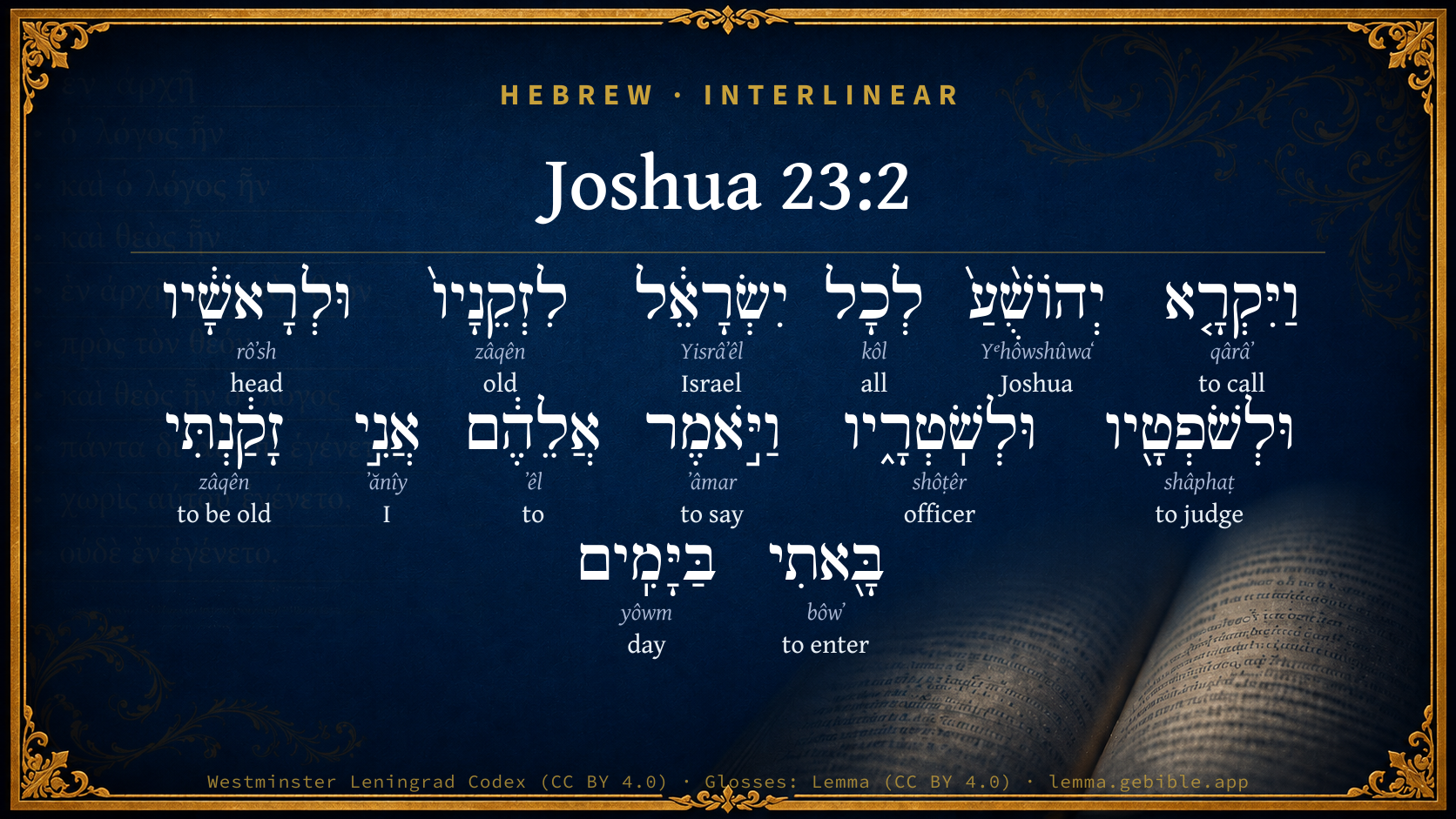
Hebrew (Westminster Leningrad Codex) Joshua 23:2 appears in the Hebrew Old Testament. The text above is from the Westminster Leningrad Codex. Each word links to its Strong’s number, a concise gloss, and parsing drawn from the Open Scriptures Hebrew Bible morphology. Click any word for its full Brown-Driver-Briggs (BDB) entry.
Download image
Cite this verse

Joshua 23:2 (World English Bible). Public Domain. Lemma interlinear Bible study tool, https://lemma.gebible.app/v/joshua/23/2.

Show BibTeX & RIS
BibTeX
RIS
English Translation
that Joshua called for all Israel, for their elders and for their heads, and for their judges and for their officers, and said to them, I am old and well stricken in years:
World English Bible · Public Domain
Download a study sheet

One document with this verse’s original text, its word-by-word gloss line, the meaning frame, cross-references with their text, attributed commentary, and full source and license credits — printable, and it pastes into notes with its structure intact.

This verse Autodidact and up

Study sheet (.html) Plain text (.txt)

A passage Seminary Student

Up to 50 verses in one chapter. A passage sheet keeps up to 6 commentary sources and 12 cross-references per verse, in the order this page ranks them, and says so on the sheet whenever that leaves anything out. Ask for a single verse and you get the Autodidact verse sheet above.

Everything on this page stays free to read, with no account — the sheet is a download of what is already on screen, not access to it.

Want to remove ads? Support Godless Engineer
Compare translations 3

The same verse in 3 English versions, stacked beneath the original-language interlinear above. Click any original word for its lexicon entry.

Each is an independent rendering of the whole verse — the interlinear is not word-aligned to these translations.

Highlighted words mark where these versions differ — a whole-verse word diff, not a word-by-word alignment.

  • World English Bible Public Domain
    that Joshua called for all Israel, for their elders and for their heads, and for their judges and for their officers, and said to them, I am old and well stricken in years:
  • King James Version Public Domain
    And Joshua called for all Israel, and for their elders, and for their heads, and for their judges, and for their officers, and said unto them, I am old and stricken in age:
  • unfoldingWord Literal Text CC BY-SA 4.0
    And Joshua called to all of Israel, to its elders and to its heads and to its judges and to its officers, and he said to them, “I have aged, I have come into days.

unfoldingWord Literal Text — © unfoldingWord, licensed CC BY-SA 4.0. Word-aligned USFM3 via Door43 (git.door43.org/unfoldingWord/en_ult).

Versions to compare (up to 4)

3 of 4 selected

Show all 18 translations

Every available English version of this verse, each an independent rendering of the whole verse.

  • World English Bible Public Domain
    that Joshua called for all Israel, for their elders and for their heads, and for their judges and for their officers, and said to them, I am old and well stricken in years:
  • Berean Standard Bible Public Domain
    he summoned all Israel, including its elders, leaders, judges, and officers. “I am old and well along in years,” he said,
  • Majority Standard Bible Public Domain
    he summoned all Israel, including its elders, leaders, judges, and officers. “I am old and well along in years,” he said,
  • King James Version Public Domain
    And Joshua called for all Israel, and for their elders, and for their heads, and for their judges, and for their officers, and said unto them, I am old and stricken in age:
  • American Standard Version (1901) Public Domain
    that Joshua called for all Israel, for their elders and for their heads, and for their judges and for their officers, and said unto them, I am old and well stricken in years:
  • Revised Version (1885) Public Domain
    that Joshua called for all Israel, for their elders and for their heads, and for their judges and for their officers, and said unto them, I am old and well stricken in years:
  • Geneva Bible (1599) Public Domain
    Then Ioshua called all Israel, and their Elders, and their heads, and their iudges, and their officers, and said vnto them, I am old, and stricken in age.
  • Douay-Rheims (1899) Public Domain
    Josue called for all Israel, and for the elders, and for the princes, and for the judges, and for the masters, and said to them: I am old, and far advanced in years:
  • Young's Literal Translation Public Domain
    and Joshua calleth for all Israel, for its elders, and for its heads, and for its judges, and for its authorities, and saith unto them, `I have become old; I have entered into days;
  • Literal Standard Version CC BY-SA 4.0
    and Joshua calls for all Israel, for his elderly, and for his heads, and for his judges, and for his authorities, and says to them, “I have become old; I have entered into days;
  • Unlocked Literal Bible CC BY-SA 4.0
    Joshua called for all Israel—for their elders, for their leaders, for their judges, and for their officers—and he said to them, “I am very old.
  • unfoldingWord Literal Text CC BY-SA 4.0
    And Joshua called to all of Israel, to its elders and to its heads and to its judges and to its officers, and he said to them, “I have aged, I have come into days.
  • Darby Bible Public Domain
    that Joshua called for all Israel, for their elders, and for their heads, and for their judges, and for their officers, and said unto them, I am become old, advanced in age;
  • World Messianic Bible Public Domain
    Joshua called for all Israel, for their elders and for their heads, and for their judges and for their officers, and said to them, “I am old and well advanced in years.
  • Webster's Bible Public Domain
    And Joshua called for all Israel, and for their elders, and for their heads, and for their judges, and for their officers, and said to them, I am old and advanced in age:
  • Free Bible Version CC BY-SA 4.0
    summoned all the Israelites—the elders, leaders, judges, and officials—and told them, “I'm old, getting on in years.
  • Bible in Basic English Public Domain
    Joshua sent for all Israel, for their responsible men and their chiefs and their judges and their overseers, and said to them, I am old, and full of years:
  • JPS Tanakh (1917) Public Domain
    that Joshua called for all Israel, for their elders and for their heads, and for their judges and for their officers, and said unto them: 'I am old and well stricken in years.

Literal Standard Version (2020), Covenant Press — licensed CC BY-SA 4.0. Text via the HelloAO Bible API (eBible.org). Unlocked Literal Bible (unfoldingWord) — licensed CC BY-SA 4.0. Text via the HelloAO Bible API (eBible.org). unfoldingWord Literal Text — © unfoldingWord, licensed CC BY-SA 4.0. Word-aligned USFM3 via Door43 (git.door43.org/unfoldingWord/en_ult). Free Bible Version, Dr. Jonathan Gallagher — licensed CC BY-SA 4.0. Text via the HelloAO Bible API (eBible.org).

Word by word

More ways to search: Search by grammar → Find every occurrence → Compare this word →

Practice this passage: Drill this verse → Learn its vocabulary →

וּלְשֹֽׁטְרָ֑יו
shôṭêr
H7860
“and · to/for · officer · him”
Conjunction + Preposition + Verb, Qal, Participle Active, Masculine, Plural, Construct + Suffix, Personal, 3rd Person, Masculine, Singular
Part of Speech
Conjunction + Preposition + Verb
Stem
Qal
Form
Participle Active
Gender
Masculine
Number
Plural
State
Construct
Full BDB Definition

Origin: act part of an otherwise unused root probably meaning to write

TWOT: TWOT - 2374a

(Qal) official, officer
  1. וַיִּקְרָ֤א qârâʼ H7121 “and · to call” Conjunction + Verb, Qal, Sequential Imperfect, 3rd Person, Masculine, Singular
  2. יְהוֹשֻׁ֨עַ֙ Yᵉhôwshûwaʻ H3091 “Joshua” Noun, Proper
  3. לְכָל kôl H3605 “to/for · all of” Preposition + Noun, Common, Masculine, Singular, Construct
  4. יִשְׂרָאֵ֔ל Yisrâʼêl H3478 “Israel” Noun, Proper
  5. לִזְקֵנָיו֙ zâqên H2205 “to/for · old · his” Preposition + Adjective, Adjective, Masculine, Plural, Construct + Suffix, Personal, 3rd Person, Masculine, Singular
  6. וּלְרָאשָׁ֔יו rôʼsh H7218 “and · to/for · heads · his” Conjunction + Preposition + Noun, Common, Masculine, Plural, Construct + Suffix, Personal, 3rd Person, Masculine, Singular
  7. וּלְשֹׁפְטָ֖יו shâphaṭ H8199 “and · to/for · judging · him” Conjunction + Preposition + Verb, Qal, Participle Active, Masculine, Plural, Construct + Suffix, Personal, 3rd Person, Masculine, Singular
  8. וַיֹּ֣אמֶר ʼâmar H559 “and · to say” Conjunction + Verb, Qal, Sequential Imperfect, 3rd Person, Masculine, Singular
  9. אֲלֵהֶ֔ם ʼêl H413 “to · them” Preposition + Suffix, Personal, 3rd Person, Masculine, Plural
  10. אֲנִ֣י ʼănîy H589 “I” Pronoun, Personal, 1st Person, Common, Singular
  11. זָקַ֔נְתִּי zâqên H2204 “to be old” Verb, Qal, Perfect, 1st Person, Common, Singular
  12. בָּ֖אתִי bôwʼ H935 “to enter” Verb, Qal, Perfect, 1st Person, Common, Singular
  13. בַּיָּמִֽים yôwm H3117 “in/at the · days” Preposition, Determined + Noun, Common, Masculine, Plural, Absolute

About this verse

These counts appear in no published source. They are computed here, from the morphology-tagged text and Lemma’s own curated glosses. What Lemma adds →

14
words
14
distinct lemmas
Historical
section

Notable vocabulary

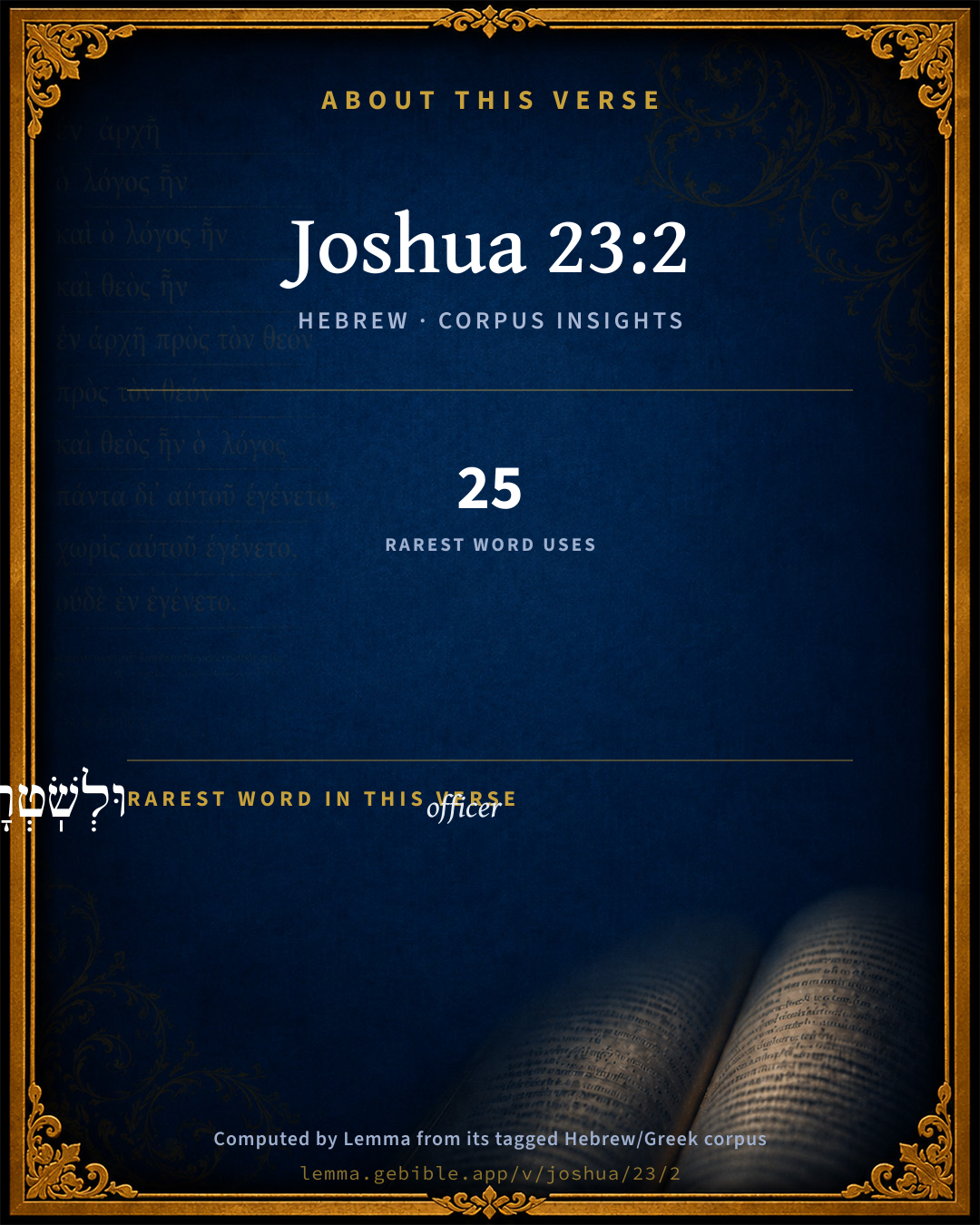
The rarest word here is וּלְשֹֽׁטְרָ֑יו officer H7860 — appearing just 25 times in the whole Hebrew Bible.

Shared distinctive vocabulary

וּלְשֹֽׁטְרָ֑יו officer H7860 occurs in 25 verses of the Hebrew Bible. Also found in:

Grammatical profile

  • 6 verbs
  • 5 nouns
  • 1 adjective
  • 1 pronoun
  • 1 preposition

Verb forms

  • וַיִּקְרָ֤א Qal · Sequential Imperfect
  • וּלְשֹׁפְטָ֖יו Qal · Participle Active
  • וּלְשֹֽׁטְרָ֑יו Qal · Participle Active
  • וַיֹּ֣אמֶר Qal · Sequential Imperfect
  • זָקַ֔נְתִּי Qal · Perfect
  • בָּ֖אתִי Qal · Perfect

Hebrew & Septuagint length

In English translation the verse runs 33 words from the Hebrew and 32 from the Septuagint (LXX English) — closely comparable.

A rough comparison of the two English renderings, which tokenize alike — not a word-level alignment.

Word counts can differ between the Hebrew and the Greek without any difference in meaning — e.g. the Hebrew direct-object marker אֵת has no separate Greek word, and Greek often adds the article ὁ.

Cross-references

4

Topical passages linked to Joshua 23:2 in the Treasury of Scripture Knowledge — connected by theme and wording, ordered by reader-vote popularity; previews shown in the World English Bible.

  • Joshua 24:1 Joshua gathered all the tribes of Israel to Shechem, and called for the elders of Israel, and for their heads, and for their judges, and for their officers; and they presented themselves before God.
  • Deuteronomy 31:28 Assemble to me all the elders of your tribes, and your officers, that I may speak these words in their ears, and call heaven and earth to witness against them.
  • 1 Chronicles 28:1 David assembled all the princes of Israel, the princes of the tribes, and the captains of the companies who served the king by division, and the captains of thousands, and the captains of hundreds, and the rulers over all the substance and possessions of the king and of his sons, with the officers, and the mighty men, even all the mighty men of valor, to Jerusalem.
  • Acts 20:17–35 From Miletus he sent to Ephesus, and called to himself the elders of the assembly.

Cross-references courtesy of OpenBible.info (CC BY 4.0).

Hebrew and Greek witnesses Masoretic Hebrew ↔ Greek Septuagint

The same verse in the two great witnesses to the Old Testament, shown verse-for-verse.

These are two independent witnesses, not word-aligned to each other, and the Septuagint is shown in lemma (dictionary) form.

Hebrew Joshua 23:2 Masoretic · Westminster Leningrad Codex

וַיִּקְרָ֤א יְהוֹשֻׁ֨עַ֙ לְכָל יִשְׂרָאֵ֔ל לִזְקֵנָיו֙ וּלְרָאשָׁ֔יו וּלְשֹׁפְטָ֖יו וּלְשֹֽׁטְרָ֑יו וַיֹּ֣אמֶר אֲלֵהֶ֔ם אֲנִ֣י זָקַ֔נְתִּי בָּ֖אתִי בַּיָּמִֽים

that Joshua called for all Israel, for their elders and for their heads, and for their judges and for their officers, and said to them, I am old and well stricken in years:

World English Bible · Public Domain

Greek LXX Joshua 23:2 Septuagint · lemma form

καί συνκαλέω ἰησοῦς πᾶς ὁ υἱός ἰσραήλ καί ὁ γερουσία αὐτός καί ὁ ἄρχων αὐτός καί ὁ γραμματεύς αὐτός καί ὁ δικαστής αὐτός καί εἶπον πρός αὐτός ἐγώ γηράσκω καί προβαίνω ὁ ἡμέρα

And Joshua called together all the children of Israel, and their elders, and their chiefs, and their judges, and their officers; and said to them, I am old and advanced in years.

LXX2012 (modern English Septuagint) · Public Domain

Hebrew: Westminster Leningrad Codex (CC BY 4.0). Greek: Septuagint (public domain); English from LXX2012 (modern English Septuagint) (Public Domain). How the Septuagint differs from the Hebrew →

Targum (Aramaic paraphrase)

1

The Targum is the ancient Jewish Aramaic paraphrase of the Hebrew Scriptures — an interpretive translation, not the Hebrew text itself. Onkelos (literal) and Pseudo-Jonathan (expansive) render the Torah, and Jonathan the Prophets. Coverage is partial: where no permissively-licensed English translation exists for a verse, only the Aramaic is shown. This is verse-level text, not a word-by-word alignment to the Hebrew.

  1. Targum Jonathan Prophets (Joshua–Malachi)
    וּקְרָא יְהוֹשֻׁעַ לְכָל יִשְׂרָאֵל לְסָבוֹהִי וּלְרֵישׁוֹהִי וּלְדַיָנוֹהִי וּלְסַרְכוֹהִי וַאֲמַר לְהוֹן אֲנָא סִיבִית עָלִית בְּיוֹמִין:

    (no public-domain English translation for this verse)

    Targum Jonathan — Aramaic: “Mikraot Gedolot” (public domain). English: “Sefaria Community Translation” (CC0 1.0 (public-domain dedication)); “London "Chaldee Paraphrase," 1871” (public domain). Text via Sefaria.

Commentary

Notes on Joshua 23:2 from classic Christian and Jewish commentators (each source and its license shown beneath its notes). The classic Christian expositions comment on the surrounding passage and are grouped to its opening verse, so a note may address several verses; the Jewish commentaries on the Tanakh (Rashi and others) are per-verse, so they appear only where the commentator wrote on this verse.

Lemma curates 59 commentaries, every one of them public domain or Creative Commons licensed, each selected and text-cleaned for this edition rather than reprinted as found. About our sources →

Trapp's Complete Commentary

John Trapp

Jos 23:2 And Joshua called for all Israel, [and] for their elders, and for their heads, and for their judges, and for their officers, and said unto them, I am old [and] stricken in age:

Ver. 2. I am old and stricken in age.] Audite senem iuvenes, quem iuvenem senes audierunt, said old Augustus to his mutineers, and settled them.

“ Tanta fuit quondam capitis reverentia cani,

Inque sou precio ruga senilis erat. ”

John Trapp, A Commentary or Exposition upon All the Books of the Old and New Testament (1647–1656) — public domain. Text from a community e-Sword module.

Tyndale Open Study Notes

Tyndale Open Resources

23:2-3 The leaders . . . of Israel had experienced what God had done for them and to their enemies. Throughout the lifetimes of these leaders who outlived Joshua, Israel continued to be faithful to God (Judg 2:7).

Tyndale Open Study Notes — © Tyndale Open Resources, licensed CC BY-SA 4.0. Text via the HelloAO Bible API.

Jamieson, Fausset & Brown

Robert Jamieson, A. R. Fausset & David Brown

Joshua called for all Israel--The clause which follows seems to restrict this general expression as applicable only to the officers and representatives of the people. The place of assembly was most probably Shiloh. The occasion of convening it was the extreme age and approaching death of the venerable leader; and the purport of this solemn address was to animate the chosen people and their posterity to a faithful and unswerving continuance in the faith and worship of the God of Israel.

Jamieson, Fausset & Brown — Commentary Critical and Explanatory on the Whole Bible (1871) — public domain (CC PDM 1.0). Text via the HelloAO Bible API.

Adam Clarke's Commentary

Verse 2. Joshua called for all Israel] There are four degrees of civil distinction mentioned here:

1. זקנים zekenim, the elders or senate, the PRINCES of the tribes.

2. ראשים rashim or rashey aboth, the CHIEFS or HEADS of families.

3. שפטים shophetim, the JUDGES who interpreted and decided according to the law.

4. שטרים shoterim, the OFFICERS, serjeants, c., who executed the decisions of the judges.

Whether this assembly was held at Timnath-serah, where Joshua lived, or at Shiloh, where the ark was, or at Shechem, as in Jos 24:1, we cannot tell. Some think that the meaning here, and that mentioned in Jos 24:1, were the same, and if so, Shechem was the place of assembling but it is more likely that the two chapters treat of two distinct assemblies, whether held at the same place or not.

Adam Clarke's Commentary on the Bible (1810–1826) — public domain. Text from a community e-Sword/MySword module.

Ellicott's Commentary for English Readers

(2) Joshua called for all Israel (i.e., first). . . for their elders . . . heads . . . judges, and . . . officers.—The first “and” in the English Version of this verse should be omitted.

And said unto them . . .—The address which follows should be contrasted with that in Joshua 24. The first is suited to men of education, authority, and position in Israel, and concerns the duty of the rulers; the second contains one plain lesson for all the people, and makes no demand upon their intellect, nor does it require any position of influence or authority to carry out the instructions which it gives.

A Bible Commentary for English Readers, edited by Charles John Ellicott (1878–1897) — public domain. Text from a community e-Sword module.

The Cambridge Bible for Schools and Colleges

gen. ed. J. J. S. Perowne

2. called for all Israel] Where we are not told. But perhaps at Timnath-serah (Jos_19:50), or possibly at Shiloh. On the occasion of his second farewell discourse the tribes were convened at Shechem (Jos_24:1).

and for their elders] The word “and” is not found in the Hebrew. If any word is to be supplied, it should be “even” or “namely”. The terms elders, heads, judges and officers are explanatory.

I am old] He begins by reminding them of his own advance in years.

The Cambridge Bible for Schools and Colleges (gen. ed. J. J. S. Perowne; Cambridge University Press, 1878–1918) — public domain. Text from a community e-Sword module.

John Gill's Exposition

And Joshua called for all Israel,.... Summoned them together, whether at Timnathserah, his own city, he being old and infirm, and not able to go elsewhere; or whether at Shechem, where it is plain they were afterwards convened, Jos 24:1, or whether rather at Shiloh, where the tabernacle was, is not certain; and by "all Israel" cannot be meant the whole body of the people, unless it can be thought to be at one of the feasts, when all the males in Israel appeared before the Lord; though this seems to be not a stated convocation, but occasionally made, and to be understood of the representatives of the people called together, as explained in the following clause:

and for their elders, and for their heads, and for their judges, and for their officers; the first and is supplied, and another word or words may be supplied, as "even", or "that is", or the like, and so explanative of all Israel, namely, "their elders", both in age and office, especially the latter, the seventy elders, or who composed what in later times was called the great sanhedrim; and the "heads" of their tribes, the chief princes of every tribe; and their "judges" in their several cities, who heard and tried causes, and administered justice and judgment to the people; and their "officers", who attended on them to execute the judgment they pronounced:

and said unto them, I am old and stricken in age; which he observes as a reason of his calling them together to give them some advice and instructions before his death, and in order to command greater reverence of him, and respect to him, and to excite attention to what he had to say to them.

John Gill's Exposition of the Whole Bible (1746–1763) — public domain (CC PDM 1.0). Text via the HelloAO Bible API.

Albert Barnes' Notes on the Bible

All Israel, and for their elders - Omit “and,” which is not in the Hebrew. The meaning is that Joshua summoned to him all Israel as represented by its elders, etc. Deu 1:15. This gathering probably took place at the tabernacle at Shiloh.

Albert Barnes' Notes on the Bible (1834–1885) — public domain. Text from a community e-Sword/MySword module.

Matthew Poole's English Annotations

Joshua called; either to his own city, or rather to Shiloh, the usual place of such assemblies, where his words being uttered before the Lord, were likely to have the more effect upon them.

For all Israel; not all the people in their own persons, who could not either come thither, or hear him there; but in their representatives, by their elders, heads, judges, and officers, which are here added for the restriction and explication of that general expression. And for, or, even for, &c.

Matthew Poole's English Annotations on the Holy Bible (1683–1685) — public domain. Text from a community e-Sword/MySword module.

Whedon's Commentary on the Bible

Daniel D. Whedon

2. And for their elders — The and is not in the Hebrew. It should be for the elders, the representatives of Israel. This restriction is sometimes not expressed but implied. Hence Bishop Colenso’s numerical impossibilities exist nowhere but in his own imagination. All Israel could not stand before the narrow front of the tabernacle, nor could they listen to the feeble words of an infirm old man in any other way than representatively. Probably this assembly was at Timnath-serah, the residence of Joshua; possibly at Shiloh. We have no data for determining the place. As death approaches, the national founder feels a special solicitude for his people. The farewell words of such men have great weight with succeeding generations. The Farewell Address of George Washington to the American people has exerted an incalculable influence upon the nation.

Daniel D. Whedon (gen. ed.), Commentary on the Old and New Testaments (1874–1909) — public domain. Text from a community e-Sword module.

The Pulpit Commentary

All Israel. By their representatives, as subsequently mentioned. For their officers. (see Jos_1:10) In the original the pronoun is in the singular throughout. (see note on Jos_6:25) And said unto them. This speech is not, as Calvin, Maurer, and others have suggested, the same as that in Jos 24 (see notes there). Maurer believed that he was the first to entertain this idea, but he has been anticipated by Calvin. It consists largely of quotations from Deuteronomy.

The Pulpit Commentary (1880–1919), ed. H.D.M. Spence-Jones & Joseph S. Exell — public domain. Text from a community e-Sword module.

John Wesley's Explanatory Notes

Joshua called - Either to his own city, or rather to Shiloh, the usual place of such assemblies, where his words being uttered before the Lord, were likely to have the more effect upon them. All Israel - Not all the people in their own persons, but in their representatives, by their elders, heads, Judges and officers. Probably he took the opportunity, of one of the three great feasts. You will not have me long to preach to you; therefore observe what I say, and lay it up for the time to come.

John Wesley, Explanatory Notes Upon the Whole Bible (1754–1765) — public domain. Text via the GEBible commentary corpus.

Keil & Delitzsch

C. F. Keil & F. Delitzsch

Joshua commenced his address by reminding them of the greatest manifestations of grace which they had received from the Lord, namely, by referring to what the Lord had done to all these nations (the Canaanites) before them, when He fought for Israel, as Moses had promised them (Deu 1:30 and Deu 3:22).

Jos 23:3

"Before you," sc., smiting and driving them away.

Jos 23:4

He (Joshua) had now divided by lot among the tribes of Israel as their inheritance these still remaining (Canaanitish) nations, as the Lord had commanded (Jos 13:6-7), "from Jordan and further all the nations, which I have exterminated (i.e., which Joshua had destroyed when Canaan was taken), and the great sea (for 'to the great sea') in the west." The breadth of the land of Canaan is here given in a peculiar manner, the terminus a quo being mentioned in the first clause, and the terminus ad quem (though without the preposition עד) in the second; and through the parallelism which exists between the clauses, each clause is left to be completed from the other. So that the whole sentence would read thus: "All these nations which remain ... from Jordan to the great sea, also all the nations which I have cut off from Jordan, and to the great sea westward."

Jos 23:5

For the Lord would drive all these still remaining nations before the Israelites, and cut them off, and give the Israelites their land for a possession, as He had promised (Jos 13:6; cf. Exo 23:23.). הדף, as in Deu 6:19; Deu 9:4; and the form יהדּפם, with Chateph-kametz, on account of the weakness of the ה, as in Num 35:20. ירשׁתּם, as in Jos 1:15.

Jos 23:6-8

Only let them be strong, i.e., be brave, to keep the law of Moses without fail (cf. Jos 1:7), to enter into no fellowship with these remaining nations (בּוא, to enter into close intimacy with a person; see Jos 23:12), and not to pay reverence to their gods in any way, but to adhere stedfastly to the Lord their God as they had hitherto done. To make mention of the names of the idols (Exo 23:13), to swear by them, to serve them (by sacrifices), and to bow down to them (to invoke them in prayer), are the four outward forms of divine worship (see Deu 6:13; Deu 10:20). The concluding words, "as ye have done unto this day," which express a reason for persevering in the attachment they had hitherto shown to Jehovah, "do not affirm that the Israelites had hitherto done all these things fully and perfectly; for who does not know how few mortals there are who devote themselves to God with all the piety and love which He justly demands? But because the nation as a whole had kept the laws delivered to them by Moses, during the time that the government had been in the hands of Joshua, the sins of individual men were left out of sight on this occasion" (Masius).

Jos 23:9-13

For this reason the Lord had driven out great and strong nations before the Israelites, so that no one was able to stand before them. The first hemistich points to the fulfilment of Deu 4:38; Deu 7:1; Deu 9:1; Deu 11:23; the second to that of Deu 7:24; Deu 11:25. ואתּם is placed at the beginning absolutely. - In Jos 23:10, the blessing of fidelity to the law which Israel had hitherto experienced, is described, as in Deu 32:30, upon the basis of the promise in Lev 26:7-8, and Deu 28:7, and in Jos 23:10 the thought of Jos 23:3 is repeated. To this there is attached, in Jos 23:11-13, the admonition to take heed for the sake of their souls (cf. Deu 4:15), to love the Lord their God (on the love of God as the sum of the fulfilment of the law, see Deu 6:5; Deu 10:12; Deu 11:13). For if they turned, i.e., gave up the faithfulness they had hitherto displayed towards Jehovah, and attached themselves to the remnant of these nations, made marriages with them, and entered into fellowship with them, which the Lord had expressly forbidden (Exo 34:12-15; Deu 7:3), let them know that the Lord their God would not cut off these nations before them any more, but that they would be a snare and destruction to them. This threat is founded upon such passages of the law as Exo 23:33; Deu 7:16, and more especially Num 33:55. The figure of a trap, which is employed here (see Exo 10:7), is still further strengthened by פּח, a snare (cf. Isa 8:14-15). Shotet, a whip or scourge, an emphatic form of the word derived from the poel of שׁוּט, only occurs here. "Scourges in your sides, and thorns in your eyes" (see Num 33:55). Joshua crowds his figures together to depict the misery and oppression which would be sure to result from fellowship with the Canaanites, because, from his knowledge of the fickleness of the people, and the wickedness of the human heart in its natural state, he could foresee that the apostasy of the nation from the Lord, which Moses had foretold, would take place but too quickly; as it actually did, according to Jdg 2:3., in the very next generation. The words "until ye perish," etc., resume the threat held out by Moses in Deu 11:17 (cf. Josh Deu 28:21.).

Keil & Delitzsch — Biblical Commentary on the Old Testament (1861–1891) — public domain (CC PDM 1.0). Text via the HelloAO Bible API. (Old Testament only.)

Lesson kit

Teaching starters — assembled from the data on this page, not authored interpretation. Every prompt links to the verse data it draws on. Edit before teaching.

Joshua, in the Historical, opens this verse with 14 words (14 distinct Hebrew lemmas). Its most distinctive word is shôṭêr (“officer”). A historical commentator’s framing appears above. Read the whole chapter for the surrounding context.

Discussion questions

  1. The word shôṭêr carries the sense “officer.” How does it shape the verse?
  2. How does Exodus 5:6, which shares the word «officer», read alongside this verse?
  3. These translations render this verse differently; the difference is in the English rendering, not the original. What questions does that raise?
  4. «וַיִּקְרָ֤א» is a Qal Sequential Imperfect verb. How does that grammatical form shape the action described?
  5. Compare how Trapp's Complete Commentary and Tyndale Open Study Notes read this verse. Where do they agree or differ?

Things to notice

Reading settings

Reading text

Shown beneath each verse's original-language words.

Old Testament
Old Testament edition

Read the OT as the Masoretic Hebrew (MT) or the Greek Septuagint (LXX).

English shown for the Greek Septuagint (in the Hebrew ↔ Greek comparison).

Comparing translations? Open the Compare panel on any verse page to stack up to four side by side.