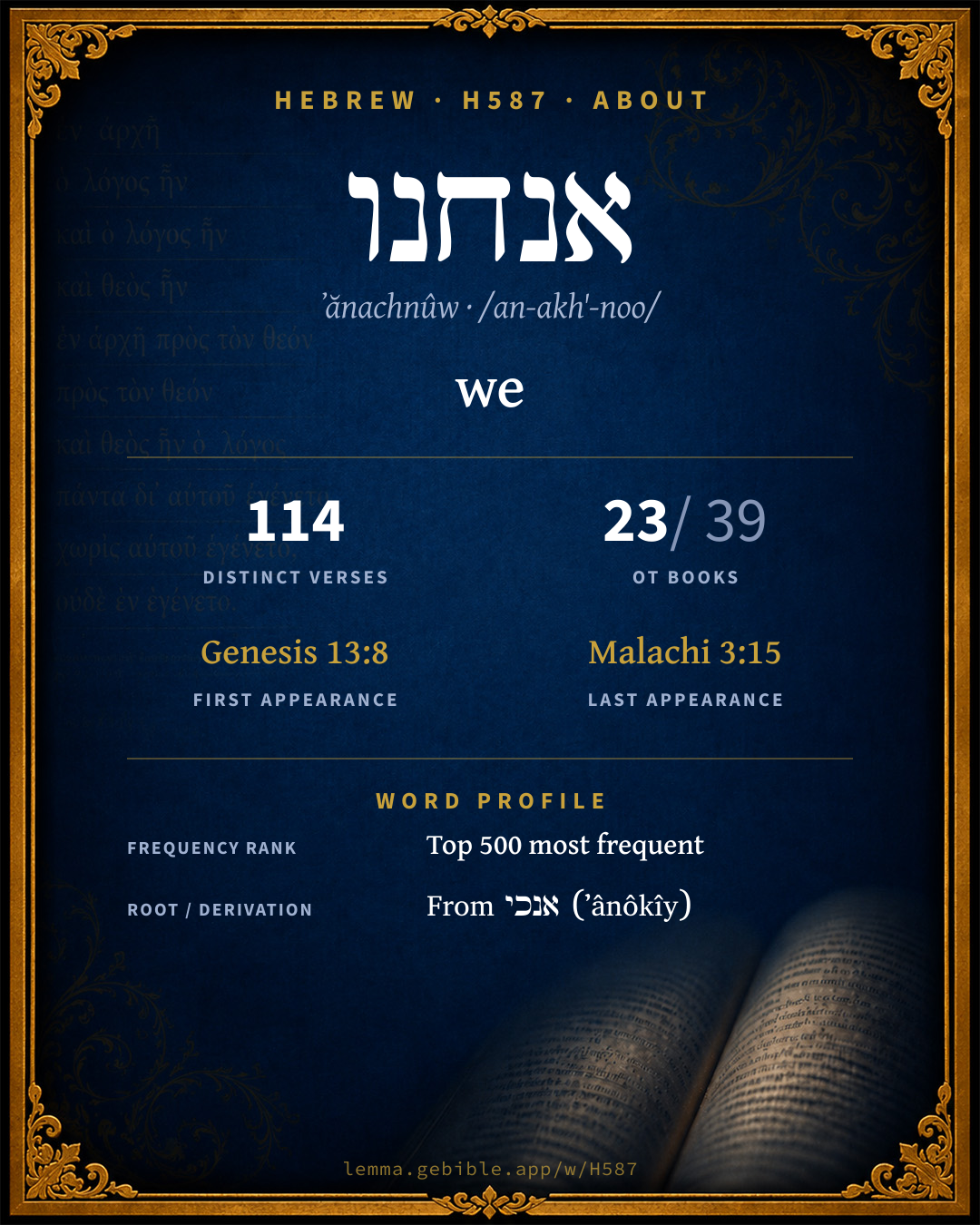
אֲנַ֫חְנוּ
we
Full lexicon entry — Brown-Driver-Briggs (BDB)
From Brown-Driver-Briggs (BDB)
Where this word appears
Grammar key — what these labels mean
Part of speech
- Pronoun
- A word standing in for a noun (“he,” “this,” “who”).
Person
- 1st Person
- The speaker (“I / we”).
Gender
- Common
- Either gender — not distinguished for this form.
Number
- Plural
- More than one (in Hebrew, generally three or more).
Every verse where H587 appears — 114 distinct verses across 23 books. Click any verse to open its interlinear word-by-word view. Verse text shown in the World English Bible for context — . Each verse’s Hebrew form is shown with its reference; the English is not keyword-highlighted, since the data carries no word-level English alignment. Use “Compare translations” on any verse to read it across multiple English versions. This concordance covers the Hebrew Bible; Septuagint (Greek Old Testament) occurrences are not indexed here.
Genesis 16 verses
- Genesis 13:8 אֲנָֽחְנוּ pron pers 1cp Abram said to Lot, "Please, let there be no strife between me and you, and between my herdsmen and your herdsmen; for we are relatives.
- Genesis 19:13 אֲנַ֔חְנוּ pron pers 1cp for we will destroy this place, because the cry of them is grown great before Yahweh. Yahweh has sent us to destroy it."
- Genesis 29:4 אֲנָֽחְנוּ pron pers 1cp Jacob said to them, "My relatives, where are you from?" They said, "We are from Haran."
- Genesis 37:7 אֲנַ֜חְנוּ pron pers 1cp for, behold, we were binding sheaves in the field, and behold, my sheaf arose and also stood upright; and behold, your sheaves came around, and bowed down to my sheaf."
- Genesis 42:11 אֲנַ֔חְנוּ pron pers 1cp We are all one man's sons; we are honest men. Your servants are not spies."
- Genesis 42:13 אֲנַ֛חְנוּ pron pers 1cp They said, "We, your servants, are twelve brothers, the sons of one man in the land of Canaan; and, behold, the youngest is this day with our father, and one is no more."
- Genesis 42:21 אֲנַחְנוּ֮ pron pers 1cp They said one to another, "We are most assuredly guilty concerning our brother, in that we saw the distress of his soul, when he begged us, and we wouldn't listen. Therefore this distress has come on us."
- Genesis 42:31 אֲנָ֑חְנוּ pron pers 1cp We said to him, 'We are honest men. We are no spies.
- Genesis 42:32 אֲנַ֛חְנוּ pron pers 1cp We are twelve brothers, sons of our father; one is no more, and the youngest is this day with our father in the land of Canaan.'
- Genesis 43:8 אֲנַ֥חְנוּ pron pers 1cp Judah said to Israel, his father, "Send the boy with me, and we will arise and go, so that we may live, and not die, both we, and you, and also our little ones.
- Genesis 43:18 אֲנַ֖חְנוּ pron pers 1cp The men were afraid, because they were brought to Joseph's house; and they said, "Because of the money that was returned in our sacks at the first time are we brought in; that he may seek occasion against us, and fall on us, and take us for bondservants, along with our donkeys."
- Genesis 44:9 אֲנַ֕חְנוּ pron pers 1cp With whoever of your servants it be found, let him die, and we also will be my lord's bondservants."
- Genesis 44:16 אֲנַ֕חְנוּ pron pers 1cp Judah said, "What will we tell my lord? What will we speak? Or how will we clear ourselves? God has found out the iniquity of your servants. Behold, we are my lord's bondservants, both we, and he also in whose hand the cup is found."
- Genesis 46:34 אֲנַ֖חְנוּ pron pers 1cp that you shall say, 'Your servants have been keepers of cattle from our youth even until now, both we, and our fathers:' that you may dwell in the land of Goshen; for every shepherd is an abomination to the Egyptians."
- Genesis 47:3 אֲנַ֖חְנוּ pron pers 1cp Pharaoh said to his brothers, "What is your occupation?" They said to Pharaoh, "Your servants are shepherds, both we, and our fathers."
- Genesis 47:19 אֲנַ֨חְנוּ֙ אֲנַ֤חְנוּ pron pers 1cp pron pers 1cp Why should we die before your eyes, both we and our land? Buy us and our land for bread, and we and our land will be servants to Pharaoh. Give us seed, that we may live, and not die, and that the land won't be desolate."
Exodus 1 verse
Numbers 5 verses
- Numbers 9:7 אֲנַ֥חְנוּ pron pers 1cp Those men said to him, "We are unclean because of the dead body of a man. Why are we kept back, that we may not offer the offering of Yahweh in its appointed season among the children of Israel?"
- Numbers 10:29 אֲנַ֗חְנוּ pron pers 1cp Moses said to Hobab, the son of Reuel the Midianite, Moses' father-in-law, We are journeying to the place of which Yahweh said, I will give it you: come you with us, and we will do you good; for Yahweh has spoken good concerning Israel.
- Numbers 20:4 אֲנַ֖חְנוּ pron pers 1cp Why have you brought the assembly of Yahweh into this wilderness, that we should die there, we and our animals?
- Numbers 20:16 אֲנַ֣חְנוּ pron pers 1cp and when we cried to Yahweh, he heard our voice, and sent an angel, and brought us forth out of Egypt: and, behold, we are in Kadesh, a city in the uttermost of your border.
- Numbers 32:17 וַ/אֲנַ֜חְנוּ conj + pron pers 1cp but we ourselves will be ready armed to go before the children of Israel, until we have brought them to their place: and our little ones shall dwell in the fortified cities because of the inhabitants of the land.
Deuteronomy 5 verses
- Deuteronomy 1:28 אֲנַ֣חְנוּ pron pers 1cp Where are we going up? our brothers have made our heart to melt, saying, The people are greater and taller than we; the cities are great and fortified up to the sky; and moreover we have seen the sons of the Anakim there.
- Deuteronomy 1:41 אֲנַ֤חְנוּ pron pers 1cp Then you answered and said to me, We have sinned against Yahweh, we will go up and fight, according to all that Yahweh our God commanded us. You girded on every man his weapons of war, and were forward to go up into the hill-country.
- Deuteronomy 5:3 אֲנַ֨חְנוּ pron pers 1cp Yahweh didn't make this covenant with our fathers, but with us, even us, who are all of us here alive this day.
- Deuteronomy 5:25 אֲנַ֗חְנוּ pron pers 1cp Now therefore why should we die? for this great fire will consume us: if we hear the voice of Yahweh our God any more, then we shall die.
- Deuteronomy 12:8 אֲנַ֧חְנוּ pron pers 1cp You shall not do after all the things that we do here this day, every man whatever is right in his own eyes;
Joshua 8 verses
- Joshua 2:17 אֲנַ֔חְנוּ pron pers 1cp The men said to her, We will be guiltless of this your oath which you have made us to swear.
- Joshua 2:18 אֲנַ֥חְנוּ pron pers 1cp Behold, when we come into the land, you shall bind this line of scarlet thread in the window which you did let us down by: and you shall gather to you into the house your father, and your mother, and your brothers, and all your father's household.
- Joshua 2:19 וַ/אֲנַ֣חְנוּ conj + pron pers 1cp It shall be, that whoever shall go out of the doors of your house into the street, his blood shall be on his head, and we shall be guiltless: and whoever shall be with you in the house, his blood shall be on our head, if any hand be on him.
- Joshua 9:8 אֲנָ֑חְנוּ pron pers 1cp They said to Joshua, We are your servants. Joshua said to them, Who are you? and from whence come you?
- Joshua 9:11 אֲנַ֔חְנוּ pron pers 1cp Our elders and all the inhabitants of our country spoke to us, saying, Take provision in your hand for the journey, and go to meet them, and tell them, We are your servants: and now make you a covenant with us.
- Joshua 9:19 אֲנַ֨חְנוּ֙ pron pers 1cp But all the princes said to all the congregation, We have sworn to them by Yahweh, the God of Israel: now therefore we may not touch them.
- Joshua 9:22 אֲנַ֤חְנוּ pron pers 1cp Joshua called for them, and he spoke to them, saying, Why have you deceived us, saying, We are very far from you; when you dwell among us?
- Joshua 24:18 אֲנַ֨חְנוּ֙ pron pers 1cp and Yahweh drove out from before us all the peoples, even the Amorites who lived in the land: therefore we also will serve Yahweh; for he is our God.
Judges 6 verses
- Judges 9:28 אֲנָֽחְנוּ pron pers 1cp Gaal the son of Ebed said, Who is Abimelech, and who is Shechem, that we should serve him? Isn't he the son of Jerubbaal? and Zebul his officer? serve you the men of Hamor the father of Shechem: but why should we serve him?
- Judges 16:5 וַ/אֲנַ֨חְנוּ֙ conj + pron pers 1cp The lords of the Philistines came up to her, and said to her, Entice him, and see in which his great strength lies, and by what means we may prevail against him, that we may bind him to afflict him: and we will each give you of us eleven hundred [pieces] of silver.
- Judges 18:5 אֲנַ֖חְנוּ pron pers 1cp They said to him, Ask counsel, we pray you, of God, that we may know whether our way which we go shall be prosperous.
- Judges 19:18 אֲנַ֜חְנוּ pron pers 1cp He said to him, We are passing from Bethlehem Judah to the farther side of the hill-country of Ephraim; from there am I, and I went to Bethlehem Judah: and I am [now] going to the house of Yahweh; and there is no man who takes me into his house.
- Judges 21:7 וַ/אֲנַ֨חְנוּ֙ conj + pron pers 1cp How shall we do for wives for those who remain, seeing we have sworn by Yahweh that we will not give them of our daughters to wives?
- Judges 21:18 וַ/אֲנַ֗חְנוּ conj + pron pers 1cp However we may not give them wives of our daughters, for the children of Israel had sworn, saying, Cursed be he who gives a wife to Benjamin.
1 Samuel 4 verses
- 1 Samuel 8:20 אֲנַ֖חְנוּ pron pers 1cp that we also may be like all the nations, and that our king may judge us, and go out before us, and fight our battles.
- 1 Samuel 14:8 אֲנַ֥חְנוּ pron pers 1cp Then said Jonathan, Behold, we will pass over to the men, and we will disclose ourselves to them.
- 1 Samuel 23:3 אֲנַ֥חְנוּ pron pers 1cp David's men said to him, Behold, we are afraid here in Judah: how much more then if we go to Keilah against the armies of the Philistines?
- 1 Samuel 30:14 אֲנַ֡חְנוּ pron pers 1cp We made a raid on the South of the Cherethites, and on that which belongs to Judah, and on the South of Caleb; and we burned Ziklag with fire.
2 Samuel 1 verse
1 Kings 2 verses
- 1 Kings 3:18 וַ/אֲנַ֣חְנוּ אֲנַ֖חְנוּ conj + pron pers 1cp pron pers 1cp It happened the third day after I was delivered, that this woman was delivered also; and we were together; there was no stranger with us in the house, save we two in the house.
- 1 Kings 22:3 וַ/אֲנַ֣חְנוּ conj + pron pers 1cp The king of Israel said to his servants, "You know that Ramoth-gilead is ours, and we are still, and don't take it out of the hand of the king of Syria?"
2 Kings 8 verses
- 2 Kings 6:1 אֲנַ֜חְנוּ pron pers 1cp The sons of the prophets said to Elisha, See now, the place where we dwell before you is too strait for us.
- 2 Kings 7:3 אֲנַ֛חְנוּ pron pers 1cp Now there were four leprous men at the entrance of the gate: and they said one to another, Why sit we here until we die?
- 2 Kings 7:9 אֲנַ֣חְנוּ וַ/אֲנַ֣חְנוּ pron pers 1cp conj + pron pers 1cp Then they said one to another, We aren't doing right. This day is a day of good news, and we hold our peace: if we wait until the morning light, punishment will overtake us; now therefore come, let us go and tell the king's household.
- 2 Kings 7:12 אֲנַ֗חְנוּ pron pers 1cp The king arose in the night, and said to his servants, I will now show you what the Syrians have done to us. They know that we are hungry; therefore are they gone out of the camp to hide themselves in the field, saying, When they come out of the city, we shall take them alive, and get into the city.
- 2 Kings 10:4 אֲנָֽחְנוּ pron pers 1cp But they were exceedingly afraid, and said, Behold, the two kings didn't stand before him: how then shall we stand?
- 2 Kings 10:5 אֲנַ֔חְנוּ pron pers 1cp He who was over the household, and he who was over the city, the elders also, and those who brought up [the children], sent to Jehu, saying, We are your servants, and will do all that you shall bid us; we will not make any man king: you do that which is good in your eyes.
- 2 Kings 10:13 אֲנַ֔חְנוּ pron pers 1cp Jehu met with the brothers of Ahaziah king of Judah, and said, Who are you? They answered, We are the brothers of Ahaziah: and we go down to Greet the children of the king and the children of the queen.
- 2 Kings 18:26 אֲנָ֑חְנוּ pron pers 1cp Then said Eliakim the son of Hilkiah, and Shebnah, and Joah, to Rabshakeh, Please speak to your servants in the Syrian language; for we understand it: and don't speak with us in the Jews' language, in the ears of the people who are on the wall.
1 Chronicles 3 verses
- 1 Chronicles 11:1 אֲנָֽחְנוּ pron pers 1cp Then all Israel gathered themselves to David to Hebron, saying, Behold, we are your bone and your flesh.
- 1 Chronicles 29:13 אֲנַ֖חְנוּ pron pers 1cp Now therefore, our God, we thank you, and praise your glorious name.
- 1 Chronicles 29:15 אֲנַ֧חְנוּ pron pers 1cp For we are strangers before you, and foreigners, as all our fathers were: our days on the earth are as a shadow, and there is no abiding.
2 Chronicles 4 verses
- 2 Chronicles 2:16 וַ֠/אֲנַחְנוּ conj + pron pers 1cp and we will cut wood out of Lebanon, as much as you shall need; and we will bring it to you in floats by sea to Joppa; and you shall carry it up to Jerusalem.
- 2 Chronicles 13:10 וַ/אֲנַ֛חְנוּ conj + pron pers 1cp But as for us, Yahweh is our God, and we have not forsaken him; and [we have] priests ministering to Yahweh, the sons of Aaron, and the Levites in their work:
- 2 Chronicles 13:11 אֲנַ֔חְנוּ pron pers 1cp and they burn to Yahweh every morning and every evening burnt offerings and sweet incense: the show bread also [set they] in order on the pure table; and the lampstand of gold with the lamps of it, to burn every evening: for we keep the charge of Yahweh our God; but you have forsaken him.
- 2 Chronicles 20:12 וַ/אֲנַ֗חְנוּ conj + pron pers 1cp Our God, will you not judge them? for we have no might against this great company that comes against us; neither know we what to do: but out eyes are on you.
Ezra 6 verses
- Ezra 4:2 אֲנַ֣חְנוּ pron pers 1cp then they drew near to Zerubbabel, and to the heads of fathers' [houses], and said to them, Let us build with you; for we seek your God, as you do; and we sacrifice to him since the days of Esar Haddon king of Assyria, who brought us up here.
- Ezra 4:3 אֲנַ֨חְנוּ pron pers 1cp But Zerubbabel, and Jeshua, and the rest of the heads of fathers' [houses] of Israel, said to them, You have nothing to do with us in building a house to our God; but we ourselves together will build to Yahweh, the God of Israel, as king Cyrus the king of Persia has commanded us.
- Ezra 9:7 אֲנַ֨חְנוּ֙ אֲנַחְנוּ֩ pron pers 1cp pron pers 1cp Since the days of our fathers we have been exceeding guilty to this day; and for our iniquities have we, our kings, and our priests, been delivered into the hand of the kings of the lands, to the sword, to captivity, and to plunder, and to confusion of face, as it is this day.
- Ezra 9:9 אֲנַ֔חְנוּ pron pers 1cp For we are bondservants; yet our God has not forsaken us in our bondage, but has extended loving kindness to us in the sight of the kings of Persia, to give us a reviving, to set up the house of our God, and to repair the ruins of it, and to give us a wall in Judah and in Jerusalem.
- Ezra 10:2 אֲנַ֨חְנוּ֙ pron pers 1cp Shecaniah the son of Jehiel, one of the sons of Elam, answered Ezra, We have trespassed against our God, and have married foreign women of the peoples of the land: yet now there is hope for Israel concerning this thing.
- Ezra 10:4 וַ/אֲנַ֣חְנוּ conj + pron pers 1cp Arise; for the matter belongs to you, and we are with you: be of good courage, and do it.
Nehemiah 15 verses
- Nehemiah 2:17 אֲנַ֣חְנוּ pron pers 1cp Then said I to them, You see the evil case that we are in, how Jerusalem lies waste, and the gates of it are burned with fire: come, and let us build up the wall of Jerusalem, that we be no more a reproach.
- Nehemiah 2:20 וַ/אֲנַ֥חְנוּ conj + pron pers 1cp Then answered I them, and said to them, The God of heaven, he will prosper us; therefore we his servants will arise and build: but you have no portion, nor right, nor memorial, in Jerusalem.
- Nehemiah 4:1 אֲנַ֤חְנוּ pron pers 1cp But it happened that when Sanballat heard that we were building the wall, he was angry, and took great indignation, and mocked the Jews.
- Nehemiah 4:10 וַ/אֲנַ֨חְנוּ֙ conj + pron pers 1cp Judah said, The strength of the bearers of burdens is decayed, and there is much rubbish; so that we are not able to build the wall.
- Nehemiah 4:19 וַ/אֲנַ֗חְנוּ conj + pron pers 1cp I said to the nobles, and to the rulers and to the rest of the people, The work is great and large, and we are separated on the wall, one far from another:
- Nehemiah 4:21 וַ/אֲנַ֖חְנוּ conj + pron pers 1cp So we worked in the work: and half of them held the spears from the rising of the morning until the stars appeared.
- Nehemiah 4:23 אֲנַ֥חְנוּ pron pers 1cp So neither I, nor my brothers, nor my servants, nor the men of the guard who followed me, none of us put off our clothes, everyone [went with] his weapon [to] the water.
- Nehemiah 5:2 אֲנַ֣חְנוּ pron pers 1cp For there were that said, We, our sons and our daughters, are many: let us get grain, that we may eat and live.
- Nehemiah 5:3 אֲנַ֣חְנוּ pron pers 1cp Some also there were that said, We are mortgaging our fields, and our vineyards, and our houses: let us get grain, because of the dearth.
- Nehemiah 5:5 אֲנַ֣חְנוּ pron pers 1cp Yet now our flesh is as the flesh of our brothers, our children as their children: and, behold, we bring into bondage our sons and our daughters to be servants, and some of our daughters are brought into bondage [already]: neither is it in our power to help it; for other men have our fields and our vineyards.
- Nehemiah 5:8 אֲנַ֣חְנוּ pron pers 1cp I said to them, We after our ability have redeemed our brothers the Jews, that were sold to the nations; and would you even sell your brothers, and should they be sold to us? Then held they their peace, and found never a word.
- Nehemiah 9:33 וַ/אֲנַ֥חְנוּ conj + pron pers 1cp However you are just in all that is come on us; for you have dealt truly, but we have done wickedly;
- Nehemiah 9:36 אֲנַ֥חְנוּ אֲנַ֥חְנוּ pron pers 1cp pron pers 1cp Behold, we are servants this day, and as for the land that you gave to our fathers to eat the fruit of it and the good of it, behold, we are servants in it.
- Nehemiah 9:37 אֲנָֽחְנוּ pron pers 1cp It yields much increase to the kings whom you have set over us because of our sins: also they have power over our bodies, and over our cattle, at their pleasure, and we are in great distress.
- Nehemiah 9:38 אֲנַ֛חְנוּ pron pers 1cp Yet for all this we make a sure covenant, and write it; and our princes, our Levites, [and] our priests, seal to it.
Job 1 verse
Psalms 8 verses
- Psalms 20:7 וַ/אֲנַ֓חְנוּ conj + pron pers 1cp Some trust in chariots, and some in horses, But we trust the name of Yahweh our God.
- Psalms 20:8 וַ/אֲנַ֥חְנוּ conj + pron pers 1cp They are bowed down and fallen, But we rise up, and stand upright.
- Psalms 79:13 וַ/אֲנַ֤חְנוּ conj + pron pers 1cp So we, your people and sheep of your pasture, Will give you thanks forever. We will praise you forever, to all generations.
- Psalms 95:7 וַ/אֲנַ֤חְנוּ conj + pron pers 1cp For he is our God. We are the people of his pasture, And the sheep in his care. Today, oh that you would hear his voice!
- Psalms 100:3 אֲנַ֑חְנוּ pron pers 1cp Know that Yahweh, he is God. It is he who has made us, and we are his. We are his people, and the sheep of his pasture.
- Psalms 103:14 אֲנָֽחְנוּ pron pers 1cp For he knows how we are made. He remembers that we are dust.
- Psalms 115:18 וַ/אֲנַ֤חְנוּ conj + pron pers 1cp But we will bless Yah, From this time forth and forevermore. Praise Yah!
- Psalms 124:7 וַ/אֲנַ֥חְנוּ conj + pron pers 1cp Our soul has escaped like a bird out of the fowler's snare. The snare is broken, and we have escaped.
Isaiah 4 verses
- Isaiah 20:6 אֲנָֽחְנוּ pron pers 1cp The inhabitant of this coast-land shall say in that day, Behold, such is our expectation, where we fled for help to be delivered from the king of Assyria: and we, how shall we escape?
- Isaiah 36:11 אֲנָ֑חְנוּ pron pers 1cp Then said Eliakim and Shebna and Joah to Rabshakeh, Please speak, to your servants in the Syrian language; for we understand it: and don't speak to us in the Jews' language, in the ears of the people who are on the wall.
- Isaiah 53:4 וַ/אֲנַ֣חְנוּ conj + pron pers 1cp Surely he has borne our sickness, and carried our suffering; yet we considered him plagued, struck by God, and afflicted.
- Isaiah 64:8 אֲנַ֤חְנוּ pron pers 1cp But now, Yahweh, you are our Father; we are the clay, and you our potter; and we all are the work of your hand.
Jeremiah 10 verses
- Jeremiah 3:25 אֲנַ֨חְנוּ֙ pron pers 1cp Let us lie down in our shame, and let our confusion cover us; for we have sinned against Yahweh our God, we and our fathers, from our youth even to this day; and we have not obeyed the voice of Yahweh our God.
- Jeremiah 8:8 אֲנַ֔חְנוּ pron pers 1cp How do you say, We are wise, and the law of Yahweh is with us? But, behold, the false pen of the scribes has worked falsely.
- Jeremiah 8:14 אֲנַ֣חְנוּ pron pers 1cp Why do we sit still? assemble yourselves, and let us enter into the fortified cities, and let us be silent there; for Yahweh our God has put us to silence, and given us water of gall to drink, because we have sinned against Yahweh.
- Jeremiah 8:20 וַ/אֲנַ֖חְנוּ conj + pron pers 1cp The harvest is past, the summer is ended, and we are not saved.
- Jeremiah 26:19 וַ/אֲנַ֗חְנוּ conj + pron pers 1cp Did Hezekiah king of Judah and all Judah put him to death? Didn't he fear Yahweh, and entreat the favor of Yahweh, and Yahweh repented him of the evil which he had pronounced against them? Thus should we commit great evil against our own souls.
- Jeremiah 35:8 אֲנַ֣חְנוּ pron pers 1cp We have obeyed the voice of Jonadab the son of Rechab, our father, in all that he charged us, to drink no wine all our days, we, our wives, our sons, or our daughters;
- Jeremiah 42:6 אֲנַ֜חְנוּ pron pers 1cp Whether it be good, or whether it be evil, we will obey the voice of Yahweh our God, to whom we send you; that it may be well with us, when we obey the voice of Yahweh our God.
- Jeremiah 44:17 אֲנַ֤חְנוּ pron pers 1cp But we will certainly perform every word that is gone forth out of our mouth, to burn incense to the queen of the sky, and to pour out drink-offerings to her, as we have done, we and our fathers, our kings and our princes, in the cities of Judah, and in the streets of Jerusalem; for then had we plenty of food, and were well, and saw no evil.
- Jeremiah 44:19 אֲנַ֤חְנוּ pron pers 1cp When we burned incense to the queen of the sky, and poured out drink-offerings to her, did we make her cakes to worship her, and pour out drink-offerings to her, without our husbands?
- Jeremiah 48:14 אֲנָ֑חְנוּ pron pers 1cp How say you, We are mighty men, and valiant men for the war?
Lamentations 1 verse
Ezekiel 3 verses
- Ezekiel 11:3 וַ/אֲנַ֖חְנוּ conj + pron pers 1cp who say, [The time] is not near to build houses: this [city] is the caldron, and we are the flesh.
- Ezekiel 33:10 אֲנַ֥חְנוּ pron pers 1cp You, son of man, tell the house of Israel: Thus you speak, saying, Our transgressions and our sins are on us, and we pine away in them; how then can we live?
- Ezekiel 33:24 וַ/אֲנַ֣חְנוּ conj + pron pers 1cp Son of man, they who inhabit those waste places in the land of Israel speak, saying, Abraham was one, and he inherited the land: but we are many; the land is given us for inheritance.
Daniel 1 verse
Micah 1 verse
Malachi 1 verse
About this entry
At a glance — auto-summarized from this page’s data, not written by a person. Every figure links to its source below. This summary describes the numbers; it doesn’t interpret them.
אנחנו (ʼănachnûw) is a Hebrew word most often rendered “we.” Debuting at Genesis 13:8, it then recurs through the corpus. With 114 verses in 23 books, it is a common word in the Hebrew Bible. From the same root come אנכי, אנו and אנחנא. The sections below give every sense, occurrence, and version rendering.
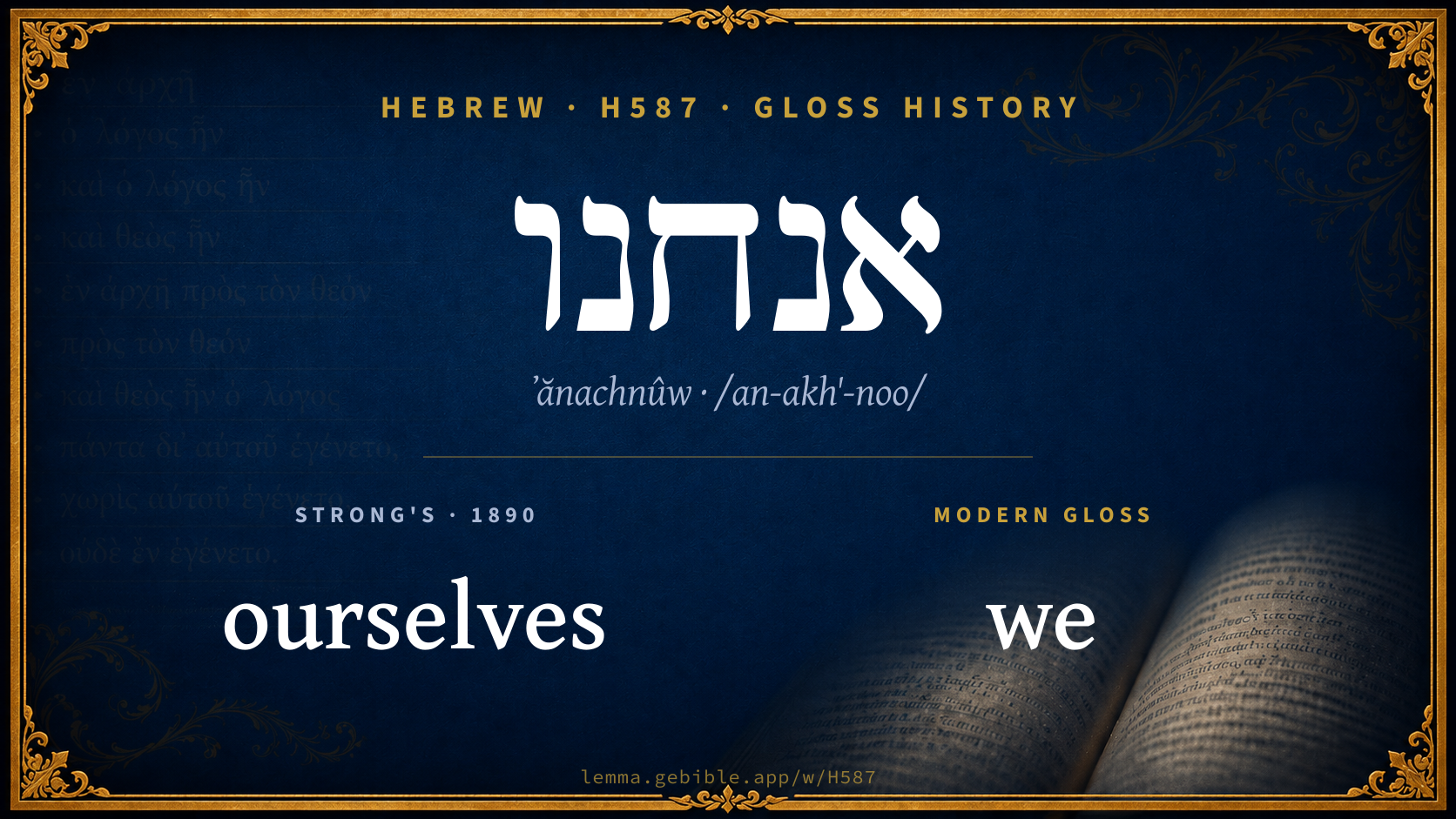
Gloss history
Strong's 1890 vs modern scholarship
About this word
Strong's H587 catalogs a Hebrew word from the Hebrew Old Testament.
These counts are not copied from any lexicon or concordance. They are computed here, from the morphology-tagged Hebrew Old Testament. What Lemma adds →
- 114
- distinct verses
- The word appears in 114 distinct verses.
- 23 / 39
- OT books
- The word appears in 23 of 39 Old Testament books.
- #360
- by frequency
- Top 500 most frequent Hebrew words (rank 360 of 8,640 Hebrew words by occurrence).
View all 114 occurrences in the concordance →
By section of the Old Testament
By traditional corpus
Conventional, traditional groupings — biblical authorship is debated, so this is a traditional corpus grouping, not an authorship claim. Each share is this word’s portion of its verses in that division of the Hebrew canon. Each figure is a share of the word’s 114 distinct verses.
- Prophets (Nevi'im) 48 verses · 42%
- Writings (Ketuvim) 39 verses · 34%
- Torah (Pentateuch) 27 verses · 24%
How translations render this word
Counts come from each version’s own published word-to-Strong’s tagging or interlinear alignment — an approximate guide to how each version renders this word, not a word-level alignment the data otherwise carries. Because each total is that version’s own tagged count, the per-version totals vary from one another and need not match the appearance or distinct-verse counts above. These counts may also differ from a printed concordance because Lemma counts each distinctly tagged rendering and does not collapse phrase taggings into a single head-word total. This is a fixed set of word-tagged versions (KJV, ASV, BSB, ULT) and does not change with the reading translation you choose elsewhere. Each version’s license is shown beside its name below (and on Sources).
BDB lists this Strong’s number as 2 distinct words (homographs). Each count above pools all of them and is not split by sense — see the Senses section below. A low-frequency rendering may belong to a different one of those words, not the primary meaning.
- King James Version†: We 2×
- American Standard Version†: Us 2×
- Berean Standard Bible†: We 86×, Us 6×, We are 6×
- unfoldingWord Literal Text†: We 89×, Ourselves 14×, Are 8×
King James Version Public Domain
Renders H587 across 6† tagged occurrences — most commonly:
Plus 4 renderings that appear only once — usually multi-word phrases or single function words the recovered tagging swept in, not distinct renderings.
American Standard Version Public Domain
Renders H587 across 7† tagged occurrences — most commonly:
Plus 5 renderings that appear only once — usually multi-word phrases or single function words the recovered tagging swept in, not distinct renderings.
Berean Standard Bible Public Domain
Renders H587 across 112† tagged occurrences — most commonly:
Plus 8 renderings that appear only once — usually multi-word phrases or single function words the recovered tagging swept in, not distinct renderings. Not rendered by a distinct English word in 7 further occurrences.
unfoldingWord Literal Text CC BY-SA 4.0
Renders H587 across 131† tagged occurrences — most commonly:
Plus 5 renderings that appear only once — usually multi-word phrases or single function words the recovered tagging swept in, not distinct renderings.
Senses in the full BDB
What do BDB’s symbols mean?
BDB uses these scholarly abbreviations:
| Symbol | Meaning |
|---|---|
| 𝔊 | the Septuagint (the ancient Greek translation, LXX) |
| 𝔙 | the Vulgate (the Latin translation) |
| 𝔖 | the Syriac version (the Peshitta) |
| 𝔗 | the Targum (the Aramaic translation) |
| ψ | the Psalms |
| √ | root (the underlying root or stem) |
| ‖ | parallel passage (a synonymous or contrasted parallel) |
| † | the dagger: every passage where the word occurs is cited |
The 0 senses and sub-senses the full Brown-Driver-Briggs lexicon distinguishes for this word, in lexicon order (not ranked by frequency), with BDB’s own verbatim wording and sub-sense lettering. Shown in Hebrew script with BDB’s own scholarly abbreviations. The condensed entry is in the Lexicon Entry tab. See also the Forms in the corpus table below.
אנחנו I on. 1 pl. we v. infr.
אנחנו II on. 1 pl. comm. we (the pl. corresp. to אָנֹכִי, as אֲנוּ to אֲנִי
Senses from the full Brown-Driver-Briggs lexicon (Brown, Driver, Briggs; Oxford 1906 — public domain), digitized via Sefaria, supplemented by the OpenScriptures HebrewLexicon (CC BY 4.0). Full attribution on Sources.
Word origin
I. pron. 1 pl. we v. infr.
I. pron. 1 pl. comm. we (the pl. corresp. to אָנֹכִי, as אֲנוּ to אֲנִי; v. WSG p. 100; Ph. אנחן, Aramaic אֲנַחְנָא, 𝔗 also נַחְנָא, Syriac ܐܶܢܚܢܰܢ, ܐܶܢܰܚܢܰܢ, ܚܢܰܢ, Arabic نَحْنُ, Ethiopic ንሕነ ) Gn 13:8; 29:4; 37:7; 42:11, 13; Nu 9:7; Dt 1:28, 41; Jo 2:17, 18, etc. Like אֲנִי, following a ptcp. as its subj. Gn 19:13; Nu 10:29; Ju 19:18 2 K 18:26; appended to a vb. for emph. Ju 9:28 2 K 10:4; Is 20:6.
— Brown-Driver-Briggs (Oxford 1906, public domain), digitized via Sefaria, supplemented by the OpenScriptures HebrewLexicon (CC BY 4.0). See Sources.
Derived from אנכי (ʼânôkîy) (H595) — I.
Jastrow Dictionary
A second Hebrew/Aramaic lexicon for comparison, covering Aramaic and post-biblical (Talmudic, Targumic, Midrashic) usage that the biblical-Hebrew BDB does not. Matched by lemma rather than by Strong’s number, so a lemma may carry more than one Jastrow headword (shown separately below), and the entries cover usage well beyond the Bible.
אֲנַחְנָא
- pl. of אֲנָא, אֲנִי.
A Dictionary of the Targumim, the Talmud Babli and Yerushalmi, and the Midrashic Literature (Marcus Jastrow; London, Luzac, 1903) — Public Domain. Digitized via Sefaria. Digitized via Sefaria. Full attribution on Sources.
Forms in the corpus
The 30 distinct written forms H587 takes in the Hebrew Bible, most frequent first — each parse links to that state’s occurrences in the concordance. Hebrew forms include their vowel points and cantillation, so a single lemma takes many written forms.
| Form | Parsing | Example | Uses |
|---|---|---|---|
| אֲנַ֣חְנוּ | Pronoun, Personal, 1st Person, Common, Plural | Deuteronomy 1:28 | 11 |
| אֲנַ֔חְנוּ | Pronoun, Personal, 1st Person, Common, Plural | Ezra 9:9 | 9 |
| אֲנַ֖חְנוּ | Pronoun, Personal, 1st Person, Common, Plural | Genesis 43:18 | 9 |
| אֲנַ֥חְנוּ | Pronoun, Personal, 1st Person, Common, Plural | Ezekiel 33:10 | 9 |
| אֲנָֽחְנוּ | Pronoun, Personal, 1st Person, Common, Plural | Genesis 13:8 | 9 |
| וַ/אֲנַ֣חְנוּ | Pronoun, Personal, 1st Person, Common, Plural | Exodus 10:26 | 8 |
| אֲנַ֤חְנוּ | Pronoun, Personal, 1st Person, Common, Plural | Deuteronomy 1:41 | 7 |
| אֲנַ֨חְנוּ֙ | Pronoun, Personal, 1st Person, Common, Plural | Ezra 9:7 | 6 |
| אֲנָ֑חְנוּ | Pronoun, Personal, 1st Person, Common, Plural | Genesis 42:31 | 5 |
| וַ/אֲנַ֗חְנוּ | Pronoun, Personal, 1st Person, Common, Plural | 2 Chronicles 20:12 | 5 |
| אֲנַ֛חְנוּ | Pronoun, Personal, 1st Person, Common, Plural | Genesis 42:13 | 4 |
| אֲנַ֜חְנוּ | Pronoun, Personal, 1st Person, Common, Plural | Genesis 37:7 | 4 |
| וַ/אֲנַ֖חְנוּ | Pronoun, Personal, 1st Person, Common, Plural | Ezekiel 11:3 | 4 |
| וַ/אֲנַ֥חְנוּ | Pronoun, Personal, 1st Person, Common, Plural | Nehemiah 2:20 | 4 |
| אֲנַ֗חְנוּ | Pronoun, Personal, 1st Person, Common, Plural | Deuteronomy 5:25 | 3 |
| אֲנַ֨חְנוּ | Pronoun, Personal, 1st Person, Common, Plural | Daniel 9:18 | 3 |
| וַ/אֲנַ֤חְנוּ | Pronoun, Personal, 1st Person, Common, Plural | Psalms 79:13 | 3 |
| וַ/אֲנַ֨חְנוּ֙ | Pronoun, Personal, 1st Person, Common, Plural | Judges 16:5 | 3 |
| אֲנַ֕חְנוּ | Pronoun, Personal, 1st Person, Common, Plural | Genesis 44:9 | 2 |
| אֲנַ֧חְנוּ | Pronoun, Personal, 1st Person, Common, Plural | Deuteronomy 12:8 | 2 |
| אֲ֭נַחְנוּ | Pronoun, Personal, 1st Person, Common, Plural | Job 8:9 | 1 |
| אֲנַ֑חְנוּ | Pronoun, Personal, 1st Person, Common, Plural | Psalms 100:3 | 1 |
| אֲנַ֡חְנוּ | Pronoun, Personal, 1st Person, Common, Plural | 1 Samuel 30:14 | 1 |
| אֲנַחְנוּ֩ | Pronoun, Personal, 1st Person, Common, Plural | Ezra 9:7 | 1 |
| אֲנַחְנוּ֮ | Pronoun, Personal, 1st Person, Common, Plural | Genesis 42:21 | 1 |
| אנחנו | Pronoun, Personal, 1st Person, Common, Plural | Lamentations 5:7 | 1 |
| וַ/אֲנַ֓חְנוּ | Pronoun, Personal, 1st Person, Common, Plural | Psalms 20:7 | 1 |
| וַ/אֲנַ֛חְנוּ | Pronoun, Personal, 1st Person, Common, Plural | 2 Chronicles 13:10 | 1 |
| וַ/אֲנַ֜חְנוּ | Pronoun, Personal, 1st Person, Common, Plural | Numbers 32:17 | 1 |
| וַ֠/אֲנַחְנוּ | Pronoun, Personal, 1st Person, Common, Plural | 2 Chronicles 2:16 | 1 |
Same root — word family
Other BDB entries built from the same root as H587, grouped by Strong’s listed origin. These share a root / origin per the lexicon — not necessarily a shared meaning. Each links to that word’s own entry.
Derives from
Derived from this word
Proper names from this root
People and places named from this root — a name, not an additional meaning of the word.
Compare all same-root words → Showing 4 of 6 — not the complete family. 2 of the same-root words are proper names (people or places). They share a root, not necessarily a meaning.
Septuagint verse parallels
This word appears in 97 verses that also exist in the Greek Old Testament (Septuagint), out of the 114 Hebrew verses it occurs in. You can read those verses in Greek by switching the Old Testament edition to the Septuagint.
Read these verses in the Septuagint
- Genesis 13:8
- Exodus 10:26
- Numbers 9:7
- Deuteronomy 1:28
- Joshua 2:17
- Judges 9:28
- 1 Samuel 8:20
- 2 Samuel 5:1
- 1 Kings 3:18
- 2 Kings 6:1
- 1 Chronicles 11:1
- 2 Chronicles 2:16
This is a verse-level parallel only — the same verses exist in both the Hebrew and Greek Old Testaments. No word-level Hebrew↔Greek correspondence is claimed: the data carries no such alignment, so no Greek word is shown as this Hebrew word’s translation. Coverage is not total — the Septuagint omits the deuterocanon and renumbers the Psalms, so some Hebrew verses have no direct Greek parallel.