
Psalms 6:2

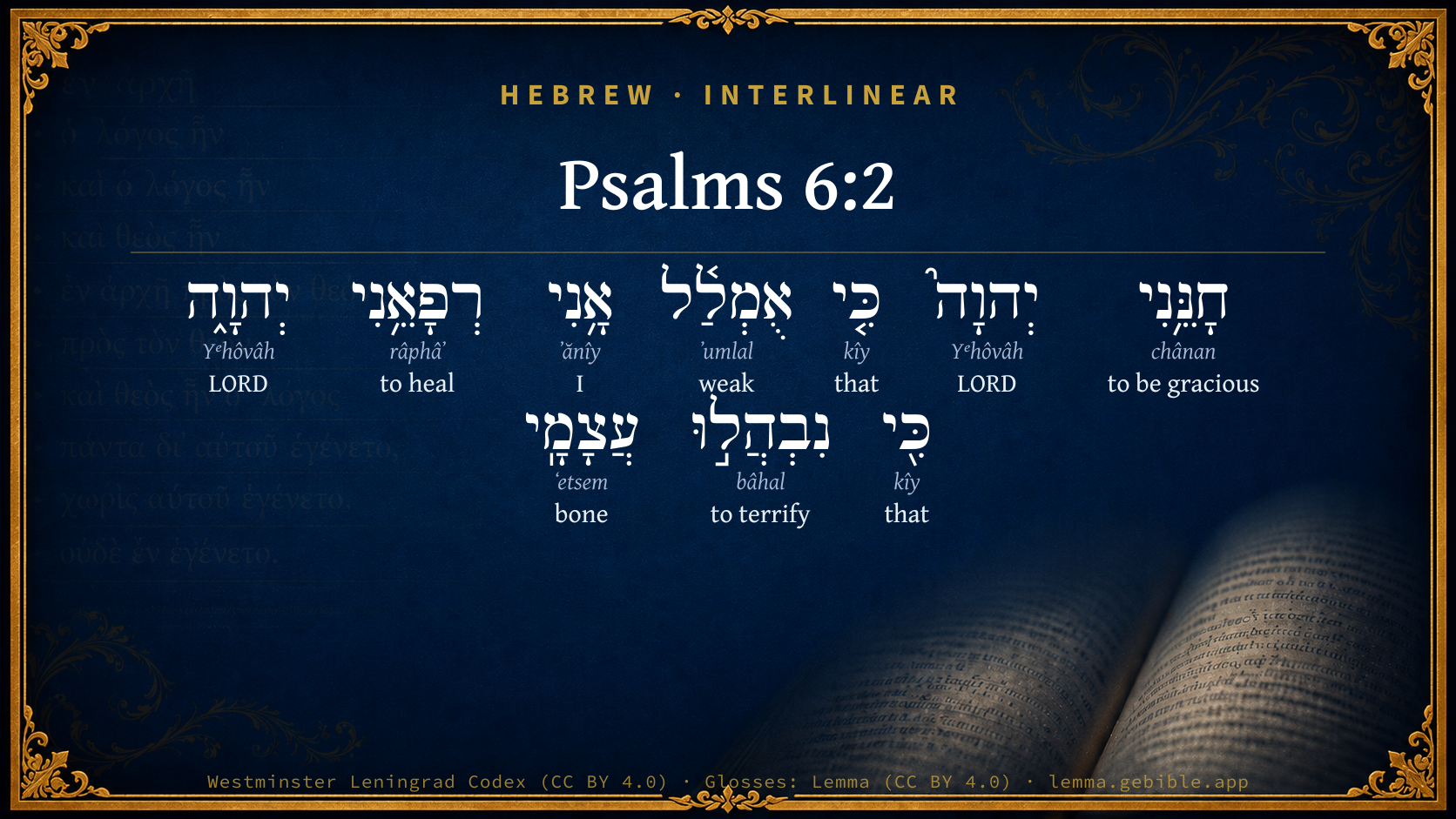
Hebrew (Westminster Leningrad Codex) Psalms 6:2 appears in the Hebrew Old Testament. The text above is from the Westminster Leningrad Codex. Each word links to its Strong’s number, a concise gloss, and parsing drawn from the Open Scriptures Hebrew Bible morphology. Click any word for its full Brown-Driver-Briggs (BDB) entry.
Download image
Cite this verse

Psalms 6:2 (World English Bible). Public Domain. Lemma interlinear Bible study tool, https://lemma.gebible.app/v/psalms/6/2.

Show BibTeX & RIS
BibTeX
RIS
English Translation
Have mercy on me, Yahweh, for I am faint. Yahweh, heal me, for my bones are troubled.
World English Bible · Public Domain
Highlights
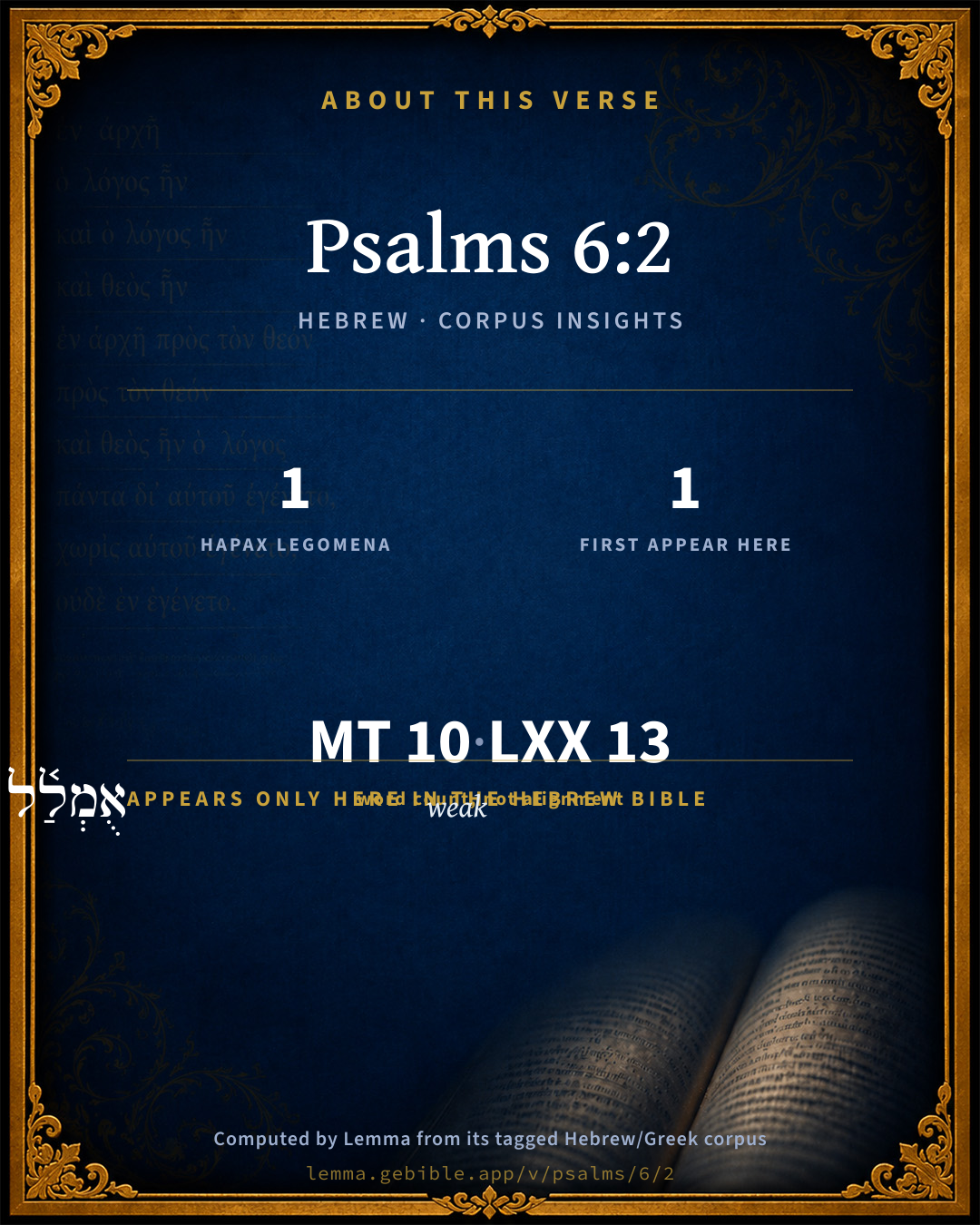
  • 1 hapax legomenon — only here in the Hebrew Bible
  • 1 first appearance in the Hebrew Bible
Full analysis ↓
Download a study sheet

One document with this verse’s original text, its word-by-word gloss line, the meaning frame, cross-references with their text, attributed commentary, and full source and license credits — printable, and it pastes into notes with its structure intact.

This verse Autodidact and up

Study sheet (.html) Plain text (.txt)

A passage Seminary Student

Up to 50 verses in one chapter. A passage sheet keeps up to 6 commentary sources and 12 cross-references per verse, in the order this page ranks them, and says so on the sheet whenever that leaves anything out. Ask for a single verse and you get the Autodidact verse sheet above.

Everything on this page stays free to read, with no account — the sheet is a download of what is already on screen, not access to it.

Want to remove ads? Support Godless Engineer
Compare translations 3

The same verse in 3 English versions, stacked beneath the original-language interlinear above. Click any original word for its lexicon entry.

Each is an independent rendering of the whole verse — the interlinear is not word-aligned to these translations.

Highlighted words mark where these versions differ — a whole-verse word diff, not a word-by-word alignment.

  • World English Bible Public Domain
    Have mercy on me, Yahweh, for I am faint. Yahweh, heal me, for my bones are troubled.
  • King James Version Public Domain
    Have mercy upon me, O LORD; for I am weak: O LORD, heal me; for my bones are vexed.
  • unfoldingWord Literal Text CC BY-SA 4.0
    Be gracious me, Yahweh, for I am frail! Heal me, Yahweh, for my bones are shaking!

unfoldingWord Literal Text — © unfoldingWord, licensed CC BY-SA 4.0. Word-aligned USFM3 via Door43 (git.door43.org/unfoldingWord/en_ult).

Versions to compare (up to 4)

3 of 4 selected

Show all 18 translations

Every available English version of this verse, each an independent rendering of the whole verse.

  • World English Bible Public Domain
    Have mercy on me, Yahweh, for I am faint. Yahweh, heal me, for my bones are troubled.
  • Berean Standard Bible Public Domain
    Be merciful to me, O LORD, for I am frail; heal me, O LORD, for my bones are in agony.
  • Majority Standard Bible Public Domain
    Be merciful to me, O LORD, for I am frail; heal me, O LORD, for my bones are in agony.
  • King James Version Public Domain
    Have mercy upon me, O LORD; for I am weak: O LORD, heal me; for my bones are vexed.
  • American Standard Version (1901) Public Domain
    Have mercy upon me, O Jehovah; for I am withered away: O Jehovah, heal me; for my bones are troubled.
  • Revised Version (1885) Public Domain
    Have mercy upon me, O LORD; for I am withered away: O LORD, heal me; for my bones are vexed.
  • Geneva Bible (1599) Public Domain
    Haue mercie vpon me, O Lord, for I am weake: O Lord heale me, for my bones are vexed.
  • Douay-Rheims (1899) Public Domain
    O Lord, rebuke me not in thy indignation, nor chastise me in thy wrath.
  • Young's Literal Translation Public Domain
    Favour me, O Jehovah, for I `am' weak, Heal me, O Jehovah, For troubled have been my bones,
  • Literal Standard Version CC BY-SA 4.0
    Favor me, O YHWH, for I [am] weak, || Heal me, O YHWH, || For my bones have been troubled,
  • Unlocked Literal Bible CC BY-SA 4.0
    Have mercy on me, Yahweh, for I am frail; heal me, Yahweh, for my bones are shaking.
  • unfoldingWord Literal Text CC BY-SA 4.0
    Be gracious me, Yahweh, for I am frail! Heal me, Yahweh, for my bones are shaking!
  • Darby Bible Public Domain
    Be gracious unto me, Jehovah, for I am withered; Jehovah, heal me, for my bones tremble.
  • World Messianic Bible Public Domain
    Have mercy on me, LORD, for I am faint. LORD, heal me, for my bones are troubled.
  • Webster's Bible Public Domain
    \\6:1\\To the chief Musician on Neginoth upon Sheminith, A Psalm of David. O LORD, rebuke me not in thy anger, neither chasten me in thy hot displeasure.
  • Free Bible Version CC BY-SA 4.0
    Have mercy on me, Lord, for I am weak; heal me, Lord, for I am sick to the bone.
  • Bible in Basic English Public Domain
    Have mercy on me, O Lord, for I am wasted away: make me well, for even my bones are troubled.
  • JPS Tanakh (1917) Public Domain
    (6-3) Be gracious unto me, O LORD, for I languish away; heal me, O LORD, for my bones are affrighted.

Literal Standard Version (2020), Covenant Press — licensed CC BY-SA 4.0. Text via the HelloAO Bible API (eBible.org). Unlocked Literal Bible (unfoldingWord) — licensed CC BY-SA 4.0. Text via the HelloAO Bible API (eBible.org). unfoldingWord Literal Text — © unfoldingWord, licensed CC BY-SA 4.0. Word-aligned USFM3 via Door43 (git.door43.org/unfoldingWord/en_ult). Free Bible Version, Dr. Jonathan Gallagher — licensed CC BY-SA 4.0. Text via the HelloAO Bible API (eBible.org).

Word by word

More ways to search: Search by grammar → Find every occurrence → Compare this word →

Practice this passage: Drill this verse → Learn its vocabulary →

About this verse

These counts appear in no published source. They are computed here, from the morphology-tagged text and Lemma’s own curated glosses. What Lemma adds →

10
words
8
distinct lemmas
Wisdom
section

Notable vocabulary

1 hapax legomenon — a word that appears only here in the entire Hebrew Bible:

  • אֻמְלַ֫ל weak H536

First appearance in Scripture

This word makes its first canonical appearance in the Hebrew Bible here:

  • אֻמְלַ֫ל weak H536

Shared distinctive vocabulary

נִבְהֲל֣וּ to terrify H926 occurs in 39 verses of the Hebrew Bible. Also found in:

Grammatical profile

  • 3 verbs
  • 3 nouns
  • 1 adjective
  • 1 pronoun
  • 2 conjunctions

Verb forms

  • חָנֵּ֥נִי Qal · Imperative
  • רְפָאֵ֥נִי Qal · Imperative
  • נִבְהֲל֣וּ Niphal · Perfect

Repetition

Words recur within this verse — often emphatic in Hebrew:

  • יְהוָה֮ LORD H3068 ×2
  • כִּ֤י that H3588 ×2

Hebrew & Septuagint length

In English translation the verse runs 17 words from the Hebrew and 17 from the Septuagint (LXX English) — the same length.

A rough comparison of the two English renderings, which tokenize alike — not a word-level alignment.

Word counts can differ between the Hebrew and the Greek without any difference in meaning — e.g. the Hebrew direct-object marker אֵת has no separate Greek word, and Greek often adds the article ὁ.

In the original languages it is 10 Hebrew tokens and 13 Greek tokens — but the two are counted differently (Hebrew bundles its prefixes and suffixes into one token; the Greek is in lemma form), so that isn’t a like-for-like length.

Cross-references

19

Topical passages linked to Psalms 6:2 in the Treasury of Scripture Knowledge — connected by theme and wording, ordered by reader-vote popularity; previews shown in the World English Bible.

  • Hosea 6:1 "Come, and let us return to Yahweh; For he has torn us to pieces, And he will heal us; He has injured us, And he will bind up our wounds.
  • Psalms 30:2 Yahweh my God, I cried to you, And you have healed me.
  • Psalms 31:10 For my life is spent with sorrow, My years with sighing. My strength fails because of my iniquity. My bones are wasted away.
  • Jeremiah 17:14 Heal me, O Yahweh, and I shall be healed; save me, and I shall be saved: for you are my praise.
  • Deuteronomy 32:39 See now that I, even I, am he, There is no god with me: I kill, and I make alive; I wound, and I heal; There is none who can deliver out of my hand.
  • Psalms 41:3–4 Yahweh will sustain him on his sickbed, And restore him from his bed of illness.
  • Psalms 51:8 Let me hear joy and gladness, That the bones which you have broken may rejoice.
  • Genesis 20:17 Abraham prayed to God. God healed Abimelech, and his wife, and his maid-servants, and they bore children.
  • Numbers 12:13 Moses cried to Yahweh, saying, Heal her, God, I beg you.
  • Job 33:19–21 He is chastened also with pain on his bed, With continual strife in his bones;
  • Psalms 32:3 When I kept silence, my bones wasted away through my groaning all day long.
  • Psalms 38:3 There is no soundness in my flesh because of your indignation, Neither is there any health in my bones because of my sin.
  • Psalms 38:7 For my loins are filled with burning. There is no soundness in my flesh.
  • Matthew 4:24 The report about him went out into all Syria. They brought to him all who were sick, afflicted with various diseases and torments, possessed with demons, epileptics, and paralytics; and he healed them.
  • Exodus 15:26 and he said, "If you will diligently listen to the voice of Yahweh your God, and will do that which is right in his eyes, and will pay attention to his commandments, and keep all his statutes, I will put none of the diseases on you, which I have put on the Egyptians; for I am Yahweh who heals you."
  • Job 5:18 For he wounds, and binds up; He injures, and his hands make whole.
  • Psalms 22:14 I am poured out like water. All my bones are out of joint. My heart is like wax; It is melted within me.
  • Psalms 103:13–17 Like a father has compassion on his children, So Yahweh has compassion on those who fear him.
  • Job 19:21 "Have pity on me, have pity on me, you my friends; For the hand of God has touched me.

Cross-references courtesy of OpenBible.info (CC BY 4.0).

Hebrew and Greek witnesses Masoretic Hebrew ↔ Greek Septuagint

The same verse in the two great witnesses to the Old Testament, shown verse-for-verse.

You’re reading Greek Psalm 6 (Hebrew Psalm 6). The Septuagint counts the superscription, so verse numbers can differ from the Hebrew — chapter-level alignment, not verse-by-verse. Numbering follows Rahlfs.

These are two independent witnesses, not word-aligned to each other, and the Septuagint is shown in lemma (dictionary) form.

Hebrew Psalms 6:2 Masoretic · Westminster Leningrad Codex

חָנֵּ֥נִי יְהוָה֮ כִּ֤י אֻמְלַ֫ל אָ֥נִי רְפָאֵ֥נִי יְהוָ֑ה כִּ֖י נִבְהֲל֣וּ עֲצָמָֽי

Have mercy on me, Yahweh, for I am faint. Yahweh, heal me, for my bones are troubled.

World English Bible · Public Domain

Greek LXX Greek Psalm 6:2 Septuagint · lemma form

κύριος μή ὁ θυμός σύ ἐλέγχω ἐγώ μηδέ ὁ ὀργή σύ παιδεύω ἐγώ

Pity me, O Lord; for I am weak: heal me, O Lord; for my bones are vexed.

LXX2012 (modern English Septuagint) · Public Domain

On this verse, Ellicott's Commentary for English Readers discusses the Septuagint’s reading. Read the note in Commentary ↓

Hebrew: Westminster Leningrad Codex (CC BY 4.0). Greek: Septuagint (public domain); English from LXX2012 (modern English Septuagint) (Public Domain). How the Septuagint differs from the Hebrew →

Commentary

Notes on Psalms 6:2 from classic Christian and Jewish commentators (each source and its license shown beneath its notes). The classic Christian expositions comment on the surrounding passage and are grouped to its opening verse, so a note may address several verses; the Jewish commentaries on the Tanakh (Rashi and others) are per-verse, so they appear only where the commentator wrote on this verse.

Lemma curates 59 commentaries, every one of them public domain or Creative Commons licensed, each selected and text-cleaned for this edition rather than reprinted as found. About our sources →

Trapp's Complete Commentary

John Trapp

Psa 6:2 Have mercy upon me, O LORD; for I [am] weak: O LORD, heal me; for my bones are vexed.

Ver. 2. Have mercy upon me, O Lord] As the woman in the story appealed from Philip to Philip, so doth David fly from God’s anger to God’s grace; for he had none else in heaven or earth to repair to, Psa 73:25. He seeks here to escape him by closing with God, and to get off by getting within him.

For I am weak] Or crushed, gnashed, extremely dejected with sickness of body and trouble of mind. Basil expounds it as his foul sins into which he fell from infirmity, and for which he was threatened with judgments by the prophet Nathan.

O Lord, heal me] On both sides: heal my soul, for I have sinned against thee, Psa 41:4, ; heal my body, which is full of dolours and diseases, Psa 107:18; Psa 107:20; for thou art Jehovah the physician, Exo 15:26. Heal mine estate, which is very calamitous by reason of mine enemies, who wish my death, and would gladly revel in my ruins. See Hos 6:2 Isa 30:26.

For my bones are vexed] viz. By reason of my leanness and long lying. For albeit the bones of themselves are insensible, and ache not; yet the membranes and tunicles do that compass the bones.

John Trapp, A Commentary or Exposition upon All the Books of the Old and New Testament (1647–1656) — public domain. Text from a community e-Sword module.

The Biblical Illustrator

Joseph S. Exell

Psa_6:2

Have mercy upon me, O Lord, for I am weak.

Cure for the souls weakness

There is a very immediate connection between soul sickness and bodily ailments. The material affects the mental, and presently the mental affects the soul. When David was weak in body he became more than ever conscious of his sinful condition before God. And the enemy took advantage of his weakness and oppressed him when his heart was sore sick. The saints extremity becomes the devils opportunity to annoy and to distress him. But he was by no means forsaken of his God.

I. The complaint--Soul weakness. It is not a disease exactly, and yet there are points about it which make it very much like a disease. Many persons cannot say they are ill, but there is a lack of physical force, a lack of stamina. They are the weaklings of the flock; and it is so in Christian experience. There are Christians lacking that power which makes a man act like a man, and speak like a man, and think with vigour and purpose, Next to listlessness, there is with these invalids a sort of fretfulness. Everything--even the grasshopper--becomes a burden to them. Then there comes to these poor sick souls a sort of fearfulness, their nervous force has gone. These people are very retiring in disposition--nervous, and bashful, and hesitating, very timid and timorous. What are the causes of this spiritual disease? Some are born frail. But the weakness is often due to the disease of harbouring unkind thoughts about anybody. An unhealthy climate is often the reason, physically speaking, for weakness of health. Weakness may be due to unwholesomeness of food.

II. The prescription. Have mercy upon me, O Lord. Gods mercy must be the antidote for my misery. This is the only remedy for spiritual weakness. If I go to the physician and complain of weakness he will probably give me some medicine which may not be very palatable. Well, then, take the medicine. (Thomas Spurgeon.)

The cry for mercy

To fly and escape the anger of God, he sees no means in heaven or in earth, and therefore he retires himself to God, even to Him who wounded him, that He might heal him. He flies not with Adam to the bush, nor with Saul to the witch, nor with Jonas to Tarshish, but he appeals from an angry and just God to a merciful God. Next, observe what David craves--mercy; whereby we may perceive that he was brought to a consideration of his own misery, or else he needed not to have asked for mercy. Then it is necessary, that to the end we may more effectually crave pardon, every one of us first have a sense and feeling of our own sin and misery. Moreover, see that David doth not present his merits, whereby to redeem the filthiness of his sins, neither yet prayers, praises, almsdeeds, victory over Gods foes, wherein he was frequent, but he leaveth them all as a broken reed, to the which he could not well lean in the day of his spiritual temptation, and hath his only refuge in Gods mercy. The merits of men (alas!) what are they? The best works we do are so full of imperfections that there is more dross than gold in them. What man would be content for good gold to receive such coin as is nearby altogether dross? And think ye God for His perfect law, which He gave us to observe and do, will receive our imperfect works? David, under the name of mercy, includeth all things, according to that of Jacob to his brother Esau, I have gotten mercy, and therefore I have gotten all things. Desirest thou anything at Gods hands? Cry for mercy, out of which fountain all good things will spring to thee. The blind men, seeking their sight, cried, Have mercy upon us, Thou Son of David. The Canaanite, who had her daughter possessed, cried, Have mercy upon me. If ye have purchased the Kings pardon, then ye may enjoy the privileges of His kingdom; if ye have mercy, ye have all that God can give you, ye have title to Christ, to heaven, to all the creatures, ye are freed and delivered from the prison of hell. (A. Symson.)

A good plea for the penitent

But is this not a weak plea, to allege weakness for a plea? weak indeed with men who commonly tread hardest upon the weakest, and are ever going over where the hedge is lowest; but no weak plea with God, whose mercy is ever ready upon all occasions, and then most when there is most need; and seeing there is greatest need where there is greatest weakness, therefore no plea with God so strong as this, Have mercy upon me, O God, for I am weak. But why should David pray for mercy to help his weakness? for what can mercy do? Mercy can but pity his weakness; it is strength that must relieve it. But is it not that mercy, I may say; is as the steward of Gods house, and hath the command of all He hath; that if wisdom be wanting for direction, mercy can procure it; if justice be wanting for defence, mercy can obtain it; if strength be wanting for support, mercy can command it; and therefore no plea so perfect to be urged with God as this, Have mercy upon me, O God, for I am weak? But why should David make his weakness a motive to God for mercy? for is not weakness an effect of sin? and can God love the effect when He hates the cause? But it is not the weakness in David that God loves, but the acknowledging of his weakness; for what is this but the true humility? and who knows not in how high account such humility is with God, seeing it is indeed of this wonderful condition, that though nothing be so low, yet nothing reacheth so high, and therefore no motive so fit to move God as this, Have mercy upon me, O God, for I am weak. Mercy, indeed, looks down upon no object so directly as upon weakness, and weakness looks up to no object so directly as to mercy; and therefore they cannot choose but meet, and meeting, not choose but embrace each other: mercy, weakness as her client; weakness, mercy as her patron; that no plea can be so strong with God as this, Have mercy upon me, O God, for I am weak. (Sir Richard Baker.)

An argument taken from weakness

But behold what rhetoric he trieth to move God to cure him: I am weak; an argument taken from his weakness; which indeed were a weak argument to move any man to show his favour, but is a strong argument to prevail with God. If a diseased person would come to a physician, and only lament the heaviness of his sickness, he would say, God help thee; or an oppressed person come to a lawyer, and show him the estate of his action and ask his advice, he would answer, That is a golden question; or to a merchant to crave raiment, he will either have present money or a surety; or a courtier for favour, you must have your reward ready in your hand. But coming before God, the most forcible argument ye can use is your necessity, poverty, tears, misery, unworthiness, and confessing them to Him, it shall be an open door to furnish you with all things that He hath. (A. Symson B. D.)

A forcible plea

The tears of our misery are forcible arrows to pierce the heart of our heavenly Father, to deliver us and pity our hard case. The beggars lay open their sores to the view of the world, that the more they may move men to pity them. So let us deplore our miseries to God, that He, with the pitiful Samaritan, at the sight of our wounds may help us in due time. (A. Symson B. D.)

O Lord, heal me.--

Healing

There is something very soothing, very beautiful in that word Heal. It seems so full of beneficence, so full of restoration, so full of balm. Heal, so near Health--it is a beautiful word. The healing is found in Him. There are some medicines which are called polychrists, they heal so many diseases. Heaven knows but one Polychrist. It is one to heal not only many diseases, but all, and that one is the touch of Christ. (P. B. Tower, M. A.)

The Biblical Illustrator, edited by Joseph S. Exell (c. 1880s–1900s) — public domain. Text from a community e-Sword module.

Joseph Benson's Commentary

Psa 6:2. Have mercy upon me — I plead not my merit, but thy free mercy; for I am weak — Or, I languish; my body pines away, and my spirit fails through my excessive pains and troubles. O Lord, heal me — That is, the distempers of my soul and body, of both which the word רפא, rapha, is used; for my bones are vexed — That is, my inward parts. Bones, reins, inward parts, often in Scripture signify the same as heart, soul, thought: see Psa 35:10.

Joseph Benson's Commentary on the Old and New Testaments (1811–1818) — public domain. Text from a community e-Sword module.

J. A. Alexander on Psalms

Joseph Addison Alexander

2. O Lord, Jehovah, do not in thine anger rebuke me, and do not in thy heat, or hot displeasure, chasten me. Both the original verbs properly denote the conviction and reproof of an offender in words, but are here, as often elsewhere, applied to providential chastisements, in which God speaks with a reproving voice. This is not a prayer for the mitigation of the punishment, like that in Jer 10:24, but for its removal, as appears from the account of the answer in Psa 6:9-10 (8-10). Such a petition, while it indicates a strong faith, at the same time recognises the connection between suffering and sin. In the very act of asking for relief, the psalmist owns that he is justly punished. This may serve to teach us how far the confident tone of the preceding psalms is from betraying a self-righteous spirit, or excluding the consciousness of personal unworthiness and ill-desert. The boldness there displayed is not that of self-reliance, but of faith.

3. (Psa 6:2). Have mercy upon me, or be gracious unto me, O Lord, Jehovah, for drooping, languishing, am I. The original construction is, for I am (one who) droops or withers, like a blighted plant. Like a child complaining to a parent, he describes the greatness of his suffering as a reason for relieving him. Heal me, O Lord, Jehovah, for shaken, agitated with distress and terror, are my bones, here mentioned as the strength and framework of the body. This might seem to indicate corporeal disease as the whole from which he prays to be delivered. But the absence of any such allusion in the latter part of the psalm, and the explicit mention there of enemies as the occasion of his sufferings, shows that the pain of body here described was that arising from distress of mind, and which could only be relieved by the removal of the cause. To regard the bodily distress as a mere figure for internal anguish, would be wholly arbitrary and destructive of all sure interpretation. The physical effect here ascribed to moral causes is entirely natural and confirmed by all experience.

Joseph Addison Alexander, The Psalms Translated and Explained (1850) — public domain. Text from a community e-Sword module.

Tyndale Open Study Notes

Tyndale Open Resources

6:2-3 In his longing for God’s response to his prayer, the psalmist grew physically weak (6:6; see 77:3; 119:81; 142:1-3; see also Ps 101). Fasting might have played a part in his agony, but this is not mentioned.

Tyndale Open Study Notes — © Tyndale Open Resources, licensed CC BY-SA 4.0. Text via the HelloAO Bible API.

Geneva Bible (1599)

Geneva Bible translators

For my whole strength is abated.

Geneva Bible (1599) marginal notes — public domain. Text via Bolls.life.

Jamieson, Fausset & Brown

Robert Jamieson, A. R. Fausset & David Brown

I am weak--as a culled plant (Isa 24:4).

my bones--the very frame.

are vexed-- (Psa 2:5) --shaken with fear.

Jamieson, Fausset & Brown — Commentary Critical and Explanatory on the Whole Bible (1871) — public domain (CC PDM 1.0). Text via the HelloAO Bible API.

Adam Clarke's Commentary

Verse 2. Have mercy] I have no merit. I deserve all I feel and all I fear.

O Lord, heal me] No earthly physician can cure my malady. Body and soul are both diseased, and only God can help me.

I am weak] אמלל umlal. I am exceedingly weak; I cannot take nourishment, and my strength is exhausted.

My bones are vexed.] The disease hath entered into my bones.

Adam Clarke's Commentary on the Bible (1810–1826) — public domain. Text from a community e-Sword/MySword module.

John Calvin's Commentaries

2. Have mercy upon me. As he earnestly calls upon God to be merciful to him, it is from this the more clearly manifest, that by the terms anger and indignation he did not mean cruelty or undue severity, but only such judgment as God executes upon the reprobate, whom he does not spare in mercy as he does his own children. If he had complained of being unjustly and too severely punished, he would now have only added something to this effect: Restrain thyself, that in punishing me thou mayest not exceed the measure of my offense. In betaking himself, therefore, to the mercy of God alone, he shows that he desires nothing else than not to be dealt with according to strict justice, or as he deserved. In order to induce God to exercise his forgiving mercy towards him, he declares that he is ready to fail: Have mercy upon me, O Jehovah, for I am weak As I have said before, he calls himself weak, not because he was sick, but because he was cast down and broken by what had now befallen him. And as we know that the design of God in inflicting punishment upon us, is to humble us; so, whenever we are subdued under his rod, the gate is opened for his mercy to come to us. Besides, since it is his peculiar office to heal the diseased to raise up the fallen, to support the weak, and, finally, to give life to the dead; this, of itself, is a sufficient reason why we should seek his favor, that we are sinking under our afflictions.

After David has protested that he placed his hope of salvation in the mercy of God alone, and has sorrowfully set forth how much he is abased, he subjoins the effect which this had in impairing his bodily health, and prays for the restoration of this blessing: Heal me, O Jehovah And this is the order which we must observe, that we may know that all the blessings which we ask from God flow from the fountain of his free goodness, and that we are then, and then only, delivered from calamities and chastisements, “Des maux et chastiemens.” — Fr.

John Calvin's Commentaries (1540-1563) — public domain. Text from the Calvin Translation Society English edition (1840s-50s) via the Christian Classics Ethereal Library (ccel.org). Calvin's coverage is partial (roughly two-thirds of the Bible); uncommented books and verses are honest gaps, never fabricated. The 19th-century editor's footnotes and remarks are omitted so the notes are faithfully Calvin's own voice.

Ellicott's Commentary for English Readers

(2) I am weak.—Properly, wither, or waste with disease, or languish, as in Hos_4:3; Isa_16:8.

Vexed.—So LXX. and Vulg. Literally, affrighted. (Comp. Virgil’s gelidusque per ima cucurrit Ossa tremor.)

A Bible Commentary for English Readers, edited by Charles John Ellicott (1878–1897) — public domain. Text from a community e-Sword module.

The Cambridge Bible for Schools and Colleges

gen. ed. J. J. S. Perowne

2. Have mercy upon me] Be gracious unto me. See note on Psa_4:1.

I am weak] R.V., I am withered away, retaining the primary meaning of the word. Cp. Nah_1:4, where it is rendered languisheth.

heal me] So Jeremiah prays (Psa_17:14), combining this petition with that of Psa_6:4. Cp. Job_5:18; Psa_30:2; Psa_41:4; Psa_147:3.

for my bones are vexed] Even the solid framework of the body, the seat of its strength and solidity, is racked and shaken well nigh to dissolution. Cp. Psa_22:14. ‘The bones,’ in the language of Hebrew poetry, denote the whole physical organism of the living man, as being the fundamental part of it. Hence they are the seat of health (Pro_16:24), or of pain, as here. In some passages, ‘the bones’ come to be identified with the man himself, as a living agent. Cp. Psa_35:10. On the word ‘vexed,’ see note on Psa_2:5.

The Cambridge Bible for Schools and Colleges (gen. ed. J. J. S. Perowne; Cambridge University Press, 1878–1918) — public domain. Text from a community e-Sword module.

John Gill's Exposition

Have mercy upon me, O Lord,.... He knew he was a sinner, both by original sin and actual transgression, which he was always ready to own; he knew that what he had done deserved the wrath of God, even his hot displeasure; and that for such things it came upon the children of disobedience: he knew that there was mercy with God through Christ, and therefore he flees unto it, pleads for it, and entreats the manifestation of forgiving love: he pleads no merits of his own, nor makes any mention of former works of righteousness done by him, but throws himself upon the mercy of God in Christ; giving this as a reason,

for I am weak; either in body, through some disease upon him; or in soul, being enfeebled by sin, and so without spiritual strength to do that which was good of himself; to exercise grace, and perform duty, and much less to keep the law of God, or make atonement for sin, or to bear the punishment of it;

O Lord, heal me; meaning either his body, for God is the physician of the body, he wounds and he heals; so he healed Hezekiah and others; and he should be sought to in the first place by persons under bodily disorders: or else his soul, as in Psa 41:4; sin is the disease of the soul, and a very loathsome one it is, and is incurable but by the balm of Gilead, and the physician there; by the blood of Christ, and forgiveness through it; and the forgiveness of sin is the healing of the diseases of the soul, Psa 103:3;

for my bones are vexed; with strong pain; meaning his body, as Kimchi and Aben Ezra observe; because these are the foundation of the body, and the more principal parts of it: and this may be understood of his grief and trouble of heart for his sins and transgressions, which is sometimes expressed by the bones being broke, and by there being no rest in them, Psa 51:8.

John Gill's Exposition of the Whole Bible (1746–1763) — public domain (CC PDM 1.0). Text via the HelloAO Bible API.

Albert Barnes' Notes on the Bible

Have mercy upon me, O Lord - That is, be gracious to me; or, show me compassion. This language may be used either in view of sin, of suffering, or of danger. It is a cry to God to interpose, and remove some present source of trouble, and may be employed by one who feels that he is a sinner, or by one on a bed of pain, or by one surrounded by enemies, or by one at the point of death, or by one who is looking out with apprehension upon the eternal world. It is commonly, indeed (compare Psa 51:1), a cry to God in view of sin, pleading for pardon and salvation; but here it is a cry in view of trouble and danger, outward sorrow and mental anguish, that had overcome the strength of the sufferer and laid him on a bed of languishing. See introduction to the psalm, Section 3.

For I am weak - The original word here, אמלל 'ûmlal, means properly to languish or droop, as plants do that are blighted, Isa 24:7, or as fields do in a drought, Isa 16:8, and is here applied to a sick person whose strength is withered and gone. The condition of such an one is beautifully compared with a plant that withers for lack of moisture; and the word is used in this sense here, as referring to the psalmist himself when sick, as the result of his outward and mental sorrows. Such an effect has not been uncommon in the world. There have been numberless cases where sorrow has prostrated the strength - as a plant withers - and has brought on languishing sickness.

O Lord, heal me - This is language which would be properly applied to a case of sickness, and therefore, it is most natural to interpret it in this sense in this place. Compare Isa 19:22; Isa 30:26; Job 5:18; Gen 20:17; Psa 60:2; 2Ch 16:12; Deu 28:27.

For my bones are vexed - The word “vexed” we now commonly apply to mental trouble, and especially the lighter sort of mental trouble - to irritate, to make angry by little provocations, to harass. It is used here, however, as is common in the Scriptures, in reference to torment or to anguish. The bones are the strength and framework of the body, and the psalmist means here to say that the very source of his strength was gone; that that which supported him was prostrated; that his disease and sorrow had penetrated the most firm parts of his body. Language is often used in the Scriptures, also, as if the “bones” actually suffered pain, though it is now known that the bones, as such, are incapable of pain. And in the same manner, also, language is often used, though that use of the word is not found in the Scriptures, as if the “marrow” of the bones were especially sensitive, like a nerve, in accordance with what is the common and popular belief, though it is now known that the marrow of the bones is entirely insensible to suffering. The design of the psalmist here is to say that he was crushed and afflicted in every part of his frame.

Albert Barnes' Notes on the Bible (1834–1885) — public domain. Text from a community e-Sword/MySword module.

Matthew Poole's English Annotations

Have mercy upon me; I plead not my merit, but thy free mercy.

I am weak; or, I languish; my body pines away and my spirit fails through my excessive pains or troubles.

Heal me, i.e. the distempers of my soul and body, of both which this word is used, Psa 41:4; 107:18,20.

My bones are vexed; my torment is so deep and so general, that it reacheth and is very grievous even to my bones, though they are inward, and might seem to be out of the reach of it, and also strong and senseless, and therefore can best bear it. See the like expressions Job 4:14; 33:19; Psa 38:3; 51:8.

Matthew Poole's English Annotations on the Holy Bible (1683–1685) — public domain. Text from a community e-Sword/MySword module.

The Treasury of David

Charles H. Spurgeon

Ver. 2. Have mercy upon me, O Lord; for I am weak. Though I deserve destruction, yet let thy mercy pity my frailty. This is the right way to plead with God if we would prevail. Urge not your goodness or your greatness, but plead your sin and your littleness. Cry, "I am weak," therefore, O Lord, give me strength and crush me not. Send not forth the fury of thy tempest against so weak a vessel. Temper the wind to the shorn lamb. Be tender and pitiful to a poor withering flower, and break it not from its stem. Surely this is the plea that a sick man would urge to move the pity of his fellow if he were striving with him, "Deal gently with me, `for I am weak.'" A sense of sin had so spoiled the Psalmist's pride, so taken away his vaunted strength, that he found himself weak to obey the law, weak through the sorrow that was in him, too weak, perhaps, to lay hold on the promise. "I am weak." The original may be read, "I am one who droops," or withered like a blighted plant. Ah! beloved, we know what this means, for we, too, have seen our glory stained, and our beauty like a faded flower.

Ver. 2. Have mercy upon me, O Lord. To fly and escape the anger of God, David sees no means in heaven or in earth, and therefore retires himself to God, even to him that wounded him that he might heal him. He flies not with Adam to the bush, nor with Saul to the witch, nor with Jonah to Tarshish; but he appeals from an angry and just God to a merciful God, and from himself to himself. The woman who was condemned by King Philip, appealed from Philip being drunken to Philip being sober. But David appeals from one virtue, justice, to another, mercy. There may be appellation from the tribunal of man to the justice-seat of God; but when thou art indicted before God's justice-seat, whither or to whom wilt thou go but to himself and his mercy-seat, which is the highest and last place of appellation? "I have none in heaven but thee, nor in earth besides thee." ... David, under the name of mercy, includeth all things, according to that of Jacob to his brother Esau, "I have gotten mercy, and therefore I have gotten all things." Desirest thou any thing at God's hands? Cry for mercy, out of which fountain all good things will spring to thee. Archibald Symson.

Ver. 2. For I am weak. Behold what rhetoric he useth to move God to cure him, "I am weak," an argument taken from his weakness, which indeed were a weak argument to move any man to show his favour, but is a strong argument to prevail with God. If a diseased person would come to a physician, and only lament the heaviness of his sickness, he would say, God help thee; or an oppressed person come to a lawyer, and show him the estate of his action and ask his advice, that is a golden question; or to a merchant to crave raiment, he will either have present money or a surety; or a courtier favour, you must have your reward ready in your hand. But coming before God, the most forcible argument that you can use is your necessity, poverty, tears, misery, unworthiness, and confessing them to him, it shall be an open door to furnish you with all things that he hath. . . . The tears of our misery are forcible arrows to pierce the heart of our heavenly Father, to deliver us and pity our hard case. The beggars lay open their sores to the view of the world, that the more they may move men to pity them. So let us deplore our miseries to God, that he, with the pitiful Samaritan, at the sight of our wounds, may help us in due time. Archibald Symson.

Ver. 2. Heal me, etc. David comes not to take physic upon wantonness, but because the disease is violent, because the accidents are vehement; so vehement, so violent, as that it hath pierced ad ossa, and ad animam, "My bones are vexed, and my soul is sore troubled, therefore "heal me;" which is the reason upon which he grounds this second petition, "Heal me, because my bones are vexed," etc. John Donne.

Ver. 2. My bones are vexed. The Lord can make the strongest and most insensible part of a man's body sensible of his wrath when he pleaseth to touch him, for here David's bones are vexed. David Dickson.

Ver. 2. The term bones frequently occurs in the Psalms, and if we examine we shall find it used in three different senses. (1.) It is sometimes applied literally to our blessed Lord's human body, to the body which hung upon the cross, as, "They pierced my hands and my feet; I may tell all my bones," (2.) It has sometimes also a further reference to his mystical body the church. And then it denotes all the members of Christ's body that stand firm in the faith, that cannot be moved by persecutions, or temptations, however severe, as, "All my bones shall say, Lord, who is like unto thee?" (3.) In some passages the term bones is applied to the soul, and not to the body, to the inner man of the individual Christian. Then it implies the strength and fortitude of the soul, the determined courage which faith in God gives to the righteous. This is the sense in which it is used in the second verse of Psalm 6, O Lord, heal me; for my bones are vexed. Augustine, Ambrose, and Chrysostom; quoted by F. H. Dunwell, B.A., in "Parochial Lectures on the Psalms," 1855.

Ver. 2. The argumentum ad misericordiam.

Ver. 2. First sentence Divine healing.

(1) What precedes it, my bones are vexed.

(2) How it is wrought.

(3) What succeeds it.

Charles H. Spurgeon's The Treasury of David (1869–1885) — public domain. Psalms only. Text from a community e-Sword/MySword module.

Whedon's Commentary on the Bible

Daniel D. Whedon

2. Weak—Withered, languid, with sorrow.

My bones are vexed—My bones have been troubled. The Niphal preterite of the verb indicates a disease of some continuance. So also the significant “how long?” Psa_6:3. The direct allusion to bodily suffering, in the absence of any confession of sin, and the prayer heal me (ופא)—the usual word for restoring the health—all point to some physical suffering.

Daniel D. Whedon (gen. ed.), Commentary on the Old and New Testaments (1874–1909) — public domain. Text from a community e-Sword module.

The Pulpit Commentary

Have mercy upon me, O Lord; for I am weak; rather, I am faint, or languid withered away, like a faded plant or flower. O Lord, heal me; for my bones are vexed. Bodily ailment seems certainly to be implied; but it is that sort of bodily ailment which is often produced by mental distress a general languor, weariness, and distaste for exertion. (comp. Psa_22:14 Psa_31:10 Psa_38:3 Psa_102:3)

The Pulpit Commentary (1880–1919), ed. H.D.M. Spence-Jones & Joseph S. Exell — public domain. Text from a community e-Sword module.

John Wesley's Explanatory Notes

Bones - My inmost parts.

John Wesley, Explanatory Notes Upon the Whole Bible (1754–1765) — public domain. Text via the GEBible commentary corpus.

Radak

Rabbi David Kimhi (Radak)

O Lord, rebuke me not in Thine anger: – If Thou dost rebuke me for mine iniquity, let it not be in Thine anger. He means “gently,” so that I may be able to bear it; as Jeremiah the Prophet says (Jer. 10:24): “O Lord, correct me, but with judgement,” etc.

Neither chasten me in Thy hot displeasure: – A duplication of the sense in different words in accordance with the idiom of the language.

Radak on the Tanakh — English translations: “Sefaria Community Translation” (CC0 1.0 (public-domain dedication)); “Eliyahu Munk, HaChut Hameshulash” (CC BY 4.0); “Rabbi Mike Feuer, Jerusalem Anthology” (CC BY 4.0); and “R. David Kimhi on the first book of Psalms, Translated by R.G. Finch, London, 1919” (public domain). Text via Sefaria.

Lesson kit

Teaching starters — assembled from the data on this page, not authored interpretation. Every prompt links to the verse data it draws on. Edit before teaching.

Psalms, in the Wisdom, opens this verse with 10 words (8 distinct Hebrew lemmas). Its most distinctive word is ʼumlal (“weak”). A historical commentator’s framing appears above. Read the whole chapter for the surrounding context.

Discussion questions

  1. What does “weak” (ʼumlal) contribute to the verse as a whole?
  2. This verse holds 1 word here found nowhere else in the Hebrew Bible. What might the rare word draw attention to?
  3. The word “weak” first appears here in Scripture. What is being introduced at this debut?
  4. Genesis 45:3 shares the word «to terrify» with this verse. How do the two illuminate each other?
  5. “LORD” occurs 2× in this one verse. What is the effect of the repetition?
  6. These translations render this verse differently. What is at stake in choosing one wording over another?
  7. The verb «חָנֵּ֥נִי» is Qal Imperative. How does its form color the action?
  8. Reading how Trapp's Complete Commentary and The Biblical Illustrator read this verse, where do the two commentators agree and where do they part?

Things to notice

  • 1 word in this verse appears nowhere else in the Hebrew Bible.
  • 1 word makes its first canonical appearance in Scripture here.
  • This verse counts 10 Hebrew ↔ 13 Greek words.
  • These translations choose different wording for 13 words in this verse.
  • “LORD” occurs 2× in this single verse.

Reading settings

Reading text

Shown beneath each verse's original-language words.

Old Testament
Old Testament edition

Read the OT as the Masoretic Hebrew (MT) or the Greek Septuagint (LXX).

English shown for the Greek Septuagint (in the Hebrew ↔ Greek comparison).

Comparing translations? Open the Compare panel on any verse page to stack up to four side by side.