Exodus 18:6

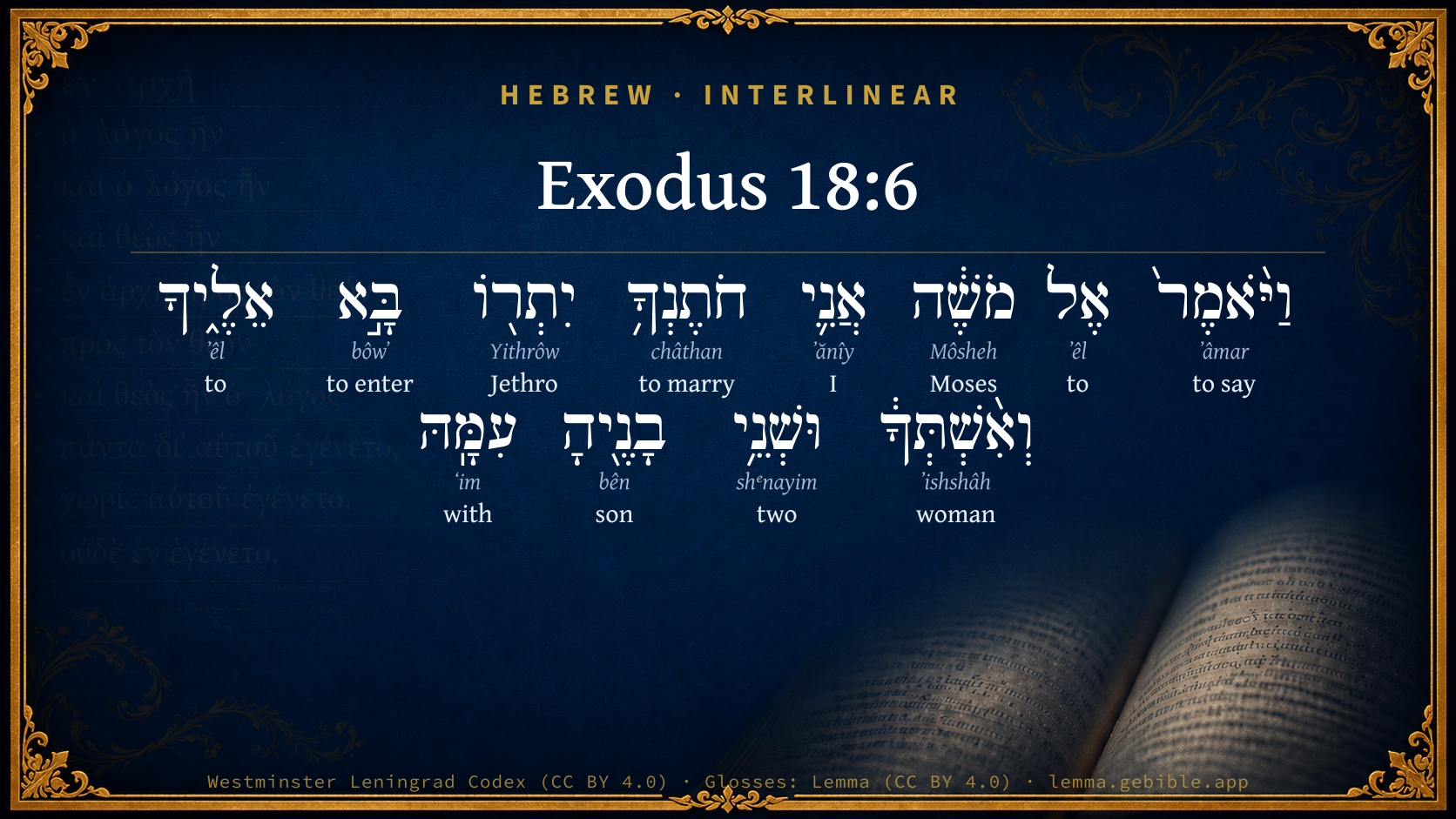
Hebrew (Westminster Leningrad Codex) Exodus 18:6 appears in the Hebrew Old Testament. The text above is from the Westminster Leningrad Codex. Each word links to its Strong’s number, a concise gloss, and parsing drawn from the Open Scriptures Hebrew Bible morphology. Click any word for its full Brown-Driver-Briggs (BDB) entry.
Download image
Cite this verse

Exodus 18:6 (World English Bible). Public Domain. Lemma interlinear Bible study tool, https://lemma.gebible.app/v/exodus/18/6.

Show BibTeX & RIS
BibTeX
RIS
English Translation
He said to Moses, I, your father-in-law Jethro, have come to you with your wife, and her two sons with her.
World English Bible · Public Domain
Download a study sheet

One document with this verse’s original text, its word-by-word gloss line, the meaning frame, cross-references with their text, attributed commentary, and full source and license credits — printable, and it pastes into notes with its structure intact.

This verse Autodidact and up

Study sheet (.html) Plain text (.txt)

A passage Seminary Student

Up to 50 verses in one chapter. A passage sheet keeps up to 6 commentary sources and 12 cross-references per verse, in the order this page ranks them, and says so on the sheet whenever that leaves anything out. Ask for a single verse and you get the Autodidact verse sheet above.

Everything on this page stays free to read, with no account — the sheet is a download of what is already on screen, not access to it.

Want to remove ads? Support Godless Engineer
Compare translations 3

The same verse in 3 English versions, stacked beneath the original-language interlinear above. Click any original word for its lexicon entry.

Each is an independent rendering of the whole verse — the interlinear is not word-aligned to these translations.

Highlighted words mark where these versions differ — a whole-verse word diff, not a word-by-word alignment.

  • World English Bible Public Domain
    He said to Moses, I, your father-in-law Jethro, have come to you with your wife, and her two sons with her.
  • King James Version Public Domain
    And he said unto Moses, I thy father in law Jethro am come unto thee, and thy wife, and her two sons with her.
  • unfoldingWord Literal Text CC BY-SA 4.0
    And he said to Moses, “I, your father-in-law Jethro, am coming to you, and your wife, and her two sons with her.”

unfoldingWord Literal Text — © unfoldingWord, licensed CC BY-SA 4.0. Word-aligned USFM3 via Door43 (git.door43.org/unfoldingWord/en_ult).

Versions to compare (up to 4)

3 of 4 selected

Show all 18 translations

Every available English version of this verse, each an independent rendering of the whole verse.

  • World English Bible Public Domain
    He said to Moses, I, your father-in-law Jethro, have come to you with your wife, and her two sons with her.
  • Berean Standard Bible Public Domain
    He sent word to Moses, “I, your father-in-law Jethro, am coming to you with your wife and her two sons.”
  • Majority Standard Bible Public Domain
    He sent word to Moses, “I, your father-in-law Jethro, am coming to you with your wife and her two sons.”
  • King James Version Public Domain
    And he said unto Moses, I thy father in law Jethro am come unto thee, and thy wife, and her two sons with her.
  • American Standard Version (1901) Public Domain
    and he said unto Moses, I, thy father-in-law Jethro, am come unto thee, and thy wife, and her two sons with her.
  • Revised Version (1885) Public Domain
    and he said unto Moses, I thy father in law Jethro am come unto thee, and thy wife, and her two sons with her.
  • Geneva Bible (1599) Public Domain
    And he said to Moses, I thy father in law Iethro am come to thee, and thy wife and her two sonnes with her.
  • Douay-Rheims (1899) Public Domain
    And he sent word to Moses, saying: I Jethro thy kinsman come to thee, and thy wife, and thy two sons with her.
  • Young's Literal Translation Public Domain
    and he saith unto Moses, `I, thy father-in-law, Jethro, am coming unto thee, and thy wife, and her two sons with her.'
  • Literal Standard Version CC BY-SA 4.0
    and he says to Moses, “I, your father-in-law Jethro, am coming to you, and your wife, and her two sons with her.”
  • Unlocked Literal Bible CC BY-SA 4.0
    He said to Moses, “I, your father-in-law Jethro, am coming to you with your wife and her two sons.”
  • unfoldingWord Literal Text CC BY-SA 4.0
    And he said to Moses, “I, your father-in-law Jethro, am coming to you, and your wife, and her two sons with her.”
  • Darby Bible Public Domain
    And he sent word to Moses: I, thy father-in-law Jethro, am come to thee, and thy wife, and her two sons with her.
  • World Messianic Bible Public Domain
    He said to Moses, “I, your father-in-law Jethro, have come to you with your wife, and her two sons with her.”
  • Webster's Bible Public Domain
    And he said to Moses, I thy father-in-law Jethro have come to thee, and thy wife, and her two sons with her.
  • Free Bible Version CC BY-SA 4.0
    Moses was told beforehand, “I, your father-in-law Jethro, am coming to see you together with your wife and her two sons.”
  • Bible in Basic English Public Domain
    And he said to Moses, I, your father-in-law, have come to you, with your wife and your two sons.
  • JPS Tanakh (1917) Public Domain
    and he said unto Moses: 'I thy father-in-law Jethro am coming unto thee, and thy wife, and her two sons with her.'

Literal Standard Version (2020), Covenant Press — licensed CC BY-SA 4.0. Text via the HelloAO Bible API (eBible.org). Unlocked Literal Bible (unfoldingWord) — licensed CC BY-SA 4.0. Text via the HelloAO Bible API (eBible.org). unfoldingWord Literal Text — © unfoldingWord, licensed CC BY-SA 4.0. Word-aligned USFM3 via Door43 (git.door43.org/unfoldingWord/en_ult). Free Bible Version, Dr. Jonathan Gallagher — licensed CC BY-SA 4.0. Text via the HelloAO Bible API (eBible.org).

Word by word

More ways to search: Search by grammar → Find every occurrence → Compare this word →

Practice this passage: Drill this verse → Learn its vocabulary →

יִתְר֖וֹ
Yithrôw
H3503
“Jethro”
Noun, Proper
Part of Speech
Noun
Type
Proper
Full BDB Definition

Origin: from H3499 with pron. suffix

TWOT: None

Jethro = "his abundance" - father-in-law of Moses; also 'Jether'
  1. וַיֹּ֨אמֶר֙ ʼâmar H559 “and · to say” Conjunction + Verb, Qal, Sequential Imperfect, 3rd Person, Masculine, Singular
  2. אֶל ʼêl H413 “to” Preposition
  3. מֹשֶׁ֔ה Môsheh H4872 “Moses” Noun, Proper
  4. אֲנִ֛י ʼănîy H589 “I” Pronoun, Personal, 1st Person, Common, Singular
  5. חֹתֶנְךָ֥ châthan H2859 “marrying · you” Verb, Qal, Participle Active, Masculine, Singular, Construct + Suffix, Personal, 2nd Person, Masculine, Singular
  6. בָּ֣א bôwʼ H935 “entering” Verb, Qal, Participle Active, Masculine, Singular, Absolute
  7. אֵלֶ֑יךָ ʼêl H413 “to · you” Preposition + Suffix, Personal, 2nd Person, Masculine, Singular
  8. וְאִ֨שְׁתְּךָ֔ ʼishshâh H802 “and · woman · your” Conjunction + Noun, Common, Feminine, Singular, Construct + Suffix, Personal, 2nd Person, Masculine, Singular
  9. וּשְׁנֵ֥י shᵉnayim H8147 “and · two” Conjunction + Adjective, Cardinal number, Masculine, Dual, Construct
  10. בָנֶ֖יהָ bên H1121 “sons · her” Noun, Common, Masculine, Plural, Construct + Suffix, Personal, 3rd Person, Feminine, Singular
  11. עִמָּֽהּ ʻim H5973 “with · her” Preposition + Suffix, Personal, 3rd Person, Feminine, Singular

About this verse

These counts appear in no published source. They are computed here, from the morphology-tagged text and Lemma’s own curated glosses. What Lemma adds →

12
words
11
distinct lemmas
Pentateuch
section

Notable vocabulary

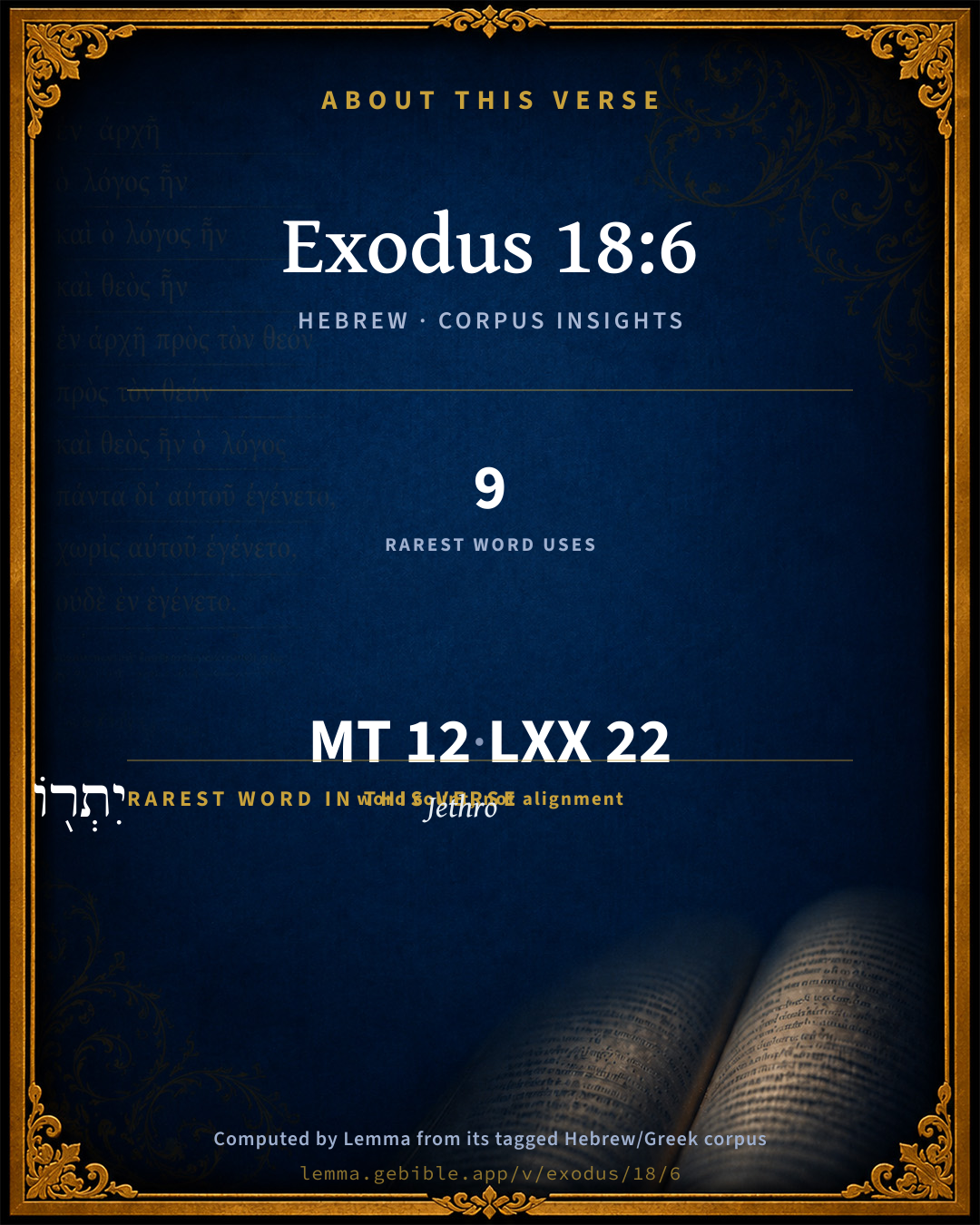
The rarest word here is יִתְר֖וֹ Jethro H3503 — appearing just 9 times in the whole Hebrew Bible.

Shared distinctive vocabulary

יִתְר֖וֹ Jethro H3503 occurs in 9 verses of the Hebrew Bible. Also found in:

Grammatical profile

  • 3 verbs
  • 4 nouns
  • 1 adjective
  • 1 pronoun
  • 3 prepositions

Verb forms

  • וַיֹּ֨אמֶר֙ Qal · Sequential Imperfect
  • חֹתֶנְךָ֥ Qal · Participle Active
  • בָּ֣א Qal · Participle Active

Repetition

A word recurs within this verse — often emphatic in Hebrew:

  • אֶל to H413 ×2

Hebrew & Septuagint length

In English translation the verse runs 21 words from the Hebrew and 22 from the Septuagint (LXX English) — closely comparable.

A rough comparison of the two English renderings, which tokenize alike — not a word-level alignment.

Word counts can differ between the Hebrew and the Greek without any difference in meaning — e.g. the Hebrew direct-object marker אֵת has no separate Greek word, and Greek often adds the article ὁ.

In the original languages it is 12 Hebrew tokens and 22 Greek tokens — but the two are counted differently (Hebrew bundles its prefixes and suffixes into one token; the Greek is in lemma form), so that isn’t a like-for-like length.

Hebrew and Greek witnesses Masoretic Hebrew ↔ Greek Septuagint

The same verse in the two great witnesses to the Old Testament, shown verse-for-verse.

These are two independent witnesses, not word-aligned to each other, and the Septuagint is shown in lemma (dictionary) form.

Hebrew Exodus 18:6 Masoretic · Westminster Leningrad Codex

וַיֹּ֨אמֶר֙ אֶל מֹשֶׁ֔ה אֲנִ֛י חֹתֶנְךָ֥ יִתְר֖וֹ בָּ֣א אֵלֶ֑יךָ וְאִ֨שְׁתְּךָ֔ וּשְׁנֵ֥י בָנֶ֖יהָ עִמָּֽהּ

He said to Moses, I, your father-in-law Jethro, have come to you with your wife, and her two sons with her.

World English Bible · Public Domain

Greek LXX Exodus 18:6 Septuagint · lemma form

ἀναἀγγέλλω δέ μωυσῆς λέγω ἰδού ὁ γαμβρός σύ ιοθορ παραγίγνομαι πρός σύ καί ὁ γυνή καί ὁ δύο υἱός σύ μετά αὐτός

And it was told Moses, saying, Behold, your father-in-law Jothor is coming to you, and your wife and two sons with him.

LXX2012 (modern English Septuagint) · Public Domain

On this verse, Adam Clarke's Commentary discusses the Septuagint’s reading. Read the note in Commentary ↓

Hebrew: Westminster Leningrad Codex (CC BY 4.0). Greek: Septuagint (public domain); English from LXX2012 (modern English Septuagint) (Public Domain). How the Septuagint differs from the Hebrew →

Targum (Aramaic paraphrase)

2

The Targum is the ancient Jewish Aramaic paraphrase of the Hebrew Scriptures — an interpretive translation, not the Hebrew text itself. Onkelos (literal) and Pseudo-Jonathan (expansive) render the Torah, and Jonathan the Prophets. Coverage is partial: where no permissively-licensed English translation exists for a verse, only the Aramaic is shown. This is verse-level text, not a word-by-word alignment to the Hebrew.

  1. Targum Onkelos Torah (Genesis–Deuteronomy)
    וַאֲמַר לְמשֶׁה אֲנָא חֲמוּךְ יִתְרוֹ אָתֵי לְוָתָךְ וְאִתְּתָךְ וּתְרֵין בְּנָהָא עִמַהּ:

    (no public-domain English translation for this verse)

    Targum Onkelos — Aramaic: “Onkelos Genesis” (public domain); “Onkelos Exodus” (public domain); “Onkelos Leviticus” (public domain); “Onkelos Numbers” (public domain); “Onkelos Deuteronomy” (public domain). English: “Sefaria Community Translation” (CC0 1.0 (public-domain dedication)); “J.W. Etheridge. The Targums of Onkelos and Jonathan Ben Uzziel on the Pentateuch. London: Longmans, Green, 1862” (public domain). Text via Sefaria.

  2. Targum Pseudo-Jonathan Torah (Genesis–Deuteronomy)
    וַאֲמַר לְמשֶׁה אָנָא חָמוּךְ יִתְרוֹ אָתֵי לְוָותָךְ לְאִתְגַיְירָא וְאִין לָא תְקַבֵּל יָתִי בְּגִינִי תְּקַבֵּיל בְּגִין אִנְתְּתָךְ וּתְרֵין בְּנָהָא דְעִמָהּ

    And he said to Mosheh, I, thy father-in-law Jethro, have come to thee to be a proselyte; and if thou wilt not receive me on my own account, receive me for the sake of thy wife and of her two sons who are with her.

    Targum Pseudo-Jonathan — Aramaic: “Targum Jonathan on Genesis” (public domain); “Targum Jonathan on Exodus” (public domain); “Targum Jonathan on Leviticus” (public domain); “Targum Jonathan on Numbers” (public domain); “Targum Jonathan on Deuteronomy” (public domain). English: “The Targum of Jonathan ben Uzziel, trans. J. W. Etheridge, London, 1862” (public domain). Text via Sefaria.

Commentary

Notes on Exodus 18:6 from classic Christian and Jewish commentators (each source and its license shown beneath its notes). The classic Christian expositions comment on the surrounding passage and are grouped to its opening verse, so a note may address several verses; the Jewish commentaries on the Tanakh (Rashi and others) are per-verse, so they appear only where the commentator wrote on this verse.

Lemma curates 59 commentaries, every one of them public domain or Creative Commons licensed, each selected and text-cleaned for this edition rather than reprinted as found. About our sources →

Trapp's Complete Commentary

John Trapp

Exo 18:6 And he said unto Moses, I thy father in law Jethro am come unto thee, and thy wife, and her two sons with her.

Ver. 6. And he said.] That is, Sent him word. So God’s messages to us are to be received as his own immediate words; "He that heareth you, heareth me."

John Trapp, A Commentary or Exposition upon All the Books of the Old and New Testament (1647–1656) — public domain. Text from a community e-Sword module.

Geneva Bible (1599)

Geneva Bible translators

That is, he sent messengers to say unto him.

Geneva Bible (1599) marginal notes — public domain. Text via Bolls.life.

Jamieson, Fausset & Brown

Robert Jamieson, A. R. Fausset & David Brown

and thy wife, and her two sons--See Exo 4:20.

Jamieson, Fausset & Brown — Commentary Critical and Explanatory on the Whole Bible (1871) — public domain (CC PDM 1.0). Text via the HelloAO Bible API.

Adam Clarke's Commentary

Verse 6. And he said unto Moses] That is, by a messenger; in consequence of which Moses went out to meet him, as is stated in the next verse, for an interview had not yet taken place. This is supported by reading הנה hinneh, behold, for אני ani, I, which is the reading of the Septuagint and Syriac, and several Samaritan MSS.; instead therefore of I, thy father, we should read, Behold thy father, &c. - Kennicott's Remarks.

Adam Clarke's Commentary on the Bible (1810–1826) — public domain. Text from a community e-Sword/MySword module.

The Cambridge Bible for Schools and Colleges

gen. ed. J. J. S. Perowne

6. am come] rather, am coming (the ptcp.; cf. Gen_29:6 cometh,’ lit is coming). ‘Said’ must mean here, ‘said by the hand of messengers’: see the next verse. Perhaps it is better, however, to read, with LXX. Sam. Pesh., הנה, ‘Behold,’ for אני, ‘I’; i.e. ‘And the said (Gen_48:1 Heb.) unto Moses, Behold, thy father-in-law, Jethro, is come,’ &c.

The Cambridge Bible for Schools and Colleges (gen. ed. J. J. S. Perowne; Cambridge University Press, 1878–1918) — public domain. Text from a community e-Sword module.

John Gill's Exposition

And he said unto Moses,.... By a messenger, as Jarchi: or by a written letter, as Aben Ezra: or, as the Septuagint version, "it was told to Moses, thy father", &c. for as yet he was not come to him, as appears by Moses going forth to meet him:

I thy father in law Jethro am come to thee: or, "am coming" (m); for, as yet, he was not in his presence, and they were not personally present face to face: the Targum of Jonathan adds, "to become a proselyte"; but it seems that before, as well as now, he had been a worshipper of the true God, and always speaks like one that had had the fear of God before him continually:

and thy wife, and her sons with her; this he thought fit to acquaint him of by messenger or letter, that he might be in expectation of them, and not be surprised at once with their appearance: besides, as some observe, and not amiss, after the late attack of the Amalekites upon their rear, guards or sentinels might be placed in the outer parts of the camp for its safety, and who would not easily, without order, let strangers pass into it, and therefore previous notice was necessary to get admission.

(m) "veniens", Montanus.

John Gill's Exposition of the Whole Bible (1746–1763) — public domain (CC PDM 1.0). Text via the HelloAO Bible API.

Albert Barnes' Notes on the Bible

And he said ... - Or according to the Greek Version, “And it was told to Moses, saying, Lo, thy father in law Jether is come.”

Albert Barnes' Notes on the Bible (1834–1885) — public domain. Text from a community e-Sword/MySword module.

Haydock's Catholic Bible Commentary

Word. Hebrew, "And he said unto Moses, I, &c. 7. And Moses went out to meet," &c., which seems very strange, after he had been just talking with him. The authors of the Septuagint and Syriac read behold, instead of I. "It was told Moses. Behold thy," &c. Kennicott observes, that five Samaritan copies retain ene, "behold," instead of ani, "I," and thus obviate the nonsense which disturbs the reader of the present Hebrew.

George Leo Haydock (1774–1849), Haydock's Catholic Family Bible and Commentary, 1859 edition — public domain. Excludes Psalms (Douay-Rheims chapter numbering differs from Protestant) and Deuterocanonical books (Catholic canon only).

Matthew Poole's English Annotations

He spoke, not by word of mouth, as the next verse showeth, but either by a letter, or by a messenger, as that word is used, Mat 8:6,8, compared with Luk 7:3,6.

Matthew Poole's English Annotations on the Holy Bible (1683–1685) — public domain. Text from a community e-Sword/MySword module.

Whedon's Commentary on the Bible

Daniel D. Whedon

6. He said unto Moses — That is, as the context shows, and as true Oriental custom required, he said this word to Moses by messengers sent before him to announce his coming. The Vulgate reads: He sent word (mandavit) to Moses, saying. Septuagint: It was told Moses, saying, Behold Jethro, thy father in law, is come to thee.

Daniel D. Whedon (gen. ed.), Commentary on the Old and New Testaments (1874–1909) — public domain. Text from a community e-Sword module.

The Pulpit Commentary

And he said. It is suspected that the true reading here is, "and they said,i.e. , some one said Moses, behold thy father-in-law" (or "brother-in-law"), "Jethro, is come unto thee." So the LXX, and many moderns, as Kennicott, Geddes, Boothroyd, Canon Cook, and others. But the explanation, that Jethro, on arriving in the vicinity of Moses, sent a messenger to him, who spoke in his name (Rosenmuller, Patrick, Pool, Kalisch, Keil, etc.) is at any rate plausible, and removes all necessity of altering the text.

HOMILIES BY H. T. ROBJOHNS Vers. 6-12. Friendship in its loftiest form.

asked each other of their welfare." Exo_18:7. The visit of Jethro comes between the agony of Rephidim and the solemnities of "Sinai," like the insertion of a sweet pastoral poem between two tragedies. Something may be learnt from it as to what should characterise friendship in its highest form, that is, between two devout souls, as consecrated and elevated by religion.

I CONSTANCY. Moses and Jethro met as in the earlier years; no assumption with Moses, no sycophancy with Jethro.

II COURTESY. Ver. 7. The nearer our relations to each other, the more indispensable this grace.

III MUTUAL SOLICITUDE. Ver. 7.

IV INTERCHANGE OF EXPERIENCE. Vers. 8-11. Happy time, when the deeper experiences (religious) can be exchanged to mutual advantage.

V COMMUNION IN WORSHIP. Ver. 12. It is clear that Jethro and Moses were one as to Monotheism, in their common possession of the great Divine traditions of the race. Jethro spiritually was in the descent of Abel, Enoch, Noah, and Melchisedek. For him but one God, the God of heaven and earth, and therefore the God of Israel. Contrast with Amalek! Hence the sacrifice and the sacrificial feast.

VI FIDELITY IN GIVING COUNCIL. Vers. 14, 17-23. Great courage required.

VII HUMILITY IN RECEIVING IT. This the moral attitude of Moses.

VIII AN ULTIMATE REFERENCE IN ALL INTERCOURSE TO THE DIVINE FRIEND. Ver. 23. "And God commanded thee so.

IX SYMPATHY AS TO GREAT OBJECT. Jethro knew the destiny of Israel, and was concerned for the realisation.

X PEACEFUL PARTING AT LIFE"S DIVERGING PATHS. Ver. 27. Apply this to moral and intellectual cross-roads; and to that which is so difficult agreeing to differ and that with mutual respect and affection. All in view and hope of the Perfect and immortal amity that is beyond the sky. R.

The Pulpit Commentary (1880–1919), ed. H.D.M. Spence-Jones & Joseph S. Exell — public domain. Text from a community e-Sword module.

Keil & Delitzsch

C. F. Keil & F. Delitzsch

When Jethro announced his arrival to Moses ("he said," sc., through a messenger), he received his father-in-law with the honour due to his rank; and when he had conducted him to his tent, he related to him all the leading events connected with the departure from Egypt, and all the troubles they had met with on the way, and how Jehovah had delivered them out of them all. Jethro rejoiced at this, and broke out in praise to Jehovah, declaring that Jehovah was greater than all gods, i.e., that He had shown Himself to be exalted above all gods, for God is great in the eyes of men only when He makes known His greatness through the display of His omnipotence. He then gave a practical expression to his praise by a burnt-offering and slain-offering, which he presented to God. The second כּי in Exo 18:11 is only an emphatic repetition of the first, and אשׁר בּדּבר is not dependent upon ידעתּי, but upon גּדול nopu tub, or upon הגדּיל understood, which is to be supplied in thought after the second כּי: "That He has proved Himself great by the affair in which they (the Egyptians) dealt proudly against them (the Israelites)." Compare Neh 9:10, from which it is evident, that to refer these words to the destruction of Pharaoh and his army in the Red Sea as a punishment for their attempt to destroy the Israelites in the water (Exo 1:22) is too contracted an interpretation; and that they rather relate to all the measures adopted by the Egyptians for the oppression and detention of the Israelites, and signify that Jehovah had shown Himself great above all gods by all the plagues inflicted upon Egypt down to the destruction of Pharaoh and his army in the Red Sea.

Keil & Delitzsch — Biblical Commentary on the Old Testament (1861–1891) — public domain (CC PDM 1.0). Text via the HelloAO Bible API. (Old Testament only.)

Rashi

Rabbi Shlomo Yitzchaki (Rashi)

ויאמר אל משה AND HE SAID UNTO MOSES through a messenger (Mekhilta).

אני חתנך יתרו וגו I, THY FATHER-IN-LAW, JETHRO etc. — If you will not come out for my own sake, come out for the sake of your wife; and if you will not come out for your wife’s sake, come out for the sake of your two sons (Mekhilta).

Rashi on the Tanakh — English translations: “The Judaica Press complete Tanach with Rashi, translated by A. J. Rosenberg” (CC BY 4.0); “Pentateuch with Rashi's commentary by M. Rosenbaum and A.M. Silbermann, 1929-1934” (public domain); “The Metsudah Tanach series, Lakewood, N.J” (CC BY 4.0); and “The Book of Joshua, Metsudah Publications, 1997” (CC BY 4.0). Text via Sefaria.

Ramban (Nachmanides)

Rabbi Moshe ben Nachman (Ramban / Nachmanides)

AND HE SAID UNTO MOSES: ‘I THY FATHER-IN-LAW JETHRO AM COMING UNTO THEE.’ He sent him the message in a letter in which [the above words] were written. A messenger, [as Rashi would have it], could not say, I thy father-in-law. Instead, he would say, “Behold, Jethro your father-in-law is coming to you.” It is also not possible that Jethro told him so mouth to mouth, for in that case he would have said, “Behold, I have come to you.” Besides, it is not customary in such instances for the speaker to mention his name: “I, such and such a person,” for upon seeing him, he would recognize him. A similar case is the verse: Then Huram the King of Tyre said in writing, which he sent to Solomon.

Ramban (Nachmanides) on the Tanakh — English translation: “Commentary on the Torah by Ramban (Nachmanides). Translated and annotated by Charles B. Chavel. New York, Shilo Pub. House, 1971-1976” (CC BY 4.0). Text via Sefaria.

Lesson kit

Teaching starters — assembled from the data on this page, not authored interpretation. Every prompt links to the verse data it draws on. Edit before teaching.

Exodus, in the Pentateuch, opens this verse with 12 words (11 distinct Hebrew lemmas). Its most distinctive word is Yithrôw (“Jethro”). A historical commentator’s framing appears above. Read the whole chapter for the surrounding context.

Discussion questions

  1. The word Yithrôw carries the sense “Jethro.” How does it shape the verse?
  2. How does Exodus 3:1, which shares the word «Jethro», read alongside this verse?
  3. What does the repetition of “to” (2× in this one verse) do in this verse?
  4. These translations render this verse differently. What is at stake in choosing one wording over another?
  5. «וַיֹּ֨אמֶר֙» is a Qal Sequential Imperfect verb. How does that grammatical form shape the action described?
  6. Compare how Trapp's Complete Commentary and Geneva Bible (1599) read this verse. Where do they agree or differ?

Things to notice

Reading settings

Reading text

Shown beneath each verse's original-language words.

Old Testament
Old Testament edition

Read the OT as the Masoretic Hebrew (MT) or the Greek Septuagint (LXX).

English shown for the Greek Septuagint (in the Hebrew ↔ Greek comparison).

Comparing translations? Open the Compare panel on any verse page to stack up to four side by side.