
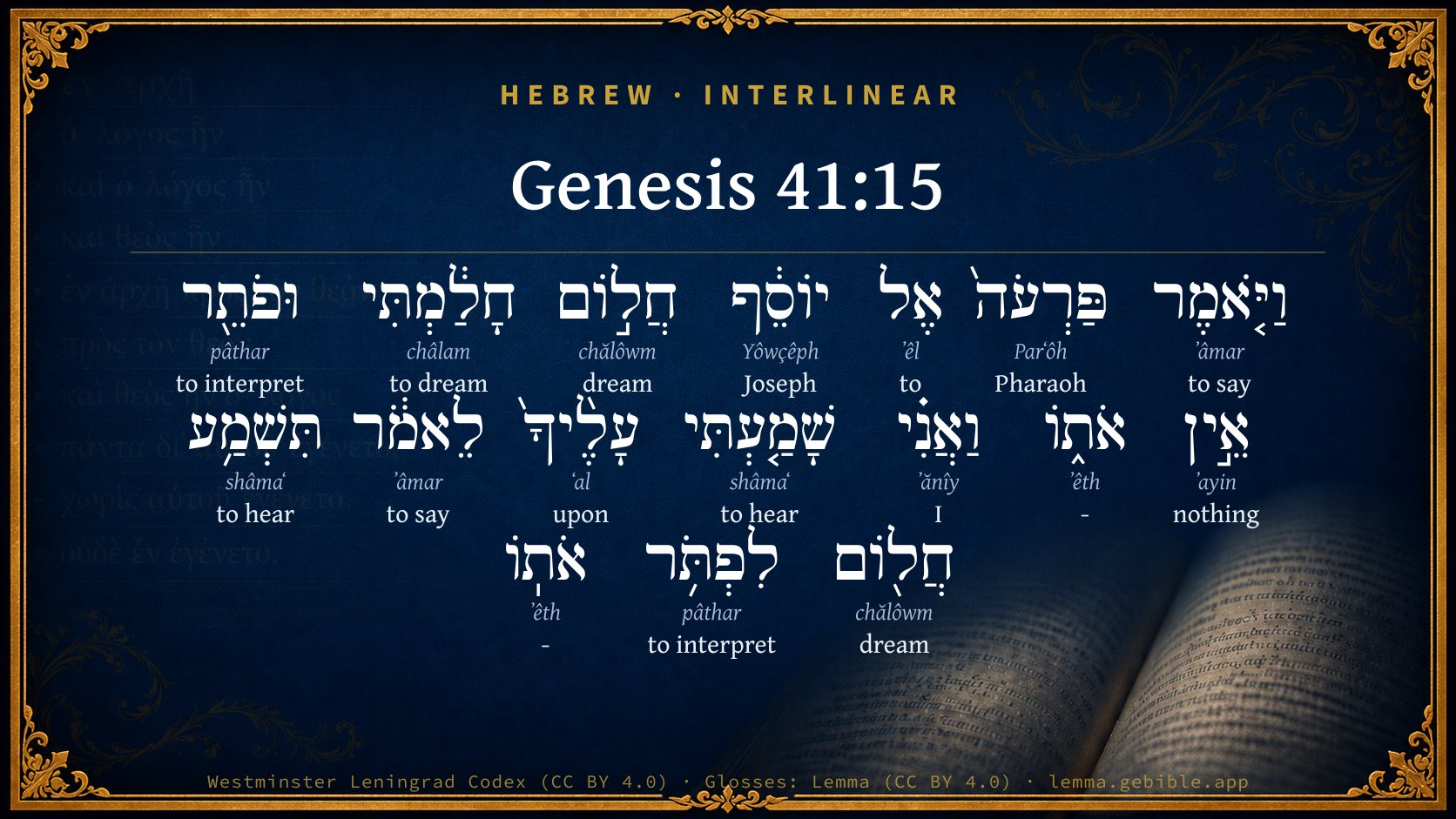
Genesis 41:15

Hebrew (Westminster Leningrad Codex) Genesis 41:15 appears in the Hebrew Old Testament. The text above is from the Westminster Leningrad Codex. Each word links to its Strong’s number, a concise gloss, and parsing drawn from the Open Scriptures Hebrew Bible morphology. Click any word for its full Brown-Driver-Briggs (BDB) entry.
Download image
Cite this verse

Genesis 41:15 (World English Bible). Public Domain. Lemma interlinear Bible study tool, https://lemma.gebible.app/v/genesis/41/15.

Show BibTeX & RIS
BibTeX
RIS
English Translation
Pharaoh said to Joseph, "I have dreamed a dream, and there is no one who can interpret it. I have heard it said of you, that when you hear a dream you can interpret it."
World English Bible · Public Domain
Download a study sheet

One document with this verse’s original text, its word-by-word gloss line, the meaning frame, cross-references with their text, attributed commentary, and full source and license credits — printable, and it pastes into notes with its structure intact.

This verse Autodidact and up

Study sheet (.html) Plain text (.txt)

A passage Seminary Student

Up to 50 verses in one chapter. A passage sheet keeps up to 6 commentary sources and 12 cross-references per verse, in the order this page ranks them, and says so on the sheet whenever that leaves anything out. Ask for a single verse and you get the Autodidact verse sheet above.

Everything on this page stays free to read, with no account — the sheet is a download of what is already on screen, not access to it.

Want to remove ads? Support Godless Engineer
Compare translations 3

The same verse in 3 English versions, stacked beneath the original-language interlinear above. Click any original word for its lexicon entry.

Each is an independent rendering of the whole verse — the interlinear is not word-aligned to these translations.

Highlighted words mark where these versions differ — a whole-verse word diff, not a word-by-word alignment.

  • World English Bible Public Domain
    Pharaoh said to Joseph, "I have dreamed a dream, and there is no one who can interpret it. I have heard it said of you, that when you hear a dream you can interpret it."
  • King James Version Public Domain
    And Pharaoh said unto Joseph, I have dreamed a dream, and there is none that can interpret it: and I have heard say of thee, that thou canst understand a dream to interpret it.
  • unfoldingWord Literal Text CC BY-SA 4.0
    Then Pharaoh said to Joseph, “I dreamed a dream, but no one could interpret it. But I heard about you, saying you hear a dream to interpret it.”

unfoldingWord Literal Text — © unfoldingWord, licensed CC BY-SA 4.0. Word-aligned USFM3 via Door43 (git.door43.org/unfoldingWord/en_ult).

Versions to compare (up to 4)

3 of 4 selected

Show all 18 translations

Every available English version of this verse, each an independent rendering of the whole verse.

  • World English Bible Public Domain
    Pharaoh said to Joseph, "I have dreamed a dream, and there is no one who can interpret it. I have heard it said of you, that when you hear a dream you can interpret it."
  • Berean Standard Bible Public Domain
    Pharaoh said to Joseph, “I had a dream, and no one can interpret it. But I have heard it said of you that when you hear a dream you can interpret it.”
  • Majority Standard Bible Public Domain
    Pharaoh said to Joseph, “I had a dream, and no one can interpret it. But I have heard it said of you that when you hear a dream you can interpret it.”
  • King James Version Public Domain
    And Pharaoh said unto Joseph, I have dreamed a dream, and there is none that can interpret it: and I have heard say of thee, that thou canst understand a dream to interpret it.
  • American Standard Version (1901) Public Domain
    And Pharaoh said unto Joseph, I have dreamed a dream, and there is none that can interpret it: and I have heard say of thee, that when thou hearest a dream thou canst interpret it.
  • Revised Version (1885) Public Domain
    And Pharaoh said unto Joseph, I have dreamed a dream, and there is none that can interpret it: and I have heard say of thee, that when thou hearest a dream thou canst interpret it.
  • Geneva Bible (1599) Public Domain
    Then Pharaoh sayde to Ioseph, I haue dreamed a dreame, and no man can interprete it, and I haue hearde say of thee, that when thou hearest a dreame, thou canst interprete it.
  • Douay-Rheims (1899) Public Domain
    And we heard what afterwards the event of the thing proved to be so. For I was restored to my office: and he was hanged upon a gibbet.
  • Young's Literal Translation Public Domain
    And Pharaoh saith unto Joseph, `A dream I have dreamed, and there is no interpreter of it, and I -- I have heard concerning thee, saying, Thou understandest a dream to interpret it,'
  • Literal Standard Version CC BY-SA 4.0
    And Pharaoh says to Joseph, “I have dreamed a dream, and there is no interpreter of it, and I have heard concerning you, saying, You understand a dream to interpret it,”
  • Unlocked Literal Bible CC BY-SA 4.0
    Pharaoh said to Joseph, “I had a dream, but there is no interpreter for it. But I have heard about you, that when you hear a dream you can interpret it.”
  • unfoldingWord Literal Text CC BY-SA 4.0
    Then Pharaoh said to Joseph, “I dreamed a dream, but no one could interpret it. But I heard about you, saying you hear a dream to interpret it.”
  • Darby Bible Public Domain
    And Pharaoh said to Joseph, I have dreamt a dream, and there is none to interpret it. And I have heard say of thee, thou understandest a dream to interpret it.
  • World Messianic Bible Public Domain
    Pharaoh said to Joseph, “I have dreamed a dream, and there is no one who can interpret it. I have heard it said of you, that when you hear a dream you can interpret it.”
  • Webster's Bible Public Domain
    And Pharaoh said to Joseph, I have dreamed a dream, and there is none that can interpret it: and I have heard it said of thee, that thou canst understand a dream to interpret it.
  • Free Bible Version CC BY-SA 4.0
    Pharaoh said to Joseph, “I had a dream, but no one can interpret its meaning. But I've heard that when someone tells you a dream you know how to interpret it.”
  • Bible in Basic English Public Domain
    And Pharaoh said to Joseph, I have had a dream, and no one is able to give me the sense of it; now it has come to my ears that you are able to give the sense of a dream when it is put before you.
  • JPS Tanakh (1917) Public Domain
    And Pharaoh said unto Joseph: 'I have dreamed a dream, and there is none that can interpret it; and I have heard say of thee, that when thou hearest a dream thou canst interpret it.'

Literal Standard Version (2020), Covenant Press — licensed CC BY-SA 4.0. Text via the HelloAO Bible API (eBible.org). Unlocked Literal Bible (unfoldingWord) — licensed CC BY-SA 4.0. Text via the HelloAO Bible API (eBible.org). unfoldingWord Literal Text — © unfoldingWord, licensed CC BY-SA 4.0. Word-aligned USFM3 via Door43 (git.door43.org/unfoldingWord/en_ult). Free Bible Version, Dr. Jonathan Gallagher — licensed CC BY-SA 4.0. Text via the HelloAO Bible API (eBible.org).

Word by word

More ways to search: Search by grammar → Find every occurrence → Compare this word →

Practice this passage: Drill this verse → Learn its vocabulary →

וּפֹתֵ֖ר
pâthar
H6622
“and · interpreting”
Conjunction + Verb, Qal, Participle Active, Masculine, Singular, Absolute
Part of Speech
Conjunction + Verb
Stem
Qal
Form
Participle Active
Gender
Masculine
Number
Singular
State
Absolute
Full BDB Definition

Origin: a primitive root

TWOT: 1860

(Qal) to interpret (dreams)
  1. וַיֹּ֤אמֶר ʼâmar H559 “and · to say” Conjunction + Verb, Qal, Sequential Imperfect, 3rd Person, Masculine, Singular
  2. פַּרְעֹה֙ Parʻôh H6547 “Pharaoh” Noun, Proper
  3. אֶל ʼêl H413 “to” Preposition
  4. יוֹסֵ֔ף Yôwçêph H3130 “Joseph” Noun, Proper
  5. חֲל֣וֹם chălôwm H2472 “dream” Noun, Common, Masculine, Singular, Absolute
  6. חָלַ֔מְתִּי châlam H2492 “to dream” Verb, Qal, Perfect, 1st Person, Common, Singular
  7. אֵ֣ין ʼayin H369 “nothing” Particle, Negative
  8. אֹת֑וֹ ʼêth H853 “- · him” Particle, Direct Object + Suffix, Personal, 3rd Person, Masculine, Singular
  9. וַאֲנִ֗י ʼănîy H589 “and · I” Conjunction + Pronoun, Personal, 1st Person, Common, Singular
  10. שָׁמַ֤עְתִּי shâmaʻ H8085 “to hear” Verb, Qal, Perfect, 1st Person, Common, Singular
  11. עָלֶ֨יךָ֙ ʻal H5921 “upon · you” Preposition + Suffix, Personal, 2nd Person, Masculine, Singular
  12. לֵאמֹ֔ר ʼâmar H559 “to say” Preposition + Verb, Qal, Infinitive Construct
  13. תִּשְׁמַ֥ע shâmaʻ H8085 “to hear” Verb, Qal, Imperfect, 2nd Person, Masculine, Singular
  14. חֲל֖וֹם chălôwm H2472 “dream” Noun, Common, Masculine, Singular, Absolute
  15. לִפְתֹּ֥ר pâthar H6622 “to interpret” Preposition + Verb, Qal, Infinitive Construct
  16. אֹתֽוֹ ʼêth H853 “- · him” Particle, Direct Object + Suffix, Personal, 3rd Person, Masculine, Singular

About this verse

These counts appear in no published source. They are computed here, from the morphology-tagged text and Lemma’s own curated glosses. What Lemma adds →

17
words
12
distinct lemmas
Pentateuch
section

Notable vocabulary

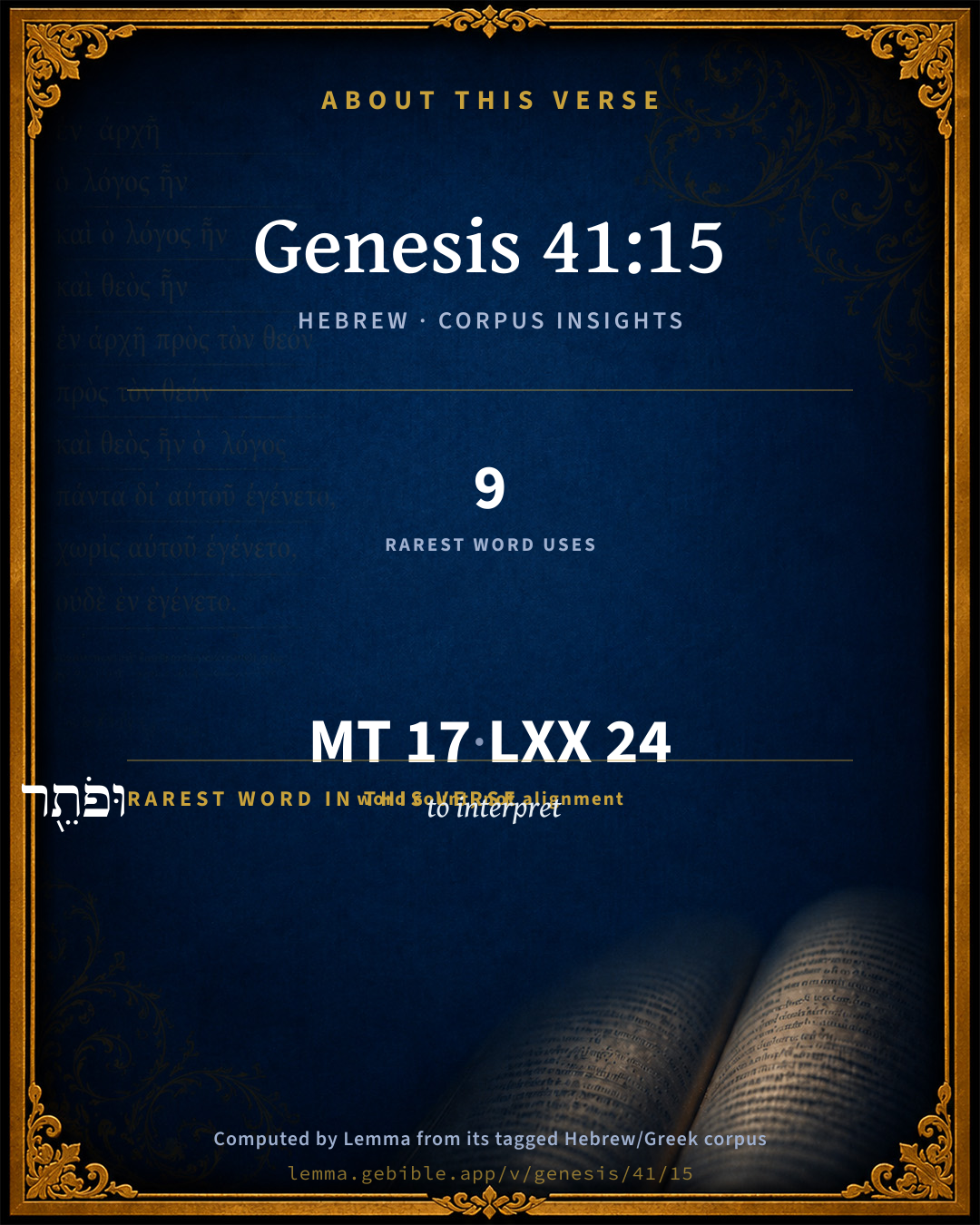
The rarest word here is וּפֹתֵ֖ר to interpret H6622 — appearing just 9 times in the whole Hebrew Bible.

Shared distinctive vocabulary

וּפֹתֵ֖ר to interpret H6622 occurs in 7 verses of the Hebrew Bible. Also found in:

Grammatical profile

  • 7 verbs
  • 4 nouns
  • 1 pronoun
  • 2 prepositions
  • 3 particles

Verb forms

  • וַיֹּ֤אמֶר Qal · Sequential Imperfect
  • חָלַ֔מְתִּי Qal · Perfect
  • וּפֹתֵ֖ר Qal · Participle Active
  • שָׁמַ֤עְתִּי Qal · Perfect
  • לֵאמֹ֔ר Qal · Infinitive Construct
  • תִּשְׁמַ֥ע Qal · Imperfect
  • לִפְתֹּ֥ר Qal · Infinitive Construct

Repetition

Words recur within this verse — often emphatic in Hebrew:

  • וַיֹּ֤אמֶר to say H559 ×2
  • חֲל֣וֹם dream H2472 ×2
  • וּפֹתֵ֖ר to interpret H6622 ×2
  • שָׁמַ֤עְתִּי to hear H8085 ×2

Hebrew & Septuagint length

In English translation the verse runs 35 words from the Hebrew and 33 from the Septuagint (LXX English) — closely comparable.

A rough comparison of the two English renderings, which tokenize alike — not a word-level alignment.

Word counts can differ between the Hebrew and the Greek without any difference in meaning — e.g. the Hebrew direct-object marker אֵת has no separate Greek word, and Greek often adds the article ὁ.

In the original languages it is 17 Hebrew tokens and 24 Greek tokens — but the two are counted differently (Hebrew bundles its prefixes and suffixes into one token; the Greek is in lemma form), so that isn’t a like-for-like length.

Cross-references

4

Topical passages linked to Genesis 41:15 in the Treasury of Scripture Knowledge — connected by theme and wording, ordered by reader-vote popularity; previews shown in the World English Bible.

  • Daniel 5:16 But I have heard of you, that you can give interpretations, and dissolve doubts; now if you can read the writing, and make known to me the interpretation of it, you shall be clothed with purple, and have a chain of gold about your neck, and shall be the third ruler in the kingdom.
  • Daniel 5:12 because an excellent spirit, and knowledge, and understanding, interpreting of dreams, and showing of dark sentences, and dissolving of doubts, were found in the same Daniel, whom the king named Belteshazzar. Now let Daniel be called, and he will show the interpretation.
  • Genesis 41:9–13 Then the chief cupbearer spoke to Pharaoh, saying, "I remember my faults today.
  • Psalms 25:14 The friendship of Yahweh is with those who fear him. He will show them his covenant.

Cross-references courtesy of OpenBible.info (CC BY 4.0).

Hebrew and Greek witnesses Masoretic Hebrew ↔ Greek Septuagint

The same verse in the two great witnesses to the Old Testament, shown verse-for-verse.

These are two independent witnesses, not word-aligned to each other, and the Septuagint is shown in lemma (dictionary) form.

Hebrew Genesis 41:15 Masoretic · Westminster Leningrad Codex

וַיֹּ֤אמֶר פַּרְעֹה֙ אֶל יוֹסֵ֔ף חֲל֣וֹם חָלַ֔מְתִּי וּפֹתֵ֖ר אֵ֣ין אֹת֑וֹ וַאֲנִ֗י שָׁמַ֤עְתִּי עָלֶ֨יךָ֙ לֵאמֹ֔ר תִּשְׁמַ֥ע חֲל֖וֹם לִפְתֹּ֥ר אֹתֽוֹ

Pharaoh said to Joseph, "I have dreamed a dream, and there is no one who can interpret it. I have heard it said of you, that when you hear a dream you can interpret it."

World English Bible · Public Domain

Greek LXX Genesis 41:15 Septuagint · lemma form

εἶπον δέ φαραώ ὁ ιωσηφ ἐνύπνιον ὁράω καί ὁ συνκρίνω οὐ εἰμί αὐτός ἐγώ δέ ἀκούω περί σύ λέγω ἀκούω σύ ἐνύπνιον συνκρίνω αὐτός

And Pharao said to Joseph, I have seen a vision, and there is no one to interpret it; but I have heard say concerning you that you did hear dreams and interpret them.

LXX2012 (modern English Septuagint) · Public Domain

Hebrew: Westminster Leningrad Codex (CC BY 4.0). Greek: Septuagint (public domain); English from LXX2012 (modern English Septuagint) (Public Domain). How the Septuagint differs from the Hebrew →

Targum (Aramaic paraphrase)

2

The Targum is the ancient Jewish Aramaic paraphrase of the Hebrew Scriptures — an interpretive translation, not the Hebrew text itself. Onkelos (literal) and Pseudo-Jonathan (expansive) render the Torah, and Jonathan the Prophets. Coverage is partial: where no permissively-licensed English translation exists for a verse, only the Aramaic is shown. This is verse-level text, not a word-by-word alignment to the Hebrew.

  1. Targum Onkelos Torah (Genesis–Deuteronomy)
    וַאֲמַר פַּרְעֹה לְיוֹסֵף חֶלְמָא חֲלֵמִית וּפָשַׁר לֵית לֵהּ וַאֲנָא שִׁמְעֵית עֲלָךְ לְמֵימַר דְּאַתְּ שָׁמַע חֶלְמָא לְמִפְשַׁר יָתֵהּ

    (no public-domain English translation for this verse)

    Targum Onkelos — Aramaic: “Onkelos Genesis” (public domain); “Onkelos Exodus” (public domain); “Onkelos Leviticus” (public domain); “Onkelos Numbers” (public domain); “Onkelos Deuteronomy” (public domain). English: “Sefaria Community Translation” (CC0 1.0 (public-domain dedication)); “J.W. Etheridge. The Targums of Onkelos and Jonathan Ben Uzziel on the Pentateuch. London: Longmans, Green, 1862” (public domain). Text via Sefaria.

  2. Targum Pseudo-Jonathan Torah (Genesis–Deuteronomy)
    וַאֲמַר פַּרְעה לְיוֹסֵף חֶלְמָא חֲלֵימִית וּמַפְשַׁר לֵית יָתֵיהּ וַאֲנָא שְׁמָעִית עֲלָךְ לְמֵימָר אִין אַנְתְּ שְׁמַע חִילְמָא אַנְתְּ פְּשַׁר לֵיהּ

    And Pharoh said to Joseph, I have dreamed a dream, and there is no interpreter for it; and I have heard of thee, saying, that if thou hear a dream thou canst explain it.

    Targum Pseudo-Jonathan — Aramaic: “Targum Jonathan on Genesis” (public domain); “Targum Jonathan on Exodus” (public domain); “Targum Jonathan on Leviticus” (public domain); “Targum Jonathan on Numbers” (public domain); “Targum Jonathan on Deuteronomy” (public domain). English: “The Targum of Jonathan ben Uzziel, trans. J. W. Etheridge, London, 1862” (public domain). Text via Sefaria.

Commentary

Notes on Genesis 41:15 from classic Christian and Jewish commentators (each source and its license shown beneath its notes). The classic Christian expositions comment on the surrounding passage and are grouped to its opening verse, so a note may address several verses; the Jewish commentaries on the Tanakh (Rashi and others) are per-verse, so they appear only where the commentator wrote on this verse.

Lemma curates 59 commentaries, every one of them public domain or Creative Commons licensed, each selected and text-cleaned for this edition rather than reprinted as found. About our sources →

Trapp's Complete Commentary

John Trapp

Gen 41:15 And Pharaoh said unto Joseph, I have dreamed a dream, and [there is] none that can interpret it: and I have heard say of thee, [that] thou canst understand a dream to interpret it.

Ver. 15. I have dreamed a dream, and there is none, &c.] So men send not for the minister till given up by the physician. Then they cry out with him in the gospel: "Sir, if thou canst do anything, help us," &c. {Mar 9:22} Whereunto what can we reply, but as that king of Israel did to the woman that cried to him for help, in the famine of Samaria; "If the Lord help thee not, whence shall I help thee? out of the barn floor, or out of the winepress?" {2Ki 6:27} Did not I forewarn you, saying, "touch not the unclean thing," &c., and ye would not hear? "Therefore is this thing come upon you." {Gen 42:21 2Co 6:17}

And I have heard say, &c.] Pharaoh despiseth not wisdom, how meanly soever habited. Saepe sub attrita latitat sapientia veste: Paupertas est philosophiae vernacula, saith he in Apuleius: and Eumolpus in Petronius, being asked why he went so poorly apparelled, answered, "The study of wisdom never made any man wealthy." {a} And afterward he addeth, "However it comes to pass, poverty is the sister of piety, {b} and virtue is forsaken of fortune." Nudus opum, sed cui coelum terraeque paterent, saith Silius of Archimedes, that great mathematician. And Aelian observes, that the best of the Greeks, Aristides, Phocion, Pelopidas, Epaminondas, Socrates, were very poor men: Lactantius, that Christian Cicero, as Jerome calls him, {c} was so needy that he wanted necessaries. All that Calvin left behind him, books and all, came scarcely to three hundred French crowns, as Beza his colleague witnesseth.

{a} Amor ingenii neminem unquam divitem fecit. - Petron.

{b} Nescio quomodo bonae mentis soror est paupertas. - Ibid.

{c} Lactantius quasi quidam fluvius Tullianae eloquentiae. - Jerome.

John Trapp, A Commentary or Exposition upon All the Books of the Old and New Testament (1647–1656) — public domain. Text from a community e-Sword module.

Jamieson, Fausset & Brown

Robert Jamieson, A. R. Fausset & David Brown

Pharaoh said, . . . I have dreamed a dream--The king's brief statement of the service required brought out the genuine piety of Joseph; disclaiming all merit, he ascribed whatever gifts or sagacity he possessed to the divine source of all wisdom, and he declared his own inability to penetrate futurity; but, at the same time, he expressed his confident persuasion that God would reveal what was necessary to be known.

Jamieson, Fausset & Brown — Commentary Critical and Explanatory on the Whole Bible (1871) — public domain (CC PDM 1.0). Text via the HelloAO Bible API.

John Calvin's Commentaries

15. And Pharaoh said unto Joseph. We see that Pharaoh offers himself as a disciple to Joseph, being persuaded, by the statement of the butler, that he is a prophet of God. This is, indeed, a constrained humility; but it is expressly recorded, in order that, when the opportunity of learning is afforded us, we may not refuse reverently to honor the gifts of the Spirit. Now, though Joseph, in referring Pharaoh to God, seems to deny that he himself is about to interpret the dream, yet his answer bears on a different point: for, because he knew that he was conversing with a heathen addicted to superstitions, he wishes, above all things, to ascribe to God the glory due to him; as if he had said, I am able to do nothing in this matter, nor will I offer anything as from myself; but God alone shall be the interpreter of his own secret. Should any one object, that whenever God uses the agency of men, their office ought to be referred to in connection with his command: that indeed I acknowledge, but yet so that the whole glory may remain with God; according to the saying of St. Paul,

“Neither is he that planteth anything, neither he that watereth.” (1 Corinthians 3:7.)

Moreover, Joseph not only desires to imbue the mind of Pharaoh with some relish for piety, but, by ascribing the gift of interpreting dreams to God alone, confesses that he is destitute of it, until he obtains it from God. Wherefore, let us also learn, from the example of holy Joseph, to honor the grace of God even among unbelievers; and if they shut the door against the entire and full doctrine of piety; we must, at least, endeavor to instill some drops of it into their minds. Let us also reflect on this, that nothing is less tolerable than for men to arrogate to themselves anything as their own; for this is the first step of wisdom, to ascribe nothing to ourselves; but modestly to confess, that whatever in us is worthy of praise, flows only from the fountain of God’s grace. It is especially worthy of notice, that as the Spirit of understanding is given to any one from heaven, he will become a proper and faithful interpreter of God.

John Calvin's Commentaries (1540-1563) — public domain. Text from the Calvin Translation Society English edition (1840s-50s) via the Christian Classics Ethereal Library (ccel.org). Calvin's coverage is partial (roughly two-thirds of the Bible); uncommented books and verses are honest gaps, never fabricated. The 19th-century editor's footnotes and remarks are omitted so the notes are faithfully Calvin's own voice.

John Gill's Exposition

And Pharaoh said unto Joseph,...., Immediately, upon his being introduced to him:

I have dreamed a dream, and there is none that can interpret it; that he could yet meet with; none of his magicians or wise men, who made great pretensions to skill in such matters:

and I have heard say of thee, that thou canst understand a dream to interpret it; it had been reported to him, particularly by the chief butler, that when he heard a dream told him, he had such knowledge and understanding, that he could interpret it, tell the meaning of it, what it portended, and what would be the events signified by it.

John Gill's Exposition of the Whole Bible (1746–1763) — public domain (CC PDM 1.0). Text via the HelloAO Bible API.

Whedon's Commentary on the Bible

Daniel D. Whedon

15. Thou canst understand — Literally, thou hearest a dream to interpret it.

Daniel D. Whedon (gen. ed.), Commentary on the Old and New Testaments (1874–1909) — public domain. Text from a community e-Sword module.

The Pulpit Commentary

And Pharaoh said unto Joseph, I have dreamed a dream, and there is none that can interpret it (literally, and interpreting it there is no one): and I have heard say of thee, that thou canst understand a dream to interpret it literally, I have heard of thee, saying, thou hearest a dream to interpret it.

The Pulpit Commentary (1880–1919), ed. H.D.M. Spence-Jones & Joseph S. Exell — public domain. Text from a community e-Sword module.

Rashi

Rabbi Shlomo Yitzchaki (Rashi)

תשמע חלום לפתר אותו — means thou payest heed to and UNDERSTANDEST A DREAM TO INTERPRET IT.

תשמע means understanding and paying heed to. Examples are: (42:23) “Joseph (שומע) understood”; (Deuteronomy 28:49) “[a people] whose tongue thou shalt not understand (תשמע)”. old French entendre.

Rashi on the Tanakh — English translations: “The Judaica Press complete Tanach with Rashi, translated by A. J. Rosenberg” (CC BY 4.0); “Pentateuch with Rashi's commentary by M. Rosenbaum and A.M. Silbermann, 1929-1934” (public domain); “The Metsudah Tanach series, Lakewood, N.J” (CC BY 4.0); and “The Book of Joshua, Metsudah Publications, 1997” (CC BY 4.0). Text via Sefaria.

Radak

Rabbi David Kimhi (Radak)

ויאמר..לאמר; people say that you understand the meanings of a dream and are able to interpret it correctly.

תשמע, this means the same here as “you will understand.” The root שמע appears meaning the same in Deuteronomy 28,49 גוי אשר לא תשמע לשונו, “a people whose language you do not understand.”

Radak on the Tanakh — English translations: “Sefaria Community Translation” (CC0 1.0 (public-domain dedication)); “Eliyahu Munk, HaChut Hameshulash” (CC BY 4.0); “Rabbi Mike Feuer, Jerusalem Anthology” (CC BY 4.0); and “R. David Kimhi on the first book of Psalms, Translated by R.G. Finch, London, 1919” (public domain). Text via Sefaria.

Lesson kit

Teaching starters — assembled from the data on this page, not authored interpretation. Every prompt links to the verse data it draws on. Edit before teaching.

Genesis, in the Pentateuch, opens this verse with 17 words (12 distinct Hebrew lemmas). Its most distinctive word is pâthar (“to interpret”). A historical commentator’s framing appears above. Read the whole chapter for the surrounding context.

Discussion questions

  1. What does “to interpret” (pâthar) contribute to the verse as a whole?
  2. How does Genesis 40:8, which shares the word «to interpret», read alongside this verse?
  3. What does the repetition of “to say” (2× in this one verse) do in this verse?
  4. These translations render this verse differently; the difference is in the English rendering, not the original. What questions does that raise?
  5. «וַיֹּ֤אמֶר» is a Qal Sequential Imperfect verb. How does that grammatical form shape the action described?
  6. Compare how Trapp's Complete Commentary and Jamieson, Fausset & Brown read this verse. Where do they agree or differ?

Things to notice

Reading settings

Reading text

Shown beneath each verse's original-language words.

Old Testament
Old Testament edition

Read the OT as the Masoretic Hebrew (MT) or the Greek Septuagint (LXX).

English shown for the Greek Septuagint (in the Hebrew ↔ Greek comparison).

Comparing translations? Open the Compare panel on any verse page to stack up to four side by side.