
Joshua 8:5

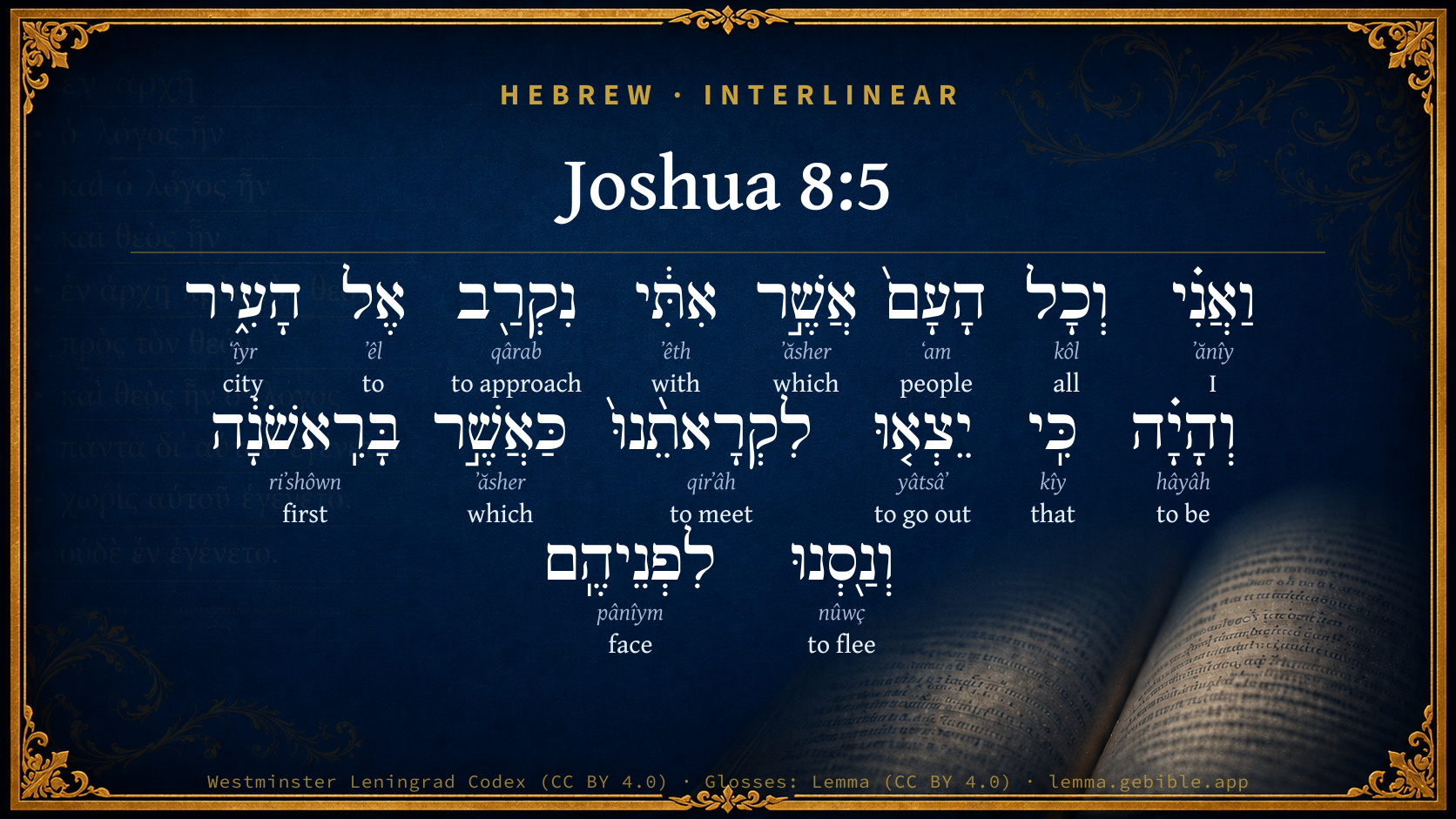
Hebrew (Westminster Leningrad Codex) Joshua 8:5 appears in the Hebrew Old Testament. The text above is from the Westminster Leningrad Codex. Each word links to its Strong’s number, a concise gloss, and parsing drawn from the Open Scriptures Hebrew Bible morphology. Click any word for its full Brown-Driver-Briggs (BDB) entry.
Download image
Cite this verse

Joshua 8:5 (World English Bible). Public Domain. Lemma interlinear Bible study tool, https://lemma.gebible.app/v/joshua/8/5.

Show BibTeX & RIS
BibTeX
RIS
English Translation
and I, and all the people who are with me, will approach to the city. It shall happen, when they come out against us, as at the first, that we will flee before them;
World English Bible · Public Domain
Download a study sheet

One document with this verse’s original text, its word-by-word gloss line, the meaning frame, cross-references with their text, attributed commentary, and full source and license credits — printable, and it pastes into notes with its structure intact.

This verse Autodidact and up

Study sheet (.html) Plain text (.txt)

A passage Seminary Student

Up to 50 verses in one chapter. A passage sheet keeps up to 6 commentary sources and 12 cross-references per verse, in the order this page ranks them, and says so on the sheet whenever that leaves anything out. Ask for a single verse and you get the Autodidact verse sheet above.

Everything on this page stays free to read, with no account — the sheet is a download of what is already on screen, not access to it.

Want to remove ads? Support Godless Engineer
Compare translations 3

The same verse in 3 English versions, stacked beneath the original-language interlinear above. Click any original word for its lexicon entry.

Each is an independent rendering of the whole verse — the interlinear is not word-aligned to these translations.

Highlighted words mark where these versions differ — a whole-verse word diff, not a word-by-word alignment.

  • World English Bible Public Domain
    and I, and all the people who are with me, will approach to the city. It shall happen, when they come out against us, as at the first, that we will flee before them;
  • King James Version Public Domain
    And I, and all the people that are with me, will approach unto the city: and it shall come to pass, when they come out against us, as at the first, that we will flee before them,
  • unfoldingWord Literal Text CC BY-SA 4.0
    As I and all of the people who with me, we will go near to the city. And it will happen, when they come out to meet us just as at the first, that we will flee to their faces.

unfoldingWord Literal Text — © unfoldingWord, licensed CC BY-SA 4.0. Word-aligned USFM3 via Door43 (git.door43.org/unfoldingWord/en_ult).

Versions to compare (up to 4)

3 of 4 selected

Show all 18 translations

Every available English version of this verse, each an independent rendering of the whole verse.

  • World English Bible Public Domain
    and I, and all the people who are with me, will approach to the city. It shall happen, when they come out against us, as at the first, that we will flee before them;
  • Berean Standard Bible Public Domain
    Then I and all the troops with me will advance on the city. When they come out against us as they did the first time, we will flee from them.
  • Majority Standard Bible Public Domain
    Then I and all the troops with me will advance on the city. When they come out against us as they did the first time, we will flee from them.
  • King James Version Public Domain
    And I, and all the people that are with me, will approach unto the city: and it shall come to pass, when they come out against us, as at the first, that we will flee before them,
  • American Standard Version (1901) Public Domain
    and I, and all the people that are with me, will approach unto the city. And it shall come to pass, when they come out against us, as at the first, that we will flee before them;
  • Revised Version (1885) Public Domain
    and I, and all the people that are with me, will approach unto the city: and it shall come to pass, when they come out against us, as at the first, that we will flee before them;
  • Geneva Bible (1599) Public Domain
    And I and all the people that are with me, will approche vnto the citie: and when they shall come out against vs, as they did at the first time, then will we flee before them.
  • Douay-Rheims (1899) Public Domain
    But I and the rest of the multitude which is with me; will approach on the contrary side against the city. And when they shall come out against us, we will flee, and turn our backs, as we did before:
  • Young's Literal Translation Public Domain
    and I and all the people who `are' with me draw near unto the city, and it hath come to pass when they come out to meet us as at the first, and we have fled before them,
  • Literal Standard Version CC BY-SA 4.0
    and I and all the people who [are] with me draw near to the city, and it has come to pass, when they come out to meet us as at the first, and we have fled before them,
  • Unlocked Literal Bible CC BY-SA 4.0
    I and all the men with me will approach the city, and when they come out to attack us, we will run away from them just as before.
  • unfoldingWord Literal Text CC BY-SA 4.0
    As I and all of the people who with me, we will go near to the city. And it will happen, when they come out to meet us just as at the first, that we will flee to their faces.
  • Darby Bible Public Domain
    And I and all the people that are with me will approach to the city; and it shall come to pass when they come out against us, as at the first, that we will flee before them.
  • World Messianic Bible Public Domain
    I and all the people who are with me will approach the city. It shall happen, when they come out against us, as at the first, that we will flee before them.
  • Webster's Bible Public Domain
    And I, and all the people that are with me, will approach to the city: and it shall come to pass when they come out against us, as at the first, that we will flee before them,
  • Free Bible Version CC BY-SA 4.0
    When I and the rest of the men with me approach the town, the defenders will run out to attack us just like before, and we'll run away from them.
  • Bible in Basic English Public Domain
    And I and all the people with me will come near the town, and when they come out against us as they did before, we will go in flight from them;
  • JPS Tanakh (1917) Public Domain
    And I, and all the people that are with me, will approach unto the city; and it shall come to pass, when they come out against us, as at the first, that we will flee before them.

Literal Standard Version (2020), Covenant Press — licensed CC BY-SA 4.0. Text via the HelloAO Bible API (eBible.org). Unlocked Literal Bible (unfoldingWord) — licensed CC BY-SA 4.0. Text via the HelloAO Bible API (eBible.org). unfoldingWord Literal Text — © unfoldingWord, licensed CC BY-SA 4.0. Word-aligned USFM3 via Door43 (git.door43.org/unfoldingWord/en_ult). Free Bible Version, Dr. Jonathan Gallagher — licensed CC BY-SA 4.0. Text via the HelloAO Bible API (eBible.org).

Word by word

More ways to search: Search by grammar → Find every occurrence → Compare this word →

Practice this passage: Drill this verse → Learn its vocabulary →

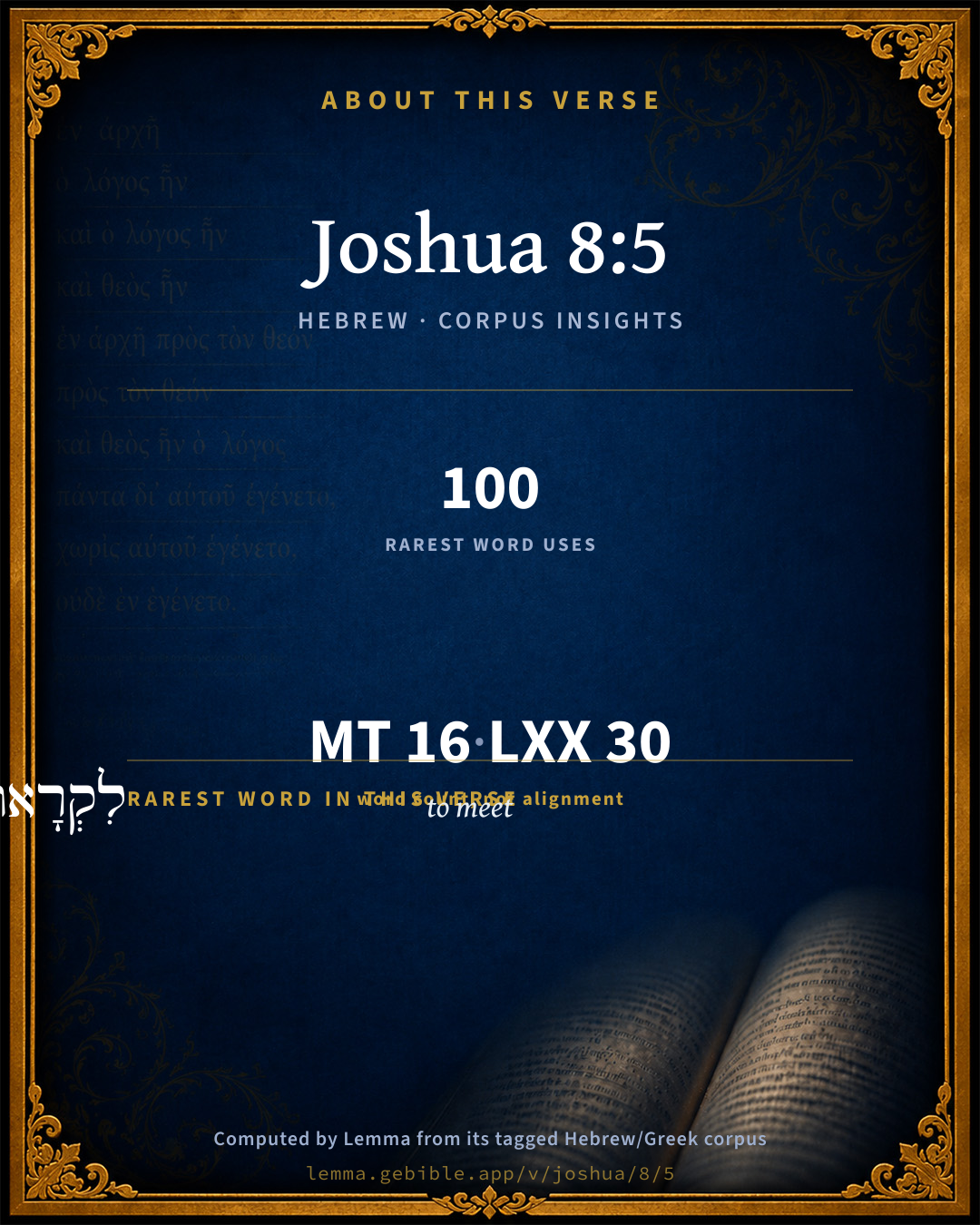
לִקְרָאתֵ֨נוּ֙
qirʼâh
H7125
“to meet · us”
Preposition + Verb, Qal, Infinitive Construct + Suffix, Personal, 1st Person, Common, Plural
Part of Speech
Preposition + Verb
Stem
Qal
Form
Infinitive Construct
Full BDB Definition

Origin: from H7122

TWOT: 2064

to encounter, befall, meet - (Qal) - to meet, encounter - to befall (figuratively)
  1. וַאֲנִ֗י ʼănîy H589 “and · I” Conjunction + Pronoun, Personal, 1st Person, Common, Singular
  2. וְכָל kôl H3605 “and · all of” Conjunction + Noun, Common, Masculine, Singular, Construct
  3. הָעָם֙ ʻam H5971 “the · people” Particle, Definite Article + Noun, Common, Masculine, Singular, Absolute
  4. אֲשֶׁ֣ר ʼăsher H834 “which” Particle, Relative
  5. אִתִּ֔י ʼêth H854 “with · me” Preposition + Suffix, Personal, 1st Person, Common, Singular
  6. נִקְרַ֖ב qârab H7126 “to approach” Verb, Qal, Imperfect, 1st Person, Common, Plural
  7. אֶל ʼêl H413 “to” Preposition
  8. הָעִ֑יר ʻîyr H5892 “the · city” Particle, Definite Article + Noun, Common, Feminine, Singular, Absolute
  9. וְהָיָ֗ה hâyâh H1961 “and · to be” Conjunction + Verb, Qal, Sequential Perfect, 3rd Person, Masculine, Singular
  10. כִּֽי kîy H3588 “that” Conjunction
  11. יֵצְא֤וּ yâtsâʼ H3318 “to go out” Verb, Qal, Imperfect, 3rd Person, Masculine, Plural
  12. כַּאֲשֶׁ֣ר ʼăsher H834 “like/as · which” Preposition + Particle, Relative
  13. בָּרִֽאשֹׁנָ֔ה riʼshôwn H7223 “in/at the · first” Preposition, Determined + Adjective, Adjective, Feminine, Singular, Absolute
  14. וְנַ֖סְנוּ nûwç H5127 “and · to flee” Conjunction + Verb, Qal, Sequential Perfect, 1st Person, Common, Plural
  15. לִפְנֵיהֶֽם pânîym H6440 “to/for · face(s) · their” Preposition + Noun, Common, Both, Plural, Construct + Suffix, Personal, 3rd Person, Masculine, Plural

About this verse

These counts appear in no published source. They are computed here, from the morphology-tagged text and Lemma’s own curated glosses. What Lemma adds →

16
words
15
distinct lemmas
Historical
section

Grammatical profile

  • 5 verbs
  • 4 nouns
  • 1 adjective
  • 1 pronoun
  • 2 prepositions
  • 1 conjunction
  • 2 particles

Verb forms

  • נִקְרַ֖ב Qal · Imperfect
  • וְהָיָ֗ה Qal · Sequential Perfect
  • יֵצְא֤וּ Qal · Imperfect
  • לִקְרָאתֵ֨נוּ֙ Qal · Infinitive Construct
  • וְנַ֖סְנוּ Qal · Sequential Perfect

Repetition

A word recurs within this verse — often emphatic in Hebrew:

  • אֲשֶׁ֣ר which H834 ×2

Hebrew & Septuagint length

In English translation the verse runs 34 words from the Hebrew and 38 from the Septuagint (LXX English) — closely comparable.

A rough comparison of the two English renderings, which tokenize alike — not a word-level alignment.

Word counts can differ between the Hebrew and the Greek without any difference in meaning — e.g. the Hebrew direct-object marker אֵת has no separate Greek word, and Greek often adds the article ὁ.

In the original languages it is 16 Hebrew tokens and 30 Greek tokens — but the two are counted differently (Hebrew bundles its prefixes and suffixes into one token; the Greek is in lemma form), so that isn’t a like-for-like length.

Cross-references

3

Topical passages linked to Joshua 8:5 in the Treasury of Scripture Knowledge — connected by theme and wording, ordered by reader-vote popularity; previews shown in the World English Bible.

  • Joshua 7:5 The men of Ai struck of them about thirty-six men; and they chased them [from] before the gate even to Shebarim, and struck them at the descent; and the hearts of the people melted, and became as water.
  • Judges 20:31–33 The children of Benjamin went out against the people, and were drawn away from the city; and they began to strike and kill of the people, as at other times, in the highways, of which one goes up to Bethel, and the other to Gibeah, in the field, about thirty men of Israel.
  • Matthew 10:16 "Behold, I send you out as sheep in the midst of wolves. Therefore be wise as serpents, and harmless as doves.

Cross-references courtesy of OpenBible.info (CC BY 4.0).

Hebrew and Greek witnesses Masoretic Hebrew ↔ Greek Septuagint

The same verse in the two great witnesses to the Old Testament, shown verse-for-verse.

These are two independent witnesses, not word-aligned to each other, and the Septuagint is shown in lemma (dictionary) form.

Hebrew Joshua 8:5 Masoretic · Westminster Leningrad Codex

וַאֲנִ֗י וְכָל הָעָם֙ אֲשֶׁ֣ר אִתִּ֔י נִקְרַ֖ב אֶל הָעִ֑יר וְהָיָ֗ה כִּֽי יֵצְא֤וּ לִקְרָאתֵ֨נוּ֙ כַּאֲשֶׁ֣ר בָּרִֽאשֹׁנָ֔ה וְנַ֖סְנוּ לִפְנֵיהֶֽם

and I, and all the people who are with me, will approach to the city. It shall happen, when they come out against us, as at the first, that we will flee before them;

World English Bible · Public Domain

Greek LXX Joshua 8:5 Septuagint · lemma form

καί ἐγώ καί πᾶς ὁ μετά ἐγώ προςἄγω πρός ὁ πόλις καί εἰμί ὡς ἄν ἐκἔρχομαι ὁ καταοἰκέω γαι εἰς συνάντησις ἐγώ καθάπερ καί πρώην καί φεύγω ἀπό πρόσωπον αὐτός

And I and all with me will draw near to the city: and it shall come to pass when the inhabitants of Gai shall come forth to meet us, as before, that we will flee from before them.

LXX2012 (modern English Septuagint) · Public Domain

Hebrew: Westminster Leningrad Codex (CC BY 4.0). Greek: Septuagint (public domain); English from LXX2012 (modern English Septuagint) (Public Domain). How the Septuagint differs from the Hebrew →

Targum (Aramaic paraphrase)

1

The Targum is the ancient Jewish Aramaic paraphrase of the Hebrew Scriptures — an interpretive translation, not the Hebrew text itself. Onkelos (literal) and Pseudo-Jonathan (expansive) render the Torah, and Jonathan the Prophets. Coverage is partial: where no permissively-licensed English translation exists for a verse, only the Aramaic is shown. This is verse-level text, not a word-by-word alignment to the Hebrew.

  1. Targum Jonathan Prophets (Joshua–Malachi)
    וַאֲנָא וְכָל עַמָא דְעִמִי נִתְקָרֵב לְקַרְתָּא וִיהֵי אֲרֵי יִפְקוּן לִקְדָמֻתָנָא כִּדְבְּקַדְמֵיתָא וְנִפּוֹךְ קֳדָמֵיהוֹן:

    (no public-domain English translation for this verse)

    Targum Jonathan — Aramaic: “Mikraot Gedolot” (public domain). English: “Sefaria Community Translation” (CC0 1.0 (public-domain dedication)); “London "Chaldee Paraphrase," 1871” (public domain). Text via Sefaria.

Commentary

Notes on Joshua 8:5 from classic Christian and Jewish commentators (each source and its license shown beneath its notes). The classic Christian expositions comment on the surrounding passage and are grouped to its opening verse, so a note may address several verses; the Jewish commentaries on the Tanakh (Rashi and others) are per-verse, so they appear only where the commentator wrote on this verse.

Lemma curates 59 commentaries, every one of them public domain or Creative Commons licensed, each selected and text-cleaned for this edition rather than reprinted as found. About our sources →

Trapp's Complete Commentary

John Trapp

Jos 8:5 And I, and all the people that [are] with me, will approach unto the city: and it shall come to pass, when they come out against us, as at the first, that we will flee before them,

Ver. 5. We will flee before them.] God also hath his stratagems; he seemeth sometimes to retire, that he may come upon his enemies with the greater advantage. The end of all the present troubles will be the ruin of the Antichristian faction, and we shall see the Church in her more perfect beauty, when the enemies shall be in that place that is fittest for them, the lowest, that is the footstool of Christ.

John Trapp, A Commentary or Exposition upon All the Books of the Old and New Testament (1647–1656) — public domain. Text from a community e-Sword module.

The Cambridge Bible for Schools and Colleges

gen. ed. J. J. S. Perowne

5. will approach unto the city] Joshua himself took up his position on the north side of “the ravine,” apparently the deep chasm through which the Wâdy Harith descends to the Wâdy Kelt. Stanley’s Sinai and Palestine, pp. 202, 203.

The Cambridge Bible for Schools and Colleges (gen. ed. J. J. S. Perowne; Cambridge University Press, 1878–1918) — public domain. Text from a community e-Sword module.

John Gill's Exposition

And I and all the people that are with me will approach unto the city,.... That is, Joshua with the main body of the army would march up to the city the next morning, in order to draw out the inhabitants of it to fight them:

and it shall come to pass, when they come out against us, as at the first; as they had done before, when the three thousand were sent against them, Jos 7:4,

that we will flee before them; as the three thousand did, which would animate them to pursue them with the greater eagerness, and to a distance from their city.

John Gill's Exposition of the Whole Bible (1746–1763) — public domain (CC PDM 1.0). Text via the HelloAO Bible API.

Haydock's Catholic Bible Commentary

And turn, &c. Josue had not fled before. (Calmet) --- Hebrew, "against us, as at the first, we will flee before them."

George Leo Haydock (1774–1849), Haydock's Catholic Family Bible and Commentary, 1859 edition — public domain. Excludes Psalms (Douay-Rheims chapter numbering differs from Protestant) and Deuterocanonical books (Catholic canon only).

Matthew Poole's English Annotations

That are, or, that shall be; for at present he sent them away, Jos 8:9, but he next morning followed them, and joined himself with the prover. Jos 8:10,11.

We will flee; I and the twenty-five thousand with me.

Matthew Poole's English Annotations on the Holy Bible (1683–1685) — public domain. Text from a community e-Sword/MySword module.

Whedon's Commentary on the Bible

Daniel D. Whedon

5. All the people — The soldiers are often spoken of by Homer as “the people.”

We will flee — This was no uncommon stratagem for decoying the garrison of a walled town into the open fields. See Livy’s description of the capture of Fidenae by the Romans, book i, chap. 14. There is always danger of military disorganization on the part of the soldiers making this movement, unless they are let into the secret of the commander, as they were in the present instance.

Daniel D. Whedon (gen. ed.), Commentary on the Old and New Testaments (1874–1909) — public domain. Text from a community e-Sword module.

The Pulpit Commentary

We will flee before them. A common expedient of a sagacious general when contending with undisciplined troops is a strong position. Many instances will occur to the student of history, and among others the celebrated feigned flight of William the Conqueror at Hastings. St. Augustine doubts whether this stratagem were lawful. Cajetan and the Jesuit commentators reply that it was so "quia mendacium non tam facile committitur factis, quam verbis" (Cornelius a Lapide).

The Pulpit Commentary (1880–1919), ed. H.D.M. Spence-Jones & Joseph S. Exell — public domain. Text from a community e-Sword module.

John Wesley's Explanatory Notes

That are - Or, that shall be: for at present he sent them away, ver. 9, but the next morning followed, and joined himself with them, ver. 10, 11. That we - I and the twenty five thousand with me.

John Wesley, Explanatory Notes Upon the Whole Bible (1754–1765) — public domain. Text via the GEBible commentary corpus.

unfoldingWord translationNotes

Door43 World Missions Community

General Information:

Joshua continues to explain the battle plan to his soldiers.

will give it into your hand

Here "hand" symbolizes the control and power the people have over their enemies. (See: Metonymy)

translationWords

Yahweh

God

unfoldingWord translationNotes — © Distant Shores Media and the Door43 World Missions Community, licensed CC BY-SA 4.0. Source: git.door43.org/Door43/en_tn.

Lesson kit

Teaching starters — assembled from the data on this page, not authored interpretation. Every prompt links to the verse data it draws on. Edit before teaching.

Joshua, in the Historical, opens this verse with 16 words (15 distinct Hebrew lemmas). Its most distinctive word is qirʼâh (“to meet”). A historical commentator’s framing appears above. Read the whole chapter for the surrounding context.

Discussion questions

  1. How does “to meet” (qirʼâh) shape what this verse is saying?
  2. How does Joshua 7:5, which shares this passage’s theme, read alongside this verse?
  3. What does the repetition of “which” (2× in this one verse) do in this verse?
  4. The translations on this page render this verse differently — a whole-verse word diff, not a word-by-word alignment. What might account for the different wordings?
  5. «נִקְרַ֖ב» is a Qal Imperfect verb. How does that grammatical form shape the action described?
  6. Compare how Trapp's Complete Commentary and The Cambridge Bible for Schools and Colleges read this verse. Where do they agree or differ?

Things to notice

Reading settings

Reading text

Shown beneath each verse's original-language words.

Old Testament
Old Testament edition

Read the OT as the Masoretic Hebrew (MT) or the Greek Septuagint (LXX).

English shown for the Greek Septuagint (in the Hebrew ↔ Greek comparison).

Comparing translations? Open the Compare panel on any verse page to stack up to four side by side.