Leviticus 14:34

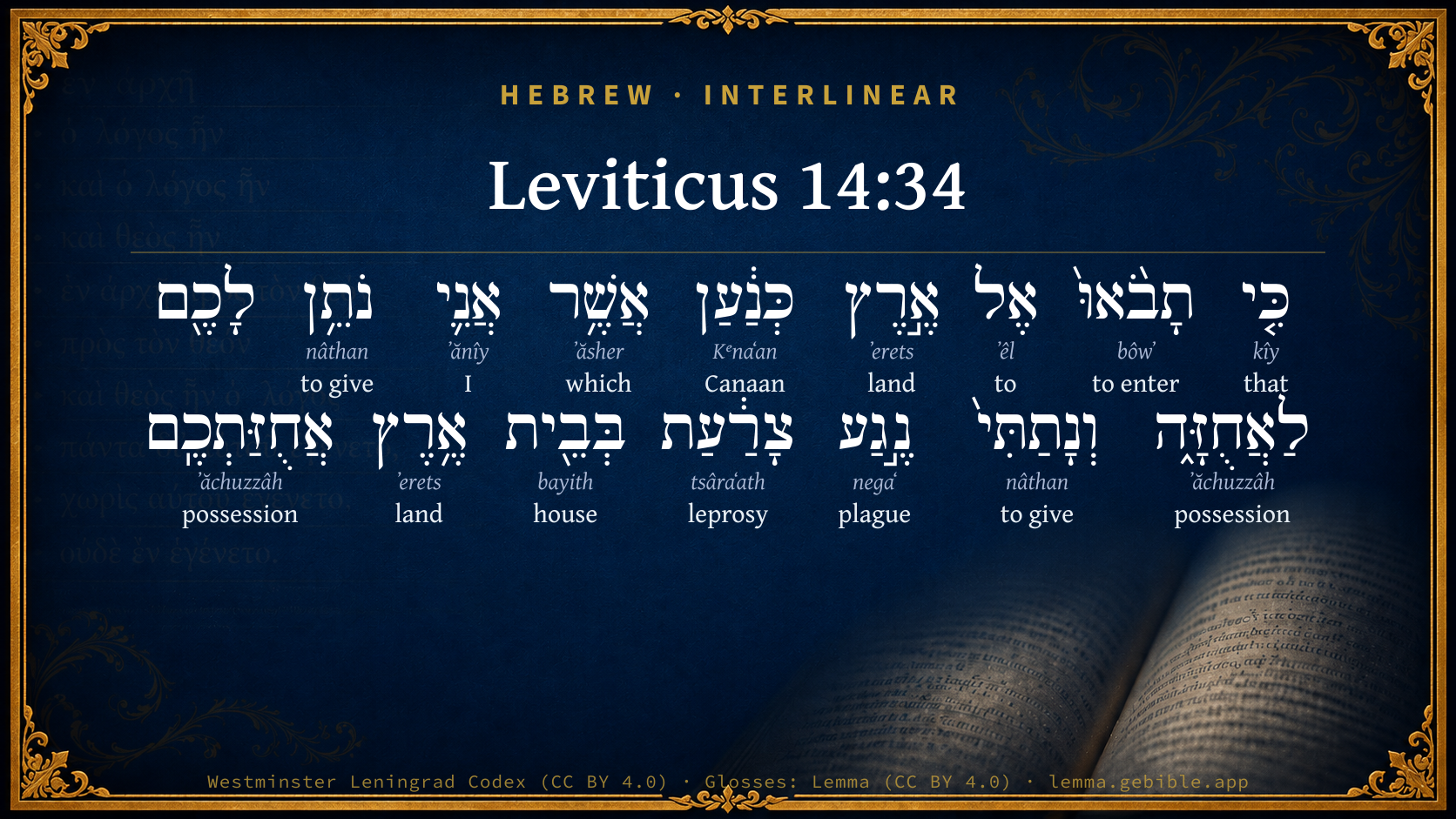
Hebrew (Westminster Leningrad Codex) Leviticus 14:34 appears in the Hebrew Old Testament. The text above is from the Westminster Leningrad Codex. Each word links to its Strong’s number, a concise gloss, and parsing drawn from the Open Scriptures Hebrew Bible morphology. Click any word for its full Brown-Driver-Briggs (BDB) entry.
Download image
Cite this verse

Leviticus 14:34 (World English Bible). Public Domain. Lemma interlinear Bible study tool, https://lemma.gebible.app/v/leviticus/14/34.

Show BibTeX & RIS
BibTeX
RIS
English Translation
"When you have come into the land of Canaan, which I give to you for a possession, and I put a spreading mildew in a house in the land of your possession,
World English Bible · Public Domain
Download a study sheet

One document with this verse’s original text, its word-by-word gloss line, the meaning frame, cross-references with their text, attributed commentary, and full source and license credits — printable, and it pastes into notes with its structure intact.

This verse Autodidact and up

Study sheet (.html) Plain text (.txt)

A passage Seminary Student

Up to 50 verses in one chapter. A passage sheet keeps up to 6 commentary sources and 12 cross-references per verse, in the order this page ranks them, and says so on the sheet whenever that leaves anything out. Ask for a single verse and you get the Autodidact verse sheet above.

Everything on this page stays free to read, with no account — the sheet is a download of what is already on screen, not access to it.

Want to remove ads? Support Godless Engineer
Compare translations 3

The same verse in 3 English versions, stacked beneath the original-language interlinear above. Click any original word for its lexicon entry.

Each is an independent rendering of the whole verse — the interlinear is not word-aligned to these translations.

Highlighted words mark where these versions differ — a whole-verse word diff, not a word-by-word alignment.

  • World English Bible Public Domain
    "When you have come into the land of Canaan, which I give to you for a possession, and I put a spreading mildew in a house in the land of your possession,
  • King James Version Public Domain
    When ye be come into the land of Canaan, which I give to you for a possession, and I put the plague of leprosy in a house of the land of your possession;
  • unfoldingWord Literal Text CC BY-SA 4.0
    “When you enter into the land of Canaan, which I am giving to you as a possession, and I put an infection of a disease in a house of the land of your possession,

unfoldingWord Literal Text — © unfoldingWord, licensed CC BY-SA 4.0. Word-aligned USFM3 via Door43 (git.door43.org/unfoldingWord/en_ult).

Versions to compare (up to 4)

3 of 4 selected

Show all 18 translations

Every available English version of this verse, each an independent rendering of the whole verse.

  • World English Bible Public Domain
    "When you have come into the land of Canaan, which I give to you for a possession, and I put a spreading mildew in a house in the land of your possession,
  • Berean Standard Bible Public Domain
    “When you enter the land of Canaan, which I am giving you as your possession, and I put a contamination of mildew into a house in that land,
  • Majority Standard Bible Public Domain
    “When you enter the land of Canaan, which I am giving you as your possession, and I put a contamination of mildew into a house in that land,
  • King James Version Public Domain
    When ye be come into the land of Canaan, which I give to you for a possession, and I put the plague of leprosy in a house of the land of your possession;
  • American Standard Version (1901) Public Domain
    When ye are come into the land of Canaan, which I give to you for a possession, and I put the plague of leprosy in a house of the land of your possession;
  • Revised Version (1885) Public Domain
    When ye be come into the land of Canaan, which I give to you for a possession, and I put the plague of leprosy in a house of the land of your possession;
  • Geneva Bible (1599) Public Domain
    When ye be come vnto the land of Canaan which I giue you in possession, if I sende the plague of leprosie in an house of the land of your possession,
  • Douay-Rheims (1899) Public Domain
    When you shall be come into the land of Chanaan, which I will give you for a possession, if there be the plague of leprosy in a house,
  • Young's Literal Translation Public Domain
    `When ye come in unto the land of Canaan, which I am giving to you for a possession, and I have put a plague of leprosy in a house `in' the land of your possession;
  • Literal Standard Version CC BY-SA 4.0
    “When you come into the land of Canaan, which I am giving to you for a possession, and I have put a plague of leprosy in a house [in] the land of your possession,
  • Unlocked Literal Bible CC BY-SA 4.0
    “When you have come into the land of Canaan which I gave to you as a possession, and if I put mildew that spreads in a house in the land of your possession,
  • unfoldingWord Literal Text CC BY-SA 4.0
    “When you enter into the land of Canaan, which I am giving to you as a possession, and I put an infection of a disease in a house of the land of your possession,
  • Darby Bible Public Domain
    When ye come into the land of Canaan, which I give to you for a possession, and I put a leprous plague in a house of the land of your possession,
  • World Messianic Bible Public Domain
    “When you have come into the land of Canaan, which I give to you for a possession, and I put a spreading mildew in a house in the land of your possession,
  • Webster's Bible Public Domain
    When ye shall have come into the land of Canaan, which I give to you for a possession, and I put the plague of leprosy in a house of the land of your possession;
  • Free Bible Version CC BY-SA 4.0
    “When you get to Canaan, the land I'm giving you to own, if I put some mold into a house there and contaminate it,
  • Bible in Basic English Public Domain
    When you have come into the land of Canaan which I will give you for your heritage, if I put the leper's disease on a house in the land of your heritage,
  • JPS Tanakh (1917) Public Domain
    When ye are come into the land of Canaan, which I give to you for a possession, and I put the plague of leprosy in a house of the land of your possession;

Literal Standard Version (2020), Covenant Press — licensed CC BY-SA 4.0. Text via the HelloAO Bible API (eBible.org). Unlocked Literal Bible (unfoldingWord) — licensed CC BY-SA 4.0. Text via the HelloAO Bible API (eBible.org). unfoldingWord Literal Text — © unfoldingWord, licensed CC BY-SA 4.0. Word-aligned USFM3 via Door43 (git.door43.org/unfoldingWord/en_ult). Free Bible Version, Dr. Jonathan Gallagher — licensed CC BY-SA 4.0. Text via the HelloAO Bible API (eBible.org).

Word by word

More ways to search: Search by grammar → Find every occurrence → Compare this word →

Practice this passage: Drill this verse → Learn its vocabulary →

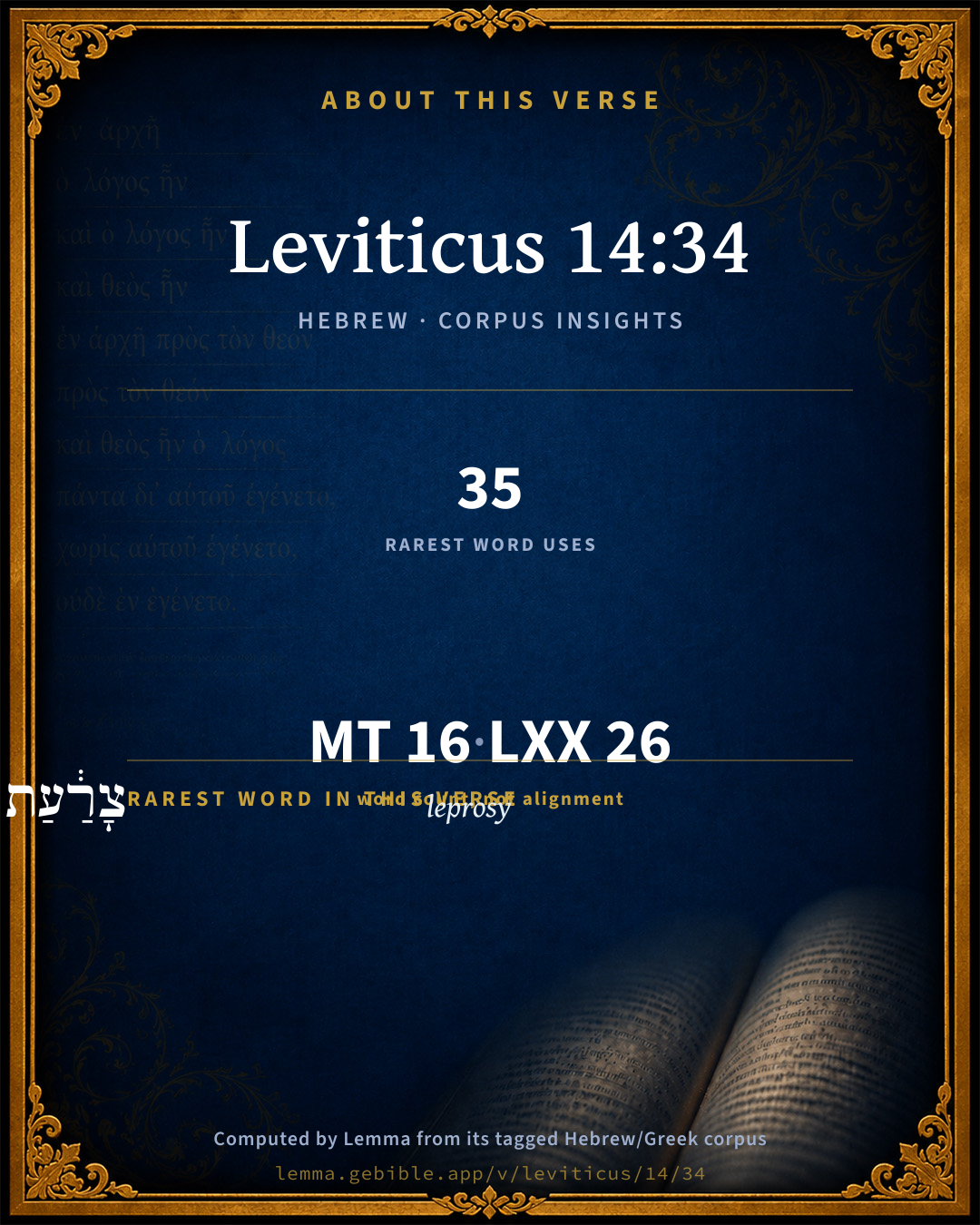
צָרַ֔עַת
tsâraʻath
H6883
“leprosy”
Noun, Common, Feminine, Singular, Absolute
Part of Speech
Noun
Type
Common
Gender
Feminine
Number
Singular
State
Absolute
Full BDB Definition

Origin: from H6879

TWOT: 1971a

leprosy - in people, malignant skin disease ( Lev. 13-14 ) - in clothing, a mildew or mould ( Lev 13:47-52 ) - in buildings, a mildew or mould ( Lev. 14:34-53 )
  1. כִּ֤י kîy H3588 “that” Conjunction
  2. תָבֹ֨אוּ֙ bôwʼ H935 “to enter” Verb, Qal, Imperfect, 2nd Person, Masculine, Plural
  3. אֶל ʼêl H413 “to” Preposition
  4. אֶ֣רֶץ ʼerets H776 “land of” Noun, Common, Both, Singular, Construct
  5. כְּנַ֔עַן Kᵉnaʻan H3667 “Canaan” Noun, Proper
  6. אֲשֶׁ֥ר ʼăsher H834 “which” Particle, Relative
  7. אֲנִ֛י ʼănîy H589 “I” Pronoun, Personal, 1st Person, Common, Singular
  8. נֹתֵ֥ן nâthan H5414 “giving” Verb, Qal, Participle Active, Masculine, Singular, Absolute
  9. לַאֲחֻזָּ֑ה ʼăchuzzâh H272 “to/for · possession” Preposition + Noun, Common, Feminine, Singular, Absolute
  10. וְנָתַתִּי֙ nâthan H5414 “and · to give” Conjunction + Verb, Qal, Sequential Perfect, 1st Person, Common, Singular
  11. נֶ֣גַע negaʻ H5061 “plague of” Noun, Common, Masculine, Singular, Construct
  12. בְּבֵ֖ית bayith H1004 “in/at · house of” Preposition + Noun, Common, Masculine, Singular, Construct
  13. אֶ֥רֶץ ʼerets H776 “land of” Noun, Common, Both, Singular, Construct
  14. אֲחֻזַּתְכֶֽם ʼăchuzzâh H272 “possession · your” Noun, Common, Feminine, Singular, Construct + Suffix, Personal, 2nd Person, Masculine, Plural

About this verse

These counts appear in no published source. They are computed here, from the morphology-tagged text and Lemma’s own curated glosses. What Lemma adds →

16
words
12
distinct lemmas
Pentateuch
section

Shared distinctive vocabulary

צָרַ֔עַת leprosy H6883 occurs in 33 verses of the Hebrew Bible. Also found in:

Grammatical profile

  • 3 verbs
  • 8 nouns
  • 1 pronoun
  • 2 prepositions
  • 1 conjunction
  • 1 particle

Verb forms

  • תָבֹ֨אוּ֙ Qal · Imperfect
  • נֹתֵ֥ן Qal · Participle Active
  • וְנָתַתִּי֙ Qal · Sequential Perfect

Repetition

Words recur within this verse — often emphatic in Hebrew:

  • אֶ֣רֶץ land H776 ×2
  • נֹתֵ֥ן to give H5414 ×2
  • לַאֲחֻזָּ֑ה possession H272 ×2

Hebrew & Septuagint length

In English translation the verse runs 32 words from the Hebrew and 34 from the Septuagint (LXX English) — closely comparable.

A rough comparison of the two English renderings, which tokenize alike — not a word-level alignment.

Word counts can differ between the Hebrew and the Greek without any difference in meaning — e.g. the Hebrew direct-object marker אֵת has no separate Greek word, and Greek often adds the article ὁ.

In the original languages it is 16 Hebrew tokens and 26 Greek tokens — but the two are counted differently (Hebrew bundles its prefixes and suffixes into one token; the Greek is in lemma form), so that isn’t a like-for-like length.

Cross-references

24

Topical passages linked to Leviticus 14:34 in the Treasury of Scripture Knowledge — connected by theme and wording, ordered by reader-vote popularity; previews shown in the World English Bible.

  • Genesis 17:8 I will give to you, and to your seed after you, the land where you are traveling, all the land of Canaan, for an everlasting possession. I will be their God."
  • Deuteronomy 32:49 Go up into this mountain of Abarim, to Mount Nebo, which is in the land of Moab, that is over against Jericho; and see the land of Canaan, which I give to the children of Israel for a possession;
  • Genesis 12:7 Yahweh appeared to Abram, and said, "I will give this land to your seed." He built an altar there to Yahweh, who appeared to him.
  • Genesis 13:17 Arise, walk through the land in the length of it and in the breadth of it; for I will give it to you."
  • Exodus 15:26 and he said, "If you will diligently listen to the voice of Yahweh your God, and will do that which is right in his eyes, and will pay attention to his commandments, and keep all his statutes, I will put none of the diseases on you, which I have put on the Egyptians; for I am Yahweh who heals you."
  • Leviticus 23:10 "Speak to the children of Israel, and tell them, 'When you have come into the land which I give to you, and shall reap its the harvest, then you shall bring the sheaf of the first fruits of your harvest to the priest:
  • Leviticus 25:2 "Speak to the children of Israel, and tell them, 'When you come into the land which I give you, then the land shall keep a Sabbath to Yahweh.
  • Numbers 32:22 and the land is subdued before Yahweh; then afterward you shall return, and be guiltless towards Yahweh, and towards Israel; and this land shall be to you for a possession before Yahweh.
  • Numbers 32:32 We will pass over armed before Yahweh into the land of Canaan, and the possession of our inheritance [shall remain] with us beyond the Jordan.
  • Numbers 35:10 Speak to the children of Israel, and tell them, When you pass over the Jordan into the land of Canaan,
  • Deuteronomy 7:1–2 When Yahweh your God shall bring you into the land where you go to possess it, and shall cast out many nations before you, the Hittite, and the Girgashite, and the Amorite, and the Canaanite, and the Perizzite, and the Hivite, and the Jebusite, seven nations greater and mightier than you;
  • Deuteronomy 7:15 Yahweh will take away from you all sickness; and none of the evil diseases of Egypt, which you know, will he put on you, but will lay them on all those who hate you.
  • Deuteronomy 12:1 These are the statutes and the ordinances which you shall observe to do in the land which Yahweh, the God of your fathers, has given you to possess it, all the days that you live on the earth.
  • Deuteronomy 12:8–10 You shall not do after all the things that we do here this day, every man whatever is right in his own eyes;
  • 1 Samuel 2:6 Yahweh kills, and makes alive: He brings down to Sheol, and brings up.
  • Isaiah 45:7 I form the light, and create darkness; I make peace, and create evil. I am Yahweh, who does all these things.
  • Amos 3:6 Does the trumpet alarm sound in a city, Without the people being afraid? Does evil happen to a city, And Yahweh hasn't done it?
  • Deuteronomy 19:1 When Yahweh your God shall cut off the nations, whose land Yahweh your God gives you, and you succeed them, and dwell in their cities, and in their houses;
  • Deuteronomy 26:1 It shall be, when you are come in to the land which Yahweh your God gives you for an inheritance, and possess it, and dwell therein,
  • Deuteronomy 27:3 and you shall write on them all the words of this law, when you are passed over; that you may go in to the land which Yahweh your God gives you, a land flowing with milk and honey, as Yahweh, the God of your fathers, has promised you.
  • Joshua 13:1 Now Joshua was old and well stricken in years; and Yahweh said to him, You are old and well stricken in years, and there remains yet very much land to be possessed.
  • Proverbs 3:33 Yahweh's curse is in the house of the wicked, But he blesses the habitation of the righteous.
  • Amos 6:11 "For, behold, Yahweh commands, and the great house will be smashed to pieces, And the little house into bits.
  • Micah 6:9 Yahweh's voice calls to the city, And wisdom sees your name: "Listen to the rod, And he who appointed it.

Cross-references courtesy of OpenBible.info (CC BY 4.0).

Hebrew and Greek witnesses Masoretic Hebrew ↔ Greek Septuagint

The same verse in the two great witnesses to the Old Testament, shown verse-for-verse.

These are two independent witnesses, not word-aligned to each other, and the Septuagint is shown in lemma (dictionary) form.

Hebrew Leviticus 14:34 Masoretic · Westminster Leningrad Codex

כִּ֤י תָבֹ֨אוּ֙ אֶל אֶ֣רֶץ כְּנַ֔עַן אֲשֶׁ֥ר אֲנִ֛י נֹתֵ֥ן לָכֶ֖ם לַאֲחֻזָּ֑ה וְנָתַתִּי֙ נֶ֣גַע צָרַ֔עַת בְּבֵ֖ית אֶ֥רֶץ אֲחֻזַּתְכֶֽם

"When you have come into the land of Canaan, which I give to you for a possession, and I put a spreading mildew in a house in the land of your possession,

World English Bible · Public Domain

Greek LXX Leviticus 14:34 Septuagint · lemma form

ὡς ἄν εἰςἔρχομαι εἰς ὁ γῆ ὁ χαναναῖος ὅς ἐγώ δίδωμι σύ ἐν κτῆσις καί δίδωμι ἁφή λέπρα ἐν ὁ οἰκία ὁ γῆ ὁ ἔγκτητος σύ

Whenever you⌃ shall enter into the land of the Chananites, which I give you for a possession, and I shall put the plague of leprosy in the houses of the land of your possession;

LXX2012 (modern English Septuagint) · Public Domain

Hebrew: Westminster Leningrad Codex (CC BY 4.0). Greek: Septuagint (public domain); English from LXX2012 (modern English Septuagint) (Public Domain). How the Septuagint differs from the Hebrew →

Targum (Aramaic paraphrase)

2

The Targum is the ancient Jewish Aramaic paraphrase of the Hebrew Scriptures — an interpretive translation, not the Hebrew text itself. Onkelos (literal) and Pseudo-Jonathan (expansive) render the Torah, and Jonathan the Prophets. Coverage is partial: where no permissively-licensed English translation exists for a verse, only the Aramaic is shown. This is verse-level text, not a word-by-word alignment to the Hebrew.

  1. Targum Onkelos Torah (Genesis–Deuteronomy)
    אֲרֵי תֵעֲלוּן לְאַרְעָא דִכְנַעַן דִי אֲנָא יָהֵב לְכוֹן לְאַחֲסָנָא וְאֶתֵּן מַכְתַּשׁ סְגִירוּ בְּבֵית אַרְעָא אַחֲסַנְתְּכוֹן

    (no public-domain English translation for this verse)

    Targum Onkelos — Aramaic: “Onkelos Genesis” (public domain); “Onkelos Exodus” (public domain); “Onkelos Leviticus” (public domain); “Onkelos Numbers” (public domain); “Onkelos Deuteronomy” (public domain). English: “Sefaria Community Translation” (CC0 1.0 (public-domain dedication)); “J.W. Etheridge. The Targums of Onkelos and Jonathan Ben Uzziel on the Pentateuch. London: Longmans, Green, 1862” (public domain). Text via Sefaria.

  2. Targum Pseudo-Jonathan Torah (Genesis–Deuteronomy)
    אֲרוּם תֵיעָלוּן לְאַרְעָא דִכְנָעַן דַאֲנָא יָהֵב לְכוֹן לְאַחְסָנָא וּמִשְׁתַּכַּח גְבַר דִבְנֵי בֵיתָא בַּחֲטוֹפִין וְאֶתֵּן מַכְתַּשׁ סְגִירוּ בְּבֵית אֲרַע אַחְסַנְתְּכוֹן

    When you have entered upon the land of Kenaan which I will give you for a possession, and a man who hath builded a house by rapine finds that I have put the plague of leprosy in the house of the land of your inheritance;

    Targum Pseudo-Jonathan — Aramaic: “Targum Jonathan on Genesis” (public domain); “Targum Jonathan on Exodus” (public domain); “Targum Jonathan on Leviticus” (public domain); “Targum Jonathan on Numbers” (public domain); “Targum Jonathan on Deuteronomy” (public domain). English: “The Targum of Jonathan ben Uzziel, trans. J. W. Etheridge, London, 1862” (public domain). Text via Sefaria.

Commentary

Notes on Leviticus 14:34 from classic Christian and Jewish commentators (each source and its license shown beneath its notes). The classic Christian expositions comment on the surrounding passage and are grouped to its opening verse, so a note may address several verses; the Jewish commentaries on the Tanakh (Rashi and others) are per-verse, so they appear only where the commentator wrote on this verse.

Lemma curates 59 commentaries, every one of them public domain or Creative Commons licensed, each selected and text-cleaned for this edition rather than reprinted as found. About our sources →

Trapp's Complete Commentary

John Trapp

Lev 14:34 When ye be come into the land of Canaan, which I give to you for a possession, and I put the plague of leprosy in a house of the land of your possession;

Ver. 34. Plague of leprosy in a house.] Such is the contagion of sin, that it will infect the very house we dwell in, the garments we wear, even all the creatures we use, so as all things are to us impure; {Tit 1:13} even the house of God also, {Lev 16:16} and his holy ordinances. The Canaanites had defiled the land from one end to another with their uncleannesses, {Ezr 9:11} and so infected the air. This law taught men, (1.) Upon all occasions to show their utter detestation of sin, but especially of idolatry; (2.) To take heed of despising admonition, lest they be utterly ruined, "and that without remedy." {Pro 29:1}

John Trapp, A Commentary or Exposition upon All the Books of the Old and New Testament (1647–1656) — public domain. Text from a community e-Sword module.

The Biblical Illustrator

Joseph S. Exell

Lev_14:34-57

Leprosy in a house.

Leprosy of house and garments

(see also Lev_13:49):--Few subjects have proved more perplexing to the student of Scripture than this. That human dwellings and garments should exhibit a similar disease to that which infects the human body seems at first sight to be highly improbable. We are indebted to the recent discoveries of the microscope for the first intimation of the true nature of the leprosy of house and garments. A careful examination of the Levitical narrative in the light of modern science leaves no room to doubt that the conclusions of Sommer, Kmtz, and other recent authors, who attribute a vegetable origin to this plague, are correct. The characteristics mentioned are such as can belong only to plants. There are some species of fungi which could have produced all the effects described, and whose form and colour answer admirably to the appearances presented by the leprosy. We are therefore safe in believing that the phenomena in question were caused by fungi. The language of Moses is evidently popular, not scientific, and may therefore be supposed to include not only different species, but even different genera and orders of fungi as concerned in the production of the effects described. The leprosy of the house consisted of reddish and greenish patches. The reddish patches on the wall were in all likelihood caused by the presence of a fungus well known under the common name of dry-rot, and called by botanists Merulius lachrymans. Builders have often painful evidence of the virulent and destructive nature of this scourge. It is frequent all the year round, being in this respect different from other fungi, which are usually confined to the season of decay. If once established dry-rot spreads with amazing rapidity, destroying the best houses in a very short time. The law regarding it in Leviticus is founded upon this property; seven days only were allowed for its development, so that its true nature might be placed beyond doubt. The precautions here adopted are in entire accordance with the nature and habits of fungi. By emptying the house of its furniture, shutting the doors and windows, and excluding the air and light, the very conditions were provided in which the dry-rot would luxuriate and come to maturity. If the walls were completely impregnated with its seed and spawn, this short period of trial would amply suffice to show the fact, and the building might then safely be condemned to undergo a process of purification. There are no means of restoring rotten timber to a sound condition, and the dry-rot can only be eradicated by removing the decayed and affected parts, clearing away all the spawn and destroying the germs with which the plaster and the other materials of the walls may have been impregnated. For this purpose the process of kyanising and burnetising have been recommended--that is, washing the walls or the woodwork with a strong solution of corrosive sublimate or chloride of zinc. If the dry-rot is not fairly established in a house it may be removed with tolerable ease by these processes; should the disease, however, have become widespread and deep-seated, no means of dealing with the evil can be depended upon, except that of removing altogether the corrupted and contagious matter and admitting a free circulation of air. This was exactly what the Jewish priest was commanded to do (verses 40-42). It often happens, however, that even this severe operation proves ineffectual; and after repeated repairs of the same nature, it is found that the building is so hopelessly ruined that it must be abandoned and dismantled (verses 43-45). Dr. Thomson, in The Land and the Book, mentions that the upper rooms of the houses in Palestine, if not constantly ventilated, become quickly covered with mould and are unfit to live in. In many cases the roofs of the houses are little better than earth rolled hard, and it is by no means uncommon to see grass springing into a short-lived existence upon them. Such habitations must be damp and peculiarly subject to the infection of fungi. During the months of November and December especially, fungi make their appearance in the wretched ephemeral abodes of the poorer classes; and in the walls of many a dwelling at the present day may be seen the same leprous appearances described by Moses three thousand years ago. When the Israelites entered Palestine they occupied the dwellings of the dispossessed aboriginal inhabitants instead of building new houses for themselves. And in these dwellings, as the Canaanites lived in the midst of moral and physical impurity, and were, moreover, ignorant of all sanitary conditions, the plague of leprosy would be very apt to manifest itself. The Bible speaks of it as sent expressly by God Himself: When ye be come into the land of Canaan, which I give to you for a possession, and I put the plague of leprosy in a house of the land of your possession. It was so sent in mercy and not in judgment, to show to them, by a palpable proof appealing to the eye, what could not be so well revealed by other evidence. It was the visible manifestation of a hidden insidious unwholesomeness--the breaking out, as it were, of an internal and universal disease. It directed attention to the unhealthy character of the house, and stimulated inquiry as to how it could be remedied. Whereas if no such abnormal appearance presented itself, the inhabitants might remain unconsciously in the midst of conditions which would slowly but surely undermine their health, and in the end prove fatal. In the Levitical narrative we read that in the walls of the affected houses there were greenish as well as reddish streaks. These greenish streaks were caused by a much humbler kind of fungus than the tile Merulius lachrymans, or dry-rot, concerned in the production of tim reddish streaks. Every one is familiar with the common green mould, or Penicillium glaucum, of botanists. This fungus is extremely abundant everywhere, and seems to have been no less general in the ancient world, for we find traces of it pretty frequently in amber, mixed with fragments of lichens and mosses. It grows on all kinds of decaying substances, and is very protean in its appearance, assuming different forms according to the nature of the body or situation which it affects. Common mould grows on every substance, whether animal or vegetable, in a state of decay. It grows even upon the human body when it is in an enfeebled or disordered condition; and many diseases of the skin are owing to its efforts to develop and spread itself. The thrush in children, the muscardine so destructive to silkworms, the fungoid growth which so often causes the death of the common house-fly in autumn, are all different forms of the common mould. Its germs or spores are constantly floating in the air or swimming in the water in incalculable myriads, so that it is difficult to conceive how any place can be free from their presence. The atmosphere of our houses is loaded with them; and were we endowed with microscopic vision, we should see them dancing about in the draughts and currents of our rooms, or shining among the motes in the pencilled rays of sunshine. The ubiquity of mould has given rise to the theory of spontaneous generation, still held by a certain class of naturalists; but the immense profusion of its seeds, and their wonderful powers of adaptability under varying circumstances, and of entering through the finest conceivable apertures, will easily account for its presence in every situation, without being under the necessity of admitting what has never yet been proved--that substances in a particular state of decay can, without seeds or germs of any kind, generate low forms of life. Many medical men are of opinion that various zymotic diseases, if not originated, are increased by the presence of these minute cellules in the blood, and by their deleterious action in developing themselves. The injuries inflicted by fungi are indeed incalculable. But we have nevertheless a grand compensation in the benefits which they confer in accelerating, by their unparalleled rapidity of growth, the process of decay, and removing frown the atmosphere into their own tissues, where they arc innocuous, the putrescent effluvia of dead substances. They also economise the stock of organised material which has been slowly and tediously gained from the earth, air, and water, by preventing it from going back through decomposition to the mineral state, and preserving it in an organic form to be at once made available for the purposes of higher animal and plant life. Mould, for these reasons, is not so much an evil in itself as an indication of evil conditions in the World, and by minimising these it renders an all-important service in the economy of nature. Its great purpose is purely benevolent; but, like the storm intended to purify the atmosphere, it sometimes oversteps its limits, and proves injurious in particular cases. The minute regulations for inspecting and cleansing those houses where symptoms of leprosy appeared, indicate how complete was the sanitary system under which the ancient Israelites lived. God considered no part of their domestic and social economy, however humble, beneath His notice. Cleanliness in person, in dress, in dwellings, and in all outward appointments, was enforced by statutes of a peculiarly solemn character. All these ceremonial enactments were in the first instance intended for sanitary purposes. God had respect to the physical health and well-being of His people. He wished them to be patterns of purity, models of beauty, their bodies to be perfectly developed in the midst of the most favourable circumstances; and therefore the most admirable arrangements were made for securing cleanly, orderly, and healthy habitations. But not for purely physical purposes alone were the Levitical laws regarding the leprosy of the house enforced. They had also a spiritual significance. All experience tells us of the mysterious connection, founded upon the constitution of our twofold nature, between physical and moral evil--between external and internal impurity. The proverb, Cleanliness is next to godliness, is truer even than it is admitted to be. Physical filth has in innumerable instances been the means of turning away the Lord from the homes of those who endure it. For want of a little more room and a little more purity in their dwellings, the sublimest truths fall dead upon the ears of thousands. The salvation of the poor, though to them the gospel is preached, is in very many cases rendered impossible, humanly speaking, on account of the degrading conditions amid which they live, and the deadening, hardening influence which familiarity with noxious sights and smells produces. How often are the spiritual instructions of the district visitor thrown away on account of the unhallowed effects of filthy surroundings! Sad it is to think of the leprosy of the house being the type of the leprosy of sin which infects the earthly tabernacle of this body. We bear about with us this plague in all our members. From the crown of the head to the sole of the foot there is no soundness in us. Be it ours to put our natures entirely under the purifying power of Gods Spirit, so that they may be cleansed from all impure desires, &c. So much for the leprosy of the house. The leprosy of garments may have been caused by the same fungi. Precisely the same appearances manifested themselves in the one case as in the other. I am disposed to attribute the greenish streaks on the garments to the common green mould; for, as I have observed, it is ubiquitous, and grows as readily on clothes as on house walls, when left in damp, ill-ventilated, ill-lighted places. The reddish patches, however, seem to me to have been produced by the growth of the Sporendonema, or red mould, very common on cheese; or of the Palmella prodigiosa. This last-mentioned plant is occasionally found on damp walls in shady places, and on various articles of dress and food, sometimes extending itself over a considerable area. It is usually a gelatinous mass of the colour and general appearance of coagulated blood, whence it has received the famous name of Gory-dew. Though formerly ranked with the algae, or seaweed family, it is now ascertained by more accurate physiological researches to be a species of mould; so that, under whatever names we may class them, the plants which occasioned the strange appearances on houses and garments belong to the same tribe. Instances of reddish patches suddenly investing linen and woollen clothes are by no means confined to the Levitical narrative. A whole volume might be filled with similar examples. Along with other marvellous prodigies they abound in the mediaeval chronicles; and were they not authenticated by the most trustworthy evidence, we should hesitate--from their very extraordinary character--to accept them as true. It was by no means rare to find, in the Middle Ages, consecrated wafers and priestly vestments sprinkled with a minute red substance like blood. Such abnormal appearances were called Signacula, as tokens of the Saviours living body; and pilgrimages were not unfrequently made to witness them. In several cases the Jews were suspected, on account of their abhorrence of Christianity, of having caused sacramental hosts to bleed, and were, therefore, ruthlessly tormented and put to death in large numbers. Upwards of ten thousand were slaughtered at Rotil, near Frankfort, in 1296, for this reason. The bleeding of the host, produced in consequence of the scepticism of the officiating priest, gave rise to the miracle of Bolsena in 1264; the priests garment stained with this bloody-looking substance being preserved until recent times as a relic. This gave rise to the festival of the Corpus Christi founded by Urban

IV. Before the potato-blight broke out in 1846, red mould spots appeared on wet linen surfaces exposed to the air in bleaching-greens, as well as on household linen kept in damp places, in Ireland. In September, 1848, Dr. Eckard, of Berlin, while attending a cholera patient, observed the same production on a plate of potatoes which had been placed in a cupboard in the patients house. All these instances-and hundreds more might be enumerated--though somewhat exaggerated by the dilated eye of fear, were found by microscopic investigation to be caused by the extraordinary development in abnormal circumstances of the red mould. Occurring, as most of them did, before the outbreak of epidemics, which they were supposed to herald, they obviously point to the conclusion that they were developed by unhealthy conditions of the atmosphere. In ordinary times but few of the fungi which caused these alarming appearances are produced, and then only in obscure and isolated localities; but their seeds lie around us in immense profusion, waiting but the recurrence of similar atmospheric conditions as existed in former times, to exhibit as extraordinary a development. O Lord, how manifold are Thy works; in wisdom hast Thou made them all! is the thought that arises in the devout soul at the contemplation of the wonderful structure and history of these minute existences, which live and die unknown to the great majority of mankind. Even a mould, requiring the highest powers of the microscope for its examination, can become in His hands a mighty scourge or a transcendent benefit. (H. Macmillan, D. D.)

House leprosy

The particular nature of this affection I cannot very certainly determine. Michaelis thinks it was a sort of mural efflorescence, which often appears in damp situations, cellars, and ground-floors, and so corrodes walls and plastering as to affect and damage everything near it, and sometimes quite destroying the entire building. Calmet thinks it was a disorder caused by animal-eulse which eroded the walls, and finally destroyed them, if left undisturbed. But perhaps we cannot do better than to agree with the Rabbins and early Christian Fathers, who believed that this leprosy was not natural, but sent of God as an extraordinary judgment, to compel men to the public acknowledgment and expiation of some undetected negligence or crime. It was the stone crying out of the wall against the sinner, and the beam out of the timber answering it (Hab_2:11). It came like a great domestic affliction, saying, This is not your rest, because it is polluted. It was the hand of God upon the forgetters of His law. It was the curse of the Lord, in the house of the wicked. Its typical significance will at once suggest itself. It plainly points to the fact that not only man, and his surroundings in life, but his very dwelling-place--the earth itself--is infected. The whole surface and framework of the world bespeaks infection, disobedience, and disorder. We must tear it with instruments of iron, and mix its mould with tears and sweat, before it will yield us bread. Walls and houses must be built to shelter us from its angry blasts. And with all that we can do, the sea will now and then engulf the proudest navies, and the hailstones blast the budding harvests, and famine and pestilence cut down the strength of empires, and earthquakes bury up great cities in a common tomb, and the sun and the moon flash down death in their rays, and the very winds come laden with destruction. And even in a moral aspect, the material world, though meant for spiritual as well as other good, has often been to man a source of defilement. Creation is a standing miracle to show us eternal power and Godhead. Every ray of light is an electric cord let down from the unknown heavens to lift our hearts into communion with the Father of light. Every night puts us into the midst of a sublime temple in which the tapers burn around the everlasting altar, and through which rolls the vesper anthem of the heavenly spheres, to inspire us with adoration. And the innumerable changes that pass before our eyes are but so many letters to spell out to us the name of the unknown God, in whom we live and have our being. But, how often have these very things tended to establish men in unbelief, and tempted them from the ways of piety and peace? How often have persons looked up into the starry sky, and reasoned, until they were led to say the gospel is a forgery?--or dug into the earth, and insisted that Moses was mistaken in its age?--or cut among the arteries and tissues of organic life, and denied mans immortality?--or watched the uniformity of Gods common laws, and pronounced a miracle impossible?--or dipped a little into physical science, and controverted the very existence of a deity? How often have earths products proven to be mere baits and lures to unguarded souls to lead them down to death? How have its wines tempted men to intemperance, and its beautiful groves to the licentiousness of the idolater? How frequently the very gold or silver of its rocks have taken the place of God Himself, and fastened everlasting condemnation on the worshipper? And what scene of beauty contained in this world, but has served to draw the heart of some one from the Lord? But it shall not always be so. The leprosy in our dwelling-place may pass away as well as leprosy in our persons, or in our clothing. God has appointed rites for its cleansing. The time is coming when there shall be no more curse. But it is to be the last thing cleansed. Regeneration begins first in the spirit. From the spirit it extends to the outward life, then to the redemption of the body. And after that comes the grand deliverance, when the creature (or creation) itself shall be delivered from the bondage of corruption, into the glorious liberty of the children of God. Not only our personal nature is to be renewed, but the very world in which we live. And it is only upon the theory of the ultimate and complete recovery of the world from all damage of sin, that the prescriptions now before us can be explained. The first thing to be done to a house found to be leprous, was to have the affected stones removed, the walls scraped, and the plastering renewed. This done, all parties were to wait to see what the effect would be upon the disorder. This evidently recalls the flood, and Gods dealings with the earth at that time. It was then that He broke up the old and tainted foundations, swept away the scum of its surface, and overcast it with a new order of things. All is therefore in waiting now, till our great High Priest and Judge shall come forth again to inspect the earth. After the lapse of an appropriate time of trial, which is left indefinite in the record, the priest was again to examine the house that had been thus dealt with; and if the plague had broken out again, and had spread in the house, he was to break it down, the stones of it, and the timber thereof, and all the mortar of the house, and carry them forth out of the city into an unclean place. If the leprous symptoms were not stayed, it was to be completely and for ever demolished. There was no further hope for it. It perished in its uncleanness. I take this as a type, not of what is to befall the world, but of what would have befallen it without the redemption that has come in to stay its corruption and save it from ruin. How, then, was a leprous house to be cleansed? We have seen what was to be done to it upon the first appearance of the plague. We accordingly read that, after the lapse of a suitable time to test whether the infection was stayed, the priest shall come in, &c. (Lev_14:48-53). All this refers us back to the blood-shedding, death, and resurrection of Jesus Christ, and holds forth the great fact that the world is made clean to us now, and will be entirely cleansed hereafter, by virtue of the redemptive work of our great High Priest. Because Jesus was slain, and has redeemed us to God by His blood, the saints may take it as their song, We shall reign on the earth. Some suppose that this dwelling-place of man is some day to fall to pieces, and pass away, and be no more. Had Christ not died, or having died, not risen again, it might be so; but now a light of glory rises upon its futurity. It shall not die, but live. Great changes may yet pass upon it, but it shall survive unharmed. This world was Heavens gift to man. It was his patrimonial estate. It was his sin that blighted it. And just so far as he is redeemed, he shall get his own again, and hold it by a charter written in his Saviours blood. (J. A. Seiss, D. D.)

The plague in the house

I fancy you have heard words like these before, though you might never have known that they were in the Bible. But you have heard mother or father, when worried and vexed, often say, It almost seems as if there was a plague in the house!

I. The kind of plague the text speaks about was a strange one. It first appeared in a little green or reddish spot, growing on the wall of the house. When that was noticed, the person who lived in the house had to go to the priest and say to him, It seemeth to me there is as it were a plague in the house. Then the priest came and looked at the spot, and ordered the house to be locked up for a week. At the end of that time, if the spot had not grown any larger, it was simply cut out, and the house was declared to be quite safe to dwell in. But if the spot had increased, then they knew that it was the plague, and all the stones round about it were taken out and new ones put in their places, and the old ones were carried away to a distance. But if, after all this care had been taken, the spot appeared again, then they knew it was no use trying further that way. This was a fretting leprosy, as it was called; so the house was ordered to be pulled down, and all its stones carried far away, and a new house built in its stead with entirely new stones.

II. Havent we plagues in the house now, something different from that perhaps, and yet something like too?

1. There is a bad temper. What a plague that is in the house! There is a sulky temper and a quick temper. The sulky one is when a boy or girl goes moping, moping, and wont speak or do anything cheerfully. It is a very hurtful plague in the house. Then there is the quick temper, up in a moment, over in a moment! Perhaps this is better than the other, if we are to make any distinction; but better be rid of bad temper altogether.

2. Selfishness is another plague in the house.

3. Disobedience is another plague in the house. No boy or girl ever yet came to good who did not try to obey father and mother.

III. Where the plague breaks out.

1. Where ventilation is bad. Now what fresh air is to the body, Gods Spirit is to the soul--that which keeps it fresh and free from plague. Maintain that Spirit in the house, prayer and love for God, and--striving to obey Him--no plague shall come nigh thy dwelling.

2. The plague also breaks out where sunshine never comes. What a healing thing is the sunshine! How glorious it can make even the dingiest street! The plague never comes where the sunshine is, and cheerfulness is the sunshine of the home. There was a great scholar once, Dr. Dwight, a big man with a great broad chest. Once when the students in the college were not getting on well, he said to them, Gentlemen, I see there is something wrong; you are becoming too melancholy. You must learn to laugh, thats the way to cure the plague. So he broadened his own chest, took a big breath, and burst into such a hearty laugh that all the others laughed too. Thats very good, he said, very good for a beginning; but see that you keep it up! And it is good practice in the house to have a hearty laugh. Keep cheerfulness there, and the plague wont trouble you. (J. Reid Howatt.)

The way to remove the plague

When plague, or pestilence, or war, or famine, come on a land, there are two classes of persons who act in opposite ways. One class will pray only that God may remove them, and do nothing more; another class will set about sanitary reform--a most precious and important thing--but they will do nothing more. Now, we are taught in this chapter that the two are to be combined. The priest not only applied to God, and offered sacrifices that the plague might be removed from the house, but he set to work and pulled down the stones, and broke the timbers, and scraped the house, and had it plastered and cleansed; and thus there was the most effective sanitary process, accompanied with the most sacred and Christian appeal to Him who is the Lord and the Giver of life; and who alone healeth, and when He healeth none can make ill. Now, it is the happy combination of these that constitutes in all things the perfection of Christian conduct. If we so think of means as to think of nothing else, we shall have no blessing; if we so think of, or engage in prayer, as to exclude means, we shall have no blessing. If we suppose that by attending to all that is just, and proper, and obligatory in sanitary measures, we may defy God, we blaspheme; but on the other hand, if we act as some, pray, and appoint days of fasting and of prayer, but do nothing to lift the poor from their degradation, to improve their dwellings, to increase their comforts, to give raiment to the naked, food to the hungry, a shelter and a home to them that have none, then that is downright hypocrisy. But if we can combine the two, by using all the means that God in His providence has given us, as vigorously as if all depended upon the means, and yet, while we do so, look up to God as if the means were worthless, and He must do all, then we shall combine the blessed heavenly benediction with the use of the most effective earthly means, and God, our own God, shall crown us with His blessing. (J. Cumming, D. D.)

.

The Biblical Illustrator, edited by Joseph S. Exell (c. 1880s–1900s) — public domain. Text from a community e-Sword module.

Joseph Benson's Commentary

Lev 14:34. I put the plague of leprosy in a house — Now they were in the wilderness, dwelt in tents, and had no houses; and therefore this law is made only as an appendix to the former laws concerning the leprosy, because it related not to their present state, but to their future settlement in Canaan. The leprosy in a house is as unaccountable as the leprosy in a garment: but if we do not see what natural causes can be assigned for it, we may resolve it into the power of the God of nature, who here saith, I put the leprosy in a house, as (Zec 5:4) his curse is said to enter into a house and consume it, with the stones and timber thereof.

Joseph Benson's Commentary on the Old and New Testaments (1811–1818) — public domain. Text from a community e-Sword module.

Tyndale Open Study Notes

Tyndale Open Resources

14:34 I may contaminate: In the absolute monotheism of biblical language, God causes or allows everything. For example, Exod 21:13 describes an accidental death as something that God allowed to happen (see also Deut 19:4-5).

Tyndale Open Study Notes — © Tyndale Open Resources, licensed CC BY-SA 4.0. Text via the HelloAO Bible API.

Geneva Bible (1599)

Geneva Bible translators

This declareth that no plague nor punishment cometh to man without God’s providence and his sending.

Geneva Bible (1599) marginal notes — public domain. Text via Bolls.life.

Jamieson, Fausset & Brown

Robert Jamieson, A. R. Fausset & David Brown

leprosy in a house--This law was prospective, not to come into operation till the settlement of the Israelites in Canaan. The words, "I put the leprosy," has led many to think that this plague was a judicial infliction from heaven for the sins of the owner; while others do not regard it in this light, it being common in Scripture to represent God as doing that which He only permits in His providence to be done. Assuming it to have been a natural disease, a new difficulty arises as to whether we are to consider that the house had become infected by the contagion of leprous occupiers; or that the leprosy was in the house itself. It is evident that the latter was the true state of the case, from the furniture being removed out of it on the first suspicion of disease on the walls. Some have supposed that the name of leprosy was analogically applied to it by the Hebrews, as we speak of cancer in trees when they exhibit corrosive effects similar to what the disease so named produces on the human body; while others have pronounced it a mural efflorescence or species of mildew on the wall apt to be produced in very damp situations, and which was followed by effects so injurious to health as well as to the stability of a house, particularly in warm countries, as to demand the attention of a legislator. Moses enjoined the priests to follow the same course and during the same period of time for ascertaining the true character of this disease as in human leprosy. If found leprous, the infected parts were to be removed. If afterwards there appeared a risk of the contagion spreading, the house was to be destroyed altogether and the materials removed to a distance. The stones were probably rough, unhewn stones, built up without cement in the manner now frequently used in fences and plastered over, or else laid in mortar. The oldest examples of architecture are of this character. The very same thing has to be done still with houses infected with mural salt. The stones covered with the nitrous incrustation must be removed, and if the infected wall is suffered to remain, it must be plastered all over anew.

Jamieson, Fausset & Brown — Commentary Critical and Explanatory on the Whole Bible (1871) — public domain (CC PDM 1.0). Text via the HelloAO Bible API.

Adam Clarke's Commentary

Verse 34. When ye be come into the land - and I put the plague of leprosy] It was probably from this text that the leprosy has been generally considered to be a disease inflicted immediately by God himself; but it is well known that in Scripture God is frequently represented as doing what, in the course of his providence, he only permits or suffers to be done. It is supposed that the infection of the house, as well as of the person and the garments, proceeded from animalcula. See Clarke on Le 13:47, and "Le 13:52".

Adam Clarke's Commentary on the Bible (1810–1826) — public domain. Text from a community e-Sword/MySword module.

Ellicott's Commentary for English Readers

(34) When ye be come into the land of Canaan.—We have here the first of four instances in Leviticus of a law being given prospectively, having no immediate bearing on the condition of the people of Israel (see Lev_19:23; Lev_23:10; Lev_25:2). This may be the reason why it is separated from the law of leprous men and garments, which we should naturally expect it would follow, instead of being preceded by the law of cleansing, and why it occupies the position of an appendix. Because it is here said “the land of Canaan,” the authorities during the second Temple maintained that this supernatural plague of leprous houses was peculiar to Palestine, and was unknown in any other country. They moreover adduce the words “in a house of the land of your possession” to account for the fact that houses in Palestine not in the possession of the Israelites,—i.e., houses of Gentiles—were exempt from this distemper, that the synagogues throughout the country which had no official dwelling-houses attached to them were never visited by this loathsome disease, and that none of the houses in Jerusalem were ever afflicted with it, because the holy city was never divided among the tribes. Whatever we may think of their interpretation, the testimony of these eye-witnesses who had to administer the laws of leprosy, that out of Palestine, that in certain houses in Palestine, and that in the whole of Jerusalem, this kind of distemper was unknown, remains unshaken.

And I put the plague of leprosy.—The plague is here described as a supernatural one, proceeding from the immediate hand of God. Ordinary leprosy, as we are told by the authorities in the time of Christ, comes upon man for the following sins: “for idolatry, for profaning the name of the Lord, unchastity, theft, slander, false witness, false judgment, perjury, infringing the borders of a neighbour, devising malicious plans, or creating discord between brothers.” House leprosy is sent by God if the owner of a plot of land on the sacred soil builds his house with materials unlawfully acquired. Hence the ancient Chaldee Version of Jonathan renders the first part of this verse by, “And if there be a man who buildeth his house with stolen goods, then I will put the plague,” &c.

A Bible Commentary for English Readers, edited by Charles John Ellicott (1878–1897) — public domain. Text from a community e-Sword module.

John Gill's Exposition

Then the priest shall go out of the house to the door of the house,.... Thereby signifying that it was not fit to be inhabited, and there standing to see it shut up, as follows:

and shut up the house seven days: to observe what alteration would be made in that time, and which would sooner be discovered in a house uninhabited.

John Gill's Exposition of the Whole Bible (1746–1763) — public domain (CC PDM 1.0). Text via the HelloAO Bible API.

Haydock's Catholic Bible Commentary

If there. Hebrew, "and I send the plague;" whence some infer, that this leprosy was an effect of God’s special indignation against the owners of the house. (Muis; &c.)

George Leo Haydock (1774–1849), Haydock's Catholic Family Bible and Commentary, 1859 edition — public domain. Excludes Psalms (Douay-Rheims chapter numbering differs from Protestant) and Deuterocanonical books (Catholic canon only).

Whedon's Commentary on the Bible

Daniel D. Whedon

34. Land of Canaan — Since tents were not exposed to this form of uncleanness this legislation looks forward to Palestine, where the people would abide in the cities built by the Amorites. Jos_24:13. It has been suggested, but with no show of proof, that treasures had been hidden in certain houses by the Canaanites, and that the leprosy was sent to these in order that the gold and silver hidden in them might be revealed when they were demolished. “The people were far enough from Canaan at this moment, yet a law of regulation was laid down for their conduct when they came into possession of the land. This is another revelation of the method of divine government. Laws are made in advance.” — Joseph Parker.

I put the plague of leprosy — This expression is the ground of the opinion that the house leprosy was a supernatural infliction. But in the Hebrew idiom God is often said to do acts which he permits others to do, (Exo_7:13,) or which occur through physical laws.

Daniel D. Whedon (gen. ed.), Commentary on the Old and New Testaments (1874–1909) — public domain. Text from a community e-Sword module.

The Pulpit Commentary

When ye be come into the land of Canaan, which I give to you for a possession. This is the first instance of a law being given which has no bearing on the present condition of the Israelites. but is to regulate their conduct when they had come into the promised land. From the time of Abraham downwards, the assurance of their entrance into that land had been possessed by the people of Israel, (Gen_17:8) and the expectation of the speedy fulfillment of that promise had been quickened by their exodus from Egypt, and the preparations made to march through the wilderness. There would, therefore, be nothing surprising to them in receiving instructions to guide their conduct when the entrance should have been effected. As the question is one of leprosy, it is natural that it should be treated of with the leprosy of the human subject and the leprosy of garments; but as it is not of immediate application, it is placed at the end, and dealt with after the rest of the subject has been discussed, being appended to the law of cleansing the leper, instead of preceding it. And I put the plague of leprosy in a house of the land of your possession.

This expression has led to the idea that the leprosy of houses was a special infliction at God"s hand in a manner different flora other inflictions or diseases; but the words do not mean that. All that is done is in a sense done by God, inasmuch as his providence rules over all; and, therefore, by whatever secondary cause a thing may be brought about, it is he that does it. It is God that feeds the birds, (Luk_12:24) God that clothes the grass, (Luk_12:28) nor does one sparrow fall to the ground without him. (Mat_10:29) It is he, therefore, that puts the plague in a house, as the Lord of all things. (cf. Isa_45:6, Isa_45:7, "I am the Lord, and there is none else. I form the light, and create darkness: I make peace, and create evil: I the Lord do all these things The expression militates, though not strongly, against the notion that the house caught the leprosy from the leper that lived in it.

The Pulpit Commentary (1880–1919), ed. H.D.M. Spence-Jones & Joseph S. Exell — public domain. Text from a community e-Sword module.

Rashi

Rabbi Shlomo Yitzchaki (Rashi)

ונתתי נגע צרעת [WHEN YOU COME TO THE LAND …]I WILL PUT THE PLAGUE OF THE LEPROSY — This was an announcement to them that these plagues would come upon them (Sifra, Metzora, Section 5 4; Horayot 10a), because the Amorites concealed treasures of gold in the walls of their houses during the whole 40 years the Israelites were in the wilderness (in order that these might not possess them when they conquered Palestine,) and in consequence of the plague they would pull down the house and discover them (Leviticus Rabbah 17:6).

Rashi on the Tanakh — English translations: “The Judaica Press complete Tanach with Rashi, translated by A. J. Rosenberg” (CC BY 4.0); “Pentateuch with Rashi's commentary by M. Rosenbaum and A.M. Silbermann, 1929-1934” (public domain); “The Metsudah Tanach series, Lakewood, N.J” (CC BY 4.0); and “The Book of Joshua, Metsudah Publications, 1997” (CC BY 4.0). Text via Sefaria.

Ramban (Nachmanides)

Rabbi Moshe ben Nachman (Ramban / Nachmanides)

Scripture states with reference to plagues in houses, and ‘I’ shall put the plague of leprosy, in order to allude to the fact that it was G-d’s hand that did this, and not an act of nature at all, as I have explained. It states, When ye are come into the land of Canaan etc. in a house of the Land of your possession, because He is speaking to all Israel [since Moses and Aaron did not come into the Land]. Now it would have been proper that after the verse, And the Eternal spoke unto Moses and unto Aaron, saying, He should continue to state, “Speak ye unto the children of Israel.” But Scripture shortens the account since it is self-understood [that the command was to be given to the children of Israel who would enter the Land]. Or it may be that He spoke to them in the place of [i.e., as representing] all Israel, and hinted that the intention [of giving the commandment] now is merely to teach them all the laws of leprosy, and that they in turn should teach them to the priests, and Moses did not warn all Israel now [about these laws, as they did not apply until they came into the Land]. It was only those who came into the Land that he warned, Take heed in the plague of leprosy, that thou observe diligently etc., 1:3 where it says that the Book of Deuteronomy was said in the fortieth year, i.e., to those about to enter the Land. for it was to them that he commanded at first to take heed in these ordinances.

Ramban (Nachmanides) on the Tanakh — English translation: “Commentary on the Torah by Ramban (Nachmanides). Translated and annotated by Charles B. Chavel. New York, Shilo Pub. House, 1971-1976” (CC BY 4.0). Text via Sefaria.

Ibn Ezra

Rabbi Abraham ibn Ezra

When you will come. This is applicable only in the Land of Israel because of the great virtue of the Land, for the Beis HaMikdash is among them, and Hashem’s Honor is in the Beis HaMikdash.

And I shall put. The matter depends upon Hashem’s giving.

Ibn Ezra on the Tanakh — English translations: “Sefaria Community Translation” (CC0 1.0 (public-domain dedication)); “Yalkut, Sifsei Chachomim Chumash, Metsudah Publications, 2009” (CC BY 4.0); and “Commentary of Ibn Ezra on Isaiah - trans. by M. Friedlander, 1873” (public domain). Text via Sefaria.

Lesson kit

Teaching starters — assembled from the data on this page, not authored interpretation. Every prompt links to the verse data it draws on. Edit before teaching.

Leviticus, in the Pentateuch, opens this verse with 16 words (12 distinct Hebrew lemmas). Its most distinctive word is tsâraʻath (“leprosy”). A historical commentator’s framing appears above. Read the whole chapter for the surrounding context.

Discussion questions

  1. The word tsâraʻath carries the sense “leprosy.” How does it shape the verse?
  2. Leviticus 13:2 shares the word «leprosy» with this verse. How do the two illuminate each other?
  3. “land” occurs 2× in this one verse. What is the effect of the repetition?
  4. These translations render this verse differently. What is at stake in choosing one wording over another?
  5. The verb «תָבֹ֨אוּ֙» is Qal Imperfect. How does its form color the action?
  6. Reading how Trapp's Complete Commentary and The Biblical Illustrator read this verse, where do the two commentators agree and where do they part?

Things to notice

Reading settings

Reading text

Shown beneath each verse's original-language words.

Old Testament
Old Testament edition

Read the OT as the Masoretic Hebrew (MT) or the Greek Septuagint (LXX).

English shown for the Greek Septuagint (in the Hebrew ↔ Greek comparison).

Comparing translations? Open the Compare panel on any verse page to stack up to four side by side.