
Exodus 6:7

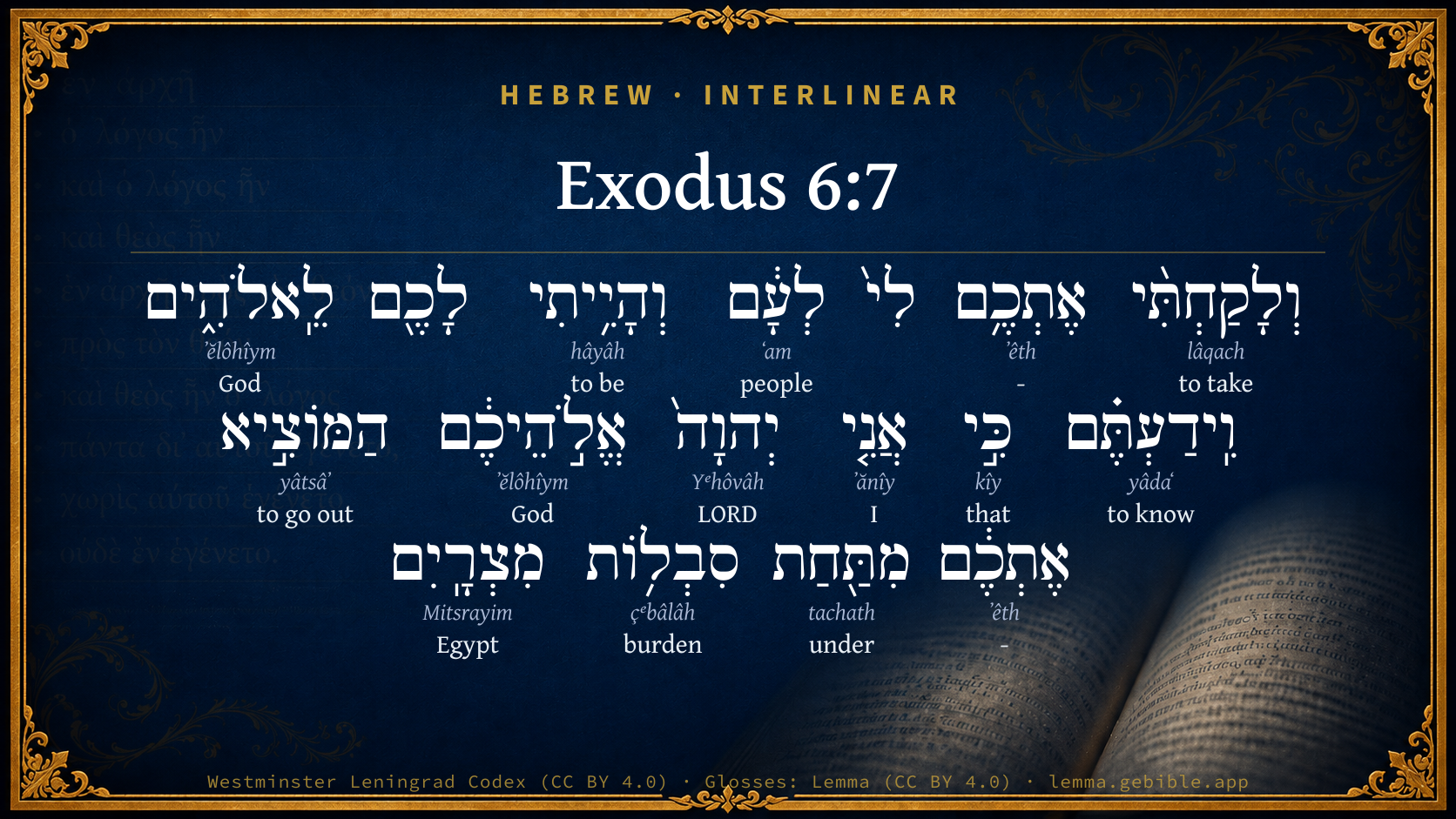
Hebrew (Westminster Leningrad Codex) Exodus 6:7 appears in the Hebrew Old Testament. The text above is from the Westminster Leningrad Codex. Each word links to its Strong’s number, a concise gloss, and parsing drawn from the Open Scriptures Hebrew Bible morphology. Click any word for its full Brown-Driver-Briggs (BDB) entry.
Download image
Cite this verse

Exodus 6:7 (World English Bible). Public Domain. Lemma interlinear Bible study tool, https://lemma.gebible.app/v/exodus/6/7.

Show BibTeX & RIS
BibTeX
RIS
English Translation
and I will take you to me for a people, and I will be to you a God; and you shall know that I am Yahweh your God, who brings you out from under the burdens of the Egyptians.
World English Bible · Public Domain
Download a study sheet

One document with this verse’s original text, its word-by-word gloss line, the meaning frame, cross-references with their text, attributed commentary, and full source and license credits — printable, and it pastes into notes with its structure intact.

This verse Autodidact and up

Study sheet (.html) Plain text (.txt)

A passage Seminary Student

Up to 50 verses in one chapter. A passage sheet keeps up to 6 commentary sources and 12 cross-references per verse, in the order this page ranks them, and says so on the sheet whenever that leaves anything out. Ask for a single verse and you get the Autodidact verse sheet above.

Everything on this page stays free to read, with no account — the sheet is a download of what is already on screen, not access to it.

Want to remove ads? Support Godless Engineer
Compare translations 3

The same verse in 3 English versions, stacked beneath the original-language interlinear above. Click any original word for its lexicon entry.

Each is an independent rendering of the whole verse — the interlinear is not word-aligned to these translations.

Highlighted words mark where these versions differ — a whole-verse word diff, not a word-by-word alignment.

  • World English Bible Public Domain
    and I will take you to me for a people, and I will be to you a God; and you shall know that I am Yahweh your God, who brings you out from under the burdens of the Egyptians.
  • King James Version Public Domain
    And I will take you to me for a people, and I will be to you a God: and ye shall know that I am the LORD your God, which bringeth you out from under the burdens of the Egyptians.
  • unfoldingWord Literal Text CC BY-SA 4.0
    And I will take you to myself as a people, and I will be to you as God. And you will know that I am Yahweh your God, the one bringing you out from under the burdens of the Egyptians.

unfoldingWord Literal Text — © unfoldingWord, licensed CC BY-SA 4.0. Word-aligned USFM3 via Door43 (git.door43.org/unfoldingWord/en_ult).

Versions to compare (up to 4)

3 of 4 selected

Show all 18 translations

Every available English version of this verse, each an independent rendering of the whole verse.

  • World English Bible Public Domain
    and I will take you to me for a people, and I will be to you a God; and you shall know that I am Yahweh your God, who brings you out from under the burdens of the Egyptians.
  • Berean Standard Bible Public Domain
    I will take you as My own people, and I will be your God. Then you will know that I am the LORD your God, who brought you out from under the yoke of the Egyptians.
  • Majority Standard Bible Public Domain
    I will take you as My own people, and I will be your God. Then you will know that I am the LORD your God, who brought you out from under the yoke of the Egyptians.
  • King James Version Public Domain
    And I will take you to me for a people, and I will be to you a God: and ye shall know that I am the LORD your God, which bringeth you out from under the burdens of the Egyptians.
  • American Standard Version (1901) Public Domain
    and I will take you to me for a people, and I will be to you a God; and ye shall know that I am Jehovah your God, who bringeth you out from under the burdens of the Egyptians.
  • Revised Version (1885) Public Domain
    and I will take you to me for a people, and I will be to you a God: and ye shall know that I am Jehovah your God, which bringeth you out from under the burdens of the Egyptians.
  • Geneva Bible (1599) Public Domain
    Also I will take you for my people, and will be your God: then ye shall knowe that I the Lord your God bring you out from the burdens of the Egyptians.
  • Douay-Rheims (1899) Public Domain
    And I will take you to myself for my people, I will be your God: and you shall know that I am the Lord your God who brought you out from the work prison of the Egyptians.
  • Young's Literal Translation Public Domain
    and have taken you to Me for a people, and I have been to you for God, and ye have known that I `am' Jehovah your God, who is bringing you out from under the burdens of the Egyptians;
  • Literal Standard Version CC BY-SA 4.0
    and have taken you to Myself for a people, and I have been to you for God, and you have known that I [am] your God YHWH, who is bringing you out from under the burdens of the Egyptians;
  • Unlocked Literal Bible CC BY-SA 4.0
    I will take you to myself as my people, and I will be your God. You will know that I am Yahweh your God, who brought you out from slavery under the Egyptians.
  • unfoldingWord Literal Text CC BY-SA 4.0
    And I will take you to myself as a people, and I will be to you as God. And you will know that I am Yahweh your God, the one bringing you out from under the burdens of the Egyptians.
  • Darby Bible Public Domain
    And I will take you to me for a people, and will be your God; and ye shall know that I, Jehovah your God, am he who bringeth you out from under the burdens of the Egyptians.
  • World Messianic Bible Public Domain
    I will take you to myself for a people. I will be your God; and you shall know that I am the LORD your God, who brings you out from under the burdens of the Egyptians.
  • Webster's Bible Public Domain
    And I will take you to me for a people, and I will be to you a God: and ye shall know that I am the LORD your God, who bringeth you out from under the burdens of the Egyptians.
  • Free Bible Version CC BY-SA 4.0
    I will make you my own people. Then you will know that I am the Lord your God, who rescued you from slavery in Egypt.
  • Bible in Basic English Public Domain
    And I will take you to be my people and I will be your God; and you will be certain that I am the Lord your God, who takes you out from under the yoke of the Egyptians.
  • JPS Tanakh (1917) Public Domain
    and I will take you to Me for a people, and I will be to you a God; and ye shall know that I am the LORD your God, who brought you out from under the burdens of the Egyptians.

Literal Standard Version (2020), Covenant Press — licensed CC BY-SA 4.0. Text via the HelloAO Bible API (eBible.org). Unlocked Literal Bible (unfoldingWord) — licensed CC BY-SA 4.0. Text via the HelloAO Bible API (eBible.org). unfoldingWord Literal Text — © unfoldingWord, licensed CC BY-SA 4.0. Word-aligned USFM3 via Door43 (git.door43.org/unfoldingWord/en_ult). Free Bible Version, Dr. Jonathan Gallagher — licensed CC BY-SA 4.0. Text via the HelloAO Bible API (eBible.org).

Word by word

More ways to search: Search by grammar → Find every occurrence → Compare this word →

Practice this passage: Drill this verse → Learn its vocabulary →

סִבְל֥וֹת
çᵉbâlâh
H5450
“burdens of”
Noun, Common, Feminine, Plural, Construct
Part of Speech
Noun
Type
Common
Gender
Feminine
Number
Plural
State
Construct
Full BDB Definition

Origin: from H5447

TWOT: 1458c

burden, forced labour, compulsory service, burden bearing
  1. וְלָקַחְתִּ֨י lâqach H3947 “and · to take” Conjunction + Verb, Qal, Sequential Perfect, 1st Person, Common, Singular
  2. אֶתְכֶ֥ם ʼêth H853 “- · you” Particle, Direct Object + Suffix, Personal, 2nd Person, Masculine, Plural
  3. לְעָ֔ם ʻam H5971 “to/for · people” Preposition + Noun, Common, Masculine, Singular, Absolute
  4. וְהָיִ֥יתִי hâyâh H1961 “and · to be” Conjunction + Verb, Qal, Sequential Perfect, 1st Person, Common, Singular
  5. לֵֽאלֹהִ֑ים ʼĕlôhîym H430 “to/for · God(s)” Preposition + Noun, Common, Masculine, Plural, Absolute
  6. וִֽידַעְתֶּ֗ם yâdaʻ H3045 “and · to know” Conjunction + Verb, Qal, Sequential Perfect, 2nd Person, Masculine, Plural
  7. כִּ֣י kîy H3588 “that” Conjunction
  8. אֲנִ֤י ʼănîy H589 “I” Pronoun, Personal, 1st Person, Common, Singular
  9. יְהוָה֙ Yᵉhôvâh H3068 “LORD” Noun, Proper
  10. אֱלֹ֣הֵיכֶ֔ם ʼĕlôhîym H430 “God(s) · your” Noun, Common, Masculine, Plural, Construct + Suffix, Personal, 2nd Person, Masculine, Plural
  11. הַמּוֹצִ֣יא yâtsâʼ H3318 “the · going out” Particle, Definite Article + Verb, Hiphil, Participle Active, Masculine, Singular, Absolute
  12. אֶתְכֶ֔ם ʼêth H853 “- · you” Particle, Direct Object + Suffix, Personal, 2nd Person, Masculine, Plural
  13. מִתַּ֖חַת tachath H8478 “from · under” Preposition + Preposition
  14. מִצְרָֽיִם Mitsrayim H4714 “Egypt” Noun, Proper

About this verse

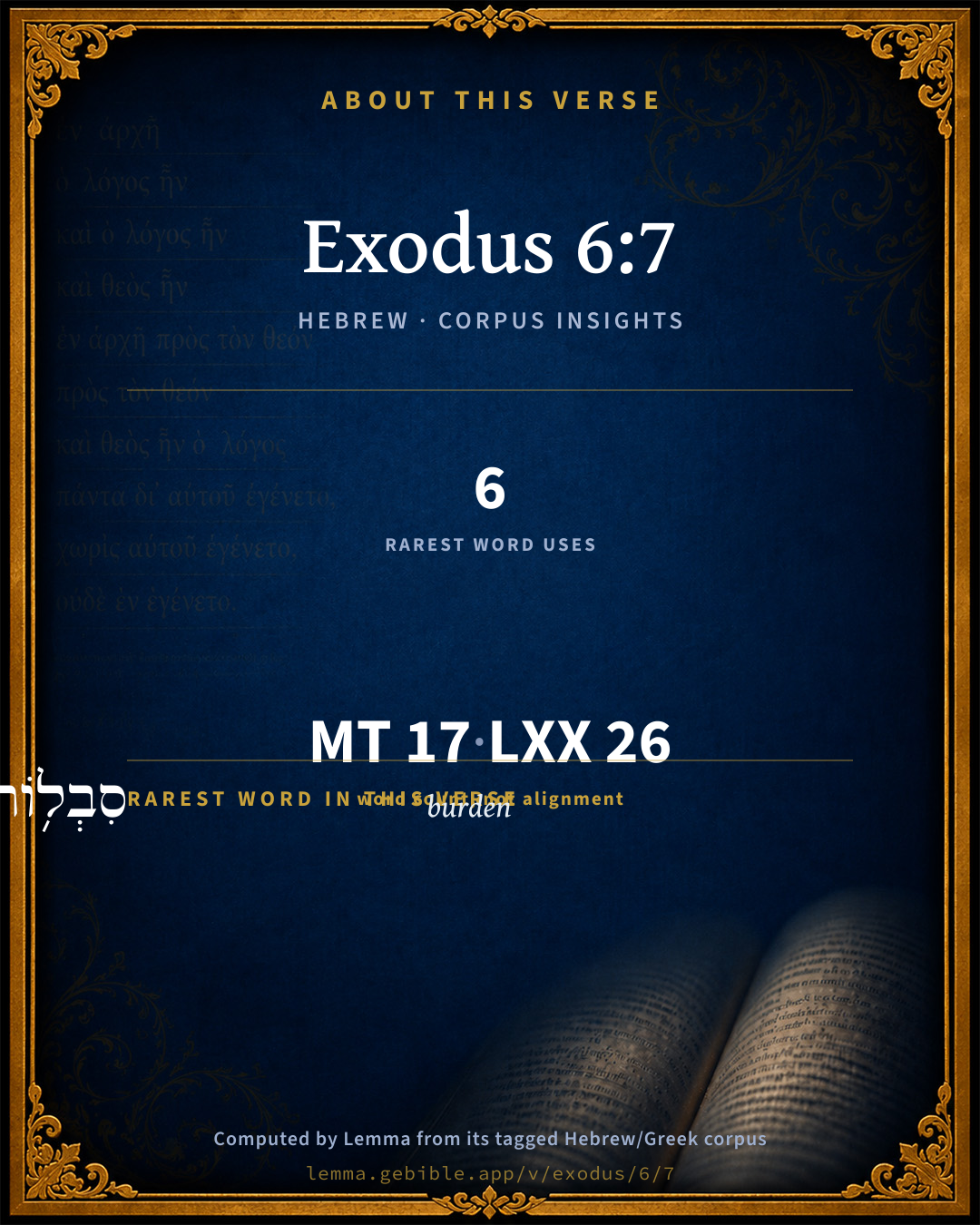
These counts appear in no published source. They are computed here, from the morphology-tagged text and Lemma’s own curated glosses. What Lemma adds →

17
words
13
distinct lemmas
Pentateuch
section

Notable vocabulary

The rarest word here is סִבְל֥וֹת burden H5450 — appearing just 6 times in the whole Hebrew Bible.

Shared distinctive vocabulary

סִבְל֥וֹת burden H5450 occurs in 6 verses of the Hebrew Bible. Also found in:

Grammatical profile

  • 4 verbs
  • 6 nouns
  • 1 pronoun
  • 3 prepositions
  • 1 conjunction
  • 2 particles

Verb forms

  • וְלָקַחְתִּ֨י Qal · Sequential Perfect
  • וְהָיִ֥יתִי Qal · Sequential Perfect
  • וִֽידַעְתֶּ֗ם Qal · Sequential Perfect
  • הַמּוֹצִ֣יא Hiphil · Participle Active

Repetition

A word recurs within this verse — often emphatic in Hebrew:

  • לֵֽאלֹהִ֑ים God H430 ×2

Hebrew & Septuagint length

In English translation the verse runs 39 words from the Hebrew and 37 from the Septuagint (LXX English) — closely comparable.

A rough comparison of the two English renderings, which tokenize alike — not a word-level alignment.

Word counts can differ between the Hebrew and the Greek without any difference in meaning — e.g. the Hebrew direct-object marker אֵת has no separate Greek word, and Greek often adds the article ὁ.

In the original languages it is 17 Hebrew tokens and 26 Greek tokens — but the two are counted differently (Hebrew bundles its prefixes and suffixes into one token; the Greek is in lemma form), so that isn’t a like-for-like length.

Cross-references

23

Topical passages linked to Exodus 6:7 in the Treasury of Scripture Knowledge — connected by theme and wording, ordered by reader-vote popularity; previews shown in the World English Bible.

  • Deuteronomy 7:6 For you are a holy people to Yahweh your God: Yahweh your God has chosen you to be a people for his own possession, above all peoples who are on the face of the earth.
  • Deuteronomy 29:13 that he may establish you this day to himself for a people, and that he may be to you a God, as he spoke to you, and as he swore to your fathers, to Abraham, to Isaac, and to Jacob.
  • Deuteronomy 4:20 But Yahweh has taken you, and brought you forth out of the iron furnace, out of Egypt, to be to him a people of inheritance, as at this day.
  • Genesis 17:7–8 I will establish my covenant between me and you and your seed after you throughout their generations for an everlasting covenant, to be a God to you and to your seed after you.
  • Exodus 29:45–46 I will dwell among the children of Israel, and will be their God.
  • Deuteronomy 14:2 For you are a holy people to Yahweh your God, and Yahweh has chosen you to be a people for his own possession, above all peoples who are on the face of the earth.
  • Deuteronomy 26:18 and Yahweh has declared you this day to be a people for his own possession, as he has promised you, and that you should keep all his commandments;
  • 2 Samuel 7:23–24 What one nation in the earth is like your people, even like Israel, whom God went to redeem to himself for a people, and to make him a name, and to do great things for you, and awesome things for your land, before your people, whom you redeem to you out of Egypt, [from] the nations and their gods?
  • Revelation 21:7 He who overcomes, I will give him these things. I will be his God, and he will be my son.
  • Exodus 5:4–5 The king of Egypt said to them, "Why do you, Moses and Aaron, take the people from their work? Get back to your burdens!"
  • Exodus 6:6 Therefore tell the children of Israel, 'I am Yahweh, and I will bring you out from under the burdens of the Egyptians, and I will rid you out of their bondage, and I will redeem you with an outstretched arm, and with great judgments:
  • Exodus 16:12 "I have heard the murmurings of the children of Israel. Speak to them, saying, 'At evening you shall eat meat, and in the morning you shall be filled with bread: and you shall know that I am Yahweh your God.'"
  • Exodus 19:5–6 Now therefore, if you will indeed obey my voice, and keep my covenant, then you shall be my own possession from among all peoples; for all the earth is mine;
  • Psalms 81:6 "I removed his shoulder from the burden. His hands were freed from the basket.
  • Isaiah 41:20 that they may see, and know, and consider, and understand together, that the hand of Yahweh has done this, and the Holy One of Israel has created it.
  • Jeremiah 31:33 But this is the covenant that I will make with the house of Israel after those days, says Yahweh: I will put my law in their inward parts, and in their heart will I write it; and I will be their God, and they shall be my people:
  • Hosea 1:10 Yet the number of the children of Israel will be as the sand of the sea, which can't be measured nor numbered; and it will come to pass that, in the place where it was said to them, 'You are not my people,' they will be called 'sons of the living God.'
  • Zechariah 13:9 I will bring the third part into the fire, And will refine them as silver is refined, And will test them like gold is tested. They will call on my name, and I will hear them. I will say, 'It is my people;' And they will say, 'Yahweh is my God.'"
  • Matthew 22:32 'I am the God of Abraham, and the God of Isaac, and the God of Jacob?' God is not the God of the dead, but of the living."
  • Romans 8:31 What then shall we say about these things? If God is for us, who can be against us?
  • Hebrews 11:16 But now they desire a better country, that is, a heavenly one. Therefore God is not ashamed of them, to be called their God, for he has prepared a city for them.
  • 1 Peter 2:10 who in time past were no people, but now are God's people, who had not obtained mercy, but now have obtained mercy.
  • Revelation 21:3 I heard a loud voice out of heaven saying, "Behold, God's dwelling is with people, and he will dwell with them, and they will be his people, and God himself will be with them as their God.

Cross-references courtesy of OpenBible.info (CC BY 4.0).

Hebrew and Greek witnesses Masoretic Hebrew ↔ Greek Septuagint

The same verse in the two great witnesses to the Old Testament, shown verse-for-verse.

These are two independent witnesses, not word-aligned to each other, and the Septuagint is shown in lemma (dictionary) form.

Hebrew Exodus 6:7 Masoretic · Westminster Leningrad Codex

וְלָקַחְתִּ֨י אֶתְכֶ֥ם לִי֙ לְעָ֔ם וְהָיִ֥יתִי לָכֶ֖ם לֵֽאלֹהִ֑ים וִֽידַעְתֶּ֗ם כִּ֣י אֲנִ֤י יְהוָה֙ אֱלֹ֣הֵיכֶ֔ם הַמּוֹצִ֣יא אֶתְכֶ֔ם מִתַּ֖חַת סִבְל֥וֹת מִצְרָֽיִם

and I will take you to me for a people, and I will be to you a God; and you shall know that I am Yahweh your God, who brings you out from under the burdens of the Egyptians.

World English Bible · Public Domain

Greek LXX Exodus 6:7 Septuagint · lemma form

καί λαμβάνω ἐμαυτοῦ σύ λαός ἐγώ καί εἰμί σύ θεός καί γιγνώσκω ὅτι ἐγώ κύριος ὁ θεός σύ ὁ ἐκἄγω σύ ἐκ ὁ καταδυναστεία ὁ αἰγύπτιος

And I will take you to me a people for myself, and will be your God; and you⌃ shall know that I am the Lord your God, who brought you out from the tyranny of the Egyptians.

LXX2012 (modern English Septuagint) · Public Domain

Hebrew: Westminster Leningrad Codex (CC BY 4.0). Greek: Septuagint (public domain); English from LXX2012 (modern English Septuagint) (Public Domain). How the Septuagint differs from the Hebrew →

Targum (Aramaic paraphrase)

2

The Targum is the ancient Jewish Aramaic paraphrase of the Hebrew Scriptures — an interpretive translation, not the Hebrew text itself. Onkelos (literal) and Pseudo-Jonathan (expansive) render the Torah, and Jonathan the Prophets. Coverage is partial: where no permissively-licensed English translation exists for a verse, only the Aramaic is shown. This is verse-level text, not a word-by-word alignment to the Hebrew.

  1. Targum Onkelos Torah (Genesis–Deuteronomy)
    וֶאֱקָרֵיב יָתְכוֹן קדָמַי לְעַמָא וְאֶהֱוֵי לְכוֹן לֶאֱלָהּ וְתִדְעוּן אֲרֵי אֲנָא יְיָ אֱלָהָכוֹן דְאַפֵּיק יָתְכוֹן מִגוֹ דְחוֹק פָּלְחַן מִצְרָיִם:

    (no public-domain English translation for this verse)

    Targum Onkelos — Aramaic: “Onkelos Genesis” (public domain); “Onkelos Exodus” (public domain); “Onkelos Leviticus” (public domain); “Onkelos Numbers” (public domain); “Onkelos Deuteronomy” (public domain). English: “Sefaria Community Translation” (CC0 1.0 (public-domain dedication)); “J.W. Etheridge. The Targums of Onkelos and Jonathan Ben Uzziel on the Pentateuch. London: Longmans, Green, 1862” (public domain). Text via Sefaria.

  2. Targum Pseudo-Jonathan Torah (Genesis–Deuteronomy)
    וַאֲקַרֵב יַתְכוֹן קֳדָמַי לְעַם וְאֶהֱוֵי לְכוֹן לֶאֱלָהָא וְתֵידְעוּן אֲרוּם אֲנָא יְיָ אֳלָהָכוֹן דְאַנְפֵּיק יַתְכוֹן מִגוֹ דְחוֹק פּוּלְחַן מִצְרָאֵי

    And I will bring you nigh before Me to be a people, and I will be a God unto you, and you shall know that I am the Lord your God who hath led you forth from the hard service of the Mizraee.

    Targum Pseudo-Jonathan — Aramaic: “Targum Jonathan on Genesis” (public domain); “Targum Jonathan on Exodus” (public domain); “Targum Jonathan on Leviticus” (public domain); “Targum Jonathan on Numbers” (public domain); “Targum Jonathan on Deuteronomy” (public domain). English: “The Targum of Jonathan ben Uzziel, trans. J. W. Etheridge, London, 1862” (public domain). Text via Sefaria.

Commentary

Notes on Exodus 6:7 from classic Christian and Jewish commentators (each source and its license shown beneath its notes). The classic Christian expositions comment on the surrounding passage and are grouped to its opening verse, so a note may address several verses; the Jewish commentaries on the Tanakh (Rashi and others) are per-verse, so they appear only where the commentator wrote on this verse.

Lemma curates 59 commentaries, every one of them public domain or Creative Commons licensed, each selected and text-cleaned for this edition rather than reprinted as found. About our sources →

The Cambridge Bible for Schools and Colleges

gen. ed. J. J. S. Perowne

7. and I will take you to me for a people] to be owned by Me, and enjoy My protection. The thought, as Exo_19:5 (J), Deu_Exo_26:18; cf. also Deu_29:13. The common expression is ‘and ye (or they) shall be to me a people,’ Jer_7:23, Eze_11:20 (and often in Jer. Ez.); Zech. 2:15, 8:8; Lev_26:12 (H).

and I will be to you a God] to be revered by you, and also to be your all-powerful leader, protector, and benefactor. The correlative of the last expression: cf. Gen_17:7-8, Exo_29:45, Lev_11:45; Lev_22:33; Lev_25:38; Lev_26:45, Num_15:41 (all P or H); and together with that expression, Lev_26:12 (H), Deu_26:17; Deu_29:13, Jer_7:23, Eze_11:20 (and often in Jer. Ez.), Zec_8:8.

and ye shall know, &c.] learn by what you witness and experience that I am Jehovah, your Deliverer; so Exo_7:5; Exo_14:4; Exo_14:18; Exo_16:12; Exo_29:46 (all P); cf. Exo_31:13 b (H), and Exo_10:2. Sentences of the type, ‘and ye (they, thou) shall know (viz. by some signal and impressive manifestation of power) that I am Yahweh,’ are extremely common in Ezek., a prophet who in other respects also displays many literary affinities with P, as Exo_6:7; Exo_6:10; Exo_6:13-14, Exo_7:4; Exo_7:9, &c. (more than 50 times altogether): comp. LOT. p. 266 f. (ed. 6–8, p. 295).

The Cambridge Bible for Schools and Colleges (gen. ed. J. J. S. Perowne; Cambridge University Press, 1878–1918) — public domain. Text from a community e-Sword module.

Trapp's Complete Commentary

John Trapp

Exo 6:7 And I will take you to me for a people, and I will be to you a God: and ye shall know that I [am] the LORD your God, which bringeth you out from under the burdens of the Egyptians.

Ver. 7. And I will be to you a God.] This is the top of any man’s happiness, to have God for his God. What can such a man want? {Psa 23:1} As he in Plutarch said of the Egyptians, that though they had no music nor vines among them, yet they had gods. {a}

{a} Plut., Sυμπος.

John Trapp, A Commentary or Exposition upon All the Books of the Old and New Testament (1647–1656) — public domain. Text from a community e-Sword module.

Joseph Benson's Commentary

Exo 6:7-9. I will take you to me for a people — A peculiar people; and I will be to you a God — And more than this we need not ask, we cannot have, to make us happy. I am the Lord — And therefore have power to dispose of lands and kingdoms as I please. But they hearkened not to Moses, for anguish of spirit — That is, they were so taken up with their troubles that they did not heed him.

Joseph Benson's Commentary on the Old and New Testaments (1811–1818) — public domain. Text from a community e-Sword module.

Tyndale Open Study Notes

Tyndale Open Resources

6:7 Then you will know that I am the Lord: The Hebrew word translated know is always based on experience and relationship. The same word is used to describe human sexual relations. To know God as Yahweh is not just to know abstract facts about him, but to be in a relationship with him in which we are always learning who he is and what he wants us to do. This is the only true rescue from the human predicament of sin described in Gen 3–11. The importance of “knowing the Lord” in the book of Exodus is seen in its recurrence, especially in Exod 5–18 (5:2; 7:5, 17; 8:10, 22; 9:29; 10:2; 11:7; 14:4, 18; 16:6, 12; 18:11).

Tyndale Open Study Notes — © Tyndale Open Resources, licensed CC BY-SA 4.0. Text via the HelloAO Bible API.

Geneva Bible (1599)

Geneva Bible translators

He meaneth, as touching the outward vocation, the dignity whereof they lost afterward by their rebellion: but as for election to life everlasting, it is immutable.

Geneva Bible (1599) marginal notes — public domain. Text via Bolls.life.

Adam Clarke's Commentary

Verse 7. I will take you to me for a people, c.] This was precisely the covenant that he had made with Abraham. See Ge 17:7, and See Clarke on Ge 17:7.

And ye shall know that I am the LORD your God] By thus fulfilling my promises ye shall know what is implied in my name. See Clarke on Ex 6:3.

But why should God take such a most stupid, refractory, and totally worthless people for his people?

1. Because he had promised to do so to their noble ancestors Abraham, Isaac, Jacob, Joseph, Judah, c., men worthy of all praise, because in general friends of God, devoted to his will and to the good of mankind.

2. "That (as Bishop Warburton properly observes) the extraordinary providence by which they were protected, might become the more visible and illustrious for had they been endowed with the shining qualities of the more polished nations, the effects of that providence might have been ascribed to their own wisdom."

3. That God might show to all succeeding generations that he delights to instruct the ignorant, help the weak, and save the lost for if he bore long with Israel, showed them especial mercy, and graciously received them whenever they implored his protection, none need despair. God seems to have chosen the worst people in the universe, to give by them unto mankind the highest and most expressive proofs, that he wills not the death of a sinner, but rather that he may turn from his iniquity and live.

Adam Clarke's Commentary on the Bible (1810–1826) — public domain. Text from a community e-Sword/MySword module.

Ellicott's Commentary for English Readers

(7) I will take you to me for a people.—Comp. Exo_19:5-6; Deu_7:6. The selection of Israel as a “peculiar people” did not involve the abandonment of all other nations, as we see by the instances of Balaam, Ruth, Job, Nebuchadnezzar, Darius the Mede, Cyrus, and others. God always continued to “govern all the nations upon the earth” (Psa_67:4); and “in every nation those that feared him and worked righteousness” were accepted with him (Act_10:35). The centurion of the Gospels (Mat_8:5-13, Luk_7:2-10) and Cornelius in the Acts (Act_10:1-33) carry the same principle into Gospel times.

I will be to you a God.—See Gen_17:8.

A Bible Commentary for English Readers, edited by Charles John Ellicott (1878–1897) — public domain. Text from a community e-Sword module.

John Gill's Exposition

And I will bring you in unto the land,.... The land of Canaan:

concerning the which I did swear; or lift up my hand (a), which was a gesture used in swearing, Gen 14:22.

to give it to Abraham, to Isaac, and to Jacob; see Exo 6:4,

and I will give it you for an heritage; to be possessed as an inheritance by them, so long as they were obedient to his will, or until the Messiah came:

I am the Lord; whose counsels of old are faithfulness and truth; whose promises are yea and amen; whose gifts and calling are without repentance; and who is able also to perform whatever he has said he will do.

(a) "levavi manum meam", Pagninus, Montanus, Munster.

John Gill's Exposition of the Whole Bible (1746–1763) — public domain (CC PDM 1.0). Text via the HelloAO Bible API.

Haydock's Catholic Bible Commentary

God, Elohim, who will pass sentence in your favour, as a just judge. (Menochius)

George Leo Haydock (1774–1849), Haydock's Catholic Family Bible and Commentary, 1859 edition — public domain. Excludes Psalms (Douay-Rheims chapter numbering differs from Protestant) and Deuterocanonical books (Catholic canon only).

Matthew Poole's English Annotations

Will take you to me for a people, i.e. for my people; ye shall no longer be the people and slaves of the king of Egypt, but my people and servants, whom I will bless and preserve.

And I will be to you a God, to judge and deliver you.

Matthew Poole's English Annotations on the Holy Bible (1683–1685) — public domain. Text from a community e-Sword/MySword module.

The Pulpit Commentary

A rich promise.

The promise is as rich as it is wonderful, and as wonderful as it is rich will take you to me for a people, and I will be to you a God." It includes

1. The highest honour. Who speaks? The absolute God. To whom? A nation of bondsmen. Yet he says will take you," etc. And he did it, even as he still takes sinners in Christ into union and fellowship with himself adopting them as sons, admitting them to covenant, making them heirs, etc.

2. The highest privilege. All promise and all blessing, for time and for eternity, are wrapped up in this single but most comprehensive word will be to you a God.

3. The most indissoluble of relations. It lasts through time, and extends into eternity, enduring as long as God and the soul and Christ endure, and that is for ever. J.O. (cf. Mat_22:31, Mat_22:32)

The Pulpit Commentary (1880–1919), ed. H.D.M. Spence-Jones & Joseph S. Exell — public domain. Text from a community e-Sword module.

John Wesley's Explanatory Notes

I will take you to me for a people - A peculiar people, and I will be to you a God - And more than this we need not ask, we cannot have, to make us happy.

John Wesley, Explanatory Notes Upon the Whole Bible (1754–1765) — public domain. Text via the GEBible commentary corpus.

Keil & Delitzsch

C. F. Keil & F. Delitzsch

The adoption of Israel as the nation of God took place at Sinai (Exo 19:5). וגו נשׁאתי אשׁר, "with regard to which I have lifted up My hand to give it" (Exo 6:8). Lifting up the hand (sc., towards heaven) is the attitude of swearing (Deu 32:40 cf. Gen 14:22); and these words point back to Gen 22:16. and Gen 26:3 (cf. Gen 24:7 and Gen 50:24).

Keil & Delitzsch — Biblical Commentary on the Old Testament (1861–1891) — public domain (CC PDM 1.0). Text via the HelloAO Bible API. (Old Testament only.)

Ramban (Nachmanides)

Rabbi Moshe ben Nachman (Ramban / Nachmanides)

AND I WILL TAKE YOU TO ME FOR A PEOPLE. That is, when you will come to Mount Sinai and you will accept the Torah. There, [at Mount Sinai], it was said, Then ye shall be Mine own treasure.

AND YE SHALL KNOW THAT I AM THE ETERNAL YOUR G-D WHO BROUGHT YOU OUT FROM UNDER THE BURDENS OF THE EGYPTIANS. The purport thereof, said Rabbi Abraham ibn Ezra, is that it was in the combined mighty power of the higher constellations that the children of Israel should yet stay in the exile. But this is not of the theme of the chapter. Rather He says: “When I will redeem you with an outstretched arm visible to all nations, you shall know that it is I the Eternal Who performs new signs and wonders in the world, and that I am your G-d and for your sake I had so acted, for you are the portions of the Eternal. ”

Ramban (Nachmanides) on the Tanakh — English translation: “Commentary on the Torah by Ramban (Nachmanides). Translated and annotated by Charles B. Chavel. New York, Shilo Pub. House, 1971-1976” (CC BY 4.0). Text via Sefaria.

Ibn Ezra

Rabbi Abraham ibn Ezra

And I will take you, when they receive the Torah on Mount Sinai.

Ibn Ezra on the Tanakh — English translations: “Sefaria Community Translation” (CC0 1.0 (public-domain dedication)); “Yalkut, Sifsei Chachomim Chumash, Metsudah Publications, 2009” (CC BY 4.0); and “Commentary of Ibn Ezra on Isaiah - trans. by M. Friedlander, 1873” (public domain). Text via Sefaria.

Lesson kit

Teaching starters — assembled from the data on this page, not authored interpretation. Every prompt links to the verse data it draws on. Edit before teaching.

Exodus, in the Pentateuch, opens this verse with 17 words (13 distinct Hebrew lemmas). Its most distinctive word is çᵉbâlâh (“burden”). A historical commentator’s framing appears above. Read the whole chapter for the surrounding context.

Discussion questions

  1. How does “burden” (çᵉbâlâh) shape what this verse is saying?
  2. How does Exodus 1:11, which shares the word «burden», read alongside this verse?
  3. What does the repetition of “God” (2× in this one verse) do in this verse?
  4. These translations render this verse differently; the difference is in the English rendering, not the original. What questions does that raise?
  5. «וְלָקַחְתִּ֨י» is a Qal Sequential Perfect verb. How does that grammatical form shape the action described?
  6. Compare how The Cambridge Bible for Schools and Colleges and Trapp's Complete Commentary read this verse. Where do they agree or differ?

Things to notice

Reading settings

Reading text

Shown beneath each verse's original-language words.

Old Testament
Old Testament edition

Read the OT as the Masoretic Hebrew (MT) or the Greek Septuagint (LXX).

English shown for the Greek Septuagint (in the Hebrew ↔ Greek comparison).

Comparing translations? Open the Compare panel on any verse page to stack up to four side by side.