
Ezekiel 20:3

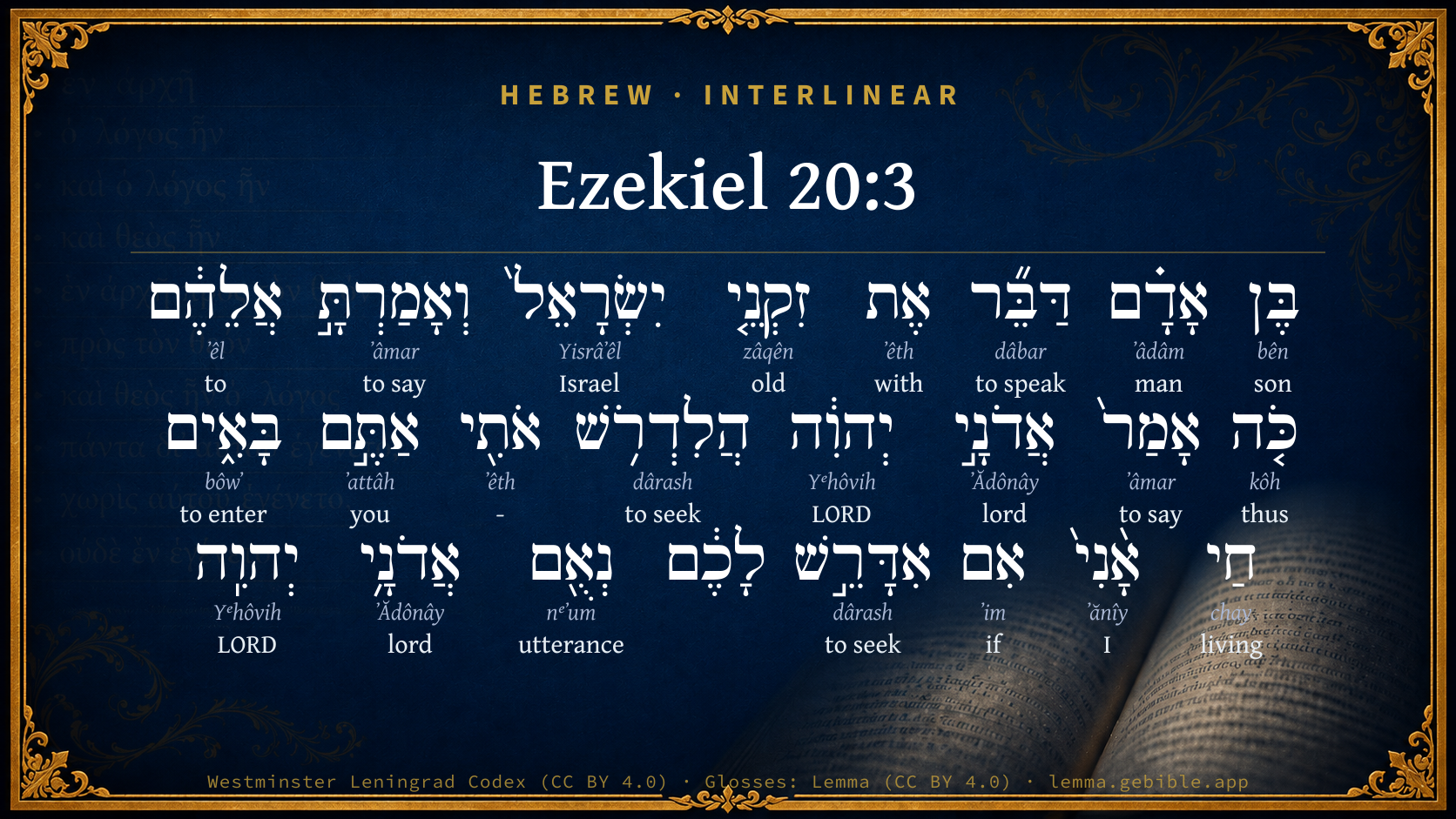
Hebrew (Westminster Leningrad Codex) Ezekiel 20:3 appears in the Hebrew Old Testament. The text above is from the Westminster Leningrad Codex. Each word links to its Strong’s number, a concise gloss, and parsing drawn from the Open Scriptures Hebrew Bible morphology. Click any word for its full Brown-Driver-Briggs (BDB) entry.
Download image
Cite this verse

Ezekiel 20:3 (World English Bible). Public Domain. Lemma interlinear Bible study tool, https://lemma.gebible.app/v/ezekiel/20/3.

Show BibTeX & RIS
BibTeX
RIS
English Translation
Son of man, speak to the elders of Israel, and tell them, Thus says the Lord Yahweh: Is it to inquire of me that you have come? As I live, says the Lord Yahweh, I will not be inquired of by you.
World English Bible · Public Domain
Download a study sheet

One document with this verse’s original text, its word-by-word gloss line, the meaning frame, cross-references with their text, attributed commentary, and full source and license credits — printable, and it pastes into notes with its structure intact.

This verse Autodidact and up

Study sheet (.html) Plain text (.txt)

A passage Seminary Student

Up to 50 verses in one chapter. A passage sheet keeps up to 6 commentary sources and 12 cross-references per verse, in the order this page ranks them, and says so on the sheet whenever that leaves anything out. Ask for a single verse and you get the Autodidact verse sheet above.

Everything on this page stays free to read, with no account — the sheet is a download of what is already on screen, not access to it.

Want to remove ads? Support Godless Engineer
Compare translations 3

The same verse in 3 English versions, stacked beneath the original-language interlinear above. Click any original word for its lexicon entry.

Each is an independent rendering of the whole verse — the interlinear is not word-aligned to these translations.

Highlighted words mark where these versions differ — a whole-verse word diff, not a word-by-word alignment.

  • World English Bible Public Domain
    Son of man, speak to the elders of Israel, and tell them, Thus says the Lord Yahweh: Is it to inquire of me that you have come? As I live, says the Lord Yahweh, I will not be inquired of by you.
  • King James Version Public Domain
    Son of man, speak unto the elders of Israel, and say unto them, Thus saith the Lord GOD; Are ye come to enquire of me? As I live, saith the Lord GOD, I will not be enquired of by you.
  • unfoldingWord Literal Text CC BY-SA 4.0
    “Son of man, declare to the elders of Israel and say to them, ‘The Lord Yahweh says this: Have you come to inquire of me? As I live, I will not be inquired of by you!—this is the Lord Yahweh’s declaration.’

unfoldingWord Literal Text — © unfoldingWord, licensed CC BY-SA 4.0. Word-aligned USFM3 via Door43 (git.door43.org/unfoldingWord/en_ult).

Versions to compare (up to 4)

3 of 4 selected

Show all 18 translations

Every available English version of this verse, each an independent rendering of the whole verse.

  • World English Bible Public Domain
    Son of man, speak to the elders of Israel, and tell them, Thus says the Lord Yahweh: Is it to inquire of me that you have come? As I live, says the Lord Yahweh, I will not be inquired of by you.
  • Berean Standard Bible Public Domain
    “Son of man, speak to the elders of Israel and tell them that this is what the Lord GOD says: Have you come to inquire of Me? As surely as I live, I will not be consulted by you, declares the Lord GOD.
  • Majority Standard Bible Public Domain
    “Son of man, speak to the elders of Israel and tell them that this is what the Lord GOD says: Have you come to inquire of Me? As surely as I live, I will not be consulted by you, declares the Lord GOD.
  • King James Version Public Domain
    Son of man, speak unto the elders of Israel, and say unto them, Thus saith the Lord GOD; Are ye come to enquire of me? As I live, saith the Lord GOD, I will not be enquired of by you.
  • American Standard Version (1901) Public Domain
    Son of man, speak unto the elders of Israel, and say unto them, Thus saith the Lord Jehovah: Is it to inquire of me that ye are come? As I live, saith the Lord Jehovah, I will not be inquired of by you.
  • Revised Version (1885) Public Domain
    Son of man, speak unto the elders of Israel, and say unto them, Thus saith the Lord GOD: Are ye come to inquire of me? As I live, saith the Lord GOD, I will not be inquired of by you.
  • Geneva Bible (1599) Public Domain
    Sonne of man, speake vnto the Elders of Israel, and say vnto them, Thus saith the Lord God, Are ye come to enquire of me? as I liue, sayth the Lord God, when I am asked, I wil not answer you.
  • Douay-Rheims (1899) Public Domain
    Son of man, speak to the ancients of Israel, and say to them: Thus saith the Lord God: Are you come to inquire of me? As I live, I will not answer you, saith the Lord God.
  • Young's Literal Translation Public Domain
    `Son of man, speak with the elders of Israel, and thou hast said unto them, Thus said the Lord Jehovah: To seek Me are ye coming in? I live -- I am not sought by you -- an affirmation of the Lord Jehovah.
  • Literal Standard Version CC BY-SA 4.0
    “Son of man, speak to the elderly of Israel, and you have said to them, Thus said Lord YHWH: Are you coming in to seek Me? [As] I live—I am not sought by you—a declaration of Lord YHWH.
  • Unlocked Literal Bible CC BY-SA 4.0
    “Son of man, declare to the elders of Israel and say to them, 'The Lord Yahweh says this: Have you come to inquire of me? As I live, I will not be inquired of by you!—this is the Lord Yahweh's declaration.'
  • unfoldingWord Literal Text CC BY-SA 4.0
    “Son of man, declare to the elders of Israel and say to them, ‘The Lord Yahweh says this: Have you come to inquire of me? As I live, I will not be inquired of by you!—this is the Lord Yahweh’s declaration.’
  • Darby Bible Public Domain
    Son of man, speak unto the elders of Israel, and say unto them, Thus saith the Lord Jehovah: Are ye come to inquire of me? [As] I live, saith the Lord Jehovah, I will not be inquired of by you.
  • World Messianic Bible Public Domain
    “Son of man, speak to the elders of Israel, and tell them, ‘The Lord GOD says: “Is it to inquire of me that you have come? As I live,” says the Lord GOD, “I will not be inquired of by you.”’
  • Webster's Bible Public Domain
    Son of man, speak to the elders of Israel, and say to them, Thus saith the Lord GOD; Are ye come to inquire of me? As I live, saith the Lord GOD, I will not be inquired of by you.
  • Free Bible Version CC BY-SA 4.0
    “Son of man, tell these elders of Israel that this is what the Lord God says: Have you come to ask my advice? As I live, I'm not going to answer you, declares the Lord God.
  • Bible in Basic English Public Domain
    Son of man, say to the responsible men of Israel, This is what the Lord has said: Have you come to get directions from me? By my life, says the Lord, you will get no directions from me.
  • JPS Tanakh (1917) Public Domain
    'Son of man, speak unto the elders of Israel, and say unto them: Thus saith the Lord GOD: Are ye come to inquire of Me? As I live, saith the Lord GOD, I will not be inquired of by you.

Literal Standard Version (2020), Covenant Press — licensed CC BY-SA 4.0. Text via the HelloAO Bible API (eBible.org). Unlocked Literal Bible (unfoldingWord) — licensed CC BY-SA 4.0. Text via the HelloAO Bible API (eBible.org). unfoldingWord Literal Text — © unfoldingWord, licensed CC BY-SA 4.0. Word-aligned USFM3 via Door43 (git.door43.org/unfoldingWord/en_ult). Free Bible Version, Dr. Jonathan Gallagher — licensed CC BY-SA 4.0. Text via the HelloAO Bible API (eBible.org).

Word by word

More ways to search: Search by grammar → Find every occurrence → Compare this word →

Practice this passage: Drill this verse → Learn its vocabulary →

הֲלִדְרֹ֥שׁ
dârash
H1875
“to seek”
Particle, Interrogative + Preposition + Verb, Qal, Infinitive Construct
Part of Speech
Particle + Preposition + Verb
Stem
Qal
Form
Infinitive Construct
Full BDB Definition

Origin: a primitive root

TWOT: 455

to resort to, seek, seek with care, enquire, require - (Qal) - to resort to, frequent (a place), (tread a place) - to consult, enquire of, seek - of God - of heathen gods, necromancers - to seek deity in prayer and worship - God - heathen deities - to seek (with a demand), demand, require - to investigate, enquire - to ask for, require, demand - to practice, study, follow, seek with application - to seek with care, care for - (Niphal) - to allow oneself to be enquired of, consulted (only of God) - to be sought, be sought out - to be required (of blood)
  1. בֶּן bên H1121 “son of” Noun, Common, Masculine, Singular, Construct
  2. אָדָ֗ם ʼâdâm H120 “man” Noun, Common, Masculine, Singular, Absolute
  3. דַּבֵּ֞ר dâbar H1696 “speak” Verb, Piel, Imperative, 2nd Person, Masculine, Singular
  4. אֶת ʼêth H854 “with” Preposition
  5. זִקְנֵ֤י zâqên H2205 “old of” Adjective, Adjective, Masculine, Plural, Construct
  6. יִשְׂרָאֵל֙ Yisrâʼêl H3478 “Israel” Noun, Proper
  7. וְאָמַרְתָּ֣ ʼâmar H559 “and · to say” Conjunction + Verb, Qal, Sequential Perfect, 2nd Person, Masculine, Singular
  8. אֲלֵהֶ֔ם ʼêl H413 “to · them” Preposition + Suffix, Personal, 3rd Person, Masculine, Plural
  9. כֹּ֤ה kôh H3541 “thus” Adverb
  10. אָמַר֙ ʼâmar H559 “to say” Verb, Qal, Perfect, 3rd Person, Masculine, Singular
  11. אֲדֹנָ֣י ʼĂdônây H136 “Lord · my” Noun, Common, Masculine, Plural, Construct + Suffix, Personal, 1st Person, Common, Singular
  12. יְהוִ֔ה Yᵉhôvih H3069 “LORD” Noun, Proper
  13. אֹתִ֖י ʼêth H853 “- · me” Particle, Direct Object + Suffix, Personal, 1st Person, Common, Singular
  14. אַתֶּ֣ם ʼattâh H859 “you” Pronoun, Personal, 2nd Person, Masculine, Plural
  15. בָּאִ֑ים bôwʼ H935 “entering” Verb, Qal, Participle Active, Masculine, Plural, Absolute
  16. חַי chay H2416 “living” Adjective, Adjective, Masculine, Singular, Absolute
  17. אָ֨נִי֙ ʼănîy H589 “I” Pronoun, Personal, 1st Person, Common, Singular
  18. אִם ʼim H518 “if” Conjunction
  19. אִדָּרֵ֣שׁ dârash H1875 “to seek” Verb, Niphal, Imperfect, 1st Person, Common, Singular
  20. נְאֻ֖ם nᵉʼum H5002 “utterance of” Noun, Common, Masculine, Singular, Construct
  21. אֲדֹנָ֥י ʼĂdônây H136 “Lord · my” Noun, Common, Masculine, Plural, Construct + Suffix, Personal, 1st Person, Common, Singular
  22. יְהוִֽה Yᵉhôvih H3069 “LORD” Noun, Proper

About this verse

These counts appear in no published source. They are computed here, from the morphology-tagged text and Lemma’s own curated glosses. What Lemma adds →

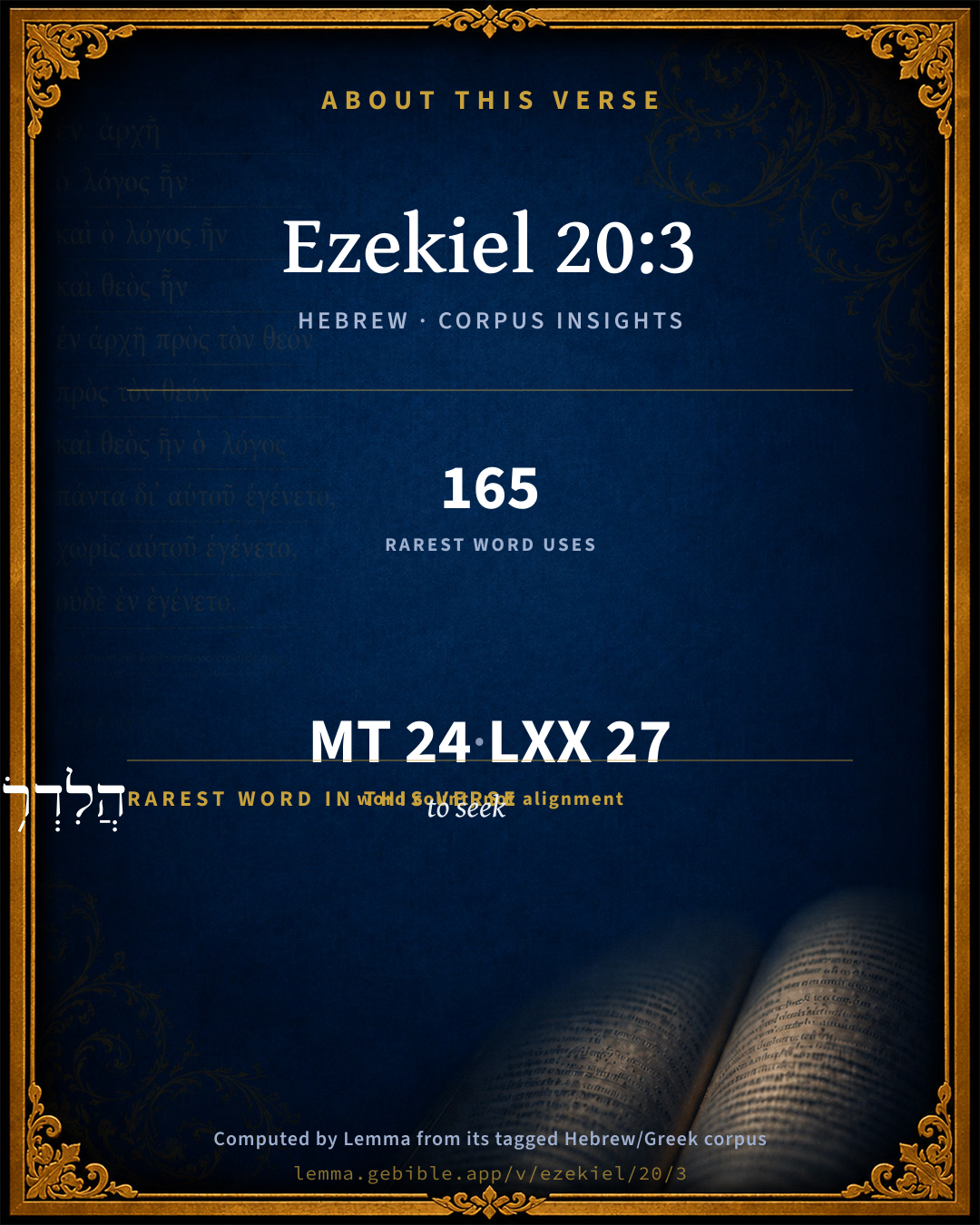
24
words
19
distinct lemmas
Prophets
section

Grammatical profile

  • 6 verbs
  • 8 nouns
  • 2 adjectives
  • 2 pronouns
  • 3 prepositions
  • 1 conjunction
  • 1 adverb
  • 1 particle

Verb forms

  • דַּבֵּ֞ר Piel · Imperative
  • וְאָמַרְתָּ֣ Qal · Sequential Perfect
  • אָמַר֙ Qal · Perfect
  • הֲלִדְרֹ֥שׁ Qal · Infinitive Construct
  • בָּאִ֑ים Qal · Participle Active
  • אִדָּרֵ֣שׁ Niphal · Imperfect

Repetition

Words recur within this verse — often emphatic in Hebrew:

  • וְאָמַרְתָּ֣ to say H559 ×2
  • אֲדֹנָ֣י lord H136 ×2
  • יְהוִ֔ה LORD H3069 ×2
  • הֲלִדְרֹ֥שׁ to seek H1875 ×2

Hebrew & Septuagint length

In English translation the verse runs 42 words from the Hebrew and 43 from the Septuagint (LXX English) — closely comparable.

A rough comparison of the two English renderings, which tokenize alike — not a word-level alignment.

Word counts can differ between the Hebrew and the Greek without any difference in meaning — e.g. the Hebrew direct-object marker אֵת has no separate Greek word, and Greek often adds the article ὁ.

In the original languages it is 24 Hebrew tokens and 27 Greek tokens — but the two are counted differently (Hebrew bundles its prefixes and suffixes into one token; the Greek is in lemma form), so that isn’t a like-for-like length.

Cross-references

15

Topical passages linked to Ezekiel 20:3 in the Treasury of Scripture Knowledge — connected by theme and wording, ordered by reader-vote popularity; previews shown in the World English Bible.

  • Psalms 50:15–21 Call on me in the day of trouble. I will deliver you, and you will honor me."
  • Proverbs 28:9 He who turns away his ear from hearing the law, Even his prayer is an abomination.
  • Micah 3:7 The seers shall be disappointed, And the diviners confounded. Yes, they shall all cover their lips; For there is no answer from God."
  • Matthew 15:8–9 'These people draw near to me with their mouth, And honor me with their lips; But their heart is far from me.
  • 1 Samuel 28:6 When Saul inquired of Yahweh, Yahweh didn't answer him, neither by dreams, nor by Urim, nor by prophets.
  • Proverbs 15:8 The sacrifice made by the wicked is an abomination to Yahweh, But the prayer of the upright is his delight.
  • Proverbs 21:27 The sacrifice of the wicked is an abomination: How much more, when he brings it with a wicked mind!
  • Isaiah 1:12 When you come to appear before me, Who has required this at your hand, to trample my courts?
  • Isaiah 1:15 When you spread forth your hands, I will hide my eyes from you; Yes, when you make many prayers, I will not hear. Your hands are full of blood.
  • Ezekiel 14:3–4 Son of man, these men have taken their idols into their heart, and put the stumbling block of their iniquity before their face: should I be inquired of at all by them?
  • Ezekiel 14:7–8 For everyone of the house of Israel, or of the strangers who sojourn in Israel, who separates himself from me, and takes his idols into his heart, and puts the stumbling block of his iniquity before his face, and comes to the prophet to inquire for himself of me; I Yahweh will answer him by myself:
  • Ezekiel 20:31 and when you offer your gifts, when you make your sons to pass through the fire, do you pollute yourselves with all your idols to this day? and shall I be inquired of by you, house of Israel? As I live, says the Lord Yahweh, I will not be inquired of by you;
  • Matthew 3:7 But when he saw many of the Pharisees and Sadducees coming for his baptism, he said to them, "You offspring of vipers, who warned you to flee from the wrath to come?
  • Luke 3:7 He said therefore to the multitudes who went out to be baptized by him, "You offspring of vipers, who warned you to flee from the wrath to come?
  • John 4:24 God is spirit, and those who worship him must worship in spirit and truth."

Cross-references courtesy of OpenBible.info (CC BY 4.0).

Hebrew and Greek witnesses Masoretic Hebrew ↔ Greek Septuagint

The same verse in the two great witnesses to the Old Testament, shown verse-for-verse.

These are two independent witnesses, not word-aligned to each other, and the Septuagint is shown in lemma (dictionary) form.

Hebrew Ezekiel 20:3 Masoretic · Westminster Leningrad Codex

בֶּן אָדָ֗ם דַּבֵּ֞ר אֶת זִקְנֵ֤י יִשְׂרָאֵל֙ וְאָמַרְתָּ֣ אֲלֵהֶ֔ם כֹּ֤ה אָמַר֙ אֲדֹנָ֣י יְהוִ֔ה הֲלִדְרֹ֥שׁ אֹתִ֖י אַתֶּ֣ם בָּאִ֑ים חַי אָ֨נִי֙ אִם אִדָּרֵ֣שׁ לָכֶ֔ם נְאֻ֖ם אֲדֹנָ֥י יְהוִֽה

Son of man, speak to the elders of Israel, and tell them, Thus says the Lord Yahweh: Is it to inquire of me that you have come? As I live, says the Lord Yahweh, I will not be inquired of by you.

World English Bible · Public Domain

Greek LXX Ezekiel 20:3 Septuagint · lemma form

υἱός ἄνθρωπος λαλέω πρός ὁ πρεσβύτερος ὁ ἰσραήλ καί εἶπον πρός αὐτός ὅδε λέγω κύριος εἰ ἐπιἐρωτάω ἐγώ σύ ἔρχομαι ζάω ἐγώ εἰ ἀποκρίνω σύ λέγω κύριος

Son of man, speak to the elders of the house of Israel, and you shall say to them, Thus says the Lord; Are you⌃ come to enquire of me? As I live, I will not be enquired of by you, says the Lord.

LXX2012 (modern English Septuagint) · Public Domain

Hebrew: Westminster Leningrad Codex (CC BY 4.0). Greek: Septuagint (public domain); English from LXX2012 (modern English Septuagint) (Public Domain). How the Septuagint differs from the Hebrew →

Targum (Aramaic paraphrase)

1

The Targum is the ancient Jewish Aramaic paraphrase of the Hebrew Scriptures — an interpretive translation, not the Hebrew text itself. Onkelos (literal) and Pseudo-Jonathan (expansive) render the Torah, and Jonathan the Prophets. Coverage is partial: where no permissively-licensed English translation exists for a verse, only the Aramaic is shown. This is verse-level text, not a word-by-word alignment to the Hebrew.

  1. Targum Jonathan Prophets (Joshua–Malachi)
    בַּר אָדָם אִתְנַבֵּי לְסָבֵי יִשְׂרָאֵל וְתֵימַר לְהוֹן כִּדְנַן אֲמַר יְיָ אֱלֹהִים הַלְמִתְבַּע אוּלְפַן מִן קֳדָמַי אַתּוּן אָתָן קַיָם אֲנָא אִם אֶשְׁתְּאֵיל לְכוֹן בְּמֵימְרִי אֲמַר יְיָ אֱלֹהִים:

    (no public-domain English translation for this verse)

    Targum Jonathan — Aramaic: “Mikraot Gedolot” (public domain). English: “Sefaria Community Translation” (CC0 1.0 (public-domain dedication)); “London "Chaldee Paraphrase," 1871” (public domain). Text via Sefaria.

Commentary

Notes on Ezekiel 20:3 from classic Christian and Jewish commentators (each source and its license shown beneath its notes). The classic Christian expositions comment on the surrounding passage and are grouped to its opening verse, so a note may address several verses; the Jewish commentaries on the Tanakh (Rashi and others) are per-verse, so they appear only where the commentator wrote on this verse.

Lemma curates 59 commentaries, every one of them public domain or Creative Commons licensed, each selected and text-cleaned for this edition rather than reprinted as found. About our sources →

Trapp's Complete Commentary

John Trapp

Eze 20:3 Son of man, speak unto the elders of Israel, and say unto them, Thus saith the Lord GOD; Are ye come to enquire of me? [As] I live, saith the Lord GOD, I will not be enquired of by you.

Ver. 3. Are ye come to inquire of me?] q.d., I scorn the motion, I loathe your false looks, be packing with your putrid hypocrisy. God will detect and shame gross hypocrites, as he did Jeroboam’s wife, the rotten hearted Pharisees, Ananias and Sapphira, that sorry couple, that consented to "tempt the Holy Ghost," as these elders also did - that is, to make trial whether he be omniscient, and able to detect and punish them.

I will not be inquired of by you.] "The sacrifice of the wicked is abomination; how much more when he bringeth it with a wicked mind?" as these did. {Pro 21:27}

John Trapp, A Commentary or Exposition upon All the Books of the Old and New Testament (1647–1656) — public domain. Text from a community e-Sword module.

Jamieson, Fausset & Brown

Robert Jamieson, A. R. Fausset & David Brown

The chapter falls into two great parts: Eze. 20:1-32, the recital of the people's rebellions during five distinct periods: in Egypt, the wilderness, on the borders of Canaan when a new generation arose, in Canaan, and in the time of the prophet.

I will not be inquired of by you--because their moral state precluded them from capability of knowing the will of God (Psa 66:18; Pro 28:9; Joh 7:17).

Jamieson, Fausset & Brown — Commentary Critical and Explanatory on the Whole Bible (1871) — public domain (CC PDM 1.0). Text via the HelloAO Bible API.

Adam Clarke's Commentary

Verse 3. I will not be inquired of by you.] I will not hear you. I will have nothing to do with you.

Adam Clarke's Commentary on the Bible (1810–1826) — public domain. Text from a community e-Sword/MySword module.

John Calvin's Commentaries

Here the Prophet is ordered to blame those elders, although they pretended to rare piety in inquiring of him: God says that they did not come with a right disposition. Many translate otherwise — if I shall be found, or be en-treated by you, or if I shall answer: thus they take the word, דרש, deresh, in a double sense: in the first clause, for to seek or interrogate; but when it is added, as I live, etc., they do not take the word by “to be sought” or “interrogated,” but by “to answer” or “be entreated.” But this seems far-fetched and in Ezekiel 14:3, a phrase not unlike this was explained; and hence we may gather, that God rather inveighs against the people’s hypocrisy than rejects them, and refuses to answer. There the Prophet said that the elders came to consult him, as if they had been his best disciples; but as Ezekiel might be deceived by that deceptive picture, God meets him, and says, Do you think that they come to inquire of me? They are fixed upon their idols; for their heart is towards them, and they raise their eyes to their own abominations: As I live, if they seek me, says he; that is, it is easy to convict them of bad faith, when they come suppliantly to inquire of thee. For if they truly and heartily sought me, they would renounce their idols, and would no longer partake of their abominations; but they do not repent, but remain obstinate in their wickedness. It is certain, therefore, that they are by no means sincere: there is no reason why you should delay them, or trouble yourself about them, since their conduct is mere dissimulation. So, therefore, in this passage God pronounced by his Prophet, are you come to seek me? that is, to consult me. I will not be inquired of by you, says he: the reason is, because, as we saw in the Ezekiel 14th, they always remained the same, since therefore they were at the greatest distance from God, and remained wrapped up in their own abominations, their seeking God was only fallacious. The conclusion is, that God rejected them, because, though they pretended a holy zeal, they were still perverse in their disposition; hence God refuses to discharge the office of a master towards them since they did not come to learn: this is one point. He then says, if I shall be inquired of by you. And because their hypocrisy was stained by various colors, God swears that their disposition was perverse, and that they did not come with pious and holy affections, and were neither docile nor obedient, nor desirous of making progress, and hence were unworthy of having him for a teacher. Now let us go on.

John Calvin's Commentaries (1540-1563) — public domain. Text from the Calvin Translation Society English edition (1840s-50s) via the Christian Classics Ethereal Library (ccel.org). Calvin's coverage is partial (roughly two-thirds of the Bible); uncommented books and verses are honest gaps, never fabricated. The 19th-century editor's footnotes and remarks are omitted so the notes are faithfully Calvin's own voice.

Ellicott's Commentary for English Readers

(3) I will not be enquired of by you.—As in Eze_14:3. St. Jerome thus comments on the words:—“ To the holy, and to those who ask for right things, the promise is given, ‘While they are yet speaking, I will say, Here I am;’ but to sinners, such as these elders of Israel were, and as those whose sins the prophet proceeds to describe, no answer is given, but only a fierce rebuke for their sins, to which He adds His oath,. ‘As I live,’ to strengthen His solemn refusal.”

A Bible Commentary for English Readers, edited by Charles John Ellicott (1878–1897) — public domain. Text from a community e-Sword module.

The Cambridge Bible for Schools and Colleges

gen. ed. J. J. S. Perowne

3. will not be inquired of] The proposed enquiries of the elders probably related to something in the present; to such men no answer will be given except to read the lesson of Israel’s history to them. For the history concerns them. They are one in spirit and conduct with Israel of the past, and the principles which have ruled the former history will rule also the history to come.

The Cambridge Bible for Schools and Colleges (gen. ed. J. J. S. Perowne; Cambridge University Press, 1878–1918) — public domain. Text from a community e-Sword module.

John Gill's Exposition

Son of man, speak unto the elders of Israel, and say unto them,.... Give them this for an answer from me:

thus saith the Lord God, are ye come to inquire of me? no; not seriously, heartily, and in good earnest, determining to abide by the advice and counsel that might be given; or how can you have the face to inquire of me, when guilty of such abominations?

as I live, saith the Lord God, I will not be inquired of by you; knowing their wickedness and hypocrisy, which were detestable to him, and therefore would not hear what they had to say, nor give them any answer, or direct them what they should do. Sad is the case of persons when the Lord will not be inquired of by them! it is plain he has no favours to bestow upon them; for, when he has, he will put them upon inquiring of him for them, to do them unto them, Eze 36:37; this was the case of Saul, whom God, when he inquired of him, would not answer in any of his usual ways, Sa1 28:6.

John Gill's Exposition of the Whole Bible (1746–1763) — public domain (CC PDM 1.0). Text via the HelloAO Bible API.

Albert Barnes' Notes on the Bible

Enquire - As to the hope of deliverance from the Babylonians.

Albert Barnes' Notes on the Bible (1834–1885) — public domain. Text from a community e-Sword/MySword module.

Matthew Poole's English Annotations

Son of man: see Eze 2:3.

Speak unto the elders of Israel; speak plainly, boldly, and to their faces, fear not their frowns; if they are deputies from Zedekiah, yet let not that character make thee mealymouthed.

Thus saith the Lord God: this expression carries enough to encourage him.

Are ye come to inquire of me? are ye in good earnest? Nay, but you act a deep hypocrisy, being already resolved on your own course, and yet now pretend you would know my counsel. It is a sharp reproof of their wickedness, and God utterly refuseth to be inquired of by such.

As I live: see Eze 14:16.

I will not be inquired of by you, profane hypocrites, that abuse my prophet, and tempt his God. They are, as all politicians who have less of religion than worldly wisdom, willing to hear whether the prophet will flatter, and fawn, and encourage them; if so, then he is a wise, able, honest man; else a sot to be slighted.

Matthew Poole's English Annotations on the Holy Bible (1683–1685) — public domain. Text from a community e-Sword/MySword module.

The Pulpit Commentary

As I live, saith the Lord God, etc. The inquirers are answered, but not as they expected. Instead of hearing of the "times and seasons" of the events that were in the near future, the prophet at once enters on his stern work as a preacher. The general principle that determines the refusal to answer has been given in Eze_14:3.

The Pulpit Commentary (1880–1919), ed. H.D.M. Spence-Jones & Joseph S. Exell — public domain. Text from a community e-Sword module.

John Wesley's Explanatory Notes

Are ye come - Are ye in good earnest?

John Wesley, Explanatory Notes Upon the Whole Bible (1754–1765) — public domain. Text via the GEBible commentary corpus.

Rashi

Rabbi Shlomo Yitzchaki (Rashi)

I will not be inquired of by you! in your request. Yet at the end of this Book (36:37): He says: “I will...be inquired of by the house of Israel.” This is one of the places that teach us that the Holy One, blessed be He, recants on evil. And regarding matters similar to this, it is said (Num. 23:19): “He says but He does not do.” Midrash of Rabbi Tanchuma (Vayera 13).

Rashi on the Tanakh — English translations: “The Judaica Press complete Tanach with Rashi, translated by A. J. Rosenberg” (CC BY 4.0); “Pentateuch with Rashi's commentary by M. Rosenbaum and A.M. Silbermann, 1929-1934” (public domain); “The Metsudah Tanach series, Lakewood, N.J” (CC BY 4.0); and “The Book of Joshua, Metsudah Publications, 1997” (CC BY 4.0). Text via Sefaria.

Lesson kit

Teaching starters — assembled from the data on this page, not authored interpretation. Every prompt links to the verse data it draws on. Edit before teaching.

Ezekiel, in the Prophets, opens this verse with 24 words (19 distinct Hebrew lemmas). Its most distinctive word is dârash (“to seek”). A historical commentator’s framing appears above. Read the whole chapter for the surrounding context.

Discussion questions

  1. How does “to seek” (dârash) shape what this verse is saying?
  2. Psalms 50:15–21 shares this passage’s theme. How do the two illuminate each other?
  3. “to say” occurs 2× in this one verse. What is the effect of the repetition?
  4. These translations render this verse differently; the difference is in the English rendering, not the original. What questions does that raise?
  5. The verb «דַּבֵּ֞ר» is Piel Imperative. How does its form color the action?
  6. Reading how Trapp's Complete Commentary and Jamieson, Fausset & Brown read this verse, where do the two commentators agree and where do they part?

Things to notice

Reading settings

Reading text

Shown beneath each verse's original-language words.

Old Testament
Old Testament edition

Read the OT as the Masoretic Hebrew (MT) or the Greek Septuagint (LXX).

English shown for the Greek Septuagint (in the Hebrew ↔ Greek comparison).

Comparing translations? Open the Compare panel on any verse page to stack up to four side by side.