
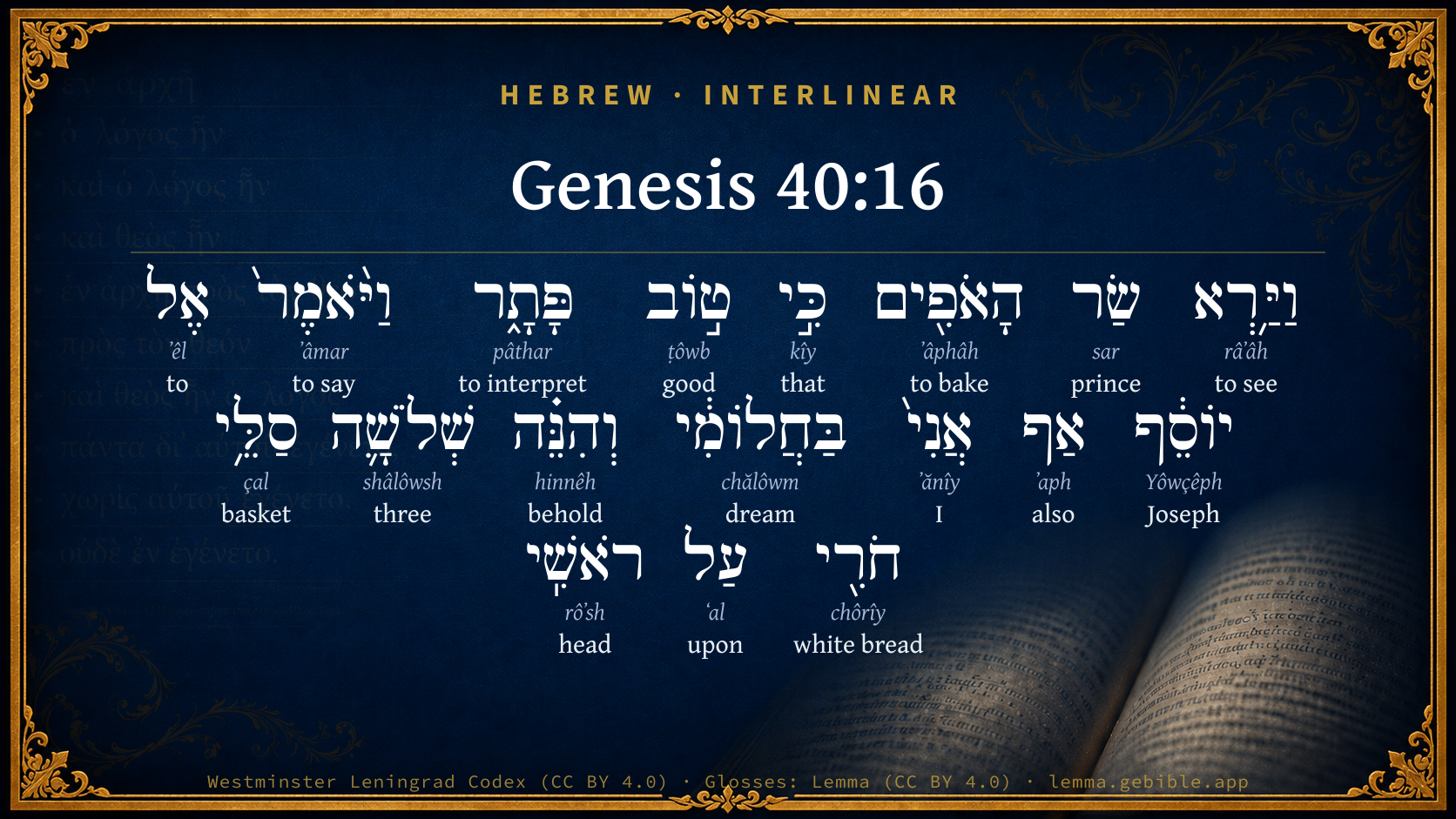
Genesis 40:16

Hebrew (Westminster Leningrad Codex) Genesis 40:16 appears in the Hebrew Old Testament. The text above is from the Westminster Leningrad Codex. Each word links to its Strong’s number, a concise gloss, and parsing drawn from the Open Scriptures Hebrew Bible morphology. Click any word for its full Brown-Driver-Briggs (BDB) entry.
Download image
Cite this verse

Genesis 40:16 (World English Bible). Public Domain. Lemma interlinear Bible study tool, https://lemma.gebible.app/v/genesis/40/16.

Show BibTeX & RIS
BibTeX
RIS
English Translation
When the chief baker saw that the interpretation was good, he said to Joseph, "I also was in my dream, and, behold, three baskets of white bread were on my head.
World English Bible · Public Domain
Highlights
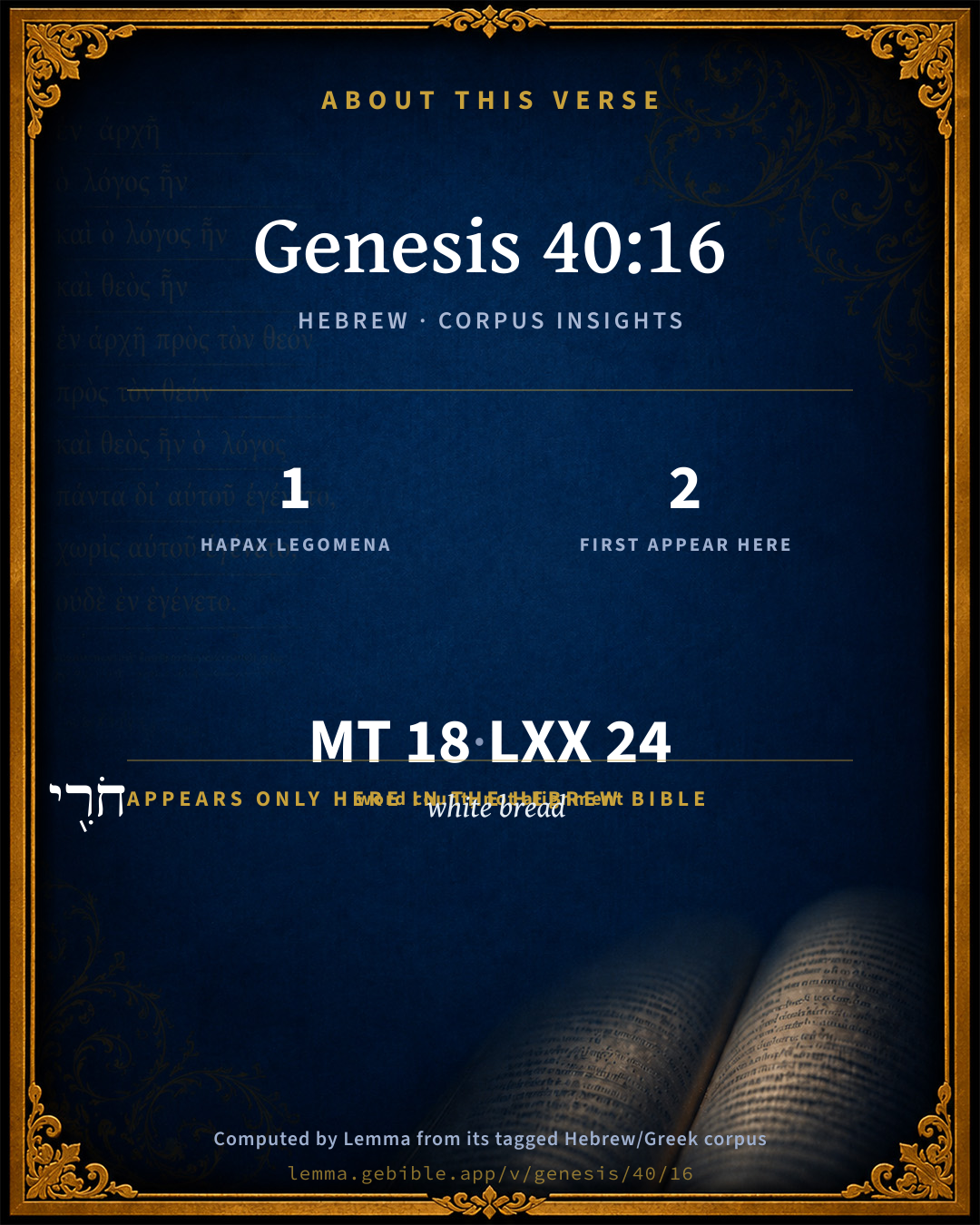
  • 1 hapax legomenon — only here in the Hebrew Bible
  • 2 first appearances in the Hebrew Bible
Full analysis ↓
Download a study sheet

One document with this verse’s original text, its word-by-word gloss line, the meaning frame, cross-references with their text, attributed commentary, and full source and license credits — printable, and it pastes into notes with its structure intact.

This verse Autodidact and up

Study sheet (.html) Plain text (.txt)

A passage Seminary Student

Up to 50 verses in one chapter. A passage sheet keeps up to 6 commentary sources and 12 cross-references per verse, in the order this page ranks them, and says so on the sheet whenever that leaves anything out. Ask for a single verse and you get the Autodidact verse sheet above.

Everything on this page stays free to read, with no account — the sheet is a download of what is already on screen, not access to it.

Want to remove ads? Support Godless Engineer
Compare translations 3

The same verse in 3 English versions, stacked beneath the original-language interlinear above. Click any original word for its lexicon entry.

Each is an independent rendering of the whole verse — the interlinear is not word-aligned to these translations.

Highlighted words mark where these versions differ — a whole-verse word diff, not a word-by-word alignment.

  • World English Bible Public Domain
    When the chief baker saw that the interpretation was good, he said to Joseph, "I also was in my dream, and, behold, three baskets of white bread were on my head.
  • King James Version Public Domain
    When the chief baker saw that the interpretation was good, he said unto Joseph, I also was in my dream, and, behold, I had three white baskets on my head:
  • unfoldingWord Literal Text CC BY-SA 4.0
    And the chief of the bakers saw that he interpreted favorably, so he said to Joseph, “I also in my dream, and behold, three baskets of white bread on my head.

unfoldingWord Literal Text — © unfoldingWord, licensed CC BY-SA 4.0. Word-aligned USFM3 via Door43 (git.door43.org/unfoldingWord/en_ult).

Versions to compare (up to 4)

3 of 4 selected

Show all 18 translations

Every available English version of this verse, each an independent rendering of the whole verse.

  • World English Bible Public Domain
    When the chief baker saw that the interpretation was good, he said to Joseph, "I also was in my dream, and, behold, three baskets of white bread were on my head.
  • Berean Standard Bible Public Domain
    When the chief baker saw that the interpretation was favorable, he said to Joseph, “I too had a dream: There were three baskets of white bread on my head.
  • Majority Standard Bible Public Domain
    When the chief baker saw that the interpretation was favorable, he said to Joseph, “I too had a dream: There were three baskets of white bread on my head.
  • King James Version Public Domain
    When the chief baker saw that the interpretation was good, he said unto Joseph, I also was in my dream, and, behold, I had three white baskets on my head:
  • American Standard Version (1901) Public Domain
    When the chief baker saw that the interpretation was good, he said unto Joseph, I also was in my dream, and, behold, three baskets of white bread were on my head:
  • Revised Version (1885) Public Domain
    When the chief baker saw that the interpretation was good, he said unto Joseph, I also was in my dream, and, behold, three baskets of white bread were on my head:
  • Geneva Bible (1599) Public Domain
    And when the chiefe baker sawe that the interpretation was good, hee saide vnto Ioseph, Also mee thought in my dreame that I had three white baskets on mine head.
  • Douay-Rheims (1899) Public Domain
    For I was stolen away out of the land I of the Hebrews, and here without any fault was cast into the dungeon.
  • Young's Literal Translation Public Domain
    And the chief of the bakers seeth that he hath interpreted good, and he saith unto Joseph, `I also `am' in a dream, and lo, three baskets of white bread `are' on my head,
  • Literal Standard Version CC BY-SA 4.0
    And the chief of the bakers sees that he has interpreted good, and he says to Joseph, “I also [am] in a dream, and behold, three baskets of white bread [are] on my head,
  • Unlocked Literal Bible CC BY-SA 4.0
    When the chief of the bakers saw that the interpretation was favorable, he said to Joseph, “I also had a dream, and, behold, three baskets of bread were on my head.
  • unfoldingWord Literal Text CC BY-SA 4.0
    And the chief of the bakers saw that he interpreted favorably, so he said to Joseph, “I also in my dream, and behold, three baskets of white bread on my head.
  • Darby Bible Public Domain
    And when the chief of the bakers saw that the interpretation was good, he said to Joseph, I also was in my dream, and behold, three baskets of white bread were on my head.
  • World Messianic Bible Public Domain
    When the chief baker saw that the interpretation was good, he said to Joseph, “I also was in my dream, and behold, three baskets of white bread were on my head.
  • Webster's Bible Public Domain
    When the chief baker saw that the interpretation was good, he said to Joseph, I also was in my dream, and behold, I had three white baskets on my head:
  • Free Bible Version CC BY-SA 4.0
    When the chief baker saw that the interpretation was positive, he said to Joseph, “I also had a dream. I had three baskets of cakes on my head.
  • Bible in Basic English Public Domain
    Now when the chief bread-maker saw that the first dream had a good sense, he said to Joseph, I had a dream; and in my dream there were three baskets of white bread on my head;
  • JPS Tanakh (1917) Public Domain
    When the chief baker saw that the interpretation was good, he said unto Joseph: 'I also saw in my dream, and, behold, three baskets of white bread were on my head;

Literal Standard Version (2020), Covenant Press — licensed CC BY-SA 4.0. Text via the HelloAO Bible API (eBible.org). Unlocked Literal Bible (unfoldingWord) — licensed CC BY-SA 4.0. Text via the HelloAO Bible API (eBible.org). unfoldingWord Literal Text — © unfoldingWord, licensed CC BY-SA 4.0. Word-aligned USFM3 via Door43 (git.door43.org/unfoldingWord/en_ult). Free Bible Version, Dr. Jonathan Gallagher — licensed CC BY-SA 4.0. Text via the HelloAO Bible API (eBible.org).

Word by word

More ways to search: Search by grammar → Find every occurrence → Compare this word →

Practice this passage: Drill this verse → Learn its vocabulary →

חֹרִ֖י
chôrîy
H2751
“white bread”
Noun, Common, Masculine, Singular, Absolute
Part of Speech
Noun
Type
Common
Gender
Masculine
Number
Singular
State
Absolute
Full BDB Definition

Origin: from the same as H2353

TWOT: 740

white bread, cake - (TWOT) Horite, Hori
  1. וַיַּ֥רְא râʼâh H7200 “and · to see” Conjunction + Verb, Qal, Sequential Imperfect, 3rd Person, Masculine, Singular
  2. שַׂר sar H8269 “prince of” Noun, Common, Masculine, Singular, Construct
  3. הָאֹפִ֖ים ʼâphâh H644 “the · baking” Particle, Definite Article + Verb, Qal, Participle Active, Masculine, Plural, Absolute
  4. כִּ֣י kîy H3588 “that” Conjunction
  5. ט֣וֹב ṭôwb H2896 “good” Adjective, Adjective, Masculine, Singular, Absolute
  6. פָּתָ֑ר pâthar H6622 “to interpret” Verb, Qal, Perfect, 3rd Person, Masculine, Singular
  7. וַיֹּ֨אמֶר֙ ʼâmar H559 “and · to say” Conjunction + Verb, Qal, Sequential Imperfect, 3rd Person, Masculine, Singular
  8. אֶל ʼêl H413 “to” Preposition
  9. יוֹסֵ֔ף Yôwçêph H3130 “Joseph” Noun, Proper
  10. אַף ʼaph H637 “also” Particle, Accusative
  11. אֲנִי֙ ʼănîy H589 “I” Pronoun, Personal, 1st Person, Common, Singular
  12. בַּחֲלוֹמִ֔י chălôwm H2472 “in/at · dream · my” Preposition + Noun, Common, Masculine, Singular, Construct + Suffix, Personal, 1st Person, Common, Singular
  13. וְהִנֵּ֗ה hinnêh H2009 “and · behold” Conjunction + Particle, Demonstrative
  14. שְׁלֹשָׁ֛ה shâlôwsh H7969 “three” Adjective, Cardinal number, Masculine, Singular, Absolute
  15. סַלֵּ֥י çal H5536 “baskets of” Noun, Common, Masculine, Plural, Construct
  16. עַל ʻal H5921 “upon” Preposition
  17. רֹאשִֽׁי rôʼsh H7218 “head · my” Noun, Common, Masculine, Singular, Construct + Suffix, Personal, 1st Person, Common, Singular

About this verse

These counts appear in no published source. They are computed here, from the morphology-tagged text and Lemma’s own curated glosses. What Lemma adds →

18
words
18
distinct lemmas
Pentateuch
section

Notable vocabulary

1 hapax legomenon — a word that appears only here in the entire Hebrew Bible:

  • חֹרִ֖י white bread H2751

First appearance in Scripture

These words make their first canonical appearance in the Hebrew Bible here:

  • סַלֵּ֥י basket H5536
  • חֹרִ֖י white bread H2751

Shared distinctive vocabulary

פָּתָ֑ר to interpret H6622 occurs in 7 verses of the Hebrew Bible. Also found in:

Grammatical profile

  • 4 verbs
  • 6 nouns
  • 2 adjectives
  • 1 pronoun
  • 2 prepositions
  • 1 conjunction
  • 2 particles

Verb forms

  • וַיַּ֥רְא Qal · Sequential Imperfect
  • הָאֹפִ֖ים Qal · Participle Active
  • פָּתָ֑ר Qal · Perfect
  • וַיֹּ֨אמֶר֙ Qal · Sequential Imperfect

Hebrew & Septuagint length

In English translation the verse runs 31 words from the Hebrew and 33 from the Septuagint (LXX English) — closely comparable.

A rough comparison of the two English renderings, which tokenize alike — not a word-level alignment.

Word counts can differ between the Hebrew and the Greek without any difference in meaning — e.g. the Hebrew direct-object marker אֵת has no separate Greek word, and Greek often adds the article ὁ.

In the original languages it is 18 Hebrew tokens and 24 Greek tokens — but the two are counted differently (Hebrew bundles its prefixes and suffixes into one token; the Greek is in lemma form), so that isn’t a like-for-like length.

Cross-references

1

Topical passages linked to Genesis 40:16 in the Treasury of Scripture Knowledge — connected by theme and wording, ordered by reader-vote popularity; previews shown in the World English Bible.

  • Genesis 40:1–2 It happened after these things, that the butler of the king of Egypt and his baker offended their lord, the king of Egypt.

Cross-references courtesy of OpenBible.info (CC BY 4.0).

Hebrew and Greek witnesses Masoretic Hebrew ↔ Greek Septuagint

The same verse in the two great witnesses to the Old Testament, shown verse-for-verse.

These are two independent witnesses, not word-aligned to each other, and the Septuagint is shown in lemma (dictionary) form.

Hebrew Genesis 40:16 Masoretic · Westminster Leningrad Codex

וַיַּ֥רְא שַׂר הָאֹפִ֖ים כִּ֣י ט֣וֹב פָּתָ֑ר וַיֹּ֨אמֶר֙ אֶל יוֹסֵ֔ף אַף אֲנִי֙ בַּחֲלוֹמִ֔י וְהִנֵּ֗ה שְׁלֹשָׁ֛ה סַלֵּ֥י חֹרִ֖י עַל רֹאשִֽׁי

When the chief baker saw that the interpretation was good, he said to Joseph, "I also was in my dream, and, behold, three baskets of white bread were on my head.

World English Bible · Public Domain

Greek LXX Genesis 40:16 Septuagint · lemma form

καί ὁράω ὁ ἀρχισιτοποιός ὅτι ὀρθῶς συνκρίνω καί εἶπον ὁ ιωσηφ καΐἐγώ ὁράω ἐνύπνιον καί οἴομαι τρεῖς κανοῦν χονδρίτης αἴρω ἐπί ὁ κεφαλή ἐγώ

And the chief baker saw that he interpreted aright; and he said to Joseph, I also saw a dream, and I thought I took up on my head three baskets of mealy food.

LXX2012 (modern English Septuagint) · Public Domain

On this verse, The Cambridge Bible for Schools and Colleges discusses the Septuagint’s reading. Read the note in Commentary ↓

Hebrew: Westminster Leningrad Codex (CC BY 4.0). Greek: Septuagint (public domain); English from LXX2012 (modern English Septuagint) (Public Domain). How the Septuagint differs from the Hebrew →

Targum (Aramaic paraphrase)

2

The Targum is the ancient Jewish Aramaic paraphrase of the Hebrew Scriptures — an interpretive translation, not the Hebrew text itself. Onkelos (literal) and Pseudo-Jonathan (expansive) render the Torah, and Jonathan the Prophets. Coverage is partial: where no permissively-licensed English translation exists for a verse, only the Aramaic is shown. This is verse-level text, not a word-by-word alignment to the Hebrew.

  1. Targum Onkelos Torah (Genesis–Deuteronomy)
    וַחֲזָא רַב נַחְתּוֹמֵי אֲרֵי יָאוּת פָּשַׁר וַאֲמַר לְיוֹסֵף אַף אֲנָא בְּחֶלְמִי וְהָא תְּלָתָא סַלִּין דְּחֵירוּ עַל רֵישִׁי

    (no public-domain English translation for this verse)

    Targum Onkelos — Aramaic: “Onkelos Genesis” (public domain); “Onkelos Exodus” (public domain); “Onkelos Leviticus” (public domain); “Onkelos Numbers” (public domain); “Onkelos Deuteronomy” (public domain). English: “Sefaria Community Translation” (CC0 1.0 (public-domain dedication)); “J.W. Etheridge. The Targums of Onkelos and Jonathan Ben Uzziel on the Pentateuch. London: Longmans, Green, 1862” (public domain). Text via Sefaria.

  2. Targum Pseudo-Jonathan Torah (Genesis–Deuteronomy)
    וַחֲמָא רַב נַחְתּוֹמֵי אֲרוּם יָאוּת פָּשָׁר דְהוּא חָמָא פּוּשְׁרַן חֵילְמָא דְחַבְרֵיהּ וְשָׁרֵי לְמַלָלָא בִּלְשׁוֹן רוּגְזָא וַאֲמַר לְיוֹסֵף אוּף אֲנָא הַוִית חָמֵי בְּחֶלְמִי וְהָא תְּלָתָא סַלִין דְפִיתָּא נַקְיָא עַל רֵישִׁי

    And the chief baker, when he understood the interpretation of his companion's dream, seeing that he had interpreted well, began to speak with an impatient tongue, and said to Joseph, I also saw in my dream, and, behold, three baskets of fine cakes were upon my head.

    Targum Pseudo-Jonathan — Aramaic: “Targum Jonathan on Genesis” (public domain); “Targum Jonathan on Exodus” (public domain); “Targum Jonathan on Leviticus” (public domain); “Targum Jonathan on Numbers” (public domain); “Targum Jonathan on Deuteronomy” (public domain). English: “The Targum of Jonathan ben Uzziel, trans. J. W. Etheridge, London, 1862” (public domain). Text via Sefaria.

Commentary

Notes on Genesis 40:16 from classic Christian and Jewish commentators (each source and its license shown beneath its notes). The classic Christian expositions comment on the surrounding passage and are grouped to its opening verse, so a note may address several verses; the Jewish commentaries on the Tanakh (Rashi and others) are per-verse, so they appear only where the commentator wrote on this verse.

Lemma curates 59 commentaries, every one of them public domain or Creative Commons licensed, each selected and text-cleaned for this edition rather than reprinted as found. About our sources →

Jamieson, Fausset & Brown

Robert Jamieson, A. R. Fausset & David Brown

THE BAKER'S DREAM. (Gen 40:16-23)

I had three white baskets--The circumstances mentioned exactly describe his duties, which, notwithstanding numerous assistants, he performed with his own hands.

white--literally, "full of holes"; that is, wicker baskets. The meats were carried to table upon the head in three baskets, one piled upon the other; and in the uppermost, the bakemeats. And in crossing the open courts, from the kitchen to the dining rooms, the removal of the viands by a vulture, eagle, ibis, or other rapacious bird, was a frequent occurrence in the palaces of Egypt, as it is an everyday incident in the hot countries of the East still. The risk from these carnivorous birds was the greater in the cities of Egypt, where being held sacred, it was unlawful to destroy them; and they swarmed in such numbers as to be a great annoyance to the people.

Jamieson, Fausset & Brown — Commentary Critical and Explanatory on the Whole Bible (1871) — public domain (CC PDM 1.0). Text via the HelloAO Bible API.

Trapp's Complete Commentary

John Trapp

Gen 40:16 When the chief baker saw that the interpretation was good, he said unto Joseph, I also [was] in my dream, and, behold, [I had] three white baskets on my head:

Ver. 16. When the chief baker saw.] So when hypocrites hear good to be spoken, in the word, to God’s children, they also listen, and fasten upon the comforts, as pertaining to them: they "receive the word with joy": {Mat 13:20} they laugh, as men use to do in some merry dream; they catch at the deserts as children, and conclude with Haman, that they are the men whom the king means to honour. But when they must practise duty, or bear the cross, they depart "sad"; {Mar 10:22} and Christ may keep his heaven to himself, if it be had on no other conditions.

John Trapp, A Commentary or Exposition upon All the Books of the Old and New Testament (1647–1656) — public domain. Text from a community e-Sword module.

Geneva Bible (1599)

Geneva Bible translators

That is made of white twigs, or as some read, baskets full of holes.

Geneva Bible (1599) marginal notes — public domain. Text via Bolls.life.

John Calvin's Commentaries

16. When the chief baker saw He does not care respecting the skill and fidelity of Joseph as an interpreter; but because Joseph had brought good and useful tidings to his companion, he also desires an interpretation, which he hopes will prove according to his mind. So, many, with ardor and alacrity, desire the word of God, not because they simply wish to be governed by the Lord, and to know what is right, but because they dream of mere enjoyment. When, however, the doctrine does not correspond with their wishes, they depart sorrowful and wounded. Now, although the explanation of the dream was about to prove unpleasant and severe; yet Joseph, by declaring, without ambiguity, what had been revealed unto him, executed with fidelity the office divinely committed to him. This freedom must be maintained by prophets and teachers, that they may not hesitate, by their teaching, to inflict a wound on those whom God has sentenced to death. All love to be flattered. Hence the majority of teachers, in desiring to yield to the corrupt wishes of the world, adulterate the word of God. Wherefore, no one is a sincere minister of God’s word, but he, who despising reproach, and being ready, as often as it may be necessary, to attack various offenses, will frame his method of teaching according to the command of God. Joseph would, indeed, have preferred to augur well concerning both; but since it is not in his power to give a prosperous fortune to any one, nothing remains for him but frankly to pronounce whatever he has received from the Lord. So, formerly, although the people chose for themselves prophets who would promise them abundance of wine and oil and corn, while they exclaimed loudly against the holy prophets, because they let fall nothing but threatening, (for these complaints are related in Micah,) yet it was the duty of the servants of the Lord, who had been sent to denounce vengeance, to proceed with severity, although they brought upon themselves hatred and danger.

John Calvin's Commentaries (1540-1563) — public domain. Text from the Calvin Translation Society English edition (1840s-50s) via the Christian Classics Ethereal Library (ccel.org). Calvin's coverage is partial (roughly two-thirds of the Bible); uncommented books and verses are honest gaps, never fabricated. The 19th-century editor's footnotes and remarks are omitted so the notes are faithfully Calvin's own voice.

Ellicott's Commentary for English Readers

(16, 17) Three white baskets.—Rashi explains the phrase of baskets of wicker-work, but most commentators agree in rendering it “baskets of white bread.” The “bakemeats” were all preparations of pastry and confectionery, as throughout the Bible meat does not mean flesh, but food. (Comp. Luk_24:41; Joh_21:5.)

On my head.—The Egyptian men carried Burdens on their heads; the women on their shoulders (Herod. ii. 35).

Bakemeats.—Heb., All sorts of work for Pharaoh the work of a baker.

A Bible Commentary for English Readers, edited by Charles John Ellicott (1878–1897) — public domain. Text from a community e-Sword module.

The Cambridge Bible for Schools and Colleges

gen. ed. J. J. S. Perowne

16. I also] The chief baker is encouraged to relate his dream. There are certain conspicuous similarities in the two dreams: (1) each man is discharging his own special office; (2) the number “3” is a feature in both.

of white bread] LXX τρία κανᾶ χονδριτῶν, Lat. tria canistra farinae. Instead of “white bread,” some scholars prefer the rendering “baskets of open wicker-work,” viz. “baskets shewing their contents” (so Rashi). Symmachus, βαϊνά = “baskets of palm-branches.”

The Cambridge Bible for Schools and Colleges (gen. ed. J. J. S. Perowne; Cambridge University Press, 1878–1918) — public domain. Text from a community e-Sword module.

John Gill's Exposition

When the chief baker saw that the interpretation was good,.... Meaning not that it was right and just, though it was; but that it was agreeable and pleasing, and portended good in the event; and therefore hoped a like interpretation would be given of his dream, and this encouraged him to tell it, which perhaps otherwise he would not have done:

he said unto Joseph, I also was in a dream; or had a dream, and in it things were represented to his mind as follows:

and, behold, I had three white baskets on my head; which were made of wicker, of rods that had the bark pulled off, and so were white; or which had holes in them, baskets wrought with holes, after the manner of network; though some think this denotes not the colour or form of the basket, but of the bread in them, and interpret the words, baskets of white bread, as Saadiah Gaon, and so the Targum of Jonathan, baskets of most pure bread, and the Targum of Jerusalem, baskets of hot bread; this dream was very agreeable to his office and business as a baker.

John Gill's Exposition of the Whole Bible (1746–1763) — public domain (CC PDM 1.0). Text via the HelloAO Bible API.

Haydock's Catholic Bible Commentary

Of meal. Hebrew may also mean "white, full of holes," &c.

George Leo Haydock (1774–1849), Haydock's Catholic Family Bible and Commentary, 1859 edition — public domain. Excludes Psalms (Douay-Rheims chapter numbering differs from Protestant) and Deuterocanonical books (Catholic canon only).

Matthew Poole's English Annotations

White baskets; so called from the colour, either of the baskets, which were made of pilled, and so white twigs, or of the things contained in them, as white bread, &c.

Matthew Poole's English Annotations on the Holy Bible (1683–1685) — public domain. Text from a community e-Sword/MySword module.

Whedon's Commentary on the Bible

Daniel D. Whedon

16. Three white baskets — Rather, three baskets of white bread. On my head — The monuments illustrate this method of carrying baskets in ancient Egypt.

Daniel D. Whedon (gen. ed.), Commentary on the Old and New Testaments (1874–1909) — public domain. Text from a community e-Sword module.

The Pulpit Commentary

Vers. 16, 17. When (literally, and) the chief baker saw that the interpretation was good, he (literally, and he, encouraged by the good fortune predicted to his fellow-prisoner) said unto Joseph, I also was in my dream, and, behold, I had three (literally, and behold three) white baskets literally, baskets of white bread; LXX, kana condritwn; Vulgate, canistra farince; Aquila, kofinoi gurewv (Onkolos, Pererius, Gesenius, Furst, Keil, Kalisch, Murphy, et alii); though the rendering "baskets of holes," i.e. wicker baskets, is preferred by some (Symmachus Datbius, Rosenm and others), and accords with the evidence of the monuments, which frequently exhibit baskets of wickerwork (vide Wilkinson"s "Ancient Egyptians," 2:34, ed. 1878)on my head. According to Herodotus (2:35), Egyptian men commonly carried on their heads, and Egyptian women, like Hagar, (Gen_21:14) on their shoulders. And in the uppermost basket (whose contents alone are described, since it alone was exposed to the depredations of the birds) there was of all manner of bake-meats for Pharaoh literally, all kinds of food for Pharaoh, the work of a baker. The monuments show that the variety of confectionery used in Egypt was exceedingly extensive (Hengstenberg, p. 27). And the birds literally, the bird; a collective, as Gen_1:21, 30 (cf. ver. 19)did eat them out of the basket upon my head.

The Pulpit Commentary (1880–1919), ed. H.D.M. Spence-Jones & Joseph S. Exell — public domain. Text from a community e-Sword module.

Keil & Delitzsch

C. F. Keil & F. Delitzsch

Encouraged by this favourable interpretation, the chief baker also told his dream: "I too,...in my dream: behold, baskets of white bread upon my head, and in the top basket all kinds of food for Pharaoh, pastry; and the birds ate it out of the basket from my head." In this dream, the carrying of the baskets upon the head is thoroughly Egyptian; for, according to Herod. 2, 35, the men in Egypt carry burdens upon the head, the women upon the shoulders. And, according to the monuments, the variety of confectionary was very extensive (cf. Hengst. p. 27). In the opening words, "I too," the baker points to the resemblance between his dream and the cup-bearer's. The resemblance was not confined to the sameness of the numbers-three baskets of white bread, and three branches of the vine-but was also seen in the fact that his official duty at the court was represented in the dream. But instead of Pharaoh taking the bread from his hand, the birds of heaven ate it out of the basket upon his head. And Joseph gave this interpretation: "The three baskets signify three days: within that time Pharaoh will take away thy head from thee ("lift up thy head," as in Gen 40:13, but with מעליך "away from thee," i.e., behead thee), and hang thee on the stake (thy body after execution; vid., Deu 21:22-23), and the birds will eat thy flesh from off thee." However simple and close this interpretation of the two dreams may appear, the exact accordance with the fulfilment was a miracle wrought by God, and showed that as the dreams originated in the instigation of God, the interpretation was His inspiration also.

Keil & Delitzsch — Biblical Commentary on the Old Testament (1861–1891) — public domain (CC PDM 1.0). Text via the HelloAO Bible API. (Old Testament only.)

unfoldingWord translationNotes

Door43 World Missions Community

the chief of the bakers

This refers to the leading person who made food for the king. See how this was translated in Genesis 40:2.

I also had a dream, and

"I also had a dream, and in my dream,"

behold, three baskets of bread were on my head

"there were three baskets of bread on my head!" The baker uses word "behold" here to show that he was surprised by what he saw in his dream and to alert Joseph to pay attention.

baked goods for Pharaoh

"baked foods for Pharaoh"

translationWords

favor

dream

bread

Pharaoh

unfoldingWord translationNotes — © Distant Shores Media and the Door43 World Missions Community, licensed CC BY-SA 4.0. Source: git.door43.org/Door43/en_tn.

Rashi

Rabbi Shlomo Yitzchaki (Rashi)

In our country there are many such baskets and sellers of fancy rolls — old French oublies — usually put them in these baskets.

Rashi on the Tanakh — English translations: “The Judaica Press complete Tanach with Rashi, translated by A. J. Rosenberg” (CC BY 4.0); “Pentateuch with Rashi's commentary by M. Rosenbaum and A.M. Silbermann, 1929-1934” (public domain); “The Metsudah Tanach series, Lakewood, N.J” (CC BY 4.0); and “The Book of Joshua, Metsudah Publications, 1997” (CC BY 4.0). Text via Sefaria.

Ramban (Nachmanides)

Rabbi Moshe ben Nachman (Ramban / Nachmanides)

THAT THE INTERPRETATION WAS GOOD. Onkelos rendered it that he interpreted it well. A similar use is found in the verses: Teach me fair discernment and knowledge;, 119:66. That they were ‘tovoth’ (fair), which means “pretty.” The intent of the verse is to state that this man [the lord of the bakers] had scorned Joseph, thinking of him as not ever knowing how to interpret the dream, and he would never have told him the dream had he not seen that he interpreted for his friend in a fair and proper manner. It may be that the verse is saying: “And the lord of the bakers saw that he gave a favorable interpretation to the lord of the butlers and he rejoiced. He then told him his own dream which had caused him more anguish than that of his friend.”

BASKETS OF ‘CHORI.’”Baskets made of peeled willows, made so that they have many holes.” This is Rashi’s language.Rav Saadia Gaon interpreted it as “baskets of white bread,” white as befits the king’s bread, with the word chori being derived from the Hebrew, Neither shall his face now wax white (‘yechvaru’), as well as from the Aramaic where the word chivar means “white.” This is the correct interpretation, for all the baskets in the dream contained the king’s bread, and in the uppermost basket there were all manner of baked goods for Pharaoh.You find it similarly in the language of our Rabbis in the Mishnah: “Large loaves and white cakes (v’chivri) [may be baked on a Festival Day].” And in the Jerusalem Talmud on this Mishnah: “The Rabbis [in discussing the permissibleness of baking extra fine white breads on the Festival Day even though they require more work than ordinary bread] derived the meaning of chori from this verse: And, behold, I had three baskets of ‘chori’ on my head. “ in the verse and chivri in the Mishnah were considered by the Rabbis of the Talmud as identical. For just as in the case of the king’s bread it means “large and white,” as befits such bread, so does it have a similar meaning in the Mishnah. It is thus obvious that the Rabbis understood the word chori, as did Rav Saadia Gaon, to mean “white.”Mikeitz

Ramban (Nachmanides) on the Tanakh — English translation: “Commentary on the Torah by Ramban (Nachmanides). Translated and annotated by Charles B. Chavel. New York, Shilo Pub. House, 1971-1976” (CC BY 4.0). Text via Sefaria.

Radak

Rabbi David Kimhi (Radak)

וירא, he realised in his heart when he had heard the interpretation Joseph had given to the Chief cup bearer that this was both a true and a positive interpretation, and he was confident that Joseph would also have a similarly positive interpretation for his own dream. He based himself there on something which our sages have called: “most dreams follow the interpretation (by the interpreter).” (Berachot 55). Joseph interpreted the two dreams according to what his reason told him was the most likely interpretation. He was not concerned whether his interpretation would be considered favourable, i.e. as portending something good in store for the dreamer or if the reverse.

סלי חרי, the word חרי is related to the same word in Kings II 12,10 ויקוב חור, “he bored hole.” The baskets are made of thin strips, peeled, with little holes so that they are elastic and look as if plaited. There is no difference between the meaning of the ending י in חרי, and the noun in the regular plural mode חרים. We find such an ending with the letter י in Samuel II 23,8 ראש השלישי, where the noun שליש means “a type of hero, warrior, leader of a contingent of troops.” Sometimes the author contents himself with a partial plural ending, i.e. י, whereas on other occasions he uses the full plural ending ים. According to my teachers (Jerusalem Talmud Beytzah 2,7) the word חרי is derived from חררה, a type of cake baked on hot coals, and according to this interpretation the baskets the baker saw resembled these cakes in appearance. Whereas the lower two baskets contained these kinds of flat cakes, the topmost basket contained the kind of baked goods served to Pharaoh, i.e. superior goods, pastries, baked in an oven or in an oiled pan.

Radak on the Tanakh — English translations: “Sefaria Community Translation” (CC0 1.0 (public-domain dedication)); “Eliyahu Munk, HaChut Hameshulash” (CC BY 4.0); “Rabbi Mike Feuer, Jerusalem Anthology” (CC BY 4.0); and “R. David Kimhi on the first book of Psalms, Translated by R.G. Finch, London, 1919” (public domain). Text via Sefaria.

Lesson kit

Teaching starters — assembled from the data on this page, not authored interpretation. Every prompt links to the verse data it draws on. Edit before teaching.

Genesis, in the Pentateuch, opens this verse with 18 words (18 distinct Hebrew lemmas). Its most distinctive word is chôrîy (“white bread”). A historical commentator’s framing appears above. Read the whole chapter for the surrounding context.

Discussion questions

  1. The word chôrîy carries the sense “white bread.” How does it shape the verse?
  2. 1 word here appears nowhere else in the Hebrew Bible. Why might the author reach for such rare wording?
  3. 2 words make their first appearance in Scripture here. What does this debut establish?
  4. How does Genesis 40:8, which shares the word «to interpret», read alongside this verse?
  5. These translations render this verse differently; the difference is in the English rendering, not the original. What questions does that raise?
  6. «וַיַּ֥רְא» is a Qal Sequential Imperfect verb. How does that grammatical form shape the action described?
  7. Compare how Jamieson, Fausset & Brown and Trapp's Complete Commentary read this verse. Where do they agree or differ?

Things to notice

Reading settings

Reading text

Shown beneath each verse's original-language words.

Old Testament
Old Testament edition

Read the OT as the Masoretic Hebrew (MT) or the Greek Septuagint (LXX).

English shown for the Greek Septuagint (in the Hebrew ↔ Greek comparison).

Comparing translations? Open the Compare panel on any verse page to stack up to four side by side.