
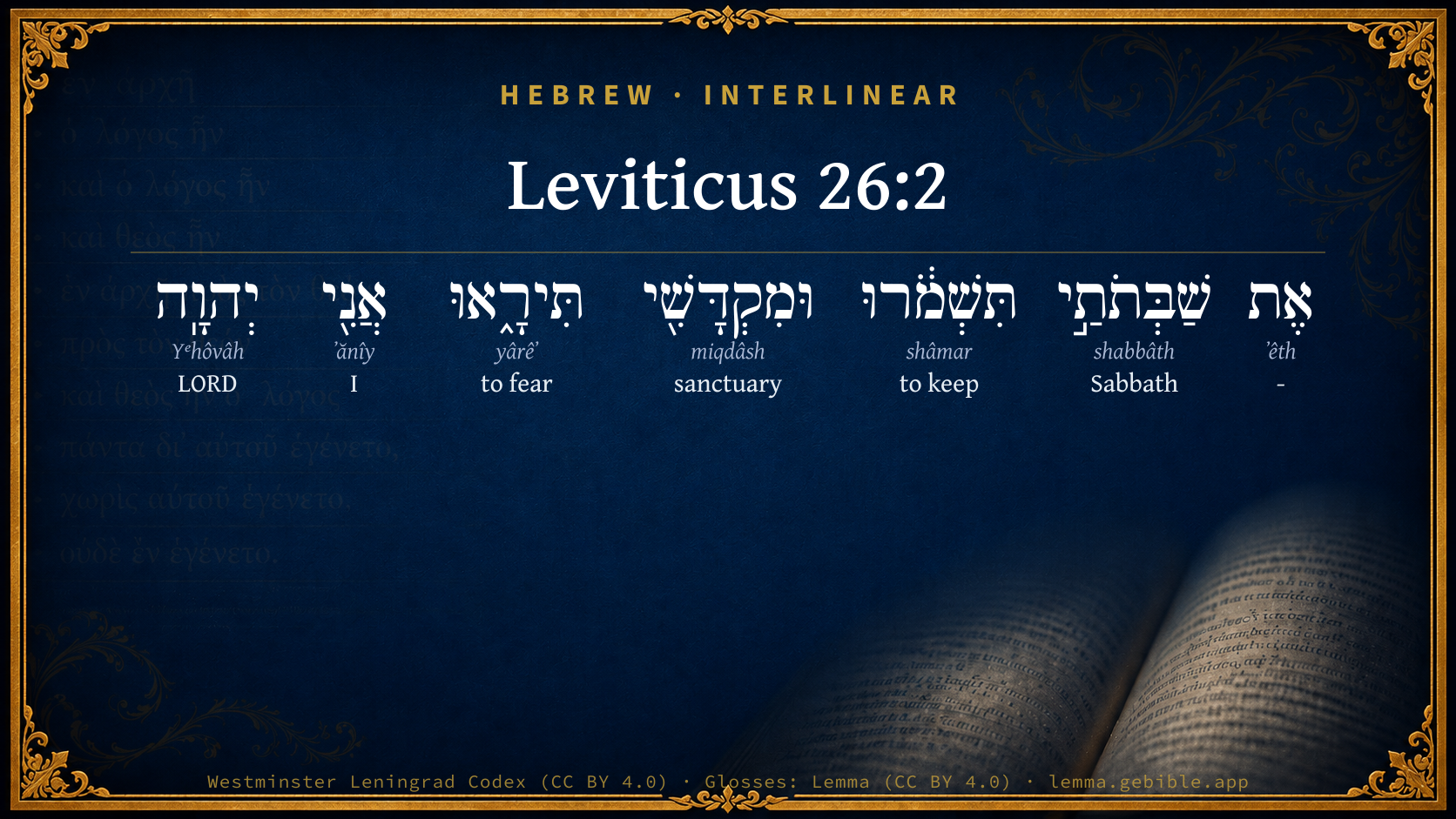
Leviticus 26:2

Hebrew (Westminster Leningrad Codex) Leviticus 26:2 appears in the Hebrew Old Testament. The text above is from the Westminster Leningrad Codex. Each word links to its Strong’s number, a concise gloss, and parsing drawn from the Open Scriptures Hebrew Bible morphology. Click any word for its full Brown-Driver-Briggs (BDB) entry.
Download image
Cite this verse

Leviticus 26:2 (World English Bible). Public Domain. Lemma interlinear Bible study tool, https://lemma.gebible.app/v/leviticus/26/2.

Show BibTeX & RIS
BibTeX
RIS
English Translation
"'You shall keep my Sabbaths, and have reverence for my sanctuary. I am Yahweh.
World English Bible · Public Domain
Download a study sheet

One document with this verse’s original text, its word-by-word gloss line, the meaning frame, cross-references with their text, attributed commentary, and full source and license credits — printable, and it pastes into notes with its structure intact.

This verse Autodidact and up

Study sheet (.html) Plain text (.txt)

A passage Seminary Student

Up to 50 verses in one chapter. A passage sheet keeps up to 6 commentary sources and 12 cross-references per verse, in the order this page ranks them, and says so on the sheet whenever that leaves anything out. Ask for a single verse and you get the Autodidact verse sheet above.

Everything on this page stays free to read, with no account — the sheet is a download of what is already on screen, not access to it.

Want to remove ads? Support Godless Engineer
Compare translations 3

The same verse in 3 English versions, stacked beneath the original-language interlinear above. Click any original word for its lexicon entry.

Each is an independent rendering of the whole verse — the interlinear is not word-aligned to these translations.

Highlighted words mark where these versions differ — a whole-verse word diff, not a word-by-word alignment.

  • World English Bible Public Domain
    "'You shall keep my Sabbaths, and have reverence for my sanctuary. I am Yahweh.
  • King James Version Public Domain
    Ye shall keep my sabbaths, and reverence my sanctuary: I am the LORD.
  • unfoldingWord Literal Text CC BY-SA 4.0
    My Sabbaths you shall keep and my holy place you shall fear. I Yahweh.

unfoldingWord Literal Text — © unfoldingWord, licensed CC BY-SA 4.0. Word-aligned USFM3 via Door43 (git.door43.org/unfoldingWord/en_ult).

Versions to compare (up to 4)

3 of 4 selected

Show all 18 translations

Every available English version of this verse, each an independent rendering of the whole verse.

  • World English Bible Public Domain
    "'You shall keep my Sabbaths, and have reverence for my sanctuary. I am Yahweh.
  • Berean Standard Bible Public Domain
    You must keep My Sabbaths and have reverence for My sanctuary. I am the LORD.
  • Majority Standard Bible Public Domain
    You must keep My Sabbaths and have reverence for My sanctuary. I am the LORD.
  • King James Version Public Domain
    Ye shall keep my sabbaths, and reverence my sanctuary: I am the LORD.
  • American Standard Version (1901) Public Domain
    Ye shall keep my sabbaths, and reverence my sanctuary: I am Jehovah.
  • Revised Version (1885) Public Domain
    Ye shall keep my sabbaths, and reverence my sanctuary: I am the LORD.
  • Geneva Bible (1599) Public Domain
    Ye shall keepe my Sabbaths, and reuerence my Sanctuarie: I am the Lord.
  • Douay-Rheims (1899) Public Domain
    Keep my sabbaths, and reverence my sanctuary: I am the Lord.
  • Young's Literal Translation Public Domain
    `My sabbaths ye do keep, and My sanctuary ye do reverence; I `am' Jehovah.
  • Literal Standard Version CC BY-SA 4.0
    You keep My Sabbaths and you revere My sanctuary; I [am] YHWH.
  • Unlocked Literal Bible CC BY-SA 4.0
    You must keep my Sabbaths and honor my sanctuary. I am Yahweh.
  • unfoldingWord Literal Text CC BY-SA 4.0
    My Sabbaths you shall keep and my holy place you shall fear. I Yahweh.
  • Darby Bible Public Domain
    Ye shall observe my sabbaths, and my sanctuary shall ye reverence: I am Jehovah.
  • World Messianic Bible Public Domain
    “‘You shall keep my Sabbaths, and have reverence for my sanctuary. I am the LORD.
  • Webster's Bible Public Domain
    Ye shall keep my sabbaths, and reverence my sanctuary: I am the LORD.
  • Free Bible Version CC BY-SA 4.0
    Keep my Sabbaths and show respect for my sanctuary. I am the Lord.
  • Bible in Basic English Public Domain
    Keep my Sabbaths and give honour to my holy place: I am the Lord.
  • JPS Tanakh (1917) Public Domain
    Ye shall keep My sabbaths, and reverence My sanctuary: I am the LORD.

Literal Standard Version (2020), Covenant Press — licensed CC BY-SA 4.0. Text via the HelloAO Bible API (eBible.org). Unlocked Literal Bible (unfoldingWord) — licensed CC BY-SA 4.0. Text via the HelloAO Bible API (eBible.org). unfoldingWord Literal Text — © unfoldingWord, licensed CC BY-SA 4.0. Word-aligned USFM3 via Door43 (git.door43.org/unfoldingWord/en_ult). Free Bible Version, Dr. Jonathan Gallagher — licensed CC BY-SA 4.0. Text via the HelloAO Bible API (eBible.org).

Word by word

More ways to search: Search by grammar → Find every occurrence → Compare this word →

Practice this passage: Drill this verse → Learn its vocabulary →

About this verse

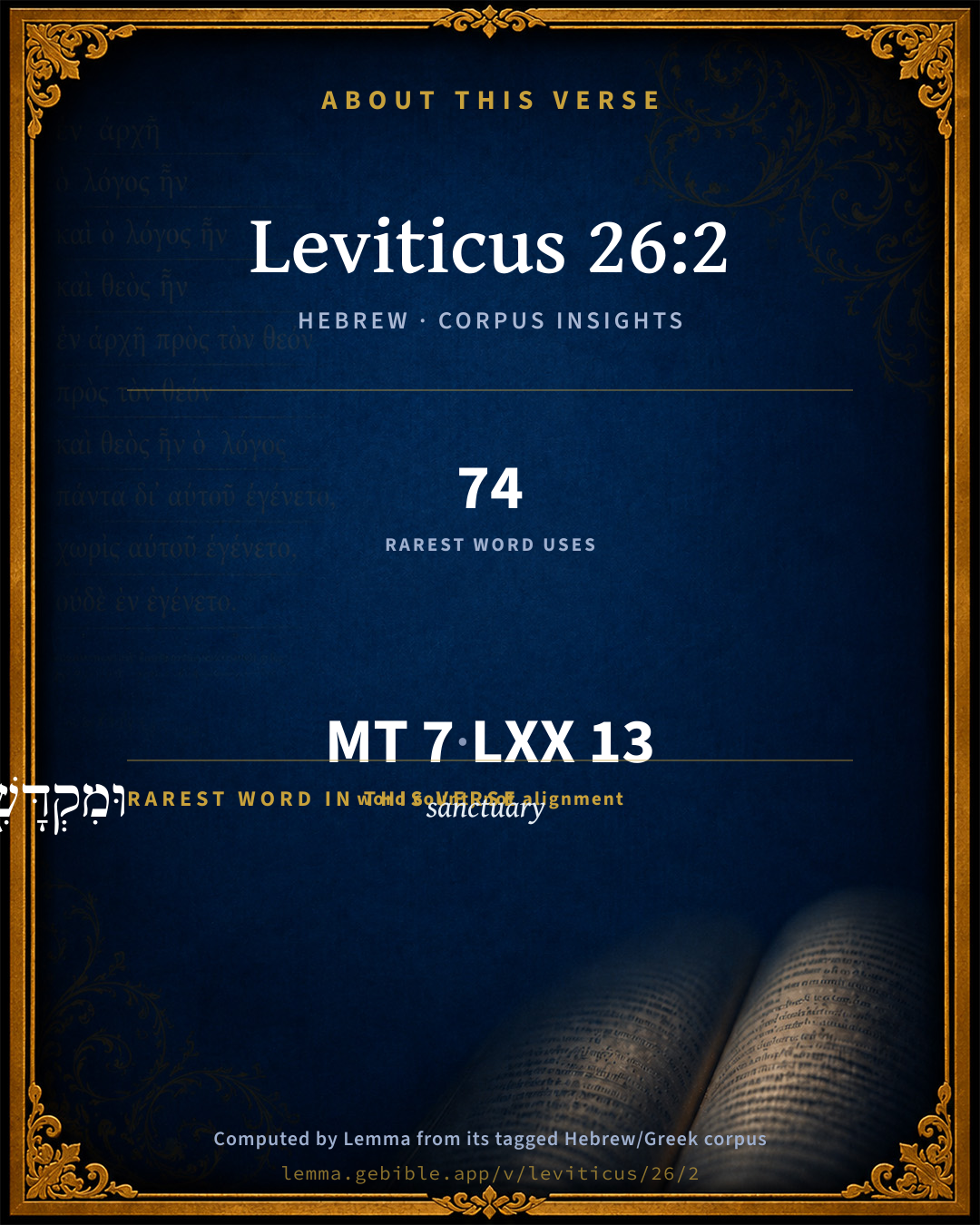
These counts appear in no published source. They are computed here, from the morphology-tagged text and Lemma’s own curated glosses. What Lemma adds →

7
words
7
distinct lemmas
Pentateuch
section

Grammatical profile

  • 2 verbs
  • 3 nouns
  • 1 pronoun
  • 1 particle

Verb forms

  • תִּשְׁמֹ֔רוּ Qal · Imperfect
  • תִּירָ֑אוּ Qal · Imperfect

Hebrew & Septuagint length

In English translation the verse runs 14 words from the Hebrew and 13 from the Septuagint (LXX English) — closely comparable.

A rough comparison of the two English renderings, which tokenize alike — not a word-level alignment.

Word counts can differ between the Hebrew and the Greek without any difference in meaning — e.g. the Hebrew direct-object marker אֵת has no separate Greek word, and Greek often adds the article ὁ.

In the original languages it is 7 Hebrew tokens and 13 Greek tokens — but the two are counted differently (Hebrew bundles its prefixes and suffixes into one token; the Greek is in lemma form), so that isn’t a like-for-like length.

Cross-references

1

Topical passages linked to Leviticus 26:2 in the Treasury of Scripture Knowledge — connected by theme and wording, ordered by reader-vote popularity; previews shown in the World English Bible.

  • Leviticus 19:30 "'You shall keep my Sabbaths, and reverence my sanctuary; I am Yahweh.

Cross-references courtesy of OpenBible.info (CC BY 4.0).

Hebrew and Greek witnesses Masoretic Hebrew ↔ Greek Septuagint

The same verse in the two great witnesses to the Old Testament, shown verse-for-verse.

These are two independent witnesses, not word-aligned to each other, and the Septuagint is shown in lemma (dictionary) form.

Hebrew Leviticus 26:2 Masoretic · Westminster Leningrad Codex

אֶת שַׁבְּתֹתַ֣י תִּשְׁמֹ֔רוּ וּמִקְדָּשִׁ֖י תִּירָ֑אוּ אֲנִ֖י יְהוָֽה

"'You shall keep my Sabbaths, and have reverence for my sanctuary. I am Yahweh.

World English Bible · Public Domain

Greek LXX Leviticus 26:2 Septuagint · lemma form

ὁ σάββατον ἐγώ φυλάσσω καί ἀπό ὁ ἅγιος ἐγώ φοβέω ἐγώ εἰμί κύριος

You⌃ shall keep my sabbaths, and reverence my sanctuaries: I am the Lord.

LXX2012 (modern English Septuagint) · Public Domain

Hebrew: Westminster Leningrad Codex (CC BY 4.0). Greek: Septuagint (public domain); English from LXX2012 (modern English Septuagint) (Public Domain). How the Septuagint differs from the Hebrew →

Targum (Aramaic paraphrase)

2

The Targum is the ancient Jewish Aramaic paraphrase of the Hebrew Scriptures — an interpretive translation, not the Hebrew text itself. Onkelos (literal) and Pseudo-Jonathan (expansive) render the Torah, and Jonathan the Prophets. Coverage is partial: where no permissively-licensed English translation exists for a verse, only the Aramaic is shown. This is verse-level text, not a word-by-word alignment to the Hebrew.

  1. Targum Onkelos Torah (Genesis–Deuteronomy)
    יָת יוֹמֵי שַׁבַּיָא דִילִי תִטְרוּן וּלְבֵית מַקְדְשִׁי תְּהוֹן דָחֲלִין אֲנָא יְיָ

    (no public-domain English translation for this verse)

    Targum Onkelos — Aramaic: “Onkelos Genesis” (public domain); “Onkelos Exodus” (public domain); “Onkelos Leviticus” (public domain); “Onkelos Numbers” (public domain); “Onkelos Deuteronomy” (public domain). English: “Sefaria Community Translation” (CC0 1.0 (public-domain dedication)); “J.W. Etheridge. The Targums of Onkelos and Jonathan Ben Uzziel on the Pentateuch. London: Longmans, Green, 1862” (public domain). Text via Sefaria.

  2. Targum Pseudo-Jonathan Torah (Genesis–Deuteronomy)
    יַת יוֹמֵי שַׁבַּיָא דִילִי תִטְרוּן וּלְבֵית מוּקְדְשִׁי תְּהוֹן אָזְלִין בִּדְחַלְתִּי אֲנָא יְיָ

    The days of My Sabbaths you shall keep, and walk to the house of My sanctuary in My fear; I am the Lord.

    Targum Pseudo-Jonathan — Aramaic: “Targum Jonathan on Genesis” (public domain); “Targum Jonathan on Exodus” (public domain); “Targum Jonathan on Leviticus” (public domain); “Targum Jonathan on Numbers” (public domain); “Targum Jonathan on Deuteronomy” (public domain). English: “The Targum of Jonathan ben Uzziel, trans. J. W. Etheridge, London, 1862” (public domain). Text via Sefaria.

Commentary

Notes on Leviticus 26:2 from classic Christian and Jewish commentators (each source and its license shown beneath its notes). The classic Christian expositions comment on the surrounding passage and are grouped to its opening verse, so a note may address several verses; the Jewish commentaries on the Tanakh (Rashi and others) are per-verse, so they appear only where the commentator wrote on this verse.

Lemma curates 59 commentaries, every one of them public domain or Creative Commons licensed, each selected and text-cleaned for this edition rather than reprinted as found. About our sources →

Trapp's Complete Commentary

John Trapp

Lev 26:2 Ye shall keep my sabbaths, and reverence my sanctuary: I [am] the LORD.

Ver. 2. Ye shall keep.] {See Trapp on "Lev 19:30"}

John Trapp, A Commentary or Exposition upon All the Books of the Old and New Testament (1647–1656) — public domain. Text from a community e-Sword module.

The Biblical Illustrator

Joseph S. Exell

Lev_26:2

Ye shall keep My Sabbaths, and reverence My sanctuary.

Of the stated times of Gods worship, particularly the Lords Day

I. What were the reasons upon which God might be supposed, under the law, to have instituted more solemn and set times of worship.

1. As to the reasonableness of the institution in general, it was highly agreeable to the natural light of mankind upon these following accounts.

(1) All external worship is designed to give us impressions of greater reverence for the Divine Majesty. Now, such is the temper of human nature, that men have much less regard for those things that are common than for those which have some peculiar mark of distinction set upon them.

(2) It being one of the first principles of natural religion that God is to be publicly worshipped, order requires that there should be some determinate and public times set apart for His worship and piety, that such times should be vacations from the common affairs of human life.

(3) It being a further end of religious worship to advance the spiritual life and bring us nearer unto God, it is not only agreeable to piety, but to all the maxims of religious prudence, that the times appropriated to the more solemn worship of God should be distinguished by a cessation from the common business of life, that by this means, our minds being wholly taken off from earthly things, they may be more open to the heavenly impressions of grace and truth.

2. These are some of the natural reasons upon which we may account for Gods commanding His people to keep His Sabbath, that is, all the stated and solemn times of His public worship; but what I have here principally an eye to is the institution of the Sabbath, which the Jews were so forcibly enjoined to keep holy in the Fourth Commandment. Now, the two principal reasons of this institution seem to have been--

(1) That hereby they acknowledged God to be the Lord, the Creator and Governor of the world; and--

(2) That they acknowledged Him to be in a more eminent and peculiar manner their God by delivering them out of the hand of Egypt.

II. How far those reasons, in either respect, hold good under the Christian dispensation.

1. The general reasons I laid down for setting apart some solemn time for the worship of God certainly extend to us Christians, and to all the nations under heaven, as well as to the Jews. Indeed, when we consider that to everything under the sun there is a time, and that the natural order of things requires there should be so, it seems highly reasonable that some stated seasons should be appropriated to His service, to whom we owe all the moments of our time and the capacity of all other enjoyments. Jesus Christ did not come to destroy any one duty arising from the law of nature or the common principles of natural religion, but to give all such duties their utmost force.

2. The great difficulty to be considered is how far those reasons, upon which the Jewish Sabbath in particular was instituted, may be supposed to affect us Christians.

(1) It appears matter of moral obligation that there should be some day set apart more peculiarly devoted to the honour and worship of Almighty God.

(2) It appears no less reasonable that the returns of such a day should be so frequent as to keep up a constant sense of religion, and their duty to God, in the minds of men, without interfering with the necessary affairs of human life.

(3) It must be granted somewhat difficult to determine this matter exactly from any principle of natural reason, it not clearly discovering what proportion of our time we are to set apart for the more solemn worship of God, or why one day in seven, rather than six or eight, should be observed to this end.

III. How and in what manner the Lords day ought to be observed.

1. We are to consider the Lords Day is a time set apart for the more public worship and service of God, wherein we are to do Him honour and praise Him according to His excellent greatness.

2. We ought also on the Lords Day to employ ourselves constantly in the private exercises of religion.

3. As the Lords Day is a day of thanksgiving for the public or private mercies we have received from God, it is a proper exercise of it to perform acts of mercy and charity to others, and both with respect to their souls and bodies.

4. As the Lords Day is a day devoted to the service of God and religion, let us take care to sanctify it by religious conversation.

5. That we may better attend these duties, we must not only intermit our ordinary labours and employments, but take off our thoughts, as much as possible, from the business of them. (R. Fiddes, D. D.)

Of the stated places of Gods-worship, and in what manner our reverence towards them ought to be expressed

I. The reasons of appropriating places to the public worship of God are the same in general under the Christian as under the mosaic dispensation.

1. One end of Gods appointing the tabernacle, and afterwards the temple, was to possess the minds of the Jews with more devout affections in their religious addresses to Him. The place we are in naturally puts us in mind of the proper business and design of it.

2. It is a principle highly agreeable to the natural notions of mankind that God is in a special manner present in such places, not only as they are consecrated to Him, and He has thereby a special propriety in them, but also by reason of the united prayers which are therein put up to Him, and which are reasonably presumed to be of more efficacy than those of single persons to bring down the real and sensible effects of His presence with the blessings prayed for.

3. The common notions we bare of order and decency require that the place designed for Gods more immediate service should be appropriated to Him, and to Him only. Of order, that men may know where to repair on all occasions to worship God; and of decency, because it is contrary to all the rules of it, and, indeed, to the ordinary acceptation of holiness throughout the Scriptures, that what is common or unclean should be promiscuously used with things set apart for holy and religious uses.

II. Places so appropriated have a relative holiness in them, and ought therefore to be reverenced. This is the notion of holiness with respect to things, and persons, and times, as well as places designed for the service of God, in the Old Testament, that they were separated from common uses to His own. And if for this very reason they were accounted sacred then, what imaginable pretence can there be that the same reason should not render them, and all of them, sacred now? If it be pretended that the temple was accounted holy by reason of the legal sacrifices which were offered to God in it, we ask why the Christian sacrifice of praise and thanksgiving in our churches should not be a sufficient ground for reputing them holy also? If it be said that there were sensible effects of Gods presence in the temple upon which it had a peculiar relation of holiness to Him, we answer that God, as to the spiritual and gracious effects of His presence, and wherein He manifests it in the most beneficial and excellent manner, is present in our Christian temples. If it be said, further, that the temple was built by the special command of God, and upon that account a certain holiness was ascribed to it, whereas we have no such command for building any places purely for Gods worship now, it is answered again that the design of Davids building a temple, and Solomons going on with it, do not appear to have proceeded from any positive and direct command of God. God, it is true, gave particular directions about building the temple, but it does not therefore follow that the design of building it was not antecedently laid by these princes upon natural motives of piety and religion, the same motives upon which the patriarchs erected sanctuaries or separate places of worship to God before any positive institution to this end. Shall I now show that our Christian churches, which I have proved to be sanctuaries in a proper sense, ought therefore to be reverenced? This is a consequence which flows so naturally, or rather, indeed, necessarily, from what has been said, that I need not say much to illustrate it. I shall only observe that we are agreed in other cases to set a value on things or persons, not in consideration of their absolute and real worth, but of their relative use or character. An insect is considered in itself as a living creature more valuable than the brightest or richest jewel in the world; but we should think him very weak who would for that reason prefer a butterfly to a diamond, which, by common consent, serves him to so many more useful ends. For the same reason, with respect to the different characters of men, or any special relation they bear to God, to the prince, or to ourselves, we give them different and suitable testimonies of our esteem. Nay, when we truly honour or love any person, we naturally express a value for everything that nearly belongs to him or wherein he has a particular interest. Certainly, then, nothing can be more reasonable than that upon account of the special propriety God has in places set apart for His service, and for so many holy uses, we should express our reverence toward such places by all becoming testimonies of it.

III. Even natural reason discovers further to us how and in what particulars our reverence towards such places ought to be expressed.

1. We are to reverence Gods sanctuary by constantly repairing to it on all proper occasions.

2. We are to reverence Gods sanctuary by a serious, devout, and regular behaviour in it.

(1) By a serious and devout behaviour, I mean such decent postures of the body as most properly express the inward sentiments and attention of the mind.

(2) By a regular behaviour in the worship of God, I understand a due conformity to the rules and order of the public service, and particularly that we should kneel or stand up at the usual offices.

3. If we reverence Gods sanctuary as we ought, we shall be willing to contribute what may be thought necessary towards the proper ornaments of it or the greater solemnity of the public worship in it.

I shall now proceed to a conclusion, with a proper application or two from what has been said.

1. To those who offend against the first rule I laid down, concerning the reverence due to Gods sanctuary, by coming late to it, or perhaps after a considerable part of the service is performed. If you are conscious to yourselves of any such scandalous, especially if it have been a customary, irreverence, be careful not to give any further offence to God or man, for it is really so to both in the same kind--to God, because it is so insolent a method of presenting ourselves in His courts, in order to beg any blessing or the pardon of our sins before we have made a humble confession of them; to man, because the Church, which we are presumed by attending her service to be members of, has piously directed such a confession at the beginning of her service. Not to mention the other disorders occasioned by this irreverence, and how contrary it is to the rule prescribed us by holy David, of worshipping God in the beauty of holiness (Psa_29:2; Psa_96:9). And for the same reason--

2. If your consciences reproach you with any former unbecoming or irregular behaviour in the sanctuary of God, resolve hereafter to correct so great an indecency, or rather, indeed, so flaming an impiety.

3. What I shall say to those who have in any signal manner expressed their zeal for Gods house, by contributing to the beauty or solemnity of it, shall be by way of encouragement. And certainly men cannot propose to themselves to show their reverence for God by a more truly pious act--an act whereby they more immediately glorify Him, in letting their good works shine before men. This consideration cannot but, at the same time, fill the minds of those who are concerned in it with a sensible pleasure and satisfaction, and make their hearts even spring for joy. This was the effect which the preparations of David and the Israelites for building the temple had upon them (1Ch_29:8).

4. What I would observe, in the last place, is that persons who are subservient in this respect towards promoting the honour of God may piously hope that He will by some wise methods pour down His special blessings upon them as He did upon Obed-Edom and his household, because of the ark of the covenant of God (2Sa_6:11). (R. Fiddes, D. D.)

The Biblical Illustrator, edited by Joseph S. Exell (c. 1880s–1900s) — public domain. Text from a community e-Sword module.

Jamieson, Fausset & Brown

Robert Jamieson, A. R. Fausset & David Brown

Ye shall keep my sabbaths, and reverence my sanctuary--Very frequently, in this Book of the Law, the Sabbath and the sanctuary are mentioned as antidotes to idolatry.

Jamieson, Fausset & Brown — Commentary Critical and Explanatory on the Whole Bible (1871) — public domain (CC PDM 1.0). Text via the HelloAO Bible API.

Ellicott's Commentary for English Readers

(2) Ye shall keep my sabbaths . . . —This is exactly the same precept laid down in chap 19:30, and is here repeated because of the danger of desecrating the Sabbath to which the Israelite is exposed who sells himself to a heathen. The Israelite will effectually guard against idol-worship, by keeping the Sabbath holy, and reverencing God’s sanctuary.

A Bible Commentary for English Readers, edited by Charles John Ellicott (1878–1897) — public domain. Text from a community e-Sword module.

John Gill's Exposition

Ye shall keep my sabbaths,.... The seventh day sabbaths, and the seventh year sabbaths; especially the former are meant, in which religious worship was given to the one true and living God, and therefore the observance of them is strictly enjoined; and hence this law follows closely upon the former, though Aben Ezra restrains it to the sabbatical years, or seventh year sabbaths, as he applies the sanctuary in the following clause to the jubilee year, which is said to be holy, Lev 26:12; supposing that this refers unto and stands in strict connection with the laws of the preceding chapter, concerning the sabbatical, Lev 25:1, and jubilee years, Lev 25:8,

and reverence my sanctuary; by attending in it, and on the worship in it, with reverence and godly fear, see Lev 19:30,

I am the Lord; who had a right to such religious worship, and to command such things, in which he ought to be obeyed, his sabbaths kept, and sanctuary reverenced.

John Gill's Exposition of the Whole Bible (1746–1763) — public domain (CC PDM 1.0). Text via the HelloAO Bible API.

Haydock's Catholic Bible Commentary

Reverence. The Rabbins inform us, with what respect their ancestors appeared in the temple. They left their sticks and shoes behind them, and washed their feet; entering solely to perform some act of religion, and not to go a shorter road to another street. When they had ended their devotions, they retired slowly without turning their back to the sanctuary. (Outram, Sacrif. lib. 3. n. 7.)

George Leo Haydock (1774–1849), Haydock's Catholic Family Bible and Commentary, 1859 edition — public domain. Excludes Psalms (Douay-Rheims chapter numbering differs from Protestant) and Deuterocanonical books (Catholic canon only).

Matthew Poole's English Annotations

Reverence my sanctuary, by purging and preserving it from all uncleanness, by approaching to it, and managing all the services of it, with reverence, and in such manner only as God hath appointed.

Matthew Poole's English Annotations on the Holy Bible (1683–1685) — public domain. Text from a community e-Sword/MySword module.

Whedon's Commentary on the Bible

Daniel D. Whedon

2. Sabbaths… sanctuary — The intimate connexion between the sanctuary and the sabbath is here very beautifully expressed. It rebukes all indolent use of the sabbath at home, and the modern, fashionable, professed worship of God in roving the fields and forests, vainly attempting to look through nature up to nature’s God. The God which a sinful Jew imperatively needed was best worshipped through the bleeding bird, the bleeding beast, and sprinkling priest; and the God most needed by the sinning Gentile is seen in the Lamb of God, whose Gospel is preached in our modern sanctuaries on the Lord’s day. There is no sin, except idolatry, against which the Hebrews were so frequently and earnestly warned as against sabbath breaking. The sabbath was intended to be an ever-recurring symbol of the heavenly rest. To despise it is to contemn heaven itself.

Daniel D. Whedon (gen. ed.), Commentary on the Old and New Testaments (1874–1909) — public domain. Text from a community e-Sword module.

The Pulpit Commentary

Ye shall keep my sabbaths, and reverence my sanctuary: I am the Lord. These words are repeated textually from Lev_19:30.

The Pulpit Commentary (1880–1919), ed. H.D.M. Spence-Jones & Joseph S. Exell — public domain. Text from a community e-Sword module.

John Wesley's Explanatory Notes

My sanctuary - By purging and preserving it from all uncleanness, by approaching to it and managing all the services of it with reverence, and in such manner only as God hath appointed.

John Wesley, Explanatory Notes Upon the Whole Bible (1754–1765) — public domain. Text via the GEBible commentary corpus.

Rashi

Rabbi Shlomo Yitzchaki (Rashi)

‎'אני ה‎ I AM THE LORD, Who am faithful to pay you your reward.

Rashi on the Tanakh — English translations: “The Judaica Press complete Tanach with Rashi, translated by A. J. Rosenberg” (CC BY 4.0); “Pentateuch with Rashi's commentary by M. Rosenbaum and A.M. Silbermann, 1929-1934” (public domain); “The Metsudah Tanach series, Lakewood, N.J” (CC BY 4.0); and “The Book of Joshua, Metsudah Publications, 1997” (CC BY 4.0). Text via Sefaria.

Sforno

Rabbi Ovadia Sforno

You shall keep My Shabbosos — even during the days of your exile from the land of your forefathers.

And you shall fear My Sanctuary. This refers to the holy places after the destruction of the Temple, which are synagogues and Torah study halls, as it says (Yechezkel 11:16): “I have become for them a minor sanctuary in the lands where they have come,” and the Sages said: “These are the synagogues and Torah study halls.

Sforno on the Tanakh — English translation: “Yalkut, Sifsei Chachomim Chumash, Metsudah Publications, 2009” (CC BY 4.0). Text via Sefaria.

Ibn Ezra

Rabbi Abraham ibn Ezra

It could be that the reason for (v. 1): “You shall not make idols for yourselves” is because it says (25:55), “They are My servants,” and since they are My servants they shall serve Me alone and no others.

Ibn Ezra on the Tanakh — English translations: “Sefaria Community Translation” (CC0 1.0 (public-domain dedication)); “Yalkut, Sifsei Chachomim Chumash, Metsudah Publications, 2009” (CC BY 4.0); and “Commentary of Ibn Ezra on Isaiah - trans. by M. Friedlander, 1873” (public domain). Text via Sefaria.

Lesson kit

Teaching starters — assembled from the data on this page, not authored interpretation. Every prompt links to the verse data it draws on. Edit before teaching.

Leviticus, in the Pentateuch, opens this verse with 7 words (7 distinct Hebrew lemmas). Its most distinctive word is miqdâsh (“sanctuary”). A historical commentator’s framing appears above. Read the whole chapter for the surrounding context.

Discussion questions

  1. How does “sanctuary” (miqdâsh) shape what this verse is saying?
  2. Leviticus 19:30 shares this passage’s theme. How do the two illuminate each other?
  3. These translations render this verse differently; the difference is in the English rendering, not the original. What questions does that raise?
  4. The verb «תִּשְׁמֹ֔רוּ» is Qal Imperfect. How does its form color the action?
  5. Reading how Trapp's Complete Commentary and The Biblical Illustrator read this verse, where do the two commentators agree and where do they part?

Things to notice

Reading settings

Reading text

Shown beneath each verse's original-language words.

Old Testament
Old Testament edition

Read the OT as the Masoretic Hebrew (MT) or the Greek Septuagint (LXX).

English shown for the Greek Septuagint (in the Hebrew ↔ Greek comparison).

Comparing translations? Open the Compare panel on any verse page to stack up to four side by side.